The State's Own Medicine — the Government Civil Hospital, Hong Kong, 1848-1941
國家醫院:香港政府民用醫院(1848–1941)
摘要
1848年10月1日,香港政府以「節省開支之舉」設立臨時民用醫院(Civil Hospital),此即後來所稱的政府民用醫院(Government Civil Hospital,中文官方文件稱「國家大醫院」,1885年起亦見「國家醫院」)。本文以政府自身的年度報告、藍皮書、憲報中文欄與行政報告為主要材料,檢驗一個流傳的圖像:政府的醫院是為歐洲人而設,華人只去東華醫院。檔案給出的答案與此相反。政府自1859年起便在民用醫院的死亡率表中單列「華人就診死亡率」一行;1871年,該院1,165名入院者中,華人311名,77名死者中,華人42名。與此同時,真正「只限華人」的,是政府自己以《1870年第3號條例》——正式名稱即《華人醫院立案條例》——撥出官地與15,000元公帑、協助創立的東華醫院。國家的醫院從未以種族為收症界限;以種族為界限的那一間,是華人的醫院。
一、問題與材料
本文的問題只有一個:政府的醫院究竟為誰而開?材料分三層。第一層是醫院自身的帳目:憲報每年刊出的醫務報告(1858年起見於語料庫),內含按類別分列(Europeans、Colored Persons、Chinese)的入院與死亡數字,以及多年期的死亡率表。第二層是政府的總帳:藍皮書的「慈善及文化機構」表與行政報告,記錄醫院的收症規則、病床與資助關係。第三層是中文官方文件:憲報中文欄與1890年種痘公告,提供機構的中文名稱與其進入華人社會的觸點。1234
方法上須說明兩點。其一,圖像系列(憲報、藍皮書、行政報告的掃描本)須經管理員工作階段下載;每張圖版均在最終版本上以肉眼核對(第6B節之門檻)。其二,文本系列的OCR在此主題上不可靠:1872年死亡率表的數字欄曾被OCR互相錯置,本文所有數字均以掃描本為準。5
二、創立:1848年的臨時醫院與1859年的新院
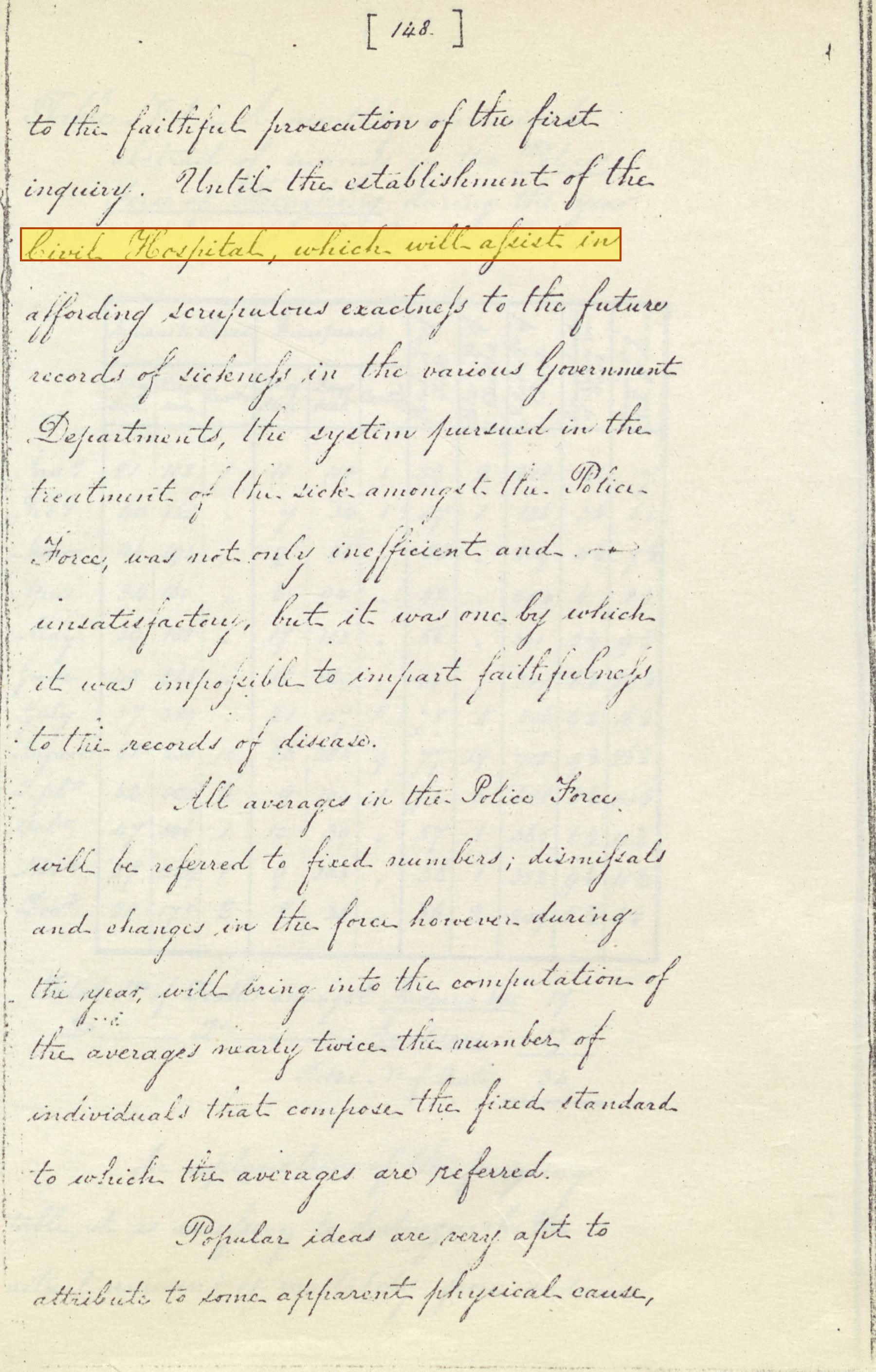
1848年9月8日,港督般咸(Bonham)以第70號公文下令設立醫院;1848年10月1日,醫院以「臨時」形式開業,藍皮書的編制頁記明其性質:「本醫院於10月1日臨時設立,屬節省開支之舉(見般咸總督1848年9月8日第70號公文)。」16創立的理由,寫在殖民地醫官1848年報告的手稿裡:在民用醫院設立之前,「警隊病人的治療制度不僅效率低落、令人不滿,更使人無法忠實地記錄疾病」——醫院的第一個用途,是政府自己的紀錄。7
1859年,醫院遷入新院。殖民地醫官梅利(Murray)醫生「力陳新民用醫院必須先行若干改建與改善,方可將病人遷入」;工務司署於1859年4月18日轉達總督對「興建新民用醫院」開支的批准,倫敦於同年6月20日核可200英鎊的改建費。8後世的《香港年報》(1955–60)稱「政府第一間醫院是民用醫院,成立於1859年」——兩種說法各指不同的時刻:1848年是臨時設立,1859年是新院落成;本文兩個年份並列,不取其一。89
醫院起初是殖民地的最後一道門:1848年,監獄的「醫院壞疽」(hospital gangrene)病例,「刑期屆滿後被移送民用醫院,病情迅速失去惡性,病人康復」。101867年,政府一度考慮把民用醫院改作性病醫院(Lock Hospital),另購地建新院;1873年,海員醫院(Seamen's Hospital)關閉後,總督堅尼地(Kennedy)在公文上寫道:「新民用醫院的需要,日形迫切。」1112
三、國家自己的表格:1859–1871
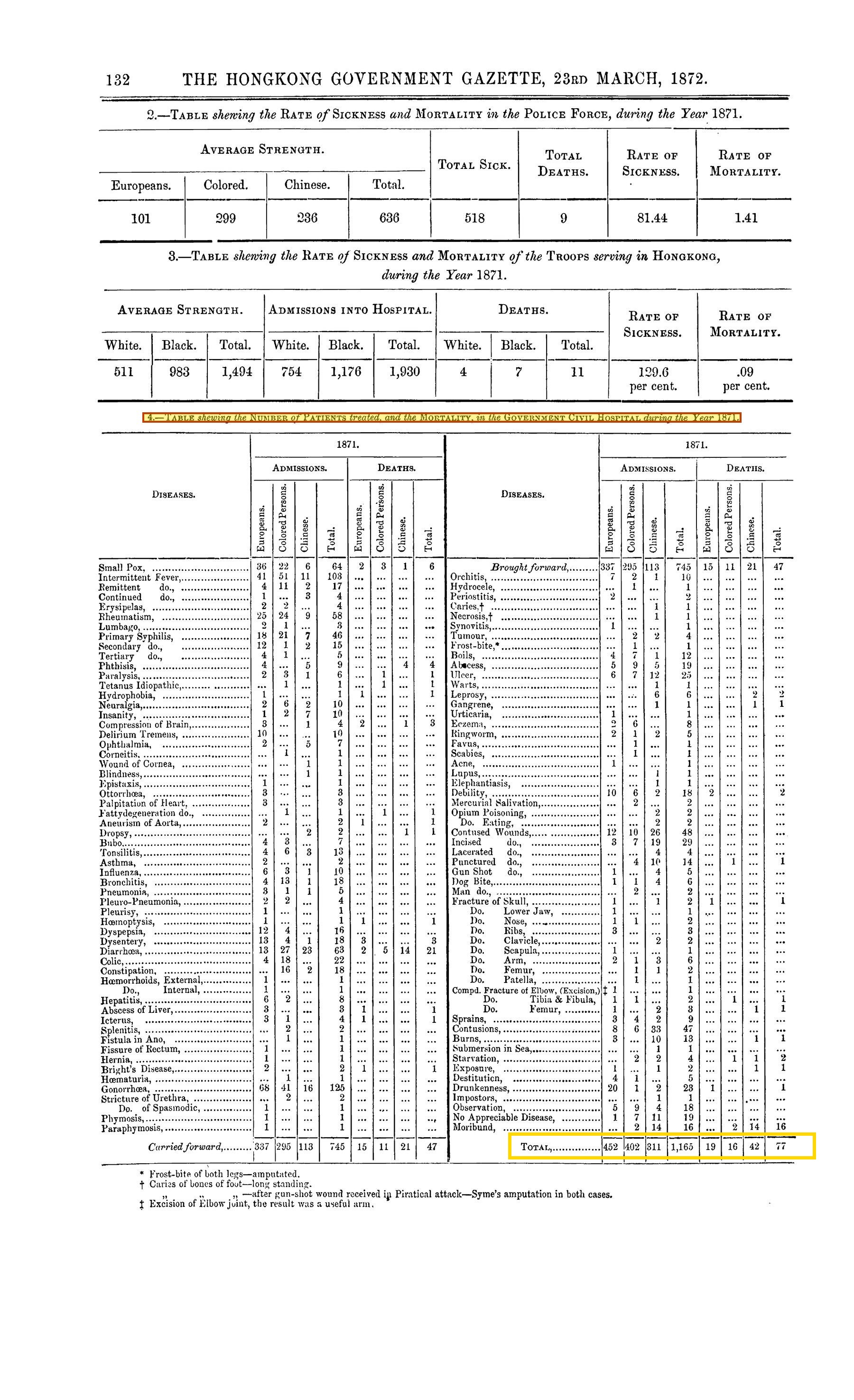
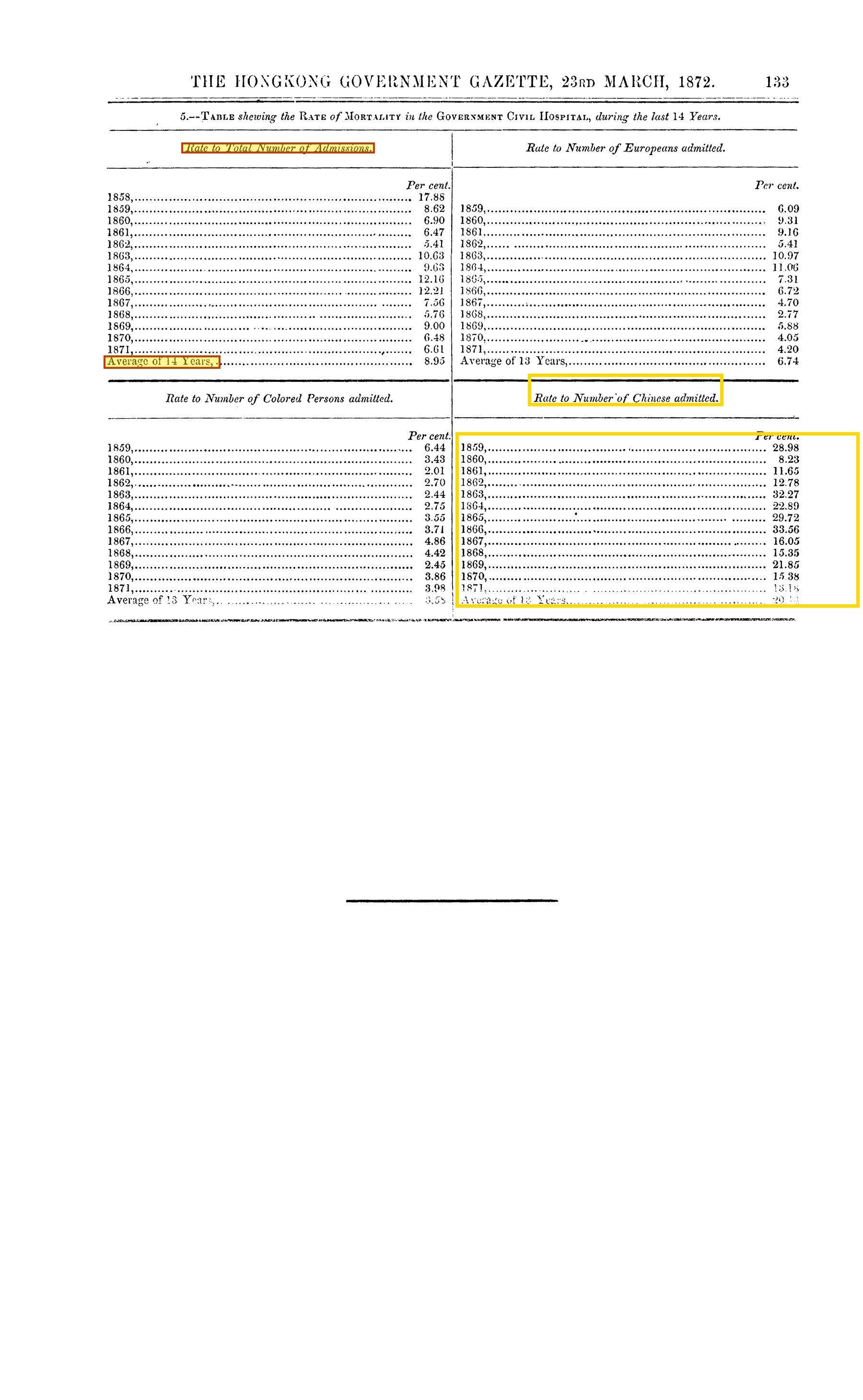
政府自1859年起,把華人就診數字列入民用醫院的常設報表:1866年3月17日憲報的《截至1865年七年民用醫院死亡率表》,已設「華人就診者死亡率」(RATE TO NO. OF CHINESE ADMITTED)一行。21872年3月23日憲報刊出1871年報告,其中兩張表是本文的核心。第四表列出該年入院的452名歐洲人、402名有色人種、311名華人(合計1,165人),以及19、16、42名死者(合計77人);第五表列出1859–1871年四個類別的死亡率:華人一欄為28.98、8.23、11.65、12.78、32.27、22.89、29.72、33.56(1866年)、16.05、15.35、21.85、15.38、13.14(1871年)百分比,歐洲人一欄從未超過11.06,13年平均6.74,有色人種平均3.65。1314
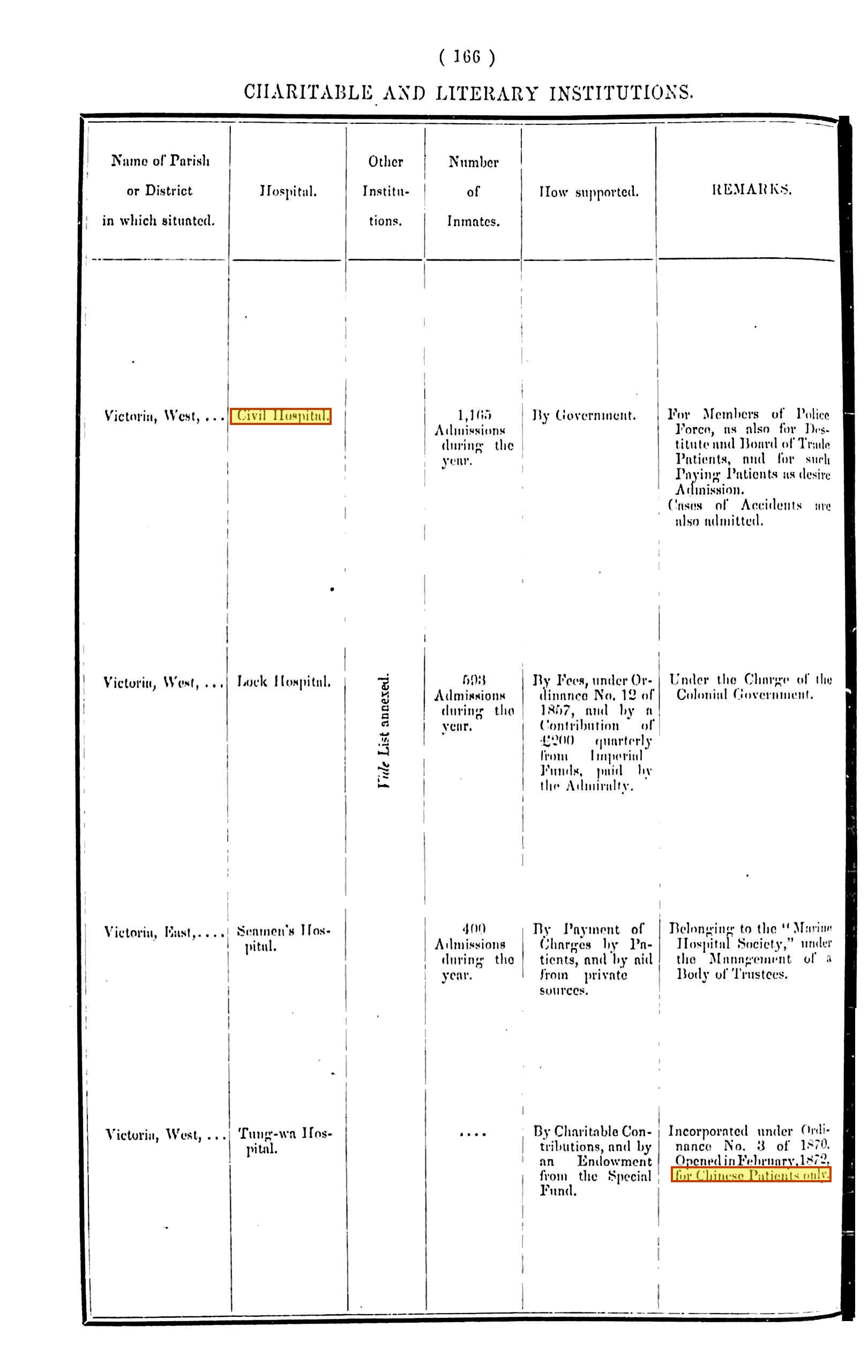
換言之:1871年,華人佔民用醫院入院人數約27%、死亡人數約55%;在國家的醫院裡,華人病人的死亡率是歐洲人同期的三倍以上,而這個差距被政府自己的報表逐年記錄了13年。藍皮書1871年卷以「1,165人次」獨立印證同一年的總數;同卷的機構表寫明民用醫院的收症範圍:「警隊成員,以及貧民與貿易局(Board of Trade)病人,與願意付費入院的病人;意外傷者亦予收治。」3
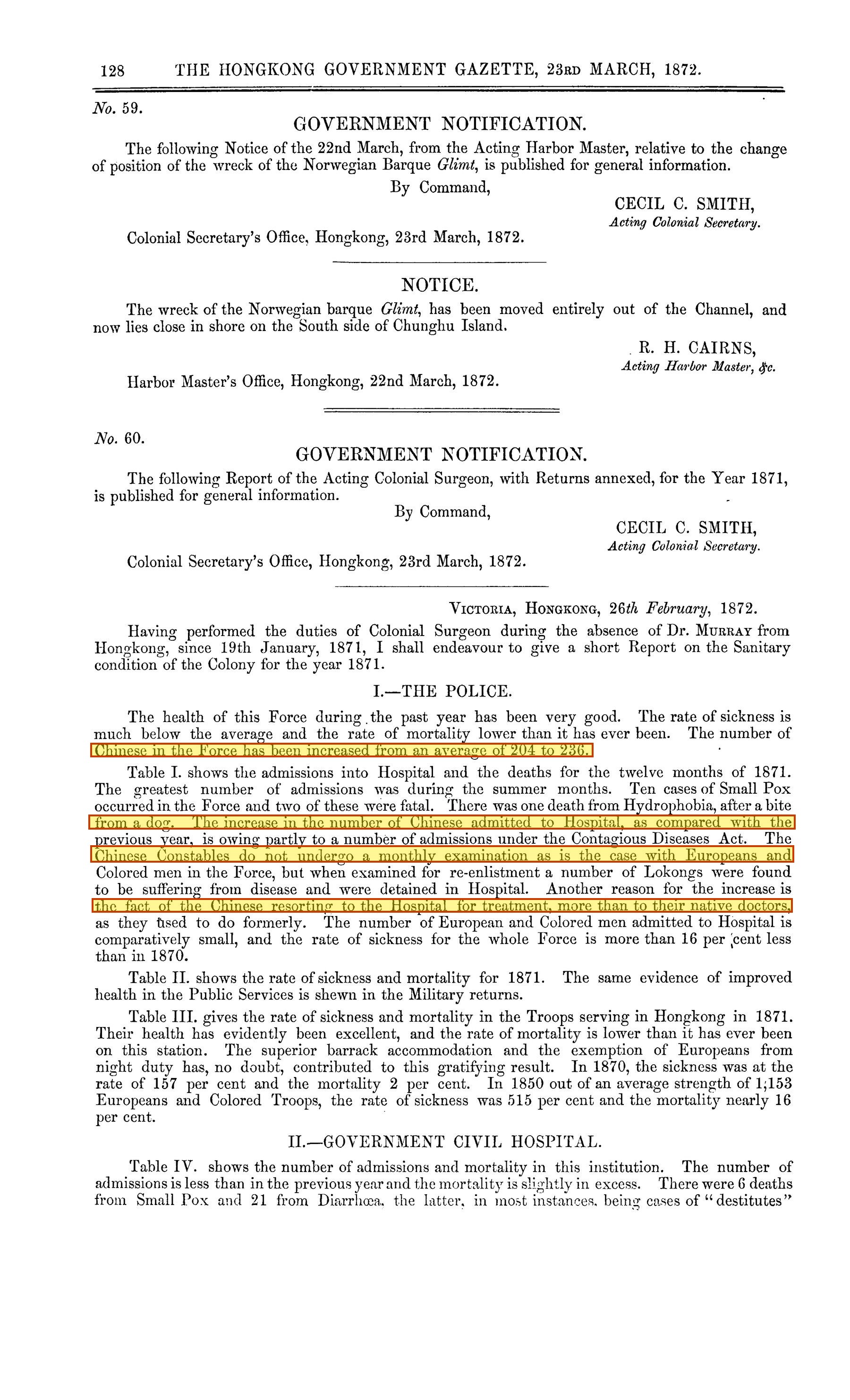
1871年報告的敘述段落寫道:「華人入院人數較去年增加……另一原因,是華人如今到醫院求醫者,多於從前求助於他們的本地醫生(native doctors)。」此句位於報告的「警隊」一節,其所指(警隊華人或華人社會)在檔案中並不能獨斷,故本文照錄原文、註明語境,而論點不倚賴此句——論點倚賴的是表格本身。13
四、誰的醫院:「只限華人」的另一間
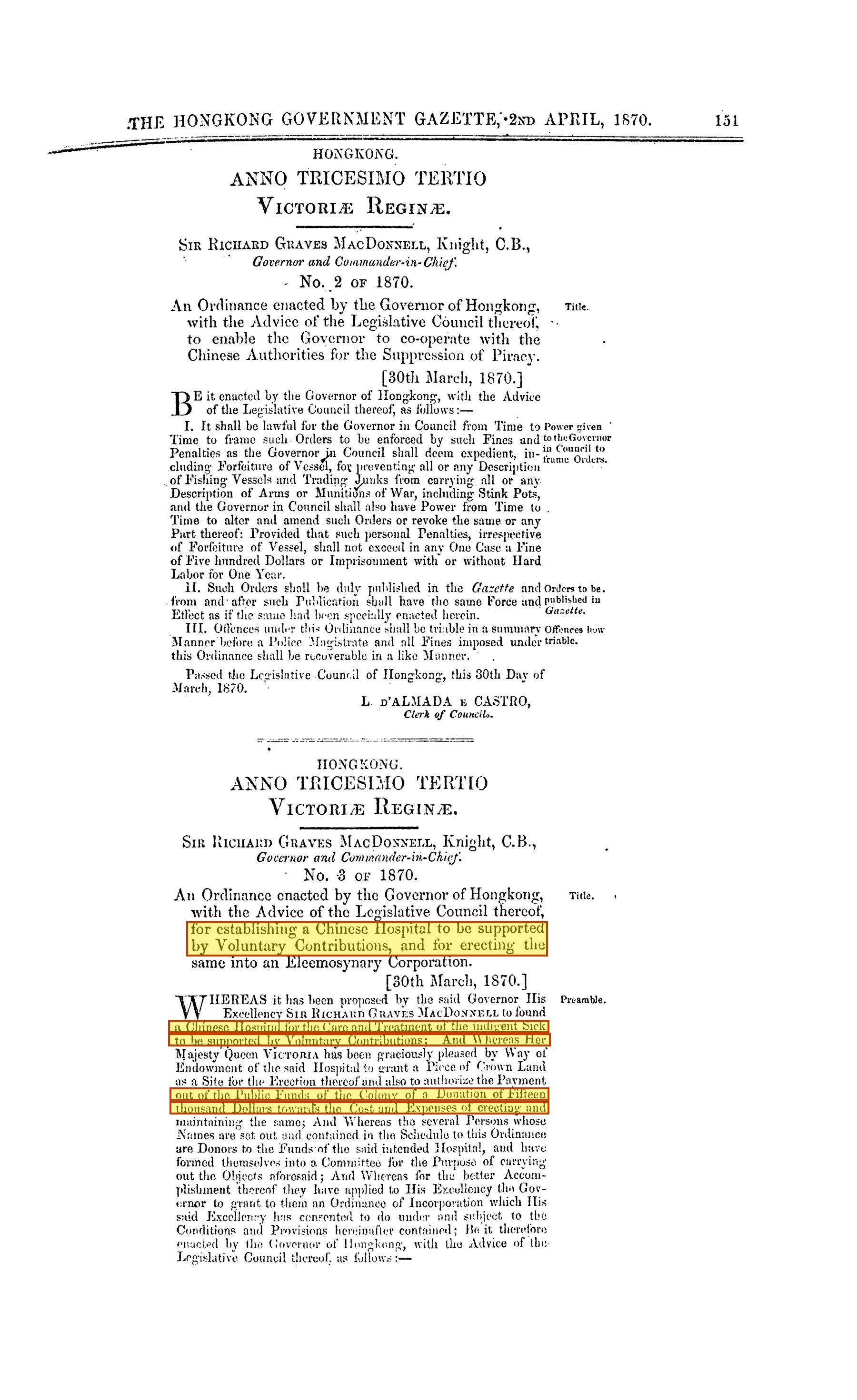
與民用醫院相對的,是1870年政府自己創立的華人醫院。1870年4月2日憲報刊出的《第3號條例》,標題即「為設立一間由自願捐款支持之華人醫院,並將其立為慈善法團」;序言記載:麥當奴(MacDonnell)總督倡議設立華人醫院,維多利亞女王撥出官地作院址,並「批准從殖民地公帑撥出15,000元捐款,用於興建及維持該院」。15歷史法例彙編把同一條例題為《華人醫院立案條例,1870》——它組成的法團,名字是「東華醫院」(The Tung Wa Hospital)。161872年2月,東華醫院開業;藍皮書1871年卷在它名下寫著:「依1870年第3號條例立案,1872年2月開業,只限華人病人(for Chinese Patients only)。」3
這組對照,就是本文的答案:以種族為收症界限的,是政府撥地撥款支持的華人醫院;而政府的民用醫院,收治警隊、貧民、海員、付費者與意外傷者,規則中沒有一句種族限制。31890年11月8日,輔政司署的種痘公告開列免費種痘地點:國家大醫院、東華醫院、雅麗氏利濟醫院,以及太平山新街31號;公告同時開列國家種痘師與「國家大醫院醫生」的職名——政府的醫療,以自己的中文名字,直接寫進華人街巷。4
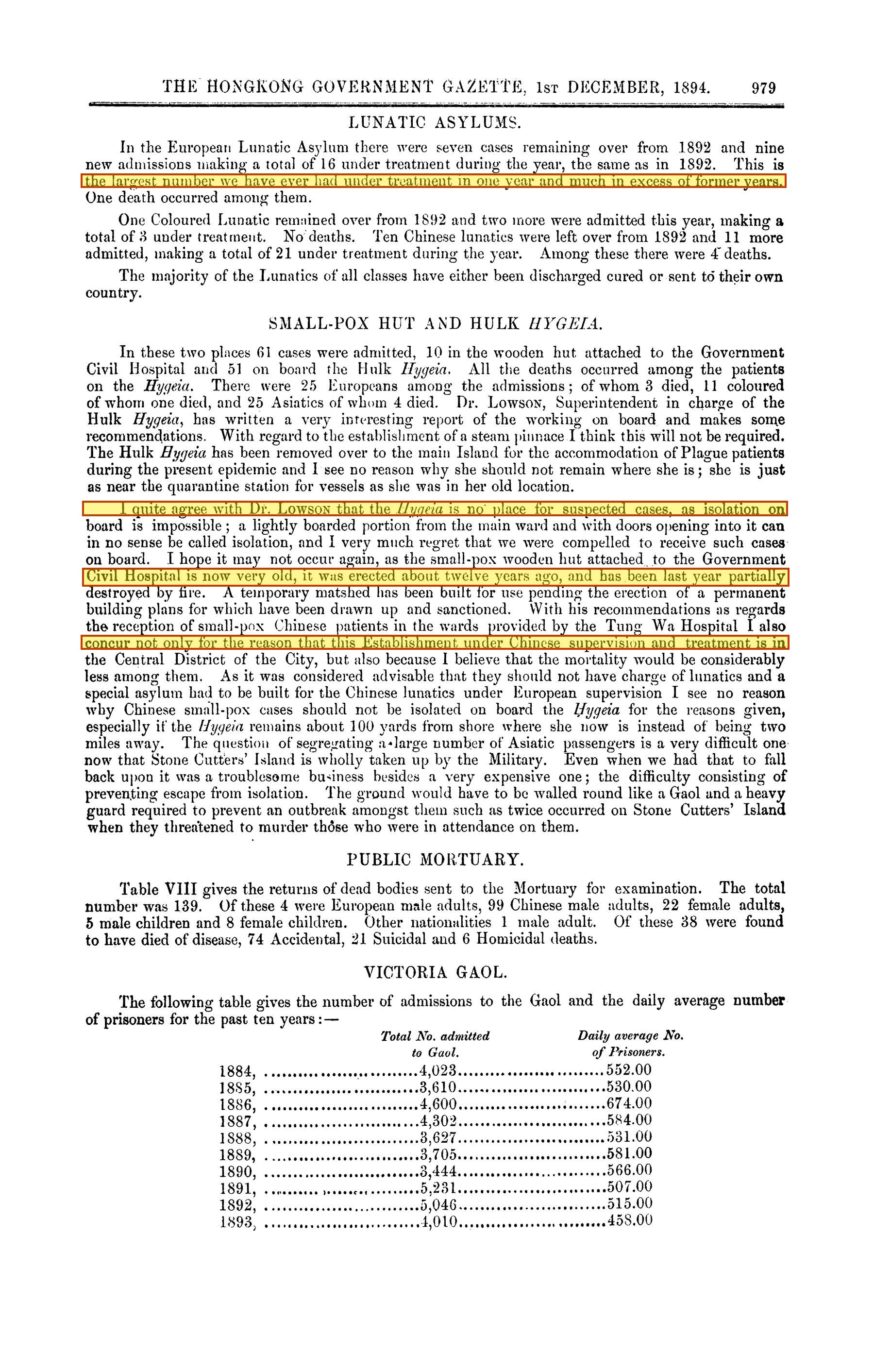
分工並非平等。1894年12月1日憲報刊出的1893年醫務報告寫道,殖民地醫官「同意」把天花華人病人送往東華醫院病房,「因為該院由華人主持、位於城中,且我相信其死亡率會顯著較低」;同一報告又記,華人精神病患者「須另建一所由歐洲人監督的特別精神病院」。17國家的醫院把這兩個題目都記錄在案。
五、病房、瘟疫與精神病院
民用醫院的病房有明確的邊界。1871年,因院內沒有傳染病隔離病床,天花病人先安置於性病醫院後的臨時建築,其後集中於昂船洲的監獄醫院(1871年1月25日設立);1879年的報告則坦言:「民用醫院沒有產科病床,此類病例從不收治」。18191885–86年的定例局文件記下了新院的擴建:「舊性病醫院改作新民用醫院一部分之工程已完成」,計有四間大病房(48名病人)、男病房、女病房等。20
1894年的鼠疫,是民用醫院最沉重的一年。1895年4月13日憲報刊出的疫症報告記載:民政醫院的工作「極為繁重,每名歐洲職員平均每日當值16小時」;5月21日,「玻璃廠醫院(Glassworks Hospital)開辦,稍減我們的負擔」;海格號(Hygeia)醫療船的兩名歐洲病人後來「轉送民用醫院」;堅尼地城醫院的病人則「移送民用醫院院內的天花觀察棚」。211893年的帳目同時記下:華人精神病患者全年21人接受治療,其中4人死亡;院內那座天花棚「約建於12年前,去年曾局部焚毀」。17
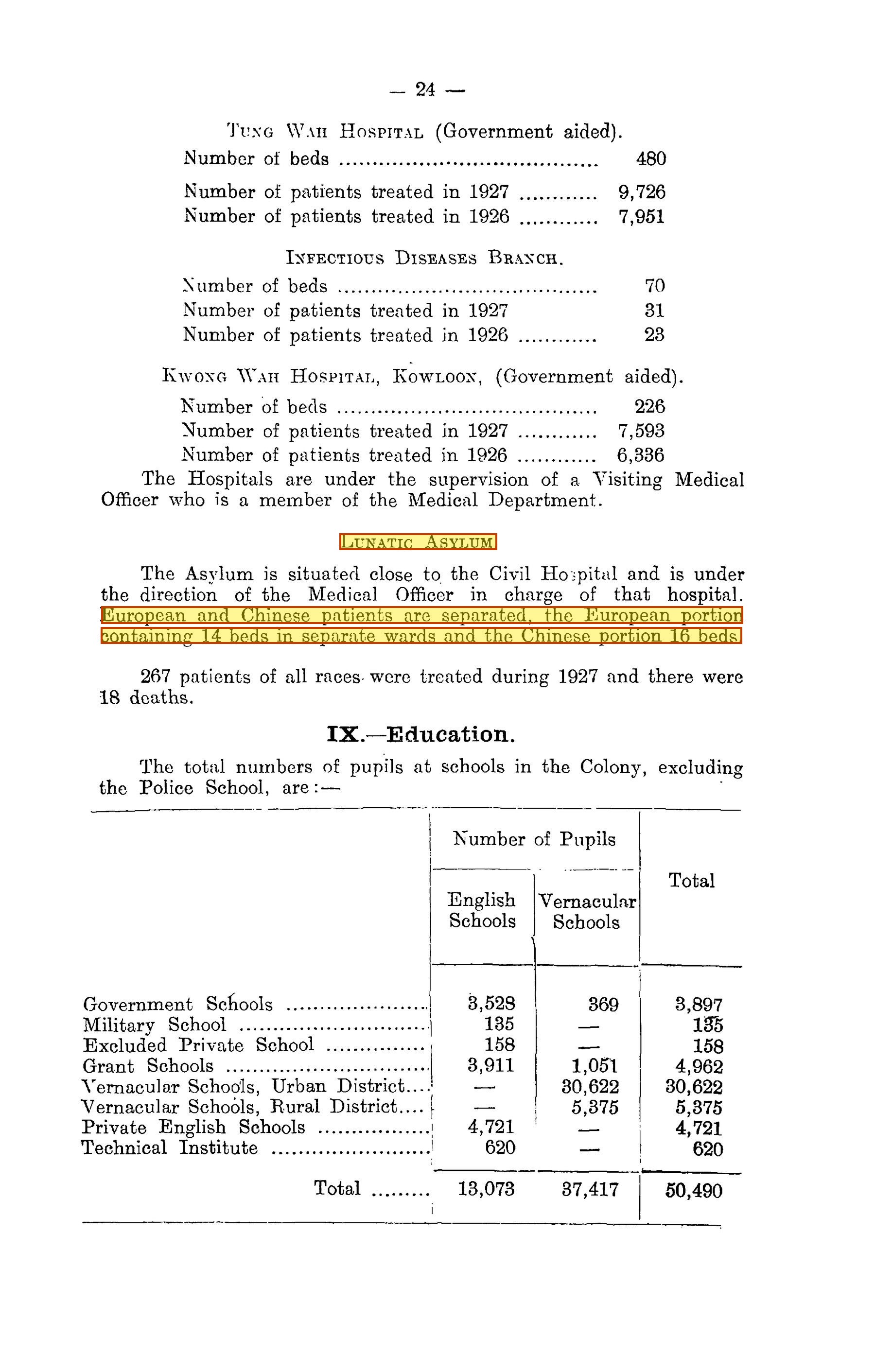
到了1927年,行政報告的措辭已經完全不同:精神病院「位於民用醫院附近,由該院主管醫生督導。歐洲與華人病人分開,歐洲部分為14張病床,華人部分為16張」;同年全港267名病人接受治療,18人死亡。同頁列出政府資助的兩間華人醫院:東華醫院480床、年內9,726人次;九龍廣華醫院226床、7,593人次。22
六、現代醫院與結局
1923年12月,立法局通過1萬元工程費,其中5,000元用於民用醫院「C座」加建26張病床及「A座」病房廚房;同年的行政報告註明,香港大學臨床部的住院病人「計入民用醫院數字」。231924年11月,立法局會議上,政府展望九龍醫院啟用後「民用醫院的病人可望減少」;九龍醫院最終於1925年12月開業,只有46張病床。2425
1928年,政府為民用醫院舊址估值2,128,000元;1933年的瘧疾調查已在「薄扶林(新建民用醫院選址)」進行,即今瑪麗醫院院址。1937年,瑪麗醫院啟用,維多利亞醫院隨之關閉;1934年1月1日,原本由華人公共診所委員會集資營辦的贊育醫院移交政府。262728
1939年,政府開設「荔枝角臨時華人醫院」,編制包括3名華人醫生、16名護士及37名雜務人員——分開的華人醫院,以戰時的形式再次出現。29戰後,舊院址一部分成為紀念公園(1951–52年檔案:「舊政府民用醫院選址上的紀念公園」),另一部分則於1955年建成贊育產科醫院。309
結論
政府的醫院不是為單一族群而設——這是檔案自己給出的答案。從1859年的死亡率表開始,華人就診與死亡被逐年記入國家報表;1871年,華人佔該院入院人數近三成、死亡人數超過一半;而「只限華人」四個字,出現在政府自己創立、撥地撥款支持的東華醫院名下。1890年的中文種痘公告,甚至把「國家大醫院」與東華、雅麗氏並列為免費種痘的地點。國家的醫學,從來不是一間只屬於歐洲人的房子;它是一套紀錄、一組表格,以及一份始終未完全平等的帳目。
The State’s Own Medicine
The Government Civil Hospital 國家大醫院 / 國家醫院, Hong Kong, 1848–1941
Abstract
On 1 October 1848 the Government of Hong Kong opened a temporary Civil Hospital “as an economical measure,” on Governor Bonham’s Despatch No. 70 of 8 September 1848. This paper tests the common picture — that the Government’s hospital was for Europeans while the Chinese went to the Tung Wah Hospital — against the Government’s own returns. The record answers otherwise. From at least 1859 the Civil Hospital’s standing mortality table carried a “Rate to Number of Chinese admitted” column; in 1871 the Chinese were 311 of 1,165 admissions and 42 of 77 deaths; and the Government’s own admission rule for the hospital named the police, the destitute, Board-of-Trade seamen, paying patients and accident cases, with no racial limit. The one hospital marked “for Chinese Patients only” was the Chinese hospital — the Tung Wah — which the Government itself had incorporated and endowed by Ordinance No. 3 of 1870 (Crown land and $15,000 of public money) under the formal title “The Chinese Hospital Incorporation Ordinance, 1870.” The state’s medicine was never a house for Europeans alone; it was a set of registers, kept every year, whose Chinese column records both the reach of the hospital and the inequality of its outcomes.
1. Scope, sources and method
The question is narrow: for whom did the Government’s hospital exist? Three strata of the record answer it. First, the hospital’s own accounts: the annual medical reports printed in the Government Gazette from 1858 onward, with admissions and deaths classified as Europeans, Colored Persons and Chinese, and multi-year mortality tables.213 Second, the Government’s general accounts: the Blue Books’ “Charitable and Literary Institutions” tables and the Administrative Reports, which record the hospital’s admission rules, beds and funding relationships.3 Third, the Government’s own Chinese: the Gazette’s Chinese columns and the 1890 vaccination notice, which carry the institution’s Chinese name and its points of contact with the Chinese town.4
Two method notes. The image series (gazette, Blue Book and Administrative Report scans) is login-gated and was fetched through the archive’s administrative session; every plate was read back by eye at its final bytes before publication (31). And the text-series OCR is not trustworthy on this topic: the 1872 mortality tables’ class columns are interleaved in the OCR layer (the Chinese column’s values were rendered under other headings). Every figure in this paper was read off the scans; the OCR values are cited nowhere.5
2. The founding: the temporary hospital of 1848 and the new house of 1859
Governor Bonham’s Despatch No. 70 of 8 September 1848 ordered the establishment, and on 1 October 1848 the hospital opened in temporary form. The Blue Book’s establishment page states its character plainly: “This Hospital temporarily established on 1st October, as an economical measure. (Vide Governor Bonham’s Despatch Nr. 70 of 8th September, 1848).” The same volume’s Treasury heads carry the costs (“Expenses of Civil Hospital £79 15s. 5d.”; “Medicines for Do. £140 0s. 7d.”) and the officer (“Dispenser to the temporary H. K. Civil Hospital”).16 The reason for the founding is written in the Colonial Surgeon’s own hand in the 1848 report: until the establishment of the Civil Hospital, “the system pursued in the treatment of the sick amongst the Police Force, was not only inefficient and unsatisfactory, but it was one by which it was impossible to impart faithfully to the records of disease.” The hospital’s first purpose was the state’s own record.7
In 1859 the hospital moved into its permanent house. Dr. Murray, Colonial Surgeon, “made a strong representation of the necessity of certain alterations and improvements in the new Civil Hospital… before the transfer of his patients to it”; the Surveyor General’s office conveyed the Governor’s sanction of “the Expenditure proposed by you in erecting the new civil Hospital” on 18 April 1859, and London approved £200 for the alterations on 20 June 1859.8 The 1955–60 Hong Kong Year Books say that “the first Government hospital was the Civil Hospital, founded in 1859” — true of the new house, not of the establishment: this paper keeps both moments and prefers neither.9
The hospital began as the colony’s last resort. In the 1848 gaol, a case of “hospital gangrene” was, “after the expiration of the term of imprisonment, … removed to the Civil Hospital, where the disease rapidly lost its malignant character, and the patient recovered.”10 In 1867 the Government contemplated converting the Civil Hospital into a lock hospital and buying a site for a new one;11 by 1873, with the Seamen’s Hospital closed, Governor Kennedy recorded that “the necessity for a New Civil Hospital is daily more apparent.”12
3. The state’s own tables, 1859–1871
From at least 1859 the Government counted Chinese admissions to its own hospital in its standing returns: the Gazette of 17 March 1866 printed the “Rate of Mortality in the Government Civil Hospital during the Seven Years ending 1865” with a “Rate to No. of Chinese Admitted” column, and the eight- and nine-year forms followed in 1867 and the 1871 Blue Books.2 The Gazette of 23 March 1872 carries the report for 1871, and its two tables are this thread’s centre. Table IV lists the year’s admissions — 452 Europeans, 402 Colored Persons, 311 Chinese, total 1,165 — and deaths — 19, 16, 42, total 77. Table V gives the mortality rates by class for 1859–1871: the Chinese column reads 28.98, 8.23, 11.65, 12.78, 32.27, 22.89, 29.72, 33.56 (1866), 16.05, 15.35, 21.85, 15.38, 13.14 per cent; the European column never exceeds 11.06 (thirteen-year average 6.74), and the Colored Persons’ average is 3.65.1314
In one year, then, Chinese patients were about 27 per cent of the state hospital’s admissions and about 55 per cent of its deaths; the Chinese mortality rate ran at more than three times the European rate, and the Government’s own tables kept that gap for thirteen consecutive years. The Blue Book 1871 independently prints the same year’s total — “Civil Hospital… 1,165 Admissions during the year” — and states the hospital’s admission rule: “For Members of Police Force, as also for Destitute and Board of Trade Patients, and for such Paying Patients as desire Admission. Cases of Accidents are also admitted.” No racial limit appears anywhere in the rule.3
The report’s narrative adds a sentence that has to be handled carefully: “Another reason for the increase is the fact of the Chinese resorting to the Hospital for treatment, more than to their native doctors, as they used to do formerly.” The sentence sits inside the report’s Police section, and its referent — the police’s Chinese or the Chinese public — cannot be settled from the document alone; it is therefore quoted with its context, and this paper’s argument rests on the tables, not on the sentence.13
4. Whose hospital? The one “for Chinese Patients only”
The counterpart of the Civil Hospital was the Chinese hospital, and the Government built it. Ordinance No. 3 of 1870, printed in the Gazette of 2 April 1870, is “An Ordinance… for establishing a Chinese Hospital to be supported by Voluntary Contributions”; its preamble records MacDonnell’s proposal, Queen Victoria’s grant of a piece of Crown land as the site, and the authorization of “a Donation of Fifteen thousand Dollars” from the public funds “towards the Cost and Expenses of erecting and maintaining the same.”15 The Historical Laws’ title of the same ordinance is “The Chinese Hospital Incorporation Ordinance, 1870” — and the corporation it creates is “The Tung Wa Hospital.”16 The hospital opened in February 1872, and the Blue Book 1871 marks it in one line: “Incorporated under Ordinance No. 3 of 1870, opened in February, 1872, for Chinese Patients only.”3
Here is the thread’s answer: the race-limited hospital was the Chinese one, endowed by the state; the state’s own hospital’s rule named the police, the destitute, the Board of Trade’s seamen, paying patients and accidents without a racial limit.3 And the state’s Chinese reached into the Chinese town by its own name: the Acting Registrar General’s vaccination notice of 8 November 1890 lists the free-vaccination places as 國家大醫院 (with 胡爾楷 in attendance), 東華醫院, 雅麗氏利濟醫院 and 太平山新街 no. 31, and names the Government vaccinator and “the doctors of 國家大醫院” who issued the certificates.4
The division of labour was not equal. The Colonial Surgeon’s report for 1893, printed on 1 December 1894, records his concurrence with sending Chinese smallpox patients “in the wards provided by the Tung Wa Hospital… because I believe that the mortality would be considerably less among them,” and notes in the same report that the Chinese lunatics’ asylum had to be built “under European supervision.”17 The state’s hospital kept both entries.
5. Wards, plague and the asylum
The hospital’s wards had hard edges. In 1871, with no accommodation for infectious diseases at the Civil Hospital, smallpox cases were first placed in a temporary building behind the Lock Hospital and then concentrated at the Stone Cutters’ Island hospital (established 25 January 1871); the 1879 report states that “there is no accommodation for lying-in women in the Civil Hospital, and such cases are never admitted.”1819 The New Civil Hospital block of the mid-1880s was the old Lock Hospital converted — four general wards holding 48 patients, a women’s ward, and small private rooms.20
The plague year of 1894 was the hospital’s heaviest. The medical report of 13 April 1895 records that at the Government Civil Hospital “every European was doing on an average sixteen hours’ duty per diem”; that “on 21st May, the Glassworks Hospital was opened and this relieved our staff”; that the hulk Hygeia’s European patients were later “transferred to the Civil Hospital”; and that the Kennedy Town hospital’s remaining patients were “removed to the small-pox observation hut in the Civil Hospital grounds.”21 The same year’s returns recorded twenty-one Chinese lunatics under treatment with four deaths, and described the hospital’s smallpox hut — “erected about twelve years ago… last year partially destroyed by fire.”17
By 1927 the Administrative Report describes the asylum beside the Civil Hospital in the language of separation: “European and Chinese patients are separated, the European portion containing 14 beds in separate wards and the Chinese portion 16 beds.” In the same year 267 patients of all races were treated there with 18 deaths, while the Government-aided Chinese hospitals carried their own lines: Tung Wah, 480 beds and 9,726 patients; Kwong Wah, Kowloon, 226 beds and 7,593.22
6. The modern hospital and the end
In December 1923 the Legislative Council voted $5,000 toward alterations to the Civil Hospital’s blocks — twenty-six beds in “C” Block and a ward kitchen in “A” Block; the same year’s report notes that the University Clinics’ in-patients were counted into the Civil Hospital’s figures.23 In November 1924 the Council looked across the harbour: “one result of the opening of the Kowloon Hospital… will result in the number of patients at the Government Civil Hospital being reduced.” The Kowloon Hospital opened in December 1925 with 46 beds.2425
In 1928 the Government valued the Civil Hospital site at $2,128,000; by 1933 the malaria surveys were already working at “Pokfulam (New Government Civil Hospital Site)” — the ground of the future Queen Mary Hospital. The Queen Mary opened in 1937, and the Victoria Hospital was closed when it did; the Tsan Yuk Hospital had been presented to the Government on 1 January 1934.262728 In 1939 the Government opened the Lai Chi Kok Temporary Chinese Hospital, staffed by three Chinese medical officers and sixteen nurses — the separated Chinese hospital returning in wartime form.29 After the war the old site was divided: part became the Memorial Park, and on the remainder the Tsan Yuk Maternity Hospital opened in 1955.309
7. Conclusion
The Government’s hospital was not built for one race — that is the record’s own answer. From the mortality table of 1859 onward, Chinese admissions and deaths were counted into the state’s returns year by year; in 1871 the Chinese were 311 of 1,165 admissions and 42 of 77 deaths; and the words “for Chinese Patients only” stand under the hospital the Government itself had founded, endowed and incorporated — the Chinese hospital, the Tung Wah. In 1890 the Government’s own Chinese notice set 國家大醫院 beside 東華醫院 and 雅麗氏利濟醫院 as free-vaccination stations. The state’s medicine was never a house for Europeans alone; it was a set of registers kept in every year’s gazette — and what those registers also kept, for thirteen straight years, was the distance between the patients it admitted and the patients it lost.
Notes
Blue Book 1848, establishment note ("This Hospital temporarily established on 1st October, as an economical measure. (Vide Governor Bonham's Despatch Nr. 70 of 8th September, 1848)"), https://hkintexts.histsyn.com/page/653161 (accessed 6 Nov. 2026). ↩
Government Gazette, 17 March 1866, Government Notification No. 41: "TABLE shewing the RATE of MORTALITY in the GOVERNMENT CIVIL HOSPITAL during the Seven Years ending 1865," with its "RATE TO NO. OF CHINESE ADMITTED" column, https://hkintexts.histsyn.com/page/1679165; the eight/nine-year form, Gazette 23 March 1867, Government Notification No. 47, https://hkintexts.histsyn.com/page/1678494 (accessed 6 Nov. 2026). ↩
Blue Book 1871, "Charitable and Literary Institutions": "Civil Hospital … 1,165 Admissions during the year … For Members of Police Force, as also for Destitute and Board of Trade Patients, and for such Paying Patients as desire Admission. Cases of Accidents are also admitted"; "Tung-wa Hospital … Incorporated under Ordinance No. 3 of 1870, opened in February, 1872, for Chinese Patients only," printed p. 166, scan https://hkintexts.histsyn.com/image-page/2184155; text https://hkintexts.histsyn.com/page/657398 (accessed 6 Nov. 2026). ↩
Government Gazette, 8 November 1890: the Acting Registrar General's vaccination notice (憲示第四百六十七號), listing the free-vaccination places — 國家大醫院 (with 胡爾楷), 東華醫院, 雅麗氏利濟醫院 and 太平山新街門牌第三十一號 — and the 國家種痘師, https://hkintexts.histsyn.com/page/1653149; scan https://hkintexts.histsyn.com/image-page/1538446 (accessed 6 Nov. 2026). ↩
Blue Book 1871, "Table shewing the Rates of MORTALITY in the Government CIVIL HOSPITAL, during the last 14 Years," https://hkintexts.histsyn.com/page/657426; Blue Book 1874's ten-year table, https://hkintexts.histsyn.com/page/658168. Both OCR layers interleave the class columns; the 1872 scans are the authority (accessed 6 Nov. 2026). ↩
Blue Book 1848, Treasury and establishment pages ("Civil Hospital — (2 months)"; "Expenses of Civil Hospital £79 15s. 5d."; "Dispenser to the temporary H. K. Civil Hospital"), https://hkintexts.histsyn.com/page/653117 and https://hkintexts.histsyn.com/page/653118 (accessed 6 Nov. 2026). ↩
Colonial Surgeon's report for 1848 (manuscript, C.O/133), Blue Book 1848, printed p. [148], https://hkintexts.histsyn.com/image-page/2178335 (accessed 6 Nov. 2026). ↩
CO 129/74, Lieut.-Governor Caine and Sir Hercules Robinson, 1859: Dr. Murray's representation on the new Civil Hospital and the Surveyor General's sanction of the expenditure (18 April 1859), https://hkintexts.histsyn.com/page/247459 and https://hkintexts.histsyn.com/page/247462 (accessed 6 Nov. 2026). ↩
Hong Kong Year Book 1955, "The first Government hospital was the Civil Hospital, founded in 1859. … on the remainder of the original site today stands the spacious and modern Tsan Yuk Maternity Hospital, opened in 1955," https://hkintexts.histsyn.com/page/1718247; the same paragraph, Year Book 1956, https://hkintexts.histsyn.com/page/1718637 (accessed 6 Nov. 2026). ↩
Blue Book 1848, the gaol "hospital gangrene" passage, printed p. [158], https://hkintexts.histsyn.com/image-page/2178348; text at https://hkintexts.histsyn.com/page/653191 (accessed 6 Nov. 2026). ↩
CO 129/124, Sir Richard MacDonnell, 1867: the proposal to convert the present Civil Hospital into a lock hospital and to purchase a site for a new Civil Hospital, https://hkintexts.histsyn.com/page/270703 (accessed 6 Nov. 2026). ↩
CO 129/164, Sir Arthur Kennedy, 1873: "At the time of closing of the Seamen's Hospital, the necessity for a New Civil Hospital is daily more apparent. A Vote of $24,000 has been taken … for the New Civil Hospital," https://hkintexts.histsyn.com/page/291764 (accessed 6 Nov. 2026). ↩
Government Gazette, 23 March 1872, Government Notification No. 60: the Acting Colonial Surgeon's Report for 1871, Table IV, "shewing the NUMBER of PATIENTS treated, and the MORTALITY, in the GOVERNMENT CIVIL HOSPITAL during the Year 1871" — admissions 452 Europeans, 402 Colored Persons, 311 Chinese, total 1,165; deaths 19, 16, 42, total 77 — printed p. 132, scan https://hkintexts.histsyn.com/image-page/1454099 (text pages https://hkintexts.histsyn.com/page/1675275 and https://hkintexts.histsyn.com/page/1675279) (accessed 6 Nov. 2026). ↩
Government Gazette, 23 March 1872, Table V, "shewing the RATE of MORTALITY in the GOVERNMENT CIVIL HOSPITAL, during the last 14 Years": the "Rate to Number of Chinese admitted" column reads 28.98 (1859), 8.23, 11.65, 12.78, 32.27, 22.89, 29.72, 33.56 (1866), 16.05, 15.35, 21.85, 15.38, 13.14 (1871) per cent; the European column's 13-year average is 6.74 and the Colored Persons' 3.65 — printed p. 133, scan https://hkintexts.histsyn.com/image-page/1454100 (text https://hkintexts.histsyn.com/page/1675280) (accessed 6 Nov. 2026). ↩
Government Gazette, 2 April 1870 (printed p. 151): Ordinance No. 3 of 1870, "An Ordinance … for establishing a Chinese Hospital to be supported by Voluntary Contributions, and for erecting the same into an Eleemosynary Corporation. [30th March, 1870.]", scan https://hkintexts.histsyn.com/image-page/1452898 (accessed 6 Nov. 2026). ↩
HK Historical Laws, "The Chinese Hospital Incorporation Ordinance, 1870" (Ordinance No. 3 of 1870; the corporation it creates is "The Tung Wa Hospital"), https://hkintexts.histsyn.com/page/1869478 (accessed 6 Nov. 2026). ↩
Government Gazette, 1 December 1894: the Colonial Surgeon's report for 1893 — "Ten Chinese lunatics were left over from 1892 and 11 more admitted, making a total of 21 under treatment during the year. Among these there were 4 deaths"; "the small-pox wooden hut attached to the Government Civil Hospital is now very old, it was erected about twelve years ago"; "the reception of small-pox Chinese patients in the wards provided by the Tung Wa Hospital I also concur"; "a special asylum had to be built for the Chinese lunatics under European supervision," printed p. 979, scan https://hkintexts.histsyn.com/image-page/1543016 (accessed 6 Nov. 2026). ↩
Government Gazette, 23 March 1872, the 1871 report's Small-Pox Hospital appendix (Stone Cutters' Island, established 25 January 1871) and the hospital's ward for destitute females, https://hkintexts.histsyn.com/page/1675278 (accessed 6 Nov. 2026). ↩
Annual Report 1879, Medical Department: "There is no accommodation for lying-in women in the Civil Hospital"; the paying patients' receipts ($2,478.44) and the Board of Trade's payment for merchant seamen ($1,150.50); the Chinese police admissions, https://hkintexts.histsyn.com/page/612209 (accessed 6 Nov. 2026). ↩
Sessional Paper 1885–86: "The conversion of the old Lock Hospital into a portion of the New Civil Hospital is now completed, and the reconstructed block contains: Four general wards holding 48 patients, … one women's ward," https://hkintexts.histsyn.com/page/1813452 (accessed 6 Nov. 2026). ↩
Government Gazette, 13 April 1895: "Medical Report on the Epidemic of Bubonic Plague in 1894" — "every European was doing on an average sixteen hours' duty per diem" at the Government Civil Hospital; "On 21st May, the Glassworks Hospital was opened and this relieved our staff"; the Hygeia's patients "transferred to the Civil Hospital"; the Kennedy Town patients "removed to the small-pox observation hut in the Civil Hospital grounds," https://hkintexts.histsyn.com/page/1643942, https://hkintexts.histsyn.com/page/1643967, https://hkintexts.histsyn.com/page/1643968, https://hkintexts.histsyn.com/page/1643969 (accessed 6 Nov. 2026). ↩
Annual Report 1927: "LUNATIC ASYLUM. The Asylum is situated close to the Civil Hospital … European and Chinese patients are separated, the European portion containing 14 beds in separate wards and the Chinese portion 16 beds. 267 patients of all races were treated during 1927 and there were 18 deaths"; Tung Wah Hospital (Government aided), 480 beds and 9,726 patients; Kwong Wah Hospital, Kowloon (Government aided), 226 beds and 7,593 patients — printed p. 24, scan https://hkintexts.histsyn.com/image-page/428539; text https://hkintexts.histsyn.com/page/623346 (accessed 6 Nov. 2026). ↩
Legislative Council Hansard, 13 December 1923: "$5,000 on account of Public Works … Alterations to Government Civil Hospital Buildings … extra accommodation in 'C' Block; 26 beds, and a ward kitchen to 'A' Block"; Annual Report 1923 on the University Clinics' in-patients "included in the figures of the Civil Hospital," https://hkintexts.histsyn.com/page/1882214, https://hkintexts.histsyn.com/page/620660, https://hkintexts.histsyn.com/page/620954 (accessed 6 Nov. 2026). ↩
Legislative Council Hansard, 3 November 1924: "I think one result of the opening of the Kowloon Hospital, which we hope will take place next August, and the subsequent opening of the War Memorial Nursing Home and … the Maternity wards in connection with the Victoria Hospital, will result in the number of patients at the Government Civil Hospital being reduced," https://hkintexts.histsyn.com/page/1882227 (accessed 6 Nov. 2026). ↩
Annual Report 1925: "The Kowloon Hospital was opened during December, the work having been much delayed during the strike. The Hospital is on up-to-date lines and provides 46 beds," https://hkintexts.histsyn.com/page/622165 (accessed 6 Nov. 2026). ↩
Annual Report 1928: "Government Civil Hospital Site — 1 property value $2,128,000.00," https://hkintexts.histsyn.com/page/624546 (accessed 6 Nov. 2026). ↩
Annual Report 1933: the malaria surveys at "Government Civil Hospital Site (Pokfulam)" and "Pokfulam (New Government Civil Hospital Site)," https://hkintexts.histsyn.com/page/628179 and https://hkintexts.histsyn.com/page/628181 (accessed 6 Nov. 2026). ↩
Annual Report 1937: the Tsan Yuk Hospital, "presented to the Government on the 1st January, 1934," and the gynaecological cases "until the Queen Mary Hospital was opened," https://hkintexts.histsyn.com/page/631068 and https://hkintexts.histsyn.com/page/631518; CO 129/563-12: "The Victoria Hospital, which was closed when the Queen Mary Hospital was opened," https://hkintexts.histsyn.com/page/554935 (accessed 6 Nov. 2026). ↩
Annual Report 1939: the Lai Chi Kok Temporary Chinese Hospital's staff — "Chinese medical officers 3; Matron 1; Assistant matron 1; Nurses (1 vacancy) 16; Probationer dispenser 1; Steward, boys, amahs and coolies 37," https://hkintexts.histsyn.com/page/633157 (accessed 6 Nov. 2026). ↩
HKRS 41, 1951/52 memorandum: "the restoration, as Public Recreation areas, of … the Memorial Park, on the old Government Civil Hospital site," https://hkintexts.histsyn.com/page/4970009; the war-cemeteries table's "Old Government Civil Hospital Site — 2,631," https://hkintexts.histsyn.com/page/4924432 (accessed 6 Nov. 2026). ↩
The National Archives (UK), Colonial Office photographic collection, CO 1069/446: "Government Civil Hospital from Hospital Road" (albumen print; no date stated in the catalogue record), via Wikimedia Commons, https://commons.wikimedia.org/wiki/File:CO_1069-446-40.jpg (no restrictions; accessed 6 Nov. 2026). ↩
Bibliography
- Blue Book 1848, establishment note. https://hkintexts.histsyn.com/page/653161 (accessed 6 Nov. 2026).
- Blue Book 1848, Treasury and establishment pages. https://hkintexts.histsyn.com/page/653117 and https://hkintexts.histsyn.com/page/653118 (accessed 6 Nov. 2026).
- Blue Book 1848 (C.O/133), Colonial Surgeon’s report for 1848, printed p. [148]. https://hkintexts.histsyn.com/image-page/2178335 (accessed 6 Nov. 2026).
- Blue Book 1848, gaol “hospital gangrene” passage, printed p. [158]. https://hkintexts.histsyn.com/image-page/2178348 (accessed 6 Nov. 2026).
- CO 129/74, Caine and Robinson, 1859. https://hkintexts.histsyn.com/page/247459 and https://hkintexts.histsyn.com/page/247462 (accessed 6 Nov. 2026).
- Hong Kong Year Book 1955 and 1956. https://hkintexts.histsyn.com/page/1718247 and https://hkintexts.histsyn.com/page/1718637 (accessed 6 Nov. 2026).
- Government Gazette, 17 March 1866 (G.N. 41) and 23 March 1867 (G.N. 47). https://hkintexts.histsyn.com/page/1679165 and https://hkintexts.histsyn.com/page/1678494 (accessed 6 Nov. 2026).
- CO 129/124, MacDonnell, 1867. https://hkintexts.histsyn.com/page/270703 (accessed 6 Nov. 2026).
- Government Gazette, 2 April 1870: Ordinance No. 3 of 1870, printed p. 151. https://hkintexts.histsyn.com/image-page/1452898 (accessed 6 Nov. 2026).
- HK Historical Laws, “The Chinese Hospital Incorporation Ordinance, 1870.” https://hkintexts.histsyn.com/page/1869478 (accessed 6 Nov. 2026).
- Blue Book 1871, Charitable and Literary Institutions, printed p. 166. https://hkintexts.histsyn.com/image-page/2184155 (accessed 6 Nov. 2026).
- CO 129/156, MacDonnell, 1872 (Despatch No. 947). https://hkintexts.histsyn.com/page/287252 (accessed 6 Nov. 2026).
- Government Gazette, 23 March 1872: the 1871 report (Tables IV and V), printed pp. 128, 132, 133. https://hkintexts.histsyn.com/image-page/1454095, https://hkintexts.histsyn.com/image-page/1454099, https://hkintexts.histsyn.com/image-page/1454100 (accessed 6 Nov. 2026).
- Blue Book 1871, mortality table, last 14 years. https://hkintexts.histsyn.com/page/657426 (accessed 6 Nov. 2026).
- CO 129/125 (MacDonnell, 1867) and CO 129/193 (Hennessy, 1881). https://hkintexts.histsyn.com/page/271202 and https://hkintexts.histsyn.com/page/308770 (accessed 6 Nov. 2026).
- Government Gazette, 23 March 1872, Small-Pox Hospital appendix. https://hkintexts.histsyn.com/page/1675278 (accessed 6 Nov. 2026).
- CO 129/164, Kennedy, 1873. https://hkintexts.histsyn.com/page/291764 (accessed 6 Nov. 2026).
- Annual Report 1879, Medical Department. https://hkintexts.histsyn.com/page/612209 (accessed 6 Nov. 2026).
- Sessional Paper 1885–86, the New Civil Hospital block. https://hkintexts.histsyn.com/page/1813452 (accessed 6 Nov. 2026).
- CO 129/231 docket index (1886 superintendence rules). https://hkintexts.histsyn.com/page/333180 (accessed 6 Nov. 2026).
- Sessional Paper 1887–88, drainage report, and the Gazette printing. https://hkintexts.histsyn.com/page/1814243 and https://hkintexts.histsyn.com/page/1652886 (accessed 6 Nov. 2026).
- Government Gazette, 13 April 1895, “Medical Report on the Epidemic of Bubonic Plague in 1894.” https://hkintexts.histsyn.com/page/1643942 (accessed 6 Nov. 2026).
- Government Gazette, 1 December 1894, Colonial Surgeon’s report for 1893, printed p. 979. https://hkintexts.histsyn.com/image-page/1543016 (accessed 6 Nov. 2026).
- LegCo Hansard, 13 December 1923, and Annual Report 1923. https://hkintexts.histsyn.com/page/1882214 and https://hkintexts.histsyn.com/page/620660 (accessed 6 Nov. 2026).
- LegCo Hansard, 3 November 1924. https://hkintexts.histsyn.com/page/1882227 (accessed 6 Nov. 2026).
- Annual Report 1925 (the Kowloon Hospital). https://hkintexts.histsyn.com/page/622165 (accessed 6 Nov. 2026).
- Annual Report 1927 (hospitals and asylum), printed p. 24. https://hkintexts.histsyn.com/image-page/428539 (accessed 6 Nov. 2026).
- Annual Report 1928 (site valuation). https://hkintexts.histsyn.com/page/624546 (accessed 6 Nov. 2026).
- Annual Report 1933 (Pokfulam site surveys). https://hkintexts.histsyn.com/page/628179 (accessed 6 Nov. 2026).
- Annual Report 1937 and CO 129/563-12. https://hkintexts.histsyn.com/page/631068 and https://hkintexts.histsyn.com/page/554935 (accessed 6 Nov. 2026).
- Annual Report 1939 (Lai Chi Kok Temporary Chinese Hospital). https://hkintexts.histsyn.com/page/633157 (accessed 6 Nov. 2026).
- HKRS 41 (1951/52 memorandum; war cemeteries table). https://hkintexts.histsyn.com/page/4970009 and https://hkintexts.histsyn.com/page/4924432 (accessed 6 Nov. 2026).
- Government Gazette, 8 November 1890, the Registrar General’s vaccination notice. https://hkintexts.histsyn.com/page/1653149 (accessed 6 Nov. 2026).
- The National Archives (UK), CO 1069/446, “Government Civil Hospital from Hospital Road.” https://commons.wikimedia.org/wiki/File:CO_1069-446-40.jpg (accessed 6 Nov. 2026).
Appendix A. Query log (selected)
| Query | Index | Hits |
|---|---|---|
| “Government Civil Hospital” | text | 10,000+ (capped) |
| “Government Civil Hospital” | image | 5,443 |
| “Chinese patients” | text | 545 (earliest press 1867) |
| “Civil Hospital” + gazette year regexp, 1850s–1890s | text | 31 / 263 / 362 / 456 / 773 |
| Colonial Surgeon’s report series | text | 259 pages |
| “resorting to the Hospital for treatment” | image | 1 (img-1454095) |
| “For Chinese Patients only” | image | 9 (1871–81 Blue Books) |
| 國家大醫院 / 國家醫院 / 政府醫院 | text | 11 / 482 / 2,464 (政府醫院 earliest 1947) |