The Racing Machine: the Hongkong Jockey Club and the colony's licensed game (1844-1941)
賽馬的機器:香港賽馬會與殖民地的合法賭博,1844–1941
摘要:1846 年,黃泥涌谷(快活谷)被抽乾、剷平,成為馬場。此後 95 年,香港的賽馬由公眾認購「賽馬基金」的臨時賽事,變成一家馬會經營、政府發牌徵稅的機器。1884 年 11 月 4 日,香港賽馬會(Hongkong Jockey Club)在市政大會堂成立,35 名認購人把 $10,877 的基金移交新會;1891 年的《賭博條例》本欲連同賽馬場上的 totalisator(同注分彩的投注機)一併禁絕,它卻在 1893 年「靜靜地、不張揚地」復出;1930 年與 1931 年,政府先以修訂條例批准會社馬票,再以《博彩稅條例》把 totalisator 與 pari-mutuel(按注分彩)投注納入發牌與徵稅。賽馬遂成為殖民地唯一合法的大眾賭博——本文重建這部「賽馬的機器」:山谷、認購制、馬會、看台、totalisator 與稅。
一、山谷與馬場(1843–46)
1843 年,「快活谷」在公共衛生信札中出現,與「濕耕」、瘴氣並列 1。1844 年,政府就「所謂快活谷」進行測量,準備清走積水 2。1845 年,有建議提出:只要政府把整個山谷批出 75 年,公眾便樂意出錢「抽乾、剷平,使之成為一個好的馬場,以及一個遊樂之地(thus forming a good race course, and a place for recreation)」 3。1846 年的社論仍在催促:黃泥涌谷「若不徹底排水、開闢為木球與策騎之所,便毫無價值」 4。同年 3 月,第一份見於記錄的賽馬程序表刊出——「香港賽馬,第一日,3 月 4 日:處女錦標,限 12 掌以下小馬,獎金由基金撥出 $50……」;12 月的程序表已有「山谷錦標」及「勝馬以 $100 售出、一刻鐘內向裁判喊價(claimed of the Judge within a quarter of an hour)」的條款 56。賽事由「賽馬委員會」主理,報名文件寄往「會所(the Club House)」,小馬先送「春園(Spring Gardens)」量度——這是「按吋負磅」的世界 7。賽後報道說:「賽馬令所有人滿意——輸家當然除外。」 8
二、認購制賽馬(1846–84)
1849 年,商人 L. Encarnação 獲准在馬場搭看台售票,「酒與烈酒不准攜入」——看台成為一門生意 9。1850–51 年,程序表由「第 59 團的 John King」以「賽道書記」身分簽發,盃賽包括女皇錦標、廣州盃、商人盃 10;1848–53 年的年賽從未間斷 11。1860 年代至 1884 年,報上的賽馬仍由公眾認購的「賽馬基金」支持:出入看台要買票(1888 年:會員免費,非會員全場 $8、新看台另加 $8,經「義務秘書 R. W. Rutter」購票;怡和洋行是「馬會代理」) 1213。1871 年的報道提到為「打吡」加磅、看台「仕女雲集」,並記「球會傢俬的欠款已經還清」 14。「香港打吡」之名 1868 年已見於報端;「香港打吡——Sweepstakes」的參賽名單見於 1873 年 3 月的賽事 15。
三、1884 年創會
1884 年 10 月 28 日的通告召集「1884 年賽馬認購人會議」,議程是「把香港的賽馬放在更穩固的基礎上——成立一家馬會」 16。11 月 4 日下午,會議在市政大會堂舉行,35 名認購人出席,包括 Hon. P. Ryrie、Hon. T. Jackson、Hon. F. D. Sassoon、遮打、麼地等;Ryrie 當選主席,義務司庫報告「賽馬基金」結餘 $10,877 1718。議案依次通過:其一,目的是「組織一個永久性的賽馬會社」;其二,「本會命名為 Hongkong Jockey Club,並即此組成」;其三,1884 年認購人、香港會與德國會(Club Germania)會員及陸海軍、義勇軍官佐為創會會員;其五,「香港賽馬基金」的結餘,不論定存與否,移交香港馬會;其六,上一屆董事(Stewards)連任為首年管治機構,「有權增補」,並由他們擬訂會章、一個月內提交會員大會 1718。11 月 5 日的報評說:「香港馬會終於成為既成事實(an accomplished fact)」——此後的賽事將「由一個正式組成的永久機構管理,而不再由認購人每次選出的委員會主辦」 19。1885 年 1 月 28 日,會章提交會員大會 20。
四、看台與風災(1888–93)
1888 年 2 月的賽事已用上「新看台」;同年 8 月,颱風把馬場的工程一掃而空——「牆壁左倒右塌,馬場的大看台……賽馬場全毀(the Race-course entirely collapsed)」 2122。看台其後重建;1893 年的賽事,「馬會新建的大看台由港督羅便臣夫婦(His Excellency and Lady Robinson)親臨啟用」 23。1888 年《香港指南》記述這項運動:「賽馬在二月下旬舉行,由香港馬會主辦,在黃泥涌谷的馬場——一個被蒼翠群丘環抱的美麗地方。屆時全殖民地休假,看台與跑道擠滿世上最五光十色的人海。馬匹大多是華北小馬。」 24 這段文字在 1930 年的《指南》仍以同一格式再版。
五、機器與法律(1890–94)
1890 年 12 月的賽馬程序表已有以 totalisator 命名的盃賽(The Totalizator Cup);1891 年 2 月的報道說「壓在他身上的 totalisator 投注是 $195」,兩日之間「totalisator 的投注增加」 2526。這部機器把散注匯入按比例派彩的池——正是政府最忌的賭博形態。1891 年的《賭博條例》(第 7 號)把「賭場」定義為包括「就博彩、注碼或彩金收取佣金或百分比」的場所,把「彩票」定義為包括「取決於……任何賽馬或競賽結果」的博彩裝置,並明文把「公眾不得進入的社交會所」也算作賭場 27。4 月 30 日,港督德輔在定例局說:「在為中國人限制賭博的法例裡,不同時包括賽馬場上的 totalisator,是極不公正的……它比一般投注壞得多……本條例的意圖就是要禁絕它。」 28。條例在 5 月 6 日獲批、5 月 9 日刊憲 27。
1892 年 2 月,賽事前夕,《士蔑新聞》刊出諷刺訃聞:「香港賽馬逝世——死因:祖母式立法(Grandmotherly Legislation)過量」;場內沒了 totalisator,卻有兩個「不知法為何物」的苦力因「在馬場賭博」被罰 $5 或 10 日苦工監;《德臣西報》的諷句問「誰殺死了賽馬?——德輔說,我以否決權殺死了它」 2930。此後兩年,馬會與報紙爭取恢復常態;1893 年 2 月,署名「老體育家」的讀者說:「只要有君子一言,前幾任港督年代免受警察干涉的好日子就會回來。」 31。1894 年 2 月,《德臣西報》回顧 1893 年賽事:「上一年被丟棄的 totalisator,靜靜地、不張揚地照做生意(did business in a quiet, unobtrusive way)」——沒有新法例,只有不再干涉的警察 23。
六、機器全開(1894–1930)
此後 30 多年,totalisator 與 pari-mutuel 及場內莊家並行:1898 年的賽事評論嫌 pari-mutuel 的派彩「離奇」,說「我有幾位朋友似乎更喜歡 totalisator」;1899 年 11 月的報道把「pari-mutuel、totalisator 與莊家」並列為場內三大投注渠道 3233。1899 年一宗破產案中,商人作供:「去年十月我帶 $200 入場,通過中國朋友把錢押在 totalisator 上。」 34。1895 年《指南》列出馬會董事:Hon. J. J. Keswick、M. Grote、Hon. C. P. Chater、J. D. Humphreys、R. M. Gray、T. Jackson、A. Coxon、H. E. Hobson、D. Gillies,義務司庫 J. C. Peter,賽道書記 T. F. Hough 35。1926 年 1 月,警察通告第 S. 18 號公布賽馬日交通安排——路線、閘口、電車上落站、貨車限制,以至「狗隻不得走近馬場;依 1845 年條例,遊蕩狗隻可被警察格殺」 36;同年政府在憲報招標重建黃泥涌渠,地標寫作「由華人看台至馬會馬房東南」 37——看台與馬房已是官方地圖上的固定座標。
七、了結:1930 與 1931
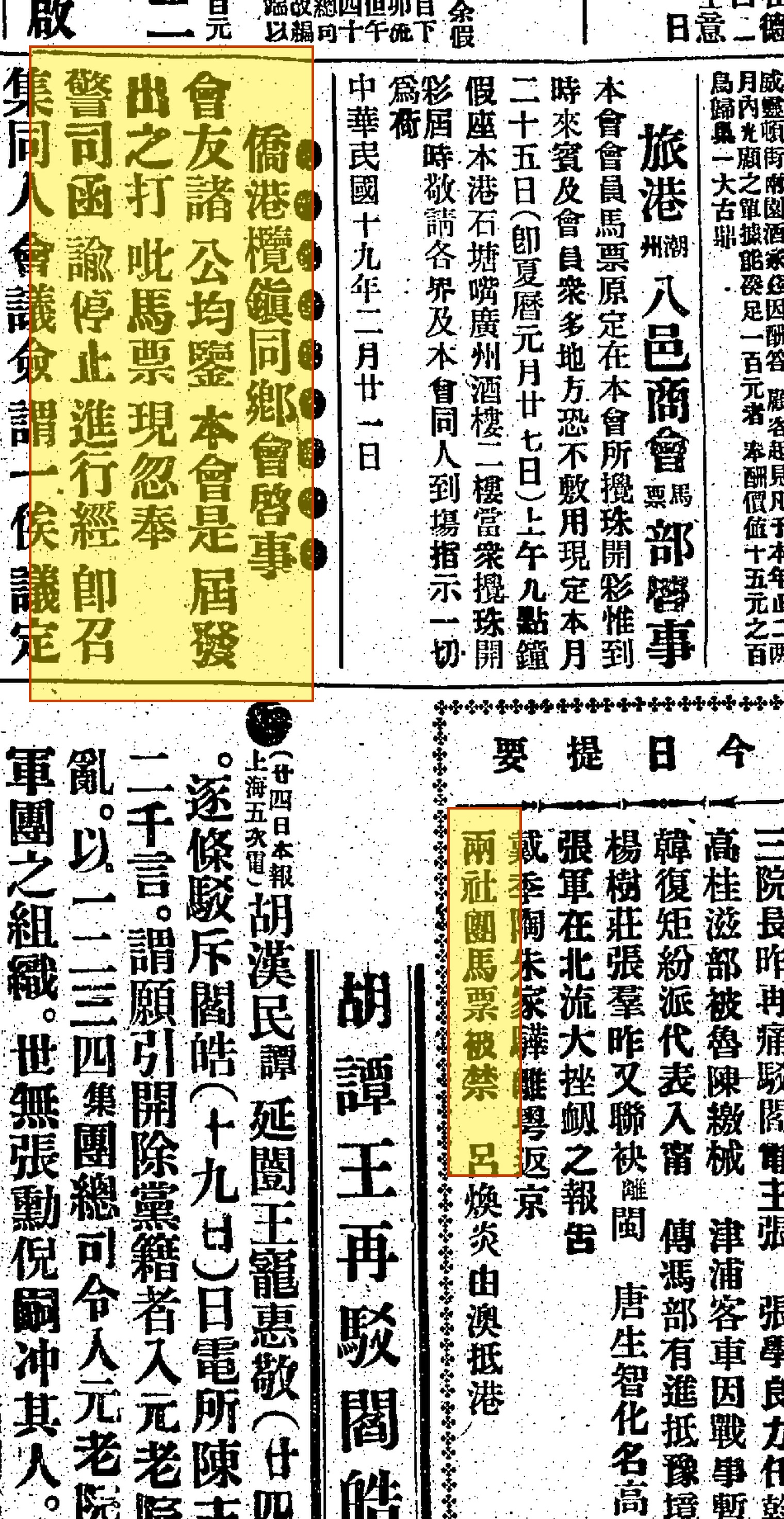
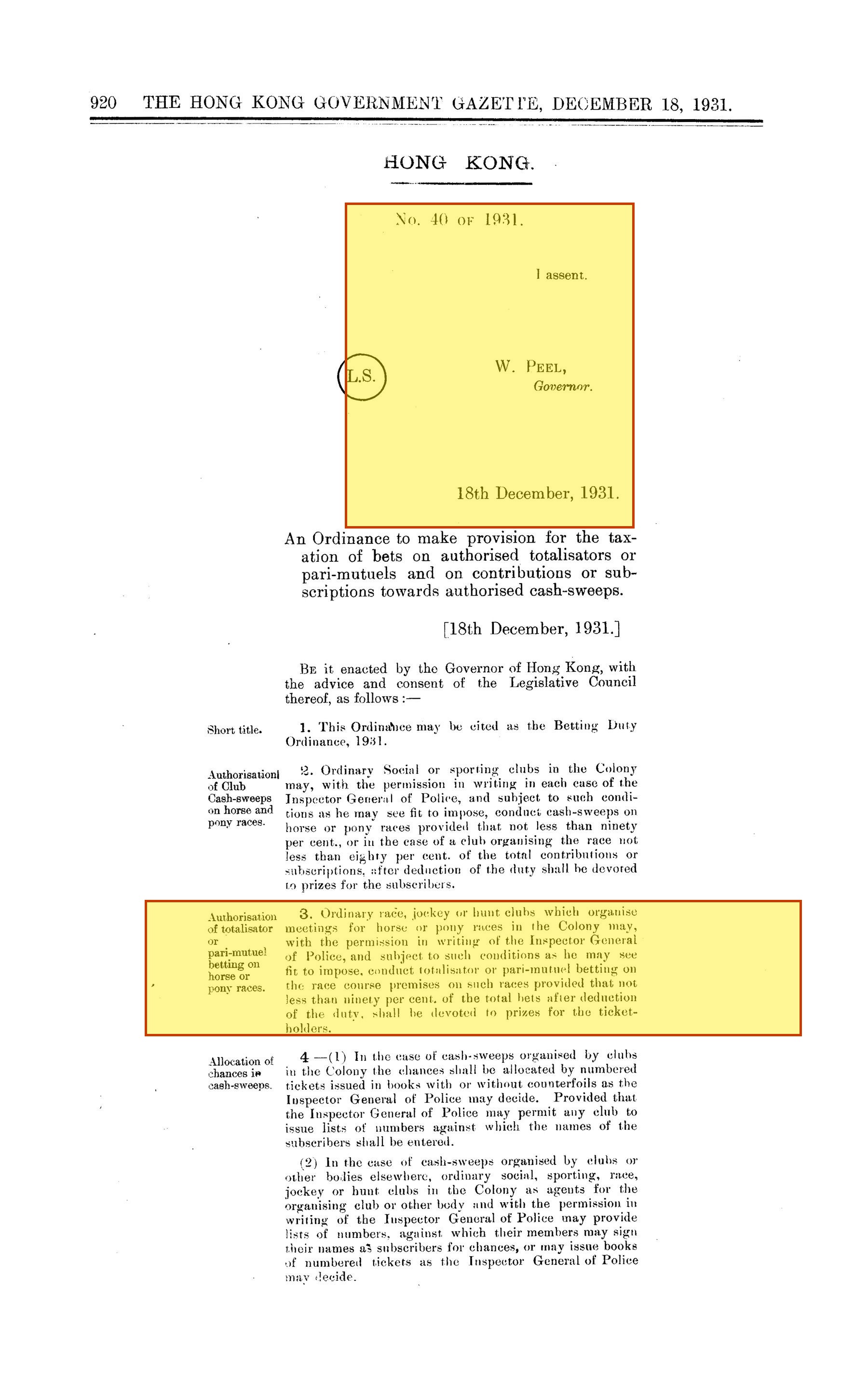
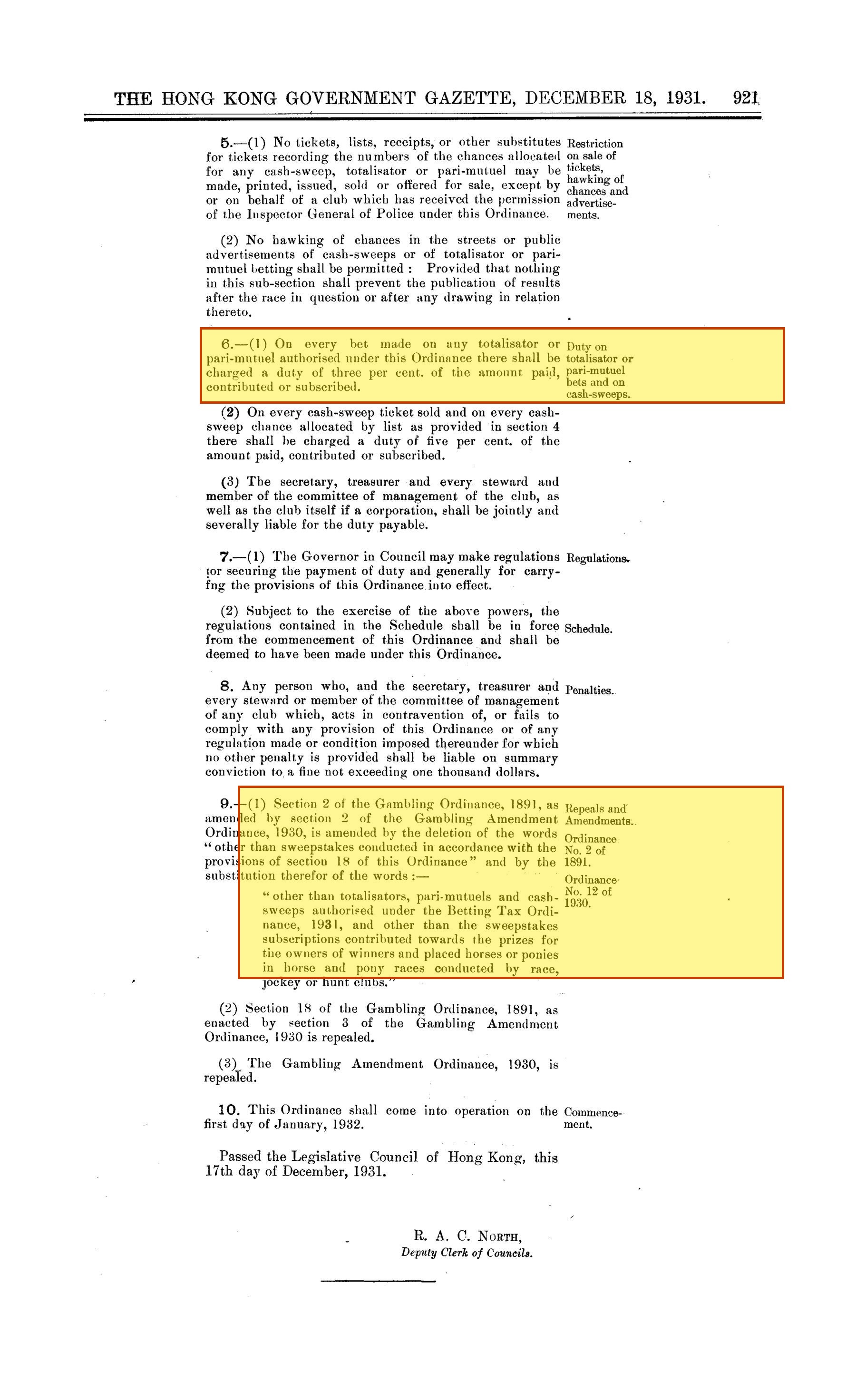
1930 年 2 月,賽馬前夕,工商日報同時刊出一家鄉會的啟事與一則新聞:僑港欖鎮同鄉會的「打吡馬票」被警司去函停止進行,另一家商會的開彩照常舉行;新聞標題是「兩社團馬票被禁」 38。同年 10 月 17 日,《1930 年賭博(修訂)條例》(第 12 號)加入第 18 條:社交或體育會社經警務處長書面批准,可辦賽馬馬票,條件是不少於九成(主辦會社八成)認購額撥作獎金,只准在會所或馬場出售,不得兜售或登廣告 39。1931 年 12 月 17 日通過、18 日獲批的《博彩稅條例》(1931 年第 40 號)更進一步:賽馬會經警務處長批准可在馬場內經營 totalisator 或 pari-mutuel 投注,扣除稅款後不少於九成投注額撥作獎金;「每注徵稅 3%」、馬票 5%;會計、司庫與各董事「共同及各別」承擔稅款;條例 1932 年 1 月 1 日生效 40。1937 年 12 月,定例局決議把稅率改為 2% 41。至此,馬會是發牌機器的經營者,政府是收稅人:1934 年的打吡報道,中文報紙逐場列出「搖彩」首名號碼與派彩;1933 年的賽事更有「七間社團」以打吡開馬票 42。
八、結論
香港的賽馬不是「不禁」的例外,而是「被經營」的例外。山谷由政府批出、馬場由政府劃定、賽馬日由政府封路、totalisator 由政府發牌徵稅;1891 年的取締意圖、1892 年的全禁、1893 年的沉默復出、1930–1931 年的發牌與稅——每一步都是同一部機器與同一個政府之間的討價還價。馬會由公眾認購的委員會變成法人,再變成特許經營者;賭客由「會員免費、非會員 $8」的看台人群,變成「通過中國朋友押 $200 上 totalisator」的普通人。唯一不變的,是機器的位置:它一直在馬場裡,而政府一直站在旁邊。
Histsyn · Independent research
The Racing Machine
The Hongkong Jockey Club and the colony’s licensed game, 1844–1941
Abstract
In 1846 the Wong Nei Chung valley — the malarial marsh the Europeans called Happy Valley — was drained and levelled into a race course. For the next ninety-five years Hong Kong’s racing was rebuilt three times over: from a sport run by a committee elected afresh each year by public subscribers, into a members’ club that took over the subscribers’ fund in November 1884, and finally into a licensed and taxed betting monopoly. The Gambling Ordinance of 1891 was meant to suppress the racecourse totalisator along with every other Chinese game; the machine returned in 1893 quietly, without any amending statute, on the strength of police forbearance; and in 1930–1931 the Government legalised club sweeps and then authorised and taxed the totalisator and the pari-mutuel. This paper reconstructs the machine in six parts: the valley, the subscription races, the founding, the grand stand and its storms, the long argument between the machine and the law, and the settlement of 1930–1931 — from the Friend of China to the Chinese press of the 1930s.
Keywords: Hongkong Jockey Club; Happy Valley; totalisator; pari-mutuel; Gambling Ordinance 1891; Betting Duty Ordinance 1931; horse racing; colonial gambling.
1. The valley (1843–1846)
The valley enters the record as a problem of public health. In 1843 a letter on the colony’s fevers lists “the Happy Valley” among the places of wet cultivation and decaying vegetation 1. In 1844 a survey was “about being made of the so-named Happy Valley”, the writer hoping it was “only preparatory to clearing it of the stagnant water” whose malaria “has so long been engendered, carrying pestilence and death to the European population of that part of the Island” 2. In 1845 a correspondent proposed the valley’s whole future: let the Governor “grant to the public” the entire valley “for the usual period of seventy-five years”, and “it would be adviseable to drain and level it, thus forming a good race course, and a place for recreation” 3. The same spring’s “races” in the same paper are, the reader must notice, boat races — the Royal Naval Regatta, with prizes given by Jardine, Matheson & Co. 3. The horse course is a separate story. In 1846 the editorial voice was still pressing: the Wong-nei-chung valley, undrained, “is not only valueless, but renders property in the vicinity of less value than it would be were the valley thoroughly drained and laid out for cricket, riding, and other amusements” 4.
Then the horses came. The first recorded programme of Hongkong horse races is printed in March 1846: “HONGKONG RACES — First Day, 4th March. THE MAIDEN STAKES for all Ponies not exceeding 12 hands…”, the “Victoria Plate” and, on the second day, “The Hunt’s Plate” and a hurdle race; the stakes are $1 and $2 entries “with $50 added from the Fund”; riders are “Gentlemen”, and “Three to start or no Race” 5. By December the programme had found its vocabulary: “The Valley Stakes”, side by side with the Black Stakes, whose winner was “to be sold for $100, claimed of the Judge within a quarter of an hour” — the claiming race, and the subscription fund already in the arithmetic (“Entrance free, $50 given for the Fund”) 6. The machinery of the meeting is in four lines of a Race Committee notice: entries “in writing, addressed to ‘The Secretary of the Race Committee, at the Club House’, stating the Name and Colour of the Horse, and Colours of the Riders”; ponies to be sent “to Spring Gardens to be measured”; “The Race Committee invite the above [notices] as their final decision” 7. And the meeting’s report: “The weather having continued fine the Course in the Valley is again in a fit condition for riding over, and the Races are definitely fixed to come off to-morrow and next day, and from the number of Entries for each Race, good sport is anticipated”; the Committee asks that dogs not be brought onto the ground, “as when they run [about] they are frequently the cause of accidents”; and afterwards: “The Races have passed off in the satisfaction of everybody — the losers always excepted” 8.
2. The subscription races (1846–1884)
The racing of the middle decades was a subscription enterprise, and its physical trace was the stand. In January 1849 L. Encarnação advertised that he had “obtained permission to erect a Stand on the Race [Course] during the meeting”, with admission by ticket, a refreshment bar, and one prohibition: “Wines and Spirits are not allowed” 9. By 1850–1851 the meetings were signed by “JOHN KING, 59th Regiment, Clerk of the Course”, and their cups had names — the Queen’s [Plate], the Canton Cup, “THE TRADESMEN’S CUP… for all untrained Horses. Weight for inches” 10. The annual pages of the Friend of China show the meetings running, year after year, through 1848–1853 11.
The daily press inherits the same system. The Grand Stand is advertised in 1864 12, and in the 1870s and 1880s admission is still sold for the meeting: in February 1888, “For Members, Free; for Non-Members $8 for the Meeting. For Admission to the New Stand $8… TICKETS OF ADMISSION… on application to R. W. Rutter, Esq., Honorary [Secretary]”, with Jardine, Matheson & Co. acting as “Agents of the Jockey Club” 13. The meeting of February 1871 shows the organism at work: it was “agreed to raise the weights for the Derby”; the first day’s company included “a large number of ladies”; and the meeting learned that “the balance due on the Club Furniture has been paid off” 14. The Derby itself — “Hongkong Derby day” appears in a leader of November 1868; “THE HONGKONG DERBY — Sweepstakes” with its list of ponies (Capt. Guntrie’s Spotted Dog among them) in March 1873 15. The modern account that the Derby was first run in 1873 is compatible with the record; the name is older than the account allows, and no founding notice survives.
3. The founding (November 1884 – January 1885)
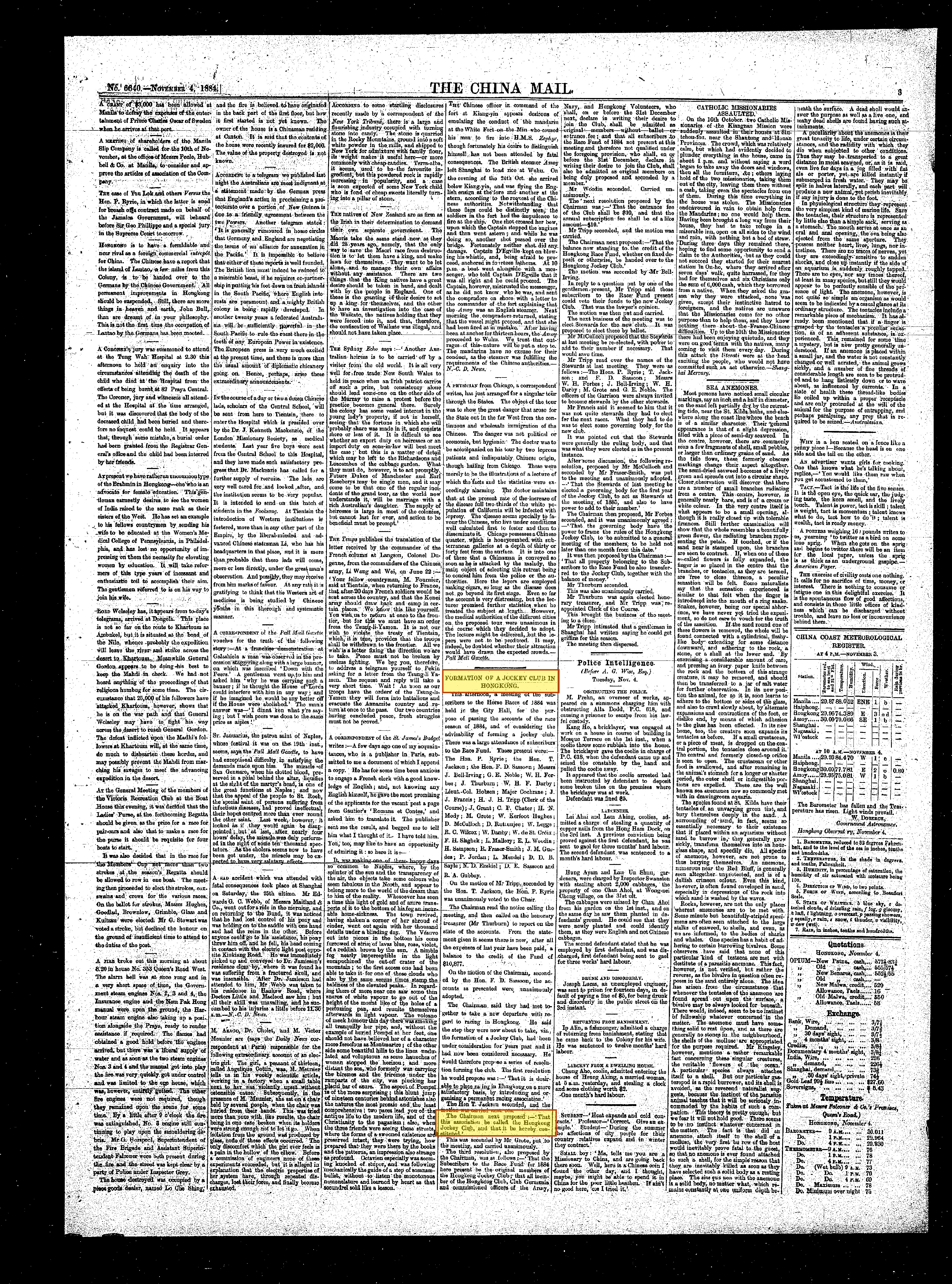
On 28 October 1884 a notice went into the daily press: “A MEETING OF THE SUBSCRIBERS TO THE RACES of 1884 will be held at the City Hall… for the purpose of passing the Accounts of the Race Season of 1884, and of considering the advisability of placing Racing in Hongkong on a more [satisfactory] footing by the formation of a Jockey Club. The Stewards will submit to the Meeting a series of Resolutions for the organization of such a Club. By Order, H. J. H. Tripp, C.C.” 16. The meeting sat on the afternoon of Tuesday 4 November 1884. The China Mail’s same-evening report opens: “This afternoon, a meeting of the subscribers to the Horse Races of 1884 was held in the City Hall… There was a large attendance of subscribers to the Race Fund. Those present were:— The Hon. P. Ryrie; the Hon. T. Jackson; the Hon. F. D. Sassoon; Messrs J. Bell-Irving; G. E. Noble; W. H. Forbes; J. Thurburn; W. H. F. Darby; Lieut.-Col. Hobson; Major Cochrane; J. J. Francis; H. J. H. Tripp (Clerk of the Course); J. Grant; C. P. Chater; H. N. Mody; M. Grote; W. Kerfoot Hughes; D. McCulloch; D. Ruttunjee; W. Legge; R. C. Wilcox; W. Danby; W. de St. Croix; F. H. Slaghek; L. Mallory; E. L. Woodin; H. Sampson; R. Fraser-Smith; J. M. Guedes; P. Jordan; L. Mendel; D. D. B. Sayle; N. D. Ezekiel; D. E. Sassoon and R. A. Gubbay. On the motion of Mr Tripp, seconded by the Hon. T. Jackson, the Hon. P. Ryrie was unanimously voted to the Chair.” 17
The treasurer — “the honorary treasurer (Mr Thurburn)” — reported “a balance to the credit of the Fund of $10,877”; the accounts were adopted; and the Chairman opened the real business: “The other business we have before us to-day is the formation of a Jockey Club. We are taking a rare departure in Hongkong in racing matters. It has long been felt by influential members of the community that this step… should be taken”; the English Jockey Club, he reminded the room, “is governed by the Stewards” 18. The resolutions followed. The first: “That it is desirable to place racing in Hongkong on a more satisfactory basis, and for the purpose to organise a permanent racing association” (seconded by the Hon. T. Jackson; carried nem. con.). The second: “The Chairman next proposed: — ‘That this association be called the Hongkong Jockey Club, and that it be hereby constituted.’ … This was seconded by Mr. Grote, put to the meeting, and carried unanimously.” The third made the membership: “That the Subscribers to the Race Fund for 1884 here present be the original members of the Hongkong Jockey Club; that all member[s] of the Hongkong Club, Club Germania and commissioned officers of the Army, [Navy and Volunteers] who shall [before] December next declare in writing their desire to join the Club…” — the tail of the clause is damaged in both witnesses and is not reconstructed here. The fifth: “That the balances now standing to the credit of the Hongkong Race Fund, whether on fixed deposit or otherwise, be handed over to the Hongkong Jockey Club” (seconded by Mr. Bell-Irving). And the last: the stewards. Mr McCulloch moved “that the Stewards of the last Meeting be re-elected with power to add to their number”; Mr Fraser-Smith seconded with the club’s first constitutional principle: “It is simply a question of names. The English Jockey Club is governed by the Stewards… I presume it will be an annual election.” The China Mail’s report adds the governing resolutions: the stewards of the last meeting “elected a governing body for the first year”, for the meeting of 1885, with “power to add to their number”; “That the governing body have the power to frame the rules of the Hongkong Jockey Club, to be submitted to a general meeting of the members; to be held not later than one month from this date”; and “all property belonging to the Subscribers to the Race Fund” transferred to the club 1718. The subscription resolution’s amount is garbled in the only full report and is left unstated 18.
The next morning’s leader gave the verdict: “The Hongkong Jockey Club is at length an accomplished fact, and these sports will in future be managed and controlled by [a] properly constituted permanent body instead of by a Committee annually elected for the occasion by the subscribers to the Race Fund… In Shanghai a Race Club has existed for [many] years, and it owns the Race Course and Stand… The new Jockey Club will, however, take over the property of the Race Fund” 19. A January chronicle line dates the event for the record: “4th — Meeting at City Hall, Hongkong, at which the Hongkong Jockey Club was formed” 43. And on 28 January 1885 the members met at St Andrew’s Hall “for the purpose of laying before them the Rules of the Jockey Club as drawn [up] by the Stewards” 20.
4. The grand stand and its storms (1888–1893)
The town’s own portrait of the races, printed in the Directory and Chronicle for 1888 and repeated almost unchanged in 1930, is the best single description the record holds: “The annual races are held at the latter end of February, under the auspices of the Hongkong Jockey Club, on the Race Course in Wong-nai Chung Valley, at the east end of the town, a beautiful spot enclosed by fir-clad hills. On this occasion the whole colony makes holiday, and the stands and course are crowded with one of the most motley collections of humanity to be seen in any part of the world. Most of the races are run with North China ponies, and there is generally good sport.” 24 The physical plant was less poetic. The “New Stand” of the February 1888 meeting 13 was wrecked that August, when a gale drove the barometer to 29.42 and, in the Daily Press’s summary, “never before in the memory of the oldest resident has the damage to property generally been so great and widespread… walls fell right and left, and… the Race-course entirely collapsed” 21. The Telegraph’s list of the lost included “the splendid new Grand Stand on the race course… (it always had a list to starboard)” and the stables 22. By March 1889 the press was discussing a new stand again 22; and by the meeting of 1893 the rebuilt house was ready: “the splendid Grand Stand of the Jockey Club was opened by His Excellency and Lady Robinson on the first day, in the presence of a brilliant assemblage of ladies and gentlemen” 23.
5. The machine and the law (1890–1894)
By the season of 1890–91 the totalisator was on the course. The December 1890 programme carries a race named for it — “THE TOTALIZATOR CUP, value $150” 25 — and the February 1891 race report reads like a betting page: “the amount put upon him at the totalisator was $195”, and across the meeting “the increase in the totalizator” 26. The machine pooled the crowd’s money and paid dividends in proportion: precisely the form of gambling the Government was preparing to end.
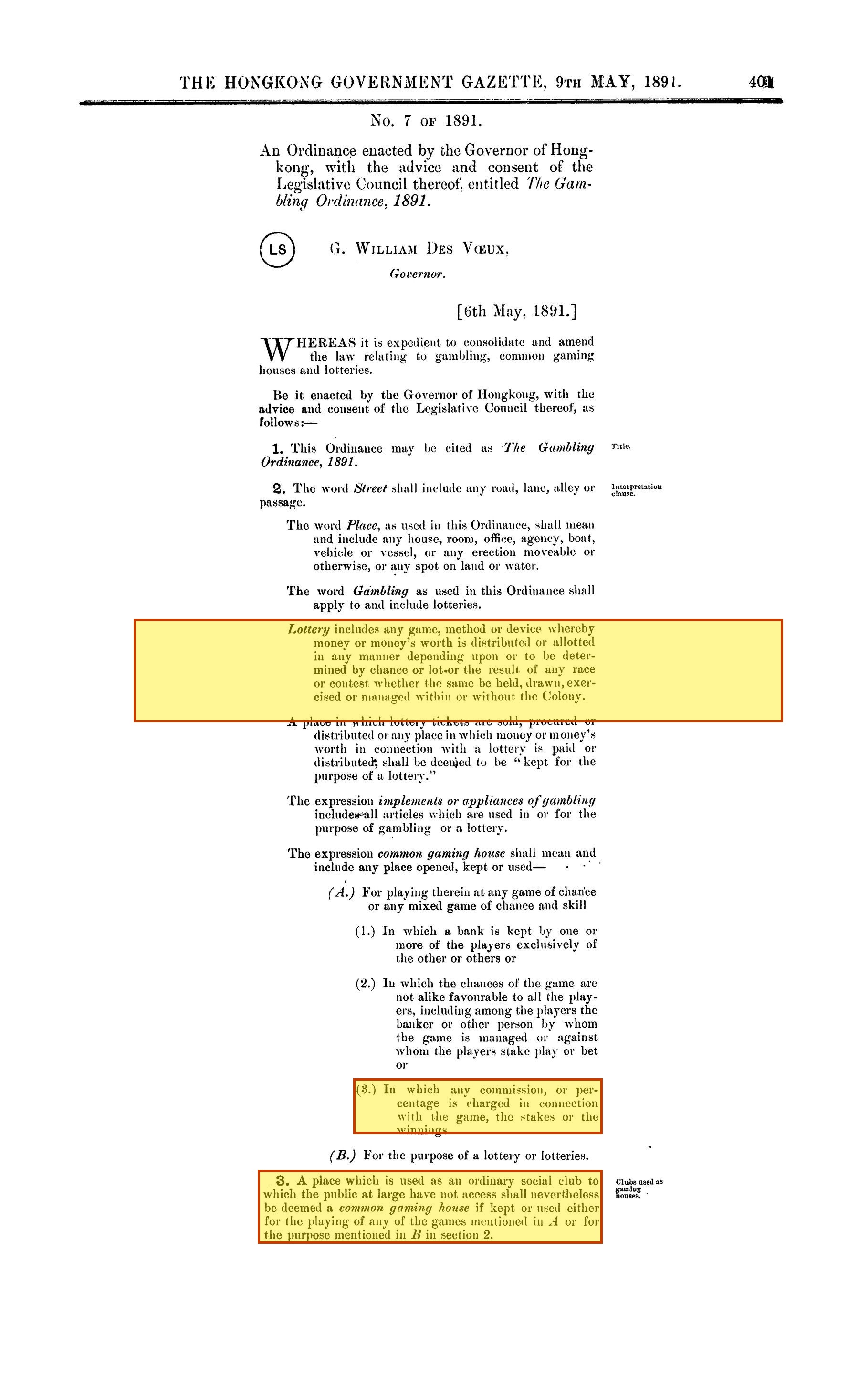
The Gambling Ordinance, 1891 (No. 7 of 1891) is a consolidation — “to consolidate and amend the law relating to gambling, common gaming houses and lotteries” — and its machinery catches the totalisator without ever naming it. A “common gaming house” expressly includes a place kept for play “[i]n which any commission, or per-centage is charged in connection with the game, the stakes or the winnings”; “Lottery” is defined to include “any game, method or device whereby money or money’s worth is distributed or allotted in any manner depending upon or to be determined by chance or lot or the result of any race or contest whether the same be held, drawn, exercised or managed within or without the Colony”; and section 3 closes the club loophole: “A place which is used as an ordinary social club to which the public at large have not access shall nevertheless be deemed a common gaming house if kept or used either for the playing of any of the games mentioned in A or for the purpose mentioned in B in section 2.” 27 The Governor, Sir George William Des Voeux, said in Council on 30 April 1891 why he had gone so far: “While passing a law of this kind for the restriction of gambling among the Chinese it would be in my opinion in the highest degree unjust to omit such forms of gambling as the totalisator at the races. That in my opinion has all the objections of licensed gambling houses without the advantage a law for the licensing of gambling houses would have… I consider the totalisator infinitely worse than betting on account of its extreme ease… If any gambling has to be stopped the totalisator is to my mind decidedly as bad as any other form of gambling, and it is therefore the intention of this Ordinance to suppress it. I know from personal experience it causes people to gamble who would not think of it otherwise, and I think it would be the greatest injustice… to stop Chinese gambling and not stop that. Consequently I have specially introduced a clause in reference to it, so that when people talk of putting down all gambling they may know what it means themselves.” 28 The ordinance was passed on 5 May, assented on 6 May 1891, and gazetted on 9 May 27.
February 1892 shows the law landing. On the eve of the meeting the Hongkong Telegraph printed a mock death notice: “DIED, Feb. 18th, 1892. THE HONGKONG RACES, Aged [n] years, from an overdose of Grandmotherly Legislation. The funeral will take place at Happy Valley, to-morrow… Undertakers: Messrs. Goodman and Leach. N.B. — Bishop Bordon will officiate…”, with verses that made the cause explicit — “You bet we’re broken hearted / Oh no, you mustn’t bet… Shun the totalisator / And the pari-mutuel, / As you would an alligator, / Or an express train to a very bad place.” 29 The meeting was held, without the machines; the China Mail’s satire asked “Who killed the Races?! ‘I’ said Des Vox [Des Voeux], With my power of Veto I killed the Races…” and complained that “the pari-mutuel or totalisator might have become the means of aiding the Charities of the Colony… had the local sports (the Jockey Club Stewards) taken any pains to obtain special immunities for the public” 30. The Telegraph’s leader described what enforcement actually meant: “The partial enforcement of some of its provisions during the recent races resulted in nought but annoyance to the general public and disgrace to those who are paid to see to it that the law of the land does not become a dead letter… a couple of unfortunate coolles, who knew not the law, [were] brought before the Magistrate and mulcted in the sum of $5 each, with the alternative of ten days’ imprisonment with hard labour. And why? For committing the awful crime of ‘gambling on the race-course!’” 30
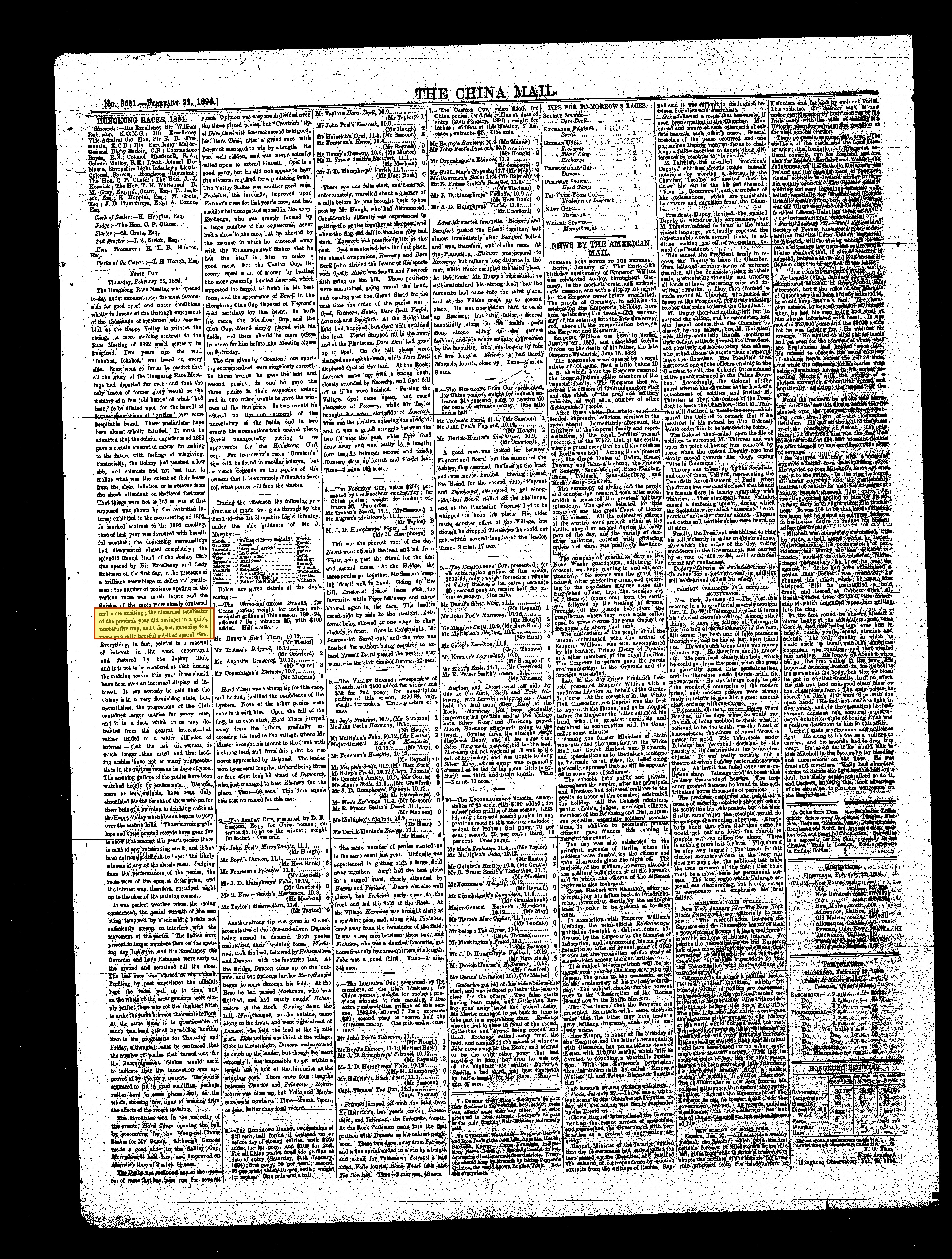
Then came the campaign and the quiet surrender. A bill to legalise the machine “on racecourses” was reported in preparation in November 1892, its fee clauses too garbled by column interleaving to be quoted 44; the Sydney Bulletin was reprinted in the Telegraph: “the introduction of the totalisator — its legalization on the racecourse — [does] good to both sport and the public… the clubs, in addition to the dividend on betting investments, would greatly gain by the increased gate-money” 31; and a correspondent signing himself “AN OLD SPORTSMAN” wrote in February 1893: “the question of whether or not a return to the status in quo as regards sweeps and the totalisator at the forthcoming race meeting has been raised… if a gentleman’s promise is to be relied on, the good old times under previous Governors… so far as concerns the freedom from police interference in a harmless custom recognised in nearly all British colonies, will be [restored]” 31. The retrospective in the China Mail of 22 February 1894 records the result: “In marked contrast to the 1892 meeting, that of last year was favoured with beautiful weather… the number of ponies competing in the various races was much larger and the finishes… more closely contested and more exciting; the discarded totalisator of the previous year did business in a quiet, unobtrusive way, and this, too, gave rise to a more generally hopeful spirit of speculation. Everything, in fact, pointed to a renewal of interest in the sport encouraged and fostered by the Jockey Club.” 23 No amending statute stands between 1891 and 1930 in this record: the machine returned because the police stopped interfering, and the press said so in the club’s own retrospective.
6. The machine in full view (1894–1930)
For the next three decades the course ran on three betting channels at once. The 1898 meeting’s own reviewer, writing in the form of “That…” resolutions, grumbled that “to those who do not comprehend the eminently fair rules of the Pari [Mutuel] system, some surprise and no little amusement were exhibited at the vagaries of the chances and results”, and confessed: “some of my friends seem to have a leaning towards the Totalisator rather than the Pari Mutuel system… I consider the Pari Mutuel to be a very good safety-valve for the surplus eagerness…” 32 The November 1899 report treats the three as permanent furniture: “The Pari, Totalisator and the [bookmakers] had their share of constituents and everything was carried out in fair time” 33. By then the machine had entered ordinary lives: in a bankruptcy case of November 1899 the debtor testified that “he went to the Race Meeting. Last October he took $200 to the meeting and put it on the totalisator, through his Chinese friends” 34.
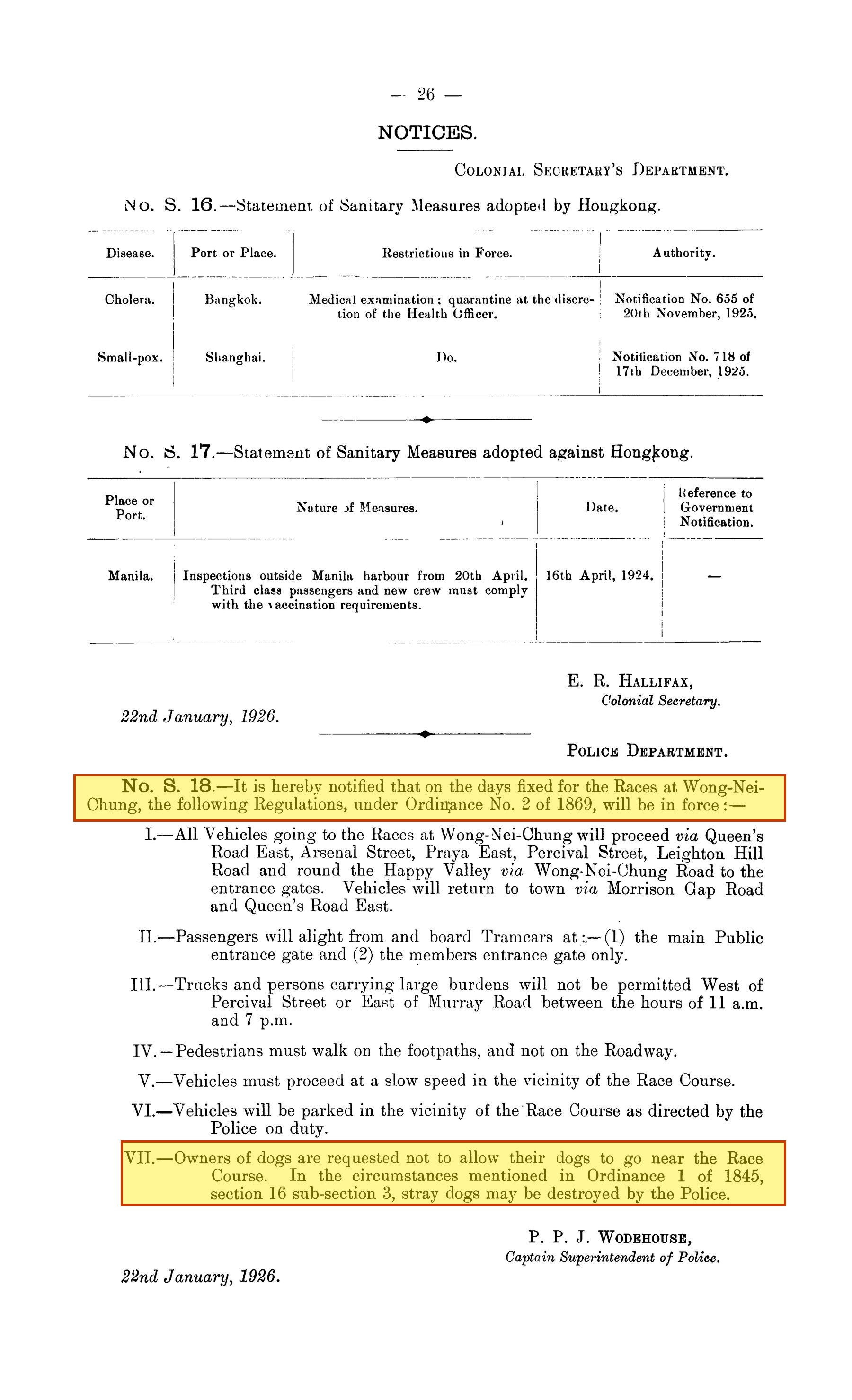
The club itself is visible mainly through its officers and its addresses. The Directory for 1895 lists “JOCKEY CLUB — Stewards: Hon. J. J. Keswick, M. Grote, Hon. C. P. Chater, J. D. Humphreys, R. M. Gray, T. Jackson, A. Coxon, H. E. Hobson, D. Gillies, J. C. Peter (hon. treasurer), T. F. Hough (clerk of course), Hart Buck (acting clerk of course)” 35. The 1910 Directory files the club among the colony’s “Recreation Clubs”; the 1930 edition repeats the 1888 description of the races word for word 24. And the state’s paperwork tracks the course as geography. On 22 January 1926 a police notice — No. S. 18, “under Ordinance No. 2 of 1869” — set out what the days fixed for the races at Wong-Nei-Chung would mean in practice: every vehicle to approach “via Queen’s Road East, Arsenal Street, Praya East, Percival Street, Leighton Hill Road and round the Happy Valley via Wong-Nei-Chung Road to the entrance gates”; tram passengers to alight at “the main Public entrance gate and… the members entrance gate only”; trucks and burden-bearers banned west of Percival Street or east of Murray Road between 11 a.m. and 7 p.m.; vehicles to “proceed at a slow speed in the vicinity of the Race Course… as directed by the Police on duty”; and, finally, “Owners of dogs are requested not to allow their dogs to go near the Race Course. In the circumstances mentioned in Ordinance 1 of 1845, section 16 sub-section 3, stray dogs may be destroyed by the Police” 36. The same year’s gazette carried the Government’s tender for the Wong Nei Cheong nullah “from Chinese Race Stand to open nullah south-east of Jockey Club Stables” 37 — the Chinese stand and the club’s stables as fixed points of the colonial map.
7. The settlement (1930–1937)
The endgame runs in two years and two statutes. In February 1930, on the eve of the races, the Chinese press of the colony printed both sides of the squeeze in a single edition of the Kung Sheung Daily News: a notice from the Kong Lam Tsun native-place association announcing that its “Derby sweep tickets” (打吡馬票) had “now suddenly received a letter from the Police Superintendent ordering a stop”, and, beside it, another association’s notice moving its sweep draw to a Shek Tong Tsui restaurant because too many members were expected; over both sat the news headline “Two associations’ sweep tickets banned” (兩社團馬票被禁) 38. In October 1930 the legislature regularised at least part of that world: the Gambling Amendment Ordinance, 1930 (No. 12 of 1930, assented 17 October), inserted a new section 18 into the 1891 Act — “Ordinary social or sporting clubs in the Colony may, with the approval in writing of the Inspector General of Police, conduct sweepstakes on horse or pony races provided… (a) Not less than ninety per cent., or in the case of a club organising the race not less than eighty per cent. of the total subscription shall be devoted to prizes for the subscribers. (b)… pari-mutuel or cash-sweep tickets sold by the club organizing the race on the premises of the race course during the meeting… no tickets shall be sold… (c) No hawking of chances or advertisements of the sweepstakes shall be permitted.” 39
Then the club itself was licensed. The Betting Duty Ordinance, 1931 — Bill printed December 1931, enacted as No. 40 of 1931, passed by the Council on 17 December, assented by Governor Peel on 18 December, and “in operation on… the first day of January, 1932” — provided in section 3: “Ordinary race, jockey or hunt clubs which organise meetings for horse or pony races in the Colony may, with the permission in writing of the Inspector General of Police, and subject to such conditions as he may see fit to impose, conduct totalisator or pari-mutuel betting on the race course premises on such races provided that not less than ninety per cent. of the total bets after deduction of the duty, shall be devoted to prizes for the ticket-holders.” Section 6 set the price of the licence: “On every bet made on any totalisator or pari-mutuel authorised under this Ordinance there shall be charged a duty of three per cent. of the amount paid, contributed or subscribed”; five per cent on cash-sweep tickets; and “The secretary, treasurer and every steward and member of the committee of management of the club, as well as the club itself, shall be jointly and severally liable for the duty payable.” Section 9 rewrote the 1891 Act’s definitions so that the licensed machines and sweeps stood outside the gambling law — “other than totalisators, pari-mutuels and cash-sweeps authorised under the [Betting Duty] Ordinance, 1931, and other than the sweepstakes subscriptions contributed towards the prizes for the owners of winners and placed horses or ponies in horse and pony races conducted by race, jockey or hunt clubs” — and repealed the 1930 amendment that section 18 had come in through. The Attorney General’s Objects and Reasons put the colony in its regional company: “In the Straits Settlements and Federated Malay States a similar object has been effected by amendment to the Stamp Ordinance… In Ceylon a special Ordinance, the Betting on Horse-racing (Taxation) Ordinance, 1930, has been preferred.” 40
The rate moved with the finances: a resolution of 15 December 1937 revoked the 1934 scale and fixed, “with effect from the 1st April, 1938… on every bet made on any totalisator or pari-mutuel authorized under the Betting Duty Ordinance, 1931… a duty of Two per cent. of the amount paid, contributed or subscribed.” 41 And the machine worked: the Chinese press of the 1930s reports every meeting. On 20 February 1933 the Kung Sheung Daily News counted the Derby sweeps of the season — seven associations running tickets on the race, their draws held at the Nam Wah Athletic Association, the Chinese Chamber, the Ching Wu Athletic Association and the rest 38; on 27 February 1934 the Derby report runs through thirteen starters, jockeys and time, and then prints the sweep results race by race — first prize ticket number 185, $562; and so on down the card 42. What began as a subscription fund of $10,877 had become a taxed industry.
8. Conclusion: the licensed exception
If the GamblingLottery thread followed the games the colony tried to suppress, this is the game it licensed and cherished — and the contrast is the point. The racecourse’s betting was never outside the law’s attention: it was inside the law’s paperwork. The valley was drained by public proposal in 1845; the fund was administered under rules from 1846; the club was constituted by its subscribers in 1884; the police closed the roads, marshalled the gates and shot the stray dogs from 1869’s ordinance onward; the Governor argued in 1891 that the totalisator had “all the objections of licensed gambling houses”; and in 1930–31 the legislature wrote the machine into the statute book as a licensed, capped, taxed and charitable industry. The three regimes of the machine were all the same bargain, renewed: the colony kept the racing, the club kept the machine, and the Government took its share — first as order (police forbearance, race-day regulation), then as law (1930–31), and finally as revenue (3 per cent, then 2). The stands were rebuilt after every storm; the machine was never shut down by anything except 1892, and not for long. On the record’s own showing, that is how horse-racing became the one mass gambling the colony would own.
Appendix A. The chronology in brief
| Date | Event | Ref |
|---|---|---|
| 1843 | “Happy Valley” named as malarial ground | 1 |
| 1844 | Survey of Happy Valley; clearing the stagnant water | 2 |
| 1845 | The drain-and-racecourse proposal (75-year grant) | 3 |
| 1846-03 / 1846-12 | The first recorded race programmes; the Valley Stakes; the Club House committee | 567 |
| 1849 | The first private stand (ticketed; no spirits) | 9 |
| 1850–53 | Clerk of the Course (59th Regiment); the cups; annual meetings | 1011 |
| 1868–73 | “Hongkong Derby day”; the Derby Sweepstakes entries | 15 |
| 1884-11-04 | The founding meeting; $10,877 transferred; the club named | 1718 |
| 1885-01-28 | The rules laid before the members | 20 |
| 1888 / 1888-08 | The New Stand; the gale wrecks the course works | 132122 |
| 1890–91 | The totalisator at work (Totalizator Cup; $195 on Enid) | 2526 |
| 1891-05-06/09 | The Gambling Ordinance (No. 7 of 1891) enacted; the Governor’s suppression clause | 2827 |
| 1892-02 | The machines stopped; the mock obituary; coolies jailed | 2930 |
| 1893-02 | The machine back “in a quiet, unobtrusive way”; the new Grand Stand opened by the Robinsons | 23 |
| 1898–99 | Totalisator + pari-mutuel + bookmakers in open operation | 3233 |
| 1926-01-22 | The race-day traffic regulations; the Chinese Race Stand and club stables on the map | 3637 |
| 1930-02 / 1930-10-17 | The Derby-sweep ban; the Gambling Amendment Ordinance (No. 12 of 1930) | 3839 |
| 1931-12-18 / 1932-01-01 | The Betting Duty Ordinance (No. 40 of 1931) assented; in force | 40 |
| 1937-12-15 / 1938-04-01 | The duty cut to 2 per cent | 41 |
Appendix B. Evidence register (summary)
Confirmed (two or more witnesses, or single authoritative prints): the valley’s malarial state and drainage proposals, 1843–46 1234; the first recorded race programmes (March and December 1846) 56; the Race Fund / Race Committee / Club House system 714; the 1884 founding meeting, its resolutions and the $10,877 transfer 171843; the rules meeting of 28 January 1885 20; the town’s description of the races under the club’s auspices 24; the New Stand of 1888 and the August 1888 wreck 132122; the totalisator at the 1890–91 meetings 2526; the 1891 ordinance’s machinery and the Governor’s speech 2728; the 1892 suppression and its press battle 2930; the quiet return by the 1893 meeting 23; the open three-channel betting of 1898–99 323334; the club’s 1895 officers 35; the 1926 race-day regimen and the stand/stables geography 3637; the 1930–31 settlement 3940; the 1937 rate change 41.
Single-witness / uncertain: the phrase “Hongkong Derby day” (1868) — a garbled leader, registered not asserted 15; the subscription resolution’s amount (1884) — garbled in the only full report 18; the membership clause’s tail (1884) — damaged in both witnesses 17; “the starting prices… returned by the Totalizator” (1886) — a syndicated-page risk, not asserted as Hongkong practice 45; the 1892 legalisation bill’s fee clauses — garbled 44; the Chinese Race Stand’s building history — only the 1926 naming survives 37.
Conflicts (registered, unreconciled): the Derby’s beginning — the name in 1868, the entries in 1873, the modern “first run 1873” 15; the 1888 gale’s precise date — the Telegraph’s “Friday morning” versus the Daily Press’s undated summary 2122; the machine’s legal position 1893–1930 — nominally unlawful under the 1891 Act, actually operating; no amending statute in the record before 1930 2339; “Betting Duty” vs “Betting Tax” naming inside the enacted 1931 ordinance itself 40; the duty rate — 3 per cent (1931/34) against 2 per cent (from 1938) 4041.
False positives (do not use): the Manila Jockey Club in the Directories of 1876–88 46; Shanghai’s “Mongol Cup” and the unplaceable mixed column of May 1893 47; the 1845 “races” = the Royal Naval Regatta 3; “Derby” as Lord Derby; the Directory’s Chinese lines beside the club entry (another firm’s name) 35; the pre-1926 gazette text-engine silence (a coverage artefact, not a fact) 37.
Gaps: the racecourse’s land tenure (no grant or lease document found; not asserted) 18; club minutes and membership registers (none in the corpus) 35; the post-1889 stands’ building history beyond the 1893 opening and the 1926 naming 2337; the first Chinese members (no membership document; the Chinese presence is documented through the crowd, the press and the 1930s coverage) 38; the 1884 subscription amount 18.
Notes
“Happy Valley” in a health letter (malaria; “wet cultivation”), Friend of China, 1843, p. 123. https://hkintexts.histsyn.com/page/3028925 (accessed 2026-11-10). ↩
“A survey is about being made of the so-named Happy Valley”, Friend of China, 1844, p. 64. https://hkintexts.histsyn.com/page/3029007 (accessed 2026-11-10). ↩
The drain-and-racecourse proposal (p. 41), with the Royal Naval Regatta pages (pp. 29/31/34/35 — the “races” of that spring are boat races), Friend of China, 1845. https://hkintexts.histsyn.com/page/3029229 ; /3029217 ; /3029219 ; /3029222 ; /3029223 (accessed 2026-11-10). ↩
“the Wong-nei-chung valley. In its present state, it is not only valueless…”, Friend of China, 1846, p. 49. https://hkintexts.histsyn.com/page/3029483 (accessed 2026-11-10). ↩
“HONGKONG RACES” programme (First Day, 4th March), Friend of China, 1846, p. 43. https://hkintexts.histsyn.com/page/3029477 (accessed 2026-11-10). ↩
December meeting programme (“The Valley Stakes”), Friend of China, 1846, p. 220. https://hkintexts.histsyn.com/page/3029654 (accessed 2026-11-10). ↩
Race Committee notices (“at the Club House”; “Spring Gardens”), Friend of China, 1846, p. 222. https://hkintexts.histsyn.com/page/3029656 (accessed 2026-11-10). ↩
The race-week report and afterword, Friend of China, 1846, pp. 228–231. https://hkintexts.histsyn.com/page/3029662 ; /3029663 ; /3029665 (accessed 2026-11-10). ↩
L. Encarnação’s stand notice, Friend of China, 1849, p. 11. https://hkintexts.histsyn.com/page/3029999 (accessed 2026-11-10). ↩
The Clerk of the Course and the cups, Friend of China, 1850 p. 211; 1851 pp. 4, 22. https://hkintexts.histsyn.com/page/3030445 ; /3030462 ; /3030480 (accessed 2026-11-10). ↩
The annual meeting pages, Friend of China, 1848–1853 (pp. 8/14/28/30 of 1848; pp. 10/11/30/57/190 of 1849; pp. 120/121/143/185/209/211/213/220 of 1850; pp. 4/9/11/20/22/24/27 of 1851; pp. 23/28 of 1852; p. 21 of 1853). https://hkintexts.histsyn.com/page/3029918 ; /3029938 ; /3029998 ; /3030018 ; /3030045 ; /3030178 ; /3030354 ; /3030355 ; /3030377 ; /3030419 ; /3030443 ; /3030445 ; /3030447 ; /3030454 ; /3030462 ; /3030467 ; /3030469 ; /3030478 ; /3030480 ; /3030482 ; /3030485 ; /3030733 ; /3030738 ; /3030964 (accessed 2026-11-10). ↩
Grand Stand advertisements, Daily Press, 4 January 1864, p. 2, https://hkintexts.histsyn.com/page/2217679 ; and 2 February 1864, p. 2, https://hkintexts.histsyn.com/page/2217779 (accessed 2026-11-10). ↩
Grand Stand tickets (“Members, free; for Non-Members $8 for the Meeting”), Daily Press, 17 February 1888, p. 1. https://hkintexts.histsyn.com/page/2202893 (accessed 2026-11-10). ↩
Meeting notes (Derby weights raised; “a large number of ladies”; the club furniture paid off), Daily Press, 8 February 1871, p. 1. https://hkintexts.histsyn.com/page/2226344 (accessed 2026-11-10). ↩
The Derby: leader mention, Daily Press, 24 November 1868, p. 2, https://hkintexts.histsyn.com/page/2223595 ; and “THE HONGKONG DERBY — Sweepstakes” entries, Daily Press, 6 March 1873, p. 2, https://hkintexts.histsyn.com/page/2228252 (accessed 2026-11-10). ↩
The founding notices, Daily Press, 1 November 1884, p. 1, https://hkintexts.histsyn.com/page/2198796 ; and 3 November 1884, p. 1, https://hkintexts.histsyn.com/page/2198800 (accessed 2026-11-10). ↩
“Formation of a Jockey Club in Hongkong”, China Mail, No. 6840, 4 November 1884, p. 3. https://hkintexts.histsyn.com/image-page/1198038 (accessed 2026-11-10; read on the scan). ↩
The founding meeting report, Daily Press, 5 November 1884, p. 2. https://hkintexts.histsyn.com/page/2198809 (accessed 2026-11-10; column-interleaved OCR — quoted fragments only). ↩
“The Hongkong Jockey Club is at length an accomplished fact”, Daily Press, 6 November 1884, p. 2. https://hkintexts.histsyn.com/page/2198813 (accessed 2026-11-10; column-interleaved — quoted fragments only). ↩
The rules meeting notice, China Mail, 26 January 1885, p. 2, https://hkintexts.histsyn.com/page/1898001 ; and Daily Press, 27 January 1885, p. 1, https://hkintexts.histsyn.com/page/2199086 (accessed 2026-11-10). ↩
The gale’s damage (“the Race-course entirely collapsed”), Daily Press, 22 August 1888, p. 2. https://hkintexts.histsyn.com/page/2203560 (accessed 2026-11-10). ↩
The gale reports and the stand’s loss, Hongkong Telegraph, 21 August 1888, p. 3, https://hkintexts.histsyn.com/page/2826851 ; 28 August 1888, p. 2, https://hkintexts.histsyn.com/page/2826874 ; and the 1889 stand discussions, China Mail, 9 March 1889, p. 2, https://hkintexts.histsyn.com/page/1902983 (accessed 2026-11-10). ↩
“the discarded totalisator of the previous year did business in a quiet, unobtrusive way” — the retrospective on the 1893 meeting, China Mail, No. 9031, 22 February 1894, p. 3. https://hkintexts.histsyn.com/image-page/1209634 (accessed 2026-11-10; read on the scan). ↩
The town’s own description of the races, Directory and Chronicle, 1888, p. 293, https://hkintexts.histsyn.com/page/998111 ; repeated in shortened form, Directory and Chronicle, 1930, p. 1077, https://hkintexts.histsyn.com/page/1101811 (accessed 2026-11-10). ↩
“THE TOTALIZATOR CUP”, meeting programme, Daily Press, 27 December 1890, p. 2. https://hkintexts.histsyn.com/page/2206640 (accessed 2026-11-10). ↩
The February 1891 race report (“the amount put upon him at the totalisator was $195”), Daily Press, 25 February 1891, p. 5. https://hkintexts.histsyn.com/page/2206851 (accessed 2026-11-10). ↩
The Gambling Ordinance, 1891 (No. 7 of 1891), assent 6 May 1891 and text, Hongkong Government Gazette, 9 May 1891, printed pp. 401–405. https://hkintexts.histsyn.com/page/1650375 ; /1650377 ; /1650378 (accessed 2026-11-10; read on the image twin, printed p. 401: https://hkintexts.histsyn.com/image-page/1538989). ↩
Legislative Council, committee on the Gambling Bill, 30 April 1891 (the Governor on the totalisator). https://hkintexts.histsyn.com/page/1881611 (accessed 2026-11-10). ↩
The mock obituary and verses (“DIED, Feb. 18th, 1892. THE HONGKONG RACES… from an overdose of Grandmotherly Legislation”), Hongkong Telegraph, 19 February 1892, p. 2. https://hkintexts.histsyn.com/page/2831349 (accessed 2026-11-10). ↩
“Who killed the Races?!” and the leader on partial enforcement, China Mail, 20 February 1892, p. 3, https://hkintexts.histsyn.com/page/1906587 ; Hongkong Telegraph, 27 February 1892, p. 4, https://hkintexts.histsyn.com/page/2831380 (accessed 2026-11-10). ↩
“The introduction of the totalisator” (Sydney Bulletin cutting) and “AN OLD SPORTSMAN”, Hongkong Telegraph, 19 November 1892, p. 3, https://hkintexts.histsyn.com/page/2832283 ; 7 February 1893, p. 3, https://hkintexts.histsyn.com/page/2832554 (accessed 2026-11-10). ↩
The Pari Mutuel vs the Totalisator, China Mail, 19 February 1898, p. 3. https://hkintexts.histsyn.com/page/1915141 (accessed 2026-11-10). ↩
“The Pari, Totalisator and the [bookmakers]… their share of constituents”, Hongkong Telegraph, 8 November 1899, p. 3. https://hkintexts.histsyn.com/page/2840987 (accessed 2026-11-10). ↩
The bankruptcy case ($200 “on the totalisator, through his Chinese friends”), China Mail, 20 November 1899, p. 3. https://hkintexts.histsyn.com/page/1918353 (accessed 2026-11-10). ↩
The club’s officer list, Directory and Chronicle, 1895, p. 656. https://hkintexts.histsyn.com/page/1006943 (accessed 2026-11-10). ↩
Police Notice No. S. 18 (“on the days fixed for the Races at Wong-Nei-Chung… under Ordinance No. 2 of 1869”), Hongkong Government Gazette Supplement No. 3, 22 January 1926, printed p. 26. https://hkintexts.histsyn.com/image-page/1457958 (accessed 2026-11-10; read on the scan, gated series via the archive session). ↩
Tenders — “Reconstruction of Wong Nei Cheong Nullah Section No. 4 from Chinese Race Stand to open nullah south-east of Jockey Club Stables”, Hongkong Government Gazette, 1926 (Supplement). https://hkintexts.histsyn.com/page/1569887 (accessed 2026-11-10). ↩
「僑港欖鎮同鄉會啓事」 (the Derby-sweep stop notice) and 「兩社團馬票被禁」 (news headline), 工商日報, 25 February 1930, p. 2. https://hkintexts.histsyn.com/image-page/439392 (accessed 2026-11-10; notice and headline read on the scan). ↩
The Gambling Amendment Ordinance, 1930 (No. 12 of 1930, assented 17 October 1930), Hongkong Government Gazette. https://hkintexts.histsyn.com/page/1621306 (accessed 2026-11-10). ↩
The Betting Duty Bill, 1931 (text and the Attorney General’s Objects and Reasons), Hongkong Government Gazette, December 1931. https://hkintexts.histsyn.com/page/1576353 ; /1576354 ; /1576355 (accessed 2026-11-10); and the enacted ordinance, No. 40 of 1931, assented 18 December 1931, printed pp. 920–921: https://hkintexts.histsyn.com/image-page/1473303 ; /1473304 (accessed 2026-11-10; read on the scans). ↩
Resolution No. 906 (the 2 per cent scale from 1 April 1938), Hongkong Government Gazette, 17 December 1937. https://hkintexts.histsyn.com/page/1595529 (accessed 2026-11-10). ↩
The Derby race report and sweep (搖彩) results, 工商日報, 27 February 1934, pp. 15–16. https://hkintexts.histsyn.com/image-page/449344 ; /449345 (accessed 2026-11-10; read on the scans). ↩
Chronicle line (“4th — Meeting at City Hall… formed”), Daily Press, 1 January 1885, p. 3. https://hkintexts.histsyn.com/page/2199004 (accessed 2026-11-10). ↩
The legalisation bill in preparation (fee clauses garbled by column interleaving — not asserted), China Mail, 4 November 1892, p. 3. https://hkintexts.histsyn.com/page/1907497 (accessed 2026-11-10). ↩
“The starting prices given are those returned by the Totalizator, or betting machine”, Daily Press, 23 February 1886, p. 3 — single witness, syndicated-page risk; not asserted as Hongkong practice. https://hkintexts.histsyn.com/page/2200385 (accessed 2026-11-10). ↩
The Manila Jockey Club rows in the Directory and Chronicle, 1876 p. 393, https://hkintexts.histsyn.com/page/989162 ; 1877 p. 176, https://hkintexts.histsyn.com/page/989478 ; 1888 p. 608, https://hkintexts.histsyn.com/page/998422 (accessed 2026-11-10; false-positive class, registered). ↩
The Shanghai meeting results and preview (the “Mongol Cup”; the mixed columns of 20 May 1893), China Mail, 6 November 1877, p. 3, https://hkintexts.histsyn.com/page/1889661 ; 20 May 1893, p. 3, https://hkintexts.histsyn.com/page/1908155 (accessed 2026-11-10; false-positive class, registered). ↩