The Bilingual Riot Act — the October 1884 strike, the Sai-Ying-Pun riot, and the Peace Preservation Ordinance
摘要
1884年10月,中法戰爭的炮火雖未波及香港,香港華人社區卻陷入一場政治危機。事件起因於香港華人拒為法國艦隻提供服務,政府隨即在警署法庭對船戶施以罰款。10月1日,各行會決定全面罷工,碼頭空無一人,華人小艇悉數駛往九龍對岸集會;10月3日,返港船工在西營盤遭襲擊,爆發全城騷亂。行政局當晚通過緊急措施,其中一項規定:軍隊出動協助警察時,須由裁判官以「英文及可能時以中文」宣讀《暴動法》。同月9日,立法局在非常會議中三讀通過《維持公安條例》(1884年第22號條例),當日刊憲生效,時限至1885年4月1日。然而,因傳播「偽諭」而被檢控的《華字日報》印刷人譚益Kin(Tam Yik Kin,中文名未見於檔案),10月22日在陪審團前被判無罪,其餘三名編輯的檢控亦告撤銷。此文依據 hkintexts 文獻庫的憲報、行政局及立法局會議記錄、英廷檔案(CO 129/217–218)及當時中英文報刊,重構這一危機的完整鏈條,並對「致命傷亡」「三合會二萬人」等傳聞作分層處理。
一、引言
121884年秋冬,香港因中法之戰而陷入雙重危機:一方面,法國艦隊在東京灣活動,本地華人被號召拒為法國服務;另一方面,清廷方面傳出的「偽諭」經本地中文報刊轉載,殖民政府視為顛覆。本文的核心論點是:這一危機並非單純的「排法」運動,而是一場由底層船工、華人精英、殖民官僚與中文報業共同角力的政治事件;其結果不是簡單的鎮壓,而是一部短命的《維持公安條例》、一次未能定罪的檢控,以及一份「三分壞人自動離境」的行政報告。
二、拒絕服務與罰款
31884年9月底,香港船戶因拒絕為法國艦隻運送牛隻、拒絕為法國郵船《哲墨丹》(Djemnah)卸貨而被罰款。此舉並未平息事態,反而激化了船工的對抗情緒。410月1日,香港各行會決定全面停工;小艇紛紛駛往九龍對岸的清廷管轄地集會,港內碼頭空無一人。當時報刊指稱有「三四個來自廣東的委員」持械威嚇勞工,並聲稱違者將遭處決——這些指控並無獨立檔案佐證,應視為危機期間的傳聞。
三、10月3日:西營盤騷亂
510月3日,返港船工在西營盤遭襲擊,磚石橫飛,皇后大道西與缺口街一帶宛如戰場。兩連英軍(Buffs)由哈里森少校(Major Harrison)指揮,持刺刀趕赴現場;警檢溫懷斯(Mr Wise)隨身攜帶《暴動法》文本,但因局勢未失控而未宣讀。6是次騷亂造成一名華人死亡(遭錫克警察開槍擊斃,死於仁濟醫院門口),另有數名警察受傷送院。7當日流傳「斬首示眾」「槍斃兩人」等消息,經《德臣西報》逐一否認為不實傳聞——這些傳聞本身是危機的組成部分,不應作為事件事實引用。810月5日(星期日),裁判官特里普少校(Major Tripp)在警察已控制局勢的情況下宣讀《暴動法》;當局認為此舉「完全不必要」。
四、行政局的緊急措施
910月3日晚,行政局召開緊急會議,決定:騷亂者即時審判;判決「張貼於太平山及華人居住區」;動員一百名軍人協助警察;招募特別警察;並發明一項沿用至今的程序——軍隊出動時,裁判官須以「英文及可能時以中文」宣讀《暴動法》。10然而,華人精英拒絕合作。太平山商紳曾委任東華醫院創院總理梁某(M. Leung)起草安民告示,但因措辭含「寬恕」字眼而被港府駁回;其後,華人富商及華人裁判官集體退出會議室,拒絕與港府「同流」。
五、檢控與「偽諭」
1112危機的另一條戰線是文字獄。9月25–26日,行政局建議、律政司認可,港府下令檢控四份中文報刊的編輯——《華字日報》(華字日報)、《循環日報》(循環日報)、《中外新報》(中外新報)及《維新日報》(維新日報)——理由是轉載了一份「諭旨」,呼籲在港華人「暗殺法國統帥」「焚毀其軍火」「內外夾攻」。1310月9日,立法局召開非常會議,Marsh 行政長官主持,律政司奧馬利(O'Malley)動議一讀,殖民地秘書斯圖爾特(Stewart)附議;《華字日報》編輯黃勝(Wong Shing,首位華人議員)列席,全程未反對,會議記錄亦未見其發言。
六、《維持公安條例》與審判
1415同日,《憲報》特別版第55號刊出政府公報第360號,宣布港督已批准《維持公安條例》(1884年第22號);條例即時生效,時限至1885年4月1日。16律政司在立法局辯論中承認:「本殖民地從無任何條例禁止持有或販賣軍火……此條例之通過,乃處於極端緊急情況之下。」1710月22日,《華字日報》印刷人譚益Kin(Tam Yik Kin,中文名未見於檔案)在首席大法官菲利普爵士(Sir George Phillippo)面前受審,陪審團裁定無罪。18律政司伊特爾(Eitel)事後備忘錄承認:「因第一次檢控失敗,其餘檢控亦告撤銷;但……檢控本身之效果良好。」
七、餘波:驅逐與繳械
1920條例生效後,警方繳獲約一萬六千件武器;五名首謀被判五年驅逐出境,但僅尋獲七人。21行政局10月15日報告稱:條例實施後,「至少三百名壞人因懼怕被驅逐而自動離境」;其中被驅逐的「老頭子」Yau-tat-in(七十歲,三合會頭目)更獲華人社會「熱烈歡迎」。
八、結論
1884年10月的危機,標誌著殖民政府首次以「緊急條例」形式介入華人社會的日常政治。22條例於1885年4月1日自動失效,但其精神延續至後續的《維持公安條例》提案。然而,這次危機並未導致華人精英與港府的徹底決裂——黃勝仍在立法局,東華醫院仍在運作,中文報刊仍在出版。危機的真正後果,是一種新的治理術:以「中英雙語宣讀《暴動法》」為象徵,以「短期日落條例」為工具,以「驅逐出境」為最後手段。這套組合,將在此後的殖民統治中反覆上演。
Research article · Histsyn · Independent research
The Bilingual Riot Act
The October 1884 strike, the Sai-Ying-Pun riot, and the Peace Preservation Ordinance
Abstract
In October 1884, the Sino-French War's reverberations reached Hong Kong as a dual crisis: Chinese workers refused to serve French vessels, the guilds ordered a general strike, and the Sai-Ying-Pun riot of 3 October forced the Executive Council to invent the bilingual Riot Act procedure. On 9 October the Legislative Council passed the Peace Preservation Ordinance (No. 22 of 1884) in extraordinary session; the same day, the Governor assented by Government Notification No. 360. Yet the prosecution of four Chinese newspaper editors for publishing a spurious Viceroy's edict collapsed when a jury acquitted the printer of the Wa Tsz Yat Po on 22 October. Drawing on the CO 129/217–218 files, the Executive and Legislative Council minutes, the Gazette extraordinary, and the press of the day, this paper reconstructs the full chain of the crisis and stratifies the period's rumour — the beheading scare, the two thousand Triads, the three hundred self-banished — as layers of the record, never as bare events.
Keywords: Sino-French War; Hong Kong; Peace Preservation Ordinance 1884; Riot Act; Chinese press; Sai-Ying-Pun; boatmen's strike; Executive Council
1. The refusal and the fines
The crisis did not begin with a bang but with a courtroom. In the last days of September 1884, the Police Court fined several cargo-boat owners for refusing to convey cattle to a French man-of-war and for refusing to unload the French mail steamer Djemnah.23 The fines were meant to enforce compliance; they instead radicalised the boatmen, who had already been absorbing the Viceroy of the Two Kwang's proclamations from across the border.
2. The all-round strike
On 1 October the guilds decided that work must stop altogether. The cargo boats emptied the harbour and crossed to the other side of the water for a mass meeting on Chinese territory. The press alleged that three or four wei-guens — Cantonese emissaries — had arrived armed with power to intimidate the labouring classes, and that boatmen who broke ranks were threatened with death. The editorial line was blunt: “The Viceroy of the Two Kwang must be taught that he has no jurisdiction in Hongkong.”24
3. 3 October: the Sai-Ying-Pun riot
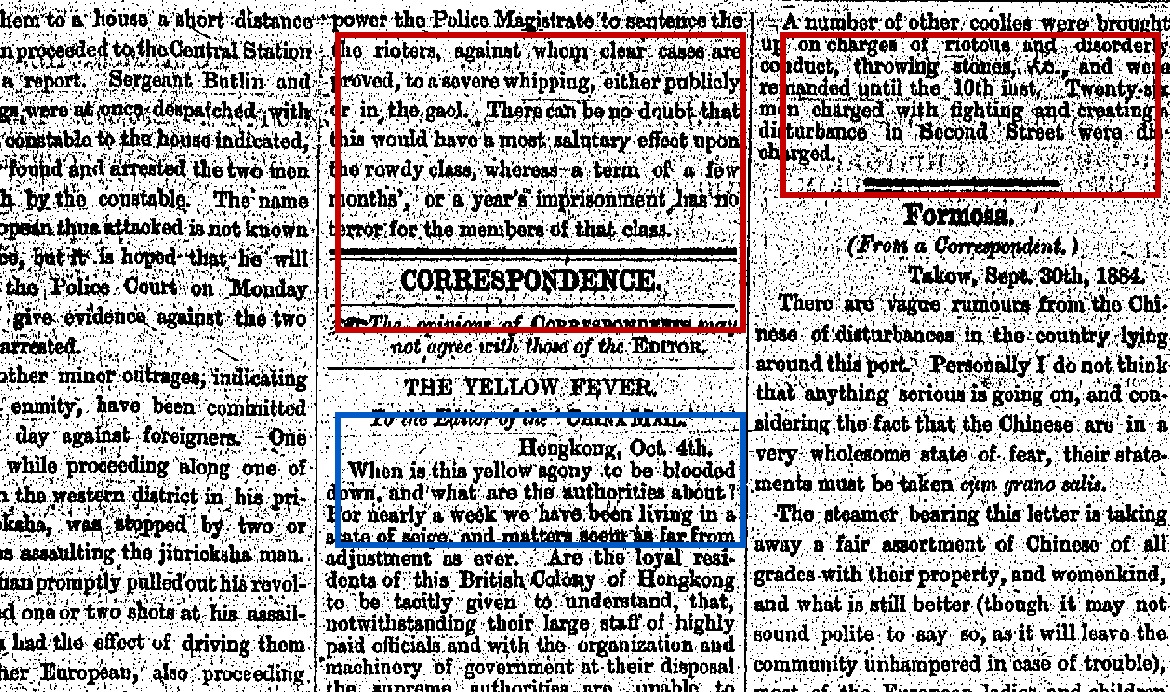
On Friday 3 October the returning boatmen, whose guarantee against being compelled to take French employment had been refused, were set upon by a crowd of coolies in Sai-Ying-Pun. Stones, bricks, and lumps of granite strewn Queen's Road West and Gap-street “like a battlefield.” Two companies of the Buffs marched under Major Harrison with fixed bayonets; Police Magistrate Wise carried the Riot Act but did not read it — “it was then not considered necessary.”25
One Chinese civilian died — shot by Sikh constables at the Civil Hospital gate — and several policemen were wounded.26 The day's rumour mill produced two enduring fictions: a mass beheading (“the swords of the troopers are not sharpened”) and the shooting of two Chinamen (“there was no shooting”). Both were killed by the press itself; both are recorded here as the period's own false reports, never as events.27 On Sunday 5 October, Major Tripp did read the Riot Act — an act the police considered “quite unnecessary.”28
4. The Council's measures
The Executive Council met the same evening. Its minutes (CO 131/14, pp. 157–62) record the emergency package: rioters brought up “at once”; sentences placarded in Tai Ping Shun and the Chinese portion of the town; a picket of one hundred men; special constables enrolled; Magistrates Thomsett, Coxon, McLeven and Tripp warned — and the invention that would last: the moment the military are called on, the Riot Act “shall be read by a Magistrate in English, and also, if possible, in Chinese.”29
The minutes' own header prints “Friday, 22 October, 1884” — a date conflict registered as K2 (22 October was a Wednesday; the meeting is universally dated Friday 3 October).
The Chinese elite refused to play their assigned role. M. Leung — one of the original Directors of the Tung Wa Hospital — was deputed to draft a proclamation; but its talk of pardon was “inadmissible.” The native Justices and their friends then walked out of the Council Chamber almost immediately.30
5. The editors and the spurious edict
The second front was textual. Despatch No. 336 (25–26 September 1884, C.O. 18738) records the Administrator's direction — on the Attorney General's recommendation, with the Executive Council's concurrence — to prosecute the editors of four Chinese newspapers for publishing what purported to be a Viceroy's edict.31 The edict's own translation exhorted Chinese subjects in Hong Kong to “secretly Kill some French Commander, or destroy by fire their munitions of war” — with promises of liberal rewards.32
The four papers were Wa Tsz Yat Po (華字日報), Tsun Wan Yat Po (循環日報), Chung Ngoi San Po (中外新報), and Wai San Yat Po (維新日報). Each is confirmed by corpus phrase search and by the period's own web record: the Wa Tsz Yat Po was the China Mail's Chinese sister; the Tsun Wan Yat Po Wang Tao's creation; the Chung Ngoi San Po the Daily Press's; and the Wai San Yat Po, founded 1879, made its name reporting the Sino-French war itself.
6. The ordinance and its assent
On Thursday 9 October 1884 the Legislative Council met in extraordinary session. Present: the Officer Administering the Government William Henry Marsh, C.M.G.; Chief Justice Sir George Phillippo; Acting Colonial Secretary Frederick Stewart; Attorney General Edward Loughlin O'Malley; Colonial Treasurer Alfred Lister; Surveyor General John Macneile Price; and the elected members Phineas Ryrie, Thomas Jackson, Frederick David Sassoon, and Wong Shing — the colony's first Chinese member sits through the crisis ordinance's passage.33
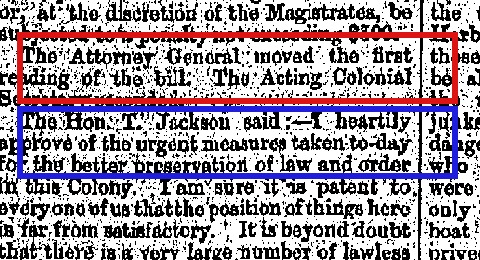
On the Attorney General's motion, seconded by the Acting Colonial Secretary, the Bill was read a first time; the Standing Orders were suspended; three readings followed; the Bill passed; the Council adjourned sine die. Jackson's speech is worth preserving: “I heartily approve of the urgent measures taken to-day for the better preservation of law and order” — and then the pivot to the Triads: “I heard two days ago, on what I consider very good authority, that there are some 10,000 men of the Triad Society in Hongkong and Kowloon.”34
The Gazette extraordinary of the same day — Extraordinary No. 55, Vol. XXX, p. 765 — carries Government Notification No. 360: “His Excellency the Officer Administering the Government has given his assent to the following Ordinance passed by the Legislative Council: Ordinance No. 22 of 1884… The Peace Preservation Ordinance, 1884.”35
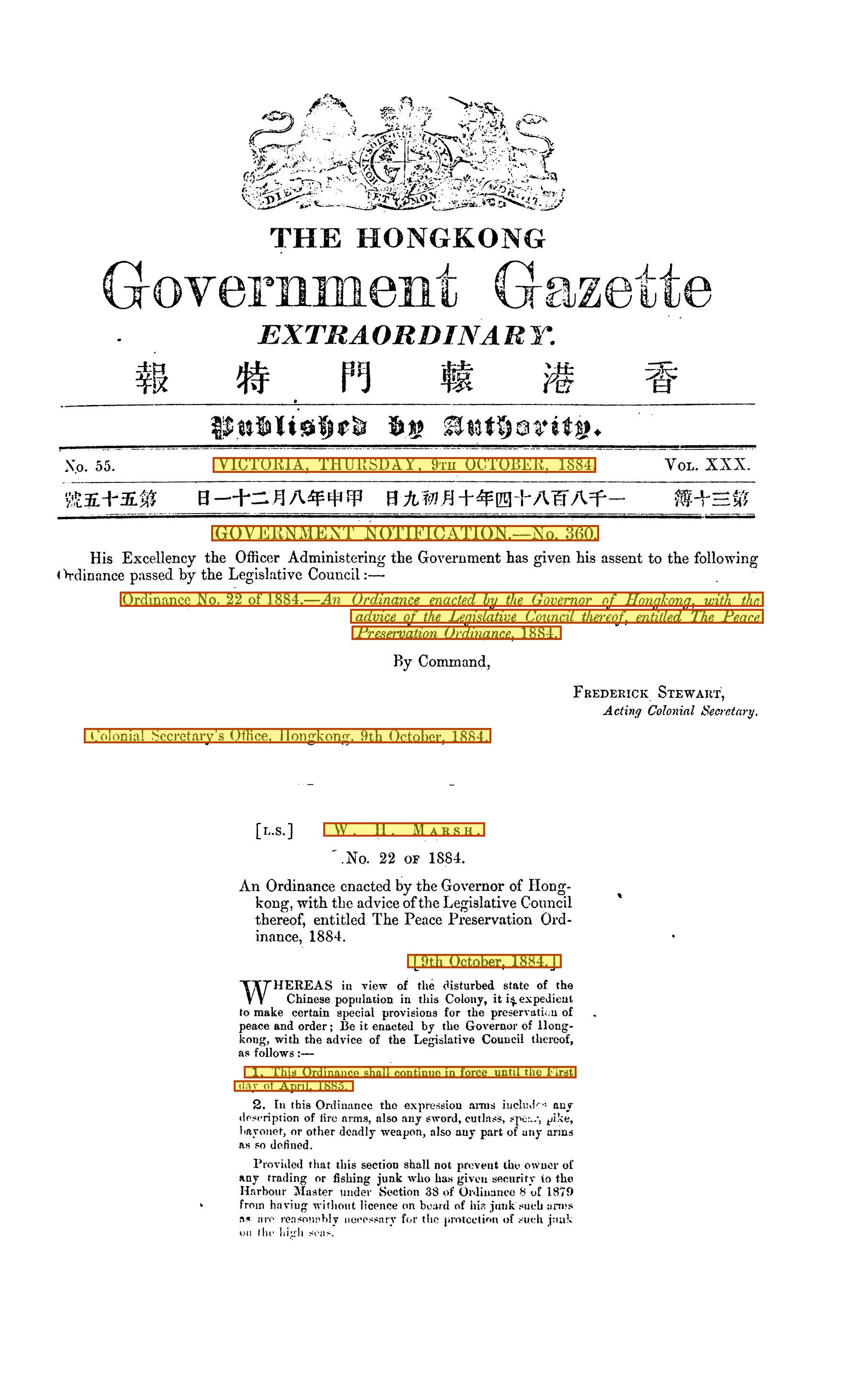
The statute itself (full text, Historical Laws reprint, vol. 3 (1890), pp. 549–51) opens with the preamble: “WHEREAS in view of the disturbed state of the Chinese population in this Colony, it is expedient to make certain special provisions for the preservation of peace and order.” Section 1 puts it in force until 1 April 1885; s. 2 defines “arms”; s. 3 forbids a Chinese person to have or carry arms save as authorised by the Governor in Council; s. 10 requires the Registrar General's permission for any Chinese-language notice on a wall or public place.36
The Attorney General's first-reading speech is the ordinance's own alibi: “There are… no Ordinances in the colony preventing the possession of arms, or the sale of arms… it is intended that this Ordinance shall come into operation immediately upon the passing of it; that provision is made entirely under pressure of extreme circumstances.”37
7. The trial that failed
On Wednesday 22 October, the Criminal Sessions opened before Chief Justice Sir George Phillippo. Tam Yik Kin, printer and publisher of the Wa Tsz Yat Po, was charged under s. 4 of Ordinance 4 of 1865 (conspiracy to murder) and at Common Law. The defence (Mr J. J. Francis) submitted that the proclamation “only referred to such Chinese who might have taken service under the French… not out of accordance with the usages of war of a civilised nation.” The jury took “a different view of it from that which had been taken by the Executive Council” — Not Guilty.38
The Attorney-General's memorandum of 14 November 1884 (signed Edward J. Eitel) is the prosecution's own post-mortem: “as the first prosecution failed, the others have been dropped; but… the effect of the proceedings taken has been good.”39
8. Aftermath: banishment and arms
Orders of banishment for five years went out against the ringleaders; about 16,000 arms of different kinds were seized by the Police; only seven of the persons whose banishment had been decreed were found.40 The Executive Council's report of 15 October, drawing on Stewart's Chinese informants, claims the ordinance's “most salutary effect”: no less than three hundred bad characters having banished themselves from the Colony through fear of being banished by the Government.41 The same report singles out Yau-tat-in — the old man of about seventy, an influential leader or Head Centre of the Triads, with $3,000 allegedly sent from Canton to destroy a French mail steamer (single-witness, the despatch's “secret information received by the Police”).42
The Triad numbers are period estimates, never verified: the despatch's police figure “about 20,000” against Jackson's Council speech “some 10,000.” Both are kept as variance, never totalled.43
9. The sequel
The 1884 ordinance dies by its own s. 1 on 1 April 1885. But the machinery it invented — the bilingual Riot Act procedure, the short-term sunset statute, the banishment order — was not abandoned. CO 129/221, p. 497 preserves the proposed Peace Preservation Ordinance, 1885: Part I on Special Constables, “Whenever it appears to the Governor that any tumult or riot has taken place, or may be reasonably apprehended…” And Lord Derby's despatch No. 19555 (24 November 1884) conveys “Her Majesty's gracious allowance of the Ordinance No. 22 of 1884.”44
10. Conclusion
The October 1884 crisis marks the first time the colonial government intervened in the Chinese community's everyday politics by emergency ordinance. Its legacy is not a simple story of suppression: it is a story of a bilingual procedure, a short-lived statute, a failed prosecution, and a report claiming three hundred self-banished. The Chinese elite did not break with the government; Wong Shing remained in the Council; the Tung Wa Hospital continued; the Chinese press continued. The true legacy is a new governance toolkit — the bilingual Riot Act, the sunset ordinance, the banishment order — that would be replayed in the colony's subsequent history.
Appendix A — ES query log
| Label | Index | Query | Hits / note |
|---|---|---|---|
| CO129_217 | hkintexts_pages | dumpdoc.py CO129/217 | 572 pp / 12,164 lines — the central document, full pull |
| CO129_218 | hkintexts_pages | get.py pp. 56–61 | AG memo + trial report |
| CO131_14 | hkintexts_pages | get.py pp. 157–62 | Executive Council minutes, 3 Oct 1884 |
| DP_1884-10-04 | hkintexts_pages | dumpdoc.py Daily Press 4 Oct 1884 | whole-issue pull, 9,528 lines |
| gaz1522295 | hkintexts_image_pages | get.py id 1522295 | Gazette Extraordinary No. 55, p. 765 |
| cm1197938 | hkintexts_image_pages | get.py id 1197938 | China Mail 4 Oct 1884, printed p. 3 |
| cm1197953 | hkintexts_image_pages | get.py id 1197953 | China Mail 9 Oct 1884, printed p. 3 |
| hansard | hkintexts_pages | get.py id 1881416 | Extraordinary Meeting No. 21 |
| statute | hkintexts_pages | get.py id 5337246 | Historical Laws reprint of Ord. 22 of 1884 |
| stale_ids | hkintexts_pages | get.py 674275 / 669094 | stale; discarded — re-verified after reindex |
See the research notes (research_riots_1884.md, Appendix A) for the full query log including the date-prefix sweep, the Chinese phrase battery (華字日報 558, 循環日報 165, 中外新報 242, 太平山街 1,094, 義祠 51), and the adversarial-pass attempts.
Appendix B — Evidence register
| Claim | Status | Source |
|---|---|---|
| Strike began 30 Sept / 1 Oct 1884 | Confirmed, hedged | CO 129/217 p. 440 — the enclosed press of 1 Oct |
| One dead coolie (Sikh fire) | Confirmed | CO 129/217 p. 444 — China Mail 4 Oct |
| Bilingual Riot Act procedure | Confirmed | CO 131/14 pp. 157–62 — Executive Council |
| Ordinance No. 22 of 1884 | Confirmed | Gazette Extraordinary No. 55, img-1522295; Historical Laws |
| Tam Yik Kin Not Guilty | Confirmed | Daily Press 23 Oct — CO 129/218 |
| Wong Shing present, no division | Confirmed, limited | Hansard Extraordinary Meeting No. 21 — sittings through only |
| Beheading / mass-shooting rumour | Failed verification — the press's own false report | China Mail 4 Oct — registered as rumour, never as event |
| Triad estimate 10,000 vs 20,000 | Conflict K4 — kept as variance, never totalled | Jackson speech vs despatch |
| ExCo minutes header date 22 Oct | Conflict K2 — OCR/date conflict | CO 131/14 p. 157 |