阿裙與徽章:舊香港旗上的人物、裙帶路的傳說與一九五九年紋章 / A-kwan on the Badge (1867–1961)
研究文章
阿裙與徽章
舊香港旗上的人物、裙帶路的傳說,與一九五九年的紋章(1867–1961)
摘要
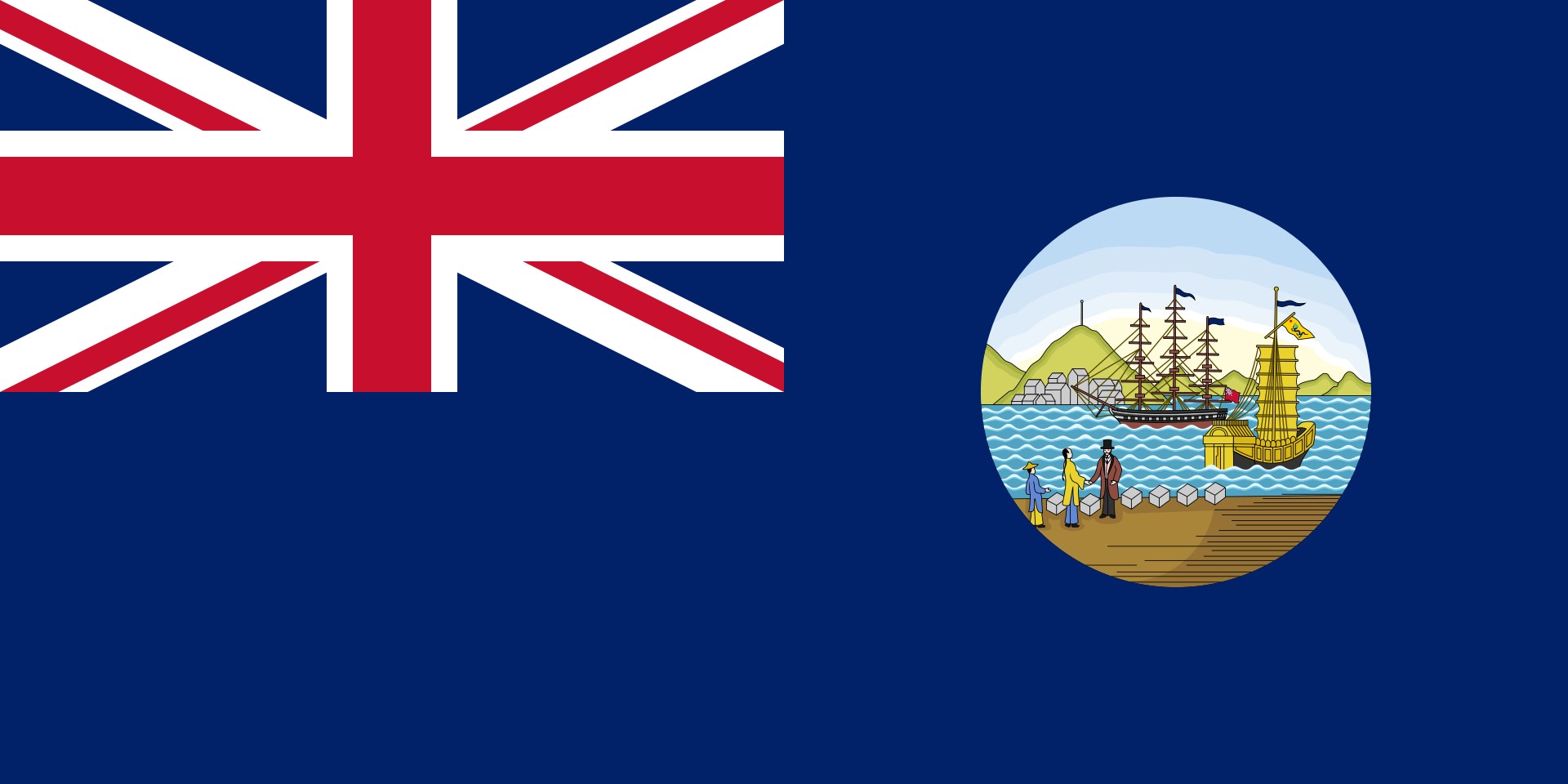
舊香港旗——藍底、旗尾一面圓徽——中間的海港圖景裏,岸上站着戴笠的中國商人與戴禮帽的歐籍貿易者,貨物堆疊其間。老一輩的說法:那個中國人就是「阿裙」——傳說中為英人帶路、因而得名「裙帶路」的嚮導。本文以語料庫為本,重構這面徽章的官方身世與傳說的流傳:一八六七年的海軍部通令、一八七○年代的旗制辯論、一九○七年(依殖民部存檔)核准的旗徽,以及一九四七至一九六一年間香港政府自身檔案(檔案編號 1/2461/47)對徽章的追查、重繪與退役。核心發現有二:其一,「阿裙即徽章人物」之說確曾進入官方記錄——但只是殖民部一九四七年轉引西方旗書(E. N. Baxter《National Flags》)的第二手文字,且同一檔案內政府官員自己的描述自始至終只用「商人」與「貿易者」的詞彙;其二,官方對「裙帶路」一名同樣眾說紛紜(關帶路、關帝爐、山徑三說並錄),承認「其義已忘」。名變成人、人變成面——這個神話閉環如今兩造俱在:政府的檔案同時保存了傳說的蹤跡與否證。1 2 3 4
一、旗與徽:一八六七至一八七五年的官方身世
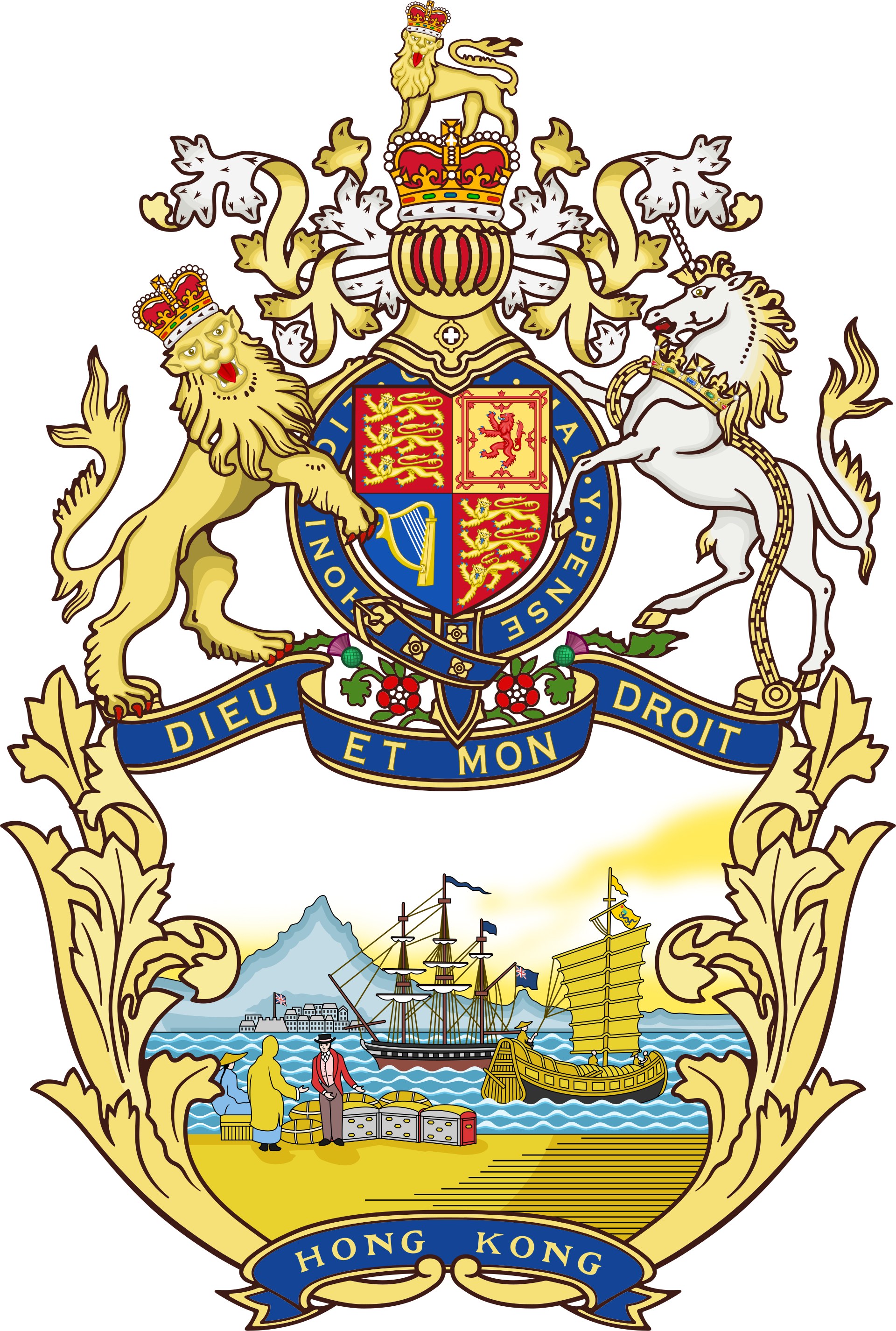
香港旗的規則始於一八六七年一月十六日海軍部通令:殖民地維持的船隻「應懸掛藍旗,旗尾加該殖民地之印章或徽章」。徽章自此以行政物件的身份入檔——旗面上的一個印——官方文本對其中人物隻字未提。5一八六九年,麥當奴總督直言現有旗「全然不稱」:圖樣「置於獎章尚可,置於印章則顯然不然」。6一八七○年,殖民部的一片意見主張「仿新西蘭,採藍旗加 H K 兩字母——總好過此前所擬的一切」;同年決定「殖民地旗用藍底」。7 8一八七三年,堅尼地總督請示改旗,殖民部批註「殖民地之旗不宜屢改」、並自承「一八七○年我們似乎並未諮詢海軍部」,海軍部則反問改旗「以何方式、為何目的」。9 10 11一八七五年八月二十三日的通函終於定下常制:藍旗旗尾加「殖民地之紋章或徽章」。12至於徽章圖樣本身,依殖民部存檔「於一九○七年核准」,而其核准經過的全部往來文件「已依法銷毀」。2
二、傳說的中文記錄
傳說最完整的中文形態見於《百年商業》:相傳道光年間有專為英人做嚮導者名阿裙,「每從赤柱帶旅客經香港圍到山北來」,那條山徑因他時常帶路而得名「裙帶路」;「阿裙姓什麼不得而知,大概是個蛋人」;「這阿裙幫助了英人知道香港底地勢地形,功勞倒是不小,所以現在香港底徽章留着他底形貌」——隨即描述徽章:「岸上站着兩個中國人,一個正在歡迎着登岸英人,據西人說,他就是阿裙。」書自己標明此說得自聽聞。1「裙帶路」之名的早期文獻(一八四五年《香港指南》詞彙、一八五六年新安縣紳士啟事、一八五八年雙語憲報告示)屬「裙帶路/維多利亞城」專題的範圍,本文不贅。13報章裏,一九六三年一則掌故重述帶路故事;一九六九年專欄數出裙帶路得名的三說——魚產小路、阿裙帶路、裙帶形山徑——阿裙只是三說中的第二說;一九七九年藏家專欄引 James Hayes 的學報文章,記「阿裙帶路……之說仍存」。14
三、官方檔案裏的傳說與否證(1947–1961)
檔案編號 1/2461/47 的一九四七年三月十四日首頁紀錄:郵政司有意「為香港取得核准紋章」,輔政司建議公開徵集設計;總督一方則指出殖民地「已有核准之紋章或徽章」(見《殖民地規例》第 124 條),且官方《各殖民地紋章徽志錄》「在香港大概已無存本」。15同年六月十二日,殖民部覆文:香港未獲分配紋章;旗徽一九○七年核准;往來文件「已依法銷毀」;該徽章錄「戰時毀於敵襲」——然後轉引 E. N. Baxter《National Flags》一書對香港旗徽的描述:「碼頭前景堆着貨物,兩個中國人,其中一人正向一個白人打招呼……那位向歐洲人打招呼的中國人就是帶路人 Tai Lo(Kwan),他在英人佔領之時名氣如此之大,以致中國人把這地方叫作 Kwan Tai Lo。」傳說由此進入官方記錄——但只是轉引。2
同一檔案隨後的官方描述卻從不用這套語言。一九五四年八月十六日 Deputy Clerk of Councils 的紀錄逐項比對一八四二年原印與現行旗徽:「前景坐着的華籍商人竟站了起來,歐籍貿易者似乎穿上了冬大衣」,旗桿與碉樓成了土丘茅寮,帆船的舵手消失,貨包「身形大縮」;並指這圖景「所繪者乃本殖民地首度之英人佔領」。3一九五五年四月的會議紀錄更叮囑「勿節外生枝去爭論船具、華歐貿易者之衣着」。16至於「裙帶路」之名本身,檔案內一九四九至一九六一年的備忘錄同樣三說並錄:Baxter 讀「關帶路」(Taai Lo 意為帶路、Kwaan 為其姓——「他把兩截倒轉了」);已故 Hindsell 法官主張「關帝爐」(戰神之爐);又有 Paul Tsui 祖父所指由香港仔沿崖至銅鑼灣的山徑——結語是「此名湮沒已久,其義已忘……可能性不勝枚舉」。4
四、一九五五年的重繪與一九五九年的紋章
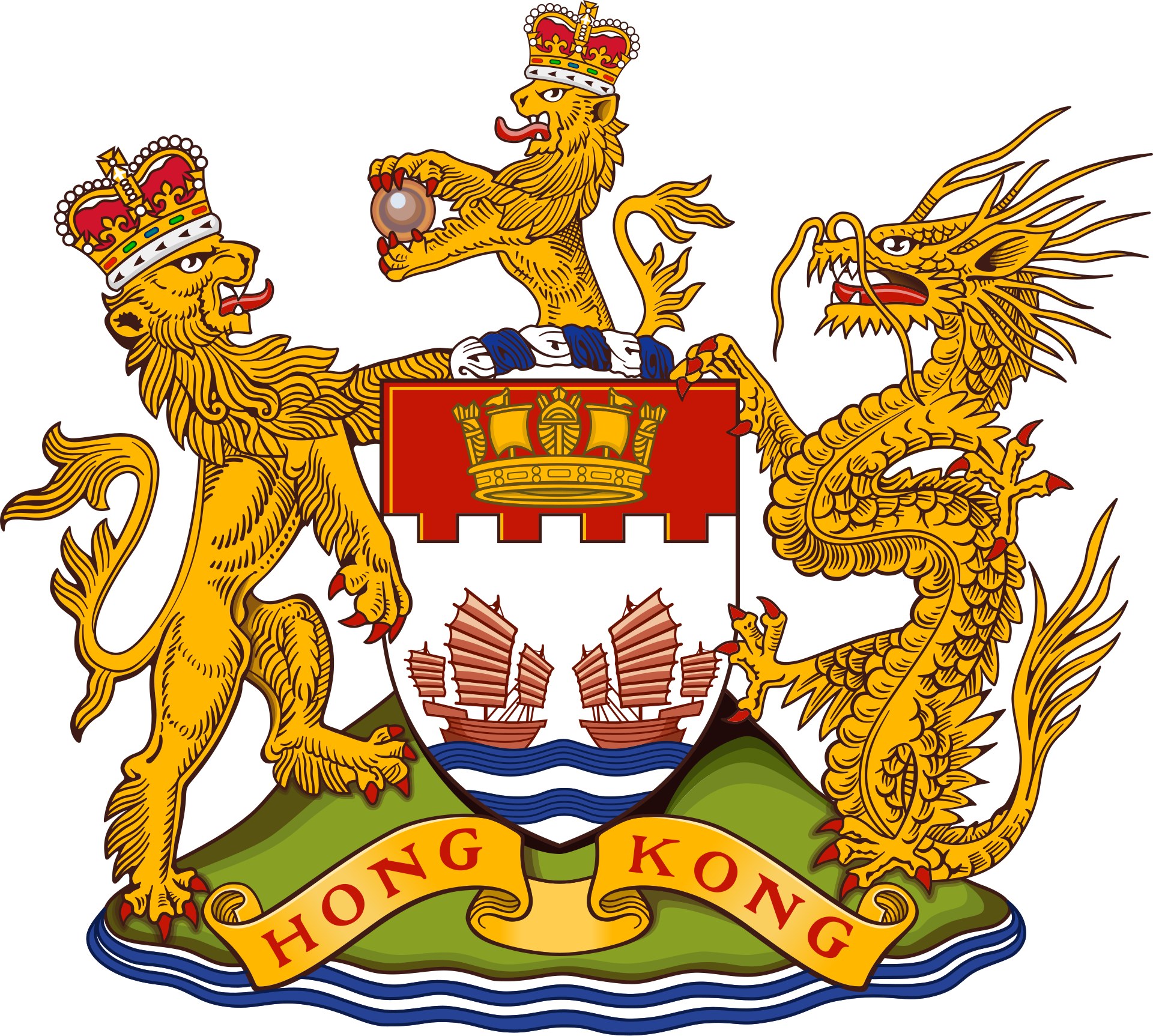
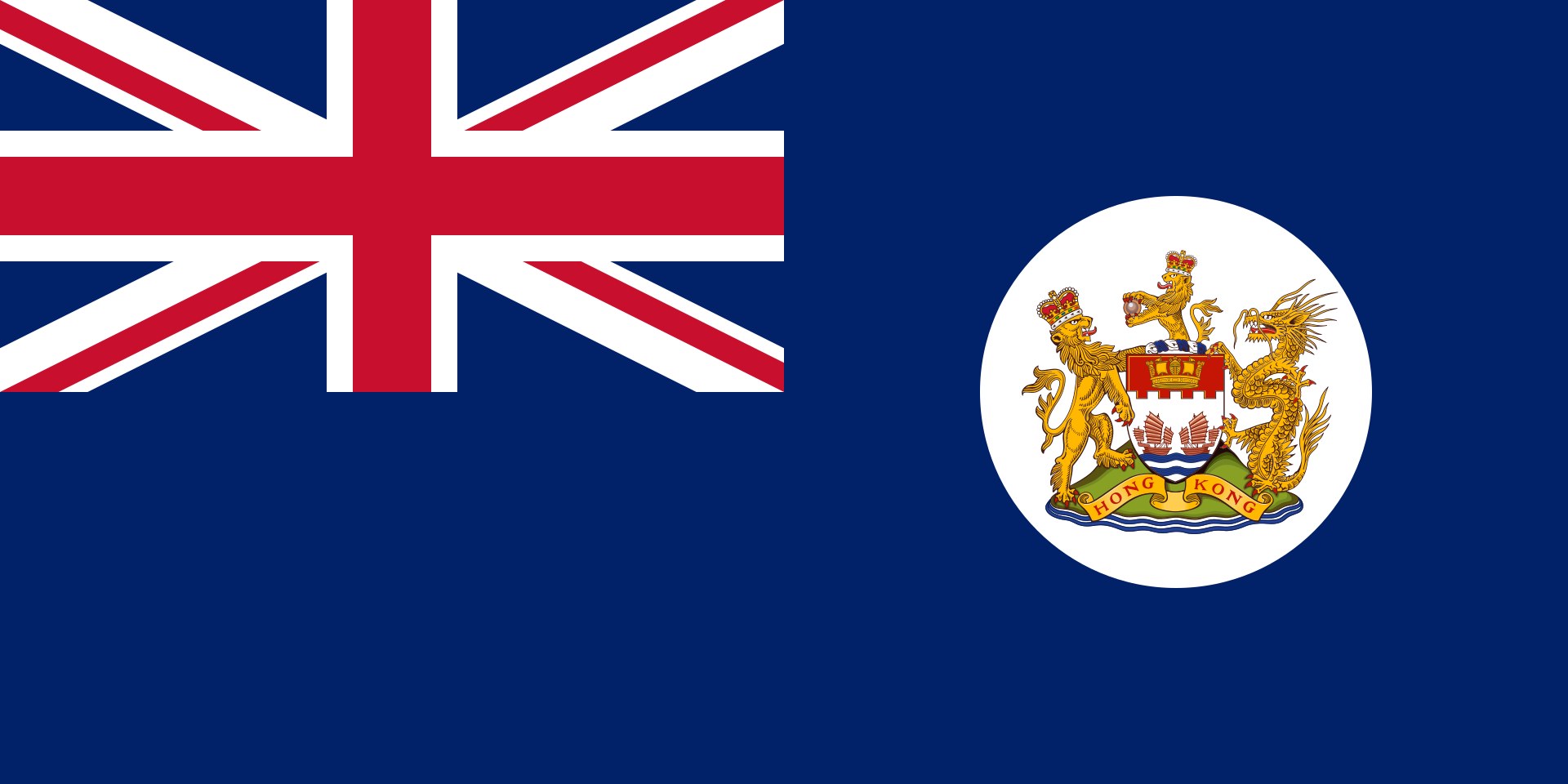
一九五四年,《倫敦新聞畫報》一八四四年一月六日一期所載原印(同年登上《香港年報》封面)促成重繪。Crown Agents 的畫稿(佣金三鎊三先令)被斥為「拙劣之作」,本地經政府印務局重製的設計獲行政局核准(一九五五年五月十日第 18 節節錄),送海軍部記錄為正式旗徽;七月二十九日,政府文書 Chan Kwok Chuen 獲五十元特惠酬金,表揚其「重繪新旗徽之工作」。17 18一九五七年十月,Kidd 建議另製正式紋章:政府「把皇家紋章與旗徽併合」的做法「以紋章學言之殊屬不當」,而「我們正致力開拓旅遊收益,此等別致的飾物當可略盡綿力」。19一九五九年一月二十一日,女皇頒皇家認可狀:銀盾上「兩艘三桅中國帆船揚帆相向」,紅色雉堞盾首加海軍冠,冠頂半獅捧珠,獅(英)龍(華)相扶,銘帶書 Hong Kong——認可狀於三月七日憲報特刊公布。20 21十一月,立法局三讀通過《殖民地紋章(保護)條例》(第 38 號,一九五九年):未經輔政司書面許可而製作、公開展示、出售或使用紋章之複製品,可處罰款五千元及監禁三個月;條例十一月二十七日生效。22 23 24 25一九六一年,海軍部覆文准許「以紋章為旗徽,惟於藍旗上須襲以白色圓地」——海港風景的旗徽就此落旗,阿裙的面孔隨之而去。26
五、結論:名、人、像的神話閉環
這宗「人物考證」的兩造如今俱在檔案:一邊是旗書的轉述(一九四七年殖民部引 Baxter:「帶路人 Tai Lo」)與中文書的傳聞筆法(「據西人說」);另一邊是政府官員自己的眼睛——坐着的華商、穿冬大衣的歐商、縮水的貨包。徽章上沒有名字;裙帶路一名的三個官方解釋沒有一個被採納。一九五九年的紋章把海港圖景昇華為紋章語言(雙帆船仍在),《香港年鑑》以「襯以獅及中國龍各一,象徵香港之英國及中國方面」作結;一九六一年旗徽換面,傳說失去畫布,卻在報章掌故裏又活了三十年。一個地名如何長出一個人、一個人如何長出一張臉——裙帶路、阿裙與徽章的閉環,是香港史裏最完整的民間考據標本;而它最可貴之處,在於政府的檔案同時保存了傳說的蹤跡與否證。2 3 4 26 27
Research article
A-kwan on the Badge
The figures of the old Hong Kong arms, the Kwan Tai Lo legend, and the heraldic afterlife, 1867–1961
Abstract
The old Hong Kong badge — the harbour scene in the fly of the colony’s Blue Ensign — shows a conical-hatted Chinese merchant and a top-hatted European trader over cargo on a wharf. The folk identification of the Chinese figure as 阿裙 (A-kwan; the modern web form writes 阿群), the legendary guide who gave 裙帶路 its name, is re-examined here against the badge’s own official file (HKRS 41, File No. 1/2461/47, 1947–1961), the flag correspondence of 1867–1875, the 1959 Royal Warrant and protection ordinance. The finding: the identification DID enter the official record — but only second-hand, when the Colonial Office in 1947 quoted E. N. Baxter’s flag book (“The Chinese greeting the European is the Kwan, or guide, Tai Lo”) after admitting its own badge correspondence was “destroyed under Statute”. The Government’s own descriptions in the same file never use the story: the 1954 minute reads the figures as a “Sitting Chinese merchant” and a “European trader” — a commerce scene, not a welcoming — and the officials’ own name-notes record three theories for Kwan Tai Lo and conclude the name’s meaning is forgotten. The myth-circle of a name becoming a man becoming a face survives with both sides now documented.
Keywords: Hong Kong badge; Blue Ensign; armorial bearings; 阿裙; 裙帶路; Royal Warrant 1959; College of Arms; flag history
1. Sources and method
This paper continues the workspace’s corpus-first method.28 The load-bearing source is the badge’s own file: HKRS 41-1-2817(2)-to-2818, File No. 1/2461/47 (“Armorial Bearing for Hong Kong”), pulled in full (45,446 lines) and covering the whole arc from the Postmaster General’s 1947 coat-of-arms idea to the 1961 Admiralty approval that moved the new arms onto the flag. The legend’s Chinese witnesses are 《百年商業》 and the 華僑日報 columns of 1963, 1969 and 1979; the official flag stratum runs through CO 129 (1867–1873) and the printed CO 885 flag regulations; the arms stratum runs through the 1959 Gazette Extraordinary, the Hansard readings and the ordinance.
2. The flag before the badge, 1867–1875
The rule began with the Admiralty’s Colonial Defence Act circular of 16 January 1867: colony-maintained vessels “shall wear the Blue Ensign, with the Seal or Badge of the Colony in the fly thereof”.29 The device’s adequacy was doubted from the first decade: MacDonnell in 1869 called the flag “wholly unsuitable” — the device “when put on a Medal becomes obviously so when occupying a Seal”.30 In 1870 a Colonial Office minute proposed to “follow New Zealand & adopt the blue Ensign with the letters H K”, “not so absurd as what has hitherto been suggested”;31 the same file records the decision “that the Colonial Ensign shall be blue”.32 In 1873 Governor Kennedy sought sanction to alter the flag by enclosed pattern;33 the Colonial Office minuted that “Colonial flags should [not] be frequently altered” and that it had “not appear[ed] to have” consulted the Admiralty in 1870;34 the Admiralty in turn asked “in what manner, & for what purpose the Flag” was to be altered.35 The Circular Despatch of 23 August 1875 settled the standing rule: the Blue Ensign “with the Arms or Badge of the Colony emblazoned on the fly”.36 As for the badge device itself, the Colonial Office’s surviving record says it was approved in 1907 — and that everything earlier about it was gone.37
3. The legend’s Chinese record
The legend’s fullest Chinese form is 《百年商業》’s: in the Daoguang years a guide named 阿裙 led travellers from 赤柱 (Stanley) past 香港圍 to the north of the island, and the path took the name 裙帶路; “阿裙姓什麼不得而知,大概是個蛋人” (his surname unknown — probably a Tanka); his service was such “所以現在香港 底徽章留着他底形貌” — and the badge is then described: “岸上站着兩個中國人,一個正在 歡迎着登岸英人,據西人說,他就是阿裙” — the identification marked, even in the book that preserves it, as hearsay from Westerners.38 The name’s early documentation belongs to the eleventh thread (KwanTaiLo_VictoriaCity). In the press, a 1963 miscellany retells the guide story;39 the 1969 column counts three theories for the name — the fish-path, the 阿裙 guide, the sash-shaped ridge — the guide being theory two of three;40 and the 1979 collector’s column, citing James Hayes’s journal work, notes that the 阿裙帶路 story “仍存” (still circulates).41
4. The badge’s own file, 1947–1961
File 1/2461/47 opens on 14 March 1947 with the Postmaster General’s idea of “getting an approved Coat of Arms for Hong Kong” and the Colonial Secretary’s suggestion of a public competition — met with the reply that the Colony “already has its ‘approved Arms or Badge’, vide Colonial Regulations 124”, and that of the official book of Arms and Badges of the Colonies “very probably no copy of this survives in Hong Kong”.42 The Secretary of State’s despatch of 12 June 1947 (No. 204, answering Sir Mark Young’s No. 51 of 22 March) is the pivot: no Armorial Bearings assigned; “a Flag Badge was approved in 1907”; “All correspondence regarding the Flag Badge has now been destroyed under Statute”; the empire badge-book “destroyed by enemy action”; — and then the Baxter extract, quoted into the record: “The Chinese greeting the European is the Kwan, or guide, Tai Lo, who was so famous on the island at the time of the British occupation that the Chinese called the place Kwan Tai Lo.”37 In 1948 the Colonial Office sent colour prints of the badge and its official wording.43
Meanwhile the name question got its own sub-file: the minute of 20 February 1949 sends for Sung Hok Pang, the “well known Cantonese teacher for H.K. Cadets”, and the notes name “Paul Tsui on the meaning ‘Kwan Tai Lo’”.44 The standing Note records the theories — Baxter’s 關帶路 reading (“Taai Lo… indicates ‘guide’ and Kwaan is his surname — In Mr. Baxter’s version he has twisted the parts round”), the late Mr. Justice Hindsell’s 關帝爐 (“the Stove or Censer of the God of War”), and Mr. Tsui’s grandfather’s cliff path from Aberdeen to Causeway Bay — and concludes: “The KWAN TAI LO has been extinct for so long that its meaning has been forgotten… the possibilities are without number.”45 A 1961 amplification adds that the name “is still current on Lantao, Cheung Chau, Lamma and the Sai Kung + Sha Tau Kok peninsulas”.43 The design hunt ran parallel: by 1951–53 “details for the design were taken from various sources” including the Secretariat’s plaster arms and the “engraving on the Hong Kong & Shanghai Bank’s notes… examined minutely with a magnifying glass”.46 Then, in August 1954, Mr. Walden’s cutting from the Illustrated London News gave the Government its own first picture of the original 1842 seal, and the Deputy Clerk of Councils’ minute of 16 August itemised the century’s drift: “Flagpost and Battlements… have become a pole on top of a round mound of earth with squatter huts… Sitting Chinese merchant in foreground has decided to stand up and the European trader seems to have donned his winter overcoat.”47 The scene, the minute says, “represent[s]… the first British occupation of the Colony” and should be “insusceptible of change at the hands of modern artists”.
5. The 1955 redraw
The Crown Agents’ £3. 3s. painting was rejected as “a very feeble effort”; the Colonial Secretary confined the exercise “to getting back to the old design and not… launch into discussions about the rig of the ships, the clothes of the Chinese and European traders”.48 The local design through the Government Printer (“The cost of preparing the design was $50”) was submitted “for approval as the official flag badge of the Colony”; the Executive Council approved it on 10 May 1955 (Extract No. 18 of 10.5.55) for recording by the Admiralty.49 On 29 July 1955 an honorarium of $50 (Special Warrant No. 6) was approved “to… Mr. Chan Kwok Chuen, G.C.S. Clerk Class I No. 115… for the work of redesigning the new flag badge of the Colony”.50 The badge then entered service: the flag stock’s old and new inserts showed “an appreciable difference”, the P.R.O. fielded requests — a Canadian advertising agency among them — and the Government Printer priced 1,000 reprint copies.51
6. The arms and the ordinance, 1957–1961
On 15 October 1957 Mr. Kidd’s suggestion reached the file: a Coat of Arms “in addition to the approved Colony Badge”, because “our present habit… of combining the Royal Arms and the Flag Badge is, heraldically speaking, improper” — and, “to put it at its lowest, we are about to indulge in a drive for tourist revenue and I think that a picturesque ornament of this kind could play a modest part”.52 The Royal Warrant followed on 21 January 1959, addressed to the Duke of Norfolk as Earl Marshal, with the blazon — “two three-masted Chinese junks in full sail bows inwards… on a Chief embattled Gules a Naval Crown Or… a demi Lion Or Royally Crowned proper holding between the paws a Pearl… on the dexter side a Lion Or Royally Crowned proper and on the sinister side a Chinese Dragon Gold” — published by Gazette Extraordinary No. 370 of 7 March 1959 with a reproduction in colour.53 54 The Legislative Council passed the Colony Armorial Bearings (Protection) Bill at three readings in fortnight: on 11 November the Colonial Secretary linked the grant to “the recent visit of His Royal Highness The Duke of Edinburgh” and framed the rule — “The Armorial Bearings are the symbol of us all collectively”;55 on 25 November the Bill “passed into law” without amendment as No. 38 of 1959 (assent 26 November, in force 27 November; unauthorised copies: a fine of five thousand dollars and three months).56 57 58 The badge’s own flag life ended by correspondence: the savingram of 15 August 1961 asked whether the Admiralty had approved the flag badge, and the December 1961 reply approved “use of Coat of Arms as Flag Badge provided this is shown on a white circular ground when defacing Blue Ensign”.59 The Annual Report 1959 recorded the grant and the ordinance together.60
7. Afterlives and what cannot be settled
Two official birth dates for the badge coexist: the Colonial Office’s 1907 (its earlier correspondence destroyed) and the Government’s own 1963 badge book, whose plate list runs “1869” (in black and white, “because we don’t know what the colours were”) and “Flag Badge 1871/76”.61 The accepted web frame tells the story as 1843–1871–1876–1955–1959 and names the badge 阿群帶路圖, with a 阿群 spelling that differs from the corpus’s 阿裙.62 The 香港年鑑’s Chinese description of the new arms — the lion and the Chinese dragon “象徵香港之英國及中國方面” — closes the circle in Chinese.63 What cannot be settled: the badge’s adoption correspondence (destroyed), the 1907 designer, the 阿裙 figure’s surname (“不得而知” per the book itself), and the identification itself — which rests on one Chinese witness marked as hearsay and a flag book the Colonial Office quoted after its own records burned. The plates’ sources and licences are recorded in the images manifest.64
Appendix A — Query log (summary)
The battery (5 + 22 October 2026, read-only): the 2026-10-05 legend battery re-verified (阿裙 42 raw → 4 real); “badge of the colony” 79 (the file and CO 885 located); “Flag of the Colony” 9; “Colonial Defence Act” 16; “armorial bearings” + 1958–59 26; 阿裙×徽章 1; “Kwan Tai Lo” 19; “Colony Armorial Bearings (Protection)” 28; “Royal Warrant” + 1959 6; “graciously pleased to honour the Colony of Hong Kong” 4 (the Gazette Extraordinary); Hansard “Armorial Bearings (Protection)” 2; “Flag badges, seals” × Hamilton 3; the rule-9 battery (§3 of the research notes); the compulsory dumpdoc pull of File 1/2461/47 (45,446 lines). Full log: research_badge_aquan.md, Appendix A.
Appendix B — The register’s corrections and do-nots
Corrections to the 2026-10-05 pass: the ordinance is No. 38 of 1959 (not No. 39 — that number belongs to the Naval Reserve (Change of Style) Ordinance printed after it); “no official document names the figure” is revised (the CO’s 1947 despatch carries the Baxter identification second-hand); the 《百年商業》 quotation is restored to its full form (the guide’s route, his trade, the road sign, the 香山詩話 attestation); the Royal Warrant’s text is held (Gazette Extraordinary, 7 March 1959); the central document’s dumpdoc pull is done. Do-nots: never call 阿裙 an officially adopted name (the Government’s own descriptions say merchant and trader); never adjudicate the badge’s birth date (1907 vs 1869/1871-76 vs the 1876 frame — K1); never render Chan Kwok Chuen or Sung Hok Pang in Chinese (unverified); the 陳國泉 and 宋學鵬 corpus hits are unrelated people.
- 《百年商業》, p. 11: 「相傳在道光年間有一專爲英人做嚮導底名叫阿裙,每從赤柱帶旅客經香港圍到山北來。那條本是山徑,因為阿裙時常帶領外人從那裏通行,就叫做裙帶路…阿裙姓什麼不得而知,大概是個蛋人…所以現在香港底徽章留着他底形貌。香港底徽章最易見到底是所有屬於香港政府底船隻所懸底旗幟中間那個圓章…徽章裏[描]寫香港山形,海上有兩艘帆船泊着,岸上站着兩個中國人,一個正在歡迎着登岸英人,據西人說,他就是阿裙。」 https://hkintexts.histsyn.com/page/3186154, accessed 22 October 2026. ↩
- Secretary of State to the Governor, Despatch No. 204, 12 June 1947 (received 24 June 1947), in File 1/2461/47, p. 525: “no Armorial Bearings have been assigned to Hong Kong”; “a Flag Badge was approved in 1907 for the Colony… All correspondence regarding the Flag Badge has now been destroyed under Statute”; the badge-book “destroyed by enemy action during the war”; and the extract from E. N. Baxter, National Flags: “on a wharf in the foreground are bales of merchandise and two Chinese, one of whom is greeting a white man… The Chinese greeting the European is the Kwan, or guide, Tai Lo, who was so famous on the island at the time of the British occupation that the Chinese called the place Kwan Tai Lo.” https://hkintexts.histsyn.com/page/5068069, accessed 22 October 2026. ↩
- Deputy Clerk of Councils’ minute, 16 August 1954, in File 1/2461/47, pp. 336–337: “A comparison of the ‘Hong Kong design’ included in the lower half of the 1842 seal with that in the present flag badge shows how during a century of progress the present form has come to deviate from the original: — Flagpost and Battlements (1842 seal) at the base of the Peak have become a pole on top of a round mound of earth with squatter huts at the base. Rigging of the three-master schooner has changed and the flag has been lost. Helmsman of the junk has also disappeared… Sitting Chinese merchant in foreground has decided to stand up and the European trader seems to have donned his winter overcoat. Bales of merchandise have lost considerably in size and stature.” The scene “represent[s]… the first British occupation of the Colony.” https://hkintexts.histsyn.com/page/5067880; https://hkintexts.histsyn.com/page/5067881, accessed 22 October 2026. ↩
- “Note — The KWAN TAI LO”, in File 1/2461/47, p. 524: the name “has been extinct for so long that its meaning has been forgotten and it is not certain how it was originally pronounced or in what dialect”; Mr. Baxter’s reading 關帶路 (“Taai Lo… indicates ‘guide’ and Kwaan is his surname — In Mr. Baxter’s version he has twisted the parts round”); “the late Mr. Justice Hindsell favoured the reading 關帝爐… the Stove or Censer of the God of War”; Mr. Tsui’s grandfather’s cliff path “from Aberdeen to Causeway Bay”; “the possibilities are without number.” https://hkintexts.histsyn.com/page/5068068, accessed 22 October 2026. ↩
- Admiralty, Circular No. 4 (Colonial Colours), 16 January 1867, in CO 129/127, Public Offices – 1867, p. 53: vessels maintained by a colony “shall wear the Blue Ensign, with the Seal or Badge of the Colony in the fly thereof.” https://hkintexts.histsyn.com/page/271860, accessed 22 October 2026. ↩
- Governor MacDonnell to the Secretary of State, in CO 129/139, Sir MacDonnell – 1869 [8–12], p. 613: the flag “at present assigned to the Colony… is wholly unsuitable, as the device, though not strikingly out of good taste, when put on a Medal becomes obviously so when occupying a Seal.” https://hkintexts.histsyn.com/page/279577, accessed 22 October 2026. ↩
- Colonial Office minute, 20 April 1870, in CO 129/147, Public Offices – 1870, p. 74: “I think the best course maybe to follow New Zealand & adopt the blue Ensign with the letters H K which is at all events not so absurd as what has hitherto been suggested.” https://hkintexts.histsyn.com/page/282866, accessed 22 October 2026. ↩
- CO 129/147, Public Offices – 1870, p. 75: “It has been decided that the Colonial Ensign shall be blue.” https://hkintexts.histsyn.com/page/282867, accessed 22 October 2026. ↩
- Governor Sir Arthur E. Kennedy to the Earl of Kimberley, No. 116, 5 May 1873, in CO 129/163, Sir Kennedy – 1873 [4–6], p. 282: “I have the honor to request Your Lordship’s sanction to the Flag of the Colony being altered in accordance with the pattern which accompanies.” https://hkintexts.histsyn.com/page/291115, accessed 22 October 2026. ↩
- Colonial Office minutes on Kennedy’s despatch, in CO 129/163, p. 281: “I do not see how the letters ‘H. K’ can be said to be misleading; and I think it undesirable that Colonial flags should be frequently altered… Should we not consult the Admiralty? We do not appear to have done so in 1870”; and “It is not necessary to consult the Admiralty on the change of the flag.” https://hkintexts.histsyn.com/page/291114, accessed 22 October 2026. ↩
- Admiralty to the Colonial Office, 21 July 1873, in CO 129/166, Public Offices & Others – 1873, p. 16: their Lordships request “to inform their Lordships in what manner, & for what purpose the Flag” was to be altered. https://hkintexts.histsyn.com/page/292586, accessed 22 October 2026. ↩
- “Use of Flags,” ch. XX (governed by the Circular Despatch of 23 August 1875), in CO 885 (16–18), pp. 223–224: the British Blue Ensign “with the Arms or Badge of the Colony emblazoned on the fly.” https://hkintexts.histsyn.com/page/711684; https://hkintexts.histsyn.com/page/711685, accessed 22 October 2026. ↩
- The name’s early life — the 1845 Directory’s 裙帶路, the 1856 San-On notice, the 1858 bilingual gazette notice — is the eleventh thread’s subject (KwanTaiLo_VictoriaCity); its register and rule-9 battery carry those witnesses. This thread takes the legend’s attachment to the badge only. ↩
- 《華僑日報》, 2 November 1969, p. 15 — the 裙帶路 three-theories column: 「香港裙帶[路],有三個[說法]:一、香港盛產[一]小魚…二、傳說英人[接管]香港[初]時,不識[地]形,由一位名叫阿裙的[人]帶[路],巡視各地…三、據說在早年,[有]條小徑,由對海望[來],好似[一]條小裙[的]裙帶,[由]此得名。」 https://hkintexts.histsyn.com/page/2561261, accessed 22 October 2026. ↩
- Colonial Secretariat minute, 14 March 1947, and the Governor’s reply, in HKRS 41-1-2817(2)-to-2818, File No. 1/2461/47 (“Armorial Bearing for Hong Kong”), p. 333: the Postmaster General’s “possibility he had in mind of getting an approved Coat of Arms for Hong Kong”; the reply — the Colony “already has its ‘approved Arms or Badge’, vide Colonial Regulations 124”; of the official book of Arms and Badges of the Colonies, “very probably no copy of this survives in Hong Kong.” https://hkintexts.histsyn.com/page/5067877, accessed 22 October 2026. ↩
- Minutes M.20–M.21, April 1955, in File 1/2461/47, p. 339: the Crown Agents’ £3. 3s. commission “a very feeble effort”; “confine the exercise to getting back to the old design and not… launch into discussions about the rig of the ships, the clothes of the Chinese and European traders”; the local design “through the Government Printer… The cost of preparing the design was $50”; “I submit for approval as the official flag badge of the Colony.” https://hkintexts.histsyn.com/page/5067883, accessed 22 October 2026. ↩
- “Memorandum for Executive Council — Flag Badge of the Colony of Hong Kong” (X.C.R. 126; for discussion 10.4.55) and “Extract of Executive Council Minutes No. 18 of 10.5.55”, in File 1/2461/47, p. 500 (the same record in the ExCo minutes series: https://hkintexts.histsyn.com/page/5237619): the seal impression “found in a copy of The Illustrated London News dated 6th January, 1844”, which “appeared on the front cover of the Hong Kong Annual Report for 1954”; “Council advised and the Governor ordered that the design… be approved and recorded by the Admiralty as the official flag badge of the Colony.” https://hkintexts.histsyn.com/page/5068044, accessed 22 October 2026. ↩
- Colonial Secretariat memo, 29 July 1955, in File 1/2461/47, p. 499: “an honorarium of $50 has been approved vide Special Warrant No. 6 to be awarded to… Mr. Chan Kwok Chuen, G.C.S. Clerk Class I No. 115… for the work of redesigning the new flag badge of the Colony.” https://hkintexts.histsyn.com/page/5068043, accessed 22 October 2026. ↩
- Minutes M.49–M.50, 15 October 1957, in File 1/2461/47, p. 344: “Mr. Kidd has suggested that we should consider having a Coat of Arms approved for the Colony… our present habit… of combining the Royal Arms and the Flag Badge is, heraldically speaking, improper… we are about to indulge in a drive for tourist revenue and I think that a picturesque ornament of this kind could play a modest part”; Sir Mark Young’s 1947 minute “dismissed the question in favour of reviving the existing badge.” https://hkintexts.histsyn.com/page/5067888, accessed 22 October 2026. ↩
- The Royal Warrant, 21 January 1959 (Elizabeth R to the Duke of Norfolk, Earl Marshal), Gazette Extraordinary, 7 March 1959, printed pp. 640–641, in File 1/2461/47, p. 394: “For Arms: Argent on Water Barry wavy in base proper two three-masted Chinese junks in full sail bows inwards also proper on a Chief embattled Gules a Naval Crown Or. And for the Crest: On a Wreath Argent and Azure demi Lion Or Royally Crowned proper holding between the paws a Pearl also proper. And for the Supporters: On the dexter side a Lion Or Royally Crowned proper and on the sinister side a Chinese Dragon Gold together with a Motto scroll inscribed with the words ‘Hong Kong’… Given at Our Court at Buckingham Palace this twenty first day of January 1959… By Her Majesty’s Command, Alan Lennox Boyd.” https://hkintexts.histsyn.com/page/5067938, accessed 22 October 2026. ↩
- Government Gazette Extraordinary, 7 March 1959, No. 370 (E. B. Teesdale, Acting Colonial Secretary), in File 1/2461/47, p. 393: “Her Majesty the Queen, having on 21st January, 1959 been graciously pleased to honour the Colony of Hong Kong by the award of Armorial Bearings, the Royal Warrant assigning them together with a reproduction in colour is hereby published for information.” https://hkintexts.histsyn.com/page/5067937, accessed 22 October 2026. ↩
- Hong Kong Legislative Council, Official Report of Proceedings, 11 November 1959, pp. 239–240: the Colonial Secretary moved the first reading — the arms “which Her Majesty the Queen graciously granted to Hong Kong on the occasion of the recent visit of His Royal Highness The Duke of Edinburgh… The Armorial Bearings are the symbol of us all collectively”; permissions “will be given freely in suitable cases.” https://hkintexts.histsyn.com/page/1882892, accessed 22 October 2026. ↩
- Hong Kong Legislative Council, Official Report of Proceedings, 25 November 1959, p. 256: the Bill “passed through Committee without amendment and… was read a Third time and passed into law.” https://hkintexts.histsyn.com/page/1882893, accessed 22 October 2026. ↩
- The Colony Armorial Bearings (Protection) Ordinance, No. 38 of 1959 (assented 26 November 1959, Claude Burgess, Officer Administering the Government), HKRS 28-8-26 Part 3, pp. 7–8: “the armorial ensigns and supporters granted and assigned for the Colony under Royal Warrant dated the 21st day of January, 1959”; the prohibition; “a fine of five thousand dollars and to imprisonment for three months”; “Passed the Legislative Council of Hong Kong, this 25th day of November, 1959.” https://hkintexts.histsyn.com/page/641227; https://hkintexts.histsyn.com/page/641228, accessed 22 October 2026. ↩
- Colony Armorial Bearings (Protection) Ordinance, Cap. 315, Revised Edition 1964: “[27th November, 1959.]”; “Originally 38 of 1959.” https://hkintexts.histsyn.com/page/1873219, accessed 22 October 2026. ↩
- Savingram No. 1688, 15 August 1961, and the Secretary of State’s reply (registered 15 December 1961), in File 1/2461/47, p. 35: “I should be grateful if you would confirm whether or not approval of the Flag Badge has been given by the Admiralty”; the reply — “Admiralty has no objection to use of Coat of Arms as Flag Badge provided this is shown on a white circular ground when defacing Blue Ensign.” The same page carries the ordinances-not-disallowed list naming “No. 38 of 1959” as the protection ordinance. https://hkintexts.histsyn.com/page/4865755, accessed 22 October 2026. ↩
- 《香港年鑑》 第十三回, p. 220 — the arms’ Chinese description: 「盾章」及「飾章」之下「襯以獅及中國龍各一,象徵香港之英國及中國方面」. https://hkintexts.histsyn.com/page/1764468, accessed 22 October 2026. ↩
- Method note: direct execution per AGENTS.md §§1–2. The battery: (1) the 2026-10-05 legend battery re-verified (阿裙 42 raw hits, refined to four real witnesses); (2) the badge’s own official file located via “badge of the colony” (79 hits) and pulled in full — HKRS 41-1-2817(2)-to-2818, File No. 1/2461/47, 45,446 lines (the compulsory dumpdoc pull); (3) the flag correspondence 1867–1875 in CO 129; (4) the 1959 warrant, ordinance and Hansard readings; (5) the rule-9 proper-name battery (corpus + web). Citations carry the public viewer links only (hard rule 8). ↩
- Admiralty, Circular No. 4 (Colonial Colours), 16 January 1867, in CO 129/127, p. 53. https://hkintexts.histsyn.com/page/271860. ↩
- Governor MacDonnell to the Secretary of State, in CO 129/139, p. 613. https://hkintexts.histsyn.com/page/279577. ↩
- Colonial Office minute, 20 April 1870, in CO 129/147, p. 74. https://hkintexts.histsyn.com/page/282866. ↩
- CO 129/147, p. 75 (“the Colonial Ensign shall be blue”). https://hkintexts.histsyn.com/page/282867. ↩
- Governor Kennedy to the Earl of Kimberley, No. 116, 5 May 1873, in CO 129/163, p. 282. https://hkintexts.histsyn.com/page/291115. ↩
- Colonial Office minutes, in CO 129/163, p. 281. https://hkintexts.histsyn.com/page/291114. ↩
- Admiralty to the Colonial Office, 21 July 1873, in CO 129/166, p. 16. https://hkintexts.histsyn.com/page/292586. ↩
- “Use of Flags”, ch. XX, in CO 885 (16–18), pp. 223–224. https://hkintexts.histsyn.com/page/711684. ↩
- Secretary of State to the Governor, 12 June 1947, in File 1/2461/47, p. 525 (the Baxter extract). https://hkintexts.histsyn.com/page/5068069. ↩
- 《百年商業》, p. 11 (「據西人說,他就是阿裙」). https://hkintexts.histsyn.com/page/3186154. ↩
- 《華僑日報》, 20 October 1963, p. 32 — the miscellany retelling the 阿裙-guide legend (「由一位名叫阿裙的[人]帶路」). https://hkintexts.histsyn.com/page/2497399, accessed 22 October 2026. ↩
- 《華僑日報》, 2 November 1969, p. 15 (the three theories). https://hkintexts.histsyn.com/page/2561261. ↩
- 《華僑日報》, 26 March 1979, p. 18 — the collector’s column revisiting the name-theories, citing the Hayes journal work and noting 「阿裙帶路…之說仍存」. https://hkintexts.histsyn.com/page/2664504, accessed 22 October 2026. ↩
- Colonial Secretariat minute, 14 March 1947, in File 1/2461/47, p. 333. https://hkintexts.histsyn.com/page/5067877. ↩
- The Census Commissioner’s letter, 16 June 1961, in File 1/2461/47, pp. 522–523: “in 1948, we obtained from the Colonial Office the original… printed copies, in colour, [of the] Badge and also a copy of the original wording.” https://hkintexts.histsyn.com/page/5068066, accessed 22 October 2026. ↩
- Minute of 20 February 1949, in File 1/2461/47, p. 521: “Mr. Sung Hok Pang… well known Cantonese teacher for H.K. Cadets, ha[s] done some research work on the historical materials”; the notes name “Paul Tsui on the meaning ‘Kwan Tai Lo’.” https://hkintexts.histsyn.com/page/5068065, accessed 22 October 2026. ↩
- “Note — The KWAN TAI LO”, in File 1/2461/47, p. 524 (關帶路 / 關帝爐 / the cliff path). https://hkintexts.histsyn.com/page/5068068. ↩
- The design-sources minute (1951–53), in File 1/2461/47, p. 335: “Details for the design were taken from various sources: … (b) The plaster coat of arms over the lift at the entrance to the Secretariat; (c) Cover of Hong Kong British Passport; (d) The engraving on the Hong Kong & Shanghai Bank’s notes. The latter was examined minutely with a magnifying glass.” https://hkintexts.histsyn.com/page/5067879, accessed 22 October 2026. ↩
- Deputy Clerk of Councils’ minute, 16 August 1954, in File 1/2461/47, pp. 336–337 (the deviation list). https://hkintexts.histsyn.com/page/5067880. ↩
- Minutes M.20–M.21, April 1955, in File 1/2461/47, p. 339. https://hkintexts.histsyn.com/page/5067883. ↩
- The ExCo memorandum (X.C.R. 126) and Extract No. 18 of 10.5.55, in File 1/2461/47, p. 500. https://hkintexts.histsyn.com/page/5068044. ↩
- Colonial Secretariat memo, 29 July 1955, in File 1/2461/47, p. 499. https://hkintexts.histsyn.com/page/5068043. ↩
- The 1956 minutes, in File 1/2461/47, p. 341: “I have seen specimens of the old and new inserts in the large flags and there is an appreciable difference”; the P.R.O.’s request for prints (“a Canadian advertising agency… crests and badges of various countries”); the Government Printer’s estimate of 1,000 prints. https://hkintexts.histsyn.com/page/5067885, accessed 22 October 2026. ↩
- Minutes M.49–M.50, 15 October 1957, in File 1/2461/47, p. 344. https://hkintexts.histsyn.com/page/5067888. ↩
- The Royal Warrant, 21 January 1959, Gazette Extraordinary, 7 March 1959, in File 1/2461/47, p. 394 (the blazon). https://hkintexts.histsyn.com/page/5067938. ↩
- Government Gazette Extraordinary, 7 March 1959, No. 370, in File 1/2461/47, p. 393. https://hkintexts.histsyn.com/page/5067937. ↩
- Hansard, 11 November 1959, pp. 239–240 (first reading). https://hkintexts.histsyn.com/page/1882892. ↩
- Hansard, 25 November 1959, p. 256 (third reading; “passed into law”). https://hkintexts.histsyn.com/page/1882893. ↩
- The Colony Armorial Bearings (Protection) Ordinance, No. 38 of 1959, pp. 7–8. https://hkintexts.histsyn.com/page/641227. ↩
- Colony Armorial Bearings (Protection) Ordinance, Cap. 315, 1964 Ed. (“Originally 38 of 1959”). https://hkintexts.histsyn.com/page/1873219. ↩
- Savingram No. 1688, 15 August 1961, and the reply of December 1961, in File 1/2461/47, p. 35. https://hkintexts.histsyn.com/page/4865755. ↩
- Hong Kong Annual Report 1959, p. 254: “Her Majesty the Queen graciously granted and signed under Royal Warrant Armorial Bearings for the Colony. This Ordinance prohibits the unauthorized use of the Colony’s Armorial Bearings.” https://hkintexts.histsyn.com/page/1719833, accessed 22 October 2026. ↩
- G. C. Hamilton to the Government Printer, and reply, December 1962 – 3 January 1963, HKRS 41-2-376: “All seals should be in black and white, and all flag badges in colour (except the 1869 flag badge which should be in black and white because we don’t know what the colours were)… Flag Badge 1871/76: Grateful if you would redraw… a copy of the 1959 flag badge.” https://hkintexts.histsyn.com/page/4847465, accessed 22 October 2026. ↩
- The modern web frame: Wikipedia, “Emblem of Hong Kong” (the colonial badge “in use since 1843 in one version or another”; the 1959 blazon; citing G. C. Hamilton, Flag badges, seals, and arms of Hong Kong, Government Press, 1963) and “Flag of Hong Kong (1959–1997)” (the flag chronology 1843–1997; the badge’s Chinese name 阿群帶路圖; the flag “designed by Geoffrey Cadzow Hamilton”). https://en.wikipedia.org/wiki/Emblem_of_Hong_Kong; https://en.wikipedia.org/wiki/Flag_of_Hong_Kong_(1959%E2%80%931997), accessed 22 October 2026. ↩
- 《香港年鑑》 第十三回, p. 220 (the arms in Chinese). https://hkintexts.histsyn.com/page/1764468. ↩
- Plate sources (Wikimedia Commons, licence-checked via the Commons API, 22 October 2026): “Coat of arms of Hong Kong (1843–1959).svg” and “Coat of arms of Hong Kong (1959–1997).svg” (vectorization User:Nv7801, public domain); “Flag of Hong Kong (1876–1955).svg” and “Flag of Hong Kong (1959–1997).svg” (User:Sodacan; CC BY-SA 4.0 and public domain per the file data). Manifest: BadgeAquan/images/README.md. ↩