A Purely Chinese Hospital — the Tung Wah’s founding, 1851–1896
從義祠到東華:香港華人醫院的創立(1851–1896)
摘要
本文依據香港政府憲報、定例局文件、藍皮書及殖民地檔案(CO 129),並參酌 Elizabeth Sinn《Power and Charity》,重建東華醫院創立全程:1851 年義祠(I Ts’z)如何演變為收留垂死病人的「dying-house」;1866 年的請願如何在醜聞之前已為醫院奠基;1869 年醜聞如何迫使當局以「政府監管」為開醫院的條件;1870 年 3 月 30 日通過、4 月 2 日頒布的《1870 年第 3 號條例》如何以第 14、15 條落實視察與年結監督;1872 年 2 月 14 日的開幕及其財政規模;1886 年代總督 Marsh 以「imperium in imperio(國中之國)」評東華;1896 年調查委員會的三方報告及東華的存續。全文結論:東華的創立契約自始不是「完全自治」,而是「華人出資、政府監管」;1896 年爭論所重申的,正是這一份雙方各執一詞的契約。
一、義祠:醫院的前身與 1869 年醜聞
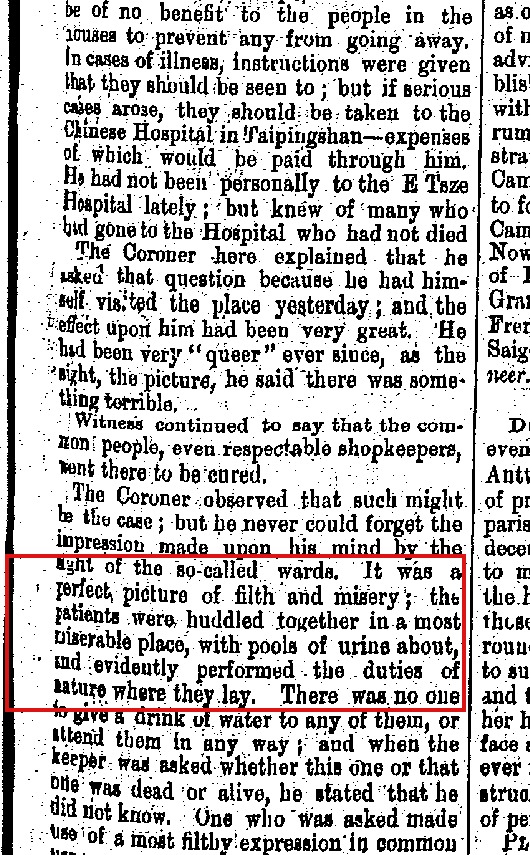
1851 年,一群華人在太平山街一帶購地設立義祠,本為安置祖先牌位;其後逐漸演變為收留垂死病人的場所,殖民地檔案稱之為「dying-house」。1 1869 年 4 月,《德臣西報》(China Mail)報導驗屍官調查:義祠內「生死不明者約九至十人」,輿論嘩然。2 此一醜聞成為推動正式醫院的直接契機。
二、1866 年的請願與「監管」條件
然而,醫院的構想早於醜聞。1866 年 5 月 23 日,華人袖紳聯名請願,要求撥地建「公共祖祠」;輔政司 MacDonnell 隨即於 6 月 29 日批示,准以委員會「general control」方式管理,並以條例(Ordinance)落實。3 1869 年 4 月,MacDonnell 連發三道批示,限期四十八小時內覓得新址,否則 Registrar General 即屬失職;4 同年 8 月,華人認捐額達三萬元。5 此一「華人出資、政府監管」的共識,即東華創立的基本契約。
三、《1870 年第 3 號條例》:charter 與監督條款
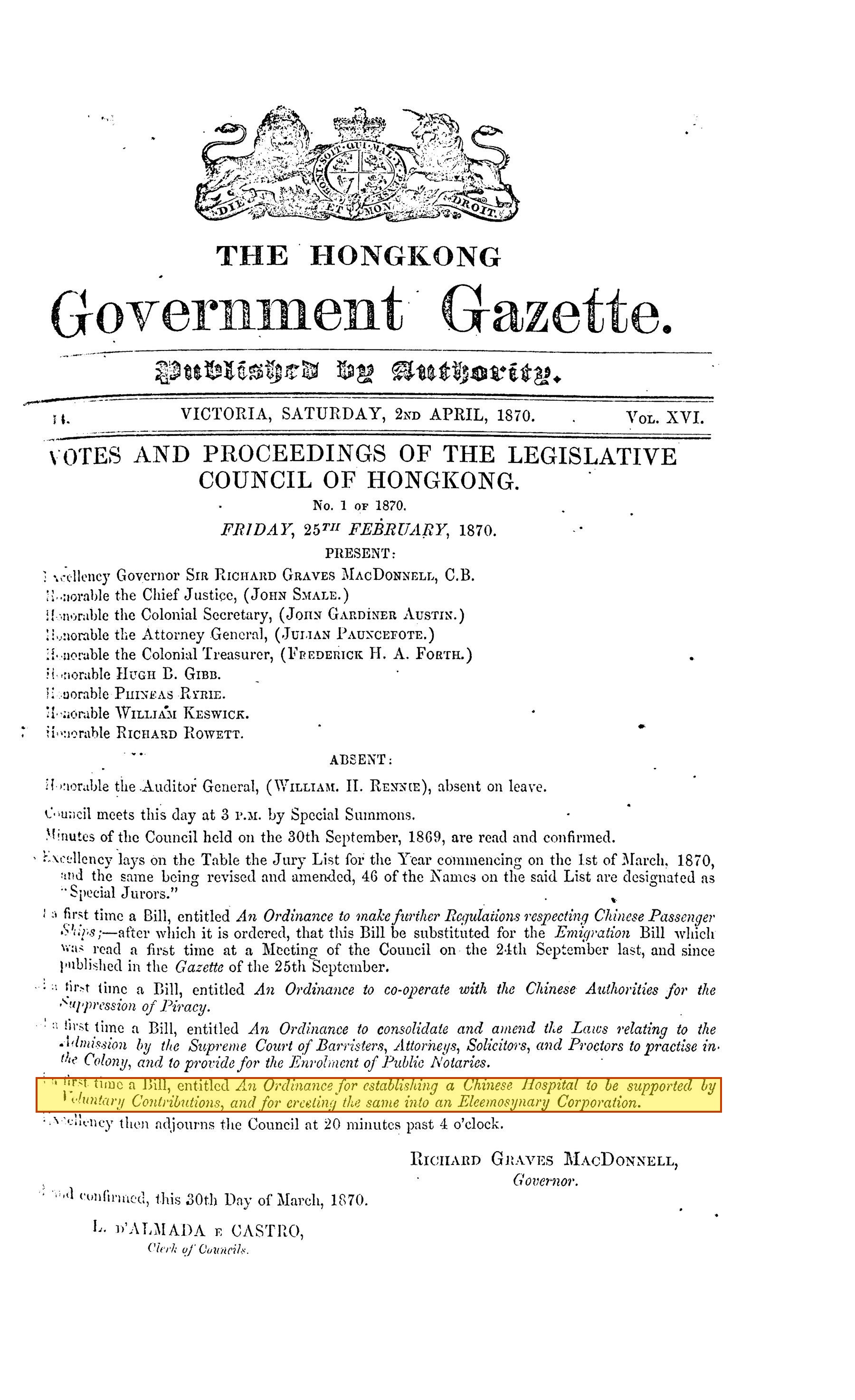
1870 年 2 月 25 日,定例局首讀該法案;3 月 30 日三讀通過,當日立法序列編為 No. 3(同日 No. 1 為保護鳥類、No. 2 為海盜案)。6 憲報於 4 月 2 日刊登全文,題為《1870 年第 3 號條例:設立華人醫院並組成法人團體》。7 其中第 14 條規定醫院須隨時開放予 Registrar General、殖民地外科醫生及總督委派之人員視察;第 15 條規定年結須於農曆新年前一個月提交,由兩名董事宣誓核實。附表列出十二名創辦捐款人。歷史法例彙編(1901、1912 年版)將其重編為「第 1 號」,此一編號差異已列為 K1 衝突項。8 7 月 30 日,總督會同行政局確認該條例正式生效。9
四、1872 年開幕與華人自辦的落實
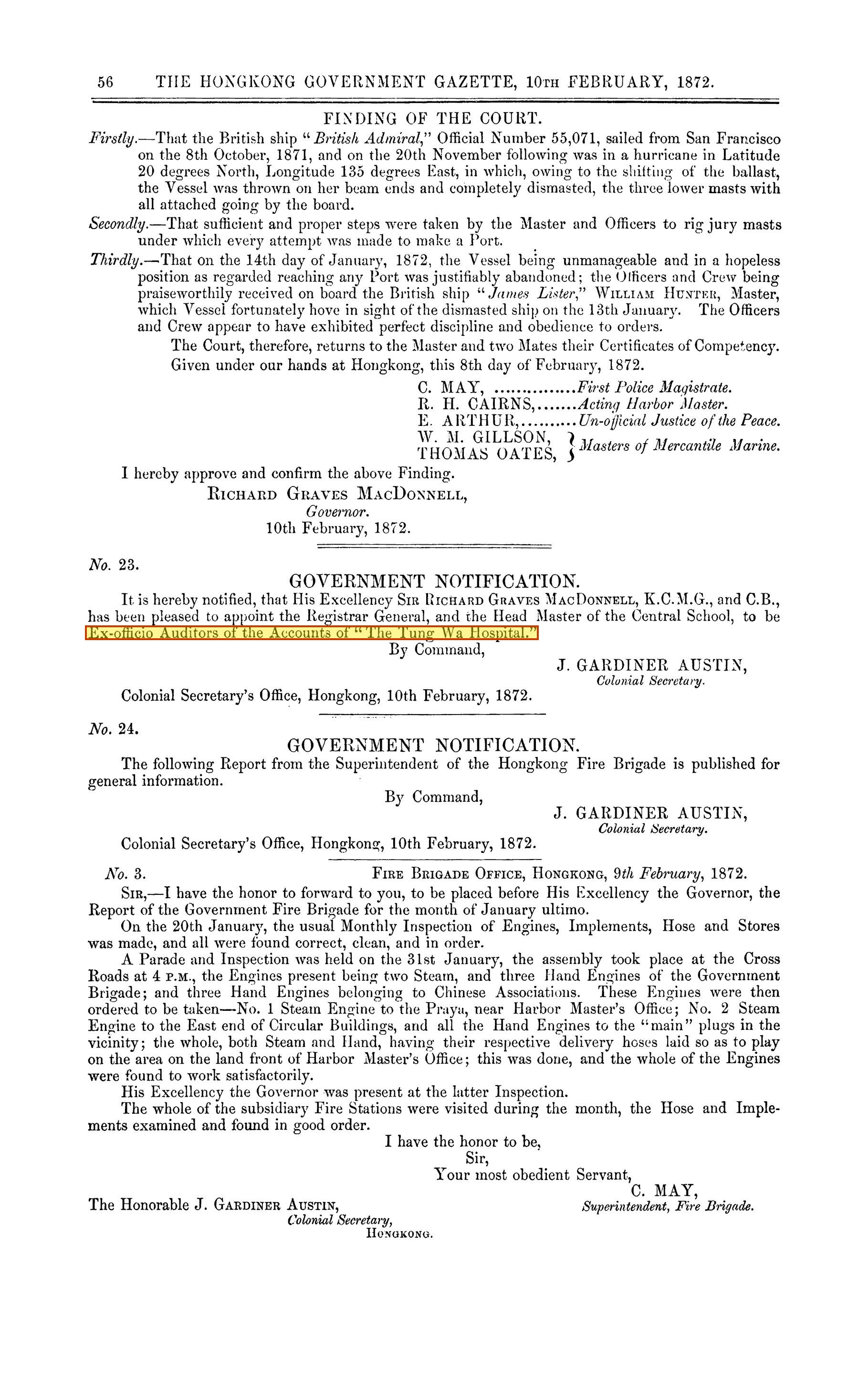
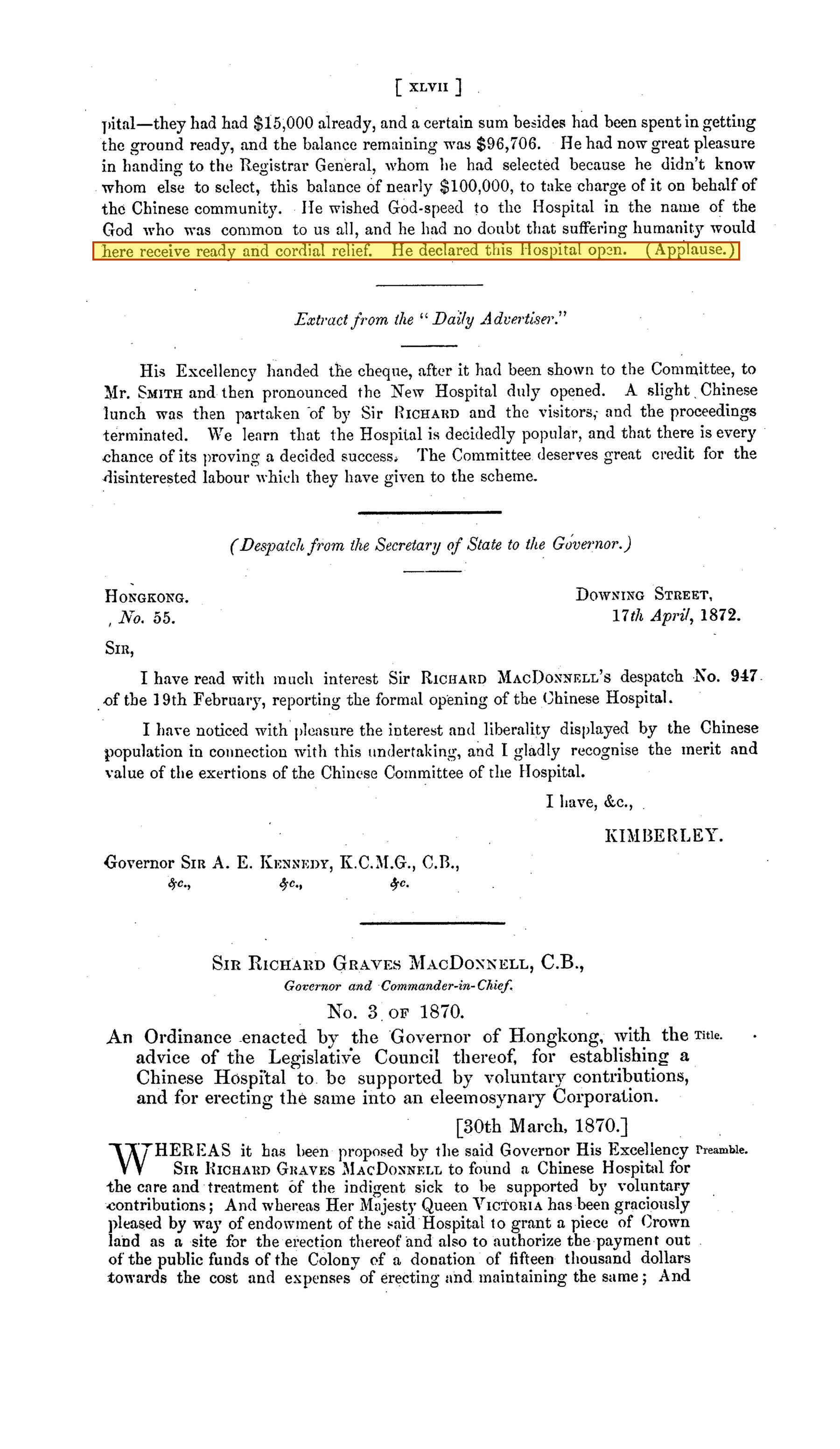
1871 年,殖民地外科醫生 Dods 在年報中提及「前稱 I-tze 之醫院」仍在運作,顯示過渡期沿用舊址。10 1872 年 2 月 10 日,政府發布第 23 號公告,委任 Registrar General 及中央書院院長為東華醫院帳目當然審計員。11 2 月 14 日,醫院於普仁街新址正式開幕,MacDonnell 主持開幕禮,移交公帑一萬五千元,餘額九萬六千七百零六元。12 1872 年藍皮書另列二百二十一鎊八先令七便士補助。13 1873 年《德臣西報》已以「TUNG WA HOSPITAL」為題報導,可見「東華」之名在英人報刊中通行之早。14
五、1886 年「國中之國」與 1896 年調查委員會
1878 至 1885 年間,清廷先後頒贈匾額:曾國荃(1878)、光緒帝(1879、1885)、李鴻章(1884)等,皆為 Sinn 所考。15 1886 年,署總督 Marsh 於呈文中首次以「imperium in imperio(國中之國)」形容東華的自主地位。16 1894 至 1895 年間,鼠疫爆發,殖民地外科醫生 Lowson 直指醫院為「瘟疫溫床」,並威脅援引條例第 14 條接管。17 1896 年 2 月 5 日,總督委任調查委員會,由 Sheriff Lockhart 任主席,成員包括 Ho Kai、Whitehead、Chater 等;自 2 月 14 日至 7 月 2 日,共訊問十四名證人、舉行九次會議。18
六、三份報告的分歧與東華的存續
醫學證人 Ayres 直斥中醫治療為「恐怖屋」(chamber of horrors),Atkinson 稱九成外科病人不治。19 但董事 Ho Amei 堅持:「此乃純粹華人醫院……一切應保持華人特色」,並稱若華人特色改變,「捐款將隨之停止」。20 多數報告最終裁定:醫院已達成其創立宗旨。21 Whitehead 則將責任歸咎於歷任 Registrar General 與殖民地外科醫生監督不力;22 Chater 提議改為西醫制並停止捐款。23 1896 年 12 月 29 日,事件以妥協收場。24
結論
東華醫院的創立文獻,是一份「雙簽名契約」:一方是華人的出資與自辦(義祠、董事、醫院本身),另一方是同一條例中的監督條款(第 14、15 條)。1896 年的調查,正是這份契約的再談判:醫院對華人而言太「華」,對醫生而言太無序,對當局而言太自主——而它最終活了下來,靠的是華人社群的持續支持與捐款,以及殖民地當局在「廢」與「留」之間選擇了後者。
Research article
A Purely Chinese Hospital: the Tung Wah’s founding, 1851–1896
The I Ts’z dying-house, Ordinance No. 3 of 1870, and the 1896 Commission’s split verdict
Compiled 14 October 2026
Abstract
The Tung Wah Hospital’s founding rests on an argument with two signatures: the community’s and the government’s. The I Ts’z — a “dying-house” on the Po Yan Street ground since 1851 — scandalised the colony in April 1869; but the Chinese petition for a hospital predated the scandal by three years (23 May 1866), and the Colonial Secretary’s minute of 29 June 1866 had already contemplated a committee’s “general control” under an Ordinance. Ordinance No. 3 of 1870 (passed 30 March, promulgated 2 April; the Historical Laws compilations renumber it “No. 1”) incorporated the hospital, named the Tung Wa in s.2, and—in ss.14–15—left it “open at all reasonable times” to the Registrar General’s inspection with an annual audited statement. The hospital opened 14 February 1872 with $15,000 of public money against a balance of $96,706. In 1886 Acting Governor Marsh first called it an “imperium in imperio”; the 1896 Commission’s three reports restaged the founding argument with the hospital’s life at stake, and the record’s verdict is the disagreement itself — a hospital too Chinese for the doctors, too useful to abolish, and too autonomous for the doctrine its own charter had written.
Keywords: Tung Wah Hospital; I Ts’z; Ordinance No. 3 of 1870; imperium in imperio; Ho Amei; Lockhart Commission; Po Yan Street; MacDonnell
1. Introduction: method and names
This paper rebuilds the Tung Wah Hospital’s founding from the colonial record itself: the Government Gazette, the Legislative Council’s Hansard and Votes and Proceedings, the Sessional Papers of 1896, the Blue Books, and the Colonial Office files (CO 129), checked against Elizabeth Sinn’s standard history. Every quotation below was read inside its whole document; the query families are itemised in Appendix A and in the research notes. Where a source exists in both the text series and the image series, the citation links the scan. The documentary corpus interrogated for this paper is the hkintexts research index (read-only), queried 14 October 2026. 25
Names follow the double-verification rule now standard in this workspace: a Chinese form ships only after both a corpus phrase search and an exact-phrase web search confirm it, recorded in the cross-thread glossary. 東華醫院, 義祠, 廣福義祠, 普仁街 (Po Yan Street), 麥當奴 (MacDonnell), 定例局 (the period Council), 政府憲報 (the Gazette), 保良局, 何啟 (Ho Kai), 遮打 (Chater) and 駱克 (Lockhart) all pass. Every unlisted person or institution stays in its English form — Ho Amei, Civil Hospital, Alice Memorial Hospital, Smale, Whitehead, Lowson, Atkinson, Ayres, Dods, Marsh. The corpus form “T’UNG WA” has zero hits and is not used. 26
2. Before the scandal: the I Ts’z and the 1866 petition
The Commission’s own majority report opens with the history it was convened to judge: in 1851 a piece of ground was acquired for ancestral tablets, becoming “a kind of native hospital to which Chinese were taken in a moribund condition” — their word for it a “dying-house.”27 The colonial file’s own short version agrees: the 1851 “Yee Tsz”; the first Tung Wah Hospital at Po Yan Street, opened 1872.28
But the hospital the colony remembers was petitioned for three years before the scandal. On 23 May 1866 a group of Chinese petitioned for “a piece of ground … to build a common ancestral Chinese temple”; Acting Governor MacDonnell’s minute of 29 June 1866 already contemplated a Chinese committee’s “general control,” with power to close and reversion to the Crown — and added, in the minute’s own words, “These arrangements are to be made by Ordinance.”29
The 1869 press scandal made the ordinance urgent rather than originating. In April 1869 The China Mail carried the coroner’s inquest report: the I Ts’z’s caretaker could not say which of the bodies before him were dead or alive.30 MacDonnell’s three minutes of 23/26/28 April 1869 followed within days — “if in forty-eight hours, such a place … exists in this town, I shall consider that the Registrar General does not carry out his duty” — and Memo. No. 470 of 5 May 1869 fixed the formula: a “really good hospital for sick and moribund Chinese, conditionally that its regulations and general superintendence be subject to Government control.”31
The subscription list among the Chinese reached $30,000 by August 1869, with the petition stating the terms on which the Chinese understood the hospital to be established.32 Despatch No. 726 of 21 June 1869 carried the hospital “open to European surveillance but under Chinese management and direction” — and MacDonnell’s summary that “the horrors of the ‘I Ts’z’ exist no longer.”33
3. 1869–1870: scandal, statute, supervision
The bill reached the Legislative Council in early 1870. The first reading, on 25 February, appears in the Gazette’s Votes and Proceedings under the day’s sequence label — a third sense of “No. 1” that must not be confused with the ordinance number.34 The passage and third reading followed on 30 March: the bill passed, “being ‘No. 3 of 1870’”; the same day’s sequence ran Birds = No. 1, Piracy = No. 2, Passenger Ships = No. 4.35 Chief Justice Smale’s valedictory that sitting called it “the foundation of a Chinese Hospital by Chinamen, helped by the Government, which we have this day established by Ordinance.”36
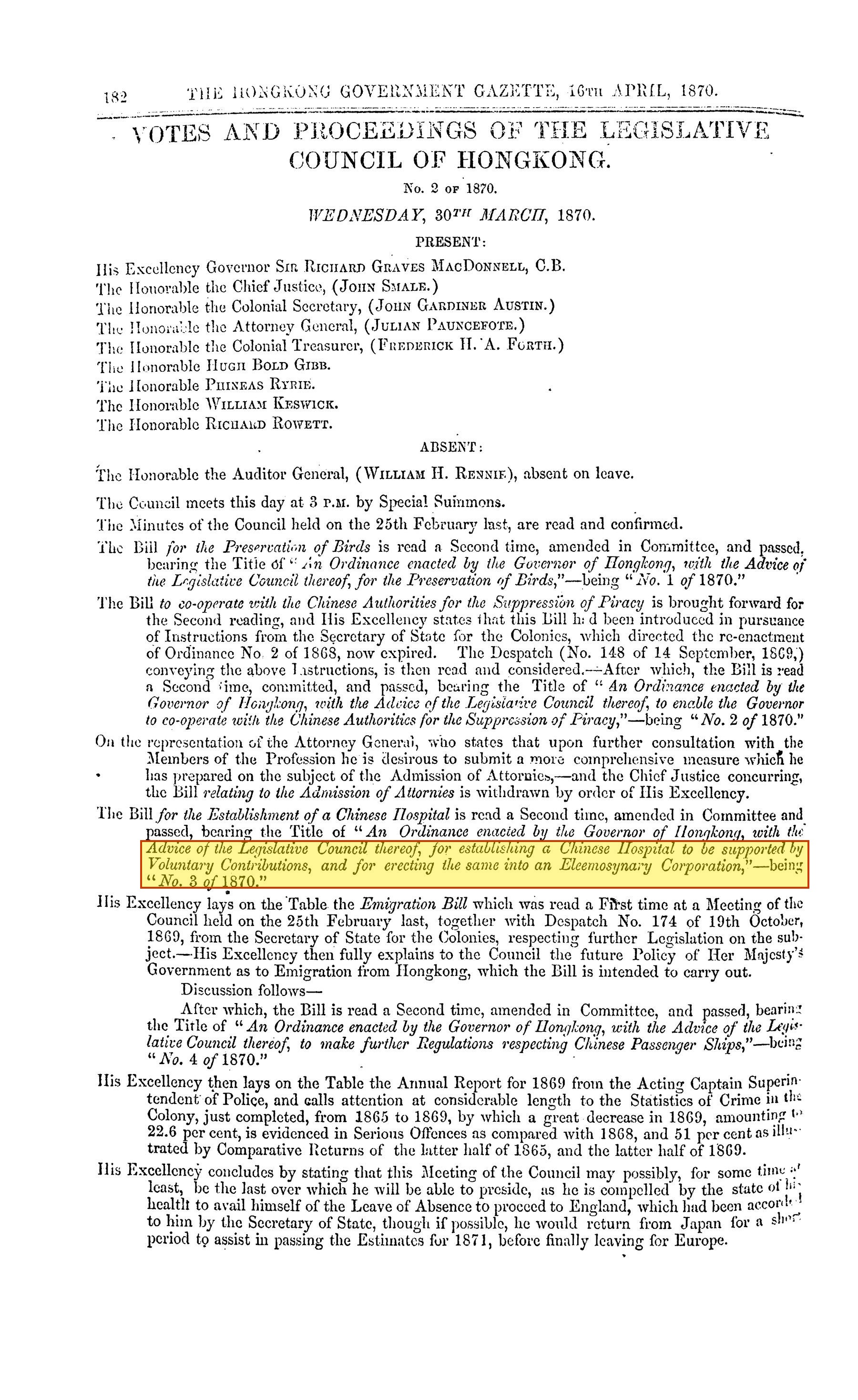
The promulgated text, in the Gazette of 2 April 1870, is the charter. Its preamble recites the “DONATION of Fifteen thousand Dollars”; s.2 incorporates “The Tung Wa Hospital”; s.14 leaves the hospital “open at all reasonable times to the inspection of the Registrar General, the Colonial Surgeon, and of any other person whom the Governor may appoint”; s.15 requires the annual statement within one month after Chinese new year, verified on oath by two members; s.16 permits repeal on neglect; and the Schedule names the twelve founding donors.37 No image-series scan of these leaves exists (four phrase sweeps returned 0) — a gap registered, never papered over.
The ExCo proclamation of 30 July 1870 confirmed the ordinance duly enacted — the day’s No. 1 = Preservation of Birds, No. 2 = Piracy — signed H. W. Whitfield and J. Gardiner Austin.38 The ordinance number itself carries a registered variance: the Historical Laws compilations of 1901 and 1912 renumber it “No. 1 of 1870”; the enactment prints, the proclamation, and Lowson’s 1895 quotation all carry “No. 3 of 1870.” The scan wins; the renumbering is conflict K1.39
4. 1872: the opening
The transition ran on the old premises. Dods, Acting Colonial Surgeon, reported for 1871: patients treated “in the building formerly known as the I-tze Hospital” — the old premises running under the new corporation until the new building opens.40 On 10 February 1872 the government published Notification No. 23: the Registrar General and the Head Master of the Central School, “to be Ex-officio Auditors of the Accounts of ‘The Tung Wa Hospital’” — the charter’s oversight machinery in the period’s own print.41
The opening itself, on 14 February 1872, is recorded in the Sessional Papers of 1896 (the Commission’s own reproduction of the contemporary record): MacDonnell declaring the hospital open — “here receive ready and cordial relief … (Applause)” — $15,000 of public money handed over against a balance of $96,706; Kimberley’s Despatch No. 55 of 17 April 1872 acknowledging MacDonnell’s No. 947 of 19 February 1872.42 Despatch 947 itself fixed the autonomy doctrine in the government’s own words: the Chinese “enjoying great freedom in all matters of local details and management, but subject to the general superintendence and visits of certain Government Officers.”43
The Blue Book for 1872 carries £221 8s. 7d. in the Tung Wah grant’s favour — the public subsidy kept in its own column, never summed with the subscription figures.44 The earliest press heading found by this pass, “IY.—TUNG WA HOSPITAL,” is The China Mail of 24 May 1873; registered as earliest-found only, with no global “first” claim (the Chinese press series begin 1947).45
5. 1878–1886: plaques and imperium
The hospital’s survival was marked by the empire it had left: the founder-era plaques — Zeng Guoquan (1878), the Guangxu Emperor (1879), Li Hongzhang and others (1884), the Emperor again (1885) — recorded by Sinn, with the later $47,000 total and the 29 December 1896 settlement (citing Robinson to Chamberlain, No. 294, CO 129/273).46 The plaque inscriptions themselves were not pulled (single-witness, secondary) — a gap registered, not papered over.
In 1886 Acting Governor Marsh, in the despatch on the Tung Wa Hospital tablet-scrolls case, first used the phrase the colony would soon reach for: the committee being treated as under “the orders” of the writer “is equivalent to saying that the Tung Wa Hospital … is, so to speak, an ‘imperium in imperio’” — the phrase’s first corpus use about the Tung Wa. The old pass misattributed it to the 1896 report; the 1886 despatch is the anchor.47
6. 1896: the counter-trial
The plague years (1894–95) brought the crisis that forced the Commission. Dr. Lowson’s report of 1 March 1895 denounced the hospital as a “hot-bed of medical and sanitary vice” — “a disgrace and danger to the public health of Hongkong” — and his 1895 reminder to the committee invoked the charter’s own teeth: under “the Ordinance, 3 of 1870, the Governor has power to appoint anybody he thinks fit … and I shall act on that decidedly.”48
The Commission was appointed by Gazette notification of 5 February 1896; between 14 February and 2 July it examined 14 witnesses at 9 meetings. President Sheriff Lockhart (Registrar General); members Thomson, Ho Kai, Whitehead, Chater.49
The medical witnesses were unanimous in their indictment. Ayres: “The treatment by the so-called ‘Doctors’ practising at the Tung Wa is tantamount to no treatment at all in the majority of cases … We always considered it ‘a chamber of horrors’”; Atkinson: nine-tenths of the surgical cases lose their lives; Lowson: “From a medical point of view, I think the Tung Wa should be abolished.”50
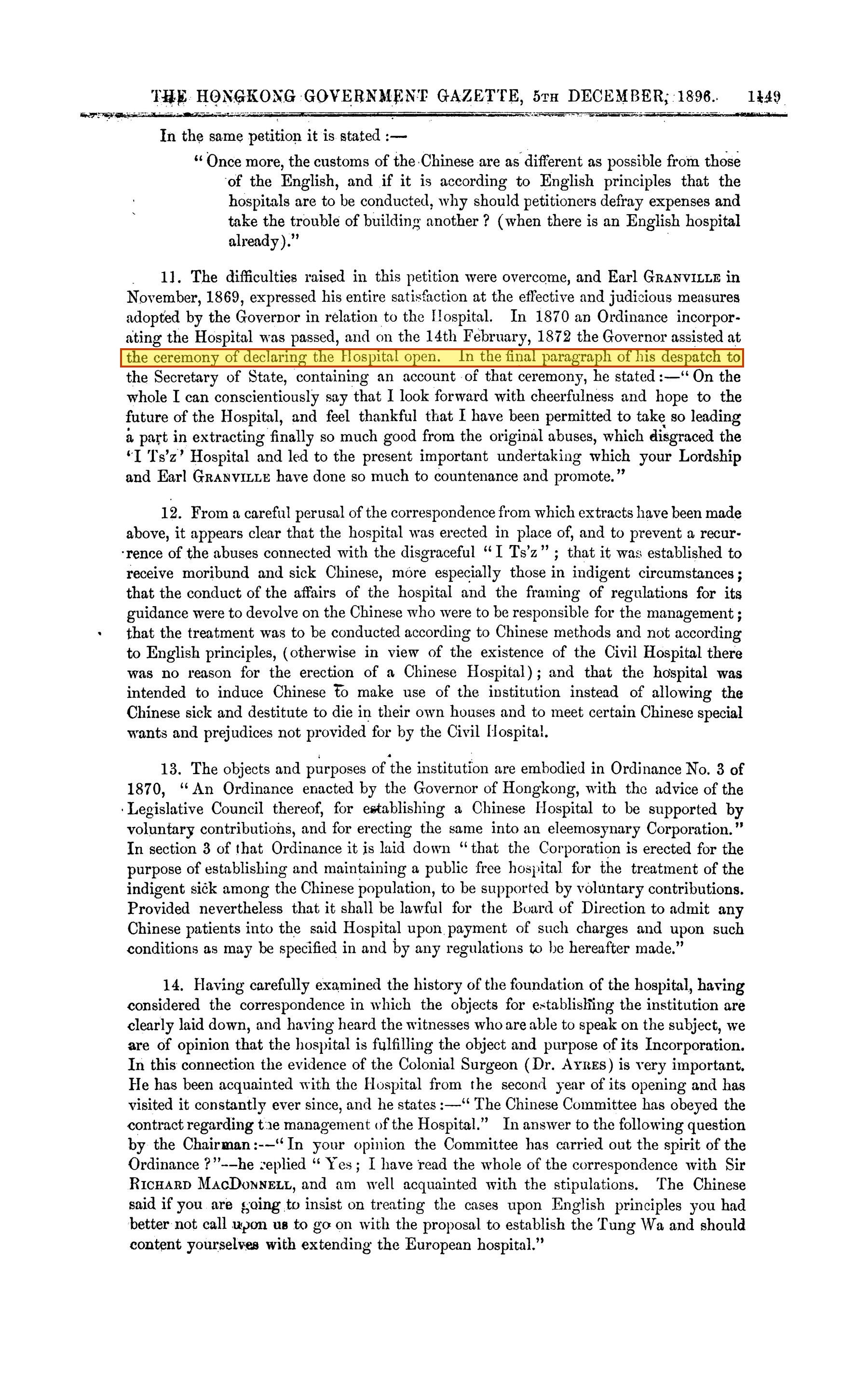
Ho Amei’s defence was the founding compact restated: “This is purely a Chinese hospital … everything in the Hospital should be Chinese”; surgical cases wanting a Western doctor were “sent to the Civil Hospital or the Alice Memorial Hospital”; and if the Chinese character changed, “these subscriptions will cease.”51 The majority report’s own verdict: “Having carefully examined the history of the foundation … we are of opinion that the hospital is fulfilling the object and purpose of its Incorporation,” with Ayres’s own “The Chinese Committee has obeyed the contract regarding the management of the Hospital” pinned to it.52
The minority reports were the disagreement itself. Chater’s: the hospital as “an asylum for the destitute, a refuge for the dying, and a burial for the dead”; his remedy — one doctor trained in Western medicine and the “withdrawal of all subscriptions.”53 Whitehead’s: the failure was “not because of any mismanagement by the Chinese Directors … but because of the failure of successive Registrars General and Colonial Surgeons” to exercise “continuous inspection, frequent supervision”; para. 31 blamed the Registrar General’s Department’s “sub-servience to Chinese ideas”; para. 36 still favoured “maintaining and extending the Tung Wa … under Chinese management and control.”54 The settlement of 29 December 1896 (Robinson’s proposal reaching the hospital committee) closed the crisis — Sinn’s note citing Robinson to Chamberlain, No. 294, CO 129/273; the despatch itself was not pulled (single-witness, secondary).55
7. Conclusion
The Tung Wah’s founding documents are an argument with two signatures: the community’s (the I Ts’z ground, the directors, the hospital itself) and the government’s (the supervision clauses in the same Ordinance No. 3 of 1870). The 1896 enquiry restaged the argument with the hospital’s life at stake, and the record’s verdict is the three reports’ disagreement: a hospital too Chinese for the doctors, too useful to abolish, and too autonomous for the doctrine its own charter had written. What survived — the plaques, the diplomacy, the later incorporation — was the community’s answer, outlasting both the scandal that forced the ordinance and the officials who tried to write its autonomy away.56
Appendix A: sources and method
The documentary corpus interrogated for this paper is the hkintexts research index (read-only), queried 14 October 2026. Every quotation was read inside its whole document; the query families are itemised in the research notes’ Appendix A. No write was made to the index. Where a source exists in both the text series and the image series, the citation links the scan; where the text series is the sole carrier (the ordinance leaves, the Hansard leaf, the Blue Books), the citation links the text-series page.
- “Tung Wa” + the founding era (1851–73) — the Blue Books, the Gazette, and the 1870s records;
- “Tung Wa Hospital” / “Tung Wah Hospital” / “T’UNG WA” — the name-form battery (the corpus form “T’UNG WA” has zero hits);
- “Chinese Hospital” + the same era — the 1869 press run;
- “imperium in imperio” + 1886 — the Marsh despatch anchor;
- the ordinance number battery: “No. 3 of 1870” / “No. 1 of 1870” / “No. 3” + the Historical Laws renumbering;
- the Commission report leaves: the Gazette notification of 5 February 1896 and its printed-page span (1146–72), verified against the dumpdoc pull and the img-id arithmetic (1545857 + N).
Appendix B: evidence register
| Claim | Witnesses |
|---|---|
| The 1851 I Ts’z as the dying-house origin | the Commission majority report (printed p. 1147); HKRS 41’s short history |
| The 1866 petition predating the scandal; MacDonnell’s 29 June 1866 minute contemplating an Ordinance | Whitehead’s report (§I, printed p. 1157) |
| The 1869 press scandal (the inquest, the caretaker’s testimony) | The China Mail, 24 April 1869, p. 2; the Commission’s own history |
| Ordinance No. 3 of 1870: the enactment prints, the passage (30 March), the promulgation (2 April), the ExCo confirmation (30 July) | the Gazette leaves (V&P of 2 and 16 April; the promulgated text; the proclamation); the Hansard debate |
| The 1872 opening (14 February; $15,000 / $96,706; Despatch 947) | the Sessional Papers reproduction; the Blue Book for 1872 |
| The “imperium in imperio” phrase’s first corpus use (1886, Marsh) | CO 129/225, printed p. 57 (the 1896 report does not use the phrase) |
| The 1896 Commission’s three reports and their disagreement | the Gazette printing of the majority report, Chater’s and Whitehead’s minority reports (printed pp. 1146–72) |
| Item | Resolution |
|---|---|
| K1: the ordinance number — “No. 3 of 1870” vs the Historical Laws’ “No. 1 of 1870” | the enactment prints, the proclamation and Lowson’s 1895 quotation carry “No. 3”; the renumbering is a later compilation artefact; cite “No. 3 of 1870” with the variance registered |
| Autonomy vs supervision | Ho Amei’s “purely a Chinese hospital” vs Whitehead’s “complete autonomy was never intended in the Ordinance” — the founding’s own argument, still open in 1896; both positions recorded, neither endorsed |
| The imperium phrase’s attribution | the old pass misattributed it to the 1896 report; the 1886 Marsh despatch is the anchor (CO 129/225) |
| Item | Why |
|---|---|
| The 1869 press pages of the founding moment beyond the inquest | the April 1869 “Chinese hospital” run is OCR-garbled (fragments only); registered as context-with-gap, never quoted |
| The foundation stone / cornerstone story | no corpus witness; the web-only 奠基 1870 lead (hkmemory/zh.wiki) is modern-secondary, never asserted as fact |
| The 1886 Guangdong letter / the 1875 consul lead | drops from the battery (F1); never carried into the deliverables |
| The “death house” as a commission or medical-witness quotation | the majority report’s own word is “dying-house”; “death house” appears only in Sinn nn. 69–71, never as the commission’s or a witness’s quote |
| Item | Why |
|---|---|
| The ordinance leaves’ image twin | four phrase sweeps of the image series returned 0; the text-series pages are the sole carrier |
| The 1872 opening’s own same-day press report | not located in this pass (the Sessional Papers reproduction is the anchor) |
| The plaque inscriptions’ own text | single-witness via Sinn; the inscriptions themselves were not pulled |
| The 29 December 1896 settlement despatch (CO 129/273) | single-witness via Sinn; the despatch itself was not pulled |
| The founding directors’ full roll | the Schedule names twelve donors, not the full board; the roll was not pulled |
Notes
- ↑Tung Wa Hospital Commission (majority report), “Report of the Tung Wa Hospital Commission,” The Hongkong Government Gazette, 5 December 1896, Notification No. 464, printed p. 1147 — the Commission’s own history: the 1851 ground for ancestral tablets becoming “a kind of native hospital to which Chinese were taken in a moribund condition,” their word for it a “dying-house”; Lister and Stewart’s 1869 inspections finding “dead and alive, about nine or ten” patients. https://hkintexts.histsyn.com/image-page/1545858 (accessed 14 October 2026).
- ↑“The Chinese Hospital in Taipingshan” (coroner’s inquest report), The China Mail, 24 April 1869, p. 2 column — the April 1869 press record of the I Ts’z scandal; the caretaker could not say which of the bodies before him were dead or alive. https://hkintexts.histsyn.com/image-page/1185809 (accessed 14 October 2026).
- ↑T. H. Whitehead, “Report on the Tung Wa Hospital,” in the same Commission report, printed p. 1157, §I — the petition of 23 May 1866 (“that a piece of ground be granted to certain Chinese to build a common ancestral Chinese temple”) and MacDonnell’s minute of 29 June 1866 contemplating a Chinese committee’s “general control” with power to close and reversion to the Crown — “These arrangements are to be made by Ordinance.” https://hkintexts.histsyn.com/image-page/1545868 (accessed 14 October 2026).
- ↑Whitehead, same report, printed pp. 1157–58 — MacDonnell’s three minutes of 23/26/28 April 1869 (“if in forty-eight hours, such a place … exists in this town, I shall consider that the Registrar General does not carry out his duty”) and Memo. No. 470 of 5 May 1869: a “really good hospital for sick and moribund Chinese, conditionally that its regulations and general superintendence be subject to Government control.” https://hkintexts.histsyn.com/image-page/1545869 (accessed 14 October 2026).
- ↑Commission majority report, printed p. 1148, para. 10 — the Governor’s report of August 1869: the subscription list among the Chinese at $30,000, with the petition enclosed stating the terms on which the Chinese understood the hospital to be established. https://hkintexts.histsyn.com/image-page/1545859 (accessed 14 October 2026).
- ↑“Votes and Proceedings of the Legislative Council, No. 2 of 1870, … Wednesday, 30th March, 1870,” The Hongkong Government Gazette, 16 April 1870, printed p. 182 — the bill passed and titled, “being ‘No. 3 of 1870’”; the same day’s sequence: Birds = No. 1, Piracy = No. 2, Passenger Ships = No. 4. https://hkintexts.histsyn.com/image-page/1452927 (accessed 14 October 2026).
- ↑“No. 3 of 1870 — An Ordinance for establishing a Chinese Hospital to be supported by Voluntary Contributions, and for erecting the same into an Eleemosynary Corporation,” The Hongkong Government Gazette, 2 April 1870, printed pp. 151–53 — the promulgated text: preamble “DONATION of Fifteen thousand Dollars”; s.2 incorporates “The Tung Wa Hospital”; s.14 leaves the hospital “open at all reasonable times to the inspection of the Registrar General, the Colonial Surgeon, and of any other person whom the Governor may appoint”; s.15 requires the annual statement within one month after Chinese new year, verified on oath by two members; s.16 permits repeal on neglect; the Schedule names the twelve founding donors. No image-series scan of these leaves exists (four phrase sweeps returned 0). https://hkintexts.histsyn.com/page/1676710 (accessed 14 October 2026).
- ↑The Historical Laws of Hong Kong, the volume for 1901 and that for 1912 — the ordinance reprinted as “No. 1 of 1870,” the renumbering variance registered as conflict K1 in the research notes (the enactment prints, the proclamation and Lowson’s 1895 quotation all carry “No. 3 of 1870”). https://hkintexts.histsyn.com/page/1841065 ; https://hkintexts.histsyn.com/page/1843325 (accessed 14 October 2026).
- ↑“Proclamation,” The Hongkong Government Gazette, 30 July 1870, printed p. 1 — the Governor and Executive Council confirming Ordinance “No. 3 of 1870” duly enacted (the day’s No. 1 = Preservation of Birds, No. 2 = Piracy), signed H. W. Whitfield and J. Gardiner Austin. No image twin located. https://hkintexts.histsyn.com/page/1676933 (accessed 14 October 2026).
- ↑G. Dods, M.D., Acting Colonial Surgeon, “Medical Report for 1871,” in The Hongkong Government Gazette, 23 March 1872, printed p. 130 — patients treated “in the building formerly known as the I-tze Hospital”: the old premises running under the new corporation until the new building opens. https://hkintexts.histsyn.com/image-page/1454097 (accessed 14 October 2026).
- ↑“Government Notification No. 23 — Chinese Hospital: Auditors,” The Hongkong Government Gazette, 10 February 1872, printed p. 56 — “the Registrar General, and the Head Master of the Central School, to be Ex-officio Auditors of the Accounts of ‘The Tung Wa Hospital’”: the charter’s oversight machinery in the period’s own print. https://hkintexts.histsyn.com/image-page/1454025 (accessed 14 October 2026).
- ↑“The Opening of the Chinese Hospital,” in Sessional Papers, 1896, printed p. [XLVII] — the opening of 14 February 1872: MacDonnell declaring the hospital open (“here receive ready and cordial relief … (Applause)”), $15,000 of public money handed over against a balance of $96,706; Kimberley’s Despatch No. 55 of 17 April 1872 acknowledging MacDonnell’s No. 947 of 19 February 1872. https://hkintexts.histsyn.com/image-page/1610362 (accessed 14 October 2026).
- ↑Blue Book for the Colony of Hongkong, 1872 — £221 8s. 7d. in the Tung Wah grant’s favour: the public subsidy kept in its own column, never summed with the subscription figures. No image twin located. https://hkintexts.histsyn.com/page/657492 (accessed 14 October 2026).
- ↑“IY.—TUNG WA HOSPITAL” (press heading), The China Mail, 24 May 1873, p. 3 — the earliest attestation found by this pass; registered as earliest-found only, with no global “first” claim (the Chinese press series begin 1947). https://hkintexts.histsyn.com/page/2228522 (accessed 14 October 2026).
- ↑Elizabeth Sinn, Power and Charity: A Chinese Merchant Elite in Hong Kong (the corpus’s research-publications copy) — the founder-era plaques: Zeng Guoquan (1878), the Guangxu Emperor (1879), Li Hongzhang and others (1884), the Emperor again (1885); also the $47,000 later total and the 29 December 1896 settlement (citing Robinson to Chamberlain, No. 294, CO 129/273). The plaque inscriptions themselves were not pulled (single-witness, secondary). https://hkintexts.histsyn.com/page/3186068 (accessed 14 October 2026).
- ↑Acting Governor Marsh, despatch on the Tung Wa Hospital tablet-scrolls case (the LegCo speech as quoted in the file: the committee being treated as under “the orders” of the writer “is equivalent to saying that the Tung Wa Hospital … is, so to speak, an ‘imperium in imperio’”), 1886, CO 129/225, printed p. 57 — the phrase’s first corpus use about the Tung Wa; the old pass misattributed it to the 1896 report. https://hkintexts.histsyn.com/page/330195 (accessed 14 October 2026).
- ↑Whitehead, same report, printed pp. 1163 and 1168 — Dr. Lowson’s report of 1 March 1895 (“I cannot denounce this hot-bed of medical and sanitary vice in sufficiently strong terms … a disgrace and danger to the public health of Hongkong”) and his 1895 reminder to the committee: “Under the Ordinance, 3 of 1870, the Governor has power to appoint anybody he thinks fit … and I shall act on that decidedly.” https://hkintexts.histsyn.com/image-page/1545874 ; https://hkintexts.histsyn.com/image-page/1545879 (accessed 14 October 2026).
- ↑Commission majority report, printed p. 1147 — the Commission appointed by Gazette notification of 5 February 1896; between 14 February and 2 July it examined 14 witnesses at 9 meetings; President Sheriff Lockhart (Registrar General); members Thomson, Ho Kai, Whitehead, Chater. https://hkintexts.histsyn.com/image-page/1545858 (accessed 14 October 2026).
- ↑Whitehead, same report, printed pp. 1161–63 — the medical witnesses: Ayres (“The treatment by the so-called ‘Doctors’ practising at the Tung Wa is tantamount to no treatment at all in the majority of cases … We always considered it ‘a chamber of horrors’”); Atkinson (“nine-tenths (of the surgical cases) lose their lives”); Lowson (“From a medical point of view, I think the Tung Wa should be abolished”). https://hkintexts.histsyn.com/image-page/1545872 ; https://hkintexts.histsyn.com/image-page/1545873 ; https://hkintexts.histsyn.com/image-page/1545874 (accessed 14 October 2026).
- ↑Ho Amei, evidence, in the Commission report, Sessional Papers, 1896, printed pp. (35)–(36) — “This is purely a Chinese hospital … everything in the Hospital should be Chinese”; surgical cases wanting a Western doctor were “sent to the Civil Hospital or the Alice Memorial Hospital”; if the Chinese character changed, “these subscriptions will cease.” https://hkintexts.histsyn.com/image-page/1610155 ; https://hkintexts.histsyn.com/image-page/1610156 (accessed 14 October 2026).
- ↑Commission majority report, printed p. 1149, para. 14 — “Having carefully examined the history of the foundation … we are of opinion that the hospital is fulfilling the object and purpose of its Incorporation,” with Ayres’s own “The Chinese Committee has obeyed the contract regarding the management of the Hospital” pinned to it. https://hkintexts.histsyn.com/image-page/1545860 (accessed 14 October 2026).
- ↑Whitehead, same report, printed pp. 1161, 1168–69 — the failure was “not because of any mismanagement by the Chinese Directors … but because of the failure of successive Registrars General and Colonial Surgeons” to exercise “continuous inspection, frequent supervision”; para. 31 blames the Registrar General’s Department’s “sub-servience to Chinese ideas”; para. 36 still favoured “maintaining and extending the Tung Wa … under Chinese management and control.” https://hkintexts.histsyn.com/image-page/1545872 ; https://hkintexts.histsyn.com/image-page/1545880 (accessed 14 October 2026).
- ↑C. P. Chater, “Report by the Honourable C. P. Chater,” in the Commission report, printed p. 1156 — the hospital as “an asylum for the destitute, a refuge for the dying, and a burial for the dead”; his remedy: one doctor trained in Western medicine and the “withdrawal of all subscriptions.” https://hkintexts.histsyn.com/image-page/1545867 (accessed 14 October 2026).
- ↑Sinn, Power and Charity — the settlement of 29 December 1896 (Robinson’s proposal reaching the hospital committee), his note citing Robinson to Chamberlain, No. 294, CO 129/273; the despatch itself was not pulled (single-witness, secondary). https://hkintexts.histsyn.com/page/3186069 (accessed 14 October 2026).
- ↑Method note: the documentary corpus interrogated for this paper is the hkintexts research index (read-only), queried 14 October 2026; every quotation was read inside its whole document, and the query families are itemised in Appendix A of the research notes. Where a source exists in both the text series and the image series, the citation links the scan. The 1869–72 Gazette, Hansard and Sessional Papers leaves cited here carry their own public viewer links; no write was made to the index.
- ↑On names: Chinese forms follow the double-verification rule (corpus phrase search and exact-phrase web search, both mandatory, recorded in the cross-thread glossary) — 東華醫院, 義祠, 廣福義祠, 普仁街 (Po Yan Street), 麥當奴 (MacDonnell), 定例局 (the period Council), 政府憲報 (the Gazette), 保良局, 何啟 (Ho Kai), 遮打 (Chater), 駱克 (Lockhart). Every unlisted person or institution stays in its English form (Ho Amei, Civil Hospital, Alice Memorial Hospital, Smale, Whitehead, Lowson, Atkinson, Ayres, Dods, Marsh). The corpus form “T’UNG WA” has zero hits and is not used.
- ↑Commission majority report, printed p. 1147 (the I Ts’z history). https://hkintexts.histsyn.com/image-page/1545858.
- ↑HKRS 41, hospital history — the official colonial file’s own short version: the 1851 “Yee Tsz”; the first Tung Wah Hospital at Po Yan Street, opened 1872. https://hkintexts.histsyn.com/page/5148415 (accessed 14 October 2026).
- ↑Whitehead, same report, printed p. 1157 (the 1866 petition). https://hkintexts.histsyn.com/image-page/1545868.
- ↑“The Chinese Hospital in Taipingshan,” China Mail, 24 April 1869, p. 2. https://hkintexts.histsyn.com/image-page/1185809.
- ↑Whitehead, same report, printed pp. 1157–58 (the 1869 minutes). https://hkintexts.histsyn.com/image-page/1545869.
- ↑Commission majority report, printed p. 1148, para. 10 ($30,000). https://hkintexts.histsyn.com/image-page/1545859.
- ↑Commission majority report, printed p. 1149 — Despatch No. 726 of 21 June 1869 (the hospital “open to European surveillance but under Chinese management and direction”), with MacDonnell’s summary that “the horrors of the ‘I Ts’z’ exist no longer.” https://hkintexts.histsyn.com/image-page/1545860 (accessed 14 October 2026).
- ↑“Votes and Proceedings of the Legislative Council, No. 1 of 1870, … Friday, 25th February, 1870,” The Hongkong Government Gazette, 2 April 1870, printed p. 156 — the first reading of the Chinese Hospital bill (the day’s V&P sequence label, a third sense of “No. 1”). https://hkintexts.histsyn.com/image-page/1452896 (accessed 14 October 2026); debate text: https://hkintexts.histsyn.com/page/1881231.
- ↑“Votes and Proceedings … No. 2 of 1870,” Gazette, 16 April 1870, printed p. 182. https://hkintexts.histsyn.com/image-page/1452927.
- ↑Legislative Council, Proceedings and Minutes of Proceedings, sitting of 30 March 1870 — Chief Justice Smale’s valedictory: “the foundation of a Chinese Hospital by Chinamen, helped by the Government, which we have this day established by Ordinance.” The Hansard leaf has no image twin. https://hkintexts.histsyn.com/page/1881232 (accessed 14 October 2026).
- ↑“No. 3 of 1870 … for establishing a Chinese Hospital,” Gazette, 2 April 1870, printed pp. 151–53. https://hkintexts.histsyn.com/page/1676710.
- ↑“Proclamation,” Gazette, 30 July 1870, printed p. 1. https://hkintexts.histsyn.com/page/1676933.
- ↑Historical Laws, 1901 and 1912 vols. (the “No. 1” renumbering). https://hkintexts.histsyn.com/page/1841065.
- ↑Dods, “Medical Report for 1871,” Gazette, 23 March 1872, printed p. 130. https://hkintexts.histsyn.com/image-page/1454097.
- ↑Government Notification No. 23, Gazette, 10 February 1872, printed p. 56. https://hkintexts.histsyn.com/image-page/1454025.
- ↑“The Opening of the Chinese Hospital,” Sessional Papers, 1896, printed p. [XLVII]. https://hkintexts.histsyn.com/image-page/1610362.
- ↑Whitehead, same report, printed p. 1159, para. 11 — Despatch No. 947 of 19 February 1872: the Chinese “enjoying great freedom in all matters of local details and management, but subject to the general superintendence and visits of certain Government Officers.” https://hkintexts.histsyn.com/image-page/1545870 (accessed 14 October 2026).
- ↑Blue Book, 1872 (£221 8s. 7d. grant). https://hkintexts.histsyn.com/page/657492.
- ↑“TUNG WA HOSPITAL,” China Mail, 24 May 1873, p. 3. https://hkintexts.histsyn.com/page/2228522.
- ↑Sinn, Power and Charity (the founder-era plaques). https://hkintexts.histsyn.com/page/3186068.
- ↑Marsh, despatch, CO 129/225, printed p. 57 (1886). https://hkintexts.histsyn.com/page/330195.
- ↑Whitehead, same report, printed pp. 1163, 1168 (Lowson, 1895). https://hkintexts.histsyn.com/image-page/1545874.
- ↑Commission majority report, printed p. 1147 (appointment and members). https://hkintexts.histsyn.com/image-page/1545858.
- ↑Whitehead, same report, printed pp. 1161–63 (the medical witnesses). https://hkintexts.histsyn.com/image-page/1545872.
- ↑Ho Amei, evidence, Sessional Papers, 1896, printed pp. (35)–(36). https://hkintexts.histsyn.com/image-page/1610155.
- ↑Commission majority report, printed p. 1149, para. 14. https://hkintexts.histsyn.com/image-page/1545860.
- ↑Chater, “Report,” printed p. 1156 (minority). https://hkintexts.histsyn.com/image-page/1545867.
- ↑Whitehead, same report, printed pp. 1161, 1168–69. https://hkintexts.histsyn.com/image-page/1545880.
- ↑Sinn, Power and Charity (the 29 December 1896 settlement). https://hkintexts.histsyn.com/page/3186069.
- ↑Elizabeth Sinn, Power and Charity: A Chinese Merchant Elite in Hong Kong (1989; HKU Press ed. 2003), chs. 2–3, 5 and notes — the standard history, used here as the secondary witness for the plaque list, the $47,000 total, the building cost and the settlement; the Commission’s testimony inside it was checked against the Gazette printing. https://hkintexts.histsyn.com/page/3186068 (accessed 14 October 2026).
Bibliography
Primary sources
- The Hongkong Government Gazette, 2 April 1870 (Votes and Proceedings, first reading; the promulgated Ordinance No. 3 of 1870, printed pp. 151–53); 16 April 1870 (passage, printed p. 182); 10 February 1872 (Notification No. 23, printed p. 56); 30 July 1870 (ExCo proclamation); 5 February 1896 (the Commission’s appointment and report, Notification No. 464, printed pp. 1146–72).
- Legislative Council, Proceedings and Minutes of Proceedings, sitting of 30 March 1870 (Smale’s valedictory).
- Sessional Papers, 1896 — “The Opening of the Chinese Hospital” (printed p. [XLVII]); the Commission report (Ho Amei’s evidence, printed pp. (35)–(36)).
- Blue Book for the Colony of Hongkong, 1872 (£221 8s. 7d. in the Tung Wah grant’s favour).
- Colonial Office, CO 129/225 (Marsh’s 1886 despatch, printed p. 57); CO 129/273 (the settlement despatch, not pulled; cited via Sinn).
- HKRS 41, hospital history (the 1851 “Yee Tsz”; the 1872 Po Yan Street opening).
- The Historical Laws of Hong Kong, the volumes for 1901 and 1912 (the ordinance renumbered “No. 1 of 1870”).
- The China Mail, 24 April 1869, p. 2 (the inquest report); 24 May 1873, p. 3 (the “TUNG WA HOSPITAL” heading).
Secondary sources
- Sinn, Elizabeth. Power and Charity: A Chinese Merchant Elite in Hong Kong. 1989; HKU Press ed. 2003. — the standard history; the plaque list, the $47,000 total, the building cost, and the settlement (citing Robinson to Chamberlain, No. 294, CO 129/273). The Commission’s testimony inside it was checked against the Gazette printing.
The full numbered bibliography (37 items) is in the research notes; this paper cites the load-bearing subset. Every corpus-derived citation carries its public viewer link and access date.