Two Chambers for One Harbour: the Hong Kong General Chamber of Commerce and the Chinese Chamber of Commerce, 1861–1941
兩個商會,一個海港:香港總商會與華商總會,1861–1941
摘要
香港的商人曾經兩次集會組商會。1861年5月29日,一批外商商號在香港成立商會;同一日的《Friend of China》記下這場會議,並以全港一百二十家商號之中只有二十家派代表出席,稱這場會議「can but be considered an insignificant one」。39年後,華商代表團向總督請願,要求成立自己的商會;總督答允他們「you are entitled to have your own Chamber of Commerce」,並答應四萬元與一段地。殖民地政府的社團名冊其後把兩個商會並列在同一分類之下:1913年的名冊寫作「Hongkong General Chamber of Commerce」與「Chinese Chamber of Commerce 中華會館」,1915年起改為「Chinese General Chamber of Commerce 香港華商總會」。1917年2月,華商總會就白銀出口問題去函,外商總商會代為把意見轉遞外資銀行。本文梳理兩個商會的成立、章程、往來與各自的活動,並說明華商總會在政府名冊上的名稱曾經變動。
一、1861年5月29日:一次只有五分之一商號到場的會議
1861年5月29日星期三,一批外商商號在香港召開成立會議,成立商會,當時的名稱是「Hongkong Chamber of Commerce」。會上通過的章程只有第9條付諸表決,其餘各條留待日後的會員大會確認。章程第1條訂明商會的名稱,第3條訂明入會資格:凡從事中國貿易與航運的商號與個人均可入會,商號入會費100元、個人50元,會費按年預繳。第9條訂明理事會由7人組成,主席、副主席及5名會員每年5月改選;第13條把會員大會定在每年5月1日與11月1日。[1][2]
出席名單有26個名字,其中一間是帕西商號,名單上沒有華商行號;《Friend of China》的社論則點出,全港一百二十家商號、銀行、經紀與商業公司之中,只有20家派代表出席,因此這場會議「can but be considered an insignificant one」,而急於填補理事席位的做法則「unpardonable」。[2]
同一日該報還刊登了另一間商會的章程:1831年9月11日由廣州英商成立的「British Chamber of Commerce」,由當時的英國大臣 Napier 倡議。社論記下創會者的一項異議——這間新商會「is not to be a British Chamber of Commerce」。兩間商會的名稱與章程同一天並排印在報上,香港的商人沒有沿用廣州的名字。[3]
二、1863年:名稱改為「總商會」
商會成立兩年後,名稱已經改為「Hongkong General Chamber of Commerce」。1863年2月6日,議員 Mr. Murray 將商會的一份備忘錄提交議會,反對《1862年第8號郵政局條例》修訂草案的第二次閱讀。這是商會在議會紀錄中的第一次出現,也是「General」一名最早的見證。議會自身的中文研究記下,1882年首次委任香港總商會一名代表為非官守議員。[4][5]
此後數年,商會的名字一再出現在殖民地政府的文件上。1864年1月5日,《Daily Press》記錄一場關於殖民地是否應設皇家造幣廠分廠的辯論,會上提出「What the Hongkong Chamber of Commerce had proposed」。1865年2月23日,總督向議會提交兩份簽署人數眾多的請願書,一份來自商會,另一份來自293名殖民地居民,兩者都請求重新提出早前遭否決的《有限責任公司條例》。1868年3月12日,《China Mail》刊登開會通知:商會會員大會於3月17日下午3時舉行,議決劇院業的營運方式。[6][7][8]
三、1880年2月:華商請願與總督的答允
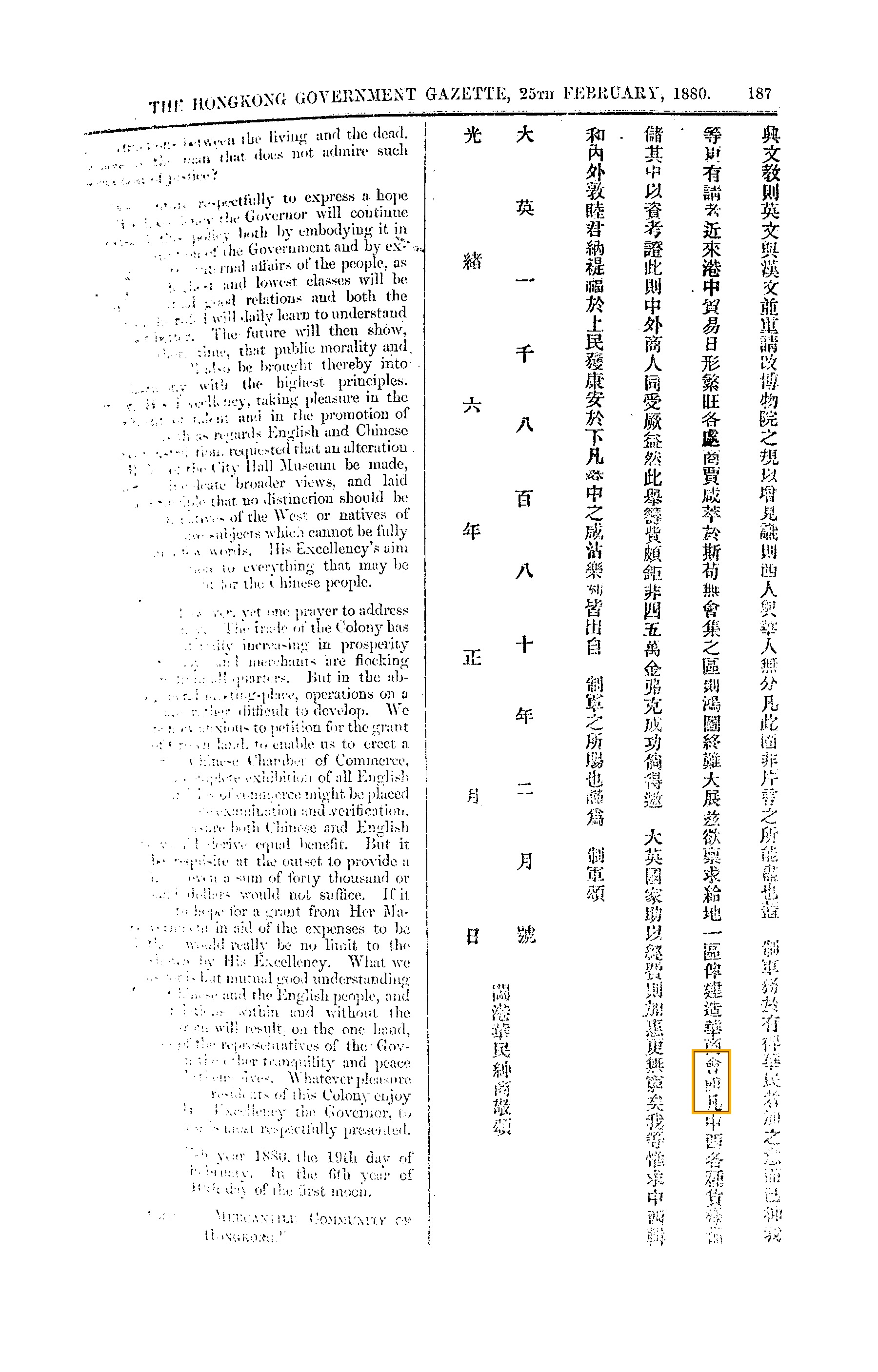
商會成立19年後,香港的華商向總督請願,要求有自己的商會。1880年2月24日,代表團到總督府請願。代表團在《政府憲報》中文欄的陳情指出,本港貿易日漸繁旺,各處商賈聚集於此,若無會集之所則難以拓展,因此請求撥給一段土地以建造華商會,並附設展示本地製造品的博物院。[9]
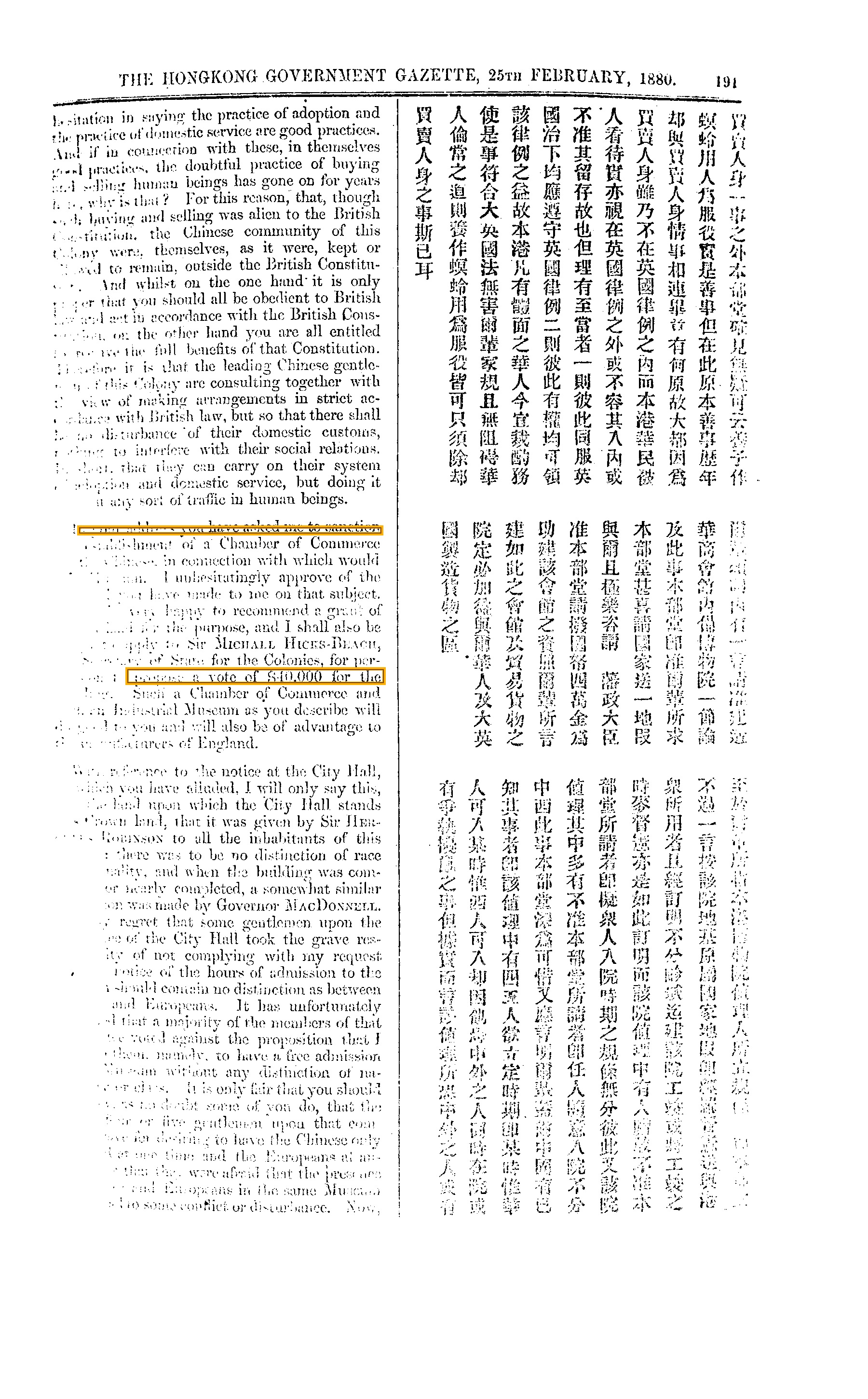
總督麥督憲在答覆中說,請求撥款興建商會與博物院一事,他已經考慮,而這件事的用款將以四萬元為數,並且他會為商會取得一段土地。答覆的中文欄記下同一個承諾:批准由政府撥款四萬元,並請政府給予一段地。[10]
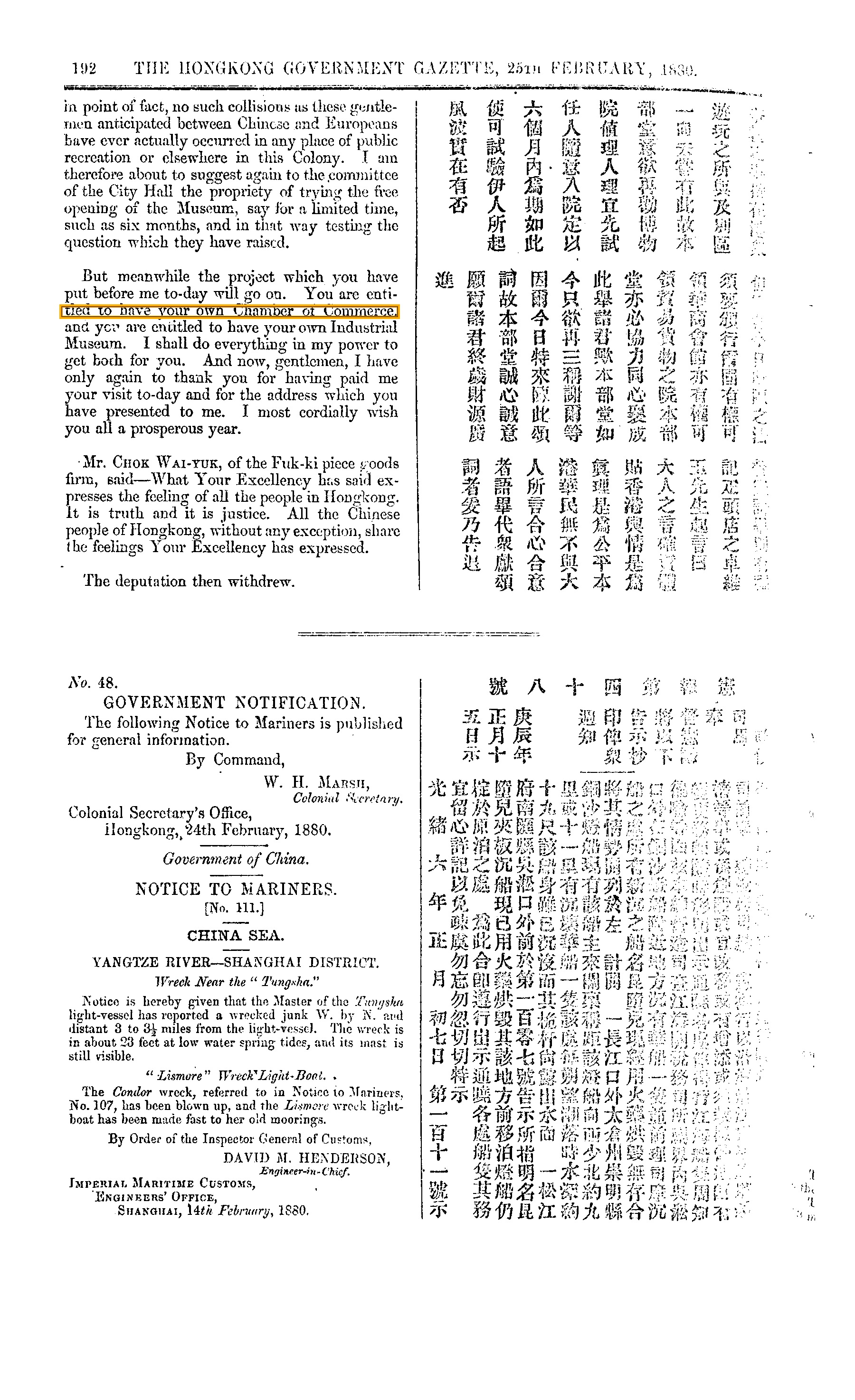
總督在答覆的結尾說:「You are entitled to have your own Chamber of Commerce, and you are entitled to have your own Industrial Museum. I shall do everything in my power to get both for you.」代表團的 Mr. Chok Wai-yuk 隨後表示,總督所說的正是全香港華人的感受。[11][12]
四、1911至1914年:社團條例與名冊上的兩會
《社團條例》於1911年訂立,訂立後不久,政府每年公布的豁免及註冊社團名冊就成了殖民地商業組織的公開名錄。1913年4月28日公布的名冊把商會按性質分類,在「GENERAL MERCHANTS' ASSOCIATION」一欄之下,上行列出非華人的商會,下行列出華人的商會:華人社會的名單上列有「Chinese Chamber of Commerce 中華會館」與「Chinese Commercial Union 華商公局」。同一頁的名單亦列出華人的社交會所與各行商會。[13]
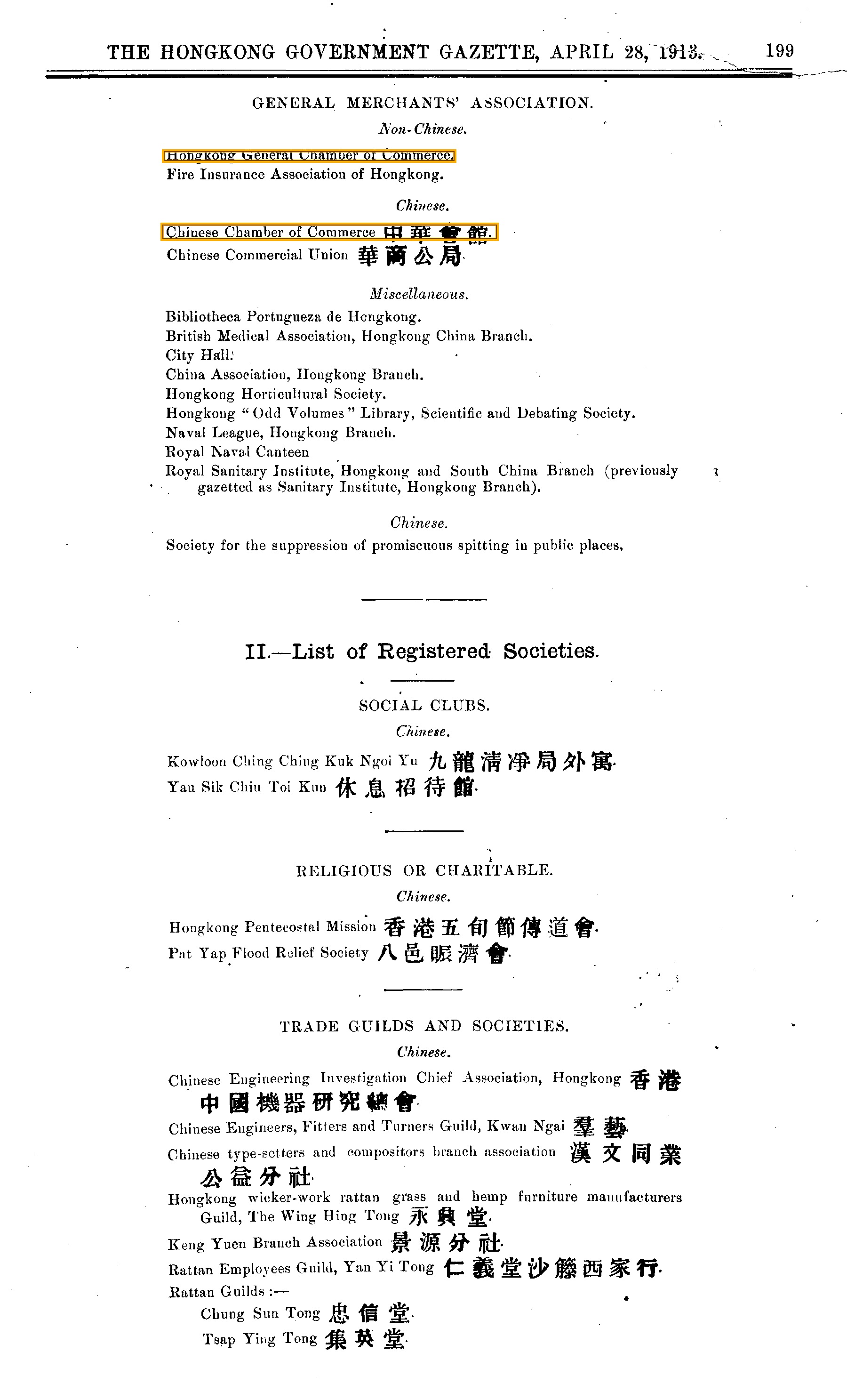
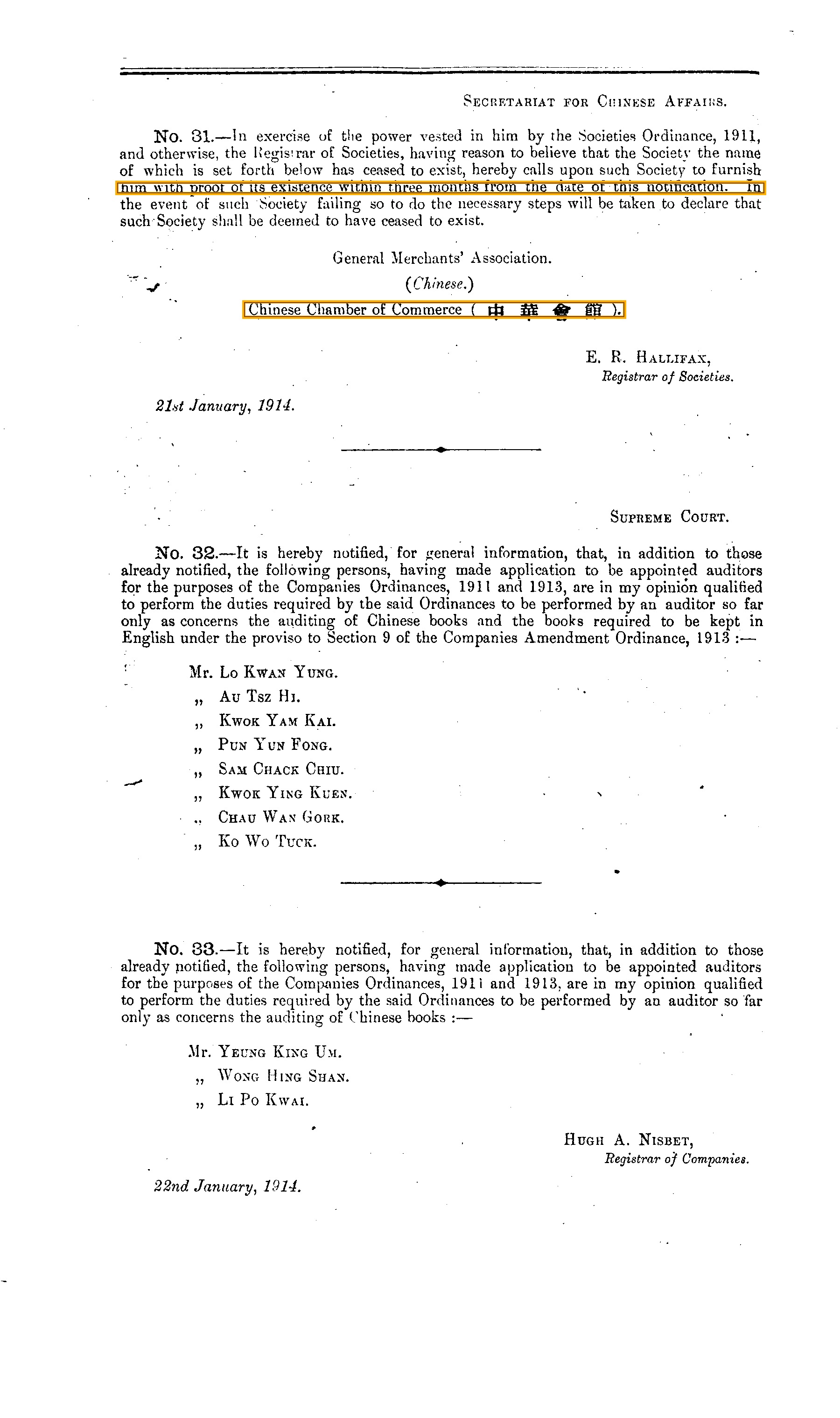
名冊上這一欄的分法,等於由殖民地政府自己把兩個商會並列在同一個分類之下,並以「華人」與「非華人」分列。1914年1月21日,華民政務司署發出第31號通告,按照《社團條例》賦予註冊官員的權力,指該會「已經不再存在」,要求「Chinese Chamber of Commerce (中華會館)」在三個月內證明自己仍然存在,否則會被視為已經不再存在。通告由註冊官員 E. R. Halifax 簽署。[14][15]
華商總會在政府名冊上的中英文名稱其後都變過。1915年的名冊在同一欄之下寫作「Chinese General Chamber of Commerce 香港華商總會」,1916年商會按月提交的財政報表也用同一個名稱印在憲報上。1919年的《Blue Book》在華文報紙一覽中列出商會自辦的報紙「華商總會報」。華商總會今日的通用名稱則是香港中華總商會。[16][17][18]
五、1915至1919年:商會之間的管道與政治
1915年10月16日,華商總會在 To Yuen Restaurant 設宴,約150位華洋顯要出席,華民政務司 B. B. C. Boss 亦在座;他在席間表示,華民政務司沒有華商總會的協助與指點便辦不成事。[19]
1917年2月1日,劉鑄伯以87票中63票當選華商總會會長,接替不再連任的何福。[20]兩家報紙同日對這次選舉的記載並不相同:《China Mail》說何福辭去的是會長一職,《Daily Press》則說由何福轉任副主席,而 Chan Kai-ming 以37票當選副主席。[21][22]
兩間商會之間的往來,在同月的一次白銀爭議中顯得清楚。1917年2月20日,《士蔑新聞》報導:華商總會就限制白銀出口一事致函,外商總商會接手處理,把華商的建議轉交外資銀行。華商的訴求由外商總商會代為轉達,兩個商會在這一件事上分工明確。[23]
1919年1月,制憲改革協會提出議案,主張七名非官守議員中,兩席由香港總商會選出,一席由太平紳士選出,三席由陪審團或合資格陪審員選出,另有一席由「the Chinese General Chamber of Commerce, or some other body representative of the Chinese community」選出。議案同時提出兩個商會,是把它們視為殖民地商界的兩邊。1919年4月26日,《China Mail》報導華商總會以約25萬元買下皇后大道中原本用作分租宿舍的 Zetland House,並打算改裝為會所。[24][25]
六、1931至1941年:九十名會員與戰時的商會
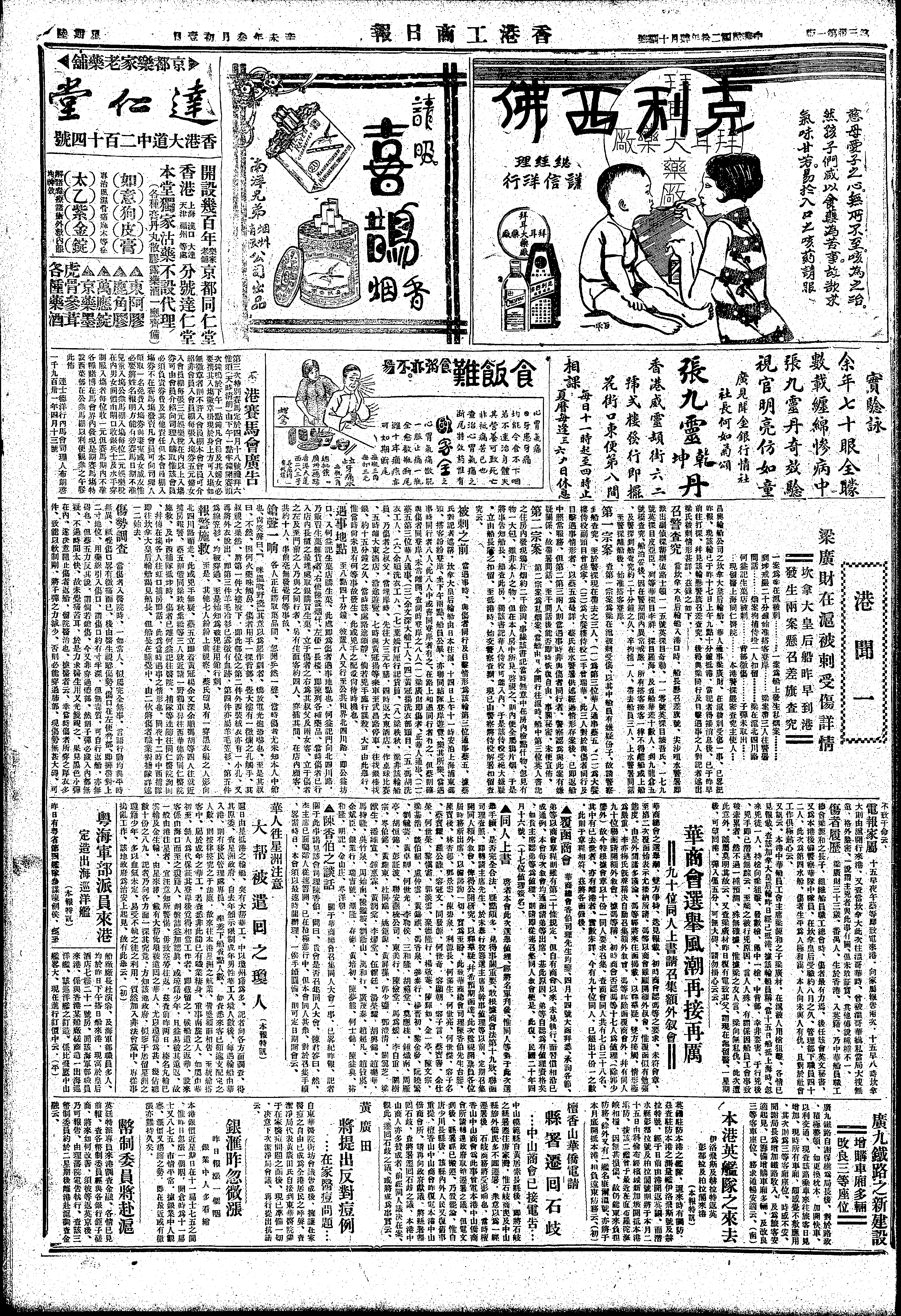
1931年4月18日,《工商日報》報導華商總會九十名會員要求召開特別大會,聯署的名單上有何世傑。[26]
戰爭改變了商會的處境。1941年的陪審員名冊上有一名「Clerk, Chinese Chamber of Commerce」,商會在這份名冊上是以僱主的身份出現,而不是以提名者的身份。1941年11月28日,《工商日報》報導日佔時期取得物資的安排,華商總會與華僑團體同在其中被徵詢。戰爭結束之後,兩個商會都進入新的時期。[27][28]
結論
香港的商人兩次集會,兩次都為同一件事:一個能向政府說話的機構。1861年那一間,章程的門是敞開的——凡從事中國貿易航運的商號都可入會——但到場的只有20家,該報社論也說這場會議不足為道。1880年華商請願時,政府答應給他們自己的商會,於是有了第二間。兩間商會在1913年的政府名冊上以「華人」與「非華人」分列,在1917年的一封白銀函件上分工,在1919年的制憲議案上分別被列為兩種席位的來源。
華商總會自己的中文名,在政府的名冊上由「中華會館」變成「香港華商總會」,今日則是香港中華總商會。同一個機構在政府的名冊上先後印過兩個中文名;而它所代表的那一群商人,在1880年之前並不在任何一間商會之內。
Two Chambers for One Harbour
The General Chamber of Commerce and the Chinese Chamber of Commerce in Hong Kong, 1861–1941
Abstract
Hong Kong's merchants organised twice. On 29 May 1861 a group of foreign firms met in Hong Kong and formed a chamber of commerce; the paper that reported the meeting the same week counted the colony's mercantile, banking, broking and commercial firms at a hundred and twenty, noted that only twenty were represented, and called the meeting insignificant. Nineteen years later the Chinese firms asked the Governor for a chamber of their own, and were told that they were entitled to one. The Government's own lists of exempted societies then set the two chambers side by side under a single heading, one under the head of the Chinese population and the other under the head of the non-Chinese. This paper follows both bodies: their founding, their rules, the work they did, and the conduit through which one carried the other's representations to the banks and to the Legislative Council. It also records what the Government printed as the Chinese chamber's name, which changed twice between 1913 and 1916 while the chamber itself kept its constitution and its officers.
1. Scope and method
The question this paper asks is simple: who spoke for the colony's commerce? The answer the archive gives is two bodies rather than one, and the second was not an accident of the first.
The corpus was swept over both of its indices for the chamber's English and Chinese names, in the Government Gazette, the Legislative Council's votes and proceedings, the English press from 1864, the 工商日報 from 1926 and the Hong Kong Year Books. The Friend of China for 1861 was read in full, three hundred and eighteen printed pages, because it is the only English-language paper in the colony for the year of the founding and it prints the chamber's rules and the account of its own birth. [29]
The phrase "chamber of commerce" is heavily overloaded in this corpus, and every body named by it had to be separated from the others before a hit could count. Shanghai had its own General Chamber of Commerce; so had Canton, in a Chinese form, and Bengal had one at Calcutta. The Government Gazette's lists of district societies include a Tung Kun chamber of commerce and industry whose English title contains the same three words. Each of these is a different body, and the paper's argument depends on keeping them apart. [30][31]
2. The founding of 1861
The meeting was held on Wednesday 29 May 1861. The rules were printed with the report of it. Rule 1 styled the body the Hongkong Chamber of Commerce; Rule 3 opened its doors to every firm and person engaged or interested in the commerce or shipping of China, at a hundred dollars a firm and fifty dollars an individual, the annual subscription payable in advance; Rule 9 gave it a committee of seven — a Chairman, a Vice-Chairman and five members — elected each May; Rule 13 fixed the general meetings for 1 May and 1 November. [1]
Only one rule was put to that meeting. The Chairman said the rules were not for confirmation there: copies would be printed and circulated among the members, and taken at an early general meeting, with only Rule 9, on the committee's size, settled on the day. [2]
The attendance as the paper printed it runs to twenty-six names, among them a Parsi firm; the paper's editorial then set the meeting against the colony's commercial life. Hong Kong had a hundred and twenty mercantile, banking, broking and commercial firms, the editorial wrote, and only twenty of them were represented, so the meeting could be considered no more than insignificant, and the haste to fill the committee seats with unseemly. [2]
The same issue printed the regulations of the British Chamber of Commerce at Canton, established by the British merchants there on 11 September 1831 at Lord Napier's suggestion, and reported the objection among the founders in Hong Kong that the new chamber was not to be a British chamber. The two sets of rules stood side by side, and the founders took the older constitution without the older name. [3]
3. The General Chamber of Commerce: the rename and the first campaigns
By February 1863 the body was already the Hongkong General Chamber of Commerce. On 6 February that year Mr. Murray presented to the Legislative Council a memorial from the chamber objecting to the second reading of the amendment to the Post Office Ordinance No. 8 of 1862. It is the chamber's first appearance in the Council's minutes and the earliest witness to the new name. [4]
The chamber then became a petitioner. In January 1864 the colony's new paper reported a debate on whether Hong Kong should have a branch of the Royal Mint, in which what the chamber had proposed was set against the view that the cost should fall on the mother country rather than on the colony. In February 1865 the Governor laid before the Council two heavily signed petitions, one from the chamber and one from 293 residents of the colony, both asking for the Limited Liability Ordinance that a previous meeting had rejected. By March 1868 the chamber was advertising its general meetings in the newspapers, and the subject on that occasion was the working of the theatre. [6][7][8]
The chamber's Chinese name was Hong Kong's own, and the Council's Chinese records use it. The Legislative Council's own research on its constitutional history records that in 1882 the first representative of the Hongkong General Chamber of Commerce was appointed as an unofficial member, the representative being Jackson of the Hongkong and Shanghai Banking Corporation. [5]
4. The Chinese chamber's origin: the deputation of 1880
Nineteen years after the first chamber was formed, a deputation of leading Chinese merchants asked the Governor for a chamber of their own. On 24 February 1880 the deputation explained its case in the Chinese column of the Government Gazette: the colony's trade was growing, merchants from everywhere gathered in it, and without a place of assembly their plans could not develop, so they asked for a piece of land on which to build a chamber, together with a museum of the goods they manufactured. [9]
The Governor's reply granted the principle and named the sum. The government was asked for a vote of forty thousand dollars towards the chamber and the museum, and the Governor undertook to obtain the money and to procure a site for them; the Chinese column records the same undertaking. [10]
The answer itself was short and categorical. "You are entitled to have your own Chamber of Commerce, and you are entitled to have your own Industrial Museum. I shall do everything in my power to get both for you." Mr. Chok Wai-yuk then told the Governor that his words expressed the feeling of all the Chinese people in Hongkong without exception. [11][12]
5. The two chambers in the statute book
The Societies Ordinance of 1911 gave the Registrar of Societies the power to call upon a registered or exempted society, where he had reason to believe it had ceased to exist, to furnish proof of its existence within three months, failing which the Governor in Council might cancel its registration. [15]
The Government's annual lists of exempted and registered societies soon made the two chambers public. The list of 28 April 1913 arranged them under a single heading, GENERAL MERCHANTS' ASSOCIATION, with the non-Chinese bodies first and the Chinese bodies below: Hongkong General Chamber of Commerce and the Fire Insurance Association of Hongkong on one side, Chinese Chamber of Commerce 中華會館 and Chinese Commercial Union 華商公局 on the other. The same page lists the colony's Chinese social clubs and trade guilds. The classification was the Government's own, and it set the colony's two merchant bodies against each other under one legal heading. [13]
A year later the Chinese chamber was in doubt. On 21 January 1914 the Secretariat for Chinese Affairs issued Notice No. 31: the Registrar of Societies, having reason to believe that the society named below had ceased to exist, called upon the Chinese Chamber of Commerce (中華會館) to furnish proof of its existence within three months, failing which steps would be taken to declare that it had ceased to exist. The notice was signed by E. R. Halifax. [14]
Both the English and the Chinese names on that list changed soon afterwards. The list of 16 April 1915 gives the Chinese body as Chinese General Chamber of Commerce 香港華商總會, and the chamber's monthly financial statement for January 1916, printed by the Gazette under the same heading of exempted societies, carries the same wording. The Blue Book for 1919 lists the chamber's own newspaper among the Chinese papers of the colony as 華商總會報. The chamber's name in the Government's lists was thus not fixed even while its constitution and its officers were. [16][17][18]
6. The two chambers at work
By 1915 the two bodies carried comparable weight. On 16 October the Chinese General Chamber of Commerce gave a dinner at the To Yuen Restaurant for about 150 of the most distinguished and prominent British and Chinese gentlemen, with the Secretary for Chinese Affairs, the Hon. Mr. B. B. C. Boss, present; the Secretary said that no Secretary for Chinese Affairs could do anything without the help and advice of the Chinese chamber. [19]
The chairmanship of the Chinese chamber changed hands on 1 February 1917, when the Hon. Mr. Lau Chu Pak was elected Chairman by 63 votes of a total of 87, in succession to Mr. Ho Fook, who did not seek re-election. [20] The two papers of that morning do not agree on the office Mr. Ho Fook held: the China Mail has him as Chairman and Mr. Chan Kaiming as Treasurer, the Daily Press has Chan Kai-ming elected Vice-Chairman in succession to Mr. Ho Fook with 37 votes against 9 for Mr. Un Ying Shan and 7 each for Mr. Ho Fook and Mr. Chan Kang-yu. Both readings are left standing. [21][22]
The way the two chambers worked together is visible in a dispute over silver. On 20 February 1917 the Hongkong Telegraph reported that upon receipt of a letter from the Chinese General Chamber of Commerce on the question of restricting the export of silver, the foreign General Chamber of Commerce took the matter up and forwarded the suggestions of the Chinese merchants to the foreign exchange bank. The Chinese chamber petitioned; the foreign chamber carried the petition to the banks. [23]
Political recognition followed. In January 1919 the Constitutional Reform Association proposed that of seven elected unofficial members, two should be elected by the Hongkong General Chamber of Commerce, one by the Justices of the Peace, three by British subjects who were jurymen or qualified for but exempt from jury service, and one by the Chinese General Chamber of Commerce, or some other body representative of the Chinese community. The resolution put the colony's two merchant bodies on either side of a single franchise. In April of the same year the China Mail reported that the Chinese General Chamber of Commerce had acquired the building formerly occupied by the Zetland House in Queen's Road for approximately $250,000, and intended to overhaul it as the chamber's headquarters. [24][25]
7. The later record
The Chinese chamber became a body that could move. On 18 April 1931 the 工商日報 reported that ninety members of the Chinese Chamber of Commerce were demanding an extraordinary general meeting, with 何世傑 among the signatories. [26]
War changed the chamber's circumstances. In the 1941 jurors list the chamber appears as an employer rather than a nominator: one name in the pool of persons available for jury service is a clerk of the Chinese Chamber of Commerce. On 28 November 1941 the 工商日報 reported on the arrangements for obtaining goods for the population under the Japanese occupation, and the Chinese chamber and the overseas Chinese associations were among the bodies approached. [27][28]
The chamber's own account of its beginning dates it to 1900: its website states that the Chinese General Chamber of Commerce was founded in 1900 and is one of the oldest and largest such chambers in Hong Kong. That is the body's own statement, and the Government Gazette's lists attest the chamber's existence from 1913 onward under the names set out above. [32]
8. Conclusion
Hong Kong's merchants organised twice, and both times for the same reason: to have a body that could speak to the Government. The chamber of 1861 opened its doors in the rules to every firm in the China trade and Chinese included, and a fifth of the colony's firms came to the meeting at which it was founded; the paper that reported the meeting called it insignificant. The Chinese firms' petition of 1880 produced a promise of forty thousand dollars and a site, and a chamber of their own in the following years. The Government's lists then set the two bodies side by side under one heading, split by the head of the population they represented; in 1917 one of them carried the other's representations to the exchange banks; and in 1919 each supplied a source of a seat in the colony's legislature.
The chamber's Chinese name on the Government's own lists changed more than once — 中華會館 in 1913 and 1914, 香港華商總會 from 1915 — and the modern body is 香港中華總商會. A name that moved while the institution did not is a useful reminder of what the two chambers were. The first was a chamber of firms; the second was a chamber of a population. And for nineteen years before the second existed, the firms that carried the colony's trade had no body of their own at all.
Friend of China, 1 June 1861, p. 132, “The Hongkong Chamber of Commerce”: the report of the founding meeting, the list of firms present, and Rules 1–19 of the chamber. The meeting was “called for Wednesday last”; the attendance as printed runs “Messrs Perceval, Chomley, Macandrew, Reddie, [Duncan?], Brodersen, Nissen, Sharp, Purdon, Cryder, Baldwin, Lapraik, Noble, Maclellan, Still, Linstead, P. Campbell, Maclean, Gibb, Delano, P. Dhunjeebhoy, Johanus, Murray, Johnson, and Bosnan.” Rule 1: “That the Society be styled the Hongkong Chamber of Commerce.” Rule 3: “That all Mercantile Firms and persons engaged or interested in the commerce or shipping of China shall be eligible for admission as members,” on payment of “$100 for Firms, $50 for single individuals for the current year, and an annual subscription of $100 payable in advance on 1st January.” https://hkintexts.histsyn.com/page/3032547 (accessed 21 November 2026). ↩
Friend of China, 1 June 1861, p. 133: the remaining rules and the committee election, and the paper's own editorial on the meeting. Rule 9 provides a committee of seven — a Chairman, a Vice-Chairman and five members — elected annually at the general meeting of May, with seven members besides the committee forming a quorum and the Chairman holding the casting vote; Rule 13 fixes the general meetings for 1 May and 1 November. The editorial: “Taking into consideration the fact that of Hongkong's hundred and twenty mercantile, banking, broking or commercial firms, only twenty were represented, the meeting in question can but be considered an insignificant one; the haste to [elect] seats in Committee being unpardonable.” The Chairman also stated that the rules were not put to that meeting: copies “would be printed and circulated for the information of the Members, to be confirmed or revised at the next General Meeting,” and only Rule 9 was confirmed. https://hkintexts.histsyn.com/page/3032548 (accessed 21 November 2026). ↩
Friend of China, 1 June 1861, p. 134: the election of the committee, the objection that the new chamber “is not to be a British Chamber of Commerce,” and the printed rules of the chamber the founders had before them — “REGULATIONS OF THE CHAMBER OF COMMERCE, ESTABLISHED by the British merchants at Canton, the 11th day of September, 1831, at the suggestion of the Right Honorable Lord Napier.” The paper noted of the Canton committee that “in that small community the committee consisted of five members, two of whom were natives of India.” https://hkintexts.histsyn.com/page/3032549 (accessed 21 November 2026). ↩
Hongkong Votes and Proceedings of the Legislative Council, 6 February 1863, p. 1: “Mr. Murray, by leave, presented a Memorial from the Hongkong General Chamber of Commerce objecting to the Bill” for the second reading of the amendment to the Post Office Ordinance No. 8 of 1862. https://hkintexts.histsyn.com/page/1881164 (accessed 21 November 2026). ↩
立法會秘書處資料研究及圖書館服務部, 《立法局文件》 (the Legislative Council's own research series), the Council's timeline of constitutional practice, which records that in 1882 there was the “首次委任香港總商會一名代表為非官守議員”, the representative being Jackson of the Hongkong and Shanghai Banking Corporation. https://hkintexts.histsyn.com/image-page/1679894 (accessed 21 November 2026). ↩
Daily Press, 5 January 1864, p. 2: a debate on whether the colony should have a branch of the Royal Mint, in which “What the Hongkong Chamber of Commerce had proposed” was set against the view that the cost should fall on the mother country and not on the colony. https://hkintexts.histsyn.com/page/2217682 (accessed 21 November 2026). ↩
Hongkong Votes and Proceedings of the Legislative Council, 23 February 1865, p. 1: “The Governor laid on the table two Petitions very numerously signed, one being from the Hongkong General Chamber of Commerce, the other from 293 Residents in this Colony,” both praying for the Limited Liability Ordinance, rejected at a previous meeting. https://hkintexts.histsyn.com/page/1881186 (accessed 21 November 2026). ↩
China Mail, 12 March 1868, p. 1: “NOTICE. MEETING of the HONGKONG GENERAL CHAMBER OF COMMERCE will be held on TUESDAY, the 17th instant, at 3 P.M., for the purpose of ascertaining the views of Members with reference to the working of” the theatre. https://hkintexts.histsyn.com/page/1884475 (accessed 21 November 2026). ↩
Hong Kong Government Gazette, 25 February 1880, printed p. 191, the Chinese deputation's address to the Governor in the Gazette's Chinese column: 「近來港中貿易日形繁旺,各處商賈咸萃於斯,苟無會集之區,則鴻圖終難大展,茲欲稟求給地一區,俾建造華商會」, with the museum of manufactured goods asked for in the next column. https://hkintexts.histsyn.com/image-page/1491237 (accessed 21 November 2026). ↩
Hong Kong Government Gazette, 25 February 1880, printed p. 195, the Governor's reply in both columns: “Your address has asked me to sanction the building of a Chamber of Commerce and an Industrial Museum in connection with which would be made a vote of $40,000 for the purpose,” with the Chinese column recording 「准本部堂請機國帑四萬金」 and 「請國家送一地叚」. https://hkintexts.histsyn.com/image-page/1491241 (accessed 21 November 2026). ↩
Hong Kong Government Gazette, 25 February 1880, printed p. 196: the Governor's answer to the deputation — “You are entitled to have your own Chamber of Commerce, and you are entitled to have your own Industrial Museum. I shall do everything in my power to get both for you.” https://hkintexts.histsyn.com/image-page/1491242 (accessed 21 November 2026). ↩
Hong Kong Government Gazette, 25 February 1880, printed p. 192, the deputation's address and withdrawal, with the Governor's undertaking and Mr. Chok Wai-yuk's reply that “All the Chinese people of Hongkong, without any exception, share the feelings Your Excellency has expressed.” https://hkintexts.histsyn.com/page/1667792 (accessed 21 November 2026). ↩
Hong Kong Government Gazette, 28 April 1913, printed p. 199, the List of Exempted and Registered Societies, under the heading GENERAL MERCHANTS' ASSOCIATION: “Non-Chinese. Hongkong General Chamber of Commerce. Fire Insurance Association of Hongkong. Chinese. Chinese Chamber of Commerce 中華會館. Chinese Commercial Union 華商公局.” The page also lists, under SOCIAL CLUBS and TRADE GUILDS AND SOCIETIES, the Chinese clubs and guilds of the colony. https://hkintexts.histsyn.com/image-page/1486260 (text twin https://hkintexts.histsyn.com/page/1601237; accessed 21 November 2026). ↩
Hong Kong Government Gazette, 21 January 1914, printed p. 20, Secretariat for Chinese Affairs, Notice No. 31: the Registrar of Societies, “having reason to believe that the Society the name of which is set forth below has ceased to exist,” calls upon the “General Merchants' Association. (Chinese.) Chinese Chamber of Commerce (中華會館)” to furnish proof of its existence within three months, the notice being signed by E. R. Halifax. https://hkintexts.histsyn.com/image-page/1487810 (text twin https://hkintexts.histsyn.com/page/1603415; accessed 21 November 2026). ↩
Hong Kong Government Gazette, 1911, printed p. 617, the Societies Ordinance 1911: “If the Registrar shall have reason to believe that any Cessation of Registered or Exempted Society has ceased to exist, he may publish in the Gazette a notification calling upon such Society to furnish him with proof of its existence within three months from the date of such notification, and if at the expiration of such three months the Governor-in-Council is satisfied that the Society has ceased to exist, the Registrar shall cancel the registration or exemption.” https://hkintexts.histsyn.com/image-page/1478555 (accessed 21 November 2026). ↩
Hong Kong Government Gazette, 16 April 1915, printed p. 205, the List of Exempted and Registered Societies: under GENERAL MERCHANTS' ASSOCIATION, “Chinese. Chinese General Chamber of Commerce 香港華商總會,” the Chinese name having changed from the form printed two years earlier. The same page lists the colony's district societies, including “Chu Kong Tung Kun Kuu Hop Yap Chung Sheung Wai 駐港東莞關邑總商會 (General Commercial Association of Tang Kun Merchants resident in Hongkong).” https://hkintexts.histsyn.com/image-page/1490605 (accessed 21 November 2026). ↩
Hong Kong Government Gazette, 20 April 1916, printed p. 224, the chamber's monthly financial statement for January 1916, published under the list of exempted societies: “General Merchants' Association. Chinese. Chinese General Chamber of Commerce 香港華商總會. TREASURY. No. 166.—Financial Statement for the month of January, 1916.” The same wording is printed in the lists of 1918 and 1919. https://hkintexts.histsyn.com/image-page/1494156 (accessed 21 November 2026). ↩
Hong Kong Blue Book 1919, p. 267, the return of the Chinese newspapers in the colony: the list includes “The Chinese Commercial News (daily) — 華商總會報,” the chamber's own newspaper. https://hkintexts.histsyn.com/page/673631 (accessed 21 November 2026). ↩
Daily Press, 16 October 1915, p. 3: “a gathering of about 150 of the most distinguished and prominent British and Chinese gentlemen” given by the Chinese General Chamber of Commerce at the To Yuen Restaurant, with the Secretary for Chinese Affairs, the Hon. Mr. B. B. C. Boss, present; the Secretary said that no Secretary for Chinese Affairs could do anything without “the help and advice of the Chinese” chamber. https://hkintexts.histsyn.com/page/2274948 (accessed 21 November 2026). ↩
《百年商業》, p. 17, the chamber's own newspaper and its chairman in Chinese: 「其時華商總會已有華商總會報之出版,純為該會宣傳消息之機關報……本港華商總會舉行同人總敍會,由會主席劉鑄伯君提議,以該會因未辦有報紙……特提議由該會創辦報紙」, with the printing contract signed with the 孖剌西報 and a proposed capital of $15,000. https://hkintexts.histsyn.com/page/3186160 (accessed 21 November 2026). ↩
China Mail, 1 February 1917, p. 4, “CHINESE GENERAL CHAMBER OF COMMERCE”: “The Hon. Mr. Lau Chu Pak has been elected Chairman of the Chinese General Chamber of Commerce by 63 out of a total of 87 votes … in succession to Mr. Ho Fook who did not seek re-election.” https://hkintexts.histsyn.com/page/1952482 (accessed 21 November 2026). ↩
Daily Press, 1 February 1917, p. 5: the same election, with the offices and the votes — “Mr Chan Kai-ming was elected Vice-Chairman in succession to Mr. Ho Fook. who did not seek re-election. Mr. Chan Kai-ring received thirty-seven votes as against nine given for Mr. Un Ying Shan, and seven each for Mr. Ho Fook and Mr. Chan Kang-yu.” The two papers of the same day disagree on which office Ho Fook held. https://hkintexts.histsyn.com/page/2278949 (accessed 21 November 2026). ↩
Hongkong Telegraph, 20 February 1917, p. 2: “Upon receipt of a letter from the Chinese General Chamber of Commerce on the question of restricting the export of silver, the foreign General Chamber of Commerce has taken up the matter by forwarding the suggestions of the Chinese merchants to the foreign exchange bank.” https://hkintexts.histsyn.com/page/2886508 (accessed 21 November 2026). ↩
China Mail, 9 January 1919, p. 3, the resolution of the Constitutional Reform Association: “That of the seven elected unofficial members (all of whom shall be British subjects) two shall be elected by the Hongkong General Chamber of Commerce; one by the Justices of the Peace; three (two of whom shall be of British race and one of Portuguese race) by British subjects who are jurymen, or are qualified for, but exempt from jury service and one by the Chinese General Chamber of Commerce, or some other body representative of the Chinese community.” https://hkintexts.histsyn.com/page/1957213 (accessed 21 November 2026). ↩
China Mail, 26 April 1919, p. 5: “MORE PEOPLE HOMELESS. WELL-KNOWN BOARDING HOUSE BECOMES CHINESE CHAMBER OF COMMERCE. The China Mail understands that the Chinese General Chamber of Commerce has acquired the building hitherto occupied by the Zetland House in Queen's Road, for approximately $250,000, and it is intended to overhaul the building for the purpose of making it the Chamber's headquarters.” https://hkintexts.histsyn.com/page/1958139 (accessed 21 November 2026). ↩
工商日報, 18 April 1931, p. 13848: ninety members of the Chinese Chamber of Commerce demanding an extraordinary general meeting, with 何世傑 among the signatories. https://hkintexts.histsyn.com/image-page/442715 (accessed 21 November 2026). ↩
Hong Kong Government Gazette, 1941, Jurors List, p. 29, the pool of persons available for jury service: “Assistant, Lane, Crawford, Ld. Clerk, Chinese Chamber of Commerce.” The chamber appears here as an employer of a person on the list, not as a body that nominates jurors. https://hkintexts.histsyn.com/page/1598821 (accessed 21 November 2026). ↩
工商日報, 28 November 1941, p. 5: the Chinese chamber and the overseas Chinese associations among the bodies approached over the supply of goods to the population under the Japanese occupation. https://hkintexts.histsyn.com/image-page/477250 (accessed 21 November 2026). ↩
The corpus was swept over both of its indices for the chamber's English and Chinese names, in the Government Gazette, the Legislative Council's votes and proceedings, the English press from 1864, the 工商日報 from 1926 and the Hong Kong Year Books. The Friend of China for 1861 was read in full (318 printed pages) because it is the only English-language paper in the colony for the year of the founding. Every chamber named in the corpus was separated from the others: Shanghai's General Chamber of Commerce (1845), the Canton British Chamber of Commerce (1831), the Canton Chinese General Chamber of Commerce, the Bengal Chamber of Commerce at Calcutta, and the Tung Kun district's own chamber of commerce and industry, which the gazette listed under District Societies and whose English title contains the words General Chamber of Commerce. ↩
Shanghai's General Chamber of Commerce is a separate body: the Daily Press of 4 October 1864 reports the “Sex Comissions adopted by the Shanghai General Chamber of Commerce, at the annual Meeting held on the 23rd September, 1864. Purchasing Tea, Raw Silk, Opium.” https://hkintexts.histsyn.com/page/2218592 (accessed 21 November 2026). ↩
The Canton chamber is a separate body: the China Mail of 23 March 1906 prints a despatch “delivered to the Canton Chinese General Chamber of Commerce” on the Canton–Hankow railway. https://hkintexts.histsyn.com/page/1925242 (accessed 21 November 2026). ↩
香港中華總商會 (the Chinese General Chamber of Commerce's own site), 「香港中華總商會(中總)於1900年成立,是香港歷史最長及最具規模的商會之一,秉持服務社會、與時並進的宗旨」 — the chamber's own account of its founding year. https://www.cgcc.org.hk/zh/subcat.php?cid=2&sid=25 (accessed 21 November 2026); the English page of the same body: “Founded in 1900, the Chinese General Chamber of Commerce (CGCC) is one of the oldest and largest such chambers in Hong Kong.” https://www.cgcc.org.hk/en/subcat.php?cid=2&sid=16 (accessed 21 November 2026). ↩
Bibliography
- *Friend of China*, 1861, pp. 132–134 — the founding of the Hongkong Chamber of Commerce, its rules and the account of its first meeting. https://hkintexts.histsyn.com/page/3032547 · https://hkintexts.histsyn.com/page/3032548 · https://hkintexts.histsyn.com/page/3032549 (accessed 21 November 2026).
- Hong Kong Government Gazette, 1880, printed pp. 191–196 — the Chinese deputation and the Governor's answer. https://hkintexts.histsyn.com/image-page/1491237 · https://hkintexts.histsyn.com/image-page/1491241 · https://hkintexts.histsyn.com/image-page/1491242 (accessed 21 November 2026).
- Hong Kong Government Gazette, 1911–1919 — the Societies Ordinance, the lists of exempted and registered societies, and the chamber's monthly financial statements. https://hkintexts.histsyn.com/image-page/1478555 · https://hkintexts.histsyn.com/image-page/1486260 · https://hkintexts.histsyn.com/image-page/1487810 · https://hkintexts.histsyn.com/image-page/1490605 · https://hkintexts.histsyn.com/image-page/1494156 (accessed 21 November 2026).
- Hongkong Votes and Proceedings of the Legislative Council, 1863 and 1865. https://hkintexts.histsyn.com/page/1881164 · https://hkintexts.histsyn.com/page/1881186 (accessed 21 November 2026).
- *Daily Press*, 1864, 1915 and 1917; *China Mail*, 1868, 1917 and 1919; *Hongkong Telegraph*, 1917. https://hkintexts.histsyn.com/page/2217682 · https://hkintexts.histsyn.com/page/2274948 · https://hkintexts.histsyn.com/page/2278949 · https://hkintexts.histsyn.com/page/1884475 · https://hkintexts.histsyn.com/page/1952482 · https://hkintexts.histsyn.com/page/1958139 · https://hkintexts.histsyn.com/page/2886508 (accessed 21 November 2026).
- 香港中華總商會, the chamber's own account of its foundation in 1900. https://www.cgcc.org.hk/zh/subcat.php?cid=2&sid=25 (accessed 21 November 2026).
Appendix A — The sources, and the chambers that are not this one
The corpus holds at least five other bodies under the name "chamber of commerce", and the paper's argument holds only if they are kept apart.
- Shanghai's General Chamber of Commerce. Established in 1845; its rules and its meetings are reported in the Hong Kong papers. The entry of 4 October 1864 in the Daily Press, which this paper's author first took for the Hong Kong chamber's, is Shanghai's. [30]
- The Canton Chinese General Chamber of Commerce. The despatch of 23 March 1906 printed in the China Mail under this name was delivered to Canton, not to Hong Kong. [31]
- The British Chamber of Commerce at Canton, established by the British merchants at Canton on 11 September 1831, whose regulations the Hong Kong founders had before them in 1861.
- The Bengal Chamber of Commerce at Calcutta, whose notices of famine relief fill the Government Gazette of 1861.
- The Tung Kun district chamber of commerce and industry, printed in the Gazette's lists of district societies, whose English title contains the words General Chamber of Commerce.
The Society of 1911's list of exempted societies is the most useful single instrument for the period: it names the bodies, gives each a category, and prints the Chinese name beside the English one.
Appendix B — The chronology
| Date | Document | What it records |
|---|---|---|
| 29 May 1861 | Friend of China, 1 June 1861 | The founding meeting, the attendance, Rules 1–19, and the paper's verdict on it. |
| 6 February 1863 | Votes and Proceedings | The chamber's first memorial, as the Hongkong General Chamber of Commerce. |
| 5 January 1864 | Daily Press | The chamber's proposal of a branch of the Royal Mint. |
| 23 February 1865 | Votes and Proceedings | The chamber's petition, with that of 293 residents, on the Limited Liability Ordinance. |
| 12 March 1868 | China Mail | Notice of the chamber's general meeting. |
| 24–25 February 1880 | Government Gazette | The Chinese deputation's petition and the Governor's answer, with $40,000 and a site. |
| 1911 | Government Gazette | The Societies Ordinance and the Registrar's power to call on a society to prove its existence. |
| 28 April 1913 | Government Gazette | The list of exempted societies: the two chambers under one heading. |
| 21 January 1914 | Government Gazette | The call on the Chinese chamber to prove that it still existed. |
| 16 April 1915 | Government Gazette | The same list, with the chamber's English and Chinese names changed. |
| 20 April 1916 | Government Gazette | The chamber's monthly financial statement, printed under its new name. |
| 16 October 1915 | Daily Press | The Chinese chamber's dinner for 150 guests, and the Secretary for Chinese Affairs's address. |
| 1 February 1917 | China Mail; Daily Press | The election of the Chinese chamber's chairman, with the two papers differing on one office. |
| 20 February 1917 | Hongkong Telegraph | The Chinese chamber's letter on silver, carried by the foreign chamber to the banks. |
| 9 January 1919 | China Mail | The franchise resolution naming both chambers. |
| 26 April 1919 | China Mail | The purchase of the Zetland House for the Chinese chamber's headquarters. |
| 1919 | Blue Book | The chamber's own newspaper, 華商總會報, in the list of Chinese papers. |
| 18 April 1931 | 工商日報 | Ninety members demanding an extraordinary general meeting. |
| 1941 | Government Gazette; 工商日報 | The chamber in the jury pool and in the occupation's supply arrangements. |
Comments
Post a Comment