保良局1878–1893:防拐社會與它的時代
保良局1878–1893:防拐社會與它的時代
摘要
保良局(Po Leung Kuk)今天以學校與慈善服務為人所知;它的起點,是一場發生在1870年代末的拐帶恐慌,以及東莞縣駐港客商的一次集體自保1。本硏究以語料庫中兩批創局文獻為骨幹——1880年2月4日《憲報》刊布的請願與委員會文件(35頁),以及同年2月18日的續刊案件檔案23——重建這所「防拐社會」由請願(1878年11月)、成立(1880年6月)、訂章(1882年8月)、立案(1893年)到制度化(1897–1932年)的整條線索。三點發現:其一,創辦的推動力來自兩個不對稱的方向——高等法院首席按察司 John Smale1878年從審判席上發出的譴責4,與同年11月東莞商人向總督軒尼詩(Hennessy)遞上的請願書1;其二,社會先於批准而存在——1880年5月,該會僱用的偵探已在廈門拐帶案中工作5,而殖民地部大臣金巴利伯爵(Earl of Kimberley)5月20日的覆文還在責備港府「失時」6;其三,立案並非坦途——1892年有「秘密社會」之指控7,1893年的調查委員會與立法局角力留下了道歉聲明8,而英廷的不否決帶有修訂條件9。
一、導論:一宗抵債賣女案
1877年10月5日,九龍城寨外大角嘴的石匠曾三發(Tsang San-fat),把六歲的女兒林娣交給理髮店的梁亞哲(Leung A-tsit),抵銷一筆連利共23元的欠債10。1878年5月,曾三發得知女兒將被送走,先後向登記官與輔政司請願;總督軒尼詩要求律政司檢控,律政司 G. Phillippo卻先後兩次覆稱:這些行為「在我們的法例中不構成刑事罪行」,若要取締,「將有必要為此制定特別條文」1011。這一宗案子把當時法律的空隙完整暴露:事主承認「參與非法交易」,父親無力還債,買方「預備還錢便交人」,而法庭只能靠人身保護令。本硏究即由這宗案件進入。
二、請願:東莞客商與六十二家商號
1878年11月,東莞縣駐港客商盧禮屏、馮明珊、施笙階、謝達盛等聯名上書軒尼詩:他們說拐匪「陽奉陰違、行踪詭秘」,甚至「媒婆老媼俱為拐帶窩家」;「良家婦女到港,初則詭騙為傭,繼則逼勒為妓,或轉販外洋,或分售各埠」;「童男則賣作螟蛉,童女則鬻作娼婢」。請願書附有五條規條:集資懸賞、每名拐匪定罪後賞紅二十元、由三位殷商管帳、被拐者資遣回籍——並請求總督「給諭」,即批准他們自行查緝1。附件上蓋有62家商號的印章;英譯出自德國傳教士、漢務參贊歐德理(E. J. Eitel)之手,署期1878年11月9日1。軒尼詩11月12日批示:「此乃本地商人可嘉之願」;巡理府 J. J. Francis起草章程:有限公司形式、十元認捐人、七人值理、總督否決權、以及由公局自僱偵探、經政府認可後宣誓為特務警察12。11月28日首次會議上,馮明珊(有利銀行買辦)拿出兩份名單:西營盤與太平山一帶37至38間「拐匪窩舖」,以及21名、41名「職業拐匪」的姓名13。1879年6月,馮明珊以「暫充值事」名義回覆章程修訂14;10月,首席按察司 John Smale 留下一句名文:「『人類販子』,一個十一歲女孩如此稱呼他們,在本港各類經紀中自成一行,而法律像對待麻將館主一樣,視若無睹。」4同月,值事們再上一稟,反對把買婢視為公罪,理由包括溺女之風恐因此更甚15;歐德理的長篇報告則稱「任何立法或行政措施」都不會加速這一社會變遷16。
三、成立:白廳的催逼
1880年2月4日與18日,《憲報》分兩期刊出全部文件,呈交定例局(立法局)23。第二期所載案件中,被賣女子的供詞首次出現:「區妹」案、「羅桂」案、19歲的陳蓮好「由福州帶來」、15歲的黃女……以及雜貨商羅明對威靈頓街一名女販的供詞:「她買賣年幼女子,送往澳門」3。文件送到倫敦,殖民地部大臣金巴利伯爵5月20日覆軒尼詩:他注意到請願「自1878年11月以來並無進展」,「很遺憾損失瞭如許寶貴時間」;指示港府「即時致謝這些華人紳士」,「准許他們自行組織任何形式的社團」6。6月24日,輔政司 Frederick Stewart致函盧禮屏、馮明珊、施笙階、謝達盛等(第723號):准予設會,但「章程與組織須呈請殖民地政府核准」,警察將與他們合作17。值得注意的是:在批文到達之前,1880年5月的廈門拐童案中,歐德理已經寫道「多謝本會僱用的偵探」,馮明珊親自報告查案結果5——社會先於批准而工作。1880年2月19日,全港華商代表團到督轅致謝,名單上有「有利銀行買辦馮普熙」與「主筆王韜」18;此後數月,該會以「保良公局」之名繼續籌組。今日保良局以11月8日為創局紀念日;語料庫文件顯示請願書的英譯署期11月9日,歐德理函件稱之為「11月11日的請願」——三個日子並存,記錄同一個11月119。
四、訂章、偵探與質疑:1882–1888
1882年8月5日,《憲報》第318號公告核准保良局章程:其宗旨為「協助政府執行保護婦孺之法律」20。8月12日第328號刊出1882–83年度值事:馮明珊正主席、伍秩庸(伍廷芳)副主席、梁鶴巢(仁記洋行)司庫,值理有李逸樓、黃筠堂、趙子墻、陳述初、曹雨亭等21——創局群體與東華醫院、南北行、定例局議員同一批人。同年,登記官在一份密件中留下日後常被引用的評語:保良局「若不慎加監督,可能發展為一種『imperium in imperio』」22;而政府批出的土地文件上,出現了耐人尋味的用途描述——「保良局與商業博物館」23。報紙的質疑亦隨之而來:「保良局自身是否無愧於軒尼詩的盛讚?」「買來的婢女,與人家的祖屋有何不同?」24。1884年,定例局通過首次撥款1,000元25;1888年,再通過8,500元,興建「拯救女童之家」26。
五、立案:1892–1894的角力
1891年,值事會上稟請求「撥款並明定地位」;登記官駱克(Stewart Lockhart)1892年2月的報告寫下官方的創局史:1878年Smale 的審判席言論「引起華人社會關注」,促成向軒尼詩的請願;「在批示到達之前,保良局已非正式成立」;他並統計:四年間「2,412名男女經保良局送回親屬,218名女子成婚,46名孩童被領養,共處理2,851人」27。然而1892年的第一條立案草案遭遇猛烈反對:N. J. Ede投書稱,賦予法團地位等於「在我們中間建立一個秘密政府」7;1892–93年,定例局成立調查委員會(駱克任主席),記錄了 Inspector Stanton 等人的指控與登記官的反駁28。1893年5月,條例草案首讀,Whitehead提出押後動議、Belilios和議,以二對六被否決,「草案隨即首讀通過」29。6月26日,《保良局立案法團條例》(1893年第10號)通過;12月,殖民地部大臣Ripon覆文:不否決,但「須修訂後方可實施」——加上向總督上訴的條文與借用更練的權力;1894年第1號條例照改9。Whitehead其後以書面道歉:「用語易致誤解,謹向保良局諸君致歉。」8
六、制度化:1897–1932
1897年《保護婦女及女童條例》(第9號)施行後,保良局的「留養」有了法定程序:1898年,依該條例第二部留養的女子225名;同年警方依該條例第30條搜查「暗娼館」671次,救出17名女子;另有48名女子被報失蹤,僅15名尋回30。經費仍靠捐助:全年支出五千餘元,認捐二千餘元,原30,000元本金的餘額補足差額;政府拒絕了每年1,000元補助的請求30。1898年6月,日本「褒賞局」透過領事送來銀杯,答謝保良局保護「被騙來港的日本女子」30。1909年的年報列出運作細節:全年收容515人(內124名孩童)、送回親屬193人、婚配49人、領養25人;巡獄法官年訪12次;年結存20,116元,其中15,000元分存五家華資銀行31。1910年的報告寫下官方的定型句:「保良局是1878年創立的華人社會,以制止拐帶及販賣人口為務。」321932年,立法局通過《保良局立案法團修訂條例》(第4號),調整值理會組織33。此後,保良局的名字一路走進現代香港;而它的起點,始終是那份蓋著62家商號印章的請願書19。
結論
保良局的歷史不是「慈善機構的成長史」那麼簡單。它起於一個法律空隙(1865年條例管不了自願賣女)、一個社會危機(拐帶與人口販賣)與一個社群的自我組織(東莞客商62家商號)。它的建立順序值得記錄:先有偵探與查案(1880年5月),後有政府的批准(1880年6月);先有值事會與值理(1882年),後有立法局條例(1893年)。英廷的兩次介入——1880年的催逼與1893年的附條件不否決——說明殖民政府與這個華人自治機構之間的關係,從來是既合作又警惕6922。而保良局自己留下的那句話——「本局創立於戊寅年(1878–79),由東華醫院總理等創辦」27——與政府檔案、與報紙、與今天的紀念日,共同構成它多聲部的出生證明。
The Society Against Kidnapping
The Po Leung Kuk 保良局 and its founding generation, 1878–1893
Abstract
The Po Leung Kuk is known today as one of Hong Kong's largest charities. This paper reconstructs what it was at the start: a self-organised vigilante-adjacent society of Dongguan 東莞 merchants, born in a kidnapping panic, licensed by Whitehall only after three years of colonial delay, and fought over at its incorporation as a suspected “secret society.” The spine is the corpus's own founding dossier — the Government Gazette of 4 and 18 February 1880 (“papers relating to the purchase and detention of children, kidnapping, and so called domestic servitude in Hongkong”) 23 — the formation letter of 24 June 1880 17, the approved rules of 5 August 1882 20, the government's 1892 history of the society 27, the 1892–93 Special Committee of Enquiry 28, and the surviving annual reports down to 1932 3133. Three findings: (1) the society existed before its permission — its detective was working the Au Múi case in May 1880 while Kimberley's despatch was still in the mail 56; (2) its leadership was the same Chinese elite as the Tung Wah Hospital, the Nam Pak Hong and the Legislative Council — its 1882 vice-president was Ng Tit-yung 伍秩庸, the councillor Wu Tingfang 21; (3) its incorporation was conditional history: not disallowed by the Crown only on condition of amendment, and amended in 1894 accordingly 9.
Keywords: Po Leung Kuk 保良局; kidnapping; domestic servitude; Chinese elites; colonial legislation; Hong Kong 1878–1893.
1. The case that found the law, 1877–78
On 5 October 1877 Tsang San-fat, a stone cutter of Tai-kok-tsui outside Kowloon City, handed over his six-year-old daughter Lam-ki to Leung A-tsit of a barber's shop, against a $23 debt; in May 1878 the father heard she was to be sent away and petitioned the Registrar General and then the Colonial Secretary 10. The Governor, Hennessy, told the Attorney General to prosecute; G. Phillippo twice declined, finding no criminal offence and warning that “it will be necessary to introduce special provisions for the purpose” 11. The file — printed two years later as the opening of the founding dossier — is the exact measure of the gap that private initiative then filled 2.
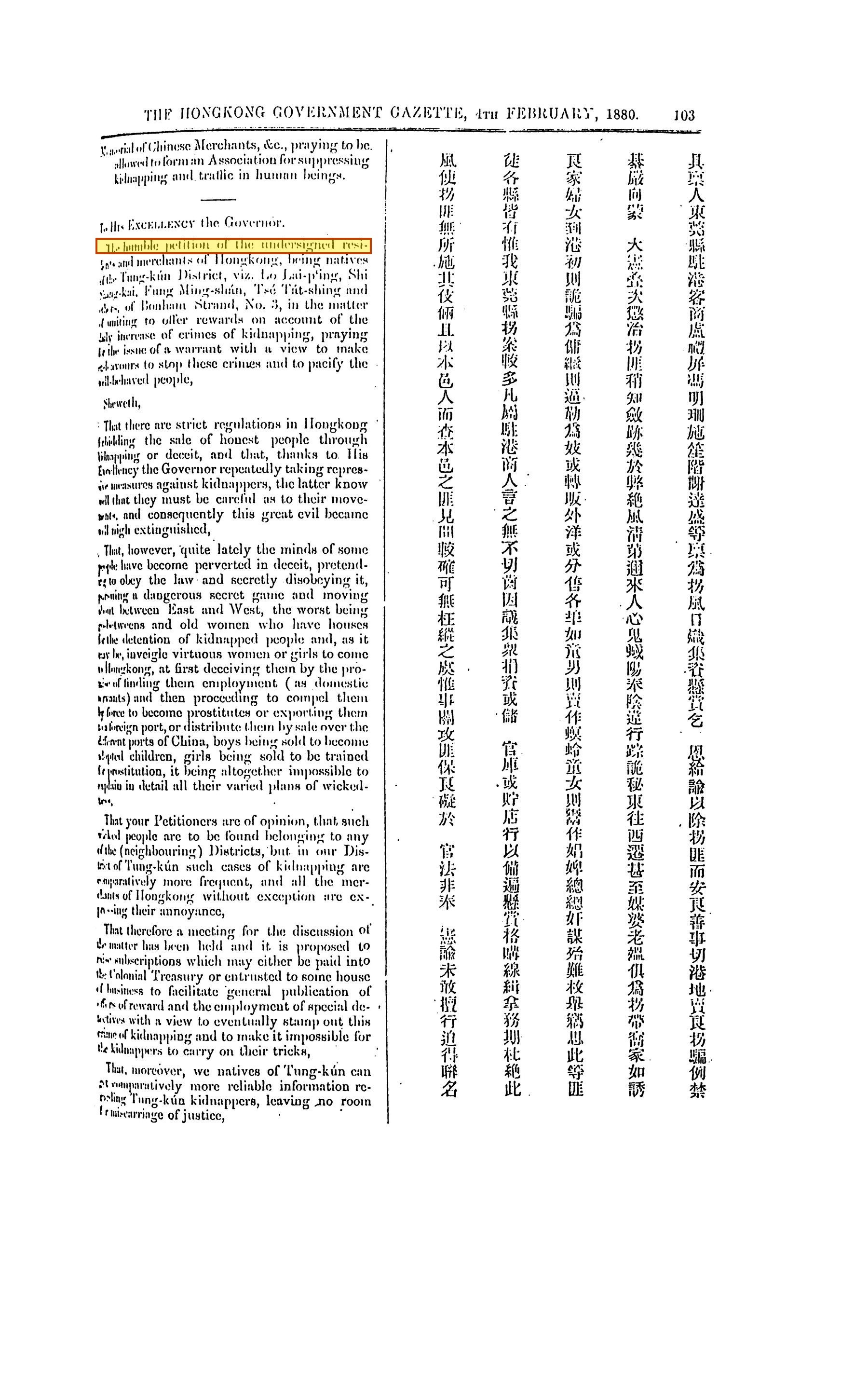
2. The petition of November 1878
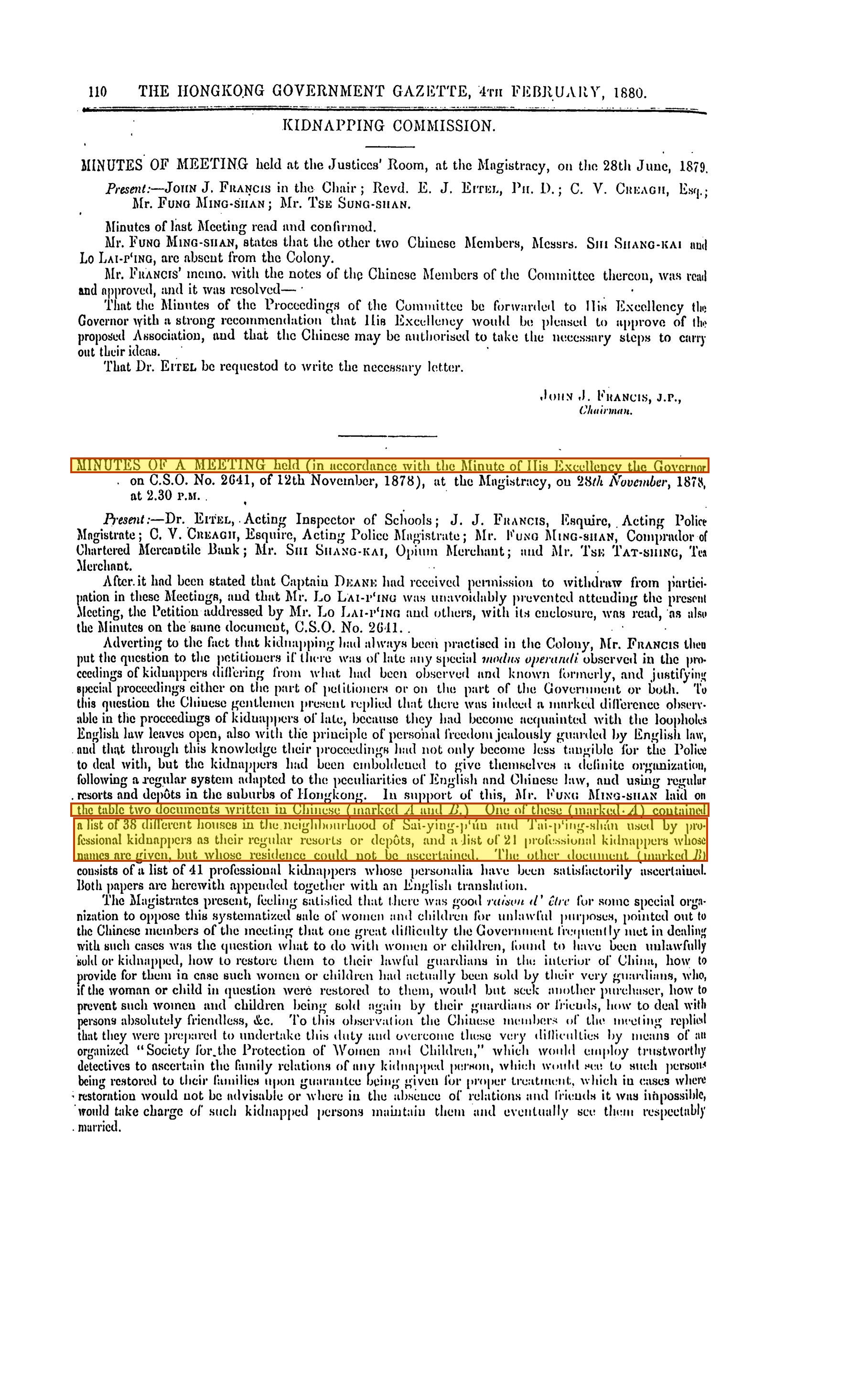
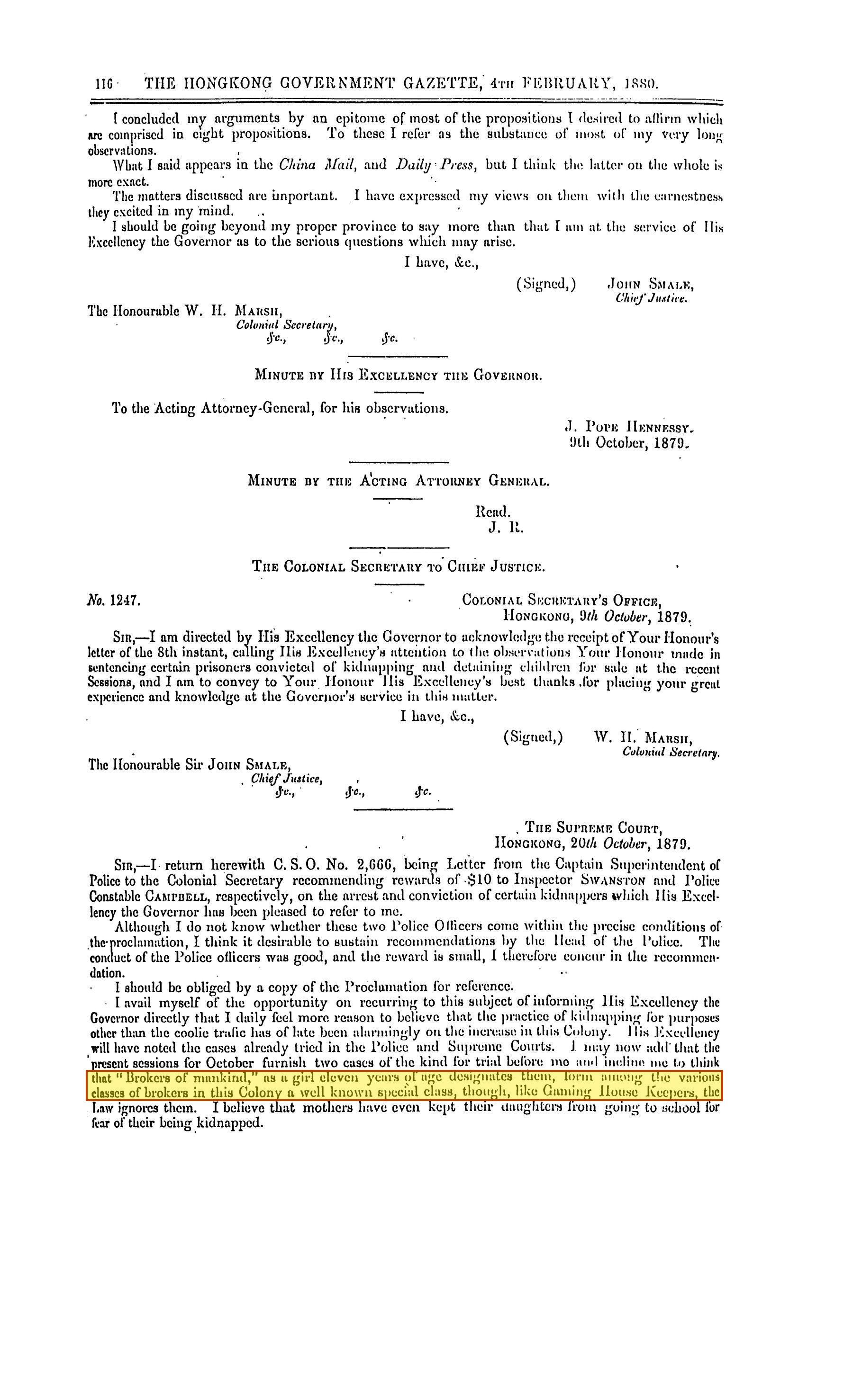
In November 1878 the resident merchants of the Tung-kún (Dongguan) district — Lo Lai-ping 盧禮屏, Shi Shang-kai 施笙階, Fung Ming-shán 馮明珊, Tsé Tát-shing 謝達盛 “and others, of Bonham Strand, No. 3” — petitioned the Governor for a warrant “to institute inquiries” against kidnappers, offering subscriptions and $20 rewards, and appending five regulations; the petition carried the seals of 62 shops and was translated by the Chinese Secretary E. J. Eitel 歐德理, dated 9 November 1878 1. Hennessy's minute of 12 November asked the two Police Magistrates, the Captain Superintendent of Police and Eitel to draw up a scheme with the petitioners 1; J. J. Francis's “Suggestions” of 15 November designed the society — corporate form, $10 members, a committee of seven, a Governor's veto, and detectives sworn as special constables 12. At the first meeting, 28 November 1878, the Chinese members explained that kidnappers had learned “the loopholes English law leaves open,” and Fung Ming-shan tabled two documents: a list of 38 houses in Sai-ying-p'un and Tai-p'ing-shán used as the kidnappers' depôts, and the names of 21 and 41 professional kidnappers 13. Through 1879 the scheme moved forward — Fung's amendments (detectives to board junks and steamers) 14, the second petition of 22 October against the Chief Justice's criminalisation of domestic service 15, and the two voices that frame the whole file: Smale's “brokers of mankind” letter, and Eitel's long report concluding that “no legislative or executive measures taken in Hongkong will hasten this process” 416.
3. Whitehall's push and the formation, 1880
The dossier was laid before the Legislative Council and gazetted on 4 and 18 February 1880 23; the second batch carries the case files with the girls' own declarations — Lo-Lin-Kiu, 17; Etiax-Kwai, 18; Chan-Lin-Ho, 19, “brought here from Foochow” — and the jeweller's deposition that a Wellington Street woman “was a buyer and seller of young girls to go to Macao” 3. In London the Earl of Kimberley read the papers and wrote (20 May 1880) that nothing further appeared to have been done: “I regret that so much valuable time has been lost… you will allow them to form themselves into an association of whatever kind they desire” 6 — the Governor’s defence against the charge following on 23 June 34. The Colonial Secretary's letter No. 723 of 24 June 1880 conveyed the permission to Lo, Shi, Fung, Tsé “and others,” with the conditions (rules to be approved; police to co-operate) 17. But the society had already been working: in the Au Múi case of May 1880 Eitel reported “Thanks to the Detective employed by the Chinese Society for the protection of women and children,” and Fung Ming-shan himself ran the enquiry 5. On 19 February 1880 a Chinese deputation to Government House — the firm list carrying “Fung Pò-hi (Ming-shan), of the Chartered Mercantile [Bank]” and the editor Wang Tao 王韜 — had already thanked the Governor for the papers 18.
4. Rules, detectives and critics, 1881–88
The rules were approved and gazetted on 5 August 1882 (No. 318) 20; the committee gazetted a week later: Fung Ming-shan President, and as Vice-President Ng Tit-yung 伍秩庸 — Wu Tingfang 伍廷芳, barrister and the colony's first Chinese Legislative Councillor 21. The same years brought the state's own caveat — the Registrar General's “imperium in imperio” minute of June 1882 22 — the land file for the “Po Leung Kuk and Commercial Museum” with its stop-order 23, and a critical press that asked whether the society deserved the Governor's praise and whether purchased servants were not “goods and chattel” 24. The first Government grant came in 1884 ($1,000) 25; the $8,500 vote for a Home for rescued girls in 1888 26; and through the 1886–87 Protection of Women and Children Bill the Registrar General consulted “the Chairman of the Po Leung Kuk” as a matter of course 35.
5. Incorporation and its enemies, 1891–94
The society's 1891 petition asked for money and legal status; Lockhart's report of 1 February 1892 gave the government's history of the founding — Smale's bench, the memorial, Kimberley's permission — the society's own (“established in the Mo Yan year (1878-79) by the Directors of the Tung Wa Hospital”), and the statistics (2,412 restored to relatives in four years; 218 married; 46 adopted; 2,851 dealt with) 27. The first incorporation bill brought the “secret society” charge (N. J. Ede's letter: legal status “amounts to erecting in our midst a secret form of Government”) 7, the Special Committee of Enquiry under Lockhart with its police criticism and rebuttals 28, and the wreck of the postponement motion — six votes to two, Ho Kai leading the defence — before the bill was read a first time 29. Ordinance No. 10 of 1893 passed on 26 June; the Crown did not disallow it, but Ripon's despatch required amendments — an appeal to the Governor, and “or District Watchmen” in s. 19 — “and much good work has in past years been done by this Society” 9. Whitehead, the member for the Chamber of Commerce, apologised in writing: “I am sorry that I made use of a phrase liable to misconstruction” 8.
6. The institution, 1897–1932
Under the Women and Girls Protection Ordinance (No. 9 of 1897) the Kuk's detention became statutory: 225 women and girls detained in 1898, 671 searches of “sly brothels” yielding 17 rescues, 48 reported missing of whom 15 were found; the finances still precarious (a refused $1,000 annual grant), the recognition real (a silver cup from Japan's Bureau for Decoration and Merit for protecting Japanese women) 30. The 1909 annual report shows the machine in motion: 515 received (124 children), 193 restored, 49 married, 25 adopted, $20,116 balance with $15,000 on deposit in five Chinese banks, and the Visiting Justices' twelve inspections — signed by the Registrar General as President and Ho Kai as Vice-President 31. By 1910 the official sentence had settled: “The Po Leung Kuk is a Chinese Society founded in 1878 for the suppression of kidnapping and traffic in human beings” 32. The last colonial amendment pulled for this paper — No. 4 of 1932 — adjusts the Board of Direction 33; the modern institution, and the name 保良局 itself, are the afterlife 19; the name had already travelled to the Straits Settlements, where the Singapore and George Town committees of a “Po Leung Kuk” managed the statutory Homes from 1888 36. The departmental note of 1902 fixes the settled formula: “a Society, under the supervision of Government” 37.
7. Conclusion
The record's own order of events is the argument: petition (November 1878), work (1880), permission (June 1880), rules (1882), grant (1884), Home (1888), legal status (1893), machinery (1897), permanence (1932). At every stage the initiative was Chinese and the authority was negotiated — and the state's two decisive interventions were a reprimand for delay (1880) and a conditional consent (1893) 69. The society was never a mere charity: it ran detectives, it detained people under warrant, and it was accused of being a government within the government 22. What it kept, through all of it, was the object its founders wrote into the first line of their petition: to stop the traffic in persons, and to bring the kidnapped home 1.
Appendix A — the evidence as the record gives it
The thread's evidence register (C1–C16 confirmed; S1–S7 single-witness; K1–K8 conflicts; F1–F6 failed verification; G1–G5 gaps) is held in the research notes; the register's load-bearing entries are these: the petition and its 62 seals 1; the Kimberley letter and the formation letter No. 723 617; the 1882 rules and committee 2021; the Registrar General's caveat 22; the 1892 government history and statistics 27; the incorporation ordinance and the Crown's conditional consent 299; the 1909 annual report 31. The three dates that must not be averaged: the petition's November 1878 (the institution keeps 8 November; the file's translation is dated 9 November, and Eitel's letter calls it the petition “of 11th November”) 19.
Appendix B — the plates
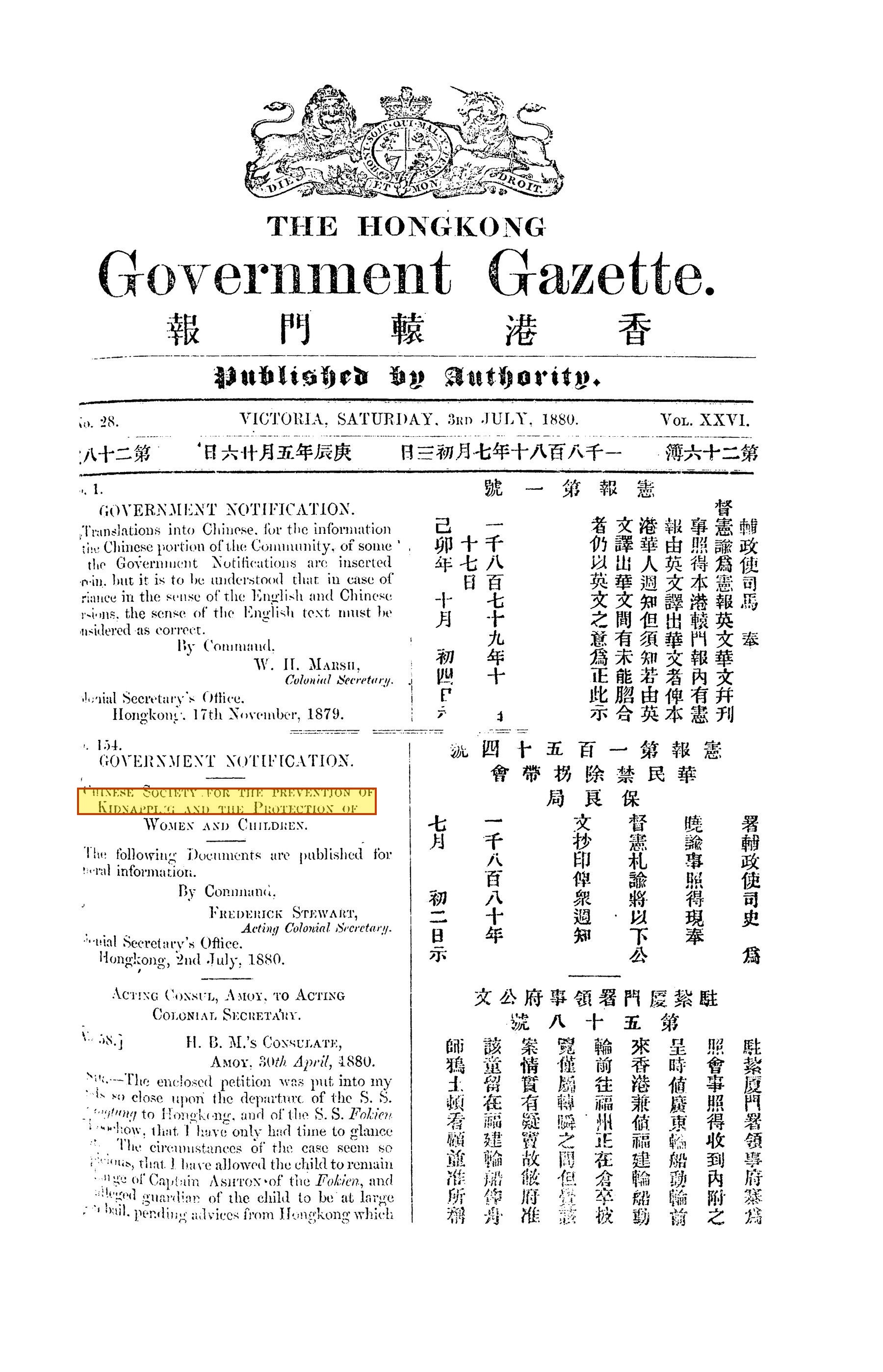
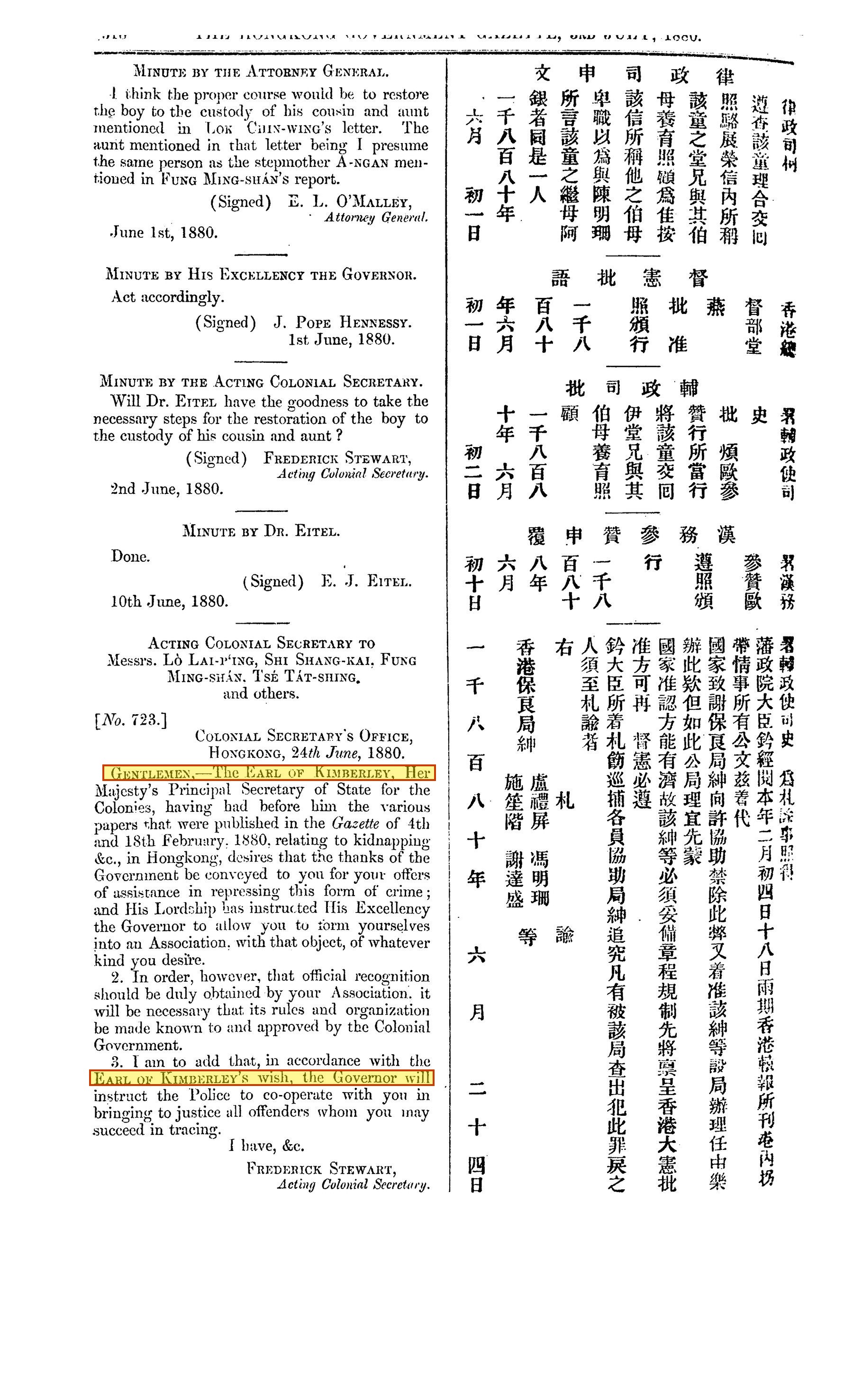
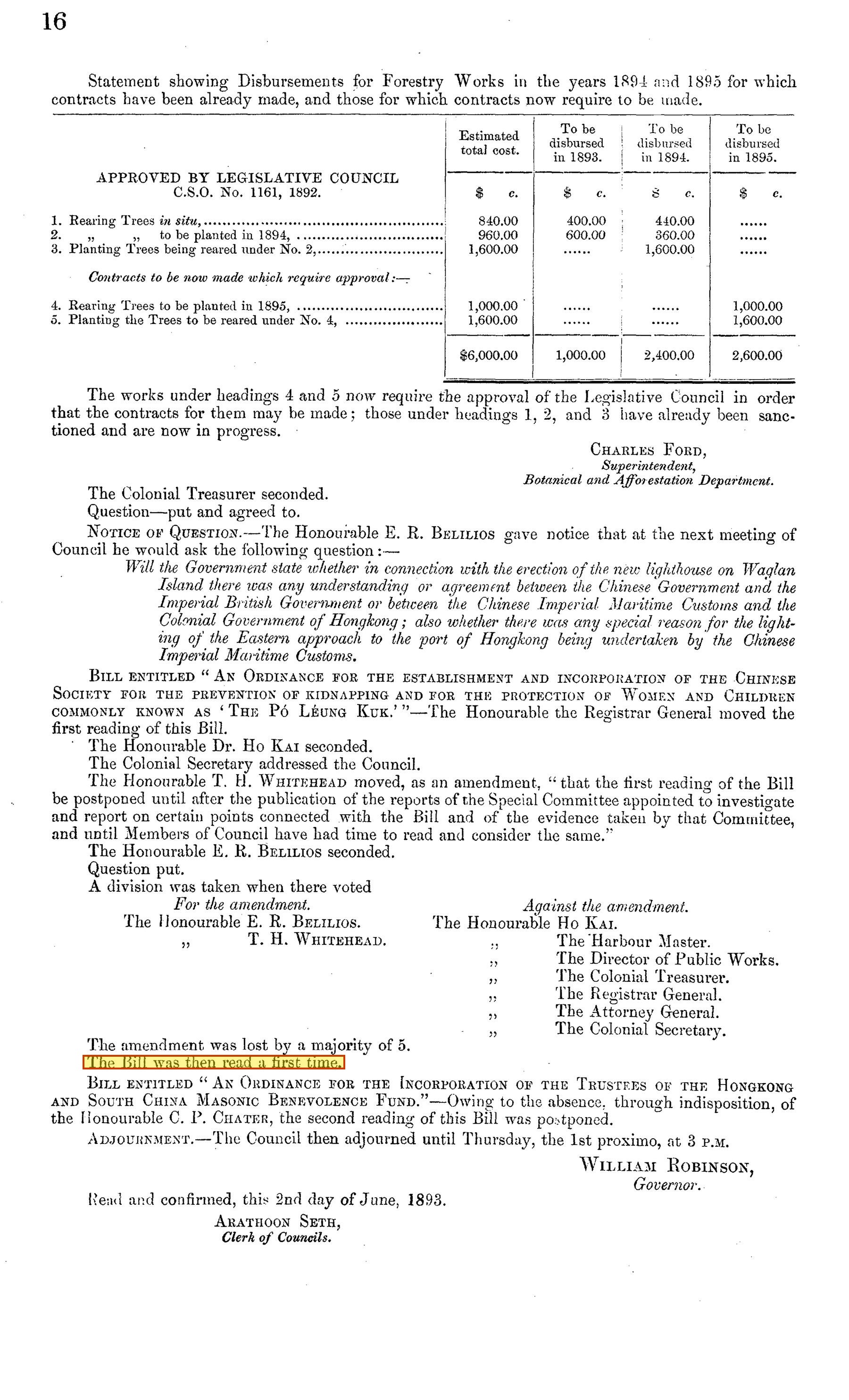
Figure 1. The petition, bilingual, printed p. 103 (https://hkintexts.histsyn.com/image-page/1491155). Figure 2. The kidnapping commission's minutes, printed p. 110 (image-page/1491162). Figure 3. The Chief Justice's “brokers of mankind” letter, printed p. 116 (image-page/1491168). Figure 4. The Gazette's formation notice, 3 July 1880, printed p. 513 (image-page/1491552). Figure 5. The Kimberley letter and the Chinese column 「香港保良局紳」, printed p. 518 (image-page/1491557). Figure 6. The incorporation bill's first reading and division, 1893 (image-page/1607485). All read back at final crop (the §6B gate, 2 November 2026).
Notes
The petition of the Chinese merchants, in the bilingual Gazette of 4 February 1880, printed p. 103: English — “The humble petition of the undersigned resident merchants of Hongkong, being natives of the Tung-kún District, viz. Lo Lai-ping, Shi Shang-kai, Fung Ming-shán, Tsè Tát-shing and others, of Bonham Strand, No. 3… praying for the issue of a warrant”; Chinese — 「具禀人東莞縣駐港客商盧禮屏馮明珊施笙階謝達盛等稟為拐風日熾集資懸賞乞恩給諭以除拐匪而安良善事」; the seals: “[Here follow the Stamps of 62 different Shops]”; translated by E. J. Eitel, “Hongkong, 9th November, 1878”; the five appended regulations (the $20 rewards; the subscriptions; the three elected managers). Scan, plate 1: https://hkintexts.histsyn.com/image-page/1491155 (accessed 2 November 2026). ↩
The Gazette dossier itself, laid “before the Legislative Council by order of His Excellency the Governor”, Colonial Secretary’s Office, 4 February 1880: 35 printed pages (99–133). Whole-document pull (this thread’s compulsory dumpdoc): text https://hkintexts.histsyn.com/page/1667691 ; scans from https://hkintexts.histsyn.com/image-page/1491145 (accessed 2 November 2026). ↩
Government Gazette, 18 February 1880, “Further papers relating to kidnapping, &c. in Hongkong”, pp. 171–178: the Registrar General’s brothel-register evidence before the Contagious Diseases Commission, and the case files with the declarations of the girls themselves — Lo Kwai; Lo-Lin-Kiu, 17; Etiax-Kwai, 18; Lakyan-Kix, 21; Chan-Lin-Ho, 19 (“brought here from Foochow”); Wong-Hive / Wong-Kam, 15; the jeweller Lo-Ming’s evidence (“She was a buyer and seller of young girls to go to Macao”); the Singapore case (“He told me that he lived by selling women into brothels of Singapore”). Scan: https://hkintexts.histsyn.com/image-page/1491221 ; text: https://hkintexts.histsyn.com/page/1667771 (accessed 2 November 2026). ↩
Chief Justice Sir John Smale to the Colonial Secretary, 20 October 1879 (in [1], printed pp. 116–117): “the practice of kidnapping for purposes other than the coolie traffic has of late been alarmingly on the increase… ‘Brokers of mankind,’ as a girl eleven years of age designates them, form among the various classes of brokers in this Colony a well known special class, though, like Gaming House Keepers, the Law ignores them. I believe that mothers have even kept their daughters from going to school for fear of their being kidnapped.” Scan, plate 3: https://hkintexts.histsyn.com/image-page/1491168 (accessed 2 November 2026). ↩
The Au Múi case (Gazette, 3 July 1880, pp. 513–517): the Acting Consul at Amoy H. A. Giles’s covering letter, 30 April 1880; Dr. Eitel’s report of 10 May — “I went on board the New Fokien, and had the boy handed over to me, and, after communicating with the Tung-wá Hospital Committee and the Chinese Society for the protection of women and children, sent the boy to the Tung-wá Hospital”; his report of 27 May — “Thanks to the Detective employed by the Chinese Society for the protection of women and children”; Fung Ming-shan’s own enquiry report (21 May) and the investigator Lok Chin-wing’s letter (7 May). Text: https://hkintexts.histsyn.com/page/1668170 (accessed 2 November 2026). ↩
The Earl of Kimberley to Governor Hennessy, Downing Street, 20 May 1880: “certain Chinese gentlemen in November 1878 asked permission to form themselves into an association for its prevention… It does not appear that anything further has been done in the matter, and I regret that so much valuable time has been lost. I therefore request that you will at once thank these Chinese gentlemen for their offers of assistance in repressing this form of crime, and that you will allow them to form themselves into an association of whatever kind they desire.” Printed in the Gazette of 3 July 1880 (as re-quoted by the Colonial Secretary’s letter of 24 June) and in the parliamentary reprint [20]. Scan, plate 5: https://hkintexts.histsyn.com/image-page/1491557 (accessed 2 November 2026). ↩
N. J. Ede’s letter against the incorporation bill, Hongkong, 22 April 1892 (printed in the 1893 committee’s appendix): “to confer legal status on a body corporate is to confer immensely greater authority and powers, and by the Chinese, and especially the lower classes, the acts of the members of the Society will be looked upon as the acts of the Government… the granting of legal status amounts to erecting in our midst a secret form of Government which may do much mischief.” https://hkintexts.histsyn.com/page/1817010 (accessed 2 November 2026). ↩
The Honourable T. H. Whitehead’s statement, Hongkong, 20 March 1893: “I am sorry that I made use of a phrase liable to misconstruction, and I apologise to the members of the Pó Léung Kuk for having spoken without full consideration of the meaning and the possible effect of my words.” The Governor’s speech of 25 April 1892, quoted in the same statement, names the charge: “the member for the Chamber of Commerce, namely, that it was a secret society” — “I should have amended the Bill so that the meetings of the Society and the buildings and establishment should be open at all times to any Justice of the Peace.” https://hkintexts.histsyn.com/page/1817011 (accessed 2 November 2026). ↩
The Secretary of State’s despatch (Ripon), Downing Street, 22 December 1893, gazetted 17 March 1894: “In my opinion sections 6 and 9 of the Ordinance give the Board of Direction too absolute power… the Ordinance should be amended so as to provide for an appeal to the Governor… Section 19… ‘or District Watchmen’… I have now to inform you that Her Majesty will not be advised to exercise her power of disallowance with respect to the Ordinance, No. 10 of 1893… but you will understand that the Ordinance should not be brought into operation, until it has been amended. It gives me pleasure to learn from the Report of the Committee… that much good work has in past years been done by this Society.” Ordinance No. 1 of 1894, “to amend The Pó Leung Kuk Incorporation Ordinance, 1893” follows; the non-disallowance notice is gazetted. https://hkintexts.histsyn.com/page/1645584 and /page/1645606, /page/1645974 (accessed 2 November 2026). ↩
Government Gazette 政府憲報, 4 February 1880, “Papers relating to the purchase and detention of children, kidnapping, and so called domestic servitude in Hongkong”, pp. 99–102: the Tsang San-fat / Leung A-tsit case (the $23 debt, the daughter Lan-ki aged six, the petitions of 24 May and 14 June 1878, the Governor’s minutes of 29 May / 1 June / 19 June / 26 June, and the Attorney General’s minutes of 31 May / 14 June / 21 June). Scan: https://hkintexts.histsyn.com/image-page/1491145 (printed p. 103, the petition); text: https://hkintexts.histsyn.com/page/1667691 (accessed 2 November 2026). ↩
Attorney General G. Phillippo’s minute, 1 July 1878 (in the same Gazette dossier): “if His Excellency wishes to suppress the practice of parties adopting children or taking them as servants on giving a premium to the parents, by the institution of criminal proceedings against parties obtaining possession of children from their parents, under such circumstances it will be necessary to introduce special provisions for the purpose” [1], p. 101. ↩
J. J. Francis, “Suggestions for the Organisation of the proposed Chinese Society for the Protection of Women and Children”, 15 November 1878 (in [1], printed p. 106): incorporation under the Companies Ordinance 1865; $10 subscribers as members; the objects (detection and suppression of kidnapping; restoration to their homes; maintenance pending enquiries; marriage or settlement; a Refuge); “The Governor [to] have a veto on the action of any member”; “the Society engages and pays its own officers and detectives, who, if approved by the Government and guaranteed by the Society in the sum of $100 each, [to] be sworn in as special Constables”. The Chinese column of the same pages prints the draft as 「擬設華人保良會章程」 and the reply as 「佛些士大老爺所擬保良會章程稿」 — the draft-stage name 保良會. ↩
“Minutes of a Meeting held… at the Magistracy, on 28th November, 1878” (Gazette, 4 February 1880, printed p. 110): present Dr. Eitel, J. J. Francis, C. V. Creagh, and the Chinese members Fung Ming-shan (compradore of the Chartered Mercantile Bank), Shi Shang-kai (opium merchant), Tse Tat-shing (tea merchant); the Chinese gentlemen’s reply on the kidnappers’ method — “they had become acquainted with the loopholes English law leaves open… the kidnappers had been emboldened to give themselves a definite organization… using regular resorts and depôts in the suburbs of Hongkong”; Fung Ming-shan’s two documents — “a list of 38 different houses in the neighbourhood of Sai-ying-pún and Tái-p’ing-shán” and the lists of 21 and 41 professional kidnappers. Scan, plate 2: https://hkintexts.histsyn.com/image-page/1491162 (accessed 2 November 2026). ↩
Fung Ming-shan to Dr. Eitel, received 31 May, translated 5 June 1879 (in [1], printed pp. 108–109): the committee’s amendments to Francis’s scheme — subscribers “of ten dollars or upwards”; the detectives to board “[e]very Chinese passage-boat or cargo-junk… the moment the anchor is dropped” and every foreign vessel carrying Chinese passengers before sailing; signed “For the provisional Committee, FUNG MING-SHAN”. The Chinese column prints 「暫充值事馮明珊頓首」. ↩
The committee’s second petition, 22 October 1879 (光緒五年九月初八日), translated by Eitel 25 October (in [1], printed pp. 119–126): fourteen committee members “acting on behalf of the Chinese Community of Hongkong” (招雨田、梁安、郭松、馮明珊、馮登、陳灼之、崔瑞生、胡浩泉、馮衎庭、彭逸、郭南屏 and others) against the Chief Justice’s treatment of the buying of girls for domestic service as “an indictable offence”; the invocation of Governor Elliot’s 1841 proclamation (Chinese “to be governed in accordance with their native customs”); the infanticide 溺女 argument; the prayer for “a point… stretched”. The P.S. records Fung Ming-shan’s complaint that the Daily Press had published the petition without authorisation. ↩
Dr. E. J. Eitel’s report, signed Hongkong 25 October 1879 (in [1], printed pp. 127–133), gazetted with the founding papers: its four closing propositions — Chinese domestic servitude “cannot be logically brought under the provisions of any English enactment”; “Absolute condemnation… would be an act of moral injustice”; prohibition “would constitute an act of violence”; and “no legislative or executive measures taken in Hongkong will hasten this process”. Also his 1 November 1879 minute answering the Chief Justice’s points (the $350 Singapore price; “pocket-mother”; “I regret I have to contradict so flatly… the statement of His Lordship”). [1], pp. 117–133. Cf. the mui-tsai thread's separate use of the same essay: Posted/MuiTsai/. ↩
Acting Colonial Secretary Frederick Stewart to Messrs. Lò Lai-ping, Shi Shang-kai, Fung Ming-shán, Tsé Tát-shing, and others, No. 723, 24 June 1880: Kimberley’s thanks conveyed and the permission — “His Lordship has instructed His Excellency the Governor to allow you to form yourselves into an Association, with that object, of whatever kind you desire”; “it will be necessary that its rules and organization be made known to and approved by the Colonial Government”; the police to co-operate. Printed with the Chinese column — 「香港保良局紳 盧禮屏 馮明珊 施笙階 謝達盛 等」 — in the Gazette of 3 July 1880, scanned p. 518, plate 5: https://hkintexts.histsyn.com/image-page/1491557 (accessed 2 November 2026). ↩
Government Gazette, 24 February 1880, “Chinese Deputation to the Governor”: the deputation received by Hennessy at Government House on Thursday 19 February 1880, with the firm list — “Fung Pò-hi (Ming-[shan]), of the Chartered Mercantile [Bank]” and “Wong Tò, Editor of the [Chinese] Herald” — and the Chinese column 「有利銀行買辦馮普熙」「主筆王韜」: the corpus’s own pairing of the name forms. Text: https://hkintexts.histsyn.com/page/1667785 (accessed 2 November 2026). ↩
The proper-name battery (rule 9), searches of 2 November 2026: 保良局 18,099 (text; earliest 1947-05-21) + 9,739 (image); 保良會 9 (the 1879 draft); 馮明珊 28; 盧禮屏 4; 施笙階 9; 謝達盛 6 (the scan-settled characters of the 1880 columns; the text-series OCR variants 盧禮屛 / 躞達盛 registered); 馮普熙 1 (paired with “Fung Pò-hi (Ming-shan)” on the deputation leaf [12]); 王韜 2+; 歐德理 87 + 118 (image); 東莞 11,956. Web leg: Po Leung Kuk’s institutional history and zh.wikipedia 保良局 — 盧賡揚(禮屏)、馮普熙(明珊)、施笙階、謝達盛; the 8 November 1878 founding-day memory; Eitel = 歐德理; Kimberley = 金巴利伯爵 (accessed 2 November 2026). ↩
Government Gazette, 5 August 1882, Government Notification No. 318: “A number of Chinese Gentlemen, resident in the Colony, having formed themselves into an Association called the Pó LEUNG KUK, with the object of assisting the Government in carrying out the laws for the protection of women and children, His Excellency the Administrator has been pleased to approve of the following rules which are hereby published for general information.” Reprinted in the 1892 report [6], p. 178; the CO 129/202 copy at https://hkintexts.histsyn.com/page/318273 (accessed 2 November 2026). ↩
Government Gazette, 12 August 1882, Government Notification No. 328: “The following gentlemen have been reported to this Government as forming the Committee of the Pò Leung-kuk (Society for the protection of Women and Children) for the year 1882-1883 — Mr. FUNG MING SHÁN, Merchant, President; NG TIT YUNG, Barrister-at-Law, Vice-President; LEUNG HOK CHI AN… Treasurer…” The Chinese column prints 「馮明珊正主席、伍秩庸副主席、李逸樓、趙子墻、陳述初、黃筠堂、曹雨亭」 — 伍秩庸 (Wu Tingfang, 伍廷芳) as the society’s vice-president. Text: https://hkintexts.histsyn.com/page/1665882 (accessed 2 November 2026). ↩
The Registrar General’s confidential minute, 5 June 1882 (CO 129/201, p. 368): “I have always placed on record that the Po Leung Kuk society, if not carefully supervised, with ‘Constable’ under my control, might develop into a sort of ‘imperium in imperio’.” The file also records the Chairman of the Po Leung Kuk being asked to help in a woman’s case (“I postponed her registration and sent her to ‘the Lang Kia Hospital’ and asked the chairman of the Po Leung Kuk to see if he could find out anything from her”, p. 349). https://hkintexts.histsyn.com/page/317687 and /page/317668 (accessed 2 November 2026). ↩
CO 129/199 (1882) — the Government land file: “The object of the grant is stated in the deed to be ‘for the charitable designs and objects of the said Po Leung Kuk and a Commercial Museum’” (p. 217); the tracing of the 16,200 sq ft site “Proposed for the Po Leung Kok and Commercial Museum” beside the Tung-wah Hospital (p. 279); “the steps already taken by the Administrator in giving notice to the Trustees of the Po Leung Kuk to stop building operations” (p. 222). https://hkintexts.histsyn.com/page/316590 , /page/316652, /page/316595 (accessed 2 November 2026). The modern institutional histories identify the site project with the 大笪地 half-lot later divided with the Chinese Merchants’ Hall project (web leg, [26]) — the corpus itself prints only “Commercial Museum”. ↩
The press file (dates as printed): China Mail 5 February 1880 (https://hkintexts.histsyn.com/page/1892882), 5 July 1880 (/page/1893412), 7 February 1882 (/page/1895500), 15 June 1882 (/page/1895945), 7 August 1882 (the Rules, /page/1896132), 14 August 1882 (/page/1896157), 17 June 1886 (/page/1899595), 29 July 1886 (/page/1899738), 12 March 1887 (/page/1900498), 20 October 1887 (/page/1901254), 22 October 1887 (/page/1901263); Daily Press 20 February 1880 (/page/2194290), 25 February 1880 (/page/2194307), 5 July 1880 (/page/2194742), 3 June 1882 (/page/2195858), 13 June 1882 (/page/2195889), 19 June 1884 (/page/2198331), 23 June 1884 (/page/2198343), 7 August 1884 (/page/2198499), 17 September 1885 (/page/2199868); Hongkong Telegraph 28 July 1881 (/page/2823477), 28 February 1882 (/page/2824183), 13 June 1882 (/page/2824541) (accessed 2 November 2026). ↩
Legislative Council, 8 May 1884, the estimates: “Grant to the Po Leung Kuk Society in aid of its expenses… $1,000.00 — C.S.O. 867 of 1884.” https://hkintexts.histsyn.com/page/1881407 (accessed 2 November 2026). ↩
Legislative Council, 22 October 1888 (No. 19), the Governor’s minute: “The Governor recommends the Council to vote the sum of Eight thousand Five hundred Dollars, for building a Home for girls rescued under the Ordinance for the protection of women and children. The house will provide for a certain return in rent from the ground floor, and give sufficient accommodation above for the Home.” https://www.legco.gov.hk/1887-88/h881022.pdf (accessed 2 November 2026). ↩
Hongkong Sessional Papers 1892, No. 11, “Report on a Petition from the Pó Léung Kuk…” (Registrar General J. H. Stewart Lockhart, 1 February 1892; laid before the Legislative Council 14 March 1892), pp. 177–190: the government’s history of the founding (“In the year 1878, public attention was drawn… by the late Sir JOHN SMALE… The discussion, to which his utterances from the bench gave rise… led to a numerously signed memorial… to the Governor, Sir J. POPE HENNESSY”; “Before the receipt of these instructions a society entitled the Pó Léung Kuk had already been constituted informally”); the Kuk’s own petition (“The Pó Léung Kuk was established in the Mo Yan year (1878-79) by the Directors of the Tung Wa Hospital”); the December 1891 visit; the Lot No. 361 (Kwong Fuk I Tsz) resolution of 13 December 1891; the statistics — “during the past 4 years, no fewer than 2,412 males and females have been sent to the Pó Léung Kuk and restored to their relatives… 218 women have been married, and 46 children have been adopted… the total number of persons dealt with has been 2,851”; the committee of eight with the firms. https://hkintexts.histsyn.com/page/1815781 , /page/1815783, /page/1815785, /page/1815787 (accessed 2 November 2026). ↩
Hongkong Sessional Papers 1893, “Reports of the Special Committee appointed by His Excellency Sir William Robinson… to investigate and report on certain points connected with the Bill for the Incorporation of the Pó Léung Kuk”, pp. 625–916: the Committee of Enquiry chaired by J. H. Stewart Lockhart (the Registrar General); Wodehouse’s blind-man case (14 July 1892, “That I consider irregular”) and Inspector Stanton’s evidence (22 July 1892); Lockhart’s rebuttal of 6 August 1892; the LI FUNG detention case with the girl’s letters; the Singapore regulations printed in appendix. https://hkintexts.histsyn.com/page/1816723 , /page/1816940, /page/1817010 (accessed 2 November 2026). ↩
Ordinance No. 10 of 1893, “The Pó Léung Kuk Incorporation Ordinance”, assented 26 June 1893, gazetted 1 July 1893: preamble — “WHEREAS in the year 1878 a Chinese Society entitled ‘The Pó Léung Kuk’ was formed in this Colony for the prevention of kidnapping and for the protection of women and children and the same has been supported and carried on partly by voluntary contributions up to the present”; the Board of Direction; the Registrar General as President. The bill’s first reading division: for Whitehead’s postponement amendment, Belilios and Whitehead; against, Ho Kai, the Harbour Master, the Director of Public Works, the Colonial Treasurer, the Registrar General, the Attorney General, the Colonial Secretary — “The amendment was lost by a majority of 5. The Bill was then read a first time.” Scan, plate 6: https://hkintexts.histsyn.com/image-page/1607485 ; ordinance text: https://hkintexts.histsyn.com/page/1647602 (accessed 2 November 2026). ↩
The Women and Girls Protection Ordinance (No. 9 of 1897; amended by No. 14 of 1900) and the Registrar General’s report for 1898: “The number of women and girls detained under Part II… was 225. The average number detained each year from 1891 to 1894, inclusive, is 247… The number of girls reported to the Po Leung Kuk as being missing in Hongkong was 48. Of these only 15 are reported to have been found. The rest, I have little doubt, were kidnapped and sold into brothel slavery. The number of warrants issued under section 30… to search ‘sly brothels’ was 671, and 17 girls were rescued.” Also the finances (“a little over $5,000” spent against “something over $2,400” subscribed; the $30,000 original subscription fund; the guilds’ subscriptions; the refused request for an annual $1,000 grant) and the Japanese silver cup of June 1898. https://hkintexts.histsyn.com/page/1820540 (accessed 2 November 2026). ↩
Administrative Report 1909, “Report of the Po Leung Kuk for the Year 1909” (Annexe A, pp. C 39–C 44): the twelve elected managers; the balance $20,116; 515 received during the year (124 children) against 54 on 1 January; 193 placed with relatives, 49 married, 25 adopted, 3 absconded; the twelve Visiting Justices’ visits; the women’s quarters’ netting removed; signed “A. W. Brewin, Registrar General, President” and “Ho Kai, Vice-President”. https://hkintexts.histsyn.com/page/613088 and /page/613089, /page/613090 (accessed 2 November 2026). ↩
Administrative Report 1910, p. 19: “The Po Leung Kuk is a Chinese Society founded in 1878 for the suppression of kidnapping and traffic in human beings.” The same year’s report records the Visiting Justices’ visits and the sessional note “Po Leung Kuk Incorporation Ordinance, No. 6 of 1893” (the revised numbering). https://hkintexts.histsyn.com/page/613474 (accessed 2 November 2026). ↩
Government Gazette, 1932, “Po Leung Kuk Incorporation Amendment Ordinance, 1932” (No. 4 of 1932): “An Ordinance to amend the Po Leung Kuk Incorporation Ordinance, 1893”; the Board of Direction’s composition amended; “the senior member for the time being of the Committee of the Po Leung Kuk”. https://hkintexts.histsyn.com/page/1576683 and /page/1576703 (accessed 2 November 2026). ↩
Governor Hennessy to the Earl of Kimberley, Government House, Hongkong, 23 June 1880: “In connection, however, with the formation of such a Society, a slight misconception has arisen, for which I am probably to blame” — his defence against Kimberley’s charge of delay, printed in the parliamentary reprint [20], No. 6. Text: https://hkintexts.histsyn.com/image-page/1759486 (accessed 2 November 2026). ↩
Hongkong Sessional Papers 1886–87, the Protection of Women and Children Bill correspondence: “In accordance with the instructions of the Secretary of State, I have consulted the leading Chinese in the Colony and the Chairman of the PO LEUNG KUK in regard to the Bill”; the Registrar General’s proposal that he “associate with himself say three or four members of the Po Leung Kuk… who would advise him”; the Kuk’s own letter of 13 September 1882 on the photographing of women. https://hkintexts.histsyn.com/page/1813655 and /page/1813625 (accessed 2 November 2026). ↩
The sister society in the Straits: Hongkong Sessional Papers 1893, appendix — the Singapore regulations of 31 March 1885 and 20 December 1888: “The Committees at Singapore and George Town, respectively, of the Society known as ‘Po Leung Kuk’ shall have the charge of the management of such Homes” (the 1888 Women and Girls’ Protection Ordinance’s places of safety). https://hkintexts.histsyn.com/page/1816976 (accessed 2 November 2026). The name travelled; Hongkong’s was the earlier society. ↩
Hongkong Sessional Papers 1902, p. 909, the departmental note: “PO LEUNG KUK. This is a Society, under the supervision of Government, for the protection of women and children.” https://hkintexts.histsyn.com/page/1823236 (accessed 2 November 2026). ↩
Comments
Post a Comment