海上的問題——香港與華南海盜紀錄,1841–1927
海上的問題——香港與華南海盜紀錄,1841–1927
摘要
本文以語料庫自身的紀錄為骨幹,考察香港開埠至 1927 年海盜問題的全貌:開埠文告中的「移交中國懲治」約定、1849 年的兩場清剿戰役(大鵬灣與 Chokeum 之戰)、海盜徐亞保的落網與審判、1868 年《剿辦海盜條例》的立法機器,以及 1890 年《Namoa》劫案與 1913 年《Shui On》劫案所顯示的延續性。三項發現構成本文主線:其一,問題自始至終未曾消失——英文報刊 1864–1919 年每一年都有海盜報道;其二,殖民地的應對由「移交懲治」的約定,經 1849 年的武力清剿,走向 1868 年的成文法機器,最後在 1927 年的條例細則中仍在運作;其三,1851 年徐亞保一案的陪審團裁決(誤殺)與聖約翰座堂碑文的記載互相矛盾,而這一矛盾正是檔案自身的發現,本文不作調和。
一、開埠的海上約定
1841 年 6 月 7 日,義律的文告邀請中國商民來港,承諾「full protection」,並承諾以獎金鼓勵查緝海盜——「the pirates to be taken and delivered to the Chinese Government for punishment」1。這是殖民地奠基性的海上約定:在香港被捕的海盜,送到中國處死。1843 年 1 月,紀錄顯示「海盜竟敢在英國海軍軍艦護航下擄劫中國船隻」;同年 3 月 8 日,璞鼎查致海軍中將的公函記錄中方「civilly declined any co-operation」,民間輿論則指「no one having any confidence in the integrity of Chinese officers」1。
問題在開埠第 4 年已經進入「避風港」框架。1845 年 3 月 20 日,署理船政司 Lena 在九龍一舉擒獲 18 名睡在艇上的海盜——消息來自九龍官員的密報;另一艘海盜船在綠島與香港之間被截,船上人「awaiting their opportunity」2。1846 年,紀錄寫下「Piratical attacks had now begun afresh, and it was believed that the pirates had made Hongkong their abode」,城內據稱有「300 Chinese of notoriously bad character」;同年 6 月,鴉片帆船《Privateer》案轟動一時,海盜首領 Chun Teen Soong 落網,承認 9 項海盜及謀殺罪行,就刑時「indifference on the scaffold」3。
二、1849:兩場戰役
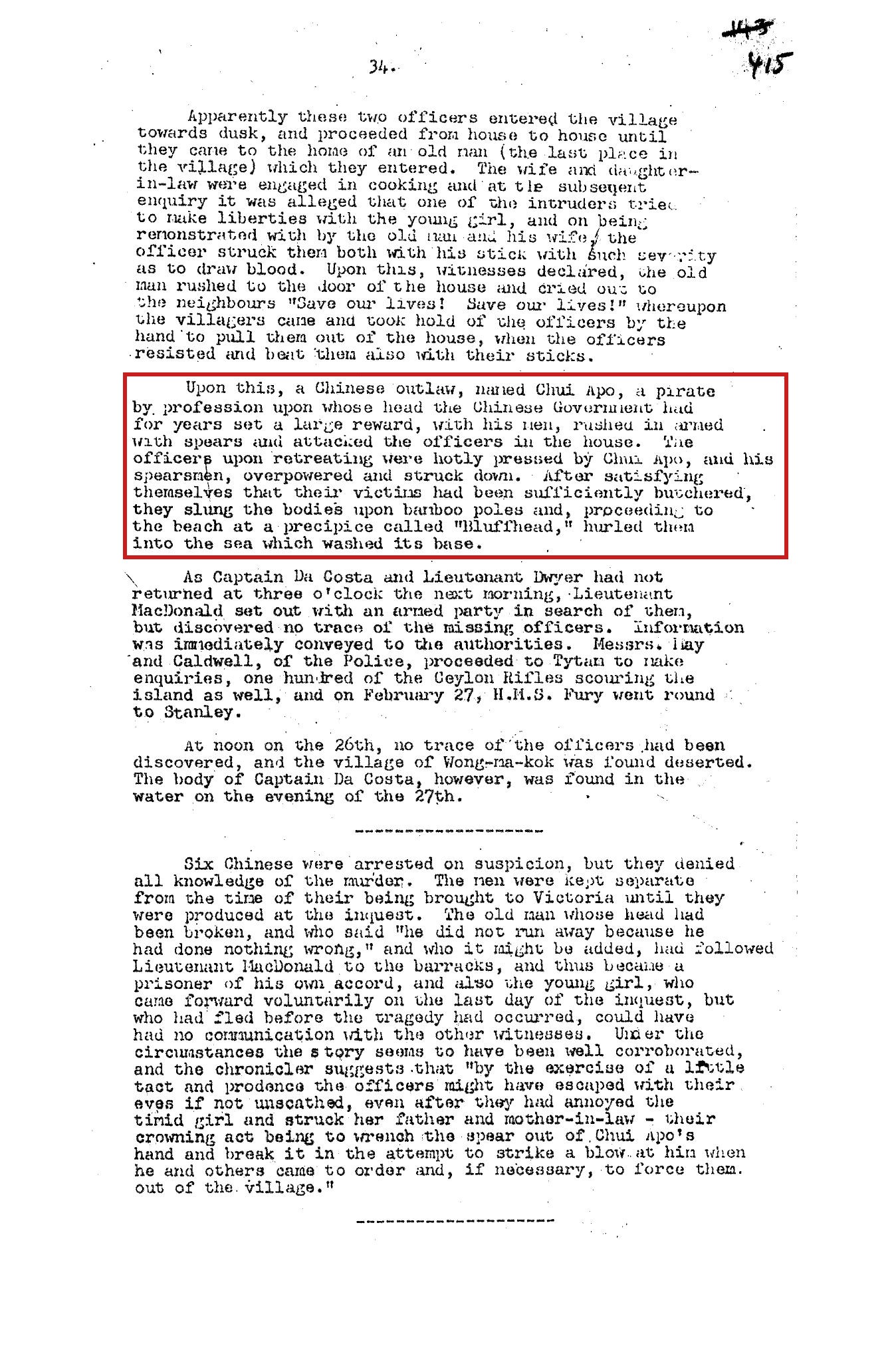
1849 年是戰役之年。2 月 25 日,赤柱黃麻角村(Wong-na-kok)發生命案:皇家工程兵 Da Costa 上尉與錫蘭來福槍團 Dwyer 中尉入村後,遭海盜頭子徐亞保(Chui Apo)與長矛手襲殺,屍體以竹竿抬至「Bluffhead」崖頂拋入海中4。港督般咸隨後透過領事系統向駐華欽差反覆要求交凶——「repeating my demand for the murderers of Captain Da Costa and Lieutenant Dwyer」——自 1848 年 6 月起已發出 7 次照會5。
9 月,英國艦艇在 Tinpak Bay 兩度接戰:9 月 5 日摧毀 5 艘海盜帆船,8 日再摧毀 5 艘;這些船隻是「part of the fleet of Shap-’ng-tsai」,中方沿海官員「all much gratified at our success」6。般咸 9 月 20 日致欽差的照會留下名句:海盜「will, no doubt, have recourse to the ordinary Chinese mode of bribing them into submission, by making a compromise with their Chief, who will be bought off with the gift of some honorary distinction, and probably be taken into the service of the state」——他預言了招安,而招安果然在 1850 年兌現7。
10 月 8 日,Hay 指揮官率《Columbine》號(另有《Fury》與《Phlegethon》)出發,掃蕩 Concock、Sattei、St John's、Mong、Mance、Sungyue、Tienpak,直海南島海口;他寫道:「Shap-ng-tsai had boasted he would go where English ships dared not follow him. This vaunt I determined to belie.」海南總督派 8 艘水師帆船,由王姓官員統領隨行8。10 月 20 日,Chokeum 之戰爆發:黎明發現 37 艘帆船,「the channel hunted like terriers at a rat-hole」,4 時 40 分越過沙洲;「At 5.5 Shap-ng-tsai's Junk blew up with a tremendous crash, and at 5.30 they had ceased firing. Before 8 o'clock 27 were in flames.」8
11 月 1 日,艦隊返港,戰報寫下:「58 Piratical Vessels, mounting about 1200 Guns, and with crews of 3000 men, have been totally destroyed by fire; and, by the blessing of God, without the loss of One life of the Officers and Men under my orders.」般咸彙總當月兩役:「the destruction of 88 of their junks, with loss of 2,400 killed and drowned」9。同月,《Amazon》號的 Mould 中尉在西海岸另有戰果,附有「a list of pirates killed on the West Coast of China」10。值得注意的是,同一份檔案收錄了中國水師統領的中文照會譯文(8 月初八出發、9 月初五擒獲 48 男 8 女 6 童),中英雙方的紀錄在此互證9。
三、徐亞保:從懸賞到絞首
徐亞保本人正是般咸預言的註腳。他的說法是:約在十五仔(Shap-ng-tsai)招安的同一時期,他也「made his peace with the Chinese Government」,獲授「mandarin's button」,獲派統領十五仔船隊的一部分;他並聲稱「still held office under the Canton Government」。而欽差徐的親筆則誓言:「If he be not yet dead, as soon as he shall be taken he shall, of course, be punished with the utmost rigour.」兩句話並列,即是檔案自身的矛盾11。
1851 年 2 月 16 日,英籍輪船《Phlegethon》號自廣州抵港,「having the atrocious Chui Apo on board」。他的說法是自福州赴廣州途中遭「a gang of desperadoes」洗劫、毆打、塞口,被押上船——當日即有人質疑拘捕合法性,認為違反《虎門條約》(Treaty of the Bogue)的移交條款11。3 月 10 日上午 11 時,特別開庭審訊;應港督之意,檢察署自己的律師 Gaskell 出庭為海盜辯護,法庭「crowded with Europeans and Chinese」。Gaskell 的初步異議(條約移交條款;無逮捕令,連屍檢令都沒有)被當庭駁回:「That is a question for His Excellency the Governor to settle with the Chinese Government. I have him here, and will try him.」徐亞保不答——庭上指其「there was a God above and earth below」。首席法官在引導詞中指「the deceased officers were the aggressors, and had given the first provocation」,陪審團退席「after a few minutes' deliberation」裁定誤殺,判處終身流放;審訊 5 時結束12。
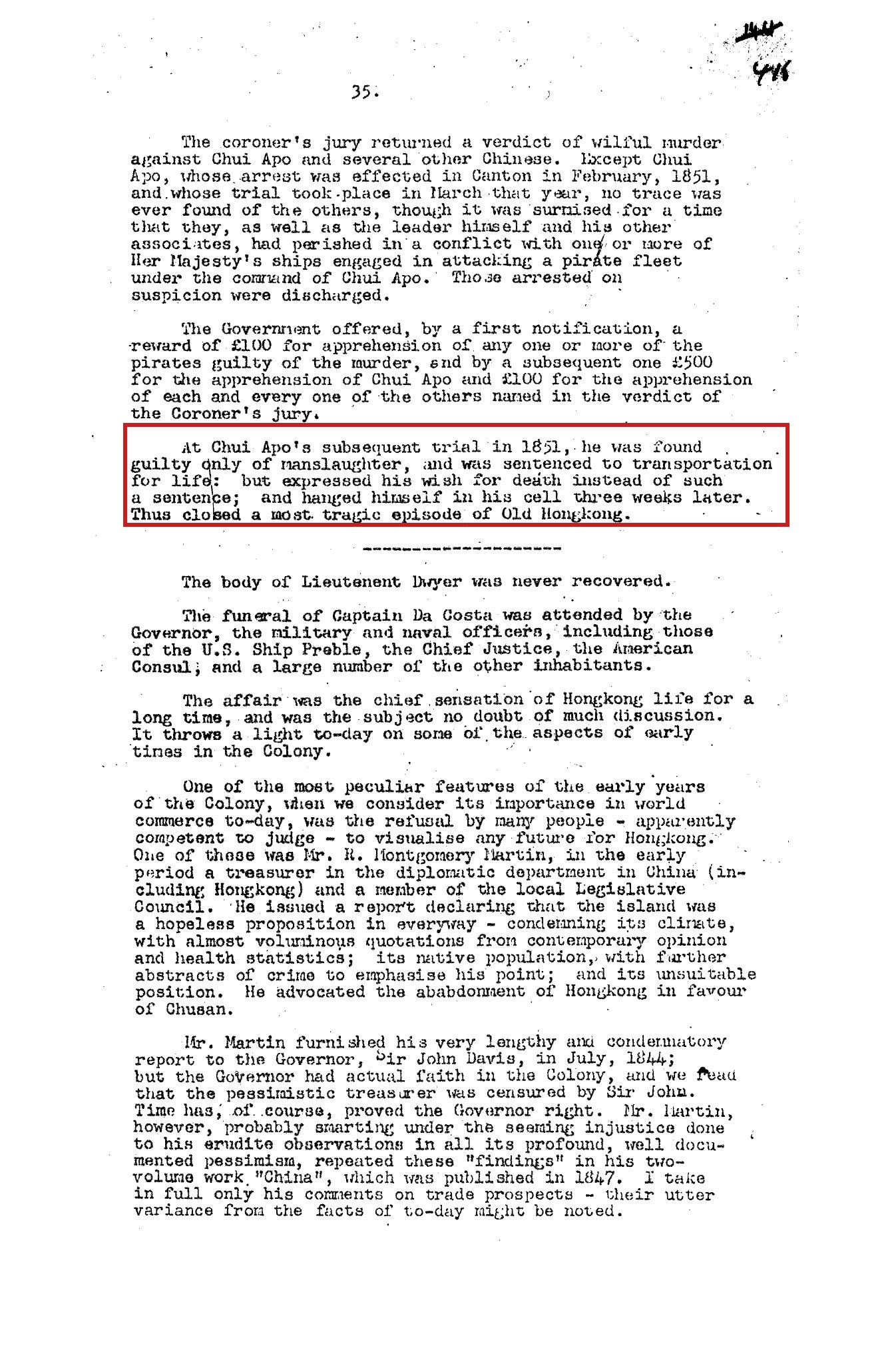
4 月 2 日,儘管他曾揚言自盡、獄方亦曾獲警告,「no heed was paid to the warning」:清晨被發現「dead and hanging… to the bars of the door of his cell, strangled with a piece of cord which held up his fetters」,驗屍陪審團裁定 felo de se(自殺)且不予非難13。此後的記憶戰仍未結束:死者家屬在聖約翰座堂立碑,記載二人「wantonly attacked and murdered while walking on the sea-side」——與陪審團的「先動手」認定正面衝突;1851 年 6 月 14 日《Illustrated London News》刊出審訊報導「and a sketch of the notorious miscreant… described as a faithful likeness」13。語料庫中的《Friend of China》1851 年卷亦兩度印證判決——「Chui-Apoo was found guilty of manslaughter only, and he received a sentence of transportation for life」14。
四、法律機器:1868 與它的子孫
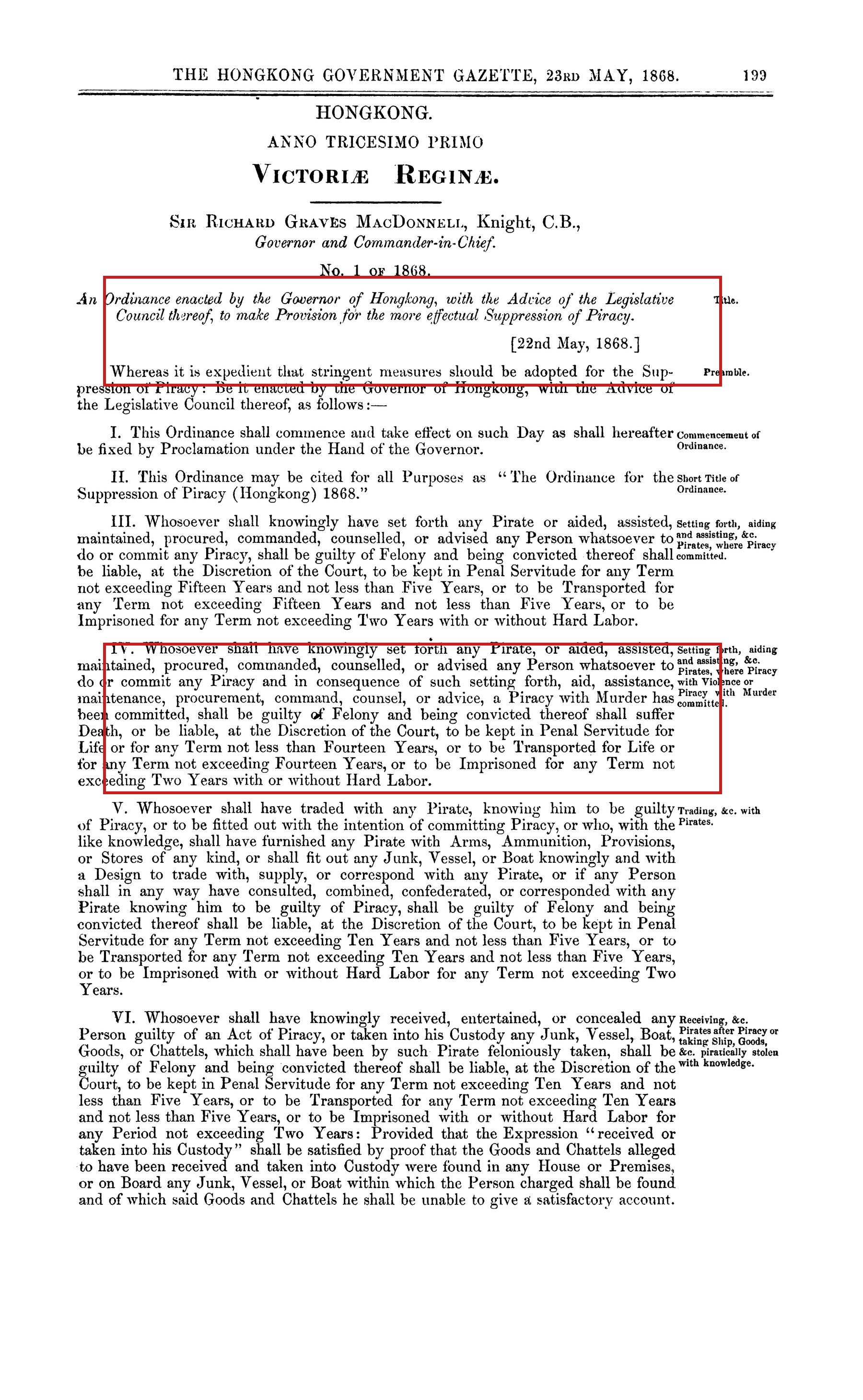
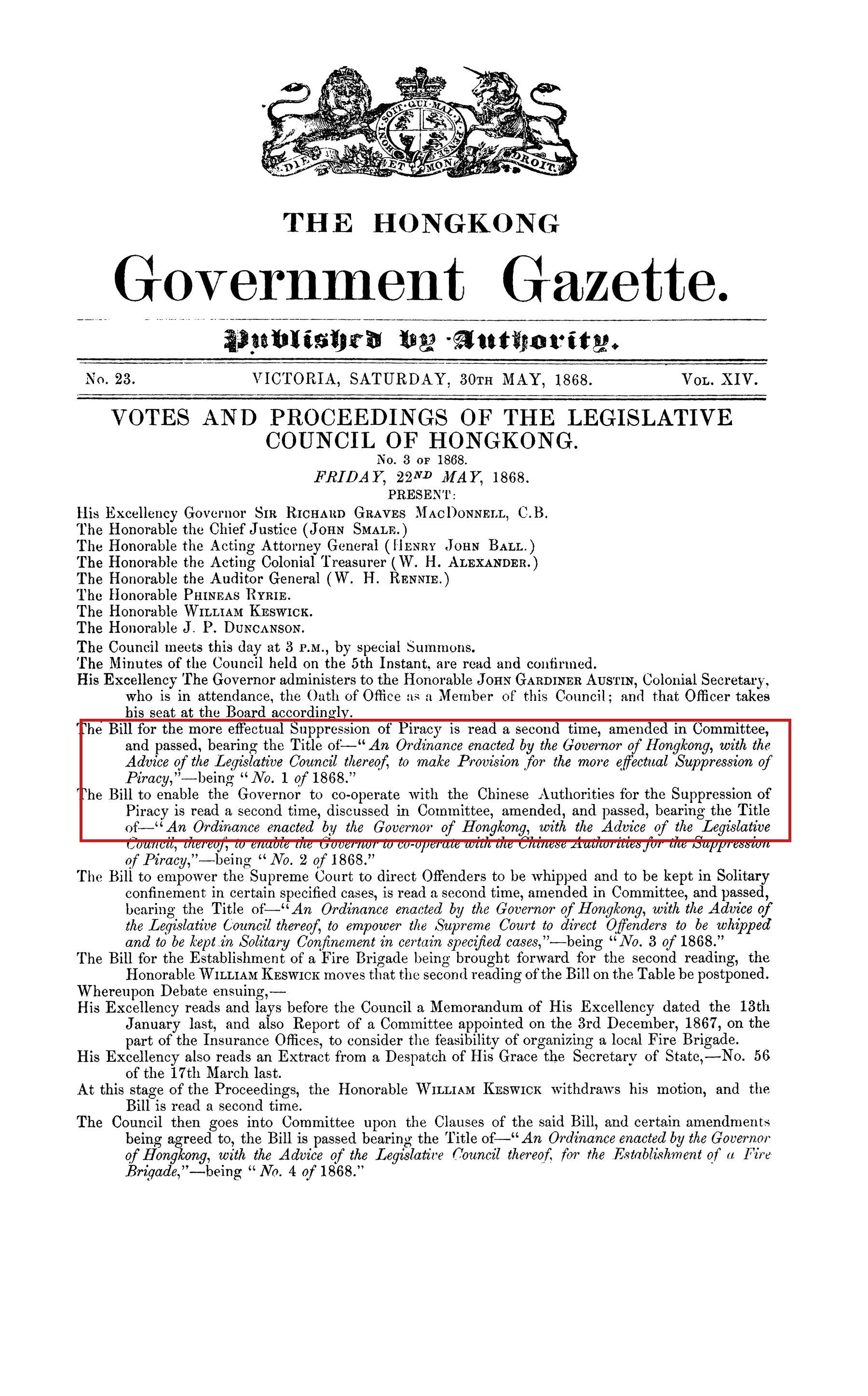
1868 年 5 月 22 日,立法局同日通過兩條海盜條例。第 1 號《剿辦海盜條例》(Suppression of Piracy Ordinance):協助或放走海盜者判 5 至 15 年勞役;「a piracy with murder has been committed」者死刑或終身勞役;與海盜交易或供應者為重罪;並設反向推定條款——凡在經證明 21 日內參與過海盜行為的帆船上被捕者,即為有罪,「shall be unable to satisfy the Court that he was not on board」15。同日通過的第 2 號條例授權港督「co-operate with the Chinese Authorities for the Suppression of Piracy」,即帆船繳械機器,1868 年 7 月 1 日生效16。憲報的《議事錄》在同一版面上記錄了兩條法案的通過17。
然而最嚴苛的推定不到一年即被收回:1869 年第 6 號條例廢除第 7 條(反向推定)18。條例機器此後持續運作——1927 年,同一條例下仍訂有細則草案:警務處長可搜索及扣留任何船隻;「every vessel in the waters of the Colony shall stop when hailed by the police」;貴重貨物須事先秘密申報;任何人不得由水路上船;船長必須「stand by」並救助遭受「piratical attack」的船隻;客船須經警方搜索及發證、於指定時段開航19。距離條例頒布 59 年、Chokeum 之戰 78 年,殖民地仍在以成文法打海盜。
五、延續:Namoa 號與 Shui On 號
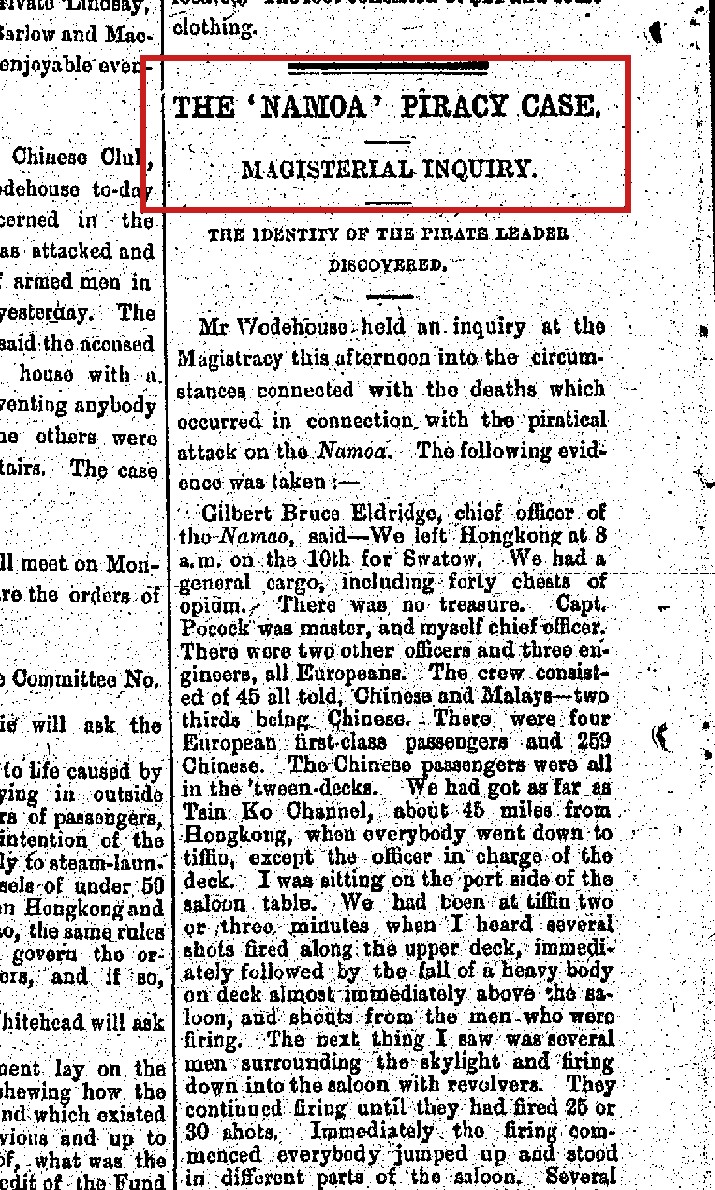
後期紀錄顯示問題從未真正結束。1890 年 12 月 11 日,Douglas Lapraik & Co. 的輪船《Namoa》自香港開往汕頭,船上載有「forty chests of opium」;午膳時分在海峽外,約 50 名海盜發難,船長 Pocock 中槍身亡(屍體被拋入海),另有 6 人受傷,贓物由 4 艘「engaged to hover in the vicinity ready to receive」的帆船接走,艙門被釘死。《德臣西報》社論直指殖民地本身:「The Namoa plot, there is every reason to believe, was hatched in Hongkong. It is here that they heard of the rich booty, and it is here that they obtained the arms.」20《孖剌西報》與《士蔑報》同日跟進,案件連審數週,並引發立法局(P. Ryrie 非官守議員)對外海客船安全的質詢2122。
1913 年 11 月 23 日,英籍輪船《Shui On》在西江擱淺,「a number of armed Chinese pirates attacked the ship firing volleys at the European Quarters and afterwards ransacked her, taking away valuables to the amount of $10,000」;大副 Nicholson「lost his life in gallantly endeavouring to prevent the pirates from boarding the ship」23。同年的行政報告還有一行日常紀錄:「As in 1910, seven (7) steam-launches were permitted to carry Arms, &c., for their protection against pirates.」——武装護航已是常規23。
把視線放寬,延續性有其量化面向:英文報刊中「pirates」一詞在 1864–1919 年每一年都有 38 至 151 條紀錄(《孖剌西報》38–116、《德臣西報》29–83、《士蔑報》17–151,峰值在 1890–92、1906–07、1911)24。沒有哪一年的報紙是乾淨的。
結論
香港的海盜問題有三個層次。第一層是開埠的約定:1841 年文告把海盜送回中國處死,這一安排在 1849 年的「Unconstitutional stretches of power」爭議中被質疑——無罪開釋的囚犯被港督令再捕移交25。第二層是武力與招安的循環:1849 年兩役摧毀 88 艘帆船,般咸預言的招安隨即在徐亞保與十五仔身上兌現,而徐亞保本人又在 1851 年以綁架方式被送回香港受審——條約、主權與治外法權的張力貫穿全程。第三層是機器的常設化:1868 年的成文法(含死刑條款與一年後收回的反向推定)、1890 年的船上武裝許可、1913 年的護航慣例,直至 1927 年的細則,海盜始終是殖民地立法的常客。至於徐亞保一案,陪審團的「先動手」認定與聖約翰座堂的碑文各執一詞,檔案把矛盾原樣留給後世——本文亦然。
The Sea Problem — Hong Kong and the South China Piracy Record, 1841–1927
Abstract
The colony was founded with a piracy settlement already written into its charter documents: pirates caught in Hong Kong were to be handed to the Chinese government for punishment. This paper follows the record the corpus itself keeps — the 1849 campaigns against the fleets of Shap-ng-tsai and Chui Apo, the capture and trial of Chui Apo in 1851, the Suppression of Piracy Ordinance of 1868 and its machinery, and the later exemplars (the Namoa of 1890, the Shui On of 1913) — to argue three things. First, the problem never went away: the term "pirates" appears in the Hong Kong English press in every single year from 1864 to 1919. Second, the colonial answer moved through three phases — extradition by agreement, naval war, and statute — and the statutory phase was still being written in 1927, fifty-nine years after the 1868 ordinance. Third, the 1851 trial record contradicts itself: the jury found the murdered officers "the aggressors", and their families' memorial in St John's Cathedral says they were "wantonly attacked". The paper keeps the contradiction as the record's own finding.
1. Scope and method
The evidential spine is the corpus's own 1849–51 record: CO 129/30 (Governor Bonham's campaign despatches, read at pp. 265, 284–289, 293–298, 300, 304–306, 331 — the compulsory full-file pull of the thread's central document); J. W. Norton-Kyshe's History of the Laws and Courts of Hongkong (1898), whose chapters on 1841–46 and 1849–51 carry the founding bargain, the campaigns, the capture and the trial at printed pp. ~30–97 and ~256–299; Old Hong Kong vol. 4 (the Wong Ma Kok narrative, printed pp. 414–15, 417); and the Friend of China year-volumes for the trial's reception (heavily OCR-garbled, quoted only where legible). The statutory stratum is the Suppression of Piracy Ordinance, 1868 (No. 1 of 1868) with its same-day companion No. 2 (junk disarmament), the 1869 amendment, and the 1927 draft regulations. The later exemplars are the Namoa piracy of December 1890 (three papers, one event) and the S.S. Shui On of November 1913 (the Marine Court finding in the 1913 Administrative Report).
The Chinese record's structural limit must be stated at the outset: the corpus's Chinese-language press begins in 1926 (工商日報) and 1947 (華僑日報), so the 1840s–1910s stratum is English-official. The Chinese renderings used here (徐亞保, 十五仔, 張保仔, 黃麻角) rest on the postwar press, the corpus's modern works, and the web leg; each is logged in the research notes' name battery. Where the record gives only a romanization (Chokeum, Hoi-how), no Chinese is asserted.
2. The founding bargain, 1841–1848
Captain Elliot's proclamation of 7 June 1841 invited Chinese traders to the island with "full protection" and promised "rewards leading to the detection of pirates, the pirates to be taken and delivered to the Chinese Government for punishment"1. The bargain was there from the first month: pirates caught here die there. Three years later the arrangement was already failing in public — a Chinese vessel was captured "while under convoy of one of Her Majesty's sloops of war", and Pottinger's letter to Admiral Parker of 8 March 1843 records that the Chinese had "civilly declined any co-operation", while the public complained that "no one having any confidence in the integrity of Chinese officers"1.
The local record fills in the mechanics. In March 1845 the acting Harbour Master, Mr. Lena, captured eighteen pirates asleep in their boats at Kowloon — the tip-off came from the Kowloon mandarins themselves — and a second boat was taken between Green Island and Hongkong, its crew "awaiting their opportunity" among the junks in the offing2. By 1846 the haven accusation had entered the record: "Piratical attacks had now begun afresh, and it was believed that the pirates had made Hongkong their abode", with "300 Chinese of notoriously bad character" said to reside in the town; and in June 1846 the murder on the opium schooner Privateer produced the conviction of Chun Teen Soong, who confessed nine acts of piracy and murder and met the scaffold with recorded "indifference"3.
3. The year of the two campaigns, 1849
On 25 February 1849 two British officers — Captain Da Costa, of the Royal Engineers, and Lieutenant Dwyer of H.M. Ceylon Rifle Regiment — were murdered at Wong-na-kok (黃麻角), a village near Stanley, by Chui Apo (徐亞保), "a pirate by profession upon whose head the Chinese Government had for years set a large reward", and his spearmen; the bodies were slung on bamboo poles and thrown from the "BluffHead" precipice into the sea4. Governor Bonham's demands ran through the year — "repeating my demand for the murderers of Captain Da Costa and Lieutenant Dwyer", seven communications since June 1848 — and the Imperial Commissioner's answers stayed unsatisfactory5.
In September the Navy went to war. At Tinpak Bay on the 5th a vessel-of-war "fell in with a fleet of Pirate Junks, of which she destroyed five"; a second vessel sent on the 8th "also destroyed five" — junks "pointed out as such" by Chinese detainees and "part of the fleet of Shap-'ng-tsai", with the coastal Chinese authorities "all much gratified at our success"6. Bonham's note of 20 September to the Commissioner states the policy in one breath — "as long as they remained at a distance and did not interfere with British vessels, I did not consider myself bound to interpose… Now that they have come to the vicinity of this Island, I have determined to take steps for the despatch of vessels to scour the seas in all directions" — and then predicts the ending: the Chinese "will, no doubt, have recourse to the ordinary Chinese mode of bribing them into submission, by making a compromise with their Chief, who will be bought off with the gift of some honorary distinction, and probably be taken into the service of the state"7.
Commander John Dalrymple Hay sailed in the Columbine on 8 October with the Fury and the H.C. steamer Phlegethon, searched Concock, Sattei, St John's, Mong, Mance, Sungyue and Tienpak, and pushed to Hoi-how in Hainan — "Shap-ng-tsai had boasted he would go where English ships dared not follow him. This vaunt I determined to belie." The Governor-General of Hainan assigned eight war junks under a Mandarin named Wong, who was given passage in the Fury8. On 20 October, off Chokeum in Cochin China waters, the squadron caught the fleet: thirty-seven junks sighted at dawn, the channel hunted "like terriers at a rat-hole", across the bar at 4.40 p.m., and "At 5.5 Shap-ng-tsai's Junk blew up with a tremendous crash, and at 5.30 they had ceased firing. Before 8 o'clock 27 were in flames."8
The return to Hongkong on 1 November carried the war's own arithmetic: "58 Piratical Vessels, mounting about 1200 Guns, and with crews of 3000 men, have been totally destroyed by fire; and, by the blessing of God, without the loss of One life of the Officers and Men under my orders." Bonham's aggregate for the two expeditions of the month was "the destruction of 88 of their junks, with loss of 2,400 killed and drowned", of whom "about 1700… slain by us, and about 300 only out of 3,000 escaped in the six small vessels"9. The same file preserves the Chinese naval commander's own communiqué in translation — the sailing fixed for the 8th of the 8th moon, forty-eight men, eight women and six children taken on the 5th of the 9th — so that the two sides' records can be read against each other9. Lieutenant Mould's party from H.M.S. Amazon was at work on the west coast in the same weeks, enclosing "a list of pirates killed on the West Coast of China"10.
The year also produced its due-process scandal, and the colony's own legal historian headed it "Unconstitutional stretches of power": suspected pirates taken at Tien-pak, and others taken by the U.S. Ship Plymouth and handed over through Captain Hay, were discharged by the Chief Magistrate for want of any charge — and then re-apprehended on the Governor's own warrant and handed to the Chinese, with Commissioner Su having "assented to, if he did not actually demand, the surrender of the men"25.
4. Chui Apo brought to book, 1850–1851
Bonham's prediction arrived on schedule. Chui Apo's own account at trial was that "he had made his peace with the Chinese Government somewhat about the time that the celebrated Shap Ng Tsai did… and, receiving a mandarin's button, was appointed to the command of a portion of Shap Ng Tsai's large pirate fleet", and he claimed he "still held office under the Canton Government"11. Commissioner Su's despatch says the opposite on paper: "If he (Chui Apo) be not yet dead, as soon as he shall be taken he shall, of course, be punished with the utmost rigour; there shall be no possibility of his resuming his evil career"11. Both statements are in the record; the contradiction is the finding.
The H.C. steamer Phlegethon arrived from Canton on 16 February 1851 "having the atrocious Chui Apo on board". His story was a kidnapping — attacked by "a gang of desperadoes", plundered, gagged, carried to the steamer — and "doubts were at once raised locally as to the legality of Chui Apo's capture… as it was believed to be in violation of the stipulations of the Treaty of the Bogue"11. At the special Sessions of Monday, 10 March 1851, by the Governor's desire Mr. Gaskell — the Crown's own law officer — undertook the pirate's defence before a court "crowded with Europeans and Chinese". His preliminary objections (the Bogue surrender clause; no warrant, not even a coroner's) were swept aside: "That is a question for His Excellency the Governor to settle with the Chinese Government. I have him here, and will try him." Chui Apo stood mute, answering the plea by pointing up and down — "there was a God above and earth below". The Chief Justice charged that "the deceased officers were the aggressors, and had given the first provocation"; the jury retired and returned manslaughter "after a few minutes' deliberation"; the Chief Justice "entirely" concurred; sentence was transportation for life, and the trial ended at five o'clock12. The Friend of China carried the verdict twice that year, the August number printing "Chui-Apoo was found guilty of manslaughter only, and he received a sentence of transportation for life"14.
On 2 April 1851, despite his threats and the warning given to the gaol authorities — "no heed was paid to the warning" — he was found "dead and hanging… to the bars of the door of his cell, strangled with a piece of cord which held up his fetters"; the Coroner's jury returned felo de se without censure13. The afterlife was a memory fight: the officers' relatives set up a tablet in St John's Cathedral recording that the deceased had been "wantonly attacked and murdered while walking on the sea-side" — in the teeth of the jury's finding — and the Illustrated London News of 14 June 1851 published the trial account "as well as a sketch of the notorious miscreant… described as a faithful likeness"13.
5. The machinery of suppression, 1868–1927
On 22 May 1868 the Legislative Council passed two piracy ordinances in a single day. No. 1 of 1868, "An Ordinance to make provision for the more effectual Suppression of Piracy", made aiding or setting forth a pirate penal servitude for 5 to 15 years; the same, where "a piracy with murder has been committed", punishable with death or penal servitude for life; trading with or supplying pirates a felony; and it enacted a reverse-onus clause — anyone found aboard a junk proved to have taken part in piracy within twenty-one days was guilty of felony and "shall be unable to satisfy the Council that he was not on board" — the Court, in the operative text15. No. 2 of 1868 empowered the Governor to "co-operate with the Chinese Authorities for the Suppression of Piracy" — the junk-disarmament machinery, in force 1 July 186816. The Gazette's own Votes & Proceedings of 22 May records both bills' passage on one leaf17.
The harshest presumption lasted less than a year: s.7 was repealed by Ordinance No. 6 of 186918. The rest of the machine, however, became permanent furniture. The draft regulations of 1927 — fifty-nine years after the ordinance and seventy-eight after Chokeum — still operate under it: the Captain Superintendent of Police may search and detain any vessel; "every vessel in the waters of the Colony shall stop when hailed by the police"; treasure shipments must be notified confidentially in advance; no one may board a ship from the waterside; every master must "stand by" and assist any vessel under "piratical attack"; and passenger ships sail only after police search and certificate, at approved hours19.
6. The later record: the Namoa and the Shui On
The problem's continuity has exemplars. On 11 December 1890 the Douglas steamer Namoa left Hongkong at 8 a.m. for Swatow with forty chests of opium in her cargo; at tiffin off the channel some fifty pirates rose — the plot "was hatched in Hongkong", said the China Mail, "it is here that they heard of the rich booty, and it is here that they obtained the arms" — Captain Pocock was shot dead and his body thrown overboard, six more were wounded, and the loot was transferred to four junks "engaged to hover in the vicinity ready to receive" it, the cabin doors nailed shut behind20. Three papers carried the event (the Daily Press and the Telegraph alongside), the magisterial inquiry before Mr. Wodehouse ran with chief officer Eldridge's testimony, and the case reached the Legislative Council in a question from Hon. P. Ryrie on small vessels carrying large numbers of passengers in outside waters2122.
Twenty-three years later the same grammar: on 23 November 1913 the S.S. Shui On took the ground N.E. of Staunch Island in the West River, and "a number of armed Chinese pirates attacked the ship firing volleys at the European Quarters and afterwards ransacked her, taking away valuables to the amount of $10,000"; the Chief Officer, Mr. Nicholson, "lost his life in gallantly endeavouring to prevent the pirates from boarding the ship"23. The same year's Administrative Report carries the routine underneath: "As in 1910, seven (7) steam-launches were permitted to carry Arms, &c., for their protection against pirates."23 Armed escort had become administration.
The quantitative frame is blunt: "pirates" appears in the Hong Kong English press in every year from 1864 to 1919 — 38 to 116 hits a year in the Daily Press, 29 to 83 in the China Mail, 17 to 151 in the Telegraph, with peaks in 1890–92, 1906–07 and 191124. There is no clean year in the run.
7. Conclusion
The colony's piracy record has three layers. The first is the founding settlement — the 1841 proclamation's promise to hand pirates to the Chinese government, a promise whose darker edge appears in 1849 when men no charge could be made out against were nevertheless re-arrested and shipped across the boundary25. The second is the cycle of war and amnesty: the 1849 campaigns destroyed 88 junks, Bonham's predicted buy-off duly arrived for Shap-ng-tsai and then for Chui Apo, and Chui Apo himself was fetched back to Hong Kong by kidnapping in 1851 — treaty, sovereignty and consular jurisdiction pressing on each other at every step. The third is the permanent machine: the 1868 statutes (capital clause included, and the reverse-onus repealed within a year), the arms permissions, the 1927 regulations. The press record says the same thing without argument: no year from 1864 to 1919 passes without pirates.
And the trial of 10 March 1851 leaves the record arguing with itself. The jury found provocation and the Chief Justice agreed; the families' tablet in St John's Cathedral says the officers were wantonly attacked; the modern web entry gives the date and the reward and leaves the question alone. The colony tried its pirate with the Crown's own lawyer defending him, sentenced him to transportation, and could not hold him alive three weeks. The paper offers no reconciliation — the contradiction is the archive's, and it is kept.
Appendix A — Query log (the battery)
| # | Query family | Result |
|---|---|---|
| A1 | English term battery | piracy 10,000+ / pirates 10,000+ (capped); piratical 5,039; Chinese pirates 700; pirate junk(s) 233; pirate chief 573; anti-piracy 1,747; suppression of piracy 1,518; ladrones 1,029 |
| A2 | Name romanization variants | Shap-ng-tsai 13 + Shap Ng Tsai 8; Chui Apo 22 + Chui-apoo 10 + Chui-Apo 17; Cheung Po Tsai 6; Chang Pao 105; Chuiapoo 0 |
| A3 | Chinese battery | 海盜 3,225; 海賊 427; 賊船 234; 徐亞保 9; 張保仔 636; 十五仔 74; 黃麻角 304 |
| A4 | Series mix ("pirates") | China Mail 6,645 / Telegraph 6,633 / Daily Press 6,240 / CO 129 3,269 / D&C 1,022 / Friend of China 609 / Weekly Press 569 / Gazette 399 |
| A5 | Gazette year sweep 1842–61 ("piracy") | 10–31 hits every year (1845: 27; 1846: 31; 1849: 27; 1850–53: 27 each) |
| A6 | Press year sweep 1864–1919 ("pirates") | continuous: DP 38–116/yr; CM 29–83/yr; TG (from 1881) 17–151/yr; peaks 1890–92, 1906–07, 1911 |
| A7 | CO 129/30 full-file read | pp. 265, 284–289, 293–298, 300, 304–306, 331 (the compulsory central-document pull) |
| A8 | Norton-Kyshe chapter read | ES pp. 5–6, 8–10, 18–27 (printed ~30–97, ~256–299) |
| A9 | Friend of China year-volume pulls | 1849 pp. 45–48, 201; 1850 p. 210; 1851 pp. 41, 46, 50, 103, 146, 239 |
| A10 | Old Hong Kong vol. 4 pulls | pp. 154, 155, 176 (+ image twins 1587818/19) |
| A11 | Image-index sweeps | "Chui Apo" 28 (OHK-4 p154/155; NK scans; the Wong Ma Kok Carl Smith card); chinamail NAMOA 4,326 (Dec 1890 leaves located); gazette "Suppression of Piracy" 112 (1868/1927 leaves located) |
| A12 | Negative controls | Medusa + pirates 1850–51 = 0; Mirs Bay 1850–51 = 0; Shap-ng-tsae = 0; 张十五仔 = 0; Chuiapoo = 0 |
| A13 | 1927 regulations | Gazette S. 227, pp. 450–451, read in full |
| A14 | Administrative Report 1913 | §D 14 §18 (launches' arms) + the Marine Court finding of 11 December 1913 (the Shui On) |
Appendix B — Plates and the name battery
Five document plates carry the load-bearing claims, each read back by the session model's own eyes at its final crop before publishing: the 1868 ordinance's opening leaf (title block + the capital clause); the same Gazette issue's Votes & Proceedings recording both bills' passage; Old Hong Kong vol. 4 pp. 414–15 (the murders; the verdict and the death); and the China Mail column crop of the Namoa inquiry. The published copies are hosted at histsyn.github.io/plates/Piracy/images/ and md5-verified against the gated local files. CO 129/30 and the Friend of China have no image scans in the corpus; the Illustrated London News sketch of Chui Apo survives only as Norton-Kyshe's description and is not reproduced.
The proper-name battery (rule 9) ran on every rendering used: 徐亞保 (9 corpus hits — the postwar 華僑日報 1955–1985 and four modern works; zh.wikipedia attests; rendered); 十五仔 (74 hits, postwar press; rendered); 張保仔 (636 hits, memory-frame only — no pre-1947 witness exists, corpus structure); 黃麻角 (304 hits; rendered). Chokeum, Hoi-how and the 1849 officials' names stay romanized: no verified Chinese forms were found, and none is invented.
Notes
J. W. Norton-Kyshe, The History of the Laws and Courts of Hongkong (1898), ch. I–III — Elliot’s proclamation of 7 June 1841 promising Chinese traders “full protection” and “rewards leading to the detection of pirates, the pirates to be taken and delivered to the Chinese Government for punishment”; the 1843 capture of a vessel “under convoy of one of Her Majesty’s sloops of war”; Pottinger to Admiral Parker, 8 March 1843, on the Chinese having “civilly declined any co-operation”. https://hkintexts.histsyn.com/page/3185914 and https://hkintexts.histsyn.com/page/3185915, accessed 1 November 2026. ↩
Norton-Kyshe, History of the Laws and Courts, ch. III — 20 March 1845: Mr. Lena, acting Harbour Master, captures eighteen pirates asleep in their boats at Kowloon after the Kowloon mandarins tip off the local authorities; a second piratical boat taken between Green Island and Hongkong, its crew “awaiting their opportunity.” https://hkintexts.histsyn.com/page/3185917, accessed 1 November 2026. ↩
Norton-Kyshe, History of the Laws and Courts, ch. III — 1846: “Piratical attacks had now begun afresh, and it was believed that the pirates had made Hongkong their abode”; “300 Chinese of notoriously bad character” said to be resident in the town; the June 1846 murder on the opium schooner Privateer and the conviction of Chun Teen Soong, who confessed nine acts of piracy and murder and died on the scaffold with “indifference.” https://hkintexts.histsyn.com/page/3185918 and https://hkintexts.histsyn.com/page/3185919, accessed 1 November 2026. ↩
Norton-Kyshe, History of the Laws and Courts, ch. XI — the Wong-na-kok (黃麻角) murders of 25 February 1849: Captain Da Costa, of the Royal Engineers, and Lieutenant Dwyer of H.M. Ceylon Rifle Regiment, attacked in a village house by Chui Apo “a pirate by profession upon whose head the Chinese Government had for years set a large reward” and his spearmen; the bodies slung on bamboo poles and hurled from the “BluffHead” precipice. https://hkintexts.histsyn.com/page/3185929, accessed 1 November 2026. ↩
CO 129/30 (Bonham, 1849), 265, 288–289, 293: Governor Bonham’s repeated demands to the Imperial Commissioner “repeating my demand for the murderers of Captain Da Costa and Lieutenant Dwyer” — seven communications since June 1848; the Consul-General’s report that the fleet destroyed in September was “under the command of one Chui Apoo.” https://hkintexts.histsyn.com/page/229314, https://hkintexts.histsyn.com/page/229346, https://hkintexts.histsyn.com/page/229349, accessed 1 November 2026. ↩
CO 129/30, 288–289: the Tinpak Bay actions of 5 and 8 September 1849 — a vessel-of-war “fell in with a fleet of Pirate Junks, of which she destroyed five” on the 5th; a second vessel “also destroyed five” on the 8th; junks “pointed out as such” by Chinese detainees, “part of the fleet of Shap-’ng-tsai”; the Chinese coastal authorities “all much gratified at our success.” https://hkintexts.histsyn.com/page/229346 and https://hkintexts.histsyn.com/page/229347, accessed 1 November 2026. ↩
CO 129/30, 293: Bonham to the Imperial Commissioner, 20 September 1849 (translated) — “as long as they remained at a distance and did not interfere with British vessels, I did not consider myself bound to interpose… Now that they have come to the vicinity of this Island, I have determined to take steps for the despatch of vessels to scour the seas in all directions”; and his prediction that the Chinese “will, no doubt, have recourse to the ordinary Chinese mode of bribing them into submission, by making a compromise with their Chief, who will be bought off with the gift of some honorary distinction, and probably be taken into the service of the state.” https://hkintexts.histsyn.com/page/229349, accessed 1 November 2026. ↩
CO 129/30, 300: Commander John Dalrymple Hay’s despatch of 23 October 1849, written aboard H.M.S. Columbine at “CHOKUM, Cocon-Chinsa” — the squadron (Columbine, Fury and the H.C. steamer Phlegethon) sailed 8 October, searched Concock, Sattei, St John’s, Mong, Mance, Sungyue and Tienpak, and pushed to Hoi-how in Hainan: “Shap-ng-tsai had boasted he would go where English ships dared not follow him. This vaunt I determined to belie”; the Governor-General of Hainan assigning eight war junks under a Mandarin named Wong; the battle of Chokeum, 20 October — thirty-seven junks sighted at dawn, across the bar at 4.40 p.m., “At 5.5 Shap-ng-tsai’s Junk blew up with a tremendous crash, and at 5.30 they had ceased firing. Before 8 o’clock 27 were in flames.” https://hkintexts.histsyn.com/page/229353, accessed 1 November 2026. ↩
CO 129/30, 297–298, 305–306: the squadron’s return to Hongkong, 1 November 1849 — “58 Piratical Vessels, mounting about 1200 Guns, and with crews of 3000 men, have been totally destroyed by fire; and, by the blessing of God, without the loss of One life of the Officers and Men under my orders”; Bonham’s aggregate for the month’s two expeditions, “the destruction of 88 of their junks, with loss of 2,400 killed and drowned”; of Shap-ng-tsai’s men, “about 1700… slain by us, and about 300 only out of 3,000 escaped in the six small vessels”; and the Chinese commander’s translated communiqué (Inclosure No. 4) fixing the sailing on the 8th of the 8th moon and recording 48 men, 8 women and 6 children taken on the 5th of the 9th moon. https://hkintexts.histsyn.com/page/229350, https://hkintexts.histsyn.com/page/229354, https://hkintexts.histsyn.com/page/229355, accessed 1 November 2026. ↩
CO 129/30, 284–285: Lieutenant Mould’s report from H.M.S. Amazon, 18 September 1849, on the west coast — junks boarded and destroyed in the surf, prisoners taken, “a list of pirates killed on the West Coast of China” enclosed; the same month’s war running on several fronts at once. https://hkintexts.histsyn.com/page/229343 and https://hkintexts.histsyn.com/page/229344, accessed 1 November 2026. ↩
Norton-Kyshe, History of the Laws and Courts, ch. XII — the capture: the H.C. steamer Phlegethon arrives from Canton, 16 February 1851, “having the atrocious Chui Apo on board”; his account of being attacked by “a gang of desperadoes”, plundered, gagged and carried to the steamer; “doubts were at once raised locally as to the legality of Chui Apo’s capture… as it was believed to be in violation of the stipulations of the Treaty of the Bogue”; his claim to a mandarin’s button and office under the Canton Government, against Commissioner Su’s vow that “if he be not yet dead, as soon as he shall be taken he shall, of course, be punished with the utmost rigour.” https://hkintexts.histsyn.com/page/3185931, accessed 1 November 2026. ↩
Norton-Kyshe, History of the Laws and Courts, ch. XII, printed pp. 297–298 — the trial of Monday, 10 March 1851: by the Governor’s desire Mr. Gaskell, the Crown’s own law officer, undertakes the defence; the court-room “crowded with Europeans and Chinese”; Gaskell’s objections (the Bogue treaty’s surrender clause; no warrant) swept aside — “That is a question for His Excellency the Governor to settle with the Chinese Government. I have him here, and will try him”; the mute plea (pointing up and down: “there was a God above and earth below”); the Chief Justice’s charge that “the deceased officers were the aggressors, and had given the first provocation”; the jury’s verdict of manslaughter “after a few minutes’ deliberation”; sentence of transportation for life; the trial ending at five o’clock. Scans: https://hkintexts.histsyn.com/image-page/1763991, https://hkintexts.histsyn.com/image-page/1763992; text: https://hkintexts.histsyn.com/page/3185932, accessed 1 November 2026. ↩
Norton-Kyshe, History of the Laws and Courts, ch. XII — 2 April 1851: despite his threats and the warning given to the gaol authorities, “no heed was paid to the warning”; Chui Apo found “dead and hanging… to the bars of the door of his cell, strangled with a piece of cord which held up his fetters”; the Coroner’s jury returning felo de se without censure; and the afterlife — the St John’s Cathedral tablet recording that the deceased had been “wantonly attacked and murdered while walking on the sea-side”, in the teeth of the jury’s finding; the Illustrated London News of 14 June 1851 carrying an account of the trial “as well as a sketch of the notorious miscreant… described as a faithful likeness”; the “Wat Tyler in Hong-kong” letter in the London Weekly Dispatch of 15 June 1851, reproduced in the China Mail of 14 August 1851. https://hkintexts.histsyn.com/page/3185932, accessed 1 November 2026. ↩
The Friend of China and Hongkong Gazette, 1851 year-volume — the trial’s reception: a letter of 11 March 1851 on “the late trial of Chiapoo” (vol. 1851, p. 50); the verdict reported again in August — “Chui-Apoo was found guilty of manslaughter only, and he received a sentence of transportation for life” (p. 146). OCR heavily garbled; quoted only where legible. https://hkintexts.histsyn.com/page/3030499, https://hkintexts.histsyn.com/page/3030562, accessed 1 November 2026. ↩
Ordinance No. 1 of 1868, “An Ordinance to make provision for the more effectual Suppression of Piracy” (passed 22 May, in force 23 May 1868), Historical Laws — aiding or setting forth a pirate: penal servitude 5–15 years; the same where “a piracy with murder has been committed”: death, or penal servitude/transportation for life; trading with or supplying pirates: felony; and the reverse-onus clause — anyone found aboard a junk proved to have taken part in piracy within twenty-one days “shall be unable to satisfy the Court that he was not on board.” https://hkintexts.histsyn.com/page/1839342, https://hkintexts.histsyn.com/page/1839343, https://hkintexts.histsyn.com/page/1839344, accessed 1 November 2026. ↩
Ordinance No. 2 of 1868 (22 May 1868), “An Ordinance to enable the Governor to co-operate with the Chinese Authorities for the Suppression of Piracy” — the disarmament of junks machinery; s.34 declares inconsistent local laws “of no force and effect whatsoever within the Colony”, saving the Supreme Court’s jurisdiction; in force from 23 May 1868 by proclamation of the same date. https://hkintexts.histsyn.com/page/1839349, accessed 1 November 2026. ↩
Hong Kong Government Gazette, 23 May 1868 — the Ordinance No. 1 of 1868 opening leaf (title block and the s.IV capital clause), and the Council Votes & Proceedings of 22 May 1868 recording the passage of BOTH piracy bills: No. 1 (Suppression of Piracy) and No. 2, “An Ordinance to enable the Governor to co-operate with the Chinese Authorities for the Suppression of Piracy” (the junk disarmament, in force 1 July 1868). Scans: https://hkintexts.histsyn.com/image-page/1451864, https://hkintexts.histsyn.com/image-page/1451881, accessed 1 November 2026. ↩
Suppression of Piracy Amendment Ordinance (No. 6 of 1869) — s.7 of the 1868 ordinance (the reverse-onus presumption) repealed within a year. https://hkintexts.histsyn.com/page/1870213, accessed 1 November 2026. ↩
Hong Kong Gazette, 1927, Supplement No. S. 227 — draft Suppression of Piracy Regulations under the 1868 ordinance as amended: the Captain Superintendent of Police may search and detain any vessel; “every vessel in the waters of the Colony shall stop when hailed by the police”; treasure shipments notified confidentially in advance; no one may board a ship on the waterside; every master must “stand by” and assist any vessel under “piratical attack”; passenger ships sailing only after police search and certificate, at approved hours. https://hkintexts.histsyn.com/page/1571397, https://hkintexts.histsyn.com/page/1571398, accessed 1 November 2026. ↩
China Mail, 12–13 December 1890 — the Namoa piracy of 11 December 1890: the magisterial inquiry before Mr. Wodehouse (chief officer Gilbert Bruce Eldridge’s testimony — forty chests of opium in the cargo, Captain Pocock master, the shots along the upper deck); the editorial naming the colony itself: “The Namoa plot, there is every reason to believe, was hatched in Hongkong. It is here that they heard of the rich booty, and it is here that they obtained the arms.” Scans: https://hkintexts.histsyn.com/image-page/1205765, https://hkintexts.histsyn.com/image-page/1205770; text: https://hkintexts.histsyn.com/page/1905167, https://hkintexts.histsyn.com/page/1905171, https://hkintexts.histsyn.com/page/1905172, accessed 1 November 2026. ↩
Daily Press, 12 and 15 December 1890 — the Namoa: the first report of the attack and the front-page coverage of the inquiry. https://hkintexts.histsyn.com/page/2206590, https://hkintexts.histsyn.com/page/1881600, https://hkintexts.histsyn.com/page/1905174, accessed 1 November 2026. ↩
Hong Kong Telegraph, 12 December 1890 — the Namoa: the pirates’ behaviour aboard, the four junks “engaged to hover in the vicinity ready to receive” the loot, the cabin doors nailed shut. https://hkintexts.histsyn.com/page/2829715, accessed 1 November 2026. ↩
Hongkong Administrative Report, 1913 — §D 14 §18: “As in 1910, seven (7) steam-launches were permitted to carry Arms, &c., for their protection against pirates”; and the Marine Court finding of 11 December 1913 on the S.S. Shui On, which took the ground N.E. of Staunch Island in the West River on 23 November — “a number of armed Chinese pirates attacked the ship firing volleys at the European Quarters and afterwards ransacked her, taking away valuables to the amount of $10,000”; the Chief Officer, Mr. Nicholson, “lost his life in gallantly endeavouring to prevent the pirates from boarding the ship.” https://hkintexts.histsyn.com/page/615013, https://hkintexts.histsyn.com/page/615014, accessed 1 November 2026. ↩
Year-by-year press sweeps of the term “pirates”, 1864–1919 (the hkintexts corpus): the record is continuous — Daily Press 38–116 hits per year, China Mail 29–83, Telegraph (from 1881) 17–151 with peaks in 1890–92, 1906–07 and 1911. No year without piracy coverage in the English press. Appendix A of this paper's research notes records the full sweep. ↩
Norton-Kyshe, History of the Laws and Courts, ch. XI — headed “Unconstitutional stretches of power”: prisoners taken at Tien-pak and at Capsingmoon (by the U.S. Ship Plymouth, handed over through Captain Hay) discharged by the Chief Magistrate for want of charge, then re-apprehended on the Governor’s warrant and handed to the Chinese; “the High Commissioner Su had assented to, if he did not actually demand, the surrender of the men.” https://hkintexts.histsyn.com/page/3185929, accessed 1 November 2026. ↩
Comments
Post a Comment