米價之問:1919年的搶米風潮與香港政府的米糧管制
摘要
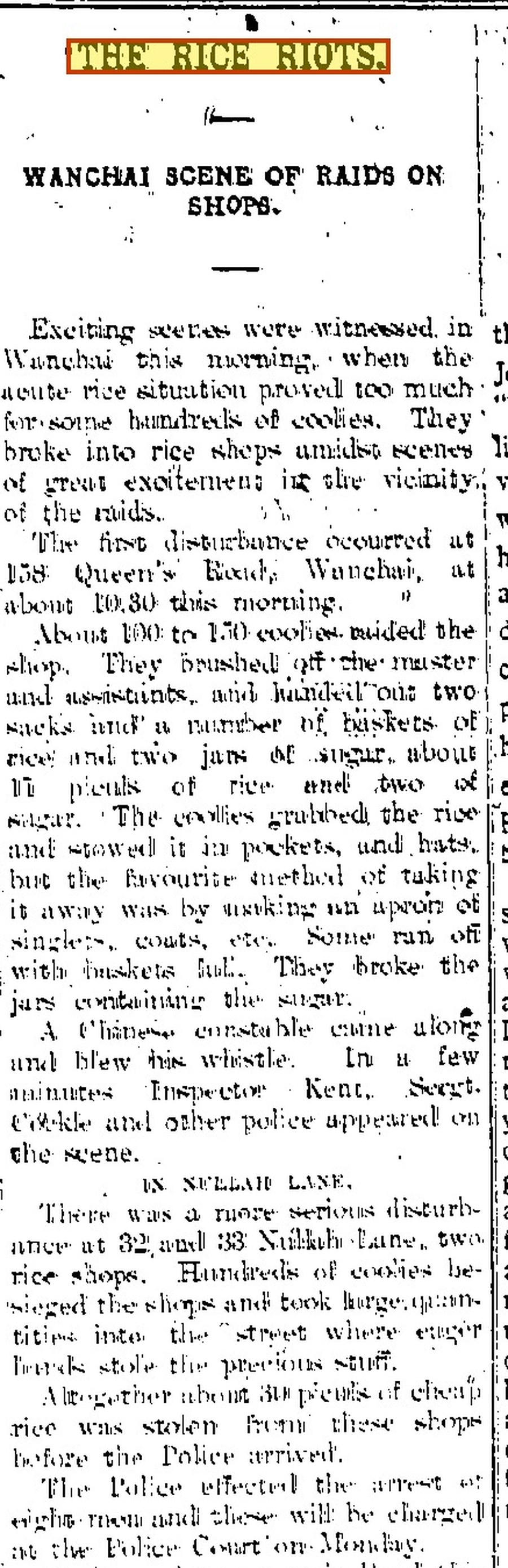
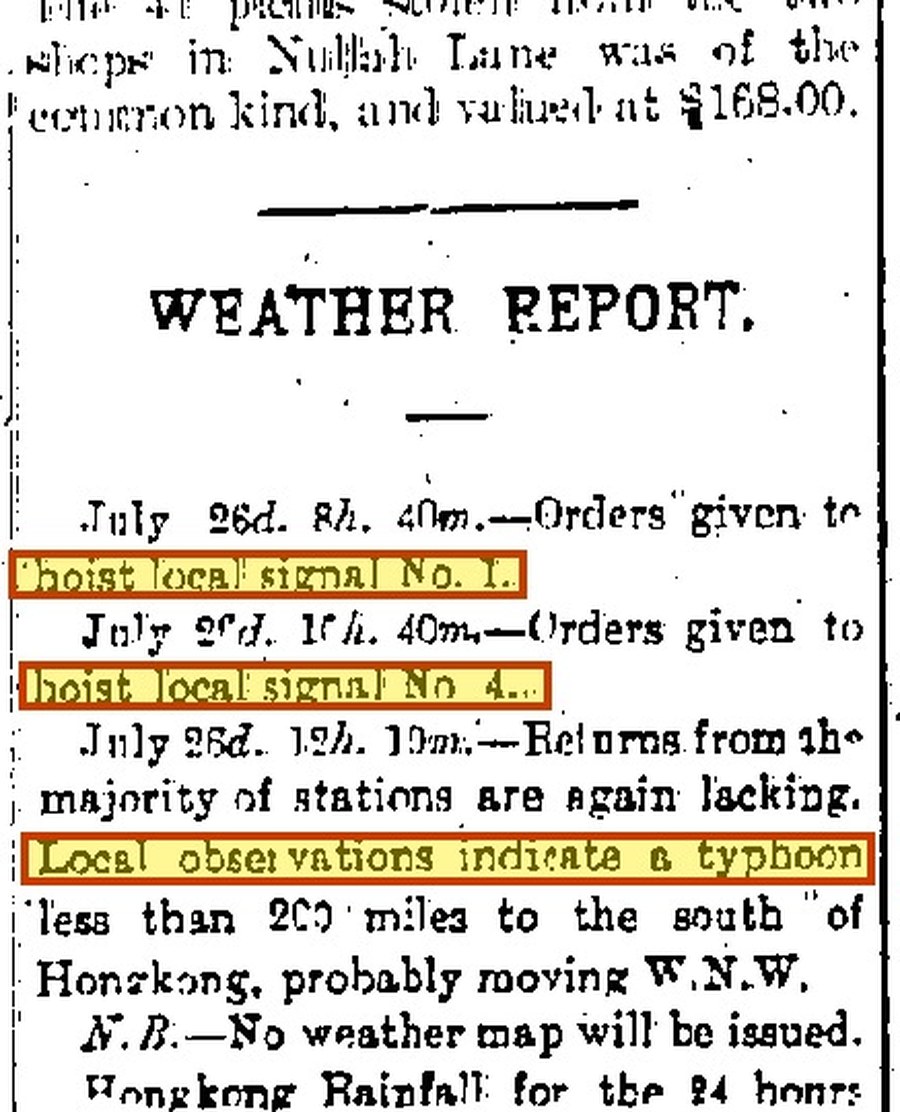
1919年7月26日星期六早上10時30分,灣仔皇后大道158號的米舖被100至120名苦力闖入:他們搬出兩袋、數籃白米和兩罈砂糖,把米塞進口袋與帽裡,更多人用背心、外衣兜成包袱,「捧著滿籃的米跑掉」1。這一天,香港天文台先後升起一號與四號風球,觀測「颱風位於香港以南不足200英里」2;暴風天氣令碼頭與煤炭苦力停工,而米價已由戰前的每擔約5元升至每擔18.5元3。由星期六到星期一,搶米蔓延全港:灣仔、石水渠街、筲箕灣、油麻地、紅磡、西營盤、大埔與中環街市都留下紀錄;一名搶米者在筲箕灣與偵探爭奪手槍時中彈4;油麻地的騷動持續約8小時,警察被人投石、向天開槍5。政府當晚發出公告,由米政專員R. O. Hutchison訂定米價:上等每擔21元、中等15元、下等12.5元4;警庭對「一夥飢餓的暴民」從輕發落,刑期由7天到14天不等6。兩位華人定例局議員何福與劉鑄伯面見護督施勳,要求把下等米降至每擔10元,遭婉拒——理由是碎米缺貨,混合下等米所需的「碎米」在市面上15元、18元也買不到7。其後數月,政府一面在海外買米(西貢、仰光、廣東),一面委託東華醫院在港九各地搭棚施粥,每天兩次免費供應「粥」給成千上萬的窮人89;9月3日,廣東米重臨香港、市價跌至每擔8元,官米銷售隨之停止8。9月18日,定例局三讀通過《米糧條例》(第20號條例):它追認政府此前的所有徵用行動,授權總督徵用與轉售米糧、以公告訂價、不得從中圖利,並在結尾附上一條「緊急條款」——定例局可隨時決議暫停整條條例1011。1921年9月1日,政府在補充撥款辯論中公佈總帳:「米糧條例結束前、由1919年8月起計的所有米糧交易虧損,合共略逾270萬元」12。
一、導言:一座城市與一碗飯
香港開埠即以轉口貿易為生:1918年,進口香港的白米「略逾一百萬噸」,出口「幾乎同量」13。這意味著米既是市民的主糧,也是港口的生意——一旦禁止轉口,進口立即消失,生意會轉往「更遷就人的口岸」13。1919年7月,這門生意出了事:西貢與暹羅的出口限制、日圓與法鎊的匯價、日本政府的搜購,層層擠壓之下,米價如脫韁野馬1415。本研究要回答的,是三個具體的問題:價格如何升到民變的地步;那五天裡發生了什麼;政府那套「米糧管制」實際上做了什麼、花了多少錢。
二、米價的危機(1918–1919)
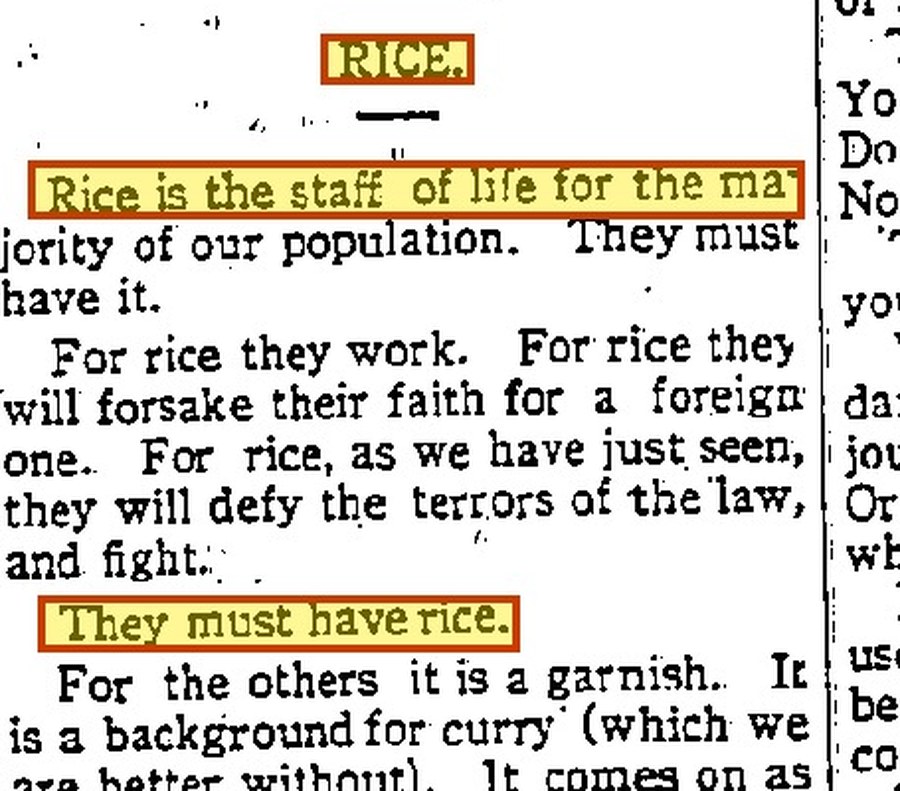
1918年日本爆發米騷動(大阪、神戶、名古屋),香港的英國官員已在檔案裡記下「這次的暴動只是未來的前奏」16。1919年,壓力轉到香港:日商在港搜購,因為「西貢出口受限,否則日本會直接向西貢買」;一名日商更指西貢有人「組成販賣出口許可證的集團」——「米價每擔15元,許可證也值15元,消費者付的不是15元而是30元」15。本地米商亦同步抬價。東華三院歷史記下商界的另一條戰線:香港商人拍電報給梁士詒,請他游說安徽省不要把米賣給日本、把米輸港17。政府其實早在3月已收到警告——劉鑄伯後來向《孖剌西報》說:「遠在3月,政府已被明確警告,當前的局面更是向他們預言過的」7;但殖民地秘書處堅持「不干預正常貿易」的政策:「年初已向船商解釋,且多次重申,無意改變」7。7月下旬,市場終於失序。7月26日的《德臣西報》社論「米」這樣寫:「米是多數市民的命根。他們必須有米。為米而工作,為米而背棄自己的信仰、為米而藐視法律的恐怖」、「壓價是好的……禁止再出口可以令價格回落,那更好。然後催他們辦米回來。快。去買。別管匯價。打擊囤積者」18。
三、搶米的五天:7月26–28日
星期六早上10時30分,第一場騷動在灣仔皇后大道158號的米舖爆發,約100至120名苦力把「師傅及夥計」推開,搬出約11擔米與2擔糖(連糖共值198元)1。石水渠街(當年的Nullah Lane)32號與38號的兩間米舖是「更嚴重的騷動」,數百苦力圍攻,警察僅追回11擔中的約8擔4。當晚,筲箕灣一間米舖出事:一名中國偵探與搶米者爭奪手槍,「糾纏間手槍走火,那人手臂中彈」,傷者被送院後被控暴動行為45。星期日,油麻地的騷動持續約8小時,有人喊「向警察扔石」,人群照做,警察向天開槍;「若干人、包括兩名警員受了不輕的傷」5。同日,晏頓街的米倉被三百多人圍攻,西營盤的米舖外聚集了約二千名苦力,有人在皇后大道東91號(Praya East)搶走約20擔米;大埔有店主拒絕賣米(「米都運去香港了」),被街坊圍住理論,未成大事4。星期一凌晨2時30分,近百名苦力在西環海旁遊行;白天,中環街市被搶——人群「以為裡面囤了大批米」185。警庭擠滿了被捕者與旁聽的苦力:12人提堂,米商方面不願追究,警官Brazil說「這不過是一夥飢餓的暴民想找點吃的」;法官Lindsell判刑時說「米價的確很高,窮人負擔很重;但你們不應把法律握在自己手裡」,刑期由7天到14天6。整場風潮中,記錄未見有人死亡——傷者有名有姓的,只有筲箕灣中彈的男子與油麻地的警民若干54。
四、政府的米糧管制
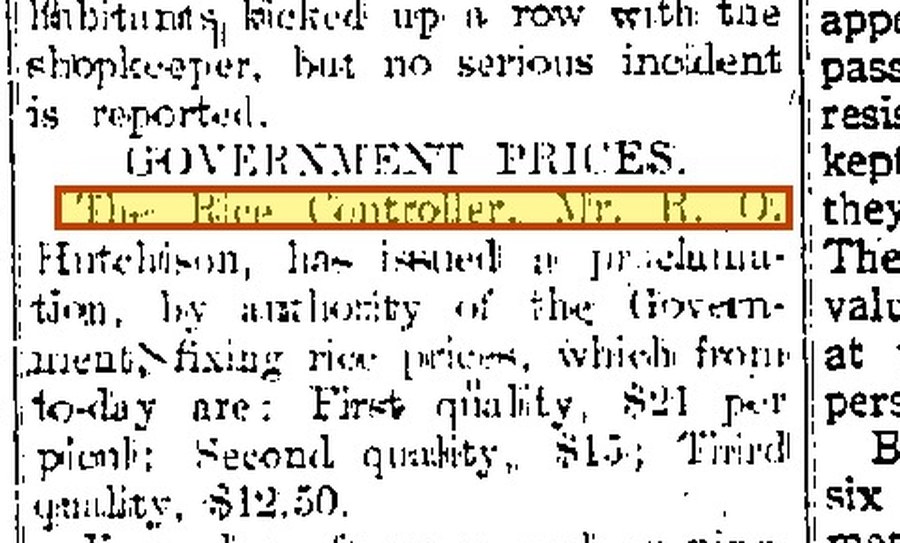
7月27日晚至28日晨,政府發出公告,由米政專員R. O. Hutchison訂定零售米價:上等每擔21元、中等15元、下等12.5元419;同時「接管米糧的管制」,沒收本地存米、撤銷出口許可——一間公司原定經「Hawaii Maru」運往南非的大批白米被政府買下7。護督施勳與警司Wolfe、米政專員Hutchison乘車巡視各區,發現「秩序平靜」4。何福與劉鑄伯在7月底面見施勳,要求把下等米降至10元;政府回覆:明白窮人辛苦,但一時無法照辦——因為混合下等米要用碎米,而碎米缺貨,15至18元也買不到;長期減價亦將令政府不斷虧蝕7。救濟方面,東華醫院在港九各地設多間粥廠施粥,長洲、坪洲等離島也要求東華開辦;8月31日粥廠停止,改辦「平糶」(賣平米,次等米每擔7.5元);同年9月15日米價下跌,搶米風潮才告平息9。政府自己的總結則記下:港、九、筲箕灣、香港仔的棚廠「每天兩次」免費派發「粥」(米與鹽煮成的稀飯),持續數週,「對防止大規模困苦大有幫助」8;10,000擔蕪湖米經廣東糧食救濟會與廣州軍政府放行、以每擔6.70元售予東華813;印度政府批准從仰光運出3,750噸米;湖南省索價過高,作罷8。政府又給月薪不超過70元的公務員每月2元「米津貼」(一次撥款48,000元),並呼籲僱主效法137。9月3日,廣東米重來,市價跌至每擔8元,官米銷售「突然停止」8。法制方面:8月28日條例首讀,9月4日二讀並轉入委員會,9月18日三讀通過132011;第20號條例(9月19日)追認了此前以「樞密院令」權力所作的一切行動,授權總督徵用米糧(賠償由法官主持的5人委員會裁定)、以公告訂定米價、規定「政府不得從米糧銷售中獲利」,並附上緊急條款:定例局可隨時決議暫停條例的全部或部分條文1021。
五、代價與記憶
賬單在1921年才結清:到《米糧條例》結束為止,政府自1919年8月起的全部米糧交易共虧損「略逾270萬元」12;中途的代價還包括把「長米」與「圓米」弄錯的美國代銷合約(虧近14萬元)與匯價損失69萬餘元8。1920年的米業再遇一次危機——古巴買家毀約連累三藩市買家,香港的米商也受傷22。制度上,《米糧條例》此後一直留在法例全書:1950年的《香港法例》第146章仍標明「原為1919年第20號條例」10。中文世界的記憶則由後來的著作承載:家族史寫「米價如脫韁野馬」,記錄「以30、40人為一隊或150、160人為一隊,分頭往各街米店肆意強搶」與「罰款5至7元及入獄14天」的判決14;影像集記下7月23日大埔先起風潮、7月27日蔓延油蔴地、警方「向天鳴槍十餘響,拘捕七人」,以及8月31日東華由施粥轉為平糶的細節9。需要注意的是:1919年的香港沒有中文日報記錄留在此語料庫——中文報紙層要到1926年以後才出現,故本篇的中文引文全部來自後世的著述2324。
結論
「米價之問」的答案有兩面。一面是市場:1918至19年間,日本搜購、出口限制、匯價與囤積共同把米價推上一倍有餘的高位,而政府的「不干預」政策把行動拖到7月最後一個週末715。另一面是治理:暴動之後,政府用不到兩個月建成一套完整的管制機器——公告訂價、徵用存米、官米專售、東華施粥、米津貼——再花六星期把它寫成第20號條例,並為此付出了約270萬元。歷史學者常說1919年的搶米「很快平息」;語料的紀錄則補充:平息它的不是市場的自我修復,而是政府接管了米糧生意,一直做到廣東米重新運到、市價跌穿官價的那一天812。
The Rice Question
Hong Kong’s price crisis and the rice riots of July 1919 — and the Government’s rice control that followed
Abstract
In July 1919 the price of rice — the colony’s staple, and the cargo of one of its chief trades — outran the wages of the people who ate it, and Hong Kong rioted. This paper reconstructs the crisis from the three English dailies of the week, the records of the Legislative Council, the Rice Ordinance No. 20 of 1919, the Annual Reports and the Colonial Office file: the international squeeze (Buying by Japan, Saigon’s export restrictions and licence syndicate, exchange), the “non-interference” policy that held until the last weekend of July, the five days of rice raids from Wanchai to Yaumati and Tai Po, the Government’s proclamation of fixed prices and its manager, the Rice Controller, the congee stations run with the Tung Wah Hospital, the ordinance that validated and empowered the whole machine, and the bill: rather over $2,700,000, stated in Council in September 1921. A weather observation opens the story: the raids began on the morning of a typhoon warning, with the waterfront idle. The Chinese-language record of 1919 is structurally absent from the corpus (the Chinese press strata begin in 1926/1947); the later Chinese works are used as such, and every figure is kept to the witness that printed it.
1. Scope and method
This thread’s question is the price of the colony’s staple and what happened when it outran the people’s wages. Its witnesses are the press of 26 July – 6 August 1919 (the China Mail, Hongkong Daily Press and Hongkong Telegraph, read day by day), the official record (Legislative Council Hansard of 28 August, 4 and 18 September and 16 October 1919, 5 February 1920 and 1 September 1921; the Gazette’s Council minutes; the Rice Ordinance No. 20 of 1919 in the Historical Laws; the Annual Reports 1919–1921; CO 129/451 and CO 129/456), and the later Chinese works held in the corpus. Of the three dailies only the China Mail has a 1919 image series: its leaves of 26, 28 and 30 July 1919 were downloaded and read directly, and the plates below are its columns; the Daily Press and Telegraph quotations rest on the OCR and are kept short. The compulsory whole-document pulls are the China Mail issue of 28 July 1919 and the Daily Press issue of 29 July 1919. The full battery and the query log are in the research notes2324.
2. A city of imported rice
“In the year 1918, something over one million tons were imported into Hongkong and nearly this quantity exported”: the colony lived on the transhipment trade, which is why the one measure that could have stopped the price rise at once — a general export ban — was refused throughout the crisis, its refusal stated to the Council in August: if export is prohibited, “imports cease and the trade will no doubt go to some more accommodating centre.” The New Territories could not feed the city: the Government “has no control over sources of supply except as regards rice grown in the New Territories”13. The pre-crisis norm was $5 a picul; by 1919 the official summary puts the top at $18.50 “for grades which normally could be purchased for $5”3.
3. The crisis, 1918–1919
The international squeeze had a location and a name. Japan’s own rice riots of 1918 sit in the Governor’s despatches — “we have had the recent rice riots in Osaka, Kobe and Nagoya… a foretaste of what may occur in the future”16 — and in 1919 Japan’s buying moved to Hong Kong’s market, because “Saigon exports have been restricted. Otherwise Japan would have purchased direct from Saigon… She has now to fall back upon Hongkong.” A Japanese house explained the machinery of the price to a Telegraph interviewer on 5 August: a Saigon licence syndicate — “supposing the price of rice is $15 per picul. The price of a licence is likewise, so that the consumer instead of having to pay $15 pays $30” — while denying that Japanese merchants were “cornering the stocks at all” and conceding that the Superintendent of Imports and Exports “has not been very strict with us”15. The Chinese trade’s own line ran to politics: Hong Kong merchants telegraphed Liang Shih-yi to press the Anhui authorities not to sell rice to Japan and to send it to Hong Kong17. Local dealers “were increasing their selling prices to a very high figure”7; by April a correspondent would claim second-quality rice was $6.50 a picul, and on the crisis Sunday, $25.5025.
The Government had been warned — its own Chinese member said so on the record: “I have it on good authority that, as far back as March last, the Government were definitely warned, and the present situation was actually predicted to them” (Lau Chu-pak, 31 July)7. Its policy was stated in the same exchange: “The policy of non-interference with ordinary trade was explained to shippers early in the year, it has been reiterated on several occasions, and there is no intention of departing from it.” The China Mail’s leader of 28 July answered the policy with the week’s bluntest economics: “Rice is the staff of life for the majority of our population. They must have it… By forbidding further exports they can bring the prices down. That is better. Then let them hustle in that matter of importing rice. Rush it. Get it here. Maskee exchange. Smash the profiteers… Urgency. That’s the matter”18.
Then the weather turned. On Saturday 26 July the Observatory hoisted local signals No. 1 and No. 4, with “Local observations indicat[ing] a typhoon less than 200 miles to the south of Hongkong, probably moving W.N.W.”2. It was cargo and coal work that stopped first, and it was the cargo and coal coolies who raided: the Daily Press’s explanation of 31 July, printed beside Lau Chu-pak’s words, is explicit — the raids “were the result of the lack of employment among cargo and coal coolies during the stormy weather, which unfortunately occurred at a time when the local dealers were increasing their selling prices to a very high figure”7.
4. The riot week: 26–28 July 1919
The first raid was small and specific: about 100 to 120 coolies at No. 158 Queen’s Road, Wanchai, who “brushed off the master and assistants, and handed out two sacks and a number of baskets of rice and two jars of sugar” — about 11 piculs of rice and two of sugar, valued with the sugar at $198 — and were still being counted when “Inspector Kent, Sergt. Criddle and other police appeared on the scene.” The same afternoon, at Nos. 32 and 38 Nullah Lane, “hundreds of coolies besieged the shops and took large quantities into the street where eager hands stole the precious stuff”; the police recovered “about eight out of the 11 piculs” of the lane’s rice, “of the common kind, and valued at $168.” At Shaukiwan a rice shop was raided at night and a Chinese detective, struggling with a raider for his revolver, shot the man through the arm. The Daily Press adds the sequel and the official blessing: the constable, Inspector Angus testified, “was justified in doing as he did in the case of an emergency”; the wounded man was charged with riotous behaviour45.
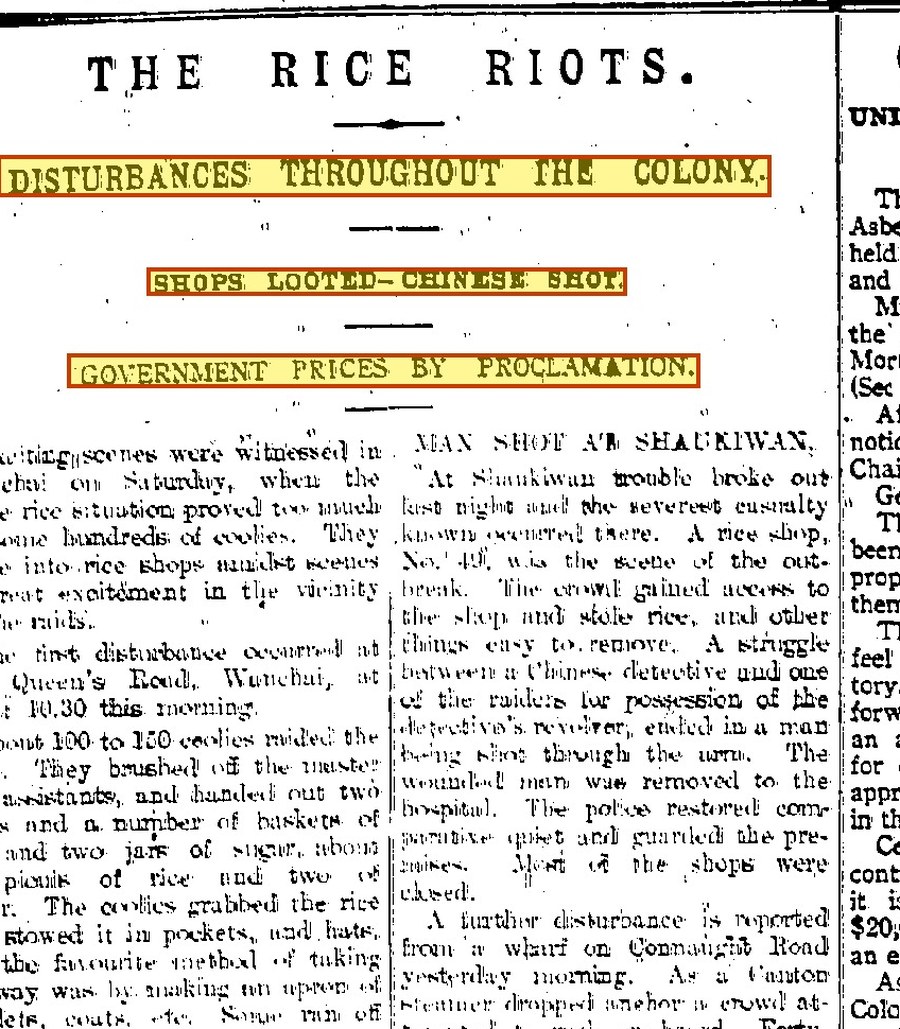
Sunday spread it: at Yaumati “the rioting… continued for about eight hours… One man shouted ‘Stone the Police…’ The Police fired into the air… Several men, including two constables, are reported to have been somewhat seriously injured”; the China Mail adds that “a number received cracked heads.” At West Point about 2,000 coolies gathered; a crowd broke into the shop at No. 91 Praya East; the Government contractors’ rice for the Tai Po Road works — fifteen bags, about 27 piculs, from the Tung Yee firm of Yaumati — was taken off the trucks before it could start. At Tai Po itself a shopkeeper who refused to sell, “saying it was all being sent to Hongkong,” was argued with but “no serious incident is reported.” On Monday morning before dawn “nearly a hundred coolies paraded the Praya along West Point… aimlessly”; by daylight the only fresh attack was on the Western Market, “attacked by a large mob under the impression that a large quantity of rice had been stored there”4518.
The courts treated the raiders as hungry people. Both docks at the Magistracy “were filled with rioters… The spectators’ seats were filled with sympathising coolies, while others crowded round the doors”; the police did not press where the rice could not be proved stolen; Inspector Brazil told the magistrate “It is more a case of a hungry mob trying to get something to eat”; Mr Lindsell, retiring to consider, “said he had found that the price of rice is very high, and he knew how hard it is for the lower classes of Chinese to pay for it. At the same time it was wrong for defendants to take the law into their own hands… The Government has now fixed the price for rice” — $12 to $13 for low grade, $15 middle, $21 first — and passed sentences of a fortnight, seven days and ten days. Fines of $5 and $7 were handed to the lesser cases65. No death is recorded anywhere in the riot-week record. The named injuries are the Shaukiwan gunshot wound and the Yaumati constables and cracked heads; the record is silent beyond that, and this paper says so rather than more54.
5. The control: from Sunday’s proclamation to the Rice Ordinance
The Government’s answer came on the night of Sunday 27 July and the morning of Monday 28th: a proclamation by the Rice Controller, Mr R. O. Hutchison, fixing the retail prices — “First quality, $21 per picul; Second quality, $15; Third quality, $12.50” — and, simultaneously, the taking over of the rice: local stocks commandeered, export permits withdrawn (the Hongkong Mercantile Co.’s South Africa-bound rice on the Hawaii Maru was bought by the Government), and the ships watched 47. The Telegraph described the first day of fixed prices — the shop that opened selling “12 catties per dollar,” the police forming “queues on either side of the door,” the shelves bare “by 8 o’clock at night” — and doubted the level: “The prices fixed by Government are certainly beyond the means of the average coole [coolie]… The plundering of a number of rice and provision shops on Saturday and Sunday is the first sign of outward protest against the rising price of this staple cereal… In one [resp]ect it is understandable and almost forgivable… Cheaper rice must speedily be provided for the poorer people”19.
Two days later, the two Chinese Unofficial Members went to the Officer Administering the Government. Ho Fook and Lau Chu-pak asked that third-quality rice be cut from $12.50 to $10; they “represented that the present price was a great hardship on the coolie class, whose monthly wages were insufficient to ensure the bare necessities of life.” The answer was sympathetic and negative: the cut “could not be granted at the moment… because of the great difficulty that was being experienced in obtaining sufficient broken rice to make up the third quality rice. Broken rice could not be obtained at $15 or $18 per picul… and a high quality rice had to be used for mixing”7. Within days the lower grades did fall, as the imports arrived: by late August the grades were sold at 5, 7½ and 10 catties per dollar, and the Government was feeding its own staff a $2-a-month rice allowance for salaries of $70 and under, an arrangement it commended to private employers138.
The relief was the Tung Wah’s. “The Tung Wah Directors showed great energy in erecting a number of matsheds in Victoria[,] Shaukian [Shaukiwan] and Aberdeen where many thousands of very poor people were supplied free of cost with a mixture of boiled rice and salt, known as congee, twice a day. This system of relief continued for several weeks and was most useful in preventing a great deal of distress”8. The Council chamber thanked the hospital for “the management of the congee stations which are now working”13; the Telegraph photographed one of the stations26; and the later Chinese photo-book records the same institution’s weeks of 施粥 (congee), the outlying islands’ requests for it, and the switch on 31 August from the free congee to 平糶 — cheap rice sold at $7.50 a picul for the second grade9. The supply itself came from everywhere: 10,000 piculs of Wuhu rice released from Canton by the Kwangtung Food Relief Association and the Military Government of Canton at $6.70 a picul for the Tung Wah; 3,750 tons from Rangoon on the Indian Government’s permission; Hunan’s price refused; purchases from Saigon paid for with the help of the Hongkong and Shanghai Bank, which the Government thanked in Council813.
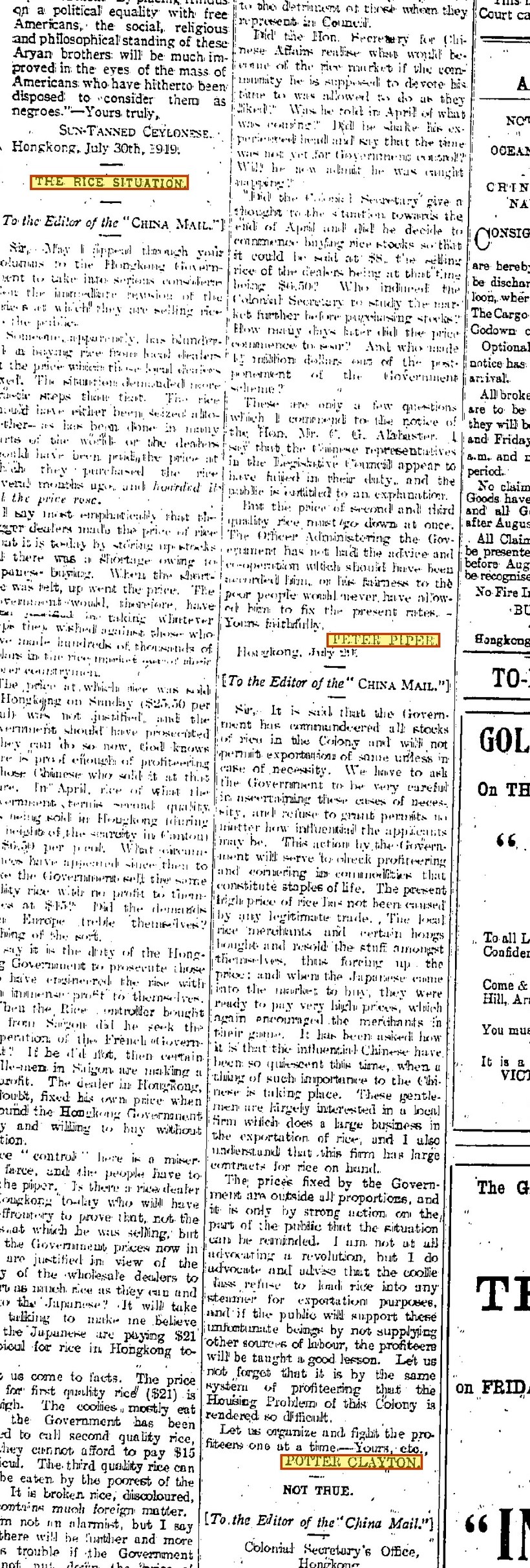
The press fought the blame out in the same week. The China Mail printed, on 30 July, Peter Piper on the profiteers (“the bigger dealers… make the price of rice what it is today by storing up stocks… when the Japanese came into the market to buy, they were ready to pay very high prices”; the Sunday price of $25.50 “was not justified”) beside Potter Clayton’s questions to the Government and the Chinese members (“Who is responsible for the postponement of Government action…? Did the Hon. Mr. Lau Chu-pak and the Hon. Mr. Ho Fook inform the Government that the rise in the price of rice was being engineered…? Was he told in April of what was coming?… Will he now admit he was caught napping?”) and his remedy, a coolie refusal to load rice for export25. On 3 September the argument lost its subject: sales of Government rice “suddenly ceased” as Cantonese rice returned to the market at $8 a picul8.
What the emergency had done, the statute made legal and permanent. The Rice Bill was read a first time on 28 August, when the Colonial Secretary explained it to the Council: it validated acts “done under powers conferred by Order in Council”; it kept the New Territories’ rice in (export “prohibited except under licence,” at prices “sufficiently above the prices ruling over the border to check any inclination to smuggle into China”); it recorded the purchases (7,500 piculs of the first New Territories crop; the then-cheapest grade at $11.11) and the thanks (the Tung Wah; the bank; the Canton authorities). The second reading and committee came on 4 September, the completed committee and third reading on 18 September, with Dodwell’s emergency wish granted in a new suspension clause and the dealers’-registration clause dropped132011. The ordinance — No. 20 of 1919, dated 19 September 1919, in operation on 12 October — is worth reading as the shape of the state’s appetite: the Governor may seize any rice “in time of peace as well as in time of war” and sell it, compensation settled by a five-man board chaired by a judge and with “no addition on account of the purchase being compulsory”; the total proceeds “shall not recoup to the Government more than the total cost”; prices by proclamation; licensed sale of Government rice; entry and inspection with force; a $500/six-months penalty; and clause 13’s emergency brake, the power of the Council to suspend the whole ordinance102728. The Attorney-General’s report and Stubbs’ despatch to London went out with it, and Whitehall asked for the promised report on the measures taken — the report that reached the press, in summary, at the end of January 1920218.
6. The reckoning
The Government’s own report — printed in the Telegraph of 30 January 1920 — is the only record of the scheme’s interior. It bought above 13,750 tons; the exchange between the American and Hong Kong dollars on that purchase cost $693,911 by itself; a contract confusion between “long” and “round” rice on the consignment to America cost “nearly $140,000”; the retail sales ran, to 3 September, to 2,853 piculs of No. 1, 8,838 of No. 2 and 56,124 of No. 3. The sales stopped when the private trade returned at $8, and the losses were made up of “actual reduction in the price at which local sale had to be made of rice bought locally, rent of [god]owns, freight on rice from Saigon and Rangoon, commissions on sale of Government rice, interest on overdraft, and insurance.” The final audit was given to the Council on 1 September 1921: “the loss under all transactions in rice from August, 1919, up to the end of the Rice Ordinance” was “rather over $2,700,000”812.
Three afterlives. The trade had a second crisis in 1920 — San Francisco buyers failing contracts, Cuba repudiating them2229. The statute stayed on the books: the 1950 consolidation prints it as Cap. 146, “Originally 20 of 1919”10. And the memory settled in Chinese: the family-history’s chapter on the rice-grab wave records the price “rising like a runaway horse” from 1918, the raiders in bands of thirty or forty and of a hundred and fifty or a hundred and sixty “to the rice shops of every street,” the coolies of Yaumati and Mong Kok and Shanghai Street (and Hung Hom, too), and the courts’ light touch — “fines of 5 to 7 dollars and 14 days’ jail”; the photo-book records the first wave at Tai Po on 23 July, its spread to Yaumati on the 27th with “ten-odd shots fired into the air and seven arrested,” and the Tung Wah’s switch from congee to cheap-rice sales on 31 August149. The record’s limits are stated rather than smoothed: no contemporaneous Chinese newspaper witness exists in the corpus (G1); the July closure of the colony’s rice shops, beyond the raids named, is not enumerated; the printed variants (the Nullah Lane numbers; the arm/wrist; the $25.50) are kept as variants30; and no death is claimed where the record records none.
7. Conclusion
The “rice question” has two answers. The market answer is that a colony which lived by importing and re-exporting rice, and by refusing to interfere with the trade that carried it, was exposed to every shock of the war’s end — Japan’s buying, Saigon’s restrictions and licences, the exchanges — and that when the price broke, the waterfront went hungry first. The government answer is that within a week of the raids Hong Kong had a rice controller, fixed prices, commandeered stocks, congee kitchens, a rice allowance for the poorly paid, and within nine weeks an ordinance’s full apparatus — at a net cost of rather over $2,700,000, ended not by argument but by the arrival of Cantonese rice that undercut the Government’s own price. The last word belongs to the record’s own most humane line, the police officer’s in court: it was, he said, a hungry mob.65
Appendix A — the crisis in dates
| 1918 | Imports above one million tons; the Japanese rice riots in the despatches; the price’s slow climb from $5 a picul. |
| March–April 1919 | The Government “definitely warned”; the non-interference policy restated. |
| 26 July (Sat.) | Typhoon warning (signals 1 and 4); Wanchai raid at 158 Queen’s Road, 10.30 a.m.; Nullah Lane; Shaukiwan shooting; Kinshan wharf rush. |
| 27 July (Sun.) | Yaumati for eight hours; Anton Street godowns; West Point; Tung Yee rice taken; Connaught Road wharf rush; proclamation that night. |
| 28 July (Mon.) | Prices fixed at $21 / $15 / $12.50; Western Market attacked; the courts; the Government’s tour. |
| 29–31 July | The Shaukiwan case justified; the letters (Peter Piper, Potter Clayton, “Merchant”); Ho Fook and Lau Chu-pak ask $10, refused. |
| August | Congee stations; the $2 allowance; grades fall to 5/7½/10 catties per $1; the Japan interview; the retrospective. |
| 3 September | Canton rice returns at $8; Government sales stop. |
| 28 Aug.–18 Sept. | Rice Bill: first reading, second, third; No. 20 of 1919 dated 19 September; in force 12 October. |
| 30 Sept.–8 Oct. | Stubbs arrives; the ordinance despatched to London with the Attorney-General’s report. |
| Nov. 1919–Jan. 1920 | Last purchase; the American consignment and its loss; the report printed 30 January 1920. |
| 1 Sept. 1921 | The reckoning in Council: rather over $2,700,000. |
Appendix B — the evidence register in brief
Confirmed by two or more witnesses: the riot dates and places; the typhoon warning; the coolies’ unemployment and the dealers’ prices; the 158 Queen’s Road raid; the fixed prices ($21/$15/$12.50); the Rice Controller R. O. Hutchison; the courts and the light sentences; the $10 request and its refusal; the $2 rice allowance; the Tung Wah congee stations and the Canton 10,000 piculs; the ordinance’s terms and dates; the price arc; the final loss; Severn’s administration and Stubbs’ arrival; the Chinese-language agreement on the essentials.
Single witnesses (labelled in the notes): the “500 to 800” estimate; the Shaukiwan shop number and the arm/wrist variants; the $25.50 and the April $4.50/$6.50 prices; the Saigon licence syndicate; the Nullah Lane variants; the Tai Po shop row; the 2.30 a.m. West Point parade; the $140,000 consignment loss; the detail of the January 1920 report.
Do-not list: no death claim; no superlatives; no personal attribution of “the Governor” for July 1919 (the office was administered by Claud Severn); no implication of a contemporaneous Chinese press; no unpulled quotation; no $10 fixed price.
Notes
“The Rice Riots: Wanchai Scene of Raids on Shops,” *China Mail*, 26 July 1919, p. 8 (the Saturday evening’s later edition): “Exciting scenes were witnessed in Wanchai this morning, when the acute rice situation proved too much for some hundreds of coolies… The first disturbance occurred at 158, Queen’s Road, Wanchai, at about 10.30 this morning. About 100 to 120 coolies raided the shop… about 11 piculs of rice and two of sugar… In a few minutes Inspector Kent, Sergt. Criddle and other police appeared on the scene.” https://hkintexts.histsyn.com/image-page/1732645 (accessed 3 November 2026). ↩
*China Mail*, 26 July 1919, p. 8, “Weather Report”: signals No. 1 and No. 4 hoisted (the times as printed, “8h. 40m.” and “1h. 40m.”), “Returns from the majority of stations are again lacking. Local observations indicate a typhoon less than 200 miles to the south of Hongkong, probably moving W.N.W. N.B.—No weather map will be issued.” https://hkintexts.histsyn.com/image-page/1732645 (accessed 3 November 2026); the same day’s typhoon-signal notice, *Hongkong Telegraph*, 26 July 1919, p. 1, https://hkintexts.histsyn.com/page/2894065. ↩
Hong Kong, *Annual Report for 1919*: “Owing to the abnormal situation in the Straits Settlements and Ceylon, the Hongkong rice market was seriously affected and it became necessary for the Government to take steps to ensure that the poorer classes of the Colony were able to obtain this commodity, which is their staple food, at a reasonable price. The Government therefore took general control of the rice trade in the Colony and made large purchases to tide over the threatened crisis… the ever increasing price of rice which reached as high as $18.50 per picul for grades which normally could be purchased for $5. Even this action did not prevent the more unruly element among the working classes causing considerable disturbances in various parts of the City, and rice merchants’ stores were frequently looted. The tactful supervision of the Police however prevented any serious outbreak of disorder.” And: “The Colonial Secretary (Mr. Claud Severn) administered the Government from the 1st January until the arrival of Sir Edward Stubbs, who arrived in and assumed the government of the Colony on the 30th September.” https://hkintexts.histsyn.com/page/617989 (accessed 3 November 2026). ↩
“The Rice Riots: Disturbances Throughout the Colony—Shops Looted—Chinese Shot—Government Prices by Proclamation,” *China Mail*, 28 July 1919, p. 5: the Wanchai raid of 158 Queen’s Road; “a more serious disturbance at 32 and 38 Nullah Lane, two rice shops… The Police recovered about eight out of the 11 piculs of rice stolen. The rice stolen from 158 Queen’s Road was of a superior quality and with the sugar was valued at $198.00. The 11 piculs stolen from the two shops in Nullah Lane was of the common kind, and valued at $168.00”; “MAN SHOT AT SHAUKIWAN… A struggle between a Chinese detective and one of the raiders for possession of the detective’s revolver, ended in a man being shot through the arm”; the estimate “that from 500 to 800 coolies were concerned in the raids”; “At Yaumati the disturbances assumed a serious aspect. The Police fired warning shots and the crowd indulged in stone throwing… a number received cracked heads”; the Tung Yee firm’s 27 piculs of Government-contractor rice taken at Yaumati; and the Government’s tour of the districts “in motor cars… They found matters quiet.” https://hkintexts.histsyn.com/image-page/1732654 (accessed 3 November 2026). ↩
“The Rice Riots: Police Stoned at Taumati,” *Hongkong Daily Press*, 29 July 1919, p. 3: “The proclamation issued by the Government yesterday morning that they were taking over the control of rice, which would be retailed at a lower rate, has had a soothing effect on the minds of the poorer classes in Hongkong. Consequently, although a feeling of unrest still prevails, there were no scenes of violence yesterday, except at the Western Market, which was attacked by a large mob under the impression that a large quantity of rice had been stored there… The rioting in Yaumati on Sunday continued for about eight hours… One man shouted 'Stone the Police'… The Police fired into the air… Several men, including two constables, are reported to have been somewhat seriously injured”; the Shaukiwan case (“The wounded man attempted to wrest the revolver from the constable’s hand, and in the struggle the weapon went off”); and the courts: “Both docks at the Magistracy, yesterday, were filled with rioters… The spectators’ seats were filled with sympathising coolies… A gang of about 500 strong, attacked the rice stores at Shaukiwan on Sunday… one man attempted to attack a constable and in the struggle a revolver shot was fired and penetrated the man’s wrist.” https://hkintexts.histsyn.com/page/2286261 (accessed 3 November 2026). ↩
The Magistracy report, *China Mail*, 28 July 1919, p. 5 (same leaf): “A dozen Chinese were charged at the Magistracy today in connection with the rice riots… Inspector Brazil said that the shop in question was raided by several hundred coolies and thirty piculs of rice were stolen… the C.S.P. did not want to press the charge… 'It is more a case of a hungry mob trying to get something to eat.’… Mr. Lindsell, after retiring to consider the case, said he had found that the price of rice is very high, and he knew how hard it is for the lower classes of Chinese to pay for it… The Government has now fixed the price for rice at [twelve dollars] third grade, per picul, middle $15 per picul, and first grade [$21]… The first two defendants were sentenced to two weeks’ jail, the third and fourth accused seven days and the fifth defendant ten days.” https://hkintexts.histsyn.com/image-page/1732654 (accessed 3 November 2026). ↩
“The Rice Question—The Government’s Policy Explained; Explanation by Mr. Lau Chu-pak,” *Hongkong Daily Press*, 31 July 1919, p. 3. Lau Chu-pak: “Mr. Ho Fook and he had seen H.E. the Officer Administering the Government to request that the price of third quality rice be lowered from $12.50 per picul to $10 per picul. They represented that the present price was a great hardship on the coolie class, whose monthly wages were insufficient to ensure the bare necessities of life.” The answer: the request “could not be granted at the moment… because of the great difficulty that was being experienced in obtaining sufficient broken rice to make up the third quality rice. Broken rice could not be obtained at $15 or $18 per picul owing to the supply being very limited, and a high quality rice had to be used for mixing.” The Government’s statement: “The Government’s only action has been to secure that there shall be an adequate supply of rice for the Colony’s needs during the remaining months of the year… The policy of non-interference with ordinary trade was explained to shippers early in the year, it has been reiterated on several occasions, and there is no intention of departing from it.” And: “The raids that took place on Sunday and Monday on certain rice shops in Victoria, Shaukiwan, Yaumati, and Hung Hom were the result of the lack of employment among cargo and coal coolies during the stormy weather, which unfortunately occurred at a time when the local dealers were increasing their selling prices to a very high figure.” The withdrawal of export permits and the Government’s purchase of the Hongkong Mercantile Co.’s South Africa-bound rice on the *Hawaii Maru* are reported on the same page. https://hkintexts.histsyn.com/page/2286281 (accessed 3 November 2026). ↩
“Rice Control,” *Hongkong Telegraph*, 30 January 1920, pp. 1 and 5 (the press printing of the Government’s report on its rice transactions): “The Tung Wah Directors showed great energy in erecting a number of matsheds in Victoria Shaukian and, Aberdeen where many thousands of very poor people were supplied free of cost with a mixture of boiled rice and salt, known as congee, twice a day. This system of relief continued for several weeks and was most useful in preventing a great deal of distress”; “the Government at Canton permitted the export of 10,000 piculs of Wuhu rice by the Kwangtung Food Relief Association to the Tung Wah Hospital at Hongkong at a price of $6.70 a picul”; “The Indian Government sanctioned the export of 3,750 tons of rice from Rangoon”; “an attempt was also made to get rice from the Hunan Province… the price demanded was prohibitive so that the offers had to be refused”; the classes and prices (“No. 1 rice was Saigon round or long, No. 2 a mixture of Saigon round or long with an equal amount of broken rice, and No. 3 a mixture of one-fifth Saigon round or long with four-fifths broken rice”; prices before the end of August reduced to “5 catties $1, 7½ catties $1, and 10 catties $1”); sales to 3 September (No. 1, 2,853 piculs; No. 2, 8,838; No. 3, 56,124); “About the 3rd September sales suddenly ceased and it was found that rice had begun to come into the Colony from Kwangtung… at the comparatively low price of $8 a picul”; the long/round confusion and “a loss of nearly $140,000” on the American consignment; and the exchange losses (the 13,750 tons costing “$3,072,300” in American currency, “the equivalent in Hongkong currency being $3,766,217 — a difference of $693,911”). https://hkintexts.histsyn.com/page/2895916 and /page/2895920 (accessed 3 November 2026). ↩
鄭寶鴻, 《幾許風雨:香港早期社會影像 1911–1950》 (香港:商務印書館, 2014), pp. 246, 248: the rice street — “上環文咸西街,被稱為『南北行街』及『米街』”; the price series — “1911年中,米價為每擔5元(即每斤5仙)。同年9月升至每擔8元。俟後,不斷漲升。到了1919年,為每擔16元”; July 1919 — “因西貢(現為胡志明市)的貨幣匯價,不利於辦米來港,法國政府限制安南(印支半島)白米出口,導致米價升至每擔21元,次等米亦售十多元,不少貧民以番薯芋頭作飯…7月23日,大埔現搶米風潮。7月27日,蔓延至油蔴地。警方於當晚向天鳴槍十餘響,拘捕七人”; and the relief — “東華醫院在港九各地設多家粥廠施粥,長洲及坪洲等離島亦要求東華辦施粥。8月31日,東華停止施粥,改辦平糶(賣平米),次等米每擔售7元半,在施粥廠及荷李活道大笪地辦理。同年9月15日,米價下跌,搶米風潮才告平息。” https://hkintexts.histsyn.com/image-page/1769239 and /image-page/1769241 (accessed 3 November 2026). ↩
“The Rice Ordinance, 1919” (No. 20 of 1919; “An Ordinance for the acquisition and disposal of rice by the Hong Kong Government”; dated 19 September 1919), *The Laws of Hong Kong*, 1937 consolidation, pp. 1475–1478: “2.—(1) The Governor may, at any time when he thinks fit, and in time of peace as well as in time of war, order the seizure and taking possession of any rice within the limits of the Colony, and may sell such rice for consumption in the Colony… (3) For the purpose of determining the amount of compensation… the Governor shall appoint a board consisting of five persons, of whom one shall be a judge or stipendiary magistrate… (4) The said board… shall not make any addition on account of the purchase being compulsory”; “4. The total proceeds of all sales of rice for consumption in the Colony shall not recoup to the Government more than the total cost”; s. 5 (proclamation of prices); s. 6 (standard Government qualities; sealed samples at the Superintendent of Imports and Exports and the District Officers); s. 8 (licence to sell Government rice); s. 11 (fine ≤$500 or six months; forfeiture); “13.… the Legislative Council… to pass a resolution suspending the operation of this Ordinance or of any section or sections thereof.” https://hkintexts.histsyn.com/page/1871964 (accessed 3 November 2026); the 1950 consolidation, Cap. 146, “Originally 20 of 1919… 22 of 1950”, https://hkintexts.histsyn.com/page/1872761. ↩
Legislative Council, *Hansard*, 18 September 1919 (committee completed; third reading), https://hkintexts.histsyn.com/page/1882147 : “RICE BILL.—The Colonial Secretary moved that the Council go into Committee to consider the Bill… certain clauses had been left in Committee at the previous meeting”; the Attorney General’s replacement of clause 4 with “the draft Bill dated September 12th., 1919”; clause 14 (regulations for “the registration and supervision of persons dealing in rice supplied by the Government”) omitted; and the new emergency clause — “In view of this Ordinance being an emergency measure it shall be lawful for the Legislative Council… to pass a Resolution suspending the operation of this Ordinance”; then “the Bill, as amended, be read a third time… and the Bill was read a third time and passed.” (accessed 3 November 2026). ↩
Legislative Council, *Hansard*, 1 September 1921 (supplementary appropriation, 1920): “The first is Miscellaneous Services $742,979… That sale of rice reduced the loss under all transactions in rice from August, 1919, up to the end of the Rice Ordinance, to the sum of rather over $2,700,000.” https://hkintexts.histsyn.com/page/1882174 (accessed 3 November 2026). ↩
Hong Kong Legislative Council, *Hansard*, 28 August 1919 (first reading of the Rice Bill), https://hkintexts.histsyn.com/page/1882145 : the scheme’s description — “The purpose of this Bill is to make provision in as simple a manner as possible for the efficient working of the Government’s scheme of rice sales. Certain acts, which have already been done under powers conferred by Order in Council, are validated…”; “Under Section 6 of this Ordinance the export of rice from the Northern District of the New Territories is prohibited except under licence, and prices have been fixed which are substantially below the prices obtaining in Hongkong, but, at the same time, sufficiently above the prices ruling over the border to check any inclination to smuggle into China”; “The Government has already, out of the very excellent first crop this season, bought 7,500 piculs”; “In the year 1918, something over one million tons were imported into Hongkong and nearly this quantity exported”; “The Government holds considerable stocks, partly purchased in Saigon, partly purchased locally and partly requisitioned locally… I may express the Government’s appreciation of the assistance rendered by the Kwangtung Food Relief Association and the Military Government of Canton for allowing the export of 10,000 piculs from Canton to Hongkong… [it] will be able to put on the market a considerably cheaper grade of rice than the cheapest grade now being sold, the price of which is $11.11 a picul”; the thanks to employers, “the Tung Wah hospital… more particularly, in the management of the congee stations which are now working”, and “the Hongkong and Shanghai Bank which rendered most useful assistance in the matter of financing the large purchases.” The same meeting’s Finance Committee voted “$48,000 on account of Miscellaneous Services, Rice Allowance… the Government has given $2 a month special rice allowance to persons drawing $70 a month or under.” (accessed 3 November 2026). ↩
鄭宏泰、高皓, 《白手興家:香港家族與社會 1841–1941》 (香港:中華書局, 2016), ch. 搶米風潮與米業家族整合, pp. 123–125 (a modern secondary work held in the corpus): “米失收,因而大舉向國際米糧市場搜購所左右,令一直依賴糧食入口的香港,自1918年起已無法採購足夠食米供應,導致米價如脫韁野馬般狂升猛漲,普羅民眾生活十分困苦”; the raids — “[苦力]聯群結隊,以30、40人為一隊或150、160人為一隊,分頭往各街米店,肆意強搶…有苦力多人在油麻地、望角(旺角)、上海街一帶搶米…至於紅磡,亦有搶米之舉”; the courts — “法官最後判各人罰款5至7元及入獄14天,算是從輕發落。” https://hkintexts.histsyn.com/image-page/2214260 , /image-page/2214261, /image-page/2214262 (accessed 3 November 2026). ↩
“High Prices of Rice—Their Causes Explained: Frank Opinion of a Japanese House,” *Hongkong Telegraph*, 5 August 1919, p. 5 (an interview with a Japanese rice firm’s manager in Hongkong): “Japanese merchants only buy for the Japanese Government for immediate requirements. They are not cornering the stocks at all… We are not trying to put up the prices. On the contrary, we try to put them down, so we are buying slowly… Somebody in Saigon has apparently formed a syndicate to sell licences. We buy from them the rice and the licence. But for these wretched licences the price of rice would not be so high. Supposing the price of rice is $15 per picul. The price of a licence is likewise, so that the consumer instead of having to pay $15 pays $30… I wish to explain why the demand from Japan accumulated in Hongkong. It is because Saigon exports have been restricted. Otherwise Japan would have purchased direct from Saigon… The Superintendent of Imports and Exports has renewed most of our permits, while some of them are under consideration. I should say, he has not been very strict with us… some of the Japanese merchants have sold a portion of their stocks to the Hongkong Government.” https://hkintexts.histsyn.com/page/2894155 (accessed 3 November 2026). ↩
CO 129/451, “Public Offices, 1918” (the Governor’s despatches on the 1918 Japanese rice riots): “we have had the recent rice riots in Osaka, Kobe and Nagoya and other districts… The rice riots began in Kyoto and Osaka, and Kobe was also infected by the riots”; and the comment that they were “a foretaste of what may occur in the future.” https://hkintexts.histsyn.com/page/478285 and /page/478293 (accessed 3 November 2026). ↩
丁新豹, 《善與人同:與香港同步成長的東華三院(1870–1997)》, p. 138: the Hong Kong merchants’ telegram to 梁士詒 pressing the Anhui authorities not to sell rice to Japan and to send rice to Hong Kong — “求他向安徽省政府施壓,不要把食米賣予日本。同時,香港商人亦拍電報予梁士詒,央求他利用其影響力,說服安徽省讓食米輸到[香港]”. https://hkintexts.histsyn.com/image-page/2850696 (accessed 3 November 2026). ↩
“RICE.” (leader), *China Mail*, 28 July 1919, p. 4: “Rice is the staff of life for the majority of our population. They must have it. For rice they work. For rice they will forsake their faith for a foreign one. For rice, as we have just seen, they will defy the terrors of the law, and fight… Fixing prices is good. It helps. It stops them going higher… By forbidding further exports they can bring the prices down. That is better. Then let them hustle in that matter of importing rice. Rush it. Get it here. Maskee exchange. Smash the profiteers… Urgency. That’s the matter.” The same page’s Local and General column: “At about 2.30 a.m. this morning nearly a hundred coolies paraded the Praya along West Point. They were standing about aimlessly. Some Chinese residents were afraid, but the coolies did not meddle with any one”; and “So far this month 29 newspapers in different parts of Japan have had issues confiscated by the authorities on the ground of having published articles or reports concerning the rice question and the rise in prices, says the *Jiji*.” https://hkintexts.histsyn.com/image-page/1732653 (accessed 3 November 2026). ↩
“Hongkong Rice Riots” (leader), *Hongkong Telegraph*, 28 July 1919, p. 5: “What the Government of Hongkong had all along feared occurred on Saturday when rice riots broke out in different parts of the Colony… the issue of a Proclamation on Sunday night, fixing the prices of the cereal in the retail shops… the whole stock of the shop was sold [at] 12 catties per dollar. This caused a rush on the part of would-be purchasers. The Police got these formed into queues on either side of the door… by 8 o’clock at night there was very little rice left in the hands of the retail dealers… The prices fixed by Government are certainly beyond the means of the average coole [coolie]… The annual turnover of rice in this Colony is [about 800,000 tons]… What brought matters to a head was the ruthless profiteering of the rice retailers… The plundering of a number of rice and provision shops on Saturday and Sunday is the first sign of outward protest against the rising price of this staple cereal… In one [resp]ect it is understandable and almost forgivable, for the poorer [classes]… It is, therefore, to be hoped that the Government will quickly get its rice control scheme into operation and thus put a check on profiteering… Cheaper rice must speedily be provided for the poorer people.” Bracketed words are this reader’s repairs of damaged OCR; the passage is text-only (no scan exists for the title). https://hkintexts.histsyn.com/page/2894082 (accessed 3 November 2026). ↩
Legislative Council, *Hansard*, 4 September 1919 (second reading; committee), https://hkintexts.histsyn.com/page/1882146 : “RICE BILL.—The Colonial Secretary moved the Second reading… Council in Committee on the Bill, when Clause 4 and Clause 7 were amended… The Bill was then left in Committee, for the amendments to Clauses 2, 3 and 14 to be considered at the next meeting of the Council.” The same session’s Criminal Procedure Bill exchange (Dodwell’s wish that the emergency character appear) is recorded on adjacent pages. (accessed 3 November 2026). ↩
CO 129/456 (Governor Sir R. E. Stubbs, 1919): despatch of 8 October 1919, “I have the honour to submit for the signification of His Majesty’s pleasure the following Ordinance intituled:—An Ordinance for the acquisition and disposal of Rice by the Hongkong Government, and for validating acts previously done. No. 20 of 1919; together with the report of the Attorney-General thereon. A report on the measures taken under the Ordinance will follow in due course”; with the Attorney-General’s report of 25 September 1919: “Section 2 removes any doubts as to the validity of any acts heretofore done by the Government and by its Officers or any person acting under its direction to cope with the recent abnormal rise in the price of rice. 3. Section 3 gives the Governor power to requisition and resell rice on payment of compensation either agreed upon between the parties or settled by a Board therein provided…” and the Colonial Office minute, “I think we had better wait till the promised report comes.” The despatch’s printed date (8 October) postdates the bill’s passage; the ordinance’s own date (19 September) and the gazette record are the anchors. https://hkintexts.histsyn.com/page/480831 and /page/480832 (accessed 3 November 2026). ↩
Hong Kong, *Annual Report for 1920*: “The rice business of the colony also passed through a severe crisis during the year, due to a great extent to the failure of certain San Francisco buyers to honour their contracts, on the ground that buyers in Cuba, as a result of a considerable amount of overbuying, were repudiating their contracts.” https://hkintexts.histsyn.com/page/618476 (accessed 3 November 2026). ↩
Research note: the corpus battery ran on the hkintexts cluster (read-only) — the phrase families (rice riots 154; rice question 67; price of rice 2,322; rice controller 382; rice control 43 in 1920–22; congee stations 9; 搶米 78 text / 183 image; 米荒 121 / 681; 平糶 9 / 211), the official record (LegCo Hansards of 28 August, 4 and 18 September, 16 October 1919, 5 February 1920, 1 September 1921; the Gazette minutes; the ordinances; the Annual Reports 1919–21; CO 129/451 and 456), and the Chinese works in the corpus. The compulsory whole-document pulls: the *China Mail* issue of 28 July 1919 and the *Daily Press* issue of 29 July 1919, both read whole; the riot week was read day by day in the three papers (the *China Mail* from the scans). The 1919 *China Mail* image leaves were read directly (see the note on scans, below). A full query log is kept in the research notes. ↩
Note on scans: of the three daily papers, only the *China Mail* has a 1919 image series; its leaves of 26, 28 and 30 July 1919 were downloaded and read directly for this paper (the figures on the plates). The *Daily Press* and *Telegraph* quotations rest on the text-series OCR, kept short and marked where the print is damaged. The image-series links in the notes are the image-series pages. ↩
Correspondence, *China Mail*, 30 July 1919, p. 5: “THE RICE SITUATION. To the Editor… Sir,—May I appeal through your columns to the Hongkong Government to take into serious consideration… the price of rice at which they are selling it in the Colony… The price at which rice was sold in Hongkong on Sunday ($25.50 per picul) was not justified, and the Government should have prosecuted… I say it in view of… this forcing up [of the price]… and when the Japanese came into the market to buy, they were ready to pay very high prices, which again encouraged the merchants in their game… In April, rice of what the Government terms second quality was selling in Hongkong… $6.50 per picul. What justification have [the Government] to sell the same quality rice with no profit to themselves at $15?… It is the duty of the Hongkong Government to prosecute those who have engineered the rise… PETER PIPER. Hongkong, July 29.” And the second letter: “Did the Hon. Mr. Lau Chu-pak and the Hon. Mr. Ho Fook inform the Government that the rise in the price of rice was being engineered to the detriment of those whom they represent in Council. Did the Hon. Secretary for Chinese Affairs realise what would be the state of the rice market…? Was he told in April of what was coming? Did he shake his professional head and say that the time was not yet for Government to concern itself…? Will he now admit he was caught napping?… But the price of second and third quality rice must go down at once… Let us organize and fight the profiteers one at a time.—Yours, etc., POTTER CLAYTON.” https://hkintexts.histsyn.com/image-page/1732674 (accessed 3 November 2026). ↩
*Hongkong Telegraph*, 16 August 1919, p. 5 (pictorial supplement): photograph captioned “One of the Free Co[ngee stations]”, credited “Photo: Mee Chiong”. https://hkintexts.histsyn.com/page/2894273 (accessed 3 November 2026). ↩
“Legislative Council Minutes No. 11”, *Hongkong Government Gazette*, 19 September 1919 (the 4 September meeting): “On the motion of the Attorney General it was agreed that the 12th October should be inserted in sub-section 2 of Clause 8 as the date upon which the Ordinance would come into operation”; and the Rice Bill’s clause list. https://hkintexts.histsyn.com/page/1632965 (accessed 3 November 2026). ↩
“Legislative Council Minutes No. 12”, *Hongkong Government Gazette*, 17 October 1919 (the meeting of 16 October; minutes confirmed 16 October by the Clerk of Councils): “RICE BILL.—The Colonial Secretary moved that the Council go into Committee to consider the Bill… On the motion of the Attorney General, it was agreed to insert a new clause in the Bill, in place of the original clause 4, as per the draft Bill dated September 12th, 1919… Bill read a third time and passed. ADJOURNMENT.—The Council then adjourned *sine die*.” The gazette’s print of the meeting of 18 September, whose minutes the October session confirmed, carries the identical Rice Bill wording — the two gazette entries are the same bill’s committee record, and the ordinance’s September date stands. https://hkintexts.histsyn.com/page/1633188 (accessed 3 November 2026); combined text, /page/1632967 and /page/1632968. ↩
Hong Kong, *Annual Report for 1921*: the Cuba improvement was “shortlived”. https://hkintexts.histsyn.com/page/618998 (accessed 3 November 2026). ↩
Proper-name battery (rule 9; corpus + web, 3 November 2026): 何福 2,328 (text) / 1,540 (image); 劉鑄伯 23 / 160; 施勳 201 / 117 + *zh.wikipedia* 施勳 (Claud Severn); 司徒拔 5,991 / 2,470 + *zh.wikipedia* 司徒拔; 梁士詒 35 / 91; 東華醫院 3,087 / 6,487; 石水渠街 1,835 / 1,395 (Nullah Lane / Stone Nullah Lane, the modern name); 交加街 1,559 / 2,066 (Cross Street); 春園街 1,305 / 1,053 (Spring Garden Lane); 聖佛蘭士街 436 / 279 (St Francis Street); 晏頓街 260 / 241 (Anton Street); 皇后大道東 5,222 / 2,363; 上海街 37,751 / 21,893; 搶米 78 / 183; 米價 6,011 / 6,697. Kept in English: R. O. Hutchison, Peter Piper, Potter Clayton (no verified Chinese pairing), the *China Mail*/*Daily Press*/*Telegraph* (the standing glosses 德臣西報/孖剌西報/士蔑新聞 are used when needed). ↩