石塘咀:從採石岸到塘西——殖民地最後一個煙花地的誕生與終結(1841–1935)
摘要
石塘咀(「石塘之咀」)是港島西端的一片採石岸。1845年的《藍皮書》職業表上,它已有酒食商、石匠與燒灰匠;1875年建起自己的街市,1880年《藍皮書》記它仍有4座石礦場12。它不是荒地,而是一條做工的岸。可是今天提起石塘咀,人們記得的名字是「塘西」,是香港開埠後最大的一片妓寨區。本研究要回答三個問題:妓寨怎樣來到石塘咀?它們此前受什麼制度管?它們怎樣終結?
第一個答案推翻了一個流傳很廣的說法。坊間通行的敍述是「1903年,政府下令把妓寨從水坑口搬到石塘咀」(有些版本加上一場水坑口大火,有些說下令者是彌敦Nathan)。語料庫中的紀錄卻顯示:西遷是一場從1896年持續到1906年的行政擠壓,而不是一紙命令——行政局在1896–99年間批准了警察司的「妓寨位置」方案,指示「逐步」執行3;1899年的《1899年第31號條例》授予華民司與警察司「隨時關閉或遷移任何妓寨」的權力4;1900年開始,妓寨經營者在「西環的禁制街道」被檢控,裁判司限令8月1日前遷出5;1901年,118家妓寨依該條例第4條被下令關閉6;同月,石塘咀住戶「Lei Yung等9人」向潔淨局遞稟,訴說「自從妓寨遷到這裡,租金漲了十倍以上,超出我們的能力」7;到1905–06年,報紙直言「妓寨已經遷到西環」8、「政府已把華人妓寨放逐到石塘咀」9。1903年留下的不是遷移令,而是土地:那年7月,政府刊出石塘咀地段拍賣(75年租期),這是「塘西」被建成的年份10。
第二個答案是一個制度的兩張面孔。1857年《傳染病條例》開設登記制度11;1867年第10號條例把牌照、醫院費與罰款制度化:1868年至1877年,殖民地從妓寨牌照得款74,404元,加醫院費9,849元、罰款11,362元,共95,616元,扣除性病醫院(Lock Hospital)與「妓寨督察」(Inspector of Brothels)的開支後,利潤約達8、9萬元12。監督機構包括灣仔檢驗所(Wanchai Examination Rooms)13。1874年,華人醫官艾爾斯(B. C. Ayres)奉令巡查全港牌照妓寨,寫道「我發現巡視這些地方令我作嘔不止」("I found the inspection of these places acted as a very unpleasant emetic")14;1877年庇利街(Peel Street)有女子「為躲避妓寨督察墮樓而死」,坐實了制度濫權的指控15;1879年《憲報》公開全部文件:條例第66條規定的專款「一直沒有執行」,款項自1859年起併入一般收入;兩名華人女子的死亡,「是華民司署屬下的妓寨督察所為」16。其後1890年第11號條例曾把登記、檢驗、甚至「劃定妓寨地區」的權力寫入法例17;但1893年殖民部大臣下令廢除登記與檢驗,1894年條例大刪——唯獨「區域劃定」成為日常行政裡的事實18。
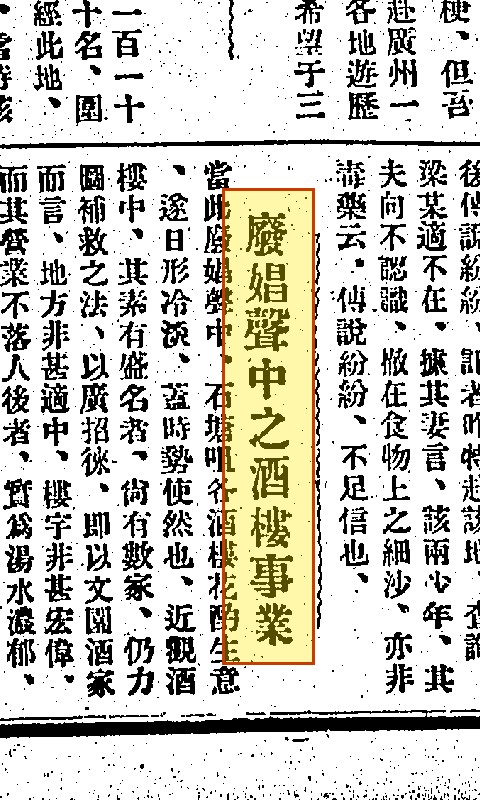
第三個答案是一場由1930年走到1932年的政策。1930年6月,英國下議院討論妹仔問題時,殖民部次官宣布「政府政策是完全廢除妓寨」19;1930年7月,香港執行「廢娼之第一步」——重新登記與停發新牌,石塘咀的鴇母與妓女結隊到華民司署請願,「列隊前往者達二百餘人」2021;1931年12月4日,官方正式宣布「所有妓寨將在切實可行的範圍內廢除」("all brothels are to be abolished as soon as practicable")22;1932年1月,政府向華商會重申「逐步關閉的政策不會改變」,報紙以「三年內禁絕」為題23;1932年4月,工商日報寫下塘西自己的墓誌銘:「當此廢娼聲中,石塘咀各酒樓花酌生意,遂日形冷落,蓋時勢使然也」24;1932年12月,立法局通過《1932年保護婦女及少女(修訂)條例》25。1933年官方報紙回顧:「廢除只是去年的事」26。
本研究的三點結論:其一,把妓寨趕到石塘咀的,是一套「不承認妓寨存在」的政府的行政機器——它一面說「政府對妓寨毫不知情」(1902年立法局語)27,一面行使第31號條例的遷移權;其二,石塘咀的到來並非偶然:地價紀錄顯示,該區應課差餉租值由1897–98年的119,704元,跳至1900–01年的214,265元,三年多升79%,與1901年住戶「租金漲了十倍」的稟詞互相印證28;其三,塘西的終結不是取締而是散場:政令自1930年起,1931年公開,1932年執行,剩下的煙花散入舊城街道——「私娼」、「二四寨」之名自此轉入尋常巷陌。至於今日流傳的「1903年命令」,本研究無意在正文與之爭辯:它屬於一個更簡單的記憶,而檔案裡的事實較它複雜,也較它誠實(辨正見第八節)。
一、採石岸(1841–1875)
石塘咀的名字來自石塘——採石場蓄水成塘,塘的出口即「咀」。1845年的《藍皮書》在職業表上記下它的營生:酒食商(victualler)、石匠與燒灰匠1。1849年的《藍皮書》人口表列「Shek-tong-tsui」為獨立一欄,全數不過數十人29;1852年至1856年的地區人口與死亡表中,它與西營盤、西灣、堅尼地城同列30。1853年的《藍皮書》更記下它的一項工業:兩座火藥製造廠(全港另有一座在黃茅角、一座寫作「香港」)31。
1869年,一則《德臣西報》短訊提到「移民客棧已在海旁的石塘咀開設」(emigration boarding houses have been opened at Shek Tong Tsui on the Praya)——出洋的苦力生意也在這裡落腳32。
同治五年(1866年)三月,一封140人簽名的稟帖在《德臣西報》刊出,求政府把「位於羅便臣道、摩羅廟台之上」的一條「華人村落」「毀去或遷移」;今人著作把這條村記作石塘咀村,並說它「遷到了今天石塘咀的位置」。但稟帖本身從未寫出石塘咀之名,而所有《藍皮書》都把石塘咀記在西端——兩者是不同的地方。這一條線索在本研究中列為錯認(F1),不作為石塘咀村的歷史;它只是一段與西端無關的中環山村故事33。
石塘咀自己的公共建設:1875年,街市建成;1879年《藍皮書》記其30檔,1880年《藍皮書》的礦場表記它仍有4座石礦場2。1889年大風雨後,工務報告提到「Poyan街、力池涌與石塘咀渠」受損34;1898年的工務清單列有「石塘咀海旁牆——M.L. 126及177–183對面」34。這些紀錄說明:在西遷之前,石塘咀是一個有市集、有礦場、有渠務的社區,而不是「空白地」。
二、牌照、檢驗與「專款」:一個制度的兩張面孔(1857–1894)
香港開埠早期的妓寨制度,與海軍性病防治連在一起。1857年第12號條例(「防止花柳病傳染條例」)建立登記制度;1858年的行政局卷宗裡已出現「118號登記妓寨」(Registered Brothel No 118)11。1867年第10號條例把制度精細化:發牌、按例徵收醫院費、罰款,並在第66條規定該等收入應設「專款」,用於性病醫療。
1878年10月15日,港督軒尼詩在立法局宣讀財政報告時,親手公布了制度的帳目:1868年4月至1877年4月,妓寨牌照收入74,404元;同期妓寨醫院費9,849元;妓女與妓寨經營者的罰款11,362元;扣去性病醫院(Lock Hospital)的開支與「妓寨督察」的薪金,淨利約8萬至9萬元12。他同時說明:第66條的「專款」一直沒有成立——款項自1859年起併入一般收入,直到1878年才因他被質問而下令照條例執行12。制度的人手見於1875年的《藍皮書》:妓寨督察W. F. Whitehead(1874年3月3日到任,年薪150鎊)、副督察J. Lee,以及灣仔檢驗所的醫生與配藥員13。
制度運作的陰暗面,由殖民地醫官留下最直接的紀錄。1874年1月19日,代理華人醫官艾爾斯(B. C. Ayres)提交《香港牌照妓寨報告》:他巡查了12次以上,仍未走遍全港,「廚房無不污穢」「地板飽吸腐敗動物質」「房間之內再建房間」,多次發現「妓寨督察」只理條例、不理衛生;他下令關閉8家「無可救藥」的房屋,並主張此後發牌須先經醫官證明適宜居住14。督憲堅尼地(Kennedy)的批示是:「這是一個恐怖的揭露」(This is a horrible revelation)14。
1877年,積怨爆發。是年秋季的審訊裡,《德臣西報》記者寫下:「有本地女子,其死因是為躲避一名妓寨督察,自卑利街(Peel Street)一屋墮下」(whose death was caused by a fall from a house in Peel Street while escaping from an Inspector of Brothels)15。這就是促使政府設立委員會調查《傳染病條例》運作的觸發點;1878年11月,報紙還在催促委員會公開報告35。1879年11月19日,《憲報》刊出「公布有關不名譽房屋收益之文件」的全套往來,包括軒尼詩第71號函原件:第66條「一直沒有執行,款項被當作一般收入的一部分」,註冊總署卻無從解釋;「兩名華人女子的死亡,是華民司署屬下的妓寨督察所為」16。
同年11月,立法局在表決《1879年第5號條例》時,首席按察司當面指出「第66條多年被違反」,最終把「專款」條款中的shall改為may36。至此,牌照制度雖然保留,其「賬目神話」已經破產:從1878年起,牌照費不再列入歲入,專款(如果真的存在)也只是維繫性病醫院的費用而已。
三、把「罪惡」趕去西邊:1888–1899年的政策鏈
1888至1890年間,行政局第一次認真討論「把妓寨遷到市郊」:文件題為「the removal of the Brothels to the outskirts of the city」,港督指出西營盤已過於擠迫,請潔淨局提意見;這個議題其後「 adjourned」——擱置37。1891年,庫務司在答覆議員麥敬時又把「把妓寨遷到市郊」列為疏解市區擠迫的手段之一,並提醒議會:「搬遷的不只是現有作妓寨的房屋,還有那些靠為妓寨供應生計的人所住的房屋」37。
1890年第11號條例(《保證婦女條例》)的第三篇把制度推到頂點:登記妓寨、規定經營者責任、認定妨擾的標準,並授權總督「劃定妓寨應在的地區」;第24、25、33條另授權華民司入屋檢查、索取住客名單、訂立清潔規則17。可是這張法定權力只維持了4年。1893年初,殖民部大臣函諭香港:「登記妓寨與檢驗住客,與英國國會認可的政策相違背,應予廢除」,限6個月執行18。1894年9月3日,輔政司在立法局提交修訂條例,直言法案「奉英廷明令,必須通過」;議員遮打(Chater)抗議:「我們深知反對亦是徒然」;議員何啟把話說得更直接:「過去15年這些條例運作極佳……可憐的婦女們今後將再無保護」18。
法案的內容與後果,是這一節的關鍵:修訂條例刪去第三篇全部——登記、檢驗、以及「地區劃定」的權力一併廢除;留下的,只有「鄰里投訴」時把妓寨當作妨擾場所、以簡易程序關閉的權力18。但早在1893年6月,註冊總署代潔淨局轉呈的「守望委員會」(Watch Committee)意見書,已預言了往後十年:「取消登記後,經營者對住客的控制將甚於今日;住客將不及今日安穩;除非維持現行的做法、把妓寨局限於若干地區,全港將妓寨氾濫;而這將令更多華人家庭遷離」18。
預言成真。1894–1899年間,警察司向行政局提交「妓寨位置」方案;行政局1896–1899年間批准的措詞是:「本局對方案無反對,但認為警察應逐步執行,並顧及1898年2月殖民部大臣第45號函的指示」3。1899年10月17日,《孖剌西報》的社論〈擠迫與妓寨的遷移〉(Overcrowding and the Re-moval of Brothels),由英文《Hongkong Weekly Press》周刊在10月21日轉載:城中「有超過400間房屋,其中一層或多層用作妓寨」,政府「有意」把它們遷離擁擠地區,「把樓層騰出來給體面的華人家庭」;同一週的報紙記下有人建議:「妓寨應盡量遷往堅尼地城一端」38。
1899年,立法局通過《保護婦女及少女(修訂)條例》,即第31號條例。其後《1900年立法局文件》如此概括它的核心條款:「授予華民司與警察司隨時關閉或遷移任何妓寨的權力,即使並無鄰里投訴」4。這條條文,就是1900年之後一切「搬遷」的法律依據——它不是「1903年命令」,而是一部藏在別的條例名下的行政權。
四、強制搬遷(1900–1906)
1900年5月,行動開始。數批妓寨經營者在裁判司署被控「在西環若干禁制街道經營妓寨」(keeping brothels in certain prohibited streets at West Point);御用大律師法蘭西斯(J. J. Francis, Q.C.)為他們辯護,當庭指出:「這些經營者是被華民司與警察以完全合法的手段從原居所逼走的;他們搬進警察特別指給他們的房屋,未及安頓,又被命令搬走」;他把這批檢控稱為「邪惡、任意、毫無理據」(wicked, wanton, and without justification)5。裁判司郭士(Gompertz)最終下令:被告須於1900年8月1日前遷出5。6月,更多房屋在「禁制區域」內被令24小時內關閉;報紙以「淨化一個地區」(Purifying a Locality)為題,報道西邊三家妓寨被令「搬離體面住宅區」39。
1901年是數字之年。華民司年報記載:「118家妓寨依1899年第31號條例第4條經裁判司令關閉;另有3宗依第8條起訴,2人被定罪並遞解出境」;另有49宗依第11a條起訴,35宗定罪,罰款2,950元6。同年5月,潔淨局收到一封來自石塘咀居民的稟帖:Lei Yung 等9人,「久居石塘咀」,稟文說:「自從妓寨遷到這裡,租金漲了十倍以上,超出我們的能力」;他們其後獲Lai Po Lung讓地在堅尼地城附近的山邊搭屋,十一月颱風吹倒,重建後又因衛生問題被罰7。同一時期,行政局對「歐籍妓寨」作出限制:「數目應限於1899年C.S.O. 2438號所准許的範圍」40。1903年的疫症紀錄裡,一名患者在潛伏期內「在石塘咀一家妓寨過夜」——這是官方文件裡石塘咀與妓寨同現的最早記錄之一41。
與此同時,政府在石塘咀「造地」。1903年7月,四家報紙連續刊出同一則拍賣公告:「石塘咀一幅官地……75年租期,可續租75年」;10月,屈地街(Whitty Street)的M.L. 284地段拍出10。1904年12月,干諾道石塘咀的M.L. 289(16,342平方呎)以113,694元拍出42。同年,立法局通過《保護婦女及少女(修訂)條例》,對付所謂「私寨」(sly brothels)43。1905年9月,一名破產商人在法庭上說出市場的看法:「他聽說妓寨已經遷到西環,遂沒完成那筆買賣」8。1906年2月,《德臣西報》刊登一封地產代理的信:「已故Granville Sharp的遺產包括市西的貨倉與唐樓;自他去世後,政府把華人妓寨放逐到石塘咀,該區物業價值因而上升」9。
1906年5月,〈公共衛生及建築條例委員會〉(Public Health and Building Ordinance Commission;主席Pollock御用大律師,成員包括劉鑄伯、馮華川)開庭取證。委員會的質問把整件事記錄在案:「妓寨是何時遷到石塘咀的?」「不記得了。」「不是去年搬過去的嗎?」「我想是今年。」另一名證人記述自己商號的經歷:「我們本來在灣仔,然後被趕上石塘咀,去年年底又搬了回來。」同一份證詞裡還有今日讀來觸目的細節:「送給潔淨局的禮物」(presents to the Sanitary Board)、「督察Lamble放過了Man Shing妓寨的天窗」、以及那句命令式的追問:「把Lamble督察收過錢的妓寨全部說出來」44。妓寨與警察、衛生、金錢的關係,在這份證詞裡現出全貌。1907年6月,何啟議員在立法局質問政府「打算如何落實公共衛生及建築條例委員會的建議」——委員會的報告在6月6日提交44。
五、地價作證:西遷的算術
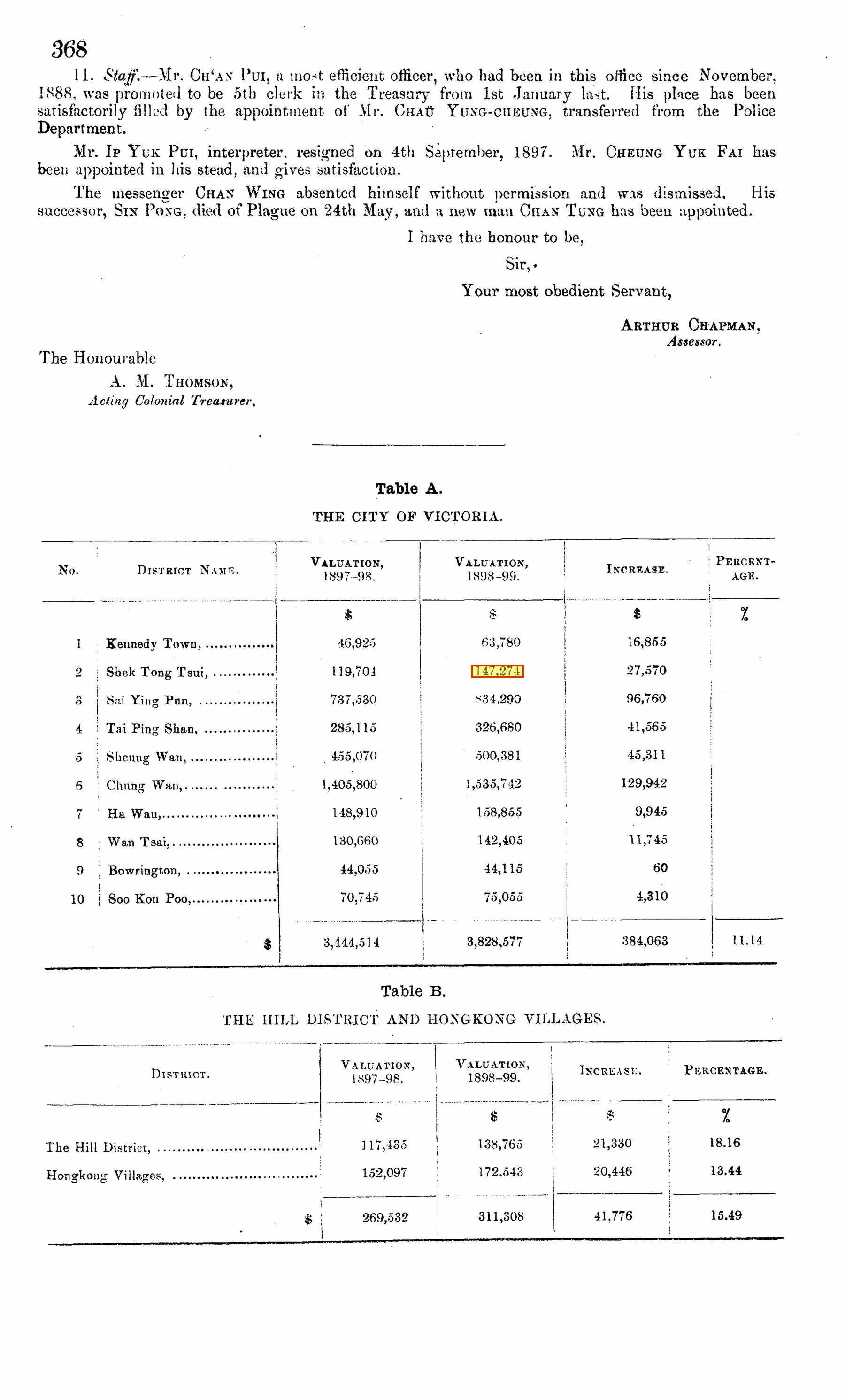
如果西遷是一場真實的搬遷,它必然在數字上留下痕跡。差餉估價冊提供了這筆帳:以「維多利亞城」第2區「石塘咀」計算,應課差餉租值(Valuation)
1897–98年:119,704元 → 1898–99年:147,274元(+27,570) → 1899–1900年:159,654元 → 1900–01年:214,265元(+54,611)28
三年間增幅79%。同期西營盤的增幅是約24%(834,290元→1,035,165元)28。換句話說,石塘咀的租值升幅是鄰區的三倍有多——與1901年住戶「租金漲了十倍」的稟詞、1906年「物業價值因而上升」的律師信,以及1905年「妓寨已遷到西環」的市場傳聞,指向同一件事實。本研究不主張這是唯一的因果(西端的填海、街市、交通也在發展),但把它列為西遷的最硬證據:地價不會說謊。
六、塘西(1906–1930)
妓寨在石塘咀定下來之後,這片區域有了自己的名字與世界:塘西——「石塘之西」45。1926年,《工商日報》一篇回顧把它的來歷記下:「距今二十年前,本港之牆花路柳乃萃於水坑口……世事更移,藏然貯燕之所竟遷於石塘(咀),一時盛地頓生寂寞之情形」46。
塘西的組織方式,在1926–1931年的報紙上歷歷可見:妓寨稱「寨」,大堂口稱「大寨」;有一類分級叫「二四寨」(前引「卑路乍街十八號某二四寨之二樓尾房」);妓女稱「校書」;宴會叫「花酌」或「花筵」;經營者稱「鴇母」。街道的名字:山道、卑路乍街、遇安台。寨名:詠花寨、倚紅妓院、翠樂寨、桃樂寨、長樂之寨、天一院、宜樂院……酒樓的名字:萬國、金陵、新中國、文圓、廣州酒樓。1929年12月,潔淨局還為石塘咀街市的攤位與兩封匿名信開了一次會47。1930年5月,新任港督貝璐(William Peel)的車隊自中環西行,「在石塘咀轉上山道」,再去大會堂接受歡迎詞——新的總督,在就職當日便被駛過他的政策將要改寫的那片街區48。
七、廢娼(1930–1932)
1930年6月26日,英國下議院在審議殖民地撥款時,議員特伯維爾(Turberville)就妹仔與妓寨質詢;殖民部次官杜林·希爾斯(Drummond Shiels)答覆:「政府的政策是完全廢除妓寨」;他又說,「新任港督貝璐爵士上次回倫敦時已與大臣商議此事」19。次日路透社的電訊以「香港妹仔與妓寨:條例已執行;殖民地的廢娼政策」為題49。
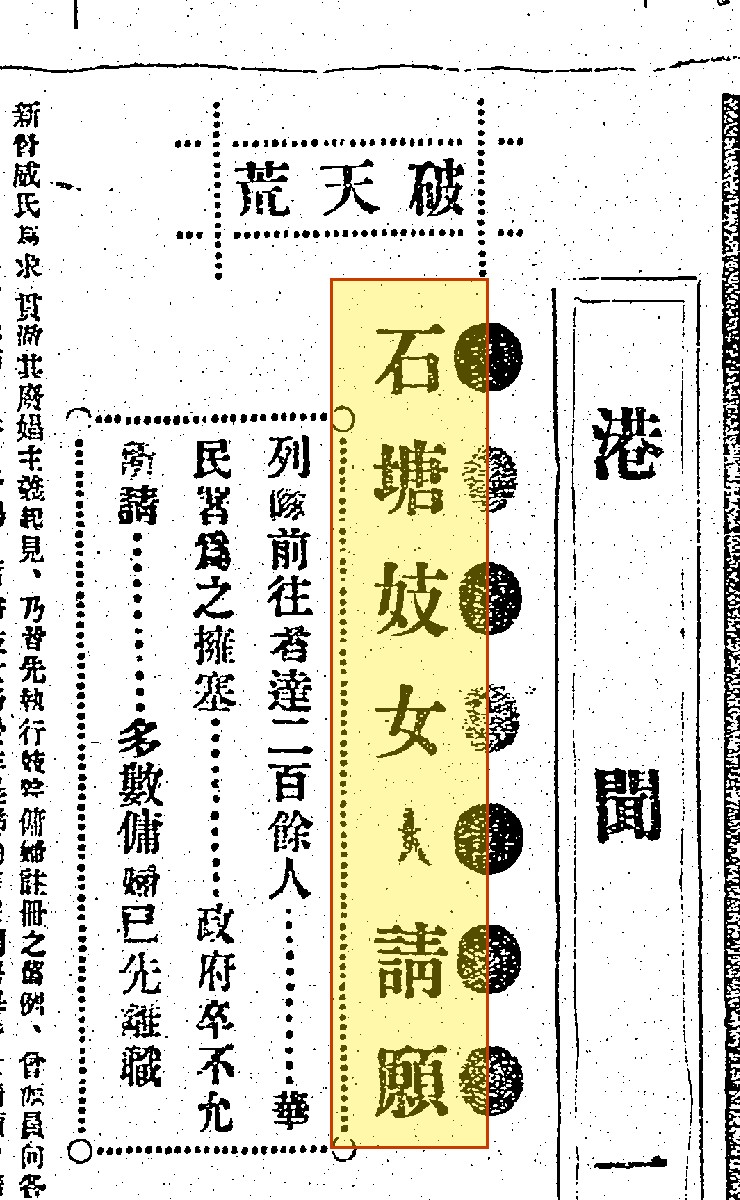
香港方面,1930年7月開始執行「第一步」:登記現有妓寨與住客、停發新牌21。全區陷入恐慌。7月7日的報道:「最使人注意者為石塘咀妓女聯同請願」20;7月8日:鴇母偕傭婦、妓女「聯同華民司署舉行大請願,請將命收回」,隊列「中鴇母占其三,餘則百餘傭婦妓女」;報道又說,政府的登記是「廢娼之第一步驟」,而「華民司卒不允」20。這一頁的側欄標題至今讀來有聲:「石塘妓女請願」;側欄文字:「列隊前往者達二百餘人」「政府毫不允」「多數傭婦已先離職」20。報紙的爭論也同時展開:〈士蔑報〉7月10日的社論反對「無情地關閉這些場所」,說那會「鼓勵無數地下妓寨的出現」50;9月,〈德臣西報〉以「那些妓寨:取締還是控制?」為題繼續討論50。
1931年12月4日,〈士蔑報〉以頭號標題宣布:「BROTHELS TO GO——政府的重要決定」:「政府對香港社會問題的政策已經成形,正式宣布所有妓寨將在切實可行的範圍內廢除」(as soon as practicable)22。1932年1月,華商會透過立法局華人議員得到的答覆是:「政府的逐步關閉政策不會改變」;報紙的社論稱:「政府要在三年內禁絕娼妓的決心,顯示它打算把香港建成一個沒有不道德的現代口岸」23。
塘西的散場,由它自己的餐飲業記下。1932年4月28日,《工商日報》「酒樓事業」專欄的標題是:「廢娼聲中之酒樓事業」;正文:「當此廢娼聲中,石塘咀各酒樓花酌生意,遂日形冷落,蓋時勢使然也。近觀酒樓中,其素有盛名者,尚冇數家,仍力圖補救之法」24。兩個月後(同報5月5日),一名詠樂妓院的妓女在中環一間酒店服毒身亡——舊世界的人,在報紙社會版上最後一次出現24。也別忘記這一年2月,上海戰事發生時,塘西花界還在為災民募捐:這是它們作為公眾一員的最後姿態24。
八、餘響與辨正(1933–1935)
1932年的關閉之後,舊城區的街道上開始出現「私寨」案件(荷李活道、卑利街、高街、永樂街、文華里);1933年5月,立法局的討論已轉向另一議題:「不是廢除妓院,而是為娼妓引入某種形式的定期體檢」5152。1933年8月9日,《孖剌西報》刊登「1858年的回聲」專欄,寫下最直白的一句總結:「本報75年前鼓吹全廢牌照妓寨,值得留意的是——廢除只是去年的事」26。1935年,《建築條例》把妓寨寫進估價的技術條文中:仲裁人須聽取「物業租金曾因用作妓寨而提高」的證據——一個時代至此只剩下測量的語彙53。石塘咀的街市則繼續記帳:它的收入欄從1908年的幾百元一直排到1918年的表格裡54。
最後是辨正。今日通行的一句「1903年,政府下令把妓寨搬到石塘咀」,本研究在檔案裡找不到對應的命令;檔案顯示的是短缺的、逐步的、以行政權執行的搬遷(1896年的位置方案、1899年的第31號條例、1900年的遷出令、1901年的118宗關閉、1905–06年的市面陳述、1906年的委員會質詞)。「1903」在紀錄裡對應的是石塘咀的地段開賣——「塘西」被建成的那一年10。至於「彌敦下令」的說法,時間上亦不合:彌敦1904年才到任,而搬遷在此之前已經開始57。本研究無意嘲笑記憶,但必須指出:檔案裡的版本更複雜——更複雜,也更誠實。555657
結論
石塘咀的故事,是香港殖民地政府的一個縮影:它不承認任何一種罪惡的合法存在,卻管理着它們的位置、價格與秩序。牌照時代如此(1867–1894),行政時代也是如此(1899–1930);「政府對妓寨毫不知情」的宣示27與第31號條例的遷移權,是同一個政府的兩隻手。當1930年倫敦決定「完全廢除」,香港執行得既可預測又不情願:先登記、再宣布、然後讓市場自己完結——三年之間,塘西的燈火散入尋常巷陌,留下來的,是地價表上的一個異常升幅、一份請願書上被逼遷的九個人,與一張寫着「石塘妓女請願」的報紙。
The Quarry Shore that Became a Vice Quarter: Shek Tong Tsui (塘西), 1841–1935
Abstract
Shek Tong Tsui is remembered as 塘西, the colony’s licensed vice quarter — the district the brothels were “moved to” in 1903. This paper tests that formula against the record and finds a different story. The shore was a working quarry village with its own market (1875) and four quarries as late as 1880, not empty land. The brothels that arrived there belonged to a system built by Ordinance No. 10 of 1867 — licences, hospital fees, fines, the Lock Hospital and the Wanchai Examination Rooms, worth $95,616 gross in 1868–77 — exposed by the 1877–79 commission (two women’s deaths “owing to the action of an Inspector of Brothels”) and by the s. 66 special-fund breach “worked so much in the dark”. After London ordered registration abolished in 1893 and the 1894 amendment repealed both registration and the power to delimit a brothel area, the Watch Committee’s warning — the colony “will be overrun with brothels unless they are confined … to certain neighbourhoods” — came true administratively: an ExCo-approved “location of brothels” scheme (1896–99, to be carried out “gradually”), the discretionary closing-and-removing power of Ordinance No. 31 of 1899, the “prohibited streets at West Point” prosecutions of 1900, 118 closings in 1901, and the July 1903 Crown land sales (75-year terms) that laid out the new quarter. The district’s rateable value rose from $119,704 (1897–98) to $214,265 (1900–01), beside a May 1901 residents’ petition that “on the brothels moving there, the rents rose ten-fold”. By 1905–06 the press says the brothels “had been moved to West Point” and the Government “has relegated Chinese brothels to Shek Ton Tsui”; a 1906 commission asks the removal question on the record. The end was policy, not raid: the Commons statement of June 1930, the district’s own mass petition at the Secretariat for Chinese Affairs (July 1930), the announcement of 4 December 1931 (“all brothels are to be abolished as soon as practicable”), “within three years” (January 1932) and the closing of 1932, recorded in the district’s own newspaper: “當此廢娼聲中,石塘咀各酒樓花酌生意,遂日形冷落”.
Keywords: Shek Tong Tsui 石塘咀 · 塘西 · licensed brothels · Ordinance 10 of 1867 · Ordinance 31 of 1899 · Lock Hospital · Public Health and Building Ordinance Commission 1906 · abolition 1930–1932.
1. Scope, sources, method
This paper asks how the brothels came to Shek Tong Tsui, what regime they had belonged to, and how they ended. The corpus is the hkintexts research collection (read-only): the English official print (Blue Books from 1845; LegCo Hansard; Executive Council minutes, CO 131; Sessional Papers; the Government Gazette; Administrative Reports; CO 129 and the CO 537 commission evidence), the English press (China Mail, Daily Press, Telegraph, Weekly Press), and the Chinese press from 1926 (工商日報, image series). There is no contemporaneous Chinese newspaper in the corpus for 1900–1926: the relocation’s record is English-side, with the gazette’s own bilingual columns and later Chinese retrospectives supplying the Chinese vocabulary. Method: phrase batteries across both indices with the period romanizations; one compulsory whole-document pull (CO 537 (35–36), 694 pages — the 1906 commission); an adversarial pass against the paper’s headline claims; and a rule-9 name battery. Details in the research notes; the instruments are tabulated in Appendix A and the register in Appendix B. 5657
2. The quarry shore (1841–1875)
The name is the economy: a stone pond, its mouth the “tsui”. The Blue Book of 1845 lists at Shek-tong-tsui a victualler, stone masons and limeburners; 1849 counts the hamlet on its own row; the 1852–56 mortality tables place it beside Sai Ying Pun, Sai Wan and Kennedy Town; the 1853 Blue Book counts two gunpowder manufactories there. 1293031 An 1869 notice records “emigration boarding houses … opened at Shek Tong Tsui on the Praya”. 32 By 1875 the shore had its own market (30 stalls by 1880) and still four quarries; the district’s drains and the Praya wall on Marine Lots 126 and 177–183 are on the public works. 234
The 1866 petition of 140 householders against “the Chinese Village situated on the Robinson Road, Victoria, immediately above Mosque Terrace” is sometimes folded into this shore’s history; the petition itself names no Shek Tong Tsui, and its village is in Central. It is registered here as a separate, Central, event — not this village’s. 33
3. The licensed system and its unmasking (1857–1894)
Ordinance No. 12 of 1857 opened the register (“Registered Brothel No 118” appears in the ExCo papers of 1858–59); Ordinance No. 10 of 1867, in operation from April 1868, licensed the houses and charged them for the medical system. 1112 The Governor’s own financial statement of 15 October 1878 totalled up the trade: $74,404 from brothel licences, $9,849 in hospital fees from prostitutes, $11,362 in fines — $95,616 — against the Lock Hospital and the Inspectors of Brothels. The establishment (Blue Book 1875): Inspector of Brothels W. F. Whitehead, assistant J. Lee, the Lock Hospital, and the Wanchai Examination Rooms. 1213 In 1884–85 the ExCo put the Inspector “on the same footing” as police inspectors and the Sanitary Board required that “all registered brothels shall be scavenged, cleansed and lime-whited by their owners under Government inspection”. 58
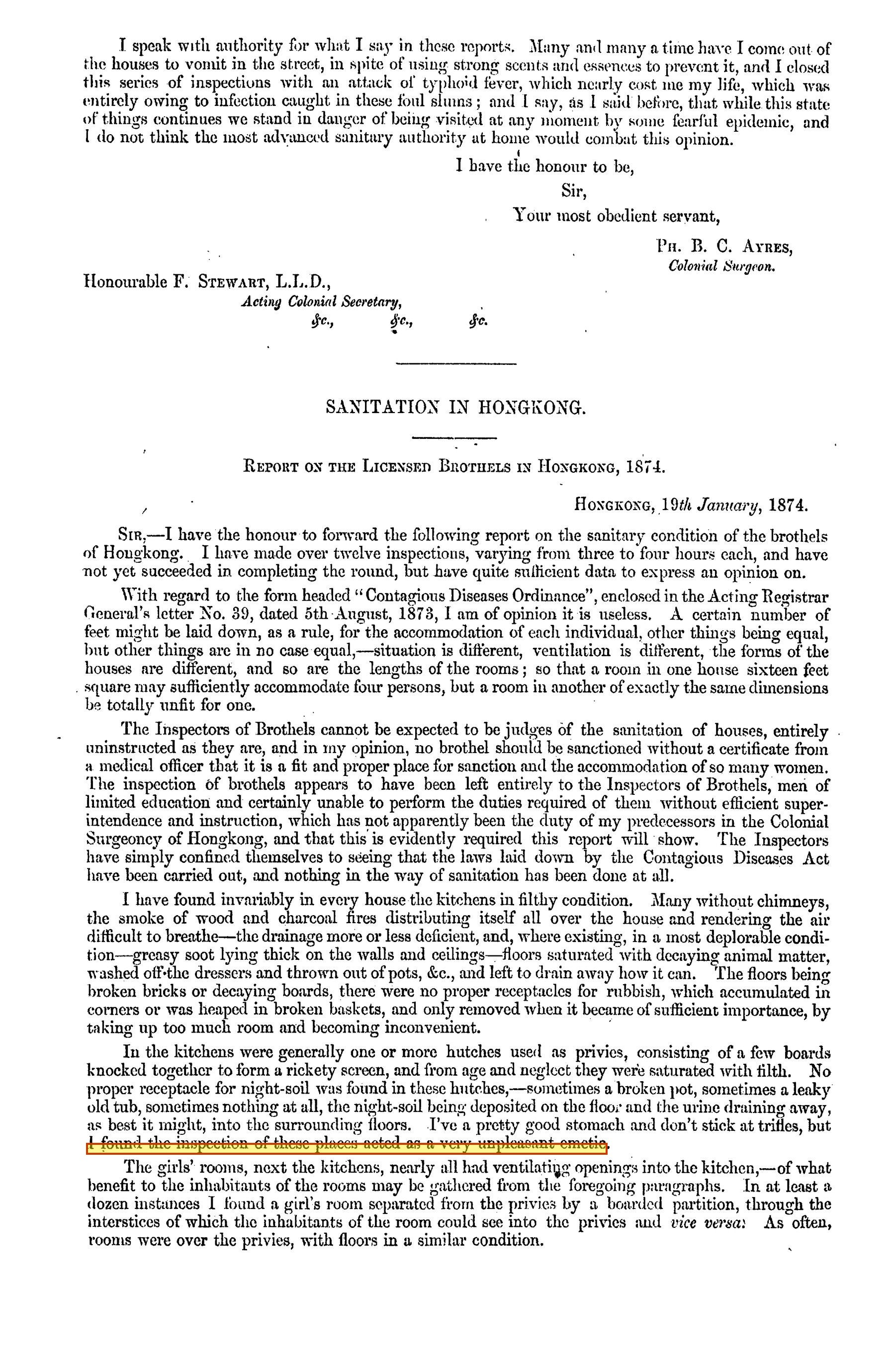
Ayres’s report (19 January 1874) is the system’s X-ray: kitchens “saturated with decaying animal matter”, rooms built within rooms, houses “quite unfit for use as brothels or human habitation”; eight houses ordered closed; Governor Kennedy’s minute, “This is a horrible revelation”. 14 In 1877 the press recorded “native women, whose death was caused by a fall from a house in Peel Street while escaping from an Inspector of Brothels” — the scandal “which led to the appointment of the Commission” into the working of the Contagious Diseases Ordinance. 1535
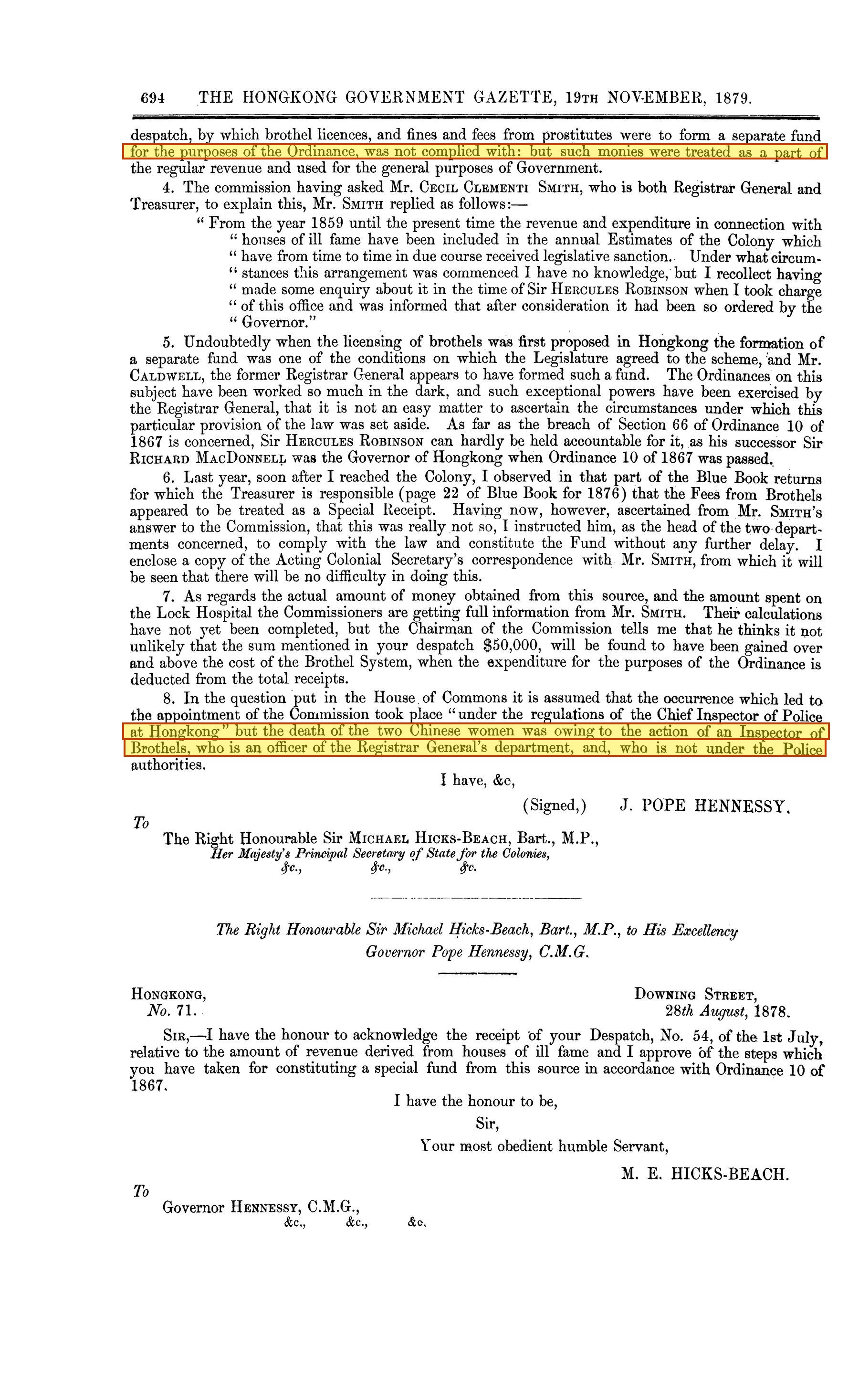
The 1879 Gazette papers exposed the fund breach; LegCo heard of “the violation for so many years of section 66 of the Brothel Ordinance”, and the fund clause was softened from shall to may. 1636 In 1890 the protection law was rebuilt at its height — Ordinance No. 11 of 1890 Part 3: registration, keepers’ duties, nuisance rules, and the Governor’s power “to limit the area within which brothels should be kept”; s. 24 entry and inspection. 17 Three years later London ordered it down: registration and inspection “a system contrary to the recognised policy of Parliament … to be abolished”. The Watch Committee’s representation, forwarded by the Registrar General, warned: “the colony will be overrun with brothels unless they are confined, as at present, to certain neighbourhoods; and … this will lead to a decrease in the numbers of Chinese families residing”. The 1894 amendment repealed Part 3 — registration, inspection, and the delimitation power — leaving only closing-on-complaint. Chater: “we are fully aware how useless would be any opposition”; Ho Kai: “The ordinances have worked very well during the past 15 years … these poor people will have no further protection”. 18
4. The removal west (1896–1906)
What replaced the law was administration. The Executive Council of 1896–99 approved the Captain Superintendent of Police’s “proposals with regard to the location of brothels”, to be carried out “gradually”, with a February 1898 Secretary of State’s instruction to be kept in view. 3 In October 1899 the Daily Press leader — reprinted by the Weekly Press — stated the programme: “the intended removal of houses of ill fame from the congested parts of the town. There are said to be over four hundred houses with one or more of their … floors occupied as brothels”; the same week’s press recorded the suggestion “that all brothels are to be kept as far as possible to the Kennedytown end of the town”. 38 Then came Ordinance No. 31 of 1899: the power “of closing or removing any brothel at their discretion, even though it may not have been complained of by the neighbours”. 4
The machinery ran from May 1900: keepers prosecuted “for keeping brothels in certain prohibited streets at West Point”; Mr J. J. Francis, Q.C., showing that the keepers “had been bullied from their former houses by the Registrar General and the Police in a perfectly legal manner”, had moved into houses “specially pointed out to them by the police”, and were “no sooner settled down, than … ordered out again” — “wicked, wanton, and without justification”; the magistrate’s order to vacate by 1 August 1900. More houses “in a prohibited area” followed within 24-hour orders; “Purifying a Locality” sent three more houses “farther away from a respectable locality”. 539 The Registrar General’s report for 1901 records 118 brothels closed by order of the Magistrate under s. 4 of Ordinance 31 of 1899. 6
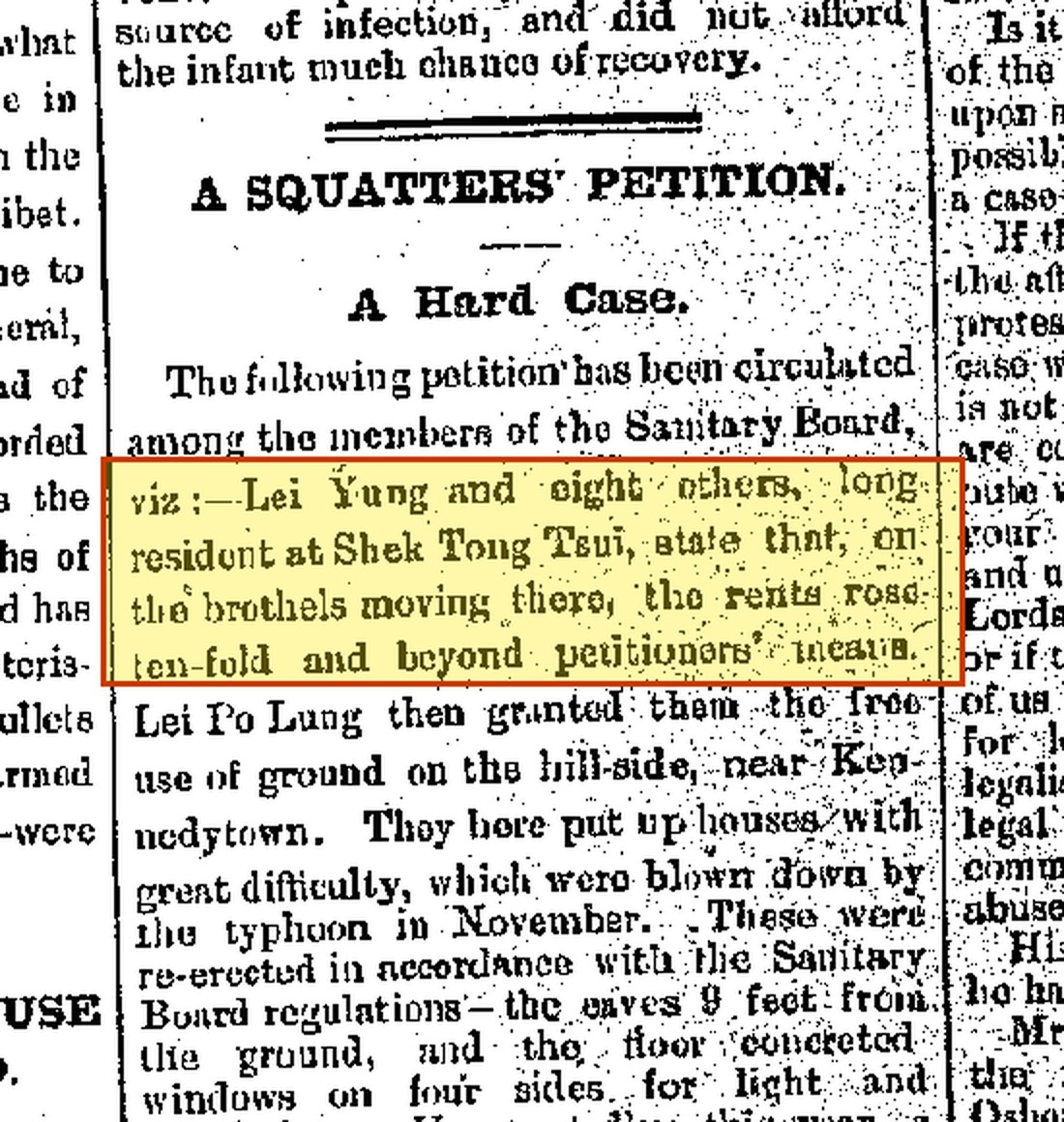
The May 1901 petition is the relocation’s ground-level witness: the mat-shed families above the shore priced out by the brothels’ arrival. 7 The same season the ExCo restricted European brothels “to the area sanctioned in C.S.O. 2438 of 1899”; a 1903 plague case was traced to a man who “stayed all night in a brothel in Shek Tong Tsui”. 4041 On 7 July 1902 LegCo voted the Inspector of Brothels’ allowance while hearing the official fiction in full: “‘The Inspector of Brothels’ is not quite the proper title … The Government have no [cognizance] of brothels”. 27
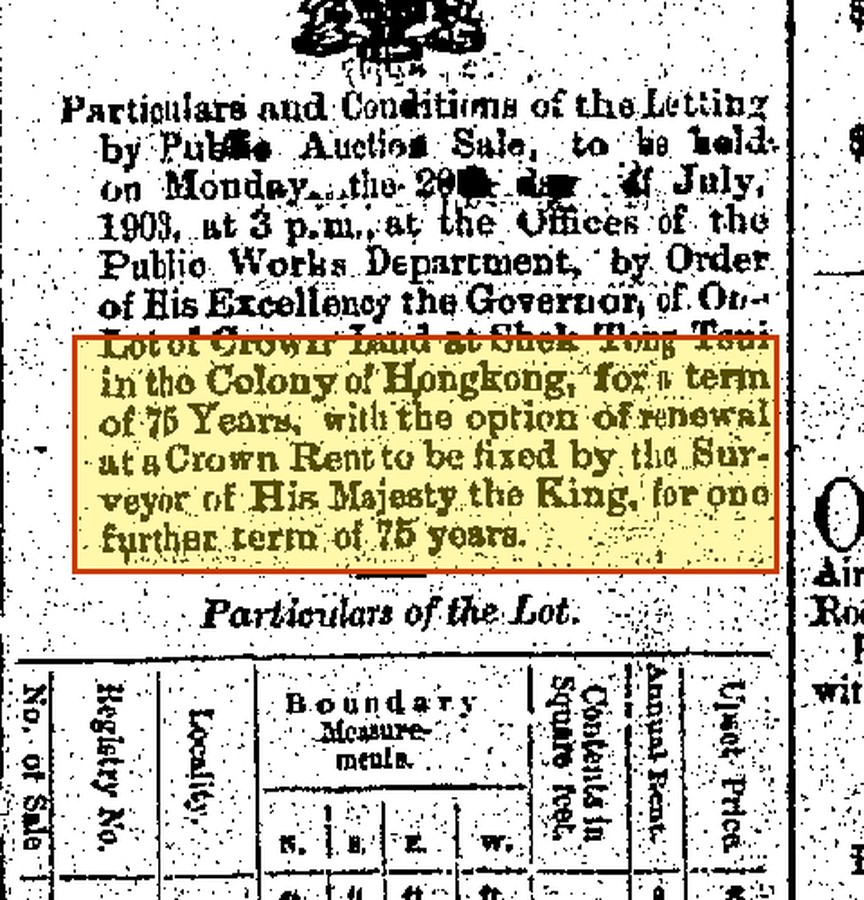
1903 laid out the district: the July auction notices (75-year terms) and the October M.L. 284 sale; the same year’s ExCo advised “six months notice … with a view to the closing of European or American brothels containing more than 2 women” (the year-index: “Women and Girls Protection: Closing of certain Brothels”), and the bacteriological-examination address became the Public Mortuary, Shek Tong Tsui; 1904 added M.L. 289 at Connaught Road, Shek Tong Tsui — 16,342 sq ft at $113,694 — and the “sly brothels” amendment. 1059604243 By September 1905 the market knew it: “He heard that the brothels had been moved to West Point”. By February 1906 the estate correspondence said it plainly: “the Government has relegated Chinese brothels to Shek Ton Tsui”, and western property values had risen “partly from this cause”. 89 In May 1906 the Public Health and Building Ordinance Commission (chairman H. E. Pollock, K.C.; commissioners including Lau Chu Pak 劉鑄伯 and Fung Wa Chun 馮華川) put the question itself on the record — “When were the brothels removed down to Shek Tong Tsui?” — with a firm’s history in answer (“we used to be at Wanchai, then we were driven up to Shek Tong Tsui, and then we moved back again at the end of last year”), and the sanitary underside: “presents to the Sanitary Board”; “Name all the brothels from which Inspector [L]umble got money”. 44
5. The arithmetic of the move
The Assessor’s tables make the move measurable. District 2, “Shek Tong Tsui”, City of Victoria: $119,704 (1897–98) → $147,274 (1898–99, +$27,570) → $159,654 (1899–1900) → $214,265 (1900–01, +$54,611) — seventy-nine per cent in three years, against Sai Ying Pun’s roughly twenty-four per cent. The petition’s “rents rose ten-fold”, the 1906 “property … has increased”, and the 1905 market talk all point the same way. 2879
6. 塘西: the district’s world (1906–1930)
The quarter took its own name and order. A 1926 retrospective in 工商日報 dated the migration to “twenty years ago” and told it as a memory: the flower world at 水坑口, the swallows’ roost moved to Shek Tong Tsui, the old place grown lonely. 46 The district’s vocabulary, from the 1926–31 record: 寨 and 大寨 for the houses, 二四寨 for a rank of them, 校書 for the women, 花酌 for the banquet trade, 鴇母 for the keepers, 烟花塲 for the world itself; the streets 山道, 卑路乍街, 遇安台; the houses 詠花寨, 倚紅妓院, 翠樂寨, 桃樂寨, 長樂之寨; the restaurants 萬國, 金陵, 新中國, 文圓. 4561 In May 1930 the new Governor, Sir William Peel, was driven west past it: “At Shek Tong Tsui he will turn up Hill Road” on the way to the City Hall and the address of welcome. 48 Even the market stayed in the record — the Sanitary Board’s 1929 debate over its stalls, prompted by two anonymous letters. 47
7. 廢娼: the abolition (1930–1932)
On 26 June 1930 the House of Commons, hearing mui tsai and brothels on the Colonial vote, was told by the Under-Secretary, Dr Drummond Shiels, that the policy was “wholly to abolish brothels” and that “the new Governor, Sir William Peel, had conferred with the Secretary of State”. 1949 Hong Kong executed the “first step” in July: registration of the houses and their inmates, new licences stopped. The district answered with a petition: the madams and the women of Shek Tong Tsui went together to the Secretariat for Chinese Affairs — “列隊前往者達二百餘人” (over two hundred in the procession, by the page’s own count) — “請將命收回”; the registration was reported as “廢娼之第一步驟”. 2021 The press split: the Telegraph’s 10 July editorial warned against “the ruthless shutting down of these establishments”; the China Mail ran “THOSE BROTHELS. SUPPRESSION OR CONTROL?” in September. 50
On 4 December 1931 the Telegraph announced the decision: “BROTHELS TO GO. IMPORTANT DECISION BY GOVERNMENT. … all brothels are to be abolished as soon as practicable.” 22 In January 1932 the Chinese Chamber of Commerce was told the policy of “gradually closing down the brothels could not be altered”; the press called it suppression “within three years”. 23 By April the district’s own paper wrote its epitaph in the trade columns: “當此廢娼聲中,石塘咀各酒樓花酌生意,遂日形冷落,蓋時勢使然也” — in the midst of this abolition, the flower-banquet business of the Shek Tong Tsui restaurants declines daily; such is the way of the times. 24 In December the Council passed the Protection of Women and Girls Amendment Ordinance, 1932. 25
8. Aftermath, verdict, and the modern account
The closing was a process, and the record says so: the S.C.A. and police reported by August 1932 “the closing down of large numbers of recognised brothels” with the trade displaced; by December the “vice problem in the Wanchai district … marked since the abolition of the local brothels”. 62 The sly-brothel cases moved into the old city streets (Hollywood Road, Peel Street, Gough Street, Wing Lok Street) through 1933; in May 1933 the debate had already turned to “not … the abolition of brothels, but … some form of regular medical inspection”. 5152 On 9 August 1933 the Daily Press’s own column said it plainly: “the abolition was carried out only last year”. 26 In 1935 the Buildings Ordinance reduced the trade to a line in the valuation code — evidence that “the rental of the premises was enhanced by reason of the same being used as a brothel”. 5354
The modern formula — a 1903 order, sometimes with a fire, sometimes naming Governor Nathan — is not what the record carries. The record carries a decade-long administrative squeeze (1896–1906) under discretionary powers: the ExCo location scheme, Ordinance No. 31 of 1899, the 1900 prosecutions, 118 closings in 1901, the 1903 land sales that built the quarter, and the 1905–06 statements and commission. 1903 is the year the district was laid out; Nathan arrived in 1904. The paper does not quarrel with the memory; it offers the archive’s version, which is more complicated — and, it is submitted, more honest. 5556
Appendix A — the instruments
| Year | Instrument / act | Effect on the brothels |
|---|---|---|
| 1857 | Ordinance No. 12 (contagious diseases) | Registration of houses; the “Registered Brothel No 118”. 11 |
| 1867 | Ordinance No. 10 (in force Apr 1868) | Licences, hospital fees, fines; s. 66 special fund (not executed until 1878); Lock Hospital, Inspector of Brothels. 1216 |
| 1877–79 | The Commission (Contagious Diseases Ordinance) + Gazette papers | The Peel Street deaths; the fund breach exposed; the licence item leaves the estimates. 151636 |
| 1890–91 | Ordinance No. 11 (Women and Girls’ Protection), s. 24–25, 33 | Registration, inspection, and the Governor’s power to delimit a brothel area. 17 |
| 1893–94 | Secretary of State’s orders; the 1894 Amendment | Registration, inspection and delimitation repealed; closing-on-complaint only. 18 |
| 1899 | Ordinance No. 31 (Protection of Women and Girls Amendment) | Closing or removing any brothel at the Registrar General’s and Captain Superintendent’s discretion. 4 |
| 1904 | Protection of Women and Girls Amendment (No. 2) | Warrant procedure against “sly brothels”. 43 |
| 1932 | Protection of Women and Girls Amendment Ordinance, 1932 | Enforcement machinery after the abolition announcement. 25 |
| 1935 | Buildings Ordinance | The brothel as a valuation fact. 53 |
Appendix B — evidence register (summary)
Confirmed (multi-witness): the quarry-shore economy (1845–1880); the licensed system’s accounts and plant (1867–79); the s. 66 breach; the 1877 deaths and the Commission; the 1890 law and its 1894 repeal; the ExCo location scheme; Ordinance No. 31 of 1899 and the 1901 closings; the five-witness removal chain (1900 prosecutions, 1901 petition, 1905 market, 1906 press and commission); the valuation jump; the 1930–32 abolition chain. Single-witness (labelled): the 1903 M.L. 284 price note; the mortuary notice; the ExCo “six months” advice; the licence stop; the petition’s “two hundred” (kept as the page’s own count); the 1926 retrospective’s dating. Conflicts (kept): the modern 1903 formula vs the record’s gradual process (K1); the commission’s own dating exchange, individual and not general (K2); the petitioner’s name forms Lei Yung / Lai Yeung / Lai Young (K3); “West Point” and “Shek Tong Tsui” as one quarter (K4); the 1877 deaths’ number as the despatch prints it (K5); the market’s 1875 vs 1879 first listing (K6); the printed p. 694 vs the label “Page 678” (K7). Do-not list: the 1866 Robinson Road petition as this village’s history (F1); the 水坑口 fire and the Nathan order (F2); a gazetted “1903 order” (F3); 1935 as the closing year (F4); the district as empty land (F5). Gaps: the February 1898 despatch; the police location scheme itself; C.S.O. 2438 of 1899; the 1930 registration instrument; the licence-renewal lever; the pre-1926 Chinese-language record; a single “closing day”. Details in the research notes, §3.
Notes
Blue Book 1845, the Colony’s trades & occupations list: at Shek-tong-tsui a victualler, stone masons and limeburners. https://hkintexts.histsyn.com/page/652748 (accessed 31 October 2026). The quarries gave the shore its name and its first economy. ↩
Shek Tong Tsui market and quarries: Blue Book 1880, market table — “Shek-tong-tsui Market | Shops, Stalls | Chinese Dealers (30 stalls)” https://hkintexts.histsyn.com/page/659440; Blue Book 1880, quarries — “Shek-tong-tsui | 4” https://hkintexts.histsyn.com/page/659580; Urban Council 1965 (the market “built in 1875”) https://hkintexts.histsyn.com/page/602326 (accessed 31 October 2026). ↩
Executive Council minutes 1896–99 (CO 131/26, pp. 530–531): “Council considered a report by the Honourable Captain Superintendent of Police containing certain proposals with regard to the location of brothels. The Council had [no] objection to the scheme, but expressed the opinion that the police should exercise great discretion in carrying it out gradually and that the Secretary of State’s instruction contained in [Despatch] No. 45 of the […] February 1898 should be kept in view.” https://hkintexts.histsyn.com/page/5224674; https://hkintexts.histsyn.com/page/5224675 (accessed 31 October 2026; the OCR of ‘location’ and of the despatch date is fragmentary — only the clause ‘carrying it out gradually’ is quoted as printed). ↩
Ordinance No. 31 of 1899 (the Protection of Women and Girls Amendment) — its own summary: it “confers upon the Registrar General and Captain Superintendent of Police the power of closing or removing any brothel at their discretion, even though it may not have been complained of by the neighbours” (Sessional Paper 1900) https://hkintexts.histsyn.com/page/1821251; the consolidated text of the Protection of Women and Girls Ordinance, 1897 (with Ordinances No. 31 of 1899, No. 14 of 1900, No. 3 of 1901): https://hkintexts.histsyn.com/page/1847074 (accessed 31 October 2026). ↩
The May–June 1900 prosecutions: brothel keepers charged “with keeping brothels in certain prohibited streets at West Point”; Mr J. J. Francis, Q.C., for the defence — “these brothel keepers had been bullied from their former houses by the Registrar General and the Police in a perfectly legal manner, and now that they had moved into houses which had been specially pointed out to them by the police, they were no sooner settled down, than they were ordered out again” — “wicked, wanton, and without justification”; Mr Gompertz’s order giving the defendants until 1 August 1900 to vacate. Hongkong Weekly Press 26 May 1900: https://hkintexts.histsyn.com/page/2160496; Daily Press 24 May 1900: https://hkintexts.histsyn.com/page/2235853; Telegraph 23 May 1900: https://hkintexts.histsyn.com/page/2841948 (accessed 31 October 2026). ↩
Sessional Paper 1901 — the Registrar General’s report: “118 brothels were closed by order of the Magistrate under section 4 of Ordinance 31 of 1899, while 3 prosecutions were instituted under section 8 of the same Ordinance resulting in the conviction and banishment of two persons”; 49 prosecutions under s. 11a with 35 convictions ($2,950 in fines). https://hkintexts.histsyn.com/page/1821561 (accessed 31 October 2026). ↩
The May 1901 petition, read as printed in the China Mail of 2 May 1901 (column crop, plate 4): “A SQUATTERS’ PETITION. A Hard Case. The following petition has been circulated among the members of the Sanitary Board, viz.:—Lei Yung and eight others, long resident at Shek Tong Tsui, state that, on the brothels moving there, the rents rose ten-fold and beyond petitioners’ means. Lai Po Lung then granted them the free use of ground on the hillside, near Kennedytown. They here put up houses with great difficulty, which were blown down by the typhoon in November…” https://hkintexts.histsyn.com/image-page/1312304 (accessed 31 October 2026). The same petition as carried by the Weekly Press of 4 May 1901 (https://hkintexts.histsyn.com/page/2161475) prints the name “Lai Yeung” — the variants are registered, not merged. ↩
Telegraph, 1 September 1905 — in the bankruptcy examination of a Chinese merchant: “The property on which, in the purchase and sale, he had lost $4,000 was in West Point, where he had agreed to purchase … He heard that the brothels had been moved to West Point, so after consultation with friends he did not complete the contract.” https://hkintexts.histsyn.com/page/2853431; 2 September 1905: https://hkintexts.histsyn.com/page/2853448 (accessed 31 October 2026). ↩
China Mail, 14 February 1906 — the Granville Sharp estate correspondence: “Mr Sharp’s estate includes some godowns and tenement houses in the western part of the town; and as (since his death) the Government has relegated Chinese brothels to Shek Ton Tsui, the general value of property in the neighbourhood has increased, partly from this cause.” https://hkintexts.histsyn.com/page/1925211; the Telegraph’s twin printings, 14–17 February 1906: https://hkintexts.histsyn.com/page/2854698 (accessed 31 October 2026). ↩
The July 1903 Crown land sales at Shek Tong Tsui — the notice “One Lot of Crown Land at Shek Tong Tsui … for a term of 75 Years, with the option of renewal … for one further term of 75 years”, carried by four papers: China Mail 11 July 1903 https://hkintexts.histsyn.com/page/1924142 (column crop, plate 5: https://hkintexts.histsyn.com/image-page/1318341); Telegraph 14 July 1903 https://hkintexts.histsyn.com/page/2847929; Daily Press 15 July 1903 https://hkintexts.histsyn.com/page/2242310; and the 5 October 1903 sale of M.L. 284, Whitty Street, with the price commentary https://hkintexts.histsyn.com/page/2848513 (accessed 31 October 2026). ↩
Executive Council minutes, 1857–59 (CO 131/4): the “Registered Brothel No 118” and “Ordinance No 12 of 1857 known as An Ordinance for checking the spread of Venereal Diseases”. https://hkintexts.histsyn.com/page/5220136 (accessed 31 October 2026). ↩
Legislative Council, 15 October 1878 — the Governor’s financial statement: “The next item that will no longer figure in the revenue returns of the Colony … amount last year to $7,023; it is the item for brothel licences”; from April 1868 to April 1877 the Colony received $74,404 from brothel licences, $9,849 hospital fees from prostitutes, and $11,362 in fines — $95,616 gross — less the Lock Hospital and the Inspectors; and the special-fund clause’s history. https://hkintexts.histsyn.com/page/1881343 (accessed 31 October 2026). ↩
Blue Book 1875 (the establishment): Inspector of Brothels W. F. Whitehead (appointed 3 March 1874, £150 a year, paid from ‘Revenue of the Colony’), Assistant Inspector J. Lee (25 October 1870), the Lock Hospital, and the Wanchai Examination Rooms (Surgeon C. J. Wharry, M.D., appointed 24 March 1873). https://hkintexts.histsyn.com/page/658222; the 1878 return: https://hkintexts.histsyn.com/page/658987 (accessed 31 October 2026). ↩
Annual Report 1879 — Dr B. C. Ayres, Report on the Licensed Brothels in Hongkong, 1874 (19 January 1874), with minutes by the Colonial Secretary J. G. Austin, the Registrar General C. C. Smith, Governor Kennedy (“This is a horrible revelation”), and Major-General Whitfield: the kitchens “saturated with decaying animal matter”; rooms built in rooms; “I found the inspection of these places acted as a very unpleasant emetic”; the houses “quite unfit for use as brothels or human habitation”; eight houses ordered closed. https://hkintexts.histsyn.com/page/612218 through /612221; scan (plate 2): https://hkintexts.histsyn.com/image-page/416683 (accessed 31 October 2026). ↩
China Mail, 31 October 1877: “native women, whose death was caused by a fall from a house in Peel Street while escaping from an Inspector of Brothels”; the hearings run through the autumn and winter (8, 28 December 1877, Inspector Whitehead examined). https://hkintexts.histsyn.com/page/1889637 (accessed 31 October 2026). ↩
Government Gazette, 19 November 1879, printed p. 694 — Despatch No. 71 publishing the papers on the revenue from houses of ill-fame: the s. 66 special fund “was not complied with: but such monies were treated as a part of the regular revenue” since 1859; the Registrar General C. C. Smith’s explanation; “the Ordinances on this subject have been worked so much in the dark”; and “the death of the two Chinese women was owing to the action of an Inspector of Brothels, who is an officer of the Registrar General’s department”. https://hkintexts.histsyn.com/page/1669564; scan (plate 1): https://hkintexts.histsyn.com/image-page/1477774 (accessed 31 October 2026). The image series labels the leaf “Page 678” against the printed 694 — the printed folio governs. ↩
Legislative Council, 3 September 1894 — the Attorney General on Ordinance No. 11 of 1890 (“The Women and Girls’ Protection Ordinance, 1890”) Part 3: the registration of brothels, the keepers’ responsibilities, the nuisance rules, and the power “to the Governor to limit the area within which brothels should be kept”; s. 24 (entry and inspection), s. 25 (reduction of inmates), s. 33 (rules for registration, inspection, cleanliness); the 1891 amendment restoring the power to arrest a keeper without warrant. https://hkintexts.histsyn.com/page/1881677; https://hkintexts.histsyn.com/page/1881616 (accessed 31 October 2026). ↩
The same debate (3 September 1894): the Secretary of State’s order of early 1893 — “the registration of brothels, and the inspection of inmates, was a system contrary to the recognised policy of Parliament, and that it was to be abolished”, six months given; the Colonial Surgeon’s objection; the Registrar General’s minute forwarding the Watch Committee’s representation — “the colony will be overrun with brothels unless they are confined, as at present, to certain neighbourhoods; and … this will lead to a decrease in the numbers of Chinese families residing”; the 1894 repeal of Part 3; Chater’s and Ho Kai’s protests (Ho Kai: “The ordinances have worked very well during the past 15 years … these poor people will have no further protection”). https://hkintexts.histsyn.com/page/1881677 (accessed 31 October 2026). ↩
House of Commons, 26 June 1930 (the Colonial vote): Miss Turberville on the mui tsai “curse” and brothels; Dr Drummond Shiels, Under-Secretary for the Colonies, replying — “It was the policy of the Government … wholly to abolish brothels. The new Governor, Sir William Peel, had conferred with the Secretary of State when last in [London]”. China Mail 27 June 1930: https://hkintexts.histsyn.com/page/1999567; Telegraph 27 June 1930: https://hkintexts.histsyn.com/page/2939157 (accessed 31 October 2026). ↩
The July 1930 registration “first step” and the petition: ksyp 7 July 1930 — “最使人注意者為石塘咀妓女聯同請願” and the panic in the trade (https://hkintexts.histsyn.com/image-page/440723); 8 July 1930 — “各鴇偕傭婦妓女乃於昨晨聯同華民司署舉行大請願,請將命收回”; the queue “中鴇母占其三,餘則百餘傭婦妓女”; the registration being pressed as “廢娼之第一步驟” (https://hkintexts.histsyn.com/image-page/440739) (accessed 31 October 2026). The count of participants is kept as the report’s own — “over two hundred” by the side column “列隊前往者達二百餘人” on the same page. ↩
ksyp, 13 August 1930 — the licence stop: “現在凡女子之欲領取妓牌者皆不能領得” and “又有停發新妓牌照事故”, with the registration described as the first stage of the abolition (「此為廢娼之第一步驟」). https://hkintexts.histsyn.com/image-page/441258 (accessed 31 October 2026). ↩
Hongkong Telegraph, 4 December 1931: “BROTHELS TO GO. IMPORTANT DECISION BY GOVERNMENT. The Government’s policy upon the social problem in Hongkong has now crystallised, and it is officially announced that all brothels are to be abolished as soon as practicable.” https://hkintexts.histsyn.com/page/2945431 (accessed 31 October 2026). ↩
Daily Press, 28 January 1932: “CHINESE BROTHELS TO GO. NO CHANGE IN GOVT’S POLICY” — the Chinese Chamber of Commerce told, through the Chinese members of the Legislative Council, “that the Government’s policy of gradually closing down the brothels could not be altered”; the editorial: “The Government’s strong determination to suppress prostitution within three years in this Colony shows that the Government intends to make Hong Kong a modern port free from immorality”. https://hkintexts.histsyn.com/page/2334162 (accessed 31 October 2026). ↩
The closing year in the district’s own news: ksyp 28 April 1932 — “當此廢娼聲中,石塘咀各酒樓花酌生意,遂日形冷落,蓋時勢使然也” (the headline column 「廢娼聲中之酒樓事業」; scan, plate 7: https://hkintexts.histsyn.com/image-page/444682); 5 May 1932 — the death of a woman of 詠樂妓院 reported at the Asia Hotel (https://hkintexts.histsyn.com/image-page/444760); 22 February 1932 — the 花界’s own Shanghai-disaster subscriptions, the old world’s public face (https://hkintexts.histsyn.com/image-page/444235) (accessed 31 October 2026). ↩
Legislative Council, 1932: 22 September — the draft estimates note officers “required for Women and Girls’ work in Kowloon, arising largely from the new policy of dealing with brothels” (https://hkintexts.histsyn.com/page/1882375); 1 and 8 December — the Protection of Women and Girls Amendment Ordinance, 1932, first to third readings (https://hkintexts.histsyn.com/page/1882381; https://hkintexts.histsyn.com/page/1882382) (accessed 31 October 2026). ↩
Daily Press, 9 August 1933 — “ECHOES OF 1858. 38.—Agitation Against Social Evil In Hong Kong. Seventy-five years ago, the Editor of the Daily Press agitated for the total abolition of licensed brothels in Hong Kong. It is interesting to note that the abolition was carried out only last year.” https://hkintexts.histsyn.com/page/2341857 (accessed 31 October 2026). ↩
Legislative Council, 7 July 1902 — voting the Inspector of Brothels’ allowance for quarters and fuel (Inspector Hudson, $295.48): “‘The Inspector of Brothels’ is not quite the proper title. He is Inspector under the Protection of Women and Girls Ordinance” and — as the daily press reported the same sitting — “The Government have no nognisance [sic] of brothels.” Hansard: https://hkintexts.histsyn.com/page/1881820; Daily Press 8 July 1902: https://hkintexts.histsyn.com/page/2239816 (accessed 31 October 2026). ↩
The Assessor’s tables (City of Victoria, district 2 ‘Shek Tong Tsui’): 1897–98 $119,704 (https://hkintexts.histsyn.com/page/1819521); 1898–99 $147,274, increase $27,570 (https://hkintexts.histsyn.com/page/1819938; scan, plate 3: https://hkintexts.histsyn.com/image-page/1611314); 1899–1900 $159,654; 1900–01 $214,265, increase $54,611 (https://hkintexts.histsyn.com/page/1821353) (accessed 31 October 2026). Compare Sai Ying Pun over the same window: $834,290 (1898–99) → $1,035,165 (1900–01), +24%. ↩
Blue Book 1849, population table: Shek-tong-tsui as its own row (17 + 3 + 23 across the columns). https://hkintexts.histsyn.com/page/653351 (accessed 31 October 2026). ↩
Blue Books 1852–1856: Shek Tong Tsui listed in the district population / mortality tables beside Sai Ying Pun, Sai Wan and Kennedy Town. 1852: https://hkintexts.histsyn.com/page/653734; 1856: https://hkintexts.histsyn.com/page/654536 (accessed 31 October 2026). ↩
Blue Book 1853, manufactures and quarries: “2 Gunpowder Manufactories — Shek Tong Tsui” (beside one at Wong Ma Kok and one ‘Hong Kong’). https://hkintexts.histsyn.com/page/653970 (accessed 31 October 2026). ↩
China Mail 德臣西報, 9 December 1869: “…emigration boarding houses have been opened at Shek Tong Tsui on the Praya…” https://hkintexts.histsyn.com/page/1888039 (accessed 31 October 2026). ↩
China Mail, 1 March 1866 — the petition of “the undersigned owners and occupants of Dwelling-houses in the neighbourhood of the Chinese Village situated on the Robinson Road, Victoria, immediately above Mosque Terrace”, asking that the village be “destroyed or removed” (140 signatories; pigs, drainage, the dead buried “higher up the Hill”). https://hkintexts.histsyn.com/page/1883949; scan: https://hkintexts.histsyn.com/image-page/1182986 (accessed 31 October 2026). Registered as a Central village event (F1): the petition names no Shek Tong Tsui, and every Blue Book places this shore’s village in the west; the modern identification of the two is not used in this paper. ↩
Sessional Paper 1889 (storm report: “the lines of the Po Yan Street, Richmond Nullah and Shek Tong Tsui drains”) https://hkintexts.histsyn.com/page/1814671; Sessional Paper 1898 (public works: “Raising the Praya Wall, Shek Tong Tsui, opposite M.Ls. 126 and 177–183”) https://hkintexts.histsyn.com/page/1819818 (accessed 31 October 2026). ↩
China Mail, 22 November 1878: “the result of the appointment of the Commission to enquire into the working of the ‘Contagious Diseases Ordinance’: It is now more than a year since the Commission held its first meeting…” https://hkintexts.histsyn.com/page/1891162 (accessed 31 October 2026). ↩
Legislative Council, 19 November 1879: the Chief Justice on “the violation for so many years of section 66 of the Brothel Ordinance”, and the Special Fund’s state; Ordinance No. 5 of 1879 appropriations. https://hkintexts.histsyn.com/page/1881352 (accessed 31 October 2026). ↩
Executive Council minutes 1888–90 (CO 131/17): the papers “respecting the removal of the Brothels to the outskirts of the city”; the Governor understands Sai Ying Pun to be overcrowded and asks the Sanitary Board’s opinion; the question “adjourned”. https://hkintexts.histsyn.com/page/5223633; https://hkintexts.histsyn.com/page/5223734. The wider context: CO 129/249 (1891) — “the removal of the brothels to the outskirts” as the Governor’s own reply to MacEwen — “not only the houses now used as brothels that would become vacant … but also those occupied by people who … exist on the money they earn in supplying the brothels” https://hkintexts.histsyn.com/page/344957 (accessed 31 October 2026). ↩
Hongkong Weekly Press, 21 October 1899, reprinting the Daily Press leader of 17 October — “OVERCROWDING AND THE RE-MOVAL OF BROTHELS”: “the intended removal of houses of ill fame from the congested parts of the town. There are said to be over four hundred houses with one or more of their … floors occupied as brothels. When these floors become available for occupation by respectable Chinese families they will afford considerable temporary relief.” https://hkintexts.histsyn.com/page/2159917; the same week’s press records the suggestion “that all brothels are to be kept as far as possible to the Kennedytown end of the town” https://hkintexts.histsyn.com/page/2159885 (accessed 31 October 2026). ↩
The continuing closures: “eight more houses used as brothels in Sam To lane and Second Street were ordered to be closed within 24 hours on account of their being in a prohibited area” (Weekly Press, 16 June 1900: https://hkintexts.histsyn.com/page/2160543; Daily Press, 9 June 1900: https://hkintexts.histsyn.com/page/2235945); “Purifying a Locality — The keepers of three brothels out west … who had been ordered to shut up their premises and remove farther away from a respectable locality” (China Mail, 12 June 1900: https://hkintexts.histsyn.com/page/1919288) (accessed 31 October 2026). ↩
Executive Council minutes, 1900–03 (CO 131/31): the Captain Superintendent of Police’s minutes of 30 April and 2 May 1901 asking “a definite statement of the policy of the Government with regard to … European brothels”; the Council advised “that the number of European brothels should be restricted to the area sanctioned in C.S.O. 2438 of 1899” and gave the Superintendent discretion over the inmates. https://hkintexts.histsyn.com/page/5224870 (accessed 31 October 2026). ↩
The plague record of 1903, tracing a case to the district: Sessional Paper 1903 — “A few nights before this man took ill it is said that he stayed all night in a brothel in Shek Tong Tsui” https://hkintexts.histsyn.com/page/1823759; the CO 129/318 twin https://hkintexts.histsyn.com/page/389333 (accessed 31 October 2026). ↩
Telegraph, 10 December 1904: “A BUILDING-LOT, Marine Lot No. 289, situate at Connaught Road, Shek Tong Tsui … comprising 16,342 square feet … upset price of $113,694”; the sale “by public auction” of 27 December 1904, M.L. 289, 25 years with renewal for 75. https://hkintexts.histsyn.com/page/2851504; https://hkintexts.histsyn.com/page/2851625 (accessed 31 October 2026). ↩
Legislative Council, 22 September 1904 — the Protection of Women and Girls Amendment Bill “to enable the Police to deal more effectively with the evil of so-called ‘sly brothels’” (summons to be replaced by warrant). https://hkintexts.histsyn.com/page/1881865; Daily Press https://hkintexts.histsyn.com/page/2245383; Telegraph 15 September 1904 https://hkintexts.histsyn.com/page/2850857 (accessed 31 October 2026). ↩
Public Health and Building Ordinance Commission, 1906 — the evidence in CO 537 (chairman the Hon. H. E. Pollock, K.C.; first meeting 9 May 1906; commissioners including Lau Chu Pak 劉鑄伯 and Fung Wa Chun 馮華川): “When were the brothels removed down to Shek Tong Tsui?” — “I dont remember”; “were not they removed down there last year?” — “I think it was this year”; the keeper’s ledger begun “when we moved down to Shek Tong Tsui”; a firm’s history — “we used to be at Wanchai, then we were driven up to Shek Tong Tsui, and then we moved back again at the end of last year”; the sanitary lines — “presents to the Sanitary Board”, “Inspector [L]amble for passing a skylight in the brothel Man Shing”, “Name all the brothels from which Inspector [L]umble got money”. https://hkintexts.histsyn.com/page/690016, /690017, /689985, /689999, /690005, /694012; front matter https://hkintexts.histsyn.com/page/692612; the report’s aftermath — LegCo 6 June 1907 https://hkintexts.histsyn.com/page/1881903 and Dr Ho Kai’s questions, Daily Press 7 June 1907 https://hkintexts.histsyn.com/page/2252132 (accessed 31 October 2026). ↩
The district’s life in the ksyp record (samples): 2 April 1926 — 詠花寨 and its 妓女 in a court item (https://hkintexts.histsyn.com/image-page/213609); 28 June 1926 — a suicide reported from “石塘咀卑路乍街十八號某二四寨之二樓尾房” (https://hkintexts.histsyn.com/image-page/214312); 1 May 1930 — 翠樂寨 (https://hkintexts.histsyn.com/image-page/440246); 18–28 August 1930 — the stabbing case at 石塘咀山道五號 倚紅妓院 (https://hkintexts.histsyn.com/image-page/441330; /441488); 25 July 1931 — 長樂之寨, 石塘烟花塲, and a pickpocketing on the street (https://hkintexts.histsyn.com/image-page/443607); the Telegraph of 21 December 1927 places “a house at Shek Tong Tsui, West Point” (https://hkintexts.histsyn.com/page/2927403) (accessed 31 October 2026). ↩
工商日報 (ksyp), 21 June 1926, p. 1 — the retrospective on the flower world: it places the old centre at 水坑口 “twenty years ago” (「蓋距今二十年前,本港之牆花路柳乃萃於水坑口」) and records the migration — the swallows’ roost moved to Shek Tong Tsui and the busy place grew lonely, the houses closing one after another. https://hkintexts.histsyn.com/image-page/214248; the companion page of 14 June 1926: https://hkintexts.histsyn.com/image-page/214187 (accessed 31 October 2026). Used as the district’s memory, never as an act. ↩
China Mail and Daily Press, 24 December 1929 — the Sanitary Board on the Shek Tong Tsui market stalls: the matter “had arisen through two anonymous letters” and was referred on. https://hkintexts.histsyn.com/page/1997552; https://hkintexts.histsyn.com/page/2323722 (accessed 31 October 2026). ↩
China Mail, 8 May 1930 — the Governor-designate Sir William Peel’s route to the City Hall: the party would “proceed in motor cars in a Westerly direction down Connaught Road Central and Connaught Road West. At Shek Tong Tsui he will turn up Hill Road and thence by Queen’s Road West and Queen’s Road Central to the City Hall”; the following day’s Telegraph reports the drive performed. https://hkintexts.histsyn.com/page/1999029; https://hkintexts.histsyn.com/page/2939316 — the latter is the 10 July editorial (see debate1930) (accessed 31 October 2026). ↩
Daily Press, 28 June 1930 (Reuter): “HONG KONG MUI TSAI AND BROTHELS. REGULATIONS HAVE BEEN CARRIED OUT. … BROTHEL ABOLITION POLICY OF COLONY.” https://hkintexts.histsyn.com/page/2326201 (accessed 31 October 2026). ↩
The press debate: Telegraph, 10 July 1930 — “we also want to see every possible measure taken to wipe out some of the worse aspects of brothel management in this Colony. But to imagine that a service is being done to the community by the ruthless shutting down of these establishments, and thus encouraging the coming into existence of innumerable [others]…” https://hkintexts.histsyn.com/page/2939316; China Mail, 9 September 1930 — “THOSE BROTHELS. SUPPRESSION OR CONTROL?” https://hkintexts.histsyn.com/page/2000357 (accessed 31 October 2026). ↩
The sly-brothel aftermath in the old streets: Telegraph, 1 August 1933 (Gough Street and Man Wa Lane keepers fined) and 24 August 1933; Daily Press, 12 July 1933 (Hollywood Road and Peel Street). https://hkintexts.histsyn.com/page/2341468 (accessed 31 October 2026). ↩
Daily Press, 20 May 1933 — on the next legislative step: “expected to introduce legislation, not for the abolition of brothels, but for the inauguration of some form of regular medical inspection of prostitutes by the health authorities”. https://hkintexts.histsyn.com/page/2340737 (accessed 31 October 2026). ↩
Buildings Ordinance, No. 18 of 1935 — the arbitrators’ evidence clause: “that the rental of the premises was enhanced by reason of the same being used as a brothel, or as a gaming house, or for any other illegal purpose”. https://hkintexts.histsyn.com/page/1586780 (accessed 31 October 2026). ↩
The market’s long revenue lines: Administrative Reports (1908–1918: “Shek Tong Tsui Market” in the markets tables) https://hkintexts.histsyn.com/page/616199; the 1965–66 Urban Council debate on the old markets (“built in 1875”) https://hkintexts.histsyn.com/page/602326 (accessed 31 October 2026). ↩
The modern accounts tested in this paper’s §8: zh.wikipedia “石塘咀” (“彌敦靈機一觸,下令所有妓寨一律遷至石塘咀”); 港識多史 (“1903年,香港政府把上環、西環、水坑口一帶妓院搬遷到西塘嘴”); 香港記憶 (“1903年命令全數水坑口妓院於1906年前遷到新開發的石塘咀,否則不獲續牌”); 灼見名家/鄭明仁 (“1903年政府強迫水坑口的妓院全數搬往石塘咀”); 香港地方志/鄭寶鴻 (“於1903年至1906年其間搬來石塘咀”); and the museum version adding a 水坑口 fire and Governor Nathan. All accessed 31 October 2026. The paper states the record’s own process and registers where the popular formula differs (see §8). ↩
Research method. Battery across both indices of the hkintexts corpus (read-only), 31 October 2026: period romanizations `Shek Tong Tsui` (text 807 / image), `Shek-tong-tsui` (105), `Shek Tong` (1,313), `Sek Tong` (8), `Shek Dong` (2); Chinese 石塘咀 (6,102 / 3,194), 石塘嘴 (the 1908 gazette’s own variant), 塘西 (483 / 648), 水坑口 (1,422 / 1,616); thematic phrases (`licensed brothels` 151, `sly brothels`, `prohibited streets`, `removal of brothels` 9 + 4, `the brothels moving` 3); the machinery (`Ordinance 31 of 1899` 7 + 20, `437/2438 of 1899`, `Inspector of Brothels` 263 / 159, `WANCHAI EXAMINATION ROOMS`); the endgame (`Brothels To Go` 3 / 1, `廢娼` 4 / 92). One compulsory whole-document pull anchors the thread: **CO 537 (35–36)**, 694 pages — the 1906 Public Health and Building Ordinance Commission evidence — read at the brothel, money and moving sections; plus **Annual Report 1879** (136 pp., the Ayres report). Source-ecology limit: no Chinese newspaper exists in the corpus for 1900–1926; the relocation rests on the English official/press strata and later Chinese retrospectives. ↩
Proper-name battery (rule 9; corpus counts text/image, 31 October 2026): 石塘咀 6,102/3,194; 塘西 483/648; 妓寨 324/472; 大寨 591/585; 二四寨 4/38; 校書 1,439/558; 花酌 10/17; 鴇母 216/27; 廢娼 4/92; 禁娼 88/263; 水坑口 1,422/1,616; 堅尼地城 10,213/6,276; 卑路乍街 12,190/3,979; 加多近街 1,155/780; 華民署 432/1,473; 輔政司 4,977/7,583; 劉鑄伯 23/153; 馮華川 13/41; 何啟 1,101/661; 遮打 15,011/7,428. Web (accessed 31 October 2026): 石塘咀 and 塘西 standard on zh.wikipedia and the 香港記憶 / 灼見名家 / 香港地方志 retrospectives; 二四寨 glossed by 港識多史. Kept in English (no attested Chinese form): Inspector of Brothels, Lock Hospital, Wanchai Examination Rooms; the 1901 petitioners’ names (Lei Yung / Lai Yeung / Lai Young variants; Lai Po Lung) stay romanized. ↩
Executive Council minutes 1884–85 (CO 131/14): the Inspector of Brothels “on the same footing” as inspectors of police (uniform, three classes: 3/14, 5/14); the Sanitary Board’s instructions — “All registered brothels shall be scavenged, cleansed and lime-whited by their owners under Government inspection”. https://hkintexts.histsyn.com/page/5222463; https://hkintexts.histsyn.com/page/5222771 (accessed 31 October 2026). ↩
Executive Council minutes, 1903 (CO 131/31): “BROTHELS. Question of notice to be given before closing some of them. Advised that six months notice be given with a view to the closing of European or American brothels containing more than 2 women”; the year-index carries “Women and Girls Protection: Closing of certain Brothels”. https://hkintexts.histsyn.com/page/5225212; https://hkintexts.histsyn.com/page/5225223 (accessed 31 October 2026). ↩
Daily Press, 8 June 1903: “all Animals sent for Bacteriological Examination be addressed to Dr Hunter and forwarded to the Public Mortuary, Shek Tong Tsui”. https://hkintexts.histsyn.com/page/2242053 (accessed 31 October 2026). ↩
The period vocabulary, each form attested in the ksyp record of this thread: 寨 and 大寨 (the houses; 石塘之大寨, the petition item), 二四寨 (the grade named in the Belcher Street report), 校書 (the courtesans’ style), 花酌 (the banquet trade), 鴇母 (the keepers), 烟花塲 (the register in which the district is described), 廢娼/禁娼 (the abolition years’ own words). Counts and witnesses in the research notes, Appendix B (accessed 31 October 2026). ↩
Telegraph, 24 August 1932 — the S.C.A. and police report: “the almost entire disappearance of soliciting in public by European women, as well as the closing down of large numbers of recognised brothels”, with soliciting by Chinese prostitutes and the use of “so-called hotels” increasing; 2 December 1932 — “the vice problem in the Wanchai district, which has become marked since the abolition of the local brothels”. https://hkintexts.histsyn.com/page/2950091; https://hkintexts.histsyn.com/page/2952119 (accessed 31 October 2026). ↩