The Great English Game — football in Hong Kong, 1864–1941
最英國的遊戲:香港足球,1864–1941
摘要
足球在香港的歷史,不是一條由1886年開始的直線。1864年11月,殖民地最早的一隊足球會已在大操場(Parade Ground)開波:它的啟事寫明,球與旗存放在操場,逢星期三下午5時開賽,「如當晚操場舉行馬匹拍賣,球賽順延一日」1。此後十年(1876–1885),球會這個形式在報紙上近乎絕跡;1886年2月,一群人開會時的說法因此是「事隔多年,又再有人嘗試把這個偉大的英國遊戲重新引入本殖民地」2。是年2月12日晚,維多利亞遊艇會的健身房裏約20人開會,決議「成立一間球會,名為香港足球會」——並且講明,這不只是欖球會,足球(Association Rules)也要並行3。
此後的故事分兩條線。一條是制度:1886至1890年代,香港足球會與各團英軍、海軍週週對賽;1908年12月,香港足球聯賽「已是既成事實」,首屆冠軍是英軍「巴夫團」;1909年,足球總會章程擬定45。另一條線是人的轉移:1907年前後,皇仁書院與廣州嶺南學堂的足球隊互訪——皇仁的報告說,這是「破天荒的創舉,因為記錄上從未有過一支中國足球隊離開大陸、到外地作賽」6;1914–15年球季,乙組出現「Lam Liong」與「Confucians」兩支華人球隊7;1916年1月22日,一支「華人聯隊」首次參加挑戰盾(Challenge Shield)8;同年9月,南華體育會獲准加入乙組,第一個球季已見「大批以華人為主的觀眾」9。1923年5月,以港穗運動員組成的中國隊在大阪遠東運動會決賽以5比1勝日本,奪得足球冠軍10。本論文以制度與人兩條線並行,說明「最英國的遊戲」如何成為香港華人的遊戲——以及1941年9月之後,這場記錄為何中斷。
一、研究範圍與方法
本論文所依據的語料,以香港英文報刊為骨幹:1864年起有《孖剌西報》,1866年起有《德臣西報》,1880年代起有《士蔑報》;官方文件用《憲報》與立法局會議紀錄。這是一個「英文為主」的層位:語料庫中的中文報刊要到1926年(《工商日報》影像)與1947年(《華僑日報》全文)才出現,因此1864–1925年之間的華人球員與球會,主要透過英文報刊被看見。凡中文名有當時雙語文件為據者照用(如南華體育會、中華體育會);無據者保留英文羅馬字,並在註中說明。
方法上,本論文把所有「football」的命中先區分為「本地」與「轉載」兩類:1890年代之後,語料庫內大多數足球新聞是英國本土聯賽的轉載;本論文只採用帶有本地標記(香港/九龍的球場、球會、球隊、球員)的條目,取捨記錄見文末註與研究筆記。
二、從操場到大阪:兩條線的提要
制度線:1864年大操場的球會啟事(1,見摘要);1876–1885年的中斷;1886年2月創會;1886–1900年代的英軍、海軍賽事;1908年12月的聯賽;1909年的總會。人線:1907年皇仁與嶺南的互訪;1914–15年的乙組華人球隊;1916年挑戰盾的「華人聯隊」與南華體育會;1920年南華已與甲組並列;1923年大阪的冠軍。
結論
「最英國的遊戲」在引入它的殖民地,最後由華人球員代表中國奪冠;而它的記錄,在1941年9月戛然而止。這兩件事——轉移與中斷——才是這77年香港足球史的形狀。
The Great English Game
Football in Hong Kong, 1864–1941:
from the Parade Ground to the Osaka championship, and the record’s edge
Abstract
Hong Kong’s football history does not begin with the club of 1886. It begins with a standing notice of November 1864, in which the colony’s earliest “Hongkong Football Club” kept ball and flags at the military Parade Ground, played every Wednesday at 5 p.m., and yielded its game to horse auctions: “In the event of Horse Auctions on Parade, &c. taking place the same evening, the game will be held the following day.” The club game then lapsed for a decade — the phrase “Football Club” appears in none of the 1876–1880 press — until February 1886, when a meeting at the Victoria Recreation Club resolved “to form a Club under the name of the Hongkong Football Club”, at an entrance fee of two dollars and a subscription of one, with both codes, Rugby and Association, played at the members’ option. This paper follows the two strands that run from that room to 1941: the institutional strand — the club’s weekly round against the regiments and the Navy; the Hongkong Football League, “now an accomplished fact” in December 1908, first won by the Buffs; the association of 1909 and its re-formation of 1913 — and the human strand: the Queen’s College–Canton exchange of 1907 (“no precedent on record of a Chinese football team leaving the mainland to play upon foreign shores”); the Chinese clubs Confucians and Lam Liong Wan King in the League’s Second Division by 1914–15; the first Chinese combination in the Challenge Shield, January 1916; South China Athletic’s admission to the League in September 1916 and the crowds it drew (“a large crowd, mainly Chinese”; “a tremendous crowd, four or five deep”); the Chinese Derby of 1927; and the Far Eastern Games at Osaka in May 1923, where a team built around Hong Kong’s South China players, Lee Wai-tong among them, beat the Philippines 3–0 and Japan 5–1 to take China’s football championship. It closes where the record does: the South China A.A.’s Malayan tour of July 1941, the pre-season pages of September 1941, and the empty months beyond — the corpus’s press holds no October to December 1941.
Keywords: Hong Kong football; Hongkong Football Club; Hongkong Football League; South China Athletic Association 南華體育會; Lee Wai-tong 李惠堂; Far Eastern Games 1923; Challenge Shield.
1. Scope, sources, and method
This paper asks two questions of one corpus. How did football arrive in the colony, and how did it become the Chinese game? Its sources are the colony’s own press and print — the Daily Press 孖剌西報 from January 1864, the China Mail 德臣西報 from 1866, the Hongkong Telegraph 士蔑新聞, the Government Gazette, Legislative Council Hansard — together with the Chinese-language image stratum that begins in 1926. 11
The method’s central discipline is the local/syndicated cut. 12 A second discipline is negative: every “first” in this paper is scoped to what the record can carry. The 1864 club is the record’s first club; the 1886 club is the second, lasting institution, and no document connects the two. The corpus’s first attestation of the South China Athletic Association is September 1916; the club’s own modern account dates it to 1910, and the 1910 telegram from the Nanking games — “South China football champions. MacPherson.” — is not connected by any document to the club. Both dates are stated; neither is merged. 13
Three whole-document pulls anchor the narrative: the Daily Press of 13 February 1886 (8 pp. — the founding reports read in context), the China Mail of 24 January 1916 (22 pp.), and the Daily Press of 25 May 1923 (36 pp.). The plates in this paper are scans of the cited leaves, read back at their final crops before publication.
2. The first club, the lull, and the re-introduction (1864–1890)
The record opens with equipment kept at a military ground. From at least 14 November to 3 December 1864, the Daily Press runs a standing notice under the heading “HONGKONG FOOTBALL CLUB”: “To prevent mistakes, for the future the Ball and Flags will be in readiness at the Parade Ground every Wednesday, at 5 p.m. till further notice. In the event of Horse Auctions on Parade, &c. taking place the same evening, the game will be held the following day.” 14 The same paper’s commercial columns sell the game’s kit — “GOLD LEATHER FOOTBALL” among Lane, Crawford & Co.’s lines, “Rugby FOOTBALL” in the China Mail’s goods lists. 15
The 1870s keep the game alive in fragments. The garrison sports of March 1872 print “DROP KICK WITH FOOTBALL — Prize $10” among the foot races. 16 In January 1873, “a select twenty of Hongkong civilians met fifteen of the Navy in a friendly contest at football.” 17 A fortnight later the paper’s leader speaks of “the decline of football in Hongkong”. 18 Then the lull: 19 two organizing efforts flicker in 1881 — “an effort is being put forth to organise a Football Club amongst those of the residents who are young and nimble enough”, 20 and a proposal “to establish the existing football club upon [a] further permanent basis”. 21 The ball stayed in play only with the services: in 1885 the China Mail reports “the Rugby Union Football match between Shanghai and the Officers of the ‘Navy’” and the Daily Press its “return Association Football match”. 22
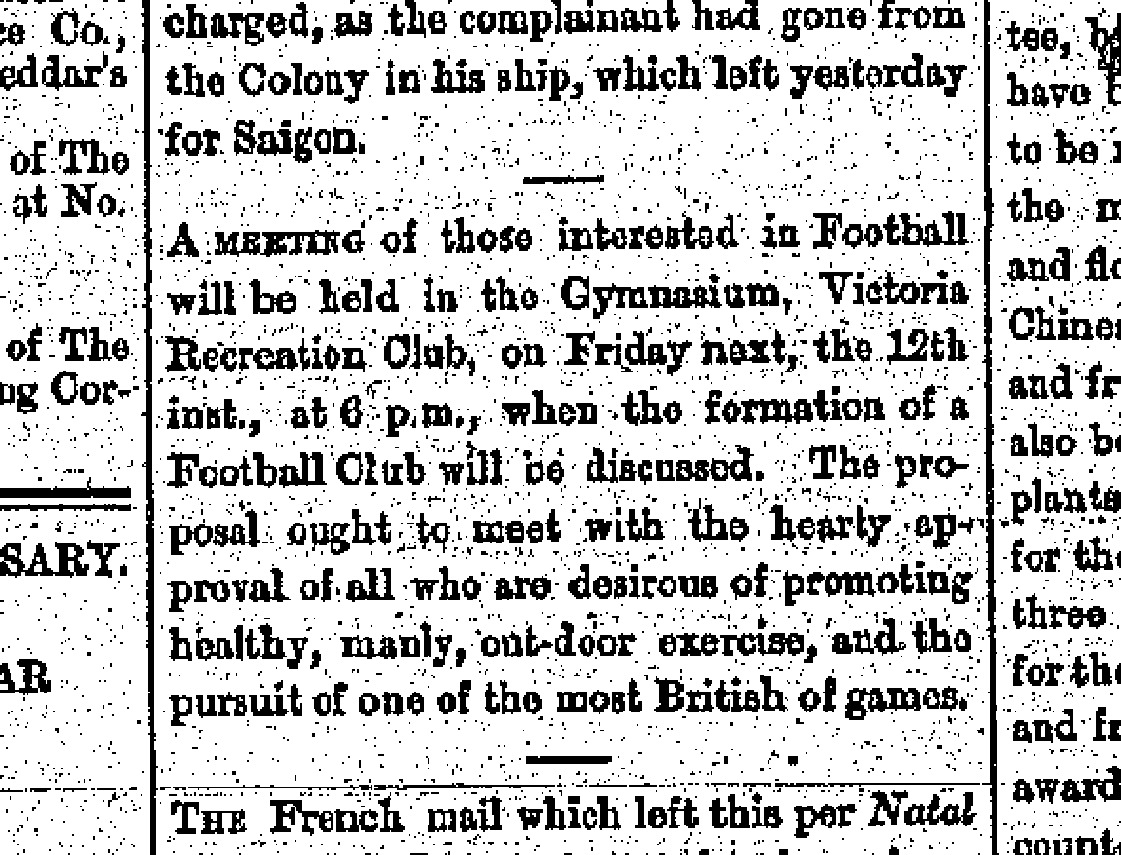
The revival was therefore an argument, not an accident. On 3 February 1886 the Daily Press prints its essay “A Football Match in Hongkong”: “An attempt has [once] more been made after a lapse of many years to introduce into this Colony the great English game of football”, naming Mr. J. H. Stewart-Lockhart, Honorary Secretary of the Victoria Recreation Club, “with his usual enthusiasm for manly sports”. 23 The instrument was a meeting, and the notice for it is the thread’s first plate: “A MEETING of those interested in Football will be held in the Gymnasium, Victoria Recreation Club, on Friday next, the 12th inst., at 6 p.m., when the formation of a Football Club will be discussed. The proposal ought to meet with the hearty approval of all who are desirous of promoting healthy, manly, out-door exercise, and the pursuit of one of the most British of games.” 24
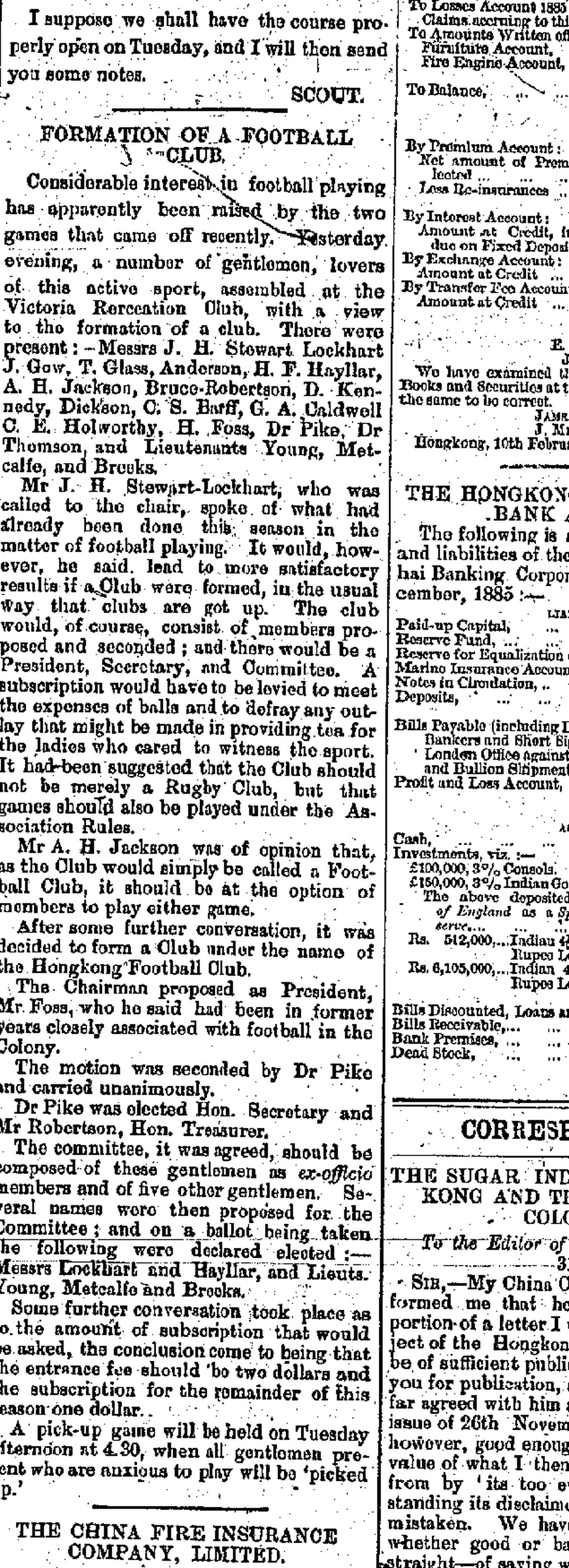
Around twenty men came; the report of 13 February 1886 lists them by name and records the argument that made the club what it was: “It had been suggested that the Club should not be merely a Rugby Club, but that games should also be played under the Association Rules… After some further conversation, it was decided to form a Club under the name of the Hongkong Football Club”; the chairman proposed as President “Mr. Foss, who he said had been in former years closely associated with football in the Colony”; Dr. Pike was elected Hon. Secretary, Mr. Robertson Hon. Treasurer, and the terms were fixed at an entrance fee of two dollars and a subscription of one for the remainder of the season. 25 The first matches of the revived game — “The Rest” against “the Garrison (without Medical Staff)” — were played on the Race Course through February. 22
One caution belongs here, and the record itself supplies it: 26 Through the later 1880s and 1890s the club settles into the colony’s week — the regiments (the A. & S. Highlanders, the Royal Engineers, the Royal Artillery), the Navy, and its own cricket fixtures against the Hongkong C.C.; Association rules dominate its football by 1891. 27 By the end of 1897 a second club exists across the harbour: “a match will be played at the Happy Valley between the Hongkong and Kowloon football clubs… Kick-off at 4.30.” 28
3. Clubs, schools, and the League (1900–1909)
By the 1905–06 season the game has institutions of its own. The schools run a league — “the championship of the Schouls’ [Schools’] League” hangs on a Diocesan School v. Queen’s College match played “on the ground of the Hongkong FC” — and the services have their cup, the “Soldiers’ Football Club Challenge Shield”, opened at the Naval Football ground at Happy Valley by H.M.S. Tamar v. I.M.S. Sutlej. 29
The transfer to Chinese players begins in the classroom. 30 Queen’s College’s report for 1907 records the visits interchanged with the Christian College (Canton) team, and names the departure: nothing in the record shows a Chinese football team leaving the mainland to play abroad before this fixture. 30
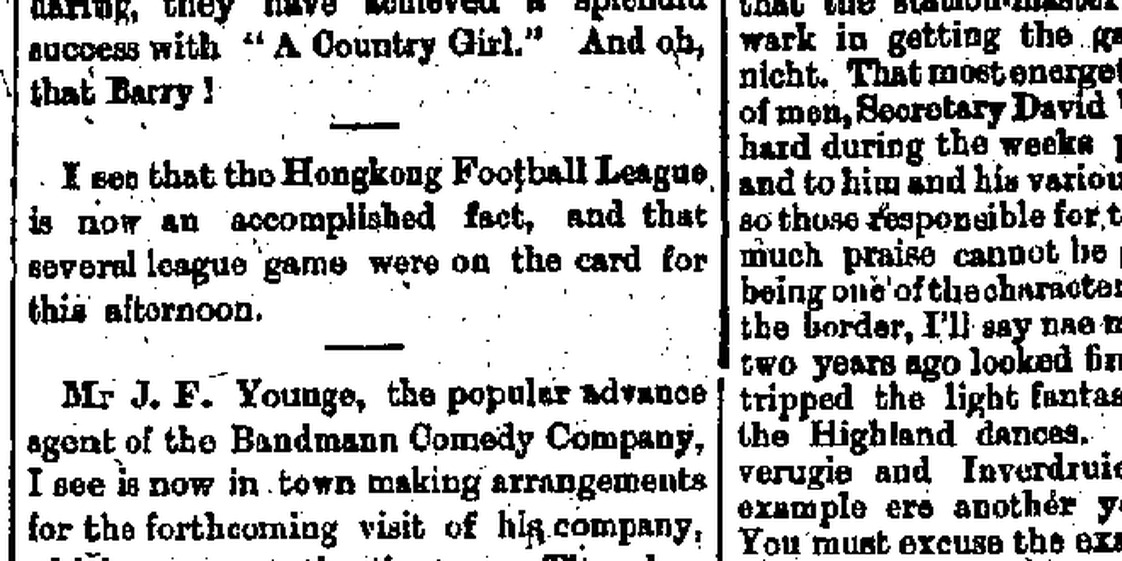
The League followed in December 1908. 31 Its first season was played by the Buffs, the Royal Engineers, the R.A.M.C., the Naval Yard, the Y.M.C.A. and the Lusitano Recreation Club, and its challenge cup was a newspaper’s gift: “At the close of the game the Hongkong Daily Press Cup will be presented to the Buffs who will hold the trophy for a year.” 32 The association that would govern the game was drafted in February 1909 and “formed at once” in March — then re-formed in 1913, with affiliation to the English Football Association: “The work of forming this new Association is proceeding apace.” 33 The modern game dates its governing body to the 1913–14 sequence; the record’s own steps of 1909 and 1913 are as printed above.
4. The Chinese enter the game (1914–1920)
The League’s Division II fixture programme of December 1914 prints the entry: “December 30th — Confucians v St. Joseph College… January 2nd — Lam Liong v Queen’s College…” — Chinese clubs alongside the colleges, the Diocesans, the University and the Portuguese. 34 The fuller name of one of them surfaces in a match report: “A fine rushing game took place between St. Joseph’s College team and the Lam Liong Wan King Club for Second Division honours.” 34 The clubs’ Chinese characters cannot be verified in this record, and the names stay romanized here. 35
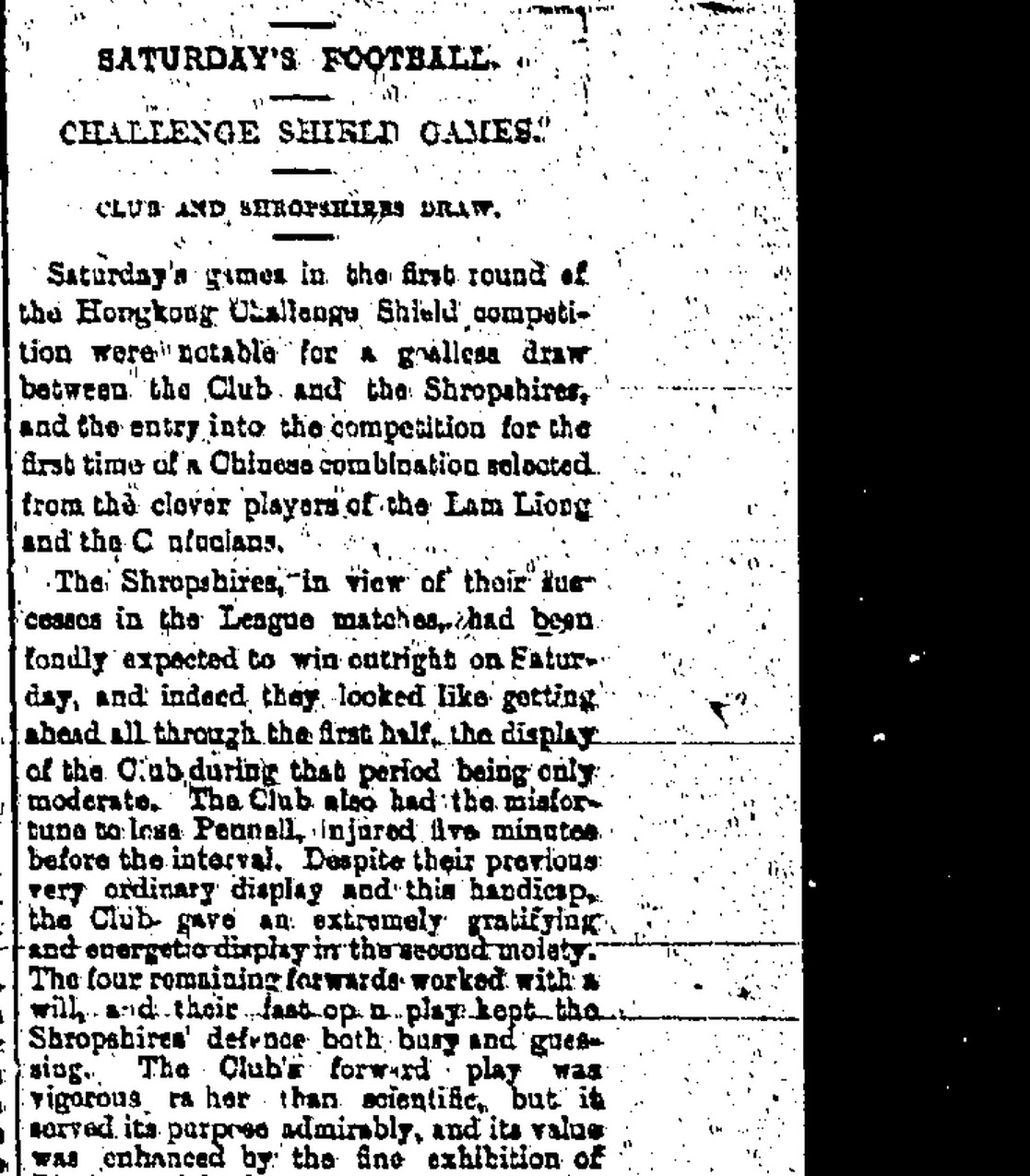
January 1916 is the turning point. In the first round of the Challenge Shield, alongside “a goalless draw between the Club and the Shropshires”, the China Mail notes “the entry into the competition for the first time of a Chinese combination selected from the clever players of the Lam Liong and the Confucians.” 36 The Telegraph’s report gives the scene: “The first matches… took place at Happy Valley on Saturday afternoon, both games being of an interesting and exciting character. Large crowds witnessed the fixtures“; and of the Chinese team, “a corner was eventually forced by the Chinese… the Chinese forwards were in almost brilliant mood.” 37
In September 1916 the lasting club arrived. At the League’s general meeting at Victoria Barracks, “the following clubs were admitted to Division [II]: Lusitano, 88 Coy. R.G.A., Hongkong Police, South China Athletic, 87 Coy. R.G.A. Reserve, Royal Engineers, Islamics and University.” 38 The crowds came at once. Of South China v. the Navy (R.): “A large crowd, mainly Chinese, assembled on the Naval Ground… The Chinese team played very clever football.” Against the Islamics in November: “a tremendous crowd, four or five deep, witnessed this match… Only one goal was scored, Wong Pak Cheung finding the net for the Athletic in the first half.” 38 In January 1918, South China v. St. Joseph’s is “one of the tit-bits of the 2nd Division” before “a very large crowd”. 39 By November 1920 the club is first-division class: a charity match for the North China Famine Fund is billed as “SOUTH CHINA A.A. v THE REST OF THE LEAGUE”, the opposition chosen “from the rest of the first division of the Hongkong football league”. 40 And in October 1921 the Government records the change itself: the move of Queen’s College to Caroline Hill is justified because “the development during the last few years of a taste for field games among the Chinese” requires grounds. 41
5. Osaka, May 1923
In January 1923 the Hongkong Amateur Athletic Federation, “composed of thirteen of the athletic bodies in Hongkong”, was asked by the China Amateur Athletic Union “to develop teams for the Far Eastern Olympiad in swimming, volleyball, football, tennis, baseball and in track and field athletics”, with the best of Canton and Hong Kong to be combined; its campaign raised “$6,000 to cover the [expenses] of 42 athletes”. 42 For the football share, the South China A.A.’s secretary applied to play a benefit match “to provide funds to assist in the expense of sending the South China football team to Osaka to represent China at the Eastern Olympiad”. 43
Through the spring the South China team — Lee Wai-tong at centre — beat the Club and Kowloon before Chinese crowds: “A very large crowd of Chinese witnessed the game”; against the Club, “Lee Wai Tong… into an empty goal amidst cheers from the South China supporters.” 44 The results at Osaka followed in the papers’ Reuter despatches: “China Wins Football. In the preliminary football match China beat the Philippines by three goals to nil”; the Philippines then beat Japan 2–1; and on 24 May, “In the final of the Football, China defeated Japan by 5 to 1.” 45 46
6. The interwar city of clubs (1926–1937)
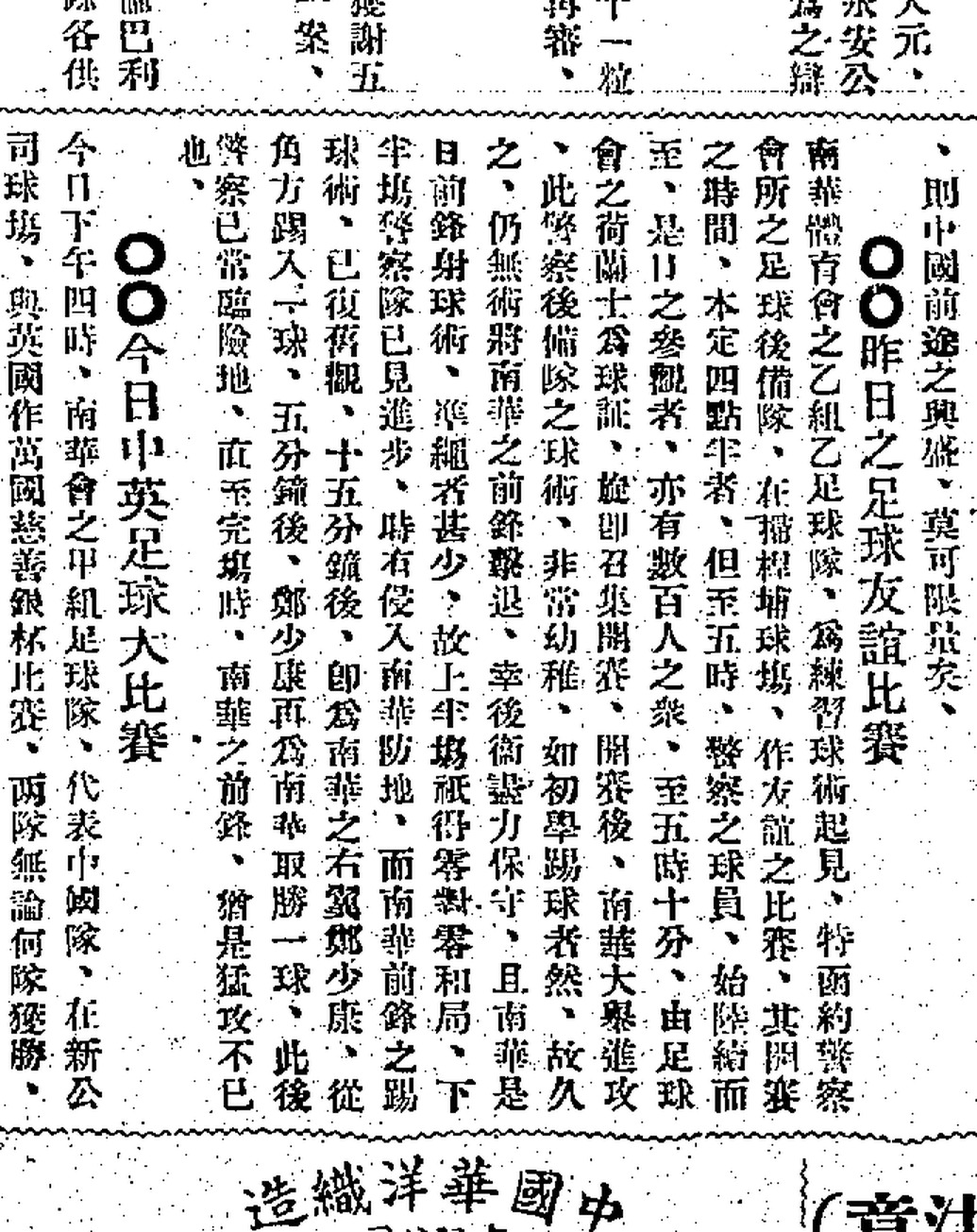
From April 1926 the Chinese-language press carries the game as its own news. The 工商日報 of 2 April prints two items side by side: a friendly in which 南華體育會’s second team beat the Police reserve “before several hundred” spectators at the 掃桿埔 (Sookunpoo) ground, 鄭少康 scoring twice; and, for that afternoon, 南華’s first team — “representing China” — against an English eleven in a charity cup. 47 On New Year’s Day 1927 the Chinese Derby is the holiday fixture: “China Athletic 3, South China 0… played at Sookunpoo before a large attendance.” 48 By 1929 the Chinese clubs have grounds of their own: the mid-week card reads “China Athletic… China Athletic ground… Lam Long Wan v. South China, Caroline Hill ground.” 49 Through the 1930s the interport against Shanghai is a fixture of the calendar (“FIRST INTERPORT SOCCER TRIAL ON CLUB GROUND TO-DAY”, January 1934), and the senior league’s tables carry Chinese, British and Portuguese clubs together. 50
7. The edge of the record (1941)
In July 1941 the South China A.A. tours Malaya; against Negri Sembilan the team draws 4–4, and the scorers are “Lee Wai-tong (3) and Chan Tak-fai” — the man of Osaka still scoring eighteen years on. 51 In September 1941 the papers are printing the new season’s prospects — “WE ARE GOING TO UPSET A GOOD MANY TEAMS”, says Police F.C.’s sergeant-manager. 52 Then the record stops. This corpus’s press holds no October, November or December 1941; the season the colony was about to play, and everything after it, lies beyond the archive’s edge. That edge is part of the finding: the story this paper can tell runs from a notice that gave way to horse auctions to a team that beat Japan 5–1 — and no further.
Appendix A — Sources and query log
Whole-document pulls (compulsory). Daily Press, 13 February 1886 (8 pp., 9,719 lines — the founding reports in whole-issue context); China Mail, 24 January 1916 (22 pp., 14,420 lines — the Shield first round in context); Daily Press, 25 May 1923 (36 pp., 22,712 lines — the Osaka results in context).
Query log (selected; all read-only against the hkintexts cluster). “football” by decade of press keys: 32 (1864–69), 44 (1870s), 606 (1880s), 3,362 (1890s), 5,343 (1900s), 6,429 (1910s), 13,656 (1920s), 23,032 (1930s), 3,973 (1940–41). “Football Club” per year: 0 across 1876–80; 4 (1881), 1 (1882), 0 (1883), 1 (1884); 19 (1886), 24 (1887), 37 (1888), 46 (1889), 53 (1890), 90 (1891); 96 (1895), 132 (1896), 231 (1899). “Hongkong Football League” earliest 3 December 1908. “Confucians” and “Lam Liong” first with the 1914–15 fixtures (“Confucians” 42 hits in 1915, “Lam Liong” 57). “South China Athletic” per year from 15 (1916) to 162 (1927). “Lee Wai Tong” earliest 12 March 1923. The image series (chinamail 1866–1919; ksyp 1926–84; gazette 1842–1941) supplied the plate twins; the 1909 gazette leaf returned an empty image path and is recorded as PENDING in the thread’s image manifest.
Exclusions. “Football League” items of 20 April 1894 and 19 May 1897, read whole and excluded as English-League reprints; “Chinese Football Club” hits of 1924/1933/1936 read and excluded as the Straits (Singapore) club; “totalisator” and racing materials parked for the racing thread. The full register — confirmed, single-witness, conflicts, failed verifications, gaps, and the adversarial pass — is in the research notes deposited with this paper.
Appendix B — Plates and the image gate
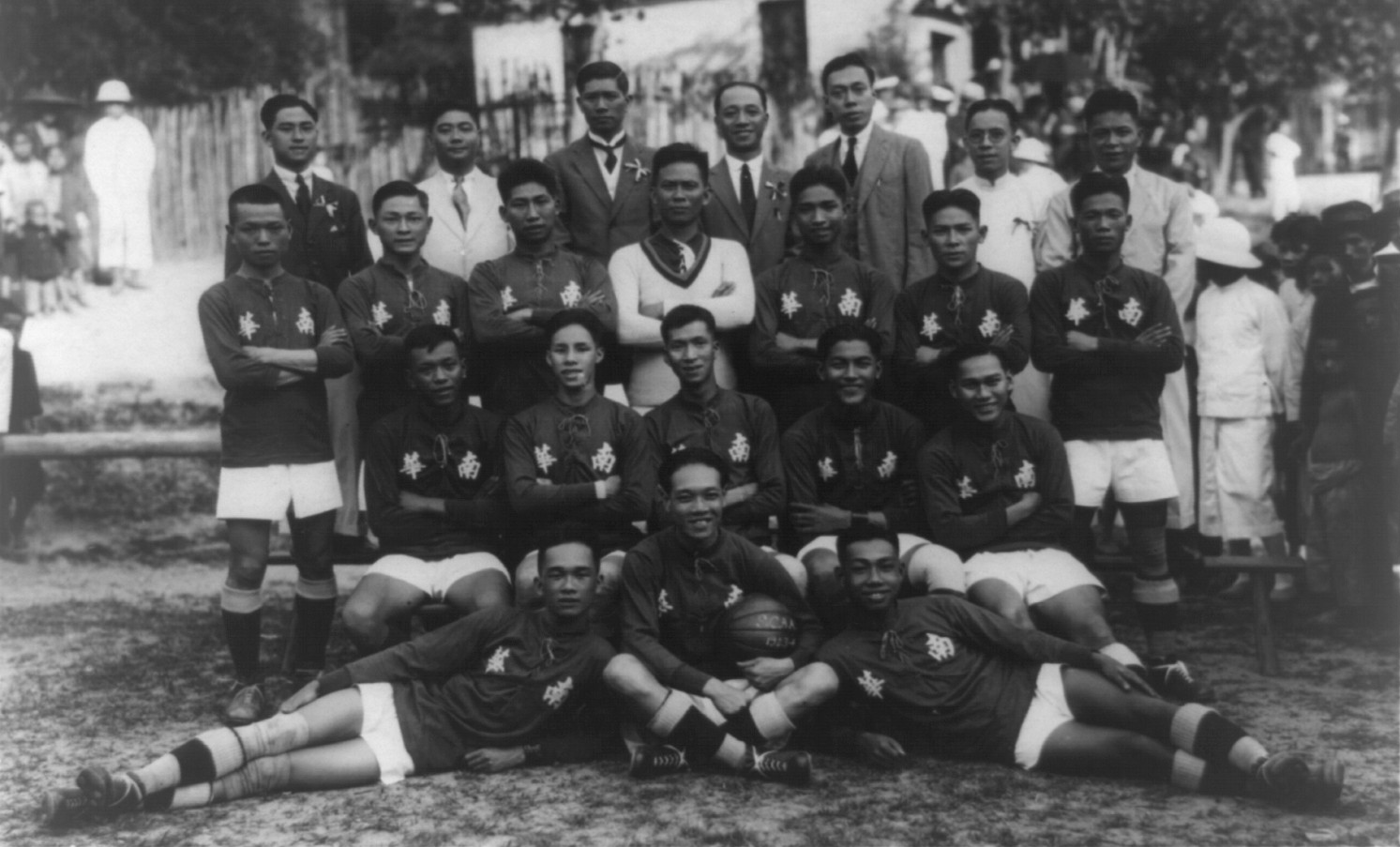
Five document plates and one photograph carry this paper. Plates 1–5 (the meeting notice; the founding report; the League; the Chinese Shield entry; the Chinese press page) were read back at their final crops before publication, per the workspace’s image gate; each caption carries its public viewer link and access date. The photograph (Fig. 1, below) is a 1923–24 team portrait by the Ming Yuan studio, in which the players’ jerseys carry the 南華 characters — the season after the Osaka championship; it serves as the Facebook post’s single attachment. 53 Not plated, and recorded so: the Osaka results of May 1923 (no scan twin exists — the China Mail scans end in 1919 and the Daily Press has no scan series); the 1864–70s Daily Press items (same reason); the 1909 gazette leaf (image path gated at access).
Notes
Daily Press 孖剌西報, 26 November 1864, p. 1 — the standing notice “HONGKONG FOOTBALL CLUB”: “To prevent mistakes, for the future the Ball and Flags will be in readiness at the Parade Ground every Wednesday, at 5 p.m. till further notice. In the event of Horse Auctions on Parade, &c. taking place the same evening, the game will be held the following day.” The notice runs in ten issues, 14 November – 3 December 1864 (first issue: https://hkintexts.histsyn.com/page/2218721). https://hkintexts.histsyn.com/page/2218766 (accessed 4 November 2026). No scan series exists for the Daily Press — OCR-based, reconstructed where bracketed. ↩
Daily Press, 3 February 1886, p. 2 — the essay “A Football Match in Hongkong”: “An attempt has [once] more been made after a lapse of many years to introduce into this Colony the great English game of football. Mr. J. H. Stewart-Lockhart, the Honorary Secretary of the Victoria Recreation Club, with his usual enthusiasm for manly sports, has been working …” (OCR reconstruction, bracketed words supplied; no DP scans exist.) https://hkintexts.histsyn.com/page/2200320 (accessed 4 November 2026). ↩
The founding report, China Mail, 13 February 1886, p. 3, column headed “FORMATION OF A FOOTBALL CLUB”: “Considerable interest in football playing has apparently been missed by the two games that came off recently. Yesterday evening, a number of gentlemen, lovers of this active sport, assembled at the Victoria Recreation Club, with a view to the formation of a club. There were present: — Messrs. J. H. Stewart-Lockhart, J. Gov., T. Glass, Anderson, H. F. Hayllar, A. H. Jackson, Bruce-Robertson, D. Kennedy, Dickson, O. S. Burff, G. A. Caldwell, C. E. Holworthy, H. Foss, Dr. Pike, Dr. Thomson, and Lieutenants Young, Metcalfe and Brooks.” The report continues: “It had been suggested that the Club should not be merely a Rugby Club, but that games should also be played under the Association Rules… After some further conversation, it was decided to form a Club under the name of the Hongkong Football Club. The Chairman proposed as President, Mr. Foss, who he said had been in former years closely associated with football in the Colony… Dr. Pike was elected Hon. Secretary and Mr. Robertson, Hon. Treasurer… the entrance fee should be two dollars and the subscription for the remainder of this season one dollar. A ‘pick-up’ game will be held on Tuesday afternoon at 4.30…” The scan settles two OCR defects: the meeting date (12 February; see the notice) and the president’s name (Mr. Foss, not the OCR’s “Mr Foms”). Scan, plate 2: https://hkintexts.histsyn.com/image-page/1199473. The Daily Press of the same day carries a second report: https://hkintexts.histsyn.com/page/2200352 (accessed 4–5 November 2026). ↩
China Mail, 5 December 1908, p. 5, “Rambling Notes”: “I see that the Hongkong Football League is now an accomplished fact, and that several league game[s] were on the card for this afternoon.” Scan, plate 3: https://hkintexts.histsyn.com/image-page/1332099. The first season’s teams appear in the fixture lists of the same month: Daily Press, 5 December 1908, p. 5 (R.E. v. the Buffs; Y.M.C.A. v. Naval Yard); Daily Press, 12 December 1908, p. 3, https://hkintexts.histsyn.com/page/2256010; Hongkong Telegraph, 3 December 1908, p. 7, /page/2861867 (accessed 4–5 November 2026). ↩
The association: Daily Press, 6 February 1909, p. 3 — “The proposed rules for the guidance of the newly-formed Hongkong Football Association have been drafted, and forwarded by the secretary, Mr. Alex. P. Storrie, to the secretaries of the various football clubs in the Colony”, https://hkintexts.histsyn.com/page/2256383; 3 March 1909, p. 3 — “The Hongkong Football Association is to be formed at once. The Secretary will send copies of rules to all Football teams in the Colony… YMCA, Buffs, R.G.A., R.E., H.M.S. King Alfred, Lusitano, Boys Own Club and League Committee have promised their support”, /page/2256554; the re-formation: Hongkong Telegraph, 14 August 1913, p. 12 — “Work of forming the Hongkong Football Association. The work of forming this new Association is proceeding apace”, with affiliation to the English Football Association, /page/2875547 (accessed 4 November 2026). ↩
Queen’s College’s annual report for 1907, printed January 1908: “Visits interchanged between the Q.C. and Christian (Canton) Football Team [is] a distinctly new departure, as there is no precedent on record of a Chinese football team leaving the mainland to play upon foreign shores. Q.C. was too strong for them, but it is hoped that better matches may take place in the future.” Daily Press, 22 January 1908, p. 3, https://hkintexts.histsyn.com/page/2253749; Hongkong Telegraph, 22 January 1908, p. 5, /page/2859457; China Mail, 22 January 1908, p. 3, /page/1929153 (accessed 4 November 2026). ↩
The League’s Division II fixture programme, Daily Press, 21 December 1914, p. 5 — “December 30th — Confucians v St. Joseph College… January 2nd — Lam Liong v Queen’s College…”, https://hkintexts.histsyn.com/page/2272487; Hongkong Telegraph, 21 December 1914, p. 5, /page/2880177. The club’s fuller name: Hongkong Telegraph, 28 December 1914, p. 8 — “A fine rushing game took place between St. Joseph’s College team and the Lam Liong Wan King Club for Second Division honours.” /page/2880229 (accessed 4 November 2026). ↩
China Mail, 24 January 1916, p. 4, “Saturday’s Football”: “Saturday’s games in the first round of the Hongkong Challenge Shield competition were notable for a goalless draw between the Club and the Shropshires, and the entry into the competition for the first time of a Chinese combination selected from the clever players of the Lam Liong and the Confucians.” Scan, plate 4: https://hkintexts.histsyn.com/image-page/1723693 (accessed 5 November 2026). ↩
China Mail, 30 September 1916, p. 4 — “A general meeting of the Hongkong Association Football League was held at Victoria Barracks last evening… and the following clubs were admitted to Division [II]: Lusitano, 88 Coy. R.G.A., Hongkong Police, South China Athletic, 87 Coy. R.G.A. Reserve, Royal Engineers, Islamics and University.” https://hkintexts.histsyn.com/page/1951657. First-season crowds: Daily Press, 30 October 1916, p. 3 — “SOUTH CHINA ATHLETIC v. NAVY (R.). A large crowd, mainly Chinese, assembled on the Naval Ground to witness this match… The Chinese team played very clever football”, /page/2278197; 20 November 1916, p. 3 — “a tremendous crowd, four or five deep, witnessed this match… Only one goal was scored, Wong Pak Cheung finding the net for the Athletic in the first half”, /page/2278357; 28 October 1916, p. 2 (fixture: “2ND DIVISION HONGKONG LEAGUE… South China Athletic v Navy”), /page/2278186 (accessed 4 November 2026). ↩
The Osaka football, May 1923: Hongkong Telegraph, 23 May 1923, p. 14 — “China Wins Football. In the preliminary football match China beat the Philippines by three goals to nil. Three Filipinos were seriously injured. Cui broke a leg and Manzano and Hernaez sustained broken ribs.” https://hkintexts.histsyn.com/page/2907930; China Mail, 24 May 1923, p. 11 — “In the preliminary Association Football match the Philippines beat Japan by 2 to 1”, /page/1971745; Daily Press, 25 May 1923, p. 6 — “OSAKA, May 24th. In the final of the Football, China defeated Japan by 5 to 1.”, /page/2298324; China Mail, 25 May 1923, p. 11, /page/1971757 (accessed 4 November 2026). ↩
Research note. The battery ran on the hkintexts corpus (read-only) in six families: the word (“football” by decade of press keys: 32 / 44 / 606 / 3,362 / 5,343 / 6,429 / 13,656 / 23,032 / 3,973 for 1864–69 … 1940–41); the club (“Football Club” 0 across 1876–80, 4 in 1881, then 19 / 24 / 37 / 46 / 53 / 90 for 1886–91); the league (“Hongkong Football League” earliest 3 December 1908; “Football League” earliest 20 April 1894 — read and excluded as the English League reprinted); the Chinese entry (“Confucians” and “Lam Liong” first with the 1914–15 fixtures; “South China Athletic” from September 1916); the person (“Lee Wai Tong” earliest 12 March 1923; 李惠堂 in the Chinese strata from 1926/1947); and the image series for scan twins (chinamail 1866–1919; ksyp 1926–84). Three compulsory whole-document pulls anchor the thread: the Daily Press of 13 February 1886 (8 pp.), the China Mail of 24 January 1916 (22 pp.), and the Daily Press of 25 May 1923 (36 pp.). Access 4–5 November 2026. ↩
The local/syndicated discrimination (the thread’s central method note). By the 1890s the overwhelming majority of “football” hits in this corpus are reproductions of British football news — the English League, the FA Cup, Scottish results; e.g. the “Football League” item of 20 April 1894 read whole is an interview about the English League, and the 19 May 1897 item is an Everton profile. Every item cited in this paper was read for a local marker (a Hongkong/Kowloon ground, club, team or player) before use; the exclusions are documented in the thread’s notes (adversarial item A4). ↩
South China Athletic Association 南華體育會: the modern account dates the club to 1910; this corpus’s first attestation is its admission to the League’s Second Division in September 1916, and the 1910 telegram “South China football champions” from the Nanking games (25 October 1910) is not connected by any document to the club. Both dates are stated; neither is merged. https://hkintexts.histsyn.com/page/2260888 (accessed 4 November 2026). ↩
Daily Press, 26 November 1864, p. 1 (the standing notice; see the full note). https://hkintexts.histsyn.com/page/2218766 (accessed 4 November 2026). ↩
The game’s kit on the colony’s counters: Lane, Crawford & Co. advertising “GOLD LEATHER FOOTBALL” among the sports goods, Daily Press, 9 January 1865, p. 1, https://hkintexts.histsyn.com/page/2218911; “Rugby FOOTBALL” in the China Mail’s goods list, 4 September 1869, p. 1, /page/1887514 (accessed 4 November 2026). ↩
“Drop kick with football — Prize $10”, among the garrison athletic sports: Daily Press, 11 March 1872, p. 2. https://hkintexts.histsyn.com/page/2227666 (accessed 4 November 2026). ↩
Daily Press, 25 January 1873, p. 2 — “Yesterday, the 24th inst., a select twenty of Hongkong civilians met fifteen of the Navy in a friendly contest at football.” (OCR reconstruction; words bracketed elsewhere in this thread’s notes.) https://hkintexts.histsyn.com/page/2228124 (accessed 4 November 2026). ↩
Daily Press, 5 February 1873, p. 2 — the leader referring to “the decline of football in Hongkong”. https://hkintexts.histsyn.com/page/2228156 (accessed 4 November 2026). ↩
The lull, documented: “Football Club” appears in none of the 1876–1880 press; six times across 1881–85 (four in 1881, one each in 1882 and 1884); the phrase “the decline of football in Hongkong” dates from 5 February 1873, and the 1886 revival essay itself speaks of a “lapse of many years”. The game survived between the clubs as scattered service and Naval matches (the 1885 Shanghai fixtures), but the club game lapsed. https://hkintexts.histsyn.com/page/2228156; /page/2200320 (accessed 4 November 2026). ↩
China Mail 德臣西報, 21 January 1881, p. 3 — “An effort is being put forth to organise a Football Club amongst those of the residents who are young and nimble enough to participate in that invigorating pastime.” https://hkintexts.histsyn.com/page/1894136 (accessed 4 November 2026). ↩
China Mail, 10 December 1881, p. 3 — “it is proposed to establish the existing football club upon [a] further permanent basis. The recent game which took place between the Navy and the …” https://hkintexts.histsyn.com/page/1895295 (accessed 4 November 2026). ↩
The revived game’s first matches, February 1886: Daily Press, 6 February 1886, p. 2 (the team “The Rest” v. the Garrison), https://hkintexts.histsyn.com/page/2200328; 8 February 1886, p. 2, https://hkintexts.histsyn.com/page/2200332; the result, China Mail, 9 February 1886, p. 3, https://hkintexts.histsyn.com/page/1899191 (accessed 4 November 2026). ↩
Daily Press, 3 February 1886, p. 2 (see the full note). https://hkintexts.histsyn.com/page/2200320 (accessed 4 November 2026). ↩
China Mail, 10 February 1886 — the meeting notice: “A MEETING of those interested in Football will be held in the Gymnasium, Victoria Recreation Club, on Friday next, the 12th inst., at 6 p.m., when the formation of a Football Club will be discussed. The proposal ought to meet with the hearty approval of all who are desirous of promoting healthy, manly, out-door exercise, and the pursuit of one of the most British of games.” The date reads the 12th on the scan (the text-series OCR misreads “13th”). Scan, plate 1: https://hkintexts.histsyn.com/image-page/1199462 (accessed 5 November 2026). ↩
China Mail, 13 February 1886, p. 3 (the founding report; see the full note). Scan: https://hkintexts.histsyn.com/image-page/1199473 (accessed 5 November 2026). ↩
Do not read the 1886 club as the colony’s first: the record’s first club is the 1864 “Hongkong Football Club” of the Parade Ground (this paper, section 2). No document connects the two clubs of the same name; the 1886 essay’s own “after a lapse of many years” is the record’s account of the gap, and this paper asserts neither continuity nor re-foundation. ↩
The club’s 1890s round, all read for this paper: Hongkong Telegraph 港電新報, 13 November 1890, p. 2 (cricket v. the Hongkong C.C.), https://hkintexts.histsyn.com/page/2829604; Daily Press, 8 January 1891, p. 3 (v. a company of the regiment under Association rules), /page/2206683; p. 6 (v. the A. & S. Highlanders, 2 January), /page/2206686; 15 January 1891, p. 6 (v. a combined R.A. and R.E. team), /page/2206712 (accessed 4 November 2026). ↩
China Mail, 27 December 1897, p. 3 — “a match will be played at the Happy Valley between the Hongkong and Kowloon football clubs… Kick-off at 4.30”, with the Kowloon team listed position by position. https://hkintexts.histsyn.com/page/1914900 (accessed 4 November 2026). ↩
The Schools’ League: Daily Press, 13 January 1906, p. 5 — “The result of the match between the Diocesan School and Queen’s College will probably decide the championship of the Schouls’ [Schools’] League. The game will be played on the ground of the Hongkong FC, at 3 p.m. to-day.” https://hkintexts.histsyn.com/page/2248655; the services’ cup: Hongkong Telegraph, 5 January 1906, p. 4 — “Soldiers’ Football Club Challenge Shield… the first match in the Competition was held on the Naval Football ground at Happy Valley yesterday afternoon, between H.M.S. Tamar and I.M.S. Sutlej… resulted in a draw.” https://hkintexts.histsyn.com/page/2854395 (accessed 4 November 2026). ↩
Queen’s College report, January 1908 (see the full note). https://hkintexts.histsyn.com/page/2253749 (accessed 4 November 2026). ↩
China Mail, 5 December 1908, p. 5 (see the full note). Scan: https://hkintexts.histsyn.com/image-page/1332099 (accessed 5 November 2026). ↩
Daily Press, 17 April 1909, p. 2 — “The last match of the present season in connection with the Hongkong Football League takes place on Wednesday next at the Happy Valley when the Buffs play the Royal Engineers. At the close of the game the Hongkong Daily Press Cup will be presented to the Buffs who will hold the trophy for a year.” https://hkintexts.histsyn.com/page/2256865 (accessed 4 November 2026). ↩
Daily Press, 6 February and 3 March 1909 (see the full note). (accessed 4 November 2026). ↩
Daily Press, 21 December 1914, p. 5; Hongkong Telegraph, 28 December 1914, p. 8 (see the full note). (accessed 4 November 2026). ↩
The Chinese clubs’ names in English only. “Lam Liong” (also printed “Lam Liong Wan King Club”, “Lam Liung”, “Lam Long Wan”), “Confucians” and “Hung Kui School” have no verifiable Chinese pairing in the corpus (the pre-1926 Chinese stratum does not exist in this record); the battery’s failures are recorded in the thread’s notes (Appendix B) and the names stay romanized. ↩
China Mail, 24 January 1916, p. 4 (see the full note). Scan: https://hkintexts.histsyn.com/image-page/1723693 (accessed 5 November 2026). ↩
Hongkong Telegraph, 24 January 1916, p. 5 — “The first matches in connection with the Hongkong Shield competition took place at Happy Valley on Saturday afternoon, both games being of an interesting and exciting character. Large crowds witnessed the fixtures…” and on the Chinese team: “a corner was eventually forced by the Chinese… the Chinese centre-forward broke through and looked like scoring… the Chinese forwards were in almost brilliant mood.” https://hkintexts.histsyn.com/page/2884297. The draw and previews: China Mail, 20 January 1916, p. 4, /page/1949951; Daily Press, 22 January 1916, p. 3 (“MILITARY V. CHINESE”), /page/2275792 (accessed 4 November 2026). ↩
China Mail, 30 September 1916, p. 4; Daily Press, October–November 1916 (see the full note). (accessed 4 November 2026). ↩
Daily Press, 7 January 1918, p. 3 — “SOUTH CHINA ATHLETIC, 1; ST JOSEPH’S COLLEGE, 0… A very large crowd assembled to see this game, which was considered to be one of the tit-bits of the 2nd Division” (the division reads II on the Telegraph’s report of the same match; the DP’s header prints “DIVISION (1)” — registered as a conflict and read as Div. II). Hongkong Telegraph, 7 January 1918, p. 8, https://hkintexts.histsyn.com/page/2889244; Daily Press, /page/2281616 (accessed 4 November 2026). ↩
China Mail, 8 November 1920, pp. 3–4 — “FOOTBALL. GRAND CHARITY MATCH in aid of the NORTH CHINA FAMINE FUND… SOUTH CHINA A.A. v THE REST OF THE LEAGUE. TO-DAY, at 4 p.m. Mr. R. J. Wilton, President of Football League, will kick off…”; p. 4 — “the South China Athletics will meet a team chosen from the rest of the first division of the Hongkong football league.” https://hkintexts.histsyn.com/page/1963054; /page/1963055 (accessed 4 November 2026). ↩
Legislative Council Hansard, 27 October 1921, p. 1 — the Estimates debate: “the development during the last few years of a taste for field games among the Chinese has rendered it essential that any site to which the principal Government School is to be transferred shall not only be easily accessible, but shall have ample grounds for recreation of every kind.” https://hkintexts.histsyn.com/page/1882176 (accessed 4 November 2026). ↩
Preparations for the Far Eastern Olympiad: Daily Press, 17 January 1923, p. 2 — “HONGKONG AMATEUR ATHLETIC FEDERATION. PREPARING FOR THE FAR EASTERN OLYMPIAD. This organization, composed of thirteen of the athletic bodies in Hongkong, has been asked by the China Amateur Athletic Union to develop teams for the Far Eastern Olympiad in swimming, volleyball, football, tennis, baseball and in track and field athletics… the best athletes from Canton and Hongkong will be made into teams”, https://hkintexts.histsyn.com/page/2297037; China Mail, 18 January 1923, p. 4 — “the Hongkong Amateur Athletic Federation commenced its campaign to raise $6,000 to cover the [expenses] of 42 athletes who will be going from Hongkong to compete at the Far Eastern Olympiad at Osaka”, /page/1970497; Hongkong Telegraph, 2 March 1923, p. 2 — “South China Planning Big Things”, /page/2907079 (accessed 4 November 2026). ↩
China Mail, 24 March 1923, p. 9 — “The Secretary of the South China A.A. applied for permission to play a match to provide funds to assist in the expense of sending the South China football team to Osaka to represent China at the Eastern Olympiad.” https://hkintexts.histsyn.com/page/1971139 (accessed 4 November 2026). ↩
Daily Press, 30 April 1923, p. 2 — South China v. the Club: “Lee Wai Tong… into an empty goal amidst cheers from the South China supporters… winners of a fast and clean game by two clear goals”, https://hkintexts.histsyn.com/page/2298056; 7 May 1923, p. 5 — “SOUTH CHINA, 2: KOWLOON, 0… A very large crowd of Chinese witnessed the game”, /page/2298131 (accessed 4 November 2026). ↩
Hongkong Telegraph, 23 May 1923, p. 14; Daily Press, 25 May 1923, p. 6 (see the full note). (accessed 4 November 2026). ↩
The three football results of the Osaka tournament, each from its own report: China 3–0 Philippines (Telegraph, 23 May); Philippines 2–1 Japan (China Mail, 24 May); China 5–1 Japan (Daily Press, China Mail, 25 May). The Reuters points table printed beside them is OCR-corrupt and is not quoted. ↩
工商日報 (Kung Sheung Daily Press), 2 April 1926, p. 11 — the Chinese press’s football column: 「○○昨日之足球友誼比賽」: 南華體育會之乙組乙足球隊,爲練習球術起見,特函約警察會所之足球後備隊,在掃桿埔球場,作友誼之比賽…是日之參觀者,亦有數百人之衆…南華之右翼鄭少康,從角方踢入一球。五分鐘後,鄭少康再爲南華取勝一球; and 「○○今日中英足球大比賽」: 今日下午四時,南華會之甲組足球隊,代表中國隊,在新公司球場,與英國作萬國慈善銀杯比賽. Scan, plate 5: https://hkintexts.histsyn.com/image-page/213613 (accessed 5 November 2026). This is the earliest football page of the Chinese stratum (工商日報 images begin 1926). ↩
“NEW YEAR DAY FOOTBALL… CHINESE DERBY… Division I: China Athletic 3, South China 0… The former game was played at Sookunpoo before a large attendance”, Daily Press, 4 January 1927, p. 9, https://hkintexts.histsyn.com/page/2311594; the fixture, Daily Press, 1 January 1927, p. 8, /page/2311581; the companion report, Hongkong Telegraph, 3 January 1927, p. 9, /page/2923023 (accessed 4 November 2026). ↩
China Mail, 9 January 1929, p. 9 — the mid-week fixtures: “P.W.D. Chinese v. China Athletic, China Athletic ground… Hong Kong Police v Hung Kui School, St. Joseph’s ground… Lam Long Wan v. South China, Caroline Hill ground.” https://hkintexts.histsyn.com/page/1993581 (accessed 4 November 2026). ↩
China Mail, 3 January 1934, p. 4 — “FIRST INTERPORT SOCCER TRIAL ON CLUB GROUND TO-DAY”; the senior league’s Chinese, British and Portuguese clubs together in the tables and results, China Mail, 2 January 1934, p. 5, https://hkintexts.histsyn.com/page/2013196; /page/2013207 (accessed 4 November 2026). ↩
Hongkong Telegraph, 3 July 1941, p. 4 — “S.C.A.A. Draw 4-4. The South China Athletic Association touring Football team shared eight goals with the Negri Sembilan State eleven yesterday at Seremban. Lee Wai-tong (3) and Chan Tak-fai scored for South China.” https://hkintexts.histsyn.com/page/3016871; China Mail, 3 July 1941, p. 14, /page/2070377 (accessed 4 November 2026). ↩
China Mail, 1 September 1941, p. 14 — “‘WE ARE GOING TO UPSET A GOOD MANY TEAMS’ — POLICE F.C.… WE HAVE NO NEW PLAYERS IN THE SENIOR TEAM, BUT ALL THE OLD BRIGADE ARE AVAILABLE…” https://hkintexts.histsyn.com/page/2073048. The corpus’s press stratum holds no October–December 1941 documents (checked by month count: Oct 2, Nov 1, Dec 0 non-press leaves). (accessed 4 November 2026). ↩
Plates: the five document plates are scans of the cited leaves, read back at their final crops before publication (the §6B gate); captions carry the public viewer link and access date. The 1923–24 team photograph (Ming Yuan) is the post’s single attachment and Fig. 1 of this paper. ↩
Bibliography
- CO 129/… — not used in this thread; the colony’s own print carries the argument.
- Legislative Council Hansard, 27 October 1921. https://hkintexts.histsyn.com/page/1882176 (accessed 4 November 2026).
- Government Gazette, 24 December 1909, G.N. 815 (Wong-Nei-Chong Recreation Ground schedule of allotments). https://hkintexts.histsyn.com/page/1573396 (accessed 4 November 2026).
- Daily Press 孖剌西報 (1864–1941); China Mail 德臣西報 (1866–1941); Hongkong Telegraph 士蔑新聞 (1880–1941); 工商日報 (1926–), image series. Individual items are cited in the notes above.