The Floating City — Hong Kong's boat population in the colony's own record, 1849–1941
浮城:香港的水上人口與殖民地自己的記錄(1849–1941)
摘要
香港的人口統計從一開始就把船民單列一類。1849年的人口普查已有「Chinese Boat Population, Victoria Harbour」與「Chinese Boat Population other than Victoria」兩行,表頭設 Houses 與 Boats 兩欄12;1851、1852年的回報沿用這兩行34。到1860年12月31日的普查,船民第一次有乾淨的數字:維多利亞港內17,417人(2,331艘船)、港外11,142人(1,594艘船),合計28,559人住3,925艘船5。此後這條數列走過1871年的23,709人(較1860年下降4,850人,記錄無解,本研究照錄不作解釋6)、1881年的28,989人、1891年的32,035人、1906年的42,744人,至1911年的53,983人789。
這條數列背後,是殖民地政府對一個問題的三種答法:如何數、如何分、如何管。數——普查把船當住所,與房屋同表並列;分——1890年代的每月死亡表把每個地區的人口估計劈成「Land. Boat.」兩欄,陸上與船上分別計算10;管——1874年颱風之後,華商兩度具稟請求保護船民,總督裁定避風塘「at the cost of the public」(由公帑興建),銅鑼灣避風塘於1880年動工,造價約16,000英鎊1112。醫務官自己的算術則記錄了船上的死亡:1898年呼吸道疾病死亡率船8.2‰、陸4.6‰,其中56%死於肺結核,「intimately associated with overcrowding」(與擁擠密切相關)13。
本研究追隨這一類別,從1849年的第一次出現到戰前最後一批藍皮書。凡語料庫不能證實者(1861年普查的船民數字、1871年船型表的分項計數、1921與1931年人口普查報告本身),本研究均據實說明,不作推測。
一、問題與史料
本研究只問一個問題:殖民地自己的表格,怎樣數、分類、管理住在船上的人?它們說了甚麼?這是一個統計與類別的題目。船民在記錄裏先後以三種身分出現:普查類別(「Boat population in Victoria」/「other than Victoria」)、死亡地區(Land/Boat 兩欄的分區表),以及年度概算裏的一行(「Population afloat」)14。
史料分四層:藍皮書(1849至1940年間52年有「boat population」一字14)、憲報印行的普查與死亡回報、CO 129 檔案(1849至1852年普查隨包令總督函件送出,純文字、無掃描對本),以及行政報告(重印普查表並附總督敘述)。中文記錄(就本語料庫而言)自1926年的《工商日報》圖像系列始:艇戶737、蛋家403、水上人496、避風塘4,08315。
一條方法上的警告:圖像索引的標題頁碼不是印刷頁碼,且逐年不同(1861年標題22印24、1871年標題198印196、1881年標題436印437、1890年標題428印431、1891年標題738印747、1911年標題252印246)14。本線所有承重數字均由本會話親眼讀自掃描頁,引用一律用印刷頁碼。
二、人口普查裏的船戶(1849–1871)
1849年12月31日的普查已有船民兩行,表頭設 Houses 與 Boats 欄12;1851與1852年的回報重現這兩行,1852年表上另加「Total No. of Boats」34。這些早期回報的數字在文字索引裏嚴重錯行,本研究只斷言行名,不斷行內數字。
1860年12月31日的普查(1861年2月9日憲報印出,印刷第24頁)給出第一組乾淨數字:港內17,417人、2,331艘船;港外11,142人、1,594艘船;全殖民地的住所欄為4,861間屋與3,925艘船。同一頁的第二張表(第2號,按性別分類)把同一批人口放在一行裏——「Boat Population in the Harbour and Bays of Hongkong, 19,558 males + 9,001 females」——19,558加9,001同為28,559:同一張葉子上,同一個人口的兩種分類5。
1871年4月2日的普查:港內12,309人、港外11,400人,合計23,709人,全殖民地124,198人6。與1860年相比,船民少了4,850人——1860年代這一次下降,記錄沒有給出解釋,本研究照錄6。同一次普查還有一張船型表,是國家自己對港內小船的分類學:Trading Junks(貿易帆船)、Passage Boats(渡船)、Cargo Boats(貨船)、Fishing Boats(漁船)、Stone Boats(石船)、Hakow Boats、Sampans(舢舨)、Bumboats(躉船)、Pullaway Boats、Pilots(領港船)——表的結構可斷言,各項計數在每一種文字擷取裏都錯行,故不引6。
三、風災與避風塘(1874–1880)
1874年9月22日的颱風改變了這一類別的治理。報封船隻損失:「sunk, and total loss, 185 Junks; repairable, 455」(沉沒全毀185艘、可修455艘),附註:「Hundreds of smaller Junks and boats must have been driven out to sea, or gone down in the Harbour, of which nothing can ever be known.」(數以百計的小船舢舨必被衝出海外或沉於港中,其數永遠無人知曉。)11
溺斃者登记在冊:成年男子419、成年女子152、兒童141,共712人。記錄自己解釋了為何婦孺如此之多:「The fact that many families reside permanently in these Junks, accounts for the deaths of the women and children.」(許多家庭常年住在這些船上,婦孺的死亡由此而來。)註冊總監認為實際損失「might be roughly estimated at thrice that recorded」(約為登記數的3倍);兩名行政局成員估計「between four and five thousand」(4,000至5,000之間)。總督報告的結句是:「The probability is that all these people were drowned in about fifty minutes」(這些人大概在約50分鐘內溺斃)11。
風災之後是請願。華商「had presented Memorials in 1874 and 1875 to the Government, praying that steps might be taken to protect the boat population from similar calamities in future」(於1874、1875年具稟政府,請求採取措施,使船民日後免受同類災禍);1874年11月18日殖民地大臣 Lord Carnarvon 的函件記錄了「the deep personal interest the Queen had manifested in the calamity of 1874」(女皇陛下對1874年災難的深切關懷)11。
避風塘的決策過程記錄在1880年行政報告裏:總督軒尼詩(Hennessy)飭工務署估算防波堤,理由是它「might save the lives of the floating population during a typhoon」(或可於颱風中保住浮動人口的性命);海軍中將 Admiral Watson、H.M.S. Sylvia 艦長 Captain Bonham Bax 與海軍中將 Admiral Ryder 就選址提供意見;華商領袖曾提出捐資,總督裁定防波堤應「at the cost of the public」(由公帑興建)。計劃於1877年11月送倫敦,殖民地大臣 Sir Michael Hicks-Beach 於1878年批准,因海旁牆修葺延誤,至1880年動工11。
1880年的報告寫道:「The breakwater is now being constructed in Cause-way Bay … It will cost about £16,000.」(避風塘現正在銅鑼灣興建……造價約16,000英鎊。)11語料庫把動工定在1880年;現代著作把銅鑼灣避風塘的落成定在1883年,稱之為「香港第一個避風塘」12——兩個日期分屬兩種記錄,本研究並存不作平均。
四、數目與分類(1881–1891)
1881年4月3日的普查(1881年6月11日憲報印出,印刷第437頁,署理註冊總監 Gerrard 簽發):港內華籍船民16,687人(男7,635、女3,440、男童3,061、女童2,551);港外12,302人(5,039/2,961/2,226/2,076);合計28,989人,全殖民地160,402人16。
1891年註冊總監的報告回頭解剖了這組數字:「for some reason which I have not been able to discover, five per cent. was added in the case of the Chinese resident in Victoria and the Villages and ten per cent. in the case of the boat population of Victoria to the actual numbers ascertained」(因我無從查究的理由,維市及村落的華人加了5%,而維多利亞船民加了10%,加在實測數字之上),並推斷「it is probable that the figures of the 1881 Census are rather in excess of what was the real population」(1881年普查數字可能高於實際人口)7。
1891年普查本身也講了一個關於船民的故事: census 原定4月,兩度延期——先是清明,再是「a festival in honour of the Queen of Heaven held at a place on the mainland of China called Ch’ik Wan」(赤灣天后誕)——為的是讓外出了的人回家,普查等待船民歸家7。
1891年5月20日晚的實測:船民32,035人(較1881年的28,989人增3,046人)。分區表(Return I A):維多利亞港17,215人(男8,088、女3,574、男童3,164、女童2,389)、九龍6,447、筲箕灣3,828、香港仔3,977、赤柱56817。報告自己的觀察:赤柱「the only place where there is a decrease」(唯一減少之地,1881年981人降至568);「The largest increase is at Kaulung, where the boat population has risen from 4,472 to 6,447.」(增幅最大在九龍,船民由4,472升至6,447。)7
同一份報告記錄了船隻與造船業:船隻數「increased from 4,226 to 5,220」(由4,226增至5,220);貿易帆船回報數由72艘跌至15艘——報告自己解釋,是因為「many of the junks [were] absent … and … confounded with some other class of boat」(許多帆船當日不在港……又與其他船類混同);蒸汽小艇由23增至81。而大角咀「no less than 14 boat-building sheds, several with patent slips, and four large timber yards」(不少於14間造船棚、多個滑道、4個大型木材場);望角咀「not only is there a large boat-building trade carried on, but steamers and steam-launches are also constructed there」(不單造船業興旺,輪船與汽艇亦在此建造)7。
五、陸上與船上的死亡(1885–1900)
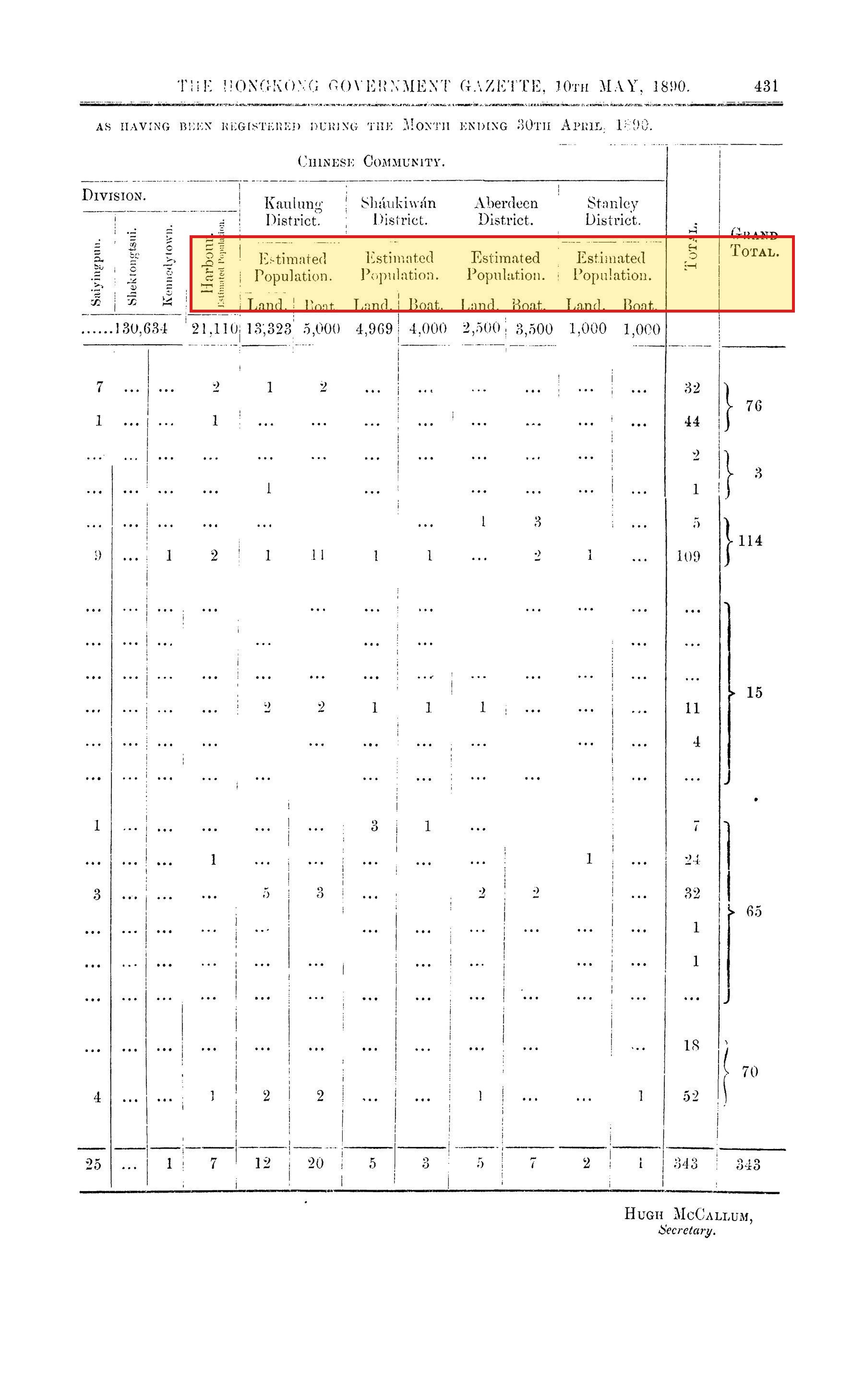
從1888年起,憲報每月印出華人社區的死亡回報,每個地區的人口估計都劈成「Land. Boat.」兩欄,死亡人數同樣分欄計算10。1890年4月30日止的一個月(印刷第431頁):海港(人口估計)21,110;九龍陸13,323/船5,000;筲箕灣4,969/4,000;香港仔陸2,500/船3,500(船多於陸);赤柱1,000/1,00010。1885年的霍亂回報同樣分欄,船民死者65人18。
醫務官自己的算術記錄了船上的死亡率。1898年報告論呼吸道疾病:「the death-rate from these causes is much heavier among the boat population than among the land population, being for the former 8.2 per 1,000 and for the latter 4.6 per 1,000. No less than 56 per cent. of these deaths are due to Phthisis, a disease which is always intimately associated with overcrowding …」(此類疾病死亡率船民遠高於陸民:前者8.2‰、後者4.6‰;其中至少56%死於肺結核,此病總是與擁擠密切相關……)13。1900年報告論瘧疾:船2.2‰,「less … than among the land population, as in 1899」(低於陸民,1899年亦然)19。
六、船隊與浮動人口的估算(1906–1928)
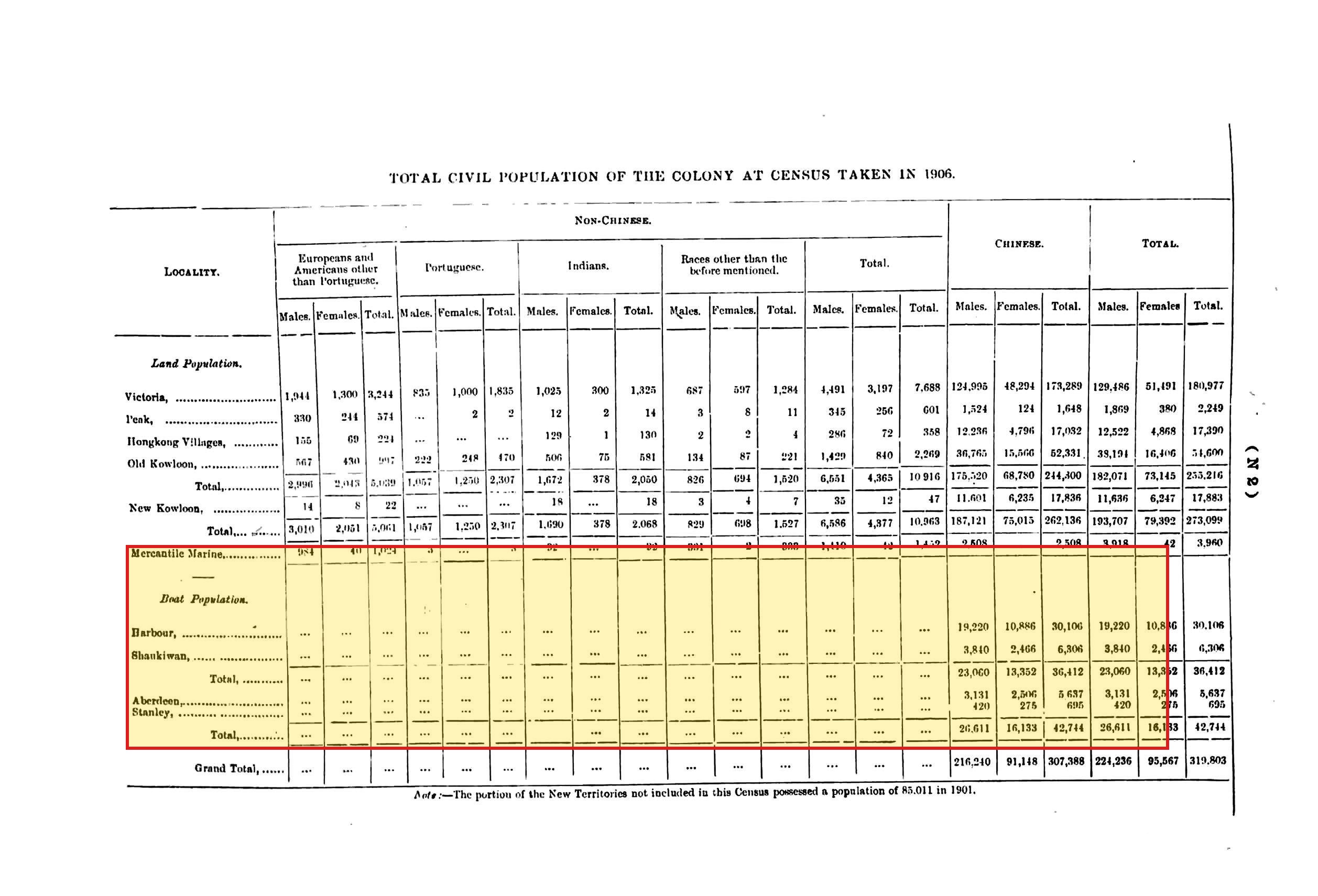
1906年11月20日的普查(藍皮書1907,印刷N8頁第217頁):船民42,744人——海港30,106、筲箕灣6,306、香港仔5,637、赤柱695(男26,611、女16,133),全殖民地合計307,388人8;普查日期由同一藍皮書另一表載明20。這一頁的地理值得注意:船民的70%住在海港8。
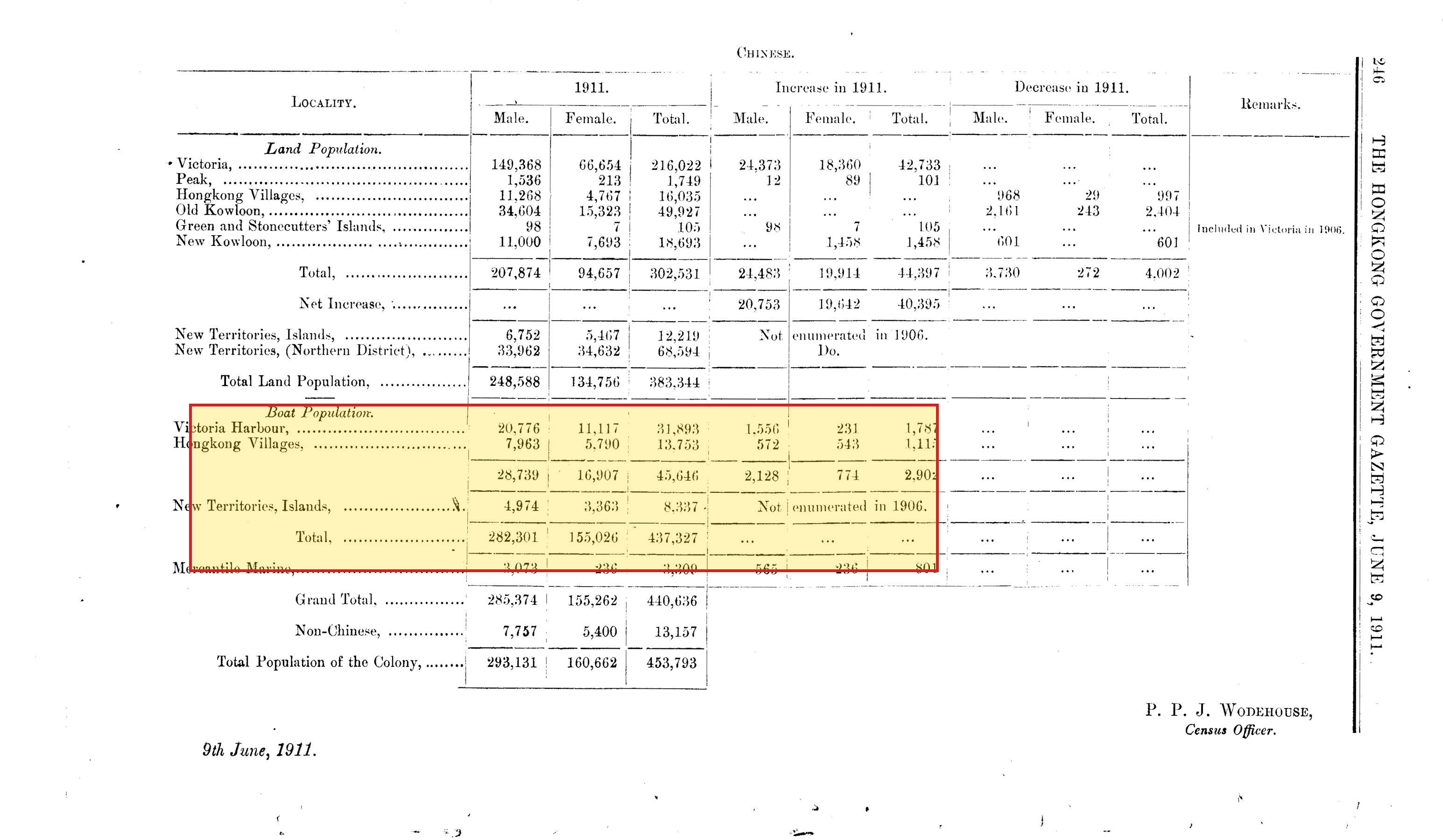
1911年6月9日的初步普查(憲報第174號,印刷第246頁,普查官 P. P. J. Wodehouse 簽發):維多利亞港31,893(20,776/11,117)、香港村落13,753(7,963/5,790)、新界離島8,337(4,974/3,363)——印刷的小計45,646只覆蓋前兩項,加離島後船民總數為53,983;陸民383,344;陸船合計437,327;全殖民地453,793(含非華人13,157)9。45,646不是總數,這是本線最易中伏的一個數字。
此後普查停止給船民單獨出表(1921與1931年普查報告本身不在語料庫中),記錄改以估算與註冊船隻表說話。1914年:「an average of 4.1 persons per boat」(平均每船4.1人),加上海事勞動力後「total Chinese population afloat of 55,300」(華人浮動人口合計55,300,不含新界)21。1919年:「Population afloat, 64,250」,註冊船隻為客船1,119、躉船1,720、漁船及其他7,177、躉66,合計10,082,新界領牌船6,63922。年度估算其後為:1920年69,30023、1921年73,42024、1922年64,30025,至1928年「used for compilation of statistics」(編纂統計所用)的估算達103,40026——而同一年的死亡表仍把「Population Afloat」當作一個地區26。
七、記錄不再說的(1930–1941)
藍皮書的年度人口表從1930年到1937年一直印着同一句話:「Both births and birth rates are very fallacious owing to partial Chinese registration and migration of boat population.」(出生數與出生率皆甚不可靠,因華人登記不全與船民遷徙。)2728——船民在統計的腳注裏,而不是統計的表裏。
1931年10月16日,立法局會議上,Mr. W. E. L. Shenton 問:颱風訊號懸掛時,若「the native boat population desiring to get to shelter」(本地船民欲入避風塘),政府輪船能否「assist in towing the boat population to shelter」(協助拖船民入港),並問政府是否知悉上一次颱風逼近時港內「exorbitant towing charges」(高昂拖船費)。海港司的回答是:政府知悉該指稱,惟「many cargo boats and trading junks refused the offer of a tow in the early stages of the typhoon … It is hoped that boats and junks will, in future, take shelter more promptly」(許多貨船帆船在颱風初期拒絕拖帶……希望日後船隻能更迅速入港)29。
1921與1931年的人口普查報告本身不在語料庫中,故1911年之後沒有普查船民表可引;線尾的數字只能靠年度估算與註冊船隻表14。語料庫裏「boat population」一語在1909年後的憲報逐漸稀薄(死亡表系列改了體例),這一類別最後的完整身分,是藍皮書腳注裏那句關於出生率的警告。
結論
殖民地自己的表格對船民做了三件事,而三件事都留下了自己的痕跡。其一是把船當住所:從1849年普查的 Houses/Boats 兩欄,到1860年把船民與房屋同表並列,船在統計上是一間屋15。其二是把人劈成兩半:1880年代末起,每個地區的死亡回報都把人口與死亡分為 Land 與 Boat 兩欄,香港仔的船上人口長期多於陸上人口10;醫務官則把這一劈變成率——8.2‰對4.6‰,並把死因寫成「擁擠」13。其三是把船民寫進政策:1874年風災後華商的兩次具稟、總督「由公帑興建」的裁定、銅鑼灣16,000英鎊的避風塘,直到1931年立法局仍在問同一個問題——颱風來時,誰把船拖進避風塘,錢由誰出1129。
數字本身也在說話:28,559(1860)→23,709(1871)→28,989(1881)→32,035(1891)→42,744(1906)→53,983(1911),此後改為64,250、73,420、103,400的估算5616789222426。1861至1871年間4,850人的下降,記錄沒有解釋6;1881年多加的那10%,註冊總監自己說查不出理由7;1911年的小計45,646不是總數9。這些不是本研究的疏漏,而是記錄自己的狀態——本研究把它們照錄在案。
至於名字:普查從不用「蜑家」「Tanka」分類,只用 boat population(船民)一類15;「蜑家」在今日的用法帶貶義,水上人寧自稱「水上人」30;「艇戶」「蛋家」「避風塘」則是戰後與1926年後新聞層的用語15。記錄的類別與人的自稱,從來不是同一個詞。
The Floating City
Hong Kong’s boat population in the colony’s own record,
1849–1941: counting, classifying, and governing a people afloat
Abstract
From the colony’s first modern census the boat population was a category of its own: the return of 31 December 1849 prints the rows “Chinese Boat Population, Victoria Harbour” and “Chinese Boat Population other than Victoria” beside the city and village rows, under a table with Houses and Boats columns. This paper follows that category for ninety-two years, through its first clean count (28,559 people on 3,925 boats in 1860), an unexplained fall to 23,709 in 1871, 28,989 in 1881, 32,035 in 1891, 42,744 in 1906 and 53,983 in 1911, and into the annual “Population afloat” estimates that replace the census tables afterwards. Three things the colony’s own tables did to this population are the paper’s argument: they counted boats as dwellings; they split every district’s population and deaths into Land and Boat columns (with the Medical Officer of Health’s own rates — respiratory disease 8.2 per 1,000 afloat against 4.6 on land, phthisis 56 per cent of the boat deaths, attributed to overcrowding); and they wrote the boat population into policy — the merchants’ memorials of 1874–75, the Governor’s ruling that the Causeway Bay breakwater be built “at the cost of the public” (about £16,000), and the Legislative Council’s 1931 questions about towing boats to shelter. Where the record cannot answer, the paper says so: the 1861 boat figures are unreadable, the 1871 boat-type counts interleave in every capture, and no census boat tables after 1911 exist in the corpus.
Keywords: boat population; census; mortality returns; typhoon shelter; Population afloat; Tanka; Hong Kong; Aberdeen; Victoria Harbour.
1. Scope, sources, and method
This is a history of one statistical category. Its documents are the colony’s own: the censuses and population returns in four strata (the Blue Books, whose early leaves are manuscript scans; the Gazette printings of the Registrar General’s returns from 1860 onward; the CO 129 despatches enclosing the 1849–52 returns, text-only with no image twin; and the Administrative Reports, which reprint the census tables with the Governor’s narrative); the monthly mortality returns, which from 1888 split every district’s estimated population and deaths into Land and Boat columns; and the annual estimates, whose “Population afloat” line runs from 1914 into the 1920s. The Chinese-language record in this corpus begins with the Kung Sheung Daily Press image series from 1926, where 艇戶, 蛋家, 水上人 and 避風塘 are all attested 15. The battery and query log are in Appendix A; the full evidence register sits in the research notes deposited with this paper. Six whole-document pulls anchor the thread and nine leaves were read by eye. All corpus links cite the public viewer; where a scan twin exists the image link is cited in preference. Accessed 3 November 2026 14.
Two method notes. First, the image index’s title page number is not the printed page, and the offset varies by year: title “1861 — Page 22” prints 24; “1871 — Page 198” prints 196; “1881 — Page 436” prints 437; “1890 — Page 428” prints 431; “1891 — Page 738” prints 747; “1911 — Page 252” prints 246, this last running the other way 14. Every figure here was read from the printed leaf, and the printed number is the citation. Second, all load-bearing figures were scan-verified because the text-series OCR interleaves these multi-column tables badly: a first-pass OCR reading of the 1906 Boat Population table put “Aberdeen 30,106” where the scan prints Harbour 30,106, Aberdeen 5,637. The verified readings are cited with their printed pages 8.
The thread is scoped to the record’s own categories. The typhoons appear here only as the events that produced the shelter policy (the disaster threads cover them); piracy, the ferry crossings and Aberdeen’s lease plan are adjacent threads and are not re-argued. The horizon is 1941: postwar resettlement is out of scope.
2. The census category, 1849–1871
The boat rows are as old as the modern census itself. The return of 31 December 1849, enclosed in Bonham’s despatch and reprinted in the Blue Book, carries the rows “Chinese Boat Population, Victoria Harbour” and “Chinese Boat Population other than Victoria” beside the city and village rows, under a table headed with Houses and Boats columns 1 2. The same rows recur in the 1851 and 1852 returns, the 1852 table additionally headed “Total No. of Boats” 3 4. The figures in these early returns are garbled in the OCR and CO 129 has no image twin, so the paper asserts the row names and not the numbers (register S1).
The earliest clean figures come with the census of 31 December 1860, printed in the Gazette of 9 February 1861: Boat population in Victoria 17,417 on 2,331 boats, and other than Victoria 11,142 on 1,594 boats — 28,559 people on 3,925 boats, against the colony’s dwelling columns of 4,861 houses and 3,925 boats. The same leaf’s Table No. 2 counts the same population in one row, “Boat Population in the Harbour and Bays of Hongkong, 19,558 males + 9,001 females”, which sums to the same 28,559: two classifications of one count, on one leaf 5.
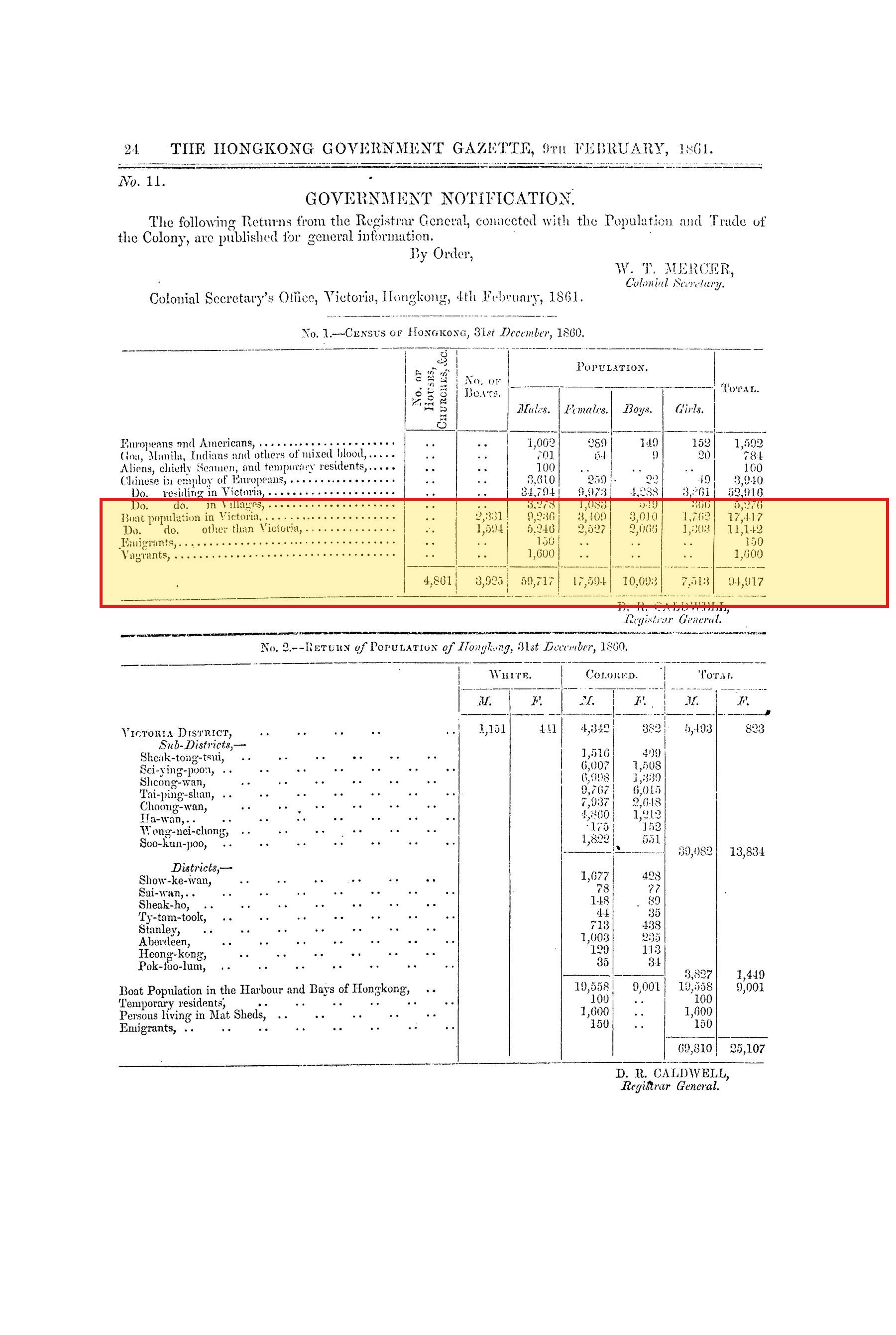
The 1861 census again carries a “No. of Boats” column and a “Boat population in Victoria” row, but its figures are incomplete in the text series and no image twin was located; the 1861 boat figures are therefore not asserted here (do-not F7, gap G1) 31.
The census of 2 April 1871 gives 12,309 in Victoria and 11,400 elsewhere — 23,709 against a colony total of 124,198 6. Against 1860 this is a fall of 4,850 people in a decade of growing trade. The record offers no explanation; the paper keeps the fall as printed rather than explaining it away (register K1). The same return carries the census’s boat-type table, the state’s own taxonomy of the harbour’s small craft — Trading Junks, Passage Boats, Cargo Boats, Fishing Boats, Stone Boats, Hakow Boats, Sampans, Bumboats, Pullaway Boats, Pilots. The table’s structure is asserted; its counts interleave in every text capture and are not quoted (gap G2) 6.
3. The storm and the shelter, 1874–1880
The typhoon of 22 September 1874 changed the governance of this category. Governor Kennedy’s despatch of 14 October encloses a report of the losses: “sunk, and total loss, 185 Junks; repairable, 455”, adding that “Hundreds of smaller Junks and boats must have been driven out to sea, or gone down in the Harbour, of which nothing can ever be known” 11.
The drowned were registered: 419 adult males, 152 adult females, and 141 children — 712. The record explains its own women-and-children figure: “The fact that many families reside permanently in these Junks, accounts for the deaths of the women and children.” The Registrar General thought the true loss “might be roughly estimated at thrice that recorded”; two members of the Executive Council put it “between four and five thousand”. The Governor’s report closes: “The probability is that all these people were drowned in about fifty minutes, when the force of the typhoon was at its maximum” 11.
The memorials followed. Chinese merchants “had presented Memorials in 1874 and 1875 to the Government, praying that steps might be taken to protect the boat population from similar calamities in future”, and Lord Carnarvon’s despatch of 18 November 1874 recorded “the deep personal interest the Queen had manifested in the calamity of 1874” 11.
The decision-making is recorded in the Administrative Report of 1880. Governor Hennessy instructed the PWD to estimate breakwaters, seeing that they “might save the lives of the floating population during a typhoon”; Admiral Watson, Captain Bonham Bax of H.M.S. Sylvia and Admiral Ryder advised on sites; leading Chinese merchants offered a subscription, and the Governor ruled that the breakwater should be built “at the cost of the public”. Plans went to London in November 1877; Sir Michael Hicks-Beach authorised the work in 1878; delayed by the Praya wall repairs, it was taken in hand in 1880 11.
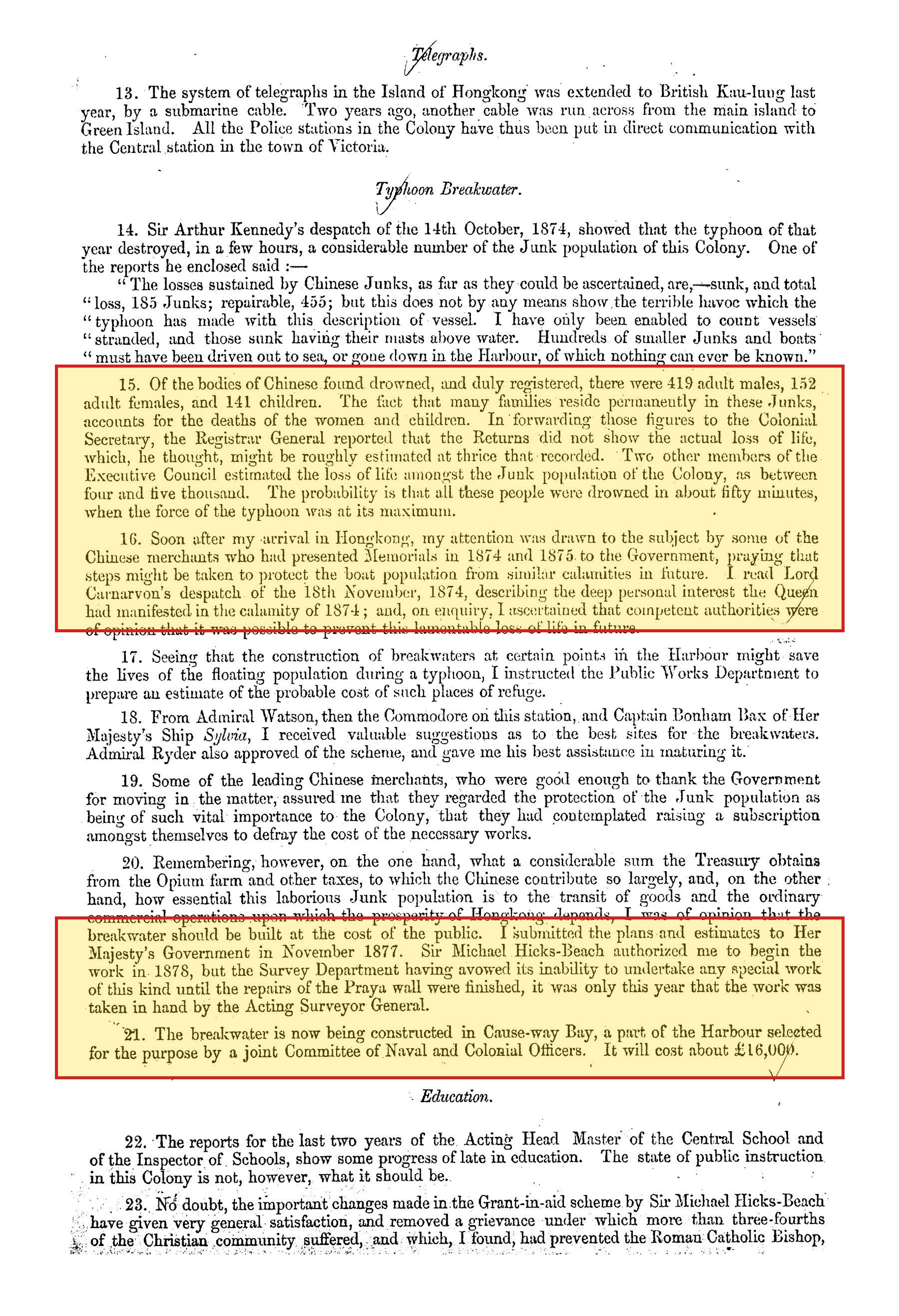
The 1880 report gives the work in progress: “The breakwater is now being constructed in Cause-way Bay, a part of the Harbour selected for the purpose by a joint Committee of Naval and Colonial Officers. It will cost about £16,000” 11. The corpus dates the work in hand to 1880; modern accounts date the Causeway Bay shelter’s completion to 1883 and call it Hong Kong’s first 12. The paper keeps begun-1880 and completed-1883 apart, each in its own source (register K3), rather than averaging them.
4. Counting and classifying, 1881–1891
The census of 3 April 1881, printed in the Gazette of 11 June and signed by John Gerrard, Acting Registrar General, gives 16,687 Chinese boat population in Victoria Harbour (7,635 men / 3,440 women / 3,061 boys / 2,551 girls) and 12,302 other than in Victoria Harbour (5,039 / 2,961 / 2,226 / 2,076) — 28,989, against a colony total of 160,402 16.
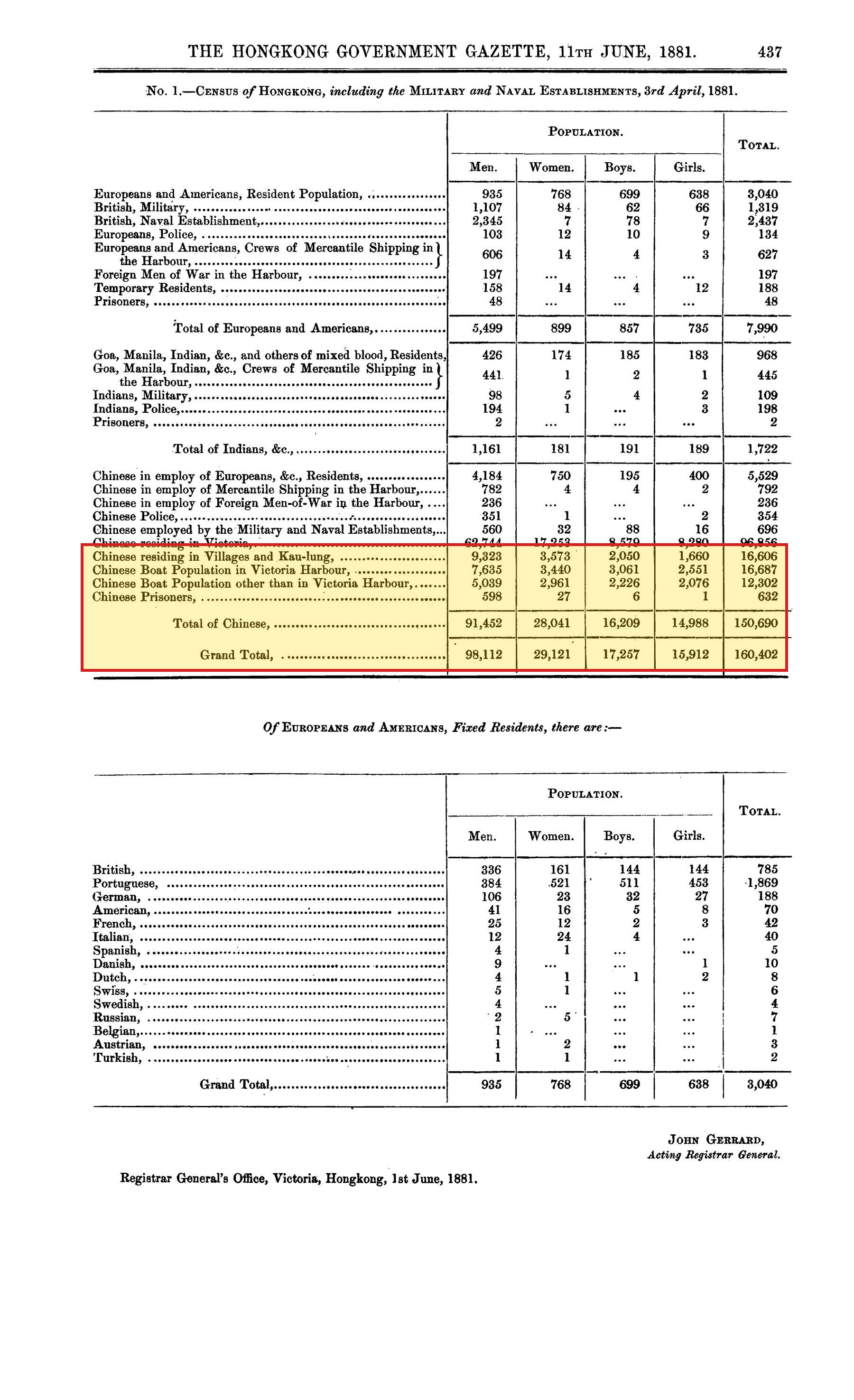
The Registrar General’s report of 1891 dissects that figure: “for some reason which I have not been able to discover, five per cent. was added in the case of the Chinese resident in Victoria and the Villages and ten per cent. in the case of the boat population of Victoria to the actual numbers ascertained” in 1881 — adding that “it is probable that the figures of the 1881 Census are rather in excess of what was the real population” 7. The census of 1881, in other words, had been inflated for the boat population by a margin its own successor could not explain (register C3).
The 1891 census tells a second story in its dating. It was taken on the evening of 20 May, moved twice from April: first for the tomb-worshipping festival (清明), then for “a festival in honour of the Queen of Heaven held at a place on the mainland of China called Ch’ik Wan” — the Tin Hau festival at 赤灣. The census waited for the boat population to come home 7.
The measured figures: 32,035 boat population in 1891, against 28,989 in 1881, an increase of 3,046. The district table (Return I A) gives Victoria Harbour 17,215 (8,088 men / 3,574 women / 3,164 boys / 2,389 girls), Kaulung 6,447, Shauki Wán 3,828, Aberdeen 3,977, Stanley 568 17. The report’s own observations: Stanley is “the only place where there is a decrease”, 981 in 1881 falling to 568; and “The largest increase is at Kaulung, where the boat population has risen from 4,472 to 6,447” 7.
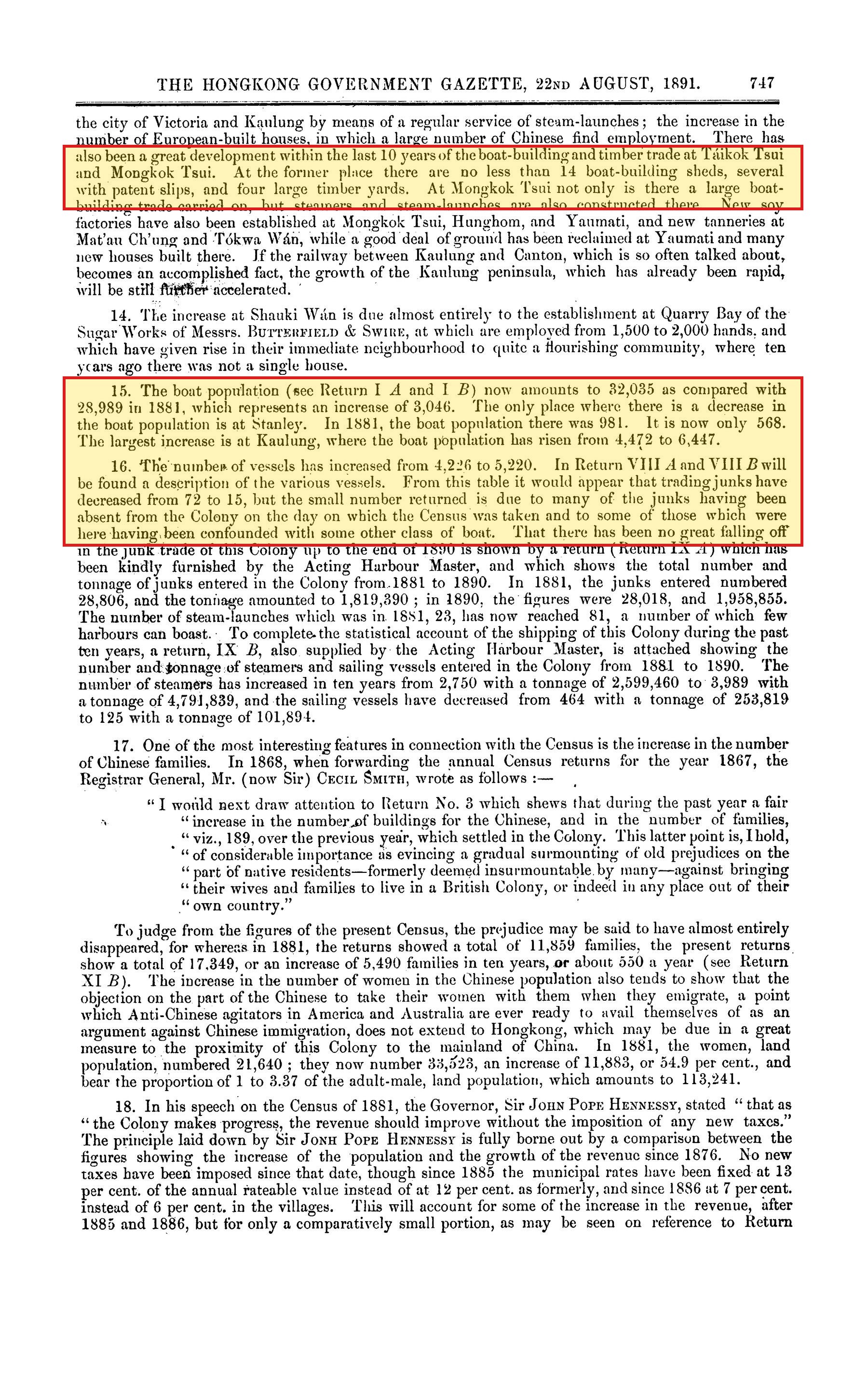
The same report carries the harbour’s boat-building trade: vessels “increased from 4,226 to 5,220”; trading junks returned fell from 72 to 15, explained in the report itself — “many of the junks [were] absent … and … confounded with some other class of boat” — while the junk trade’s port entries held steady (28,806 in 1881; 28,018 in 1890, tonnage rising); steam-launches 23 to 81. At Táikok Tsui there were “no less than 14 boat-building sheds, several with patent slips, and four large timber yards”, and at Mongkok Tsui “not only is there a large boat-building trade carried on, but steamers and steam-launches are also constructed there” 7.
5. Land and boat, 1885–1900: death in two columns
From 1888 the Gazette printed monthly mortality returns for the Chinese community in which every district’s estimated population is split under two columns, Land and Boat, and the deaths are counted in the same split 10. The verified leaf — the month ending 30 April 1890, printed p. 431 — reads: Harbour (Estimated Population) 21,110; Kaulung Land 13,323 / Boat 5,000; Sháukiwán 4,969 / 4,000; Aberdeen 2,500 / 3,500 (more people afloat than ashore); Stanley 1,000 / 1,000 10. The 1885 cholera returns split the same way, the Boat Population 65 18.
The Medical Officer of Health turned the split into arithmetic. On respiratory diseases in his report for 1898: “the death-rate from these causes is much heavier among the boat population than among the land population, being for the former 8.2 per 1,000 and for the latter 4.6 per 1,000. No less than 56 per cent. of these deaths are due to Phthisis, a disease which is always intimately associated with overcrowding, inefficient ventilation and structural insanitary conditions generally” 13. On malaria in 1900 the direction reverses: boat 2.2 per 1,000, “less … than among the land population, as in 1899” 19. The boat’s mortality profile was not uniformly worse; it was worse in the diseases of enclosure.
6. The fleet and the afloat estimates, 1906–1928
The census of 20 November 1906 (the date carried by the Blue Book itself) gives the boat population as 42,744: Harbour 30,106, Shaukiwan 6,306, Aberdeen 5,637, Stanley 695 (26,611 males / 16,133 females), against a grand total of 307,388 8 20. Seven in ten of the boat population lived in the harbour proper 8.
The preliminary returns of the 1911 census, signed by P. P. J. Wodehouse, Census Officer (the future Governor), give Victoria Harbour 31,893 (20,776 / 11,117), Hongkong Villages 13,753 (7,963 / 5,790) and New Territories, Islands 8,337 (4,974 / 3,363) — a printed sub-total of 45,646 covering only the first two rows, and a boat population of 53,983 when the islands are added; land population 383,344; grand total 437,327; colony total 453,793 including 13,157 non-Chinese 9. The sub-total is the trap of this thread: 45,646 is not the total (do-not F2).
After 1911 the census tables stop carrying the boat population as a separate return (the 1921 and 1931 census reports are not in the corpus — gap G3), and the record speaks through estimates and registered-boat tables instead. In 1914: “This gives an average of 4.1 persons per boat”, with 5,791 Chinese employed in the mercantile marine added, giving “a total Chinese population afloat of 55,300 exclusive of the New Territories” 21. In 1919: “Population afloat, 64,250”, with the registered fleet — passenger boats class A and B 1,119; lighters, cargo and water boats 1,720; fishing and other boats 7,177; hulks 66; Total, 10,082 — and 6,639 licensed boats in the New Territories 22. The annual estimates thereafter read 69,300 (1920) 23, 73,420 (1921) 24, 64,300 (1922) 25, and 103,400 in the 1928 estimates “used for compilation of statistics” 26 — a year in which the death tables still carry “Population Afloat” as a district 26.
7. What the record stops saying, 1930–1941
The Blue Books’ annual POPULATION AND VITAL STATISTICS tables print the same sentence from 1930 to 1937: “Both births and birth rates are very fallacious owing to partial Chinese registration and migration of boat population” 27 28. The boat population survives into the war years as a footnote to the birth rate — present in the statistics’ own warning about them, absent from the tables themselves.
The last direct exchange in the record is legislative. On 16 October 1931 the Hon. Mr. W. E. L. Shenton asked whether, “in the event of typhoon signals being hoisted … and the native boat population desiring to get to shelter”, Government launches could be used to “assist in towing the boat population to shelter”, and whether Government knew of “the exorbitant towing charges demanded by launches in the harbour during the approach of the last typhoon”. The Harbour Master’s answer: Government is aware of the allegation, but “many cargo boats and trading junks refused the offer of a tow in the early stages of the typhoon … It is hoped that boats and junks will, in future, take shelter more promptly on the hoisting of a typhoon signal” 29. Fifty-seven years after the memorials of 1874–75, the question in Council was still who gets towed into shelter, and at what price.
The phrase “boat population” thins out of the Gazette after about 1909, when the mortality series changes its form, and no census boat figures after 1911 were located in the corpus. The late numbers rest on the annual estimates and the registered-boat tables; the category’s last complete identity in the record is the Blue Book’s caveat about the birth rate 14 32.
8. Conclusion
The colony’s own tables did three things to the people afloat, and each left its mark. They counted boats as dwellings: from the 1849 census’s Houses and Boats columns to the 1860 table that sets the boat population beside the houses, the boat was a house in statistics 1 5. They split people in two: from the late 1880s every district’s mortality return divides population and deaths into Land and Boat, Aberdeen carrying more people afloat than ashore for years 10, and the Medical Officer turned the split into rates — 8.2 against 4.6 per 1,000, with overcrowding named as the cause 13. They wrote the boat population into policy: the merchants’ memorials of 1874–75, the Governor’s ruling that the Causeway Bay breakwater be built at the public’s cost, the £16,000 of 1880, and the Legislative Council’s questions of 1931 about towing charges 11 29.
The numbers speak too: 28,559 (1860) → 23,709 (1871) → 28,989 (1881) → 32,035 (1891) → 42,744 (1906) → 53,983 (1911), then the estimates of 64,250, 73,420 and 103,400 5 6 16 7 8 9 22 24 26. The 4,850 fall of the 1860s has no explanation in the record 6; the ten per cent added to the 1881 boat count was a margin the next Registrar General could not account for 7; and the 1911 sub-total of 45,646 is not the total 9. These are not the paper’s oversights but the record’s own state, and they are kept as such.
Finally, the names. The censuses never classify by “Tanka” or 蜑家 — only by “boat population” 15; 蜑家 is a name water people resent, and 水上人 the preferred form 30; 艇戶, 蛋家 and 避風塘 belong to the press strata from 1926 onward 15. The record’s category and the people’s own name were never the same word.
Notes
CO 129/32 (Sir Bonham, 1850 [1–4]), “Census of Hongkong, 31st December, 1849,” p. 228 — the census whose rows include “Chinese Boat Population, Victoria Harbour” and “Chinese Boat Population other than Victoria” beside the city and village rows, under a table headed with Houses and Boats columns. https://hkintexts.histsyn.com/page/230025 (accessed 3 November 2026). The OCR of the figures is garbled; only the row names are asserted here (register S1). ↩
Blue Book 1849, “Return of the Population, and of the Marriages, Births, and Deaths,” p. 74 — the Blue Book reprint of the same census, the stratum in which the boat rows recur annually. https://hkintexts.histsyn.com/page/653328 (accessed 3 November 2026). ↩
CO 129/39 (Sir Bonham, 1852 [1–12]), “Census of Hong Kong, 31st December, 1851,” p. 147 — the rows “Boat population in Victoria Harbour” and “Boat population other than Victoria”. https://hkintexts.histsyn.com/page/232286 (accessed 3 November 2026). ↩
Blue Book 1852, “Census of Hongkong, 31st December, 1852,” p. 168 — the same boat rows, the table additionally headed “Total No. of Boats”. https://hkintexts.histsyn.com/page/653835 (accessed 3 November 2026). ↩
Government Gazette, 9 February 1861, G.N. No. 11, “No. 1.—Census of Hongkong, 31st December, 1860” (printed p. 24): “Boat population in Victoria 17,417” on 2,331 boats and “other than Victoria 11,142” on 1,594 boats — 28,559 people on 3,925 boats; the colony’s dwelling columns read 4,861 houses and 3,925 boats. The same leaf’s Table No. 2 counts the same population in one row — “Boat Population in the Harbour and Bays of Hongkong, 19,558 males + 9,001 females” — which sums to the same 28,559. Scan, plate 1: https://hkintexts.histsyn.com/image-page/1448707 (accessed 3 November 2026). Scan-verified; the printed page (24) differs from the image index’s title (“Page 22”) — register K2. ↩
Government Gazette, 6 May 1871, G.N. No. 68, “No. 1.—Census of Hongkong … 2nd April, 1871” (printed p. 196): “Boat Population in Victoria 12,309” and “Boat Population, other than in Victoria 11,400” — 23,709 in all, against a colony total of 124,198. The same return carries the census’s boat-type table, the state’s own taxonomy of the harbour’s small craft: Trading Junks, Passage Boats, Cargo Boats, Fishing Boats, Stone Boats, Hakow Boats, Sampans, Bumboats, Pullaway Boats, Pilots (the counts are column-interleaved in every text capture — the structure is asserted, the figures are not; gap G2). Scan, plate: https://hkintexts.histsyn.com/image-page/1453578 (accessed 3 November 2026). Scan-verified (printed p. 196; index title “Page 198”). ↩
Government Gazette, 22 August 1891, G.N. No. 361, the Registrar General’s report on the Census of 20 May 1891, §§3, 13–17 (printed p. 747). §15: “The boat population … now amounts to 32,035 as compared with 28,989 in 1881”, with Stanley “the only place where there is a decrease” (981 in 1881 → 568) and “The largest increase is at Kaulung, where the boat population has risen from 4,472 to 6,447.” §13: the boat-building trade — at Táikok Tsui “no less than 14 boat-building sheds, several with patent slips, and four large timber yards”, and at Mongkok Tsui “not only is there a large boat-building trade carried on, but steamers and steam-launches are also constructed there”. §16: vessels increased “from 4,226 to 5,220”, trading junks returned fell from 72 to 15 because “many of the junks [were] absent … and … confounded with some other class of boat”. The same report records that in the 1881 census “for some reason which I have not been able to discover, five per cent. was added … and ten per cent. in the case of the boat population of Victoria to the actual numbers ascertained”, and dates the census itself to the evening of 20 May, postponed twice — the tomb-worshipping festival (清明) and then “a festival in honour of the Queen of Heaven held at a place on the mainland of China called Ch’ik Wan” — so that absentees might be at home. Scan, plate 3: https://hkintexts.histsyn.com/image-page/1539328 (accessed 3 November 2026). Scan-verified (printed p. 747; index title “Page 738”). ↩
Blue Book 1907, “Total Civil Population of the Colony at Census taken in 1906 — Boat Population” (printed N 8, p. 217): Harbour 30,106, Shaukiwan 6,306, Aberdeen 5,637, Stanley 695 — 42,744 in all (26,611 males / 16,133 females), against a grand total of 307,388. Scan, plate 5: https://hkintexts.histsyn.com/image-page/2194855 (accessed 3 November 2026). Scan-verified. (A first-pass OCR reading of this table put “Aberdeen 30,106”; the scan prints Harbour 30,106, Aberdeen 5,637 — register F1.) ↩
Government Gazette, 9 June 1911, G.N. No. 174, “1911 Census — Preliminary Returns” (printed p. 246), signed P. P. J. Wodehouse, Census Officer: Victoria Harbour 31,893 (20,776 / 11,117), Hongkong Villages 13,753 (7,963 / 5,790), New Territories, Islands 8,337 (4,974 / 3,363) — a printed sub-total of 45,646 for the first two rows, and a boat population of 53,983 when the islands are added; land population 383,344; grand total 437,327 (land + boat); colony total 453,793 including 13,157 non-Chinese. Scan, plate 7: https://hkintexts.histsyn.com/image-page/1481293 (accessed 3 November 2026). Scan-verified (printed p. 246; index title “Page 252” — this one runs the other way). The printed sub-total 45,646 must not be taken for the total (register K4, do-not F2). ↩
Government Gazette, 10 May 1890, “Return showing the number of deaths registered during the month ending 30th April, 1890 — Chinese Community” (printed p. 431): for every district the estimated population is split under two columns, Land and Boat, and the deaths are counted in the same split — Harbour (Estimated Population) 21,110; Kaulung Land 13,323 / Boat 5,000; Sháukiwán 4,969 / 4,000; Aberdeen 2,500 / 3,500; Stanley 1,000 / 1,000. Scan, plate 4: https://hkintexts.histsyn.com/image-page/1537755 (accessed 3 November 2026). Scan-verified (printed p. 431; index title “Page 428”). ↩
Administrative Report 1880 (the Governor’s report), “Typhoon Breakwater,” §§14–21 — the colony’s own account of the typhoon of 22 September 1874 and the shelter built after it. §15: the registered drowned — “419 adult males, 152 adult females, and 141 children” (712) — with the Registrar General’s estimate that the true loss “might be roughly estimated at thrice that recorded” and two Executive Council members’ figure “between four and five thousand”, closing “The probability is that all these people were drowned in about fifty minutes, when the force of the typhoon was at its maximum.” §16: the Chinese merchants’ “Memorials in 1874 and 1875 … praying that steps might be taken to protect the boat population from similar calamities in future”, and Lord Carnarvon’s despatch of 18 November 1874. §§20–21: the decision that the breakwater be built “at the cost of the public”, the plans sent to London in November 1877, Sir Michael Hicks-Beach’s 1878 authorisation, and the work in hand in 1880 — “The breakwater is now being constructed in Cause-way Bay … It will cost about £16,000.” Scan, plate 6: https://hkintexts.histsyn.com/image-page/416705 (accessed 3 November 2026). Scan-verified. The 1874 junk losses — “sunk, and total loss, 185 Junks; repairable, 455” — are from Kennedy’s despatch of 14 October 1874, quoted in the same file. ↩
Web leg: 銅鑼灣避風塘, 香港粵語維基百科 — the Causeway Bay shelter as “香港第一個避風塘”, with the 1883 reclamation date. https://zh-yue.wikipedia.org/wiki/%E9%8A%85%E9%91%BC%E7%81%A3%E9%81%BF%E9%A2%A8%E5%A1%98 (accessed 3 November 2026). Register K3 keeps the two dates apart: the corpus dates the work in hand to 1880 (“now being constructed”, about £16,000); the modern accounts date completion to 1883. Neither is averaged. ↩
Government Gazette, 29 April 1899, “Reports of the Medical Officer of Health … for 1898” (printed p. 666): on respiratory diseases, “the death-rate from these causes is much heavier among the boat population than among the land population, being for the former 8.2 per 1,000 and for the latter 4.6 per 1,000. No less than 56 per cent. of these deaths are due to Phthisis, a disease which is always intimately associated with overcrowding, inefficient ventilation and structural insanitary conditions generally.” https://hkintexts.histsyn.com/page/1636109 (accessed 3 November 2026). ↩
Research note. The battery ran on the hkintexts corpus (read-only) in six families: the category (“boat population” 1,948 text hits / 924 image hits; “Population afloat” 180), the boat types (“sampan” 9,837; “Tanka” 2,228; “Tan-ka” 50; “Hoklo” 802), the shelter vocabulary (“typhoon shelter” 3,578; 避風塘 4,083 text / 3,504 image), the Chinese people-terms (艇戶 737, 蜑家 26, 疍家 270, 蛋家 403, 水上人 496, 漁戶 281, 住家艇 631), the Blue Book year sweep (“boat population” present in 52 years, 1849–1940), and the image series for scan twins. Six whole-document pulls anchor the thread (the 1871, 1881, 1891 and 1911 census returns, the April 1890 mortality returns, and the Legislative Council minutes of 16 October 1931); thirty-odd single-page pulls and nine eye-read leaves sit behind every figure. Access 3 November 2026. ↩
Web leg of the name battery: 維基百科, “蜑家” — the Tanka naming layer (蜑家 / 蛋家 / 艇戶; the 1726 abolition of the base status; the 1934 order). https://zh.wikipedia.org/zh-tw/%E8%9C%91%E5%AE%B6 (accessed 3 November 2026). The corpus counts for the same terms: 艇戶 737 text / 651 image (postwar strata), 蜑家 26 / 62, 蛋家 403 / 369 (the 工商日報 press form from 1926-04-17), 水上人 496 / 380, 避風塘 4,083 / 3,504 (工商日報 from 1926-04-05). Register K6: the censuses classify by boat/land locality, never by “Tanka” — the record’s own category is “boat population” (do-not F4: “Tan-ka” is thin, 50 hits, press vocabulary). ↩
Government Gazette, 11 June 1881, “No. 1.—Census of Hongkong … 3rd April, 1881” (printed p. 437), signed John Gerrard, Acting Registrar General: “Chinese Boat Population in Victoria Harbour 16,687” (7,635 men / 3,440 women / 3,061 boys / 2,551 girls) and “Chinese Boat Population other than in Victoria Harbour 12,302” (5,039 / 2,961 / 2,226 / 2,076) — 28,989 in all, against a colony total of 160,402. Scan, plate 2: https://hkintexts.histsyn.com/image-page/1505109 (accessed 3 November 2026). Scan-verified (printed p. 437; index title “Page 436”). ↩
Government Gazette, 22 August 1891, Census Return I A, “Census of Hongkong including Military and Naval Establishments, 20th May, 1891” (printed p. 749): the district table — Victoria Harbour 17,215 (8,088 men / 3,574 women / 3,164 boys / 2,389 girls), Kaulung 6,447, Shauki Wán 3,828, Aberdeen 3,977, Stanley 568. Scan: https://hkintexts.histsyn.com/image-page/1539330 (accessed 3 November 2026). Scan-verified (printed p. 749; index title “Page 740”). ↩
CO 129/222 (Acting Governor Cameron / Governor Sir Bowen, 1885 [7–10]), “Statistics of Deaths” (the cholera returns) — the return records the Boat Population 65 among the cholera deaths, beside European shipping, the city divisions and the districts. https://hkintexts.histsyn.com/page/328879 (accessed 3 November 2026). ↩
Sessional Paper 1901, “Report of the Medical Officer of Health for 1900,” p. 403 — malarial fevers: boat 2.2 per 1,000, “less … than among the land population, as in 1899”. https://hkintexts.histsyn.com/page/1821796 (accessed 3 November 2026). ↩
Blue Book 1907, “Return of the Statistics of Population for the Year 1907 — Census taken on 20th November, 1906,” p. 411 — the Blue Book dates the census itself. https://hkintexts.histsyn.com/page/667911 (accessed 3 November 2026). ↩
Administrative Report 1914, Report of the Medical Officer of Health (population), p. 242 — “This gives an average of 4.1 persons per boat. In addition there were at the Census 5,791 Chinese employed in the mercantile marine in the Harbour, and the addition of 6,100 for 1914 to the estimated boat population gives a total Chinese population afloat of 55,300 exclusive of the New Territories.” https://hkintexts.histsyn.com/page/615635 (accessed 3 November 2026). Text-only (register S5). ↩
Administrative Report 1919, “Population,” p. 256 — “Population afloat, 64,250”, and the registered fleet: “Passenger boats, class A and B, 1,119; Lighters, cargo and water boats, 1,720; Fishing and other boats, 7,177; Hulks, 66; Total, 10,082. The licensed boats in the New Territories numbered 6,639.” https://hkintexts.histsyn.com/page/618236 (accessed 3 November 2026). ↩
Administrative Report 1920, “Population,” p. 263 — “Population afloat 69,300.” A first read of “100,800” proved to be the New Territories figure, not the afloat row (register K5). https://hkintexts.histsyn.com/page/618729 (accessed 3 November 2026). ↩
Administrative Report 1921, “Population,” p. 39 — “Population afloat 73,420.” https://hkintexts.histsyn.com/page/619033 (accessed 3 November 2026). ↩
Administrative Report 1922, “Population,” p. 38 — “Population afloat 64,300.” https://hkintexts.histsyn.com/page/619642 (accessed 3 November 2026). ↩
Administrative Report 1928, “Population” (the estimate “used for compilation of statistics”: Population Afloat 103,400) and the death tables’ “Population Afloat” district, pp. 437, 476–480 — the afloat figure still functioning as a district of the mortality returns. https://hkintexts.histsyn.com/page/624403 (accessed 3 November 2026). ↩
Blue Book 1930, “Population and Vital Statistics, 1930,” p. 396 — under the annual table: “Both births and birth rates are very fallacious owing to partial Chinese registration and migration of boat population.” https://hkintexts.histsyn.com/page/678094 (accessed 3 November 2026). ↩
Blue Book 1937, “Population and Vital Statistics, 1937,” p. 325 — the same caveat, verbatim, seven years later. https://hkintexts.histsyn.com/page/681476 (accessed 3 November 2026). ↩
Government Gazette, 16 October 1931, Legislative Council Minutes No. 12, p. 698 — the Hon. Mr. W. E. L. Shenton asks whether, “in the event of typhoon signals being hoisted … and the native boat population desiring to get to shelter, … Government launches … assist in towing the boat population to shelter”, and whether Government knew of “the exorbitant towing charges demanded by launches in the harbour during the approach of the last typhoon”. The Harbour Master replies that “Government is aware of the allegation … many cargo boats and trading junks refused the offer of a tow in the early stages of the typhoon … It is hoped that boats and junks will, in future, take shelter more promptly on the hoisting of a typhoon signal.” https://hkintexts.histsyn.com/page/1634378 (accessed 3 November 2026). ↩
Web leg: 城市日記 (Urban Diary), “移居岸上的水上人家” — the naming from the community’s side: 蜑家 as a name water people resent, 水上人 as the preferred, well-accepted form, and 住家艇 as “水上人的屋子”. https://www.urbandiarist.com/tc/story/Yue-Kwong-Chuen-Home-of-People-on-the-water-on-land (accessed 3 November 2026). The page also carries a modern “1841: 2,000 boat people” count, which this run did not verify in the corpus — not asserted (do-not F5). ↩
Blue Book 1861, “No. 1.—Census of Hongkong, 31st December, 1861,” p. 99 — the census again carries a “No. of Boats” column and a “Boat population in Victoria” row, but the text-series OCR of the figures is incomplete and no image twin was located; the 1861 boat figures are therefore not asserted (register F7, gap G1). https://hkintexts.histsyn.com/page/655330 (accessed 3 November 2026). ↩
China Mail 德臣西報, 7 February 1931, p. 7, “Review of Census Development — Hongkong” — the pre-census survey of the colony’s census machinery, cited here as modern-adjacent context (register S7), not as a boat-population witness. https://hkintexts.histsyn.com/page/2001995 (accessed 3 November 2026). ↩
Appendix A — Select bibliography
- CO 129/32 (Sir Bonham, 1850), “Census of Hongkong, 31st December, 1849,” p. 228. https://hkintexts.histsyn.com/page/230025.
- Blue Book 1849, “Return of the Population, and of the Marriages, Births, and Deaths,” p. 74. https://hkintexts.histsyn.com/page/653328.
- CO 129/39 (Sir Bonham, 1852), “Census of Hong Kong, 31st December, 1851,” p. 147. https://hkintexts.histsyn.com/page/232286.
- Blue Book 1852, “Census of Hongkong, 31st December, 1852,” p. 168. https://hkintexts.histsyn.com/page/653835.
- Government Gazette, 9 February 1861, G.N. No. 11, “No. 1.—Census of Hongkong, 31st December, 1860” (printed p. 24). https://hkintexts.histsyn.com/image-page/1448707.
- Blue Book 1861, “No. 1.—Census of Hongkong, 31st December, 1861,” p. 99. https://hkintexts.histsyn.com/page/655330.
- Government Gazette, 6 May 1871, G.N. No. 68, “No. 1.—Census of Hongkong … 2nd April, 1871” (printed p. 196). https://hkintexts.histsyn.com/image-page/1453578.
- Administrative Report 1880 (Governor’s report), “Typhoon Breakwater,” §§14–21. https://hkintexts.histsyn.com/image-page/416705.
- Government Gazette, 11 June 1881, “No. 1.—Census of Hongkong … 3rd April, 1881” (printed p. 437). https://hkintexts.histsyn.com/image-page/1505109.
- Government Gazette, 22 August 1891, G.N. No. 361, Registrar General’s report on the Census of 20 May 1891, §§3, 13–17 (printed p. 747). https://hkintexts.histsyn.com/image-page/1539328.
- Government Gazette, 10 May 1890, mortality return for the month ending 30th April 1890 — Chinese Community (printed p. 431). https://hkintexts.histsyn.com/image-page/1537755.
- CO 129/222 (1885), “Statistics of Deaths” (cholera), p. 138. https://hkintexts.histsyn.com/page/328879.
- Government Gazette, 22 August 1891, Census Return I A (printed p. 749). https://hkintexts.histsyn.com/image-page/1539330.
- Government Gazette, 29 April 1899, “Reports of the Medical Officer of Health … for 1898” (printed p. 666). https://hkintexts.histsyn.com/page/1636109.
- Sessional Paper 1901, “Report of the Medical Officer of Health for 1900,” p. 403. https://hkintexts.histsyn.com/page/1821796.
- Blue Book 1907, “Total Civil Population of the Colony at Census taken in 1906 — Boat Population” (printed N 8, p. 217). https://hkintexts.histsyn.com/image-page/2194855.
- Blue Book 1907, “Return of the Statistics of Population for the Year 1907 — Census taken on 20th November, 1906,” p. 411. https://hkintexts.histsyn.com/page/667911.
- Government Gazette, 9 June 1911, G.N. No. 174, “1911 Census — Preliminary Returns” (printed p. 246). https://hkintexts.histsyn.com/image-page/1481293.
- Administrative Report 1914, Report of the Medical Officer of Health (population), p. 242. https://hkintexts.histsyn.com/page/615635.
- Administrative Report 1919, “Population,” p. 256. https://hkintexts.histsyn.com/page/618236.
- Administrative Report 1920, “Population,” p. 263. https://hkintexts.histsyn.com/page/618729.
- Administrative Report 1921, “Population,” p. 39. https://hkintexts.histsyn.com/page/619033.
- Administrative Report 1922, “Population,” p. 38. https://hkintexts.histsyn.com/page/619642.
- Administrative Report 1928, “Population” (Population Afloat 103,400) and the death tables’ “Population Afloat” district, pp. 437, 476–480. https://hkintexts.histsyn.com/page/624403.
- Blue Book 1930, “Population and Vital Statistics, 1930,” p. 396. https://hkintexts.histsyn.com/page/678094.
- Blue Book 1937, “Population and Vital Statistics, 1937,” p. 325. https://hkintexts.histsyn.com/page/681476.
- Government Gazette, 16 October 1931, Legislative Council Minutes No. 12, p. 698. https://hkintexts.histsyn.com/page/1634378.
- China Mail 德臣西報, 7 February 1931, “Review of Census Development — Hong Kong,” p. 7. https://hkintexts.histsyn.com/page/2001995.
- [W1] 維基百科, “蜑家”. https://zh.wikipedia.org/zh-tw/%E8%9C%91%E5%AE%B6.
- [W2] 城市日記 (Urban Diary), “移居岸上的水上人家”. https://www.urbandiarist.com/tc/story/Yue-Kwong-Chuen-Home-of-People-on-the-water-on-land.
- [W3] 銅鑼灣避風塘, 香港粵語維基百科. https://zh-yue.wikipedia.org/wiki/%E9%8A%85%E9%91%BC%E7%81%A3%E9%81%BF%E9%A2%A8%E5%A1%98.
Appendix B — Evidence register (summary)
Confirmed (scan-verified where marked). The boat rows from the first modern censuses (1849–52, row names); the counted series — 1860 28,559 on 3,925 boats ✓, 1871 23,709 ✓, 1881 28,989 ✓, 1891 32,035 ✓, 1906 42,744 ✓, 1911 53,983 ✓; the 1881 census’s unexplained ten per cent on the boat population of Victoria; the 1891 census postponed twice for the tomb and Queen of Heaven festivals; the monthly mortality returns’ Land/Boat split per district; the MOH’s boat-vs-land rates (respiratory 8.2 vs 4.6 per 1,000 in 1898; malaria 2.2 vs 3.3 in 1900; cholera boat 65 in 1885); the 1874 typhoon’s 185 sunk + 455 repairable junks, 712 registered drowned, the “thrice” and “four and five thousand” estimates, and “drowned in about fifty minutes”; the merchants’ memorials of 1874–75 and the Causeway Bay breakwater at about £16,000, public cost; the 1919 registered fleet of 10,082 (+6,639 New Territories); the annual afloat estimates 1914–1928; the Blue Books’ standing birth-rate caveat (1930, 1937); the 1931 towing questions.
Conflicts kept, never averaged. The series is not monotone — 1860’s 28,559 falls to 1871’s 23,709 with no explanation in the record (K1); the image index’s title page numbers differ from the printed folios in both directions, every citation using the printed page (K2); the first shelter is begun-1880 in the corpus and completed-1883 in modern accounts (K3); the 1911 printed sub-total 45,646 covers only Victoria Harbour + Hongkong Villages, the true total being 53,983 (K4); a first read of the 1920 figure as 100,800 proved to be the New Territories row, the afloat row being 69,300 (K5); “Tanka” is press and ethnographic vocabulary, never the census’s category (K6); and the category’s geography changes across three systems — 1906 localities, 1911 localities, and the 1890s mortality districts (K7).
Do not use. “Aberdeen 30,106” for 1906 (an OCR row-shift; the scan prints Harbour 30,106, Aberdeen 5,637); 45,646 as the 1911 total (it is a sub-total); “boat dwellers” as a period term (earliest corpus hit 1947); “Tan-ka” as the record’s term (50 hits, press vocabulary); the modern web’s “1841: 2,000 boat people” (not verified in this run’s corpus work); postwar resettlement detail (out of scope, horizon 1941); and the 1861 census boat figures (unreadable in text, no image twin located).
Gaps. The 1861 census’s boat figures; the 1871 boat-type table’s counts (structure only); the 1921 and 1931 census reports themselves, which are not in the corpus — no census boat tables after 1911; the post-Causeway-Bay shelters (Yaumati and later) were not researched this run; the Chinese-language record for the boat population begins in this corpus with the 1926 strata; and no petition or memorial in the boat people’s own words was located beyond the merchants’ memorials, reported at second hand.