The First Chinese British Subject — Fung Ming-shan and the Naturalisation of 1881
首位歸化英籍的華人:馮明珊(馮普熙),東莞商人、有利銀行買辦、山打根甲必丹
摘要:1881 年 6 月 24 日,香港定例局在同一天通過 6 條歸化條例(第 5 至第 10 號),把 6 名華人——馮明珊、黃社帶、施笙階、彭炎、葉謙光、袁敏才——按各人一條的私人條例,逐一歸化為英籍。港督軒尼詩呈報殖民地部時寫明:「這是首次有華人在香港歸化。」(As this is the first time that any person of the Chinese race has been naturalised in Hongkong.)排在第一條、即第 5 號條例的,是東莞商人馮明珊:聖保羅書院出身、有利銀行買辦、廣謙和行東、東華醫院董事、保良局首任總理之一。本文以他的一生重建香港開埠 40 年後「歸化」這一步的來歷,並追蹤他的兩片天地——香港與英屬北婆羅洲的山打根:他是山打根華人顧問局主席、當地的「甲必丹」(Captain China),1898 年 11 月 15 日在廣州去世;1906 年,他的兒子馮純三在香港與山打根之間辦理他的遺產。
關鍵詞:馮明珊;馮普熙;有利銀行;廣謙和;保良局;歸化;甲必丹;山打根
一、東莞商人與他的行號
馮明珊(名普熙,字明珊)祖籍廣東東莞,生年與生地未見於記錄,連後出的中文工具書也只能寫「其生卒年不詳」 1。他的英語教育來自聖保羅書院:1881 年港督軒尼詩在呈交殖民地部的密函裏親筆寫道,「Mr. Fung Ming Shan was trained at St Paul's College, where he received a good English education」 2;卡爾·史密夫(Carl T. Smith)的記錄更稱他 1864 年已是聖保羅書院舊生會(Bishop Smith Old Boys)成員 3。他 1869 年在香港購入第一批物業 3。他在本記錄上最早的一次公開行動是一個簽名:1871 年商人反對賭館的具禀,署名「Mingshan 馮明珊」 4;最早的報端痕跡見於 1876 年 6 月的一宗短交貨索賠案——「Mr Fung Ming Shan, manager of the …」 5。
他的行號是廣謙和(Kwong Him Wo):主營香港與西貢(Saigon)之間的轉口貿易,1876 至 1879 年舖址在永樂坊 36 號,1880 年起遷至文咸街 56 號,名錄把該行列入「本港主要華人商行」 6。1880 年 11 月的一宗最高法院案件裏,法院文件這樣描述該行:「the firm of Kwong Hin Wo, which carries on business at Hongkong and Saigon」;史密夫的紀錄補上一句:馮明珊「1875 或 1876 年之前一直長駐西貢,是該行的駐地合夥人,其後由 Lo Chok Tong 接替」 3。1880 年 5 月的愛爾蘭賑濟捐款名單,把行號並列在兩份名單上——英文名單寫「Kwong Him Wo Hong, 50.00」,中文名單寫「廣謙和 五十圓」,同一筆 50 元的捐款,確認了行號的中文名字 7。
他做過兩家洋行的買辦:1870 年代是 A. H. Hogg and Co. 的買辦(1871 年 12 月的一宗挪用公款案,史密夫的卡片記「Fung Ming-shan, compradore to A.G. Hogg」 3),1878 年之前已轉任有利銀行(Chartered Mercantile Bank of India, London and China)的買辦 82;1884 年後,史密夫的記錄又見他轉任 Ed. Schellhans and Co. 3。1880 年 2 月 19 日,華人代表團到港督府祝賀,代表團名單在一份文件裏同時出現他的兩個名字系統:英文欄寫「Fung Pò-hi (Ming-shan), Comprador of … the Chartered Mercantile Bank」,中文欄寫「主筆王韜、有利銀行買辦馮普熙」——一份文件,兩欄名字,這是把「馮明珊=馮普熙=有利銀行買辦」釘在一起的關鍵見證 9。1881 年港督呈報倫敦時,把他的身家估算為「an owner of land and houses, supposed to be worth $100,000」(土地與房屋約值 10 萬元) 2。
二、東華醫院、賬目與名字
馮明珊的公職從東華醫院開始。同治十三年(1874 年)颱風之後,昂船洲岸邊仍有百餘具遺骸暴露,東華醫院董事稟請港督批准遷葬義山;《香港碑銘彙編》收錄的碑文,落款是「東華醫院董事:黃筠堂 招雨田 馮明珊 等敬泐」 10。1880 年的兩份憲報再把他列為「東華醫院當年總理」:一份是董事會就醫學獎學金致輔政司的稟文(「東華醫院當年總理招雨田黃筠堂馮明珊等頓首」) 11,另一份是 1880 年度董事選舉的批示 12。他捐錢的名目也留了下來:1880 年 5 月的愛爾蘭賑濟,他個人捐 100 元,行號廣謙和捐 50 元 7。
名字也是證據。1881 年 4 月的賀詞(祝賀軒尼詩上任四周年)在憲報刊出的簽名名單裏有「FUNG MING-SHAN 馮明珊」 1314;1881 年 3 月與 1882 年 2 月的陪審員名單,他都在其中(職業欄:comprador) 15;史密夫的卡片另記他 1881 至 1883 年連續三年在陪審員名單上 3。
三、防拐會:從具禀到賬目(1878–1884)
1878 年 11 月 9 日,4 名東莞籍商人在文咸街 3 號聯名具禀港督,請求批准集資緝拿拐匪:具禀人是盧禮屏、施笙階、馮明珊、謝達盛「等」,附有 62 家商號的印章,由歐德理(E. J. Eitel)翻譯 81617。其後一年,馮明珊的名字出現在這部防拐機器的每一個環節:1878 年 11 月 28 日在巡理府的首輪會議上,他向委員會提交兩份文件——西營盤與太平山用作拐匪窩點的 38 間屋名單,以及 21 名與 41 名「職業拐匪」的名單 8;1879 年 5 月 31 日,他代表臨時委員會致函歐德理,建議把章程第一款「凡捐銀 10 元者」加入「以上」二字,並建議偵探在船隻「一落錨」即上船查察,信末署名「For the provisional Committee. (Signed,) FUNG MING-SHÁN」 16;1879 年 6 月 28 日,他列席「拐帶調查委員會」(Kidnapping Commission) 8;1879 年 10 月 7 日,軒尼詩在批示裏點名感謝:「I have recently expressed to Mr. Fung Ming-shan and the other Chinese gentlemen who nearly twelve months ago brought this important matter to my notice, my best thanks.」 8。1879 年 10 月 22 日,委員會 14 人(招雨田、梁安、郭松、馮明珊、馮登、陳灼之、崔瑞生、胡浩泉等)代「闔港華紳商民」再上具禀;附註裏有一句屬於他的話:馮明珊投訴《孖剌西報》(Daily Press)「未經授權」刊登了具禀 8。
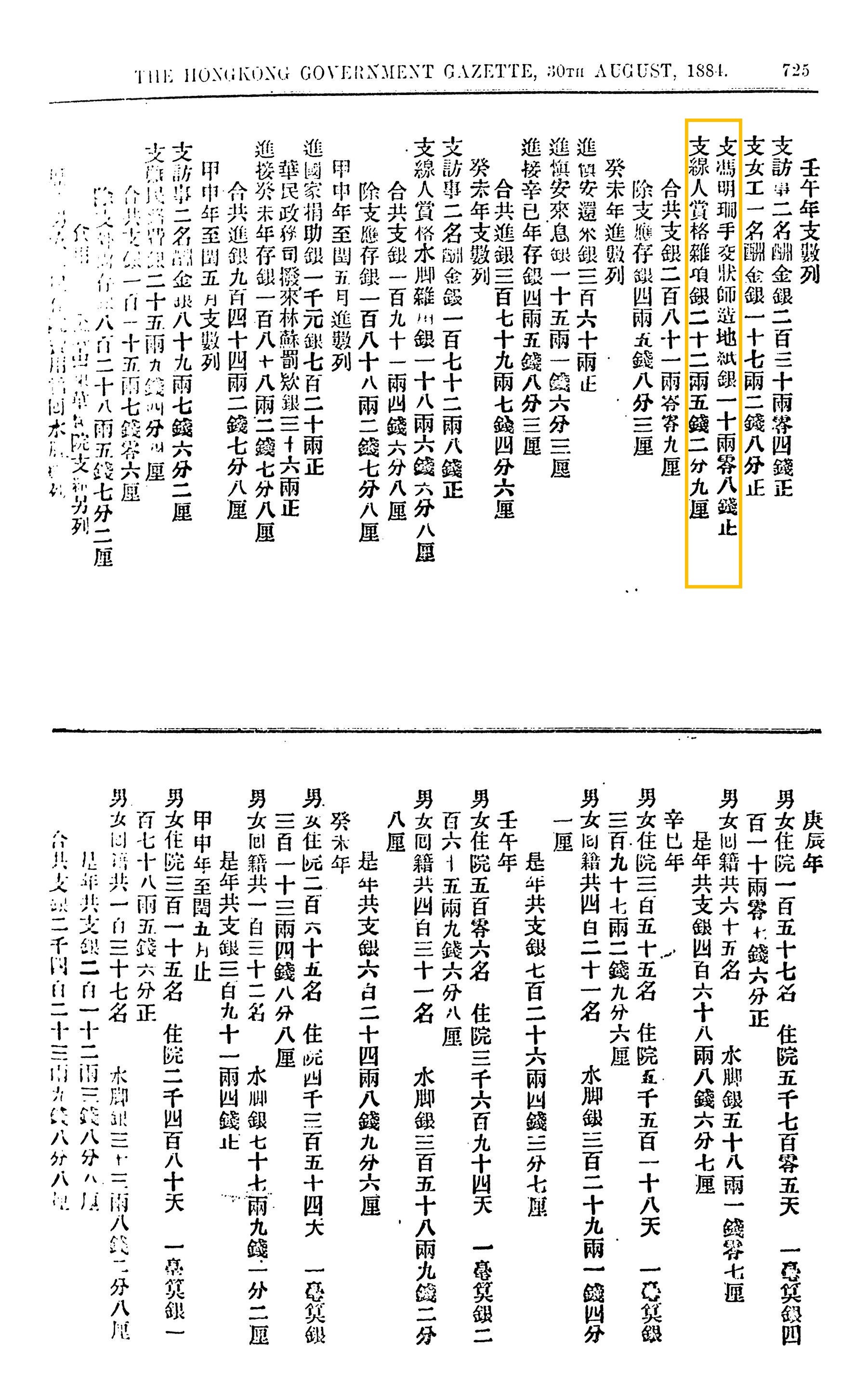
1880 年 6 月 24 日,輔政司的覆函(第 723 號)以盧禮屏、施笙階、馮明珊、謝達盛四人為收件人,正式批准設立防拐會,條件是章程與組織須呈政府核准、警察予以配合;7 月 3 日憲報刊出覆函,中文欄的抬頭是「香港保良局紳 盧禮屏 馮明珊 施笙階 謝達盛 等」 18。1881 年 4 月 29 日,華人團體再到港督府——憲報的英文記「introduced by Mr. FUNG MING-SHAN, Chairman of the Society for the Protection of Women and Children」 14;1881 年 7 月港督呈報倫敦時,直接稱他是「the Chairman of the To Leung Kuk」 2。1882 年 8 月 12 日,憲報刊出保良局 1882–83 年度值事會名單:「Mr. FUNG MING SHÁN, Merchant. President.」,副主席是伍秩庸(伍廷芳),中文欄作「馮明珊正主席、伍秩庸副主席」 19。1884 年 8 月,保良局把 1880 年以來的進支數目刊憲;1882–83 年(壬午年)的支出裏有一行「支馮明珊手交狀師造地舭銀一十兩界八錢止」——10 兩 8 錢,經他的手交給狀師 20。
四、歸化:1881 年 6 月 24 日
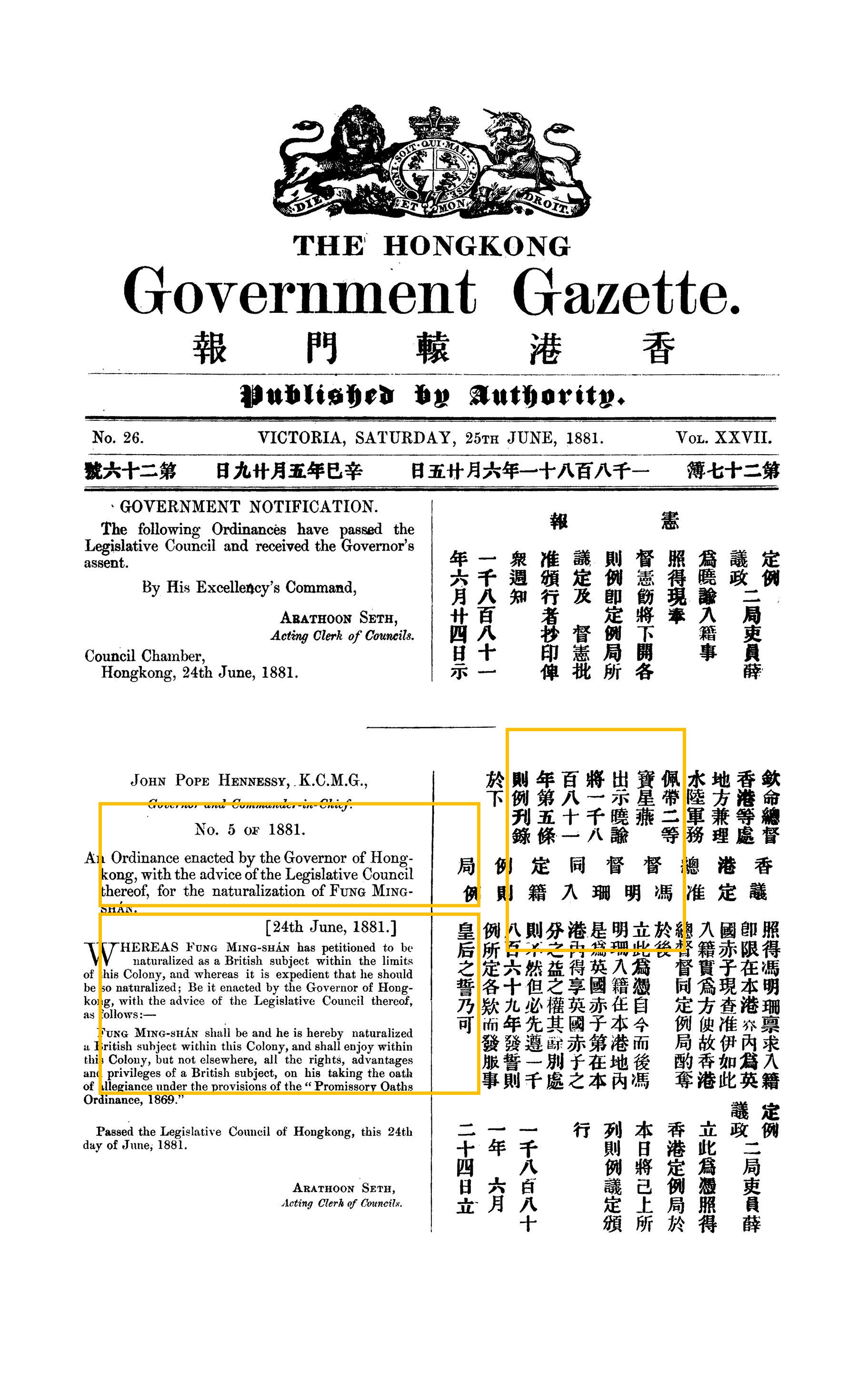
1881 年 6 月 13 日,定例局首讀三條歸化條例草案——馮明珊、黃社帶、施笙階 21;6 月 24 日,6 條條例一併通過:第 5 號是馮明珊,第 6 號黃社帶,第 7 號施笙階,第 8 號彭炎,第 9 號葉謙光,第 10 號袁敏才 2223。條文的格式完全相同:「WHEREAS FUNG MING-SHÁN has petitioned to be naturalized as a British subject within the limits of this Colony」——「馮明珊呈請在本殖民地內歸化為英籍」,然後一句「and whereas it is expedient that he should be so naturalized」(認為應予歸化),正文准他在本殖民地內享有英籍的權利,但「within this Colony, but not elsewhere」(不及於殖民地之外),條件是按《1869 年誓詞條例》(Promissory Oaths Ordinance, 1869)宣誓效忠 22。憲報中文欄的譯文以「照得馮明珊禀求入籍」開篇 22。
這一批歸化在倫敦引起了程序上的疑問。7 月 28 日,港督軒尼詩把 6 條條例呈交殖民地部,附上一份機密說明;殖民地部的內部批示寫着:「Was there not a recent correspondence on the subject of the naturalization of Chinese in Hong Kong?」(此前是否已有關於華人在香港歸化的來往文件?)與「Is there a precedent?」(有先例嗎?),最後批「no objection」(無異議) 2。軒尼詩的說明把 6 人的履歷逐一寫下,開篇即是那句「這是首次有華人在香港歸化」;馮明珊的一段包括:聖保羅書院的教育、有利銀行的買辦、廣謙和「of Australian Export Merchants」的主要合夥人、另一行號「I Shang Shan」澳洲出口商的合夥人、約值 10 萬元的不動產,以及保良局主席 2。10 月 24 日,港督發出確認公告,把 6 條條例呈請英女王批准;10 月 29 日,確認公告在憲報以中英兩欄刊出 2423。至此,開埠 40 年的香港,第一次有了華人英籍民——而這是先例,不是通例:同年的陪審員名單與其他紀錄裏,他們 6 人的身份仍是行號的買辦與商人。
五、山打根:甲必丹與顧問局(1888–1898)
1880 年代後期,馮明珊把他的一半事業移到了英屬北婆羅洲(British North Borneo)的山打根。1888 年 2 月,《孖剌西報》轉載《北婆羅洲先驅報》的報道:華人商界宴請北婆羅洲政府的官員與到訪使團,宴會「The chair was taken by Mr. Fong Ming Shan」,他在席上用英語致辭;報道同時記下他對北婆羅洲的推許——當地「將成為東方最重要的商港之一」 3;此條見史密夫卡片對該頁的引錄 3。1890 年 2 月,北婆羅洲東岸的「餉碼」(Farms)招標的結果見於香港報端:「The 'Farms' for this year have been let nominally to a Chinaman named Fung Ming Shang, but actually, I hear, to a syndicate at Hongkong with which Dr. Ho Kai is connected.」——名義上以馮明珊的名字投得,實際上的財團在香港,與何啟有關;東岸鴉片餉碼每月 4,650 元、出入口稅每月 1,500 元、山打根典當餉碼每月 120 元、賭博限制餉碼每月 3,200 元 25。名字的「Shang」是報紙的排印差異,次年同一報紙的稱呼已回到「Captain China, Mr Fung Ming Shan」。
1890 年 12 月,山打根成立華人顧問局(Chinese Advisory Board),馮明珊以「7 票對 10 票中的多數」當選主席;同日他向總督致謝,並就其他殖民地的排華法例發言:「the restrictive law which cause so much annoyance and inconvenience to the mass of their countrymen in other Colonies」 26。北婆羅洲總督 Crocker 同意成立顧問局時寫道:「I have lived for over 20 years amongst Chinese of all ranks and classes and have studied their laws and literature, and I know them to be a law abiding people…」 26。1892 年 12 月,《德臣西報》的一篇北婆羅洲通訊寫:「The Captain China, Mr Fung Ming Shan, has planted a considerable number of mulberry trees」——他在當地的種植園試種桑樹,與馬尼拉麻、棉花並列為「政府指導下的實驗作物」 27。由「甲必丹」到「Captain China」,他成了山打根華人社會的頭面人物。1892 年 4 月,他的 1878 年具禀在定例局被重新提起:議員 Whitehead 要求政府把「Petition to Government from Fung Ming Shan and other Chinese dated about 9th November, 1878, for permission to form an anti-kidnapping Association」提交議會 28。
六、其終與其後(1898–1935)
1898 年 11 月 15 日,馮明珊在廣州去世——這一日期見於兩份官方印刷品:最高法院註冊官 1905 年度報告的遺產名冊(「Fung Ming Shan alias Fung Chew, 15th Nov., 1898, at Canton, China」)29,以及 1907 年定例局文件的遺囑認證表(「Fung Ming Shan alias Fung Chew … Letters of Adm. …」)30。他的遺產在香港辦理:1906 年 7 月 26 日,遺產管理書發給他的兒子馮純三(Fung Shun Sam alias Fung Tin Sik),遺產值 6,000 元、遺產稅 120 元 30。1906 年 9 月,《士蔑新聞》轉載《北婆羅洲先驅報》的消息:香港狀師 C. E. H. Beavis(Wilkinson & Grist 律師行)抵達山打根,處理「the affairs of the late Captain-China, of Sandakan, Fung Ming Shan」;「Mr. Fung Shun Sam also arrived by the Borneo to see about his father's affairs」——他的兒子乘「Borneo」號抵達,辦理父親的事務 3132。
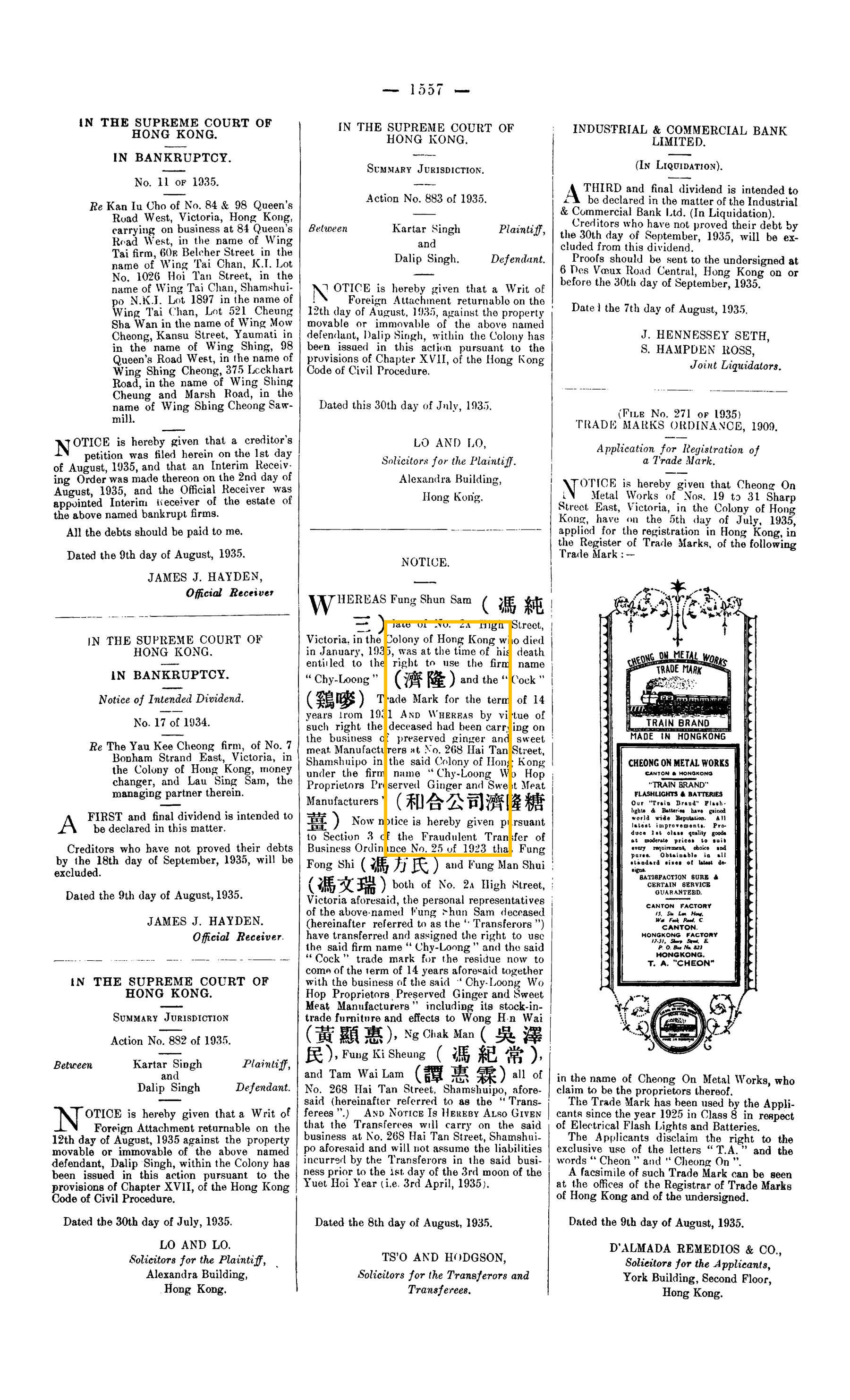
他留下的家人可以追到 1935 年。史密夫的卡片記下:遺孀馮譚氏(Fung Tam Shi),1905 年 8 月 23 日在堅道 48 號(48 Caine Road)去世;兩個兒子——馮鉅修(Fung Ku Shau,又名 Fung Tin Cheuk)1906 年去世,墓碑在香港墳場第 1 區 3 段 18 號([1/3/18]),《遺忘的靈魂》(Forgotten Souls)一書記該碑「comprador of the National Bank of China」、碑上帶「皇清」字樣;唯一在生的兒子馮純三(Fung Shun Sam,又名 Fung Tin Sik)住在雲咸街 38 號(38 Lyndhurst Terrace) 33334。1908 年,馮純三在法院被寡嫂以毆打控告(家庭訴訟,只作登記) 35;1911 年,他以九龍內地段第 130 號(K.M.L. 130)重整街道的物業申報 88,500 元的權益 36。他的生意是「濟隆」號(Chy-Leong)的糖薑與蜜餞:1935 年 1 月他去世後,憲報的商標轉讓公告寫明他自 1931 年起持有「濟隆」與「雞嘜」(Cock)商標 14 年,廠址在深水埗海壇街 268 號 37。
七、結論
「歸化」是一條私人條例,但它不是一個人的手續。1881 年的 6 條條例,把防拐會的東莞商人中的兩位(馮明珊、施笙階),與黃社帶、彭炎、葉謙光、袁敏才一起寫進香港的法律史:這是香港首次有華人歸化英籍 2。馮明珊的一生提供了這一步的全部背景:聖保羅書院的英文教育、西貢與香港之間的轉口貿易、兩家洋行的買辦、東華醫院與保良局的公職、以及從香港延伸到山打根的事業。他的記錄也有清楚的邊界:沒有出生年份,沒有歸化背後的個人理由(條例只說「expedient」),沒有遺像。可驗證的是事實的鏈條——62 家商號的印章、38 間屋與 41 個名字的名單、一封署名「for the provisional Committee」的英文信、一頁立法局的條例、一份山打根顧問局的選舉紀錄、一份寫着「15th Nov., 1898, at Canton」的遺產名冊——這些文件把一個東莞商人的一生,交給了後來的檔案。
Histsyn · Independent research
The First Chinese British Subject
Fung Ming-shan 馮明珊 (d. 1898), comprador of the Chartered Mercantile Bank, and the naturalisation of 1881
Abstract
On 24 June 1881 the Legislative Council of Hong Kong passed six private naturalisation ordinances in a single day — Nos. 5 to 10 of 1881 — making six Chinese residents British subjects within the Colony: Fung Ming-shan, Wong Shè-tái, Shi Shang-kái, P’ang Im, Ip Him-kwong and Un Man-ts’oi. The Governor’s covering despatch to the Earl of Kimberley states the point in its own words: “As this is the first time that any person of the Chinese race has been naturalised in Hongkong.” First in the batch, and the subject of this paper, is Fung Ming-shan (§ Ming-shan; alias Fung Pò-hi 馮普熙, alias Fung Chew) — a Dongguan merchant, comprador of the Chartered Mercantile Bank, principal partner of the Kwong Him Wo hong, a director of the Tung Wah Hospital, and the leading promoter of the society against kidnapping that became the Po Leung Kuk. The paper reconstructs his life from his own acts — his petitions, letters, committee seats and account lines — and follows him into his second world, Sandakan in British North Borneo, where he chaired the Chinese merchants’ dinner for Governor Crocker, took the East Coast farms in 1890, was elected President of the Chinese Advisory Board, and appears in the press as “the Captain China, Mr Fung Ming Shan”. He died at Canton on 15 November 1898; his estate was administered in Hong Kong in 1906, and his family’s record can be traced to a ginger-manufactory trade-mark notice of 1935.
Keywords: Fung Ming-shan; naturalisation; comprador; Kwong Him Wo; Po Leung Kuk; Sandakan; British North Borneo; 1881
1. Scope and method
This paper asks one question — how a Chinese merchant of Hong Kong came to be made British by a private Act in 1881 — and answers it with the subject’s own traces. The sources are the bilingual Government Gazette, whose Chinese columns carry his name and, on one leaf, his office; the English press of the colony (the China Mail, the Daily Press and the Hongkong Telegraph, the last without a scan series); the Colonial Office correspondence (CO 129/149, /193 and /194, read on the scans of the 1881 file and in whole-file transcripts of the rest); the sessional papers and the Registrar’s probate returns that carry his death, his estate and his sons; the directories that carry his firm’s addresses; and the modern literature (Carl T. Smith’s 1971 comprador notes 34 and his Chinese Christians 38, Elizabeth Sinn 39, Frank Welsh 40, the cemetery history Forgotten Souls 33, the Chinese lives 4142). The name battery ran every form separately — 馮明珊 (28 text hits), 馮普熙 (1 text, 26 image), “Fung Ming-shan” (39), “Fung Ming Shan” (99), “Fung Chew” (11) — because one person’s record is split across his forms: the British record keeps him Latin and official, the Chinese gazette columns keep him 馮明珊 and 馮普熙, and the alias that only the probate and the modern archive keep is “Fung Chew”. The identification rests on the corpus’s own pairing instrument: the deputation leaf of 19 February 1880, where one document’s English column prints “Fung Pò-hi (Ming-shan), Comprador of … the Chartered Mercantile Bank” and its Chinese column prints 「主筆王韜、有利銀行買辦馮普熙」 9. Two whole-document reads anchor the study: the 1880 kidnapping dossier as printed for the Council 8, and CO 129/193’s 678 pages, whose naturalisation despatches were read in their full context 2.
A note on the paper’s boundaries. The founding of the Po Leung Kuk as an institution has its own study in this series; this paper takes the man, and uses the society’s files only for his own acts inside it. The Chartered Mercantile Bank is printed here as the record prints it — and its Chinese name as the 1880 leaf prints it, 有利銀行; the bank’s later catalogue forms are a separate question. Names are rendered in Chinese where a period or near-period witness pairs them (馮明珊, 馮普熙, 廣謙和, 保良局, 伍秩庸), and left in English where the battery fails (A. H. Hogg; Ed. Schellhans; St Paul’s College).
2. The merchant: Saigon, the hong, the bank
Fung Ming-shan was a native of Dongguan (東莞) in Guangdong; no record states his birth year — the Chinese encyclopaedia entry says outright that his dates are unknown 1 — and the earliest fixed point in his record is an education. The Governor’s own dossier of 1881 says it: “Mr. Fung Ming Shan was trained at St Paul’s College, where he received a good English education.” 2 Carl T. Smith adds that he “may have been a classmate of Ng Choy (Wu Ting Fang)” there, and that the two were “partners in several land transactions in Hong Kong” 34; the cemetery history calls the friendship definite 33. Smith’s cards record him among the Bishop Smith Old Boys in 1864, and buying his first Hong Kong property in 1869 3. His earliest public act on the record is a signature: the merchants’ petition of 1871 against the licensed gaming houses, signed “Mingshan 馮明珊” 4. The first press trace is a lawsuit of June 1876 — “Mr Fung Ming Shan, manager of the …” — giving evidence in a short-delivery claim 5.
His hong was Kwong Him Wo, whose Chinese name 廣謙和 is settled by the Irish Distress Fund lists of May 1880, where the same subscription appears as “Kwong Him Wo Hong, 50.00” in the English list and 「廣謙和 五十圓」 in the Chinese 7. The directories place the firm at 36 Wing Lok Fong in 1876–79 and at 56 Bonham Strand from 1880, under “Principal Chinese Hongs” 6; the press market columns show it trading rice, cuttlefish and fungus through the later 1870s 43. In 1880 the Supreme Court described it as “the firm of Kwong Hin Wo, which carries on business at Hongkong and Saigon” 6, and Smith’s card preserves the arrangement behind the spelling: “Fung Ming-shan originally at Saigon until 1875 or 1876 as resident partner of deft’s firm, when replaced by Lo Chok Tong” 3. The Governor’s 1881 dossier describes the firm from the other side of the ledger — “the principal partner of the Kwong Him Wo firm of Australian Export Merchants, and also a partner in the I Shang Shan Australian Exporters firm” 2 — and Smith’s cards connect the second firm to a Sydney branch (the “I Shang Lung” of a partner’s 1879 will) 3.
Two compradorships span his working life. In the 1870s he was comprador to A. H. Hogg & Co. — Smith’s card records the 1871 embezzlement case of the firm’s shroff, with “Fung Ming-shan, compradore to A.G. Hogg” as defendant 3; by November 1878, when the anti-kidnapping committee first met, he appears in its minutes as “compradore of the Chartered Mercantile Bank” 8, and the 1881 dossier keeps him there 2. Smith’s cards add a third post: “1884 — compr. to Ed. Schellhans and Co.” 3.
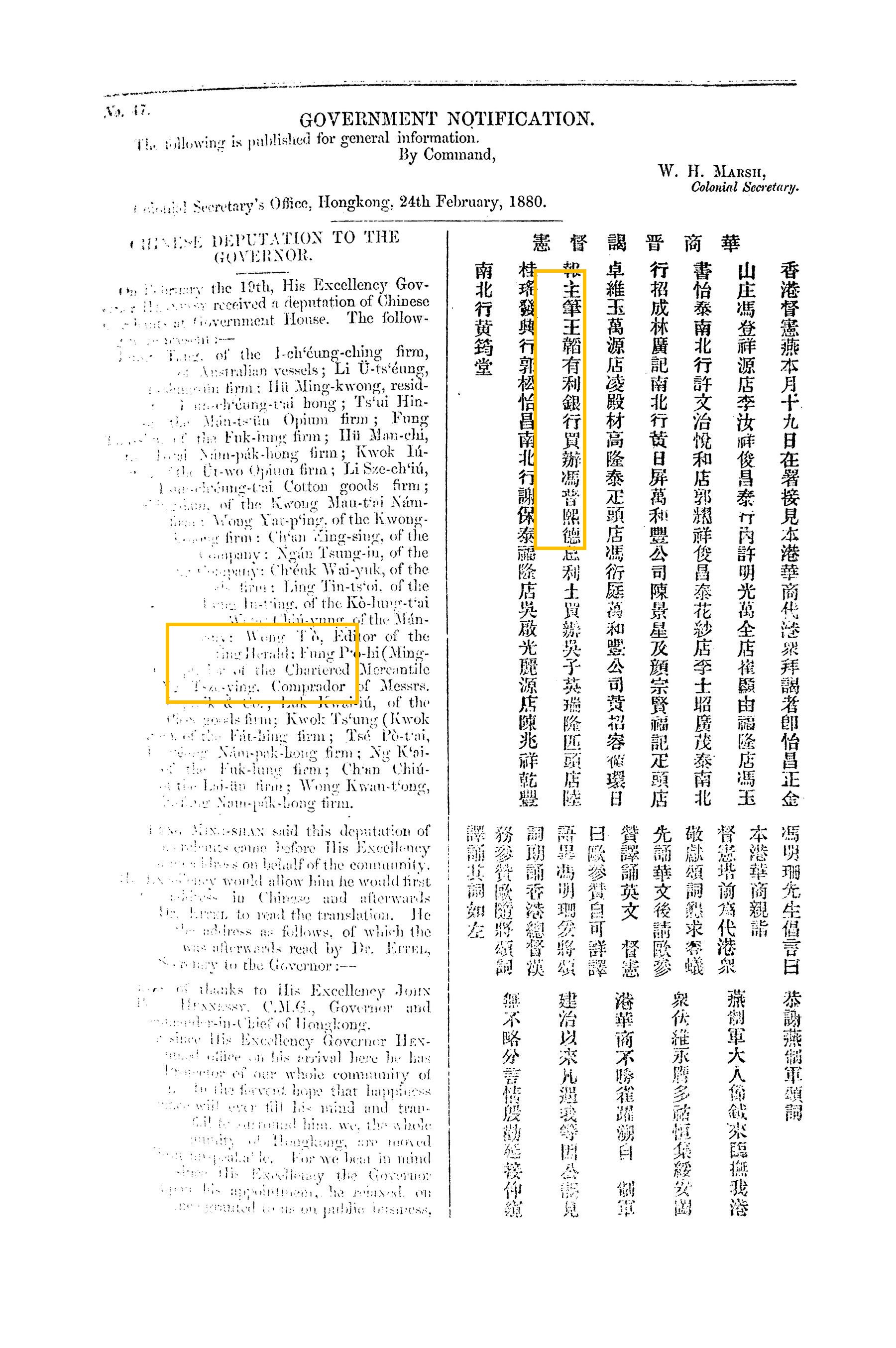
3. The community: the hospital, the society, the accounts
His public life begins with the Tung Wah Hospital. The inscription on the Stonecutters Island bones — the typhoon dead of 1874, re-buried under Governor Hennessy — is signed 「東華醫院董事:黃筠堂 招雨田 馮明珊 等敬泐」 10. In 1880 the Gazette prints him twice as a Tung Wah director of that year: in the board’s letter on medical scholarships (「東華醫院當年總理招雨田黃筠堂馮明珊等頓首」) 11, and in the directors’ election 12. The Chinese lives add the 1872 and 1879 directorships (web leg only, recorded as such) 1; the charity lists add a $100 personal subscription to the Irish Distress Fund of 1880, beside the hong’s $50 7.
The society against kidnapping is where his record is thickest. On 9 November 1878 four Dongguan merchants of Bonham Strand No. 3 — Lo Lai-ping, Shi Shang-kai, Fung Ming-shán and Tsé Tát-shing “and others” — petitioned the Governor for leave to raise rewards and hunt kidnappers, with the stamps of 62 shops attached and Eitel’s translation 816. On 28 November 1878, at the first committee meeting at the Magistracy, Fung Ming-shan tabled the two documents that gave the scheme its intelligence: a list of 38 houses in Sai-ying-p’un and Tai-p’ing-shán used as the kidnappers’ depôts, and the names of 21 and 41 professional kidnappers 8. He signed the committee’s letters — “For the provisional Committee. (Signed,) FUNG MING-SHÁN” (received 31 May 1879) 16; he sat on the Kidnapping Commission of 28 June 1879 8; and on 7 October 1879 the Governor thanked him by name: “I have recently expressed to Mr. Fung Ming-shan and the other Chinese gentlemen who nearly twelve months ago brought this important matter to my notice, my best thanks.” 8 He also wrote his own postscript to the community’s second petition that October — a complaint that the Daily Press had printed the petition “not authorized” 8. When permission came, the Colonial Secretary’s letter (No. 723, 24 June 1880) was addressed to the four, and the Gazette’s Chinese heading read 「香港保良局紳 盧禮屏 馮明珊 施笙階 謝達盛 等」 18. In April 1881 the community’s deputation to Government House was “introduced by Mr. FUNG MING-SHAN, Chairman of the Society for the Protection of Women and Children” 14; by July the Governor described him to London as “the Chairman of the To Leung Kuk” 2. The committee for 1882–83, gazetted on 12 August 1882, made it formal: “Mr. FUNG MING SHÁN, Merchant. President.” — with Ng Choy (Wu Ting-fang) as Vice-President 19.
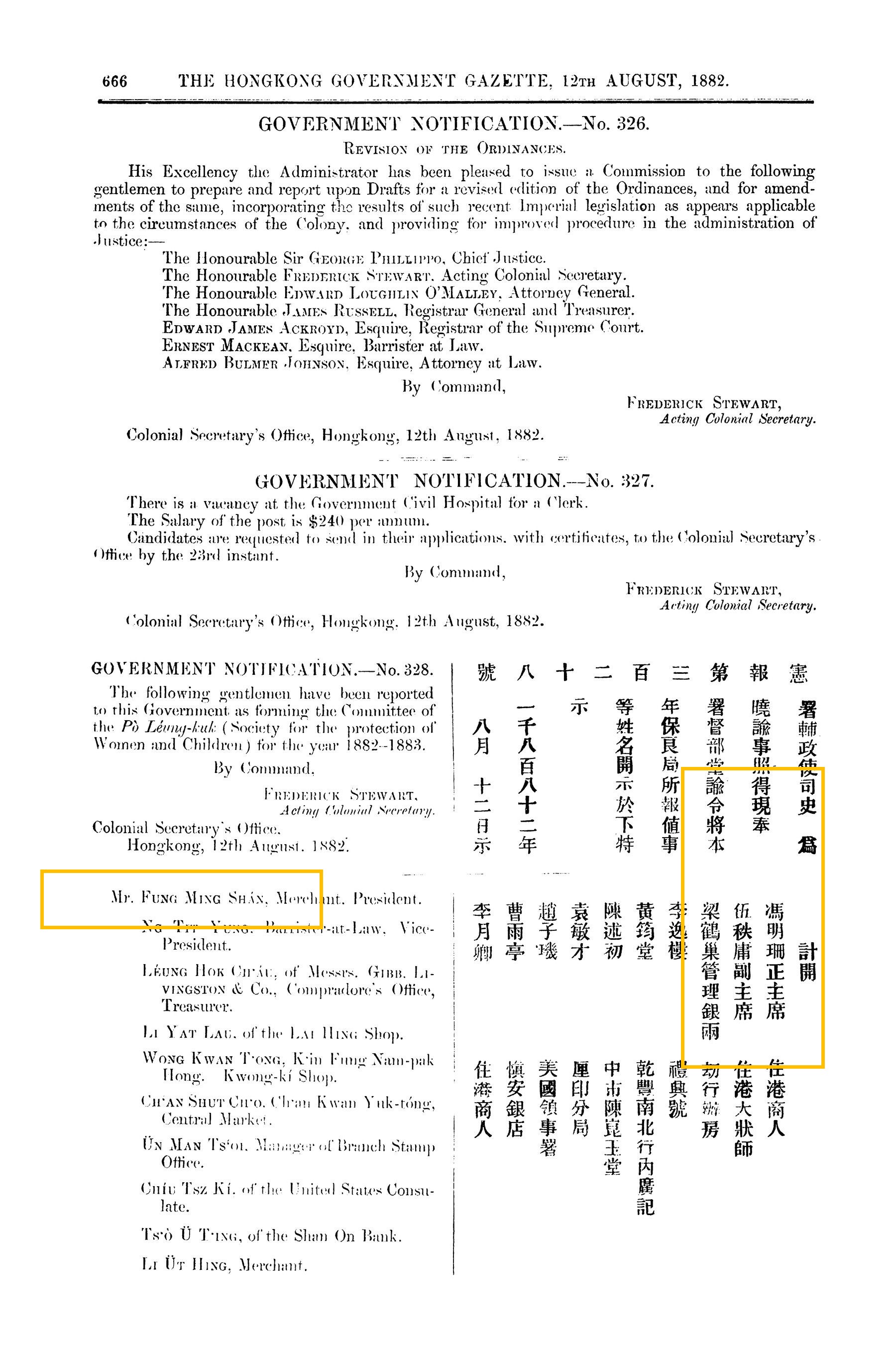
The accounts keep the smallest trace of all, and it is a good one. The Po Leung Kuk published its accounts 1880–84 in the Gazette of 30 August 1884; in the 壬午 year (1882–83) the expenditure includes the line 「支馮明珊手交狀師造地舭銀一十兩界八錢止」 — $10.80 handed by Fung Ming-shan to a solicitor 20. The society’s money passed through his hands, and the printed account says so.
4. The naturalisation: 24 June 1881
The bills were read a first time on 13 June 1881 21 and passed on 24 June. The Gazette of 25 June 1881 prints them as passed: No. 5 of 1881, “An Ordinance for the naturalization of FUNG MING-SHÁN”, then Nos. 6–10 for Wong Shè-tái (黃社帶), Shi Shang-kái (施笙階), P’ang Im (彭炎), Ip Him-kwong (葉謙光) and Un Man-ts’oi (袁敏才) — six private acts, one man each 2223. The ordinance’s formula is bare and identical in every case: “WHEREAS FUNG MING-SHÁN has petitioned to be naturalized as a British subject within the limits of this Colony, and whereas it is expedient that he should be so naturalized”; the subject is naturalised “within this Colony, but not elsewhere”, on taking the oath of allegiance under the Promissory Oaths Ordinance, 1869 22. The Chinese column of the same leaf opens 「照得馮明珊禀求入籍」 22.
The despatch that carried the six ordinances to London is the paper’s central document. Governor Hennessy’s No. 114 of 28 July 1881 opens its statement with the claim of firstness — “As this is the first time that any person of the Chinese race has been naturalised in Hongkong, I venture respectfully to submit for Her Majesty’s information the following brief statement respecting the individuals referred to in the enclosed Ordinances” — and then sets out, in the Governor’s own hand, who each man was. Fung Ming-shan’s paragraph is the fullest biographical notice he ever received: St Paul’s College; “Compradore or Chinese manager of the Chartered Mercantile Bank”; principal partner of Kwong Him Wo, “Australian Export Merchants”; partner in the I Shang Shan firm; owner of land and houses “supposed to be worth $100,000”; “Chairman of the To Leung Kuk, or Society, established with Your Lordship’s sanction for the prevention of Kidnapping and the Protection of Women and Children” 2. Wong Shè-tái’s paragraph — “compradore to Mr. Belilios”, worth over $60,000, married in Australia to an English lady of Chinese extraction, partner in the same export firms — shows that this was a cohort, not a list: the naturalised six were the kidnapping society’s merchants and their peers 2. The Colonial Office minutes, in the same file, ask the questions the firstness raised — “Was there not a recent correspondence on the subject of the naturalization of Chinese in Hong Kong?” and “Is there a precedent?” — and close with “no objection” 2. The confirmation proclamation went out on 24 October and was printed bilingually on 29 October 1881 2423.
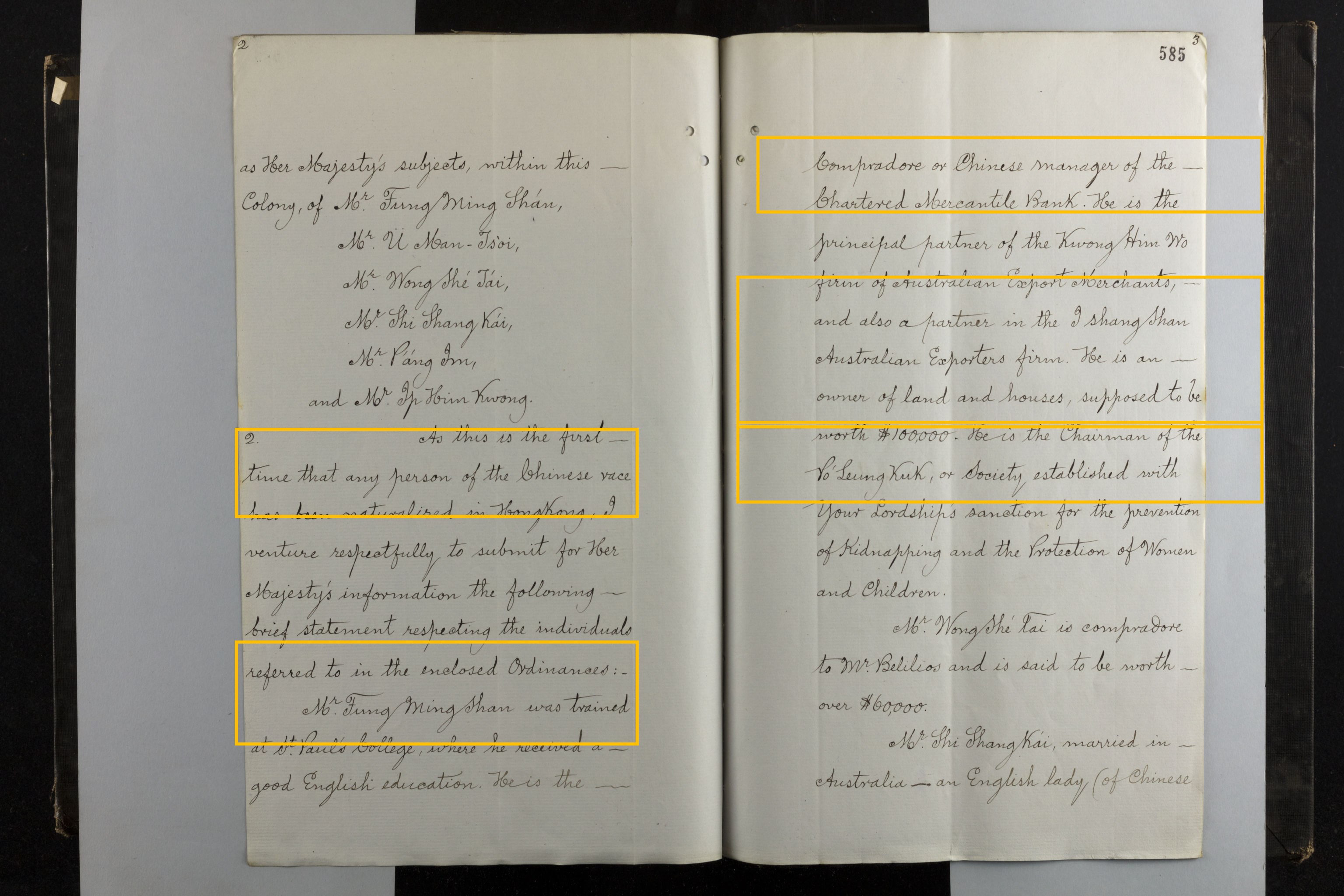
Why six private ordinances rather than a general law? The file answers by absence: the colony had no general naturalisation statute — an 1880 file had noted, in another cause, that “the want of a naturalization law in this colony” kept even the Portuguese from volunteering — and so each man was naturalised by his own Act, the route used for individuals before and after 2. What each man wanted from it the record does not say; the ordinances say only that the petitioner asked and that it was “expedient”. The consequences are visible in the lists: Fung Ming-shan and his fellow-townsman sit on the 1881 and 1882 jury lists as “Fung Ming-shan, comprador” 15, and Smith’s cards record his jury service continuing through 1883 3.
5. Sandakan: the Captain China
In the late 1880s Fung Ming-shan’s name moves to British North Borneo. In February 1888 the Hong Kong Daily Press reprinted a British North Borneo Herald account of a dinner given to the visiting officials by “the Chinese merchants of the place”, at which “the chair was taken by Mr. Fong Ming Shan”, who spoke in English; the speech praised the country’s prospects and looked to “the co-optation of General Wong Yang” 3. In February 1890 the Hongkong Telegraph’s Borneo notes report the East Coast “Farms” for the year: “let nominally to a Chinaman named Fung Ming Shang, but actually, I hear, to a syndicate at Hongkong with which Dr. Ho Kai is connected” — opium $4,650 a month, import and export duties $1,500, Sandakan pawnbroking $120, and the gambling-restriction farm $3,200 25. In December 1890, when Sandakan established its Chinese Advisory Board, the same paper reports: “Mr. Fung Ming Shan returned thanks to His Excellency on behalf of himself and the other members of the Board, and was elected President of the Advisory Board by a majority of seven out of ten votes” — and quotes Governor Crocker’s words on consenting to the Board: “I have lived for over 20 years amongst Chinese of all ranks and classes and have studied their laws and literature…” 26.
By 1892 his Sandakan title is the old one: “The Captain China, Mr Fung Ming Shan, has planted a considerable number of mulberry trees” — the silk experiment among the plantation trials of the coast 27. Whether he held the office of Kapitan Cina or carried the courtesy title is not settled by these notices; what they settle is the position — the colony’s ranking Chinese, chairing its dinners, elected its Board’s president, planting its experiments. His Hong Kong record meanwhile kept resurfacing: in April 1892 a Legislative councillor moved for the papers of his 1878 petition, “Petition to Government from Fung Ming Shan and other Chinese dated about 9th November, 1878, for permission to form an anti-kidnapping Association” 28; and in November 1896 the China Mail, reporting the society’s building event, says it is “glad to see amongst us Mr Fung Ming Shan, who is one of the promoters of the Society” 3.
6. Death, estate, family
Fung Ming-shan died at Canton on 15 November 1898. Two official prints carry the date: the Registrar of the Supreme Court’s report for 1905 — “Fung Ming Shan alias Fung Chew, 15th Nov., 1898, at Canton, China” 29 — and the Calendar of Probates in the Sessional Paper for 1907, where his estate row reads “Fung Ming Shan alias Fung Chew … Letters of Adm. … Fung Shun Sam alias Fung Tin Sik, son … $6,000”, with the grant dated 26 July 1906 30. The administration came so late because the affairs were in two jurisdictions. In September 1906 the Telegraph reprinted the British North Borneo Herald: “Mr. C. E. H. Beavis, solicitor, Hongkong, from the firms of Messrs. Wilkinson and Grist, arrived in Sandakan by s.s. Borneo … in connection with the affairs of the late Captain-China, of Sandakan, Fung Ming Shan”; and “Mr. Fung Shun Sam also arrived by the Borneo to see about his father’s affairs” 3132.
The family record continues into the next generation. Carl Smith’s cards give the widow’s name and death — Fung Tam Shi 馮譚氏, died 23 August 1905, at 48 Caine Road — and the sons: Fung Ku Shau (alias Fung Tin Cheuk), “comprador of the National Bank of China”, died 1906, whose monument stands in the Hong Kong Cemetery at plot [1/3/18] with the Ching-loyalty characters on its inscription 333; and the surviving son Fung Shun Sam (alias Fung Tin Sik) of 38 Lyndhurst Terrace 3. In 1911 Fung Shun Sam claimed $88,500 in the Kowloon reclamation proceedings for property in K.M.L. 130 (Reclamation Street) 36. The family’s trade outlived them: the trade-mark notice of August 1935 records “Fung Shun Sam (馮純三) late of No. 2a High Street … who died in January, 1935” and his firm “Chy-Leong” (濟隆) and the “Cock” (雞嘜) brand — preserved ginger and sweet-meat makers of 268 Hai Tan Street, Shamshuipo 37. The export merchants’ son sold ginger; the ginger went, in all likelihood, where the hong’s trade had always gone.
7. What the record cannot settle
Four boundaries should be stated. First, no birth year or village exists for Fung Ming-shan in any source consulted; the Chinese entry concedes the gap in its own words 1. Second, no document states why he sought naturalisation; the ordinances say “expedient”, and the businessman’s reasons — property, standing, jury service, travel — are inference, not record. Third, the Sandakan office is reported, not described: the press calls him Captain China and shows him presiding over the Chinese Advisory Board; no commission, warrant or salary has been found. Fourth, the modern Chinese works call him a “founder of the Nam Pak Hong kong-so” — a claim this corpus does not carry; it is recorded in the register and not asserted 42. Fifth, the cemetery book names his son’s father “Fung Ping Shan” — an error of names that the same page’s own alias list (Po Ha, Chew) and biography expose, since the philanthropist Fung Ping Shan (1860–1931) is another man entirely; this paper keeps the corpus’s forms, 馮明珊 / Fung Ming-shan 33.
Two smaller cautions. The 1890 farms notice prints the name “Fung Ming Shang”; the spelling differs, the context (Sandakan, the Hong Kong syndicate of a man who appears in Sandakan every year of the decade) identifies him, and the variance is registered rather than buried 25. And the 1898 China Fire Insurance meeting lists a “Fung Ming Shao” among the shareholders — kept here as a variance, since Smith’s cards show him at the same company’s meeting in 1880 443.
Conclusion
The naturalisation of 1881 was a private Act and a public fact. It made six named Chinese — merchants of Dongguan and their peers — British within the Colony, on their own petitions, one ordinance each, because the colony had no general law to do it with. The first of the six, Fung Ming-shan, carried into the statute-book the whole apparatus of a merchant’s life: a mission school education, two compradorships, a hong that traded with Saigon and Sydney, a hospital directorship, the command of a private detective force against the kidnappers, and a second career across the water in Borneo, where he ended as the Captain China of Sandakan. The record of that life is not a narrative but a chain of documents — sixty-two shop seals, thirty-eight houses, forty-one names, one letter signed for a provisional committee, one ordinance of thirteen lines, one election count, one probate row that says “at Canton” and leaves the rest to the archive.
Appendix A — Query log and pulls (summary)
Battery (2026-11-12/13, both indices, each name-form counted separately): 馮明珊 28 text / 46 image; 馮普熙 1 / 26; 普熙 4 / 38; Fung Ming-shan 39 / 55; Fung Ming Shan 99 / 73; Fung Mingshan 1 / 0; Fung Po-hai 2 / 2; Fung Po-hi 1 / 1; Fung Chew 11 / 7; Kwong Him Wo (all spellings) 41 / 26; 廣謙和 12; 廣興和 15 / 43 (a different firm — registered, not used); A. H. Hogg 13 / 20; 有利銀行 1,342 / 4,342; “Anti-kidnapping Association” 14 / 8. Date-window sweeps: 1871; 1876–1882; 1883–89; 1890–1905; 1900–41. Whole-document reads: CO 129/193 (678 pp.) and CO 129/194 (535 pp.) dumped and read; the Gazette dossier doc 683461 (30 pp.) pulled whole. Page pulls (ids): 284301; 1667691 ff.; 1667785; 1668170; 1667923/1667928; 1668148; 1668222; 1666745; 1667115; 1666996; 1666997; 1667407/1667408; 1663355; 1665882; 1666594/1665253; 1607318; 1826322/1826323/1826330; 1888606; 1890002; 1901696; 1906684; 1907593; 1912902; 2198696; 2202911; 2213948; 2828562; 2829679; 2838676; 2845029; 2846735; 2854451; 2856292; 2856328; 2861735; 431780; 309355/309358; 309252 (despatch). Image twins fetched and eye-read with the archive session for the six plates; the Smith cards (CARD-12823/12825/13237/57819/64597) were read for verification only.
Appendix B — Evidence register (summary)
Confirmed: the name pairings (deputation leaf; probate); the hong 廣謙和 and its Irish-fund pairing; the compradorship chain (Hogg 1871–72 → Chartered Mercantile by 1878–81 → Schellhans by 1884; the last two steps from the Smith archive); Ordinance No. 5 of 1881 and the firstness claim (English and Chinese columns; the Governor’s despatch); the death date 15 Nov 1898 (two official prints); the 1906 administration to the son; the Sandakan presidency and Captain China title (two press years). Single-witness: the 1871 gaming petition; the 1888 Sandakan dinner; the 1890 farms notice (spelling variance); the 1896 “promoter” line; the 1898 insurance meeting (spelling variance); the 1872/1879 Tung Wah directorships (web leg); the 南北行公所 founder claim (modern works only — recorded, not asserted). Gaps: birth year and village; the naturalisation petition itself; the oath record; the Sandakan appointment; the widow’s own notice; a portrait. Do-not: “Fung Ping Shan” as the man’s name; the 1906 Form IV prize-list “Fung Ku Shau”; the “Fung Ming” steamers; the post-1900 “Fung Ming” police-court hits.
Notes
中文百科全書「馮明珊」 (the web biography: 有利銀行買辦; friend of Wang Tao; the 藏書樓 and the printing of 王韜《普法戰紀》; 「1881年6月被港府批准加入英籍」; 「其生卒年不詳」). https://www.newton.com.tw/wiki/%E9%A6%AE%E6%98%8E%E7%8F%8A/9136858 (accessed 2026-11-13). ↩
CO 129/193 (Governor Hennessy, 1881 [5–7]): Despatch No. 114 of 28 July 1881 to the Earl of Kimberley, “Ordinances No 5, 6, 7, 8, 9 and 10 of 1881 ‘Naturalising certain Chinese’”, with the Governor’s statements on the six men (“As this is the first time that any person of the Chinese race has been naturalised in Hongkong”; “Mr. Fung Ming Shan was trained at St Paul’s College… Compradore or Chinese manager of the Chartered Mercantile Bank… the Kwong Him Wo firm of Australian Export Merchants… Chairman of the To Leung Kuk”), the Attorney-General’s reports and the Colonial Office minutes. Read on the scan: https://hkintexts.histsyn.com/image-page/3617594 (despatch) and /3617602 (report on No. 5) (accessed 2026-11-13; text series https://hkintexts.histsyn.com/page/309252). ↩
Carl T. Smith research cards, CARD-12823 / 12825 / 13237 / 57819 / 64597 (the Smith collection; consulted in the archive viewer 2026-11-13) — the family index (widow Fung Tam Shi, d. 23 August 1905; sons Fung Tin Cheuk/Fung Ku Shu and Fung Shun Sam/Fung Tin Sik, 38 Lyndhurst Terrace), the 1872 Hogg compradorship, the 1884 Ed. Schellhans & Co. compradorship, jury lists 1881–83, and the Saigon resident-partnership note (“originally at Saigon until 1875 or 1876 … replaced by Lo Chok Tong”). ↩
“Petition to Abolish Licensed Gaming Houses”, signed (as OCR reads) “Jung Mingshan 馮明珊 … et al.”, CO 129/149 (Lieut-Governor Whitfield), 1871, p. 196. https://hkintexts.histsyn.com/page/284301 (accessed 2026-11-13). ↩
“Mr Fung Ming Shan, manager of the …”, China Mail, 14 June 1876, p. 3. https://hkintexts.histsyn.com/page/1888606 (accessed 2026-11-13). ↩
The Saigon partnership case (“the firm of Kwong Hin Wo, which carries on business at Hongkong and Saigon”), Hongkong Telegraph, 3 February 1890, p. 3, https://hkintexts.histsyn.com/page/2828562 — the 1880 case reports: Daily Press, 26 September 1880 and ff. (listed in the Smith card, CARD-13237); and the Hongkong and Shanghai Bank suit against the firm, CARD-13237 (Smith archive, consulted 2026-11-13). ↩
“Hongkong Irish Distress Fund Subscription List” (English), Gazette, May 1880, https://hkintexts.histsyn.com/page/1667923 ; the Chinese list printing 「廣謙和 五十圓」, https://hkintexts.histsyn.com/page/1667928 (accessed 2026-11-13). ↩
“Papers relating to the purchase and detention of children, kidnapping, and so called domestic servitude in Hongkong” (the petitions of 9 November 1878 and October 1879, the meeting minutes of 28 November 1878, and Fung Ming-shan’s letters of 31 May 1879), Hongkong Government Gazette, 4 and 18 February 1880, printed pp. 99–133 and ff. https://hkintexts.histsyn.com/page/1667691 (accessed 2026-11-13). ↩
“Chinese Deputation to the Governor” (the deputation of 19 February 1880), Gazette, 24 February 1880; the English list prints “Fung Pò-hi (Ming-shan), Comprador of … the Chartered Mercantile [Bank]” and the Chinese column prints 「主筆王韜、有利銀行買辦馮普熙」. Read on the scan: https://hkintexts.histsyn.com/image-page/1491235 (accessed 2026-11-13; text series https://hkintexts.histsyn.com/page/1667785). ↩
《香港碑銘彙編》: the 義塚 inscription on the Stonecutters Island bones re-buried under Governor Hennessy, signed 「東華醫院董事:黃筠堂 招雨田 馮明珊 等敬泐」. https://hkintexts.histsyn.com/page/1651905 (accessed 2026-11-13). ↩
The Tung Wah directors’ letter on medical scholarships (「東華醫院當年總理招雨田黃筠堂馮明珊等頓首」), Gazette, 1880. https://hkintexts.histsyn.com/page/1668148 (accessed 2026-11-13). ↩
“Election of Directors for 1880 and Balance Sheet for 1879 — Tung-wa Hospital”, Gazette, 1880. https://hkintexts.histsyn.com/page/1668222 (accessed 2026-11-13). ↩
The congratulatory address (signatories include 「FUNG MING-SHAN 馮明珊」), Gazette, 23 April 1881. https://hkintexts.histsyn.com/page/1666745 (accessed 2026-11-13). ↩
“Congratulatory Address by Chinese on fourth anniversary of Governor Hennessy’s arrival”, Gazette, 30 April 1881. https://hkintexts.histsyn.com/page/1667115 (accessed 2026-11-13). ↩
The jury list for 1881 (Fung Ming-shan, comprador), Gazette, 5 March 1881. https://hkintexts.histsyn.com/page/1666594 ; the 1882 list, https://hkintexts.histsyn.com/page/1665253 (accessed 2026-11-13). ↩
CO 129/194 (Governor Hennessy / Administrator Tonnochy, 1881 [8–9]), the kidnapping papers: the petition of the Tung-kún merchants (Lo Lai-ping, Shi Shang-kai, Fung Ming-shán, Tsé Tát-shing and others, “of Bonham Strand, No. 3”) at pp. 16 ff., https://hkintexts.histsyn.com/page/309355 ; and the letter “For the provisional Committee. (Signed,) FUNG MING-SHÁN” (received 31 May 1879) at p. 19, https://hkintexts.histsyn.com/page/309358 (accessed 2026-11-13). ↩
zh.wikipedia「保良局」 (the Dongguan founders; 馮普熙(明珊); the 1878-11-08 date). https://zh.wikipedia.org/zh-hk/%E4%BF%9D%E8%89%AF%E5%B1%80 (accessed 2026-11-13). ↩
The Colonial Secretary’s letter No. 723 (24 June 1880) to “Messrs. Lò Lai-ping, Shi Shang-kai, Fung Ming-shán, Tsé Tát-shing, and others”, printed with the society’s papers, Gazette, 3 July 1880. https://hkintexts.histsyn.com/page/1668170 (accessed 2026-11-13). ↩
The Po Leung Kuk committee for 1882–83 (G.N. No. 328): “Mr. FUNG MING SHÁN, Merchant. President.”, with the Chinese column 「馮明珊正主席」, Gazette, 12 August 1882, printed p. 666. Read on the scan: https://hkintexts.histsyn.com/image-page/1515757 (accessed 2026-11-13; text series https://hkintexts.histsyn.com/page/1665882). ↩
The Po Leung Kuk accounts 1880–84 (G.N. 314), Gazette, 30 August 1884, printed p. 725; the 壬午 column prints 「支馮明珊手交狀師造地舭銀一十兩界八錢止」. Read on the scan: https://hkintexts.histsyn.com/image-page/1522230 (accessed 2026-11-13; text series https://hkintexts.histsyn.com/page/1663355). ↩
“Naturalization Bills read a first time”, Gazette, 18 June 1881. https://hkintexts.histsyn.com/page/1666996 (accessed 2026-11-13). ↩
“The following Ordinances have passed… No. 5 of 1881. An Ordinance … for the naturalization of FUNG MING-SHÁN. [24th June, 1881.]”, Gazette, 25 June 1881, with the Chinese column 「照得馮明珊禀求入籍」. Read on the scan: https://hkintexts.histsyn.com/image-page/1505169 (accessed 2026-11-13; text series https://hkintexts.histsyn.com/page/1666997). ↩
The confirming proclamation printed in both languages (the English lists Nos. 5–10; the Chinese list gives 葉謙光 (No. 9) and 袁敏才 (No. 10)), Gazette, 29 October 1881. https://hkintexts.histsyn.com/page/1667408 (accessed 2026-11-13). ↩
Proclamation No. 8 (24 October 1881, confirmation of Ordinances Nos. 5–10 of 1881 transmitted for the Queen’s allowance), Gazette, 24 October 1881. https://hkintexts.histsyn.com/page/1667407 (accessed 2026-11-13). ↩
The British North Borneo “Farms” item (“let nominally to a Chinaman named Fung Ming Shang, but actually … to a syndicate at Hongkong with which Dr. Ho Kai is connected”), Hongkong Telegraph, 3 February 1890, p. 3. https://hkintexts.histsyn.com/page/2828562 (accessed 2026-11-13). ↩
The Chinese Advisory Board at Sandakan (“Mr. Fung Ming Shan returned thanks to His Excellency … and was elected President of the Advisory Board by a majority of seven out of ten votes”; the Governor’s words on consenting to the Board), Hongkong Telegraph, 3 December 1890, p. 3. https://hkintexts.histsyn.com/page/2829679 (accessed 2026-11-13). ↩
“The Captain China, Mr Fung Ming Shan, has planted a considerable number of mulberry trees”, China Mail, 2 December 1892, p. 3. https://hkintexts.histsyn.com/page/1907593 (accessed 2026-11-13). ↩
Legislative Council question (Hon. T. H. Whitehead, 25 April 1892) for “copy of … Petition to Government from Fung Ming Shan and other Chinese dated about 9th November, 1878, for permission to form an anti-kidnapping Association with power to employ detectives”, China Mail, 25 April 1892, p. 4. https://hkintexts.histsyn.com/page/1906684 (accessed 2026-11-13). ↩
“Report of the Registrar of the Supreme Court for 1905”: “Fung Ming Shan alias Fung Chew, 15th Nov., 1898, at Canton, China”, Gazette, 1906. https://hkintexts.histsyn.com/page/1607318 (accessed 2026-11-13). ↩
“Calendar of Probates and Letters of Administration”, Sessional Paper 1907, pp. 106–107 and 114: “Fung Ming Shan alias Fung Chew … Letters of Adm. … Fung Shun Sam alias Fung Tin Sik, son … $6,000” (grant 26 July 1906). https://hkintexts.histsyn.com/page/1826323 ; /1826322 ; /1826330 (accessed 2026-11-13). ↩
“the affairs of the late Captain-China, of Sandakan, Fung Ming Shan … Mr. Fung Shun Sam also arrived by the Borneo to see about his father’s affairs” (reprinting the British North Borneo Herald of 1 September 1906), Hongkong Telegraph, 11 September 1906, p. 4. https://hkintexts.histsyn.com/page/2856292 (accessed 2026-11-13). ↩
The Sandakan estate item continued, Hongkong Telegraph, 15 September 1906, p. 8. https://hkintexts.histsyn.com/page/2856328 (accessed 2026-11-13). ↩
Patricia Lim, Forgotten Souls: A Social History of the Hong Kong Cemetery, on the monument of Fung Ku Shau [plot 1/3/18], “son of [Fung Ming-shan], alias Fung Po Ha alias Fung Chew, one of the founders of the Tung Wah Hospital … educated at St. Paul’s College and … a close friend and a classmate of Ng Choy (Wu Ting-fang).” https://hkintexts.histsyn.com/page/3186013 (accessed 2026-11-13). ↩
Carl T. Smith, “[Notes on Chinese compradors]”, Journal of the Royal Asiatic Society Hong Kong Branch, 1971, p. 106: “Fung Ming Shan alias Fung Po Hai alias Fung Chew … compradore to A.H. Hogg and Company, but later … the Chartered Mercantile Bank … may have been a classmate of Ng Choy (Wu Ting Fang) at St. Paul’s College … He died in 1898, leaving a widow and two sons, one of whom died in 1906.” https://hkintexts.histsyn.com/page/206289 (accessed 2026-11-13). ↩
“Mrs. Chow Lai Yung, a widow … prosecuted her late husband’s brother — Fung Shun Sam — for assaulting her”, Hongkong Telegraph, 17 November 1908, p. 4. https://hkintexts.histsyn.com/page/2861735 (accessed 2026-11-13). ↩
CO 129/377 (Governor Sir F. Lugard, 1911): the Kowloon reclamation property claims — “Fung Shun Sam | R.P. of S.S.3 of Nos. 126, 128, Sec. B of K.M.L. 130 Recln. St. 29 | $88,500”, filed via Messrs. Wilkinson & Grist. https://hkintexts.histsyn.com/page/431780 (accessed 2026-11-13). ↩
The trade-mark transfer notice: “WHEREAS Fung Shun Sam (馮純三) late of No. 2a High Street, Victoria … who died in January, 1935 … the firm name ‘Chy-Leong’ (濟隆) and the ‘Cock’ (雞嘜) Trade Mark … preserved ginger and sweet meat Manufacturers at No. 268 Hai Tan Street, Shamshuipo”, Gazette supplement, August 1935, printed p. 1557. Read on the scan: https://hkintexts.histsyn.com/image-page/1501448 (accessed 2026-11-13). ↩
Carl T. Smith, Chinese Christians: Elites, Middlemen, and the Church in Hong Kong (the fung-chew cross-reference: “Fung Ming-shan … alias Fung Po-hai … alias Fung Chew … compradore to A.H. Hogg and Company in the 1870s”). https://hkintexts.histsyn.com/page/3185995 (accessed 2026-11-13). ↩
Elizabeth Sinn, Power and Charity: A Chinese Merchant Elite in Hong Kong, p. 129 (Fung Ming-shan). https://hkintexts.histsyn.com/page/3186070 (accessed 2026-11-13). ↩
Frank Welsh, A History of Hong Kong: “Some respectable Chinese led by Fung Ming-shan, a rich and well-known compradore and a director of the Tung Wah.” https://hkintexts.histsyn.com/page/3186206 (accessed 2026-11-13). ↩
《香港人之香港史 1841–1945》 (the Dongguan directors’ petition of 1878 and the society’s founding). https://hkintexts.histsyn.com/page/3186170 (accessed 2026-11-13). ↩
《香港簡史》 (the modern claim that Fung Ming-shan was founder of the 南北行公所 — recorded, not asserted). https://hkintexts.histsyn.com/page/3186294 (accessed 2026-11-13). ↩
“Fung Ming Shan, merchant, the Kwong Him Wo Hong”, China Mail, 5 February 1878, p. 2. https://hkintexts.histsyn.com/page/1890002 (accessed 2026-11-13). ↩
The China Fire Insurance Co.’s 29th ordinary meeting (“Fung Ming Shao” in the shareholders present — spelling variance), Hongkong Telegraph, 28 February 1898, p. 2. https://hkintexts.histsyn.com/page/2838676 (accessed 2026-11-13). ↩