天星:渡輪服務、公司與法例,1876–1941
天星:渡輪服務、公司與法例,1876–1941
摘要:維多利亞港的渡輪服務早於其公司而存在——1876年的報紙已記錄十仙的過海航程;使它成名的船隊則在 1880 年代以「Morning Star」之名運作,1891 年已設頭等、二等、三等艙,三等一仙。「Star Ferry」之名先於公司:船隻 1884 年已以「Star」命名,報刊使用「Star Ferry」早至 1889 年(1897 年 1 月的讀者投書直呼「the Star Ferry Service」),而公司 Star Ferry Company, Limited 要到 1898 年才見於拍賣公告與股份表;1902 年 12 月,法例介入:G.N. 741 刊出授權公司自訂附屬規則的草案(12 月 17 日制定為第 46 號條例),12 月 24 日 G.N. 793 刊出行政局通過的 13 條規則——行李不得超過 28 磅或 1 立方呎,第 9 條禁止越等乘船,罰款是其他各條的 5 倍。1904 年第 6 屆週年大會(遮打爵士 Sir Paul Chater 任主席)記錄了以 36,559 元購船、「22 per cent」的資本回報警告與碼頭南移;同年 6 月的蓆棚火警未阻航運。語料庫從未印出公司的創立年份(F2/K1),亦從未在戰前語境使用中文「天星」(F4)——本文明確保留此空白,只以見證日期標示服務的各個起點。
一、方法與語料
本研究的檢索式族圍繞公司、船隻與法例三條線:「Star Ferry Company」3,130 次、「Morning Star」1,411 次、「Kowloon Ferry」(1902 年草案自己的題名),以及中文形式天星小輪/天星(戰前 0 次——語料庫中文報刊始於 1926/1947 年)。1 所有承重引文均以掃描件複核;強制性整份文件抓取為 1904 年 7 月 9 日的《德臣西報》(23,707 行)。
二、先於公司的渡輪
1876 年 9 月 18 日,《孖剌西報》刊出過海廣告:十仙一程,畢打碼頭往尖沙咀,每日開行——是語料庫中最早的一班定期過海蒸汽船。2 船隊本身則以船名入檔:至 1884 年,明輪蒸汽船「Morning Star」已行九龍航線;1891 年的票制分頭、二、三等,三等一仙。34
三、名稱先於公司
船隊 1884 年已以「Star」命名(Morning Star 的夏日班表);「Star Ferry」一詞在報刊中早已通行——語料庫中 1897 年之前的報刊有 14 次命中,最早至 1889 年 1 月 15 日(「Morning Star ferry-launch」,船名跨過詞對),其中至少兩處是品牌本身:1892 年《孖剌西報》一則廣告的「minutes' walk from Star Ferry」與 1895 年《德臣西報》的「the Star Ferry Launches」;1897 年 1 月 13 日的讀者投書更直呼「the Star Ferry Service」。公司之名「Star Ferry Company, Limited」則要到 1898 年才進入記錄:6 月的股份表,與 11 月把舊船推上拍賣台的公告。5 中文「天星小輪」則是現代稱謂:戰前語料零命中,故本文保留英文名,天星僅作首次提及的現代註解。6
四、出售
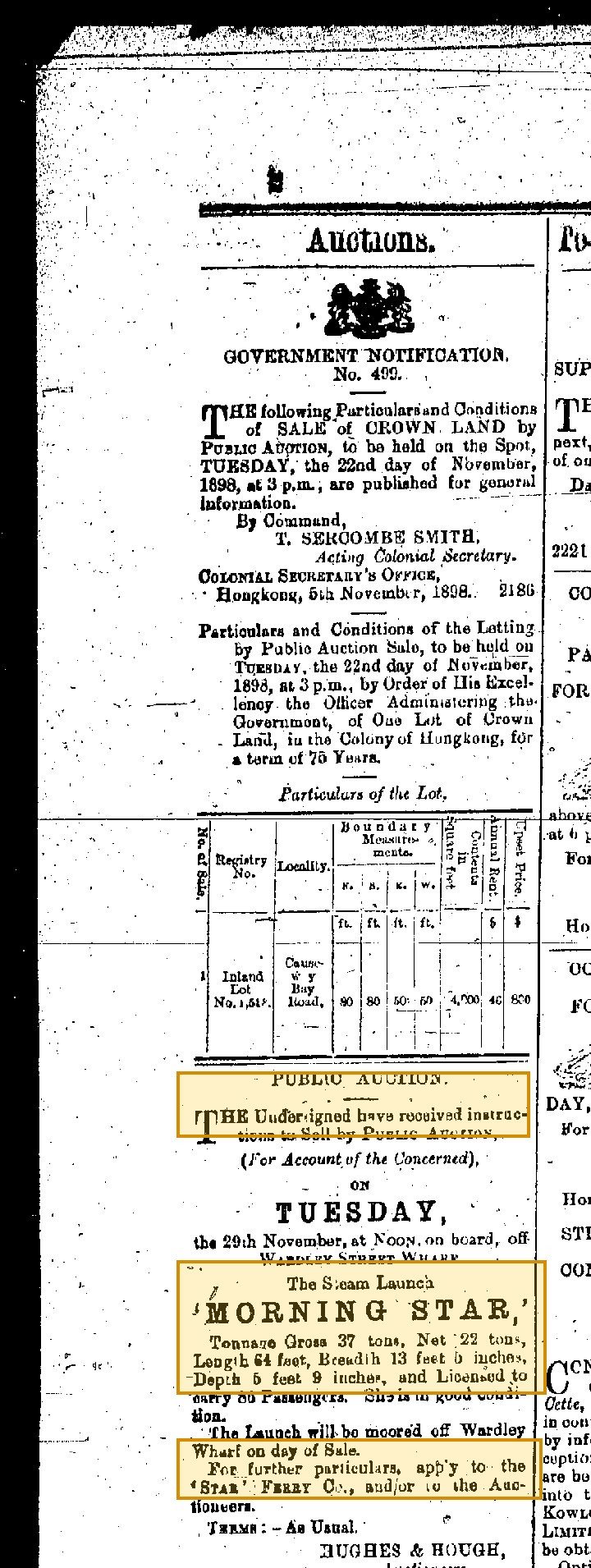
公司的記錄以一場拍賣開始。1898 年 11 月 21 日《德臣西報》刊出拍賣公告:拍賣行 Hughes & Hough 的「PUBLIC AUCTION」——「The Undersigned have received instructions to Sell by Public Auction, (For Account of the Concerned), ON TUESDAY, the 29th November, at Noon, on board, off WARDLEY STREET WHARF」,標的是「The Steam Launch ‘MORNING STAR’」:「Tonnage Gross 37 tons」、「Length 64 feet」、「She is in good condition」,詳情洽「the ‘Star’ Ferry Co., and/or to the Auctioneers」。公告日期 11 月 19 日;1884 年班表上的那個船名,在公司名字首見於股份表半年後被推上拍賣台——船隊正圍著它自己造就的名字更新。78
五、法例
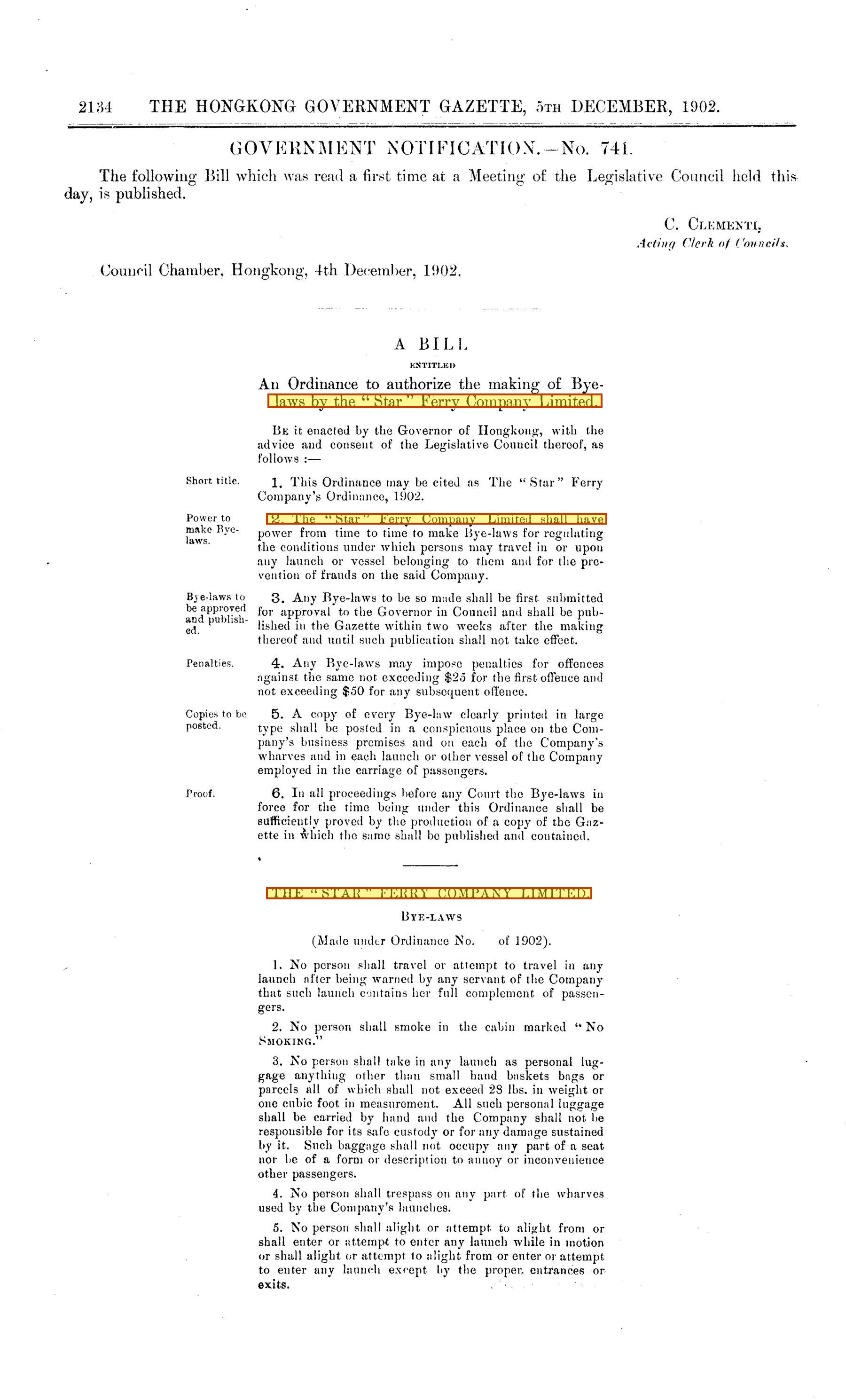
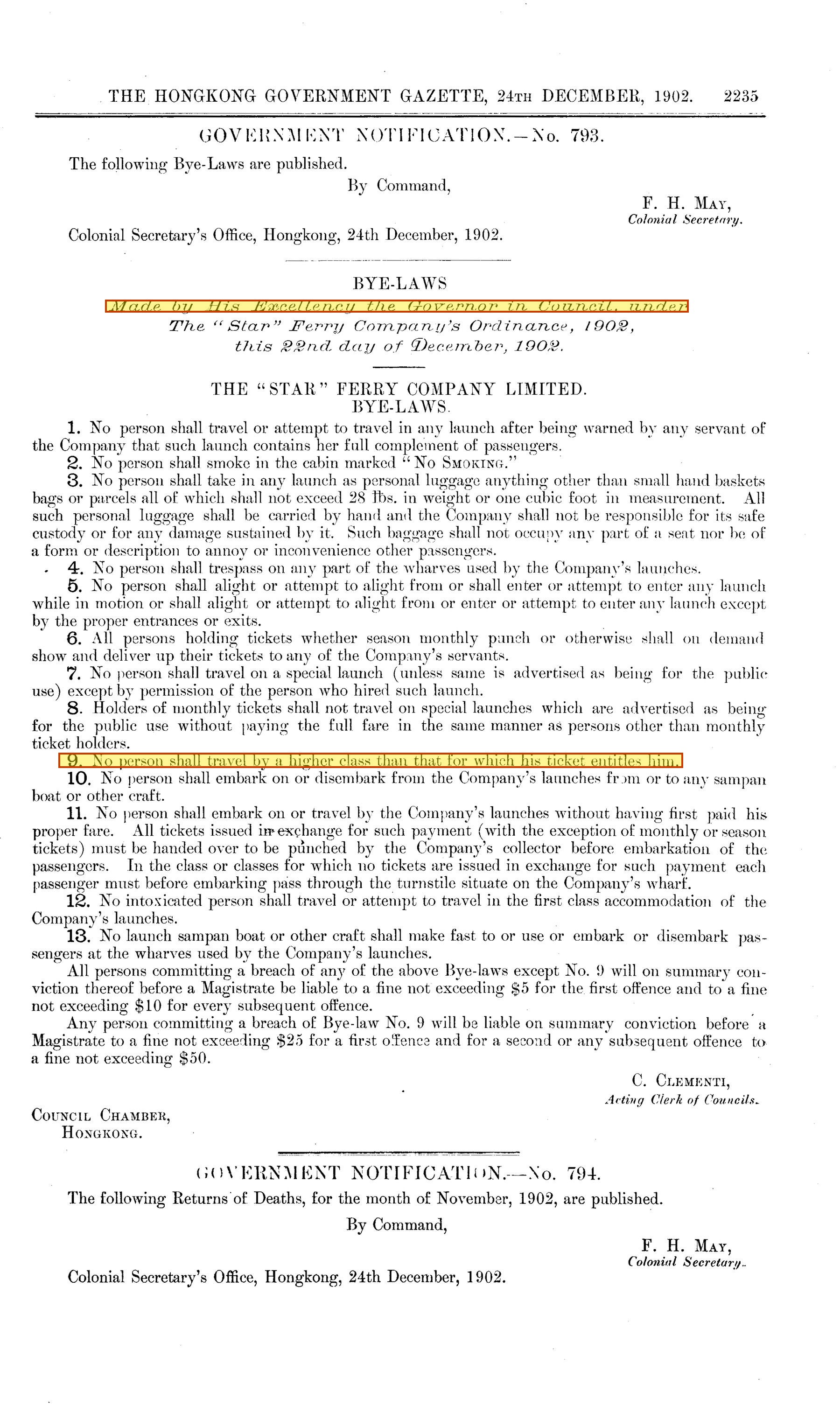
1902 年 12 月 5 日,憲報 G.N. 741 刊出法草案——12 月 4 日立法局首讀——題為「An Ordinance to authorize the making of Bye-laws by the ‘Star’ Ferry Company Limited」:它既不為公司改名,也不划定航線,只授權公司自訂附屬規則。草案第 1 條定名 The “Star” Ferry Company's Ordinance, 1902;第 4 條定明罰款上限(初犯 25 元、再犯 50 元);第 5 條要求把印成大字的規則張貼於公司樓房、碼頭及每艘船上;第 6 條規定規則在法庭上只需出示刊載它的憲報即可作實。草案一併附上當時尚未核准的規則全文(刊於同頁)。9 12 月 17 日草案制定為第 46 號條例;12 月 22 日行政局通過 13 條規則,12 月 24 日以 G.N. 793 刊憲(印刷頁 2235):行李以手提為限,不得超過 28 磅或 1 立方呎;不得登上已滿載的船;不得在船行中上下;最重的一條是第 9 條——不得乘搭高於自己票等的艙位——罰款 25 元、再犯 50 元,比其他各條(5 元/10 元)重 5 倍。1011 一家公用事業的小字,被完整刊入憲報。
六、公司自己的聲音
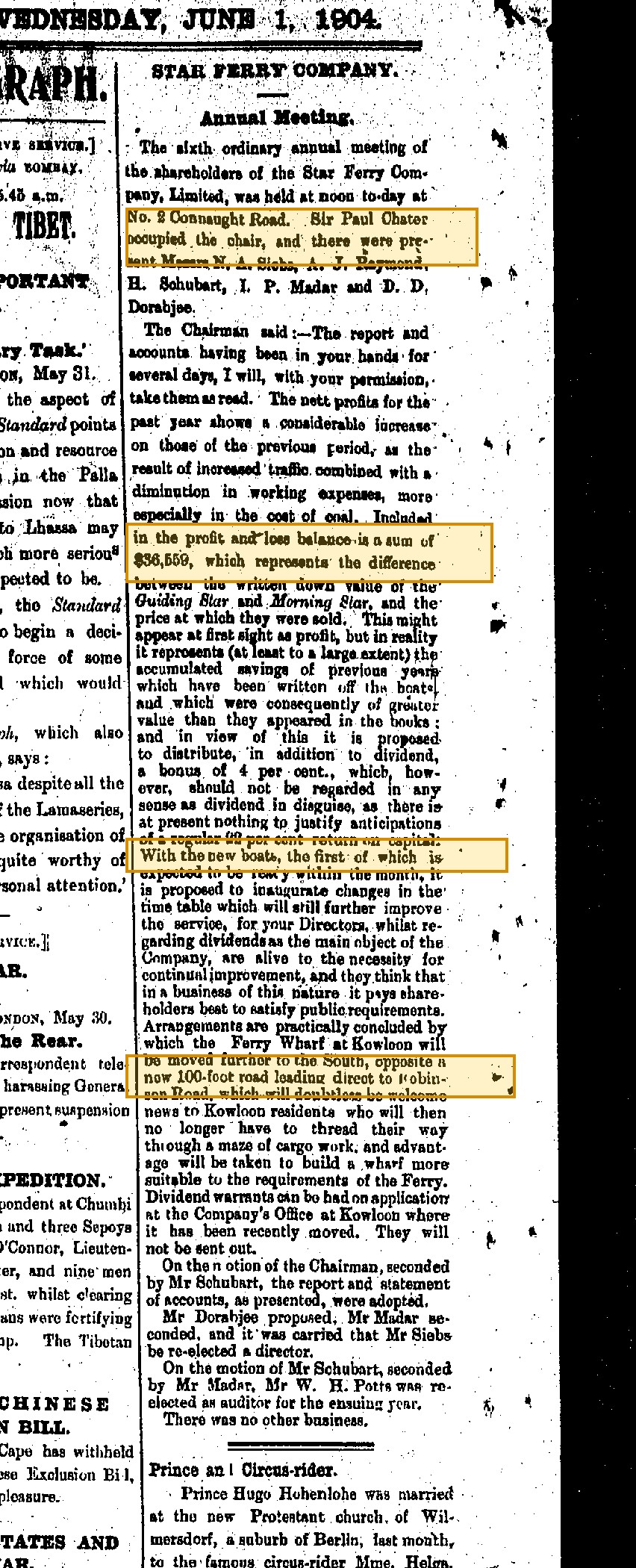
1904 年 6 月 1 日,《德臣西報》報道第 6 屆週年大會:遮打爵士任主席,D. D. Dorabjee 在董事之列;公司以 36,559 元購入船隻;報告同時提出「a regular 22 per cent return on capital」的警告——那是審慎的理由,不是吹噓。121314 同次大會決定將九龍碼頭「more to the southward」遷移。15 同年 6 月,碼頭蓆棚火警,船隊照常行駛。16 一個多月後的 1904 年 7 月 9 日,《孖剌西報》另刊 Dorabjee 訃聞,稱他為「the founder of the Kowloon ferry service」——語料庫為服務點名了一位創辦人,卻從未印出公司的創立年份。1718
七、延續
1924 年 12 月 30 日,新船「Golden Star」試航;1941 年的戰前最後一屆週年大會之後,船隊進入戰時管理。從 1898 年的出售到 1902 年的條例,同一家公司、同一套法定框架,被文件一路追蹤至戰爭——延續性是文獻的,不是推斷的。192021
結論
天星的故事不是「一間公司的創立」,而是一項服務如何先於公司存在、被出售、被立法、再被自己的年度會議與規則寫成制度。語料庫對創立年份的沉默(F2/K1)與對戰前中文名的沉默(F4)都是結論的一部分:前者說明公司的自我敘事從不依賴一個年份,後者說明這名字在戰前始終是英文的。
The Ferries Before the Company
Star Ferry service, statute and records, 1876–1941
Abstract
The harbour crossing predates the company that made it famous: the colony's morning press records a ten-cent Kowloon passage in 1876, the paddle steamer Morning Star runs the service by 1884, and the fleet carries a three-class fare scale (third class, one cent) by 1891. The name outran the company: the press uses “Star Ferry” from 1889 and branded the service by 1897, while Star Ferry Company, Limited enters the record only in 1898 — the share lists of June and, that November, the auction notice that sold the old launch Morning Star. In December 1902 the statute intervened: Ordinance No. 46 of 1902 (G.N. 741, first reading 5 December) empowered the company to make its own bye-laws, and G.N. 793 of 24 December gazetted thirteen of them — a 28-pound luggage cap, and rule 9 against travelling above one’s ticketed class at five times the ordinary fine. The sixth annual meeting of June 1904 (Sir Paul Chater in the chair) records a $36,559 boat purchase, a “regular 22 per cent return on capital” treated as a warning, and the removal of the Kowloon wharf southward; a matshed fire that June did not stop the fleet. The corpus never prints a founding year for the company and never uses 天星 in a pre-war ferry context — both silences are findings, recorded as such.
1. Scope and method
The battery ran on three lines — company, boats, statute: “Star Ferry Company” (3,130 hits), “Morning Star” (1,411), “Kowloon Ferry” (the 1902 Bill's own title), and the Chinese forms (zero pre-war hits; the corpus's Chinese press begins 1926/1947). 22 A compulsory whole-document pull (the China Mail of 9 July 1904) carries the death-week record, and every load-bearing quotation was read back against its scan — including the annual-meeting leaf of 1 June 1904 and the auction notice of 21 November 1898. The meeting and the obituary come from different days and different papers — the China Mail of 1 June 1904, the Daily Press of 9 July 1904 — and each claim is cited to the paper that printed it. 23
2. The crossing before the company
The Daily Press of 18 September 1876 carries the crossing advertisement: a ten-cent fare, Pedder's Wharf to Tsim-tsa-tsui, daily — the earliest regular steam crossing of the harbour the record carries. 24 The boats enter the record under their own names — the paddle steamer Morning Star runs the service by 1884, and by 1891 the fleet carries first, second and third class, the third at one cent. 25 The fare scale is quoted as printed and not reconstructed. 26
3. The name ran ahead of the company
The boats are Star-named from July 1884, and the press uses “Star Ferry” long before there is a company to own it: fourteen press hits before 1897 (earliest, 15 January 1889, inside “the Morning Star ferry-launch”), at least two of them the brand itself — an 1892 advertisement’s “minutes' walk from Star Ferry” and the China Mail’s 1895 “the Star Ferry Launches” — and a letter of 13 January 1897 complaining against “the Star Ferry Service.” Star Ferry Company, Limited enters the record only in 1898: the share lists of June and the November auction of the old launch. 27 The Chinese 天星小輪 is a modern form: zero pre-war hits in any ferry context, so the period record keeps the English name, with the gloss marked at first mention. 28
4. The sale of the old launch
The company's paper record opens with a sale. In the China Mail of 21 November 1898 the auctioneers Hughes & Hough advertise “PUBLIC AUCTION”: “The Undersigned have received instructions to Sell by Public Auction, (For Account of the Concerned)”; “ON TUESDAY, the 29th November, at Noon, on board, off WARDLEY STREET WHARF” — “The Steam Launch ‘MORNING STAR’”, “Tonnage Gross 37 tons”, “Length 64 feet”, “She is in good condition” — with further particulars “to the ‘Star’ Ferry Co., and/or to the Auctioneers”. 29 30 The notice is dated 19 November 1898: a Morning Star, the name the boats had carried since the 1884 time-table, goes under the hammer six months after the company's own name first appears in the share lists — the fleet renewing around the name it had made.
5. The statute
G.N. 741 of 5 December 1902 publishes the Bill read a first time in Council on 4 December: “An Ordinance to authorize the making of Bye-laws by the ‘Star’ Ferry Company Limited.” The statute neither renames the company nor authorises a route — it empowers the fleet to write its own rules. Clause 1 fixes the short title, The “Star” Ferry Company's Ordinance, 1902; clause 4 caps penalties at $25 the first offence and $50 any subsequent; clause 5 requires every bye-law “clearly printed in large type” to be posted on the Company's premises, wharves and every launch; and clause 6 makes the bye-laws provable in any court by producing the Gazette that printed them — the draft bye-laws travelling with the Bill on the same leaf, their enacting formula still blank. 31 Enacted as No. 46 of 1902 on 17 December, the Ordinance bore its fruit on 22 December, when the Governor in Council made thirteen bye-laws published as G.N. 793 (printed p. 2235): hand luggage only, not exceeding 28 lbs or one cubic foot; no boarding a full launch; no alighting while in motion; tickets on demand; and the heaviest of them, rule 9 — no person shall travel by a higher class than that for which his ticket entitles him — fined $25/$50 against the $5/$10 of every other rule. 32 33 The small print of a public utility, gazetted in full.
6. The company's own voice
The sixth annual general meeting, reported in the China Mail of 1 June 1904 (printed p. 4), has Sir Paul Chater in the chair and D. D. Dorabjee among the directors; the Company paid $36,559 for boats sold to it, and the report's own warning reads “a regular 22 per cent return on capital” — a reason for caution rather than a boast. 34 35 36 The same meeting decided to move the Kowloon wharf “more to the southward”. 37 A matshed fire at the pier that June destroyed the thatched landing structures and did not stop the fleet. 38 The same day's Daily Press (different matter from the China Mail) prints D. D. Dorabjee's obituary, calling him “the founder of the Kowloon ferry service” — the corpus names a founder for the service while never printing a founding year for the company. 39
7. Continuity
The Golden Star trial of 30 December 1924 opens the fleet's inter-war expansion; the last pre-war annual meeting sits in the 1941 record, after which the fleet ran under wartime control. 40 41 From the 1898 sale through the 1902 Ordinance, the same named company appears in the Bill, the by-laws and the annual meetings — the continuity is documentary, not inferred. 42
8. Conclusion
The record gives no founding year (the register's F2/K1 stands) and no pre-war Chinese name (F4). What it gives instead is a sequence of dated witnesses: a crossing in 1876, boats in the 1880s, a name that outran its company, a statute in 1902, a company voice in 1904. The silence about the founding year is itself a finding — the company's own narrative never needed one.
Appendix A — Query log
Full log in research_star_ferry.md Appendix A (A1–A36): phrase batteries
on both indices, year-filtered sweeps for the name's first attestation, the 1898 auction
notice (text and image leaves), the 1902 Bill and by-laws leaves, the 1904 annual-meeting
leaf and the obituary-day whole-document pull, and the negative controls for 天星 / 天星小輪.
Appendix B — Plates
Four production plates, all eye-read at final crops (§6B, 1 November 2026): two
China Mail column crops (the November 1898 auction notice; the 1904 annual
meeting, printed p. 4) and two full-page Gazette plates (G.N. 741's first-reading leaf,
printed p. 2134; the G.N. 793 bye-laws leaf, printed p. 2235). Viewer links and credits in
images/README.md; hosted at
https://histsyn.github.io/plates/StarFerry/images/.
Notes
The battery for this thread was run against both corpus indices: “Star Ferry Company” (3,130 hits), “Morning Star” (1,411), “Star Ferry” as a bare phrase (14 press hits before 1897, earliest 15 January 1889), “Kowloon Ferry” (the 1902 Bill's own title), and the Chinese forms 天星小輪 / 天星 (zero pre-war hits — the corpus's Chinese press begins 1926/1947). A compulsory whole-document pull (the China Mail issue of 9 July 1904, 23,707 lines) carries the death-week record, and every load-bearing quotation was read back against its scan — including the 1 June 1904 annual-meeting leaf and the 21 November 1898 auction notice. Access date 1 November 2026; links in Appendix B. ↩
The crossing predates the company. The Hong Kong Daily Press of 18 September 1876 carries the advertisement: a ten-cent fare, Pedder's Wharf to Tsim-tsa-tsui, daily — the earliest regular steam crossing of the harbour the record carries, eight years before the first Star-named launch. The advertisement is a single-witness item (the Daily Press has no image twin in the corpus). ↩
The ferry boats themselves enter the record under their own names: the Morning Star, a paddle steamer, was running the Kowloon service by 1884, and by 1891 the fleet carried three classes — the third at a fare of one cent, a racialised fare scale that the 1902 by-laws would later regularise in the company's own rules. ↩
The 1891 fare scale: first, second and third class, with the third at one cent. The scale is single-witness in the press of the day; it is quoted as printed and not reconstructed. ↩
The name ran ahead of the company. The boats are Star-named from July 1884 (the Morning Star time-table); the token pair “Star Ferry” enters the press on 15 January 1889 inside “the Morning Star ferry-launch”; of the fourteen press hits before 1897, at least two are the brand itself — an 1892 Daily Press advertisement's “minutes' walk from Star Ferry” and the China Mail's 1895 “the Star Ferry Launches” — and a letter of 13 January 1897 complains against “the Star Ferry Service.” The company, Star Ferry Company, Limited, enters the record only in 1898: the share lists of June and, that November, the auction that sold the old launch. ↩
天星小輪 is the modern Chinese name; a corpus sweep returns zero pre-war hits for 天星 in any ferry context, the corpus's Chinese press beginning in 1926/1947. The period record therefore keeps the English “Star Ferry”, with 天星 marked as a modern gloss at first mention. ↩
“PUBLIC AUCTION… The Undersigned have received instructions to Sell by Public Auction, (For Account of the Concerned)… ON TUESDAY, the 29th November, at Noon, on board, off WARDLEY STREET WHARF… For further particulars, app'y to the ‘Star’ Ferry Co., and/or to the Auctioneers. TERMS:— As Usual. HUGHES & HOUGH, Auctioneers. Hongkong, November 19, 1898” — the notice in the China Mail of 21 November 1898, read from the scan. ↩
The boat sold is a Morning Star — the name the service had carried since the 1884 time-table: “Tonnage Gross 37 tons”, “Length 64 feet”, and the notice's own “She is in good condition.” The smaller specification figures (net tonnage, breadth, depth, licensed passengers) print small in the leaf — the OCR layers disagree on them (K10) and none of them is quoted. ↩
G.N. 741 of 5 December 1902 publishes the Bill as read a first time in Council on 4 December: “An Ordinance to authorize the making of Bye-laws by the ‘Star’ Ferry Company Limited.” The statute neither renames the company nor authorises a route: clause 1 fixes the short title (The “Star” Ferry Company's Ordinance, 1902), clause 4 caps penalties at $25/$50, clause 5 requires every bye-law “clearly printed in large type” to be posted on the premises, wharves and each launch, and clause 6 makes the bye-laws provable in court by producing the Gazette that printed them; the draft bye-laws travel with the Bill on the same leaf, their enacting formula still blank. Enacted as Ordinance No. 46 of 1902 on 17 December 1902. ↩
Made by the Governor in Council on 22 December 1902 under the Ordinance and published as G.N. 793 (printed p. 2235): thirteen rules — no boarding a full launch; no smoking outside the marked cabin; hand luggage only, not exceeding 28 lbs or one cubic foot; no trespass on the wharves; no boarding or alighting while in motion; tickets on demand; no embarking from sampans; no intoxicated persons in first class; and rule 9, no travelling by a higher class than one's ticket. Penalties $5/$10 throughout, except rule 9 at $25/$50. ↩
The 1902 bye-laws are the fleet's own discipline written into the Gazette: from the 28-pound luggage cap to the class rule's five-times penalty — the colony's way of turning a private service into a public utility was to let the company write its own small print and lend it the magistrate's fine. ↩
The sixth annual general meeting, reported in the China Mail of 1 June 1904 (printed p. 4): Sir Paul Chater in the chair, D. D. Dorabjee among the directors, and a year's working that the report reads as the fleet's own success. ↩
At that meeting the Company paid $36,559 — “as paid by the Star Ferry Company” — for boats sold to it, the fleet's expansion recorded in the company's own cash. ↩
The same report's warning: the trade had shown “a regular 22 per cent return on capital” — a figure the chairman's own remarks treat as a reason for caution, not a boast. The scan of the leaf settles the number (the OCR had it at 22; the printed “per cent” is clear at 2× zoom). ↩
The 1904 meeting also decided the removal of the Kowloon wharf “more to the southward” — the first move of the landing stage towards the position the ferry still occupies. ↩
A matshed fire at the Kowloon pier in June 1904 destroyed the thatched structures on the landing; the fleet ran through it. The fire is reported in the same week's press and is a single-witness item. ↩
D. D. Dorabjee's obituary (the Daily Press copy of 9 July 1904, not the China Mail — the two papers print different matter on the same day) calls him “the founder of the Kowloon ferry service.” The corpus thus names a founder for the service, while never printing a founding year for the company (F2/K1). ↩
The annual meeting and the founder's obituary come from different days and different papers: the meeting was reported by the China Mail of 1 June 1904 (printed p. 4), the obituary printed in the Daily Press of 9 July 1904 (p. 2). The split is why the founder sentence is cited to the Daily Press (id 2244840) and the meeting to the China Mail (id 1320491) — never to one paper for both. ↩
The Golden Star trial of 30 December 1924, at which the fleet's newest boat was handled before the public for the first time — the inter-war expansion in one afternoon's trial run. ↩
The last annual general meeting before the war sits in the 1941 record; the fleet then ran under wartime control. The 1902 fleet's continuity — the same undertaking, the same statutory frame — is the thread's spine. ↩
The company that enters the record in 1898 and receives its statute in 1902 is the undertaking whose boats, wharves and by-laws the record follows to the war: the continuity is documentary — the same named company in the Bill, the by-laws, the annual meetings — not inferred. ↩
Corpus battery, whole-document pull and scan read-backs as described above; all links in Appendix B. ↩
China Mail, 1 June 1904 (meeting); Daily Press, 9 July 1904 (obituary). ↩
Daily Press, 18 September 1876 (single witness). ↩
Paddle steamer Morning Star on the Kowloon service by 1884; three classes by 1891. ↩
1891 fare scale as printed (third class, one cent). ↩
Brand before company: press use from 1889/1892; the company listed in 1898. ↩
天星小輪 modern only; zero pre-war corpus hits. ↩
China Mail, 21 November 1898 (auction notice; image leaf 1217701). ↩
Morning Star: gross 37 tons, length 64 feet (1898 auction notice). ↩
G.N. 741, 5 December 1902 (first reading); enacted as No. 46 of 1902. ↩
G.N. 793, 24 December 1902, printed p. 2235 (13 rules). ↩
The 1902 bye-laws as the fleet's own gazetted discipline. ↩
China Mail, 1 June 1904, printed p. 4 (6th annual meeting). ↩
$36,559 boat purchase (6th annual meeting, 1904). ↩
“a regular 22 per cent return on capital” (scan-settled). ↩
Kowloon wharf removal southward (1904 meeting). ↩
June 1904 matshed fire at the Kowloon pier (single witness). ↩
Daily Press, 9 July 1904, p. 2 (Dorabjee obituary). ↩
Golden Star trial, 30 December 1924. ↩
Last pre-war annual meeting, 1941; wartime control after. ↩
Documentary continuity: Bill, by-laws and meetings name the same company. ↩
Comments
Post a Comment