華字報紙的誕生——香港中文報業的起源(1860–1922)
摘要
本文追問一個常被一句話打發的問題:香港的第一份中文報紙是哪一份?流行的說法給出一個年份(1858 年,中外新報);而 1870 年代的兩份報紙各自在廣告上自稱「第一」,官方名冊卻把「最老」給了第三份。本文回到檔案本身:1860 年的《報紙法》[1][2][3]、政府《藍皮書》逐年刊出的出版物名冊[4][5][6][7][8][9][10][11]、以及《德臣西報》逐日的「本港華報」欄[12]。這些記錄顯示:中文報紙在官冊上最早出現於 1862 年(孖剌西報中文版);1872 年,《德臣西報》的中文報以「純華人主持」的《華字日報》之名創刊[13];1874 年,中華印務總局出版《循環日報》,自稱「第一份純華人主持的中文日報」[14];而 1879 年以後的《Directory & Chronicle》年鑑把「最老」判給中外新報[15]。四份報紙、四種「第一」,各有各的用法;本文把每個「第一」放回它自己的語境,並以 1876 年的第一宗中文報紙誹謗案、1886 年的《印務及出版條例》與 1909 年的書籍註冊冊頁收束。
一、報紙之前:1860 年的《報紙法》
中文報紙之前,先有管報紙的法律。1860 年 11 月 17 日,立法局一讀《修訂本港報紙法例》草案;11 月 30 日,草案在同一次會期內二讀、進入委員會並通過。[1]這部第 16 號條例(1860 年)名為《修訂本港報紙法例》,1861 年 1 月 1 日生效:任何人印刷或出版報紙之前,必須向最高法院登記官交出保證金——印刷人/出版人 250 英鎊,另加兩名擔保人;保證金的條件,是支付一切因誹謗罪被判的罰款、訟費與損害賠償;未交保證金而出版,每次罰款 20 英鎊。[2]1861 年 4 月,英廷批准該條例的公告刊於《憲報》,見於《藍皮書》的紀錄。[3]
這套以保證金為核心的機制,界定了此後數十年所有報紙——包括中文報紙——的責任格局:報紙的誹謗風險,以現金擔保的形式落在印刷人頭上。1876 年的第一宗中文報紙誹謗案索償 10,000 元[16],其背景正是這部條例。
二、官冊上的第一份中文報紙:孖剌西報中文版(1862–1871)
政府《藍皮書》裡的「本年主要出版物名冊」,是追蹤中文報紙最可靠的第一手材料。1862 年的名冊已經列出:「《香港政府憲報》,英文,週刊」「《香港政府憲報》,中文,週刊」「《孖剌西報》,日刊」,以及——「《孖剌西報》中文版(The Chinese issue of the Daily Press),每週三次」。[4]這是本研究的檔案中,官方記錄裡最早出現的中文報紙。
1867 年的名冊是手寫的,須直接讀掃描件:名冊列出「孖剌西報中文版——每週三次」,以及第二份中文報紙「The Hongkong Late[st] News (in Chinese)——每週三次」;同年的中文《憲報》週刊仍在。[5](需要說明的是:電子文本層把這一頁的兩個中文條目誤讀成別的報名——掃描件為準,見檔案的 K1 項。)到 1871 年,名冊上的中文報紙已有三項:「德臣西報中文版,週刊」「孖剌西報中文版,每週三次」「最近新聞紀錄(The Record of Latest News,中文),每週三次」。[6]「最近新聞紀錄」即後來文獻所稱的《近事編錄》——其漢字名稱在同期材料中未能找到,本文在正文中沿用英文名。
三份之中,「孖剌西報中文版」就是後來通稱的《中外新報》:其三種英文叫法在檔案裡互相印證——1860 至 70 年代名冊的「孖剌西報中文版」、1875 年名冊的「Chung Ngoi Shun Po」、1876 年以後名冊的「Chung Ngôi San Po」,以及《德臣西報》欄目裡同一句括註——「The Chung Ngoi San Po (the Chinese issue of the Daily Press)」。[9][10][12]由 1862 年到 1877 年,它始終是名冊上中文報紙的第一項。
三、德臣西報的中文報:《華字日報》的誕生(1872–1876)
第二份報紙出自《德臣西報》的寫字樓。現存的《德臣西報》1872 年 3 月及 4 月各頁不在語料庫中;施其樂(Rev. Carl T. Smith)檔案(Carl Smith Collection)的卡片轉錄了這兩天的報文:3 月 30 日,「本日中文版刊出一則啟事,宣布將出版一份獨立中文報紙,在本館印刷,由華人主持——此類創舉中的第一次」;4 月 2 日,「新中文報紙的招股章程……這將是第一份純由華人主持的中文報紙」。[13]
這份報紙在 1873 年的官方名冊上以「The Chinese Mail,(日刊)」出現——同年的名冊還列著孖剌西報中文版與最近新聞紀錄。[7]它自己的廣告以雙語刊頭出現——「香港華字日報(Hongkong Wa Tsz Yat Po)」,說明「逢星期一、三、五出版,另每日早晨附送增刊」,售價每年 4 元,並註明「在《德臣西報》館(No. 2, Wyndham St.)出版」;廣告落款是「總編輯 Mr. Chun Ayin」。[17]同一年的住戶名錄裡,他的身分寫得明白:「Chun Ayin,《德臣西報》訪員,兼《華字日報》編輯,住荷李活道。」[18]
而德臣西報館在 1873 年名錄裡以自己的雙語條目現身:「德臣印字館(Tuh-sun-Yan-tzee-koon),Wyndham 街 2 號,會所後面」;館內出版物四種——其中「Chinese Mail, every alternate day, with extra every morning, except Sunday」(華字日報,隔日出版,每日早晨另有增刊);職員名單裡,東主兼總經理 G. M. Bain、編輯 N. B. Dennys 之下,正是「Chun Ayin, rep. and Chinese Ed.」——這張名錄的一頁,同時給出了報紙、印刷所、頻率與人。[19]
1875 年除夕之後,報紙改為日刊:1876 年 1 月的廣告說,「本報現已每日出版……它是第一份純由華人主持的中文報紙」;另一則廣告列出它鋪向各口岸的代理網——「遠至日本各港、西貢、新加坡、檳榔嶼、加爾各答、吧城、馬尼拉、澳洲、舊金山、秘魯」——同樣由 Chun Ayin 署名。[20]
四、循環日報:第一份「純華人主持」的日報(1874)
1874 年 2 月,第三份報紙登場。它的招股及創刊廣告由「中華印務總局」(The Chinese Printing & Publishing Company, Limited,荷李活道 29 號)在《孖剌西報》連日刊出,前後至少六次(2 至 10 日)。[21]廣告的全文是這一節的核心條文:「本報將為第一份在純華人主持下出版的中文日報。編輯部由一位學識經驗俱豐、專為此聘請的先生主持。」[14]同一份章程還寫下它的野心:報紙「終將在中國成為《倫敦時報》那樣的報紙」;並計劃「不久之後另出一份週報或半月刊,把日刊的要聞轉錄,以便遠方讀者」;章程又說,「本港的華人翹楚大多與此舉有關」,各口岸「幾乎都有一兩位最有影響的華人是公司的股東或代理」;公司股票登記冊在 2 月 10 至 23 日暫停過戶。報紙的名字,章程寫作「Tsun Wan Yat Po」或「The Universal Circulating Herald」;最後一則廣告只強調一句:「本報將每日出版。」[14]
五、成長的痛:第一宗中文報紙誹謗案與「本港華報」欄(1876)
1876 年 1 月 10 日,《德臣西報》報道了一宗即將開審的案件:「兩名華人對《循環日報》(Universal Herald)提出訴訟,指控去年 11 月 17 日刊出的通信誹謗;索償 10,000 元。這將是本殖民地的第一宗針對中文報紙的誹謗案。」[16]案件的了結,記錄在報紙自己刊出、又被《德臣西報》逐句轉譯的道歉文裡:寫信人 Lai Ming Chun 曾指控「Messrs Tsang Shun Yee 與 Woo Lin Tak」「進行販賣人口的勾當,實際上就是拐匪」——「最後,他把這些話登在《循環日報》(Tsun Wan Yat Po)上」;和解的條件是:他「自願付出法律費用 600 元(《德臣西報》2 月 19 日的排版作 800 元),另捐 25 元入濟貧箱(19 日排版作 23 元);並自費在中外報紙各三家、連登一個月文章,以贖前愆」。[22]3 月間,《德臣西報》的社評又兩度回到這宗案件。[23]
同一場官司的旁邊,《德臣西報》開了一個固定的欄目:《本港華報》(The Hongkong Native Press)。[12]1876 年一年之內,欄目出現 124 次;每逢一期,它就替英文讀者讀一遍中文報紙——「《華字日報》評論澳門問題……《中外新報》(孖剌西報中文版)說,若有一國不肯讓步,戰爭便無可避免。《循環日報》注意到克虜伯工廠裁員,也提到今年日食月食的日子。」[12]一家英報聘一名華人訪員(Chun Ayin),又把三家中文報紙的言論逐日翻給它的讀者看——這是 1876 年香港報界互相觀看的精確圖景。
六、四份報紙與「最老」的判語(1876–1886)
到 1876 年,官方名冊上的中文報紙成為一份四人的名單:「Wah Tsz Yat Pà(華字日報),中文,日刊;Chung Ngôi Shun Pa(中外新報),中文,日刊;Kan Sz Pin Luk,中文,每週三次;Trun Wán Yat Pò(循環日報),中文,日刊」;同年的中文《憲報》每週出版,印數 350 份。[10]1877 年的名冊把四個名字拼得更準:「Wah Tsz Yat Po / Chung Ngôi San Po / Kan Sz Yat Luk / Tr’un Wán Yat Po」。[11]兩份名冊的印數欄都值得細看:英文報紙的印數逐年可數,中文報紙卻留下大片空白——「Unknown.」。1876 年那一頁的欄線上,800 與 710 兩個數字排在名單中段的最後兩行旁邊,與任何一個名字都無法乾淨對齊;這個排印的錯位,本文照錄原樣、不作分配(K11)。[10]
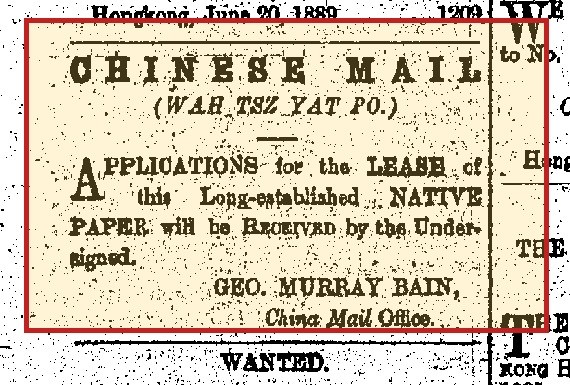
1879 年起,《Directory & Chronicle》的年度概覽接管了「數報紙」的工作,它給出的判語成為此後四十年的定論:「華報有三家日刊——中外新報(歷史最久,在孖剌西報館出版)、華字日報(即 Chinese Mail)、循環日報(即 Universal Circulating Herald);另有一份半月刊 Kan Sz Ping Luk。政府《憲報》每週以中英兩種文字出版,由政府印務承印,承印人為 Messrs. Noronha & Sons。」[15]這句「歷史最久」,此後年年不變;名單卻不斷加長:1885 年四家日刊(加入維新日報),1886 年五家(加入粵報),1887 年六家(加入華字節報),1888 年以後回到五家。[15]1883 年維新日報的廣告自稱「銷數逾一千份」——那是這批報紙裡唯一留下來的印數自述。[24]
而《華字日報》自己,是「有租約的報紙」:1882 年 6 月,一名編輯 Tam Yik Kiu 控告資方無理辭退(索償 180 元);施其樂檔案卡片註明:「原告於 1881 年 1 月受僱為編輯,僱主是當時的承租人 Kong Chim;去年 8 月,租約易手。」[25]1889 年 7 月,《德臣西報》館為它登出招租廣告:「華字日報(Wah Tsz Yat Po)——茲招人承租此歷史悠久之華報,有意者請向本館下列簽署人洽——GEO. MURRAY BAIN,德臣西報館。」[26]從 1873 年廣告的接單人,到 1889 年租約的收件人,同一個名字 Bain。報紙與印刷所之間的這條線,一直沒有斷。
七、最老的黃昏(1886–1922)
1886 年 7 月 12 日,《印刷人及出版人條例》(第 6 號條例)通過:「本條例規範報紙與書籍之印刷及印刷機之管有」;報紙的印刷人與出版人須親到登記官面前,在「報紙登記冊」上具結聲明,地址或人選變更須重新聲明。[27]《德臣西報》在條例公告之日的社評寫得尖銳:「舊《報紙法》的重新制定,加了幾條特別累人的條款……會上的討論清楚說明一件事:把歐洲人與華人放在同一條法例上,是何等荒謬——舊法本來主要是為華文報紙而設的。如今行政當局偏偏要把中英文記者一視同仁。」[28]
1888 年的第 2 號條例第 6 條另設書籍註冊制度,中文報紙的合訂本此後按「書」註冊:1909 年第 3 季的《憲報》名單上寫著「Tsun Wan Yat Po,51 Gough Street,1909 年 5 月」——循環日報館把自己的報紙送進政府的書籍登記冊,註明為 13 卷。[29]
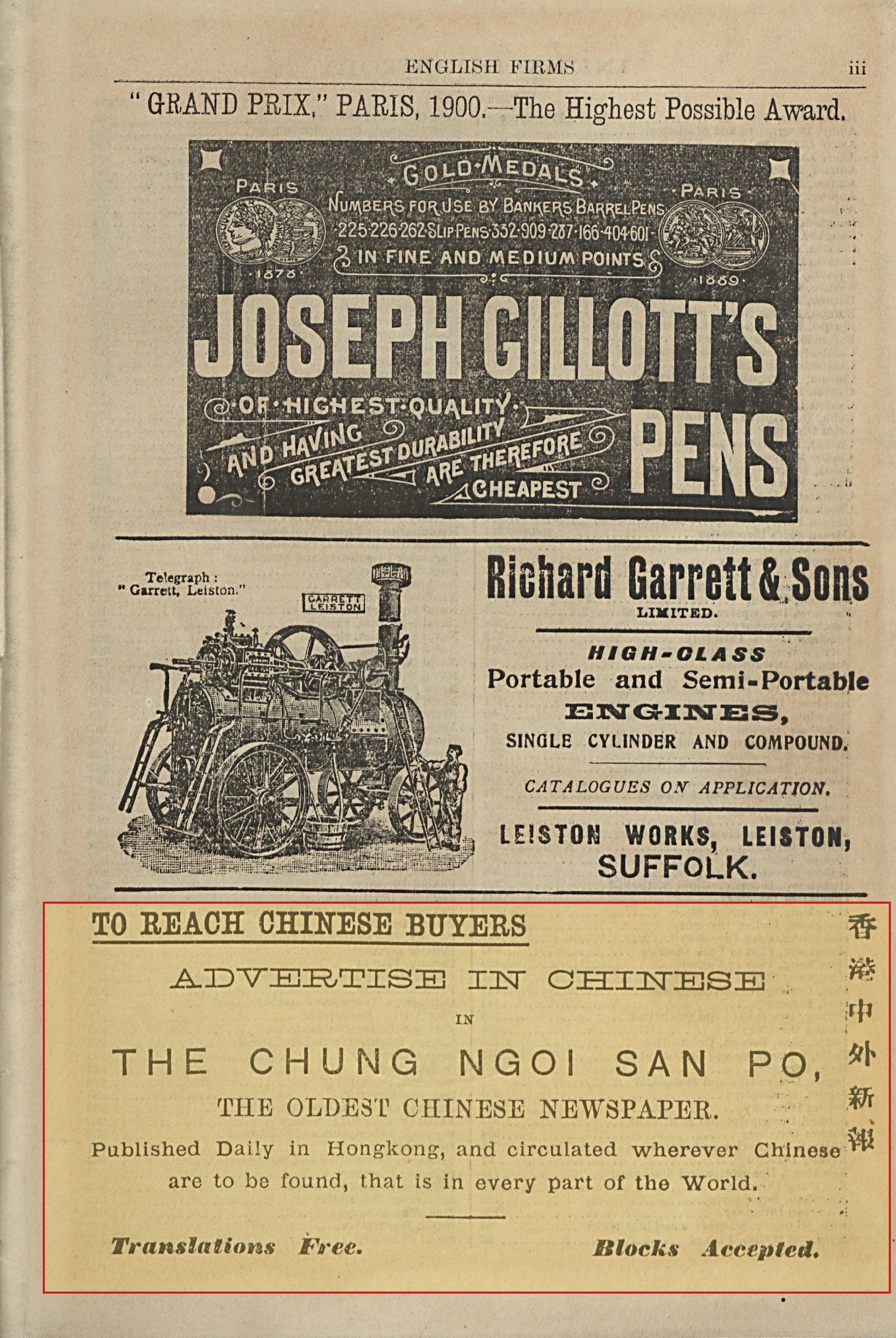
最老的一份活得最久。1893 年,中外新報的廣告自稱「The Oldest Chinese Newspaper」,每晨出版,附行情紙,每年 5 元;1901 年的廣告講得更滿:「欲觸及華人買家——在《中外新報》刊登中文廣告。它在香港每日出版,流通到凡有華人的地方,也就是世界的每一部分。」[30][31]1919 至 1922 年,《藍皮書》的名單已經排成雙語:Tsun Wán Yat Pò——循環日報;Wá-tsz Yat Pò——華字日報……[32]1922 年的《Directory & Chronicle》為這段歷史寫下最後一句:「華商總會報」(Wah Sheung Chung Wui Po)——中外新報已併入其中——「合併了歷史最久的華文報紙(the oldest vernacular journal)」。[33]
結論
把五個名字按檔案的時間排開,所謂「第一份中文報紙」的問題就化解成四種各自的「第一」:官冊上最早的中文報紙,是 1862 年已在名冊上的孖剌西報中文版(中外新報);第一份「純華人主持」的中文報紙,是 1872 年《德臣西報》中文版蛻變而成的華字日報;第一份同樣「純華人主持」的日報,是 1874 年由中華印務總局出版的循環日報;而自 1879 年起,官商兩界沿用四十年的判語把「最老」給了中外新報。四者並不互相否證——它們是同一條新聞史上不同年份、不同口徑的四個刻度。倒是有兩件事,是超越「第幾」的:其一,這批報紙從一開始就活在同一套法律之下(1860 年的保證金、1886 年的登記冊),誹謗、租約、註冊,樣樣都要落紙;其二,它們的新聞並非只為華人而寫——1876 年《德臣西報》逐日把三份中文報紙譯給英文讀者看,正是「華報」與「西報」互相閱讀的實證。
The Birth of the Chinese Newspaper in Hong Kong, 1860–1922
Abstract
Who printed Hong Kong’s news first in Chinese? The popular answer (the Chung Ngoi San Po, 1858) is a year no document in this corpus carries; two of the 1870s papers advertised rival “firsts” for themselves; and the annual directories gave “the oldest” to a third. This paper follows the record’s own instruments — the Blue Book publication returns (1862–1877), the annual “native Press” surveys (1879–1922), the China Mail’s daily digest column, and the statute book — and finds four distinct and compatible firsts: the earliest Chinese paper on the official record (the Daily Press’s Chinese issue, by 1862); the first paper “under purely native direction” (the Chinese Mail, 1872); the first native-owned daily (the Universal Circulating Herald, 1874); and the establishment’s own “oldest” (the Chung Ngoi San Po, from 1879). Around them: the 1860 Newspaper Ordinance’s libel bonds, the first libel action against a Chinese newspaper (1876), the Printers and Publishers Ordinance (1886), and a leased newspaper’s sixty-year afternoon.
1. Scope and method
This study asks what the contemporary record, not the retrospectives, can say about the beginning of Chinese-language newspapers in the colony. Three strata carry the evidence. First, the English-official record: the Blue Books’ “Return of the principal Publications” (1862–1877; the 1867 return is handwritten and is read here from the scan), the Government Gazette, and the consolidated ordinances. Second, the English press of the day — above all the China Mail, which from 1876 ran a daily column, THE HONGKONG NATIVE PRESS, digesting the Chinese papers for English readers; its translations are this paper’s window onto what the Chinese papers carried, since no nineteenth-century Chinese paper survives inside the corpus. Third, the Chinese record: the Government’s own bilingual prints (the 1873 directory masthead, the 1919–22 bilingual lists) and the post-war Chinese retrospectives, which are used as modern-secondary and labelled as such. Two whole issues are read as documents: the Daily Press of 10 February 1874 (the Universal Circulating Herald’s prospectus week) and the China Mail of 10 January 1876 (the first-libel story in its issue).
2. The law before the papers (1860–61)
The first Chinese papers lived under a press law built before them. On 17 November 1860 the Legislative Council read for the first time “An Ordinance to amend the Law relating to Newspapers in Hongkong”; on 30 November it passed through committee in the same session — sections 1 to 6 agreed to, title agreed to.[1] Ordinance No. 16 of 1860 (in force 1 January 1861) required every printer or publisher of a newspaper to enter into a bond before the Registrar of the Supreme Court, himself in £250 with two sureties, conditioned on paying all libel fines, costs and damages; £20 forfeit for every un-bonded offence; sureties might withdraw on twenty days’ notice; the bonds went to the Colonial Secretary.[2] The Royal confirmation was announced in the Gazette of 1 April 1861, and the Blue Book notes it.[3] Every press case in the following decades — including the first against a Chinese paper — stands on this cash-backed liability.
3. The first Chinese paper on the record (1862–1871)
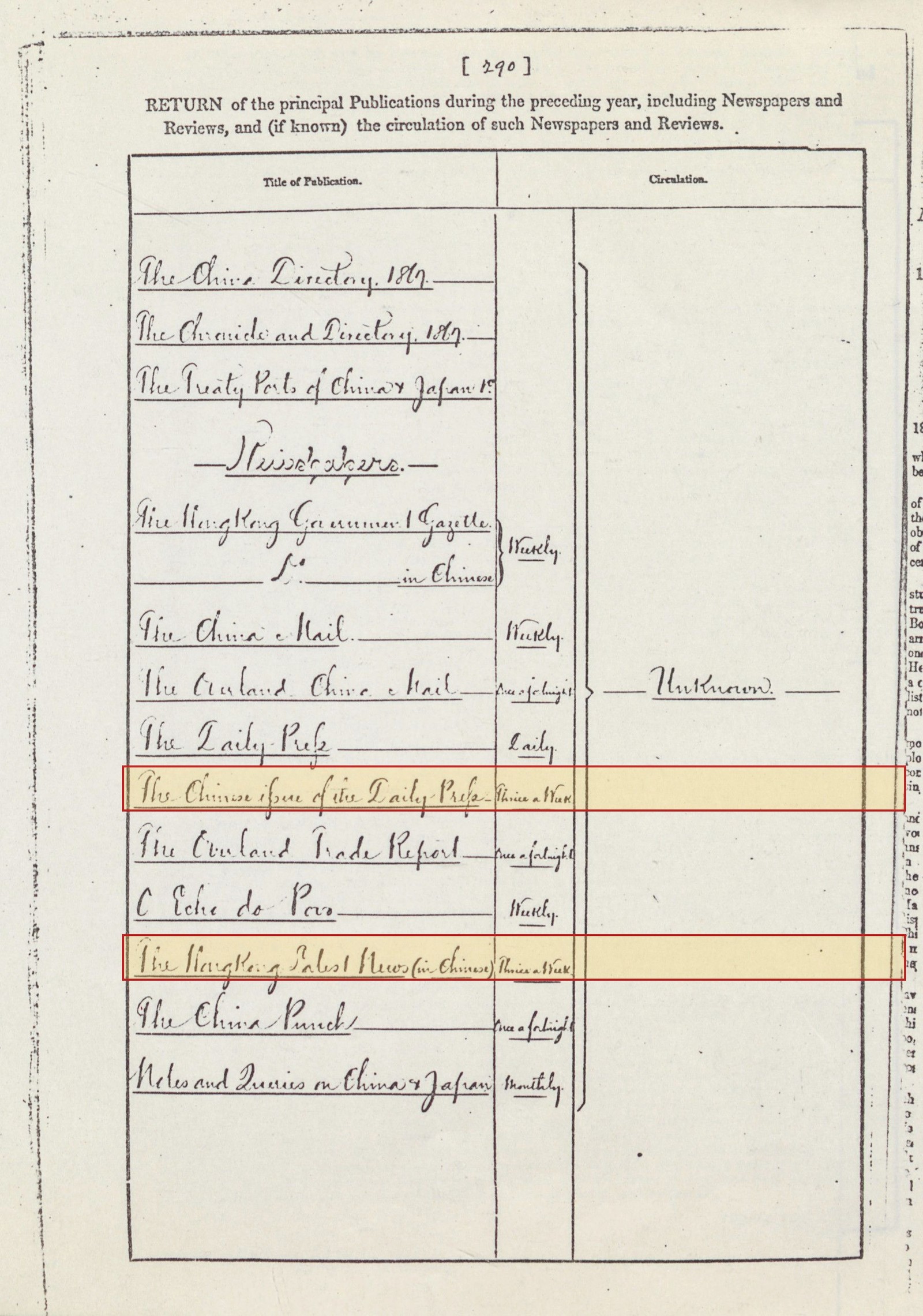
The Blue Books’ publication returns are the spine. The 1862 return already lists, among the colony’s papers, “The Chinese issue of the Daily Press” — three times a week — beside the Government Gazette “in Chinese” (weekly).[4] The 1867 return, read from the handwritten scan, pairs the same entry (“The Chinese issue of the Daily Press—Three a Week”) with a second Chinese paper, “The Hongkong Late[st] News (in Chinese)—Three a Week”; the text-series transcription of this leaf garbles both entries and is not quotable (register K1).[5] By 1871 the return carries three Chinese titles: “The China Mail (in Chinese)—weekly”; “The Chinese Edition of the Hongkong Daily Press—thrice a week”; “The Record of Latest News (in Chinese)—three times a week.”[6] The DP’s Chinese issue is the paper later known as the Chung Ngoi San Po: the returns’ own sequence of names (the Chinese issue / Chung Ngoi Shun Po, 1875 / Chung Ngôi San Po, 1876+) and the China Mail’s parenthetical equation — “The Chung Ngoi San Po (the Chinese issue of the Daily Press)” — settle the identification inside the record itself.[9][12]
4. The China Mail’s Chinese paper: the Chinese Mail, 1872–1876
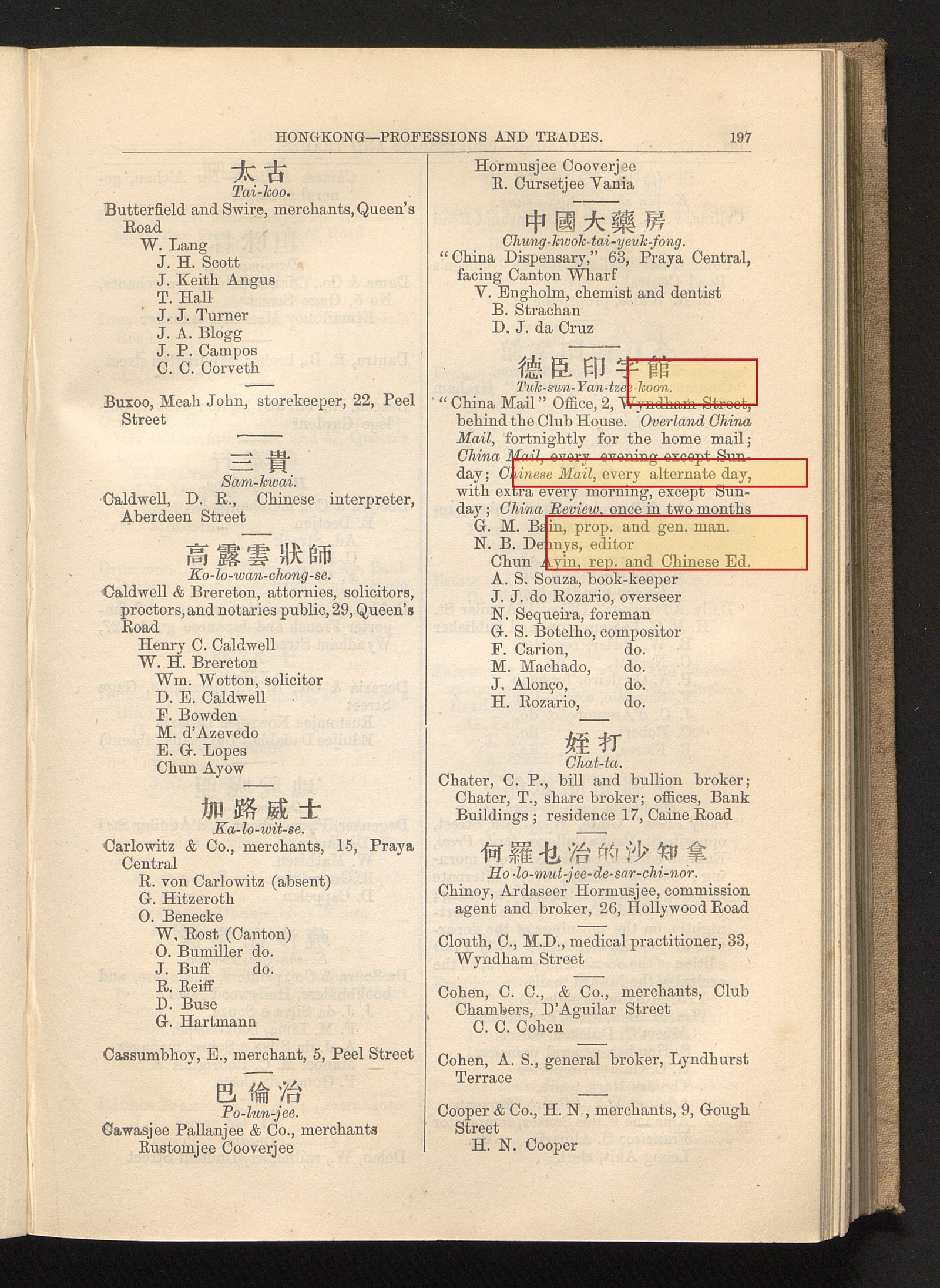
The second paper came out of the China Mail’s office. The China Mail’s own 1872 leaves are absent from the corpus, but the Carl Smith Collection card transcribes them: a circular in “this day’s Chinese page” (30 March 1872) announcing “an independent Chinese paper, to be printed at this office, but to be conducted under native direction, as the first experiment of the sort ever made”; and the prospectus (2 April 1872): “It will be the first Chinese Newspaper ever issued under purely native direction.”[13] The paper appears in the 1873 return as “The Chinese Mail, (daily.)”[7] Its own bilingual advertisement gives the working paper: masthead 報日字華港香 (read right-to-left, Hongkong Wa Tsz Yat Po); “issued on Mondays, Wednesdays and Fridays; with a Supplement every morning”; four dollars a year; “Published at the ‘China Mail’ Office, No. 2, Wyndham St.”; “Mr. Chun Ayin, Managing Editor.”[17] The same year’s directory lists the man twice: as resident — “Chun Ayin, reporter (China Mail) and editor Chinese Mail, Hollywood Road” — and inside the China Mail office’s own entry, 德臣印字館, whose staff column runs: “G. M. Bain, prop. and gen. man. N. B. Dennys, editor. Chun Ayin, rep. and Chinese Ed.”[18][19] At the turn of 1875–76 the paper went daily: “This paper is now issued every day… It is the first Chinese Newspaper ever issued under purely native direction. The editorial department is conducted by Mr Chun Ayin”; its agency list reached “all the ports of Japan… Singapore, Penang, Calcutta… Australia, San Francisco, Peru.”[20] (The modern Chinese accounts add names and dates — 陳靄亭 the China Mail translator; 1864 or 1871 for a first Chinese page — which the period record does not carry; they are labelled modern and their variances registered — including the post-war retrospectives’ own frame: the 遐邇貫珍 (1853) as the first Chinese periodical, and the Chung Ngoi San Po as “the first Chinese daily” of 1858.)[34][35][36]
5. The Universal Circulating Herald (1874)
The third paper announced itself in February 1874, in a prospectus taken by The Chinese Printing & Publishing Company, Limited, 29 Hollywood Road, and printed at least six times in the Daily Press (2–10 February).[21] The operative claims: “It will be the first daily Chinese Newspaper… under purely native auspices. The editorial department will be conducted by [a] gentleman of great experience and learning… specially engaged for that purpose”; the ambition, that the paper “will eventually become in China what the London Times is”; the plan for “a weekly or fortnightly paper… for the convenience of distant readers”; the shareholder network — “a few of the most influential Chinese in almost every outport are either shareholders in, or agents for, the Company”; and the closing pledge, “The proposed paper will be issued EVERY DAY.”[14] The paper’s name appears in the prospectus as “Tsun Wan Yat Po” or “The Universal Circulating Herald.”[14] By 1874’s return it is the fourth Chinese title in the field.[8]
6. Growing pains: the first libel case and the Native Press column (1876)
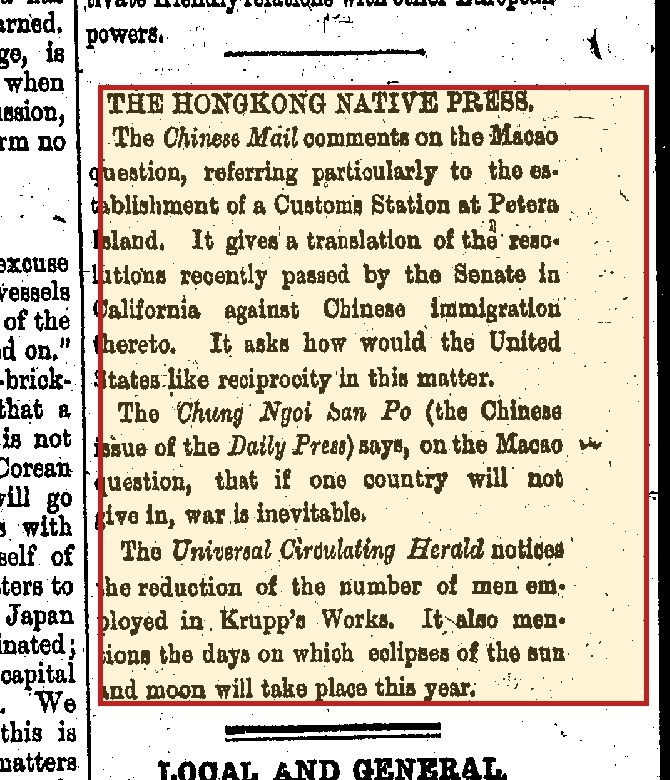
On 10 January 1876 the China Mail reported the colony’s first libel action against a Chinese paper: “An action has been brought by two Chinamen against the Universal Herald newspaper for alleged libel contained in some correspondence which was published on the 17th November… and damages are laid at $10,000. This will be the first case of libel against a Chinese newspaper in the Colony.”[16] The settlement survives in the paper’s own retraction, translated by the China Mail: the writer “slandered Messrs Tsang Shun Yee and Woo Lin Tak by falsely accusing them of being engaged in the nefarious trade of selling people for the purposes of emigration… And finally, he recorded the same in the Tsun Wan Yat Po”; he paid “the legal expenses in the sum of $600” (the 19 February printing reads $800), “$25” to the poor box (19 February: $23), and the cost of “inserting in the Chinese and foreign newspapers, three of each, for the period of one month, an article.”[22] The China Mail returned to the case twice more in March.[23]
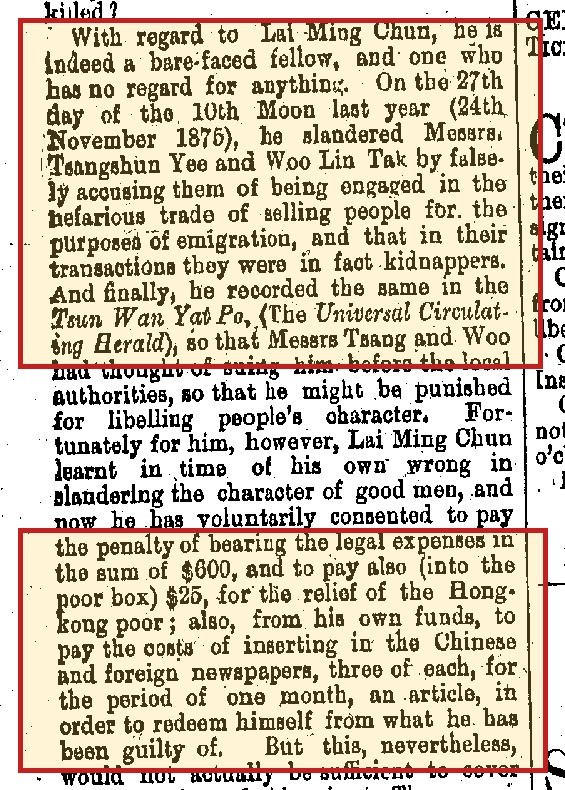
Beside the case runs the column that makes this paper possible. “THE HONGKONG NATIVE PRESS” ran daily through 1876 (124 occurrences in the year); a single number digests all three papers: “The Chinese Mail comments on the Macao question… The Chung Ngoi San Po (the Chinese issue of the Daily Press) says… that if one country will not give in, war is inevitable. The Universal Circulating Herald notices the reduction of the number of men employed in Krupp’s Works. It also mentions the days on which eclipses of the sun and moon will take place this year.”[12] The foreign paper read the Chinese press to its own readers, daily, with attribution — and employed the Chinese Mail’s editor as its own Chinese reporter.[18]
7. The four-title field and “the oldest” (1876–1886)
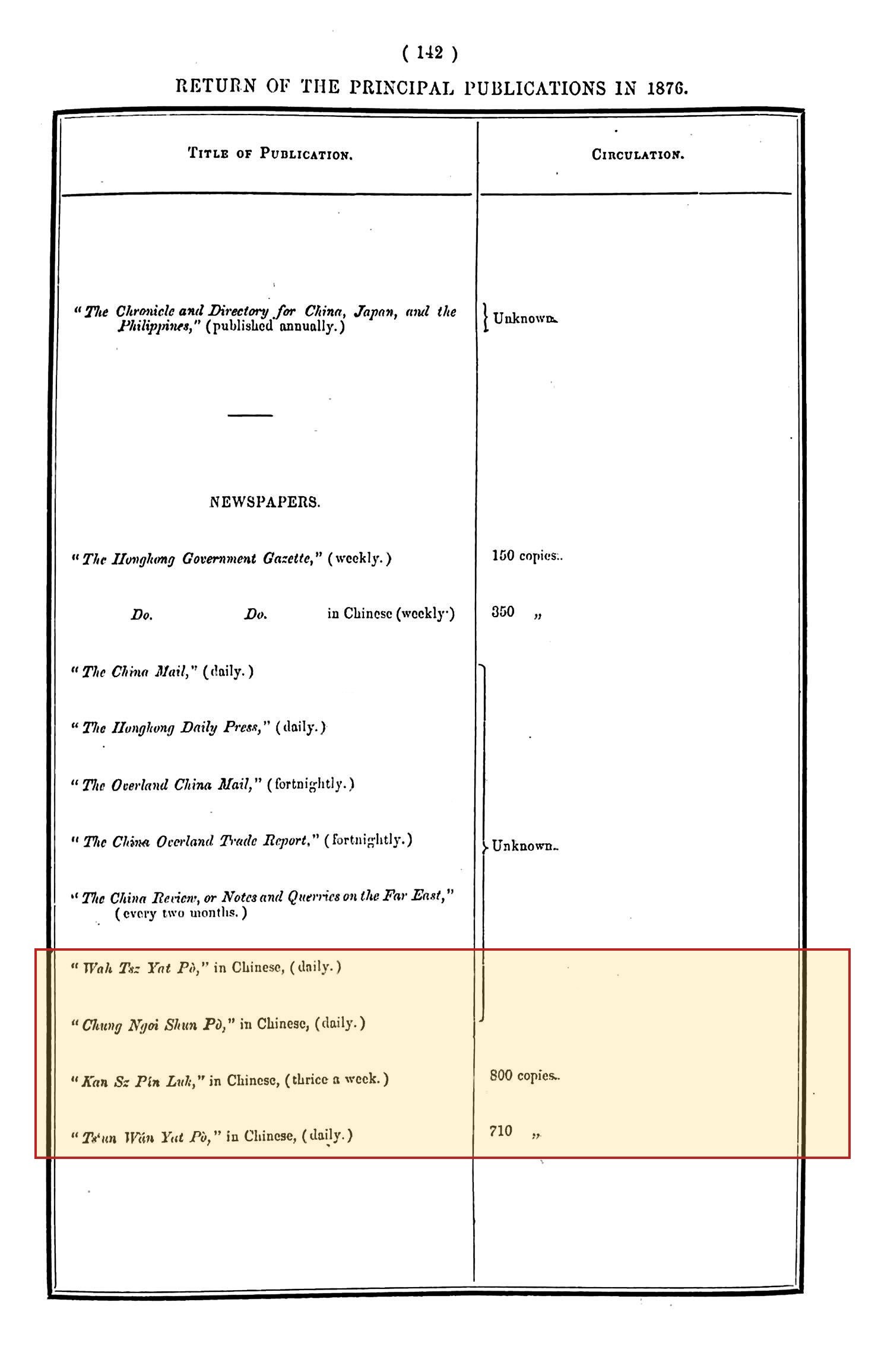
The 1876 return names the field: “Wah Tsz Yat Pà, in Chinese, (daily); Chung Ngôi Shun Pa, in Chinese, (daily); Kan Sz Pin Luk, in Chinese, (thrice a week); Trun Wán Yat Pò, in Chinese, (daily)” — with the Government Gazette in Chinese at 350 copies.[10] The 1877 return settles the spellings (“Wah Tsz Yat Po… Chung Ngôi San Po… Kan Sz Yat Luk… Tr’un Wán Yat Po”) and puts the Chinese Gazette at 300 copies; the English papers’ circulations are counted to the copy, the Chinese ones’ cells are bracketed “Unknown.”[11] The Directory’s annual survey, from 1879, supplies the verdict the century would keep: “The native Press is represented by three daily papers — the Chung Ngoi San Po, which is the oldest, published at the Daily Press Office; the Wa Tsz Yat Po, or Chinese Mail; and the Tsun Wan Yat Po, or Universal Circulating Herald.”[15] The list lengthens year by year (four dailies in 1885; five in 1886, adding the Yut Po; six in 1887, adding the Wa Tsz Tsit Po) while the leading clause never changes: “the Chung Ngoi San Po, which is the oldest and most influential.”[15]
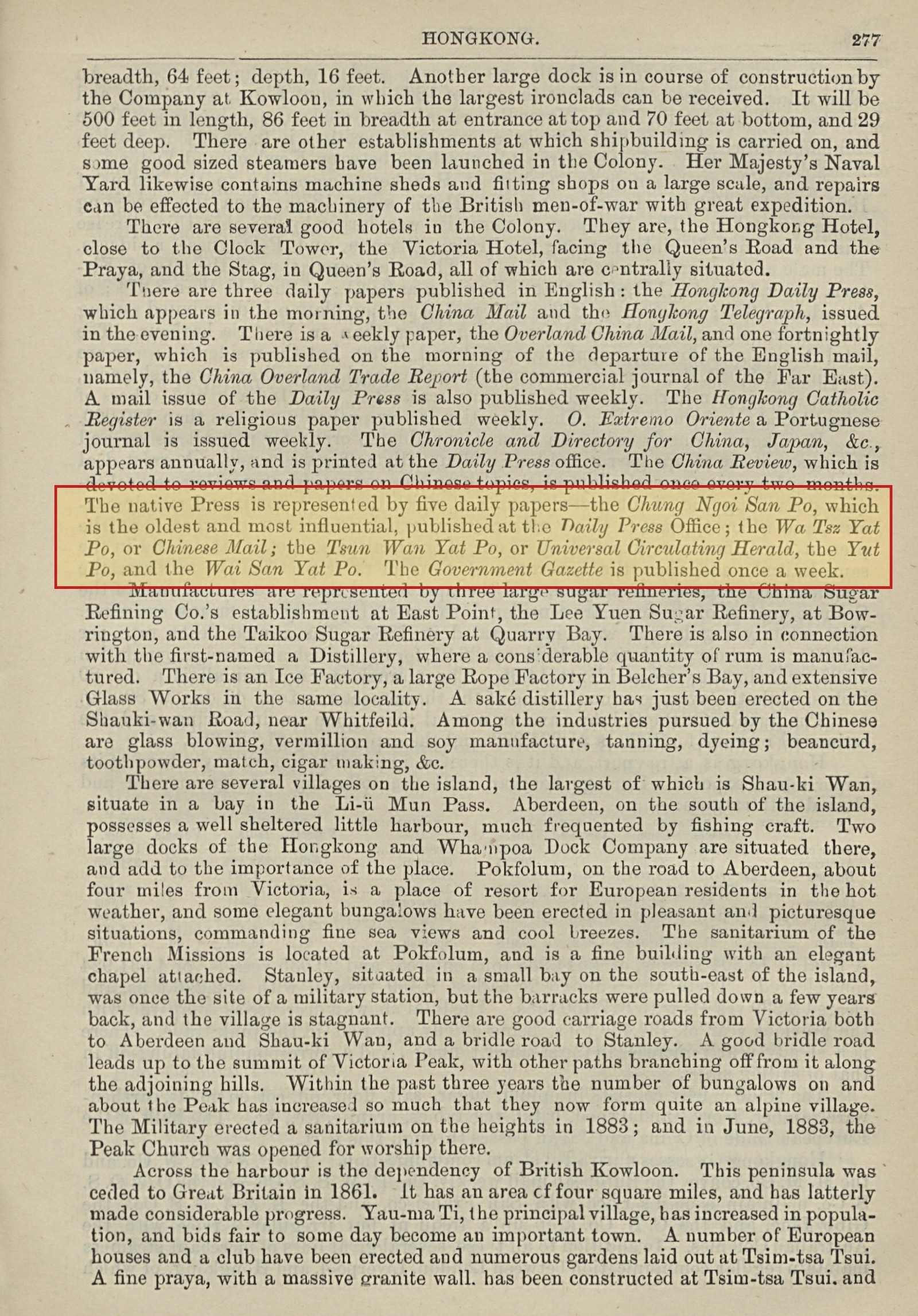
The Chinese Mail itself was property as much as paper. In June 1882 an editor sued for dismissal (“Tam Yik Kiu, $180”; the Carl Smith card: “engaged as editor, Jan. 1881, by Kong Chim, then the lessee; August last, lease changed hands”).[25] In July 1889 the China Mail office advertised it for lease — “Applications for the Lease of this Long-established Native Paper… Geo. Murray Bain, China Mail Office” — the same Bain who took orders for the paper in 1873.[26][17] The 1883 newcomer’s advertisement claimed “over 1,000 Copies” guaranteed, the only circulation figure any of these papers printed for itself.[24]
8. The long afternoon (1886–1922)
In 1886 the colony rewrote the press law. The Printers and Publishers Ordinance, 1886 (No. 6 of 1886, assented 12 July) required every newspaper’s printer and publisher to appear before the Registrar and subscribe a declaration in the Newspaper Register, with fresh declarations on any change.[27] The China Mail’s leader on the proclamation read the politics exactly: “the re-enactment of the old Press Law, with one or two new and specially burdensome clauses… a very clear example of the absurdity of legislating for Europeans on the same lines as for Chinese, as the old law was stated to be preserved mainly for the native newspapers… the Executive have thought proper to persist in treating the Chinese and European journalists upon the same footing.”[28] Two years later, Ordinance No. 2 of 1888, s. 6, opened the book register under which the newspapers’ own volumes were entered: the quarter ended 30 September 1909 registered the “Tsun Wan Yat Po, 51 Gough Street, May 1909.”[37][29]
The oldest outlived them all. By 1893 the Chung Ngoi San Po advertised as “The Oldest Chinese Newspaper,” $5 a year with a market extra;[30] in 1901, with its Chinese masthead 香港中外新報 heading the page, “To reach Chinese buyers — advertise in Chinese in the Chung Ngoi San Po, the oldest Chinese newspaper… circulated wherever Chinese are to be found, that is in every part of the World.”[31] The Blue Books of 1919–22 print the papers bilingually (Tsun Wán Yat Pò = 循環日報; Wá-tsz Yat Pò = 華字日報),[32] and the 1922 survey closes the file: “the Wah Sheung Chung Wui Po (with which is incorporated the Chung Ngoi San Po, the oldest vernacular journal, published at the Daily Press Office).”[33] The editor’s own end came in 1905: “Chan Oi-ting Dead,” the Daily Press reported; the North China Herald’s obituary traced a China Mail translator of the ’70s who left in the mid-’80s for the Chinese minister’s suite at Washington and the consulship at San Francisco — “the first Chinese newspaper man to enter diplomatic service of his country.”[38]
Conclusion
Laid out in the record’s own order, the “first Chinese newspaper” dissolves into four compatible firsts: the earliest Chinese paper on the official returns (the Daily Press’s Chinese issue, by 1862); the first paper “under purely native direction” (the Chinese Mail, from 1872); the first native-owned daily (the Universal Circulating Herald, 1874); and the judgment the directories kept for forty years (the Chung Ngoi San Po, “the oldest”, from 1879). Beyond the numbering, two things hold across the whole arc: the papers lived inside the law from the first — bonds, declarations, registered volumes — and they were never only “native”: the China Mail translated three of them daily for English readers in 1876, while printing one of them itself.
Appendix A — Bibliography
1. Legislative Council, Hongkong Government Gazette, 17 and 30 November 1860. https://hkintexts.histsyn.com/page/1881143 ; /page/1881144. — 2. Ordinances Nos. 15 and 16 of 1860 (Ordinance No. 16: “An Ordinance to amend the Law relating to Newspapers in Hongkong”, ss. 1–6). https://hkintexts.histsyn.com/page/1869899 ; /page/1869900. — 3. Blue Book 1861, p. 46. https://hkintexts.histsyn.com/page/655277. — 4. Blue Book 1862, p. 120. https://hkintexts.histsyn.com/page/655529. — 5. Blue Book 1867, printed [290] (scan). https://hkintexts.histsyn.com/image-page/2183116. — 6. Blue Book 1871, p. 130; scan /image-page/2184117. https://hkintexts.histsyn.com/page/657363. — 7. Blue Book 1873, p. 140; scan /image-page/2184617. https://hkintexts.histsyn.com/page/657837. — 8. Blue Book 1874, p. 140; scan /image-page/2184858. https://hkintexts.histsyn.com/page/658064. — 9. Blue Book 1875, p. 141. https://hkintexts.histsyn.com/page/658300. — 10. Blue Book 1876, p. 144; scan /image-page/2185360. https://hkintexts.histsyn.com/page/658539. — 11. Blue Book 1877, printed [142]; scan /image-page/2185626. https://hkintexts.histsyn.com/page/658795. — 12. Blue Book 1919, bilingual list. https://hkintexts.histsyn.com/image-page/2200958. — 13. Directory & Chronicle 1873 (pp. 24, 197, 220). https://hkintexts.histsyn.com/page/987293 ; /image-page/1010806 ; /page/987490. — 14. Directory & Chronicle 1879–1922 (“native Press” surveys; 1879 p. 203; 1886 p. 277; 1922 p. 1069). https://hkintexts.histsyn.com/page/990439 ; /image-page/905568 ; /page/1087434. — 15. Directory & Chronicle 1893 and 1901 (Chung Ngoi San Po advertisements). https://hkintexts.histsyn.com/image-page/1015110 ; /image-page/1022592. — 16. Daily Press, 2 and 10 February 1874 (the prospectus). https://hkintexts.histsyn.com/page/2229369 ; /page/2229400. — 17. Daily Press, 12 February 1883; Hongkong Telegraph, 13 February 1883 (Wai San Yat Po). https://hkintexts.histsyn.com/page/2196653 ; /page/2825376. — 18. Daily Press, 7 August 1905 (Chan Oi-ting). https://hkintexts.histsyn.com/page/2247560. — 19. China Mail, 8 January 1876 (advertisements). https://hkintexts.histsyn.com/page/1888176 ; /page/1888172. — 20. China Mail, 10 January 1876. https://hkintexts.histsyn.com/page/1888178 ; scan /image-page/1187209. — 21. China Mail, 19 and 22 February 1876; 4, 8 and 17 March 1876. https://hkintexts.histsyn.com/page/1888284 ; /page/1888293 ; scans /image-page/1187365 ; /image-page/1187378 ; /image-page/1187423 ; /image-page/1187435 ; /image-page/1187474. — 22. China Mail, 6 June 1882. https://hkintexts.histsyn.com/page/1895912 ; scan /image-page/1196255. — 23. China Mail, 5 July 1886. https://hkintexts.histsyn.com/page/1899654 ; scan /image-page/1199917. — 24. China Mail, 3 July 1889. https://hkintexts.histsyn.com/page/1903362 ; scan /image-page/1204024. — 25. Printers and Publishers Ordinance, 1886 (No. 6 of 1886, ss. 1–4); gazette scan /image-page/1529830. https://hkintexts.histsyn.com/page/1840634 ; /page/1840635. — 26. “Return of Books registered… quarter ended 30 September 1909”, Gazette, 15 October 1909, pp. 844–845. https://hkintexts.histsyn.com/page/1573062 ; /page/1573063. — 27. Carl Smith Collection cards (Wah Tsz Yat Po; Chan Oi-ting). https://hkintexts.histsyn.com/image-page/87930 ; /image-page/1493 (gated series; read via the archive admin session). — 28. Modern-secondary: 《香港史新編》; 《香港掌故》七集; 《華僑年鑑》1948–1950. https://hkintexts.histsyn.com/page/3186236 ; /page/3186257 ; /page/1757265 ; /page/1757726 ; /page/1758208. All accessed 2026-11-10.
Appendix B — The evidence register in brief
Confirmed (two or more independent witnesses): the 1862/1867 returns’ Chinese entries; the 1871 three-title field; the Chinese Mail’s daily relaunch (advertisements + the 1876/77 returns); Chun Ayin as reporter-editor (two directories + advertisements); the four-title field of 1876–77; the first libel case (news item + translated retraction); the “Native Press” column (124 numbers); “the oldest” verdict and the list’s growth; the 1886 ordinance and its repeal of the 1860 bond system. Single-witness: the 1872 founding notices (Carl Smith card only — the China Mail’s 1872 leaves are absent); the prospectus’s “London Times” sentence; the Wai San “1,000 copies” self-claim. Conflicts kept open: the 1867 return’s scan vs its text-series transcription (K1); the Chinese Mail’s frequency 1873 (advertisement vs return, K2); the Herald’s first number (K3); the apology’s sums, $600/$800 and $25/$23 (K4); the Chinese Mail’s founding year as between the modern accounts and the period sequence (K5); the layering of the “first” claims (K6); the Wai San’s frequency 1883–85 (K7); the 1860 ordinance’s repeal note (K8); the editor’s name-forms (K9); the Record of Latest News’s romanizations (K10); the 1876/77 returns’ circulation-column displacement (K11). Do-nots: the text-series “Chinese Mail (in Chinese) 1867” entry; any circulation figure assigned from the displaced column; Wang Tao and the 1857/58 dates as the record’s own facts (modern claims, labelled).
Notes
Legislative Council, Hongkong Government Gazette, 17 November 1860, p. 1 (first reading) and 30 November 1860, p. 1 (second reading and committee). https://hkintexts.histsyn.com/page/1881143 ; /page/1881144 (accessed 2026-11-10). ↩
Ordinances Nos. 15 and 16 of 1860, The Ordinances of Hong Kong: Ordinance No. 16 of 1860, “An Ordinance to amend the Law relating to Newspapers in Hongkong” [30 November 1860], ss. 1–6 (bond of £250 with two sureties; £20 penalty; bonds to the Colonial Secretary). https://hkintexts.histsyn.com/page/1869899 ; /page/1869900 (accessed 2026-11-10). ↩
Blue Book 1861, p. 46: Royal confirmation of Ordinance No. 16 of 1860 announced in the Gazette of 1 April. https://hkintexts.histsyn.com/page/655277 (accessed 2026-11-10). ↩
Blue Book 1862, p. 120: “Return of the principal Publications during the preceding year” — the Government Gazette “in Chinese” (weekly) and “The Chinese issue of the Daily Press” (3 times a week). https://hkintexts.histsyn.com/page/655529 (accessed 2026-11-10). ↩
Blue Book 1867, printed [290]: the handwritten return (read on the scan): “The Chinese issue of the Daily Press—Three a Week” and “The Hongkong [La]test News (in Chinese)—Three a Week”. https://hkintexts.histsyn.com/image-page/2183116 (accessed 2026-11-10). The text-series transcription of this leaf misrenders both Chinese entries (see the register's K1). ↩
Blue Book 1871, p. 130: “The China Mail (in Chinese)—weekly”; “The Chinese Edition of the Hongkong Daily Press—thrice a week”; “The Record of Latest News (in Chinese)—three times a week”. https://hkintexts.histsyn.com/page/657363 ; scan: /image-page/2184117 (accessed 2026-11-10). ↩
Blue Book 1873, p. 140: “The Chinese Mail, (daily.)”; “The Chinese Issue of the Daily Press,” (daily.); “The Record of Latest News, in Chinese” (thrice a week). https://hkintexts.histsyn.com/page/657837 ; scan: /image-page/2184617 (accessed 2026-11-10). ↩
Blue Book 1874, p. 140 (the Chinese Mail, the Chinese issue of the Daily Press, the Record of Latest News). https://hkintexts.histsyn.com/page/658064 ; scan: /image-page/2184858 (accessed 2026-11-10). ↩
Blue Book 1875, p. 141: “The Hongkong Chinese Mail—daily”; “Chung Ngoi Shun Po (Chinese)—daily”; the Kan Sz Pin Luk entry. https://hkintexts.histsyn.com/page/658300 (accessed 2026-11-10). ↩
Blue Book 1876, p. 144: “Wah Tsz Yat Pà,” in Chinese, (daily.); “Chung Ngôi Shun Pa,” in Chinese, (daily.); “Kan Sz Pin Luk,” in Chinese, (thrice a week.); “Trun Wán Yat Pò,” in Chinese, (daily.); the Gazette in Chinese (weekly), 350 copies. https://hkintexts.histsyn.com/page/658539 ; scan: /image-page/2185360 (accessed 2026-11-10). The circulation column’s figures do not align with any title (see the register’s K11). ↩
Blue Book 1877, printed [142]: “Wah Tsz Yat Po,” in Chinese, (daily.); “Chung Ngôi San Po,” in Chinese, (daily.); “Kan Sz Yat Luk,” in Chinese, (thrice a week.); “Tr’un Wán Yat Po,” in Chinese, (daily.); the Gazette in Chinese, 300 copies. https://hkintexts.histsyn.com/page/658795 ; scan: /image-page/2185626 (accessed 2026-11-10). ↩
“The Hongkong Native Press” (daily column), China Mail, 22 February 1876, p. 2 (scan-read): “The Chinese Mail comments on the Macao question… The Chung Ngoi San Po (the Chinese issue of the Daily Press) says… that if one country will not give in, war is inevitable. The Universal Circulating Herald notices the reduction of the number of men employed in Krupp’s Works.” https://hkintexts.histsyn.com/image-page/1187378 (accessed 2026-11-10). The column ran daily (124 occurrences in 1876). ↩
Carl Smith Collection card (施其樂檔案), “Wah Tsz Yat Po (Chinese Mail)”, quoting the China Mail of 30 March 1872 (the circular “in this day’s Chinese page”) and 2 April 1872 (the prospectus: “It will be the first Chinese Newspaper ever issued under purely native direction”); the same card annotates the 1882 editor’s case. https://hkintexts.histsyn.com/image-page/87930 (gated series, read via the archive admin session; accessed 2026-11-10). The China Mail leaves of March–April 1872 are absent from both corpus indices. ↩
The fullest form of the prospectus, Daily Press, 10 February 1874, p. 3: “It will be the first daily Chinese Newspaper… under purely native auspices. The editorial department will be conducted by [a] gentleman of great experience and learning… specially engaged for that purpose”; “will eventually become in China what the London Times is”; “The proposed paper will be issued EVERY DAY.” https://hkintexts.histsyn.com/page/2229400 (accessed 2026-11-10; column-interleaved OCR — fragments quoted). ↩
The annual survey of the “native Press”, Directory & Chronicle, 1879, p. 203: “three daily papers—the Chung Ngoi San Po, which is the oldest, published at the Daily Press Office; the Wa Tsz Yat Po, or Chinese Mail; and the Tsun Wan Yat Po, or Universal Circulating Herald. There is also a bi-weekly called Kan Sz Ping Luk. The Government Gazette is published once a week in both English and Chinese, by the Government printers, Messrs. Noronha & Sons.” https://hkintexts.histsyn.com/page/990439 ; scan: /image-page/901219 (accessed 2026-11-10). The same survey runs annually (the count: 3 dailies to 1884; 4 in 1885; 5 in 1886; 6 in 1887; 5 from 1888). ↩
“Local and General” and the first libel item, China Mail, 10 January 1876, p. 2: “An action has been brought by two Chinamen against the Universal Herald newspaper for alleged libel… and damages are laid at $10,000. This will be the first case of libel against a Chinese newspaper in the Colony.” https://hkintexts.histsyn.com/page/1888178 ; scan: /image-page/1187209 (accessed 2026-11-10). ↩
“The ‘Hongkong Chinese Mail’” (advertisement), Directory & Chronicle 1873, p. 220: the bilingual masthead 報日字華港香 (read right-to-left 香港華字日報); “issued on Mondays, Wednesdays and Fridays; with a Supplement every morning”; “Mr. Chun Ayin, Managing Editor”; “Published at the ‘China Mail’ Office, No. 2, Wyndham St.” https://hkintexts.histsyn.com/page/987490 (accessed 2026-11-10). ↩
Directory & Chronicle 1873, p. 24 (residents): “Chun Ayin, reporter (China Mail) and editor Chinese Mail, Hollywood Road.” https://hkintexts.histsyn.com/page/987293 (accessed 2026-11-10). ↩
Directory & Chronicle 1873, printed p. 197, “Professions and Trades”: the China Mail office’s entry 德臣印字館 (Tuh-sun-Yan-tzee-koon) — “‘China Mail’ Office, 2, Wyndham Street… Chinese Mail, every alternate day, with extra every morning, except Sunday… G. M. Bain, prop. and gen. man. N. B. Dennys, editor. Chun Ayin, rep. and Chinese Ed.” https://hkintexts.histsyn.com/image-page/1010806 (accessed 2026-11-10). ↩
“The Chinese Mail” advertisements, China Mail, 8 January 1876, p. 6: “This paper is now issued every day… It is the first Chinese Newspaper ever issued under purely native direction. The editorial department is conducted by Mr Chun Ayin…” and p. 2 (agencies: “Efforts have been made to establish Agents for circulating the Chinese Mail in all the ports… CHUN AYIN… Manager.”). https://hkintexts.histsyn.com/page/1888176 ; /page/1888172 ; scan: /image-page/1187202 (accessed 2026-11-10). ↩
“The Chinese Printing & Publishing Company, Limited, 29, Hollywood Road” (prospectus advertisements, text-only series), Daily Press, 2 February 1874, p. 1; the run continues 3, 5, 7 and 9 February 1874. https://hkintexts.histsyn.com/page/2229369 (accessed 2026-11-10). ↩
The paper’s own apology, translated, China Mail, 19 February 1876, p. 4 and 22 February 1876, p. 2: “he slandered Messrs Tsang Shun Yee and Woo Lin Tak… and that in their transactions they were in fact kidnappers. And finally, he recorded the same in the Tsun Wan Yat Po… voluntarily consented to pay… the legal expenses in the sum of $600 [the 19 February printing: $800], and to pay also (into the poor box) $25 [19 February: $23]… to pay the costs of inserting in the Chinese and foreign newspapers, three of each, for the period of one month, an article…” https://hkintexts.histsyn.com/page/1888284 ; /page/1888293 ; scans: /image-page/1187365 ; /image-page/1187378 (accessed 2026-11-10). ↩
The China Mail’s continuing remarks, 4, 8 and 17 March 1876, p. 1 (“These remarks apply to the case in which Messrs Tsang Shun Yee and Woo Lin Tak were… slandered by Lai Ming Chun”). https://hkintexts.histsyn.com/image-page/1187423 ; /image-page/1187435 ; /image-page/1187474 (accessed 2026-11-10). ↩
“The Wai San Yat Po” advertisements: Daily Press, 12 February 1883, p. 1, https://hkintexts.histsyn.com/page/2196653 ; Hongkong Telegraph, 13 February 1883, p. 3, https://hkintexts.histsyn.com/page/2825376 (“Guaranteed circulation of over 1,000 Copies.”). (accessed 2026-11-10). ↩
The editor’s case: “Tam Yik Kiu, $180”, China Mail, 6 June 1882, p. 3, https://hkintexts.histsyn.com/page/1895912 (scan: /image-page/1196255); the Carl Smith card annotates it: “Moy Yau San vs. Tam Yik Kiu, $180, wrongful dismissal. Pitff. engaged as editor, Jan. 1881, by Kong Chim, then the lessee; August last, lease changed hands.” https://hkintexts.histsyn.com/image-page/87930 (accessed 2026-11-10). ↩
“Chinese Mail (Wah Tsz Yat Po)” lease advertisements, China Mail, 3, 5, 13, 18, 20 and 23 July 1889, pp. 1–2: “Applications for the Lease of this Long-established Native Paper will be received by the Undersigned Geo. Murray Bain, China Mail Office.” https://hkintexts.histsyn.com/page/1903362 ; scan: /image-page/1204024 (accessed 2026-11-10). ↩
Printers and Publishers Ordinance, 1886 (Ordinance No. 6 of 1886, assented 12 July 1886), ss. 1–4: the declaration in the Newspaper Register before the Registrar; penalties for non-conformity. https://hkintexts.histsyn.com/page/1840634 ; /page/1840635 ; gazette scan: /image-page/1529830 (accessed 2026-11-10). ↩
“The Printers and Publishers’ Ordinance” (leader), China Mail, 5 July 1886, p. 2: “the re-enactment of the old Press Law, with one or two new and specially burdensome clauses… a very clear example of the absurdity of legislating for Europeans on the same lines as for Chinese, as the old law was stated to be preserved mainly for the native newspapers… the Executive have thought proper to persist in treating the Chinese and European journalists upon the same footing.” https://hkintexts.histsyn.com/page/1899654 ; scan: /image-page/1199917 (accessed 2026-11-10). ↩
“Registrar General’s Department — No. 655: Return of Books registered under Section 6 of Ordinance No. 2 of 1888, during the quarter ended 30th September, 1909”: the “Tsun Wan Yat Po, 51 Gough Street, May 1909” entry, Hongkong Government Gazette, 15 October 1909, printed pp. 844–845. https://hkintexts.histsyn.com/page/1573062 ; /page/1573063 (accessed 2026-11-10). ↩
“Chung Ngoi San Po” advertisement: “The Oldest Chinese Newspaper, published every morning, with a market extra. Subscription… $5 per Annum”, Directory & Chronicle 1893, p. 1149. https://hkintexts.histsyn.com/image-page/1015110 (accessed 2026-11-10). ↩
“To reach Chinese buyers… the Chung Ngoi San Po, the oldest Chinese newspaper” (advertisement with the paper’s Chinese masthead 香港中外新報), Directory & Chronicle 1901, p. iii. https://hkintexts.histsyn.com/image-page/1022592 (accessed 2026-11-10). ↩
Blue Book 1919, bilingual newspaper list: “Tsun Wán Yat Pò in Chinese, (daily), 循環日報… Wá-tsz Yat Pò in Chinese, (daily), 華字日報…” https://hkintexts.histsyn.com/image-page/2200958 (accessed 2026-11-10). ↩
“Hongkong” (annual survey), Directory & Chronicle 1922, p. 1069: “the Wah Sheung Chung Wui Po (with which is incorporated the Chung Ngoi San Po, the oldest vernacular journal, published at the Daily Press Office); the Wa Tsz Yat Po, or Chinese Mail; the Tsun Wan Yat Po, the Kung Wo Po and the Tai Kwong Po.” https://hkintexts.histsyn.com/page/1087434 (accessed 2026-11-10). ↩
《香港史新編》(modern secondary): 「《香港華字日報》由《德臣西報》的譯員陳靄亭創辦。他先於1871年3月在《德臣西報》的週六版面中,編一版中文版,名為《中外新聞七日報》。1872年正式命名《香港華字日報》,由黃勝出任主筆,初為雙日刊,翌年再改為日刊。」 https://hkintexts.histsyn.com/page/3186236 (accessed 2026-11-10). ↩
《香港掌故》七集 (modern secondary): 「《華字日報》創刊於清同治3年(1864年),創辦人是當年在《德臣西報》擔任譯著的陳靄亭,他向教會購買中文活字,托《德臣西報》代印…後一度改為兩日刊。光緒初年,再復為日刊。」 https://hkintexts.histsyn.com/page/3186257 (accessed 2026-11-10). ↩
《華僑年鑑》1948/1949/1950 (post-war retrospectives): 「至於華文報紙,應該推定英文報紙產生後十二年出版的《遐邇貫珍》為第一種…香港的第一種華文日報…這就是中外新報」;「到了一八五八年,才有一份眞正的華文日報出版…叫做中外新報…每兩天出一小張,後來改為每天一張」。 https://hkintexts.histsyn.com/page/1757265 ; /page/1757726 ; /page/1758208 (accessed 2026-11-10). ↩
Ordinance No. 2 of 1888, s. 6, under which the “Return of Books registered” was made — cited on every such return for the next sixty years (e.g. the return for the quarter ended 30 September 1909, below). ↩
“Chan Oi-ting Dead”, Daily Press, 7 August 1905, p. 2, https://hkintexts.histsyn.com/page/2247560 ; the North China Herald obituary of 11 August 1905, transcribed on a Carl Smith card (“On staff of ‘China Mail’, H.K. for many years as translator, joined paper in [the] 70’s, and severed connection middle of [the] 80’s…”), https://hkintexts.histsyn.com/image-page/1493 (accessed 2026-11-10). ↩