Lee Wai Tong (1905-1979): Hong Kong's soccer king in the colonial record
李惠堂(1905–1979):殖民紀錄裏的香港球王
摘要
李惠堂(Lee Wai Tong),南華足球隊前鋒,後世的稱呼是「亞洲球王」。本文問的問題很具體:香港殖民地時期的報章,替這個人留下了甚麼紀錄?答案有兩層。英文報章由1923年3月12日第一次記他的名字,至1941年9月29日最後一筆;中文的文字卷藏由1947年才開始,戰前的中文紀錄另有所在——《工商日報》的掃描頁,體育版上1,902頁。本文循語料逐項核實:1923年大阪遠東運動會的5–1決賽、同年澳洲遠征與Sydney Bulletin筆下的第三種拼法、1931年的回港入球、1936年柏林奧運的隊長職與30餘場熱身賽、陪審員名單上「瑞典洋行秘書」的正職、1941年7月馬來亞巡迴的「hat trick」。現代記述中流傳的幾處說法——決賽帽子戲法、巴達維亞的年份、1936年6月的出發日——同期文獻查無實據或與之相抵,本文如實記錄,不予採納。
一、題旨與方法
李惠堂,1905年10月16日生於香港大坑(現代記述),1979年7月4日歿於香港。[1] 本文的考證範圍以殖民紀錄為限:由出生到1941年12月淪陷。語料叢自身的紀錄,起1923年3月12日,訖1941年9月29日;1948年倫敦奧運的教練職、台灣的年代與身後名,屬身後史,文末一筆帶過。
傳記的前提是名字。語料叢的文字卷以報紙排印本為主,一個人的紀錄散在各種拼法裏,所以先做名字清點(附錄A):拉丁三形,加中文一形,逐式計數。結論是:英文報章載他,中文文字卷不載他,中文影像卷載他。「Lee Wai-tong」(帶連字符)1,504筆、戰前1,444筆;無連字符的「Lee Wai Tong」319筆;第三形「Li Wai-tong」戰前121筆,出自Sydney Bulletin。[2] 中文「李惠堂」文字卷1,371筆,全數1947年之後;影像卷1,985筆,其中《工商日報》1,902頁,版位全是體育版,抽樣所及1935年12月至1939年4月。[3] 這個結構決定了本文的讀法:1923年至1935年的故事在英文報章;1935年之後的中文紀錄在掃描頁上。三形合計的年份弧線,以1936年為峰(252筆)。[4]
名字之外還有陷阱。語料叢1921年前後的「Tai Hang」擊中,經逐條核讀,屬大坑來復槍射擊場的射擊成績欄,與大坑村足球無涉;現代記述中「1922年夏令營盃」一節,英文卷無同期見證,存檔不採。[5] 1914年Prince Edward Hotel的合夥人「Li Shuk Wai (alias Li Wai Tong)」是同名他人(§八);1900–1922年間的6筆「Li Wai-tong」同樣是他人。這些同名者經逐年核讀排除。
引文凡例:本文引文逐字照錄;原件排印的連字斷行(如「com-ing」)與OCR雜訊,按平常間隔與通行寫法還原,在此聲明一次,不另出校。語料叢即hkintexts語料叢(唯讀);文獻一律引公開閱覽器連結。
二、1923年3月12日:兩份報紙,一場比賽
南華對水兵的一場球,把李惠堂的名字同時送進兩份英文日報。《孖剌西報》第3頁印出正選名單,「Lee Wai Tong」無連字符;入球一段寫得細:「stooped the ball and bounced it down and Lee Wai Tong running up bent the goalkeeper and placed the ball in the net」。[6] 《士蔑新聞》頭版記同一場球,拼法帶連字符:「Lee Wai-tong opened the score for South China」。[7] 一場比賽,兩份報紙,兩種拼法——此後18年的紀錄,就在這兩形之間輪換。
入選只隔6星期。4月30日南華2–0勝香港會,報道記此球:「Rodger coming out to clear was beaten by Lee Wai Tong」,球入空門,「amidst cheers from the South China supporters」;末句宣布:「The team as played on Saturday have been chosen to represent South China in the coming Far Eastern Olympiad」。[8] 5月7日再入一球:「Before the close Lee Wai Tong added to the South China score」。[9]
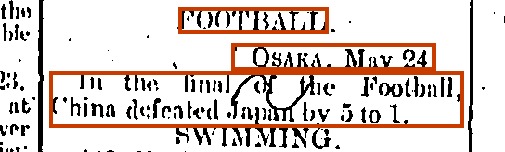
第六屆遠東運動會在大阪舉行,香港報章自5月21日起逐日報道。《德臣西報》5月25日的電訊只有一句:「Osaka, May 24. In the final of the Football, China defeated Japan by 5 to 1.」[10](圖一)三日後《孖剌西報》的大會總結記獎牌分佈,田徑、游泳、網球俱在,同樣無入球者名字。[11] 現代記述在此分歧:RSSSF記黃柏松兩球、葉九皋三球,維基百科記李惠堂連中三元;同期文獻兩面都查不到。決賽的比分是同期文件能證的,入球者不是——本文只印比分。[12]
三、澳洲遠征與第三種拼法
7月11日《士蔑新聞》第10頁印出南華會的募款啟事,澳洲行的機關寫得清楚:澳洲代表米拉德(H. A. Millard)「after having traversed China in search of the best material」,經中國競賽委員會邀南華會「to fill 12 vacancies in a total number of 17」;香港足球總會捐出200元;啟事稱此行為「the first team of Orientals to be invited to tour Australia」。[13] 8月10日頭版一行標題:「Hongkong Footballers Reach Australia」,內文記球隊「arrived in Australia, where they … (are) to play a series of matches」。[14]
Sydney Bulletin的開幕戰記,經《士蔑新聞》9月11日轉載回港。開幕戰在Show Ground舉行(英式橄欖球聯盟不借出板球場),5萬人滿座;中國隊與新南威爾士代表隊3–3言和,「after having led for the greater part of the game」。Bulletin寫李惠堂:「In Li Wai-tong they have as spry an inside left as one could wish to see」——第三種拼法(Li),場上位置是內鋒之一(inside left),不是中鋒。結語說:「As a factor in international football China has certainly arrived」。[15]
四、空窗與回返
此後三年,三種拼法合計0筆。單字「Wai-tong」同期有102筆,可見空窗是卷藏覆蓋的性質,不是查式的錯漏。[16] 現代記述把這幾年安在上海(復旦大學、樂華隊);語料能證的只有兩件事。其一,1929年4月9日,E&A線航程告示的乘客名單上有「Lee Wai-tong」一名,方向則OCR頁面無法辨讀。[17] 其二,1931年9月21日,南華對Services,他「scored a good goal with a well-placed shot」——1931年秋他人在香港。[18] 後者同時是現代記述「1931年秋赴巴達維亞」說的同期反證;巴達維亞段落的確切年份,語料查不到,本文不作斷言。
第十屆遠東運動會(馬尼拉,1934年)的機器看得見。5月4日《德臣西報》記北方選手200餘人由王正廷(Dr. C. T. Wang)率領,乘President McKinley輪抵港:「The northerners will be joined in Hong Kong by 39 South China athletes and officials」;啟程前,南華會在Caroline Hill新廈設招待會。[19] 至於李惠堂本人是否在39人之列,同期頁面沒有名字;現代記述記他參加了這一屆。兩說之間,本文只印機器,人名不引證。
五、中文紀錄的登場
中文卷對李惠堂的記載,不在文字卷——文字卷的1,371筆全是1947年之後;在影像卷:《工商日報》的掃描頁,體育版1,902頁,抽樣所及由1935年12月到1939年4月,正是他任南華隊長的年代。[3]
第一筆是1935年12月23日的尋常盃:「昨日尋常杯足球賽 … 李惠堂饒勇過人竟造成『四喜』」——南華5–2,一人四球;同標題記譚江柏「幾度失守致爲敵所乘」。[20](圖二)「四喜」是報紙自己的說法;「尋常杯」也是報紙原稱,本文不另作考釋。

六、柏林1936:隊長、兩球、三十場
1936年4月23日,《工商日報》體育版標題:「昨又有一批世運足球代表 李惠堂定今晨乘機飛滬」——代表團分批北上,李惠堂這一批在4月23日清晨搭機赴滬。[21](圖三)《士蔑新聞》8月7日的柏林專電記球隊「left Hongkong at the end of April」[22]——兩份報紙、兩種文字,同指4月下旬的出發月。現代記述「6月26日全隊自上海啟航」的單一出發說,與此相抵:6月那一段是北方球員的航程,香港球員4月已動身。本文採同期文件。
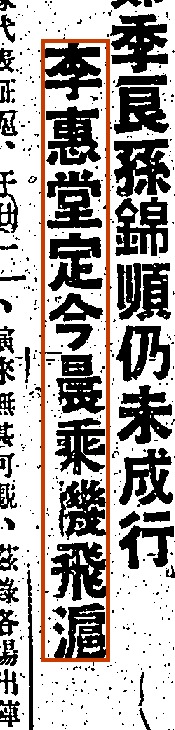
歐途的戰績有兩筆。7月9日《德臣西報》頭版:訪印首戰2–1勝印度代表隊,「before another record crowd」;「Lee Wai-tong, the skipper of the Olympic tourists, netted both the visitors' goals」——隊長之職,由頭版見。[23] 7月20日頭版再記:「the All-China football team, under the captaincy of Lee Wai-tong, will meet Great Britain in the First Round」,又記歐途「Held to a draw on four occasions in the course of over 27 matches on their way to Europe」,並載全隊名單。[24]
8月7日,柏林,第一圈對英國。《士蔑新聞》的專電:「Great Britain has defeated the China eleven in the Olympic soccer contest by two goals to none」。同頁記:「the Chinese Olympic footballers … since leaving Hongkong over three months ago (have) played something like 30 matches, and with the exception of three or four drawn games, have won all of them」——0–2之外,球隊此行30餘場不敗。[25]
一個月後,英國足球界自己把話說完。《士蔑新聞》9月16日轉述英格蘭足球總會秘書佐治·阿里臣(George Allison)的話:「The Football Association desire to thank their Chinese friends … for teaching us a lesson which (we) years ago did not think any nation outside our own was capable of teaching us」;[26] 總會的斯坦利·勞斯(Stanley Rous)說:「the Chinese footballers had that day given a lesson to the British players in the art of ground passing and headwork」。該報的結語:「we in Hongkong will be pardoned if we bask in the reflection of them」。[27]
七、白天的工作:陪審員名單上的秘書
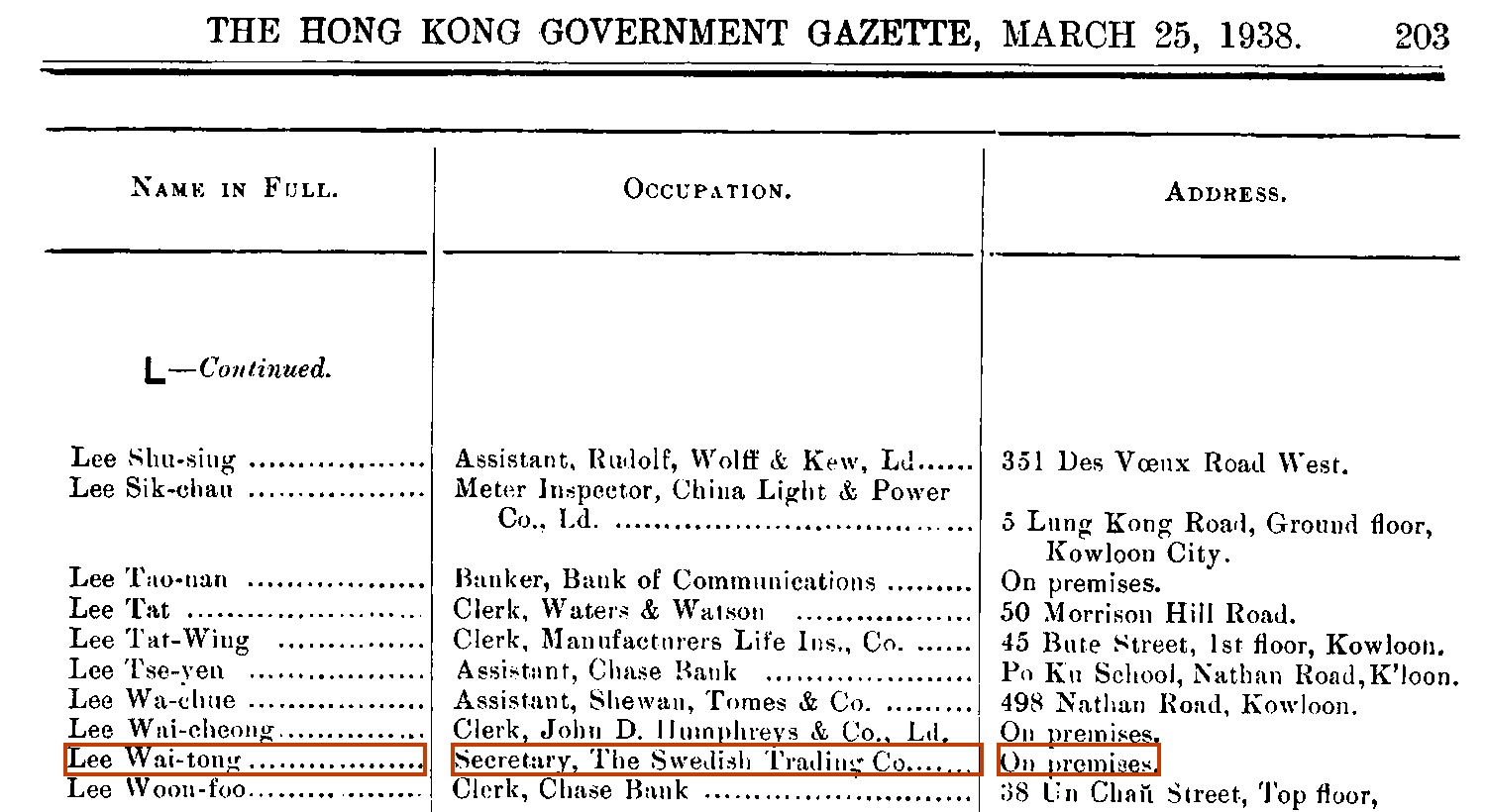
球場之外,名單上有另一行字。1937年的議政文件(Revised List of Jurors)第48頁,Lee姓四行相連,「Lee Wai-tong」對職業欄「Secretary, The Swedish Trading Co.」;[28] 1938年3月25日《憲報》的陪審員名單整行俱全:「Lee Wai-tong … Secretary, The Swedish Trading Co. … On premises.」[29](圖四)這一句在語料叢的10份文件中逐字出現,由1937年到1941年,年年不缺;[30] 公司的中文形「瑞典洋行」,文字卷118筆、影像卷179筆。
名單上的Lee Wai-tong是不是球員本人?語料叢只印名單,不印球場;把兩者接起來的是現代記述。國立臺灣圖書館的人物庫記他:「1935年,代表香港足球隊出席全國運動會。榮膺冠軍;同年,任香港瑞典洋行秘書。」[31] 香港足球歷史學會的回顧記:「後來李惠堂到雪厰街太子行四樓香港瑞典洋行擔任秘書文員。」[32] 兩處記述與名單年年相合。本文的分際照舊:名單是同期文件,拼合是現代記述;兩者之間,哪一層是哪一層,讀者看得到。
八、馬來亞,與紀錄的最後一頁
1941年7月,南華隊巡迴馬來亞。《德臣西報》7月3日體育版(印刷頁15):「South China football team, present in Malaya, were held to a four-all draw by Negri Sembilan State at Singapore on Monday. Lee Wai-tong scored a "hat trick" and Chan Tak-fai the other goal.」——「hat trick」印刷作兩詞,無連字符。[33] 巡迴總表:12場,9勝2和1負,「Goals for 40, Against 16」;射手行記「Lee Wai-tong 16, Chan Tak-fai 9, Lee Shek-yau 6, Lau Chung-sang 5, Lee Tak-kee 2, Chau Man-chi 1 and Wong Ki-leung 1」——七人合計恰為40,李惠堂的16球是全隊40球中的16球。逐場列表自相加得44/17,報紙自身的算術,本文照印,不加調和。[34]
9月29日,語料對這個名字的最後一筆,是一句戰報:「Lee Wai-tong's pass to Chin Chi-fai …」。[35] 三個月後香港淪陷,殖民紀錄至此而止。淪陷後的歲月——他拒為日方出賽、轉赴後方,1948年以教練身分出席倫敦奧運,1979年7月4日歿於香港——同期香港卷藏無載;這些年份的敘述全部出自現代記述,本文照錄其說,不作史實引證。[1]
1951年的一張卡片,替身後史添一筆家事。Carl Smith卡片記1951年的婚禮:「Mr. Lee Yuk-tak, soccer player, second son of Mr. and Mrs. Lee Wai-tong」。[36] 同卡上段1914年的酒店合夥人「Li Shuk Wai (alias Li Wai Tong)」是另一人:1914年已執業的成年人,不可能是1905年出生的球員。同卡兩段,同名不同人,存檔不採。[37]
九、結論
李惠堂的殖民地紀錄分兩層。英文報章由1923年3月12日至1941年9月29日,記了他18年半:兩份日報同日記下他的第一球,電訊記下大阪的5–1,Sydney Bulletin記下他的第三種拼法與內鋒位置,頭版記下他的隊長職,英格蘭足球總會的致謝辭經香港報章回港,陪審員名單年年記他的正職,馬來亞的戰報記下兩詞的「hat trick」。中文紀錄分兩段:《工商日報》的掃描頁由1935年起接手,1,902頁體育版;文字卷要到1947年才開口。現代記述裏流傳的幾個熱門說法——決賽帽子戲法、巴達維亞的起訖年份、6月的出發日——同期文獻查無實據或明言相反。本文把他留給殖民紀錄的部分,一項一項釘回文件上;留給身後史的部分,如實交還現代記述。
Lee Wai Tong (1905–1979): Hong Kong's soccer king in the colonial record
Abstract
Lee Wai Tong — printed by the period record as "Lee Wai-tong", "Lee Wai Tong" and "Li Wai-tong" — is the centre-forward the modern literature calls the "King of Asian Football". This paper asks what the colonial press actually holds. The answer has two layers. The English dailies carry the name from 12 March 1923 (two papers, two spellings, one match) to 29 September 1941; the Chinese text layer begins only in 1947, and the pre-war Chinese record lives elsewhere — on 1,902 scanned sports pages of the Kung Sheung Daily News. The paper verifies the arc item by item: the 5–1 Osaka final of 1923, the Australia tour and the Bulletin's third spelling, the 1931 return goal, the captaincy and some thirty unbeaten tour matches of the 1936 Berlin Olympics, the day job printed yearly on the jurors' lists ("Secretary, The Swedish Trading Co."), and the two-word "hat trick" of the July 1941 Malaya tour. The popular modern claims — a hat-trick in the Osaka final, the Batavia dates, a single late-June departure in 1936 — are unproven or contradicted by the period record, and are registered as such.
1. Scope and method
The subject: Lee Wai Tong, born 16 October 1905 in Tai Hang, Hong Kong, died 4 July 1979 (modern frame).[38] This paper's period is the colonial record, from birth to the occupation of December 1941. The corpus's own record runs from 12 March 1923 to 29 September 1941; the afterlife — the 1948 London Olympics as coach, the Taiwan years, the death — is carried briefly at the end.
The battery comes first (Appendix A), because a biography here is a spelling problem before it is a narrative one. The hyphen is load-bearing: "Lee Wai-tong" counts 1,504 text hits (1,444 pre-war), the unhyphenated "Lee Wai Tong" 319; the third form "Li Wai-tong" adds 121 pre-war hits — the Sydney Bulletin's spelling, with 6 pre-1923 namesakes set aside.[39] The Chinese record splits by medium: the text index's 李惠堂 layer — 1,371 hits — is entirely post-war, while the image index carries the name on 1,902 scanned sports pages of the Kung Sheung Daily News, sampled from 23 December 1935 to 28 April 1939.[40] The three forms' year arc peaks in 1936, at 252 hits.[41]
False leads, cleared before the narrative: the corpus's "Tai Hang" hits around 1921 are the Tai Hang Rifle Range's shooting scores, not village football, and the modern 1922 summer-camp-cup story has no period English witness;[42] the 1914 hotel partner "Li Shuk Wai (alias Li Wai Tong)" (see §8) and the six pre-1923 "Li Wai-tong" hits are other men. Quotations are verbatim; hyphenated line breaks and OCR noise are regularised to ordinary spacing and standard forms, stated here once rather than footnoted each time. The corpus is the hkintexts ES cluster (read-only); every reference carries the public viewer link.
2. The 1923 opening: two papers, one match
A single South China v. Sailors fixture put the name into two English dailies on the same day. The Daily Press of 12 March 1923 prints the line-up as "Lee Wai Tong" — no hyphen — and describes his goal: "stooped the ball and bounced it down and Lee Wai Tong running up bent the goalkeeper and placed the ball in the net".[43] The Telegraph's front page reports the same match with the hyphenated form: "Lee Wai-tong opened the score for South China".[44] One match, two papers, two spellings — and the record oscillates between the two forms for the next eighteen years.
Selection followed within six weeks. On 30 April South China beat the Hongkong Club 2–0; the report has the goalkeeper "coming out to clear was beaten by Lee Wai Tong", the ball rolled "into an empty goal amidst cheers from the South China supporters", and closes: "The team as played on Saturday have been chosen to represent South China in the coming Far Eastern Olympiad".[45] On 7 May he scored again: "Before the close Lee Wai Tong added to the South China score".[46]
The Sixth Far Eastern Championship Games opened in Osaka, and the Hongkong press reported them daily from 21 May. The China Mail's wire of 25 May is one sentence: "Osaka, May 24. In the final of the Football, China defeated Japan by 5 to 1."[47] (Fig. 1) The Daily Press's summary of 28 May carries the medal spread — track, swimming, tennis — and likewise no scorer names.[48] The modern record splits here: RSSSF credits Wong Pak-Chung (2) and Ip Kau Ko (3); the Wikipedias give Lee a hat-trick. The period record settles the score and not the scorers, and this paper prints the score only.[49]
3. Australia and the third spelling
The Australia tour was machinery before it was football. The Telegraph of 11 July prints the SCAA's appeal: the Australian delegate H. A. Millard, "after having traversed China in search of the best material", had invited the SCAA "through the China Contest Committee, to fill 12 vacancies in a total number of 17"; the Hongkong Football Association donated "$200"; the appeal calls the side "the first team of Orientals to be invited to tour Australia".[50] On 10 August the front page carries the headline "Hongkong Footballers Reach Australia", the team "arrived in Australia, where they … (are) to play a series of matches".[51]
The Sydney Bulletin's report of the opener came back to Hong Kong through the Telegraph of 11 September. The match moved to the Show Ground after the Rugby League refused the Cricket Ground; 50,000 packed in; China drew 3–3 with a strong N.S.W. side "after having led for the greater part of the game". Of Lee the Bulletin wrote: "In Li Wai-tong they have as spry an inside left as one could wish to see" — the third spelling, and the position: an inside left, not the centre. Its close: "As a factor in international football China has certainly arrived".[52]
4. The gap and the returns, 1924–1934
Then three silent years: no hit in any of the three forms. Bare "Wai-tong" has 102 hits across 1924–26, so the gap is a property of the corpus's coverage, not of the queries.[53] The modern frame places these years in Shanghai (Fudan University, the Lohwa club); the corpus can prove two things only. First, on 9 April 1929 an E&A line passenger list carries "Lee Wai-tong", direction unreadable on the OCR page.[54] Second, on 21 September 1931 he is in Hong Kong, scoring against Services "a good goal with a well-placed shot"[55] — the period counter-evidence to the modern claim that he left for Batavia in the autumn of 1931. The Batavia dates themselves stay unproven, and the paper asserts none.
The Tenth Games (Manila, 1934) leave the machinery on the record. The China Mail of 4 May: over 200 northern athletes led by Dr. C. T. Wang arriving by the President McKinley; "The northerners will be joined in Hong Kong by 39 South China athletes and officials"; a reception at South China's new pavilion at Caroline Hill before sailing.[56] Whether Lee stood among the 39 the period pages do not say; the modern frame says he played. The paper prints the machinery and marks the name as unverified.
5. The Chinese record's own account
The Chinese record's first word is not in the text index — its 1,371 hits all post-date 1947 — but in the image index: Kung Sheung Daily News scans, 1,902 sports pages, sampled from December 1935 to April 1939, the South China captaincy years.[57]
The first sighting is 23 December 1935, the Seung Sheung Cup: "yesterday's Seung Sheung Cup football … Lee, daring past every man, made a 'four-goal haul'" — South China 5–2, four goals from one man, with the same headline blaming Tam Kong-pak's repeated lapses for what was conceded.[58] (Fig. 2) The four-goal phrase and the cup's name are the paper's own print; this paper adds no gloss.
6. Berlin 1936: the captain, the two goals, the thirty matches
On 23 April 1936 the Kung Sheung Daily News sports page headlines the Olympic departure: another batch of representatives left yesterday, and "Lee Wai-tong is to fly to Shanghai by plane this morning".[59] (Fig. 3) The Telegraph's Berlin dispatch of 7 August has the squad having "left Hongkong at the end of April"[60] — two papers, two languages, one late-April departure month. The modern single-departure account (the whole team sailing from Shanghai on 26 June) does not fit: the June leg was the northern squad's; the Hong Kong players had gone in April. This paper follows the period documents.
Two results mark the road to Berlin. On 9 July the China Mail's front page: the tourists beat a representative Indian XI 2–1 "before another record crowd"; "Lee Wai-tong, the skipper of the Olympic tourists, netted both the visitors' goals" — the captaincy on the front page.[61] On 20 July, again the front page: "the All-China football team, under the captaincy of Lee Wai-tong, will meet Great Britain in the First Round" at "the Eleventh Olympic Games, which will open in Berlin on August 1"; and the tour so far "held to a draw on four occasions in the course of over 27 matches on their way to Europe".[62]
Berlin, 7 August, the first round against Great Britain. The Telegraph's dispatch: "Great Britain has defeated the China eleven in the Olympic soccer contest by two goals to none". The same page carries the wider count: the Chinese Olympic footballers, "since leaving Hongkong over three months ago", have "played something like 30 matches, and with the exception of three or four drawn games, have won all of them" — an unbeaten tour of some thirty matches around the 0–2.[63]
A month later the English game said it itself. The Telegraph of 16 September quotes the Football Association's secretary George Allison: "The Football Association desire to thank their Chinese friends … for teaching us a lesson which (we) years ago did not think any nation outside our own was capable of teaching us";[64] and the FA's Stanley Rous: "the Chinese footballers had that day given a lesson to the British players in the art of ground passing and headwork". The paper's own close: "we in Hongkong will be pardoned if we bask in the reflection of them".[65]
7. The day job: a secretary on the jurors' lists
Off the pitch, the lists carry another line. The 1937 Sessional Paper's Revised List of Jurors (p. 48) runs four consecutive Lee rows, with "Lee Wai-tong" set against "Secretary, The Swedish Trading Co."[66] The Gazette's list of 25 March 1938 (printed p. 203) carries the row whole: "Lee Wai-tong … Secretary, The Swedish Trading Co. … On premises."[67] (Fig. 4) The phrase "Secretary, The Swedish Trading" stands verbatim in 10 corpus documents, every year from 1937 to 1941;[68] the firm's Chinese form counts 118 text hits and 179 image hits.
Is the list's Lee Wai-tong the footballer? The corpus prints the lists and not the pitch; the join is made by the modern record. The National Central Library's R.O.C. biographical database: in 1935 he played for the Hong Kong side at the national games and finished champion, and "the same year, took up the post of secretary at Hong Kong's Swedish Trading Company".[69] The Hong Kong Football History Society's retrospective: Lee "later served as a secretary-clerk on the fourth floor of the Swedish Trading Company, Prince's Building, Battery Path".[70] The two accounts match the lists year for year. The paper's line stands: the lists are period documents, the join is modern, and the reader can see which layer is which.
8. Malaya, and the record's last page
In July 1941 South China toured Malaya. The China Mail's sports page of 3 July (printed folio 15): "South China football team, present in Malaya, were held to a four-all draw by Negri Sembilan State at Singapore on Monday. Lee Wai-tong scored a "hat trick" and Chan Tak-fai the other goal." — the phrase printed as two words, no hyphen.[71] The tour table: 12 matches, 9 won 2 drawn 1 lost, "Goals for 40, Against 16"; the scorers line "Lee Wai-tong 16, Chan Tak-fai 9, Lee Shek-yau 6, Lau Chung-sang 5, Lee Tak-kee 2, Chau Man-chi 1 and Wong Ki-leung 1" — the seven names sum to exactly 40, his 16 being 16 of the 40. The printed match list itself sums to 44/17; that is the paper's own arithmetic, quoted as printed and not reconciled.[72]
On 29 September the corpus records the name for the last time, in a match report: "Lee Wai-tong's pass to Chin Chi-fai …".[73] Three months later the occupation ended the colonial record. The years after — the refusal to play for the occupation authorities, the rear-area years, the 1948 London Olympics as coach, the death on 4 July 1979 — have no witness in the Hong Kong corpus; the account follows the modern frame and is not cited as period fact.[74]
One card adds a family line to the afterlife. The Carl Smith card records the 1951 wedding of "Mr. Lee Yuk-tak, soccer player, second son of Mr. and Mrs. Lee Wai-tong".[75] The same card's upper half records a 1914 hotel partnership, "Li Shuk Wai (alias Li Wai Tong)" — an adult businessman in 1914 cannot be the footballer born in 1905. One card, two same-named men; registered, never used as a pairing.[76]
9. Conclusion
The colonial record of Lee Wai Tong has two layers. The English press, from 12 March 1923 to 29 September 1941, kept him for eighteen and a half years: two dailies recorded his first goal on the same day; a wire recorded the Osaka 5–1; the Sydney Bulletin recorded the third spelling and the inside-left position; front pages recorded the captaincy; the English FA's thanks came back through the Hongkong press; the jurors' lists recorded his day job every year; the Malaya report recorded the two-word "hat trick". The Chinese record runs in two segments: the Kung Sheung Daily News scans take over from 1935 — 1,902 sports pages — and the text layer opens only in 1947. The modern frame's popular claims — a hat-trick in the Osaka final, the Batavia dates, the single June departure — are unproven or contradicted by the period record. What the colonial record holds, this paper has pinned back to its documents, item by item; what belongs to the afterlife has been handed back to the modern record, stated as such.
Works cited
Primary (period): The China Mail (德臣西報), 21 Jan 1921, 12 May 1923, 25 May 1923, 9 Apr 1929, 21 Sep 1931, 4 May 1934, 9 Jul 1936, 20 Jul 1936, 3 Jul 1941; The Hongkong Daily Press (孖剌西報), 12 Mar 1923, 30 Apr 1923, 7 May 1923, 28 May 1923; Hongkong Telegraph (士蔑新聞), 12 Mar 1923, 11 Jul 1923, 10 Aug 1923, 11 Sep 1923 — and the whole issue of 7 Aug 1936, pulled entire, 28,240 lines, 16 Sep 1936, 29 Sep 1941; Kung Sheung Daily News 工商日報 (scans), 23 Dec 1935, 23 Apr 1936; Hong Kong Government Gazette, 25 Mar 1938 (the jurors' list, printed p. 203); Hongkong Sessional Papers 1937 (the Revised List of Jurors, p. 48); Carl Smith index card 14830.
Secondary (leads, never conclusions): Ken Knight, "Sixth Far Eastern Championship Games 1923", RSSSF (rsssf.org/tablesf/fareastgames23.html); zh and en Wikipedia, "Lee Wai Tong"; 國立臺灣圖書館《民國近代史》人物庫, 李惠堂; 香港足球歷史學會, 「球王李惠堂(一)」. Each modern claim was tested against the corpus before use; the failures are registered in the text.
Appendix A — The name battery and the source counts
All counts are match_phrase queries against the hkintexts ES cluster (read-only), text index (hkintexts_pages, field content_text) and image index (hkintexts_image_pages, field all_text) separately, run 27–28 November 2026. Pre-war = the document_key carries a year 1841–1941, matching both key shapes (press YYYY-MM-DD; gazette <digits>-YYYY-…), pattern (18[4-9][0-9]|(19[0-3][0-9]|194[01])). Two filter defects were caught and fixed inside the run (recorded in the run's own log): a year pattern that matched into 1949, and day-window regexps that failed to match the whole key.
| Form | Index | all | pre-war | Notes |
|---|---|---|---|---|
| 李惠堂 | text | 1,371 | 0 | 1,309 Wah Kiu Yat Po (1947+); 58 yearbook layer; the rest scattered modern |
| 李惠堂 | image | 1,985 | n/a (key null) | 1,902 = 工商日報 scans, sports p. 12, sampled 1935-12-23…1939-04-28 |
| 惠堂 (short) | text | 2,061 | 1 | the single pre-war hit = OCR noise on a 1911 ordinance page |
| Lee Wai-tong | text | 1,504 | 1,444 | Telegraph 641 / China Mail 631 / Daily Press 168 / gazette 4; year arc peaks 1936 (252) |
| Lee Wai Tong | text | 319 | 261 | unhyphenated variant |
| Li Wai-tong | text | 126 | 121 | the Sydney Bulletin's spelling; 6 hits 1900–1922 = namesakes |
| Wai-tong Lee | text | 11 | 8 | inverted (directory style) |
| Lee Wai-tong | image | 873 | China Mail 847; departmental reports 8; gazette 3; sessional 3; one Carl Smith card (the namesake trap) | |
| 球王 | text | 1,706 | 37 | generic epithet, classified out; only 「球王李惠堂」 (31) and 「亞洲球王」 (11) are his, both post-war |
| Secretary, The Swedish Trading | text+image | 10 | 10 | the jurors' lists and council papers of 1937–1941, verbatim each year |
| 瑞典洋行 | text / image | 118 / 179 | the firm's Chinese form (glossary-adopted = The Swedish Trading Co.) |
The name-gap. No hit in any of the three Latin forms across 1924–1926, while bare "Wai-tong" has 44/53/5 hits in those years — a coverage property. The corpus's Lee record: 12 March 1923 – 29 September 1941.
Instrument lessons. The hyphen is a token separator ("Far Eastern" vs "Far-Eastern" produced a false zero before the fix); a day-window regexp must match the whole key; the image index's document_key is null-bearing text and will not sort or aggregate — aggregate on series_slug instead; and every image page cited was read whole by eye at full resolution.
Pulls. The pages cited were pulled one by one — 24 single pages — and the Telegraph's whole issue of 7 August 1936 (the Berlin-Olympics number, 28,240 lines) was pulled entire and read whole. Four source scans were read at full resolution by eye (the 25 May 1923 wire page, the 1938 jurors' page, the two 工商日報 sports pages), and the 3 July 1941 sports page was read on its scan.
Appendix B — The plate manifest
Every plate was rebuilt from measured source pixels, then read back by eye at its final delivered bytes in the shipping session; each box encloses exactly the quoted words — characters counted on the vertical columns, lines on the horizontal ones — and no box frames an unquoted neighbour.
| Plate | Crop (src px) | Boxes (src coords) | Gate |
|---|---|---|---|
plate_cm_1923-05-25_osaka_wire.jpg 505×152 | (805,1118)–(1310,1270) | rubric (983,1125,1133,1151) · dateline (1036,1161,1240,1188) · sentence (854,1189,1268,1245) | PASS — visual read + border groups exact; the next dispatch's dateline (y1245+) kept outside the crop |
plate_gaz_1938_jurors_lee.jpg 1500×820 | (150,195)–(1650,1015) | name (214,945,580,978) · occupation (605,945,1142,978) · address (1156,945,1321,978) | PASS — masthead, column headers and the three boxes seated on the Lee Wai-tong row only; neighbouring rows (Lee Wai-cheong, Lee Woon-foo) outside |
plate_ksyp_1936-04-23_departure.jpg 175×730 | (2040,2740)–(2215,3470) | headline (2081,2779,2149,3401) | PASS — border exact; the neighbouring column and the body text resuming at y3402 excluded by the box bottom (3401) |
plate_ksyp_1935-12-23_sixiang.jpg 190×1060 | (2560,2250)–(2750,3310) | col-left (2568,2301,2660,3255) · col-right (2664,2301,2742,3255) | PASS — the two columns' strokes interlock at the boundary; the split follows the measured optimum (foreign ink 0.4%/0.1% of each box) |
Notes
現代記述框架(二手,僅作線索):zh/en Wikipedia「李惠堂/Lee Wai Tong」條(2026-11-27擷取)——1905-10-16生於香港大坑,祖籍五華,父李浩如;1922年入南華;1979-07-04歿。凡語料查無實據之處,本文正文明記「語料無載」,不作採納。 ↩
連字符是分詞符:「Lee Wai-tong」(帶連字符)文字卷1,504筆、戰前1,444筆;「Lee Wai Tong」(無連字符)319筆、戰前261筆。第三形「Li Wai-tong」126筆、戰前121筆——Sydney Bulletin的拼法,另有6筆1900–1922年的同形者,經逐年核讀均為他人。年份弧線以1936年為峰(252筆)。 ↩
中文形「李惠堂」:文字卷1,371筆,全數屬1947年後的華僑日報(1,309筆)與華僑年鑑等(58筆)——戰前0筆;影像卷1,985筆,其中工商日報(ksyp)1,902頁,版位全是體育版(p.12),抽樣所及1935-12-23至1939-04-28。「惠堂」二字單用2,061筆,戰前僅1筆,經查為1911年憲報條例頁的OCR噪聲。 ↩
語料叢計數:本文的每一處出現次數,均以hkintexts語料叢(唯讀)的match_phrase查詢逐式核計;文字卷(hkintexts_pages)與影像卷(hkintexts_image_pages)分開計數,戰前限定為document_key攜1841–1941年份的兩種鍵形。逐式結果見附錄A。查詢與取頁日期2026-11-27/28。 ↩
《德臣西報》,1921年1月21日第7頁:語料叢1921年前後的「Tai Hang」擊中,經逐條核讀,屬大坑來復槍射擊場(Tai Hang Rifle Range)的射擊成績欄,與大坑村足球無涉——現代記述中「1922年夏令營盃」一節(中文維基)在英文卷無同期見證,存檔不採。https://hkintexts.histsyn.com/page/1963718 (2026-11-27擷取)。 ↩
《孖剌西報》(The Hongkong Daily Press),1923年3月12日第3頁,南華對水兵之戰:正選名單記「Lee Wai Tong」,入球描述作「stooped the ball and bounced it down and Lee Wai Tong running up bent the goalkeeper and placed the ball in the net」。https://hkintexts.histsyn.com/page/2297565 (2026-11-27擷取)。 ↩
《士蔑新聞》(Hongkong Telegraph),1923年3月12日第1頁,同場比賽的報道:「Lee Wai-tong opened the score for South China」——同一場比賽,兩份報紙,兩種拼法(無連字符對帶連字符)。https://hkintexts.histsyn.com/page/2907175 (2026-11-27擷取)。 ↩
《孖剌西報》,1923年4月30日第2頁:南華2–0香港會,報道記「Rodger coming out to clear was beaten by Lee Wai Tong」,球入空門,「amidst cheers from the South China supporters」;末句「The team as played on Saturday have been chosen to represent South China in the coming Far Eastern Olympiad」。https://hkintexts.histsyn.com/page/2298056 (2026-11-27擷取)。 ↩
《孖剌西報》,1923年5月7日第5頁:「Before the close Lee Wai Tong added to the South China score」——入選遠東運動會後的另一筆。https://hkintexts.histsyn.com/page/2298131 (2026-11-27擷取)。 ↩
《德臣西報》(The China Mail),1923年5月25日第11頁,電訊欄:「Osaka, May 24. In the final of the Football, China defeated Japan by 5 to 1.」——結果有,入球者無。影像卷(整版已讀) https://hkintexts.histsyn.com/image-page/2294129 ;文本頁 https://hkintexts.histsyn.com/page/1971757 (2026-11-27擷取)。 ↩
《孖剌西報》,1923年5月28日第4頁,大會總結:「The last day of the Osaka Olympic sports … (while) no world records were broken, practically all the Far Eastern records were smashed」——田徑、游泳、網球的獎牌分佈俱全,同樣無入球者名字。https://hkintexts.histsyn.com/page/2298346 (2026-11-27擷取)。 ↩
決賽入球者的現代分歧:RSSSF《Sixth Far Eastern Championship Games 1923》(Ken Knight,rsssf.org/tablesf/fareastgames23.html,2026-11-27擷取)記Wong Pak-Chung兩球、Ip Kau Ko三球;zh/en Wikipedia則記李惠堂連中三元。同期電文稿與大會總結均無入球者名字——本文不印任何決賽入球主張,分歧存檔。 ↩
《士蔑新聞》,1923年7月11日第10頁,南華會的募款啟事:澳洲代表H. A. Millard「after having traversed China in search of the best material」,經「the China Contest Committee」邀南華會「to fill 12 vacancies in a total number of 17」;香港足球總會捐「$200」;啟事稱此行為「the first team of Orientals to be invited to tour Australia」。https://hkintexts.histsyn.com/page/2908471 (2026-11-27擷取)。 ↩
《士蔑新聞》,1923年8月10日第1頁,標題「Hongkong Footballers Reach Australia」,內文記球隊「arrived in Australia, where they … (are) to play a series of matches」。https://hkintexts.histsyn.com/page/2908796 (2026-11-27擷取)。 ↩
《士蔑新聞》,1923年9月11日第1頁,轉載Sydney Bulletin(8月16日)的開幕戰記:Show Ground滿座五萬;「In Li Wai-tong they have as spry an inside left as one could wish to see」;中國隊「broke even 3 goals each with a strong N.S.W. side after having led for the greater part of the game」;結語「As a factor in international football China has certainly arrived」。https://hkintexts.histsyn.com/page/2909160 (2026-11-27擷取)。 ↩
名姓空窗經三形並查核實:1924–1926三年,「Lee Wai-tong」「Lee Wai Tong」「Li Wai-tong」三形合計0筆;同三年單字「Wai-tong」有44/53/5筆——空窗是卷藏覆蓋的性質,不是查式的錯漏。語料叢對李惠堂的紀錄,起1923-03-12,訖1941-09-29。 ↩
《德臣西報》,1929年4月9日第5頁,E&A線航程告示中的乘客名單,記「Lee Wai-tong」一名——上海年代的行蹤見證;OCR頁面無法辨讀方向(離港抑抵港),本文只記「名單有此人」。影像卷 https://hkintexts.histsyn.com/image-page/2316746 ;文本頁 https://hkintexts.histsyn.com/page/1994572 (2026-11-27擷取)。 ↩
《德臣西報》,1931年9月21日第5頁,南華對Services:「Lee Wai-tong scored a good goal with a well-placed shot」(半場1–0)——1931年秋他人在香港,此為現代記述「1931年秋赴巴達維亞」說的同期反證;巴達維亞段落的確切年份,語料無法核實,本文不作斷言。影像卷 https://hkintexts.histsyn.com/image-page/2574053 ;文本頁 https://hkintexts.histsyn.com/page/2004387 (2026-11-27擷取)。 ↩
《德臣西報》,1934年5月4日第6頁:北方選手200餘人,由王正廷(Dr. C. T. Wang)率領,乘「President McKinley」輪抵港;「The northerners will be joined in Hong Kong by 39 South China athletes and officials」;啟程前南華會在Caroline Hill新廈設招待會。第十屆遠東運動會,馬尼拉。同期頁面無名單,他是否在列不作同期引證。影像卷 https://hkintexts.histsyn.com/image-page/2584082 ;文本頁 https://hkintexts.histsyn.com/page/2014491 (2026-11-27擷取)。 ↩
《工商日報》,1935年12月23日體育版第12頁:「昨日尋常杯足球賽 … 李惠堂饒勇過人竟造成『四喜』」——南華5–2,李惠堂一人四球;「尋常杯」為報紙原稱。影像卷(整版已讀) https://hkintexts.histsyn.com/image-page/459855 (2026-11-28擷取)。 ↩
《工商日報》,1936年4月23日體育版第12頁,標題「昨又有一批世運足球代表 李惠堂定今晨乘機飛滬」——世運(奧運)足球代表李惠堂於該日清晨搭機赴滬。影像卷(整版已讀) https://hkintexts.histsyn.com/image-page/461617 (2026-11-28擷取)。 ↩
《士蔑新聞》,1936年8月7日,柏林專電:「CLOSE MATCH IN OLYMPIC CLASH — Berlin, Aug. 7. Great Britain has defeated the China eleven in the Olympic soccer contest by two goals to none」(Reuter)。同頁記球隊「left Hongkong at the end of April」——與《工商日報》4月23日的頭條相合,與現代記述「6月26日自上海啟航」的單一齣發說相抵(見正文§六)。整期全卷已取(本線程的整卷存證,28,240行);p.13文本頁 https://hkintexts.histsyn.com/page/2978674 (2026-11-27擷取)。 ↩
《德臣西報》,1936年7月9日第1頁(頭版):訪印首戰,中國隊2–1勝印度代表隊,「before another record crowd」;「Lee Wai-tong, the skipper of the Olympic tourists, netted both the visitors' goals」。此頁為本文對此戰果僅有的一個同期見證。影像卷 https://hkintexts.histsyn.com/image-page/2592592 ;文本頁 https://hkintexts.histsyn.com/page/2023070 (2026-11-27擷取)。 ↩
《德臣西報》,1936年7月20日第1頁(頭版):「the All-China football team, under the captaincy of Lee Wai-tong, will meet Great Britain in the First Round … at the Eleventh Olympic Games, which will open in Berlin on August 1」;又記「Held to a draw on four occasions in the course of over 27 matches on their way to Europe」,並載全隊名單。影像卷 https://hkintexts.histsyn.com/image-page/2592704 ;文本頁 https://hkintexts.histsyn.com/page/2023182 (2026-11-27擷取)。 ↩
《士蔑新聞》,1936年8月7日(同前引):「the Chinese Olympic footballers … since leaving Hongkong over three months ago (have) played something like 30 matches, and with the exception of three or four drawn games, have won all of them」。整期全卷,行18,503。 ↩
《士蔑新聞》,1936年9月16日第12頁,轉述英格蘭足球總會秘書George Allison在中國隊訪歸後的宴會致辭:「The Football Association desire to thank their Chinese friends … for teaching us a lesson which (we) years ago did not think any nation outside our own was capable of teaching us」。https://hkintexts.histsyn.com/page/2979473 (2026-11-27擷取)。 ↩
《士蔑新聞》,1936年9月16日第12頁(同前引):足球總會Stanley Rous的話——「the Chinese footballers had that day given a lesson to the British players in the art of ground passing and headwork」;該報結語「we in Hongkong will be pardoned if we bask in the reflection of them」。https://hkintexts.histsyn.com/page/2979473 。 ↩
議政定例兩局文件(Sessional Papers)1937年,第48頁,Revised List of Jurors:名姓欄Lee姓四行相連,其中「Lee Wai-tong」一行對職業欄「Secretary, The Swedish Trading Co.」;同行另有「Assistant, Shewan, Tomes & Co.」「Clerk, John D. Humphreys & Co., Ld.」「Clerk, Chase Bank」三職。影像卷 https://hkintexts.histsyn.com/image-page/1623544 ;文本頁 https://hkintexts.histsyn.com/page/1831734 (2026-11-28擷取)。 ↩
《香港政府憲報》,1938年3月25日,陪審員名單(印刷頁203):「Lee Wai-tong … Secretary, The Swedish Trading Co. … On premises.」整行俱全。影像卷(整版已讀) https://hkintexts.histsyn.com/image-page/1514365 ;文本頁 https://hkintexts.histsyn.com/page/1609373 (2026-11-28擷取)。 ↩
「Secretary, The Swedish Trading」一句在語料叢10份文件中逐字出現(1937–1941年的議政局文件與陪審員名單);公司中文形「瑞典洋行」文字卷118筆、影像卷179筆。 ↩
現代見證一(國立臺灣圖書館「民國近代史」人物庫「李惠堂」條,edata.nlpi.edu.tw/CNH/Personage/personage.aspx?ID=0004131,2026-11-28擷取):「1935年,代表香港足球隊出席全國運動會。榮膺冠軍;同年,任香港瑞典洋行秘書。」——名單上的Lee Wai-tong即球員本人的現代錨點一。 ↩
現代見證二(香港足球歷史學會「球王李惠堂(一)」回顧,facebook.com/hkfhs/posts/497958205466260,2026-11-28擷取):「後來李惠堂到雪厰街太子行四樓香港瑞典洋行擔任秘書文員。」——第二錨點。語料叢只印名單不印球場,兩處拼合是現代記述與同期文件的對接;本文如實分記,不混為同期證據。 ↩
《德臣西報》,1941年7月3日體育版(印刷頁碼Page 15;文字卷的「p.13」為卷內偏移,所指是另一新聞版):「S. CHINA HELD TO 4-ALL DRAW」——「South China football team, present in Malaya, were held to a four-all draw by Negri Sembilan State at Singapore on Monday. Lee Wai-tong scored a "hat trick" and Chan Tak-fai the other goal.」——印刷作兩詞「hat trick」,無連字符。影像卷(整版已讀,取自掃描) https://hkintexts.histsyn.com/image-page/2793814 (2026-11-28擷取)。 ↩
《德臣西報》,1941年7月3日體育版(同前引):巡迴賽總表——12場,9勝2和1負,「Goals for 40, Against 16」;射手行「Lee Wai-tong 16, Chan Tak-fai 9, Lee Shek-yau 6, Lau Chung-sang 5, Lee Tak-kee 2, Chau Man-chi 1 and Wong Ki-leung 1」——射手合計恰為40,李惠堂16球即40球中的16球;逐場列表自相加得44/17,報紙自身的算術,照印不改。 ↩
《士蔑新聞》,1941年9月29日第5頁,南華戰報:「Lee Wai-tong's pass to Chin Chi-fai …」——語料叢對此名的最後一筆。三個月後香港淪陷,殖民紀錄至此而止。https://hkintexts.histsyn.com/page/3018527 (2026-11-27擷取)。 ↩
Carl Smith卡片,image-page/14830(整卡已讀):1951年婚禮記「Mr. Lee Yuk-tak, soccer player, second son of Mr. and Mrs. Lee Wai-tong」——李惠堂之子李育燊(音譯)的婚事;同一卡片的上段是1914年酒店合夥人「Li Shuk Wai (alias Li Wai Tong)」,為另一人;卡片不作配對文件使用。https://hkintexts.histsyn.com/image-page/14830 (2026-11-27擷取)。 ↩
同形陷阱(F1類,存檔不採用):Carl Smith卡片14830上段記1914年「Li Shuk Wai (alias Li Wai Tong)」,Prince Edward Hotel的合夥人——1914年已是成年商人,不可能即1905年出生的球員;此「Li Wai Tong」為同名他人,卡片下段1951年的婚禮記錄才是本傳主之家事。 ↩
Modern frame (secondary, leads only): zh/en Wikipedia, "Lee Wai Tong", accessed 27 Nov 2026 — born 16 Oct 1905 in Tai Hang; family from Wuhua, Guangdong; joined South China in 1922; died 4 July 1979. Claims the corpus cannot verify are stated as such in the text. ↩
The hyphen is a token separator: "Lee Wai-tong" (hyphenated) 1,504 text hits, 1,444 pre-war; "Lee Wai Tong" (unhyphenated) 319 hits, 261 pre-war. The third form "Li Wai-tong": 126 hits, 121 pre-war — the Sydney Bulletin's spelling; the 6 hits of 1900–1922 are namesakes, excluded year by year on the page. ↩
The Chinese form 李惠堂: 1,371 text hits, every one post-war (1,309 in the Wah Kiu Yat Po from 1947, 58 in the yearbook layer); the image index carries 1,985 hits, of which 1,902 pages are Kung Sheung Daily News scans, all on the sports page (p. 12), sampled 23 Dec 1935 – 28 Apr 1939. The short form 惠堂: 2,061 hits, of which the single pre-war hit is OCR noise on a 1911 ordinance page. ↩
The corpus counts: every occurrence in this paper was counted form-by-form with match_phrase queries against the hkintexts ES cluster (read-only), the text index and the image index separately, the pre-war filter requiring a document_key year of 1841–1941 in both key shapes. Full table: Appendix A. Queried 27–28 Nov 2026. ↩
China Mail, 21 Jan 1921, p. 7 — the corpus's "Tai Hang" hits in this window resolve to the Tai Hang Rifle Range's shooting scores, not to village football; the modern 1922 summer-camp-cup story has no period English witness and is registered, not used. https://hkintexts.histsyn.com/page/1963718 (accessed 27 Nov 2026). ↩
Daily Press, 12 Mar 1923, p. 3 — the South China line-up prints "Lee Wai Tong" (no hyphen); the goal: "stooped the ball and bounced it down and Lee Wai Tong running up bent the goalkeeper and placed the ball in the net". https://hkintexts.histsyn.com/page/2297565 (accessed 27 Nov 2026). ↩
Hongkong Telegraph, 12 Mar 1923, p. 1 — the same match, hyphenated: "Lee Wai-tong opened the score for South China". One match, two papers, two spellings. https://hkintexts.histsyn.com/page/2907175 (accessed 27 Nov 2026). ↩
Daily Press, 30 Apr 1923, p. 2 — South China 2–0 Hongkong Club; "Rodger coming out to clear was beaten by Lee Wai Tong", the ball into an empty goal "amidst cheers from the South China supporters"; and: "The team as played on Saturday have been chosen to represent South China in the coming Far Eastern Olympiad". https://hkintexts.histsyn.com/page/2298056 (accessed 27 Nov 2026). ↩
Daily Press, 7 May 1923, p. 5 — "Before the close Lee Wai Tong added to the South China score". https://hkintexts.histsyn.com/page/2298131 (accessed 27 Nov 2026). ↩
China Mail, 25 May 1923, p. 11 — the wire: "Osaka, May 24. In the final of the Football, China defeated Japan by 5 to 1." — the result without scorer names. Image series (page read whole): https://hkintexts.histsyn.com/image-page/2294129 ; text page: https://hkintexts.histsyn.com/page/1971757 (accessed 27 Nov 2026). ↩
Daily Press, 28 May 1923, p. 4 — the Games summary: "The last day of the Osaka Olympic sports … (while) no world records were broken, practically all the Far Eastern records were smashed" — the medal spread, again no scorer names. https://hkintexts.histsyn.com/page/2298346 (accessed 27 Nov 2026). ↩
The scorers of the final are a modern conflict: RSSSF (Sixth Far Eastern Championship Games 1923, Ken Knight, rsssf.org/tablesf/fareastgames23.html, accessed 27 Nov 2026) credits Wong Pak-Chung (2) and Ip Kau Ko (3); the Wikipedias give Lee a hat-trick. The corpus's wire and summary name no scorers; the score is the settled fact, the scorers are not printed here. ↩
Hongkong Telegraph, 11 Jul 1923, p. 10 — the SCAA appeal: the Australian delegate H. A. Millard, "after having traversed China in search of the best material", invited the SCAA "through the China Contest Committee, to fill 12 vacancies in a total number of 17"; the Hongkong Football Association donated "$200"; "the first team of Orientals to be invited to tour Australia". https://hkintexts.histsyn.com/page/2908471 (accessed 27 Nov 2026). ↩
Hongkong Telegraph, 10 Aug 1923, p. 1 — "Hongkong Footballers Reach Australia"; the team "arrived in Australia, where they … (are) to play a series of matches". https://hkintexts.histsyn.com/page/2908796 (accessed 27 Nov 2026). ↩
Hongkong Telegraph, 11 Sep 1923, p. 1, reprinting the Sydney Bulletin of 16 Aug — the opener at the Show Ground before 50,000; "In Li Wai-tong they have as spry an inside left as one could wish to see"; China "broke even 3 goals each with a strong N.S.W. side after having led for the greater part of the game"; "As a factor in international football China has certainly arrived". https://hkintexts.histsyn.com/page/2909160 (accessed 27 Nov 2026). ↩
The name-gap verified across all three forms: 1924–1926 returns 0 hits for "Lee Wai-tong", "Lee Wai Tong" and "Li Wai-tong" combined, while bare "Wai-tong" has 44/53/5 hits in those years — a coverage property, not a query defect. The corpus's Lee record: 12 Mar 1923 – 29 Sep 1941. ↩
China Mail, 9 Apr 1929, p. 5 — "Lee Wai-tong" stands in the E&A line's passenger list among the sailing notices; the OCR page does not resolve the direction of travel. The paper records the sighting, not the route. Image series: https://hkintexts.histsyn.com/image-page/2316746 ; text page: https://hkintexts.histsyn.com/page/1994572 (accessed 27 Nov 2026). ↩
China Mail, 21 Sep 1931, p. 5 — South China v Services: "Lee Wai-tong scored a good goal with a well-placed shot" (half-time 1–0) — he is in Hong Kong in the autumn of 1931, the period counter-evidence to the modern "left for Batavia in autumn 1931" claim; the Batavia dates themselves stay unproven here. Image series: https://hkintexts.histsyn.com/image-page/2574053 ; text page: https://hkintexts.histsyn.com/page/2004387 (accessed 27 Nov 2026). ↩
China Mail, 4 May 1934, p. 6 — over 200 northern athletes led by Dr. C. T. Wang arriving by the President McKinley; "The northerners will be joined in Hong Kong by 39 South China athletes and officials"; a reception at South China's new pavilion at Caroline Hill before sailing for the Tenth Far Eastern Games, Manila. Image series: https://hkintexts.histsyn.com/image-page/2584082 ; text page: https://hkintexts.histsyn.com/page/2014491 (accessed 27 Nov 2026). ↩
The Chinese record's own account lives in the image index: Kung Sheung Daily News scans, 1,902 sports pages, sampled 23 Dec 1935 – 28 Apr 1939 — the South China captaincy years. The text index's 李惠堂 layer (1,371 hits) begins only in 1947. ↩
Kung Sheung Daily News, 23 Dec 1935, sports p. 12 — the Seung Sheung Cup ("尋常杯" in the paper's own print) report: South China 5–2, and the headline's verdict that Lee, " 饒勇過人 竟造成『四喜』", made four goals; the same headline blames Tam Kong-pak's repeated lapses for the goals conceded. Image series (page read whole): https://hkintexts.histsyn.com/image-page/459855 (accessed 28 Nov 2026). ↩
Kung Sheung Daily News, 23 Apr 1936, sports p. 12 — the Olympic-departure headline: another batch of the football representatives left yesterday, and "Lee Wai-tong is to fly to Shanghai by plane this morning". Image series (page read whole): https://hkintexts.histsyn.com/image-page/461617 (accessed 28 Nov 2026). ↩
Hongkong Telegraph, 7 Aug 1936, Berlin dispatch — the squad "left Hongkong at the end of April": two papers in two languages agree on a late-April departure, against the modern single-departure account (26 June from Shanghai); the June leg was the northern squad's. The whole issue was pulled entire and read whole (28,240 lines); text page (p. 13): https://hkintexts.histsyn.com/page/2978674 (accessed 27 Nov 2026). ↩
China Mail, 9 Jul 1936, p. 1 (front page) — the tourists beat a representative Indian XI 2–1 "before another record crowd"; "Lee Wai-tong, the skipper of the Olympic tourists, netted both the visitors' goals". Single witness on the pulled page. Image series: https://hkintexts.histsyn.com/image-page/2592592 ; text page: https://hkintexts.histsyn.com/page/2023070 (accessed 27 Nov 2026). ↩
China Mail, 20 Jul 1936, p. 1 (front page) — "the All-China football team, under the captaincy of Lee Wai-tong, will meet Great Britain in the First Round" of "the Eleventh Olympic Games, which will open in Berlin on August 1"; "Held to a draw on four occasions in the course of over 27 matches on their way to Europe"; the squad list follows. Image series: https://hkintexts.histsyn.com/image-page/2592704 ; text page: https://hkintexts.histsyn.com/page/2023182 (accessed 27 Nov 2026). ↩
Hongkong Telegraph, 7 Aug 1936 (same issue): "CLOSE MATCH IN OLYMPIC CLASH — Berlin, Aug. 7. Great Britain has defeated the China eleven in the Olympic soccer contest by two goals to none" (Reuter); and: the Chinese Olympic footballers, "since leaving Hongkong over three months ago", have "played something like 30 matches, and with the exception of three or four drawn games, have won all of them". ↩
Hongkong Telegraph, 16 Sep 1936, p. 12 — the Football Association's secretary George Allison, after the China–Britain match: "The Football Association desire to thank their Chinese friends … for teaching us a lesson which (we) years ago did not think any nation outside our own was capable of teaching us". https://hkintexts.histsyn.com/page/2979473 (accessed 27 Nov 2026). ↩
Hongkong Telegraph, 16 Sep 1936, p. 12 (same page) — the FA's Stanley Rous: "the Chinese footballers had that day given a lesson to the British players in the art of ground passing and headwork"; the paper's own close: "we in Hongkong will be pardoned if we bask in the reflection of them". https://hkintexts.histsyn.com/page/2979473 . ↩
Sessional Papers 1937, p. 48, the Revised List of Jurors — four consecutive Lee rows, with "Lee Wai-tong" set against the occupation "Secretary, The Swedish Trading Co."; the neighbouring occupations run "Assistant, Shewan, Tomes & Co.", "Clerk, John D. Humphreys & Co., Ld.", "Clerk, Chase Bank". Image series: https://hkintexts.histsyn.com/image-page/1623544 ; text page: https://hkintexts.histsyn.com/page/1831734 (accessed 28 Nov 2026). ↩
Hong Kong Government Gazette, 25 Mar 1938, the jurors' list, printed p. 203 — the whole row: "Lee Wai-tong … Secretary, The Swedish Trading Co. … On premises." Image series (page read whole): https://hkintexts.histsyn.com/image-page/1514365 ; text page: https://hkintexts.histsyn.com/page/1609373 (accessed 28 Nov 2026). ↩
The phrase "Secretary, The Swedish Trading" stands verbatim in 10 corpus documents, the jurors' lists and council papers of 1937–1941; the firm's Chinese form 瑞典洋行 counts 118 text hits and 179 image hits. ↩
Modern witness one: the National Central Library's R.O.C. biographical database, entry 李惠堂 (edata.nlpi.edu.tw/CNH/Personage/personage.aspx?ID=0004131, accessed 28 Nov 2026): "in 1935 … the same year, took up the post of secretary at Hong Kong's Swedish Trading Company" — the first modern anchor joining the list's Lee Wai-tong to the footballer. ↩
Modern witness two: the Hong Kong Football History Society's retrospective ("The King of Footballers, Lee Wai-tong, part 1", facebook.com/hkfhs/posts/497958205466260, accessed 28 Nov 2026): Lee "later served as a secretary-clerk on the fourth floor of the Swedish Trading Company, Prince's Building, Battery Path". The lists are period documents; the join is modern. The paper keeps the two layers apart. ↩
China Mail, 3 Jul 1941, sports page (printed folio 15; the text series' internal offset "p. 13" lands on a news page): "S. CHINA HELD TO 4-ALL DRAW" — "South China football team, present in Malaya, were held to a four-all draw by Negri Sembilan State at Singapore on Monday. Lee Wai-tong scored a "hat trick" and Chan Tak-fai the other goal." — printed as two words, no hyphen. Image series (page read on the scan): https://hkintexts.histsyn.com/image-page/2793814 (accessed 28 Nov 2026). ↩
China Mail, 3 Jul 1941 (same page): the tour table — 12 matches, 9 won 2 drawn 1 lost, "Goals for 40, Against 16"; the scorers line "Lee Wai-tong 16, Chan Tak-fai 9, Lee Shek-yau 6, Lau Chung-sang 5, Lee Tak-kee 2, Chau Man-chi 1 and Wong Ki-leung 1" — the scorers sum to exactly 40; the printed match list itself sums to 44/17. The paper's own arithmetic is quoted as printed, not reconciled. ↩
Hongkong Telegraph, 29 Sep 1941, p. 5 — a South China match report: "Lee Wai-tong's pass to Chin Chi-fai …" — the corpus's last hit for the name. The occupation ends the colonial record three months later. https://hkintexts.histsyn.com/page/3018527 (accessed 27 Nov 2026). ↩
The occupation years and after — the refusal to play for the Japanese occupation authorities, the rear-area charity matches, the 1948 London Olympics as coach, the death on 4 July 1979 — have no witness in the Hong Kong corpus (the record ends 29 Sep 1941); the account follows the modern frame and is not cited as period fact. ↩
Carl Smith card, image-page/14830 (card read whole) — the 1951 wedding: "Mr. Lee Yuk-tak, soccer player, second son of Mr. and Mrs. Lee Wai-tong". https://hkintexts.histsyn.com/image-page/14830 (accessed 27 Nov 2026). ↩
The same card's upper half records a 1914 hotel partnership, "Li Shuk Wai (alias Li Wai Tong)" of the Prince Edward Hotel — an adult businessman in 1914 cannot be the footballer born in 1905. One card, two different men of the same name; registered, never used as a pairing. ↩
Comments
Post a Comment