Justice and the Dome — the Supreme Court building in Statue Square, Hong Kong, 1844–2015
正義與圓頂:中環最高法院大樓,1844–2015
摘要
香港最高法院自1844年開庭,先後在臨時建築、威靈頓街與皇后大道中一幢舊「Exchange Building」棲身,長達半個世紀。1894年,政府委員會認定法院必須擴建;1896年,殖民地部屬下的皇冠代理顧問建築師 Aston Webb 與 E. Ingress Bell 受聘設計;1898年立法局選定填海區的現址;1903年11月12日,港督卜力(Sir Henry Blake)安放基石;1912年1月15日,大樓由港督盧吉(Sir Frederick Lugard)正式啟用,並以公告命名為「The Courts of Justice」。本文以語料庫自身的文書為骨幹,考察這幢大樓由選址、風波、八年施工、一場幾乎成事的賣地,到法院、立法局與終審法院三個時代的歷史。大樓的關鍵並不在建築本身:1903年,卜力在立法局承諾法院一帶的地段「never be built upon」、留作公共花園;1910年,政府卻打算把法院北面的海旁地段以60萬元售予 Standard Oil Company,理由是水塘與其他工程需要經費。四十多名太平紳士聯署反對,立法局以9票對2票否決保留地段的議案,賣地最終因買方要求建十層高樓而告吹。法院落成時,正按察司 Francis Piggott 在啟用禮上說:大家要「blind to its blemishes and thankful for its good points」。123456
一、問題與史料
本文要回答三個問題:這幢大樓是怎樣建成的;關於它與法院四周空間的承諾,最後變成什麼;以及它此後一百年的用途如何更替。主要史料分五層。第一層是立法局辯論的逐字紀錄(語料庫的 Hansard 系列),1903年7月20日、1909年12月2日、1910年4月14日、5月5日、6月2日與1911年10月19日六次會議,構成了本題的政治主線。172849第二層是《憲報》所印的立法局會議紀錄,用於核對動議措辭與表決票數。310第三層是1896至1913年的英文報刊:孖剌西報、德臣西報與士蔑新聞,它們記錄了建築師的任命、基石禮、大樓的細部與賣地風波的結局。1112135第四層是1930年代的報紙回顧專欄,收於Old Hong Kong第2與第5卷;其中第5卷重印了1912年1月16日《南華早報》對啟用禮的報導,因為語料庫中《德臣西報》與《孖剌西報》的該日報紙並不存在(文字與影像兩系列皆缺)。146第五層是1947年以後的中文報紙與1986年的中文立法局紀錄,用於1955年銅像重立、1978至1985年大樓的兩次改建與「泰美斯」一角的中文名稱。15161718191912年以前的中文報刊並不在語料庫內,因此1844至1941年的中文聲音,本文只能從缺;這是語料結構的限制。2011至2015年的變化超出語料庫的年代(中文報紙至1991年),本文以現代紀錄引用,並明確標示。20
二、1844–1894:法院的流徙
1844年3月4日上午10時,香港第一次以陪審團審理的刑事法庭在總督府附近一幢臨時建築內開庭:砵甸乍與陸軍少將 d'Aguilar 同席,前者穿便服,後者穿軍服;Burgass 任檢控官,Hillier 任書記;陪審團由 Patrick Stewart 任主席,審理兩宗案件。同年5月8日,按《皇家憲章》任命的正按察司 John Walter Hulme 與註冊官 Robert Dundas Cay 抵港;10月1日起法院改於威靈頓街一幢樓房開庭;1848年2月,再遷入皇后大道中較寬敞的「Exchange Building」。這幢樓本屬顛地(Dent & Co.),1847年由政府購入,有柱廊門面,至1930年代回顧刊出時已近80年樓齡。1421
此後法院在同一幢樓內經歷多次修葺;1892年8月,因工程需要,法院一度遷往 Zetland Street 的 Masonic Hall 開庭。到1890年代初,擴建已無法再拖延。1894年9月8日,羅便臣(Sir William Robinson)委任委員會研究新公共建築;報告認為新法院「of absolute necessity」。14
三、1894–1903:從委員會到基石
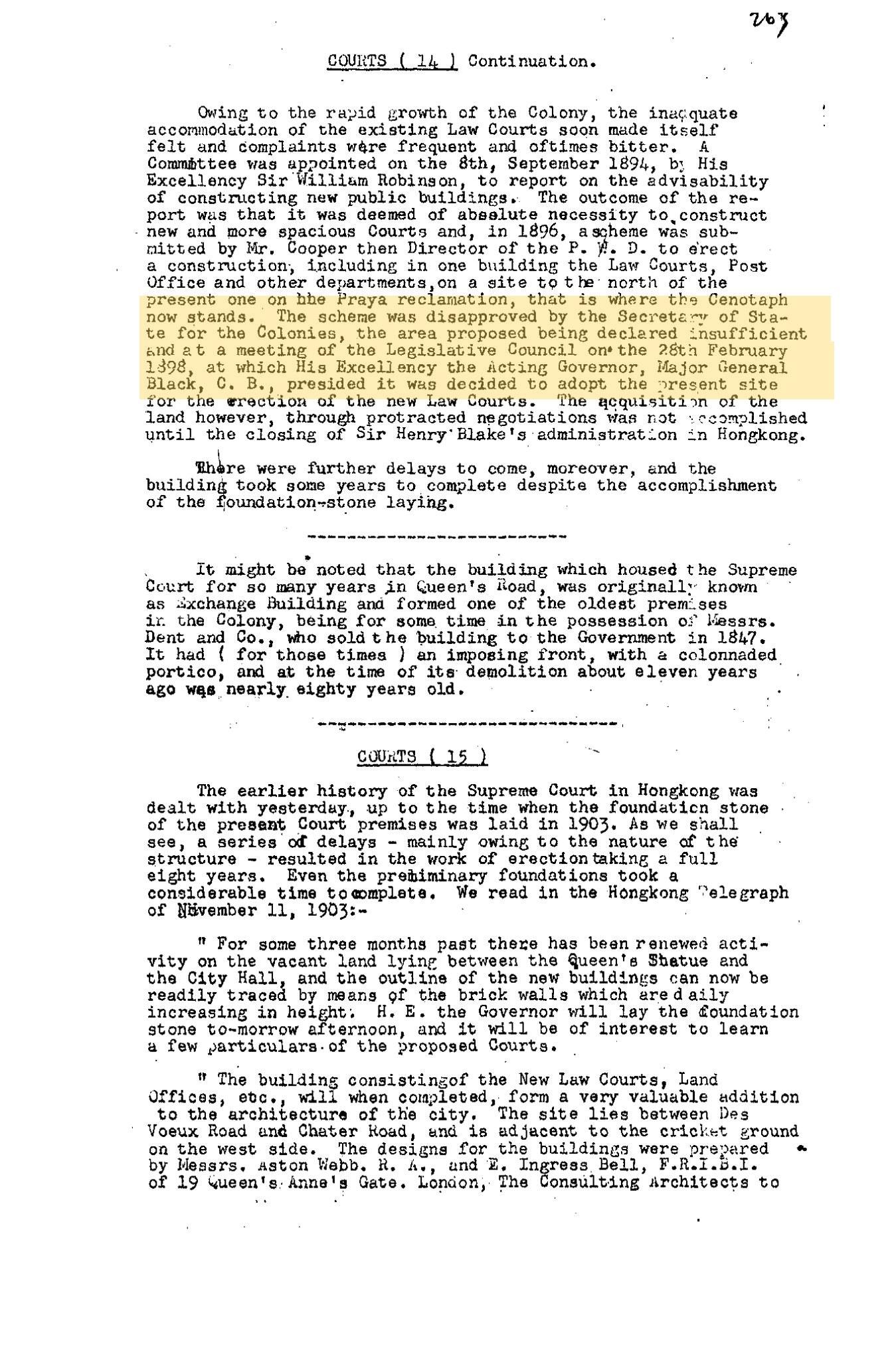
1896年,時任工務司 Cooper 提出把法院、郵政總局與其他部門合置一幢大樓的方案,選址在填海區北面—回顧文章的原話是「that is where the Cenotaph now stands」—因面積不足被殖民地部否決。同年8月,殖民地部同意聘用皇冠代理的顧問建築師 Aston Webb 與 E. Ingress Bell,兩人以伯明翰法院大樓聞名,「considerable experience in making designs for buildings in the tropics」。14111898年1月,政府公布「General Scheme」,其中一個選項是由兩位建築師在「the back and larger block in front of the City Hall」興建法院;2月28日,立法局在護督 Major-General Black 主持下議決採用「the present site」,但購地談判一直拖到卜力離任前夕(1903年末)。2214
1902年4月,政府就郵政總局選址諮詢時披露:韋伯與貝爾「were appointed Architects for the new Law Courts, selected site 'A' as the most suitable for the Courts」;1903年7月,報紙引述建築費「about $750,000」。2324同年7月20日,立法局議員 Gershom Stewart 質詢工程延誤,指出「the Law Courts site has been reclaimed for about 13 years … and yet we still have grass growing on both of them」;港督卜力承認南端地基需打樁、招標價「hundreds of thousands of dollars more than the Director of Public Works thought that we ought to pay」而兩度拒收標書,並在會上作出承諾:「As regards this ground in front of the Club … I hope that nothing will be ever built on it. I propose that that ground shall be made a public garden as also the site near the Law Courts … My idea is that the ground shall be preserved as an open space entirely and add to the beauty of the place.」(議員席上鼓掌。)1
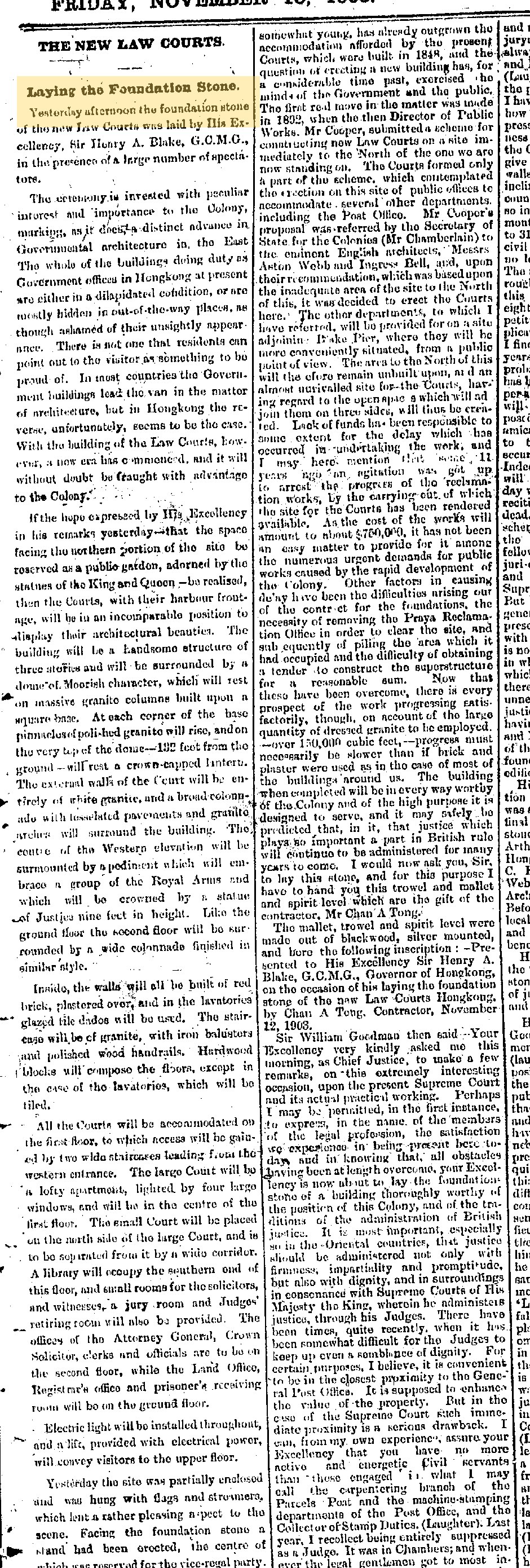
1903年11月12日下午4時30分,卜力安放基石,會場設有以旗幟與植物裝飾的看台。252627承包商 Chan A Tong 致送的銀泥刀與木槌上刻着:「Presented to His Excellency Sir Henry A. Blake … on the occasion of his laying the foundation stone of the new Law Courts, Hongkong, by Chan A Tong, Contractor, November 12, 1903.」基石為一方中國花崗石,中空處放入了當日報紙與香港各種錢幣樣本;石上銘文列名 Webb、工務司漆咸(William Chatham)、Bell、以及承包商 Chan A Tong。122813工務司在禮上宣讀:「The area to the north of this will, therefore, remain unbuilt upon, and an almost unrivalled site for the Courts, having regard to the open spaces which will adjoin them on three sides, will thus be created.」29
同年12月,報紙刊出大樓的完整描述:主立面向西,十五開間,愛奧尼柱式,高約45英尺;西立面中央為山花,圍繞半圓開口的是皇家紋章與「Mercy and Truth」兩個人物像,其上「crowned by a statue of Justice, standing nine feet high」;中央圓頂為多立克柱式鼓座,上冠花崗石燈亭,「a height of over one hundred and thirty feet … in a boldly carved Tudor crown」。全樓外牆用「granite quarried in the Colony」。1330
四、1903–1912:八年工程、屋頂與一場賣地
工程以「a full eight years」計:1908年秋,工務報告說西立面山花上「massive stone figures」的雕刻進展良好,花崗石欄柱已備好350支,每日平均僱用石匠147人;1909年8月,山花人像全部安裝,「the statue of Justice was finished ready for hoisting into position」。3132在工地的另一面,1909年12月2日立法局出現一個動議:把「the plot of Government land between the new Law Courts and the Praya」清潔整理,因為上面滿是棚屋、爛木與碎石,「all the stagnant squalor which collects in a builder's yard」,而棚屋的佔用者正是「a certain Chinese contractor」,其名以大字掛在入口。7
1910年,政府決定把法院北面海旁地段出售,並去信非官守議員徵詢意見;地價底價60萬元(每英尺30元),承租期75年可續75年;申請人是 Standard Oil Company。24月14日,Murray Stewart 在立法局提出保留動議,把這塊地比作威尼斯聖馬可教堂前的空地,指出出售等於「to alienate it, in effect, for 150 years」,並提到四十多名太平紳士聯署反對。港督盧吉答覆:這片「I should propose to call 'The Royal Square'」的空地「no encroachment should be made without the general consensus of opinion of the community」,但待售地段「outside the rectangle of Royal Square」,而庫房要負擔九廣鐵路、颱風避風塘、水塘與裁判司署等開支;政府會要求買家「the design shall be approved by the Governor in-Council」、並「a sum of not less than $100,000 shall be spent upon it」。25月6日,保留議案以9票對2票被否決,只有 Stewart 與韋玉投贊成票。3810
6月2日,Murray Stewart 在立法局作結案發言:他獲 Standard Oil 本地經理授權透露,該公司認為「the only architectural conditions which would make the purchase at that figure a 'business proposition' must allow of a building ten stories high」;「the six lakhs of dollars … was, after all, a mere subjective illusion—a sort of mirage」。他並引述政府公函:在該地建樓可以「hide the 'unsightly roofs'—the words are not mine—'the unsightly roofs' of the new Law Courts」,接着質疑一所「has so far cost seven lakhs and taken seven years to erect」的大樓,為何當初不叫 Webb 改圖則。46月4日,報紙確認賣地告吹:「There is therefore no immediate hope of our getting those six hundred thousand dollars」;政府並表明立場:「no expressions of pious hopes for the future by a former Governor or Director of Public Works can bind the Government of the day」。51911年10月,立法局預算案只餘1萬元完成工程及1萬元建築師費;並計劃把裁判司署暫遷入皇后大道中的舊法院。933
五、1912年1月15日:開庭
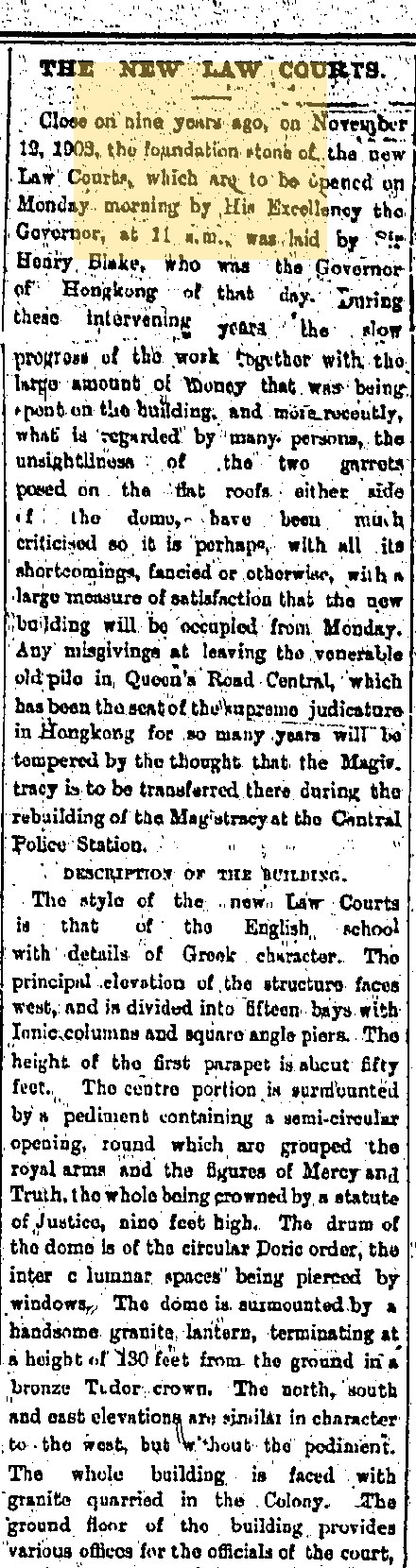
1912年1月6日,搬遷開始;13日,《德臣西報》刊出開幕前專稿:「Close on nine years ago, on November 12, 1903, the foundation stone of the new Law Courts … was laid by Sir Henry Blake」,並承認「the slow progress of the work together with the large amount of money that was being spent on the building, and more recently … the unsightliness of the two garrets fixed on the flat roofs either side of the dome, have been much criticised」。3430同一天,士蔑新聞預告:「On Monday next, the Governor Sir Frederick Lugard, will formally open the new Courts of Justice.」35
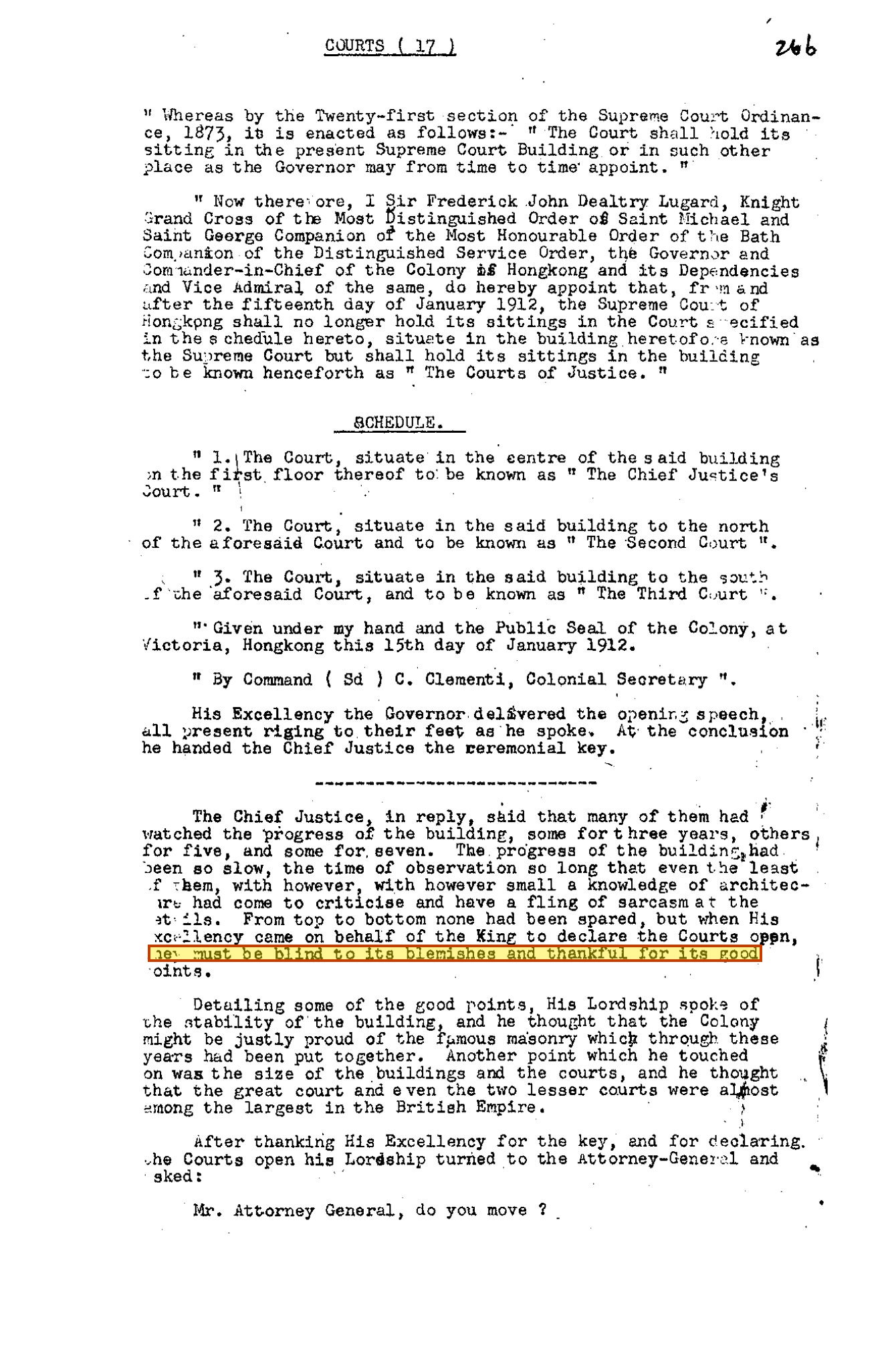
1月15日,盧吉以《最高法院條例》(1873年)第21條發出公告:最高法院「shall no longer hold its sittings in the Court specified in the schedule hereto … but shall hold its sittings in the building to be known henceforth as 'The Courts of Justice.'」;附表列出三個法庭:「The Chief Justice's Court」(中央、一樓)、「The Second Court」(北面)與「The Third Court」(南面)。6啟用禮在正按察司庭舉行,「a distinguished assemblage」,天氣欠佳而女士出席者不少;盧吉致辭後把「the ceremonial key」交給正按察司 Francis Piggott。Piggott 答謝時說:「the progress of the building had been so slow … even the least of them … had come to criticise and have a fling of sarcasm at it … they must be blind to its blemishes and thankful for its good points.」他稱讚石作堅固,並說這裡的大法庭「almost among the largest in the British Empire」。6禮成後,律政司 Rees-Davies 動議「that the minutes of this day's proceeding be entered in the minutes of the Court」;法院隨即開庭審理上訴案Lai Chi-chin v Tang Wong-shi。當時三個法庭只有兩個在用,第三庭由破產管理官辦事處佔用。6次日,《南華早報》的評論說盧吉的演辭「replete with happy sentiment」,但「it is well known there are many in the Colony who will disagree with his Excellency that it is 'a monument of which we may be proud'」。361月18日,《孖剌西報》刊登了出席啟用禮的律師名單。3738
六、大樓的一生:法院、立法局、終審法院
大樓落成時,法院四周的空地正陸續布置為雕像群:維多利亞女皇銅像(1896年揭幕)、Duke of Connaught 像(1902年立在「opposite the site of the Supreme Court」,1907年移往卜公碼頭)、King Edward VII 與 Prince of Wales 像(1907年2月6日由 Duke of Connaught 揭幕)等;回顧文章並記載,這個廣場「formerly known as Royal Square」。391913年1月27日,裁判司署按計劃遷入舊法院(皇后大道中)原址,直至新裁判司署建成。40舊法院與舊郵政總局所在的一組建築,其後在1920年代拆卸,讓位給 Queen's Theatre 與 China Building。4114
1945年9月,日本投降後不久,最高法院登報徵求其散失的物件:「The Seals of the Supreme Court … Papers, files and other documents of— (a) the Companies' Registry, (b) the Probate Registry, (c) the Bankruptcy Court, (d) the Land Office, and (e) the Marriage Registry」—戰爭期間法院的印信與檔案不知去向。421955年8月,在佔領時期被移走的維多利亞女皇銅像,經修復後在銅鑼灣維多利亞公園正門重新豎立,底座刻上記述其事蹟的英文銘文。151978年,地鐵工程使大樓停用;1982年維修後司法機構恢復部分使用;1984年,政府宣布司法部遷往金鐘道的新最高法院大樓;行政、立法兩局將遷入中環的舊大樓。1643171985年10月30日,港督尤德(Sir Edward Youde)主持大樓「作新用途」的開幕儀式:立法局會議首次在舊法院大樓舉行,大樓定名「立法局大樓」;改裝耗資4000萬元、歷時一年。4418451986年,議員在中文立法局紀錄中稱它為「我們頭上的正義女神『泰美斯』」。192011年立法局遷往添馬艦新址;大樓修復後,2015年成為終審法院。20
結論
這幢大樓的歷史有兩條線。一條是建築:1894年的委員會、1896年的建築師、1898年的選址、1903年的基石與1912年的啟用,歷時十八年,其中施工八年;落成時得到的評價是堅固而有瑕疵,連政府都曾想用買家的大樓遮住它的屋頂。另一條是它四周的空地:1903年卜力在立法局承諾「nothing will be ever built on it」,1910年政府卻準備把海旁地段售予 Standard Oil Company;四十多名太平紳士反對、立法局9對2否決保留動議,最後是買方要求建十層高樓、政府又不肯放寬條件,交易才告吹—政府並在事後明確表示,前任總督的「pious hopes」不能約束後來的政府。大樓此後的一百年,名稱由「The Courts of Justice」到最高法院大樓,再到立法局大樓與終審法院;不變的是山花上的正義女神仍然俯視中環。12451920
Justice and the Dome
The Supreme Court building in Statue Square, Hong Kong, 1844–2015
Abstract
Hong Kong’s Supreme Court sat from 1844 in a temporary building, then in Wellington Street, then for sixty-four years in an old “Exchange Building” on Queen’s Road. This paper traces the building that replaced it: the committee of 1894, the architects Aston Webb and E. Ingress Bell appointed through the Crown Agents in 1896, the site chosen on the Praya reclamation in 1898, the foundation stone laid by Governor Sir Henry Blake on 12 November 1903, and the opening by Governor Sir Frederick Lugard on 15 January 1912, when a proclamation named the house “The Courts of Justice”. Two threads run through the story. The first is the building itself — eight years in the making, criticised before it opened (the Government’s own letter spoke of hiding its “unsightly roofs”), and summed up at the opening by the Chief Justice, Sir Francis Piggott, who asked his audience to be “blind to its blemishes and thankful for its good points”. The second is the ground around it: Blake’s 1903 pledge in Council that the plot before the Club would never be built upon, the Government’s decision in 1910 to sell the sea-front plot north of the courts to the Standard Oil Company, the protest of more than forty Justices of the Peace, the lost division of 6 May 1910 (nine to two), and the collapse of the sale when the company required a ten-storey building. The building went on to hold the courts until 1978, the Legislative Council from 1985, and the Court of Final Appeal from 2015; in the Chinese Hansard of 1986 the statue above the chamber is named “the justice goddess Themis”. 123456
1. Scope, sources, method
This thread asks three questions: how the building was made; what became of the promises about the space around it; and how its use changed over a century. The record divides into five strata. First, the full transcription of the Legislative Council’s debates (the corpus’s Hansard series) — the sittings of 20 July 1903, 2 December 1909, 14 April, 5 May and 2 June 1910, and 19 October 1911 — which carry the political spine. Second, the Government Gazette’s printed minutes of the Council, used for the exact wording of motions and for the division figures. Third, the English press of 1896–1913 (China Mail, Hong Kong Daily Press, Hongkong Telegraph): the appointment of the architects, the foundation ceremony, the building’s detail, and the end of the sale affair. Fourth, the 1930s newspaper retrospectives collected in Old Hong Kong, vols 2 and 5 — vol. 5 reprinting the S.C.M. Post of 16 January 1912 for the opening, because the China Mail and Daily Press issues of that day are absent from the corpus, text and image alike. Fifth, the Chinese press from 1947 and the Chinese Hansard of 1986, for the statue’s re-erection in 1955, the building’s two conversions (1978–85), and the Chinese name of the statue. No Chinese-language record of this building survives from before 1947 — the corpus’s Chinese press begins in 1926/1947 — and the paper says so rather than filling the silence. The years 2011–15 lie beyond the corpus’s reach (the Chinese press stratum ends in 1991) and are cited from the modern record, labelled as such. 123615181920
2. The courts before the building (1844–1894)
At ten o’clock on the morning of 4 March 1844 the first criminal court for trial by jury ever held in China sat “in a temporary building near Government House”: Governor Pottinger and Major-General d’Aguilar on the bench (the Governor in plain clothes, the Major-General in uniform), Mr. Burgass as Crown Prosecutor, Mr. Hillier as Registrar, Mr. Patrick Stewart foreman of the grand jury, two cases tried. The judge appointed under the Charter, John Walter Hulme, and the Registrar, Robert Dundas Cay, did not land until 8 May 1844; from 1 October the Court sat in Wellington Street, and in February 1848 it moved into “much more commodious buildings in Queen’s Road”. The Queen’s Road house had been the “Exchange Building”, one of the oldest premises in the colony; Dent & Co. sold it to the Government in 1847; at its demolition, some eleven years before the 1934 retrospective was written, it was nearly eighty years old. Norton-Kyshe supplies the building’s one recorded festivity: the Irishmen of the place kept St. Patrick’s Day with a public dance in the hall of the old Court House. 1421
The Court sat there through repeated repairs; in August 1892 it moved temporarily to the Masonic Hall in Zetland Street while the building was altered. By the early 1890s the need was plain. On 8 September 1894 Governor Sir William Robinson appointed a committee to report on new public buildings; its report found new and more spacious courts “of absolute necessity”. 14
3. Making the building (1894–1903)
In 1896 the Director of Public Works, Cooper, proposed to put the Law Courts, the Post Office and other departments in one building on the reclamation to the north — “that is where the Cenotaph now stands”, the retrospective notes — and the Secretary of State refused it as too small. In August 1896 the despatch went out to employ “the Consulting Architects to the Crown Agents for the Colonies, Messrs. Aston Webb and Ingress Bell… who designed the Birmingham Law Courts… and who have considerable experience in making designs for buildings in the tropics”. 141146
In January 1898 the “General Scheme” for the government offices offered the Council the choice that made this thread’s building: the Law Courts to stand on “the back and larger block in front of the City Hall” or on the front lot of the Praya reclamation. On 28 February 1898, with Acting Governor Major-General Black in the chair, the Council adopted “the present site” — but the land took until the close of Sir Henry Blake’s administration, late in 1903, to acquire. In April 1902 the Government disclosed in Council papers that Webb and Bell, “appointed Architects for the new Law Courts, selected site ‘A’ as the most suitable for the Courts” and recommended site ‘B’ for the Post Office. The press of July 1903 put the cost “about $750,000”. 222324

On 20 July 1903 Gershom Stewart moved the adjournment to press the Government on the delays: “the Law Courts site has been reclaimed for about 13 years, also the site in front of the Club; and yet we still have grass growing on both of them.” The Governor answered with the engineering (the south foundations “had to be piled”) and the tenders — “hundreds of thousands of dollars more than the Director of Public Works thought that we ought to pay”, refused twice — and then made the promise this thread will follow to its end: “As regards this ground in front of the Club… I hope that nothing will be ever built on it. I propose that that ground shall be made a public garden as also the site near the Law Courts… My idea is that the ground shall be preserved as an open space entirely and add to the beauty of the place.” (Applause.) 1
At 4.30 p.m. on 12 November 1903 Blake laid the foundation stone before a large gathering; the two stands were “tastefully decorated with flags, plants and matting”. Chan A Tong, the contractor, presented the trowel and mallet, inscribed “Presented to His Excellency Sir Henry A. Blake, G.C.M.G., Governor of Hongkong, on this occasion of his laying the foundation-stone of the new Law Courts, by Chan A Tong contractor, 12th November, 1903”. The stone, a block of Chinese granite, holds the day’s newspapers and specimens of the colony’s coins; the gilded inscription names Aston Webb, William Chatham (Director of Public Works), E. Ingress Bell and “CHAN A TONG, Contractor”. The Director of Public Works read the sentence that the town would quote back at the Government seven years later: “The area to the north of this will, therefore, remain unbuilt upon, and an almost unrivalled site for the Courts, having regard to the open spaces which will adjoin them on three sides, will thus be created.” 25262712282913
The press description of December 1903 set the building down: the principal elevation facing west, an Ionic order of fifteen bays some forty-five feet high; the west pediment with the Royal arms and the statue of Justice, nine feet high, above; the dome on its circular Doric drum, the granite lantern “terminating, at a height of over one hundred and thirty feet from the ground, in a boldly carved Tudor crown”; interiors in teak and granite, lit by electric glow lamps. The China Mail’s account of January 1912 adds the pediment’s figures — “the royal arms and the figures of Mercy and Truth” — a bronze crown, and walls “faced with granite quarried in the Colony”. 1330
4. Eight years of works and the battle of the square (1903–1912)
The building took what the retrospective calls “a full eight years”. In September 1908 the works report counts the carving of “the massive stone figures, which will adorn the pediment on the west front”, the balusters prepared — three hundred and fifty by then — and an average of 147 masons at work daily; in August 1909 the pediment figures were fixed and “the statue of Justice was finished ready for hoisting into position”. 3132 Beside the works, the promised open space told its own story. On 2 December 1909 Murray Stewart moved that the Council abate “the nuisance created by the condition of the plot of Government land between the new Law Courts and the Praya”: tattered matsheds, rotting poles, old timbers, granite chippings — “all the stagnant squalor which collects in a builder’s yard” — and, advertised over the entrance, the name of “a certain Chinese contractor”. The Post Office stood “in the distance, possibly with pride, as one whose four storeys it had taken five years to raise”. 7
In 1910 the Government decided to sell the sea-front plot north of the courts, writing to the unofficial members for their opinion. The upset price was six lakhs ($600,000, at $30 a foot) on a 75-year lease renewable for 75 more; interest, Crown rent and assessed taxes came to $44,100 a year; and the named applicant was the Standard Oil Company. On 14 April 1910 Stewart moved to reserve the plot for public purposes, reaching for the one comparison that made the stakes plain: “I wonder what would be said if the municipality of Venice were to propose to sell for office buildings a site on the open space between the Doge’s palace and Sansovino’s great Library…” — and, of the sale itself, “to alienate it, in effect, for 150 years”. More than forty Justices of the Peace had signed the protest. 28
The Governor, Sir Frederick Lugard, answered for the Government. He shared the object — “This fine open space, which I should propose to call ‘The Royal Square’, surrounding … the statue of our late revered Queen Victoria — is a site of which the Colony may justly be proud, and upon which no encroachment should be made without the general consensus of opinion of the community” — but the plot for sale lay “outside the rectangle of Royal Square”, and the Colony’s finances had other claimants: the railway, the typhoon refuge, the Tytam reservoir extension, the rebuilding of the Magistracy, and “a pier opposite Royal Square to be called ‘The Royal Pier’”. The Standard Oil Company would be required to build to a design approved by the Governor in Council and to spend “not less than $100,000”. On 6 May 1910 the motion to reserve the plot was lost, nine votes to two — only Stewart and Wei Yuk for it. 2310
The denouement came in June. On the 2nd Stewart told the Council that the company’s local manager had authorised him to say that “the only architectural conditions which would make the purchase at that figure a ‘business proposition’ must allow of a building ten stories high”; the six lakhs were “a mere subjective illusion — a sort of mirage”. He also read out the Government’s own letter, which had argued that a building on the plot would “hide the ‘unsightly roofs’ — the words are not mine — ‘the unsightly roofs’ of the new Law Courts”, and asked why Sir Aston Webb had not been told to alter them for a building that had “so far cost seven lakhs and taken seven years to erect”. On 4 June the press confirmed the sale was dead — “There is therefore no immediate hope of our getting those six hundred thousand dollars” — and printed the Government’s doctrine for the future: no former Governor’s “pious hopes” could bind the Government of the day, which could not “dedicate to the public one inch of land without the sanction of the Secretary of State for the Colonies”. In October 1911 the estimates asked only $10,000 to complete the courts and $10,000 for architects’ fees, and noted that the old Law Courts would receive the Magistracy, “and the site on which they stand can be sold or otherwise dealt with”. 45933
5. The opening, 15 January 1912
The removal began on 6 January 1912; on the 13th the China Mail looked back: “Close on nine years ago, on November 12, 1903, the foundation stone of the new Law Courts, which are to be opened on Monday morning by His Excellency the Governor, at 11 a.m., was laid by Sir Henry Blake… During these intervening years the slow progress of the work together with the large amount of money that was being spent on the building, and more recently, what is regarded by many persons, the unsightliness of the two garrets fixed on the flat roofs either side of the dome, have been much criticised…”. The same leaf carried the “Description of the Building”: fifteen bays, Ionic columns, the pediment with “the royal arms and the figures of Mercy and Truth, the whole being crowned by a statue of Justice, nine feet high”. 34473035
On the 15th Lugard’s proclamation, made under section 21 of the Supreme Court Ordinance, 1873, declared that the Supreme Court “shall no longer hold its sittings in the Court specified in the schedule hereto, situate in the building heretofore known as the Supreme Court but shall hold its sittings in the building to be known henceforth as ‘The Courts of Justice’”. The schedule named the three courtrooms: “The Chief Justice’s Court” in the centre of the first floor, “The Second Court” north of it, and “The Third Court” south. The ceremony in the Chief Justice’s Court brought “a distinguished assemblage” — “undeterred by the unpropitious weather, many ladies were present” — and the Governor, after his speech, handed the Chief Justice “the ceremonial key”. Sir Francis Piggott’s reply is the building’s own epitaph: “many of them had watched the progress of the building, some for three years, others for five, and some for seven. The progress of the building had been so slow, the time of observation so long that even the least of them, with however small a knowledge of architecture had come to criticise and have a fling of sarcasm at it. From top to bottom none had been spared, but when His Excellency came on behalf of the King to declare the Courts open, they must be blind to its blemishes and thankful for its good points.” The masonry, he said, was sound; the great court and the two lesser courts “almost among the largest in the British Empire”. The Attorney General, Mr. Rees-Davies, moved “that the minutes of this day’s proceeding be entered in the minutes of the Court”, and the Court sat at once in appellate jurisdiction in Lai Chi-chin v Tang Wong-shi. Only two of the three courts were in use; the third held the Official Receiver’s offices. The next day the S.C.M. Post's leader, reprinted in the Telegraph, gave the building its public verdict: “The structure is solid and substantial and of good material. Yet it is well known there are many in the Colony who will disagree with his Excellency that it is ‘a monument of which we may be proud.’” 6363837
6. The building’s long life (1912–2015)
The square filled with its statues as the courts settled in: Queen Victoria (unveiled 1896), the Duke of Connaught (unveiled 5 July 1902 “opposite the site of the Supreme Court”, moved in 1907 to Blake Pier), King Edward VII and the Prince of Wales (unveiled by the Duke on 6 February 1907), and, among others, Queen Alexandra and Sir Thomas Jackson; the retrospective notes that the square was “formerly known as Royal Square”. In January 1913 the Police Court moved into the old Queen’s Road building while the Magistracy was rebuilt. The old courts and the old Post Office were demolished in the 1920s; their site gave place to the Queen’s Theatre and the China Building. 39404114
After the occupation, the Court advertised for its own instruments — “The Seals of the Supreme Court… Papers, files and other documents” of the Companies’ Registry, Probate Registry, Bankruptcy Court, Land Office and Marriage Registry (September 1945). In August 1955 the Queen Victoria statue, removed during the occupation and recovered after it, was re-erected at the main gate of Victoria Park on a granite base whose inscription records its wartime fate. In 1978 the building closed to the courts under the MTR works; part of the judiciary returned after repairs in October 1982; in 1984 the judiciary moved to the new Supreme Court building on Queensway, and the administrative and legislative councils prepared to move into the old house. On 30 October 1985 Governor Sir Edward Youde opened its new use: the Legislative Council sat for the first time in the former court building, now named the Legislative Council Building; the conversion had cost $40 million and taken a year. In 1986 a member, debating triad measures, reminded the Council of “the justice goddess ‘Themis’ above our heads” — the statue’s Chinese name, 正義女神「泰美斯」, in the official record. The Council moved to Tamar in 2011; after restoration the building reopened in 2015 as the Court of Final Appeal. 42151643174418451920
Conclusion
Two threads hold this building’s history. The first is the making: eighteen years from Robinson’s committee to the opening, eight of them under construction, a building praised for its masonry and mocked for its roofs — so much so that the Government itself proposed to hide them behind a purchaser’s block. The second is the ground around it. In July 1903 the Governor promised the Council that the plot before the Club would never be built upon; in 1910 his successor’s Government moved to sell the sea-front plot to the Standard Oil Company; more than forty Justices of the Peace protested, the Council divided nine to two against reserving the land, and the sale died only because the buyer wanted ten storeys and the Government would not loosen its conditions — after which the Government stated, for the record, that no former Governor’s “pious hopes” could bind it. The house then carried the courts, the Council and, at last, the final court; its names changed from “The Courts of Justice” to the Supreme Court building, the Legislative Council Building and the Court of Final Appeal Building. The statue of Justice on the west pediment has watched the whole of it. 12451920
Appendix A — Query log
The battery behind this paper: phrase counts on both indices, year histograms, date-sorted samples, and the pull list. Full log in the research notes, research_supreme_court_1912.md, Appendix A. Key instruments: “Supreme Court building” 1,225; “new Supreme Court” 237; “old Supreme Court” 921; “Themis” 1,685 (almost all the steamer and unrelated columns — treated as a false-positive class); “Aston Webb” 179; “Ingress Bell” 130; “Jackson Road” 1,215. The 1871–76 “new Law Courts” press hits are London’s Royal Courts of Justice and Paris, and were excluded. The CM image twins were found by title-match (“1903-11-12 p4”, “1903-11-13 p5”, “1902-04-09 p5”, “1912-01-13 p5”), and the Old Hong Kong leaves by “VOL 5 p264” etc. The Chinese-stratum instruments (泰美斯 14; 正義女神 6; 公正女神 1; 立法局大樓 323; 最高法院大樓) are set out in the notes’ §5 battery. 143019
Appendix B — Plates and the proper-name battery
Five plates, each read back at its final crop before use (the §6B gate): Figure 1 (Old Hong Kong, vol. 5, p. 263 printed / corpus 264), Figure 2 (China Mail, 9 April 1902, p. 5), Figure 3 (China Mail, 13 November 1903, p. 5), Figure 4 (China Mail, 13 January 1912, p. 5), Figure 5 (Old Hong Kong, vol. 5, p. 266 printed / corpus 267). Name battery (corpus + web): 卜力 (Blake, 111 corpus hits plus the 卜公 derivatives); 盧吉 (Lugard); 漆咸 (Chatham; the road 漆咸道); 韋玉 (Wei Yuk, 104); 尤德 (Youde, 4,324); 何啟 (Ho Kai, 1,101); 羅便臣 (Robinson); 維多利亞女皇 (the 1955 華僑日報 form); 和平紀念碑 (the Cenotaph); 皇后像廣場 (the square, 503). Kept in English after battery failure or absence: Chan A Tong (陳亞堂 = 0 hits), Gershom Stewart and Murray Stewart (never to be merged; the corpus shows both men together, 1895 and 1899), Francis Piggott, Rees-Davies, Hulme, Cay, Cooper, Black, d’Aguilar, Webb, Bell, Standard Oil Company, Queen’s Theatre, China Building. Registered conflicts: the opening hour (11 a.m. in the China Mail; the dais “shortly after 1 o’clock” in the SCMP reprint); the height of the order (55 ft in the November 1903 text, 45 ft in December); the supervising officer (Fisher / Foster); the Queen Victoria statue’s first placing (1896 / 1897). 143061548
Notes
Legislative Council, 20 July 1903 (Hansard transcription series), — “The New Post Office and the Law Courts”: Gershom Stewart’s questions and the Governor’s answer. Stewart: “It is clear that the Law Courts site has been reclaimed for about 13 years, also the site in front of the Club; and yet we still have grass growing on both of them.” The Governor (Sir Henry Blake): the foundations at the south end “had to be piled”; the tenders rejected as “hundreds of thousands of dollars more than the Director of Public Works thought that we ought to pay”; and the pledge: “As regards this ground in front of the Club which the hon. member speaks of, I hope that nothing will be ever built on it. I propose that that ground shall be made a public garden as also the site near the Law Courts, and we shall have, opposite, the garden which at the present moment extends from the Bank to the sea. (Applause.) My idea is that the ground shall be preserved as an open space entirely and add to the beauty of the place.” https://hkintexts.histsyn.com/page/1881842, accessed 9 November 2026. ↩
Legislative Council, 14 April 1910 (Hansard) — “A Debateable Land Sale”. Stewart: “I wonder what would be said if the municipality of Venice were to propose to sell for office buildings a site on the open space between the Doge’s palace and Sansovino’s great Library … urge artistic considerations in a discussion affecting the disposal of the remaining open space on our public square”; “You propose to sell this land on a 75 years’ lease, renewable for a further 75 years at the will of the purchaser; to alienate it, in effect, for 150 years”; the protest “signed by over 40 Justices of the Peace”. The Governor (Lugard): “This fine open space, which I should propose to call ‘The Royal Square,’ surrounded as it is by statues of their Majesties the King and Queen and of their Royal Highnesses the Prince and Princess of Wales encircling the statue of our late revered Queen Victoria—is a site of which the Colony may justly be proud, and upon which no encroachment should be made without the general consensus of opinion of the community”; the plot is “outside the rectangle of Royal Square”; “The upset price of the lot is six lakhs, and the interest on that sum, together with Crown rent, and assessed taxes, amounts to a sum of $44,100 a year”; “I should like to see a pier opposite Royal Square to be called ‘The Royal Pier’”; “The applicants are the Standard Oil Company … One of those conditions will be that the design shall be approved by the Governor in-Council … Another condition will be that a sum of not less than $100,000 shall be spent upon it.” https://hkintexts.histsyn.com/page/1881967, accessed 9 November 2026. ↩
Hong Kong Government Gazette, Legislative Council Minutes No. 3 (session of 6 May 1910), printed p. 206 — “NEW LAW COURT SITE.—Mr. STEWART … moved the following Resolution:— That in the opinion of this Council it is desirable to reserve for public purposes the plot of land situated on the sea front to the North of the New Law Courts. Mr. WEI YUK seconded. … The Council then divided on the motion which was declared lost, nine Members voting against and two—Mr. STEWART and Mr. WEI YUK—for the Resolution.” https://hkintexts.histsyn.com/page/1573707, accessed 9 November 2026. ↩
Legislative Council, 2 June 1910 (Hansard) — Stewart’s closing speech: “ninety succeeded in drawing attention. But that was all their success”; “The Standard Oil Co. was named as the applicant … I have the local manager’s leave to state the fact, here and now. According to him, the only architectural conditions which would make the purchase at that figure a ‘business proposition’ must allow of a building ten stories high. … Thus it appears that the six lakhs of dollars, of which so much has been made, was, after all, a mere subjective illusion—a sort of mirage”; and the Government’s letter: the building on the plot would “hide the ‘unsightly roofs’—the words are not mine—‘the unsightly roofs’ of the new Law Courts… a building which has so far cost seven lakhs and taken seven years to erect”. https://hkintexts.histsyn.com/page/1881971, accessed 9 November 2026. ↩
Hongkong Telegraph, 4 June 1910, p. 2 — “Mr. Murray Stewart informs us on excellent authority that the Standard Oil Company would not consider the purchase of that site a business proposition unless they could erect on it buildings ten stories high. There is therefore no immediate hope of our getting those six hundred thousand dollars”; and the Government’s doctrine: “His Excellency the Officer Administering the Government has clearly explained [it is not in his] power ‘to dedicate to the public one inch of land without the sanction of the Secretary of State for the Colonies,’ and no expressions of pious hopes for the future by a former Governor or Director of Public Works can bind the Government of the day.” https://hkintexts.histsyn.com/page/2866234, accessed 10 November 2026. ↩
The opening, 15 January 1912 — the full report survives only through Old Hong Kong, vol. 5, pp. 265–268, which reprints the S.C.M. Post of 16 January 1912 (the China Mail and Daily Press issues of that day are absent from the corpus, text and image alike). The proclamation, under section 21 of the Supreme Court Ordinance, 1873: “from and after the fifteenth day of January 1912, the Supreme Court of Hongkong shall no longer hold its sittings in the Court specified in the schedule hereto, situate in the building heretofore known as the Supreme Court but shall hold its sittings in the building to be known henceforth as ‘The Courts of Justice.’” The schedule names “The Chief Justice’s Court”, “The Second Court” and “The Third Court”; “Given under my hand and the Public Seal of the Colony, at Victoria, Hongkong this 15th day of January 1912. By Command (Sd) C. Clementi, Colonial Secretary.” “His Excellency the Governor delivered the opening speech, all present rising to their feet as he spoke. At the conclusion he handed the Chief Justice the ceremonial key.” The Chief Justice (Sir Francis Piggott), in reply: “many of them had watched the progress of the building, some for three years, others for five, and some for seven. The progress of the building had been so slow, the time of observation so long that even the least of them, with however small a knowledge of architecture had come to criticise and have a fling of sarcasm at it. From top to bottom none had been spared, but when His Excellency came on behalf of the King to declare the Courts open, they must be blind to its blemishes and thankful for its good points.” And: the great court and the two lesser courts “almost among the largest in the British Empire”; the Hon. Mr. Rees-Davies moving “that the minutes of this day’s proceeding be entered in the minutes of the Court”; the first appeal heard, Lai Chi-chin v Tang Wong-shi; “only two of the Courts are now in use, the third being occupied by the Official Receiver’s offices”. Scans: https://hkintexts.histsyn.com/image-page/1588245, /1588246, /1588247 and /1588248, accessed 9 November 2026. ↩
Legislative Council, 2 December 1909 — “Unsightly Government Land” (Hon. Mr. Murray Stewart): the plot of government land between the new Law Courts and the Praya — “an unsightly conglomeration of ramshackle and tattered matsheds, piles of rotting poles, odds and ends of old timbers, untidy heaps of granite chippings … all the stagnant squalor which collects in a builder’s yard. The fact that the tattered matsheds are in the occupation of a certain Chinese contractor is advertised in large letters over the entrance to them”; and the Post Office “pointed out in the distance, possibly with pride, as one whose four storeys it had taken five years to raise”. https://hkintexts.histsyn.com/page/1881962, accessed 9 November 2026. ↩
Legislative Council, 5 May 1910 (Hansard) — Murray Stewart’s four questions: (a) whether Blake “accurately state[d] the intentions of the Government” on 20 July 1903; (b) whether the Director of Public Works “accurately state[d] the intentions of the Government” at the foundation stone, 12 November 1903; (c) whether Sir Frederick Lugard did so on 28 October 1909 (“the present intention of the Government is to clear the plot as soon as it can be done”); and (d) whether it was “really incomprehensible to high Government officials how an impression was created in the public mind which led to many hearing with surprise of the recent decision to sell to a private purchaser, for building purposes, the site in question”. https://hkintexts.histsyn.com/page/1881968, accessed 9 November 2026. ↩
Legislative Council, 19 October 1911 (Hansard) — the budget speech: “The Law Courts and the Government Offices have for many more years than I have known Hongkong figured as the two first items on our list. The latter disappears entirely, and for the Law Courts only $10,000 is asked to complete … a further sum of $10,000 for architects’ fees”; and “we shall shortly have the old Law Courts in which to temporarily house the Magistracy. On the completion of the new building the old Courts and the site on which they stand can be sold or otherwise dealt with, as may be considered to be most to the public advantage.” https://hkintexts.histsyn.com/page/1882003, accessed 9 November 2026. ↩
Hong Kong Government Gazette, Legislative Council Minutes No. 4 (May 1910) and No. 6 (June 1910) — the questions and the answers as the gazette prints them (the answers given viva voce and summarised: “The Colonial Secretary replied”). https://hkintexts.histsyn.com/page/1573721, https://hkintexts.histsyn.com/page/1573756, accessed 9 November 2026. ↩
Hongkong Telegraph, 5 August 1896, p. 2 — the despatch printed: “it will, in my opinion, be desirable to employ the Consulting Architects to the Crown Agents for the Colonies, Messrs. Aston Webb and Ingress Bell, who designed the Birmingham Law Courts and other notable buildings, and who have considerable experience in making designs for buildings in the tropics.” https://hkintexts.histsyn.com/page/2836792, accessed 9 November 2026. ↩
China Mail, 13 November 1903, p. 5, “THE NEW LAW COURTS — Laying the Foundation Stone”: “Yesterday afternoon the foundation stone of the new Law Courts was laid by His Excellency Sir Henry A. Blake, G.C.M.G., in the presence of a large number of spectators”; the description (“a statue of Justice nine feet in height”); and the trowel’s inscription — “Presented to His Excellency Sir Henry A. Blake, G.C.M.G., Governor of Hongkong, on the occasion of his laying the foundation stone of the new Law Courts, Hongkong, by Chan A Tong, Contractor, November 12, 1903.” Scan: https://hkintexts.histsyn.com/image-page/1319160, accessed 10 November 2026. ↩
Hongkong Telegraph, 23 December 1903 — the architectural description: the west-facing principal elevation, “a single Ionic order some forty-five feet in height, forming fifteen bays”; the pediment of the west elevation “crowned by a statue of Justice, standing nine feet high”; the dome’s drum “of a circular Doric order”, the lantern “terminating, at a height of over one hundred and thirty feet from the ground, in a boldly carved Tudor crown”; and the foundation inscription (“ASTON WEBB, RA … WILLIAM CHATHAM… E. INGRESS BELL … CHAN A TONG, Contractor”). https://hkintexts.histsyn.com/page/2849072 (reprinted 26 December: https://hkintexts.histsyn.com/page/2849095), accessed 9 November 2026. ↩
“Courts”, the retrospective series (1934 newspaper columns) in Old Hong Kong, vol. 5, corpus pp. 262–268 (printed folios 262–267): the courts’ peregrinations (the temporary court of 4 March 1844; Wellington Street from 1 October 1844; the Queen’s Road building from February 1848), the 1894 committee, Cooper’s 1896 scheme (“that is where the Cenotaph now stands”), the Secretary of State’s disapproval, the Legislative Council’s decision of 28 February 1898, the Exchange Building note (bought from Dent & Co. in 1847), and the reprint of the S.C.M. Post of 16 January 1912 for the opening. Scans: https://hkintexts.histsyn.com/image-page/1588242, /1588243, /1588244, /1588247 and /1588248, accessed 9 November 2026. ↩
“維多利亞女皇銅像”, 華僑日報, 17 August 1955 (「今日陞座銅鑼灣公園 再度成為本港歷史上永久紀念碑」) and 18 August 1955 (「昨晨重新安置完成」) — the Queen Victoria statue re-erected at the main gate of Victoria Park on a granite base (「高[達]七[呎]」); the accounts record its removal in the occupation years and recovery after the war (the base given an English inscription read in part as 「一九四一至一九四五日本佔領期,一九五二年由[…]修復」等字樣), and date its first placing in the square to 1897 (「首次安放」; the Old Hong Kong retrospective gives 1896 — the conflict is registered). https://hkintexts.histsyn.com/page/2427411 and https://hkintexts.histsyn.com/page/2427427, accessed 9 November 2026. ↩
“最高法院大樓”, 華僑日報, 10 July 1978 — the building closed to the courts under the MTR works (the 1984 retrospective: 「一九七八年七月,由於地鐵路工程影響高院暫停使用。八二年十月維修工程完成後司法[部]一部[分]重新使用」). https://hkintexts.histsyn.com/page/2654523, accessed 9 November 2026. ↩
華僑日報, 13 April 1984 — the judiciary’s move to the Queensway building and the old building described for readers: granite colonnades, 「中央頂部的人字牆飾有皇家紋章及仁慈與公理之神,其上矗立着公正女神像。一九一二年一月啓用以來,一直是香港法律及司法中心」 (“since it opened in January 1912, [it has] always been the centre of Hong Kong’s law and justice”), with the administrative and legislative councils to move in. https://hkintexts.histsyn.com/page/2730198, accessed 9 November 2026. ↩
華僑日報, 29 October 1985 — the conversion: 「耗資四千萬明日[舉]行揭幕儀式 … 該幢樓高三[層]的維多利亞時代[建築]…已被改裝爲新立法局[大樓]…改裝[耗資]四千萬,歷時一年」; the chamber’s fittings (the president’s seat, 74 members’ places 「呈米白色,每張三千五百元」, two large English-style chandeliers, and 「一面武漢製造的大銅鑼」 facing the president when the doors open). https://hkintexts.histsyn.com/page/2747965, accessed 9 November 2026. ↩
Legislative Council, Chinese Hansard, 9 July 1986 — in a debate on measures against triads, the speaker invokes 「我們頭上的正義女神『泰美斯』」 (“the justice goddess ‘Themis’ above our heads”) — the statue above the Council chamber, named in the official Chinese record. https://hkintexts.histsyn.com/page/1880299, accessed 9 November 2026. ↩
Wikipedia, “Court of Final Appeal Building” (English; 終審法院大樓) — the building’s post-2011 restoration and 2015 reopening as the Court of Final Appeal; the modern descriptions of the pediment statue. Modern secondary, used only for the layer beyond the corpus’s reach (the Chinese press stratum ends 1991). Accessed 10 November 2026. ↩
John W. Norton-Kyshe, History of the Laws and Courts of Hongkong (1898), quoted in the “Courts” retrospective (Old Hong Kong, vol. 5, p. 263): the Irishmen of the place celebrating St. Patrick’s Day with a public dance in the hall of the old Court House. https://hkintexts.histsyn.com/image-page/1588243, accessed 9 November 2026. ↩
China Mail, 26 January 1898, p. 3 — the “General Scheme” for the government offices: “1. To adopt the recommendation of Messrs Aston Webb and Ingress Bell and to build the Law Courts and accessories, including Land Office, on plot No. 2…” https://hkintexts.histsyn.com/page/1915031; and the Telegraph of the same day: https://hkintexts.histsyn.com/page/2838569, accessed 9 November 2026. ↩
China Mail, 9 April 1902, p. 5 — the Governor’s minute on the Post Office sites, paragraph 5: “Subsequently Messrs Aston Webb and Ingress Bell, who were appointed Architects for the new Law Courts, selected site ‘A’ as the most suitable for the Courts and recommended that the Post Office should be erected on site ‘B’.” The minute also records the 1894 committee and its report of November 1896, and the alternative sites C and D (site D opposite Blake Pier). Scan: https://hkintexts.histsyn.com/image-page/1314460, accessed 10 November 2026. ↩
China Mail, 14 July 1903 — “the architects have designed a building which will not only be a credit to Hongkong, and suitable for the purpose for which it is intended, but which will add greatly to the architectural attractions of the city… we are informed that the total cost for their erection will be about $750,000. The plans were prepared by Messrs. Aston Webb… and E. Ingress [Bell]”. https://hkintexts.histsyn.com/page/1924144, accessed 9 November 2026. ↩
China Mail, 12 November 1903, p. 4 — “The New Law Courts. The foundation stone of the new Law Courts was laid this afternoon by H.E. Sir H. A. Blake. There was a large assemblage of spectators.” https://hkintexts.histsyn.com/page/1924368; scan: https://hkintexts.histsyn.com/image-page/1319151, accessed 9 November 2026. ↩
Hong Kong Daily Press, 12 November 1903, p. 2 — the preparations: the ceremony “of laying the foundation-stone of the new Law Courts by H.E. the Governor at 4.30 p.m. to-day, flags and drapery being arranged on the tiers of seats near the place where the stone is to be laid.” https://hkintexts.histsyn.com/page/2243171, accessed 9 November 2026. ↩
Hongkong Telegraph, 12 November 1903, p. 4 — “THE NEW LAW-COURTS: LAYING THE FOUNDATION STONE. The ceremony of laying the foundation stone of the new Law Courts took place this afternoon before a large and representative gathering. Two stands, tastefully decorated with flags, plants and matting, had been erected within the enclosure.” https://hkintexts.histsyn.com/page/2848780, accessed 9 November 2026. ↩
Hong Kong Daily Press, 13 November 1903, pp. 2–3 — the trowel text (p. 2: “Presented to His Excellency Sir Henry Arthur Blake… by Chan A Tong contractor. 12th November, 1903”) and the description (p. 3: “The New Law Courts when completed will certainly be the finest edifice in the colony… The construction of these Courts is being carried out under the supervision of Mr. H. G. Fisher, A.R.I.B.A., of the Public Works Department”). https://hkintexts.histsyn.com/page/2243179 and https://hkintexts.histsyn.com/page/2243180, accessed 9 November 2026. [The supervising officer’s name is printed “Fisher” here and “Foster” in the Old Hong Kong reprint; the conflict is registered and no name is used in this paper.] ↩
Hongkong Telegraph, 13 November 1903, p. 5 — “THE NEW LAW COURTS”: “Following are the verbatim reports of the two speeches” — the Governor’s and the Chief Justice’s; and the Director of Public Works’ reading: “The area to the north of this will, therefore, remain unbuilt upon, and an almost unrivalled site for the Courts, having regard to the open spaces which will adjoin them on three sides, will thus be created.” https://hkintexts.histsyn.com/page/2848789, accessed 9 November 2026. ↩
China Mail, 13 January 1912, p. 5 — “THE NEW LAW COURTS”: “Close on nine years ago, on November 12, 1903, the foundation stone of the new Law Courts, which are to be opened on Monday morning by His Excellency the Governor, at 11 a.m., was laid by Sir Henry Blake, who was the Governor of Hongkong of that day. During these intervening years the slow progress of the work together with the large amount of money that was being spent on the building, and more recently, what is regarded by many persons, the unsightliness of the two garrets fixed on the flat roofs either side of the dome, have been much criticised”; and “DESCRIPTION OF THE BUILDING”: “the principal elevation of the structure faces west, and is divided into fifteen bays with Ionic columns and square angle piers … The centre portion is surmounted by a pediment containing a semi-circular opening, round which are grouped the royal arms and the figures of Mercy and Truth, the whole being crowned by a statue of Justice, nine feet high … terminating at a height of 130 feet from the ground in a bronze Tudor crown … The whole building is faced with granite quarried in the Colony.” Scan: https://hkintexts.histsyn.com/image-page/1712538, accessed 10 November 2026. ↩
Hong Kong Daily Press, 29 September 1908 — the Director of Public Works’ progress report: “good progress was made with the carving of the massive stone figures, which will adorn the pediment on the west front of the building. Granite balusters to the number of 80 were prepared, bringing the total of those ready for fixing up to 350. The average number of masons employed daily was 147.” https://hkintexts.histsyn.com/page/2255482, accessed 9 November 2026. ↩
Hongkong Telegraph, 14 August 1909 — “The carved figures in the pediment on the west front were completed and fixed and the statue of Justice was finished ready for hoisting into position.” https://hkintexts.histsyn.com/page/2863900, accessed 9 November 2026. ↩
CO 129/381 (Governor Sir F. Lugard, 1911) — prints of the same speech in the Colonial Office file (the old courts “can be sold or otherwise dealt with”). https://hkintexts.histsyn.com/page/433539, accessed 9 November 2026. ↩
Hongkong Telegraph, 6 January 1912 — “The work of removal to the Law Courts from their old to the new habitation begins on Monday and the Courts themselves are expected to be open for business about January 13 or 14.” https://hkintexts.histsyn.com/page/2870747, accessed 9 November 2026. ↩
Hongkong Telegraph, 13 January 1912 — “On Monday next, the Governor Sir Frederick Lugard, will formally open the new Courts of Justice.” https://hkintexts.histsyn.com/page/2870795, accessed 9 November 2026. ↩
Hongkong Telegraph, 16 January 1912, p. 2 — the leader reprinted from the South China Morning Post: “It was a speech replete with happy sentiment that His Excellency the Governor delivered yesterday in declaring open the new Law Courts… The structure is solid and substantial and of good material. Yet it is well known there are many in the Colony who will disagree with his Excellency that it is ‘a monument of which we may be proud.’ Discussions in recent months at meetings of the Legislative Council have made that very apparent.” https://hkintexts.histsyn.com/page/2870809, accessed 9 November 2026. ↩
Hong Kong Daily Press, 18 January 1912 — “THE OPENING OF THE COURTS OF JUSTICE. Following is a list of the Solicitors who were present at the opening of the new Law Courts”. https://hkintexts.histsyn.com/page/2264464, accessed 9 November 2026. ↩
China Mail, 17 January 1912, p. 6 — “The January Assizes, [are] to be held in the new Courts of Justice, commencing tomorrow.” https://hkintexts.histsyn.com/page/1938819, accessed 9 November 2026. ↩
“The Colony’s Statues”, Old Hong Kong, vol. 2, corpus pp. 145–150 and 157 — the statue sequence: Sir Arthur Kennedy (subscribed 1883–84, the first statue); Queen Victoria (unveiled 1896; Reggio; bronze; under a canopy “the architectural merits of which have been the subject of controversy”); the Duke of Connaught, unveiled 5 July 1902 in the square “opposite the site of the Supreme Court”, moved in 1907 to Blake Pier; King Edward VII and the Prince of Wales, unveiled 6 February 1907 by the Duke of Connaught; Queen Alexandra (1905, George E. Wade); Sir Thomas Jackson (Reggio, erected by the directors of the Hongkong and Shanghai Bank); and the note that the square was “formerly known as Royal Square”. Scans: https://hkintexts.histsyn.com/image-page/1587250, /1587251, /1587252, /1587253, /1587254, /1587255 and /1587262, accessed 9 November 2026. ↩
Hongkong Telegraph, 27 January 1913 — “The Police Court was to-day transferred to the old Law Courts.” https://hkintexts.histsyn.com/page/2873733, accessed 9 November 2026. ↩
Old Hong Kong, vol. 4, p. 202 — the photograph “Here were the old Post Office and the Law Courts. The only building of this group still standing is On Lok Yuen’s… The line of trees seen in this photograph remained until about 1920, and they were felled at the time the old buildings were demolished”. Scan: https://hkintexts.histsyn.com/image-page/1587866, accessed 9 November 2026. ↩
China Mail, 19 September 1945 — “THE SUPREME COURT. Information is required of the whereabouts of (1) The Seals of the Supreme Court. (2) Papers, files and other documents of— (a) the Companies’ Registry, (b) the Probate Registry, (c) the Bankruptcy Court, (d) the Land Office, and (e) the Marriage Registry.” https://hkintexts.histsyn.com/page/2074473, accessed 9 November 2026. ↩
“新高院大樓 建費逾億元”, 華僑日報, 23 July 1978 — the new Supreme Court building planned east of Victoria Barracks on Queensway: 「預算明年開始,一九八三年完成」. https://hkintexts.histsyn.com/page/2655031, accessed 9 November 2026. ↩
華僑日報, 13 October 1985 — 「新立法局大樓月底開幕 由十月三十日起,立法局會議[將]設於[金]鐘道舊最高法院大樓內,[並]將命名爲立法局大[樓]。港[督]尤德將於當日下午四時十五分在大樓西面[平]北廊主持大[樓]作新用途的開幕儀式。」 https://hkintexts.histsyn.com/page/2747426, accessed 9 November 2026. ↩
華僑日報, 30 October 1985 — the opening of the Council’s new session and the editorial: 「立法局大樓——即最高法院的原址,這是饒有意義的事實」. https://hkintexts.histsyn.com/page/2747993, accessed 9 November 2026. ↩
Hong Kong Daily Press, 6 August 1896, p. 2 — the same despatch in the second daily: “it will, in my opinion, be desirable to employ the consulting architects to the Crown Agents for the Colonies, Messrs Aston Webb and Ingress Bell, who designed the Birmingham Law Courts.” https://hkintexts.histsyn.com/page/2213611, accessed 9 November 2026. ↩
Hong Kong Daily Press, 10 January 1912 — “The Supreme Court officials are moving in to the New Law Courts.” https://hkintexts.histsyn.com/page/2264419, accessed 9 November 2026. ↩
Wikimedia Commons — photographs of the former Supreme Court / Courts of Justice building; the Kelly & Walsh postcard “Supreme Court.” (KITLV 107528, Leiden University Library, CC BY 4.0) used as this thread’s illustration, file credits in the repository’s images/README.md. Accessed 10 November 2026. ↩