From the Cheek Brand to the Registrar's Desk — Hong Kong's war on the Secret Societies, 1844–1911
三合會與殖民地:由右臉刺字到社團名冊,1844–1911
摘要
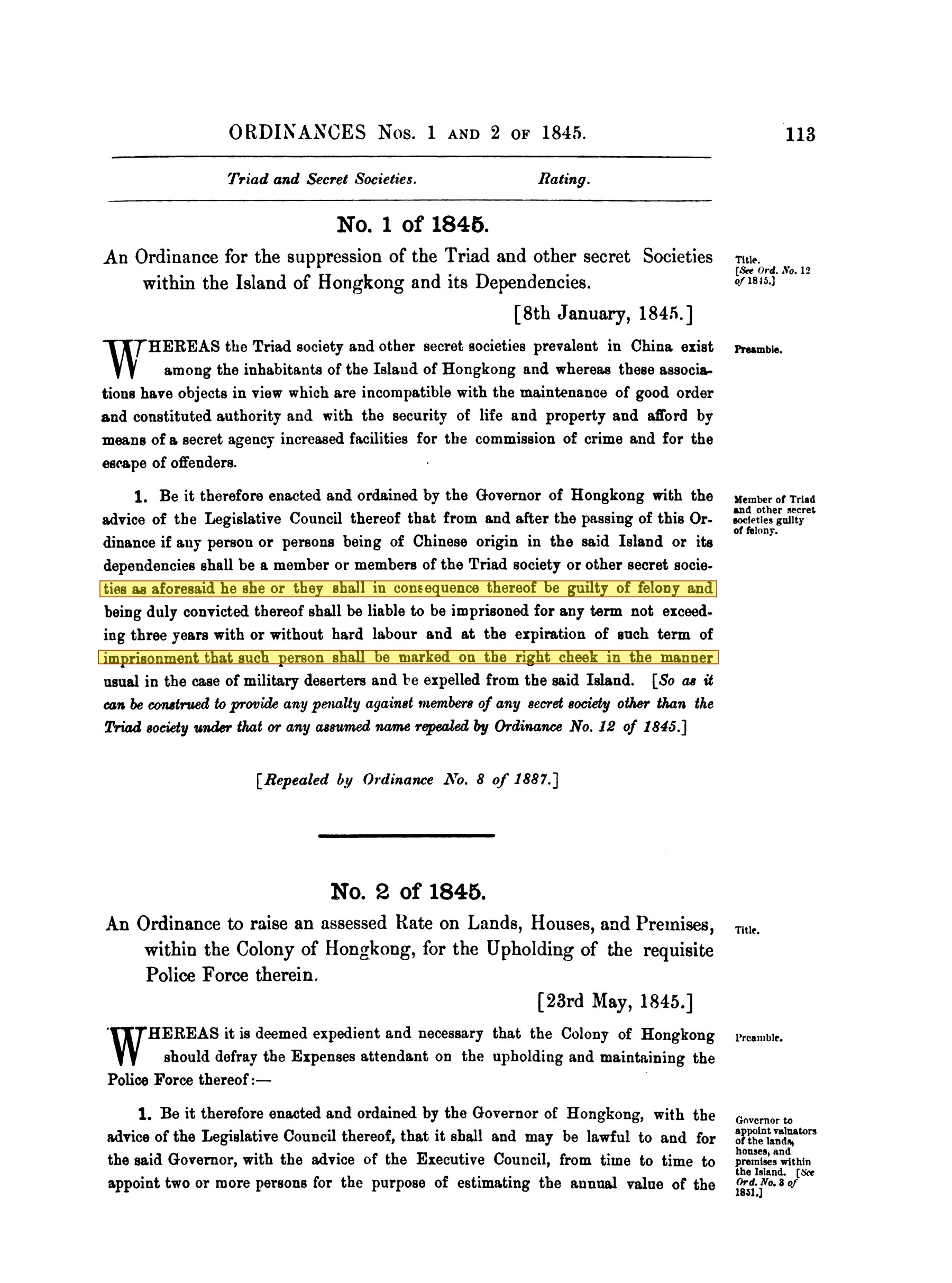
1845年1月8日,香港第二任總督戴維斯(John Francis Davis)簽署了《壓制三合會及其他秘密結社條例》(第1號條例):凡華人加入三合會,「即屬重罪」,判監不超過3年,刑滿之後——「在右臉刺字,方式一如逃兵」,並驅逐出港。這是香港開埠後最早的法例之一,也是三合會第一次被寫入殖民地的成文法。本硏究用香港政府檔案(CO 129四個整卷:1845、1884、1886),配合《憲報》、定例局會議記錄、法院年度報告與1913年以後每年4月的社團名冊,追蹤這套機器66年的演變:由1845年的肉刑(刺字、遞解),中經1854年胎死腹中的修例、1884年的「中國芬尼黨」恐慌、1886年的秘密結社調查委員會,到1887年《三合會及不法社團條例》(第8號條例)和1911年《社團條例》(第47號條例)——後者廢除1887年條例,改以「登記或豁免」管理全港社團,並規定每年4月在《憲報》刊登名冊。3點主要發現:其一,「刺字」並非傳說,而是法例原文;但它在1845年10月即遭白廳五點反對後改為「左臂之下、法官酌情」,1881年隨刑罰改革整條廢除。其二,執法從來是涓滴——法院年報所見,1889年最高法院只審了3宗「身為三合會成員」案,1898年下級法院32宗,1904年22宗,1905年7宗。其三,1911年之後,國家對社團的知識變成一本公開的名冊:1913年4月28日首份名冊列出中華會館、華商會所、竹林等豁免社團,以及忠信堂、集英堂等已登記行會——由刺在臉上的標記,到印在憲報上的名單,這正是這套機器最深的轉變123456。
一、導言:一場始於「重罪」的戰爭
三合會(英文「Triad」,即三合——天、地、人)在鴉片戰爭之前已活躍於華南7。1842年香港島正式割讓之後,這裡成為秘密結社的落腳處:1845年1月,戴維斯向倫敦報告時稱,三合會「長期以來被視為以秘密而有組織的結合,促進各類罪行的團體」;他又稱,數月前有一批武裝分子在島上一個廢棄石礦場聚集,而在條例通過之前,警方已以嚴重傷人案拘捕了「該會眾所公認的首領」8。這份報告,就是第1號條例的背景。
二、1845年:第一條法例與右臉刺字
1844年12月31日,定例局首讀《壓制三合會及其他秘密結社條例》;1845年1月8日,戴維斯簽署1。條例的序言稱,三合會「存在於香港島的居民之中」,其目的「與良好秩序及法定權威的維持不相容」;第1條規定,凡「原籍中華」者加入三合會或其它秘密結社,「即屬重罪」,判監不超過3年(可加或不加苦役),刑滿之後「在右臉刺字,方式一如逃兵,並驅逐出本島」2。與此同時,戴維斯把這條法例當作對清朝的「友誼證明」:他致函兩廣總督耆英,說明英國「已制定嚴厲條例對付三合會」;耆英回函致謝,並要求把「逃匿香港的三合會黨羽一律拘捕、送交內地官府」。戴維斯的答覆劃出界線:中國政府點名的逃犯可以移交,但「由我方警察拘捕的三合會成員,屬殖民地的罪犯,必須依我方法律懲處」9。
三、白廳的五點反對與1845年10月的修正
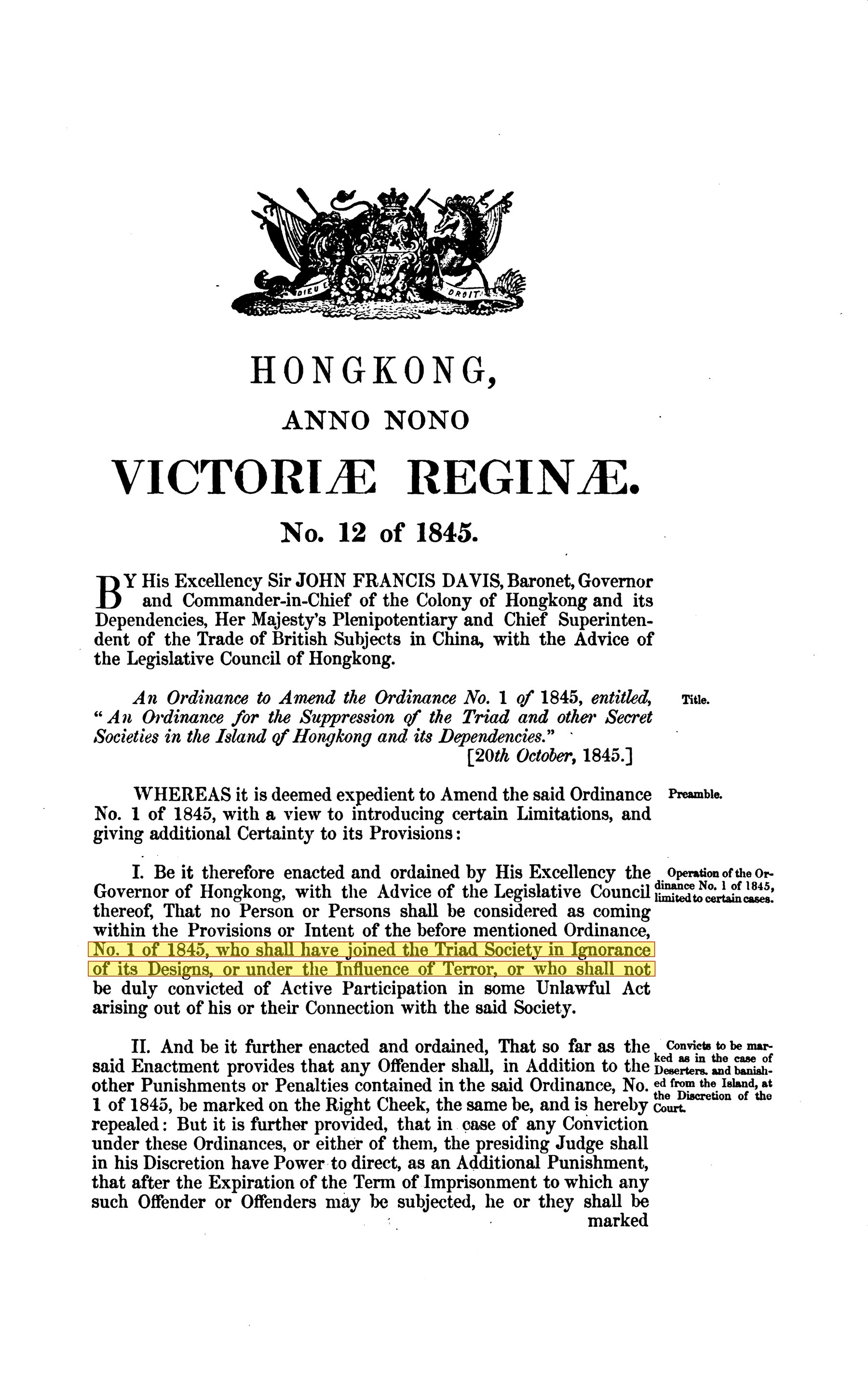
條例送到倫敦,殖民地大臣斯坦利勳爵(Lord Stanley)1845年6月24日覆文,提出5點反對:(1)沒有為「不知其圖謀、或因畏懼而加入」的人留下例外;(2)「在罪犯臉上留下不可磨滅的烙印……將令他終身蒙污,最終妨礙他重返誠實體面的社會」;(3)把所有秘密結社的「單純成員身分」都判以同樣重刑;(4)驅逐的期限不定——是終身還是短期?回來又如何?(5)「有下議院議員指出,中國政府近來的法令,可將三合會成員即時處死,而無需任何正式審訊。」斯坦利的裁決是:不否決,但「立即設法修正」;至於移交,他寫下那句關鍵的話——「他們應被移交以接受審訊,但不得未經審訊而被處死」(They should be delivered up to be tried but not to be put to death without Trial)3。1845年9月12日至10月20日,定例局依「斯坦利勳爵的訓令」通過第12號條例:加入「不知其圖謀或受脅迫」者可獲豁免;**右臉刺字廢除**,法官可酌情改為「在左臂之下刺字」並終身放逐;放逐期滿前回港者「終身流放」;刑罰只限於三合會,不再及於其他結社1011。刺字條款其後在1881年隨刑罰改革(第3號條例)整條撤銷12。
四、第一個被告:1845年2月的審訊
條例通過後一個月,最高法院刑事庭開審「女皇訴Wang Kacheong等人」案(1845年2月15日,罪名:意圖傷人)。苦力證人Trung Acheing供稱:去年12月22日他的外套被偷,27日追蹤賊人至被告屋前;「賊人走入Kacheong屋內,因為他就是所謂三合會的首領」;Kacheong質問他「你既知我是三合會首領,怎麼還敢來捉我的人」,並在持刀黨羽出現時說「殺了他,後果我負責」;他本人被刀砍傷,傷口約1/4吋深。又稱:「在Kacheong屋內(位於太平山),我見到15至20人,手持刀、矛、戟。所有正直的華人都怕三合會。」屋內的Aling「正在寫字——他是該會的文書」;警員Darrington將其拘捕。戴維斯的附註稱:被告「作為首領,有權指揮會員的行動,並向他們保證不受懲罰」;其屋「用作贓物存放之所」;而「在體面的華人眼中,該會令人憎厭,也是恐懼的對象」。被告最終被判「意圖傷人」罪成——因為條例不能溯及既往,他受罰的是傷人,而不是「成員身分」13。
五、失敗的法案與一場恐慌:1854–1884
1854年10月31日,定例局二讀新的《壓制三合會條例》。署理首席按察司提出反對:15年流放的權力(首讀時已刪)、由律政司(行政官員)參加的特別法庭、以及「對此法庭不得上訴,連向最高法院的憲制上訴權也被明文取消」。法案獲在席議員支持,但議決「暫緩通過及公布」,以副本送呈殖民地部等候批准——此後再無下文;1845年的法例(1845年修正版)繼續有效至1887年14。1884年3月,類似的一幕以「恐慌」形式重演:九龍城寨的清朝官員經「賴上校」(Colonel Lai)警告港府,稱惠州府一帶的起義由「三合會(Tam Hop Wui)」煽動,香港的會眾「據說超過1萬人,主要是勞動階層」,計劃「當晚起事、搶掠銀行與軍火商舖、再攜贓渡海投奔起義軍」。總督寶雲不以為然——「我並不傾向相信這些三合會人,即『中國的芬尼黨人』(the Fenians of China),會在這個殖民地冒險起事」——但仍下令加倍戒備:軍隊與警察巡邏、武裝汽艇監視海港。「結果並無任何騷動發生」15。當時的報紙記錄了恐慌如何消散:《德臣西報》質疑「這一切與三合會有什麼關係——當那個組織真的動手時,起的可不是一千兩千人,而是成千上萬」;3月6日「九龍城極為緊張,但並無實際騷動或攻擊」;《孖剌西報》則報道「超過一千名三合會華人已悄然離港,手無寸鐵」;3月19日,總督禁止軍火出口的公告「引起了一些議論」16。寶雲其後在公文裡為這段歷史留下註腳:「有一段時期,三合會人在本殖民地全被宣布為法外之徒」;「上述第一條條例,無疑是在一場恐慌中通過的」;而三合會的名字「取自天、地、人三合之意」7。
六、1886年的調查委員會與1887年條例
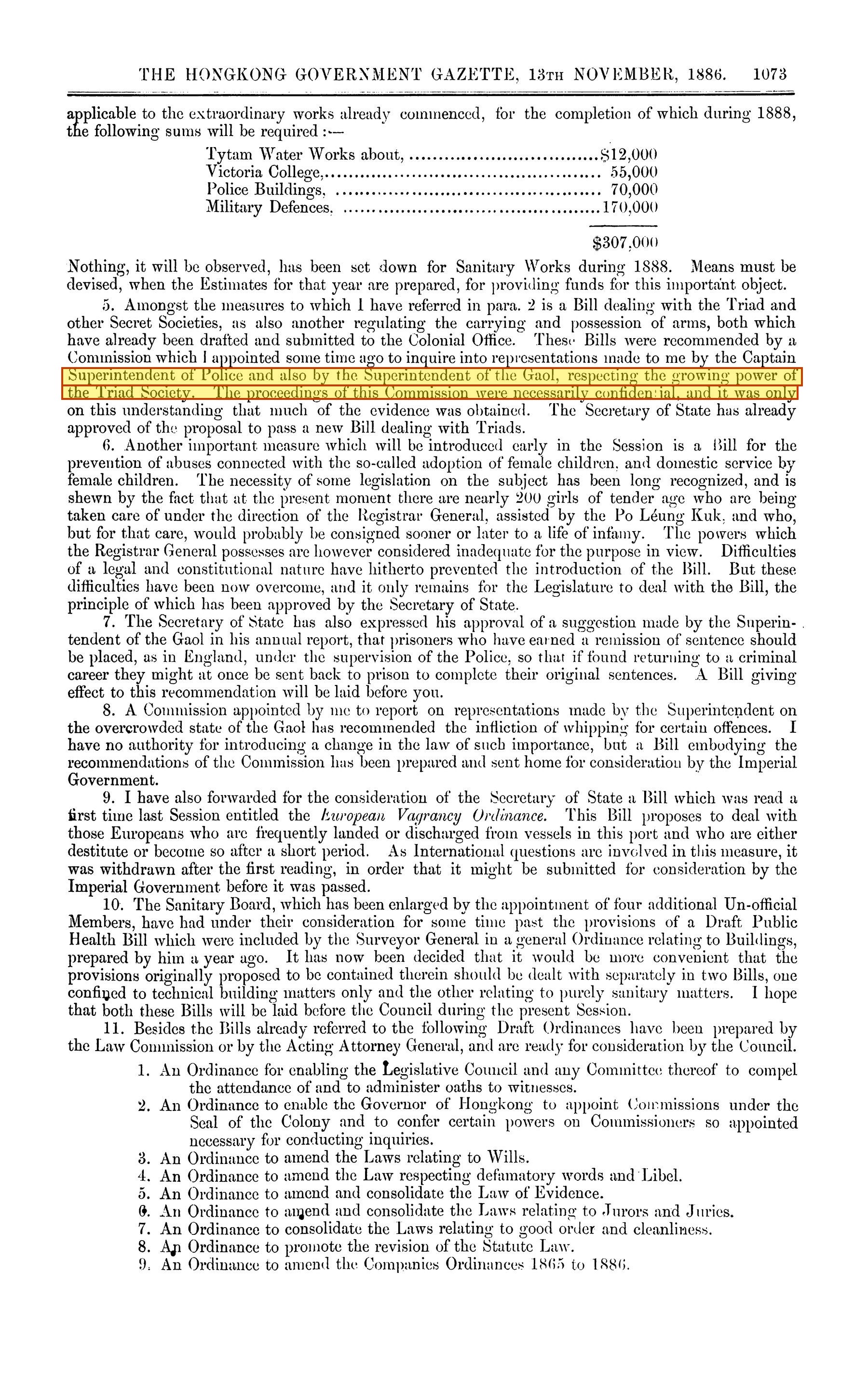
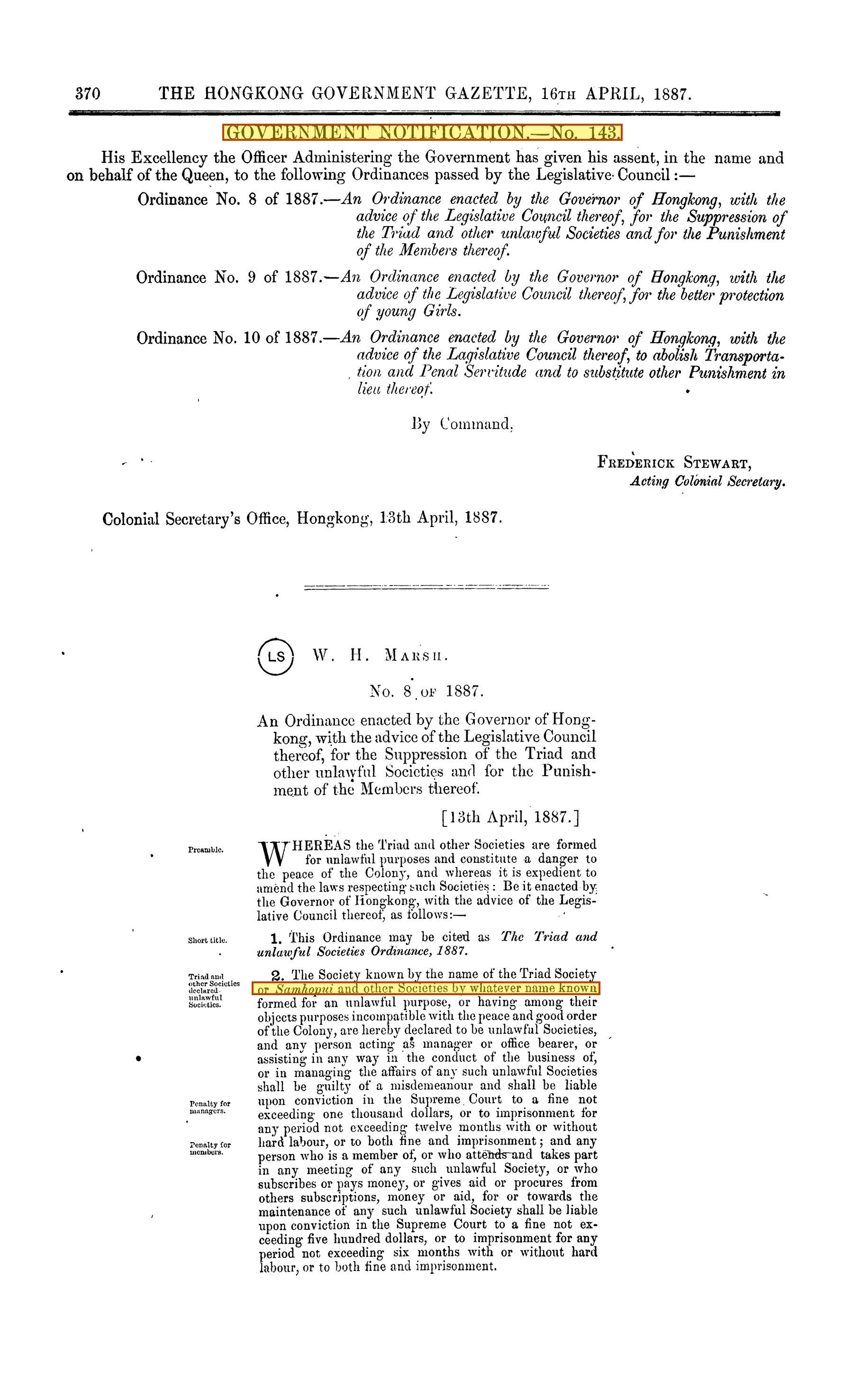
1886年4月9日,輔政司第518號函下令成立調查委員會。委員會的成因,在總督1886年11月5日的施政報告中說得直白:條例草案「是由我早前委任的一個委員會所建議——該委員會調查警察總監與監獄總監關於三合會勢力日增的陳述」,「委員會的議事程序必須保密」17。委員會報告的指控清單包括:保護罪犯、妨礙司法、勒索貨船「保護費」、控制行業、成員滲透政府機關18。報告建議:遞解主要成員、發出警告公告、訂立新條例、「現行法律不足」;行政局隨即決議:警察總監提交首要成員名單以備遞解;**偵探李凡(Li Fan)**——他本人被報稱是三合會成員——「將被遞解出境並革職」;並把新條例草案送呈殖民地部18。一份由湛約翰(John Chalmers)翻譯的匿名中文報告稱三合會「已建立起一種恐怖統治(a reign of terror)」:小販被打、學童起鬨、警察「明知而不查」;它又列出會址:「皇后大道西10259號二樓,據說是三合會的聚會處,與義利館相連」19。1886年8月,偵探李凡棄保(2,000元)潛逃,其後在家鄉被百名士兵圍捕,「射殺1人、傷數人」後中彈被擒,傷重而死20。同年,立法局華人議員**黃勝(Wong Shing)**收到恐嚇信:「有人警告他將被殺,因為據說他向政府建議遞解某些三合會人」——這一細節由總督本人寫進公文21。1887年1月21日,新條例草案首讀;3月11日三讀通過,編為第8號條例22。條例的關鍵字句:**「三合會或Samhopui」**被點名為不法社團;出席會議、繳費、援助者判罰;「在會議上宣讀或提出誓詞」即為該會議屬不法集會的「表面證據」;裁判司或太平紳士可入屋搜查、拘捕「5名或以上」的與會者;刑罰改在最高法院審理(罰款1,000元或監禁12個月)——這正是白廳1886年11月要求的修改423。1887年9月,總督在會期總結中說:這條條例「證明了這些不法社團存在到何種程度、能行使何種權力——它們不僅為自己的利益,還經常以協助罪犯的方式,危害司法」24。
七、由取締到登記:1911年社團條例及以後
1887年條例之下,被送上法庭的人並不多:最高法院1889年年報只有3宗「身為三合會成員」案;下級法院1898年32宗、1904年22宗、1905年7宗5。與之平行的是另一條線:1907年的《中文刊物(取締)條例》已把「擾亂中國和平」的出版物列為罪行25。1911年10月6日,政府公布《社團條例》草案——「更有效地控制社團與俱樂部」:凡10人以上的社團須登記或獲豁免,**登記官由總登記官出任**;而拒絕登記的理由之一,是社團「可能被用於不法目的……或其行動與程序,足以在中國激起騷動或擾亂(calculated to excite tumult or disorder in China)」。草案第5條規定:**每年4月,登記官須在《憲報》刊登所有登記或豁免社團的名冊**26。11月16日條例通過,11月17日獲批准;第25條明文「廢除1887年《三合會及不法社團條例》」27。1912年的修正案把新界《田土條例》下的「祖、堂」豁免於登記28;1912年12月,海軍聯盟(Navy League香港分會)獲豁免登記29。1913年4月28日,首份名冊刊出——豁免名單上有中華會館、華商會所、竹林、中和別墅、藝苑、香港體育學校等;已登記名單上有中國機器研究總會、忠信堂、集英堂等行會6。此後每年4月,《憲報》都刊出更新的名冊:1914年增記顯義堂、鴻泰、樂義堂(茶樓行)與樂洋參西家行;1917年增記漢商別墅、鴻儒書室、勵豪音樂會;1919年,香港汽車協會加入非華人豁免名單30。1920年6月25日,第8號條例「扭轉政策」:放棄登記,改為點名宣布「三合會、所有使用三合會儀式的社團、以及以不法目的為宗旨的社團」為不法社團31——1939年的政府回顧文件對此下的評語是:1911年的登記制度「是一次失敗,且經常令政府尷尬(a failure and frequently a cause of embarrassment to Government)」32。
結論
由1845年1月的一條「重罪」條文,到1913年4月的一份名冊,香港對三合會的戰爭走過66年:刑罰由「右臉刺字+驅逐」縮減為「左臂之下、法官酌情」,再在1881年整條取消;執法由恐慌驅動的巡邏與遞解,轉為1887年依新加坡模式訂立的搜查、宣誓證據與法庭刑罰;最後,1911年的立法者放棄了「逐個取締」的思路,改為要求全港每一個10人以上的社團,或登記、或豁免,並把結果每年4月公開。1887年條例本身一直用到1911年——它廢除時,立法局連同它一起廢除的,是1845年那條最初的法例。名冊沒有消滅三合會(1920年條例又把「三合會」三字寫回不法社團名單的第一位),但這場戰爭留下了它真正的遺產:一個殖民地學會了用紙張與檔案,管理那些它無法消滅的東西242731。
本節引用的所有檔案與刊本,連結見文末註釋;四份整卷檔案(CO 129/011、215、227、228)已全文核讀33。
From the Cheek Brand to the Registrar’s Desk
Hong Kong’s war on the Secret Societies, 1844–1911
Abstract
On 8 January 1845 the second Governor of Hong Kong, Sir John Francis Davis, signed “An Ordinance for the suppression of the Triad and other secret Societies”: membership — for any person “being of Chinese origin” — was made a felony punishable by up to three years’ imprisonment and, at the end of the term, by being “marked on the right cheek in the manner usual in the case of military deserters” and expelled from the island. It was among the colony’s earliest laws. Sixty-six years later, in November 1911, the Societies Ordinance repealed it and its 1887 successor (No. 8 of 1887) and replaced the whole machinery with registration: every club, company, partnership or association of ten or more persons was to be registered or exempted, and the Registrar General was to publish a list of registered and exempted societies in the Gazette every April. This paper follows that arc through the colony’s own files — four whole CO 129 volumes (1845, 1884, 1886), the Legislative Council minutes, the Government Gazette, the annual court returns, and the register lists of 1913–1919. Three findings: (1) the brand is statute, not legend — and the Colonial Office had it narrowed to a discretionary mark “under the left arm” within ten months, then repealed entirely in the 1881 penal reform; (2) enforcement was a trickle — three “member of the Triad Society” cases in the Supreme Court’s 1889 returns; 32 in the subordinate courts’ 1898 returns, 22 in 1904, seven in 1905; (3) the deepest change was epistemic — the state stopped marking bodies and began counting societies, and the counting itself became an annual public document23456.
Keywords: Triad society; secret societies; Ordinance No. 1 of 1845; Triad and Unlawful Societies Ordinance 1887; Societies Ordinance 1911; registration; colonial legislation; Hong Kong.
1. The first law: a felony, and a brand (1844–45)
The Legislative Council read the ordinance for the first time on 31 December 1844, at the session whose minutes name it beside the Police Rate; Governor Davis approved it on 8 January 18451. Davis had built the case in his January despatch to Lord Stanley: the society “has been long known as an association for the promotion of every species of crime, by the aid of secret and organized Combination”; “an armed gang of them reported to have assembled some months since in an abandoned stone quarry, at the coast of the island”; and “shortly before the passing of the Ordinance the reputed head of the association was seized by the Police, in a case of aggravated assault with weapons upon a Chinese who had made himself obnoxious to the body.” A postscript added Gutzlaff’s Chinese news from Heangshan: “The Triad Society has there committed fearful ravages, and plundered whole Villages.”8
The ordinance’s preamble held that the societies “have objects in view which are incompatible with the maintenance of good order and constituted authority and with the security of life and property and afford by means of a secret agency increased facilities for the commission of crime and for the escape of offenders.” Section 1: “if any person or persons being of Chinese origin in the said Island or its Dependencies shall be a member or members of the Triad society or other secret societies as aforesaid he she or they shall in consequence thereof be guilty of felony and being duly convicted thereof shall be liable to be imprisoned for any term not exceeding three years with or without hard labour and at the expiration of such term of imprisonment that such person shall be marked on the right cheek in the manner usual in the case of military deserters and be expelled from the said Island.” The scope was expressly racial, the penalty expressly corporal2.
Davis advertised the law to China as a good-will offering. To the Earl of Aberdeen (11 January 1845) he explained that he had told Imperial Commissioner Keying of the ordinance as “a proof of friendly feeling towards China, as well as cooperation in the punishment of guilt… whose avowed objects are not only the promotion and impunity of crime, but the overthrow of the existing Government of China.” Keying thanked him and asked that “native traitors and associates of the Triad Society, villains who have taken refuge at Hongkong” be arrested and sent to the mandarins “that very severe measures may be taken against them. Thus you will display your public friendship.” Davis’s own line was narrower: named refugees would be “handed over”, but “Members of the Triad Society apprehended by our own police, as offenders under the Colonial Ordinance, must of necessity be punished by our own Law.”9
2. The Colonial Office rewrites the law (1845)
The despatch that reached London drew five objections from Lord Stanley (24 June 1845). The ordinance made no exception for those who joined “in ignorance of its designs or under the influence of terror”; the cheek brand — “an indelible stigma… would consign him to a life of infamy and finally obstruct his return to honest and reputable society”; it punished “mere membership” of all secret societies; the exclusion was of indefinite duration; and — the fifth point — “It has been stated by a Member of the House of Commons… that by a recent Edict or law of the Chinese Government a number of Triad Society members may be put to death at once, and without any formal trial.” Stanley would not disallow the ordinance, but required its amendment; and on the surrender of refugees he laid down the formula the later memory would invert: “They should be delivered up to be tried but not to be put to death without Trial.”3
The amendment followed the same year: “An Ordinance to amend Ordinance No. 1 of 1845” (No. 12 of 1845, 20 October 1845), passed by the Council expressly “in accordance with the instructions contained in Lord Stanley’s Despatch”. Section 1 excludes anyone who joined “in ignorance of its designs, or under the influence of terror”, or who is not “duly convicted of active participation in some unlawful act”. Section 2 repeals the mandatory cheek mark, substituting a judicial discretion to have the convict “marked in the manner usual in the case of military deserters, under the left arm, and expelled or banished from the said Island for the term of his or their natural lives”; return from banishment meant transportation for life; and the penalty was confined to the Triad alone1011. The marking and banishment clauses survived until the penal reform of 1881 (No. 3 of 1881, the Penal Ordinances Amendment Ordinance), whose consolidation notes them as repealed12.
3. The first defendant: Regina v. Wang Kacheong (1845)
The one case the file preserves in full is the arrest that had preceded the ordinance. On 15 February 1845 the Supreme Court tried Wang Kacheong and another for cutting and wounding with intent to maim. The coolie Trung Acheing testified that his stolen jacket had been traced to the prisoner’s house; that the thief went there “because he was at the head of a society called the Triad Society. Both the Prisoners are members of that society”; that Kacheong asked how he dared seize one of its members, and, when armed men came out of his room, said “murder him and I will stop the consequences”; and that “In Kacheong’s house which is at Taiping sham I saw 15 or 20 men armed with swords spears and pikes. All honest Chinese are afraid of the Triads.” A second prisoner, Aling, “was inside writing — he is clerk to the Society.” Davis’s covering despatch reads the evidence as an anatomy of the society’s power: the head “had power to direct the operations of the Members, assuring them at the same time of impunity”; his house “served as a place of deposit for stolen property”; the people paid “a sum of money for protection… or for the restitution of property”; and “among the respectable Chinese, the society is looked upon with abhorrence, and as an object of fear.” The conviction was for the assault: the ordinance could have no ex post facto operation, so its first famous defendant was punished, in effect, for everything but membership13.
4. The bill that failed (1854) and the panic that passed (1884)
In 1854 the Council attempted a new suppression bill. At its second reading (31 October) the Acting Chief Justice objected to the fifteen-year transportation power (already struck at the first reading), to a special court with the Attorney General — an executive officer — among its members, and to the clause that abolished appeal, “the constitutional one to the Supreme Court”. The Council supported the bill but agreed “that the passing and publication of the same should be postponed” for the Secretary of State’s approval; no further proceeding appears, and the amended law of 1845 remained the colony’s instrument for another thirty-three years14.
Thirty years later, in March 1884, the old machinery produced a last great scare. The Kowloon mandarin warned the British authorities, through “Colonel Lai”, that an insurrection in the Wei-Chau district was “instigated by the Secret Society known as the Tam Hop Wui, or Triad Society”, and that the society’s Hong Kong members — “said to number over ten thousand (10,000) persons, chiefly of the labouring classes” — intended to rise that night, plunder the banks and arms shops, and cross over to join the rebels. Governor Bowen recorded his disbelief — “I did not feel disposed to believe it probable that these Triads — the Fenians of China — would risk an outbreak in this Colony” — and his precautions: doubled guards, armed steam-launches on the harbour, military patrols through the Chinese quarter. “No disturbance whatever occurred.”15 The press week shows the scare being believed, doubted and drained: the China Mail’s leader asked what any of it had to do with the Triads, since “when that organisation undertakes operations not a thousand or two of men will rise against the authorities, but hundreds of thousands”; the Daily Press reported “upwards of a thousand Chinese belonging to the Triad Society” quietly leaving the colony, and the Governor’s proclamation forbidding the export of arms; and the society’s name travelled with the rumour of the northbound volunteers16. Bowen’s own despatch added the retrospect: “It may be useful to recall the fact that at one time the whole of the Triads were declared outlaws in this Colony”; “The first mentioned Ordinance was no doubt passed in a panic.” And it preserved the period’s etymology — the name “is taken from the supposed union of heaven, earth, and man” — beside E. L. Layard’s sonnet on the society’s vanished resort, “The Triad’s Cave”, “now disappeared before the utilitarian demand for granite”7.
5. The Commission and the Ordinance of 1887
The scare that mattered came two years later, from the institutions. The Commission of 1886 — the papers’ own word is “Committee” — was appointed on instructions of 9 April 1886, after the Captain Superintendent of Police and the Superintendent of the Gaol reported on “the growing power of the Triad Society”; its proceedings, the Governor told the Council that November, “were necessarily confidential”; and the Secretary of State had already approved a new bill17. The report’s catalogue of complaints — protection of criminals, obstruction of justice, blackmail of junks and cargo, control of trades, members among “servants of the Imperial and Colonial Governments” — was headed by a Chinese detective’s statement that “during the last five years nine murders have been committed, in which the culprits have not been convicted”, owing to the society’s protection. The Executive Council resolved on banishments, a warning proclamation, a firearms law, and a new ordinance, “the existing law on the subject being insufficient”; the banishment notice is preserved as a template (“the following persons… have been banished: (Here insert the names)”) with a $50 reward for information on their return; and the banishments themselves were executed under the general law of 1882, s. 818. A minute in the same file records the road not taken — and why: “It could certainly be done by making its members register as done in Singapore with Secret Societies. The avowed object of the Triads being the subversion of the reigning Dynasty in China, it would be a most unfriendly act to recognise it in any way.”34
Two human documents sit inside the same correspondence. The first is an anonymous Chinese account, translated by the Rev. Dr. John Chalmers, which the Governor filed as confirmation “that the Triads have established a reign of terror”: the hawker beaten for talking of the society; the man “taken before the secret tribunal of the Triads and on point of being executed”; the policeman who “knowing the power of the Society did not pursue the case”; the “kwan” or lodges — “almost all Triad assemblies where mischief is bred”; and the addresses, printed as given: “In Queen’s Road West (Sai-ying-pun) No. 10259, Second floor, is said to be a Triad Society’s meeting place. And there is another place called 義利館 (Yi Li Guan) in connection with it. In First Street, N. 69, Second floor, is a gambling house, said also to be under the patronage of several detectives who are members of the Triad Society.”19 The second is the fate of the society’s best-known servant: Detective Li Fan, ordered banished and dismissed, jumped $2,000 bail in 1886 and fled to China, where a hundred soldiers surrounded his native house; he held them off, killing one and wounding several, and died of his wounds on the way to the barracks. The file’s own summary notes that this was the only recorded case of a Hong Kong Triad meeting his death in China — and that Li Fan had been committed for trial, not banished20. The same despatches record that the Honourable Wong Shing 黃勝, the sitting Chinese unofficial, received a letter warning that he would be killed “because it was supposed that he had advised the government in the matter of the banishment”21.
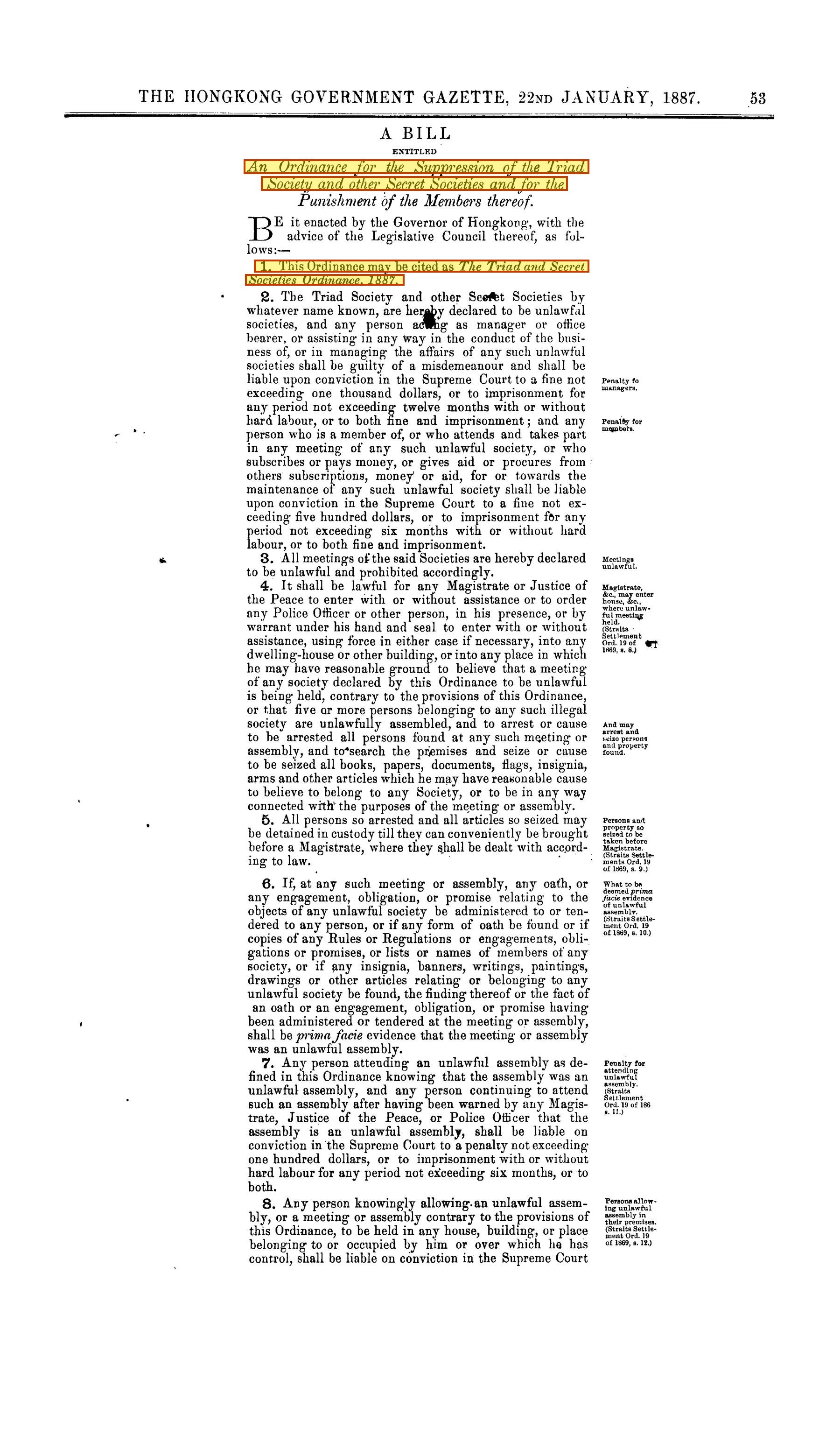
The bill published on 22 January 1887 was titled “An Ordinance for the Suppression of the Triad Society and other Secret Societies…”; it passed its second reading on 28 January, sat in committee (clauses 6, 9, 11 and 12 reserved) through February and March, and was read a third time on 11 March: “Bill passed, and numbered as Ordinance No. 8 of 1887.” The enacted title had changed “other Secret Societies” to “other unlawful Societies”3522. The Secretary of State’s redrafting is visible in the text he approved: trials moved from summary conviction to “conviction in the Supreme Court” (his despatch of 24 November 1886 had asked precisely for that, “having regard to the severity of the punishment”), and the bill’s resignation proviso was to be dropped so that a person charged would have to prove he had withdrawn23. The Act as passed — “The Triad and Unlawful Societies Ordinance, 1887”, assented 16 April 1887 — declared “the Triad society or Samhopui” and societies formed for unlawful purposes to be unlawful societies; made managers and members (and attenders, subscribers, aid-givers) liable to fines of $1,000 or $500 and to imprisonment; declared all meetings unlawful, with the administration of an oath at a meeting made “prima facie evidence” that the meeting was one of an unlawful society; and gave magistrates and Justices of the Peace power to enter, arrest and seize “books, papers, documents, flags, insignia, arms”. Its margins name its models: the Straits Settlements Ordinance 19 of 1869 (ss. 8–12, 25) and Ordinance 4 of 1882 — the Singapore law whose registration machinery Hong Kong had refused to copy434. In September 1887 the Governor told the Council what the Commission had proved: the societies’ power was used “not only for their personal benefit, but often to the prejudice of justice by the help which they extended to criminals”24.
6. The trickle: what the courts did
Against the Commission’s hearsay of 10,000 members, the state’s own annual returns record what the new law actually produced. The Supreme Court’s returns for 1889 carry the row “Triad Society — Being a Member of, &c.” with three cases and three persons; the subordinate courts’ returns carry “Triad and Unlawful Societies Ordinance, 8 of 1887, Suppression of” with 32 (1898), “Breach of” with 22 (1904), and “Contraventions of, and Offences under” with seven (1905). (The returns’ columns are interleaved in the OCR; the figures are cited as printed, and the 1887 return’s row has no legible count.)5 The machinery was real — searchable, provable by oath, tried before the Supreme Court — and it simply did not catch many people.
7. From suppression to registration (1907–1919)
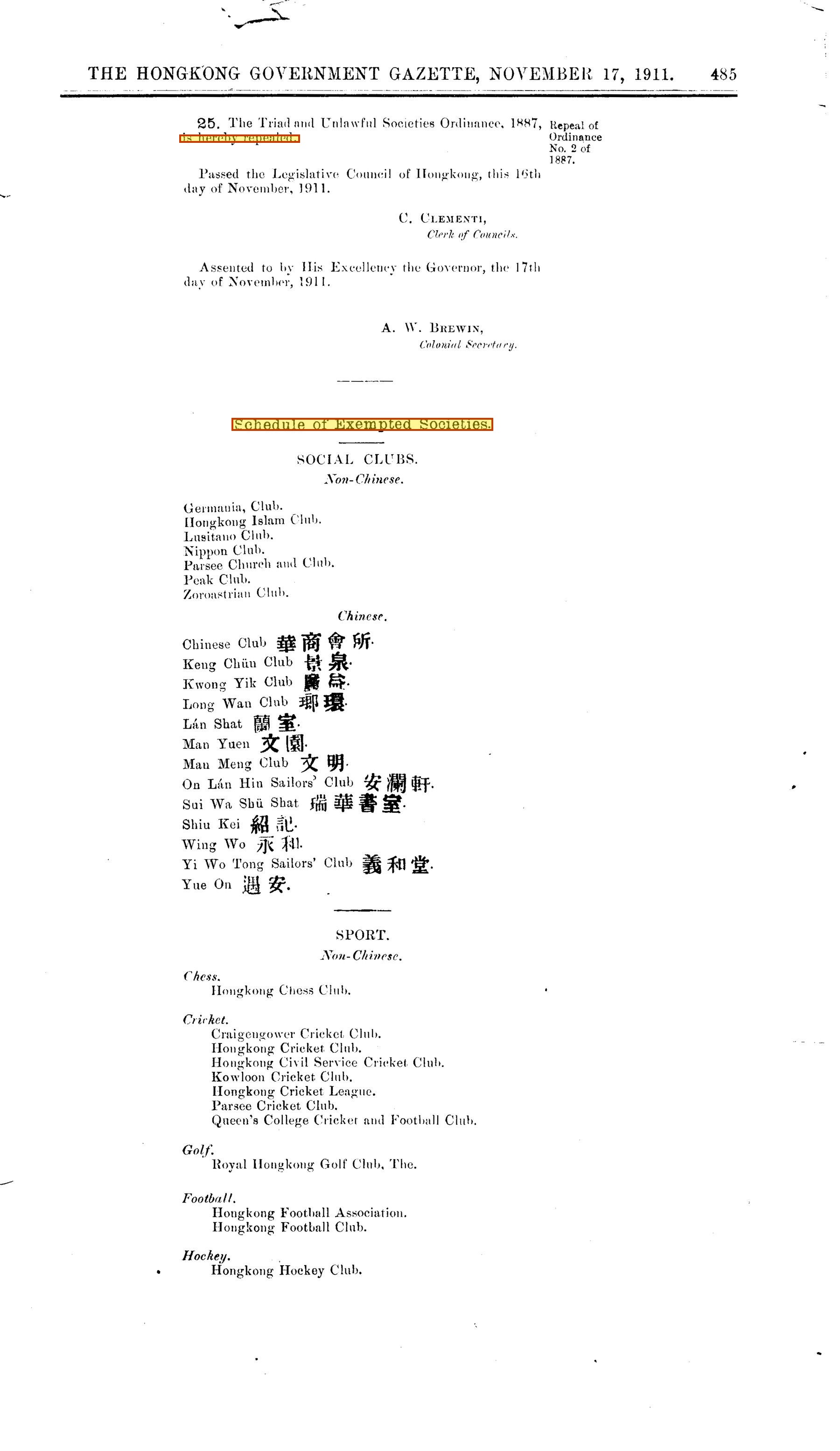
The road to 1911 runs through the censorship of politics, not of societies. In 1907 the colony passed the Chinese Publications (Prevention) Ordinance (No. 15 of 1907), “to prevent the publication in the Colony of matter calculated to disturb the peace of China”; the Colonial Office file shows the “tumult and disorder in China” test being drafted, and a 1908 note records the ordinance as “a Special Ordinance prohibiting the publication of any seditious matter calculated to create tumult or disorder” in China25. The Societies Bill published on 6 October 1911 — five days before the Wuchang rising, though the corpus states no causal link — carried the same test into the law of associations: the Governor-in-Council was not to refuse registration unless a society appeared “likely to be used for unlawful purposes… or that its action and proceedings are calculated to excite tumult or disorder in China or to excite persons to crime in China.” The bill defined a “Society” as any club, company, partnership or association of ten or more persons (excluding registered companies, chartered bodies, Freemasons’ lodges and businesses of twenty or fewer), made the Registrar General the Registrar of Societies, and required “a list of all existing Societies registered or exempted” in the Gazette each April26. The Act passed on 16 November 1911 and was assented on the 17th: Ordinance No. 47 of 1911, whose s. 25 repealed the Triad and Unlawful Societies Ordinance, 188727.
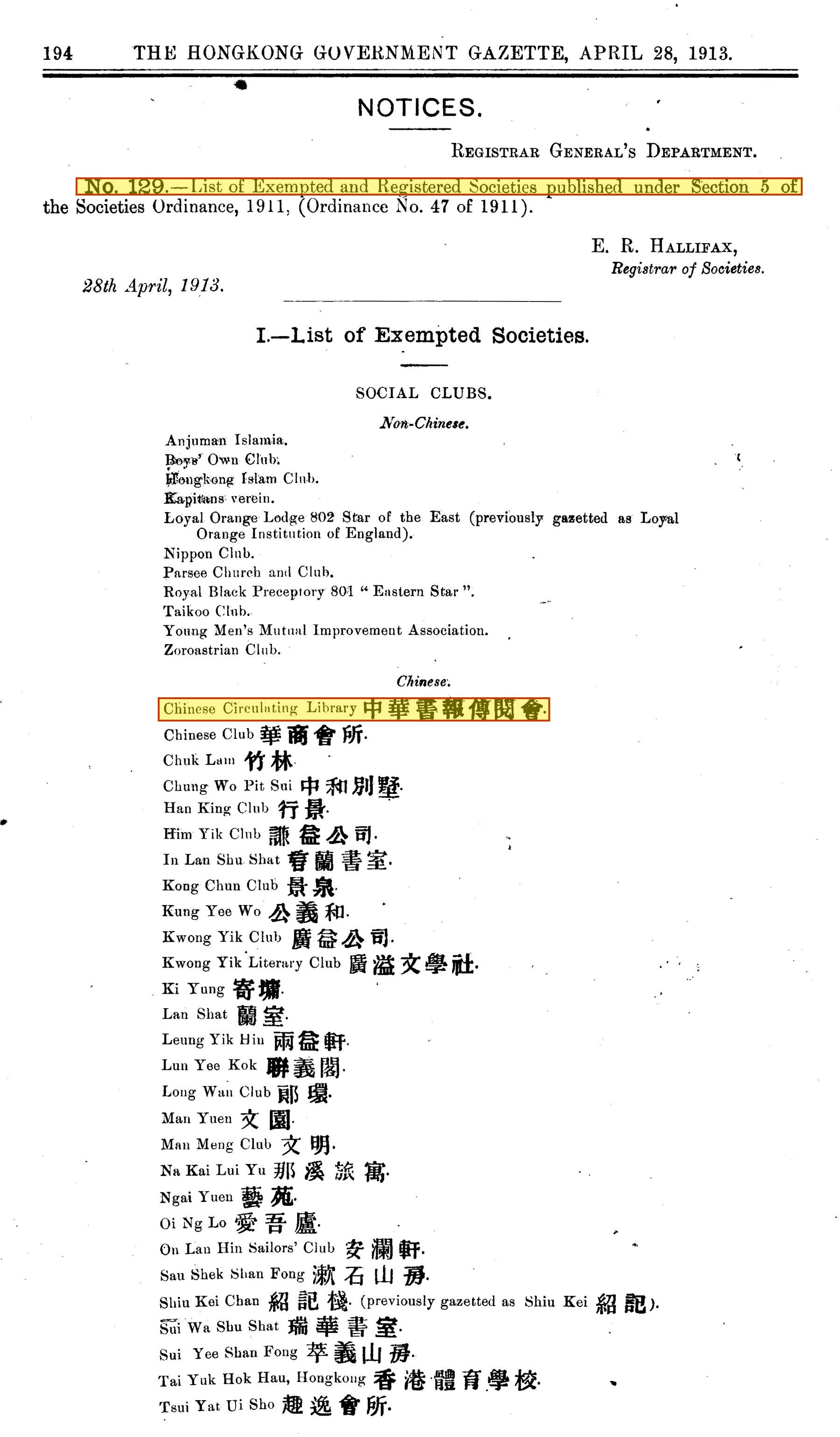
Registration began to draw its map at once. The 1912 amendment exempted the clans, families and t’ongs registered under s. 28 of the New Territories Ordinance, 191028; a Blue Book note records the Navy League (Hongkong Branch) exempted in December 191229. The first register — “No. 129. List of Exempted and Registered Societies published under Section 5 of the Societies Ordinance, 1911, (Ordinance No. 47 of 1911)”, signed by E. R. Hallifax, Registrar of Societies, 28 April 1913 — lists the non-Chinese clubs (Anjuman Islamia, the Nippon Club, the Parsee Church and Club, the Zoroastrian Club…), the Chinese clubs under their own names (中華書報傳閱會, 華商會所, 竹林, 中和別墅, 藝苑, 香港體育學校…), the merchants’ associations (中華會館, 華商公局), and the registered trade guilds (中國機器研究總會; the rattan guilds 忠信堂 and 集英堂)6. Every April the list returned: 1914 (adding the tea-house guild’s 顯義堂, 鴻泰, 樂義堂 and the ginseng workers’ 樂洋參西家行), 1915, 1916, 1917 (adding 漢商別墅, 鴻儒書室, 勵豪音樂會), 1918, 1919 (the Hongkong Automobile Association joins the exempted)30. In the war years the “excite tumult in China” clause was being read as an enforcement power: a 1919 despatch encloses the ordinance and quotes its s. 4(4)36.
8. Afterlives: 1920 and the reckoning of 1939
The policy was reversed within nine years. Ordinance No. 8 of 1920 (25 June 1920) abandoned registration: s. 3 declared unlawful “(a) the Triad Society; (b) all societies which use a Triad ritual; (c) all societies which have among their objects unlawful purposes or purposes incompatible with the peace and good order of the Colony”, and s. 4 gave the Governor in Council an “absolute discretion”, including over societies “calculated to excite tumult or disorder in China”31. The Government’s own Sessional Paper 1939 wrote the epitaph of the register: the 1911 ordinance “was passed in order to control the political activities of certain associations… The Ordinance was a failure and frequently a cause of embarrassment to Government.” Its history also preserves the popular memory of 1845 — “The ordinance was necessarily severe, branding being provided for, and causing much discussion, but in October following, doubtless upon instructions from Home, an amendment was effected by which branding was done away with”32. A later colonial retrospect (Old Hong Kong, vol. 3) went further, turning the ordinance into a tale of refugees “brand[ed] on the cheek” and sent back to Canton “where they would be forthwith tortured and executed” — a sentence registered here as the retrospect’s own, against the documents’ instruction that they were to be “delivered up to be tried but not to be put to death without Trial”373.
Conclusion
For sixty-six years the colony’s war on the secret societies moved along a single line: from punishing a body to counting an association. The 1845 ordinance made membership a felony and wrote the brand into statute; Whitehall removed the mandatory cheek mark within ten months and the reform of 1881 removed the mark entirely; the panic years — 1854, 1884, 1886 — each produced a bill or a commission, and only the last produced an act; and in 1911 the state stopped trying to outlaw the secret society one member at a time and required the whole associational world — clubs, guilds, chambers, t’ongs — to be registered or exempted, with a published list each April. The registers did not end the Triads: the 1920 ordinance put them back, by name, at the head of the unlawful list. But the paper record stayed. The deepest legacy of 1845 is not the brand and not the ban; it is the ledger — the habit of knowing the colony’s associations by manuscript, name by name, in the Gazette2427316.
Appendix A — Evidence register (summary)
| Class | Item | Witnesses |
|---|---|---|
| Confirmed | No. 1 of 1845: felony, right-cheek brand, Chinese-origin scope; first read 31 Dec 1844, passed 8 Jan 1845 | LegCo minutes; three prints of the text12 |
| Confirmed | No. 12 of 1845: ignorance/terror exception; cheek repealed; discretionary under-left-arm mark; lifetime banishment | the Act; LegCo minutes; CO 129/013 enclosure1011 |
| Confirmed | The Colonial Office line: amend, don’t disallow; “delivered up to be tried but not to be put to death without Trial” | Stanley’s despatch; the amendment itself3 |
| Confirmed | The Wang Kacheong trial (conviction for cutting and wounding) | trial notes + covering despatch + docket13 |
| Confirmed | The 1886 Commission; its recommendations; the ExCo resolutions; Li Fan; Wong Shing’s threat | CO 129/227 + CO 129/228; the Governor’s Address18172021 |
| Confirmed | No. 8 of 1887: Samhopui; meetings; oath evidence; search powers; Supreme Court penalties; passed 11 Mar, assented April | the Act (three prints); LegCo minutes; assent notice42238 |
| Confirmed | No. 47 of 1911: registration/exemption; Registrar General; annual April registers; “excite tumult in China” test; repeal of 1887 | the Bill; the Act; the 1912 amendment; the registers; SP 19392627632 |
| Single-witness | The mandarin’s “over ten thousand” members (relayed hearsay); the “nine murders” (one detective); the Chalmers document (anonymous); Layard’s sonnet; Wong Shing’s threat (as reported by the Governor) | see notes151819721 |
| Conflicts | K1 the “branded then executed” retrospect vs the documents’ formula; K2 cheek vs under-arm; K3 the “No. 8” vs “No. 2”/“S” prints of 1887; K4 the 1854 bill’s fate; K5 the “Ordinance 2 of 1845” slip; K6 the unnamed 1886 banishment list | 10337451418 |
| Failed verification | no pre-1845 law (2 hits = the first reading itself); no earlier registration attempt (the 1886 minute rejected it); no pre-1911 “Societies Ordinance”; the 1860s “Triad” ad class = “trim’d” OCR; no tally of actual markings | 33 |
| Gaps | the Commission’s full proceedings (confidential); the practice of the brand (unquantified); the first list’s date (1913 found, 1912 not); Wang Kacheong’s later fate | 336 |
Appendix B — Query log (summary)
The battery ran in five families against the hkintexts corpus (read-only, accessed 2 November 2026): (1) names — “Triad” 6,766; “Triad Society” 2,445; “Secret Societies” 1,873; “unlawful societies” 346; “Triad and other Secret Societies” 75; “Samhopui” (image index) 4; (2) statutes — No. 1 / No. 12 of 1845, No. 3 of 1881, No. 8 of 1887, No. 47 of 1911, No. 8 of 1920 (Historical Laws engine); (3) enforcement — CO 129/011, 013, 047, 215, 227, 228, 454 + the annual returns (1887–1905); (4) the register — the 1913–1919 lists (text + image series, ten gazette documents, fourteen image leaves); (5) retrospectives — SP 1939; Old Hong Kong; the modern strata. Four whole-file dumpdoc pulls: CO 129/011 (320 pp.), CO 129/215 (671 pp.), CO 129/227 (608 pp.), CO 129/228 (490 pp.). False-positive classes registered in §“failed verification”. All citations carry the public viewer links; the internal endpoint appears nowhere33.
Notes
Legislative Council of Hongkong, minutes of 31 December 1844 (first reading: “Ordinance No. 1 of 1845 intituled ‘An Ordinance for the suppression of the Triad and other Secret Societies within the Island of Hongkong and its Dependencies’”, approved by Governor Davis 8 January 1845). https://hkintexts.histsyn.com/page/1880737 and /page/1880738 (accessed 2 November 2026). ↩
“An Ordinance for the suppression of the Triad and other secret Societies within the Island of Hongkong and its Dependencies”, No. 1 of 1845, 8 January 1845. Preamble and s. 1: membership — “being of Chinese origin” — is “felony”, punishable with “imprisonment for any term not exceeding three years with or without hard labour, and at the expiration of such term of imprisonment that such person shall be marked on the right cheek in the manner usual in the case of military deserters and be expelled from the said Island.” Text: CO 129/011 enclosure, https://hkintexts.histsyn.com/page/221241 ; the consolidated print, https://hkintexts.histsyn.com/page/1870027 ; the ordinance as printed (Figure 1), https://hkintexts.histsyn.com/image-page/1764618 (accessed 2 November 2026). ↩
Lord Stanley to Governor Davis, Downing Street, 24 June 1845 — CO 129/011, pp. 42–44. The five objections: the absence of any exception for those who joined “in ignorance of its designs or under the influence of terror”; the cheek brand — “an indelible stigma… would consign him to a life of infamy and finally obstruct his return to honest and reputable society”; the punishment of “mere membership” of all secret societies; the indefinite term of exclusion; and — “It has been stated by a Member of the House of Commons… that by a recent Edict or law of the Chinese Government a number of Triad Society members may be put to death at once, and without any formal trial.” The verdict: “notwithstanding these objections [Stanley] will not be advised to disallow this Ordinance… But you will adopt immediate measures for the amendment of it”; and, on the refugees: “They should be delivered up to be tried but not to be put to death without Trial.” https://hkintexts.histsyn.com/page/221239 , /page/221240, /page/221241 (accessed 2 November 2026). ↩
“The Triad and Unlawful Societies Ordinance, 1887” (No. 8 of 1887, 13 April 1887). Preamble: “the Triad and other societies are formed for unlawful purposes and constitute a danger to the peace of the Colony.” s. 2: “The society known by the name of the Triad society or Samhopui, and other societies by whatever name known formed for an unlawful purpose or having among their objects purposes incompatible with the peace and good order of the Colony, are hereby declared to be unlawful societies” — managers/office-bearers “upon conviction in the Supreme Court”: fine ≤$1,000 or ≤12 months hard labour; members/attenders/subscribers: ≤$500 or ≤6 months. s. 3: meetings unlawful; “if at any such meeting an oath or any engagement, obligation or promise relating to the objects of any unlawful society be administered or tendered to any person, such tendering or administering… shall be prima facie evidence that the meeting is a meeting of an unlawful society.” s. 4: entry and search powers (house or place where a meeting is believed held or “five or more persons belonging to any such unlawful society are assembled”; seizure of “books, papers, documents, flags, insignia, arms”). The margins cite the models: “[Straits Settlement Ord. 19 of 1869, ss. 8–12, 25]” and “[Straits Settlement Ord. 4 of 1882]”. Text: https://hkintexts.histsyn.com/page/1870259 , /page/1870260, /page/1870261, /page/1870585 ; the consolidated print: https://hkintexts.histsyn.com/image-page/1766520 (accessed 2 November 2026). ↩
The annual court returns under the 1887 Act, as printed: Supreme Court returns, 1889 — “Triad Society—Being a Member of, &c., 3” cases, 3 persons (https://hkintexts.histsyn.com/page/1652211); subordinate-court returns — “Triad and Unlawful Societies Ordinance, 8 of 1887, Suppression of… 32” (1898, /page/1636945); “…Breach of, 22” (1904, /page/1615013); “Contraventions of, and Offences under, 7” (1905, /page/1607739). The OCR column interleaving of the returns is registered; the figures are cited as printed, and the 1887 return’s row carries no legible count (/page/1655642) (accessed 2 November 2026). ↩
“No. 129. List of Exempted and Registered Societies published under Section 5 of the Societies Ordinance, 1911, (Ordinance No. 47 of 1911)” — Government Gazette, 28 April 1913, pp. 194–199: the non-Chinese clubs (Anjuman Islamia, Boys’ Own Club, Hongkong Islam Club, Kapitans verein, Loyal Orange Lodge 802 Star of the East, Nippon Club, Parsee Church and Club, Taikoo Club, Zoroastrian Club…); the Chinese clubs with their own names — “Chinese Circulating Library 中華書報傳閱會, Chinese Club 華商會所, Chuk Lan 竹林, Chung Wo Pit Sui 中和別墅, Han King Club 行景, Him Yik Club 謙益公司, In Lan Shu Shat 蓉蘭書室, Kong Chun Club 景泉, Kung Yee Wo 公義和, Kwong Yik Club 廣益公司, Kwong Yik Literary Club 廣溢文學社, Ki Yung 寄墉, Lau Shat 蘭室, Leung Yik Hin 兩益軒, Lun Yee Kok 聯義閣, Man Yuen 文園, Man Meng Club 文明, Ngai Yuen 藝苑, Oi Ng Lo 愛吾廬, On Lan Hin Sailors’ Club 安瀾軒, Sau Shek Shan Fong 漱石山房, Shiu Kei Chan 紹記棧, Sui Wa Shu Shat 瑞華書室, Sui Yee Shan Fong 萃義山房, Tai Yuk Hok Hau 香港體育學校, Tsui Yat Ui Sho 趣逸會所”; the merchants’ associations (“Chinese Chamber of Commerce 中華會館; Chinese Commercial Union 華商公局”); and the registered trade guilds (“Chinese Engineering Investigation Chief Association, Hongkong 中國機器研究總會… Rattan Guilds: Chung Sun Tong 忠信堂, Tsap Ying Tong 集英堂”), signed “E. R. HALLIFAX, Registrar of Societies”. https://hkintexts.histsyn.com/page/1601232 and /page/1601237 ; the gazette page (Figure 6): https://hkintexts.histsyn.com/image-page/1486255 (accessed 2 November 2026). ↩
Bowen’s despatch, later passages — CO 129/215, p. 446: “It may be useful to recall the fact that at one time the whole of the Triads were declared outlaws in this Colony” (quoting Nos. 1 and 12 of 1845 in full); “The first mentioned Ordinance was no doubt passed in a panic.” The society’s name and the cave: “The Society dates from the early part of the last century, and its name is taken from the supposed union of heaven, earth, and man”; E. L. Layard’s sonnet “The Triad’s Cave” — “This cavern, romantically situated, has now disappeared before the utilitarian demand for granite. It was long the chosen resort of the members of the infamous Sam-hop-hwui or Triad Society.” https://hkintexts.histsyn.com/page/325186 (accessed 2 November 2026). ↩
Sir John Francis Davis to Lord Stanley, despatch of January 1845 enclosing Ordinance No. 1 of 1845 — CO 129/011, pp. 40–41: “This Triad society has been long known as an association for the promotion of every species of crime, by the aid of secret and organized Combination. An armed gang of them reported to have assembled some months since in an abandoned stone quarry, at the coast of the island; and shortly before the passing of the Ordinance the reputed head of the association was seized by the Police, in a case of aggravated assault with weapons upon a Chinese who had made himself obnoxious to the body.” The postscript adds Gutzlaff’s Chinese-news extract from Heangshan: “The Triad Society has there committed fearful ravages, and plundered whole Villages.” https://hkintexts.histsyn.com/page/221237 and /page/221238 (accessed 2 November 2026). ↩
Davis to the Earl of Aberdeen, Victoria, 11 January 1845, with the Keying correspondence — CO 129/011, pp. 44–48: “I added, as a proof of friendly feeling towards China, as well as cooperation in the punishment of guilt, that I had passed a severe Ordinance against the Triad Society, whose avowed objects are not only the promotion and impunity of crime, but the overthrow of the existing Government of China.” On the surrender of refugees: “Any individual specially pointed out by the Chinese Government as a refugee and proving to be so on examination would of course be handed over, but Members of the Triad Society apprehended by our own police, as offenders under the Colonial Ordinance, must of necessity be punished by our own Law.” Imperial Commissioner Keying’s reply (translation) asks that “native traitors and associates of the Triad Society, villains who have taken refuge at Hongkong” be “every one apprehended, and be sent to the local Mandarins… Thus you will display your public friendship.” https://hkintexts.histsyn.com/page/221242 , /page/221243, /page/221244, /page/221245 (accessed 2 November 2026). ↩
“An Ordinance to amend Ordinance No. 1 of 1845”, No. 12 of 1845, 20 October 1845. s. 1: no one “shall be considered as coming within the provisions or intent of the before mentioned Ordinance, No. 1 of 1845, who shall have joined the Triad society in ignorance of its designs, or under the influence of terror, or who shall not be duly convicted of active participation in some unlawful act arising out of his or their connexion with the said society”; s. 2: the mandatory cheek mark “be, and is hereby repealed”, the judge having instead a discretion that the convict “shall be marked in the manner usual in the case of military deserters, under the left arm, and expelled or banished from the said Island for the term of his or their natural lives”; s. 3: return after banishment = “transported for life”; s. 4: the penalty limited to the Triad alone. The amending text as enclosed: https://hkintexts.histsyn.com/page/222260 ; consolidated: https://hkintexts.histsyn.com/page/1870257 ; the page (Figure 2): https://hkintexts.histsyn.com/image-page/1761440 (accessed 2 November 2026). ↩
Legislative Council minutes, 12 September / 6 October / 20 October 1845: the amendment to be made “in accordance with the instructions contained in Lord Stanley’s Despatch”; No. 12 read a first time 6 October, read a second time and passed 20 October (“ordered to be printed and published”), approved 27 October. https://hkintexts.histsyn.com/page/1880759 , /page/1880762, /page/1880763 (accessed 2 November 2026). ↩
The mark and banishment clauses left the law with the penal reform of 1881: the consolidation notes ss. 2–3 of No. 12 of 1845 as “[Repealed by Ordinance No. 3 of 1881]” (https://hkintexts.histsyn.com/page/1870257), and Governor Hennessy transmitted that Act as an ordinance “for altering the penal system of Hong Kong” (CO 129/193, 28 July 1881, https://hkintexts.histsyn.com/page/309287). The Act’s print (Penal Ordinances Amendment, No. 3 of 1881): https://hkintexts.histsyn.com/image-page/1765503 (accessed 2 November 2026). ↩
“Regina versus Wang Kacheong & others”, Supreme Court of Hongkong, Criminal Sessions for February 1845, Saturday 15 February 1845, “For Cutting and Wounding with intent to maim” — the notes of trial enclosed in Davis’s despatch No. 20 of 4 March 1845, CO 129/011, pp. 138–145. The coolie Trung Acheing’s evidence: the jacket stolen on 22 December; on the 27th, “the man who stole the Jacket… went to the house of the Prisoner Kacheong because he was at the head of a society called the Triad Society. Both the Prisoners are members of that society”; “came out of Kacheong’s room armed with swords whereupon Kacheong said murder him and I will stop the consequences”; “In Kacheong’s house which is at Taiping sham I saw 15 or 20 men armed with swords spears and pikes. All honest Chinese are afraid of the Triads.” The clerk Aling “was inside writing — he is clerk to the Society”; Constable Darrington made the arrest. Davis’s covering note: “It appears that the prisoner, as its head, had power to direct the operations of the Members… his house served as a place of deposit for stolen property… among the respectable Chinese, the society is looked upon with abhorrence, and as an object of fear.” The prisoner was convicted of cutting and wounding with intent to maim — the Ordinance itself could have no ex post facto operation. https://hkintexts.histsyn.com/page/221335 , /page/221336, /page/221337, /page/221339, /page/221341 (accessed 2 November 2026). ↩
Legislative Council minutes, 31 October 1854: the second reading of “An Ordinance for the suppression of the Triad and other Secret Societies”; “The Acting Chief Justice considered certain provisions of this Ordinance to be objectionable namely: the power of transportation for 15 years (rescinded on the first reading), the constitution of the proposed Court in having the Attorney General, although an Executive Officer, a member of the Court, and that not only there was no appeal from such Court, but that the constitutional one to the Supreme Court was expressly taken away.” The bill was postponed for the Secretary of State’s approval; no further proceeding appears. https://hkintexts.histsyn.com/page/1880938 (accessed 2 November 2026); the bill text survives in CO 129/047 (https://hkintexts.histsyn.com/page/235223). ↩
Governor Bowen’s despatch on the March 1884 alarm — CO 129/215, pp. 377–378: the Kowloon mandarin’s warning, via “Colonel Lai”, of an insurrection in the Wei-Chau district “instigated by the Secret Society known as the Tam Hop Wui, or Triad Society”, and that the society’s Hong Kong members — “said to number over ten thousand (10,000) persons, chiefly of the labouring classes” — “had determined to rise that night, plunder the Banks and Shops for the sale of arms, and then cross over with their booty to join the insurgents.” Bowen: “I did not feel disposed to believe it probable that these Triads — the Fenians of China — would risk an outbreak in this Colony…” The precautions (doubled guards, armed steam-launches, patrols) and the outcome — “No disturbance whatever occurred”. https://hkintexts.histsyn.com/page/325117 and /page/325118 (accessed 2 November 2026). ↩
The March 1884 press week: China Mail 5 March 1884 (the Governor’s statement in Council — “the attack would be confined to plundering some of the richer hogs here” — and the leader’s doubt: “We question very much if this one has anything to do with the Triad Society”), https://hkintexts.histsyn.com/page/1896918 and /page/1896919 ; China Mail 6 March (“Nothing further has transpired… There is great excitement in Kowloon City, but no actual disturbance or attack has taken place”), /page/1896923 ; Daily Press 7 March (“upwards of a thousand Chinese belonging to the Triad Society have quietly left Hongkong, unarmed…”), /page/2197976 ; 14 March, /page/2197980 ; 17 March, /page/2198008 ; 19 March (“the recent proclamation of the Governor prohibiting the export of arms from the Colony has excited some discussion”), /page/2198016 and /page/2198017 (accessed 2 November 2026). ↩
Governor’s Address, Legislative Council, 5 November 1886 — LegCo Hansard and Government Gazette, 13 November 1886, p. 1073: “Amongst the measures… is a Bill dealing with the Triad and other Secret Societies, as also another regulating the carrying and possession of arms, both which have already been drafted and submitted to the Colonial Office. These Bills were recommended by a Commission which I appointed some time ago to inquire into representations made to me by the Captain Superintendent of Police and also by the Superintendent of the Gaol, respecting the growing power of the Triad Society. The proceedings of this Commission were necessarily confidential… The Secretary of State has already approved of the proposal to pass a new Bill dealing with Triads.” https://hkintexts.histsyn.com/page/1881478 and /page/1660536 ; the gazette page (Figure 3): https://hkintexts.histsyn.com/image-page/1530658 (accessed 2 November 2026). ↩
“Report of the Committee on Triad Society” (1886), with the Executive Council resolutions — CO 129/227, pp. 17, 293–300. The report opens “In accordance with the instructions contained in your letter No. 518 of the 9th April 1886… the result of our investigations into the working of the [Triad] Society”. The complaints: the society “(a) protects criminals and interferes with the course of justice; (b) harasses Emigrants and returned Emigrants; (c) is largely joined by the criminal classes; (d) tyrannises over Chinese; (e) numbers among its members many who are servants of the Imperial and Colonial Governments; (f) acts in arrangement with members on the mainland…; (g) affects and controls detrimentally various trades and industries; (h) extorts blackmail from junks and cargo.” A Chinese detective’s statement: “during the last five years nine murders have been committed, in which the culprits have not been convicted, as I believe, owing to the protection afforded by the Society to the offenders.” The recommendations — banishment of leading members; a warning proclamation; “that an Ordinance be passed suppressing the Triads and all secret societies, the existing law on the subject being insufficient”; watchlists; show-cause notices; a firearms law. The ExCo resolutions of June 1886: the Captain Superintendent to furnish names of prominent members “with a view to their banishment”; Detective Li Fan “will be banished and dismissed from the force upon a report from him that he is a member of the Triad Society”; the draft ordinance to go to the Secretary of State. The notice template: “Notice is hereby given that the following persons, being members of the Triad Society and dangerous to the peace and good order of the Colony, have been banished: (Here insert the names). And the Government hereby offers a reward of $50 to anyone who will give information leading to the return to this Colony of the persons banished.” The banishments were executed under Ordinance No. 8 of 1882, s. 8, the Triad law being “altogether insufficient”. https://hkintexts.histsyn.com/page/330934 , /page/331210, /page/331216, /page/331217 (accessed 2 November 2026). ↩
The Chalmers translation of the anonymous Chinese account — CO 129/228, pp. 294–304. The Governor: “a translation by the Reverend Dr. Chalmers… of a Chinese document that has been placed in his hands for the information of this Government… he has not subscribed his name owing to the fear that is generally entertained by the Chinese of the Triads.” The document’s content: “This document confirms the assertions that I have made in previous despatches that the Triads have established a reign of terror.” The instances (the hawker beaten; a man “taken before the secret tribunal of the Triads and on point of being executed”; the school teacher stoned; “a Policeman knowing the power of the Society did not pursue the case”); the lodges: “The laborers and coolies in Hongkong establish these places, calling them such and such ‘kwan’… these ‘twan’ or ‘kwan’ are almost all Triad assemblies where mischief is bred.” The addresses: “In Queen’s Road West (Sai-ying-pun) No. 10259, Second floor, is said to be a Triad Society’s meeting place. And there is another place called 義利館 (Yi Li Guan) in connection with it. In First Street, N. 69, Second floor, is a gambling house, said also to be under the patronage of several detectives who are members of the Triad Society.” https://hkintexts.histsyn.com/page/331823 and /page/331831 (accessed 2 November 2026). ↩
China Mail, 17 August 1886, “Extract” enclosed in the same file — CO 129/228, p. 322: “News has lately come to the colony of the violent death of the great Triad Society centre in Hongkong, Li Fan. It will be remembered that some two months ago Li Fan was summoned to answer at the Supreme Court a charge of being a member of a Secret Society and of extorting money; and that when the day of trial came he was nowhere to be found, forfeiting thus a bail of $2,000.” He fled to the Lo Fan hills and then to his native district of Tamshui: “his house was surrounded by a hundred soldiers, who summoned him to surrender… he held the place against the 100 braves… fired on the soldiers… killing one and wounding several. He was, however, disabled by two shots… The soldiers then rushed into the room and one of them ran his sword through the abdomen of the helpless man… he never reached this destination and… succumb[ed] to his wounds en route.” https://hkintexts.histsyn.com/page/331849 (accessed 2 November 2026). The same file (p. 311) notes: “In only one instance has it been reported that a Triad from Hong Kong had met with his death in China. This was the Constable Li-Fun who was not banished, but was committed recently to take his trial.” https://hkintexts.histsyn.com/page/331838 ↩
Governor’s despatch, Government House, 29 July 1886 — CO 129/228, pp. 128–130, 311: “The Honorable Wong, member of the Legislative Council, recently informed me that he had received a letter warning him that he would be killed, because it was supposed that he had advised the government in the matter of the banishment of some belonging to the Triad Society, which was ordered last month.” And: crime “diminished in frequency of late, possibly in consequence of the active measures taken against the Triads, which have induced some of the leaders of that society to leave the Colony, or to go into hiding.” https://hkintexts.histsyn.com/page/331654 , /page/331656, /page/331838 (accessed 2 November 2026). ↩
Legislative Council minutes, 1887: 14 January (notice of the first reading — “An Ordinance for the Suppression of the Triad Society and other Secret Societies…”), https://hkintexts.histsyn.com/page/1881485 ; 21 January, first reading, /page/1881486 ; 28 January, second reading — “The Acting Attorney General… moved the second reading of this Bill, and addressed the Council on the objects and reasons of it. The Acting Colonial Secretary seconded. The Chief Justice addressed the Council. Mr. RYRIE addressed the Council. The Acting Colonial Secretary, addressed the Council. The Officer Administering the Government addressed the Council. Question—put and passed.” /page/1881487 ; 18 February, committee — “Progress reported at Clause 13, Clauses 6, 9, 11 and 12 being reserved for further consideration”, /page/1881490 ; 4 March, “Bill reported with several amendments”, /page/1881492 ; 11 March — “Read a third time. Question put—that this Bill do pass. Bill passed, and numbered as Ordinance No. 8 of 1887.” /page/1881493 (accessed 2 November 2026). ↩
The Secretary of State’s despatch, 24 November 1886 — CO 129/228, pp. 323–324: “I approve of this proposal to prohibit all Secret Societies, except the Free Masons Lodges… I observe that the Bill makes the offences which it creates punishable on summary conviction; but having regard to the severity of the punishment, which may extend in some cases to 12 months’ imprisonment with hard labour, I am disposed to think that the trial of these offences should be preserved for the Supreme Court.” And on clause 9: the resignation proviso “should be omitted; this would then be left for any person charged with being a member… to prove that he had resigned or been expelled or withdrawn.” https://hkintexts.histsyn.com/page/331850 and /page/331851 (accessed 2 November 2026). ↩
Governor’s Address review, Legislative Council, 23 September 1887: “The cause of order and peace in the Colony has been further promoted by the passing— i. Of an Ordinance regulating the carriage and possession of arms. ii. Of an Ordinance enabling Government to take steps for the suppression of the Triad and other unlawful Societies, and iii. Of an Ordinance for the more effectual prevention of crime… The necessity of the second mentioned Ordinance was strongly urged on the Government by a Commission which was appointed to enquire into Secret Societies, and which proved to what an extent these unlawful Societies existed here, and the power which they were enabled to exercise,—a power which they used not only for their personal benefit, but often to the prejudice of justice by the help which they extended to criminals.” https://hkintexts.histsyn.com/page/1881516 (accessed 2 November 2026). ↩
“An Ordinance to prevent the publication in the Colony of matter calculated to disturb the peace of China” — the Chinese Publications (Prevention) Ordinance, No. 15 of 1907, 11 October 1907: https://hkintexts.histsyn.com/page/1871675 ; the Colonial Office drafting file with the deliberate “To excite tumult… disorder in China” language (CO 129/341, 1907): https://hkintexts.histsyn.com/page/410290 ; the 1908 note recording that Hong Kong had “issued… a Special Ordinance prohibiting the publication of any seditious matter calculated to create tumult or disorder” in China (CO 129/351): https://hkintexts.histsyn.com/page/416294 (accessed 2 November 2026). ↩
“A BILL ENTITLED An Ordinance to provide for a more effectual control over Societies and Clubs” (the Societies Bill; Legislative Council paper No. S. 277, published 6 October 1911) — Government Gazette. Terms: “Society” = “any club, company, partnership or association of ten or more persons”, with exclusions (companies registered under the Companies Ordinance 1865; bodies under Royal Charter/Act/Ordinance; Freemasons’ lodges; businesses of ≤20 persons); “The Registrar General shall be the Registrar of Societies”; the exemption machinery; and the refusal test — “The Governor-in-Council shall not refuse permission to any Society to be registered under this Ordinance unless it shall appear that such Society is likely to be used for unlawful purposes or for purposes incompatible with the peace or good order of the Colony or that its action and proceedings are calculated to excite tumult or disorder in China or to excite persons to crime in China.” s. 5: “The Registrar shall cause to be published in the Gazette in April of each year a list of all existing Societies registered or exempted from registration.” https://hkintexts.histsyn.com/page/1592618 and /page/1592888 (accessed 2 November 2026). ↩
“The Societies Ordinance, 1911” (No. 47 of 1911) — Gazette, 17 November 1911: passed 16 November 1911, assented 17 November 1911; s. 25: “The Triad and Unlawful Societies Ordinance, 1887, is hereby repealed.” The repeal and the Schedule of Exempted Societies (Figure 7): https://hkintexts.histsyn.com/image-page/1481519 ; the recessed sections (the Registrar’s powers, s. 8’s annual information): https://hkintexts.histsyn.com/page/1582839 and /page/1582844 (accessed 2 November 2026). ↩
Ordinance No. 8 of 1912 amending the Societies Ordinance, 1911 — Gazette, 19 April 1912, p. 254: the new s. 2 paragraph “(e.) any clan, family, or t’ong referred to in s. 28 of the New Territories Ordinance, 1910, in respect of which a manager has been duly registered under the said Ordinance”. https://hkintexts.histsyn.com/page/1596935 and https://hkintexts.histsyn.com/image-page/1483159 (accessed 2 November 2026). ↩
Blue Book 1912, Orders in Council: “Societies Ordinance, 1911 — The Navy League (Hongkong Branch) exempted from registration” (6 December 1912). https://hkintexts.histsyn.com/page/670227 (accessed 2 November 2026). ↩
The register run: 1914 (No. 159, “the Tea House Guild: Hin Yi 顯義堂, Hung Tai 鴻泰, Lok Yi 樂義堂”; the ginseng workers’ guild 樂洋參西家行), https://hkintexts.histsyn.com/page/1603599 ; 1915 (No. 172, “S. B. C. Ross, Registrar of Societies”), /page/1605419 ; 1916 (No. 165), https://hkintexts.histsyn.com/image-page/1494148 ; 1917 (No. 185 — 漢商別墅, 鴻儒書室, 勵豪音樂會…), /page/1611992 ; 1918 (No. 157), /page/1617409 ; 1919 (No. 184 — the Hongkong Automobile Association joins the non-Chinese list), /page/1631728 (accessed 2 November 2026). ↩
“The Societies Ordinance” (No. 8 of 1920, 25 June 1920): “An Ordinance to amend the law relating to societies.” s. 3: “The following societies are hereby declared to be unlawful societies:—(a) the Triad Society; (b) all societies which use a Triad ritual; (c) all societies which have among their objects unlawful purposes or purposes incompatible with the peace and good order of the Colony.” s. 4: the Governor in Council’s “absolute discretion”, including any society “calculated to excite tumult or disorder in China”. https://hkintexts.histsyn.com/page/1871979 and /page/1871487 (accessed 2 November 2026). ↩
“Societies in Hong Kong”, Hongkong Sessional Paper 1939, paras. 47–52 — the Government’s own history: “As early as 1845 it was found necessary to pass an ordinance to curb the activities of the Triad and other secret societies. The ordinance was necessarily severe, branding being provided for, and causing much discussion, but in October following, doubtless upon instructions from Home, an amendment was effected by which branding was done away with and the ordinance not made applicable to any secret society other than the Triad.” And: “The direct descendant of that ordinance through the Triad and Unlawful Societies Ordinance 1887 was the Societies Ordinance No. 47 of 1911, which was passed in order to control the political activities of certain associations. Under the Ordinance all societies were compelled to register or obtain exemption from registration… The Ordinance was a failure and frequently a cause of embarrassment to Government.” And: “The Societies Ordinance No. 8 of 1920 reversed the policy. Registration was abandoned…” https://hkintexts.histsyn.com/page/1832310 (accessed 2 November 2026). ↩
Research note: the corpus battery ran on the hkintexts cluster (read-only) across five families — the law’s names (“Triad” 6,766; “Triad Society” 2,445; “Secret Societies” 1,873; “unlawful societies” 346; “Triad and other Secret Societies” 75; “Samhopui” for the 1887 form); the statute ladder (Hist. Laws: No. 1 and No. 12 of 1845, No. 3 of 1881, No. 8 of 1887, No. 47 of 1911, No. 8 of 1920); the enforcement files (CO 129/011, 013, 047, 215, 227, 228, 454; the annual returns); the register machinery (the 1913–19 lists, text + image); and the retrospective strata (SP 1939, Old Hong Kong, the modern chronicles). Four whole-file pulls: CO 129/011 (320 pp.), CO 129/215 (671 pp.), CO 129/227 (608 pp.), CO 129/228 (490 pp.). False-positive classes registered: the 1860s “Triad” = “trim’d” advertisement OCR (Daily Press 1866, https://hkintexts.histsyn.com/page/2220635) and the China Mail 1898 column garble (https://hkintexts.histsyn.com/page/1915803). Access 2 November 2026. ↩
The minute rejecting registration — CO 129/227, p. 300: “It could certainly be done by making its members register as done in Singapore with Secret Societies. The avowed object of the Triads being the subversion of the reigning Dynasty in China, it would be a most unfriendly act to recognise it in any way.” https://hkintexts.histsyn.com/page/331217 (accessed 2 November 2026). The same page notes “The existing law, Ordinance 12 of 1845… is altogether insufficient to meet the case.” ↩
“A BILL ENTITLED An Ordinance for the Suppression of the Triad Society and other Secret Societies and for the Punishment of the Members thereof” — Government Gazette, 22 January 1887, p. 53: “1. This Ordinance may be cited as The Triad and Secret Societies Ordinance, 1887.” (The second term became “unlawful Societies” in the enacted title.) The gazette page (Figure 4): https://hkintexts.histsyn.com/image-page/1531811 (accessed 2 November 2026); the first reading, LegCo 21 January 1887: https://hkintexts.histsyn.com/page/1881486 ↩
CO 129/454 (1919) enclosing the Societies Ordinance 1911 and quoting its s. 4(4): “The Governor-in-Council shall not refuse permission to any society to be registered… unless it shall appear that such society is likely to be used for unlawful purposes… or that its actions and [proceedings are calculated to excite tumult or disorder in China]…” — the clause in its wartime use. https://hkintexts.histsyn.com/page/479862 (accessed 2 November 2026). ↩
“Old Hong Kong”, vol. 3, p. 267 — the retrospective: “Mandarindom persuaded Sir John Davis into passing an Ordinance, the effect of which was that the Hongkong Police should seek out and arrest political refugees as being members of the Triad Societies, brand them on the cheek and send them back to Canton, where they would be forthwith tortured and executed. Fortunately, this barbaric ordinance was modified by the Home Government and deportees were afterwards branded under the arm.” The same page narrates the March 1884 precautions. https://hkintexts.histsyn.com/page/1875586 (accessed 2 November 2026). (Registered as the retrospective’s own wording; cf. the documents: “delivered up to be tried but not to be put to death without Trial”.) ↩
Government Notification No. 143, Government Gazette, 16 April 1887, p. 370: assent to Ordinances Nos. 8, 9 and 10 of 1887 — “Ordinance No. 8 of 1887.—An Ordinance enacted by the Governor of Hongkong, with the advice of the Legislative Council thereof, for the Suppression of the Triad and other unlawful Societies and for the Punishment of the Members thereof”; below it the Act’s text begins (“No. 8 of 1887… [13th April, 1887]”). The gazette page (Figure 5): https://hkintexts.histsyn.com/image-page/1532118 (accessed 2 November 2026). ↩