By and with the Advice and Consent — the Hong Kong Letters Patent of 1888
由「建議」到「建議與同意」——1888年《英皇制誥》與香港立法措辭的變化
摘要:1888年1月19日,新的《英皇制誥》(Letters Patent)與《皇室訓令》(Royal Instructions)在倫敦簽署,取代1843年的《特許狀》(Charter of the Colony of Hong Kong)及1877年的舊制誥。新制誥第IX條把港督立法權的措辭,由舊印本的「with the advice of the Legislative Council」(經定例局建議)改為「by and with the advice and consent of the Legislative Council」(經定例局建議與同意)[1]。本文追查這次修訂的來龍去脈:修訂由倫敦主動作出,現存記錄中找不到殖民地方面任何呈請或推動[2];條文在1888年2月4日隨第1號條例(Ordinance No. 1 of 1888,強制嬰兒種痘)首次進入香港法例[3];措辭矩陣顯示,《轅門報》所印各條例的制定語,1887年仍是舊式52處、新式0處,1888年變成新式53處[4]。報紙的即時判斷是「the change does not imply a revolution. It is more a difference of name than anything else」——「這次改變並不代表一場革命,與其說是實質,不如說是名義上的分別」[5]。但同一批文件亦把定例局(今立法局)的組成寫入《皇室訓令》,並首次寫入自訂議事規則的權力;正按察司(Chief Justice)不再當然出任議員[6]。結論:這是一次把舊有安排合併重寫的修訂——它沒有轉移權力,卻為其後109年的立法措辭定下格式[7]。
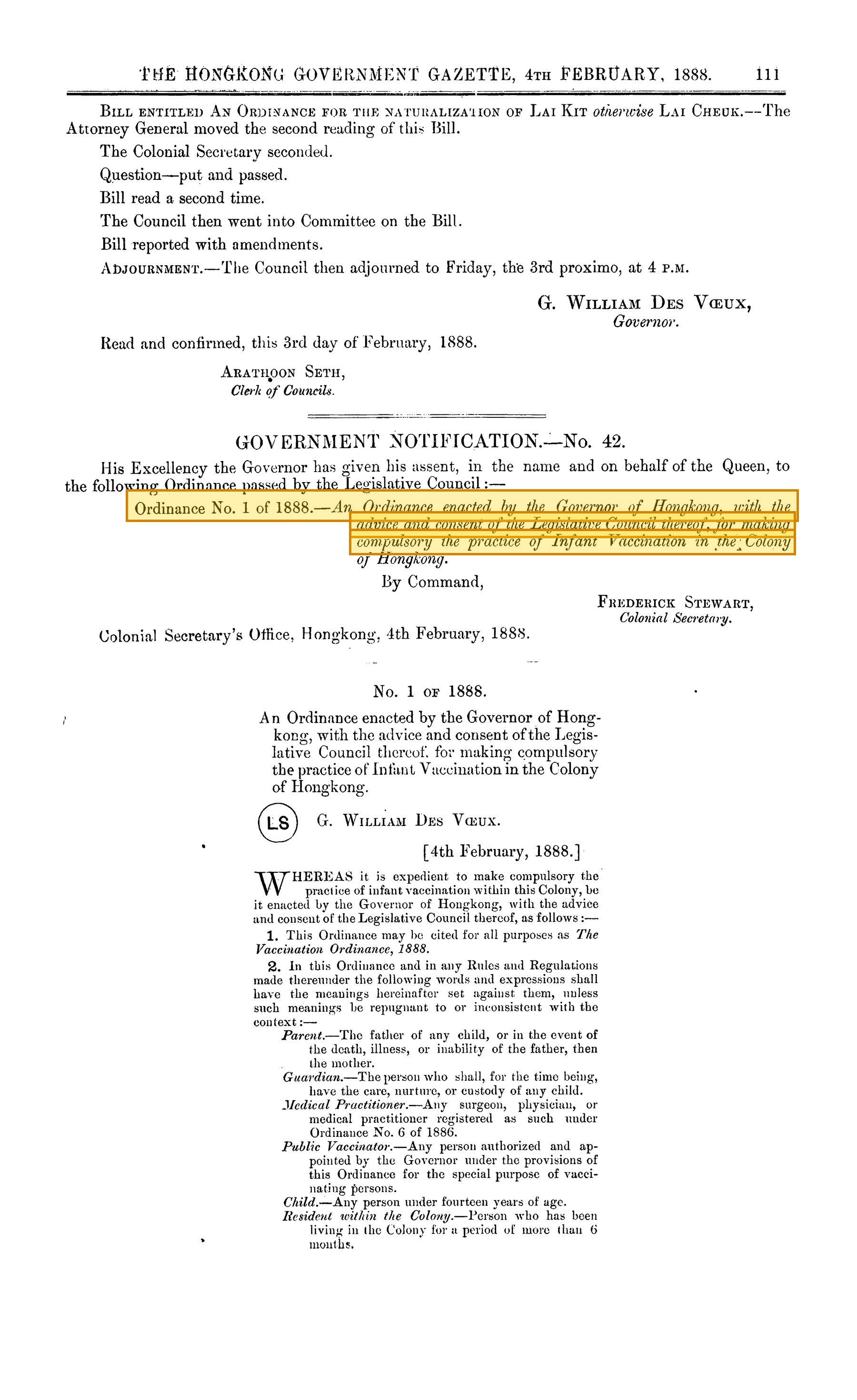
一、題旨與材料
本文要回答兩個問題:1888年的修訂由何而來;以及它是一項真實的憲制里程碑,還是一次例行改動。所用的主要材料有四類:一、兩種措辭在《香港轅門報》(即今政府憲報)各年的出現次數,逐條例核對印本[4];二、歷次制誥與訓令的文本——1843年的《特許狀》[8]、1875年的補充制誥[9]、1877年制誥[10],以及1888年的制誥與訓令[1][11];三、定例局與行政局的議事紀錄,及其在《轅門報》的正式印本[12];四、同期報紙與後來的官方文件[2][13]。查閱的起點,是英國國會圖書館轄下立法機關沿革資料庫所載的時序資料[14];中文名稱方面,本文沿用現代通行譯名並首次出現時附以英文原文[15]。
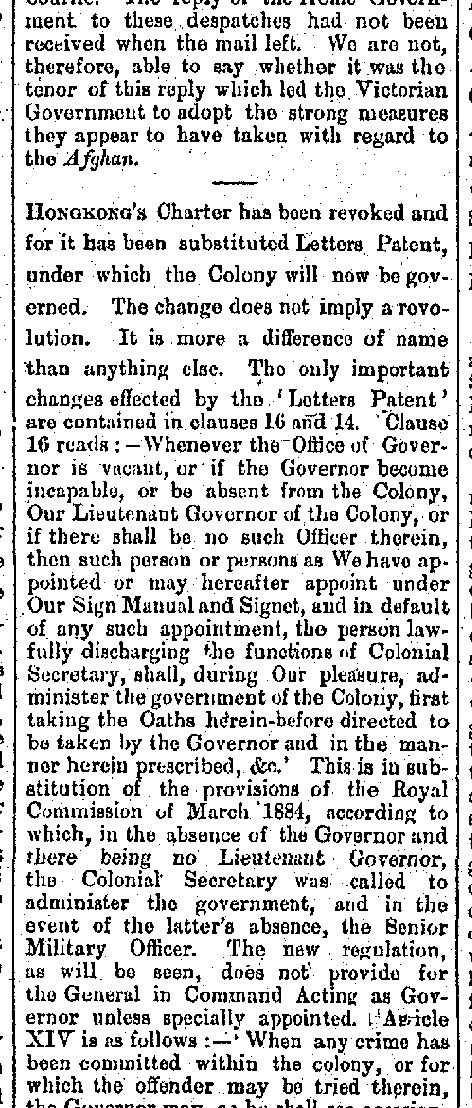
二、1888年以前的制誥鏈
1843年4月5日的《特許狀》設立香港為獨立殖民地,同時設立港督與定例局;其第III條規定,港督得「with the advice of the said Legislative Council」(經該定例局建議)制定法例[8]。此後45年,這句措辭沒有改動。1872年的制誥、1875年6月8日的補充制誥與1877年4月9日的制誥先後補上港督繼任與政府臨時主持的安排:1875年的補充制誥修訂《特許狀》第XI條,並撤銷原有關於政府臨時主持的條文;草案1875年8月曾在《憲報》公布[9];1877年的制誥則把「港督兼總司令」的職位寫成無須每次更替都重新頒發的常設安排[10]。這批舊制誥並非紙上文件——1879年5月與1881年9月的定例局會議,有官員署理港督時,都先宣讀1877年制誥第IV條,再主持宣誓[16]。1887年秋,德輔(Sir G. William Des Vœux)到任;同年11月2日會議的出席名單顯示,正按察司一席由菲臘波(Sir George Phillippo)告假期間的署理人暫代——當時定例局的組成,仍是舊制誥與慣例之下的組合[17]。
三、1888年1月19日的兩份文件
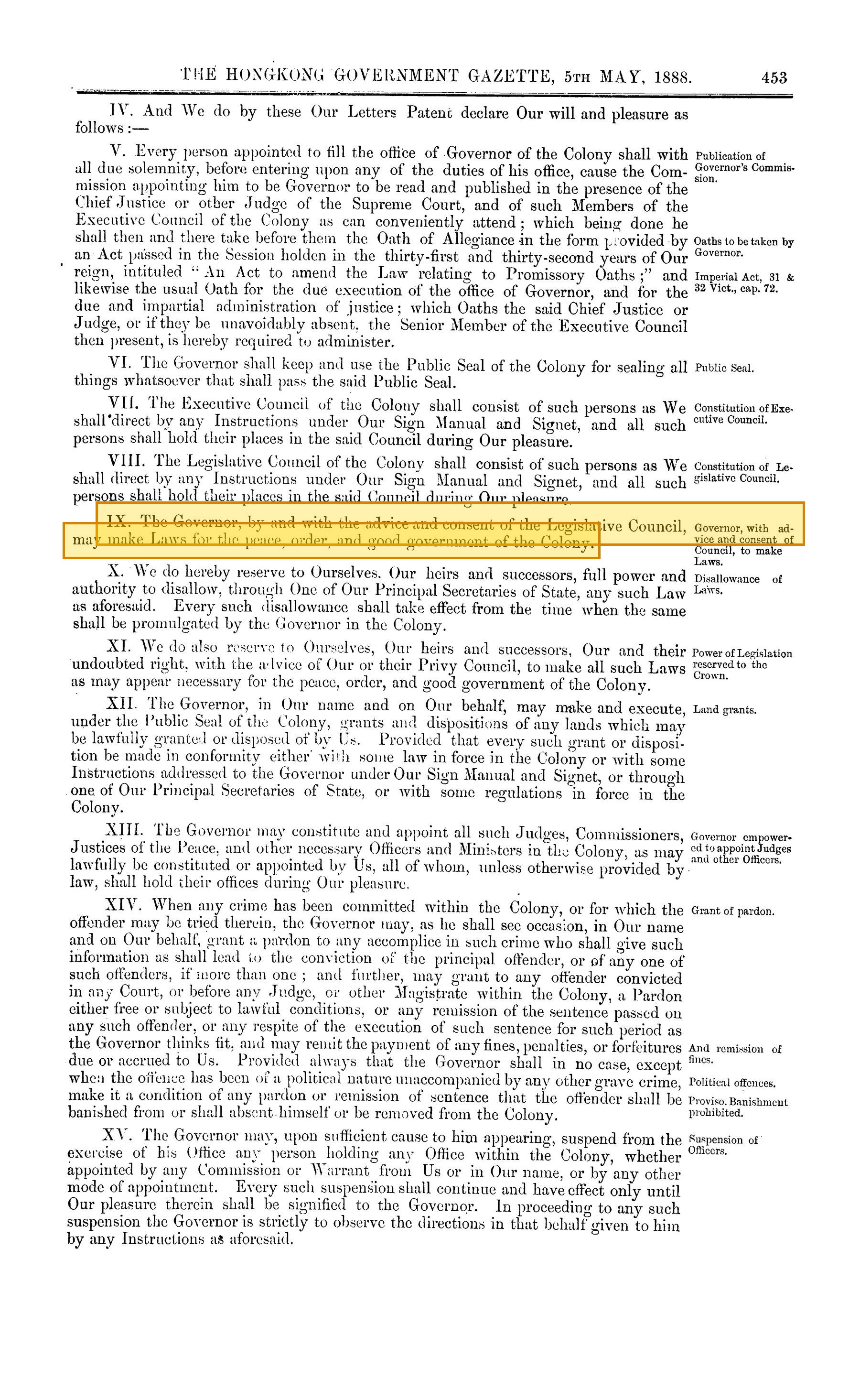
1888年1月19日,兩份文件同時簽署。制誥的末幅記明於西敏寺加印,並註「By Warrant under the Queen’s Sign Manual, MUIR MACKENZIE」[1]。新制誥撤銷1843年的《特許狀》及1877年的制誥——連同1861年2月4日關於九龍的樞密院令,一共三件舊文件[2]——並以一條新條文取代立法權的措辭:「The Governor, by and with the advice and consent of the Legislative Council, may make Laws for the peace, order, and good government of the Colony.」(港督經定例局建議與同意,得為殖民地的和平、秩序與良政制定法例)[1]。同期頒下的《皇室訓令》把原本散落於舊文件與慣例的安排集中重寫(以下所引訓令條號依通行編次):第XIII條列明定例局的組成——港督、副總督(如有)、高級軍官,以及輔政司(Colonial Secretary)、律政司(Attorney General)等當然官守議員,另有不多於3名其他官守議員與不多於6名非官守議員;第XIX條首次寫明「The Legislative Council may from time to time make Standing Rules and Orders for the regulation of their own proceedings」(定例局得隨時為本身程序制定議事規則),但規例不得與制誥或訓令相牴觸;第XXI條則把此後所有條例的制定語固定為「enacted by the Governor of Hongkong, with the advice and consent of the Legislative Council thereof」;第XXII條列出未經特別訓示不得批准的條例類別,其中第10項針對的是「any Ordinance whereby persons not of European birth or descent may be subjected or made liable to any disabilities or restrictions」——即對非歐裔人士施加差別待遇的法例[11]。1896年7月7日的補充訓令,日後也收進同一批文件的印刷本[18]。至此,1888年的兩份文件把一部45年間層層增補的「活章程」,重寫為一份正文加一份施行細則。
四、措辭落地的兩個日期
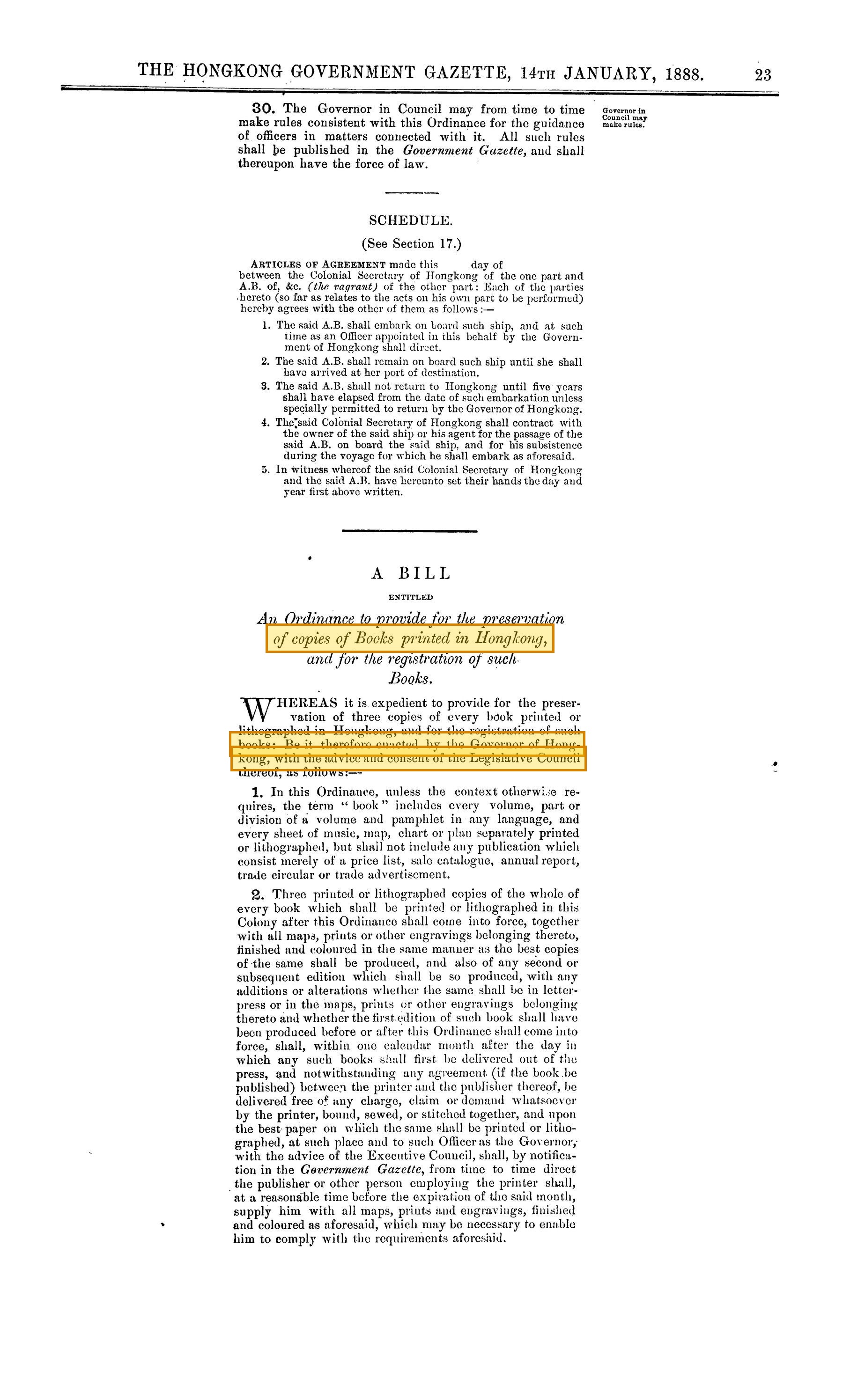
新措辭的首次出現,比制誥本身的刊行還要早。1888年1月13日,定例局復會,一讀12條草案,其中包括《書籍註冊草案》(the Books Registration bill)[12];1月14日的《轅門報》把草案刊出時,該草案的制定語已用上新句「Be it therefore enacted by the Governor of Hongkong, with the advice and consent of the Legislative Council thereof」——而同一期尚在審議的樹木保護、進出口等草案,仍用舊措辭[19]。其後兩個月,新措辭隨着新條例全面鋪開:2月3日定例局通過第1號條例(強制嬰兒種痘),2月4日刊憲,成為第一條以新措辭制定的香港法例[3];2月18日刊憲的第二至第十號條例緊隨其後[20]。而尚未清關的舊草案繼續帶着舊措辭——1888年刊憲的條例中有15處仍印舊式,全部是可追溯至1887年的存稿[4]。1888年5月5日,《轅門報》以公告(Proclamation No. 6)刊出新制誥全文,並在同期刊出第15、16號條例的批准[1]。同月的兩篇報紙社論,把時代的觀感留了下來:5月7日的《德臣西報》(China Mail)寫道「The change does not imply a revolution. It is more a difference of name than anything else」;5月11日同一報紙則坦白「We have not ascertained what led to the revocation of the previous Charter」——「我們查不出廢除舊特許狀的原因」,並記下當時律師的抱怨:新訓令「尚未寄到」,以致「Leases, it seems, cannot be signed」(地契似乎無法簽署)[5][2]。殖民地的報紙並非沒有留意這次修訂——《孖剌西報》(Daily Press)5月7日就把新制誥刊出[21]——但誰也說不出一個「為什麼」。這個空白本身就是本文的結論之一:修訂沒有殖民地內部的推動者,也沒有留下公開解釋[2]。至於為何新措辭會早於制誥刊行就在本地印出——1888年1月14日的草案、2月4日的首條條例,都早於5月5日制誥刊出的日期——兩個事實只能並列:新句式先在本地草擬環節出現,制誥的正式刊行在其後;兩者之間的通訊過程,現存檔案沒有留下。
五、新條款的第一批測試
新措辭上場後的第一場大測試,是保留西人地區的條例(European District Reservation Ordinance,第16號條例)。1888年3月27日,港督向定例局提出議案,為維多利亞城劃出一片保留給歐裔居民的區域;草案的序言已用新制定語[22],3月31日刊憲的草案全文亦然[23]。這條條例在5月5日——即新制誥刊憲的同一天——獲得批准並刊憲[24],7月28日的政府公告確認英廷已予批准[25]。7月31日,《士蔑新聞》(Telegraph)報導該條例「已獲得英廷批准,如今是殖民地的常行法律之一」;11月8日,同一報紙在介紹西區地理時寫明:在薄扶林道、高街與般咸道以上的地段,「no Chinese houses are allowed」(不准建華人房屋)——「a recent local enactment entitled The European District Reservation Ordinance (16 of 1888.) making it illegal to build any but European houses above such levels」(一項近日的本地法例,題為 European District Reservation Ordinance〔16 of 1888〕,禁止在該等水平以上興建任何非歐式房屋)[26]。藍皮書1888年的條例表,也把第16號條例的日期記成與第15號同日的5月5日——兩份官方記錄一致[27]。第二場測試更為直接:1888年11月12日,港督在定例局宣布,隨着正按察司菲臘波退休,「according to recent instructions his successors would not be ex-officio Members of Council」——「根據最近的訓令,其繼任人將不再當然出任議員」[6]。此後定例局的出席名單不再出現正按察司;藍皮書的議員名單同期由「包括署理正按察司」變成「官守議員加非官守議員」的穩定格式[28]。行政局席位的分配也曾引來申請:1887年一封呈交殖民地部的密函,以「By the Letters Patent constituting the Council, the vacancy is open to any head of a department, and not of necessity confined to the Registrar Generalships」(依設立行政局的制誥,出缺可由任何部門首長填補,不必限於某一官職)為理由,為行政局一個出缺議席提出申請[29]。這些日常運作說明:1888年的修訂不是掛在牆上的文件,它立即改變了誰可以坐在議事廳裡,以及條例的開頭如何書寫。
六、議事規則與往後的沿用
1888年之後,新訓令的幾個條文陸續落到實處。1890年3月26日,定例局通過動議,設立特別委員會「for the purpose of framing new Standing Rules and Orders … in pursuance of Article XIX. of the Royal Instructions of the 19th of January, 1888」(依據1888年1月19日《皇室訓令》第XIX條制定新議事規則)[30];4月的會議上,港督更正了兩處引用,明確指出制誥「will be found to have been published in the Government Gazette of the 5th May, 1888」(載於1888年5月5日的政府憲報)[31];6月9日規則通過,6月21日刊憲,規則的開頭寫明「Passed in pursuance of Article XIX of the Royal Instructions of the 19th day of January, 1888」[32]。此後百餘年,香港條例的制定語便按訓令的規定書寫。檔案中的幾處「後續」同樣說明問題:1890年,殖民地部在討論署理港督繼任問題時,引述「On the 19th of January 1888, fresh Letters Patent were issued revoking the Letters Patent of the 9th of April, 1877, but without prejudice to anything lawfully done thereunder」[13];1893年,共濟會慈善基金(Masonic Benevolence Fund)的條例草案在4月5日的刊本上仍印舊制定語,到8月2日批准時,條例標題已用新句、正文卻仍留舊句——轉換是逐層完成的[33]。1917年2月14日簽署的新制誥與訓令,4月20日在憲報刊出,撤銷了1888年這份;條文照樣帶過去——議事規則的授予條款與對非歐裔人士差別待遇的限制條款,都寫進新訓令[34][11]。直到1960年代,論者引用制誥時,引的仍是同一句「The Governor, by and with the advice and consent of the Legislative Council, may make laws for the peace, order, and good government of the Colony」,只是條號已變成第VII條[7];到1986年,補充訓令仍用同樣的制定語句,只加上中文條文的對應寫法[35]。1889年的兩次會議名單則顯示,新組成在一年之內已成為定例局的常態[36]。從1888年2月的第1號條例到英治結束,香港每一條條例的開頭,都寫着那句在1888年1月19日定下的話。
結論
回到最初的問題:1888年的修訂,是真里程碑,還是例行改動?檔案的答覆是分開的兩半。它是一次合併重寫——由倫敦主動、未見殖民地的推動與抗議,改動的即時效果是「名義上多於實質」[5];報紙查不到原因,本文同樣只能把它讀作一次帝國層面的文書整理[2]。但它同時是三件實事的起點:立法措辭自此固定下來,在1917年制誥、乃至1986年的補充訓令中同樣沿用[7][35];定例局的組成寫入訓令,正按察司的當然議席自此終結[6];定例局第一次得到自訂議事規則的權力,並在1890年用上[32]。因此,稱它為「行政改動」亦不準確:它把「建議與同意」四字寫在了往後109年每一條條例的開頭;但稱它為「權力轉移」同樣不準確:條文前後,港督的否決權、官守議員的多數、倫敦的否決與訓示,一件都沒有少。最準確的講法是:一次把既成事實固化的修訂——它把殖民地議會政治的「實」,補上了與之相稱的「名」。
By and with the Advice and Consent
The Hong Kong Letters Patent of 1888 — a revision, and what it changed
November 2026
Abstract
On 19 January 1888 the Crown signed a fresh set of constitutional instruments for Hong Kong: a new Letters Patent, revoking the Charter of 1843 and the Patent of 9 April 1877, and a new body of Royal Instructions, replacing those of 11 October 1886. The new Patent’s law-making clause read, for the first time, “The Governor, by and with the advice and consent of the Legislative Council, may make Laws for the peace, order, and good government of the Colony.” The change has since been read as a milestone in the Council’s constitutional standing. Measured against the record, the revision is better described as a consolidation: it was made in London, it left no local trace of a campaign for it, and the press that printed it judged that “The change does not imply a revolution. It is more a difference of name than anything else.” Yet it was not a nullity either. The enacting words it fixed were used by every Hong Kong ordinance for the next 109 years; the Council’s composition was rewritten into the Instructions, ending the Chief Justice’s ex-officio seat; and the Council received, in express words, the power to make its own Standing Rules. The verdict of this paper: a revision that wrote the name to fit an old practice — real law, no transfer of power.
1. Scope and method
This paper asks two questions. First, what led to the Letters Patent and Royal Instructions of 19 January 1888 and to the “advice and consent” formula they introduced. Second, whether that change was a true constitutional milestone or an administrative revision. The modern institutional timeline that prompts the question is cited as the commissioning source[14]; the paper’s answers are built from the record itself.
The materials are of four kinds. (1) A year-by-year count, in the Hongkong Government Gazette, of the two competing formulas — the old “with the advice of the Legislative Council” and the new “with the advice and consent of the Legislative Council” — checked against the individual prints they came from[4]. (2) The instruments themselves: the Charter of 1843[8], the Supplementary Letters Patent of 1875[9], the Patent of 1877[10], and the Patent and Instructions of 1888, the Instructions’ clauses as printed in the annual directories and the successor prints[11]. (3) The minutes of the Legislative and Executive Councils and their gazetted prints[12]. (4) The contemporary press and the later official files[2][13]. Two passages of the China Mail of 7 and 11 May 1888 are quoted as read on the scans; every quoted passage was read on the page before it was used. The Chinese half of this paper carries the same citations; the modern Chinese names of the instruments (《英皇制誥》, 《皇室訓令》) are used with the English beside them[15].
2. The chain before 1888
The Charter of 5 April 1843 erected Hong Kong a separate Colony, constituted the Governor and a Legislative Council, and empowered the Governor, in its Article III, “with the advice of the said Legislative Council” to make laws[8]. For forty-five years the enacting words of the Colony’s statutes kept that formula: Be it enacted … with the advice of the Legislative Council thereof[37]. The subsidiary instruments accumulated around the Charter rather than replacing it. The Patent of 13 February 1872, the Supplementary Patent of 8 June 1875 — published in the Gazette for general information, amending the Charter’s Article XI on the administration of the Government[9] — and the Patent of 9 April 1877, which made permanent provision for the office of Governor and Commander-in-Chief so that no new Patent was needed on each demise of the office[10]. The 1877 Patent was in daily constitutional use: on 31 May 1879 and again on 12 September 1881, the Council’s minutes record Article IV being read aloud before an Administrator took the oaths[16]. When Governor Des Vœux opened the session on 2 November 1887, the Council’s present list still showed the old shape, with the Chief Justice’s seat filled only by an acting substitute[17].
3. The two instruments of 19 January 1888
Both instruments carry the same date. The Patent was sealed “at Westminster, the nineteenth day of January, in the Fifty-first year of Our Reign. By Warrant under the Queen’s Sign Manual”; The Patent revoked the Charter of 1843 and the Patent of 1877 — and, as the press listed them together, the Order in Council of 4 February 1861 touching Kowloon[2] — and replaced the law-making clause with the new formula: “IX. The Governor, by and with the advice and consent of the Legislative Council, may make Laws for the peace, order, and good government of the Colony.”[1]
The Instructions did the consolidating work. They rewrote, in numbered articles, arrangements that had lain scattered across instruments and practice: Article XIII fixed the Council’s composition — the Governor, the Lieutenant Governor (if any), the Senior Military Officer, the Colonial Secretary, the Attorney General, the Treasurer, not more than three other officials, and not more than six unofficial members; Article XIX gave the Council, in express words, the power to make Standing Rules and Orders for its own proceedings, so long as they were not repugnant to the Patent or Instructions; Article XXI fixed the enacting words of every future ordinance — “the enacting words shall be, ‘enacted by the Governor of Hongkong, with the advice and consent of the Legislative Council thereof’”; and Article XXII listed the classes of ordinance requiring special instructions, including, at clause 10, any ordinance “whereby persons not of European birth or descent may be subjected or made liable to any disabilities or restrictions to which persons of European birth or descent are not also subjected or made liable”[11]. The Instructions were later supplemented by the Additional Instructions of 7 July 1896, printed with them in the annual directories[18]. In one sitting of the pen, a constitution that had grown by accretion for forty-five years became a principal instrument with a schedule of instructions.
4. The wording on the ground
The new formula reached the Colony’s print before the instruments reached the Governor. On 14 January 1888 the Gazette published the bills of the session just opened — and the Books Registration bill already carried the new words, “Be it therefore enacted by the Governor of Hongkong, with the advice and consent of the Legislative Council thereof”, while contemporaneous bills in the same issue, on the preservation of trees and on imports and exports, still carried the old[19][12]. The first statute to be enacted in the new form was the Infant Vaccination Ordinance, No. 1 of 1888, passed on 3 February and assented on 4 February[3]; the following fortnight’s batch, Ordinances Nos. 2 to 10, repeated it[20]. The Patent itself was proclaimed and published only on 5 May 1888[1]. The year’s books measure the change exactly: of the two phrases in the Gazette, the old form runs 52 instances in 1887 and the new form none; in 1888 the new form runs 53 against 15 surviving old-form prints, every one of them traceable to drafts carried over from 1887; by 1890 the old form is gone entirely[4][37].
The instruments were proclaimed and published in full on 5 May 1888, under the new Patent’s own Article XX[1], and the colony’s press read them the same week. The China Mail of 7 May was plain about the scale of the change: “Hongkong’s Charter has been revoked … The change does not imply a revolution. It is more a difference of name than anything else. The only important changes affected by the Letters Patent are contained in clauses 16 and 14.”[5] The claim in the second sentence is striking from the paper that printed the instruments — and the fourth sentence is exact: clause 16 of the Patent was the succession clause, which the Colonial Office would recite in 1890[13]. Four days later the same paper admitted the absence of a cause: “We have not ascertained what led to the revocation of the previous Charter, or whether its revocation necessarily nullifies the previous Instructions to the Governor” — alongside the lawyers’ complaint that the new Instructions had not yet arrived, so that “Leases, it seems, cannot be signed”[2]. The Daily Press of 7 May carried the Patent’s text for its readers[21]. No petition, no deputation, no local despatch asking for the change appears anywhere in the record; the only surviving explanation is the instruments themselves.
5. The first tests
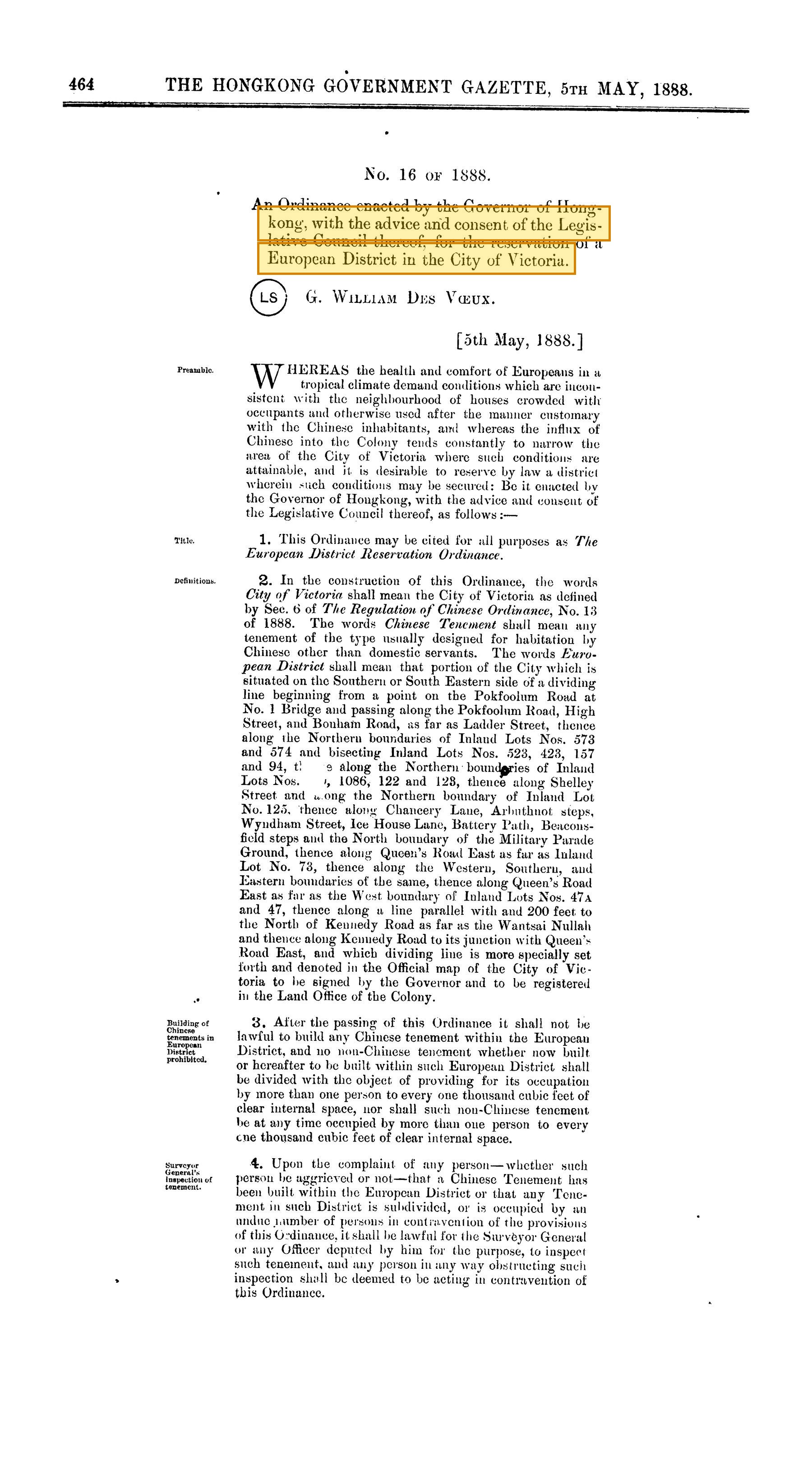
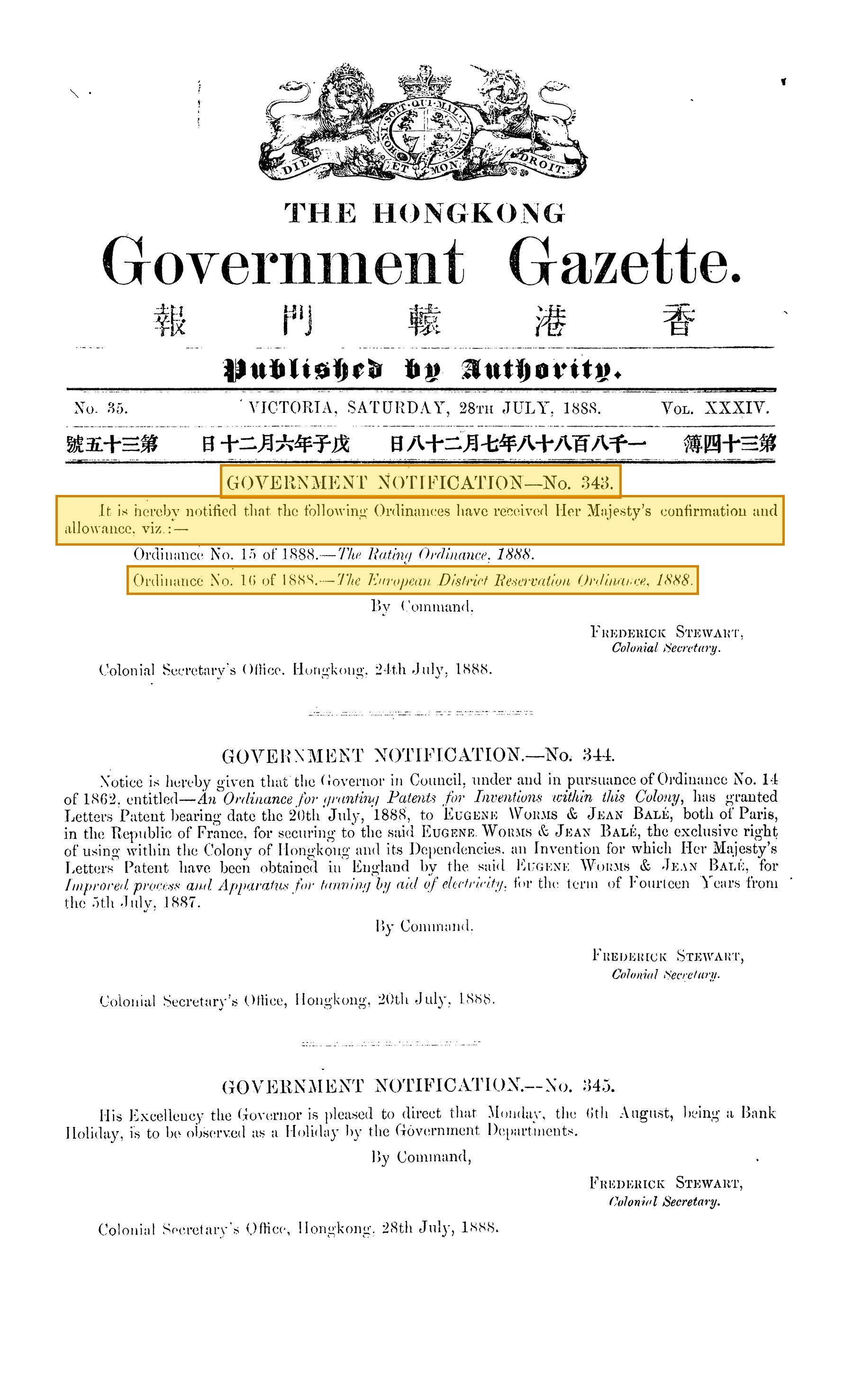
The first legislation to work the new clause was the ordinance that ordered Victoria’s geography: the European District Reservation Ordinance, No. 16 of 1888. On 27 March 1888 the Governor’s message introduced the bill, and the copy laid before the Council already ended its preamble with the new formula — “Be it enacted by the Governor of Hongkong, with the advice and consent of the Legislative Council thereof”[22]; the bill as gazetted on 31 March repeated it[23]. The ordinance was assented on 5 May 1888, in the same issue that carried the Patent itself[24], and the Queen’s confirmation and allowance followed on 28 July[25]. The press recorded both the legal and the human geography. On 31 July the Telegraph noted that the ordinance “has obtained Her Majesty’s sanction and is now one of the standing laws of the colony”; on 8 November it described the district itself: “On that portion of the Western district situated … above the level of the Pokfulam Road, High Street and Bonham Road no Chinese houses are allowed, a recent local enactment entitled The European District Reservation Ordinance (16 of 1888.) making it illegal to build any but European houses above such levels.”[26] The Blue Book’s own table of ordinances dates No. 16 to the same 5 May as No. 15 — the colony’s two printed records agree[27].
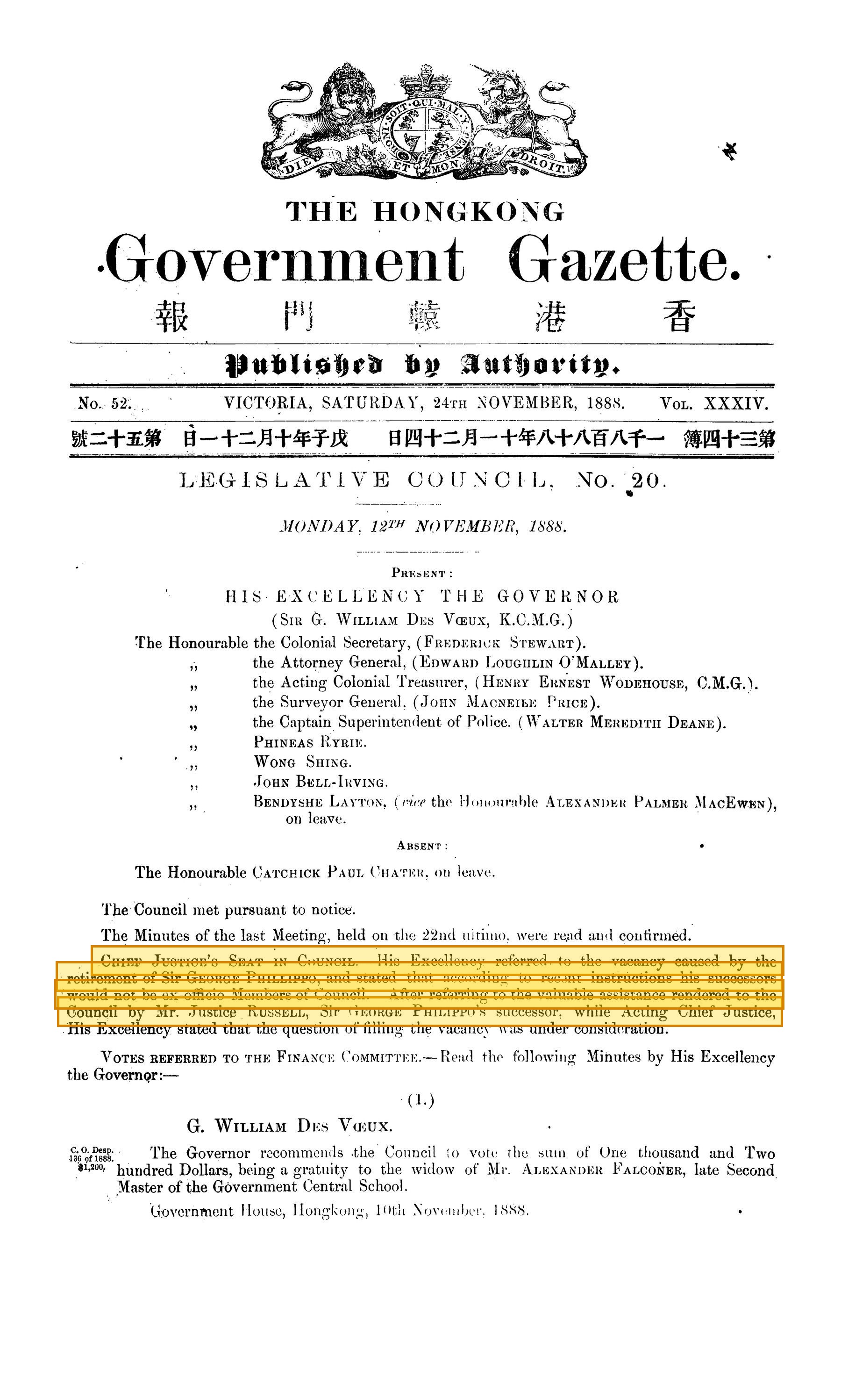
The second test was in the Council’s own membership. On 12 November 1888 the Governor told the Council that the vacancy left by Sir George Phillippo’s retirement would not be filled as before: “according to recent instructions his successors would not be ex-officio Members of Council.”[6] The bench had sat in the Council under the old instruments; the new Instructions dropped it, and the Council’s returns followed: the Blue Book’s return of members for 1887 still lists an acting Chief Justice among the members, the 1888 return lists none[28]. By the session of 2 January 1889 the present lists ran Governor, officials and unofficial members in the fixed shape the Instructions had given[36]. The distribution of seats even produced a test of a different kind: an application of 1887 for a vacant Executive Council seat argued from the instrument itself, that “by the Letters Patent constituting the Council, the vacancy is open to any head of a department, and not of necessity confined to the Registrar Generalships”[29] — the Letters Patent, in other words, were being read as a working text in the everyday business of office.
6. Standing Rules and afterlives
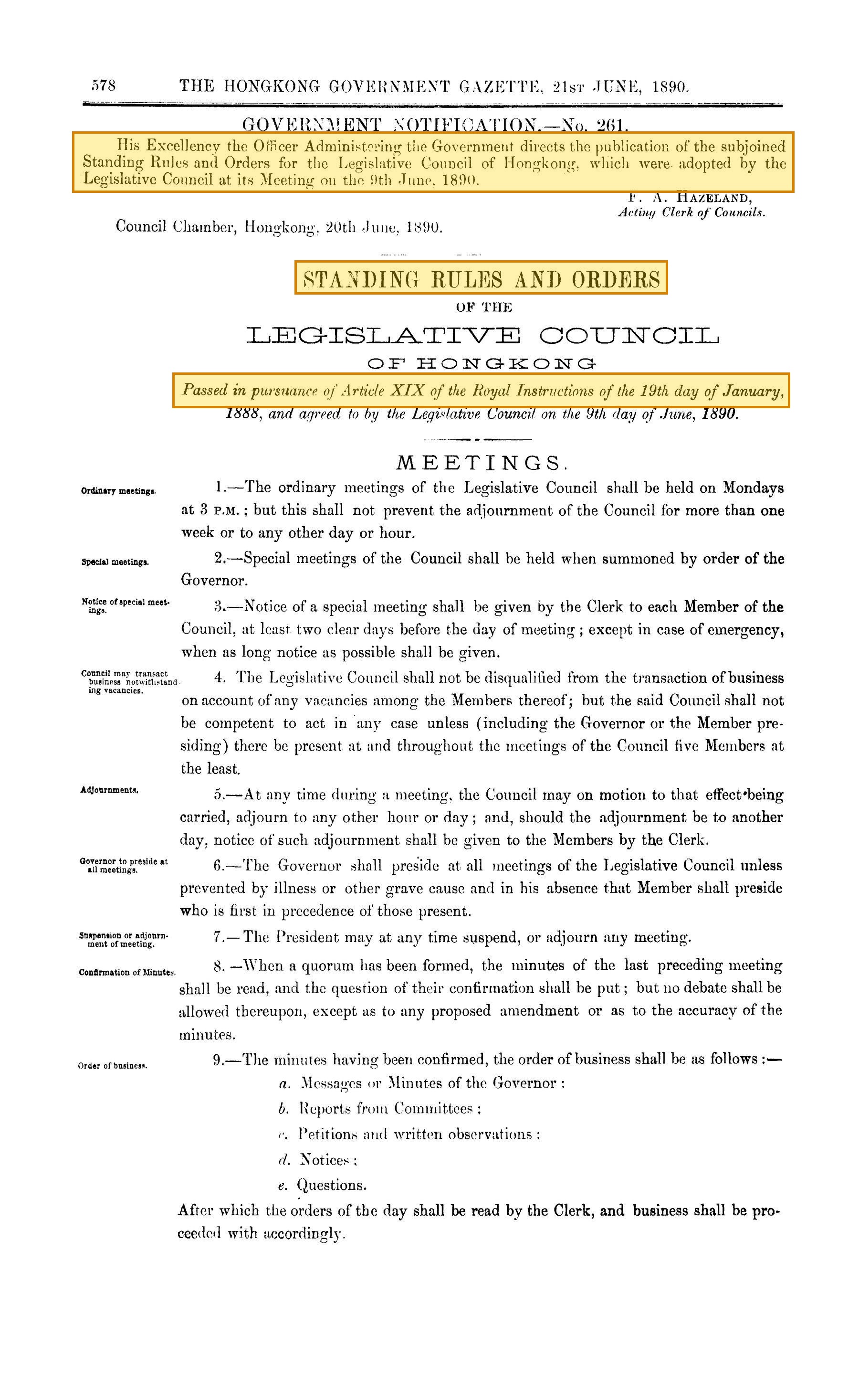
The Instructions’ standing-rules clause took two years to be used. On 26 March 1890 the Council resolved to appoint a special committee “for the purpose of framing new Standing Rules and Orders for the regulation of the Council’s Proceedings in pursuance of Article XIX. of the Royal Instructions of the 19th of January, 1888”; in April the Governor corrected the record on the Patent’s date of publication, fixing it at 5 May 1888; the rules were adopted on 9 June and gazetted on 21 June 1890, their preamble naming the same article of the same Instructions[30][31][32]. From 1888 to the end of British rule, the Council’s procedure was its own to make — within the limits the Instructions set.
The instruments remained the operative constitution of the Colony for the rest of the century. In 1890 the Colonial Office’s opinion on the Barker succession recited them exactly: “On the 19th of January 1888, fresh Letters Patent were issued revoking the Letters Patent of the 9th of April, 1877, but without prejudice to anything lawfully done thereunder and not expressly revoking the Commission of the 7th of March, 1884.”[13] The transition in the Colony’s own drafting was less tidy than the Instruments: as late as 1893, the Masonic Benevolence Fund bill went to the printer with the old formula in its enacting words, and the ordinance as assented on 2 August carried the new formula in its title and the old in its body — the words were changed in law before they were changed in habit[33]. The next settlement came with the Letters Patent and Royal Instructions dated 14 February 1917 (proclaimed on 20 April), which revoked the Patent of 19 January 1888[34] — but the law-making words, the standing-rules clause and the reserved classes were carried across, not dropped[11]. By the 1960s the clause could be cited as “Section VII of the Letters Patent”: the numbering had moved, the sentence had not — “The Governor, by and with the advice and consent of the Legislative Council, may make laws for the peace, order, and good government of the Colony”[7] — and the 1986 Additional Instructions, amending the enacting-words article to allow laws in Chinese, kept the same English words with the corresponding Chinese beside them[35].
7. A revision, not a revolution
The record supports a verdict in two parts. As to what the revision was, the evidence is consistent: an act of the Imperial government, made in London on 19 January 1888, consolidating a mass of instruments and practice into a Patent and a body of Instructions; unaccompanied in the Colony by any agitation, petition or public explanation; greeted by the press that printed it as a change in name. The one thing the record cannot supply is the file that explains the motive — and the press’s own admission that it could not find one is part of the evidence, not a gap in it.
As to what it changed, the record is equally clear, and it is not nothing. First, the enacting formula: “by and with the advice and consent” ceased to be an alternative description of the Council’s role and became the required words of every statute — printed on every ordinance from the Vaccination Ordinance of February 1888 to the end of British rule, a span of 109 years[3][35]. Second, the composition of the Council: written into the Instructions, it ended the Chief Justice’s ex-officio seat and fixed the official/unofficial shape that the Blue Books record from 1888 onward[6][28]. Third, the Council’s standing rules: a power now in express words, used in 1890 and never surrendered in the century that followed[32]. What it did not do is equally definite: no power of veto appears in any instance; the official majority and the Secretary of State’s disallowance were untouched; and the Governor’s authority was in no clause reduced. The most accurate single sentence remains the one written by the paper that did not know why it had happened: a difference of name — but of a name that was thereafter written at the head of the Colony’s laws for more than a century[5].
Appendix A — The enacting formula, year by year
Phrase counts over the Gazette, per year, of the two formulas; each anomalous count was read individually and classified, never averaged:
| Year | “with the advice of the Legislative Council” | “with the advice and consent of the Legislative Council” |
|---|---|---|
| 1882 | 75 | 3 (statute/proviso prints; not Hong Kong enacting words) |
| 1883 | 53 | 0 |
| 1884 | 63 | 0 |
| 1885 | 49 | 0 |
| 1886 | 78 | 0 |
| 1887 | 52 | 0 |
| 1888 | 15 (carry-over drafts only) | 53 |
| 1889 | 2 | 50 |
| 1890 | 0 | 82 |
| 1891 | 0 | 79 |
| 1892 | 0 | 48 |
| 1893 | 3 (the Masonic drafting slip) | 38 |
Sources: the Gazette series, year-filtered phrase queries, 13 November 2026; sample prints for the new form, https://hkintexts.histsyn.com/image-page/1535349; for the old form, https://hkintexts.histsyn.com/image-page/1535701.
Appendix B — The instrument chain, 1843–1964
| Instrument | Date | Effect |
|---|---|---|
| Letters Patent (the Charter) | 5 April 1843 | Erects the Colony; the Governor to make laws “with the advice” of the Council |
| Order in Council (Kowloon) | 4 February 1861 | Annexes the Kowloon district; revoked with the rest in 1888 |
| Letters Patent (consular pardons) | 13 October 1863 | Pardon power over the consular courts in China |
| Letters Patent | 13 February 1872 | Revoked by the Patent of 1877 |
| Supplementary Letters Patent | 8 June 1875 | Amends the Charter’s Article XI (administration of the Government) |
| Letters Patent | 9 April 1877 | Permanent provision for the office of Governor and Commander-in-Chief; revoked by the Patent of 1888 |
| Royal Instructions | 11 October 1886 | Revoked by the Instructions of 19 January 1888 |
| Letters Patent and Royal Instructions | 19 January 1888 | “Advice and consent”; the Council’s composition; Standing Rules; the enacting words |
| Additional Instructions | 7 July 1896 | Additions to the Instructions of 1888 |
| Letters Patent and Royal Instructions | 14 February 1917 (proclaimed 20 April) | Revoke the Patent of 1888; the law-making words, standing-rules clause and reserved classes carried across |
| Additional Instructions | 1986 | Laws may be enacted in Chinese; the English enacting words retained |
Sources: the instrument texts and their reprints cited in the notes to this paper; the dates are the instruments’ own.
Notes
Letters Patent of 19 January 1888, proclaimed and published in the Hongkong Government Gazette, 5 May 1888 (Proclamation No. 6): “IX. The Governor, by and with the advice and consent of the Legislative Council, may make Laws for the peace, order, and good government of the Colony.” Proclamation No. 6: https://hkintexts.histsyn.com/image-page/1535622 ; the leaf carrying Article IX: https://hkintexts.histsyn.com/image-page/1535623 ; the attestation (“Witness Ourself at Westminster … By Warrant under the Queen’s Sign Manual, MUIR MACKENZIE”): https://hkintexts.histsyn.com/image-page/1535624 (accessed 13 November 2026). ↩
“The Charter of 5th April 1843, the Order in Council of 4th February 1861 (referring to Kowloong), and the Letters Patent of 9th April 1877, have all been revoked by the Letters Patent of the 19th January of this year (1888), published and proclaimed under date the 5th of May instant, in the Government Gazette of that day … We have not ascertained what led to the revocation of the previous Charter, or whether its revocation necessarily nullifies the previous Instructions to the Governor.” China Mail, 11 May 1888, p. 2 (the same leader reports the lawyers’ complaint that the new Instructions had not yet arrived: “Leases, it seems, cannot be signed”). https://hkintexts.histsyn.com/image-page/1202007 (accessed 13 November 2026). ↩
General Notification No. 42 and “Ordinance No. 1 of 1888 — An Ordinance enacted by the Governor of Hongkong, with the advice and consent of the Legislative Council thereof, for making compulsory the practice of Infant Vaccination”, Gazette, 4 February 1888, printed folio 111; the bill passed its stages on 3 February with the standing orders suspended (https://hkintexts.histsyn.com/image-page/1535315). https://hkintexts.histsyn.com/image-page/1535297 (accessed 13 November 2026). ↩
The year matrix behind this paper: phrase totals over the Gazette per year — “with the advice of the Legislative Council” 52 (1887) / 15 (1888) / 2 (1889) / 0 (1890); “with the advice and consent” 0 (1887) / 53 (1888) / 50 (1889) / 82 (1890). Sample prints: new form https://hkintexts.histsyn.com/image-page/1535349 ; old form https://hkintexts.histsyn.com/image-page/1535701 (accessed 13 November 2026). ↩
“Hongkong’s Charter has been revoked and for it has been substituted Letters Patent under which the Colony will now be governed. The change does not imply a revolution. It is more a difference of name than anything else. The only important changes affected by the Letters Patent are contained in clauses 16 and 14.” China Mail, 7 May 1888, p. 2. https://hkintexts.histsyn.com/image-page/1201991 (accessed 13 November 2026). ↩
Legislative Council minutes, 12 November 1888 (No. 20): “CHIEF JUSTICE’S SEAT IN COUNCIL.—His Excellency referred to the vacancy caused by the retirement of Sir George Phillippo, and stated that according to recent instructions his successors would not be ex-officio Members of Council.” The gazette print: https://hkintexts.histsyn.com/image-page/1536177 (accessed 13 November 2026). ↩
G. B. Endacott, Government and People in Hong Kong 1841–1962 (1964), chapter on constitutional developments: “According to Section VII of the Letters Patent ‘The Governor, by and with the advice and consent of the Legislative Council, may make laws for the peace, order, and good government of the Colony’.” — the clause in its later numbering, the words unchanged. https://hkintexts.histsyn.com/image-page/2864146 (accessed 13 November 2026). ↩
Letters Patent, 5 April 1843 (“Charter of the Colony of Hong Kong”), §§ II–IV, as reprinted in The Directory & Chronicle for China, Japan, &c., 1882, p. 928. https://hkintexts.histsyn.com/image-page/902905 (accessed 13 November 2026). ↩
“Draft of Letters Patent passed under the Great Seal of the United Kingdom to Amend the Charter of the Colony of Hong Kong, dated 5th April, 1843”, Hongkong Government Gazette, 21 August 1875. https://hkintexts.histsyn.com/image-page/1456047 (accessed 13 November 2026). ↩
“The Charter of the Colony of Hong Kong” (the Letters Patent of 9 April 1877, with its recitals of the Patents of 13 February 1872 and 8 June 1875), Directory & Chronicle, 1885, pp. 859–862. https://hkintexts.histsyn.com/image-page/904843 (accessed 13 November 2026). ↩
Royal Instructions of 19 January 1888, given at Osborne House: Article XIII (the Council’s composition), XIX (Standing Rules and Orders), XXI (“the enacting words shall be, ‘enacted by the Governor of Hongkong, with the advice and consent of the Legislative Council thereof’”) and XXII (the classes of ordinances not to be assented to without special instructions, including any imposing disabilities on persons “not of European birth or descent”). The clauses as printed with the annual directories and in the successor Instructions: the enacting-words article, Directory & Chronicle 1895, p. 329 (https://hkintexts.histsyn.com/image-page/1015446); the Standing Rules adopted under it, same volume p. 326 (https://hkintexts.histsyn.com/image-page/1015443); the reserved classes as carried into the Instructions of 1917, Gazette, 20 April 1917 (https://hkintexts.histsyn.com/image-page/1496305) (accessed 13 November 2026). ↩
Legislative Council minutes, 13 January 1888 (No. 4): twelve bills read a first time. https://hkintexts.histsyn.com/image-page/1535263 (accessed 13 November 2026). ↩
CO 129/245, p. 560 (the Colonial Office’s opinion on the Barker succession, 1890): “4. On the 19th of January 1888, fresh Letters Patent were issued revoking the Letters Patent of the 9th of April, 1877, but without prejudice to anything lawfully done thereunder and not expressly revoking the Commission of the 7th of March, 1884. Article 16 of these Letters Patent provides that when the office of Governor is vacant, or if the Governor becomes incapable or is absent from the Colony, the Lieutenant Governor, or if there be no such officer, then such person or persons…” Text: https://hkintexts.histsyn.com/page/342177 ; scan: https://hkintexts.histsyn.com/image-page/3731385 (accessed 13 November 2026). ↩
Legislative Council of Hong Kong, historical timeline (the modern institutional account consulted for the commissioning question). https://www.legco.gov.hk/tc/education/understand/timeline.html (accessed 13 November 2026). ↩
Zh-Wikipedia, 英皇制誥 (Letters Patent) and 皇室訓令 (Royal Instructions) — the modern Chinese name forms, adopted with the English beside them. https://zh.wikipedia.org/wiki/英皇制誥 · https://zh.wikipedia.org/wiki/皇室訓令 (accessed 13 November 2026). ↩
The Letters Patent of 9 April 1877 in daily constitutional use, as printed in the Gazette: 31 May 1879 — “There is read by direction of His Excellency, Article IV of the Letters Patent dated the 9th April, 1877 … constituting the Office of Governor and Commander-in-Chief of the Colony of Hongkong, and its Dependencies”, before the Chief Justice administered the oaths of office to the Administrator (https://hkintexts.histsyn.com/image-page/1477758); 12 September 1881 — the same reading before the oaths of office were administered to the Honourable M. S. Tonnochy (https://hkintexts.histsyn.com/image-page/1515242) (accessed 13 November 2026). ↩
Legislative Council minutes, 2 November 1887 (No. 1), the session’s opening meeting under Governor Des Vœux — the present list includes “His Honour the Acting Chief Justice (JAMES RUSSELL), vice His Honour SIR GEORGE PHILLIPPO, Knt., on leave”. https://hkintexts.histsyn.com/image-page/1532991 (accessed 13 November 2026). ↩
Additional Instructions of 7 July 1896, printed with the constitution in the annual directories: “Additional Instructions to our Governor and Commander-in-Chief… Given at Our Court at St. James’s this Seventh day of July, 1896, in the Sixtieth year of Our Reign.” Directory & Chronicle 1904, p. 420. https://hkintexts.histsyn.com/image-page/1027677 (accessed 13 November 2026). ↩
“A Bill entitled An Ordinance to provide for the preservation of copies of Books printed in Hongkong”, Gazette, 14 January 1888, printed folio 23: “Be it therefore enacted by the Governor of Hongkong, with the advice and consent of the Legislative Council thereof, as follows” — the earliest located print of the new form. https://hkintexts.histsyn.com/image-page/1535213 (accessed 13 November 2026). ↩
Ordinances Nos. 2–10 of 1888, assented and gazetted 18 February 1888 — the first full series printed with the new formula. https://hkintexts.histsyn.com/image-page/1535348 (accessed 13 November 2026). ↩
Daily Press, 7 May 1888, p. 2: the colony’s press carried the Letters Patent of 19 January 1888 in full under its heading, with the notice of the Charter’s revocation. https://hkintexts.histsyn.com/page/2203179 (accessed 13 November 2026). ↩
Legislative Council minutes, 27 March 1888 (No. 11), the Governor’s message introducing the European District reservation bill, its printed preamble ending “Be it enacted by the Governor of Hongkong, with the advice and consent of the Legislative Council thereof.” https://hkintexts.histsyn.com/image-page/1535519 (accessed 13 November 2026). ↩
“A Bill entitled An Ordinance for the reservation of a European District in the City of Victoria”, Gazette, 31 March 1888, printed folio 319. https://hkintexts.histsyn.com/image-page/1535498 (accessed 13 November 2026). ↩
“No. 16 of 1888 — An Ordinance enacted by the Governor of Hongkong, with the advice and consent of the Legislative Council thereof, for the reservation of a European District in the City of Victoria”, Gazette, 5 May 1888, printed folio 464 (sections 2–4 define the district and prohibit the building of Chinese tenements within it). https://hkintexts.histsyn.com/image-page/1535634 (accessed 13 November 2026). ↩
Government Notification No. 343: “the following Ordinances have received Her Majesty’s confirmation and allowance … Ordinance No. 16 of 1888 — The European District Reservation Ordinance, 1888”, Gazette, 28 July 1888. https://hkintexts.histsyn.com/image-page/1535961 (accessed 13 November 2026). ↩
Hongkong Telegraph, 31 July 1888: the European District Reservation Ordinance “has obtained Her Majesty’s sanction and is now one of the standing laws of the colony” (https://hkintexts.histsyn.com/page/2826778); and 8 November 1888, describing the district: “On that portion of the Western district situated … above the level of the Pokfulam Road, High Street and Bonham Road no Chinese houses are allowed, a recent local enactment entitled The European District Reservation Ordinance (16 of 1888.) making it illegal to build any but European houses above such levels.” (https://hkintexts.histsyn.com/page/2827111) (accessed 13 November 2026). ↩
“Legislation”, Blue Book 1888: the table dates No. 15 of 1888 to “5th May” and dittoes the date for No. 16 (the European District Reservation Ordinance) — the same date the gazette records; “9th June” belongs to No. 17 (the Coroner’s ordinance). https://hkintexts.histsyn.com/image-page/2188187 (accessed 13 November 2026). ↩
“Return of Members composing the Legislative Council”, Blue Book 1887 (p. 62), 1888 (p. 70) and 1889 (p. 65): the 1887 return lists the Acting Chief Justice and the Harbour Master among the members; the 1888 return lists neither, and the returns thereafter run Governor, officials and 5–6 unofficial members. https://hkintexts.histsyn.com/image-page/2187933 · https://hkintexts.histsyn.com/image-page/2188194 · https://hkintexts.histsyn.com/image-page/2188454 (accessed 13 November 2026). ↩
CO 129/236, p. 131 (1887): a confidential application for the vacant seat on the Executive Council — “By the Letters Patent constituting the Council, the vacancy is open to any head of a department, and not of necessity confined to the Registrar Generalships.” https://hkintexts.histsyn.com/page/336046 (accessed 13 November 2026). ↩
Legislative Council minutes, 26 March 1890: “That a Special Committee of this Council be appointed for the purpose of framing new Standing Rules and Orders for the regulation of the Council’s Proceedings in pursuance of Article XIX. of the Royal Instructions of the 19th of January, 1888.” https://hkintexts.histsyn.com/image-page/1537642 (accessed 13 November 2026). ↩
Legislative Council minutes, 9 April 1890: “…referred to the Letters Patent and Royal Instructions of the 19th January, 1888, and stated that a copy of the Clause of the Royal Instructions enabling the Council to make Standing Rules and Orders would be sent to each member of the Select Committee…” (https://hkintexts.histsyn.com/image-page/1537662); 16 April 1890: the correction that the Letters Patent “will be found to have been published in the Government Gazette of the 5th May, 1888” (https://hkintexts.histsyn.com/image-page/1537683) (accessed 13 November 2026). ↩
“Standing Rules and Orders for the Legislative Council of Hongkong”, adopted 9 June 1890 and published by the Governor’s direction (Government Notification No. 261): “Passed in pursuance of Article XIX of the Royal Instructions of the 19th day of January, 1888, and agreed to by the Legislative Council on the 9th day of June, 1890.” Gazette, 21 June 1890, printed folio 578. https://hkintexts.histsyn.com/image-page/1537898 ; reprinted in Directory & Chronicle 1891, p. 342 (https://hkintexts.histsyn.com/image-page/911551) (accessed 13 November 2026). ↩
The 1893 drafting slip: the Masonic Benevolence Fund bill, first reading 5 April 1893, printed with the old form — “BE it enacted by the Governor of Hongkong, with the advice of the Legislative Council thereof, as follows” (https://hkintexts.histsyn.com/image-page/1541125) — while the assented Ordinance No. 11 of 1893 (2 August 1893) prints the new formula in its title and the old in its body: “An Ordinance enacted by the Governor of Hongkong, with the advice and consent of the Legislative Council thereof … E it enacted by the Governor of Hongkong, with the advice of the Legislative Council thereof.” https://hkintexts.histsyn.com/image-page/1541591 (accessed 13 November 2026). ↩
Letters Patent and Royal Instructions dated 14 February 1917, proclaimed in the Gazette of 20 April 1917: “And whereas We are minded to make other provision in lieu of the above recited Letters Patent of the Nineteenth day of January 1888: Now, know ye that We do by these presents revoke the above recited Letters Patent…” (https://hkintexts.histsyn.com/image-page/1496297); the Instructions of even date keep the standing-rules clause (extracts printed in the Gazette of 27 December 1929: https://hkintexts.histsyn.com/image-page/1469054) and the reserved classes, including the European-birth clause (https://hkintexts.histsyn.com/image-page/1496305) (accessed 13 November 2026). ↩
The Hong Kong Additional Instructions 1986, amending the Instructions to allow laws in Chinese: “All laws enacted in English shall be styled ‘Ordinances’ and the enacting words shall be ‘enacted by the Governor of Hong Kong, with the advice and consent of the Legislative Council thereof’; and the corresponding words in Chinese shall be used in laws enacted in Chinese” — the 1888 words still in use at the amendment. TNA FCO 40 file “Hong Kong Letters Patent amendments”: https://hkintexts.histsyn.com/image-page/3843449 · https://hkintexts.histsyn.com/image-page/3843471 (accessed 13 November 2026). ↩
Legislative Council minutes, 2 January 1889 (No. 1) and 18 June 1889 (No. 17): the present lists run Governor, the official members (Colonial Secretary, Attorney General, Treasurer, Surveyor General, Captain Superintendent of Police) and the unofficial members — the composition the Instructions of 19 January 1888 fixed; no Chief Justice appears. https://hkintexts.histsyn.com/image-page/1536367 · https://hkintexts.histsyn.com/image-page/1536874 (accessed 13 November 2026). ↩
The pre-1888 enacting form in the Colony’s prints: “Be it enacted by the Governor of Hongkong, with the advice of the Legislative Council thereof” — e.g. Gazette, 1887 (https://hkintexts.histsyn.com/image-page/1531783); and one carry-over print assented in 1888, No. 24 of 1887 (the Public Health Ordinance), Gazette, 2 June 1888, printed p. 532: “An Ordinance enacted by the Governor of Hongkong, with the advice of the Legislative Council thereof…” https://hkintexts.histsyn.com/image-page/1535701 (accessed 13 November 2026). ↩