A Colony at War with Its Own People — Hong Kong and the Second Opium War, 1856–1860
香港在戰爭中的 1856–60 年:廣州開火之後,殖民地改了什麼?
本節以中文敘述 1856–60 年香港的檔案記錄。引文為英文原件者以中文譯出,英文原文見文末同一編號的註釋;中文地名、人名與機構名稱均經語料庫與網絡兩重核對,無法核對者一律保留原件的羅馬拼音。
摘要
第二次鴉片戰爭的戰場在廣州,香港從未成為戰場。但香港的檔案顯示,這場戰爭真正改變的,是香港對自己華人居民的治理方式。1856 年 11 月 21 日,港督寶寧(John Bowring)在廣州開戰後的第 5 個星期,以中文發出公告12,指街上「煽動及叛亂的示威」是廣東省「秘密使者」策動的結果,並宣布即時執行 1846 年第 7 號《華人註冊條例》——所有未註冊的華人須於 11 月 29 日離開殖民地。1857 年 1 月 6 日,殖民地通過《為更好保障本殖民地治安條例》(第 2 號,1857 年)3:華人夜間外出須持夜行牌,無牌者初犯可罰款、判苦役,甚至鞭笞或示眾。1857 年 5 月 5 日,《華人註冊及人口統計條例》(第 6 號,1857 年)4規定全港房屋編號、華人須領「籤」,並由新設立的「華人 protector」(撫華道,即 Registrar General)隨時進入任何樓宇、船隻或艇隻搜尋華人。1858 年 7 月 31 日,戰爭結束後,寶寧再發公告5:廣州、香山與新會的官署曾發「恐嚇性公告」逼迫在港華人離境,政府保護他們,但凡阻礙「運往香港各市場」的物資安全運輸者,「即以此舉宣布自己為大英國之敵人,亦為中國皇帝之不法臣民」。本文所問的是:這場戰爭在香港內部做了什麼,又與誰為敵。
本文以香港政府憲報、殖民地檔案(CO 129)的 32 卷總督與輔政司文件、定例局(今立法局)會議記錄及 1856–61 年《華友西報》(Friend of China)的整卷拉檔為基礎,重建 1856–60 年香港自身的戰爭記錄。核心史料是 1857 年 4 月 14 日寶寧致英國外交大臣的機密第 181 號 Despatch 及其附件——華人秘書 George F. Wade 就英軍從一艘中國官船上搜獲的中文信件所作的備忘錄67;信件屬於廣東新會「抗敵委員會」主席 Chan-kwei-tsih 之弟 Chan-tsze-tin89,內容包括封鎖香港糧食供應的部署。論文同時記錄 7 次反證嘗試,並保留 3 項未決的版本差異。
一、題旨與方法
題目表定稿的簡述是「香港在 1856–60 年的戰爭:廣州砲擊、義勇軍與圍城焦慮」,預設戰爭以軍事形態到達香港。檔案所見並非如此。戰爭在廣州開打,在香港留下的卻是一連串關於華人的法律、公告與查驗:夜行牌與宵禁、房屋編號與註冊、華人 protector 的搜查權、針對「叛亂文件」的懸賞,最後是一份把切斷香港糧食市場的行為定為「叛國」的公告。1856–61 年的香港憲報中,戰爭時期的立法工具10幾乎全部以華人為對象;唯一以船隻為對象的是海軍戰的戰利品法例(第 5 號,1857 年),而它在 1861 年 6 月 29 日即被廢除11。
方法上,先做 1856–61 年語料庫的分層清點(CO 129 共 32 卷、憲報 2,799 頁、Executive Council(今行政會議)會議記錄 1,626 頁、藍皮書 991 頁、定例局 106 次會議、《華友西報》1,129 頁),再做詞組普查,最後整卷拉檔。強制性的整卷拉檔為 CO 129/065(470 頁,11,251 行),內含寶寧機密第 181 號 Despatch 及 Wade 的備忘錄6。所有引用的條目 id 均已重新拉取並逐頁閱讀;所有量化數字均以印本頁面或憲報正文為準,藍皮書的欄位交錯表格不作數字來源1210。詞組普查與反證檢驗的結果見研究筆記 §3。
二、戰爭如何抵達香港:1856 年 10 月至 12 月
1856 年 8 月 22 日,《華友西報》刊登一封署名 Captain Jameson、J. B. Endicott、R. Walker 與 Dr Drinker 的信件13。該年卷的掃描文字殘缺,標題只剩「Hostilities … AGAINST A LARGE … OF THE CHINESE」數段可辨,其餘為推補,本研究不把推補的整句當作引文;但 4 位在港軍官在廣州開戰之前聯名致書公開報紙,本身就是一件可查的事。10 月,廣州外港的 lorcha「Arrow」號被中國軍士攔截14,英籍船員登船帶走 12 名中國人,是為導火線。香港政府於 11 月 28 日出版《憲報》特刊,由港督本人把「在廣州所採取行動(proceedings)的真正性質」公佈於眾,並附上 Parkes 給廣州紳商的公告中譯。
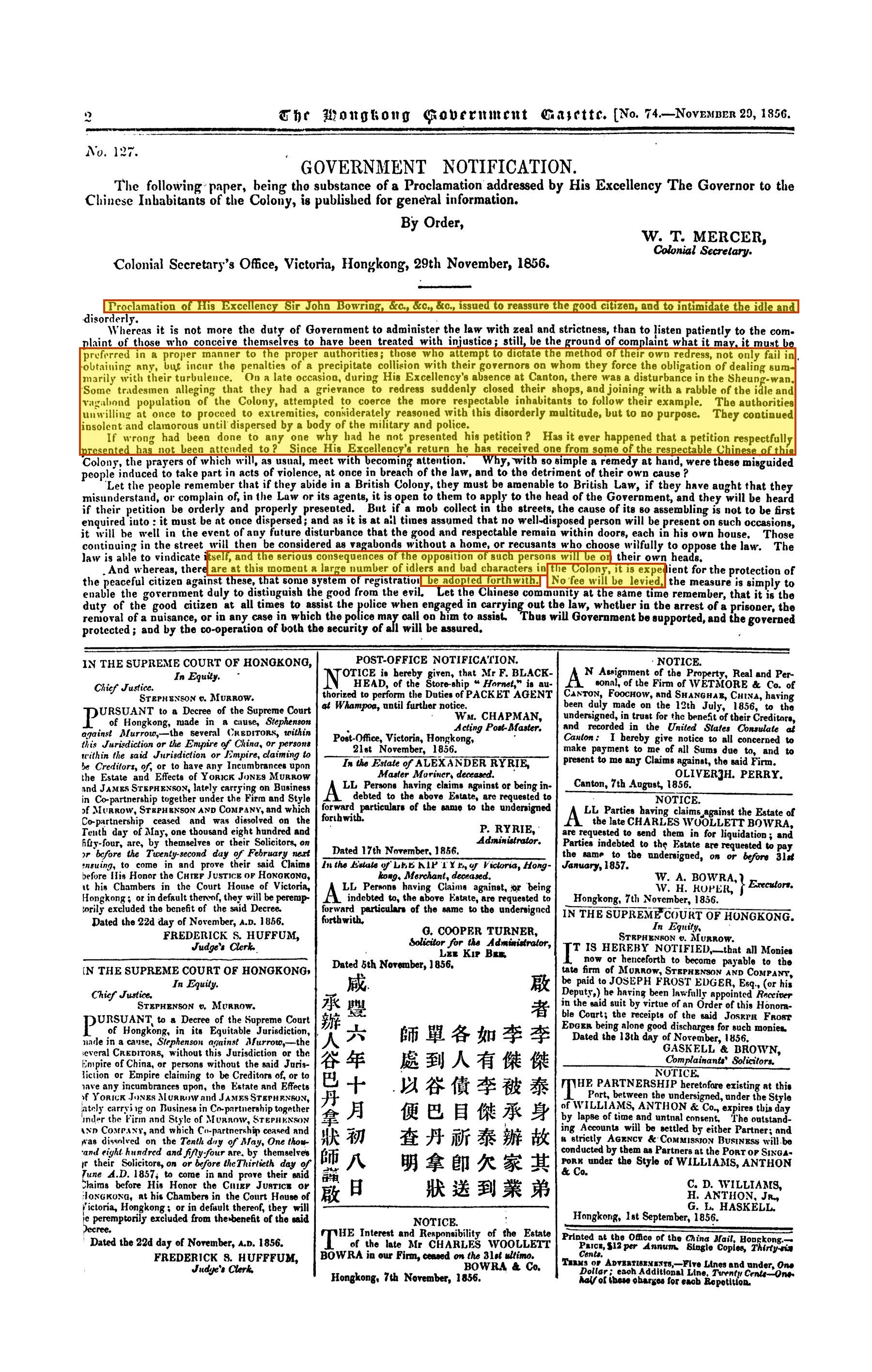
戰爭的第一個香港後果,不在軍械而在人口。11 月 21 日下午,寶寧以中文發出公告:政府相信近日「大量自華地來港的不法之徒」與「近日在本城街道上的煽動及叛亂示威」,是「在鄰近廣東省對我軍進行不法戰爭者的秘密使者」直接策動;政府將「即時採取措施,實行 1846 年第 7 號《註冊條例》的條文」,一旦該條例全面施行,「所有未註冊的華人須離開殖民地」。同日,英軍第 59 團奉 Admiral 要求調往廣州「保護洋行」15。11 月 29 日,寶寧再發公告,其英文標題為「issued to reassure the good citizen, and to intimidate the idle and disorderly」16,追述上環一帶的騷動:一些商人以有冤要申為由突然關閉舖面,並與「閒散及遊蕩之徒」(idle and vagabond)聚集企圖脅迫其他較有體面的居民,「直至由一支軍隊與警察驅散為止」。公告隨即宣布:「既然本殖民地現時有不少閒散與不良分子,為保護良民起見,實有立即採用某種註冊制度之必要……不收任何費用,此舉純為使政府得以分辨善惡。」
12 月 4 日,政府把這項任命公佈:撫華道(Registrar General)兼「在港華人 protector」Caldwell 先生,辦公處在警察署旁的 Gough Street17。同一份憲報答覆華人商號「Le-Tae 等數十家」的呈詞17,其中第二項正是戰爭的第一次侵入本港(incursion):就「叛黨在香港港口擄取船隻」一事,政府答覆「此乃最嚴重性質的暴行」,並指示船主向警察署或向 Caldwell 舉報,「罪犯將立即被捕,按海盜或匪徒治罪」。
三、1857年1月:夜行牌、宵禁與登記
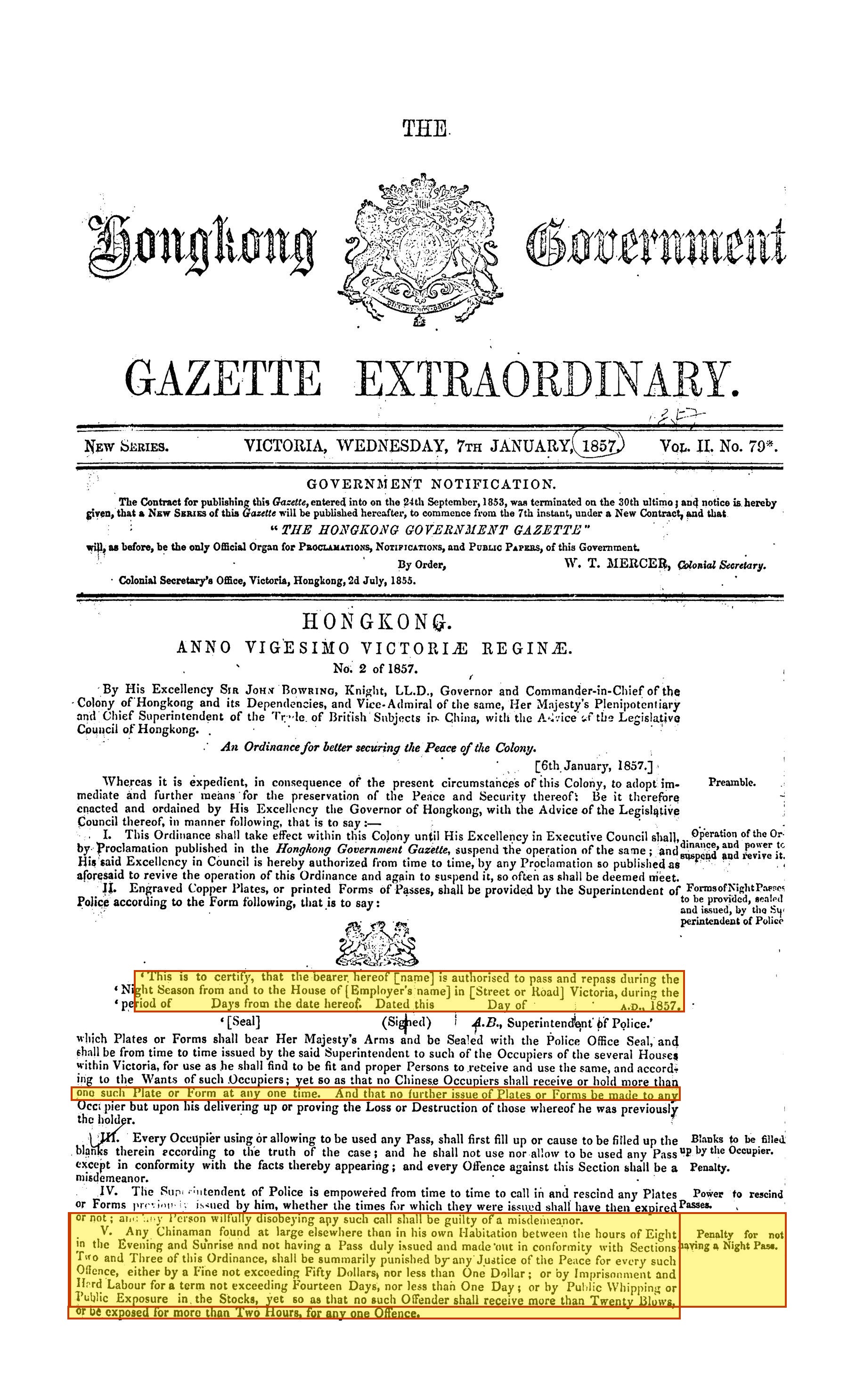
1857 年 1 月 6 日,殖民地通過《為更好保障本殖民地治安條例》(第 2 號,1857 年),翌日刊於《憲報》特刊第 79* 號3。條例序言寫明理由:「鑑於本殖民地目前的形勢,實有立即並進一步採取措施,以保全本殖民地之治安與安寧之必要。」條例規定巡警道(Superintendent of Police)向維多利亞城區各屋業主發給銅印夜行牌,蓋英皇紋章並加警察署印;每名華人業主同時只可持有不多於一張。第 5 條訂明刑罰:「任何華人,如於晚上 8 時至翌日日出之間,在其住所以外隨意遊蕩而無持有妥為簽發之夜行牌者,可由任何治安法官即時懲罰,每一干犯可罰款不超過 50 元而不少於 1 元,或判苦役不超過 14 日而不少於 1 日,或公開鞭笞,或公開示眾。」港督並可在 Executive Council 決議後以公告暫停或恢復全條例。兩星期後,白金漢宮否決了其中若干條文——這是後文的事。
1 月 10 日的《第 10 號通知》則把日常生活的規則寫成法規18:每戶須備一大桶水與兩隻水桶;鄰近空屋者每晚須查看門窗是否關好;遇火警或任何公共警報,「每一華人居民均須留在自己住所之內,守護該處,以防盜賊或縱火者之侵襲」,「任何身處街上之人,尤其若持有武器者,將有被開槍擊中之極大危險」;船主晚上 8 時後不得駛離泊位,「因為船隻與岸之間的通道受炮火控制」,駛出的船主將「置身於火線之上而趕速滅亡」;並請「本城有體面的居民」向 Caldwell 舉報「無固定職業」或「有意擾亂本殖民地貿易或公共治安」者的住所。通知末註:「上述通知已譯成中文,副本張貼於公共地方,供在港華人知悉。」1 月 22 日,政府再以 100 元懸賞19,緝拿身上帶有「鄰近中國省份當局所發之叛亂文件」的人。
3 月 5 日,定例局首讀兩條草案20:《為本殖民地華人註冊及規管、為人口統計及其他警察用途條例》與《若干情況下之救助及戰利品條例》。港督在提交預算時說,本殖民地「出乎意料地被置於的非常形勢」,「必需最後增加開支」。
四、新會委員會:糧食封鎖
本研究的中心文件,是 1857 年 4 月 14 日寶寧致外交大臣 Clarendon 伯爵的機密第 181 號 Despatch6。英軍 Commodore Elliott 率隊於 4 月 11 日攻下一艘中國官船,船上搜得一批中文文件。寶寧在信中寫:「這些文件似乎把兩廣總督、官吏與廣州各會串連起來,與威脅並繼續威脅本殖民地的駭人聽聞的縱火、擄人與暗殺勾當有關。」他要求把 Despatch 及附件轉交殖民地部,並說:「Wade 先生正在擬備上述文件的內容撮要,惟篇幅過鉅,本次郵輪無法寄出。」
華人秘書 George F. Wade 的備忘錄說明文件來源7:那是「Chan-tsze-tin」的通信,此人是 Chan-kwei-tsih 的弟弟,而 Chan-kwei-tsih 是「居於香港所在海岸之新會區抗敵委員會的主席或首腦」;Chan-kwei-tsih「曾為財政司屬員,現有舉人功名」,Chan-tsze-tin 則是 Han Lin College 出身、出身廣州最重要士紳之一 Su-ting-kwei 的門生,「顯然是這兩兄弟與廣東總督 Yeh 的通信管道,Yeh 按其意欲命他們於去年年底返回本鄉,以組織當地人口對付我方」。Wade 隨即點出核心任命:「Chan-tsze-tin 特別受命負責切斷我方供應」——他的「pickets」(哨隊)沿九龍與新會城之間的通道佈防,「作為封鎖的指揮者,他的成就並不十分出色」,他的「勇丁」至少 3 次與沿海居民發生衝突,衝突之嚴重,「已令區內官軍疲於應付」;Wade 特別指出:「其中兩次,拒絕服從的居民威脅勇丁,要把他們交給英國政府。」
Wade 的備忘錄同時把政府的指控寫全7:文件「無可置疑地證明,新會委員會在某些情況下受命、在某些情況下聽命於廣州中央委員會,涉及我們所聽聞或所獲悉企圖犯下的大抵每一宗暴行」;預期中的大艇襲擊「屬香山與順德兩區的兵力」,「大投毒案」有兩處提及,但新會方面並未直接參與,而被告 Cheung-alam「是香山人」;「Duddell 先生的店舖(store)被焚」與「Queen」號汽船被擄「令委員會大為滿意」;還有擄走外國人之事,以及「不止一次把頭顱送往廣州」與暗殺酬金數目的爭議。
英方於 4 月 25 日在《憲報》上公佈一份關於這批文件的備忘錄21,而信件的原文與英譯則保存在 CO 129/065 之中89。信件顯示,這是一場以華人對華人的供應戰:新會一方的「勇丁」在九龍紅磡(Hung-ham)的關卡攔截往維多利亞的蔬菜小艇,「任其掠去船上全部的蔬菜與其他貨物」,並捉住兩人、取去一艘英人船艇與兩名「row therein 的奸人」(在英人船艇中划槳的奸人);有人策劃(plot)在 3 日內炸毀一艘英軍船艦,並傳言「蠻人正散播消息,說他們要來攻打新會」;英方自己的夜間狀況則由對方記下——「晚上 6 時以後無人准許外出……由太平山至西環一帶都有蠻兵把守」,「Wing-tai、Wo-shang 與 Mau-tai 三家大米行已停止營業數日」;信件並記錄「九龍(香港)百姓反對停止供應,現在開始給政府造成嚴重麻煩」,以及那道命令:「停止供應一事仍須嚴格執行,因為這是『使叛亂的蠻人受管束』的一個辦法。」委員會另以每個「鬼頭」30 元懸賞(Yeh 最初許諾 100 元),並向英方索取火藥與槍彈(引文作「三四十斤火藥與二十斤 bullets」)。
五、條例如何執行,以及1858年海峽對岸的戒嚴
《治安條例》在 1857 年上半年即已投入使用。Executive Council 把被捕華人分為若干級別22,除第三級外「均應立即離開殖民地,不得在每次個案另行給予准許的情況下回返」;「華人 protector」向 Executive Council 提交保證書。另一宗在「Ering shop and Battery」被捕的華人案23,Executive Council 決議其中 12 名未被起訴者「若能取得不獲回返的保證,可准離開本殖民地」,並要求律政司就是否有「取得他們證供的任何可能,以證明拘留他們合理」提供意見。最終命令是:這 19 人24「如在香港被發現,除執行刑罰外,將被拘捕並遞解至總督所指定之地」。
值得注意的是,5 月 18 日港督企圖暫停自己剛剛通過的條例25。他援引 1843 年 4 月 6 日《御令手冊》第 23 條——該條賦予港督「在定例局反對票的情況下通過條例」的權力——並說他「在未能獲得國庫撥款以支付殖民地因該條例若干條文所承受的開支之前,對令殖民地承擔此等費用感到相當困難」,遂提出動議暫停第 6 號(1857 年)條例第 7 條(保留編號一段)、第 8 至第 12 條。議會以 1 票對 8 票否決:Lyall 認為「執行該條例可能涉及的 700 至 1,000 元額外開支,不應對我們產生任何一瞬間的影響」;正按察司(Chief Justice)則說:「本殖民地向來主要為帝國目的而存在……註冊條例在兩星期前才經本殖民地最熟識華人性格的人士一致通過,而其目的現正正是帝國所切實重要之事,無論開支幾何,亦不應成為廢除一項如此近期制定之措施的理由」,並指出所需經費「每年僅 700 元」。7 月 15 日,白金漢宮指示暫停《治安條例》全部條文26;港督宣讀會議規則以便同日完成手續,議會以 5 票對 2 票通過修訂案,正按察司以「國務大臣的指示是暫停整條條例,未賦權重訂未被反對的條文」為由不投票,律政司則提交異議書。
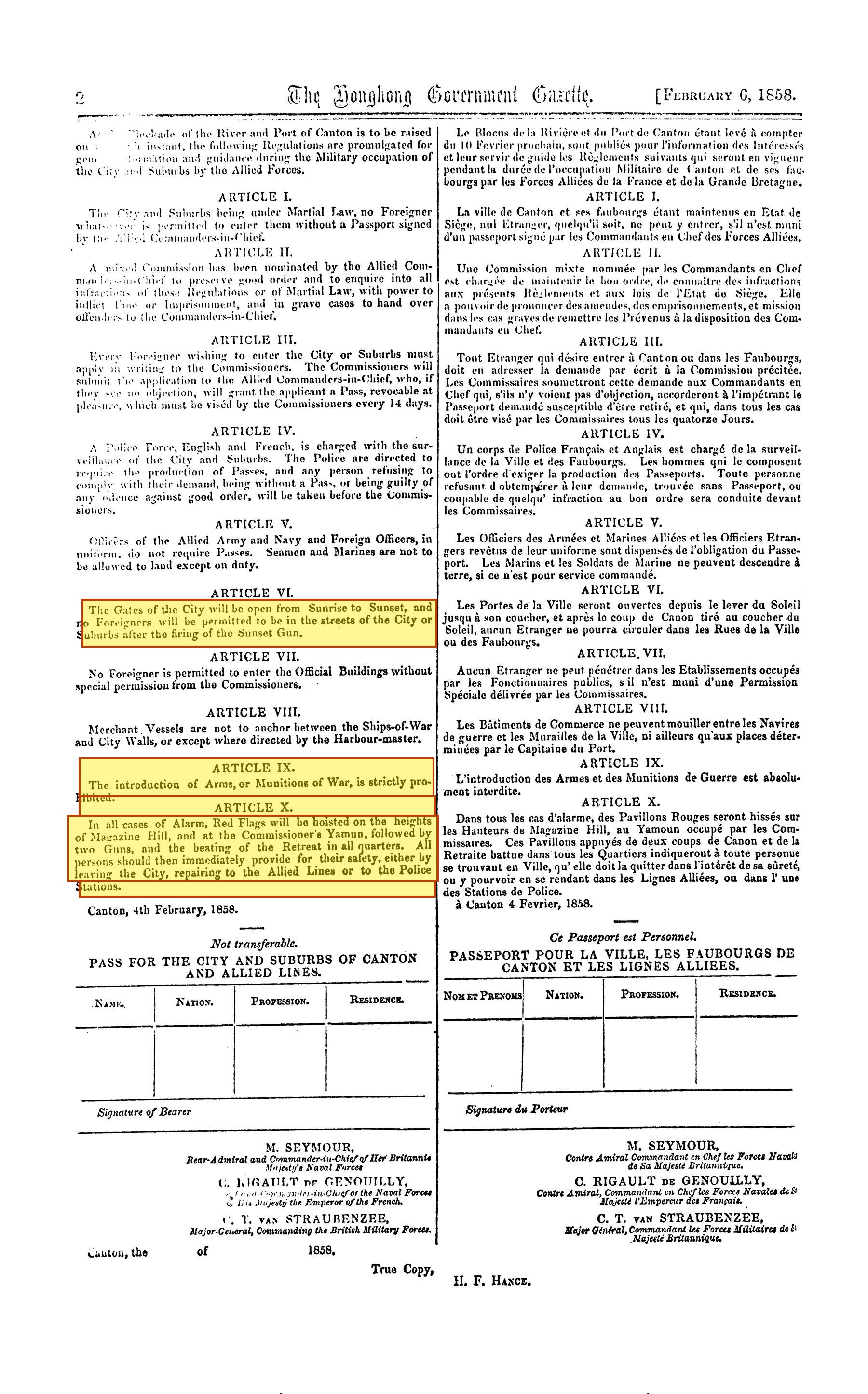
香港政府在 1858 年 1 月至 2 月把對岸的戰時狀態逐條刊印於《憲報》特刊:1 月 28 日刊出英法聯軍司令的公告27,宣布 1857 年 8 月 3 日及 12 月 10 日設立的廣州港及珠江封鎖將於 2 月 10 日解除,而「廣州城及其郊區在聯軍佔領期間將繼續處於戒嚴狀態」;2 月 6 日刊出管理廣州軍事佔領的 10 條規例28,外國人須持兩位聯軍司令簽署的通行證,混合委員會有罰款及監禁權,英法警察隊巡邏,城門由日出開放至日落、日落炮後外人不得在街上逗留,「武器與軍火的輸入一律嚴禁」,並定下警報信號——「一切警報情形,紅旗將懸於 Magazine Hill 高處及委員會官署所在之 Yamen,並以兩響炮及全城擊退鼓為號」;2 月 8 日刊出 Elgin 與 Kincardine、Bon Gros 的通知29,宣布廣州「既為英法聯軍攻陷,該城及郊區現由聯軍軍事佔領並處於戒嚴狀態」。8 月 11 日,英軍攻下 Namtow 的炮台30。駐華英軍司令 Van Straubenzee 在給港督的報告中寫明事情的起由:7 月 31 日《憲報》刊出的和平公告,派了以停戰旗護送的人員到各村散發,清軍卻向這支旗使團開火;8 月 10 日聯軍出海,8 月 11 日上午登岸,午後 2 時左右攻下炮台。戰報寫道:「城牆奪下,敵人潰逃,炮台幾乎不復可守……遂將之毀滅,並炸開主要城門。」
六、和平之後:1858年7月31日的公告,與戰爭留下的法例
1858 年 6 月 26 日《天津條約》簽訂(7 月 3 日由英方公告,1860 年 10 月 24 日於北京換約)31。戰爭結束後的第 8 日,寶寧在《憲報》第 167 號發出公告5。公告先述和平:「大英女王陛下與中國皇帝之間已愉快地建立和平……條約於 7 月 3 日在天津由雙方特派全權大臣簽署。」隨即是本殖民地華人的處境:「本殖民地定居了大量華人。他們並未參與任何戰事,而是和平地從事營生並服從法律;其中許多人受僱於英國臣民,與之訂有契約,因而有權獲得英國當局的保護與友誼。」但公告隨即指向對岸:「然而,儘管有條約的義務,儘管皇帝陛下旨意的存在,仍有恐嚇性的公告與命令發出,強迫本殖民地和平居民離棄住所、違反其責任、疏忽其職務,逃往中國大陸;這些恐嚿主要來自香山與新會兩區。」並以「信賞」相脅:「這些敵對行為的來源地方及人士將自招嚴厲懲罰。」
公告的最後一段,是本研究的問題的核心:「此外,曾有人企圖切斷本殖民地的糧食供應——茲特此公告:凡阻礙或企圖阻礙運往香港各市場之物資的安全與正常運輸者,即以此舉宣布自己為大英國之敵人,亦為中國皇帝之不法臣民,並將依法嚴加懲處。」換言之:香港的華人居民是條約的受益者,而把他們的糧食供應者變成英國的敵人,是香港政府的處境。
戰爭在法例上留下的痕跡是可數的。1858 年 4 月 19 日,寶寧將第 6 號(1858 年)條例送交倫敦32,其目的為「填補《治安條例》(第 9 號,1857 年)的一項缺陷,該條例將時限嚴格訂為晚上 8 時,其後華人不得外出」;同年 5 月 10 日,定例局一項動議以 5 票對 5 票通過33,港督投的是贊成票。1858 年 8 月與 12 月,海軍的戰事轉成反盜匪34:Seymour 海軍少將報告,經撫華道 Caldwell 通報,伶仃附近有 23 艘盜船巡弋,「Surprise」號一日之內捕獲或毀滅 26 艘,7 艘帆船解交海事法庭(Marshal);12 月 10 日,12 艘盜艇在澳門附近封鎖往香港的帆船35,Seymour 稱「Fury」號在 Leckie 指揮下「完全成功」地捕獲並毀滅該 12 艘船隻,並特別指出 Caldwell「隨同遠征」所提供的「高度協助」,Leckie 的戰報則記下焚燒一艘盜艇、釋放 5 名被擄者、另一艘裝米的船獲釋、船上 24 名船員獲安置,以及一對被擄夫妻獲釋。1858 年,撫華道本身受審:律政司(Attorney General)致國務大臣的信列出 19 項指控3637,包括「Mrs Caldwell」——「一名來自妓寨的中國女子」——所帶入本殖民地「最惡劣的華人」、投機於妓寨與妓寨牌照,以及因「Ma-chow Wong」(Wong A-kee)——一位「長期以來為政府線人」的華人——「毫無憑據的情報」而拘捕及釋放人犯;委員會的結論則寫道3839:「就第 11 項指控,Mr Caldwell 與 Ma-chow Wong 合夥經營一艘 lorcha 一節已有證明,且 Mr Caldwell 實亦承認。」
最後,戰爭的法律殘留被清走:1861 年 6 月 29 日,第 4 號(1861 年)條例廢除第 5 號(1857 年)條例11,即《若干情況下之救助及戰利品條例》——自通過至廢止共 4 年 1 個月。同年 4 月 20 日,政府另告知殖民地義勇軍可依「與英國義勇軍同樣的條件」參加女王獎章射擊比賽40。
七、結論
1856–60 年的香港不是一個戰場,而是一個前線。戰爭在廣州開火,在香港則以 4 種形態出現:把華人登記為可疑人口的法律;以夜里外出為罪的宵禁;以搜查華人住所、船艇為權的 protector 職位;以及一紙把切斷本城糧食市場宣布為通敵的公告。這些工具不是香港自己發明的——第一部的法例源於 1846 年,其啟用則由 1856 年 11 月的戰爭觸發。戰爭真正改變的,是殖民地對「誰是本地的敵人」這個問題的答案:1856 年 11 月,答案是廣東省的秘密使者;1858 年 7 月,答案是任何阻礙香港市場糧食運輸的人——包括香港自己的華人供應者。
本文同時拒絕兩個相反的誇張。其一,檔案不支持把 1858 年 7 月 31 日的公告讀成反華公告:該公告的第二段明確保護在港華人,把譴責指向香山與新會的官署;正確的讀法是,政府正因為戰爭已把他們的供應者變成英國的敵人,才必須公開保護自己的華人居民。其二,檔案也不支持把 1857 年 5 月 18 日的議會表決讀成議會反對戰爭:議員們的理由是錢(每年 700 元),而他們願意付這筆錢的理由才是戰爭。文中不設死亡數字、不設被遞解人數的總數,亦不斷言殖民地的華人因戰爭而死亡——因為檔案裡沒有。
最後是本研究的史料限度。1859 年的《華友西報》年卷在語料庫中完全缺失(0 頁),1860 年年卷僅存 87 頁;英軍的航海日誌與第 59 團的調動記錄不在語料庫中;1856 年 11 月 21 日示威的請願、群眾與華人一方的說法亦不存。這些是檔案的空隙,不是事件的消失。
A Colony at War with Its Own People
Hong Kong and the Second Opium War, 1856–1860: the curfew, the registry, and the food supply
Abstract
Canton was the battlefield of the Second Opium War; Hong Kong was not. The colony’s own record shows the war arriving instead as a series of legal instruments aimed at the colony’s Chinese residents. On 21 November 1856, five weeks after the fighting began at Canton, Governor John Bowring issued a proclamation in Chinese stating that the “seditious and treasonable demonstrations” in the streets of Victoria had been occasioned by “secret emissaries” of the provincial authorities, and announced that the Registration Ordinance No. 7 of 1846 would be put into force, so that “all unregistered Chinese will be required to depart from the Colony”12. On 6 January 1857 the Legislative Council passed “An Ordinance for better securing the Peace of the Colony”, by which any Chinese person found abroad between eight in the evening and sunrise without a night pass could be fined, sentenced to hard labour, publicly whipped or put in the stocks3. On 5 May 1857 the colony passed the Chinese Registration Ordinance, which made the Registrar General the “Protector of Chinese Inhabitants” and empowered him to enter at any time any building, vessel or boat in order to search for Chinese people inside it4. On 31 July 1858, eight days after the peace had been announced, Bowring proclaimed that any person who stopped the safe transport of provisions to the Hong Kong markets “declare[s] himself an enemy of Great Britain, and a lawless subject of the Emperor of China”5. This paper reconstructs that record from the Government Gazette, thirty-two volumes of despatches, the Legislative Council minutes, the Executive Council minutes, and 1,129 pages of the colony’s only English-language newspaper. Its central document is Bowring’s confidential despatch No. 181 of 14 April 1857 with George F. Wade’s memorandum on Chinese papers seized from a mandarin junk; those papers order the blockade of the colony’s food supply and describe the committee’s men stopping vegetable boats on their way to Victoria6789. Three findings: the war’s Hong Kong legislation was about Chinese people rather than about ships; the colony’s Chinese residents were protected by the same proclamation that made their suppliers enemies of Britain; and the statute book shows the war’s legal residue cleared within four years, the prize law of 1857 being repealed in 186111.
Keywords: Second Opium War; Hong Kong; Bowring; night passes; Chinese Registration Ordinance 1857; Protector of Chinese Inhabitants; San-on; supply blockade; martial law; colonial legislation.
1. The question, and what the sources will bear
The brief that this paper answers reads: Hong Kong in the 1856–60 war: the Canton bombardment, the volunteers, the siege anxiety. The brief assumes the war reached Hong Kong as a military fact, so that the colony’s record should be a story of batteries, boats and alarms. The corpus does not support that shape. The war’s Canton story is largely outside the corpus anyway: the 1856–61 Friend of China volumes carry “hostilities” thirty-five times and “bombardment” twenty-one times, and “Arrow war” not at all13414243. What the corpus holds in abundance is the colony’s own side of the war: the ordinances, the proclamations, the notices to the Chinese residents, the divisions in Council, and the Chinese letters intercepted by the British in 1857. The question this paper asks is therefore: what did the war do inside Hong Kong, and who was it done against?
Four answers suggest themselves from the first reading of the material, and this paper tests each of them against the documents. The first answer is that the war produced a set of security laws directed at the colony’s Chinese residents. The second is that the war turned Hong Kong’s Chinese residents into targets. The third is that Bowring’s proclamation of July 1858 was an anti-Chinese measure. The fourth is that the Legislative Council opposed the Governor over the registration ordinance. Three of these four answers fail against the record, and the shape that survives is narrower and more specific: the war’s Hong Kong legislation was about Chinese people; the colony’s Chinese residents were objects of protection rather than of suspicion; the Council’s resistance was about cost rather than about policy; and the war’s most consequential act in Hong Kong was neither a statute nor a proclamation but a supply blockade enforced by the Chinese authorities opposite, with British and Chinese both on the receiving end of it.
The method is direct, with no pipeline. The 1856–61 stratum was inventoried series by series before any claim was drafted: thirty-two distinct CO 129 despatch volumes of more than 19,000 pages, 2,799 gazette leaves, 1,463 FCO 40 Council documents, 1,626 Executive Council minutes, 1,129 Friend of China pages, 991 Blue Book leaves, 106 Legislative Council sessions, and 174 Directory and Chronicle leaves44451210. A compulsory whole-document pull of CO 129/065 — 470 pages, 11,251 lines — supplied this paper’s central document, Bowring’s confidential despatch No. 181 of 14 April 1857 with George F. Wade’s memorandum and the translations of the Chinese letters6789. Every cited document id was re-fetched and read in its own context before it entered the bibliography; no quotation here comes from a search highlight. The web leg was used only for the frame — the Arrow incident and the shape of the war — and is cited as W-items; nothing said here about Hong Kong rests on it464748.
Three features of the source ecology limit what the paper can claim. The Friend of China volume for 1859 is absent from the corpus entirely, and the 1860 volume survives only in part, so the press is quoted for 1856–58 and not for 1859. The Blue Book’s tables are column-interleaved in the OCR, and no figure is taken from them unless the scan confirms it. And the gazette’s Chinese columns for these years are printed on the same page as the English, which is why the seven plates that follow are gazette leaves rather than despatch pages: the bilingual printing is itself evidence, and the despatch volumes hold no scan at all.
2. October–December 1856: the war arrives as a registration order
The war reached Canton in the last week of October 1856, when British officers boarded the lorcha Arrow at the outer anchorage and took twelve Chinese men ashore; the forts along the river were taken, the Hai Gate was breached, and the city wall opened14. The colony’s first official account of the operations was Bowring’s own, published by his own Government in Hong Kong eleven weeks later, in an Extraordinary Gazette that also carried the Chinese text of Mr Parkes’s notification to the gentry and city of Canton14. Two months earlier, the Friend of China had printed a letter of 22 August 1856 from Canton, signed by Captain Jameson, Captain J. B. Endicott, R. Walker and Dr Drinker; the volume’s OCR carries its heading only in the fragments “Hostilities … AGAINST A LARGE … OF THE CHINESE”, so the sentence is not quoted here13.
Five weeks after the fighting began, on the afternoon of 21 November 1856, Bowring issued a proclamation in Chinese. The Government had observed “seditious and treasonable demonstrations” in the streets of Victoria, and it declared its belief that the demonstrations “have been occasioned by the direct agency of secret emissaries from the persons carrying on a lawless warfare against Her Majesty’s Forces in the neighboring Province of Kwang-tung”. The proclamation then announced that the Government would “take instant measures for putting in force the provisions of the Registration Ordinance No. 7 of 1846”, with the consequence that “all unregistered Chinese will be required to depart from the Colony” on the 29th12. On the same day the 59th Regiment was sent up to Canton, as Bowring’s despatch index records, “for the protection of the Foreign Factories”15.
The proclamation of 29 November 1856 gave the reason in fuller detail, and its own title states its purpose: it was “issued to reassure the good citizen, and to intimidate the idle and disorderly”. It recited a disturbance in Sheung-wan during the Governor’s absence at Canton, in which “some tradesmen alleging that they had a grievance to redress suddenly closed their shops, and joining with a rabble of the idle and vagabond population of the Colony, attempted to coerce the more respectable inhabitants to follow their example”, and continued “insolent and clamorous until dispersed by a body of the military and police”. The proclamation then announced the measure: “And whereas, there are at this moment a large number of idlers and bad characters in the Colony, it is expedient for the protection of the peaceful citizen against these, that some system of registration be adopted forthwith. No fee will be levied, the measure is simply to enable the government duly to distinguish the good from the evil”16. The Government did not attribute the Sheung-wan disturbance to the war, and this paper does not either: Bowring’s own account gives only “a grievance to redress”.
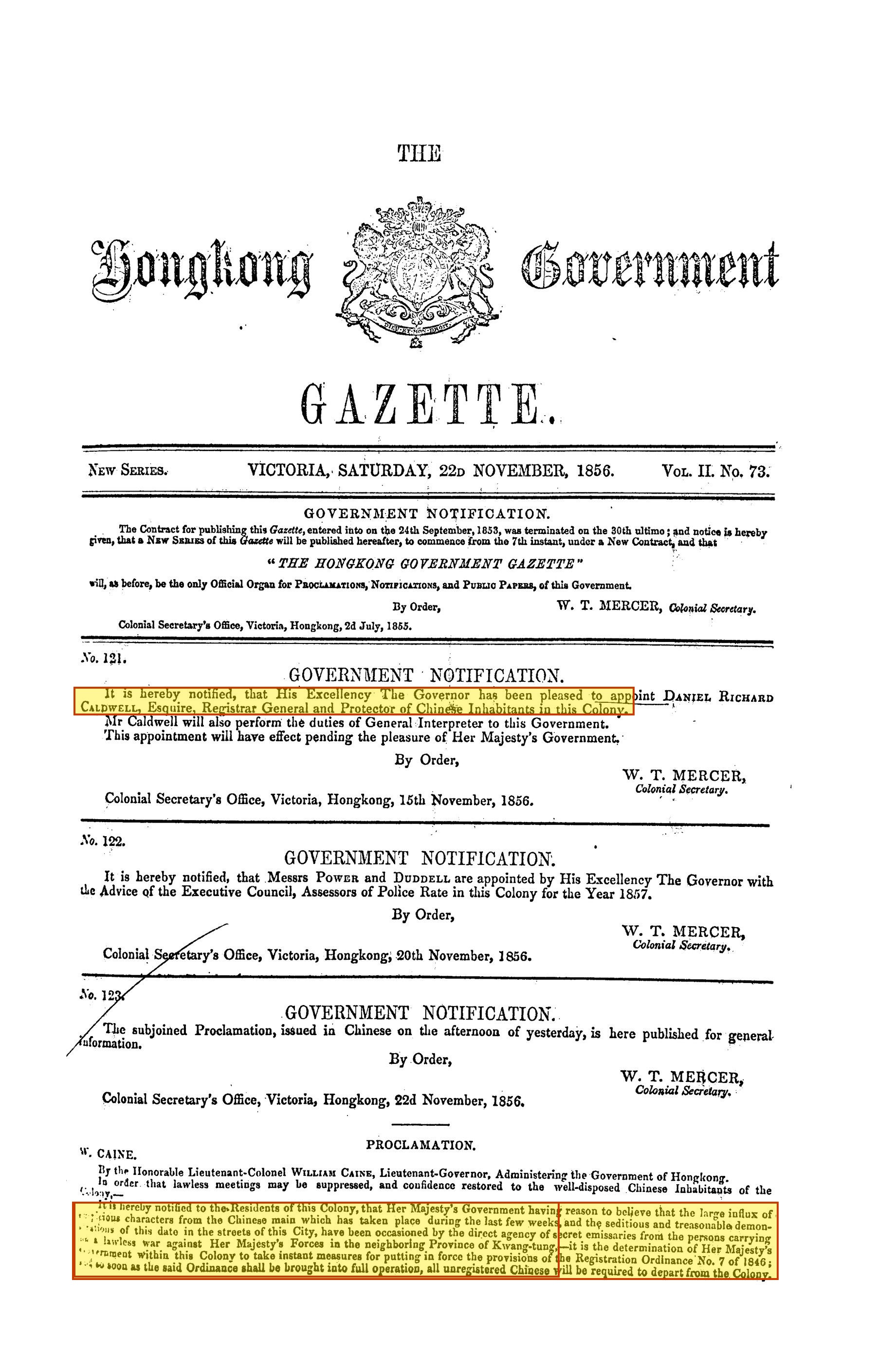
By 4 December the Government had given the measure an office and an officer. Mr Caldwell was appointed “Registrar General and Protector of Chinese residing in Hongkong”, with his office “next to the Police Station” in Gough Street. The same issue of the Gazette answered a petition signed by “the Le-Tae and other shops, several score in number”, and the second head of the reply was the war’s first recorded incursion into the harbour: “As to the seizure of vessels by Rebels in the harbour of Hongkong. This is an outrage of the gravest character.” The reply instructed shipowners to report immediately at the Police Office or to Mr Caldwell, and promised that “the delinquents will immediately be seized and dealt with as pirates or robbers”17.
3. January–May 1857: a curfew, a bounty, and two bills
On 6 January 1857, in the week after the proclamation, the Legislative Council passed “An Ordinance for better securing the Peace of the Colony”, which was gazetted the next day in an Extraordinary Gazette3. The preamble gives the cause without naming it: “Whereas it is expedient, in consequence of the present circumstances of this Colony, to adopt immediate and further means for the preservation of the Peace and Security thereof.” The machinery was a sealed night pass, issued by the Superintendent of Police to occupiers of houses in Victoria and bearing Her Majesty’s Arms and the Police Office Seal, with the restriction that “no Chinese Occupiers shall receive or hold more than one such Plate or Form at any one time”. Section V made the offence: “Any Chinaman found at large elsewhere than in his own Habitation between the hours of Eight in the Evening and Sunrise and not having a Pass duly issued and made out in conformity with Sections Two and Three of this Ordinance, shall be summarily punished by any Justice of the Peace for every such Offence, either by a Fine not exceeding Fifty Dollars nor less than One Dollar; or by Imprisonment and Hard Labour for a term not exceeding Fourteen Days, nor less than One Day; or by Public Whipping or Public Exposure in the Stocks”. The Governor in Council could revive or suspend the whole Ordinance by proclamation3.
Four days later the Government put the rules of the emergency into a Chinese-language notice, Notification No. 10 of 10 January 1857, “posted at the Public places for the information of the Chinese residents”. Every householder was to keep a tub of water and two buckets; neighbours of empty houses were to inspect their fastenings each evening; “upon the occasion of a house being on fire, or any public alarm, every Chinese Inhabitant shall remain within his own dwelling, guarding the same from the attack of thieves or incendiaries”; and “every person in the public streets, especially if armed, will be in imminent danger of being fired upon”. Boat-owners were not to remove their boats from the anchorage after eight o’clock, “the passage between the boats and shore being commanded by cannon”. The respectable inhabitants were invited to report to Mr Caldwell “the houses of persons who are without regular employment, or who from any circumstances they have reason to believe are intent upon disturbing the trade or public peace of the Colony”18. On 22 January the Government offered “A REWARD OF ONE HUNDRED DOLLARS for the apprehension of each Person” on whom “certain Treasonable Papers issued by the Authorities of the neighbouring Chinese Province” should be found19. The colony’s only English-language newspaper described the same month from the outside as a moment when “the Chinese question is involved with difficulties”42.
On 5 March 1857 the Legislative Council read two draft ordinances a first time: “An Ordinance for registration and regulation of the Chinese people, for the Population census, and for other purposes of Police within the Colony of Hongkong”, and “An Ordinance for salvage and prize in certain cases”. Laying down the estimates at the same session, the Governor stated that “the peculiar circumstances in which the Colony had been unexpectedly placed would necessitate a final augmentation of expenditure”20. The prize ordinance was the war’s one statute about ships rather than about people; it lasted four years and one month11.
4. The committee at San-on and the blockade of the colony’s food
The central document of this paper is Bowring’s confidential despatch No. 181 of 14 April 1857 to the Earl of Clarendon6. Commodore Elliott’s expedition had captured a mandarin junk and seized a packet of Chinese papers, and Bowring sent them to London with the statement that they “seem to connect the Imperial Commissioner, the mandarins, and the Canton Associations, with the atrocious acts of incendiarism, kidnapping, and assassination, which have menaced, and continue to menace, the Colony”. Bowring added that Wade was preparing a summary of the papers, and that the summary was too long for the mail6.
George F. Wade, the Chinese Secretary, identified the correspondence in his memorandum: the papers were the letters of “Chan-tsze-tin”, the younger brother of “Chan-kwei-tsih”, “President or Chief of the Committee of Hostility in San-on, the district on the coast of which Hong Kong is situated”. Wade described Chan-kwei-tsih as “a graduate of the degree of doctor, and formerly held office as a subordinate member of the Board of Revenue”, and Chan-tsze-tin as the pupil of “Su-ting-kwei, a member of the Han Lin College, one of the most important of the Canton gentry, and apparently the channel of communication between these brothers and the Governor General Yeh; by whose desire they repaired to their native district towards the end of last year, for the purpose of organizing its population against us”7.
The operative sentence of the memorandum concerns food. Wade wrote that “Chan-tsze-tin, who was specially invested with the charge of stopping our supplies”, had distributed his pickets “along the communications between Cowloon and the district city of San-on, on the left bank of the Canton river near its mouth”. Wade judged the blockade’s execution to have been poor: “His success, as director of the blockade, has not been very brilliant, and his braves, in three instances at least, have been recently involved in collision with the coast population, so serious as abundantly to occupy the force at the disposal of the district authorities.” One detail of that collision runs against the British account of the colony’s own Chinese: “It is remarkable that on two of these occasions the recusants threatened the braves that they would surrender them to the British Government”7.
Wade’s memorandum also set out the Government’s case in full. The correspondence “establishes, beyond doubt, that the San-on Committee, under authority, and in some cases at the dictation of the Canton Central Committee, have been parties to almost every atrocity with which we have been menaced by report”. The great junk attack that had been expected “belonged to the forces of the Heung-shan and Shun-tak districts”; the poisoning case was mentioned twice, but “not as an event in which the San-on people took any immediate part”, and the accused, Cheung-alam, “is a native of Heung-shan”; and the firing of Mr Duddell’s store and the seizure of the steamer “Queen” were “matters of great gratification”, as was the kidnapping of foreigners7.
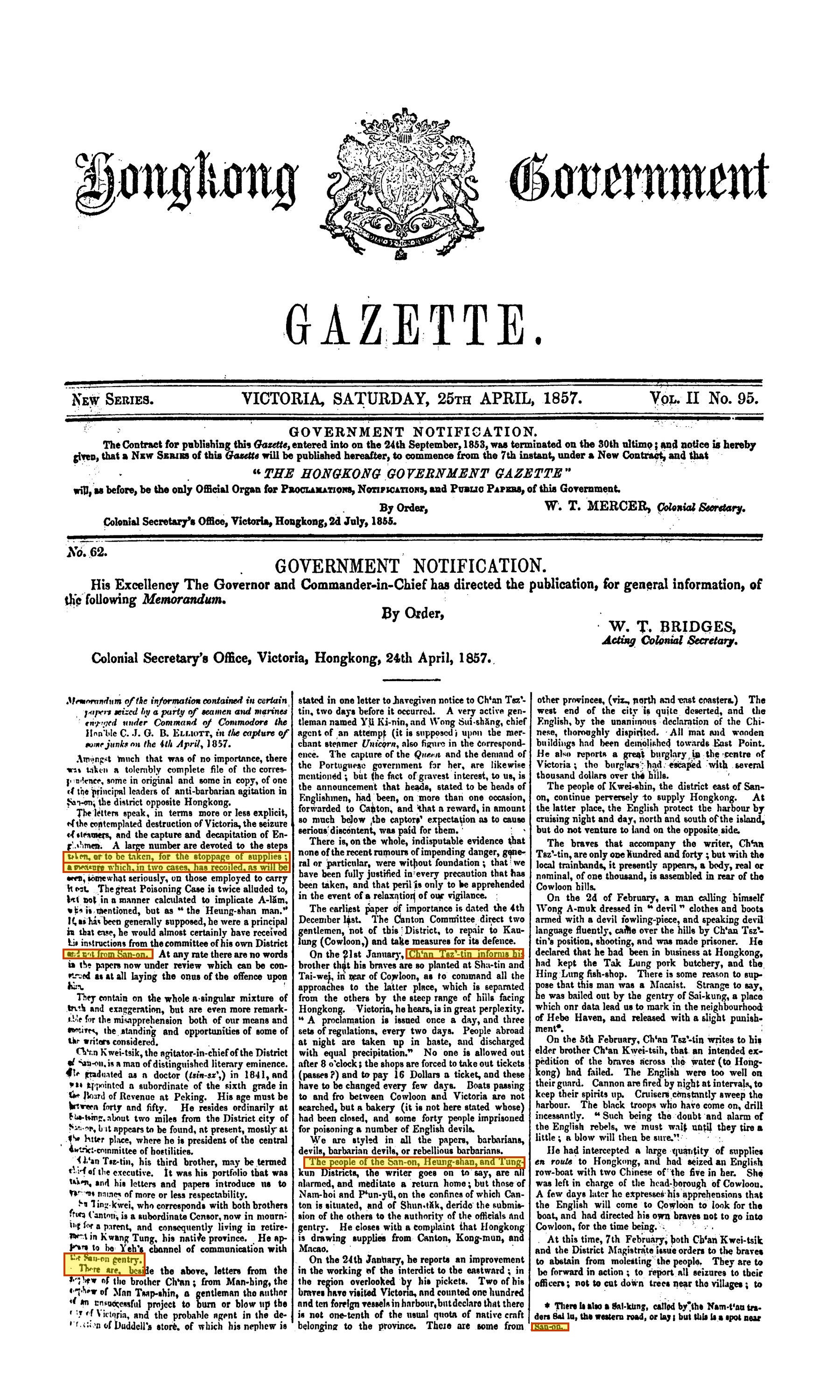
The Government published its memorandum on the papers in the Gazette of 25 April 185721. The committee’s own letters, with their translations, survive in the despatch volume89. The letters supply what the memorandum summarises. The reward for a captured “devil’s head” was thirty taels, down from the hundred taels that Yeh had first promised. The braves posted at the Hung-ham pass of Cowloon “found a number of small vessels crossing with vegetables to Victoria… They were allowed to plunder the boats of their entire cargo of vegetables and other things”, and they took two men and “two traitorous Chinese” rowing in a British boat. One letter plotted the blowing up of a British ship within three days and carried the rumour that “the barbarians are spreading a report that they are coming to attack San-on”. The committee’s report of the colony’s own conditions was equally specific: “no one is allowed out after 6 o’clock… From Tai-ping-shan to West Point there are devils on guard”, and “The Wing-tai, Wo-shang, and Mau-tai, three great rice shops” had closed. The decisive line was the order itself: “The stoppage of supplies is to be as strictly insisted upon as ever, as this is ‘a means of keeping the rebellious barbarians well in band’.” Against that order the letter recorded the resistance of Hong Kong itself: “The opposition of the people of Wong Kong, who persist in supplying Hongkong, now begins to give serious trouble”89.
Two features of this exchange deserve emphasis. First, the blockade was a Chinese-on-Chinese operation, conducted by the Chinese authorities of two districts against a Chinese population, and the committee’s own letters show that population resisting it. Second, the committee asked the British for what it needed to keep the blockade running: the letters conclude with a request for “thirty or forty pounds of gunpowder and twenty pounds of bullets” for the braves8. The Government read these papers as proof of a directed campaign against the colony. Read in full, they show a committee in difficulty, enforcing an order against the people of its own district, and appealing across the water for ammunition.
5. Enforcement: the cases, the registry, and the vote the Council refused
The Peace and Security Ordinance was put to work in the spring of 1857, and the Executive Council minutes show what that meant in practice. The Council classified the Chinese prisoners, and resolved that “all except class 3 should at once leave the colony… without especial leave being given in each instance, and not return”, on pain of seizure and deportation, with the Protector of Chinese producing bonds22. A further case concerned the Chinese apprehended “at the Ering shop and Battery”: the Council resolved that twelve Chinese not included in the indictment “be allowed to depart from this Colony if security be obtained against their return”, and that nine acquitted be asked whether there was “any probability of obtaining evidence from them which would justify their detention in the Colony”. The final orders were that the nineteen men “will in the event of their being found in Hongkong, they (in addition to the enforcement of the penalties), will be seized and deported to such places as the Governor may direct”2324.
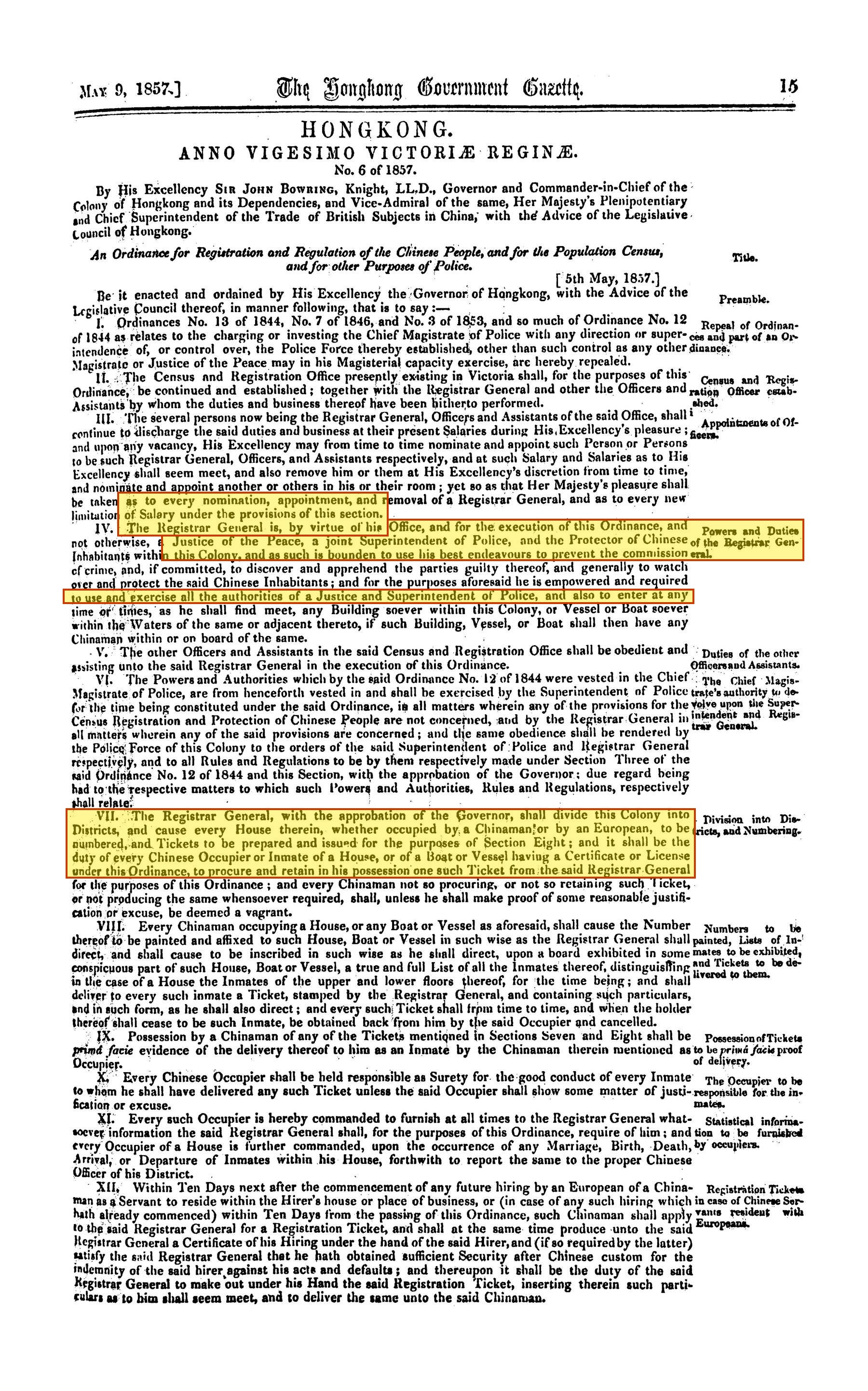
The Chinese Registration Ordinance passed its stages between 24 April and 5 May 1857. As revised in Committee it was published for general information on 24 April49; the enacted text was Ordinance No. 6 of 1857 of 5 May 1857, “An Ordinance for Registration and Regulation of the Chinese People, and for the Population Census, and for other Purposes of Police”. It repealed Ordinances No. 13 of 1844, No. 7 of 1846 and No. 3 of 1853, continued the Census and Registration Office, and made the Registrar General “by virtue of his Office… a Justice of the Peace, a joint Superintendent of Police, and the Protector of Chinese Inhabitants within this Colony”. Section IV empowered the Protector “to enter at any time or times… any Building soever within this Colony, or Vessel or Boat soever within the Waters of the same or adjacent thereto”, if a Chinese person was inside. Section VII divided the colony into districts and required that “every House therein, whether occupied by a Chinaman or by an European, to be numbered, and Tickets to be prepared and issued”; and it became “the duty of every Chinese Occupier or Inmate of a House, or of a Boat or Vessel having a Certificate or License under this Ordinance, to procure and retain in his possession one such Ticket”4.
Ten days after passing the ordinance, the Governor moved against his own statute. On 18 May 1857 Bowring read to the Council Article 23 of the Sign Manual Instructions of 6 April 1843, “giving the Governor of Hong Kong the power of passing any Ordinance in opposition to the votes of the Legislative Council”, and said he felt “considerable difficulty in subjecting the Colony to the expenses connected with certain clauses of the Registration Ordinance No. 6 of 1857 not having the aid of a Parliamentary Grant to discharge the heavy outlay to which the Colony had been exposed”. His resolution was that an Ordinance be prepared granting the Governor in Council power to suspend clauses VII (except the numbering paragraph), VIII, IX, X, XI and XII. The Council divided: 1 for, the Acting Colonial Secretary, and 8 against — Lyall, Jardine, Edger, the Chief Magistrate, the Colonial Treasurer, the Attorney General, the Chief Justice and the Lieutenant Governor. Lyall said that “an additional expense of £700 or £1,000 which it might entail in the carrying out, should not for a moment be allowed to weigh against it”. The Chief Magistrate put the war into the reason: “this Colony exists chiefly at all times for Imperial purposes… as the Registration Ordinance was passed only 2 weeks since with the approval of all those who are esteemed to be best acquainted with the Chinese Character and for an end now emphatically of imperial importance, no consideration of expense however great… should cause the repeal of a measure so lately passed”, the expenditure being “only £700 a year”25.
Whitehall then intervened, and the colony fought over the replacement. On 15 July 1857 the Secretary of State’s instructions suspended the Peace and Security Ordinance, the Governor read the resolutions giving effect to them, and then “declared the standing Rules of the Council to be suspended for a time, in order to allow this ordinance to pass through its several stages, and to be passed, at to-day’s meeting of Council”. The division was 5 to 226. The Chief Justice “declined to vote, on the ground that the instructions from the Secretary of State were to suspend the whole of the Ordinance, without giving power to re-enact the unobjectionable clauses”, and the Attorney General put in a minute of protest26. The colony kept the registration ordinance and lost the curfew; the consequence was a second ordinance, No. 6 of 1858, forwarded to London on 19 April 1858 “to supply a defect in the Peace and Security Ordinance 9 of 1857 whereby the hour was strictly limited to 8 PM after which Chinese could not be abroad”32. On 10 May 1858 the Council divided 5 to 5 on it, the Governor voting with the Ayes33.
Two points of method belong here. The registration ordinance’s own text never mentions a war or a disturbance, and the ordinance does not say that it is a war measure; the connection rests on two dated witnesses, the Government’s announcement of 21 November 1856 and the Council’s debate of 18 May 1857. And the Council’s division of 18 May 1857 was not a protest against the war: the members’s recorded reasons are about money, and it is the Chief Magistrate’s words that put the imperial purpose on the record25. The paper therefore describes the registration ordinance as the war’s legislation in that sense, and says so where the claim is made.
6. The war across the water: the Gazette prints the enemy’s city
Between January and February 1858 the Hong Kong Government Gazette printed the wartime regime of the occupied city opposite, in English, in French and in Chinese. The notice of 28 January 1858, signed by Rear-Admiral Sir Michael Seymour, Rear-Admiral Rigault de Genouilly and Major-General Van Straubenzee, announced that “the Blockade of the Port and River of Canton, established by our respective Declarations of the 3d of August, and 10th of December, 1857, will be raised on Wednesday, the 10th of February, 1858”, and that “the City and Suburbs continue under Martial Law, and will so continue during their Military occupation by the Allied Forces”27. On 6 February 1858 the ten regulations for the military occupation of Canton were gazetted: passports signed by the Allied Commanders-in-Chief; a mixed commission with power to fine or imprison; an English and French police force; “The Gates of the City will be open from Sunrise to Sunset, and no Foreigners will be permitted to be in the streets of the City or Suburbs after the firing of the Sunset Gun”; “The introduction of Arms, or Munitions of War, is strictly prohibited”; and the alarm signal — “In all cases of Alarm, Red Flags will be hoisted on the heights of Magazine Hill, and at the Commissioner’s Yamun, followed by two Guns, and the beating of the Retreat in all quarters”28. On 8 February the High Commissioners Elgin and Kincardine, with Bon Gros, notified the city that “the city having been captured by the Allied British and French Forces, the City and Suburbs are in Military occupation and under Martial Law… until further notice; but that hostile operations against China are for the present suspended”29.
The Gazette printed the war’s other side as it came. The Naval Commander-in-Chief’s despatch of 6 June 1857 was published in June50, and and in August 1858 the Gazette printed the official account of the fort at Namtow, where Chinese troops had fired upon the bearers of a flag of truce who were distributing Bowring’s own proclamation of 31 July. The fort was taken by assault about two o’clock on 11 August, and the account read: “The Wall gained, the enemy fled, leaving the Fort almost untenanted; and those remaining having been ordered out, the place was given up to destruction, and principal gates blown in”30. The colony’s own newspaper ran the same story under the heading “THE BOMBARDMENT OF CANTON”43. By August 1858 the naval war had turned into an anti-piracy war: Rear-Admiral Seymour reported that information from Mr Caldwell, the Chinese Registrar General, reached him on the 22nd, that “a Fleet of 23 Pirate Vessels were cruising in the neighbourhood of Linting”; the Surprise took “capturing or destroying 26 Vessels” and brought in seven junks “to be delivered over to the Marshal of the Admiralty Court”34. At Coulan Bay on 27–28 August the pirates’ 14-gun stockade was stormed, the guns spiked and thirty piratical fast-boats destroyed51. On 10–11 December 1858 twelve piratical junks blocked the Hong Kong passage boats near Macao; Seymour despatched the steam-sloop Fury with the gunboats Firm and Bustard, and Captain Leckie reported “having captured and destroyed, without loss, the Twelve Piratical Vessels in question”, including the liberation of a rice junk, the putting on board of “the united crews amounting to 24 men”, and the freeing of “a man and his wife who had been taken by the Pirates some days previously”. Seymour added that Leckie wrote in the highest terms of “the valuable assistance he received from Mr Caldwell, who accompanied the expedition”35. The Legislative Council debated the estimates for 1859 in December, with the Public Service ordinance at £76,00052.
The navy’s change of enemy is the clearest sign that the war in Hong Kong had ended in everything but its statutes. The man whose information located the pirate fleet, and who sailed with the expedition that destroyed it, was the same Registrar General whose registration of the colony’s Chinese had been imposed by the war3435.
7. The peace, and the colony’s own Chinese
The Treaty of Tientsin was signed on 26 June 1858, the British announcement appeared on 3 July, and the ratifications were exchanged at Peking on 24 October 186031. Eight days after the British announcement, on 31 July 1858, Bowring issued a proclamation in the Gazette5. It opened with the peace — “Peace has been happily established between The QUEEN of Great Britain and the EMPEROR OF CHINA. A solemn Treaty was signed at Tientsin on the 3d of July” — and then turned to the colony’s own residents: “In this Colony great numbers of Chinese are settled. They have taken no part in any hostilities, but have pursued their avocations in peace and due submission to the Laws; many of them have been engaged in the service of Her Majesty’s Subjects, have contracted engagements with them, and are entitled to the protection and the friendship of the British Authorities.”
The proclamation then accused the provincial authorities opposite. “But, in disregard of the obligations of Treaties, and of the Will of His Imperial Majesty, menacing Proclamations and Orders have been issued, compelling the peaceful residents of this Colony to quit their abodes, to violate their obligations, to neglect their duties, and to flee to the mainland of China; and these menaces have proceeded principally from the districts of Heang-shan and Sun-on.” The closing paragraph was the one that turned the supply war into a question of allegiance: “Moreover, attempts have been made to stop the supply of Provisions to this Colony; — and it is hereby proclaimed, that every Person who shall arrest or attempt to arrest the safe and regular transport of articles intended for the Markets of Hongkong, does, by such act, declare himself an enemy of Great Britain, and a lawless subject of the Emperor of China, and will be severely visited for his offence”5.
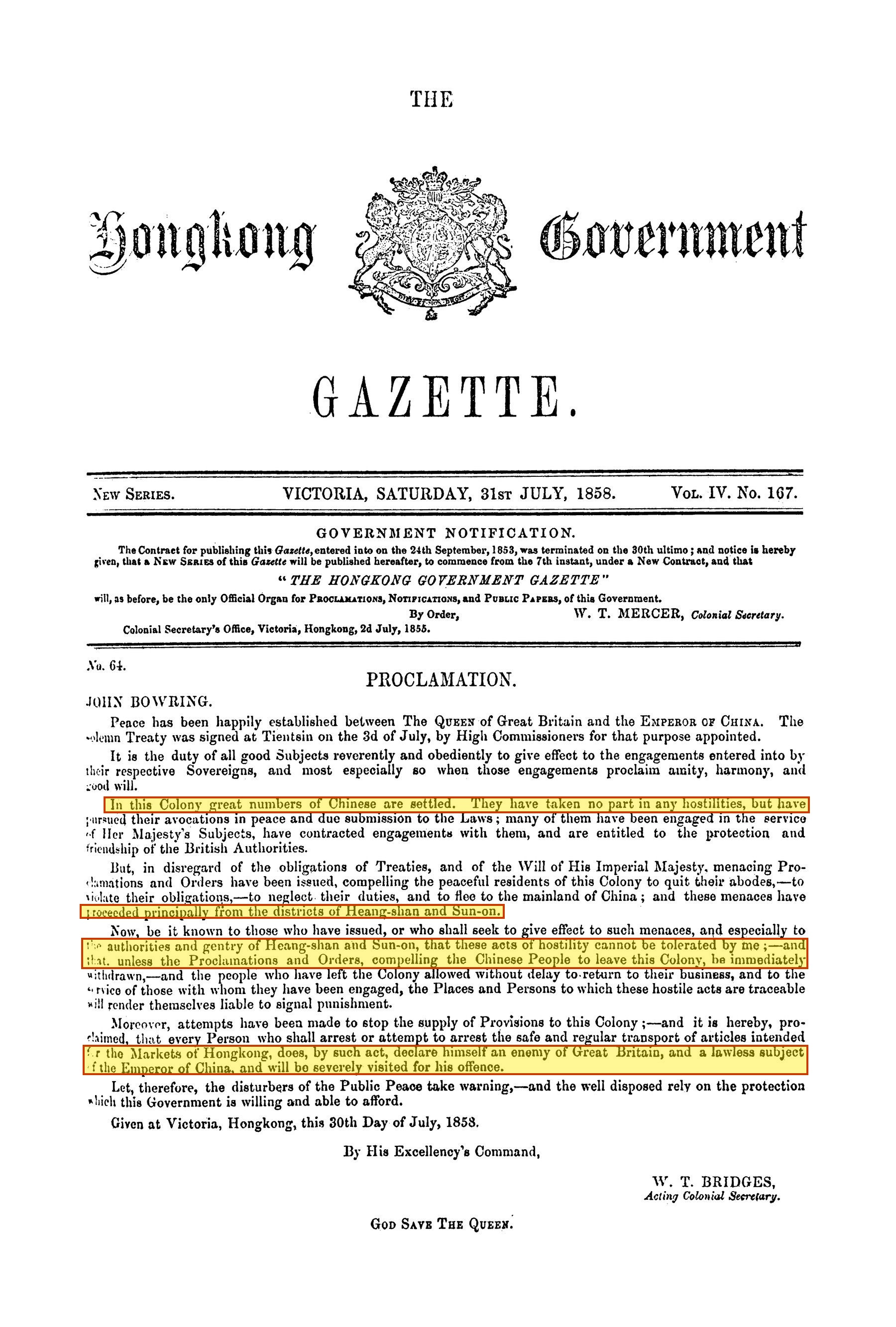
Read closely, the proclamation is not an anti-Chinese measure, and this paper does not present it as one. Its second paragraph protects the colony’s Chinese residents and calls them entitled to British protection; the accusation is directed at the authorities of Heang-shan and Sun-on. The proclamation declared an enemy of Britain anyone who stopped the food supply of the Hong Kong markets, and the supply of the Hong Kong markets was carried by the colony’s Chinese. The Government was therefore defending its own residents by making their suppliers enemies of the empire, and the proclamation states both halves of that position on the same leaf.
The war left a residue in the statute book, and the residue was measurable. On 19 April 1858 Bowring forwarded Ordinance No. 6 of 1858 to London to repair the curfew’s eight o’clock limit32, and on 10 May the Council divided 5 to 5 on it, the Governor voting with the Ayes33. The colony’s legislation table records the war’s statutes with their dates10. And on 29 June 1861, four years and one month after it had been passed, Ordinance No. 4 of 1861 repealed Ordinance No. 5 of 1857, the prize law, “An Ordinance for Salvage and Prize in certain cases”11. The statute that had been the war’s one law about ships was the first of the war’s statutes to go; the registration of the colony’s Chinese, imposed in 1856 and 1857, remained on the books, and so did the Protector’s power to enter any house, vessel or boat4.
The war also produced one prosecution of its own instruments, and it was against the man who administered them. In 1858 the Attorney General laid nineteen counts against Mr Caldwell to the Secretary of State: bringing “the worst Chinese in this Colony” through his wife, “a Chinese girl from a Brothel”; speculating in brothels and brothel licences; a connection with Ma-chow Wong (Wong A-kee), “a Government informer of long standing whose conviction upon a charge of helping pirates, brought in the previous year, occupied the Executive Council a considerable period”; and “the habit of arresting and discharging persons and of confiscating or restoring property on Ma Chow Wong’s unsupported information”3637. The Commission’s conclusions were kinder and no less damning: “That with reference to charge 11, a partnership with Ma-chow Wong in a Lorcha is proved and in fact admitted by Mr Caldwell”; and on the release of men captured on Ma-chow Wong’s information, “there is proof beyond doubt”3839. The man who had located the pirate fleet for the navy in August 1858 was the man charged with using an informer’s word to arrest and release Chinese3436.
One later notice shows the colony’s volunteer body, the “volunteers” of the pool brief, in the record at its smallest. On 20 April 1861 the Government communicated that “in accordance with Her Majesty’s desire, Colonial Volunteers will be entitled to compete for the Queen’s Prize at their annual Prize Meeting, upon the same terms as the Volunteers of Great Britain”40. No volunteer corps or militia figure appears anywhere in the 1856–61 Friend of China, and the word “militia” in that stratum refers to the Indian armies of 1857 and to the Chinese district “braves”, never to a Hong Kong force; the brief’s expectation of a volunteer defence has no support in the corpus.
8. What the record settles, and what it does not
Seven attempts were made to falsify this paper’s headline, and the results are recorded rather than suppressed. The first attempt was to find a war instrument with no Chinese subject; the prize law, the martial-law notices and the naval despatches have none, and the headline therefore stands in its narrower form — the war’s legislation in the colony was about the Chinese, and the colony’s proclamation of July 1858 was about food and allegiance. The second attempt was to read Bowring’s proclamation of July 1858 as an anti-Chinese measure; the proclamation’s second paragraph protects the colony’s Chinese, and the reading fails. The third attempt was to show that the registration ordinance was not a war measure at all, because its text never mentions a war; the silence is real, and the war connection is registered as an inference resting on two dated witnesses rather than on the ordinance’s words. The fourth attempt was to deny that the supply blockade was directed at Hong Kong; the memorandum and the letters carry it, and the attempt fails. The fifth attempt asked what harm the colony’s Chinese actually suffered; the corpus has no victim list, no casualty figure and no deportation total, so the paper claims only legislation, surveillance, reward-offerings, rhetoric and the enforced supply interdiction. The sixth asked whether the Council really opposed the Governor; the members’s recorded reasons are money, and the attempt fails as stated. The seventh asked whether the curfew was enforced; the machinery is visible in the bonds, the deportation orders and the cases before Council, but no prosecution return under section V exists in the corpus, and the volume of curfew enforcement is left as a gap322232425.
Four unresolved differences are kept unresolved, with both readings printed. The Gazette Extraordinary of 7 January 1857 prints the Peace and Security Ordinance as No. 2 of 1857 and the Legislative Council minute of 15 July 1857 calls it by that number, but Bowring’s despatch of 19 April 1858 refers to “the Peace and Security Ordinance 9 of 1857”32632. Bowring’s July 1858 proclamation says the Treaty of Tientsin was signed on 3 July, while the Gazette’s own text of the treaty is headed “SIGNED AT TIEN-TSIN JUNE 26TH 1858”315. The Blue Book’s legislation table is column-interleaved in the OCR and prints near the Chinese-people ordinance a stray “10th April” and a line about amending Ordinance No. 1 of 1857; the ordinances themselves give the dates, and the table is not used for any of them1210. And the Blue Book’s 1859 Chinese mortality return prints a Victoria population larger than the 1857 and 1858 returns, in a table whose columns the OCR interleaves; no population figure is asserted here444512.
The gaps are equally specific. The Friend of China volume for 1859 is absent from the corpus and the 1860 volume is partial, so the press is quoted for 1856–58 only. No naval log and no regimental record are in the corpus, so the 59th Regiment’s movements are known only from a single despatch-index line15. The Arrow incident’s own record is not in the corpus as a primary document; the paper has Bowring’s later account and the press’s summary1413. The 21 November 1856 demonstrations are known only through the Government’s own characterisation of them, since the petitions, the crowd and the Chinese side’s account are absent12. The Chinese side’s own account of the war’s Hong Kong dimension survives only as the intercepted San-on letters and the English reports built on them789. The place called the “Ering shop”, where forty-two Chinese were arrested, cannot be identified from the corpus’s OCR23. And what became of the Chinese who did leave the colony in November 1856 is not in the corpus at all2.
Conclusion
Hong Kong was not a battlefield in the Second Opium War. It was a front, and the front ran through the colony’s Chinese residents. The war arrived at the Victoria waterfront in the first week of November 1856 as an order to register; it became, within two months, a night-pass curfew with whipping and the stocks; it became, in May 1857, a registry of every house, boat and vessel in the colony, administered by a new Protector of Chinese Inhabitants empowered to enter any of them and search inside; and it ended, in July 1858, with a proclamation that made the interruption of the Hong Kong food supply a declaration of enmity towards Britain. These instruments were not invented in Hong Kong — the first of them came from an 1846 statute — but the war decided when they were switched on, and the war decided what they were for.
The answer to the paper’s second question, who the war was fought against in Hong Kong, is the one the record gives most clearly in the intercepted letters: against the people who kept the colony fed. The San-on committee ordered its braves to stop the vegetables and the rice; the braves took the cargo; the committee complained to the British for gunpowder; and the colony’s own Chinese kept supplying Hong Kong in defiance of the order. Bowring’s July 1858 proclamation then turned that supply war into a test of allegiance, and applied it to the merchants and boatmen of the colony. The Government was not persecuting the colony’s Chinese in that proclamation; it was protecting them, and doing so by making their suppliers enemies of the empire.
Two opposite exaggerations are refused. The record does not support reading the July 1858 proclamation as an anti-Chinese measure, because the proclamation’s own second paragraph protects the colony’s Chinese. And the record does not support reading the Council’s division of 18 May 1857 as an opposition to the war, because the members said in terms that the cost of the registry was £700 a year and that the Colony “exists chiefly at all times for Imperial purposes”. What the Council opposed was the Governor’s haste, not the Governor’s purpose; and what the colony ended with was the purpose without the haste. No death toll, no total of deportees and no claim that the colony’s Chinese died for the war appear here, because the corpus holds none25114044451210.
Appendix A — Evidence register (summary)
| Class | Item | Witnesses |
|---|---|---|
| Confirmed | The war’s Hong Kong legislation was about Chinese people: No. 2 of 1857 (night passes; a curfew with whipping and the stocks for “Any Chinaman found at large”) and No. 6 of 1857 (a registry of houses, boats and vessels, with a Protector empowered to enter any of them) | both ordinances in the Gazette; the Council debates of 5 March and 18 May 1857; the announcements of 21 and 29 November 18561216320425 |
| Confirmed | 21 November 1856: the Government announced in Chinese that the Registration Ordinance No. 7 of 1846 would be put into force, and that “all unregistered Chinese will be required to depart from the Colony” on the 29th, attributing the demonstrations to “secret emissaries” | the Gazette notification; the proclamation’s text in the despatch volume; the LegCo minute of 18 May 1857 quoting it1225 |
| Confirmed | 29 November 1856: “some system of registration be adopted forthwith… No fee will be levied”, after the Sheung-wan disturbance | the proclamation in the Gazette; the LegCo minute quoting the same proclamation1625 |
| Confirmed | The supply war: the San-on committee charged with stopping supplies; vegetable boats plundered on the way to Victoria; the committee’s own letters calling the stoppage “a means of keeping the rebellious barbarians well in band”; the people of Hong Kong “persisting in supplying Hongkong” | Wade’s memorandum; the letters in the despatch volume; the Government’s memorandum in the Gazette72189 |
| Confirmed | 31 July 1858: the proclamation declaring that anyone who stopped the safe transport of provisions to the Hong Kong markets “declare[s] himself an enemy of Great Britain, and a lawless subject of the Emperor of China” | the proclamation in the Gazette5 |
| Confirmed | The same proclamation explicitly protected the colony’s Chinese: “They have taken no part in any hostilities” | the same proclamation5 |
| Confirmed | 18 May 1857: the Council refused by 8 to 1 to suspend the costliest clauses of the registration ordinance, on the ground of expense, with the Chief Magistrate giving the imperial reason and the cost at “only £700 a year” | the LegCo minutes, with each member’s recorded opinion25 |
| Confirmed | The war’s prize law was repealed four years and one month after it was passed: No. 4 of 1861 repeals No. 5 of 1857 | the repealing ordinance in the Gazette; the Blue Book’s legislation table1110 |
| Confirmed | Canton under martial law by the Allied forces, and the Hong Kong Gazette printing the regime — passports, a mixed commission, a two-language police force, the gates at sunrise and the sunset gun, the arms ban, the Magazine Hill alarm | the notices of 28 January, 6 February and 8 February 1858272829 |
| Confirmed | The reward for the apprehension of anyone carrying “certain Treasonable Papers issued by the Authorities of the neighbouring Chinese Province” (22 January 1857), and the Chinese-language rules for staying indoors on any alarm | the Gazette notifications of January 18571819 |
| Single-witness | The seizure of the papers from a mandarin junk by “the expedition commanded by Commodore Elliott”; the 59th Regiment sent to Canton; the blockade declarations of 3 August and 10 December 1857 (known only through the January 1858 notice that recites them); the Committee’s bounty of thirty taels; the committee’s report of the colony’s own curfew and closed rice shops; the Commission’s findings against the Registrar General; the Naval Commander-in-Chief’s despatch of 6 June 1857 | see the notes157895027343839 |
| Conflicts | K1 the Peace and Security Ordinance’s number (2 vs 9); K2 the Treaty of Tientsin’s date (3 July vs 26 June); K3 the Blue Book’s legislation table; K4 the population figures; K5 the absent 1859 press volume | 3263231544451210 |
| Failed verification | No casualty figure and no death toll; no total of Chinese deported; no Hong Kong volunteer corps or militia for 1856–61; the Sheung-wan disturbance not attributed to the war; the arsenic-bread case not re-covered; no figure taken from the Friend of China OCR | 16722232440 |
| Gaps | the 1859 press year; any naval log or regimental record; the Arrow’s own incident record; the 21 November 1856 demonstrations as seen by the Chinese; the Chinese side’s account of the war’s Hong Kong dimension beyond the intercepted letters; the certified population figures; the site of the “Ering shop”; the fate of those who left in November 1856 | 1412157234445 |
Appendix B — Query log (summary)
The battery ran against the hkintexts corpus (read-only, accessed 7–9 November 2026) in fourteen passes, of which the principal families were: (1) the stratum inventory — a series aggregation over document keys matching 1856–61 (15,410 CO 129 pages, 2,799 gazette leaves, 1,626 Executive Council minutes, 1,463 FCO 40 documents, 1,129 Friend of China pages, 991 Blue Book leaves, 106 Legislative Council sessions, 174 Directory and Chronicle leaves); (2) the press stratum — a year-by-year count of the Friend of China volumes, which established the 1859 hole (0 pages against 286 for 1856); (3) the gazette’s war vocabulary — “martial law” 5, “blockade” 27, “prize” 16, “enemy” 20, “ordnance” 55, “militia” 8, “volunteer” 13, “war” 198; (4) the war’s instruments — “seditious” 17, “treasonable” 18, “Registration Ordinance No. 7 of 1846” 3, “all unregistered Chinese will be required to depart” 5, “registration and regulation of the Chinese people” 12, “salvage and prize” 20, “Peace and Security” 10; (5) the Chinese committee — “braves” 5,521, “devil’s head” 18, “Su Ting-kwei” 2, “Ch’an Tsz” 32; (6) the 1858 Commission — “Ma-chow Wong” 48, “gold dust” 12, “Caldwell” 464; (7) the image twins — eighteen gazette leaves hunted by phrase and by printed header, of which six were resolved and read back; and (8) the compulsory whole-document pull — CO 129/065, 470 pages and 11,251 lines, read in full67893411. The rule-9 name battery ran on both indices for every Chinese form in the paper; the districts are carried by the pairing witnesses recorded in the notes, and the five Chinese persons whose names the thread needs — Chan-tsze-tin, Chan-kwei-tsih, Su-ting-kwei, Ma-chow Wong and Cheung-alam — are kept in the period romanization because the corpus does not pair them with the characters. Every citation in this paper carries a public viewer link; the internal endpoint appears nowhere1210464748.
Notes
CO 129/059, Bowring's despatches, 1856 [11–12], p. 215 — the text of the Proclamation issued in Chinese on the afternoon of 21 November 1856. https://hkintexts.histsyn.com/page/239998 ↩
Hongkong Government Gazette, Vol. II No. 73, 22 November 1856, Government Notification No. 123 — the Proclamation of W. Caine, Lieutenant-Governor administering the Government, printed for general information: the notice to the residents of the colony that the "seditious and treasonable demonstrations" were "occasioned by the direct agency of secret emissaries", and that the Registration Ordinance No. 7 of 1846 would be put into full operation. (The same issue's Notification No. 121 appoints Daniel Richard Caldwell "Registrar General and Protector of Chinese Inhabitants in this Colony".) https://hkintexts.histsyn.com/image-page/1447654 ↩
Hongkong Government Gazette Extraordinary, Vol. II No. 79, 7 January 1857 — "An Ordinance for better securing the Peace of the Colony" (No. 2 of 1857)*, with the night-pass form and section V. https://hkintexts.histsyn.com/image-page/1447678 ↩
Hongkong Government Gazette, Vol. II No. 97, 9 May 1857, printed folio 15 — *"An Ordinance for Registration and Regulation of the Chinese People, and for the Population Census, and for other Purposes of Police" (No. 6 of 1857)*, of 5 May 1857. https://hkintexts.histsyn.com/image-page/1447785 ↩
Hongkong Government Gazette, Vol. IV No. 167, 31 July 1858, Government Notification No. 64 — *Proclamation of Sir John Bowring*, given at Victoria on 30 July 1858, on the peace, the Chinese inhabitants of the colony, the menacing orders of Heang-shan and Sun-on, and the supply of provisions to the markets of Hongkong. https://hkintexts.histsyn.com/image-page/1448107 ↩
CO 129/065, Bowring and Public Offices, 1857 [11–12], pp. 408–413 — *Bowring's despatch No. 181 of 14 April 1857* (confidential, to the Earl of Clarendon) with George F. Wade's memorandum on the papers seized on a mandarin junk, and the translations of the Chinese letters. (Whole volume pulled: 470 pages.) https://hkintexts.histsyn.com/page/243012 ↩
CO 129/065, 1857 [11–12], p. 409 — Wade's memorandum, first page: the identification of the papers as the correspondence of Chan-tsze-tin and Chan-kwei-tsih, "President or Chief of the Committee of Hostility in San-on", and the summary of the blockade of the supplies. https://hkintexts.histsyn.com/page/243013 ↩
CO 129/065, 1857 [11–12], p. 410 — the letters of February–March 1857: the Hung-ham pass of Cowloon, the vegetable boats to Victoria, the night-watch at Victoria, the rice shops closed, and the request for powder and bullets for the braves. https://hkintexts.histsyn.com/page/243014 ↩
CO 129/065, 1857 [11–12], p. 412 — the letter of 4 March 1857: "The stoppage of supplies is to be as strictly insisted upon as ever, as this is 'a means of keeping the rebellious barbarians well in band'"; and "The opposition of the people of Wong Kong, who persist in supplying Hongkong, now begins to give serious trouble". https://hkintexts.histsyn.com/page/243016 ↩
Hong Kong Blue Book, 1858, p. 38 — "LEGISLATION" table with the dates of the laws and of the despatches. https://hkintexts.histsyn.com/page/654813 ↩
Hongkong Government Gazette, 29 June 1861, printed p. 196 — *Ordinance No. 4 of 1861*, repealing “Ordinance No. 5 of 1857 intituled ‘An Ordinance for Salvage and Prize in certain cases’”, with the assent of Governor Sir Hercules Robinson. https://hkintexts.histsyn.com/page/1683058 ↩
Hong Kong Blue Book, 1859, p. 87 — "RETURN showing the MORTALITY amongst the Chinese during the year 1859", with the population of the colony by district. https://hkintexts.histsyn.com/page/655008 ↩
The Friend of China and Hongkong Gazette, 1856, p. 151 — the letter of Canton, 22 August 1856, signed Capt. Jameson, Capt. J. B. Endicott, R. Walker and Dr Drinker; the heading survives in the OCR only as "Hostilities proPOBEN, AND ARAINT 2? AGAINST A LARGE BRT OF tax ChinzaX", so the clean wording is a reconstruction and is not quoted. https://hkintexts.histsyn.com/page/3031754 (the OCR of this volume is badly corrupted; quoted only where the wording survives legibly) ↩
Hongkong Government Gazette Extraordinary, No. 73*, 28 November 1856 — "Correspondence between SIR JOHN BOWRING, H.B.M. Plenipotentiary, and YEH, Imperial Commissioner", with the translation from the Chinese of Mr Parkes's notification to the gentry and city of Canton, and the account of the capture of the forts and the breaching of the Tsing Hai Gate. https://hkintexts.histsyn.com/image-page/1447656 ↩
CO 129/059, Bowring's despatches, 1856 [11–12], p. 382 — the despatch index: "196 November 22. Reporting Measures adopted, for the suppression of certain seditious demonstrations in the City on the morning of the 21st Instant", and "Reporting Compliance given to the Admiral's requisition to have 100 men of the 59th Regiment sent up to Canton for the protection of the Foreign Factories". https://hkintexts.histsyn.com/page/240165 ↩
Hongkong Government Gazette, Vol. II No. 74, 29 November 1856, printed folio 12, Government Notification No. 127 — Proclamation of Sir John Bowring "issued to reassure the good citizen, and to intimidate the idle and disorderly", including the account of the Sheung-wan disturbance and the announcement of the registration measure. https://hkintexts.histsyn.com/image-page/1447663 ↩
Hongkong Government Gazette, No. 75, 6 December 1856, Government Notification No. 131 — the notice addressed to the Chinese inhabitants on Mr Caldwell's appointment as Registrar General and Protector of Chinese, and the Government's reply to the petition of the Chinese traders (No. 132), with its head "As to the seizure of vessels by Rebels in the harbour of Hongkong". https://hkintexts.histsyn.com/page/1684898 ↩
CO 129/062, Bowring's despatches, 1857 [1–3], p. 106 — Notification No. 10 of 10 January 1857: the rules for the Chinese inhabitants as regards fire, public alarm and the anchoring of boats, and the invitation to report idlers to Mr Caldwell. https://hkintexts.histsyn.com/page/241081 ↩
Hongkong Government Gazette, No. 82, 24 January 1857, Government Notification — the offer of "A REWARD OF ONE HUNDRED DOLLARS for the apprehension of each Person" on whom "certain Treasonable Papers issued by the Authorities of the neighbouring Chinese Province" should be found (the notification itself is dated 22 January). https://hkintexts.histsyn.com/image-page/1447690 ↩
Votes and Proceedings of the Legislative Council of Hongkong, 5 March 1857 — the estimates, "the peculiar circumstances in which the Colony had been unexpectedly placed", and the first reading of the registration and prize ordinances. https://hkintexts.histsyn.com/page/1880982 ↩
Hongkong Government Gazette, Vol. II No. 95, 25 April 1857, Government Notification No. 62 — the Government's memorandum on the papers, published "for general information" and signed W. T. Bridges, Acting Colonial Secretary, on 24 April 1857; it identifies Ch'an Tez'-tin and Ch'an Kwei-tsik, and states that "a large number are devoted to the steps that, or to be taken, for the stoppage of supplies; a measure which, in two cases, has recoiled". The leaf is *English only* (the page carries no Chinese column); the letters themselves, with their translations, are in the despatch volume, items 15 and 16. https://hkintexts.histsyn.com/image-page/1447755 ↩
CO 129/062, 1857 [1–3], p. 310 — the Executive Council's classification of the Chinese prisoners, the bonds produced by the Protector of Chinese, and the order that all except class 3 should leave the colony. https://hkintexts.histsyn.com/page/241285 ↩
CO 129/062, 1857 [1–3], p. 315 — the Executive Council resolutions on the Chinese indicted in the "Ering shop and Battery" case and on the nine acquitted. https://hkintexts.histsyn.com/page/241290 ↩
CO 129/062, 1857 [1–3], p. 319 — the security bonds ($50 and $100) and the order that the nineteen men found in Hongkong "will be seized and deported to such places as the Governor may direct". https://hkintexts.histsyn.com/page/241294 ↩
Votes and Proceedings, 18 May 1857 — the Governor's motion to suspend clauses VII–XII of Ordinance No. 6 of 1857, the division of 1 against 8, and each member's recorded opinion. https://hkintexts.histsyn.com/page/1880991 ↩
Votes and Proceedings, 15 July 1857 — the Secretary of State's instructions suspending the Peace and Security Ordinance, the Governor's suspension of the standing rules of Council, the division of 5 to 2, and the Attorney General's minute of protest. https://hkintexts.histsyn.com/page/1880993 ↩
Hongkong Government Gazette Extraordinary, No. 135, 28 January 1858 — the Allied notice that the blockade of the Port and River of Canton would be raised on 10 February 1858, "and that they will continue under Martial Law during their occupation by the Allied Forces", signed by Seymour, Rigault de Genouilly and Van Straubenzee. https://hkintexts.histsyn.com/image-page/1447923 ↩
Hongkong Government Gazette Extraordinary, Vol. III No. 137, 6 February 1858, printed folio 2, Government Notification No. 3 — "Regulations" for the military occupation of Canton (Articles I–X), printed in English and French side by side, with the alarm signal on Magazine Hill. https://hkintexts.histsyn.com/image-page/1447927 ↩
Hongkong Government Gazette Extraordinary, No. 138, 8 February 1858 — the notification of the High Commissioners, Elgin & Kincardine and Bon Gros, that Canton, "having been captured by the Allied British and French Forces", is in military occupation and under martial law. https://hkintexts.histsyn.com/image-page/1447929 ↩
Hongkong Government Gazette, No. 76, 14 August 1858, printed p. 46, Government Notification No. 73 — Van Straubenzee's despatch on the assault on the fort at *Namtow* on 11 August 1858, and on the firing on the truce-flag party that was distributing Bowring's proclamation of 31 July 1858 ("The Wall gained, the enemy fled"). The despatch is dated 13 August 1858 and printed the next day. https://hkintexts.histsyn.com/page/1684042 ↩
Treaty of Peace, Friendship, Commerce and Navigation between Her Majesty and the Emperor of China, signed at Tien-tsin, 26 June 1858; ratifications exchanged at Peking, 24 October 1860, as printed in the Hong Kong Government Gazette, No. 60 of 1860. https://hkintexts.histsyn.com/page/1683767 ↩
CO 129/067, Bowring's despatches, 1858 [1–4], p. 490 — the covering letter of 19 April 1858 forwarding "Ordinance 6 of 1858", "to supply a defect in the Peace and Security Ordinance 9 of 1857 whereby the hour was strictly limited to 8 PM after which Chinese could not be abroad". https://hkintexts.histsyn.com/page/244154 ↩
Votes and Proceedings, 10 May 1858 — the Council division of 5 to 5. https://hkintexts.histsyn.com/page/1684705 ↩
Hongkong Government Gazette, No. 76, 28 August 1858, printed p. 52, Government Notification No. 76 — Rear-Admiral Seymour's despatch on the fleet of 23 pirate vessels cruising near Linting and the capture or destruction of 26 vessels. https://hkintexts.histsyn.com/image-page/1448125 ↩
Hongkong Government Gazette, No. 79, 11 December 1858, printed p. 58, Government Notification No. 117 — Rear-Admiral Seymour's despatch of 10 December 1858 on the blockade of the Hong Kong passage boats near Macao and the destruction of the twelve piratical junks, with Captain Leckie's report. https://hkintexts.histsyn.com/image-page/1448183 ↩
CO 129/068, Bowring's despatches, 1858 [5–12], p. 217 — the Attorney General's letter to the Secretary of State on the charges against Mr Caldwell and the case of Ma-chow Wong (Wong A-kee), "a Government informer of long standing". https://hkintexts.histsyn.com/page/244476 ↩
CO 129/068, 1858 [5–12], p. 453 — the list of the charges brought against the Registrar General. https://hkintexts.histsyn.com/page/244711 ↩
CO 129/068, 1858 [5–12], p. 150 — the Commission's conclusions on the charges against the Registrar General. https://hkintexts.histsyn.com/page/244409 ↩
CO 129/068, 1858 [5–12], p. 152 — the Commission's finding on charge 11: "a partnership with Ma-chow Wong in a Lorcha is proved and in fact admitted by Mr Caldwell". https://hkintexts.histsyn.com/page/244411 ↩
Hongkong Government Gazette, No. 40, 20 April 1861, printed p. 115, Government Notification — the communication that “in accordance with Her Majesty’s desire, Colonial Volunteers will be entitled to compete for the Queen’s Prize at their annual Prize Meeting, upon the same terms as the Volunteers of Great Britain”, and that the National Rifle Association will give one Silver Medal to Colonial Rifle Associations. https://hkintexts.histsyn.com/image-page/1448795 ↩
The Friend of China and Hongkong Gazette, 1856, p. 153 — the letter on "designs" against the Canton Gate and the complaint to Governor Bowring. https://hkintexts.histsyn.com/page/3031756 ↩
The Friend of China and Hongkong Gazette, 1857, p. 38 — “THE CHINESE QUESTION IS INVOLVED WITH DIFFICULTIES”, reprinted from the Daily Argus of Friday, 15 January 1857. https://hkintexts.histsyn.com/page/3031927 ↩
The Friend of China and Hongkong Gazette, 1857, p. 40 — “THE BOMBARDMENT OF CANTON”. https://hkintexts.histsyn.com/page/3031929 ↩
Hongkong Government Gazette, No. 142, 6 March 1858, Government Notification No. 21 — the Registrar General's returns on the trade and population for 1857. https://hkintexts.histsyn.com/page/1684613 ↩
Hongkong Government Gazette, No. 23, 2 March 1859, printed p. 172, Government Notification — the Registrar General's returns for 1858. https://hkintexts.histsyn.com/image-page/1448234 ↩
"Second Opium War", Wikipedia, English. https://en.wikipedia.org/wiki/Second_Opium_War — accessed 7 November 2026. (The dates of the Arrow incident and the 1857–58 bombardments, and the shape of the war; the corpus's own account of the Arrow is used wherever it exists.) ↩
"Arrow War", Wikipedia, English. https://en.wikipedia.org/wiki/Arrow_War — accessed 7 November 2026. (The sequence of the Arrow incident.) ↩
"Xiangshan County, Guangdong", Wikipedia, English. https://en.wikipedia.org/wiki/Xiangshan_County,_Guangdong — accessed 7 November 2026. (香山縣; the romanizations "Hsiangshan, Siangshan, Heungsan, Heungshan" — the name battery's web leg for 香山.) ↩
Hongkong Government Gazette, 24 April 1857 — the Chinese registration ordinance "having undergone revision in Committee", published before the Legislative Council. https://hkintexts.histsyn.com/page/1685078 ↩
Hongkong Government Gazette, No. 132, 6 June 1857, Government Notification No. 26 — the Naval Commander-in-Chief's despatch. https://hkintexts.histsyn.com/image-page/1447807 ↩
Hongkong Government Gazette, No. 77, 11 September 1858, printed p. 60, Government Notification No. 40 — the operations in Coulan Bay and the destruction of the 14-gun stockade. https://hkintexts.histsyn.com/image-page/1448132 ↩
Votes and Proceedings, 8 December 1858 — the Estimates Ordinance for 1859 ("An Ordinance to apply a Sum not exceeding Seventy-six Thousand Pounds to the Public Service of the Year, 1859"). https://hkintexts.histsyn.com/page/1881119 ↩