Waiting for the Gun: Hong Kong's Typhoon Warning of 18 September 1906
Research article
The Fatal 18th
The typhoon of 18 September 1906, the boat population, and the warning question the record judged itself
Abstract
The deadliest day of colonial Hong Kong’s first sixty years came with half an hour’s warning. On the morning of Tuesday 18 September 1906 a small typhoon of “phenomenal violence” crossed the harbour in under two hours. The Observatory’s own notice, printed the same day, states the limit the record would spend the next nine months examining: the storm “gave no indication of its existence until close to the Colony”. The order to hoist the Black Drum went out at 8.00 a.m., the barometer then reading 29.604; the gun followed within the half hour — at a minute the newspapers could not agree on (8.05, 8.30, 8.40, “a quarter to nine”; the Governor said “about nine”). The Committee of Enquiry found that “prior to 7.44 a.m.… there was no indication of a typhoon approaching Hongkong” and that the warning was given “as soon as, in the circumstances, was practically possible”; the Director of the Observatory, in his own annual report, conceded that “both signal and gun were late”. The Astronomer Royal at Greenwich called the Committee’s finding “practically inevitable” and found “no question of dereliction of duty”. Beside the warning question the record counted the dead in three registers it never totalised — 6 European fatalities and “large loss of life among Chinese”; then “several thousand”; then the boat census’s 1,687 boats sunk or wrecked, 1,347 persons reported missing “very much below the mark”, and the boat population’s loss “at the lowest estimate… probably at least 5,000”. Ten days later a second typhoon, almost as furious, struck a warned harbour — “thanks to the timely warning”, its effects “by no means so disastrous”: the record’s own control experiment.
Keywords: Hong Kong; typhoon; 18 September 1906; boat population; Observatory; warning signals; typhoon shelter; Bishop Hoare; Nathan; Doberck; Committee of Enquiry; Greenwich; Zikawei; relief fund
1. Introduction: the day and the question
Every port that lives by the sea keeps a typhoon ledger, and Hong Kong’s heaviest entry is 18 September 1906. This paper reads the disaster from the record the colony made of it — the storm-day press, the telegrams, the census, the Committee of Enquiry, the Director’s own report, the Greenwich verdict, the relief fund — and keeps the record’s honesty about its own limits. The death toll is not one number but three registers, each marked by the men who wrote it; the warning is not one minute but a variance the newspapers printed among themselves; and the inquiry the disaster provoked is one of the few cases in which a colonial department was judged by its own tables, its neighbours’ observations and the Astronomer Royal — all of which survive in the documents.1 The Chinese-language record of 1906 lies outside the corpus (the retrospective term 丙午風災 returns nothing there), so the Chinese dead are counted here in the English record’s tables — which is where the colony counted them.2
2. The storm morning: what the warning was
The machinery the 18th would test already existed, and had been used weeks earlier. The China Mail of 17 September carried the aftermath of an earlier September signal: boatmen prosecuted for keeping their boats “in the typhoon shelter at Causeway Bay for a longer time than was in the opinion of the police necessary”, the sampans having “crowded into the shelter as soon as the typhoon signal was hoisted last week and remained there for a day after the signal was taken down”.3 The Causeway Bay shelter existed, worked, and was policed. No signal, however, went up on the 16th or 17th for the storm that was coming — the adversarial sweep for any earlier hoisting (pass A1) returns only this earlier signal’s case.4
The storm-day papers printed the warning as it happened. The China Mail’s editorial put the gun “at a quarter to nine this morning”, noted that “for several days it has been feared that a typhoon was in the vicinity, but no inkling of its proximity could [be had] … no danger signal was hoisted”, and printed the Observatory’s own notice in its Weather Report: “On the 18th at 8.0 a.m. — Orders issued to hoist the Black Drum and at 8.4[0] a.m. to fire the typhoon gun … The centre of a small typhoon, probably formed last night to the East of Hongkong, passed quickly over the Colony between 8.30 a.m. and 11 a.m. It gave no indication of its existence until close to the Colony.” The Mail demanded “an official inquiry into the qualifications of the Observatory staff” on the afternoon of the storm itself.5 The Telegraph printed the same morning “TERRIFIC TYPHOON”: in “the short space of barely two hours” a typhoon “of phenomenal violence” had brought “ruin, wreck and disaster to the greater portion of the native community”, and “At five minutes past eight the typhoon gun was fired and five minutes later the black ball was hanging from the yard of H.M.S. Tamar”.6
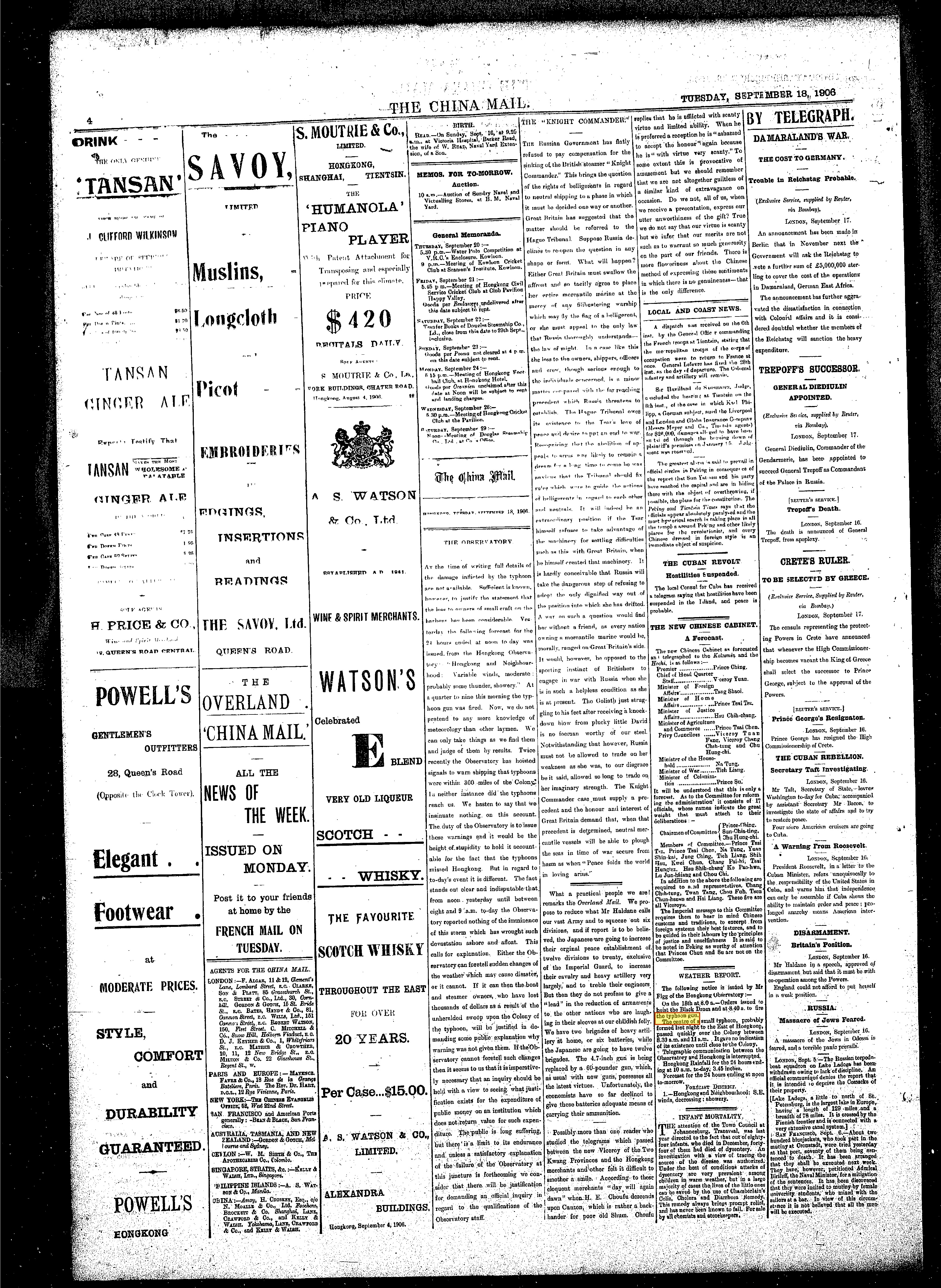
The gun-time variance is the record’s own. The same Observatory notice prints 8.40 in the China Mail and 8.30 in the Daily Press; the Telegraph printed 8.05; the Governor said “about nine o’clock” in the Council.7 The minute is not recoverable from the record; the warning’s order of magnitude is — half an hour, not hours. Every later judgement in this paper turns on that half hour.
3. The day after: the press’s account
The Daily Press’s leader of 19 September set the frame the inquiry would answer: “Not for many years has such a destructive typhoon visited the colony as that which yesterday struck Hongkong. Coming almost unexpectedly, it took a large section of the boat [population] by surprise … wholesale destruction [afloat and ashore]”; the Observatory had “told the shipping that the winds would be moderate and variable, accompanied by showers and possibly some thunder. As fact, we had with less than half an hour’s warning a typhoon such as has not struck [the Colony since 1874] … The public will not be satisfied unless there is an exhaustive enquiry into the whole conduct of this department.”8 The same issue’s weather report carried rainfall 3.45 inches for the twenty-four hours ending 10 a.m., and a correspondent’s letter proposing that the Observatory service be taken over by “the Jesuit fathers in either Shanghai or Manila”.9
The same papers counted the wrecks. The Telegraph of 19 September: “at least three large steamers, a vessel of war, a large sailing ship” total wrecks; the French torpedo-boat destroyers smashed; the Kowloon Wharf and Dock Company’s damage alone $750,000, with 40,000 bales of yarn ($500,000) destroyed; 86 junks sunk off the Western district; 200 junks sunk at Wanchai alone; the Ying Fal launch turned turtle with 130 passengers and a crew of 30; and eight Chinese arrested on charges of looting.10 In the same columns the paper printed the colony’s most prominent casualty — “BISHOP OF VICTORIA DEAD”: the Right Rev. Joseph Charles Hoare, on the “cruiser” Pioneer “in company with the boatman and a ‘boy’”, driven on the rocks at Castle Peak Bay and “utterly demolished”; “not a sign of any of the occupants … has since been seen”; the police version, with a second story (a junk journey to the outstations), still open.11
And the same columns recorded the rescue and the first offer of relief. Jardine, Matheson’s sugar-refinery employees brought “no fewer than 200 Chinese boat people ashore”, then found 400 more whose homes had disappeared — lodged at the refinery and the godowns; and the leading members of the Chinese community were “prepared … to follow the magnificent and spontaneous example they set for themselves in 1900” — Blake’s appeal after the 1900 typhoon — and contribute to a relief fund “the moment” the Governor “says the word”.12
4. The telegrams: three days of counting
The official counting began the day after the storm, and each successive register was larger than the last. Nathan’s telegram of 19 September (No. 2691): “extent of damage caused by typhoon. So far only 6 European fatalities known, but large loss of life among Chinese. Will arrange to give relief as far as possible.”13 The second telegram, received on the 20th, named the colony’s most prominent victim and widened the estimate: “Strong evidence that Bishop Hoare is drowned. Impossible to estimate loss of life but it probably amounts to several thousand.”14 One bishop and an unnumbered multitude, killed by the same morning in the same harbour — the telegrams’ two registers are the disaster’s social anatomy in two sentences.
The Governor stated both to the Legislative Council on 20 September: the loss of life and property “between the hours of nine and eleven on Tuesday morning” “greater than those incurred in the great typhoon of 1874”; “when the typhoon gun was fired about nine o’clock, crowds of helpless shipping drifting to the east before the wind”. To the press’s suggestion that earlier notice had been possible he answered: “I see no grounds for believing this possibility, but it is due to the public, and also to the Director of the Observatory that an inquiry should be held into it” — and announced the committee (a senior naval officer to preside, a master mariner nominated by the Chamber of Commerce, the manager of the Eastern Extension Telegraph Company). The same speech named the relief machinery: the public subscription, the Chinese institutional representatives Ho Kai, Wei Yuk, Fung Wa-chun, Lau Chu-pak and Fang Chi-ngong, the Council to vote a sum equal to private subscriptions, interest-free loans for junk-owners; the new typhoon “signalled about six o’clock last night” had ended the search for the drowned; the French destroyer had been lost “while enjoying the hospitality of our port” with five of her sailors; of Bishop Hoare there were “no grounds for hope that we shall ever again see” him.15
The Bishop’s death, like the toll, never closed. The China Mail of 26 September printed the item “NOT THE BISHOP”: a corpse landed on an island near Macao, “not that of Bishop Hoare” — “a tall and powerful man, with red hair and a red beard. The other bodies were all Chinese” — and “the attempts to recover his body [have] not [been] successful”.16 The record’s own words stay “strong evidence”, never more.
5. The census: the record counts what it can
The accounting that followed is the Sessional Paper’s boat census — the record’s most honest document about its own limits. Boats sunk or wrecked: passenger boats 154, cargo boats 700, trading junks 230, harbour boats 120, fishing boats and junks 483 — total 1,687, with 34 steam launches. The missing: “The number of persons reported to the Police and Harbour Department as missing was 1,347. It is to be feared that the latter figure is very much below the mark. Boats which were lost with all hands, as a very large number were, are not likely to have been reported.” The census’s own verdict on the boat population’s dead: “The total loss of life in the Boat Population of the Colony at the lowest estimate was probably at least 5,000.”17 The greatest loss of life was among the small craft’s crews — yet the total number of lives reported lost in vessels of that description was only 139; the gap between 139 and 5,000 is the census’s own statement of how much the reporting system could not see.18
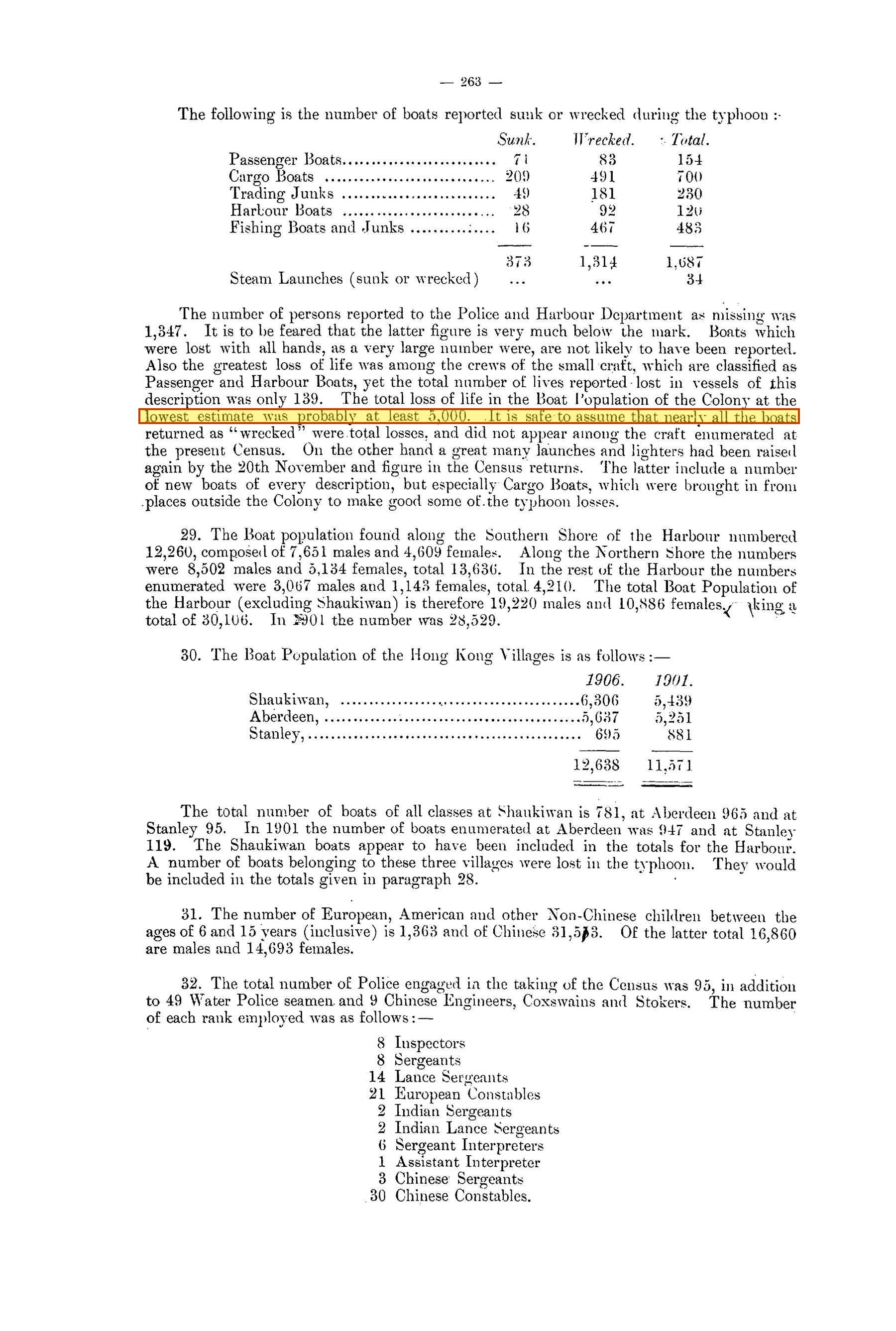
The harbour’s boat population, counted after the disaster, stood at 30,106 — against 28,529 in 1901 — a fleet rebuilt within weeks by boats “brought in from places outside the Colony to make good some of the typhoon losses”.19 The people were not replaced that way; the boats were. That asymmetry is the census’s last word.
6. The Committee of Enquiry: the record judges itself
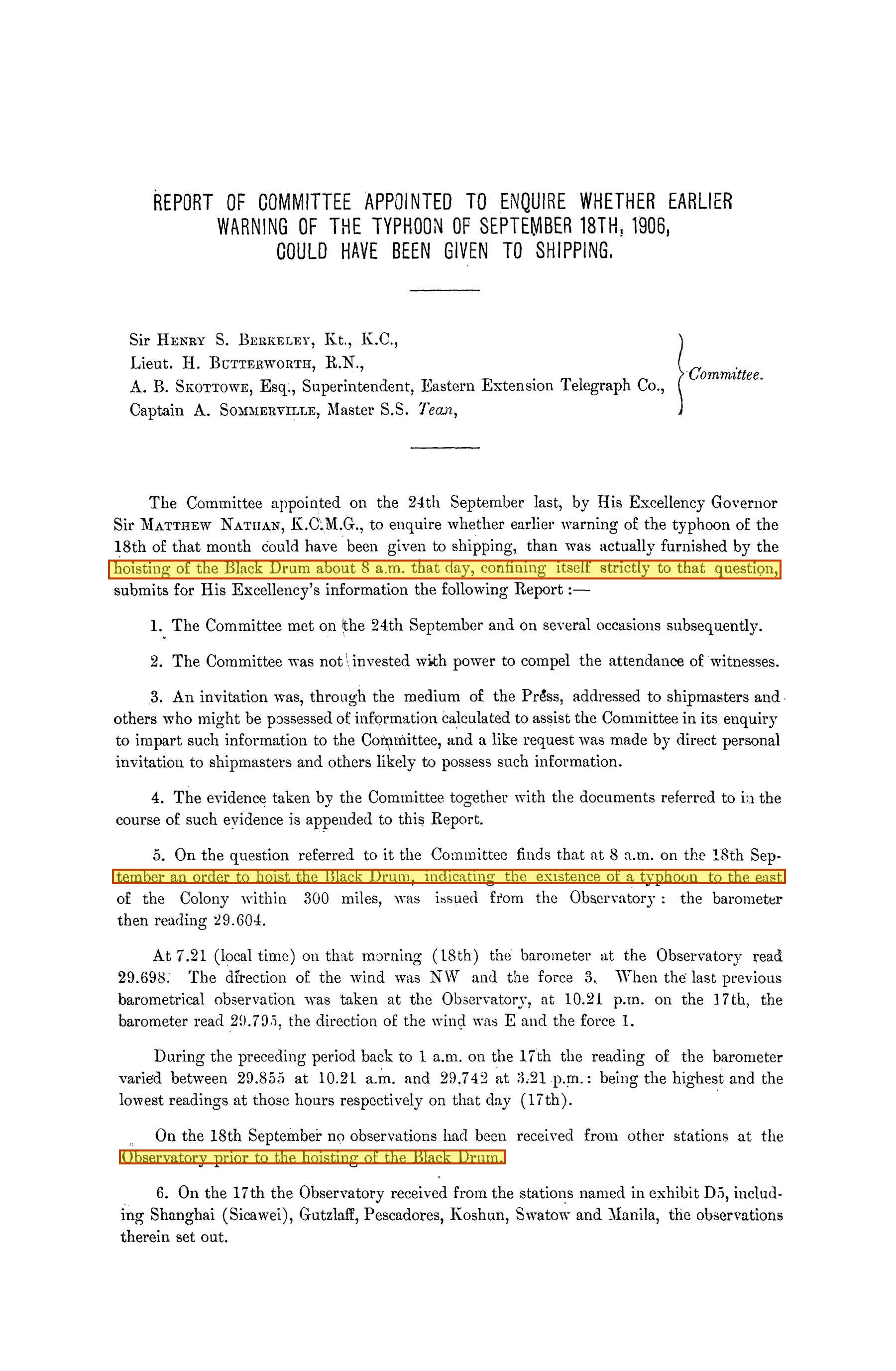
The Committee was appointed by Governor Sir Matthew Nathan on 24 September 1906: Sir Henry S. Berkeley (Chief Justice), Lieutenant H. Butterworth R.N. (the King’s Harbour Master), A. B. Skottowe (Superintendent, Eastern Extension Telegraph Company) and Captain A. Sommerville (master, S.S. Tean) — “not invested with power to compel the attendance of witnesses”, shipmasters invited through the press. Its report, signed at the Attorney General’s Chambers on 23 October 1906, opens with the barometric table: at 8 a.m. on the 18th “an order to hoist the Black Drum, indicating the existence of a typhoon to the east of the Colony within 300 miles, was issued from the Observatory: the barometer then reading 29.604” (7.21 a.m.: 29.698, wind NW force 3; 10.21 p.m. on the 17th: 29.795, wind E force 1); “On the 18th September no observations had been received from other stations at the Observatory prior to the hoisting of the Black Drum”; the 17th’s readings, against the Zikawei remarks (“filling up gradually”), “did not call for the hoisting of any typhoon signal in Hongkong on the 17th September”. And the finding: “Reviewing the evidence as a whole, the Committee find that prior to 7.44 a.m. on the 18th September there was no indication of a typhoon approaching Hongkong: and that warning, by the hoisting of the Black Drum on the morning of the 18th, was given as soon as, in the circumstances, was practically possible.”20
The finding had to weigh conflicting evidence, and the report prints the conflict rather than smoothing it: Captain Unsworth (7.30 a.m., the sea “breaking over the wharves at Kowloon”, “no skiff could have lived in such a sea”) against Captain Outerbridge (who “did not leave the shore to rejoin his ship till between 8.30 and 8.45 a.m.”); H.M.S. Tamar’s signal log (torpedo boat No. 38 left 8.15, after the Black Drum, “and safely entered the camber”); and M. Liebert, the French Consul — the red sunset of the 17th, the Polynesien’s full steam at 3 a.m., the destroyers steaming up at 7 a.m. “sometime before the first signal was hoisted” — which the Committee found “inconceivable” as preparation.21
The report reached the colony in March 1907, and the press battle that followed is part of the record. The Daily Press accepted the exoneration — “we are not prepared to dispute the decision of the Committee that the earliest possible warning was given” — but turned on the witnesses’ manner: Doberck’s and Figg’s “positive denials of jealousy and lack of cordiality … accompanied by comments which most [thinking] men will consider to savour [of animus]” toward “the Jesuits who undertake Observatory work at Manila and Shanghai”; Doberck’s “we have to be very careful” about the neighbouring experts; Captain Outerbridge’s dry “I am very glad to hear it” when told the Director called his Manila relations cordial.22 The Weekly Press dissected the report’s use of the same witness the other way: Outerbridge “did leave the Bund about 8.45” — but his means of reaching his ship was to pay $25 for a steam launch that could not come alongside, and then, “holding on to a rope which was thrown to him from his ship … plunged into the sea and was hauled aboard” — “so high was the sea then running in the harbour”.23
7. The Observatory’s own account — and its concession
While the Committee sat, the Director published his own version of the morning in the Observatory’s annual report — and it conceded more than the exoneration required. The telegraph line to the east had been interrupted from 17 September, 4.05 p.m., to 24 September, 2.30 p.m.; the Gap Rock cable from the 18th to 31 December (248 days interrupted that year) — and the report states the stakes plainly: “As our warnings in connection with typhoons in the China Sea are based mainly on reports received from the Gap Rock lighthouse, it is of the utmost importance that the cable between Hongkong and Gap Rock should be always in working order”. Against that broken line stands the concession: “Twice the gun was fired too late. In the first case warning had been given some hours previously by the hoisting of signals, and in the second instance, that of September 18th, 1906, both signal and gun were late.” The cause given: “owing to the extremely small diameter of the disturbance, its existence was not known beforehand and the indications were insufficient to justify the hoisting of signals till half past seven in the morning” — and the limit of any earlier warning: the storm “occurred at flood tide, which, owing to the typhoon, was of exceptional height … against which no precautionary measures would have availed”; the maximum hourly wind velocity, 77 miles between 9.30 and 10.30 a.m., “did not reach full typhoon force”, though “there were during this interval some four or five squalls of great severity”.24
The inquiry’s widening came from outside the colony. Nathan’s despatch records a “report published at Shanghai on the 23rd September with the authority of the Zikawei Station, suggesting that earlier prediction was possible”; hence the scope’s extension “to the general working of the Observatory and to its relations with the other Observatories in the Far East”, the evidence to go “to the Royal Observatory at Greenwich”. Beside the signals stood the shelters: the Causeway Bay junk anchorage, “provided in 1883 to give a safe place of refuge of about 100 acres in extent … barely sufficient”, entered the same review.25 At home the Council pressed prevention: the $20,000 damages vote of 27 September came with Dr Ho Kai’s plea for refuges beyond Causeway Bay — “at Kennedy Town and another on the mainland side of the harbour … so that even with short notice Chinese boat owners could run for that to which they were closer” — while the Governor confined the committee’s inquiry “to questions of fact” against the unofficial members’ wish to extend it, and a correspondent’s polemic demanded the gun “at least at six a.m.” — printed as opinion, never as finding.2627
8. The counterfactual and the aftermath
Ten days later the record acquired its control experiment. A second typhoon, 28–29 September, struck a harbour that had been warned: the gun at five o’clock on Friday evening, the sampans making “a speedy run for shelter”, the ships secured by two anchors and steam — and “although the gale was almost as furious as that of the fatal 18th of September, its effects were by no means so disastrous, thanks to the timely warning which enabled adequate preparations to be made”; the shipping losses “comparatively light”. (The Macdonnell Road landslip of the same night killed one coolie and buried three more; the rescue saved three.)28 Figg’s evidence to the Committee dates the warning precisely: the second typhoon “was first notified from the Hongkong Observatory on the 25th at 10.55 a.m.”, “it blew with full typhoon force for 11 hours at Gap Rock”.29 The 18th’s dead had priced the difference a warning makes; the 28th’s survivors collected it.
The Governor himself inspected the Causeway Bay anchorage on the night of 28–29 September, and the Council heard his finding on 1 November: “though owing to the unfortunate disaster of the 18th the anchorage was by no means full, yet all the small craft were in shallow water right up against the roadway, so that I rather infer that the small craft are, or at any rate think themselves, safer in the shallow than in the deep water of the existing anchorage” — with more harbours of refuge (Mongkoktsui and elsewhere) on the table. The same Council’s Financial Minutes price the storm’s tail: $1,200 for the Botanical and Forestry Department’s storm clearance; $180 for a house at Taipo, “the matshed formerly used for that purpose having been destroyed by the typhoon”; $5,000 for the police launches; $1,000 for raising the floating fire engine; $175 in rewards “to the junior clerks and coolies at Taipo for good work … in saving land records when the Land Office matshed was blown down”.30
The Typhoon Relief Fund’s accounts, printed in the same Sessional Paper, close the machinery: the General Committee under Hon. Sir Paul Chater; the Sub-Committee under the Registrar General with Ho Kai, Wei Yuk, Ho Kom Tong, Lau Chu-pak and Fung Wa-chun; the Investigating Committee under Fung Wa-chun; and the Statement of Expenditure — grants to buy, build or repair boats $198,002 (1,600 Chinese cases and one European); widows and orphans $16,128.45 (205 cases); corpses and destitutes through the Tung Wa Hospital $17,985.30; clerks’ salaries $577.16.31 The fund bought back the harbour’s fleet, case by case.
9. Conclusion
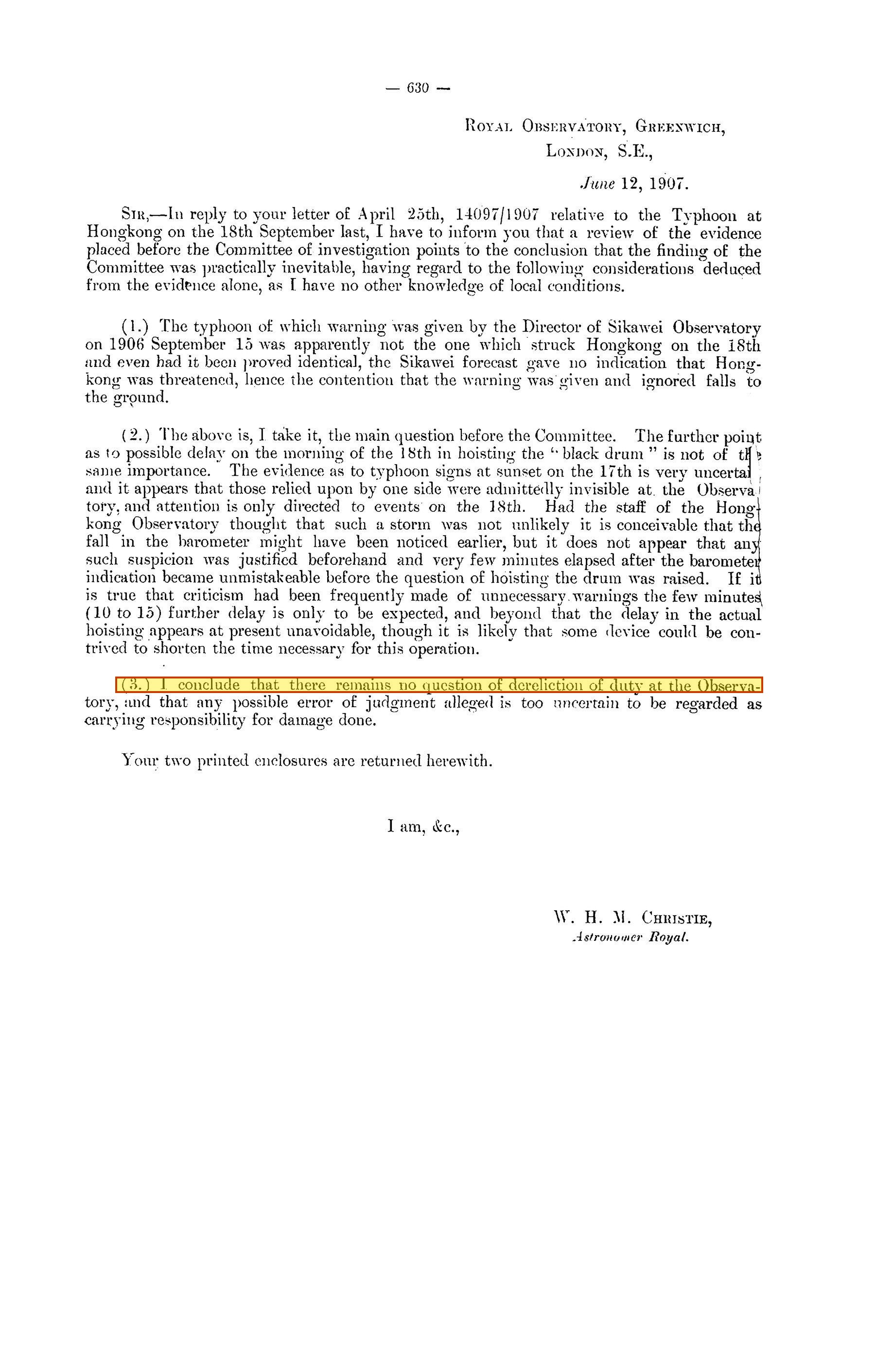
The verdict came from Greenwich. The Secretary of State’s despatch of 18 June 1907 encloses the Astronomer Royal’s letter of 12 June: “a review of the evidence … points to the conclusion that the finding of the Committee was practically inevitable”; the Zikawei warning of 15 September “was apparently not the one which struck Hongkong on the 18th”, so “the contention that the warning was given and ignored falls to the ground”; and, on the delay critics alleged, the psychology of an observatory that had been told too often it cried wolf: “If it is true that criticism had been frequently made of unnecessary warnings the few minutes (10 to 15) further delay is only to be expected”. The conclusion: “no question of dereliction of duty at the Observatory, and … any possible error of judgment alleged is too uncertain to be regarded as carrying responsibility for damage done.”32 Three months after the storm the Director whose warning had been judged went on leave: “Government has been pleased to appoint Mr. F. Figg to act as Director of the Observatory during the absence on leave of Dr. W. Doberck”.33
The conclusion is the record’s own, in three parts. First, the warning: the order of magnitude is half an hour, and the Committee’s finding — “no indication … prior to 7.44 a.m.”, the warning “practically possible” — stands beside the Director’s own concession that “both signal and gun were late”3435: the record holds both and does not reconcile them, because the exoneration and the concession are about different things — whether earlier warning was practicable, and whether the half hour could have been halved. Second, the dead: three registers, none totalised — “large loss”36, “several thousand”37, “at least 5,000”38 — and a higher popular toll the adversarial sweep could not find in the corpus at all.39 The record marks where the counting stopped. Third, the counterfactual: the second typhoon ten days later, warned in advance, “by no means so disastrous, thanks to the timely warning”40 — the same harbour, the same Observatory, the difference a half hour makes, priced in the record’s own comparison. What the disaster built is visible in the documents that follow it: an inquiry sent to Greenwich, a shelter debate reopened, a relief fund that rebuilt the fleet, and a warning system whose next test the record itself grades.
Appendix A: sources and method
The documentary corpus is the hkintexts research index, queried read-only on 12 October 2026 after the original 5 October pass; every passage quoted was read in its whole document; every corpus document id cited was re-fetched and the quoted phrase grepped before citation. No write was made to the index. The compulsory whole-document pull is both newspapers of 19 September 1906 (dumpdoc, 16 pages). Query families:
- the storm-day and day-after press — typhoon + the 18–21 September 1906 document keys (32 hits; three papers read);
- the gun and the drum — “typhoon gun” (31) and “black drum” (22) across 1906–07;
- the official record — the CO 129/335 telegrams and despatches (re-verified by get.py: 405661, 405666, 405766);
- the Sessional Papers 1907 — the Committee report (printed pp. 51–53), the Director’s report, the boat census (printed p. 263), the relief accounts (pp. 280–282), the Elgin despatch and Christie letter (pp. 629–630);
- the LegCo hansards of 20 September, 27–28 September and 1 November 1906;
- the inquiry in the March–April 1907 press (the report printed in the Telegraph 30 March; the Daily Press’s 26 March editorial; the Weekly Press’s 1 April counter-analysis);
- the Observatory aftermath (Doberck’s leave; Figg acting, June 1907);
- 丙午風災 — 0 hits: the retrospective Chinese term is not in the corpus; the 1906 Chinese press lies outside the corpus’s Chinese stratum;
- the adversarial battery A1–A6 (Appendix B).
The image pass produced four document plates, each read back by eye at
its final crop before this draft (the §6B gate, 12 October 2026): the
China Mail of 18 September (the storm-day paper), the boat-census
page, the Committee report’s opening, and the Christie letter. Where
an image twin exists, the citations carry the
/image-page/ scan link; the text series remains what was
searched and quoted from.
Appendix B: evidence register
| Claim | Witnesses |
|---|---|
| The storm struck the harbour the morning of Tuesday 18 September 1906, of “phenomenal violence”, lasting about two hours | the Telegraph, 18 Sept; the China Mail, 18 Sept; the Daily Press, 19 Sept; Nathan’s LegCo statement (“between the hours of nine and eleven”) |
| The warning: black drum order 8.00 a.m. (barometer 29.604); the gun within the half hour; “no indication of its existence until close to the Colony” | the Figg notice printed in the China Mail 18 Sept and the Daily Press 19 Sept; the Committee’s finding; the Director’s report (“till half past seven … the indications were insufficient”) |
| The gun-time variance (8.05 / 8.30 / 8.40 / “a quarter to nine” / “about nine”) | the Telegraph 18 Sept; the Daily Press 19 Sept; the China Mail 18 Sept; Nathan — never assert one minute |
| The dead: three registers, none totalised (6 European / “several thousand” / 1,347 missing, “at least 5,000”) | the telegrams; the boat census; the press |
| 1,687 boats sunk or wrecked (+34 steam launches); the fleet rebuilt to 30,106 | the boat census; the press’s same-day fragments (86 junks Western; 200 Wanchai) |
| Bishop Hoare lost in the storm; the body never recovered | the telegrams; the Telegraph 19 Sept; Nathan’s LegCo statement; the “NOT THE BISHOP” item |
| The Committee’s finding: “no indication … prior to 7.44 a.m.”; the warning “practically possible” | the report itself; its printing in the Telegraph 30 Mar 1907 (“HONGKONG OBSERVATORY EXONERATED”); the Daily Press 26 Mar editorial accepting it |
| The Observatory’s own concession: “both signal and gun were late” | the Director’s report for 1906; against it the Committee’s exoneration — the tension is the record’s own |
| The Greenwich verdict: “practically inevitable … no question of dereliction of duty” | the Christie letter + Elgin despatch; the scope’s extension and referral in Nathan’s despatch |
| The second typhoon warned in advance; its effects “by no means so disastrous” | the Weekly Press 6 Oct; Figg’s evidence (notified 25 Sept, 10.55 a.m.) |
| The relief machinery: the Chater-chaired fund; the matching vote; the boat grants $198,002 | Nathan’s LegCo 20 Sept; the fund’s accounts; the committee lists |
| Item | Source |
|---|---|
| The Observatory notice’s gun time “8.40 a.m.” as printed in the China Mail 18 September (the same notice prints 8.30 in the Daily Press) | kept as the record’s own variance, never resolved |
| The Jardine refinery’s 200 + 400 rescued; the Naval Yard’s hundred more | the Telegraph’s own tally of one day’s shelters |
| The Macdonnell Road landslip (one killed, three rescued, three believed buried) | the Weekly Press’s rescue account |
| The polemic “the gun should have been fired at least at six a.m.” | a correspondent’s letter, printed as opinion, never as finding |
| Item | Resolution |
|---|---|
| The gun time | 8.05 / 8.30 / 8.40 / “a quarter to nine” / “about nine o’clock” — the Committee’s report pins only the DRUM order to 8.00 a.m. and the barometer to 29.604; register the range, cite the Committee for the load-bearing fact |
| The toll | “several thousand” vs “at least 5,000” (the boat population alone) vs 1,347 reported missing (“very much below the mark”) — three registers, each limited by its maker; no single total is corpus-attested |
| The exoneration vs the concession | the Committee’s “practically possible” against the Director’s “both signal and gun were late” — the record holds both; the paper prints both and does not reconcile them |
| The press’s “less than half an hour’s warning” vs the Committee’s “prior to 7.44 a.m. no indication” | consistent within minutes (drum 8.00); the difference is rhetorical, not factual |
| Item | Why |
|---|---|
| 丙午風災 | 0 hits — the retrospective Chinese term is not in the corpus |
| A single death toll | the corpus holds registers, not a total; any “the typhoon killed N” claim is a construct |
| The popular 10,000+ toll for 1906 | swept (adversarial A2): all “10,000” + typhoon hits are price/tonnage tables |
| The Daily Press’s “4.40” gun time | an OCR garble against the same issue’s printed notice (8.30); never cited |
| “The warning was given and ignored” (the Zikawei contention) | killed by the record itself: the Zikawei remarks called the disturbance “filling up gradually” on the 17th; Christie found the 15 September warning “apparently not” the typhoon that struck |
| Item | Why |
|---|---|
| The gun’s exact minute | the record prints five values; the Committee pins only the drum order (8.00 a.m.) and the barometer (29.604) |
| Hoare’s death, closed | “strong evidence”, “no grounds for hope”; the body never recovered; the second story (the junk) never excluded in the record pulled |
| The Observatory inquiry’s full evidence | the Sessional Paper carries the report and its exhibits list; the complete evidence transcripts (printed pp. 54–108 per the report’s contents) were not pulled page by page |
| The Chinese-language record of the disaster | outside the corpus’s Chinese stratum for 1906 |
| Doberck’s departure, closed | the corpus shows the leave and Figg’s acting appointment (June 1907); the formal end of his directorship lies outside the pulled pages |
| Attempt | Query and outcome |
|---|---|
| A1 — could a signal have been up before the 18th? | drum/typhoon-signal sweep 16–17 September = 1 hit, the China Mail of 17 September — the shelter-overstaying prosecution from the EARLIER September signal. No signal for the 18th’s storm. The finding survives. |
| A2 — is a higher toll attested? | “10,000” + typhoon, 1906–07 = 452 raw hits, all price and tonnage tables (spot-checked). The claim survives. |
| A3 — did the storm-day papers record an earlier warning? | = 2 hits, the Telegraph and China Mail of 18 September — the pieces already cited; the Mail prints “no danger signal was hoisted” before the morning. Survives. |
| A4 — was the exoneration reversed? | committee + typhoon + reverse/reject/dissent, late 1906–1907 = 26 raw hits, none a revocation; Greenwich’s June 1907 verdict upholds the Committee. Survives. |
| A5 — the gun-time readings re-checked | all five values re-read from the pulled pages; the variance is registered, not resolved. The Committee’s 8.00 drum order (barometer 29.604) is the pinned fact. |
| A6 — the Daily Press leader’s “4.40” | checked against the same issue’s printed Observatory notice (8.30) — OCR garble, registered as do-not-use. |
Notes
- ↑Method note: the documentary corpus interrogated for this paper is the hkintexts research index (read-only), queried 12 October 2026 after the original 5 October pass; the query families are itemised in Appendix A and the Stage-7 adversarial pass (A1–A6) is recorded in Appendix B. Every passage quoted was read in its whole document; the compulsory whole-issue pull is both newspapers of 19 September 1906 (16 pages). The Chinese-language stratum is absent for 1906 (丙午風災 = 0 hits; the corpus’s Chinese series start later), so the Chinese dead are counted here in the English record’s tables — which is where the colony counted them.
- ↑The retrospective Chinese term for the disaster, 丙午風災, returns 0 hits in the corpus: the 1906 Chinese press lies outside the corpus’s Chinese stratum (adversarial negative control, Appendix B).
- ↑The China Mail, 17 September 1906 — the day before: boatmen prosecuted for keeping their boats “in the typhoon shelter at Causeway Bay for a longer time than was in the opinion of the police necessary”, the sampans having “crowded into the shelter as soon as the typhoon signal was hoisted last week and remained there for a day after the signal was taken down”. The signal of the earlier September typhoon, not the 18th’s (adversarial A1). https://hkintexts.histsyn.com/page/1925858 (accessed 12 October 2026).
- ↑Method note: the documentary corpus interrogated for this paper is the hkintexts research index (read-only), queried 12 October 2026 after the original 5 October pass; the query families are itemised in Appendix A and the Stage-7 adversarial pass (A1–A6) is recorded in Appendix B. Every passage quoted was read in its whole document; the compulsory whole-issue pull is both newspapers of 19 September 1906 (16 pages). The Chinese-language stratum is absent for 1906 (丙午風災 = 0 hits; the corpus’s Chinese series start later), so the Chinese dead are counted here in the English record’s tables — which is where the colony counted them.
- ↑The China Mail, 18 September 1906, p. 4 — the same-day record. The editorial “THE OBSERVATORY”: the gun “at a quarter to nine this morning”; “for several days it has been feared that a typhoon was in the vicinity, but no inkling of its proximity could [be had]… no danger signal was hoisted”; the demand for “an official inquiry into the qualifications of the Observatory staff”. The Weather Report prints the Observatory’s own notice: “On the 18th at 8.0 a.m.—Orders issued to hoist the Black Drum and at 8.4[0] a.m. to fire the typhoon gun… The centre of a small typhoon, probably formed last night to the East of Hongkong, passed quickly over the Colony between 8.30 a.m. and 11 a.m. It gave no indication of its existence until close to the Colony.” https://hkintexts.histsyn.com/image-page/1326048 (scan; text series https://hkintexts.histsyn.com/page/1925866 ) (accessed 12 October 2026).
- ↑The Hongkong Telegraph, 18 September 1906, p. 4 — “TERRIFIC TYPHOON”: “In the short space of barely two hours” a typhoon “of phenomenal violence” brought “ruin, wreck and disaster to the greater portion of the native community”; “At five minutes past eight the typhoon gun was fired and five minutes later the black ball was hanging from the yard of H.M.S. Tamar”. https://hkintexts.histsyn.com/page/2856350 (accessed 12 October 2026).
- ↑The gun-time variance is the record’s own: 8.05 (the Telegraph, 18 September — note 5); 8.30 (the Observatory’s printed notice per the Daily Press, 19 September — note 7); 8.40 (the same notice per the China Mail — note 3); “a quarter to nine” (the Mail’s editorial — note 3); “about nine o’clock” (Governor Nathan — note 8). The Daily Press leader’s “4.40” is an OCR garble against the same issue’s printed notice (8.30) and is never cited (do-not, Appendix B). The minute is not recoverable; the order of magnitude is — half an hour, not hours.
- ↑The Daily Press, 19 September 1906, p. 2 — the leader: “Not for many years has such a destructive typhoon visited the colony as that which yesterday struck Hongkong. Coming almost unexpectedly, it took a large section of the boat [population] by surprise… wholesale destruction [afloat and ashore]”; “the most disastrous that has taken place here within recent years”; the Observatory “told the shipping that the winds would be moderate and variable… As fact, we had with less than half an hour’s warning a typhoon such as has not struck [the Colony since 1874]… The public will not be satisfied unless there is an exhaustive enquiry into the whole conduct of this department.” https://hkintexts.histsyn.com/page/2250324 (accessed 12 October 2026).
- ↑The Daily Press, 19 September 1906, p. 2 (as note 7).
- ↑The Telegraph, 19 September 1906, p. 4 — the wreck ledger of the day after: “at least three large steamers, a vessel of war, a large sailing ship” total wrecks; the French torpedo-boat destroyers smashed; the Kowloon Wharf and Dock Company’s damage alone $750,000, with 40,000 bales of yarn ($500,000) destroyed; 86 junks sunk off the Western district; 200 junks sunk at Wanchai alone; the Ying Fal launch turned turtle with 130 passengers and a crew of 30; “eight Chinese were arrested yesterday on a charge of looting”. https://hkintexts.histsyn.com/page/2856358 (accessed 12 October 2026).
- ↑The Telegraph, 19 September 1906, p. 4 — “BISHOP OF VICTORIA DEAD”: the Right Rev. Joseph Charles Hoare “on the ‘cruiser’ Pioneer, in company with the boatman and a ‘boy’”, driven on the rocks at Castle Peak Bay and “utterly demolished”, “not a sign of any of the occupants… has since been seen”; the police version, with a second story (a junk journey to the outstations) still open. https://hkintexts.histsyn.com/page/2856358 (accessed 12 October 2026).
- ↑The Telegraph, 19 September 1906, p. 4 — the rescue and the relief offer: Jardine, Matheson’s sugar-refinery employees brought “no fewer than 200 Chinese boat people ashore”, then found 400 more whose homes had disappeared — lodged at the refinery and godowns; the leading members of the Chinese community “prepared…to follow the magnificent and spontaneous example they set for themselves in 1900” (Blake’s appeal after the 1900 typhoon) and contribute to a relief fund “the moment” the Governor “says the word”. https://hkintexts.histsyn.com/page/2856358 (accessed 12 October 2026).
- ↑Governor Nathan’s telegram, CO 129/335 — Governor Nathan — 1906 [8–10], p. 203 (Typhoon Reports, No. 2691, DE 19 SEP 06): “extent of damage caused by typhoon. So far only 6 European fatalities known, but large loss of life among Chinese. Will arrange to give relief as far as possible.” https://hkintexts.histsyn.com/page/405661 (accessed 12 October 2026).
- ↑Telegram No. 34806 with the Colonial Office minutes, CO 129/335, p. 208, received 20 September 1906: “Strong evidence that Bishop Hoare is drowned. Impossible to estimate loss of life but it probably amounts to several thousand.” The CO minutes record the sympathy exchanged at the loss among the Chinese population. https://hkintexts.histsyn.com/page/405666 (accessed 12 October 2026).
- ↑The Legislative Council, 20 September 1906 — the Governor’s statement: the loss of life and property “between the hours of nine and eleven on Tuesday morning” “greater than those incurred in the great typhoon of 1874”; “when the typhoon gun was fired about nine o’clock, crowds of helpless shipping drifting to the east before the wind”; the press’s earlier-notice suggestion answered — “I see no grounds for believing this possibility, but it is due to the public, and also to the Director of the Observatory that an inquiry should be held into it”; the committee announced (a senior naval officer to preside, a master mariner nominated by the Chamber of Commerce, the manager of the Eastern Extension Telegraph Company); the relief machinery named (the public subscription, the Chinese institutional representatives Ho Kai, Wei Yuk, Fung Wa-chun, Lau Chu-pak, Fang Chi-ngong; the Council to vote a sum equal to private subscriptions; interest-free loans for junk-owners); the new typhoon “signalled about six o’clock last night” ending the search for the drowned; the French destroyer lost “while enjoying the hospitality of our port” with five of her sailors; Bishop Hoare — “no grounds for hope that we shall ever again see Bishop Hoare”. https://hkintexts.histsyn.com/page/1881895 (accessed 12 October 2026).
- ↑The China Mail, 26 September 1906 — “NOT THE BISHOP”: a corpse landed on an island near Macao, “not that of Bishop Hoare” (“a tall and powerful man, with red hair and a red beard. The other bodies were all Chinese”); “the attempts to recover his body [have] not [been] successful”. The death was never closed by a body; the record’s own words stay “strong evidence”. https://hkintexts.histsyn.com/page/2250374 (accessed 12 October 2026).
- ↑Sessional Paper 1907, printed p. 263 — the boat census after the typhoon: boats sunk or wrecked — passenger boats 154, cargo boats 700, trading junks 230, harbour boats 120, fishing boats and junks 483 — total 1,687, with 34 steam launches; “The number of persons reported to the Police and Harbour Department as missing was 1,347. It is to be feared that the latter figure is very much below the mark. Boats which were lost with all hands, as a very large number were, are not likely to have been reported.” Also: the greatest loss of life was among the small craft’s crews, “yet the total number of lives reported lost in vessels of this description was only 139”; and the verdict: “The total loss of life in the Boat Population of the Colony at the lowest estimate was probably at least 5,000.” The post-typhoon boat census: 30,106 in the harbour (28,529 in 1901) — the fleet rebuilt within weeks, with new cargo boats “brought in from places outside the Colony to make good some of the typhoon losses”. https://hkintexts.histsyn.com/image-page/1618444 (scan; text series https://hkintexts.histsyn.com/page/1826862 ) (accessed 12 October 2026).
- ↑Boat census, Sessional Paper 1907, printed p. 263 (as note 18).
- ↑Boat census, Sessional Paper 1907, printed p. 263 (as note 18).
- ↑Sessional Paper 1907, printed pp. 51–53 — REPORT OF COMMITTEE APPOINTED TO ENQUIRE WHETHER EARLIER WARNING OF THE TYPHOON OF SEPTEMBER 18TH, 1906, COULD HAVE BEEN GIVEN TO SHIPPING (the Committee: Sir Henry S. Berkeley, Chief Justice; Lieut. H. Butterworth R.N., the King’s Harbour Master; A. B. Skottowe, Superintendent, Eastern Extension; Captain A. Sommerville, master, S.S. Tean; appointed 24 September 1906 by Governor Sir Matthew Nathan; “not invested with power to compel the attendance of witnesses”; signed at the Attorney General’s Chambers, 23 October 1906). The findings: at 8 a.m. on the 18th “an order to hoist the Black Drum… was issued from the Observatory: the barometer then reading 29.604” (7.21 a.m.: 29.698, wind NW force 3; 10.21 p.m. on the 17th: 29.795, wind E force 1); “On the 18th September no observations had been received from other stations at the Observatory prior to the hoisting of the Black Drum”; the 17th’s barometric observations — against the Zikawei remarks (“filling up gradually”) — “did not call for the hoisting of any typhoon signal in Hongkong on the 17th September”; and the finding: “Reviewing the evidence as a whole, the Committee find that prior to 7.44 a.m. on the 18th September there was no indication of a typhoon approaching Hongkong: and that warning, by the hoisting of the Black Drum on the morning of the 18th, was given as soon as, in the circumstances, was practically possible.” https://hkintexts.histsyn.com/image-page/1617913 (scan; text series https://hkintexts.histsyn.com/page/1826339 , https://hkintexts.histsyn.com/page/1826341 ) (accessed 12 October 2026).
- ↑The conflicting evidence the finding had to weigh, printed in the same report (Sessional Paper 1907, pp. 51–53): Captain Unsworth (7.30 a.m., the sea “breaking over the wharves at Kowloon”, “no skiff could have lived in such a sea”) against Captain Outerbridge (who “did not leave the shore to rejoin his ship till between 8.30 and 8.45 a.m.”), H.M.S. Tamar’s signal log (torpedo boat No. 38 left 8.15, after the Black Drum, “and safely entered the camber”), and M. Liebert, the French Consul — the red sunset of the 17th, the Polynesien’s full steam at 3 a.m., the destroyers steaming up at 7 a.m. “sometime before the first signal was hoisted” — which the Committee found “inconceivable” as preparation. https://hkintexts.histsyn.com/image-page/1617913 (accessed 12 October 2026).
- ↑The Daily Press, 26 March 1907, p. 2 — the report’s arrival: the exoneration accepted — “we are not prepared to dispute the decision of the Committee that the earliest possible warning was given” — but the witnesses’ manner turned on: Doberck’s and Figg’s “positive denials of jealousy and lack of cordiality… accompanied by comments which most [thinking] men will consider to savour [of animus]” toward “the Jesuits who undertake Observatory work at Manila and Shanghai”; Doberck’s “we have to be very careful” about the neighbouring experts; Capt. Outerbridge’s dry “I am very glad to hear it” when told the Director called his Manila relations cordial; “public opinion was already formed, and was merely echoed, not influenced, by the papers”. https://hkintexts.histsyn.com/page/2251615 (accessed 12 October 2026).
- ↑The Weekly Press, 1 April 1907 — the counter-analysis of the Committee’s use of Outerbridge: the witness “did leave the Bund about 8.45”, but his means of reaching his ship was “agreeing to pay to the Captain of a large steam launch a sum of $25” and then, the launch unable to come alongside, “holding on to a rope which was thrown to him from his ship, Captain Outerbridge plunged into the sea and was hauled aboard” — “so high was the sea then running in the harbour”; a reading of the same fact the Committee had used the other way. https://hkintexts.histsyn.com/page/2167177 (accessed 12 October 2026).
- ↑Sessional Paper 1907 — REPORT OF THE DIRECTOR OF THE HONGKONG OBSERVATORY, FOR THE YEAR 1906: the telegraph line to the east interrupted from 17 September, 4.05 p.m. to 24 September, 2.30 p.m.; the Gap Rock cable interrupted 18 September to 31 December (248 days interrupted that year) — “As our warnings in connection with typhoons in the China Sea are based mainly on reports received from the Gap Rock lighthouse, it is of the utmost importance that the cable between Hongkong and Gap Rock should be always in working order”; the gun’s 23-year record (fired 44 times since 1 January 1884; 77 per cent success); and the concession: “Twice the gun was fired too late. In the first case warning had been given some hours previously by the hoisting of signals, and in the second instance, that of September 18th, 1906, both signal and gun were late.” — with the cause: “owing to the extremely small diameter of the disturbance, its existence was not known beforehand and the indications were insufficient to justify the hoisting of signals till half past seven in the morning (Hongkong Mean Time)”; and the limit of any earlier warning: the storm “occurred at flood tide, which, owing to the typhoon, was of exceptional height… against which no precautionary measures would have availed”; the maximum hourly wind velocity 77 miles between 9.30 and 10.30 a.m., “did not reach full typhoon force”, but “there were during this interval some four or five squalls of great severity”. https://hkintexts.histsyn.com/page/1826832 ; https://hkintexts.histsyn.com/page/1826833 ; https://hkintexts.histsyn.com/page/1826834 (accessed 12 October 2026).
- ↑Governor Nathan’s despatch, CO 129/335, p. 304 — a “report published at Shanghai on the 23rd September with the authority of the Zikawei Station, suggesting that earlier prediction was possible”; hence the scope’s extension “to the general working of the Observatory and to its relations with the other Observatories in the Far East”, the evidence to go “to the Royal Observatory at Greenwich”; and the shelter question beside it — the Causeway Bay junk anchorage “provided in 1883 to give a safe place of refuge of about 100 acres in extent… barely sufficient”. https://hkintexts.histsyn.com/page/405766 (accessed 12 October 2026).
- ↑The Daily Press, 28 September 1906, p. 3 — the Council of 27 September: the $20,000 typhoon-damages vote; Dr Ho Kai’s plea for refuges beyond Causeway Bay — “at Kennedy Town and another on the mainland side of the harbour… so that even with short notice Chinese boat owners could run for that to which they were closer”. https://hkintexts.histsyn.com/page/2250391 (accessed 12 October 2026).
- ↑The China Mail, 28 September 1906, p. 5 — the Governor confines the committee’s inquiry “to questions of fact” because it had been “suggested that [the Colony] could have had earlier notice from the Observatory”, and the unofficial members want it extended; a correspondent’s polemic puts the gun an hour earlier: “The gun should have been fired at least at six a.m. on the 18th… a responsible officer on watch should be kept there at all hours of day and night during the south west [monsoon]” — printed as opinion, never as finding. https://hkintexts.histsyn.com/page/1925932 (accessed 12 October 2026).
- ↑The Weekly Press, 6 October 1906 (quoting the Daily Press, 1 October) — the second typhoon, 28–29 September: “although the gale was almost as furious as that of the fatal 18th of September, its effects were by no means so disastrous, thanks to the timely warning which enabled adequate preparations to be made to resist it or to obtain shelter” — the gun fired at five o’clock on Friday evening, the sampans making “a speedy run for shelter”, the ships secured by two anchors and steam; the losses “comparatively light”; the Macdonnell Road landslip killed one coolie and buried three more (the rescue saved three). https://hkintexts.histsyn.com/page/2166757 (accessed 12 October 2026).
- ↑The Hongkong Telegraph, 30 March 1907 — the report printed (the headline “HONGKONG OBSERVATORY EXONERATED”) and Mr. F. G. Figg’s evidence: the second typhoon “first notified from the Hongkong Observatory on the 25th at 10.55 a.m.” (its centre east of Luzon); “it blew with full typhoon force for 11 hours at Gap Rock”; the Zikawei forecasts handed to the Committee. https://hkintexts.histsyn.com/page/2857844 (accessed 12 October 2026).
- ↑The Legislative Council, 1 November 1906 — the Financial Minutes: $1,200 more for the Botanical and Forestry Department’s storm clearance; $180 for a house to carry on the Land Office at Taipo, “the matshed formerly used for that purpose having been destroyed by the typhoon”; $5,000 already voted for the police launches and pinnaces; $1,000 more for raising and beaching the floating fire engine; $175 in rewards “to the junior clerks and coolies at Taipo for good work… in saving land records when the Land Office matshed was blown down”. And the anchorage: the Governor had “visited the anchorage on the night of the 28th–29th September” and observed that “though owing to the unfortunate disaster of the 18th the anchorage was by no means full, yet all the small craft were in shallow water right up against the roadway, so that I rather infer that the small craft are, or at any rate think themselves, safer in the shallow than in the deep water of the existing anchorage” — with more harbours of refuge (Mongkoktsui and elsewhere) on the table. https://hkintexts.histsyn.com/page/1881899 (accessed 12 October 2026).
- ↑Sessional Paper 1907, printed pp. 280–282 — the Typhoon Relief Fund: the General Committee (Chairman Hon. Sir Paul Chater; Hon. Treasurer H. E. R. Hunter; Raymond, Nissim, Babington, Wood, Haupt, Goetz, Gresson…), the Sub-Committee under the Registrar General (A. W. Brewin) with Barnes-Lawrence, Ho Kai, Wei Yuk, Ho Kom Tong, Lau Chu-pak, Fung Wa-chun (Secretary), Tang Tsz-ngong, Francisco Tse-yat…, the Investigating Committee under Fung Wa-chun; the Statement of Expenditure: grants to buy, build or repair boats $198,002 (1,600 Chinese cases and one European); relief to widows and orphans $16,128.45 (205 cases); recovering and burying corpses and maintaining destitutes through the Tung Wa Hospital $17,985.30; clerks’ salaries $577.16. https://hkintexts.histsyn.com/page/1826879 ; https://hkintexts.histsyn.com/page/1826882 (accessed 12 October 2026).
- ↑Sessional Paper 1907, printed pp. 629–630 — DESPATCH FROM THE SECRETARY OF STATE WITH REGARD TO THE REPORT OF THE COMMITTEE OF ENQUIRY (Elgin, 18 June 1907) and the Astronomer Royal’s letter (W. H. M. Christie, Royal Observatory, Greenwich, 12 June 1907): “a review of the evidence… points to the conclusion that the finding of the Committee was practically inevitable”; the Zikawei warning of 15 September “was apparently not the one which struck Hongkong on the 18th and even had it been proved identical, the Sikawei forecast gave no indication that Hongkong was threatened, hence the contention that the warning was given and ignored falls to the ground”; and the psychology of the minutes lost: “If it is true that criticism had been frequently made of unnecessary warnings the few minutes (10 to 15) further delay is only to be expected”; the conclusion: “no question of dereliction of duty at the Observatory, and… any possible error of judgment alleged is too uncertain to be regarded as carrying responsibility for damage done.” https://hkintexts.histsyn.com/image-page/1618812 (scan; text series https://hkintexts.histsyn.com/page/1827217 , https://hkintexts.histsyn.com/page/1827218 ) (accessed 12 October 2026).
- ↑The Daily Press, 10 June 1907 — “Government has been pleased to appoint Mr. F. Figg to act as Director of the Observatory during the absence on leave of Dr. W. Doberck” — the Director whose warning the record had judged left on leave three months after the storm, his Assistant acting in his place. https://hkintexts.histsyn.com/page/2252149 (accessed 12 October 2026).
- ↑Report of Committee of Enquiry, Sessional Paper 1907, printed pp. 51–53 (as note 15).
- ↑Report of the Director of the Hongkong Observatory for 1906, Sessional Paper 1907 (as note 20).
- ↑Governor Nathan’s telegram, CO 129/335 — Governor Nathan — 1906 [8–10], p. 203 (Typhoon Reports, No. 2691, DE 19 SEP 06): “extent of damage caused by typhoon. So far only 6 European fatalities known, but large loss of life among Chinese. Will arrange to give relief as far as possible.” https://hkintexts.histsyn.com/page/405661 (accessed 12 October 2026).
- ↑Telegram No. 34806, CO 129/335, p. 208 (as note 12).
- ↑Boat census, Sessional Paper 1907, printed p. 263 (as note 18).
- ↑Adversarial pass A2 (12 October 2026): a higher toll is not attested — “10,000” + typhoon, 1906–07, returns 452 raw hits, all price and tonnage tables (spot-checked: the Telegraph, 20 October 1906). The popular 10,000+ figure is NOT corpus-attested for 1906 and is not used.
- ↑Weekly Press, 6 October 1906 (as note 25).
Bibliography
Primary sources
- The China Mail, 17 September 1906, p. 4 — the shelter prosecution from the earlier September signal. https://hkintexts.histsyn.com/page/1925858 (accessed 12 October 2026).
- The China Mail, 18 September 1906, p. 4 — the editorial “THE OBSERVATORY” and the Figg notice in the Weather Report. https://hkintexts.histsyn.com/image-page/1326048 (scan; text series https://hkintexts.histsyn.com/page/1925866 ) (accessed 12 October 2026).
- The Hongkong Telegraph, 18 September 1906, p. 4 — “TERRIFIC TYPHOON”. https://hkintexts.histsyn.com/page/2856350 (accessed 12 October 2026).
- The Daily Press, 19 September 1906, p. 2 — the “Coming almost unexpectedly” leader; the whole issue pulled (both papers of the 19th, 16 pages). https://hkintexts.histsyn.com/page/2250324 (accessed 12 October 2026).
- The Hongkong Telegraph, 19 September 1906, p. 4 — the wreck ledger; “BISHOP OF VICTORIA DEAD”; the looting arrests; the Jardine rescues; the Chinese community’s relief offer. https://hkintexts.histsyn.com/page/2856358 (accessed 12 October 2026).
- Governor Nathan’s telegram No. 2691, CO 129/335 — Governor Nathan — 1906 [8–10], p. 203, 19 September 1906. https://hkintexts.histsyn.com/page/405661 (accessed 12 October 2026).
- Telegram No. 34806 with the Colonial Office minutes, CO 129/335, p. 208, received 20 September 1906. https://hkintexts.histsyn.com/page/405666 (accessed 12 October 2026).
- The Legislative Council, 20 September 1906 — the Governor’s statement; the committee announced; the relief machinery. https://hkintexts.histsyn.com/page/1881895 (accessed 12 October 2026).
- The China Mail, 26 September 1906 — “NOT THE BISHOP”. https://hkintexts.histsyn.com/page/2250374 (accessed 12 October 2026).
- The Daily Press, 28 September 1906, p. 3 — the Council of 27 September: the $20,000 vote; Dr Ho Kai’s refuge plea. https://hkintexts.histsyn.com/page/2250391 (accessed 12 October 2026).
- The China Mail, 28 September 1906, p. 5 — the “questions of fact” limitation; the correspondent’s polemic. https://hkintexts.histsyn.com/page/1925932 (accessed 12 October 2026).
- The Weekly Press, 6 October 1906 (quoting the Daily Press, 1 October) — the second typhoon: “thanks to the timely warning”. https://hkintexts.histsyn.com/page/2166757 (accessed 12 October 2026).
- The Weekly Press, 1 April 1907 — the Outerbridge counter-analysis. https://hkintexts.histsyn.com/page/2167177 (accessed 12 October 2026).
- The Daily Press, 26 March 1907, p. 2 — the report’s arrival; the friction. https://hkintexts.histsyn.com/page/2251615 (accessed 12 October 2026).
- The Hongkong Telegraph, 30 March 1907 — “HONGKONG OBSERVATORY EXONERATED”; Figg’s evidence. https://hkintexts.histsyn.com/page/2857844 (accessed 12 October 2026).
- The Daily Press, 10 June 1907 — Figg acting Director during Doberck’s leave. https://hkintexts.histsyn.com/page/2252149 (accessed 12 October 2026).
- Sessional Paper 1907 — REPORT OF COMMITTEE APPOINTED TO ENQUIRE WHETHER EARLIER WARNING OF THE TYPHOON OF SEPTEMBER 18TH, 1906, COULD HAVE BEEN GIVEN TO SHIPPING, printed pp. 51–53. https://hkintexts.histsyn.com/image-page/1617913 (scan; text series https://hkintexts.histsyn.com/page/1826339 , https://hkintexts.histsyn.com/page/1826341 ) (accessed 12 October 2026).
- Sessional Paper 1907 — the boat census after the typhoon, printed p. 263. https://hkintexts.histsyn.com/image-page/1618444 (scan; text series https://hkintexts.histsyn.com/page/1826862 ) (accessed 12 October 2026).
- Sessional Paper 1907 — REPORT OF THE DIRECTOR OF THE HONGKONG OBSERVATORY, FOR THE YEAR 1906. https://hkintexts.histsyn.com/page/1826832 ; https://hkintexts.histsyn.com/page/1826833 ; https://hkintexts.histsyn.com/page/1826834 (accessed 12 October 2026).
- Governor Nathan’s despatch, CO 129/335, p. 304 — the Zikawei report; the scope’s extension; the Greenwich referral; the Causeway Bay anchorage. https://hkintexts.histsyn.com/page/405766 (accessed 12 October 2026).
- Sessional Paper 1907 — the Typhoon Relief Fund accounts, printed pp. 280–282. https://hkintexts.histsyn.com/page/1826879 ; https://hkintexts.histsyn.com/page/1826882 (accessed 12 October 2026).
- The Legislative Council, 1 November 1906 — the Financial Minutes; the anchorage debate. https://hkintexts.histsyn.com/page/1881899 (accessed 12 October 2026).
- Sessional Paper 1907 — DESPATCH FROM THE SECRETARY OF STATE WITH REGARD TO THE REPORT OF THE COMMITTEE OF ENQUIRY (Elgin, 18 June 1907) with the Astronomer Royal’s letter (W. H. M. Christie, 12 June 1907), printed pp. 629–630. https://hkintexts.histsyn.com/image-page/1618812 (scan; text series https://hkintexts.histsyn.com/page/1827217 , https://hkintexts.histsyn.com/page/1827218 ) (accessed 12 October 2026).