摘要
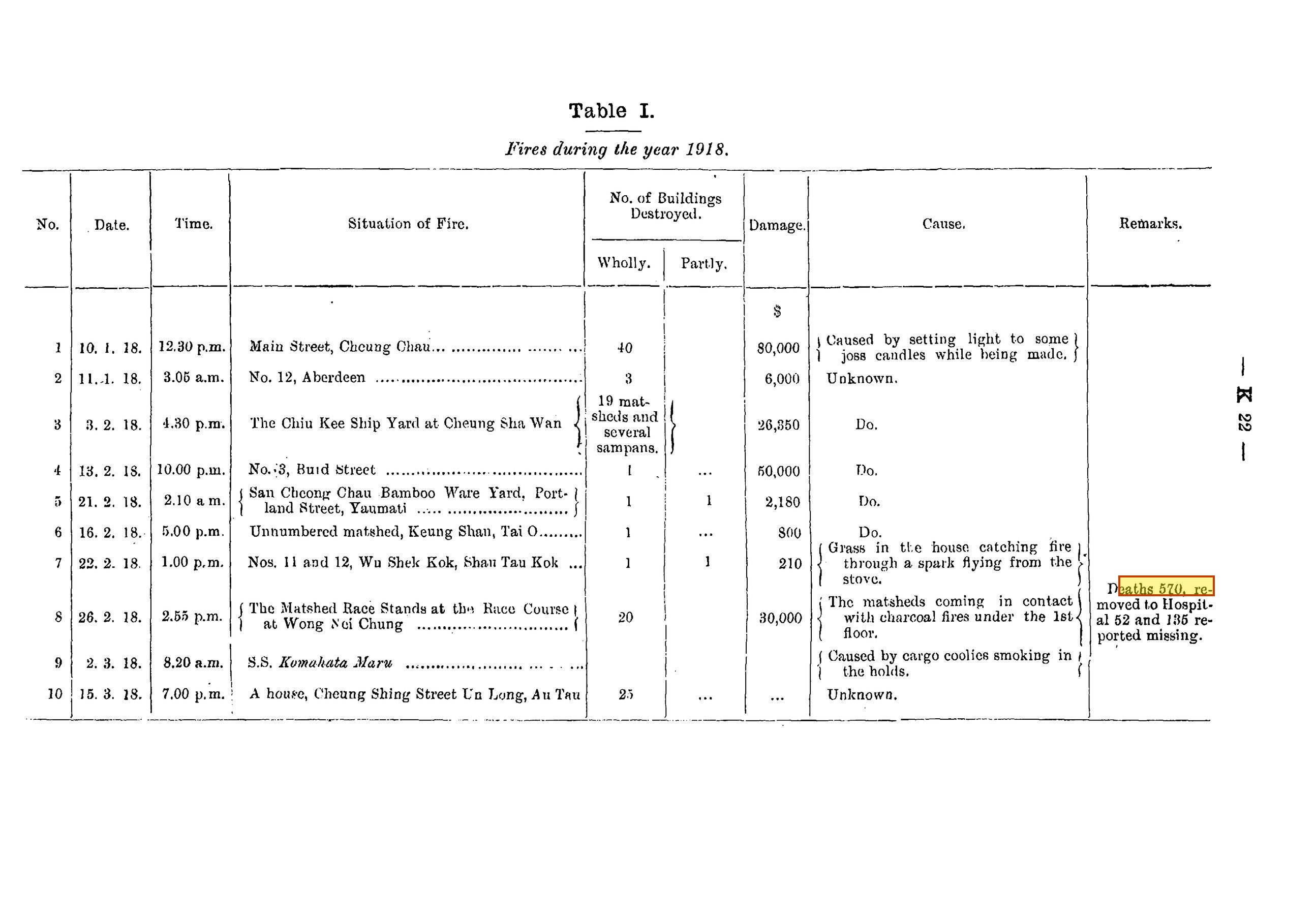
一九一八年二月二十六日下午二時五十五分,跑馬地(黃泥涌)馬場的馬棚看台倒塌,隨後起火。此份研究以文獻庫自身的官方紀錄為骨幹:一九一八年行政報告消防隊長報告的火警紀錄表第八行,明載「Deaths 570, removed to Hospital 52 and 135 reported missing」(死亡五百七十人,送院五十二人,報失蹤一百三十五人);同報工務局部分則記「約六百人喪生」。翌日報章記載目擊者所見火起於Kwong Kee Stand、棚架搖晃、人群湧向樓梯、棚後重量過大而整排倒塌;同版並刊出災場照片「現已發售」的廣告。研訊由署理首位裁判局主席J. R. Wood主持,前後二十一日,一九一八年四月十二日陪審團裁定:死因為窒息,源於倒塌或火災,或兩者兼有,「本院不對任何人就本案死亡歸咎刑事疏忽」。五月十六日梅含理總督發出第一四二號機密呈文,為竹棚制度辯護(「殖民地歷史中從無馬棚倒塌紀錄」、「從未想到要防火,我與我的各位前任皆然」),同時豁免工務局長與警務處長的疏忽責任,並定奪:「與香港賽馬有關之竹棚建築,日後一概不獲准許」。一九一八年九月政府出資興建永久建築取代馬棚;一九一九年賽馬即在全新的磚混凝土看台下舉行。本研究同時重建竹棚管制的框架:一八九七年《建築物條例》下的規則只管制「作人類居所用途」的馬棚,日間使用的賽馬看台從未納入;大火之後賽馬看台被禁,而馬棚本身於一九三五年《建築物條例》附表L方才全面納管。
一、火災與官方紀錄
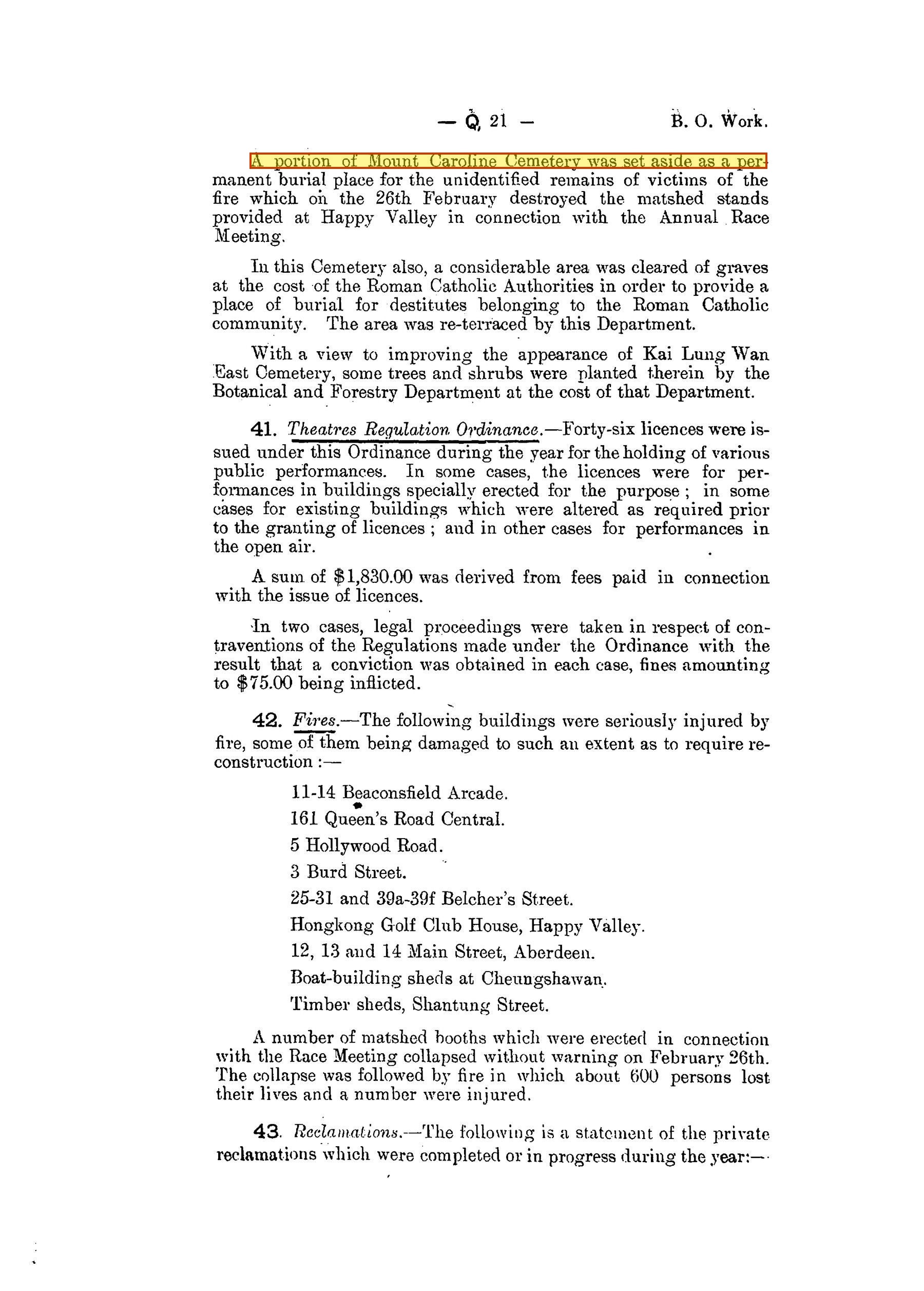
官方對這場火最完整的單一紀錄,在行政報告的消防隊長報告之內。火警紀錄表(Table I)第八行逐項列出:日期一九一八年二月二十六日,時間下午二時五十五分,地點「The Matshed Race Stands at the Race Course at Wong Nei Chung」(黃泥涌馬場馬棚賽馬看台),全毀建築二十座,損失三萬元,起因「The matsheds coming in contact with charcoal fires under the 1st floor」(馬棚接觸一樓之下炭火),備註欄則是全案的官方死亡數字:「Deaths 570, removed to Hospital 52 and 135 reported missing」。1工務局在同一份報告內記載:「為賽馬日搭蓋的馬棚看台,於二月二十六日在毫無預兆下倒塌;倒塌之後起火,約六百人喪生,另有多人受傷」,同節並列出同日被焚的香港哥爾夫球會會所。2官方紀錄自身即帶着兩個數字——消防隊的五百七十、工務局的約六百;兩者皆在文獻庫之內,此為本次重修相對初稿最重要的訂正。
賽馬看台並非臨時起意的建築。呈文寫明:「與香港賽馬有關之同類馬棚,過去二十八年每年搭蓋,從未發生任何意外」;建造期間「由工務局一位特別稱職而盡責的監工巡視三次」。3其法律位置則是空白:馬棚「雖在技術上屬一八八九年及一九〇三年《公共衛生及建築物條例》『建築物』定義之內,但從未被當作建築物處理」,故圖則從來無須呈核。4
二、翌日報章
二月二十七日的《德臣西報》以「近六百人死亡」為題,社論寫「近六百人罹難」;一位目擊者「看見火在Kwong Kee Stand燒起」;「棚架感到搖晃,人群湧向樓梯與後方;重量集中於棚後,整座建築遂如昨日所述倒塌」。同版列出死者:銀行二等司理Fung Lok Luen、澳門律師Aureliano Jorge、富商婦人Mrs. Choy Chan、十八歲的Doria Xavier小姐;「另一家十八口,只有三人回來」;「約五百人已送院救治或留醫」。5同版亦有兩則扎眼的廣告:其一「馬棚倒塌及火災各景均已攝得,現已發售」——災難在當日已是商品;其二是Fr. Francisco Tse公開感謝Hyder Brothers「自United Stand瓦礫之下救出其家人親屬」。6
《孖剌西報》同日的長篇敘述記下救援的指揮結構:「John Ward上校(Col. John Ward, M.P.)奉總督諭,奉命主持救援行動」;Middlesex Regiment「結成封鎖線,將人群擋在焚燒中的看台之外」;聖約翰救傷隊運走近三十名傷者;政府公立醫院收受五十三名傷者;香港哥爾夫球會會所中焚。該版並載首位投稿人的起因說法:「棚內多人在爐灶上備餐,正是爐灶翻倒釀成火災」——此為首日的版本,研訊最終認定的是「一樓之下炭火」。該文作者估計「死者當不下五百人;此數恐怕永遠無法確知」。7
二月二十八日《孖剌西報》續報:「賽馬會餘下賽事取消」;「下午一時前,一百二十具遺體已經辨認並由親屬認領,其中日本人十五名」;「死者大抵可估為近六百人」;市民攜花圈到場。8三日後,災難已入講章:《士蔑新聞》以「跑馬地——一場災難」為題,彙集上主日各堂的講道引用。9
三、二十一日研訊與陪審團裁定
研訊於裁判署開庭,由署理首席巡理府J. R. Wood以死因裁判官身分主持。總督呈文稱之為「一次垂詢詳盡、歷時二十一日之研訊」;裁判官「不就政府部門行為向陪審團發問——他解釋,批評的措辭應出於陪審員自己之口」。3研訊的報章紀錄橫跨二月底至四月九日:承建商Kwok Kun供稱十六號棚的木柱並未掘洞、「只將柱樁打入地中」,且二月二十六日的巡查「只入了地下樓層」;10一九一一年哥爾夫球會委員會為保球場草坪而向工務局交涉、致令搭棚條款更改一事,亦在庭上重提,證人並謂「若木柱入土少許,此類倒塌本可避免;依我之見,倒塌由於柱腳移動」;11警務處長Messer供稱馬場「並無偵探當值……亦無制服人員巡視棚座」,且指出「場上多具遺體雙腿蜷曲」,經與Dr. Macfarlane核對,顯示死者為壓斃而非燒斃;12工務局長漆咸(Chatham)則直認「樓面高度不一是一弱點……橫撐不足是一弱點……棚後無斜撐」,並承認若缺陷屬實,監工「理應察覺並呈報」。13四月九日結案陳詞:竹棚承建商的律師Bowley與死難者家屬代表D’Almada先後向陪審團陳詞,後者提出六項建議,包括拆除棚後鐵欄、加闊後巷、限定每層容納人數。14
四月十三日兩報全文刊出裁定。《孖剌西報》的裁判官總結特別記載「拉繩遭割斷」的謠言「同時見於英文及中文報章」,經研訊追查「全無根據」;「條款陳舊不足,必須全面修訂」;John Ward上校在起火八分鐘後封場,「回望之下,他自己認為錯在放進場的人太多而非太少」;單是看台一處,「接駁水管一條,棚外每棚置水桶半打」;而建築本身「以歐洲工程師所不熟悉的材料搭蓋……全無圖則與計算」,容納人數以五千計。15陪審團(Barlow為首席,連同Jack、Wallace)退庭一小時半後裁定:倒塌非因火、非因割繩,而是「結構不勝正當使用所加之負荷」;弱點在「第九至十五號棚後無斜撐,前後牆全無橫向支撐系統」;起火點在第四至十號棚之間,起因「易燃棚蓆接觸爐灶炭火」;用炭灶煮食屬「不智」但未至「嚴重疏忽」;「任何公職人員之作為或不作為,均非本案死亡的直接而有效原因」——**裁定全文:「死因為窒息,源於倒塌或火災,或兩者兼有。本院不對任何人就本案死亡歸咎刑事疏忽。」**16
四、政府辯護與總督定奪
五月十六日,梅含理總督以第一四二號機密呈文將裁定送倫敦,並附上政府對竹棚制度的辯護:馬棚「與民眾社會生活息息相關——各重要鄉村每年按節搭蓋戲棚,容納約二千人」;「殖民地歷史中,從無馬棚倒塌之紀錄」;至於防火,「從未有人向承租人或公眾提出過防火要求」「從未想到要防火——我與我各位前任(Messer先生的)皆然」。3但呈文的結論同樣乾脆:「火的可能與倒塌的可能,同樣無人預料。本人親自豁免漆咸(Chatham)先生與Messer先生的疏忽責任。容許大型馬棚的條件正着手修訂……與香港賽馬有關之竹棚建築,日後一概不獲准許。」4陪審團的報告則將責任落在體制:「就公共工程與警務兩部門而言,遺憾的是工務局長歷年未為賽馬馬棚定下建造標準」;看台「在建造期間及完工後,應由合格工程師檢驗」;消防用水「不足」;警務處長「未主動採取明顯必要的預防措施,實屬有誤……工務局未予正式通知,不足為其開脫」;「警方與工務兩部之間,就雙方均有關係的安排,長期缺乏諮詢與合作」;建議第一條即「有鑑於火災之險,容許以棚蓆、竹等易燃材料搭建臨時賽馬看台之慣例,應予終止」,並開列六項保安細則,包括「全面禁用油燈、明火及烹煮之火」。17
五、永久建築與一九一九年賽馬
禁令隨即落地。一九一八年行政報告工務部分第一三八條:「跑馬地一直使用之馬棚,決定以永久建築取代,由政府出資興建。工程於九月開始,年底已具規模」——即警察遊樂會會所。18翌年報告載會所落成,「會所屋頂採中國風格設計」,概算一萬一千元,至一九一九年底實支一萬三千二百一十一元。19一九一九年二月二十四日《德臣西報》報道新馬季開鑼:「新看台遠勝多年搭蓋之馬棚。去年馬棚釀成之慘禍——六百至七百人喪生——已令此法永廢。磚混凝土看台……當然安全」;「新看台側常駐整套消防器械,蒸汽已升,雲梯候命」;觀眾較去年為少,「本年華人買票者亦少」。20
結論
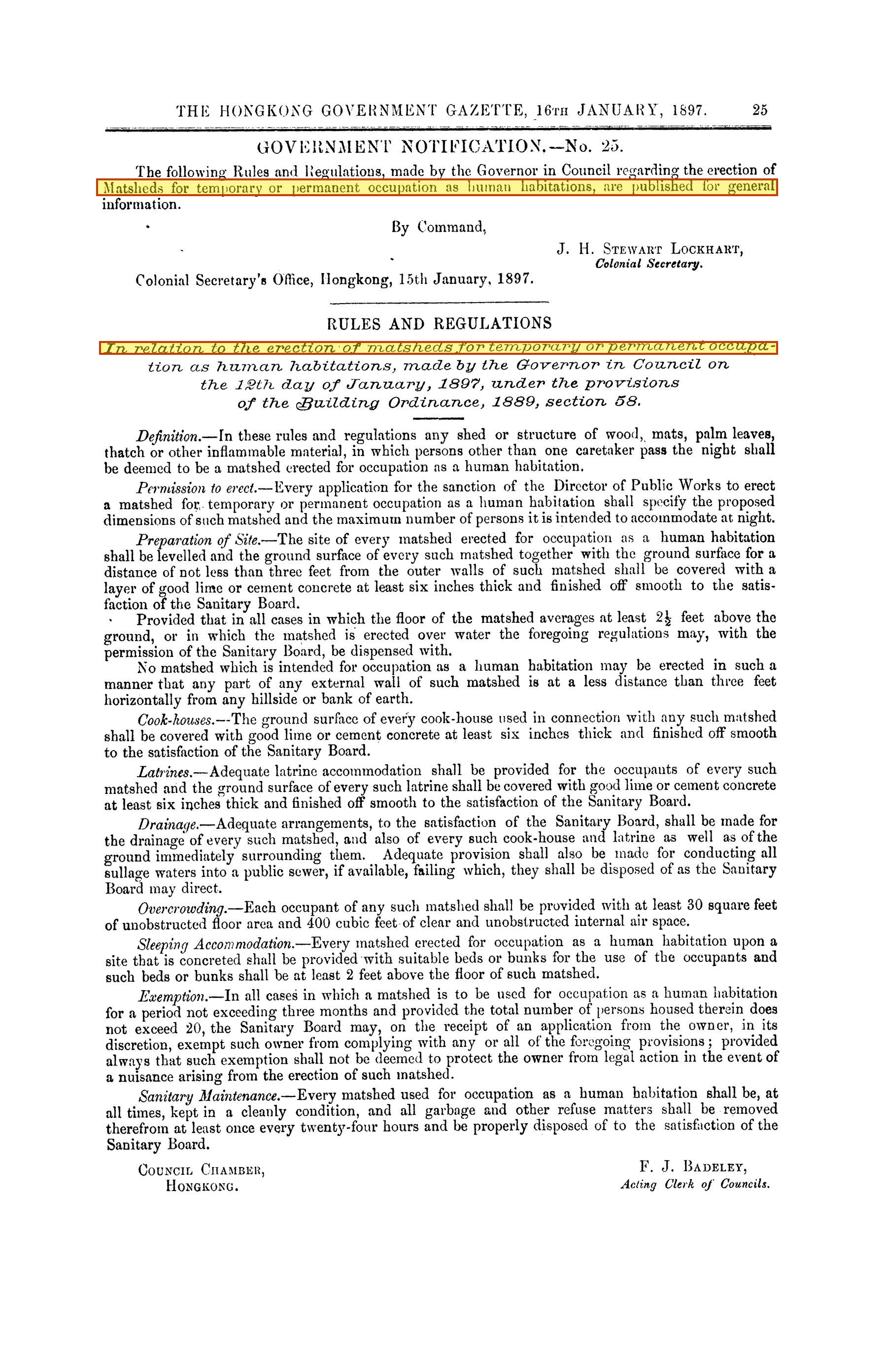
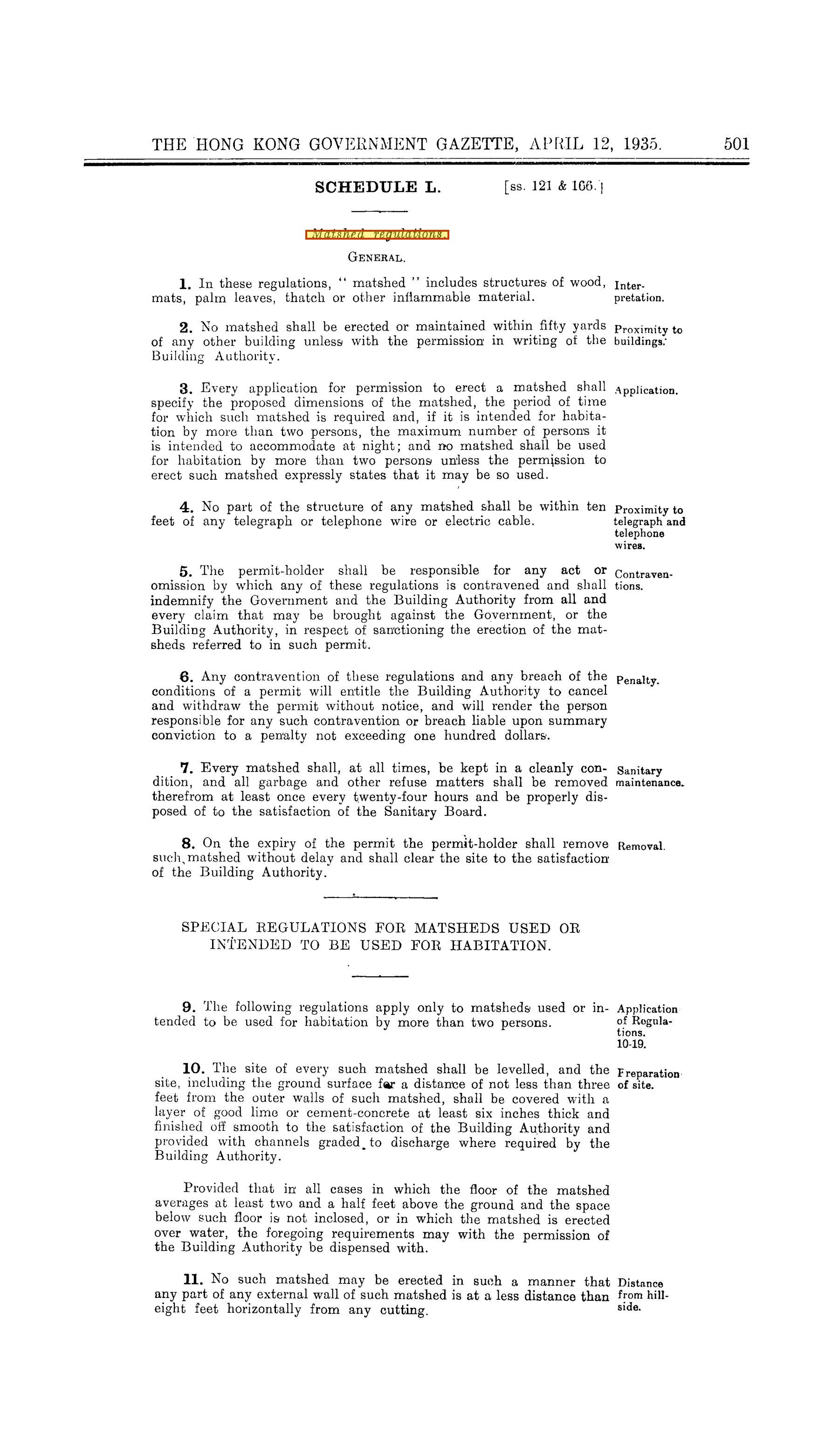
一九一八年的跑馬地大火在殖民地檔案中留下一條異常完整的鏈條:官方火警表記下時分、地點與「死亡五百七十」;二十一日研訊逐項問答;陪審團明言「不對任何人歸咎刑事疏忽」,卻在同份文件裏定下工程標準、水源、部門合作與「終止竹棚看台」的建議;總督豁免兩位官員個人責任,同時以一句「日後一概不獲准許」終結二十八年的慣例;政府九月動工興建永久看台。制度因一場大火而改——但改變的是賽馬看台,不是馬棚本身:一八九七年的規則只管「作人類居所用途」的馬棚,日間的賽馬棚從未入網;一九三五年《建築物條例》附表L方將馬棚全面納入建築權限之下。21222324
Hong Kong in Texts · Research Article
Twenty-Eight Years, One Afternoon
The Happy Valley racecourse fire of 26 February 1918, the inquest that ended the matshed stand, and the record it left
Abstract. On 26 February 1918, at 2.55 p.m., the matshed grandstands at the Happy Valley race course (the record’s form: “the Race Course at Wong Nei Chung”) collapsed under the weight of the Derby-week crowd, and fire swept the wreckage. The colony’s own Annual Report for 1918 carries the official count: “Deaths 570, removed to Hospital 52 and 135 reported missing” — beside the same report’s Public Works section, “about 600 persons lost their lives.” A 21-day inquest before the Acting First Police Magistrate, Mr. J. R. Wood, ended on 12 April 1918 with a Coroner’s Jury finding that attributed the collapse to the failure of the structure under legitimate use (no rear struts at sheds 9–15, no cross-bracing), the fire to charcoal cooking chetties, and criminal negligence to no one — while recommending that temporary matshed race stands “be discontinued.” The Governor’s despatch No. 142 of 16 May 1918 defended the unregulated matshed system (“it had never occurred to any of Mr. Messer’s predecessors, including myself, to take precautions against fire”), exonerated the two department heads, and decided: “matshed structures in connection with the Hongkong Races will not be permitted at all in the future.” Permanent concrete stands replaced the matsheds for the 1919 meeting. This paper re-reads the whole chain — the official tables, the day-after press, the inquest’s evidence, the jury’s finding, the despatch, the rebuild, and the matshed’s own regulation history (1897 habitable-matshed rules; the 1935 Schedule L) — and corrects the one figure the corpus had always carried but this thread’s first pass had missed: the official toll of 570.
1. The fire and its record
The Annual Race Meeting of 1918 opened on Monday 25 February — Derby Day, with a “sensational” win 25 — and on Tuesday 26 February, at 2.55 p.m., the matshed grandstands on the north side of the course collapsed and burned. The colony’s fullest official record of the event is a single table row. The Fire Brigade’s return in the Annual Report for 1918 (Table I, “Fires during the year 1918”, row 8) prints: date 26.2.18, time 2.55 p.m., situation “The Matshed Race Stands at the Race Course at Wong Nei Chung”, twenty buildings wholly destroyed, damage $30,000, cause “The matsheds coming in contact with charcoal fires under the 1st floor”, and remarks: “Deaths 570, removed to Hospital 52 and 135 reported missing.” 1 The course’s Chinese forms are the period gazette’s own 馬棚 and 跑馬塲, attested in the 1911 bilingual race-day traffic regulations. 26 One printed page away, the Public Works Department’s own section records the same event in prose: “A number of matshed booths which were erected in connection with the Race Meeting collapsed without warning on February 26th. The collapse was followed by fire in which about 600 persons lost their lives and a number were injured” — and lists among the buildings seriously injured by fire that year “Hongkong Golf Club House, Happy Valley.” 2
The stands themselves were an old, unregulated habit. The Governor’s despatch of May 1918 states that similar matsheds had been “erected yearly for the past 28 years in connection with the Annual Races in the Happy Valley” with “no accident” ever, inspected “during construction on 3 occasions by a particularly competent and conscientious Overseer” — and that matsheds, “although technically comprised in the definition of ‘building’ in the Public Health and Buildings Ordinances of 1889 and 1903, have never been treated as buildings,” so that plans for their erection were never required. 3
2. The day after
The China Mail of 27 February headed its account “NEARLY 600 DEATHS”; its editorial spoke of “nearly six hundred persons” perished, and of the heroism of “soldiers, police and civilians alike in the work of rescue whereby probably some hundreds were saved.” An eyewitness “saw the fire break out in Kwong Kee Stand”; another, pinned down after the collapse, described the mechanics the inquest would later confirm: “The structures were felt to be swaying and there was a rush to the stairs and at the back. The weight thus concentrated at the rear of the stands was too much and the whole erection collapsed.” The same page named the dead: the second shroff of the Mercantile Bank, Fung Lok Luen; the Macao solicitor Aureliano Jorge; Mrs. Choy Chan, “a wealthy Chinese lady”; Miss Doria Xavier, aged eighteen; it recorded families wiped out (“Of another family of 18, only three have returned”), and “about 500 people” treated or detained in hospital. 5 Two other notices shared the page: the photographers’ advertisement that “various scenes of the fire and of the falling of Matsheds… are now ready for sale,” and Father Francisco Tse’s public thanks to the Hyder Brothers for saving his family “from under the debris after the collapse of the United Stand.” 6
The Daily Press’s narrative of the same morning described the command structure of the rescue: “Col. John Ward, M.P.… by direction of HE the Governor, was placed in charge of operations”; men of the Middlesex Regiment “formed a cordon round the blazing sheds and kept the crowd back”; St John’s Ambulance Brigade carried away nearly thirty sufferers; fifty-three injured reached the Government Civil Hospital; the Golf Club house was “quite gutted.” The same page carried the first day’s explanation of the outbreak — “several people engaged in preparing meals on cooking ranges in the sheds, and it was the upsetting of these that caused the fire” — and its writer’s estimate, “the deaths number fully five hundred… probably this will never be known.” 7
The meeting was abandoned by order of the Jockey Club the next day 5; the Daily Press of 28 February reported the identification of the dead (“By 1 p.m. 120 bodies had been identified and claimed by relatives… including fifteen Japanese”) and printed the estimate the city would live with: “The dead can be safely estimated at nearly six hundred.” 8 Within a week the disaster had entered the pulpits. 9
3. The inquest, February–April 1918
The inquest sat at the Magistracy before the Acting First Police Magistrate, Mr. J. R. Wood, as Coroner, and ran — with adjournments over Easter — twenty-one days. 3 Its press record is unusually complete. The contractor Kwok Kun was examined on how the sheds were built (“he did not dig holes for shed No. 16. He simply forced the poles into the ground”; his inspection of 26 February was “confining… to the ground floors”); 10 the 1911 correspondence by which the Golf Club’s representations had altered the letting conditions was read; and the expert witnesses returned to the uprights: “If the uprights had been put into the ground to any extent at all it would have prevented a collapse of this sort… due, in my opinion, to the movement at the base of the uprights.” 11 The Captain Superintendent of Police, Mr. Messer, first gave evidence on the water supply and the fire precautions 27, then defended his dispositions (“There were no police detectives on duty… no uniform men patrolling the sheds at all”) and made the observation that the bodies’ “legs drawn up” showed they had been crushed, not burned. 12 The Director of Public Works, Mr. Chatham, conceded the design weaknesses — “a source of weakness in the floors being of different levels… insufficiency of cross-bracing… in the absence of struts at the rear” — and admitted that his department was at fault. 13 At the concluding addresses (9 April) Mr. F. B. L. Bowley appeared for the contractors Sze Hop and Mr. Leo D’Almada for the bereaved families, proposing among other measures the removal of the iron fence at the back of the sheds and a fixed limit of numbers on each floor. 14
The Coroner’s summing up, printed on 13 April, dealt with the colony’s rumours as well as its departments: the story that the lashings had been cut — which “appeared in both the English and Chinese Press” — was “entirely without foundation”; the letting conditions were “obviously inadequate and out of date”; the sheds had been erected “entirely without plans and calculations” from “materials which were strange to engineers qualified on the European system”; a single hose was laid on and “half a dozen buckets of water” stood outside each shed; and the building had been meant “to be occupied by five thousand people.” 15
4. The jury’s finding
The Coroner’s Jury — A. H. Barlow (foreman), H. C. Jack and J. H. Wallace — deliberated an hour and a half and returned its answers on the evening of 12 April 1918. 28 On the collapse: not caused by fire, not by deliberate cutting, but “by a failure of the structure to meet demands made upon it by legitimate use”; the points of weakness “the absence of struts at the rear of sheds 9 to 15 inclusive” and “the lack of any general system of cross bracing”; the fatal strain “due to the presence… of a large crowd of people.” On the fire: it “originated at some point between sheds 4 to 10 inclusive,” its cause “the inflammable matting coming in contact with the burning charcoal from some cooking chettie”; cooking with charcoal chetties was imprudent, but not grossly negligent; and no act or omission of any public officer was “a proximate and efficient cause of the death.” The verdict: “Death due to suffocation, the result either of the collapse or of the fire, or both. We do not attribute criminal negligence to any one in connection with this death.” 16
The finding’s second half was a report on the government itself. The Director of Public Works was censured for never having laid down standards for these stands, though the care exercised was held to exonerate him under the ordinances; the stands “should have been inspected by a qualified engineer”; the water supply was “inadequate,” as the Police Department had warned years before; the Captain Superintendent of Police “erred in not taking on his own initiative obvious necessary precautions”; and “there has been a regrettable lack of consultation and co-operation between the Police and Public Works Departments.” The recommendation that ended the practice: “That in view of the danger from fire, the practice of permitting the use of temporary race stands, constructed of such inflammable materials as matting and bamboo, be discontinued,” with six safeguards if matsheds were ever unavoidable — intervals between sheds, one floor only, no overcrowding, sufficient exits, “total prohibition of the use of oil lamps, naked lights, and fires for cooking,” and firemen on duty with appliances. 17 The jury also recorded that the Jockey Club had “neither responsibility nor interest in these sheds (except as lessees of Nos. 1 to 3)” and that the Golf Club was “in no way concerned.” 29
5. The defence and the Governor’s decision
Governor Sir F. H. May sent the finding home under cover of Despatch No. 142 of 16 May 1918, and used it to defend the system as well as to end it. The defence paragraphs are the most quoted — and most quoted out of context — sentences in the file: matsheds are “a Chinese device… bound up with the social life of the people” (“every important village has at a certain season of the year its matshed theatre, a temporary structure accommodating about 2,000 people”); “In the history of the Colony, there is no record of the collapse of a matshed”; the race stands had stood for twenty-eight years without accident; and of fire precautions: “it had never occurred to any of Mr. Messer’s predecessors, including myself, to take precautions against fire.” 3 May’s conclusion paired the exoneration with the ban: “The possibility of fire was in fact as little anticipated as was the possibility of collapse. Personally I entirely exonerate both Mr. Chatham and Mr. Messer of negligence… The conditions under which large matsheds are permitted in the Colony are being revised with a view to preventing as far as possible disaster from fire; and matshed structures in connection with the Hongkong Races will not be permitted at all in the future.” 4 (May, uniquely among Governors, had himself commanded the police as Captain Superintendent from 1893 to 1901 — the “including myself” of the defence was literal.)
6. The permanent rebuild, 1918–19
The implementation was immediate and governmental. The Annual Report for 1918, Public Works: “Police Recreation Club Pavilion. — It was decided that the matshed hitherto in use at Happy Valley should be replaced by a permanent structure, to be erected at the cost of the Government. Work was begun in September and the erection of the building was well advanced by the close of the year.” 18 In 1919 the club-house was completed, its roof “designed in Chinese style,” at $13,211.05 against $11,000 estimated. 19 The race meeting of February 1919 ran on the new permanent stands. The China Mail’s first-day report carried the change in a sentence: “The new stands are a great improvement on the matsheds which for many years have been erected… The terrible disaster they were responsible for last year when between 600 and 700 lost their lives has abolished them for ever. The brick and concrete stands… are, of course, perfectly safe for those frequenting them” — and the new precaution beside them: “Alongside the new stands a complete fire apparatus was stationed. The engine has steam up and the fire escape is ready for action.” The crowd was smaller, with “fewer Chinese this year.” 20 The 1919 meeting’s second day was, by contrast, a triumphal one. 30
7. The matshed before and after: 1897–1935
The fire’s regulatory meaning is easier to see against what the matshed’s own record had been. In 1897 — under the Building Ordinance 1889, s. 58 — the Governor in Council had made Rules and Regulations “in relation to the erection of matsheds for temporary or permanent occupation as human habitations”: definitions (wood, mats, palm leaves, thatch), permission to erect with stated dimensions and maximum occupants, concrete site preparation, cook-houses, latrines, drainage, thirty square feet and four hundred cubic feet of air per occupant, and an exemption for stays of not more than three months and twenty persons. 23 These rules regulated the matshed as a dwelling — the labourers’ hut and the squatter’s shed. The race stands, daylight structures used a few days a year, fell entirely outside them: that is the gap the 1918 defence described and the 1918 finding closed. After the fire the race stands were banned outright, but the matshed as such was not abolished — the matshed theatre of the despatch’s own argument continued — and in 1935 the Buildings Ordinance No. 18 of 1935 finally brought the whole class under the Building Authority by Schedule L, “Matshed regulations”: a fifty-yard proximity rule, permits with stated dimensions and maximum occupants, a penalty of one hundred dollars, and special regulations for habitable matsheds. 24
8. Afterlives
The unidentified dead were given a fixed place. A portion of Mount Caroline Cemetery was set aside “as a permanent burial place for the unidentified remains of victims of the fire” 31 — the burial ground’s own afterlife came in 1961, when the Mount Caroline Cemetery (Graves Removal) Order, made under the Public Health and Urban Services Ordinance 1960, ordered the human remains in the coloured-pink part of the cemetery removed to a cemetery depot. 32 The rescue’s commemoration travels further still: on Victoria Peak a boulder honoured the Middlesex Regiment — the troopship Tyndareus men of 1917 and, by association, Lt-Colonel John Ward, “whose prompt action, military efficiency and strong sense of humanity saved many during the disastrous Happy Valley Race Course fire.” When the stone disappeared in 1994, Martin Booth’s letter to the press called it “an outrage” and gave the death toll as 570; the Director of Public Relations replied that the Stone was “en route back to the Regiment’s safe keeping in the United Kingdom.” 33
Appendix A. Evidence register
Confirmed (two or more documents). The fire (date, time, place, cause, damage): AR 1918 Fire Brigade Table I 1 and the PWD’s §42 2, with the day-after press 5 7 8 6 34 35. The toll: the official “Deaths 570” (the same table 1) is two-witness with Booth’s 1994 letter 33; the press’s first-week range (500 / nearly 600 / 600–700) is registered as variance, never averaged 7 20. The inquest and its verdict: the despatch 3, the jury’s finding 16, the verdict in print 28, the summing up 15 36 37. The ban and the rebuild: the despatch 4, the Pavilion 18, the 1919 stands 20.
Conflicts. (K1) The toll’s five figures — “fully five hundred” (Daily Press, 27 Feb), “nearly six hundred” (China Mail, 27 Feb; Daily Press, 28 Feb), the official “Deaths 570” (AR 1918), “about 600” (AR 1918, PWD), “between 600 and 700” (China Mail, 24 Feb 1919), 570 (Booth) — are printed side by side and never reconciled; 570 is printed as the official figure. (K2) The first-day cooking-ranges story 7 is superseded by the brigade’s charcoal-fires-under-the-first-floor and the jury’s chettie finding 16. (K4) The abandonment notice’s signature prints “T. F. Hough” (OCR-uncertain) while the 1919 report calls the Clerk of the Course “Mr. T. Hough”; prose says “the Clerk of the Course, Mr. Hough.”
Failed verification (do not use). Manslaughter verdicts or any prosecution: the jury’s verdict explicitly refuses criminal negligence 16; no prosecution exists in the corpus. A colony-wide matshed ban: the ban is race-stands-specific 4. The “upset range” origin: a first-day particular, never repeated by the inquiry. A fire relief fund: not located in the corpus. A period Chinese-language account of the fire: the corpus’s Chinese press begins after 1918 (the Coroner’s own remark that the lashings rumour “appeared in both the English and Chinese Press” 15 attests the Chinese press’s presence, not any surviving text).
Gaps. The inquest’s first sitting day; the full identified-dead list; the Fire Brigade’s report text beyond Table I; the contractor’s firm’s later fate.
Appendix B. Bibliography
- 1. The Hongkong Telegraph, 25 February 1918, p. 8. hkintexts.histsyn.com/page/2889658 (accessed 21 October 2026).
- 2. The Hongkong Telegraph, 4 March 1918, p. 9. hkintexts.histsyn.com/page/2889707 (accessed 21 October 2026).
- 3. Administrative Report 1918 — Fire Brigade, Table I, row 8. hkintexts.histsyn.com/page/617698; scan image-page/422798 (accessed 21 October 2026).
- 4. Administrative Report 1918 — Public Works, Q.21 and §42. hkintexts.histsyn.com/page/617855; scan image-page/422959 (accessed 21 October 2026).
- 5. Despatch No. 142, Governor May to Walter Long, 16 May 1918, CO 129/448, pp. 291–293. hkintexts.histsyn.com/page/476476 (accessed 21 October 2026).
- 6. The China Mail, 27 February 1918, p. 4. hkintexts.histsyn.com/page/1955072; scan image-page/1728805 (accessed 21 October 2026).
- 7. The Hongkong Daily Press, 27 February 1918, p. 3. hkintexts.histsyn.com/page/2281912 (accessed 21 October 2026).
- 8. The Hongkong Daily Press, 28 February 1918, p. 3. hkintexts.histsyn.com/page/2281922 (accessed 21 October 2026).
- 9. The Hongkong Daily Press, 12 March 1918, p. 5. hkintexts.histsyn.com/page/2282020 (accessed 21 October 2026).
- 10. The Hongkong Daily Press, 23 March 1918, p. 3. hkintexts.histsyn.com/page/2282114 (accessed 21 October 2026).
- 11. The Hongkong Daily Press, 26 March 1918, p. 3. hkintexts.histsyn.com/page/2282134 (accessed 21 October 2026).
- 12. The Hongkong Daily Press, 27 March 1918, p. 3. hkintexts.histsyn.com/page/2282142 (accessed 21 October 2026).
- 13. The Hongkong Daily Press, 29 March 1918, p. 3. hkintexts.histsyn.com/page/2282162 (accessed 21 October 2026).
- 14. The Hongkong Telegraph, 9 April 1918, pp. 9–10. hkintexts.histsyn.com/page/2889993 (accessed 21 October 2026).
- 15. CO 129/448, pp. 294–298, the Coroner’s Jury finding, 12 April 1918. hkintexts.histsyn.com/page/476479 (accessed 21 October 2026).
- 16. CO 129/448, pp. 299–301, the jury’s report and recommendations. hkintexts.histsyn.com/page/476484 (accessed 21 October 2026).
- 17. The Hongkong Daily Press, 13 April 1918, p. 2. hkintexts.histsyn.com/page/2282276 (accessed 21 October 2026).
- 18. The China Mail, 13 April 1918, p. 3. hkintexts.histsyn.com/page/1955351 (accessed 21 October 2026).
- 19. Administrative Report 1918, p. 457, §138 (the Police Recreation Club Pavilion). hkintexts.histsyn.com/page/617924 (accessed 21 October 2026).
- 20. Administrative Report 1919, p. 417. hkintexts.histsyn.com/page/618394 (accessed 21 October 2026).
- 21. The China Mail, 24 February 1919, p. 5. hkintexts.histsyn.com/page/1957597 (accessed 21 October 2026).
- 22. The Hongkong Telegraph, 26 February 1919, p. 9. hkintexts.histsyn.com/page/2892707 (accessed 21 October 2026).
- 23. Mount Caroline Cemetery (Graves Removal) Order, 1961. hkintexts.histsyn.com/page/642870 (accessed 21 October 2026).
- 24. Government Notification No. 25, 16 January 1897 (matshed rules, Building Ordinance 1889 s. 58). hkintexts.histsyn.com/page/635107; scan image-page/1546172 (accessed 21 October 2026).
- 25. Buildings Ordinance No. 18 of 1935, Schedule L, 12 April 1935. hkintexts.histsyn.com/page/216843; scan image-page/1503971 (accessed 21 October 2026).
- 26. Dan Waters, “The Middlesex (‘Tyndareus’) Stone,” JRASHKB 43 (2003), p. 256. hkintexts.histsyn.com/page/216497 (accessed 21 October 2026).
- 27. Supplementary traffic regulations on days fixed for the Races (1911), Gazette Chinese text (the period attestation of 馬棚 / 跑馬塲). hkintexts.histsyn.com/page/1590072 (accessed 21 October 2026).
Notes
Administrative Report 1918 — Report of the Superintendent of the Fire Brigade, Table I (Fires during the year 1918), row 8: “The Matshed Race Stands at the Race Course at Wong Nei Chung”, 26 February 1918, 2.55 p.m., twenty buildings wholly destroyed, damage $30,000, cause “The matsheds coming in contact with charcoal fires under the 1st floor”, remarks “Deaths 570, removed to Hospital 52 and 135 reported missing.” hkintexts.histsyn.com/page/617698; scan hkintexts.histsyn.com/image-page/422798 (accessed 21 October 2026). ↩
Administrative Report 1918 — Public Works Department, B.O. Work Q.21: “A portion of Mount Caroline Cemetery was set aside as a permanent burial place for the unidentified remains of victims of the fire which on the 26th February destroyed the matshed stands provided at Happy Valley in connection with the Annual Race Meeting”; the same report’s §42 Fires: “A number of matshed booths which were erected in connection with the Race Meeting collapsed without warning on February 26th. The collapse was followed by fire in which about 600 persons lost their lives and a number were injured.” hkintexts.histsyn.com/page/617855; scan hkintexts.histsyn.com/image-page/422959 (accessed 21 October 2026). ↩
Despatch No. 142, Governor Sir F. H. May to the Right Hon. Walter Long, 16 May 1918, CO 129/448, pp. 291–293 — enclosing “the finding of the Coroner’s Jury after a patient enquiry extending over 21 days conducted with ability by Mr. J. R. Wood, Acting First Police Magistrate”; the government’s defence (matsheds “although technically comprised in the definition of ‘building’… have never been treated as buildings”; “In the history of the Colony, there is no record of the collapse of a matshed”; erected “yearly for the past 28 years”; “it had never occurred to any of Mr. Messer’s predecessors, including myself, to take precautions against fire”); and May’s conclusion: “Personally I entirely exonerate both Mr. Chatham and Mr. Messer of negligence… and matshed structures in connection with the Hongkong Races will not be permitted at all in the future.” hkintexts.histsyn.com/page/476476 (text from p. 291; also page/476477, page/476478) (accessed 21 October 2026). ↩
Despatch No. 142, 16 May 1918, CO 129/448 (page/476476). ↩
“NEARLY 600 DEATHS. Latest details of the ‘appalling disaster’”; “The China Mail”, 27 February 1918, p. 4 — the editorial’s “nearly six hundred persons have perished”; the eyewitness who “saw the fire break out in Kwong Kee Stand”; “The structures were felt to be swaying and there was a rush to the stairs and at the back. The weight thus concentrated at the rear of the stands was too much and the whole erection collapsed”; the named dead; the photograph notice (“now ready for sale”, by Mee Cheung); the Jockey Club’s abandonment notice. hkintexts.histsyn.com/page/1955072; scan hkintexts.histsyn.com/image-page/1728805 (accessed 21 October 2026). ↩
China Mail, 27 February 1918, p. 4 (page/1955072). ↩
“TERRIBLE CATASTROPHE AT THE RACES. Chinese matsheds collapse, fire consumes a row of booths”; “The Hongkong Daily Press”, 27 February 1918, p. 3 — the rescue narrative (“Col. John Ward, M.P., … by direction of HE the Governor, was placed in charge of operations”; the Middlesex cordon; fifty-three injured at the Government Civil Hospital; the Golf Club house gutted; “The fire was got under at about 6 p.m.”); the first-day cause story (“preparing meals on cooking ranges… the upsetting of these that caused the fire”); “the deaths number fully five hundred.” hkintexts.histsyn.com/page/2281912 (accessed 21 October 2026). ↩
“RACE MEETING ABANDONED… Victims estimated to be nearly six hundred”; “The Hongkong Daily Press”, 28 February 1918, p. 3 — “By 1 p.m. 120 bodies had been identified and claimed by relatives… including fifteen Japanese”; “The dead can be safely estimated at nearly six hundred.” hkintexts.histsyn.com/page/2281922 (accessed 21 October 2026). ↩
“THE RACECOURSE — ‘A CALAMITY.’ References from the Pulpit Yesterday”; “The Hongkong Telegraph”, 4 March 1918, p. 9. hkintexts.histsyn.com/page/2889707 (accessed 21 October 2026). ↩
“RACECOURSE DISASTER. Enquiry continued. Contractor’s evidence. How the sheds were constructed”; “The Hongkong Daily Press”, 12 March 1918, p. 5 — Kwok Kun examined (“he did not dig holes for shed No. 16. He simply forced the poles into the ground”; the inspection of 26 February “confining his examination to the ground floors”); Mr. David Wood recalled on the 1912 Golf Club correspondence; the photographs of the sheds for 1914–1917 produced. hkintexts.histsyn.com/page/2282020 (accessed 21 October 2026). ↩
“RACECOURSE DISASTER. The Golf Club turf. Question of uprights again”; “The Hongkong Daily Press”, 23 March 1918, p. 3 — Mr. E. J. Grist: “in 1911 the Golf Club Committee approached the P.W.D. with a view to preserving the greens over which these matsheds were built”; the expert’s opinion: “If the uprights had been put into the ground to any extent at all it would have prevented a collapse of this sort… due, in my opinion, to the movement at the base of the uprights.” hkintexts.histsyn.com/page/2282114 (accessed 21 October 2026). ↩
“MR. MESSER’S CONDEMNATION OF…”; “The Hongkong Daily Press”, 27 March 1918, p. 3 — “a number of the bodies found on the course had the legs drawn up” (crushed, not burned); “There were no police detectives on duty… no uniform men patrolling the sheds at all.” hkintexts.histsyn.com/page/2282142 (accessed 21 October 2026). ↩
“RACECOURSE DISASTER. Weaknesses in the sheds. Jury attempt to fix the responsibility — Hon. admits his department was at fault”; “The Hongkong Daily Press”, 29 March 1918, p. 3 — the Director of Public Works on “a source of weakness in the floors being of different levels… insufficiency of cross-bracing… in the absence of struts at the rear”. hkintexts.histsyn.com/page/2282162 (accessed 21 October 2026). ↩
“THE RACECOURSE DISASTER. Concluding stage of the enquiry. Pointed addresses to the jury”; “The Hongkong Telegraph”, 9 April 1918, pp. 9–10 — Mr. F. B. L. Bowley for the matshed contractors Sze Hop; Mr. Leo D’Almada for the bereaved families (his six proposals included the removal of the iron fence at the back of the sheds and the fixing of the numbers to be accommodated on each floor). hkintexts.histsyn.com/page/2889993 (also page/2889994) (accessed 21 October 2026). ↩
“THE CORONER’S SUMMING UP. The Jury’s verdict. Criticisms and recommendations”; “The Hongkong Daily Press”, 13 April 1918, p. 2 — the lashings-cutting rumour “appeared in both the English and Chinese Press” and was “entirely without foundation”; Mr. Chatham “quite candidly admitted that his Department was at fault”; the conditions of letting “obviously inadequate and out of date”; Colonel Ward’s cordon; “a building which was to be occupied by five thousand people.” hkintexts.histsyn.com/page/2282276 (accessed 21 October 2026). ↩
CO 129/448, pp. 294–298 — the Coroner’s Jury’s finding, 12 April 1918 (foreman A. H. Barlow, with H. C. Jack and J. H. Wallace): the collapse was not caused by fire, nor by deliberate cutting of lashings, but “by a failure of the structure to meet demands made upon it by legitimate use”; the weaknesses “The absence of struts at the rear of sheds 9 to 15 inclusive. The lack of any general system of cross bracing”; the fire “originated… between sheds 4 to 10 inclusive”, its cause “The inflammable matting coming in contact with the burning charcoal from some cooking chettie”; and the verdict: “Death due to suffocation, the result either of the collapse or of the fire, or both. We do not attribute criminal negligence to any one in connection with this death.” hkintexts.histsyn.com/page/476479 (continuing page/476480–page/476483) (accessed 21 October 2026). ↩
CO 129/448, pp. 299–301 — the jury’s report on the departments and recommendations: the race stand matsheds “should have been inspected by a qualified engineer”; the water supply “inadequate”; “the Captain Superintendent of Police erred in not taking on his own initiative obvious necessary precautions…”; “There has been a regrettable lack of consultation and co-operation between the Police and Public Works Departments”; “That in view of the danger from fire, the practice of permitting the use of temporary race stands, constructed of such inflammable materials as matting and bamboo, be discontinued”; and the six safeguards (intervals between sheds; one floor only; no overcrowding; sufficient exits; “Total prohibition of the use of oil lamps, naked lights, and fires for cooking”; firemen on duty with appliances). hkintexts.histsyn.com/page/476484 (continuing page/476485, page/476486) (accessed 21 October 2026). ↩
Administrative Report 1918, p. 457, P.W.E. §138: “Police Recreation Club Pavilion. — It was decided that the matshed hitherto in use at Happy Valley should be replaced by a permanent structure, to be erected at the cost of the Government. Work was begun in September and the erection of the building was well advanced by the close of the year.” hkintexts.histsyn.com/page/617924 (accessed 21 October 2026). ↩
Administrative Report 1919, p. 417, P.W.E. Hongkong (the club-house completed — “The roof of the club-house is designed in Chinese style”; 1919 estimates $11,000; expenditure to 31 December 1919 $13,211.05). hkintexts.histsyn.com/page/618394 (accessed 21 October 2026). ↩
“HONGKONG JOCKEY CLUB. First Day 1919 Races. Capital sport. Smaller crowd. Fewer Chinese this year”; “The China Mail”, 24 February 1919, p. 5 — “The new stands are a great improvement on the matsheds which for many years have been erected… The terrible disaster they were responsible for last year when between 600 and 700 lost their lives has abolished them for ever. The brick and concrete stands… are, of course, perfectly safe”; “Alongside the new stands a complete fire apparatus was stationed.” hkintexts.histsyn.com/page/1957597 (accessed 21 October 2026). ↩
AR 1918, Fire Brigade Table I, row 8 (page/617698; scan image-page/422798). ↩
CO 129/448, pp. 299–301, the jury’s report and recommendations (page/476484). ↩
Government Notification No. 25, 16 January 1897 — Rules and Regulations in relation to the erection of matsheds for temporary or permanent occupation as human habitations, made by the Governor in Council on 12 January 1897 under the Building Ordinance 1889, s. 58 (definition; permission to erect; preparation of site; cook-houses; latrines; drainage; overcrowding — thirty square feet and four hundred cubic feet per occupant; exemption for stays of not more than three months and not more than twenty persons). hkintexts.histsyn.com/page/635107; scan hkintexts.histsyn.com/image-page/1546172 (accessed 21 October 2026). ↩
The Hong Kong Government Gazette, 12 April 1935 — Buildings Ordinance No. 18 of 1935, Schedule L [ss. 121 & 166], Matshed regulations: “‘matshed’ includes structures of wood, mats, palm leaves, thatch or other inflammable material”; no matshed within fifty yards of any other building without written permission; permits stating dimensions, duration and maximum occupants; penalty not exceeding one hundred dollars; special regulations for matsheds used for habitation. hkintexts.histsyn.com/page/216843; scan hkintexts.histsyn.com/image-page/1503971 (accessed 21 October 2026). ↩
“DERBY DAY AT HAPPY VALLEY. Sensational Derby win”; “The Hongkong Telegraph”, 25 February 1918, p. 8 (the meeting’s first day). hkintexts.histsyn.com/page/2889658 (accessed 21 October 2026). ↩
Supplementary traffic regulations on days fixed for the Races (1911), Gazette Chinese text: 「七 間於黃泥涌各墳場與各馬棚中間處之路不許停放車輛……各式車輛在跑馬塲附近地方必須遵依值日巡差所指點之處停放」 — the period Chinese attestation of 馬棚 and 跑馬塲. hkintexts.histsyn.com/page/1590072 (accessed 21 October 2026). ↩
“RACECOURSE DISASTER. Water supply and fire precautions. Evidence of Captain Superintendent of Police”; “The Hongkong Daily Press”, 26 March 1918, p. 3. hkintexts.histsyn.com/page/2282134 (accessed 21 October 2026). ↩
“The Coroner’s Jury — Mr. H. Barlow (foreman), Mr. W. O. Jack and Mr. J. H. Wallace — deliberated for an hour and a half last evening upon their findings and recommendations”; “The China Mail”, 13 April 1918, p. 3 (the verdict and the departmental conclusions in print). hkintexts.histsyn.com/page/1955351 (accessed 21 October 2026). ↩
CO 129/448, pp. 294–298, the Coroner’s Jury’s finding, 12 April 1918 (page/476479). ↩
“‘LADIES’ DAY’ AT THE RACES. Fine weather still continues”; “The Hongkong Telegraph”, 26 February 1919, p. 9 (the 1919 meeting’s second day). hkintexts.histsyn.com/page/2892707 (accessed 21 October 2026). ↩
AR 1918, P.W.D. Q.21 and §42 (page/617855; scan image-page/422959). ↩
Mount Caroline Cemetery (Graves Removal) Order, 1961, made under the Public Health and Urban Services Ordinance 1960 (No. 30 of 1960), s. 119: the Director of Urban Services to cause “all human remains in graves situated in that part of Mount Caroline Cemetery coloured pink on the attached plan” to be removed to a cemetery depot. hkintexts.histsyn.com/page/642870 (accessed 21 October 2026). ↩
Dan Waters, “The Middlesex (‘Tyndareus’) Stone,” Journal of the Royal Asiatic Society Hong Kong Branch, vol. 43 (2003), p. 256 — the boulder on Victoria Peak; Martin Booth’s letter of 8 April 1994 (“An outrage”): the stone commemorated Lt-Colonel John Ward “whose prompt action, military efficiency and strong sense of humanity saved many during the disastrous Happy Valley Race Course fire”; “Booth states the death toll in the fire was 570”; the Director of Public Relations (18 April 1994): the Stone “en route back to the Regiment’s safe keeping in the United Kingdom”. hkintexts.histsyn.com/page/216497 (accessed 21 October 2026). ↩
Daily Press, 27 February 1918, p. 3 (page/2281912). ↩
Daily Press, 28 February 1918, p. 3 (page/2281922). ↩
China Mail, 13 April 1918, p. 3 (page/1955351). ↩
Daily Press, 13 April 1918, p. 2 (page/2282276). ↩