油尖旺:一個區名的三層堆積
摘要
「油尖旺」此一區名,並非任何人一時創製,而是三件獨立的歷史逐層累積而成:油麻地於1981–82年領先,尖沙咀於1988年繼之,旺角至1994年方始納入。本文運用全語料庫之合稱電池與負面對照,證明「油」永居首位——反轉寫法「旺油尖區」與「尖油旺區」之出現次數為零。1
一、問題與方法
香港有一區名為「油尖旺」。為何不是「尖油旺」,亦不是「旺油尖」?此問看似文字遊戲,然檔案庫中有一堅實答案:三地合稱之一切寫法之中,「油」從未不居首位。2
研究方法以語料庫為先:先作合稱電池,將油麻地、尖沙咀、旺角三者之名的一切二字與三字組合(有無「區」字尾)盡數檢索;再按年份排序,以發現最早之用例;最後對每一處引用重新驗證文件編號。重做階段另行完成四項對抗性測試、三次全文拉取(1993年新聞公報、1887年憲報、1888年憲報),以及一輪規則九之中西文對照核名。1
二、三鎮先於任何分區
油麻地、尖沙咀、旺角三者之名,各有其源流,先於任何「區」之概念。油麻地最早之憲報見證為1879年裁判署案件簿中之地址及「油麻地差館前」。3 同年十月另一案件載明「郭亞福 油麻地十二號」。4 1881年行政報告記錄「油麻地官立漢文學校」。5
尖沙咀之記載始自1864年藍皮書:割讓九龍之後,尖沙咀村遭移除。6 該條為機器轉錄,列為單一見證。至1881年11月,憲報招標興建「尖沙咀新水上差館」。7 1916年九廣鐵路全線通車,總站設於尖沙咀。8
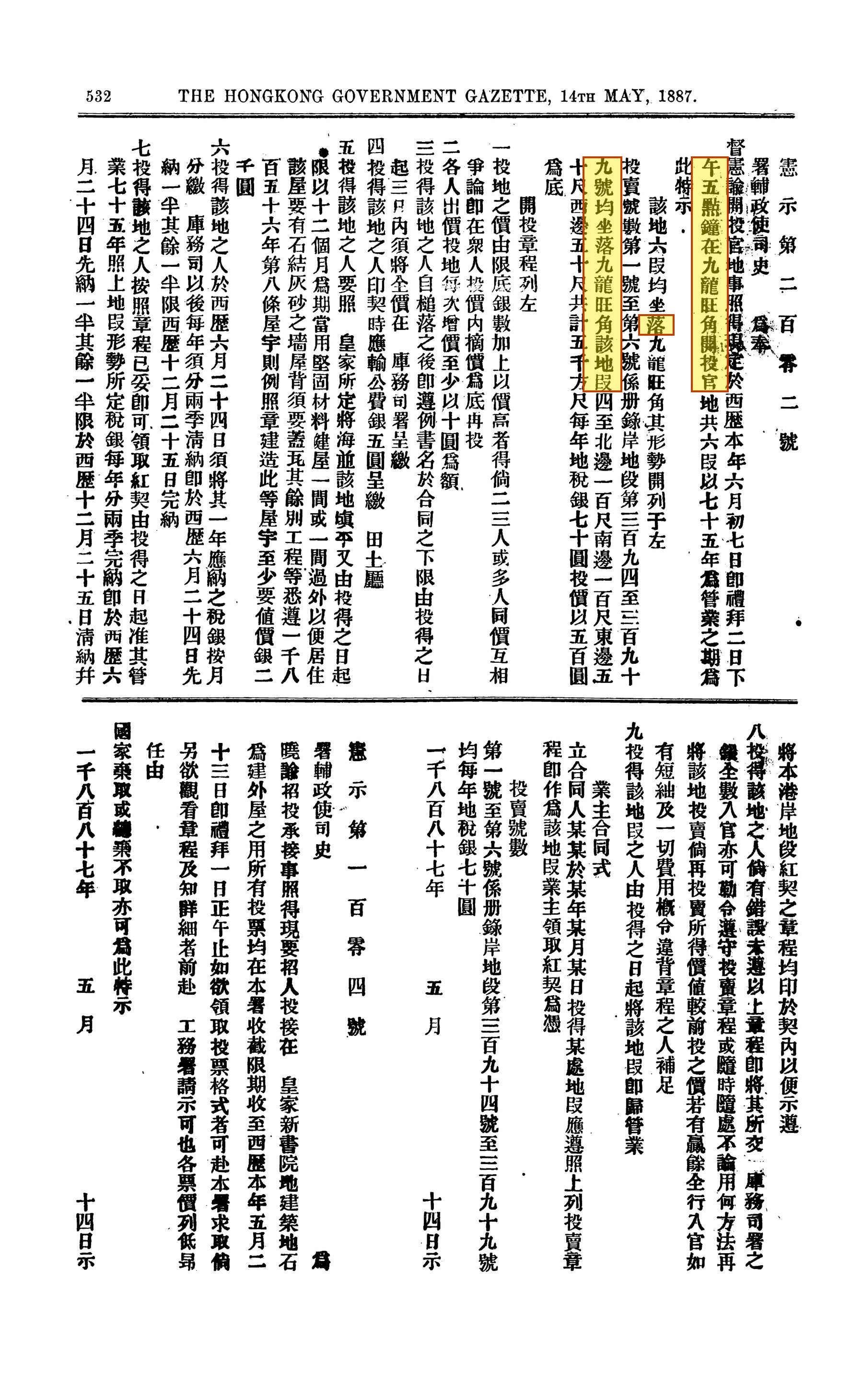
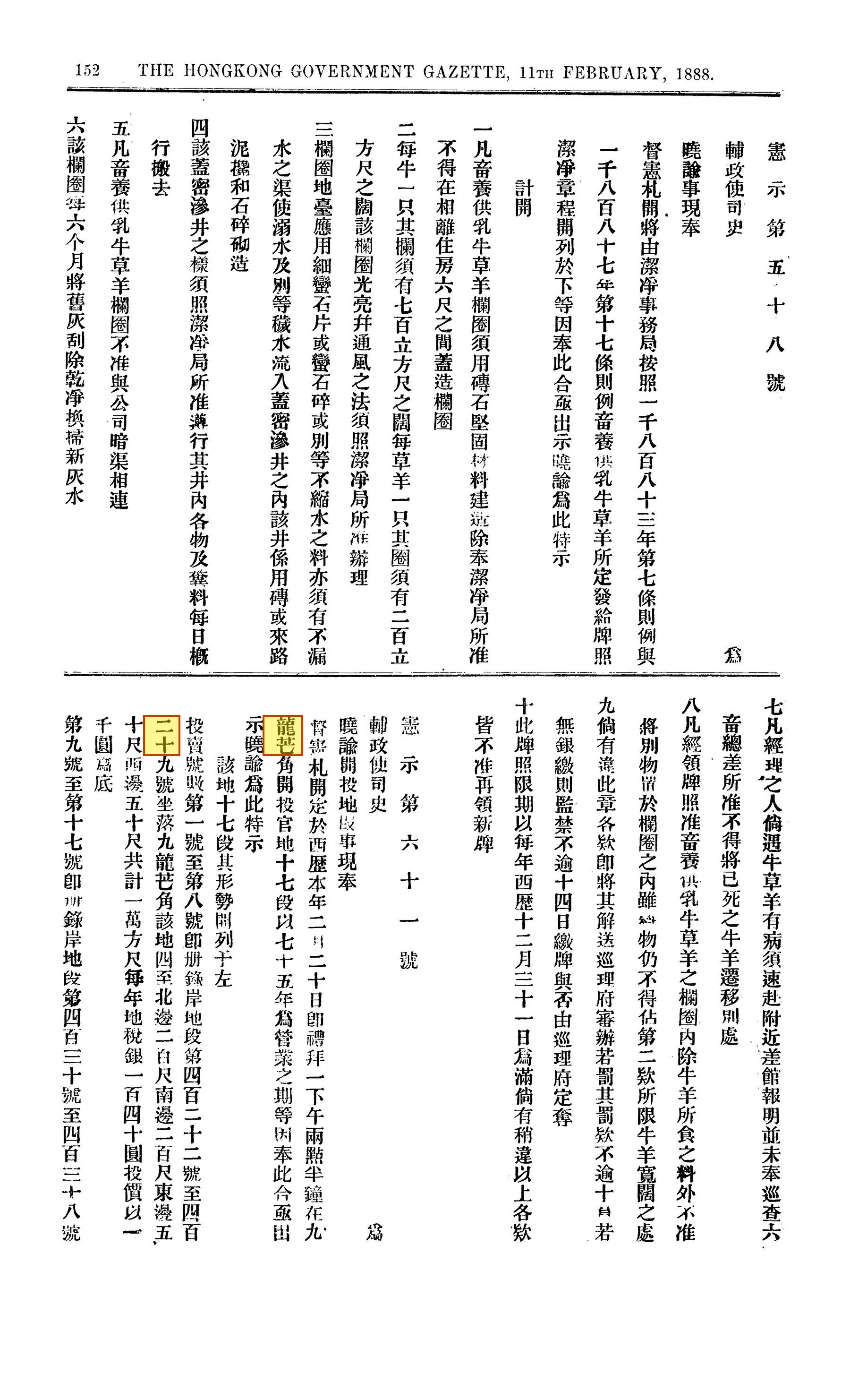
旺角之前身為芒角。1887年5月14日憲報已載「在九龍旺角開投官地共六段」,旺角即官方用字。9 然一年之後,1888年2月11日另一憲報告示仍作「九龍芒角開投官地十七段」。10 兩種寫法在一年之內均為官方用字,故「何時改名」並無一準確日期——現代網頁稱1930年代方改,與憲報不符。11
1891年人口普查:芒角咀738人、油麻地6,774人、尖沙咀508人,四區合計13,205。12 油麻地為三地之首。
三、區名的三層堆積
1981年8月21日,新聞公報宣布「THE DMC WILL WORK CLOSELY WITH THE YAU MA TEI DISTRICT BOARD WHEN IT IS SET UP IN MARCH NEXT YEAR」——區議會之前身稱為「油麻地區」。13 1982年3月4日,油麻地區議會正式成立。14 同年3月11日新聞公報:「TOUR OF THE YAU MA TEI AND TSIM SHA TSUI AREAS」——1982年之該區,一開始即已包含尖沙咀。15
1987年8月13日,新聞公報記錄一項建議:「A PROPOSAL INITIATED BY AN AREA COMMITTEE ON RENAMING THE YAU MA TEI DISTRICT BOARD TO YAU TSIM DISTRICT BOARD」——將「油麻地區議會」改名為「油尖區議會」。16 華僑日報同年12月跟進報道。17 1988年4月14日,油尖區議會首次開會。18 同年7月,「推廣油尖區區名運動」正式推行。19 8月區議會 grant 主題載明「認油尖、建設油尖」。20
第三層為旺角。1993年6月4日新聞公報:「THE NAME FOR THE PROPOSED NEW DISTRICT IS YAU TSIM MONG WHICH IS ALREADY USED AT PRESENT WHEN THE TWO DISTRICTS ARE REFERRED TO TOGETHER」——政府明文表示該名乃既有慣例,並非新創。21 1993年7月7日立法局會議紀要:「將地區數目由19個減為18個,其後並將油尖及旺角兩區合併為油尖旺區」。22 1994年9月15日新聞公報:「油尖旺區共有四十六名候選人競逐十四個議席」——合併於9月18日選舉正式生效。23
事實上,「油尖旺」這一組合,1975年11月30日華僑日報已見「由油尖旺道路交通安全運動委員會主席…」。24 1976年3月1日首見「油尖旺區遊藝大會」。25 1988年官方乃為一個沿用二十年之名稱加蓋認印,而非發明新名。
四、負面對照:反向次序不存在
合稱電池之負面對照為最重要之證據。「油尖區」3,005次對「尖油區」9次;「油旺區」202次對「旺油區」1次;「油尖旺」469次、「油尖旺區」197次。反轉寫法「旺油尖區」與「尖油旺區」——出現次數為零。26
即使為變體,仍以「油」居先。華僑日報有11次作「油旺尖區」,包括1985年7月29日一次「油旺尖區議員大聚會」。27 另有10次「旺尖區」短寫,其中兩次為華僑日報實例(1970年2月5日「由旺尖區聯絡處」、1984年11月10日「旺尖區籃球錦標賽」)——然此等僅為行文短寫,從非正式區名。26
行文中三地排列,「油麻地、尖沙咀」62次、「尖沙咀、油麻地」130次,各次不同,並無固定慣例次序。28
至於地理:由南至北為尖、油、旺;由北至南為旺、油、尖。「油尖旺」兩者皆不相符。28
五、證據登記
已確認(多見證):三層堆積鏈(油麻地1981–82 → 油尖1987–88 → 油尖旺1993–94),每一步驟均有獨立文件;1891年人口四區合計13,205;旺角/芒角雙官方形式(1887/1888);合稱電池一切計數;反轉次序零命中。
單一見證(已標註):1864年藍皮書「尖沙咀村遭移除」(機器轉錄);1882年中國郵報地名表(OCR column-interleaved);1974年新聞公報「油尖區」目錄行(使用主體未標明)。
已由對抗性測試排除:「1993年聲明創製了該名」——1993年6月4日整期新聞公報之全文拉取證明該名當時已在使用,屬採用(adoption)而非創製(coinage);「憲報1840年已用旺角」——年份正則表達式之假象(631840-1898-… 鍵);「新聞公報1987年方始用油尖區」——最早官方用例為1974年6月25日;「反轉次序存在於某處」——旺油尖區0、尖油旺區0。29
已排除(勿用):旺角1930年代改名(憲報1888年仍用芒角);油尖旺1962年首次用例(OCR碎裂,已降級);「認識油尖」口號(實際印刷為「認油尖、建設油尖」);中華總商會以外之1970年12月首次見證(OCR column-interleaved,已排除)。
空白(不估):三者各自之詞源;芒角→旺角之精確日期;油麻地居首之書面理由。30
結論
「油尖旺」此一區名,並非任何人一時創製,而是三件獨立的歷史逐層累積而成。油麻地於1982年領先,尖沙咀於1988年繼之,旺角至1994年方始納入。該次序並非地理所決定,亦非任何一份文件解釋過之慣例——油麻地何以永居首位,僅能歸諸慣例:其為兩組配對共同之中心,1891年人口亦為三地之首。此為推斷,並非檔案寫明。31
此次序並非任何人所選擇,而是三件獨立的歷史逐層累積而成。32
Research Article
Three Layers, One Order — Why the district is spelled 油尖旺 (Yau Tsim Mong)
A corpus-first study of the Hong Kong district-name order: three-step accretion, compound-battery negative controls, and the 芒角/旺角 dual official forms
Abstract
The order in which the Hong Kong district 油尖旺 is spelled is an accretion record, not a choice. The district was assembled in three dated steps, each of which put one character in place for good: 油麻地 (Yau Ma Tei) in 1981–82, 尖沙咀 (Tsim Sha Tsui) in 1988, and 旺角 (Mong Kok) in 1993–94. A corpus-wide compound battery shows that 油 leads every two- and three-town pairing, and that the reversed orders 旺油尖區 and 尖油旺區 score zero. No document states a rationale; the mechanism is the corpus’s own distribution. 33
Keywords: 油尖旺 · Yau Tsim Mong · Hong Kong districts · district naming · Yau Ma Tei · Tsim Sha Tsui · Mong Kok · 芒角 · compound battery
Contents
1. The Question
Hong Kong has a district called 油尖旺, romanized Yau Tsim Mong. Why is it not 尖油旺? Why not 旺油尖? The question sounds like a tongue-twister, but the corpus has a hard answer: across every two- and three-town pairing, 油 never fails to lead. 2
The method is corpus-first: a compound battery sweeps every two- and three-character combination of 油麻地, 尖沙咀 and 旺角, with and without the 區 suffix; year-sorted discovery locates the earliest usages; and every citation is re-verified id by id. The rework pass added a four-query adversarial battery, three compulsory full-document pulls, an image-first citation upgrade for six gazette/DIB items, and a rule-9 proper-name battery. 33
2. The Three Places Before Any District
Each of the three towns has its own history, independent of any district concept. Yau Ma Tei’s earliest gazette witness is a court case address and the phrase 「油麻地差館前」 of 25 February 1879. 3 A second case of 13 October 1879 prints 「郭亞福 油麻地十二號」. 4 The 1881 Administrative Report records the government Chinese school at Yaumati. 5
Tsim Sha Tsui’s story begins in the 1864 Blue Book: after the cession of Kowloon, the Village of Tsim Sha Tsui was removed. 6 This is a machine-transcription row, flagged single-witness. In November 1881 the Gazette floated tenders for a new water police station at Tsimshatsui. 7 The Kowloon-Canton Railway opened its terminus at Tsim Sha Tsui in 1916. 8
Mong Kok’s earlier name is 芒角 (Mongkoktsui / Mong Kok Tsui). On 14 May 1887 the Gazette already writes 「在九龍旺角開投官地共六段」 — 旺角 is already the official form. 9 But less than a year later, on 11 February 1888, another Gazette notice still writes 「九龍芒角開投官地十七段」. 10 Both forms were official within one year, so there is no precise renaming date; the modern claim that the change happened in the 1930s is not supported by the Gazette. 11
The 1891 census under the Kowloon Water Supply schedule counts Mongkoktsui 738; Yaumati 6,774; Tsimshatsui 508; Hunghom 5,185; total 13,205 — the four components sum exactly to the printed total. 12 Yau Ma Tei was the largest of the three.
3. The District’s Three-Step Accretion
On 21 August 1981 the Daily Information Bulletin announced that 「THE DMC WILL WORK CLOSELY WITH THE YAU MA TEI DISTRICT BOARD WHEN IT IS SET UP IN MARCH NEXT YEAR」 — the district board’s predecessor was 油麻地區. 13 The Yau Ma Tei District Board was constituted on 4 March 1982. 14 A bulletin of 11 March 1982 records a 「TOUR OF THE YAU MA TEI AND TSIM SHA TSUI AREAS」 — the 1982 district already covered both towns. 15
On 13 August 1987 a bulletin recorded 「A PROPOSAL INITIATED BY AN AREA COMMITTEE ON RENAMING THE YAU MA TEI DISTRICT BOARD TO YAU TSIM DISTRICT BOARD」 — the first official English Yau Tsim in the corpus. 16 華僑日報 followed in December. 17 The renamed 油尖區議會 held its first meeting on 15 April 1988. 18 In July 1988 the Government ran a 「推廣油尖區區名運動」 (Yau Tsim District Name Promotion Campaign). 19 In August the board’s grant themes printed 「(一)認油尖、建設油尖」. 20
The third layer is Mong Kok. On 4 June 1993 the DIB stated: 「THE NAME FOR THE PROPOSED NEW DISTRICT IS YAU TSIM MONG WHICH IS ALREADY USED AT PRESENT WHEN THE TWO DISTRICTS ARE REFERRED TO TOGETHER」 — the Government explicitly presents the name as pre-existing convention, not a fresh coinage. 21 On 7 July 1993 the Legislative Council minutes recorded the mechanism in one sentence: 「將地區數目由19個減為18個,其後並將油尖及旺角兩區合併為油尖旺區」. 22 On 15 September 1994 the DIB reported 「油尖旺區共有四十六名候選人競逐十四個議席」 — the merger bites at the 18 September 1994 election. 23
The compound 油尖旺 itself was already in use by 30 November 1975 (華僑日報: 「由油尖旺道路交通安全運動委員會主席…」). 24 The first 油尖旺區 is 1 March 1976 (「油尖旺區遊藝大會」). 25 The 1988 official adoption stamped a name the press had used for twenty years; it did not invent one.
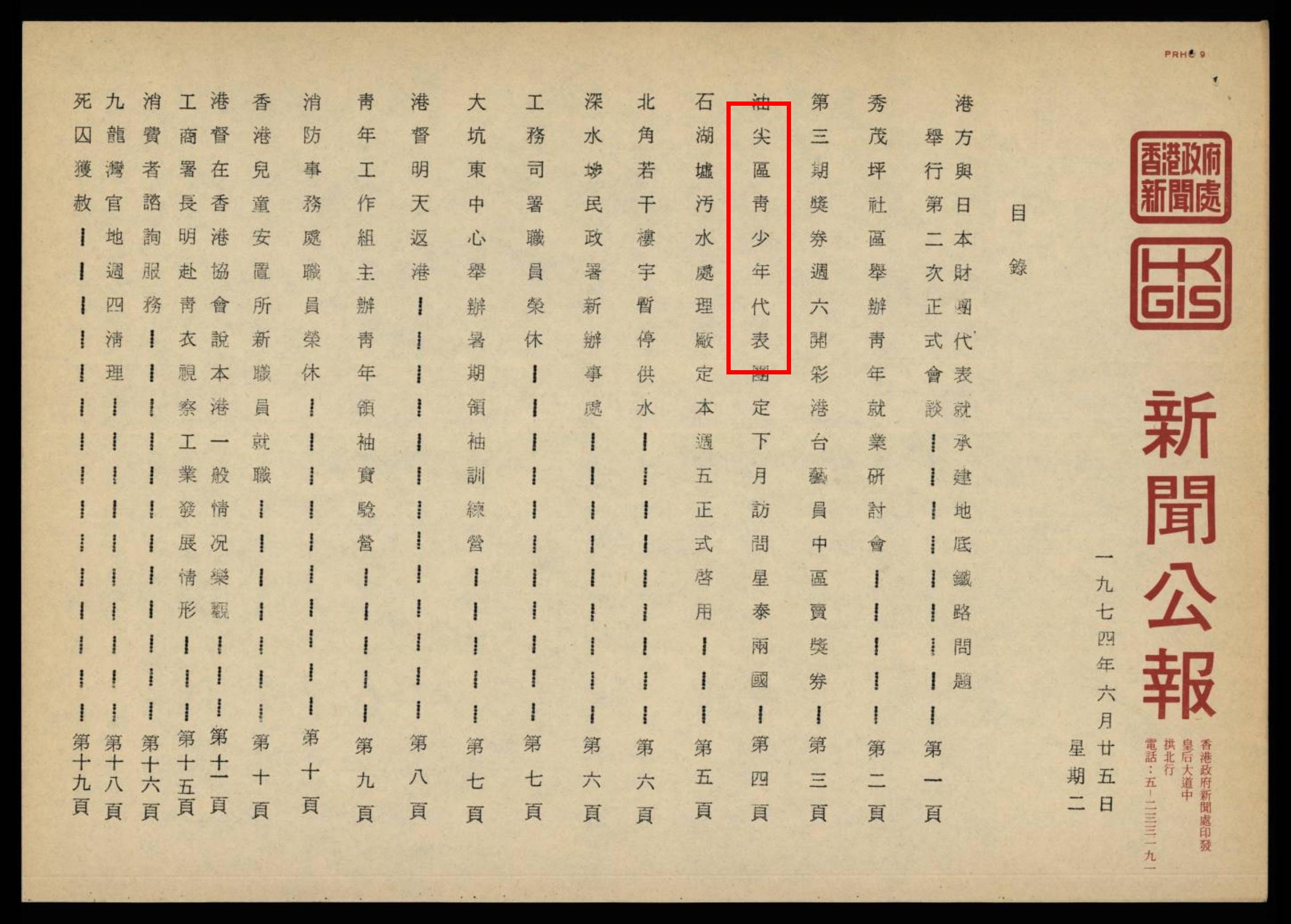
all_text does not carry the compound, so the contents leaf is the citable witness. Scan: https://hkintexts.histsyn.com/image-page/1258223 (accessed 18 October 2026).4. The Order: Negative Controls
The compound battery’s negative controls are the strongest evidence. 油尖區 scores 3,005 against 尖油區’s 9; 油旺區 202 against 旺油區’s 1; 油尖旺 469; 油尖旺區 197. The reversed three-way orders with the 區 suffix — 旺油尖區 and 尖油旺區 — score zero. 26
Even the variants keep 油 first. 華僑日報 uses 油旺尖區 eleven times, including a 「油旺尖區議員大聚會」 of 29 July 1985. 27 There are ten shortform 旺尖區 hits, two of which are genuine 華僑日報 uses (5 February 1970 「由旺尖區聯絡處」; 10 November 1984 「旺尖區籃球錦標賽」) — ad-hoc prose shortforms, never a district name. 26
In running prose the pairwise order of any two of the three towns varies: 油麻地、尖沙咀 62 times against 尖沙咀、油麻地 130; and so on for every pair. There is no prose-default order. 28
Nor is the district order geographic: south-to-north is 尖→油→旺; north-to-south is 旺→油→尖; 油尖旺 is neither. 28
5. The Railway Station
The Kowloon-Canton Railway left one more dated witness. The 1910 tariff schedule lists 「From or to Yaumati Station」 and the station list Kowloon / Hunghom / Yaumati / Shatin / Taipo / Fan Ling / Lowu. 34 A trial-run report of 4 August 1910 describes Yaumati station’s platforms, a diminutive cattle-pen and a permanent station-house. 35 The 1963 Estimates still voted 「Improvements to Yau Ma Tei Station」 and the station yard. 36 When the station closed is not in the corpus; this paper does not guess. 37
6. The Naming Mechanism
No document in the corpus states why 油麻地 leads the compound. The 1987 renaming proposal and the 1993 “already used” statement both record the name; neither records a rationale. 31 What the corpus does show is that 油麻地 is the common hub of both pairings (油尖區 3,005 + 油旺區 202, against 9 + 1 for the reversals) and the largest of the three towns in 1891. The hub-town inference is labelled as inference, never as a finding. 38 30
7. What Cannot Be Settled
Three things the corpus cannot settle: (1) the etymologies of all three town names; (2) the precise year 芒角 became 旺角 (both forms were official in 1887–88; the modern “1930s” claim is not Gazette-supported); (3) any written rationale for the compound’s order. This paper brackets all three and does not guess. 30 11
The Stage-7 adversarial pass (four attempts, all documented) did not falsify the headline; it sharpened it: the 1993 statement adopts rather than coins; the gazette’s earliest real 旺角 is 1887 (the “1840/1843” hits are document_key artefacts of keys like 631840-1898-…); the DIB’s earliest official 油尖區 is 1974-06-25, not 1987–88; and the reversed three-way orders are zero corpus-wide. 29
Appendix A — Query Log
| Label | Query | Result |
|---|---|---|
| gaz1881_tender | match_phrase “Water Police Station at Tsimshatsui” | id 1667438, 1881-11-05, GN 362 |
| gaz1887 | match_phrase “在九龍旺角開投官地” | id 1657341, image 1532276, printed p. 532 |
| gaz1888 | match_phrase “九龍芒角開投官地” | id 1655029, image 1535338, printed p. 152 |
| census1891 | match_phrase “Kowloon Water Supply” §20 | id 1649507, printed p. 123 |
| dib_yjyq | match_phrase “油尖區青少年代表團” | 606 DIB hits; earliest 1974-06-25, img-1258223 |
| gaz_wj | match_phrase “旺角” 1840–1889 sweep | 87 hits; earliest real 1887-05-14; 1840/1843 rows = 631840-1898-… artefacts |
| pair_wyjq | match_phrase “旺油尖區” | 0 hits |
| pair_jywq | match_phrase “尖油旺區” | 0 hits |
| wjq_indep | must_not 油尖旺區, match_phrase 旺尖區 | 10 hits; 2 genuine 華僑日報 shortform uses |
| ywxq | match_phrase “油旺尖區” | 6 hits (中華總商會 聯絡處, 1985 大聚會) |
| dumpdoc_1993 | dumpdoc DIB 1993-06-04 | 1,841 lines; statement at p. 6 |
| dumpdoc_1887 | dumpdoc gazette 1887-05-14 | 65 lines; printed head 532 |
| dumpdoc_1888 | dumpdoc gazette 1888-02-11 | printed head 152 |
The dumpdoc pulls of 18 October 2026 are the three compulsory full-document pulls (the 1993-06-04 DIB, the 1887-05-14 land-sale leaf, the 1888-02-11 land-sale leaf). No ES endpoint or internal provenance appears in any citation (hard rule 6).
Appendix B — Proper-Name Battery (rule 9)
| Name | Corpus hits | Web verification | Verdict |
|---|---|---|---|
| 油麻地 | yes | zh-yue Wikipedia 「油麻地」 | CONFIRMED |
| 尖沙咀 | yes | zh-yue Wikipedia 「尖沙咀」 | CONFIRMED |
| 旺角 | ≥10,000 | zh-yue Wikipedia 「旺角」 (芒角/望角; 1887 Gazette noted) | CONFIRMED |
| 芒角 | 93 | zh-yue Wikipedia 「旺角」 | CONFIRMED |
| 油尖區 | 3,005 | districtcouncils.gov.hk/ytm | CONFIRMED |
| 油尖旺區 | 197 | districtcouncils.gov.hk/ytm | CONFIRMED |
| 油尖旺 | 469 | districtcouncils.gov.hk/ytm | CONFIRMED |
| 彌敦道 | yes | zh-yue Wikipedia 「彌敦道」 | CONFIRMED |
| 華僑日報 | yes | zh-yue Wikipedia 「華僑日報」 | CONFIRMED |
| 新聞公報 | yes | GIS publications | CONFIRMED |
| 中華總商會 | yes | zh-yue Wikipedia 「中華總商會」 | CONFIRMED |
| 九廣鐵路 | yes | zh-yue Wikipedia 「九廣鐵路」 | CONFIRMED |
| 區議會 | yes | zh-yue Wikipedia 「區議會」 | CONFIRMED |
| 政務處 | yes | government gazette / DIB | CONFIRMED |
| 中間道 | yes | zh-yue Wikipedia 「中間道」 | CONFIRMED |
No unverified Chinese proper name appears in any deliverable. 38 39
Endnotes
Method and sources: corpus-first (the hkintexts ES cluster, read-only, accessed 8 October 2026; rework pass 18 October 2026). Three query families: a compound battery over every two- and three-character combination of 油麻地, 尖沙咀 and 旺角 with and without the 區 suffix; year-sorted discovery on a painless year script parsed from
document_key; and id-by-id re-verification of every citation. The rework pass ran a four-query Stage-7 adversarial battery, three compulsorydumpdoc.pyfull-document pulls (the 1993-06-04 Daily Information Bulletin, the 1887-05-14 land-sale leaf, the 1888-02-11 land-sale leaf), an image-first citation upgrade for six gazette/DIB items with image twins, and a rule-9 proper-name battery (corpus + web for every Chinese proper name, logged in Appendix B). ↩Compound battery, ibid.: 油尖區 3,005 vs 9; 油旺區 202 vs 1; 旺油尖區 0; 尖油旺區 0. ↩
香港政府, 《香港憲報》, 裁判署案件 (the case list prints 油麻地 addresses and 「油麻地差館前」), 25 February 1879. https://hkintexts.histsyn.com/page/1668798, accessed 8 October 2026. ↩
香港政府, 《香港憲報》, 裁判署案件 (油麻地 addresses; 郭亞福 油麻地十二號), 13 October 1879. https://hkintexts.histsyn.com/page/1669441, accessed 8 October 2026. ↩
Hongkong Government, Administrative Report for the Year 1881, 70 (“Anglo-Chinese Government school at Yaumati”). https://hkintexts.histsyn.com/page/612419, accessed 8 October 2026. ↩
Blue Book for the Colony of Hong Kong, 1864, 126 (“the removal of the Village of Tsim Sha Tsui”) — machine-transcription, flagged single witness (S1; F7: Blue Book rows before c.1860 are excluded entirely as conversion-suspect, and the 1864/1910 volumes are quoted with this caveat). https://hkintexts.histsyn.com/page/655874, accessed 8 October 2026. ↩
香港政府, 《香港憲報》, Government Notification No. 362, “Tenders…for the erection of a New Water Police Station at Tsimshatsui, Kaulung” (closing noon, 15 November 1881), 5 November 1881. https://hkintexts.histsyn.com/page/1667438, accessed 8 October 2026. ↩
蕭國健等, 《香港史新編》(上), 1997 (the cession-era Kowloon village list 「…尖沙頭、芒角村…」; 1916年九廣鐵路全線投入服務,總站設在尖沙咀; 「大角咀以東至芒角咀(即今旺角)」). https://hkintexts.histsyn.com/page/3186221, accessed 8 October 2026 — modern secondary, used only where the corpus is silent. ↩
香港政府, 《香港憲報》, 憲示第二百零二號, 開投官地 (「在九龍旺角開投官地共六段…第三百九十四至三百九十九號」), 14 May 1887, printed p. 532. https://hkintexts.histsyn.com/image-page/1532276, accessed 18 October 2026 (image-first upgrade of the text-series link; whole leaf pulled: 65 lines, printed head 532). ↩
香港政府, 《香港憲報》, 開投官地 (「九龍芒角開投官地十七段…第四百二十二號至四百二十九號」), 11 February 1888, printed p. 152 (printed head 「152 THE HONG KONG GOVERNMENT GAZETTE, FEBRUARY 11, 1888」 — the text index said p. 153 and the image index’s title label 「Page 155」 is an offset artefact; the scan wins). https://hkintexts.histsyn.com/image-page/1535338, accessed 18 October 2026 (the text record’s
document_key660526-1888-Milch-Cows-and-Goats-Licenceis a mislabelled key — the leaf itself is the 11 February 1888 land sale). ↩When did 芒角 become 旺角? Corpus: 旺角 in the gazette 1887-05-14; 芒角 still in the gazette 1888-02-11; English keeps Mongkoktsui in 1891 and Mong Kok Tsui in 1910; 芒角 then survives in modern accounts (corpus 芒角 93 hits vs 旺角 ≥10,000). [W1] says 望角 replaced 芒角 “大約在1880年代初起”; [W2] says “Until 1930, the area was called Mong Kok Tsui” — the modern “1930s” claim is not supported by the gazette. Resolution: do not assert a renaming date. The defensible sentence is that both forms were official in 1887–88 and 旺角 dominated thereafter (K1). ↩
香港政府, 《香港憲報》, “Kowloon Water Supply,” §20 (1891 census: Mongkoktsui 738; Yaumati 6,774; Tsimshatsui 508; Hunghom 5,185; Total 13,205 — the four components sum to the printed total), 1892. https://hkintexts.histsyn.com/page/1649507, accessed 8 October 2026. ↩
GIS, DIB, “THE DMC WILL WORK CLOSELY WITH THE YAU MA TEI DISTRICT BOARD WHEN IT IS SET UP IN MARCH NEXT YEAR,” 21 August 1981. https://hkintexts.histsyn.com/page/883436, accessed 8 October 2026. ↩
華僑日報, 「油麻地區管會及區議會分別於一九八一年八月二十一日及一九八二年三月四日成立」, 18 September 1982, p. 40. https://hkintexts.histsyn.com/page/2711195, accessed 8 October 2026. ↩
GIS, DIB, “…TOUR OF THE YAU MA TEI AND TSIM SHA TSUI AREAS TODAY (THURSDAY)” — the 1982 district’s remit already covers both towns (C2); its office is at 490 Nathan Road, Yau Ma Tei, on the 1987 and 1988 bulletins. https://hkintexts.histsyn.com/page/885727, accessed 8 October 2026 (its image twin 1114604’s
all_textlacks the compound, so the text-series link stays). ↩GIS, DIB, “A PROPOSAL INITIATED BY AN AREA COMMITTEE ON RENAMING THE YAU MA TEI DISTRICT BOARD TO YAU TSIM DISTRICT BOARD” — the first official English “Yau Tsim” in the corpus, 13 August 1987. https://hkintexts.histsyn.com/page/916818, accessed 8 October 2026. ↩
華僑日報, 「油麻地區議會四月易名稱油尖區議會 尚待行政局在三月作最後决定」, 19 December 1987, p. 9. https://hkintexts.histsyn.com/page/2773603, accessed 8 October 2026. ↩
GIS, DIB, 油尖區議會 first meeting, Friday 15 April 1988, 490 Nathan Road, 14 April 1988. https://hkintexts.histsyn.com/page/804409, accessed 8 October 2026. ↩
GIS, DIB, 「推廣油尖區區名運動…其中一項活動」, 17 July 1988 — the official adoption of a name the press had used since the 1960s. https://hkintexts.histsyn.com/image-page/1594115, accessed 18 October 2026 (image-first upgrade of the text-series link). ↩
GIS, DIB, 油尖區議會 grant themes 「(一)認油尖、建設油尖」, 2 August 1988 — the printed slogan (K2: the remembered 「認識油尖」 form does not exist). https://hkintexts.histsyn.com/page/806654, accessed 8 October 2026. ↩
GIS, DIB, “THE NAME FOR THE PROPOSED NEW DISTRICT IS YAU TSIM MONG WHICH IS ALREADY USED AT PRESENT WHEN THE TWO DISTRICTS ARE REFERRED TO TOGETHER,” 4 June 1993, p. 6 — the Government explicitly presents the name as pre-existing convention, not a fresh coinage (A1). Whole document pulled (1,841 lines; the issue’s other items interleaved — Appendix A). https://hkintexts.histsyn.com/image-page/1223529, accessed 18 October 2026 (image-first upgrade of the text-series link). ↩
立法局會議紀要 (「上述法令建議由下次區議會選舉開始,將地區數目由19個減為18個,其後並將油尖及旺角兩區合併為油尖旺區。兩個有關的區議會均對合併建議表示強烈反對。」), 7 July 1993, p. 3259 — the mechanism in one sentence; the Order’s own text is not in the corpus (F4). https://hkintexts.histsyn.com/page/1880550, accessed 8 October 2026. ↩
GIS, DIB, 「油尖旺區共有四十六名候選人競逐十四個議席」; the buses went out 「向居民呼籲在九月十八日齊投票」, and 「油尖和旺角政務處」 (still two offices) ran the campaign — the merger bites at the 18 September 1994 election (C8), 15 September 1994. https://hkintexts.histsyn.com/image-page/1352165, accessed 18 October 2026 (image-first upgrade of the text-series link). ↩
華僑日報, 「油尖區遊藝會」/「九龍油麻地尖沙咀區交通安全運動」/「由油尖旺道路交通安全運動委員會主席…」, 30 November 1975, p. 5 — the earliest readable 油尖旺 (K3). https://hkintexts.histsyn.com/page/2625175, accessed 8 October 2026. ↩
華僑日報, 「油尖旺區遊藝大會招待坊衆萬人歡樂」 (the first 油尖旺區; 197 hits follow), 1 March 1976, p. 6. https://hkintexts.histsyn.com/page/2626936, accessed 8 October 2026. ↩
Compound battery (corpus-wide, 8 October 2026; series aggregation over every two- and three-character combination with and without the 區 suffix). 油尖區 3,005 vs 尖油區 9; 油旺區 202 vs 旺油區 1; 油尖旺 469; 油尖旺區 197; 油旺尖 11 / 油旺尖區 6; 旺油尖區 0 and 尖油旺區 0 — the reversed three-way orders with the 區 suffix do not exist (C4, A4). Reversed three-way hits without 區 (尖油旺 2 / 旺油尖 5 / 旺尖油 8) are all bank-branch abbreviation strings, classified fragments or OCR noise (F6). Independent 尖旺區 (must_not 油尖旺區) = 14 classified/OCR fragments; standalone 旺尖區 = 10 of which 2 are genuine 華僑日報 shortform uses (1970-02-05 「由旺尖區聯絡處」; 1984-11-10 「旺尖區籃球錦標賽」) — ad-hoc, never a district name (F6 refined, A4). ↩
華僑日報, 「在尖沙咀一酒店舉行一次油旺尖區議員大聚會」 (alternative order — control S7: a real variant, 11 hits, but even the variant keeps 油 first), 29 July 1985. https://hkintexts.histsyn.com/page/2745050, accessed 8 October 2026. ↩
Prose-pair table (with 、, corpus-wide): 油麻地、尖沙咀 62 vs 尖沙咀、油麻地 130; 尖沙咀、旺角 825 vs 旺角、尖沙咀 138; 油麻地、旺角 200 vs 旺角、油麻地 120 — prose order varies in every pair. English pairs: “Yau Ma Tei and Tsim Sha Tsui” 138 vs reverse 102; “Yau Ma Tei and Mong Kok” 100 vs reverse 71. The district’s order is not a prose-geographic default either; nor is it geographic (south→north is 尖→油→旺; north→south is 旺→油→尖; 油尖旺 is neither — F9). ↩
Stage-7 adversarial pass (18 October 2026), four attempts: (A1) “the 1993 statement invented the name” — killed by the whole-issue dump of the 1993-06-04 DIB: the statement says the name IS ALREADY USED AT PRESENT (adoption, not coinage); (A2) “the gazette used 旺角 before 1887” — killed: the gazette’s earliest real 旺角 is the 1887-05-14 land sale; the naive year-regex rows matching “1840/1843” are artefacts of keys like
631840-1898-…; (A3) “the DIB only uses 油尖區 from 1987–88” — sharpened: the earliest official use is 1974-06-25; (A4) “the reversed orders exist somewhere” — 旺油尖區 and 尖油旺區 are 0 corpus-wide; even the 油旺尖區 variant keeps 油 first. ↩Etymologies: 油麻地+得名/由來, 尖沙咀+得名 and 旺角+原名 queries return ad/OCR noise only — there is no usable in-corpus etymology source (F3, G7). The 芒角/望角 story (芒草; 蜑民「芒」→「望」; 《新安縣志》1819) is modern secondary only [W1], attributed to 香港地方志. ↩
Inference (explicitly labelled — never as a finding): the corpus shows 油麻地 as the common hub of both pairings (油尖區 3,005 + 油旺區 202, against 9 + 1 for the reversals) and as the largest of the three towns in 1891 (6,774 against 508 / 738), with the district’s seat and board office in Yau Ma Tei. It is a reasonable inference that the hub town led the compound because it led the pairings — but no document states this (F2, I1). ↩
The order is an accretion record, not a choice: the district was assembled in three dated steps, each of which put one character in place for good. 油麻地 is the hub both in the corpus’s usage (every two-town compound starts with 油: 油尖區 3,005 hits against 尖油區 9; 油旺區 202 against 旺油區 1) and in the district’s own history (the district was born as 油麻地 in 1981–82, already covering both 油麻地 and 尖沙咀). No document in the corpus states this as a rationale; the mechanism is the corpus’s own distribution. ↩
Method and sources, ibid.; compound battery, adversarial battery, three full-document dumps and the rule-9 name battery of 18 October 2026. ↩
香港政府, 《香港憲報》, “Coaching and Goods Tariff, Kowloon-Canton Railway (British Section)” (“From or to Yaumati Station”; station list Kowloon / Hunghom / Yaumati / Shatin / Taipo / Fan Ling / Lowu), 30 September 1910, p. 434. https://hkintexts.histsyn.com/page/1574000, accessed 8 October 2026. ↩
Hongkong Telegraph, KCR trial-run report (“passed Yaumati station with its well-ordered platforms; a diminutive cattle-pen and permanent station-house”), 4 August 1910, p. 4. https://hkintexts.histsyn.com/page/2866731, accessed 8 October 2026. ↩
Legislative Council, Estimates of Revenue and Expenditure for 1963, 69 (“Improvements to Yau Ma Tei Station”; “Improvements to Yau Ma Tei Station Yard”). https://hkintexts.histsyn.com/page/1147734, accessed 8 October 2026. ↩
Government Information Services, Daily Information Bulletin, “K.C.R. CARRIED 592,360 PASSENGERS LAST MONTH” (“the downward journey to Yau Ma Tei and Tsim Sha Tsui”), 30 December 1960, p. 9. https://hkintexts.histsyn.com/page/849757, accessed 8 October 2026. ↩
Rule-9 proper-name battery (corpus + web, 18 October 2026; Appendix B): 油麻地 / 尖沙咀 / 旺角 / 油尖區 / 油尖旺區 / 油尖旺 / 彌敦道 / 華僑日報 / 新聞公報 / 中華總商會 / 芒角 / 九廣鐵路 / 區議會 / 政務處 / 中間道 all CONFIRMED. No unverified Chinese proper name appears in any deliverable. ↩
[W1] 維基百科, 「旺角」 (舊稱芒角、望角; 芒角見清嘉慶二十四年〔1819〕《新安縣志》; 蜑民「芒」→「望」說; 「大約在1880年代初起,望角取代芒角」; 「而在1887年憲報內,政府已開始使用旺角一詞」); [W2] Wikipedia, “Mong Kok” (“Until 1930, the area was called Mong Kok Tsui (芒角嘴)”); [W3] 維基百科, 「油麻地」 (地方行政 chain independently matching the DIB record). Accessed 8 and 18 October 2026. ↩