The Week the Railway Opened The Kowloon-Canton Railway, 1910–1911
Research article
The Week the Railway Opened
The Kowloon-Canton Railway, 1910–1911
Abstract
A railway’s opening is imagined as a ceremony, and remembered as a certificate. The record of the Kowloon-Canton Railway keeps both, on the same day. On 1 October 1910 the British Section was opened twice: legally, by the Chief Resident Engineer’s certification under Section 16 of the Railways Ordinance, 1909 (“the works and rolling stock are in a sound condition… without danger to the public using it… opened… on the 1st instant”), and publicly, by an afternoon ceremony at Kowloon at which the Officer Administering the Government declared “the British Section of the Canton-Kowloon Railway open for traffic” with the Viceroy of Canton’s representative present, before a five-carriage official train ran to the frontier terminus at Lowu. The first ordinary passenger train followed the next afternoon, before crowds of first-ticket hunters; within four days the line had broken down twice (an eccentric strap, a hot axle at Yaumati), suspended its service for four days, and resumed with a special train “to make a trip to the border”. The paper follows the thread through the works’ four-year sick-rolls and the terminus lots bought and shelved; the 1911 Legislative Council battle over the “incredible sum of something like £50,000 per mile”; the Chinese Section’s formal opening at Shamchun and the through service (“almost exactly a year after”), suspended by the revolution from 7 November to 14 December 1911 with a compensation claim of $7,316 against the Chinese Government; and the afterlife of the temporary ferry-side terminus in the New Terminal Station at Kowloon Point, the clock of 1921, and the tower that survived the demolition of 1978. The paper’s finding: the line’s opening was never one act — legal, ceremonial, operational, political and financial openings each have their own dates and their own documents, and the archive keeps them all.
Keywords: Hong Kong; Kowloon-Canton Railway; KCR; British Section; E. S. Lindsey; Sir Henry May; Railways Ordinance 1909; 1 October 1910; opening ceremony; through traffic; revolution 1911; Shamchun; Lowu; clock tower
1. Introduction: the ribbon and the signature
Every railway’s opening is two things at once: a legal fact and a public occasion. An earlier version of this paper read the Kowloon-Canton Railway’s opening as the legal fact alone — “opened by certificate” — because that was all a gazette-only pull had found.1 The press battery of the opening week corrects the record: on 1 October 1910 the British Section was opened by certificate and by ceremony, the signature in the morning’s files and the ribbon — or rather the detonators — in the afternoon’s papers. This paper reads the whole arc: the works and their human cost, the three gazette notices, the ceremony and its complaint letter, the first week’s failures, the cost debate, the through year with its revolution, and the terminus afterlife.2
2. The money and the earth, 1905–1910
The line was born in a loan ordinance: the money voted under “the railway loan authorised by Ordinance No. 11 of 1905”.3 The British and Chinese Corporation took the concession for the whole Canton–Kowloon undertaking, but “it was not till 1906 that circumstances justified the commencement of the construction of the British Section”.4 The works were heavy from the first: the Hung Hom reclamation alone absorbed about five million cubic feet of fill from the great Cutting No. 1, whose last fifteen feet of gullet fought the water of the tapped Old Kowloon Water Works; the typhoon of October 1909 had already torn the pitching from the sea-front banks between Miles 7 and 12.5 By 1910 the line assembled itself quickly: tunnel linings in February, permanent way from March to the middle of May, stations by June, the rolling stock erected before the end of September.6
The building had a human ledger. The medical annexe to the 1910 report kept dispensaries at Kowloon, Kowloonchai, Shatin and Taipokau “until the opening of the railway on October 1st”, and counted the camp’s sick year by year: 3,667 cases in 1907 falling to 1,015 in 1910 — a fall “largely due to the decrease of labourers, owing to the completion of the Railway”.7 The injuries column peaked at 608 in 1909; malaria ran at four figures in the first year.8 Meanwhile the permanent terminus had been bought and shelved in one transaction: $309,479 for Kowloon Inland Lots No. 442 and 618, “the proposal to utilize the lots in this manner… subsequently held in abeyance”.9

3. June–October 1910: plant, rules, certificate
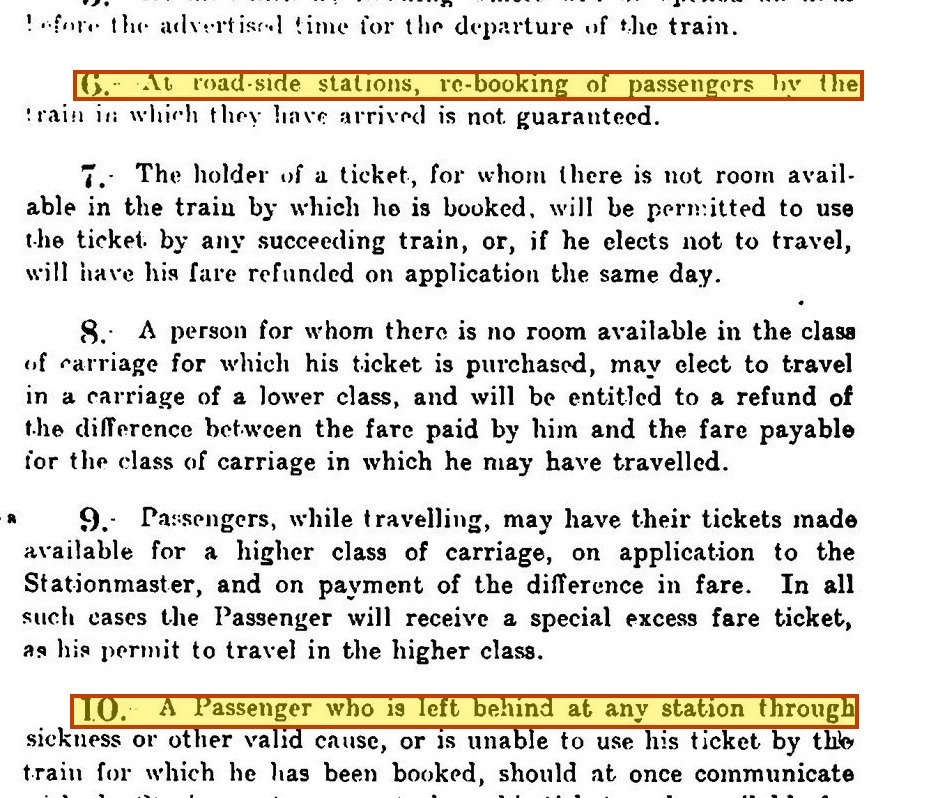
Three gazette notices carry the administrative birth. On 10 June the construction plant was offered for sale, catalogue from the Chief Resident Engineer at Kowloon — the tools sold while the rolling stock they had built was still being erected.10 On 19 September, published on the 30th, came the rulebook under Section 32: “Timing of Trains… Booking of Passengers… Missed Tickets… Want of Accommodation… Passenger left behind” — the complete apparatus of the new public life, printed the day before the opening.11 And on 7 October the opening notice itself: Mr. E. S. Lindsey’s certification under Section 16, and the sentence that opened the line — “the British Section of the said Railway was opened for the public carriage of passengers on the 1st instant”.12 The annual report confirms the date in its own words: “The Railway was opened for traffic on the 1st October.”13



4. 1 October 1910: the ceremony
The same day carried the public act. The evening paper reported it under the heading “THE OPENING CEREMONY. THE ADDRESSES”: “In the presence of a large concourse of [people] the opening ceremony of the Kowloon-Canton Railway took place at Kowloon this afternoon”; the stations then in service were “Tsimshatsui (the Kowloon terminus) and Vaumati”.14 The declaration was the Officer Administering the Government’s: with the Governor away, Sir Henry May presided — “Mr. Lindsey has briefly sketched the history of the Railway which I am asked to open to-day. I declare the British Section of the Canton-Kowloon Railway open for traffic.”15 The platform carried the line’s two jurisdictions: His Excellency Wei Han, “late Managing Director of the Chinese Section of the Railway”, “represented the Viceroy of Canton”; the British side counted the Commandant, the Consul-General at Canton, and the Governor’s A.D.C.16 The band played the anthem; the guests boarded a five-carriage special “taxed to their utmost capacity” and ran to the frontier, “as far as the terminus of the British section at Lowu” — already, within the week, a photographic souvenir.17
The addresses gave the opening its rhetoric. Mr. Lindsey’s sketch carried the route’s defence — twenty-one miles from “the Buffer Stop at Kowloon” to “the Bridge over the River at Lowu” (a figure that conflicts with the official twenty-two; Appendix B), the forty-one acres of Hung Hom reclamation, sixteen miles of deep cuttings and high banks “where no other route was practically possible”.18 Sir Henry May’s speech allegorised the railway as a child that had survived “infantile troubles” and would thrive as long as it kept “refrains from going off the track—even occasionally” — words printed on the eighth of the month, four days after the line’s first real breakdown and one day after its second.19 The occasion’s social arithmetic survived too, in a letter to the editor protesting the guest list: “what was the guiding principle that determined the compilation of the list of guests…?”20 The strategic case was made in the same week’s editorial: without railway connection with Canton, the Colony “was threatened with the creation of a rival port in the vicinity of the Bogue… a severe blow… on British influence and prestige”.21
5. The first week: crowds, failures, suspension
The ordinary service began the afternoon after the ceremony. The first train was scheduled for 2.30; by two o’clock the booking office was congested with “many… eager to obtain the first ticket or at any rate one of the early numbers”, and the green clerks issued every one “without a hitch”.22 Sunday’s takings came to “over $400”.23 Then came the week’s lesson in the difference between a certified railway and a working one. On Tuesday a locomotive was disabled beyond Yaumati when its eccentric strap snapped — and the paper’s complaint was institutional, not mechanical: “Had there been a workshop connected with the railway such a part would have been among the ‘spares’”. On Wednesday the first train reached Yaumati and stopped, its axle hot, “and the passengers had to be returned to Kowloon on trollies”; the service was suspended.24 The railway’s own notices announced three days without trains (the 6th, 7th and 8th) and a Sunday resumption from the “KOWLOON FERRY STATION” — the temporary ferry-side terminus.25 On Sunday the 9th the line returned: “After being suspended for four days the service… was resumed yesterday morning… a special train left at 8.30 for Lo[wu]… to make a trip to the border”.26 The official year-end account folded the whole season into one sentence of praise: after “the first rush of excursionists, the traffic settled down to a steady third class traffic”, the three months’ earnings ($26,839.02 coaching, $7,141.31 goods) exceeded in thirteen weeks the $20,000 estimated for twenty-six.27 The same report proposed the branch that would follow the traffic: a two-foot gauge from Fan Ling to Sha Tau Kok, “using material which is now available from Construction”.28
6. April 1911: the cost debate
Before the line had run a single through train, its price became a Legislative Council quarrel. The member for the Chamber of Commerce doubted “if any other railway in the world, with the exception of one or two in South America, has ever cost such a terrible sum of money” and set the figure at “the incredible sum of something like £50,000 per mile”.29 The Colonial Secretary, the Hon. Mr. C. Clementi, answered with the estimate’s whole history — Bruce’s $5,055,500, Eves’s $8,003,642, $11,004,128, $12,371,495, and Lindsey’s final $12,296,929 — and the works inventory: “5 tunnels of a total length of 8,784 feet, 49 bridges and culverts, many heavy cuttings, high banks running along an exposed foreshore and often built through the sea—all in a length of 22 miles”, with the Chinese section’s probable $15,500,000 producing a whole-line “$250,442 per mile—by no means an ‘incredible sum’”.30 The rebuke that survived was the walking one: “will the honourable member accompany me on a walk from Kowloon to Lowu over the centre line of the existing railway?… the method ‘solvitur ambulando’ should be applied.”31
7. 1911: the through service and the revolution
The connection had been hoped for by mid-1911; the Administration announced it for 5 October — “Through traffic will commence on [the 5th] October… By Order, THE ADMINISTRATION, Canton [-]Kowloon Railway”.32 The Chinese Section was formally opened the day before, at the border: on the invitation of the Directorate-General of the Chinese Imperial Railways, guests from both cities assembled at Shamchun — “almost exactly a year after the opening of” the British Section — under the China Mail’s headline “‘A Monument of Anglo-Chinese Co-operation’”.3334 The press found the occasion under-attended: “a pleasant little ceremony… singularly infelicitous on such an occasion to plead ‘pressure of other official business’ as an excuse for the absence” of the Viceroy and the Governor alike.35 On the 5th the junction moved: Lowu Station closed, and the working station became Sham Chun, “just over the border and in Chinese Territory”.36

Then the revolution. On 7 November, “at the request of the Viceroy of Canton, owing to disturbances in the Kwong Tung Province”, through traffic was suspended; the Working Agreement produced a claim of $7,316 against the Chinese Government for the suspension and the late trains; the resumption came on 14 December, by notice.3738 The revolution touched the junction in rumour too: a train “attacked by [about] 400 revolutionaries, and looted at Samchun”, a story the British section’s offices called exaggerated.39 The year’s arithmetic closed in the Christmas paper: October’s takings $9,413.92 local and $7,518.31 through, “since the opening of the section… $150,185.51”.40 The branch line, meanwhile, had opened on 21 December — the two-foot gauge to Sha Tou Kok, built “up to the 6th Mile”.41
8. The afterlife: the terminus and the tower
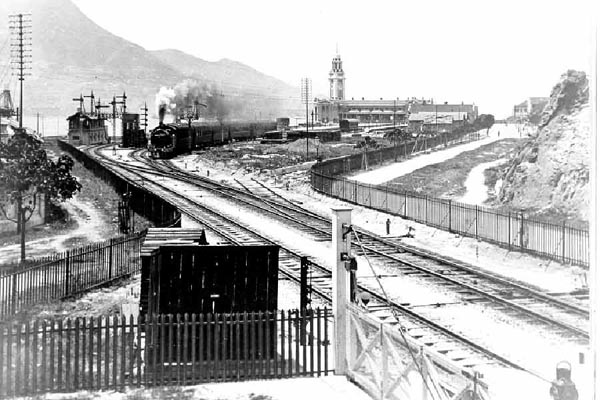
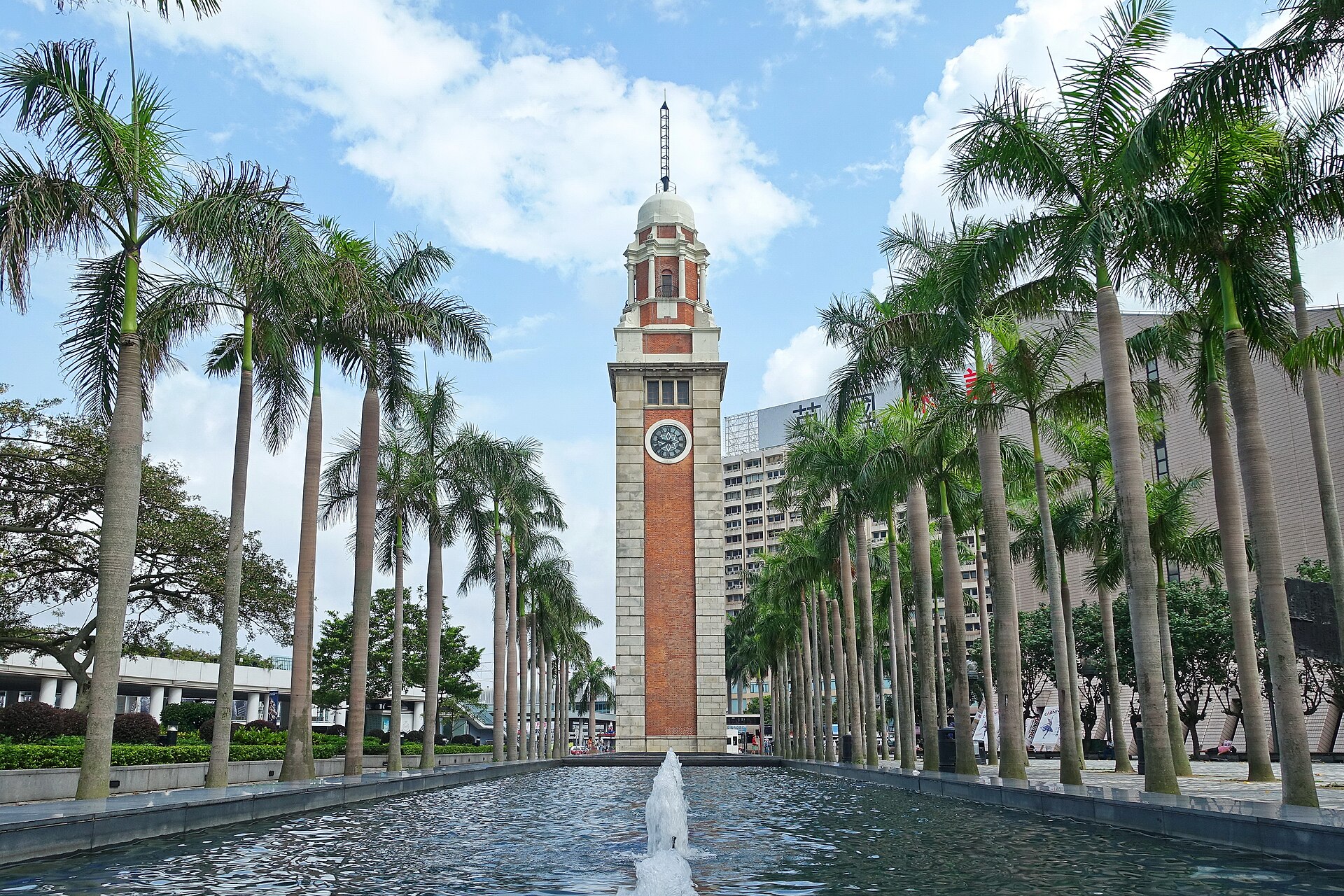
The opening week’s “KOWLOON FERRY STATION” was a beginning, not a home. The permanent station’s site “has been under discussion during the year”, the 1911 report records, with the work hoped for in 1912; by 1913 the Public Works report counts sewer diversions to clear “the site of the New Terminal Station at Kowloon Point”, “Paid from Railway funds”. 42 The official memory of what followed is a committee memorandum of 1990: the terminus was completed in 1915, the clock and its one-ton bell installed in 1921, and when the Hung Hom terminus replaced it in 1978 the Tsim Sha Tsui Terminus was demolished, “leaving only the Clock Tower intact in situ” — the one-tonne bell outlived its tower’s function by half a century.43

.jpg)
9. Conclusion
The Kowloon-Canton Railway was never opened once. It was opened by loan ordinance in 1905, by earthwork between 1906 and 1910, by certificate and by ceremony on the same afternoon of 1 October 1910, by its first ordinary train on the 2nd, by a suspension and a resumption in its first fortnight, by through traffic on 5 October 1911, by suspension again on 7 November and resumption on 14 December, and — architecturally — by the terminus of 1915 and the clock of 1921. Each opening has its own document, and the documents do not agree with each other about everything: the certificate’s 1 October stands beside the ordinary service’s 2 October; the address’s twenty-one miles beside the Council’s twenty-two. The archive’s lesson is not that one date is right and the others wrong, but that a railway’s opening is a family of events, and the family portrait hangs only when every member is cited.
Appendix A: sources and method
The documentary corpus is the hkintexts research index (Elasticsearch
cluster hkintexts, index hkintexts_pages), queried
read-only on 10 October 2026. Every passage quoted was read in its whole
page context; the thread’s central document — the newspaper
record of the opening weekend — was pulled whole (both issues of 3
October 1910, eighteen pages). The image-series scan of the China
Mail’s speeches page (5 October 1911) was located and
downloaded, but its OCR layer is empty and the speech texts are
therefore quoted only as headlines. No write was made to the index.
Query families:
- “Kowloon-Canton Railway” — 10,000+ corpus-wide; 1905–1915 year counts 42/120/50/59/71/129/295/140/109/188/156 (1911, the through year, is the densest);
- the opening-week press: railway × document_key 1910-10-0[1-9] — 60 hits (38 Daily Press, 21 Telegraph); “first train” × 1910-1[01] — 5;
- the through year: “through traffic” × 1911 — 35; “Chinese Section” × railway × 1911 — 161; “Kowloon to Canton” × 1911 — 7;
- the Administrative Reports: “Kowloon-Canton Railway” × administrative-reports × 191[0-2] — 34 (Appendix R 1910 and 1911; Annexe H 1910);
- the adversarial sweep: “without ceremony” × railway — 80 corpus-wide, none about this opening (the falsification attempt failed; the ceremony stands).
Appendix B: evidence register
| Claim | Witnesses |
|---|---|
| The opening’s legal act: the Section 16 certificate, opened “on the 1st instant” | Gazette No. 317; Administrative Report 1910 (“opened for traffic on the 1st October”) |
| The opening ceremony, 1 October 1910, at Kowloon | Telegraph 1 Oct p.4; Daily Press 3 Oct pp. 2, 6; Telegraph 8 Oct |
| The first ordinary train, 2 October 1910 | Daily Press 3 Oct p.3; Daily Press 4 Oct p.2 (the Sunday takings) |
| The failures and the four-day suspension (5–8 October) | Daily Press 6 Oct p.3; the notices of 6–7 Oct; Daily Press 10 Oct p.2 |
| The cost: final estimate $12,296,929; the saving $74,566.11 | LegCo 27 April 1911; Administrative Report 1910, Appendix R |
| Through traffic commenced 5 October 1911 | the Administration notice; Administrative Report 1911 |
| Through traffic suspended 7 November–14 December 1911, at the Viceroy’s request | Administrative Report 1911; the resumption notices |
| Item | The variance |
|---|---|
| The opening date vs the ordinary service | the certificate and the annual report date the opening to 1 October; the press dates the first ordinary passenger train to the afternoon of 2 October — both kept, as printed |
| 21 vs 22 miles | Lindsey’s address (OCR-suspect) says 21; the Legislative Council debate uses 22 — neither averaged nor emended |
| The December 1911 passenger pairs | the printed takings ($9,413.92 local, $7,518.31 through) are arithmetically consistent with the annual report; the printed passenger figures (8,397 and 32,982) are OCR-interleaved and are not paired with their categories |
| The concession year and the Chinese-section agreement date | the address’s digits are OCR-garbled; the clean anchor is the railway loan of Ordinance No. 11 of 1905 |
| Item | Status |
|---|---|
| The ceremony’s programme sequence; the guest-list complaint letter; the engineering detail of the failures; Lindsey’s address figures; May’s child allegory; the construction sick-rolls | single-witness, labelled as such in the notes |
| The China Mail’s through-ceremony speeches | the scan was located but its OCR layer is empty; quoted as headlines only |
| The fares and time table of the opening | not located in this pass; never asserted |
| The Governor’s leave | implied by the presiding officer’s title, never stated in the pulled documents |
| Chinese renderings of personal names (Wei Han; Chao Ching-hua) | kept in the printed romanizations |
Notes
- ↑Corrections note (2026-10-10): this paper replaces an earlier version which claimed that the line “opened not by ceremony but by an engineer’s certificate”. That claim rested on a gazette-only pull; the 1910-10-0X press battery returns the opening ceremony in five documents, and the adversarial sweep (“without ceremony” × railway, eighty corpus hits, none about this opening) failed to falsify the ceremony. The corrected finding: the certificate was the legal act, the ceremony the public act, and both happened on 1 October 1910.
- ↑Method note: the documentary corpus interrogated for this paper is the hkintexts research index (Elasticsearch cluster hkintexts, index
hkintexts_pages), queried read-only on 10 October 2026; the logged queries are itemised in Appendix A. The thread’s central document — the newspaper record of the opening weekend — was pulled whole (both issues of 3 October 1910, eighteen pages). No write was made to the index. - ↑Hong Kong Legislative Council, Hansard, 27 April 1911, pp. 70–73: “The resolution proposes in effect that out of the unexpended balance of the railway loan authorised by Ordinance No. 11 of 1905 a sum of $412,501.59 should be advanced for the requirements of the British section of the Kowloon-Canton Railway during the current year.” https://hkintexts.histsyn.com/page/1881990 (accessed 10 October 2026).
- ↑The Hongkong Telegraph, 8 October 1910, p. 4 (Mr. Lindsey’s opening address, printed in full): “the British [and] Chinese Corporation obtained a concession for the construction of a railway between Canton and Kowloon. Much delay [ensued] in negotiating with the Chinese Corporation for the construction of the Chinese Section and it was not till 1906 that circumstances justified the commencement of the construction of the British Section.” The concession’s printed year is OCR-garbled; the loan of Ordinance No. 11 of 1905 is the clean anchor. https://hkintexts.histsyn.com/page/2867257 (accessed 10 October 2026).
- ↑Administrative Report 1910, Appendix R, p. 449 (the British Section’s own annual report): the Hung Hom reclamation needed “about 5,000,000 cubic feet” at the end of 1909, the big Cutting No. 1 feeding it, “heavy retaining walls of cement concrete… about 200 feet in length” on the western side and 500 on the eastern; and “the water from the Old Kowloon Water Works which was tapped at about 10 feet from the bottom gave considerable trouble in dealing with the last fifteen feet of the gullet of this Cutting”. The typhoon of October 1909 had damaged “the Pitching to Banks between Mile 7 and 12”. https://hkintexts.histsyn.com/page/613898 (accessed 10 October 2026).
- ↑Administrative Report 1910, p. 17 (the Public Works account): “All the Earthwork of the British section of the Kowloon-Canton Railway was completed during the year… The Lining of Beacon Hill and Taipo Tunnels was completed early in February. Bridges 2, 3, 4, 8, 12 and the additions to others were finished in time and did not delay the platelaying. The laying of Permanent Way began in March and was completed by the middle of May… All Stations, Staff Quarters and Buildings were completed by June. The Engines and Rolling Stock arrived at various periods of the year and were duly erected before the end of September.” https://hkintexts.histsyn.com/page/613472 (accessed 10 October 2026).
- ↑Administrative Report 1910, Annexe H, p. 256 (Dr. J. W. Hartley, “Kowloon-Canton Railway Construction. Report by Dr. J. W. Hartley, Medical Officer”): “There have been dispensaries at Kowloon, Kowloonchai, Shatin and Taipokau until the opening of the railway on October 1st when Shatin and Kowloonchai dispensaries were closed.” https://hkintexts.histsyn.com/page/613708 (accessed 10 October 2026).
- ↑Ibid.: “There has been a steady decrease in the number of cases treated, the total being 1,015 against 2,192 in 1909, 2,064 in 1908, and 3,667 in 1907. This is largely due to the decrease of labourers, owing to the completion of the Railway. Cases of Malaria are reduced by practically 50 per cent…” The table’s injuries: 371 (1907), 354 (1908), 608 (1909), 123 (1910); malaria: 1,168, 556, 450, 242. https://hkintexts.histsyn.com/page/613708 (accessed 10 October 2026).
- ↑Administrative Report 1910, p. 17: “In the sum expended under the former head is included an amount of $309,479 which was paid for the acquisition by Government of Kowloon Inland Lots No. 442 and 618 as a site for the Kowloon-Canton Railway Terminus. The proposal to utilize the lots in this manner was, however, subsequently held in abeyance.” https://hkintexts.histsyn.com/page/613472 (accessed 10 October 2026).
- ↑The Hongkong Government Gazette, 10 June 1910, No. 181: “It is hereby notified that a quantity of Railway Construction Plant and Stores, the property of the Kowloon-Canton Railway (British Section), are offered for sale. Intending purchasers will be furnished with a catalogue on application to the Chief Resident Engineer, Kowloon.” — the building nearly done, the tools sold while the rolling stock was still being erected. https://hkintexts.histsyn.com/page/1573781 (accessed 10 October 2026).
- ↑The Hongkong Government Gazette, 30 September 1910, No. 297 (the Rules made under Section 32 of the Railways Ordinance, 1909, this 19th day of September, 1910): the headings — “Timing of Trains… Booking of Passengers… Re-booking… Missed Tickets… Want of Accommodation… Changing into a higher class… Passenger left behind” — every mishap anticipated, printed the day before the opening. https://hkintexts.histsyn.com/page/1573992 (accessed 10 October 2026).
- ↑The Hongkong Government Gazette, 7 October 1910, No. 317: “It is hereby notified that Mr. E. S. LINDSEY, Chief Resident Engineer of the Kowloon-Canton Railway (British Section), having certified in writing… as required by Section 16 of the Railways Ordinance, 1909 (Ordinance No. 21 of 1909), that he has made a careful inspection of the British Section of the Kowloon-Canton Railway and of such of the rolling stock as has already been put on the rails, and that he is of opinion that the works and rolling stock are in a sound condition and that the Railway can be opened for the public carriage of passengers without danger to the public using it, the British Section of the said Railway was opened for the public carriage of passengers on the 1st instant.” A. M. Thomson, Colonial Secretary, 7th October, 1910. https://hkintexts.histsyn.com/page/1574053 (accessed 10 October 2026).
- ↑Administrative Report 1910, Appendix R, p. 454 (the British Section’s report): “The Railway was opened for traffic on the 1st October.… it is interesting to note that after making allowances for the first rush of excursionists, the traffic settled down to a steady third class traffic… The earnings for the three months after opening have been $26,839.02 Coaching and $7,141.31 Goods”, against “only $20,000” estimated in June 1909 for six months; the final account showed “a net saving on the total of the Revised Estimate for 1910 of $74,566.11”. https://hkintexts.histsyn.com/page/613903 (accessed 10 October 2026).
- ↑The Hongkong Telegraph, 1 October 1910, p. 4: “KOWLOON-CANTON RAILWAY. THE OPENING CEREMONY. THE ADDRESSES.” — “In the presence of a large concourse of [people] the opening ceremony of the Kowloon[-]Canton Railway took place at Kowloon this afternoon.” The same page prints the stations then in service: “the stations on the British section of the line will be Tsimshatsui (the Kowloon terminus) and Vaumati”. https://hkintexts.histsyn.com/page/2867209 (accessed 10 October 2026).
- ↑The Daily Press, 3 October 1910, p. 6: the Officer Administering the Government’s declaration — “Mr. Lindsey has briefly sketched the history of the Railway which I am asked to open to-day. I declare the British Section of the Canton-Kowloon Railway open for traffic. (Applause.)” The Band played the national anthem and the ceremony concluded; the guests then “boarded the special train which was waiting. It comprised five carriages, which were taxed to their utmost capacity to accommodate the large number who had been invited.” https://hkintexts.histsyn.com/page/2260697 (accessed 10 October 2026).
- ↑Ibid., p. 6: those accommodated on the platform included “His Excellency and Lady May”, “His Excellency Wei Han (late Managing Director of the Chinese Section of the Railway) who represented the Viceroy of Canton”, Major-General Broadwood, the Hon. Mr. Wei Yuk, Mr. J. W. Jamieson (H.B.M.’s Consul-General at Canton), and “Capt. Garnath, A.D.C. to H.E. Sir Henry May”. The presiding officer is the Officer Administering the Government — the Governor being away; the editorial of 3 October names the speaker: “No doubt its most immediate effect will be to encourage development in the New Territory, a subject on which Sir HENRY May enlarged in his address on Saturday” (The Daily Press, 3 October 1910, p. 2, https://hkintexts.histsyn.com/page/2260693).
- ↑Ibid.: “After the formal opening ceremony the invited guests boarded the train and proceeded on a trip to the frontier as far as the terminus of the British section at Lowu.” The same week a shop advertised “a [series] of photographs of the official trip to Samchun by the Kowloon-Canton Railway last Saturday” (The Hongkong Telegraph, 6 October 1910, p. 4, https://hkintexts.histsyn.com/page/2867241).
- ↑Ibid. (Mr. Lindsey’s address): “The length of the railway is 21 miles between the Buffer Stop at Kowloon and the Bridge over the River at Lowu” (but see Appendix B: the official figure is 22 miles; the digit is OCR-suspect); “there is a Reclamation 41 acres in [extent] extending between the Deep Sea Front known as Blackhead’s, the purchase of which is also included in the capital cost of the Railway and the new Gascoigne Road at Hung Hom”; and “For 16 miles the railway [runs] through deep cuttings and on high banks where no other route was practically possible”.
- ↑The Hongkong Telegraph, 8 October 1910, p. 4 (Sir Henry May’s address, printed in full): the railway “has not been altogether free from infantile troubles, severe chills [from] typhoons, a little dyspepsia now and then, and other [ills] that a young and growing railway is heir to… as long as it keeps steadily on its way, and refrains from going off the track—even occasionally— there is no reason to doubt that it will eventually settle down into regular and comfortable practice, and amply repay those who have done so much for it.” https://hkintexts.histsyn.com/page/2867257 (accessed 10 October 2026).
- ↑Ibid., the correspondence column: “RAILWAY INAUGURAL CEREMONY. TO THE EDITOR of the Hongkong Telegraph. Sir—May I ask, through the medium of your columns, what was the guiding principle that determined the compilation of the list of guests to the opening ceremony of the Kowloon Canton Railway on Saturday last?… the list must have been made up in haphazard manner, or rather in that invidiously discriminating manner as to leave a good deal of room for much and justified dissatisfaction.”
- ↑The Daily Press, 3 October 1910, p. 2 (editorial): “So long as Hongkong remained without railway connection with Canton, while great railway undertakings were projected to connect Canton with the interior of China, the Colony was threatened with the creation of a rival port in the vicinity of the Bogue which would serve as a seaport terminus of the great trunk railway… not alone on account of the individual losses which would ensue… but also because of the severe blow it would inflict on British influence and prestige.” https://hkintexts.histsyn.com/page/2260693 (accessed 10 October 2026).
- ↑The Daily Press, 3 October 1910, p. 3 (“THE FIRST TRAIN”): “Considerable interest was manifested in the running of the first train of the ordinary passenger service, which commenced yesterday afternoon. Although the train was not scheduled to leave till 2.30, quite a large number of people had collected at the booking office by two o’clock… Many seemed to be eager to obtain the first ticket or at any rate one of the early numbers”; and, despite “the inexperience of the clerks… the issue of tickets proceeded without a hitch”. https://hkintexts.histsyn.com/page/2260694 (accessed 10 October 2026).
- ↑The Daily Press, 4 October 1910, p. 2: “The service on the Kowloon-Canton Railway was well maintained yesterday, good time being observed and a fair amount of patronage being extended. The takings on Sunday amount to over $400.” https://hkintexts.histsyn.com/page/2260703 (accessed 10 October 2026).
- ↑The Daily Press, 6 October 1910, p. 3: a locomotive was disabled beyond Yaumati when “the eccentric strap snapped. This, of course, placed the engine out of action… Had there been a workshop connected with the railway such a part would have been among the ‘spares,’ and the accident would have caused little delay”; then, on the Wednesday, “when the first train left yesterday morning it had only reached Yaumati when a [hot] axle made it impossible for it to continue the journey, and the passengers had to be returned to Kowloon on trollies”. The substitute motion “was not considered safe without further trials, and so the service of trains had to be suspended”. https://hkintexts.histsyn.com/page/2260724 (accessed 10 October 2026).
- ↑Kowloon-Canton Railway notices: The Daily Press, 6 October 1910, p. 4 (“NO PASSENGER TRAINS will RUN TO-DAY (THURSDAY), the 6th October, TO-MORROW (FRIDAY), the 7th October, and SATURDAY, the 8th October”, https://hkintexts.histsyn.com/page/2260725) and 7 October 1910, p. 4 (“NO PASSENGER TRAINS will RUN TO-DAY (FRIDAY), the 7th October, and TOMORROW (SATURDAY), the 8th October. The 2.30 p.m. TRAIN will leave KOWLOON FERRY STATION on SUNDAY, the 9th Oct. BY ORDER. Hongkong, 5th October, 1910”, https://hkintexts.histsyn.com/page/2260735; accessed 10 October 2026).
- ↑The Daily Press, 10 October 1910, p. 2 (“THE RAILWAY”): “After being suspended for four days the service on the British Section of the Kowloon-Canton Railway was resumed yesterday morning; [a] good number [took] advantage of the arrangement when a special train left at 8.30 for Lo[wu]… to make a trip to the border, and the afternoon train also took out a good many more.” https://hkintexts.histsyn.com/page/2260757 (accessed 10 October 2026).
- ↑Administrative Report 1910, Appendix R, p. 454 (the British Section’s report): “The Railway was opened for traffic on the 1st October.… it is interesting to note that after making allowances for the first rush of excursionists, the traffic settled down to a steady third class traffic… The earnings for the three months after opening have been $26,839.02 Coaching and $7,141.31 Goods”, against “only $20,000” estimated in June 1909 for six months; the final account showed “a net saving on the total of the Revised Estimate for 1910 of $74,566.11”. https://hkintexts.histsyn.com/page/613903 (accessed 10 October 2026).
- ↑Ibid.: “Information supplied by the District Officer, Taipo, goes to show that there is a steady going backwards and forwards between Sha Tau Kok and Sam Chun, and as this will materially increase the receipts on the Main Line, it is proposed to lay a two-foot gauge from Fan Ling to Sha Tau Kok, using material which is now available from Construction.”
- ↑Hong Kong Legislative Council, Hansard, 27 April 1911, pp. 70–73: the member for the Chamber of Commerce had said “I doubt if any other railway in the world, with the exception of one or two in South America, has ever cost such a terrible sum of money”, had called the country “comparatively simple”, and had put the cost at “the incredible sum of something like £50,000 per mile”. https://hkintexts.histsyn.com/page/1881990 (accessed 10 October 2026).
- ↑Ibid. (the Hon. Mr. C. Clementi, Colonial Secretary): the estimate history — Mr. Bruce’s $5,055,500 (“in no sense a detailed estimate”), Mr. Eves’s $8,003,642 (June 1907), $11,004,128 (1909), $12,371,495 (1910), and Mr. Lindsey’s final $12,296,929; the works inventory — “5 tunnels of a total length of 8,784 feet, 49 bridges and culverts, many heavy cuttings, high banks running along an exposed foreshore and often built through the sea—all in a length of 22 miles”; the whole-line arithmetic — the Chinese section’s probable $15,500,000 for 89 miles (per Mr. Chao Ching-hua, its manager) gives “$27,796,929 for a length of 111 miles, or $250,442 per mile—by no means an ‘incredible sum.’”
- ↑Ibid.: “All country is no doubt simple when traversed in agreeable post-prandial repose and a 1st class railway carriage; but will the honourable member accompany me on a walk from Kowloon to Lowu over the centre line of the existing railway?… the case is emphatically one to which the method ‘solvitur ambulando’ should be applied.” The route decision had been Mr. Bruce’s: “no drawings or calculations of quantities and rates were supplied with his estimates, and his alignment was considerably altered by Mr. Eves… whether it should be built viâ Castle Peak and San T’in, or viâ Ch’ong-sha-wan along the line of the Taipo Road, or through the Beacon Hill… decided finally… in favour of the Beacon Hill line.”
- ↑Canton-Kowloon Railway Administration notice, The China Mail, 2 October 1911, p. 1 (and The Daily Press, 3 October 1911, p. 3): “Through traffic will commence on [the 5th] October. By Order, THE ADMINISTRATION, Canton[-]Kowloon Railway. Hongkong, September 30, 1911.” https://hkintexts.histsyn.com/page/1938029 and https://hkintexts.histsyn.com/page/2263781 (accessed 10 October 2026).
- ↑The Daily Press, 5 October 1911, p. 1: “THE KOWLOON CANTON THROUGH RAILWAY. CONNECTION ESTABLISHED. FORMAL OPENING OF THE CHINESE SECTION.” — “On the invitation of the Directorate-General of the Chinese Imperial Railways a number of guests from Hongkong and Canton assembled at [Shamchun] yesterday to participate in the opening ceremony of the Chinese Section of the Canton-Kowloon Railway. The occasion was a memorable one, for it marked the connection of Hongkong and Canton by rail”; the same paper on 4 October: “Almost exactly a year after the opening of [the British Section]… OPENING OF THROUGH TRAFFIC” (p. 2, https://hkintexts.histsyn.com/page/2263789). https://hkintexts.histsyn.com/page/2263797 (accessed 10 October 2026).
- ↑The China Mail, 5 October 1911, p. 5: “CANTON KOWLOON RAILWAY. OPENING OF CHINESE SECTION. SOME NOTABLE SPEECHES. ‘A Monument of Anglo-Chinese Co-operation.’… Railway Declared Open.” The speech texts beneath the headlines are OCR-garbled and are not quoted here (see Appendix B). https://hkintexts.histsyn.com/page/1938067 (accessed 10 October 2026).
- ↑The Daily Press, 9 October 1911, p. 3: “The event of the week, of course, has been the inauguration of through traffic on the Canton-Kowloon Railway. It was a pleasant little ceremony that took place at Samchun. Some nice things were said on the Chinese as well as on the British side, but at the back of everyone’s mind there must have been the thought that if H.E. the Viceroy of Canton and H.E. the Governor of Hongkong had been present on such an historic occasion it would have been the best… assurance of that harmonious co-operation in the working of the railway on which its prosperity must so largely depend. It seemed… singularly infelicitous on such an occasion to plead ‘pressure of other official business’ as an excuse for the absence…” https://hkintexts.histsyn.com/page/2263824 (accessed 10 October 2026).
- ↑Ibid., p. 478: “Lowu Station was closed on October 5th, when the Chinese Section was opened and through traffic commenced with China and Canton. The station now in use is Sham Chun, just over the border and in Chinese Territory, where the Chinese Section have erected a wooden Station Building on the western platform for the use of the British Section. The Lowu Station loop is used for shunting and making up trains, and it is intended to maintain it as a Supplementary Station for Military purposes or emergencies.”
- ↑Administrative Report 1911, Appendix R, p. 479: “It was anticipated … that connection with Canton would be made about the middle of the year… This unfortunately was not the case as the line was not opened until October 5th.”; “On November 7th, at the request of the Viceroy of Canton, owing to disturbances in the Kwong Tung Province, through traffic was suspended and not resumed until December 14th”; “Under the Working Agreement a claim of $7,316.00 has been made against the Chinese Government for compensation for late trains, and for suspension of Through Traffic from November 7th to December 14th.” https://hkintexts.histsyn.com/page/614394 (accessed 10 October 2026).
- ↑Kowloon-Canton Railway notices: The Hongkong Telegraph, 12 December 1911, p. 5 and The Daily Press, 15 December 1911, p. 4: “THROUGH TRAFFIC will be [resumed] to Canton on THURSDAY, 14th inst., by the trains leaving Kowloon at 8 a.m. and 2.25 p.m. and from Canton at 7.55 and 2.25 p.m. The 3.45 p.m. train from Kowloon will run to Fan Ling only.” https://hkintexts.histsyn.com/page/2870588 and https://hkintexts.histsyn.com/page/2264244 (accessed 10 October 2026).
- ↑The Hongkong Telegraph, 8 November 1911, p. 1: “REBELS AND THE RAILWAY. Revolutionaries Seize Chinese Section.” — “This morning a rumour was current in the Colony that last evening a train was attacked by [about] 400 revolutionaries, and looted at Samchun”; the report continued that “Enquiries at the offices of the British section show that the rumour is exaggerated”, and that the train that reached Samchun after nine p.m. “waited for a British engine to couple on… and so complete the journey.” https://hkintexts.histsyn.com/page/2870360 (accessed 10 October 2026).
- ↑The Daily Press, 25 December 1911, p. 2: “A statement of the traffic on the British section of the Canton-Kowloon Railway for the month of October shows that the takings for local traffic amounted to $9,413.92, and for through traffic to $7,518.31… Since the opening of the section up to the end of October, the total takings have amounted to $150,185.51.” The printed passenger figures (8,397 and 32,982) are OCR-interleaved and are not paired with their categories here (see Appendix B). https://hkintexts.histsyn.com/page/2264317 (accessed 10 October 2026).
- ↑Administrative Report 1911, Appendix R, p. 477: “The construction of a two-foot Gauge Light Railway from Fanling to Sha Tou Kok, a distance of 7 miles, was commenced in April and completed up to the 6th Mile (Shek Chung Au Station) and opened for traffic on December 21st.” https://hkintexts.histsyn.com/page/614392 (accessed 10 October 2026).
- ↑Public Works Department Annual Report 1913, pp. 80, 82: “Diversion of 12″ sewer to clear site of Kowloon Terminal Station… Paid from Railway funds”; the works were required “on account of that portion of Canton Road south of Salisbury Road being incorporated with the site of the New Terminal Station at Kowloon Point”. https://hkintexts.histsyn.com/page/198878 and https://hkintexts.histsyn.com/page/198876 (accessed 10 October 2026).
- ↑Hong Kong Public Records Office, HKRS 1124-1-96, p. 260 (Committee Paper CUL/142/89, 23 February 1990): “The Clock Tower is the remains of the former Tsim Sha Tsui Terminus of the Kowloon-Canton Railway. The terminus was completed in 1915, and the clock together with an one-ton hour bell were installed in the Tower in 1921… Following the completion of the new terminus in Hung Hom in 1978, the Tsim Sha Tsui Terminus was demolished, leaving only the Clock Tower intact in situ.” https://hkintexts.histsyn.com/page/4748272 (accessed 10 October 2026).
Bibliography
Government records
- The Hongkong Government Gazette, 10 June, 30 September and 7 October 1910 (Nos. 181, 297 and 317 — the plant sale, the passenger rules and the opening certificate). https://hkintexts.histsyn.com/page/1573781; https://hkintexts.histsyn.com/page/1573992; https://hkintexts.histsyn.com/page/1574053 (accessed 10 October 2026).
- Administrative Report 1910 (Public Works, p. 17; Appendix R, pp. 449–461; Annexe H, p. 256). https://hkintexts.histsyn.com/page/613472; https://hkintexts.histsyn.com/page/613898; https://hkintexts.histsyn.com/page/613903; https://hkintexts.histsyn.com/page/613708 (accessed 10 October 2026).
- Administrative Report 1911, Appendix R, pp. 477–479. https://hkintexts.histsyn.com/page/614392; https://hkintexts.histsyn.com/page/614393; https://hkintexts.histsyn.com/page/614394 (accessed 10 October 2026).
- Hong Kong Legislative Council, Hansard, 27 April 1911, pp. 70–73. https://hkintexts.histsyn.com/page/1881990 (accessed 10 October 2026).
- Public Works Department Annual Report 1913, pp. 80, 82. https://hkintexts.histsyn.com/page/198878; https://hkintexts.histsyn.com/page/198876 (accessed 10 October 2026).
Contemporaneous press
- The Hongkong Telegraph: 1 October 1910, p. 4; 6 October 1910, p. 4; 8 October 1910, p. 4; 8 November 1911, p. 1; 12 December 1911, p. 5. https://hkintexts.histsyn.com/page/2867209; https://hkintexts.histsyn.com/page/2867241; https://hkintexts.histsyn.com/page/2867257; https://hkintexts.histsyn.com/page/2870360; https://hkintexts.histsyn.com/page/2870588 (accessed 10 October 2026).
- The Daily Press: 3 October 1910, pp. 2, 3, 6; 4 October 1910, p. 2; 6 October 1910, pp. 3, 4; 7 October 1910, p. 4; 10 October 1910, p. 2; 3 October 1911, p. 3; 5 October 1911, p. 1; 9 October 1911, p. 3; 15 December 1911, p. 4; 25 December 1911, p. 2. https://hkintexts.histsyn.com/page/2260693; https://hkintexts.histsyn.com/page/2260694; https://hkintexts.histsyn.com/page/2260697; https://hkintexts.histsyn.com/page/2260703; https://hkintexts.histsyn.com/page/2260724; https://hkintexts.histsyn.com/page/2260725; https://hkintexts.histsyn.com/page/2260735; https://hkintexts.histsyn.com/page/2260757; https://hkintexts.histsyn.com/page/2263781; https://hkintexts.histsyn.com/page/2263797; https://hkintexts.histsyn.com/page/2263824; https://hkintexts.histsyn.com/page/2264244; https://hkintexts.histsyn.com/page/2264317 (accessed 10 October 2026).
- The China Mail: 2 October 1911, p. 1; 5 October 1911, p. 5. https://hkintexts.histsyn.com/page/1938029; https://hkintexts.histsyn.com/page/1938067 (accessed 10 October 2026).
Archival memorandum
- Hong Kong Public Records Office, HKRS 1124-1-96, p. 260 (Committee Paper CUL/142/89, 23 February 1990 — the Clock Tower memorandum). https://hkintexts.histsyn.com/page/4748272 (accessed 10 October 2026).
All citations carry the public viewer links of the hkintexts research portal; cluster internals are not reproduced (AGENTS.md hard rules 6 and 8).