The Trams Take the Praya Statute, certification and the electric tramway’s two-stage opening, Hong Kong, 1902–1904
Research article
The Trams Take the Praya
Statute, certification and the electric tramway’s two-stage opening, Hong Kong, 1902–1904
Abstract
Hong Kong’s electric tramway opened the way its statute required, in portions and on the record. The Tramway Ordinance, No. 10 of 1902 built the machinery in advance: no portion might carry the public “until the same has been certified to be fit for such traffic by the Director of Public Works… and the Governor-in-Council has, by notification in the Gazette, authorised the same to be opened” (s.25). The record keeps the sequence: the trial trips of July 1904 (“the clanging of the alarm-bell… the first tram”); the Rules made under s.36 on 27 July and gazetted as Notification No. 531 on 29 July; the Executive Council’s two opening resolutions — 27 July and 9 August in the Blue Book’s DATE column, gazetted 29 July and 12 August — which opened the line eastward of Arsenal Street on 30 July (Mrs Jones at the controller, “the bell clanging loudly”) and completed the through service from 13 August. The line measured “nine and a quarter miles” for a 45-cent ride. And the street answered before the Council finished: a July verse — written, its printer admitted, by “some unsympathetic Bangkok resident” — blessing the rickshaw men in advance of their machine’s collisions with the tram. The paper reads the opening from its instruments, corrects the ledger dates and the line length of the previous draft, and registers the opening months’ court and inquest record — the fine lists, the first-class-fare rule, the workmen’s cars, the death by misadventure.
Keywords: Hong Kong trams; electric tramway; 1904; Tramway Ordinance 1902; Director of Public Works; certification; two-stage opening; Mrs Jones; rickshaws; workmen’s cars
1. Introduction: an opening in instruments
The electric tramway’s opening survives in the corpus not as a single day but as a sequence of instruments — statute, expert opinion, rules, resolutions, notifications — each of which names the next. The sequence is the finding: a colony admitting its trams the way it admitted its ordinances, a portion at a time, each portion an act of certification and a notice in the Gazette.1 The machinery was the point. The statute’s s.25 required, before any public traffic, a certificate from the Director of Public Works and a Gazette notification; the newspapers’ opening-day sentences repeat the machinery in their own words, and the phrase battery shows it — the statute’s exact “certified to be fit for traffic” never appears in the 1904 press, while the paraphrase “certified as fit for traffic” does.2 This paper reads the sequence from the 1902 statute through the two-stage opening of July and August 1904, and then listens for the street — the verse, the fines, the inquests — that answered the machine in its first months. One negative control frames the whole: the first electric tramway in China was Peking’s, opened 24 June 1899.3
2. The statute and its machinery (1902)
Hansard records the tramway bill read a third time and passed on 13 April 1902, and the third reading moved again on 30 April — the two issues kept as printed.4 The statute was Tramway Ordinance, No. 10 of 1902, assent line “[14th May, 1902]” in the 1912 revised edition, whose s.1 names the undertaking: “The company means The Hongkong Tramway Company, Limited.”5 The Blue Book ledger sets the three instruments of the year in order — No. 9 (amending the 1883 tramways ordinances), No. 10 (the tramway), No. 32 (amending No. 10) — each carried to England in a Governor’s despatch.6
The works clauses put the burden of the street on the company: it maintained the road between the rails and 18 inches each side, and re-laid its rails at its own expense whenever the Director of Public Works altered a road’s level.7 The operating clauses fixed speeds before any car ran — s.36: 10 miles an hour on Sections 1–5, 15 on Sections 6 and 7, 4 through movable facing points.8 And the security clauses armed the Government: an insolvency procedure that ends the company’s powers after six months unless it is bought, and a purchase right at fifty years (then five-year periods).9 Over all of it stood s.25, the opening clause itself: no portion for public traffic until certified fit by the Director of Public Works and authorised by the Governor-in-Council in the Gazette.10
3. Building the line, 1903
The construction record’s sharpest surviving page is a dispute. The promoters wanted the track laid on “only stringers (or separate strips) of concrete under the rails”; the Director of Public Works refused, required a layer of concrete under each line, and sent the point to an expert in England — “the opinion of the expert (Colonel Yorke) fully bore out the Director of Public Works.”11 The Daily Press’s session review of July 1903 called the ordinance the year’s most important private measure.12 By November the works were in the streets — rails taken up and the road deepened near the Law Courts because “the level of the tramway will be made when the Law Courts are finished.”13
Two public questions ran alongside. In LegCo, the raising of the Praya East roadway was justified against the tram: laying the lines on the existing Praya “would be put to great inconvenience later on, as the tramway traffic would be seriously interfered with by the raising of the road, and the relaying of the lines” — the reclamation dictated the sequence, and its cost went to an advance account against the future Praya Reclamation Fund.14 And in the press, Hong Kong read other colonies’ franchise terms — Rangoon, Colombo, Singapore track-rents printed “in view of the coming tramway service for Hongkong, now under rapid progress.”15
4. Trials and previews (July 1904)
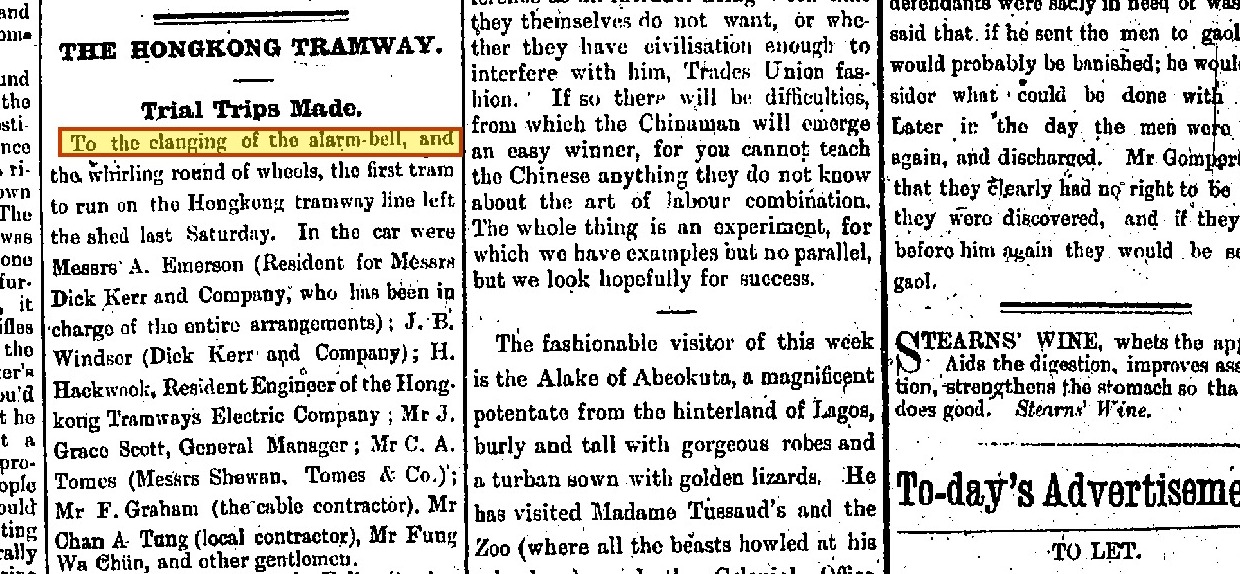
The machine was seen in motion before it was authorised to carry: the China Mail’s report of the trial trips, “To the clanging of the alarm-bell, and the whirling round of wheels, the first tram to run on the Hongkong tramway line left the shed last Saturday” — in the car, the contractors’ resident party and “Mr J. Grace Scott, General Manager”.16 The Daily Press’s technical page of the same day fixed the enterprise in one paragraph: an English company, work commenced May 1903; consulting engineers Alfred Dickinson & Co. of Birmingham; resident engineer Harold Hackwood; contractors Dick, Kerr & Co. of London; “the total length of single track is 14 miles”; gauge 3 feet 6 inches; a branch to the Race Course; the Quarry Bay grade reduced from 1 in 10 to 1 in 15; the eastern terminus “the small Chinese village of Shaukiwan”; “There will be 26 cars running.”17 Its reporter rode the trial car and marked the speed against the old street: “going at least three times faster than the best ricksha-puller.”18 A fortnight later the press rode again — “the trolleys did not jump the wires at all” — with one “slight breakdown at Causeway Bay.”19
5. The Rules of 27 July
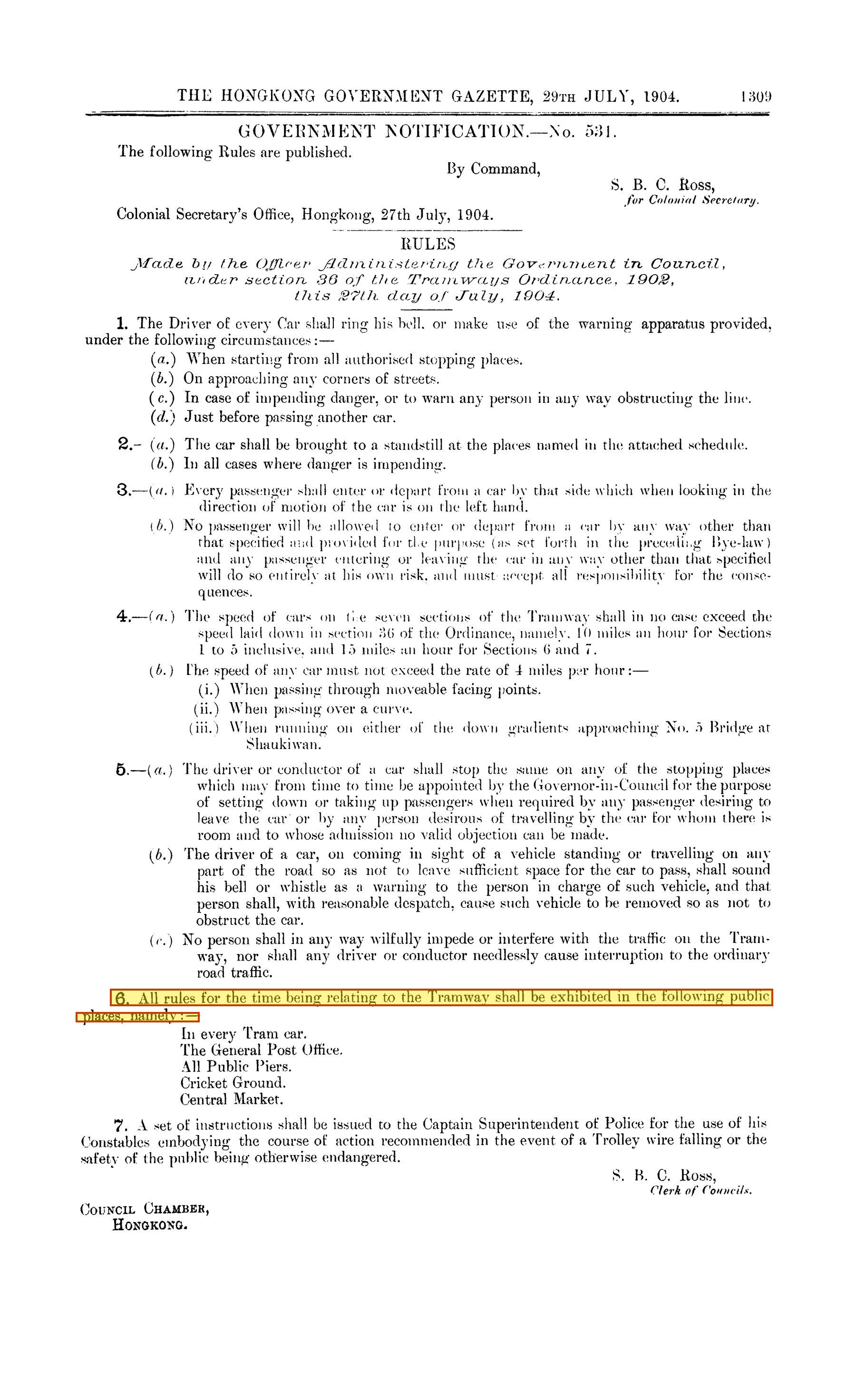
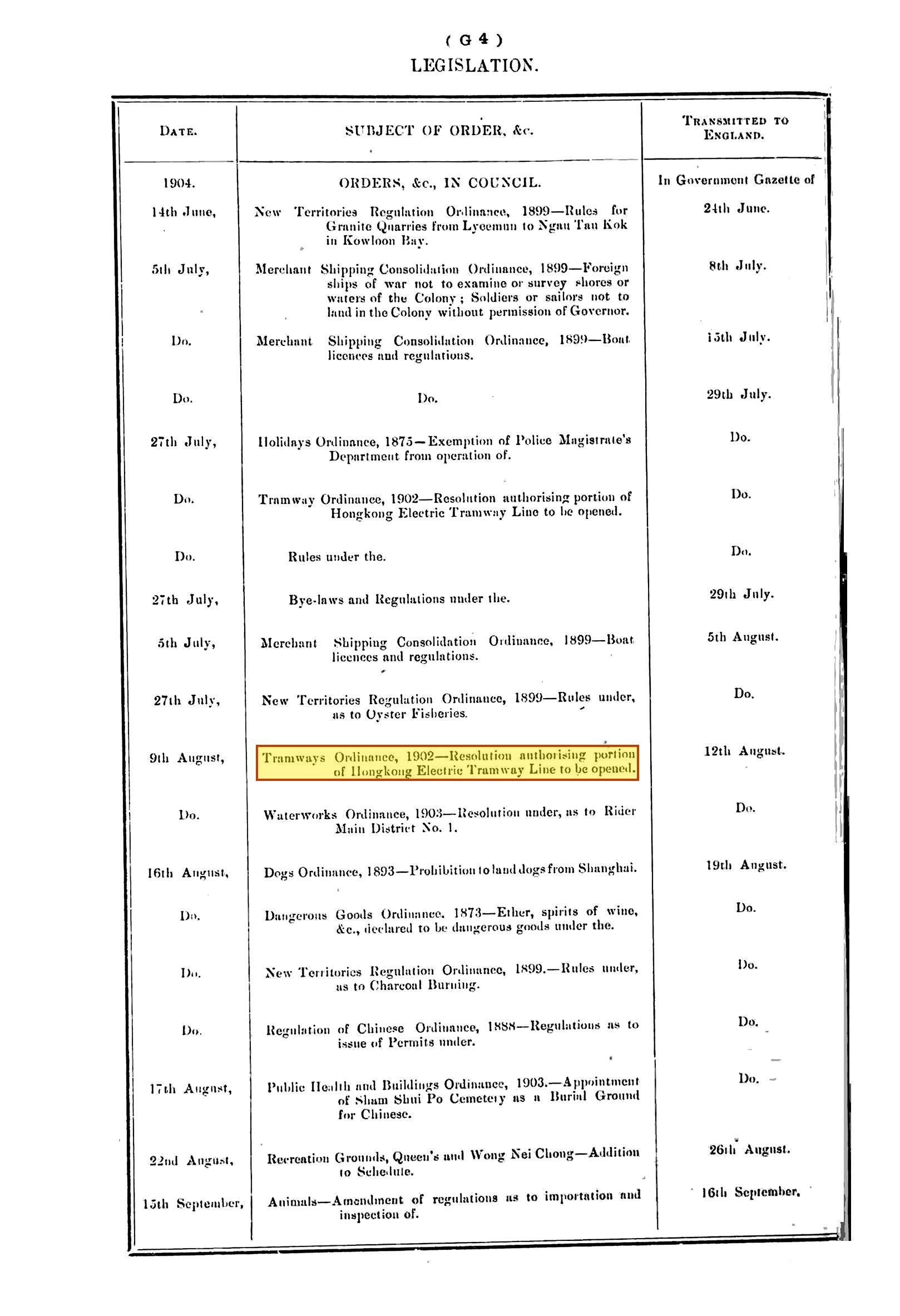
One Executive Council day, 27 July 1904, produced three instruments at once: the first opening resolution, the Rules, and the Bye-laws — the Blue Book’s legislation ledger lists all three under the same DATE, each transmitted to England (and gazetted) on 29 July; a second resolution followed on 9 August, gazetted 12 August.20 The Rules themselves print as Government Notification No. 531 in the Gazette of 29 July, printed p. 1309: “RULES Made by the Officer Administering the Government in Council, under section 36 of the Tramways Ordinance, 1902, this 27th day of July, 1904.”21 Their contents are the machine’s manners in seven clauses — the bell in four cases; a standstill at the scheduled places; passengers boarding by the left-hand side “entirely at his own risk” otherwise; the s.36 speeds; four miles an hour at facing points, curves, and the down gradients approaching No. 5 Bridge at Shaukiwan; the stopping-place procedure; and the rules “exhibited” in every tram car, the General Post Office, all public piers, the Cricket Ground, and the Central Market — with a seventh clause arming the police for a falling trolley wire.22
6. The two-stage opening
The first portion ran on Saturday 30 July 1904. The China Mail: “Section Opened For Traffic. The first portion of the Hongkong Electric Tramways has been opened to the general public. The first tram commenced to run at about 10 a.m. to-day, under the control of Mrs Jones, wife of Mr P. N. H. Jones, Acting Director of Public Works… Then Mrs Jones took her place at the controller, grasped it and turned the current on. Away went the tram, the bell clanging loudly, under the energetic manipulations of Master Jones.”23 The Telegraph’s account names the mechanism: the Director of Public Works “had certified as fit for traffic that portion of the line lying eastward of Arsenal Street, comprising sections Nos. 3, 4, 5, 6 and 7” (with the Arsenal Street–Causeway Bay portion of section 2), and “a ten minutes’ service” ran all day.24 Mrs Jones’s car ran from Arsenal Street to Bowrington and back, “when the line was formally declared open.”25
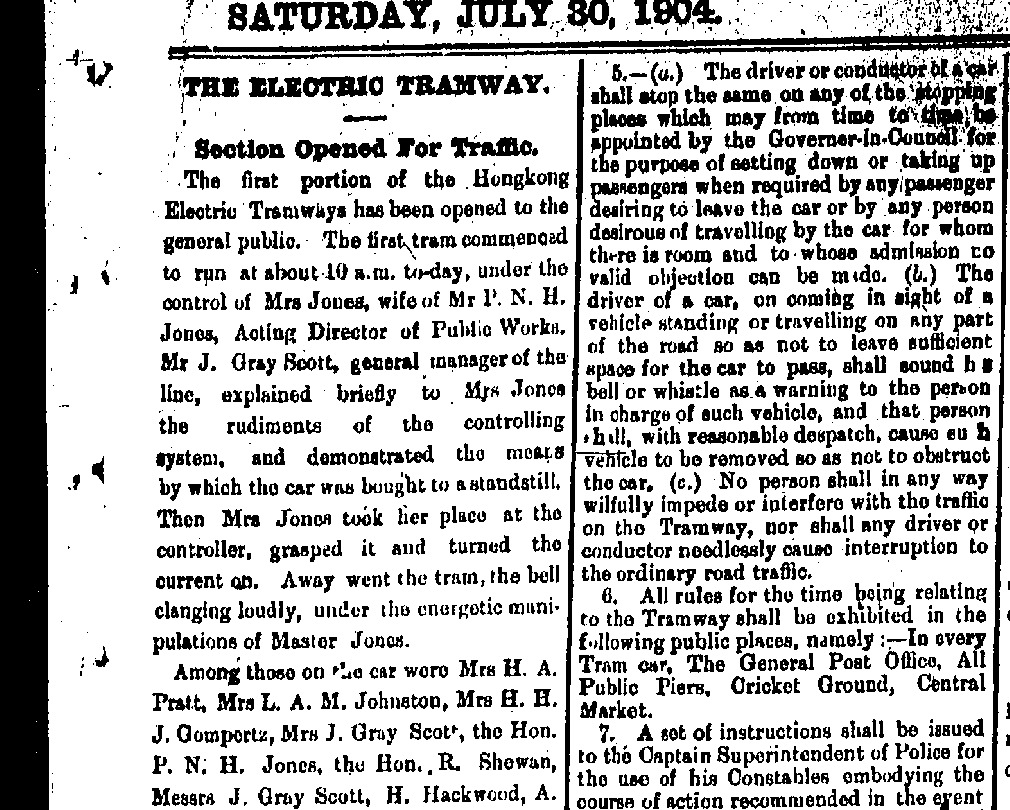
The same leaf carries the numbers the opening ran on: cars every ten minutes over five sections at five cents a section; twenty specified stopping places; and the line’s length — “The full length of the line—from Shaukiwan to Kennedytown is nine and a quarter miles, and this ride may be had for 45 cents—about 5 cents per mile first class.”26 The leaf’s engineering notes add the rails (“7¼ lbs. per foot of length”, copper-bonded) and the concrete bed — figures the Daily Press’s July page had printed differently, and which are kept as printed.27
The second stage followed the machinery to the letter. On 10 August the Telegraph reported cars run “over the full length of the electric tramway lines,” the service awaiting only the Director’s pass.28 On 13 August the resolution’s own words appeared: the portion “between Arsenal Street and Chater Street, Kennedy Town… described in section 3 of the Tramway Ordinance, No. 10 of 1902, has been duly certified as fit for traffic by the Director of Public Works”; the Governor in Council “authorises the same to be opened for traffic from 13th August, and directs that this resolution be published in the Government Gazette.”29 The Daily Press noticed the completion and the new timetable: “over the entire route from Kennedy-town to Shaukiwan. From the western terminus to Causeway Bay a five-minutes service was put on, and a half hour service to Shaukiwan” — with the drivers “rather prone to excessive use of the warning gong” and headways that left one “waiting more than half an hour.”30
7. The street’s answer
The street answered before the Council finished. On 18 July the Daily Press printed the tram verse and explained its provenance: “These two verses seem to fit Hongkong, but… were not meant to. They… were produced by some unsympathetic Bangkok resident, with reference to local troubles.” Its stable lines run: “That they will prove a saying and a blessing / Along our most congested thoroughfares… It may be that the ricksha man will bless them / And when his rik is smashed by them…”31 The verse is single-witness — the phrase battery returns one hit corpus-wide — and it is not Hongkong’s own voice but a borrowed rhyme that seemed to fit: one transport revolution (the electric car) meeting another (the man-drawn rickshaw) in somebody else’s meter.32
From the first working day the record turns to the courts and the complaint column. The conductors’ “unnecessary shrieks and yells”; the passenger tempted back to “the jumpy bumpy rick.”33 The fine lists: old tickets at $10; two Macao Portuguese boys charged with refusing first-class fare — the rule spelled out in the report, “Europeans and foreigners — all except natives of China, in fact — had always to pay 1st-class fare”; a rickshaw coolie fined $30 for “putting three stones in the tram rail.”34 The near-miss celebrated as providence: the coolie laying concrete on the tram-line at Des Voeux Road West who walked on beneath a continuously ringing bell.35 The advertisements contract followed in September.36 The September letter demanded what every tram city demands: a timetable, quieter gongs, and — its author’s own remedy — “the two front seats be entirely reserved and labelled ‘European 1st Class’.”37 And the Council answered one need on its own motion: the workmen’s cars of 14 September, two cents single and three return, for “artisans, mechanics and daily labourers.”38
8. The toll
The machine’s first months kept an inquest ledger. La Luk, killed by a car at Wilmer Street on 21 August; the inspector’s evidence, a car at ten miles an hour “pulled up in ten yards by reversing the controller.”39 An unknown Chinaman knocked down at Des Voeux Road West on the evening of 16 October; at the inquest “it was impossible to get at the actual facts as the motor-man in charge of the car absconded,” his brake story changing between the traffic manager and the police; the verdict, “death by misadventure.”40 The same page carries the Quarry Bay collision — car No. 8 climbing the single-line incline into car No. 7, “as neither, apparently, would give way to the other.”41 A rumoured tram death in August dissolved on inspection: the only corpus record is the coroner’s explanation that press suggestions prompted his enquiry, and the evidence heard was of an unconscious drunken man — registered here as failed verification, not as fact.42 No casualty total is asserted from this record; the corpus counts bodies case by case, never in sum.
9. Conclusion: the record’s shape
The 1904 opening is administrative in form and social in margin. The statute fixed the machinery (s.25) and the speeds (s.36); the expert fixed the roadbed; the Council fixed the rules (27 July) and opened the line in two certified portions (30 July; 13 August); the newspapers fixed the numbers — ten minutes, five cents, twenty stops, nine and a quarter miles for 45 cents.43444546 And the street fixed the meaning: a borrowed Bangkok rhyme blessing the rickshaw men against the machine; the fine lists marking who the first-class rule divided; the workmen’s cars marking what the colony chose to subsidise at two cents; the inquests marking what the bell could not stop in time.47484950 The trams that took the Praya that summer still run the island’s northern shore — the ordinance’s line, opened in portions on the record, with its first review preserved as a borrowed verse.51
Appendix A: sources and method
The documentary corpus is the hkintexts research index (Elasticsearch
cluster hkintexts, indices hkintexts_pages and
hkintexts_image_pages), queried read-only on 13 October 2026.
The central document — the combined issue of 30 July 1904 — was
pulled whole (nineteen pages; China Mail 1, Daily Press 10, Telegraph 8),
as was the Ordinance (thirty-three pages). No write was made to the index.
Query families:
- “electric tramway” + 190[45] — 234 hits (the ordinance ledger, the works, the running year);
- “the first tram” + 1904 — 4 hits; “first electric tramway” — 4 hits, all pre-1904 and all other places (the 1899 Telegraph hit is Peking);
- “opened for traffic” + 1904 — 12 hits; “certified to be fit for traffic” — 0 (the statute’s phrase never echoed; the press paraphrases);
- the verse battery: “ricksha man will bless” = 1 hit; “rik is smashed” = 1; “smashed by them” = 2 (the second a 1935 shipping advertisement, a false positive);
- the length battery: “nine and a quarter miles” = 3 hits, all false positives — the 1904 witness OCRs as “Dine and a quarter iniles” and was read by eye on the printed leaf;
- “workmen’s cars” — 126 hits (an institution running into the 1910s); “artisans, mechanics and daily labourers” — 19;
- the Chinese negative control: 電車 + 1904 = 0 hits (the corpus’s Chinese press begins 1926+; the opening year is English-record only).
Image twins: the China Mail carries a per-leaf image twin (eight leaves for 1904-07-30; the opening feature, the Tramway Rules reprint and the line-length paragraph all sit on printed p. 5 = image id 1320901), as do the Gazette and the Blue Book. The Daily Press and the Hongkong Telegraph have no image twin; their pages remain text-only citations. The China Mail’s text record for 30 July 1904 is a whole-issue OCR filed under page number 1; the printed leaf is p. 5 — the printed page is cited, the image twin linked.
Adversarial pass: (1) the length claim — the phrase query fails on OCR; resolved by eye on the printed leaf, and the old draft’s “about five miles” was a mis-memory of “about 5 cents per mile” on the same line — killed; (2) the ledger dates — the old draft read the Blue Book’s TRANSMITTED column as approval dates; the scan’s column headings killed it (DATE: 27 July and 9 August); (3) the old draft’s “no ceremonial account in the corpus” — killed by the China Mail’s “Section Opened For Traffic” and the Telegraph’s “An Official Opening This Morning”; (4) the verse — the corpus-wide battery (1 hit) plus the printer’s own Bangkok note kills the old “the street’s own answer” framing; (5) the “first in China” claims — killed by the Peking witness of 1899; (6) the Telegraph’s 19 July “regular service” stoppage — identified as the Peak Tramway’s power-house derangement, a column-proximity false positive, excluded; (7) the August tram-death rumour — registered as failed verification.52535455
Appendix B: evidence register
| Claim | Witnesses |
|---|---|
| The line opened in portions under s.25 of the Tramway Ordinance 1902 — DPW certification + Gazette notification + ExCo resolution, twice | Ordinance s.25; the Blue Book 1904 ledger; the Telegraph’s resolution text; the Gazette’s Rules notification |
| The first portion ran 30 July 1904, Arsenal Street eastward, Mrs Jones at the controller | the China Mail 30 July; the Telegraph 30 July; the Blue Book ledger (resolution of 27 July, gazetted 29 July) |
| The full service Kennedy Town–Shaukiwan followed the 13 August resolution | the Telegraph 13 August; the Daily Press 15 August; the Blue Book ledger (9 August resolution, gazetted 12 August) |
| Trial trips preceded the opening | the China Mail 4 July; the Daily Press preview 23 July; the 4 July technical page |
| The opening machinery was statute-first (s.25 + s.36 + ExCo rules under s.36) | the Ordinance; the Gazette’s Rules (citing s.36); the Telegraph’s opening-day sentence |
| Claim | Witness |
|---|---|
| The verse (“the ricksha man will bless them…”), written by “some unsympathetic Bangkok resident… not meant to” fit Hong Kong | the Daily Press 18 July (1 corpus hit) |
| The technical description (Dickinson, Hackwood, Dick Kerr, 14 miles single track, 26 cars, 3 ft 6 in, Race Course branch) | the Daily Press 4 July (its route-mile figure lost in OCR) |
| The concrete dispute and Colonel Yorke’s opinion | CO 129/318 |
| The 26 September letter (timetable, gong, “European 1st Class”) | the Daily Press 26 September |
| The Rangoon/Colombo/Singapore track-rent comparison | the Daily Press 30 December 1903 |
| Conflict | Reading |
|---|---|
| Third reading recorded in two Hansard issues (13 and 30 April 1902) | both kept; no document explains the repeat |
| Workmen’s cars resolution: agreed on the 14th (Hansard issue of the 14th), printed again on the 15th, and dated “15th September 1904” by the Gazette of 1906 | all three kept |
| The manager’s surname: “J. Gray Scott” (30 July, scan) vs “J. Grace Scott” (4 July, scan) | both scan-verified; “Gray Scott” preferred in prose |
| Company name: “The Hongkong Tramway Company, Limited” (Ordinance) vs “Hongkong Tramway Electric Company, Limited” (ledger, Hansard, Gazette 1906) vs “Hongkong Electric Tramways” (China Mail) | quoted as printed in each place |
| Rails: “8 lbs. per lineal yard” (Daily Press) vs “7¼ lbs. per foot of length” (China Mail, scan) | irreconcilable figures; both kept as printed |
| Single-track 14 miles (Daily Press) vs route length nine and a quarter miles (China Mail) | different measures; the Daily Press’s route figure lost in OCR; never reconciled |
| Item | Why |
|---|---|
| “About five miles” line length (the old draft) | a mis-memory of “about 5 cents per mile”; the scan reads “nine and a quarter miles” |
| Ledger dates 5 July / 29 July / 5 August / 12 August as approval dates (the old draft) | read off the TRANSMITTED column; the DATE column reads 27 July and 9 August |
| “No ceremonial account in the corpus” (the old draft’s gap) | killed by the 30 July China Mail and Telegraph |
| The August tram-death rumour | the only record is the coroner’s explanation; the evidence heard was of a drunken death; no tram death recorded |
| The bye-laws’ full text | approved 27 July and gazetted 29 July per the ledger, but the bye-law document itself was not pulled |
| The Chinese-language record of the opening | 電車 + 1904 = 0 corpus hits; the corpus’s Chinese press begins 1926+ (a negative control, not a finding about the city) |
Notes
- ↑Method note: the documentary corpus interrogated for this paper is the hkintexts research index (Elasticsearch cluster hkintexts, indices
hkintexts_pagesandhkintexts_image_pages), queried read-only on 13 October 2026. The logged queries are itemised in Appendix A. The central document — the combined issue of 30 July 1904 (China Mail, Daily Press, Hongkong Telegraph) — was pulled whole (nineteen pages), as was the Ordinance (thirty-three pages). Every passage quoted below was read in its whole document or verified against the scan. No write was made to the index. - ↑Tramway Ordinance, No. 10 of 1902, s.25: “Neither the tramway nor any portion thereof shall be opened for public traffic until the same has been certified to be fit for such traffic by the Director of Public Works or other officer duly appointed in writing for that purpose by the Governor-in-Council, and the Governor-in-Council has, by notification in the Gazette, authorised the same to be opened for such traffic.” https://hkintexts.histsyn.com/page/1843260 (accessed 13 October 2026). The press never quotes the statute’s phrase: “certified to be fit for traffic” returns 0 hits in the corpus’s 1904 stratum, while “opened for traffic” returns 12 — the papers paraphrased the machinery as “certified as fit for traffic.”
- ↑The Hongkong Telegraph, 6 July 1899, p. 5: “The first electric tramway in China was opened on Saturday the 24th June, between the Peking station at Manchlapu and the south gate of the metropolis, Yung ting men… The tramway was projected and constructed by Messrs Siemens and Halske of Berlin.” https://hkintexts.histsyn.com/page/2840355 (accessed 13 October 2026). Hong Kong’s line of 1904 was not the first in China.
- ↑LegCo Hansard, 13 April 1902: “The following Bills were read a third time and passed… The Bill entitled an Ordinance for authorising the construction of a Tramway within the Colony of Hongkong.” https://hkintexts.histsyn.com/page/1881815 (accessed 13 October 2026). The Hansard of 30 April 1902 records the third reading moved again — the same bill carried in two issues; no document explains the repeat. https://hkintexts.histsyn.com/page/1881816 (accessed 13 October 2026).
- ↑Tramway Ordinance, No. 10 of 1902 (1912 revised edition): “For authorising the construction of a Tramway. [14th May, 1902.]”; s.1: “The company means The Hongkong Tramway Company, Limited.” https://hkintexts.histsyn.com/page/1843248 (accessed 13 October 2026). The ledger of the Blue Book 1902, pp. 87–88, records No. 9 (amending the 1883 tramways ordinances) in Governor’s despatch No. 104, No. 10 in despatch No. 129, and No. 32 (“An Ordinance to amend the Tramway Ordinance, No. 10 of 1902”) in despatch No. 310. https://hkintexts.histsyn.com/page/665491; https://hkintexts.histsyn.com/page/665492 (accessed 13 October 2026).
- ↑Tramway Ordinance, No. 10 of 1902; the Blue Book 1902, pp. 87–88 (see note 5).
- ↑Tramway Ordinance, No. 10 of 1902, ss.14–15 (the company maintains the road between the rails and 18 inches each side, and must re-lay its rails at its own expense whenever the Director of Public Works alters a road’s level, “a fine not exceeding 100 dollars” for default). https://hkintexts.histsyn.com/page/1843254 (accessed 13 October 2026).
- ↑Tramway Ordinance, No. 10 of 1902, s.36: the Governor-in-Council may make rules “for regulating the rate of speed of the cars” — 10 miles an hour on Sections 1–5, 15 miles an hour on Sections 6 and 7, 4 miles an hour through movable facing points, with power to raise the 10 to 12. https://hkintexts.histsyn.com/page/1843264 (accessed 13 October 2026). The schedule defines the seven sections out to the Shau-ki-wan Road point. https://hkintexts.histsyn.com/page/1843269 (accessed 13 October 2026).
- ↑Tramway Ordinance, No. 10 of 1902, ss.30–31: if the Governor-in-Council finds the company insolvent, its powers end after six months unless purchased; and the Government may purchase the tramway “at the expiration of 50 years from the date of the commencement of this Ordinance, or at the expiration of any subsequent period of 5 years.” https://hkintexts.histsyn.com/page/1843262 (accessed 13 October 2026).
- ↑Tramway Ordinance, No. 10 of 1902, s.25 (see note 2).
- ↑CO 129/318 (Governor Sir H. Blake, 1903): “The Promoters having proposed that the Tramway should be constructed with only stringers (or separate strips) of concrete under the rails, a proposal which the Director of Public Works refused to accept… the Director of Public Works requested that the point should be referred to an expert in England. This was done and the opinion of the expert (Colonel Yorke) fully bore out the Director of Public Works in his requirements.” https://hkintexts.histsyn.com/page/389545 (accessed 13 October 2026).
- ↑The Daily Press, 9 July 1903, p. 5: “Of the private measures the most important was the Tramway Ordinance (No. 10 of 1902); by which the construction of an electric tramway within the Colony was authorised.” https://hkintexts.histsyn.com/page/2242271 (accessed 13 October 2026).
- ↑The China Mail, 6 November 1903, p. 5 (“News about the electric tramway”): rails taken up and the road deepened near the Law Courts “owing to the fact that the level of the tramway will be made when the Law Courts are finished. This portion of the line has been already relaid.” https://hkintexts.histsyn.com/page/1924329 (accessed 13 October 2026).
- ↑LegCo Hansard, 23 December 1903: “If the electric tramway lines were laid along the existing Praya the public would be put to great inconvenience later on, as the tramway traffic would be seriously interfered with by the raising of the road, and the relaying of the lines”; the cost was debited to an advance account “to be recovered in due course from the new Praya Reclamation Fund.” https://hkintexts.histsyn.com/page/1881851 (accessed 13 October 2026).
- ↑The Daily Press, 30 December 1903, p. 3: “In view of the coming tramway service for Hongkong, now under rapid progress,” the Rangoon, Colombo and Singapore track-rents were set out for comparison. https://hkintexts.histsyn.com/page/2243501 (accessed 13 October 2026).
- ↑The China Mail, 4 July 1904: “THE HONGKONG TRAMWAY. Trial Trips Made, To the clanging of the alarm-bell, and the whirling round of wheels, the first tram to run on the Hongkong tramway line left the shed last Saturday” — in the car, A. Emerson (Resident for Messrs Dick Kerr and Company), J. B. Windsor, H. Hackwood (Resident Engineer), “Mr J. Grace Scott, General Manager.” Scan twin: https://hkintexts.histsyn.com/image-page/1320716 (printed p. 5); text: https://hkintexts.histsyn.com/page/1924728 (accessed 13 October 2026). The same issue’s manager prints “J. Gray Scott” at the opening of 30 July — both spellings scan-verified, variance kept.
- ↑The Daily Press, 4 July 1904, p. 3: an English company with its headquarters in London, “work was commenced in May 1903”; detailed plans by “the Company’s Consulting Engineers, Messrs Alfred Dickinson and Co. of Birmingham,” who appointed “Mr. Harold Hackwood” resident engineer; contractors “Dick, Kerr & Co., of London”; “The total length of single track is 14 miles which is laid in [number lost in OCR] miles of route”; gauge 3 feet 6 inches; “with the exception of a short branch line, which runs to the Race Course, the route runs parallel with the water front”; at Quarry Bay the grade reduced “from 1 in 10… to 1 in 15”; eastern terminus “the small Chinese village of Shaukiwan”; “There will be 26 cars running.” https://hkintexts.histsyn.com/page/2244801 (accessed 13 October 2026).
- ↑The Daily Press, 4 July 1904, p. 3: “She ran at a lively pace along straight parts of the track, going at least three times faster than the best ricksha-puller. At the curves the trolley [took them] well.” https://hkintexts.histsyn.com/page/2244801 (accessed 13 October 2026).
- ↑The Daily Press, 23 July 1904, p. 2 (the preview run with Hackwood): “The trolleys did not jump the wires at all, and the cars climbed up the slight inclines without any difficulty. On the return journey, however, there was a slight breakdown at Causeway Bay, but after a minute or so the car went ahead as before.” https://hkintexts.histsyn.com/page/2244940 (accessed 13 October 2026).
- ↑The Blue Book 1904, p. 108 ((G 4) Legislation ledger). DATE column: “27th July, Tramway Ordinance, 1902 — Resolution authorising portion of Hongkong Electric Tramway Line to be opened”; “27th July, Rules under the”; “27th July, Bye-laws and Regulations under the”; “9th August, Tramways Ordinance, 1902 — Resolution authorising portion of Hongkong Electric Tramway Line to be opened.” TRANSMITTED TO ENGLAND column (sub-headed “In Government Gazette of”): 29th July / 29th July / 29th July / 12th August. The old pass read the approval dates off the transmitted column; corrected from the scan. Scan twin: https://hkintexts.histsyn.com/image-page/2193210; text: https://hkintexts.histsyn.com/page/666278 (accessed 13 October 2026).
- ↑The Hongkong Government Gazette, 29 July 1904, printed p. 1309, Government Notification No. 531: “The following Rules are published… By Command, S. B. C. Ross, for Colonial Secretary. Colonial Secretary’s Office, Hongkong, 27th July, 1904.” “RULES Made by the Officer Administering the Government in Council, under section 36 of the Tramways Ordinance, 1902, this 27th day of July, 1904.” Rule 4(a): “10 miles an hour for Sections 1 to 5 inclusive, and 15 miles an hour for Sections 6 and 7”; Rule 4(b): 4 miles per hour at movable facing points, over curves, and “on either of the down gradients approaching No. 5 Bridge at Shaukiwan”; Rule 6: the rules exhibited “In every Tram car, The General Post Office, All Public Piers, Cricket Ground, Central Market.” https://hkintexts.histsyn.com/image-page/1560997 (accessed 13 October 2026).
- ↑The Hongkong Government Gazette, 29 July 1904, printed p. 1309, No. 531 (see note 21).
- ↑The China Mail, 30 July 1904, printed p. 5: “Section Opened For Traffic. The first portion of the Hongkong Electric Tramways has been opened to the general public. The first tram commenced to run at about 10 a.m. to-day, under the control of Mrs Jones, wife of Mr P. N. H. Jones, Acting Director of Public Works… Then Mrs Jones took her place at the controller, grasped it and turned the current on. Away went the tram, the bell clanging loudly, under the energetic manipulations of Master Jones.” Among those on the car: Mrs Pratt, Mrs Johnston, Mrs Gompertz, Mrs Scott, the Hon. P. N. H. Jones, the Hon. R. Shewan, Messrs J. Gray Scott, H. Hackwood, A. Emerson, E. R. Graham. Scan twin: https://hkintexts.histsyn.com/image-page/1320901; whole-issue text: https://hkintexts.histsyn.com/page/1924751 (accessed 13 October 2026). The China Mail text record for this date is a whole-issue OCR filed under page_number 1; the printed leaf is p. 5.
- ↑The Hongkong Telegraph, 30 July 1904, p. 5: “Shortly after ten o’clock this morning an interesting [little] ceremony took place on the Praya, near Arsenal Street, when Mrs. P. N. H. Jones drove the first public car over a length of the electric tramway line. The Director of Public Works had certified as fit for traffic that portion of the line lying eastward of Arsenal Street, comprising sections Nos. 3, 4, 5, 6 and 7” (plus the Arsenal Street–Causeway Bay portion of section 2; columns interleaved with war news in OCR); “throughout the day maintained a ten minutes’ service from Arsenal Street over the completed section of the line”; Mrs Jones’s car ran “from Arsenal Street to Bowrington and back again.” https://hkintexts.histsyn.com/page/2850543 (accessed 13 October 2026).
- ↑The China Mail, 30 July 1904, printed p. 5 (see note 23).
- ↑The China Mail, 30 July 1904, printed p. 5: “Cars will run every ten minutes throughout the day, and will cover five sections, the first-class fare over each section being five cents”; “Altogether there are 20 specified stopping places between Kennedy Town terminus and Shaukiwan terminus”; and “The full length of the line—from Shaukiwan to Kennedytown is nine and a quarter miles, and this ride may be had for 45 cents—about 5 cents per mile first class” (read by eye on the printed leaf; the OCR garbles it to “Dine and a quarter iniles”, so the phrase query misses it). The same leaf describes the route: “Along the water front to Kennedytown the line goes, and here a loop is made, along Chater St.” https://hkintexts.histsyn.com/image-page/1320901 (accessed 13 October 2026).
- ↑The China Mail, 30 July 1904, printed p. 5: “The rails weigh 7¼ lbs. per foot of length, and each rail is copper-bonded”; the concrete bed “eight inches deep and seven foot three inches wide, extending under the entire track.” The Daily Press’s technical page (4 July) had printed “rails of the girder type weighing 8lbs. per lineal yard” (OCR tail garbled) — two irreconcilable figures, both kept as printed. https://hkintexts.histsyn.com/image-page/1320901; https://hkintexts.histsyn.com/page/2244801 (accessed 13 October 2026).
- ↑The Hongkong Telegraph, 10 August 1904, p. 4: “CARS were run over the full length of the electric tramway lines this morning, and immediately the Director of Public Works passes the line as fit for traffic the service between Kennedy Town and Shaukiwan will be started.” https://hkintexts.histsyn.com/page/2850608 (accessed 13 October 2026).
- ↑The Hongkong Telegraph, 13 August 1904, p. 5 (the resolution’s own words, columns interleaved in OCR): the portion “between Arsenal Street and Chater Street, Kennedy Town, and which are described in section 3 of the Tramway Ordinance, No. 10 of 1902, has been duly certified as fit for traffic by the Director of Public Works”; the Governor in Council “authorises the same to be opened for traffic from 13th August, and directs that this resolution be published in the Government Gazette.” https://hkintexts.histsyn.com/page/2850633 (accessed 13 October 2026).
- ↑The Daily Press, 15 August 1904, p. 2: “The portion of the tramway between Arsenal Street and Chater Street has been officially notified as fit for traffic from the 13th inst.”; “over the entire route from Kennedy-town to Shaukiwan. From the western terminus to Causeway Bay a five-minutes service was put on, and a half hour service to Shaukiwan”; the drivers “rather prone to excessive use of the warning gong”; “It is irritating to be passed by seven or eight inward cars while waiting more than half an hour for an outward bound vehicle.” https://hkintexts.histsyn.com/page/2245100 (accessed 13 October 2026).
- ↑The Daily Press, 18 July 1904, p. 3 (Hongkong Jottings): “These two verses seem to fit Hongkong, but… were not meant to. They… were produced by some unsympathetic Bangkok resident, with reference to local troubles.” The verse’s stable lines: “That they will prove a saying and a blessing / Along our most congested thoroughfares… / It may be that the ricksha man will bless them / And when his rik is smashed by them…” The final word is an OCR coin-toss (“in fan” in this pull; an earlier read gave “in pie”) and is not quoted. https://hkintexts.histsyn.com/page/2244901 (accessed 13 October 2026). The phrase battery: “ricksha man will bless” = 1 hit corpus-wide; the verse is single-witness.
- ↑The Daily Press, 18 July 1904, p. 3 (see note 31).
- ↑The Daily Press, 1 August 1904, p. 3 (the first working day): “I hope that… the Chinese conductors will learn to abstain from their unnecessary shrieks and yells”; and the conductor’s parting line: “until it shows signs of abatement I shall be tempted to stick to the jumpy bumpy rick.” https://hkintexts.histsyn.com/page/2245001 (accessed 13 October 2026).
- ↑The Daily Press, 23 August 1904: three Chinese fined $10 each for travelling on old tickets; two Macao Portuguese boys, “about 12 or 14, charged with refusing to pay 1st-class fare on a tram: Europeans and foreigners — all except natives of China, in fact — had always to pay 1st-class fare”; a rickshaw coolie fined $30 “for putting three stones in the tram rail, at Des Voeux Road West.” https://hkintexts.histsyn.com/page/2245159 (accessed 13 October 2026).
- ↑The Hongkong Telegraph, 22 August 1904, p. 4: “TRULY there is a providence that looks after the life of the Chinese coolie” — a coolie laying concrete on the tram-line at Des Voeux Road West walked on while “the bell of an approaching car was kept continuously ringing.” https://hkintexts.histsyn.com/page/2850689 (accessed 13 October 2026).
- ↑The Daily Press, 5 September 1904, p. 2: “A contract has been made for advertisements on the tram cars.” https://hkintexts.histsyn.com/page/2245250 (accessed 13 October 2026).
- ↑The Daily Press, 26 September 1904: “it is about time a regular time table was issued and adhered to… they seem to run in batches of two or three, with a prodigious interval between”; “Whilst Europeans are obliged to rub shoulders with all sorts and conditions of Chinese, the trams will never become popular… the two front seats be entirely reserved and labelled ‘European 1st Class’.” https://hkintexts.histsyn.com/page/2245401 (accessed 13 October 2026).
- ↑LegCo Hansard, 14 September 1904: “Resolved that until further notice the Hongkong Tramway Electric Co., Ltd., shall provide the following number of cars every morning and evening, at such hours not being later than 7 a.m. or earlier than 5.30 p.m.… for artisans, mechanics and daily labourers, at fares not exceeding 2 cents for the single journey and 3 cents for the return journey” — two cars Central Market–Kennedy Town, four No. 2 Police Station–Quarry Bay; “the resolution was agreed to.” https://hkintexts.histsyn.com/page/1881863 (accessed 13 October 2026). The Hansard of the 15th prints the resolution again (https://hkintexts.histsyn.com/page/1881864), and the Gazette of 22 June 1906 dates its passage to “the 15th September 1904” — the dates kept as printed. https://hkintexts.histsyn.com/page/1609254 (accessed 13 October 2026).
- ↑The Daily Press, 1 September 1904, p. 3: the inquest before Mr. H. H. J. Gompertz into the death of “La Luk, a Chinaman, recently killed by a tram accident at Wilmer Street”; the inspector Waller Linden: “A car running at a rate of ten miles [an hour] could be pulled up in ten yards by reversing the controller.” https://hkintexts.histsyn.com/page/2245225 (accessed 13 October 2026).
- ↑The Hongkong Telegraph, 21 November 1904, p. 4: the inquest into the Chinaman knocked down by a tram-car at West Point (the Daily Press of 18 November records the accident, Des Voeux Road West, 16 October, 8.15 p.m., PC Frank Hayes’s evidence; https://hkintexts.histsyn.com/page/2245786): “It was impossible to get at the actual facts as the motor-man in charge of the car absconded. At the time of the occurrence he told the traffic manager that the brake acted alright, but to the police he stated that the brake would not act at all. A verdict of death by misadventure.” The same page, the Quarry Bay collision: car No. 8 going up the single-line incline met car No. 7, “as neither, apparently, would give way to the other.” https://hkintexts.histsyn.com/page/2851354 (accessed 13 October 2026).
- ↑The Hongkong Telegraph, 21 November 1904, p. 4 (see note 40).
- ↑The Daily Press, 16 August 1904, p. 3: the coroner explained that “on account of statements in the local Press suggesting foul play, and suggestions that deceased had had a fall of a tramcar, he ordered an enquiry”; the evidence heard was of an unconscious drunken man. No corpus document records a tram death on that occasion — the rumoured tram death failed verification and is registered as such. https://hkintexts.histsyn.com/page/2245109 (accessed 13 October 2026).
- ↑Tramway Ordinance, No. 10 of 1902, s.25 (see note 2).
- ↑The Hongkong Government Gazette, 29 July 1904, printed p. 1309, No. 531 (see note 21).
- ↑The Blue Book 1904, p. 108 (see note 20).
- ↑The China Mail, 30 July 1904, printed p. 5 (see note 26).
- ↑The Daily Press, 18 July 1904, p. 3 (see note 31).
- ↑The Daily Press, 23 August 1904 (see note 34).
- ↑LegCo Hansard, 14 September 1904 (see note 38).
- ↑The Hongkong Telegraph, 21 November 1904, p. 4 (see note 40).
- ↑The Blue Book 1904, p. 108 (see note 20).
- ↑The Blue Book 1904, p. 108 (see note 20).
- ↑The Daily Press, 18 July 1904, p. 3 (see note 31).
- ↑The Hongkong Telegraph, 6 July 1899, p. 5 (see note 3).
- ↑The Daily Press, 16 August 1904, p. 3 (see note 42).
Bibliography
Primary sources — official
- 1–6. Tramway Ordinance, No. 10 of 1902, in the 1912 revised edition (HK Historical Laws): title and assent line, s.1; ss.14–15; s.25; ss.30–31; s.36; the schedule of the seven sections. https://hkintexts.histsyn.com/page/1843248, /page/1843254, /page/1843260, /page/1843262, /page/1843264, /page/1843269 (accessed 13 October 2026).
- 7. The Blue Book 1902, pp. 87–88 (ordinance ledger, Nos. 9, 10, 32). https://hkintexts.histsyn.com/page/665491, /page/665492 (accessed 13 October 2026).
- 8–9. LegCo Hansard, 13 and 30 April 1902 (third readings). https://hkintexts.histsyn.com/page/1881815, /page/1881816 (accessed 13 October 2026).
- 10. CO 129/318 (Governor Sir H. Blake, 1903; the concrete dispute; Colonel Yorke). https://hkintexts.histsyn.com/page/389545 (accessed 13 October 2026).
- 14. LegCo Hansard, 23 December 1903 (the Praya East raising). https://hkintexts.histsyn.com/page/1881851 (accessed 13 October 2026).
- 19. The Hongkong Government Gazette, 29 July 1904, printed p. 1309, Notification No. 531 (the Rules). https://hkintexts.histsyn.com/image-page/1560997 (accessed 13 October 2026).
- 20. The Blue Book 1904, p. 108 ((G 4) Legislation ledger). Scan: https://hkintexts.histsyn.com/image-page/2193210; text: https://hkintexts.histsyn.com/page/666278 (accessed 13 October 2026).
- 32–33. LegCo Hansard, 14 and 15 September 1904 (the workmen’s cars resolution). https://hkintexts.histsyn.com/page/1881863, /page/1881864 (accessed 13 October 2026).
- 36. The Hongkong Telegraph, 6 July 1899, p. 5 (Peking’s electric tramway). https://hkintexts.histsyn.com/page/2840355 (accessed 13 October 2026).
- 37. The Hongkong Government Gazette, 22 June 1906 (the workmen’s-cars resolution rescinded and re-enacted). https://hkintexts.histsyn.com/page/1609254 (accessed 13 October 2026).
Primary sources — press (the Daily Press and the Hongkong Telegraph carry no image twins; the China Mail citations link its scans)
- 11–13. The Daily Press, 9 July 1903; the China Mail, 6 November 1903; the Daily Press, 30 December 1903 (the session review; the Law Courts relaying; the colonies’ track-rents). https://hkintexts.histsyn.com/page/2242271, /page/1924329, /page/2243501 (accessed 13 October 2026).
- 15–16. The China Mail, 4 July 1904 (scan: https://hkintexts.histsyn.com/image-page/1320716; text: /page/1924728); the Daily Press, 4 July 1904, p. 3 (the technical description) (/page/2244801) (accessed 13 October 2026).
- 17–18. The Daily Press, 18 July 1904 (the verse) and 23 July 1904 (the preview run). https://hkintexts.histsyn.com/page/2244901, /page/2244940 (accessed 13 October 2026).
- 21–22. The China Mail, 30 July 1904, printed p. 5 (scan: https://hkintexts.histsyn.com/image-page/1320901; whole-issue text: /page/1924751); the Hongkong Telegraph, 30 July 1904, p. 5 (/page/2850543) (accessed 13 October 2026).
- 23–25. The Hongkong Telegraph, 10 and 13 August 1904; the Daily Press, 15 August 1904 (the full-length run; the second resolution; the completed service). https://hkintexts.histsyn.com/page/2850608, /page/2850633, /page/2245100 (accessed 13 October 2026).
- 26–31. The Daily Press and the Hongkong Telegraph, August to September 1904 (the first working day; the coroner’s explanation; the providence coolie; the fine lists; the La Luk inquest; the advertisements contract). https://hkintexts.histsyn.com/page/2245001, /page/2245109, /page/2850689, /page/2245159, /page/2245225, /page/2245250 (accessed 13 October 2026).
- 34–35. The Daily Press, 26 September 1904 (the letter); the Hongkong Telegraph, 21 November 1904 (the inquest; the Quarry Bay collision), with the Daily Press of 18 November (/page/2245786). https://hkintexts.histsyn.com/page/2245401, /page/2851354 (accessed 13 October 2026).