中市場(Middle Bazaar)與它的清拆:香港,1842–1862
摘要
本文考證殖民地檔案與同期報刊中的「Middle Bazaar」(中市場)——一個在1844年 census 中有獨立行列、卻在史學論述中長期被併入「上市場」(Upper Bazaar)的地區。1844年1月22日的官地拍賣以「六個月內交地」為條件出售該處土地;4月17日,Pottinger 總督下令清拆「Upper Bazar」的現住戶;5月22日的「Final Regulations concerning the Middle Bazaar」以「中市場」為正式名稱;同年 census 中「Middle Bazar」三條街(Main、East、West)合計1,741人。此名其後從記錄中消失十七年,僅存於1861–62年教育報告的三校名單。同期記錄本身亦有歧義——5月4日的通函標題作「Middle, or Upper Bazar」——本文不以論斷抹平此歧義,而將其本身作為一項發現。
一、導言:中市場是甚麼?
委託題目為「中市場」。必須立即說明:同期記錄中,這個地區從未以中文命名。全部官方文件與報刊均使用英文——「Middle Bazaar」、「Middle Bazar」,或在1844年5月的通函標題中寫成「Middle, or Upper Bazar」。「中市場」三字在語料庫中最早的出現是1980年,屬現代用語1。因此,本文以「中市場」為現代題目標籤,正文一律使用同期英文名稱。
這個名稱的意義在於:它是維多利亞城最早的華人商住區之一,在1844年的 census 中以三條街(Main Street、East Street、West Street)獨立計算,與相鄰的「Upper Bazar」分列;而它的住戶在1844年被政府以拍賣土地後的「六個月交地」條件清拆,遷往太平山。這是太平山聚落形成前的關鍵事件,也是殖民政府第一次以「improvement」為由大規模遷移華人社區。
二、名稱的考古:Middle、Upper,還是同一個?
1843年12月19日,土地監督(Land Officer)A. J. Gordon 致函殖民地秘書,提出維多利亞城新規劃。他寫道:「That part of the town known as the Upper Bazar I propose to remove altogether; at present it is inhabited by Chinese of the lowest description, who are a nuisance to the neighbourhood. I have divided the space it occupies into lots (twenty seven in number) suitable for shops and dwellings for Europeans or respectable Chinese。」2這是殖民檔案中第一次明確提出清拆該區。
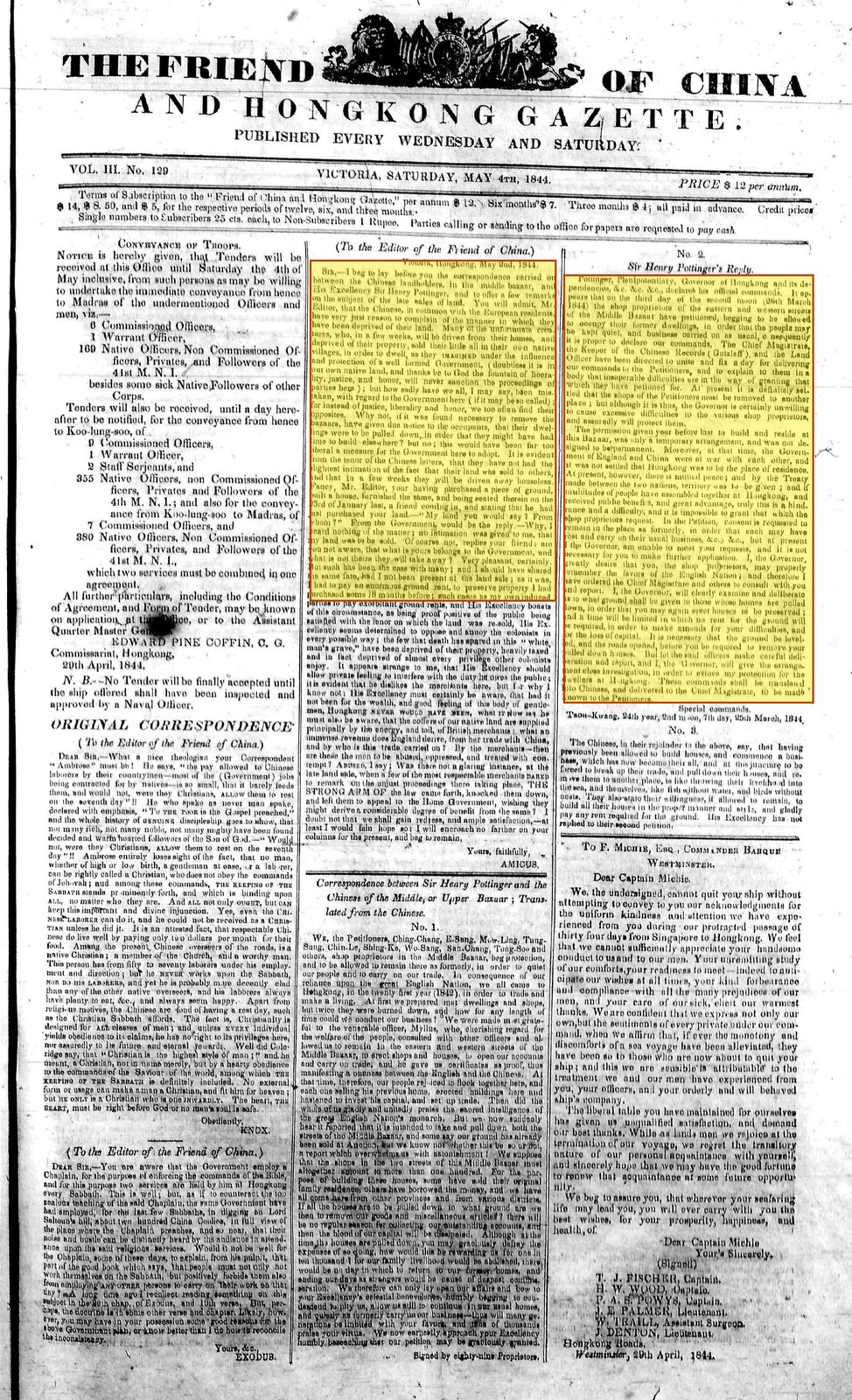
但同一時期的記錄卻出現了名稱歧義。1844年5月4日,Friend of China以大字標題刊出Pottinger總督與華人商戶的通信,標題是:「Correspondence between Sir Henry Pottinger and the Chinese of the Middle, or Upper Bazar」——「中市場,或上市場」。商戶的請願書末尾署名「eighty-nine Proprietors」(八十九名業主)3。這是同期記錄自己承認的歧義:同一個地方,在同一份文件中,有兩個名字。
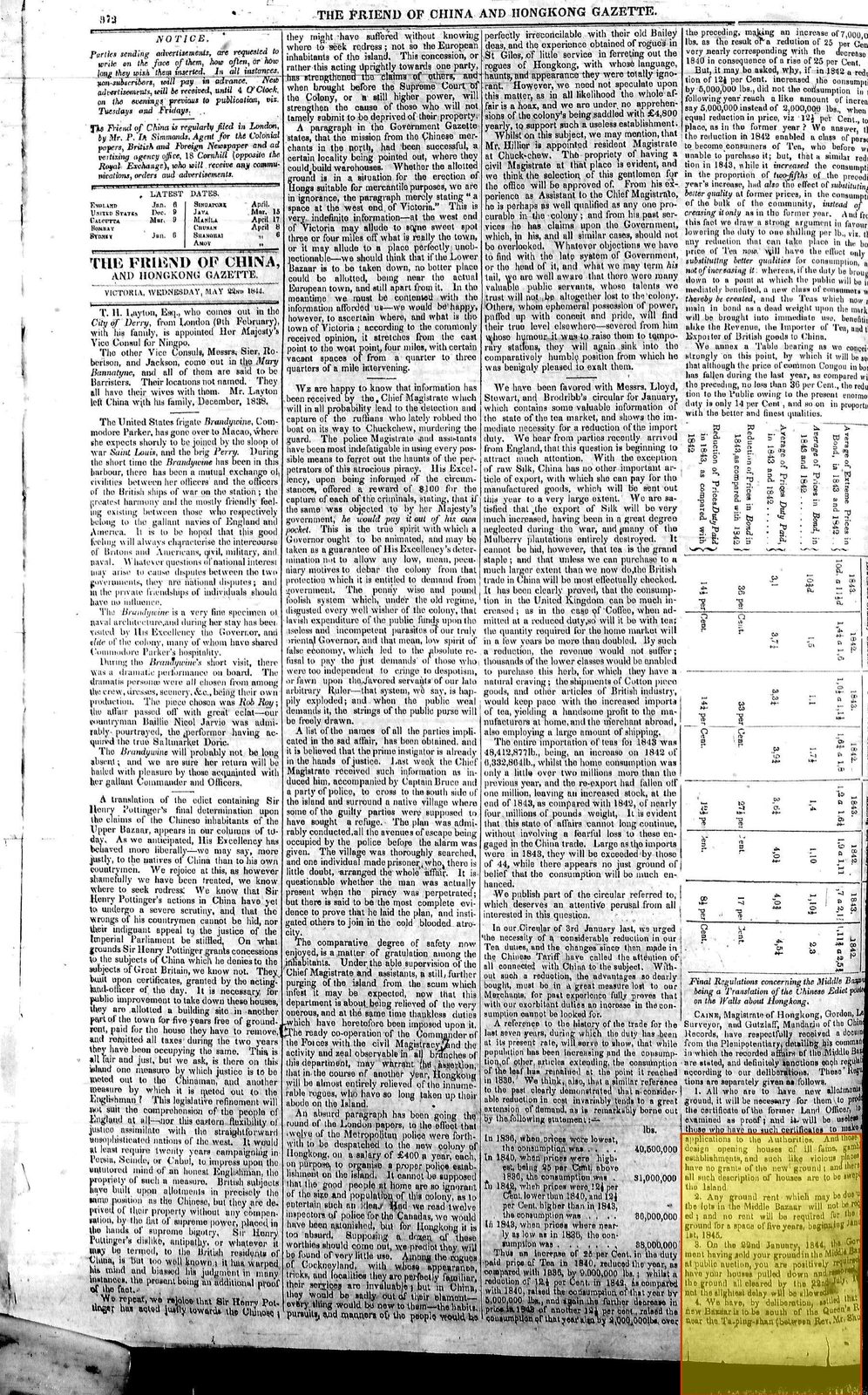
三個月後,政府的最終公告卻只用了一個名字。1844年5月22日,Friend of China刊出「Final Regulations concerning the Middle Bazaar being a Translation of the Chinese Edict」,由Caine(Magistrate)、Gordon(Land Surveyor)與Gutzlaff(Chinese Records 的 Mandarin)共同簽署;第二條規定中市場地段的地租「a space of five years, beginning 1st [January] 1845」豁免4。政府的正式文書,用的是「Middle Bazaar」。
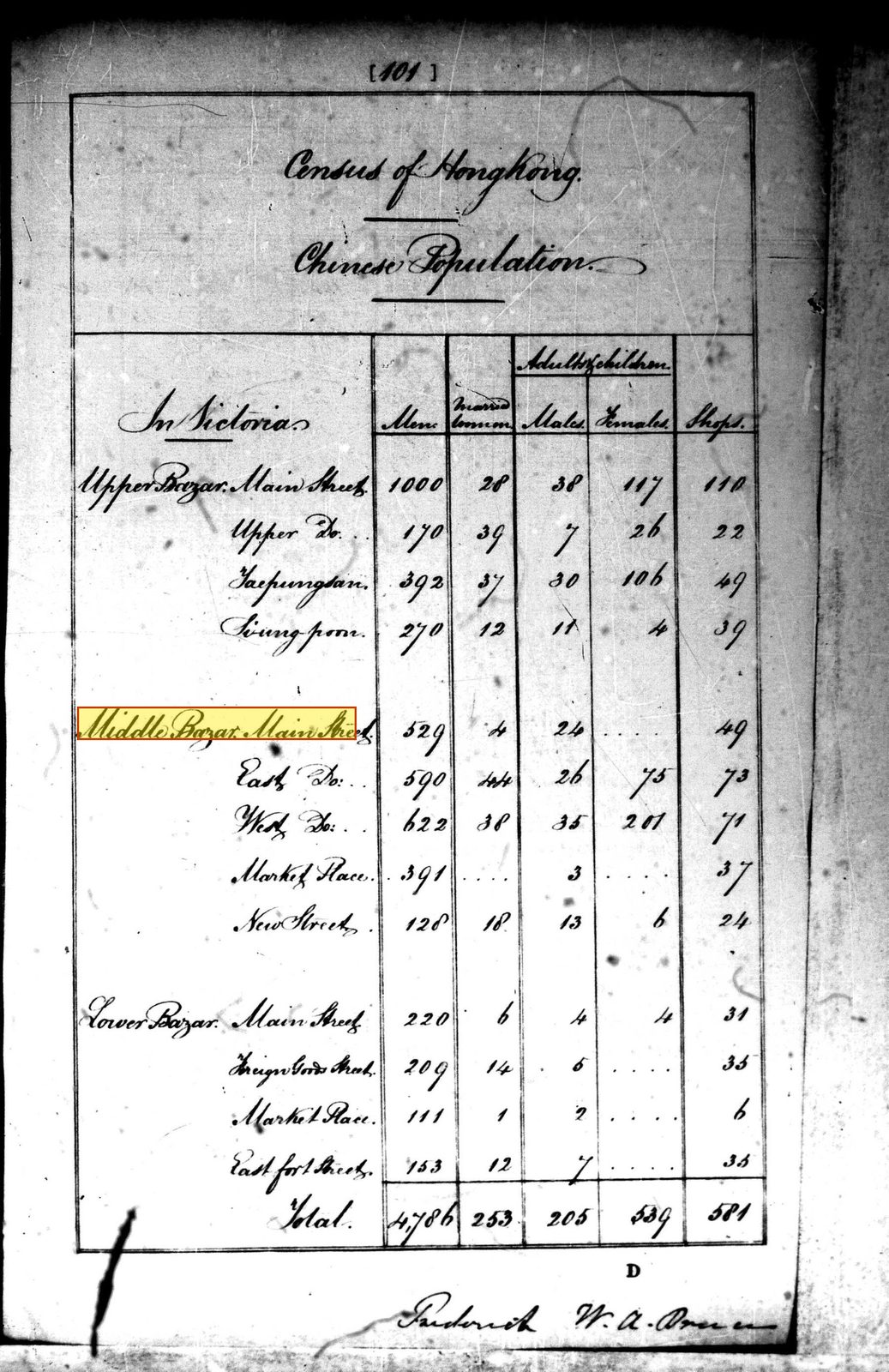
更有力的證據來自 census。1844年 census 中,「Middle Bazar」有三條街:Main Street 529人、East Street 590人、West Street 622人,合計1,741人,另有 shop 數欄;而「Upper Bazar Main St」則是另一行,1,000人5。兩者在 census 中是分開的兩組數字,不是同一個地方的兩個叫法。
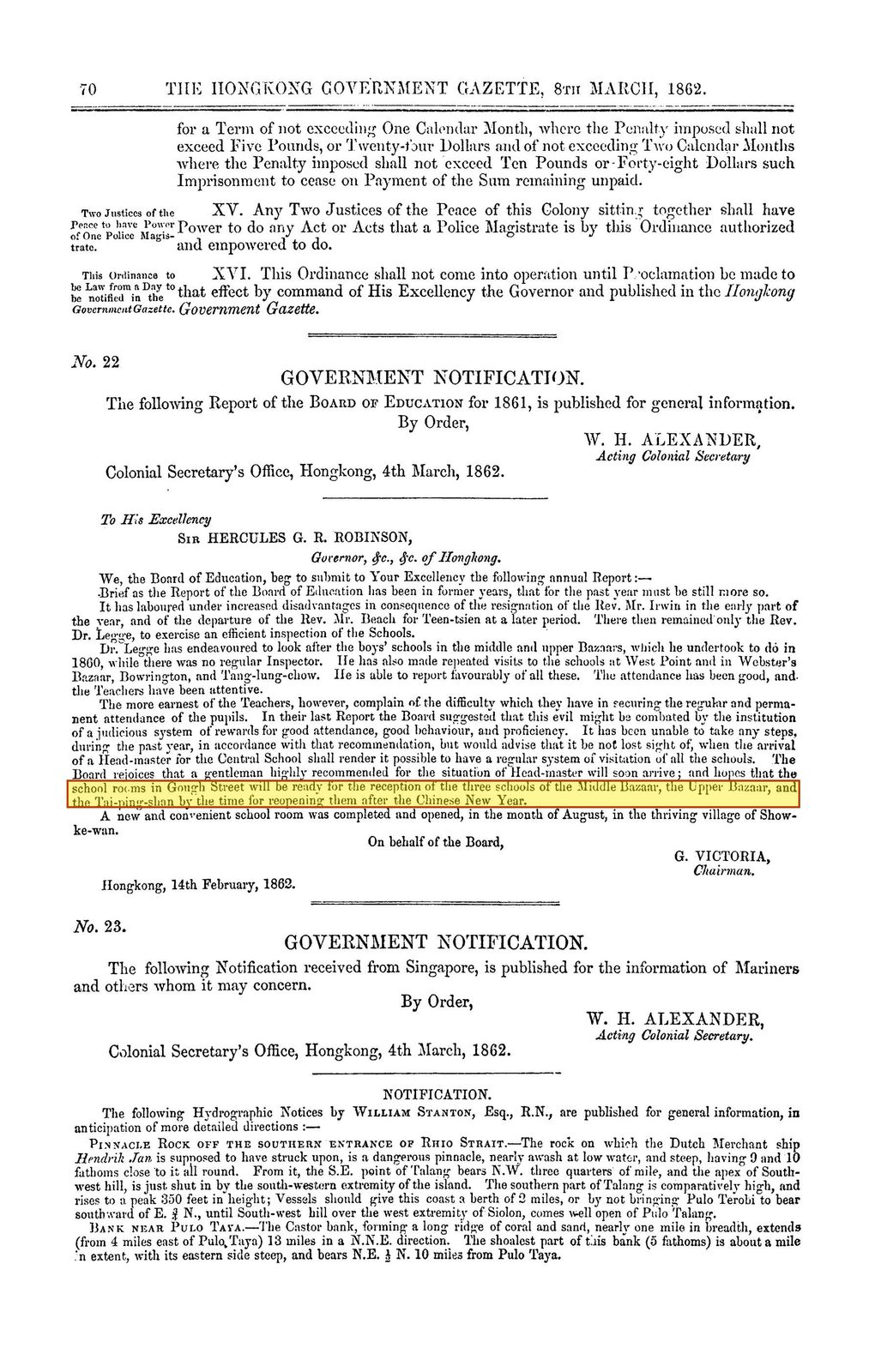
1862年3月8日,教育局的 Gazette No. 22 列出三所要搬往高街(Gough Street)的學校:「the three schools of the Middle Bazaar, the Upper Bazaar, and the Tai-ping-shan」6。三校並列,再次證明 Middle 與 Upper 是兩個不同的地方。
然而,1970年Dafydd Emrys Evans 的經典論文卻將兩者合而為一:「the Upper Bazaar (sometimes referred to as the ‘Middle Bazaar’)」7。1971年Carl T. Smith 則保持區分:「when the residents of the Middle Bazaar were removed to the Tai Ping Shan area in 1844…」8。這個史學分歧不是偶然——它根源於同期記錄自身的歧義(「Middle, or Upper Bazar」)。本文的立場是:歧義本身是一項發現,不應以論斷抹平。Census 與1862年三校名單是結構性證據:Middle 與 Upper 在官方記錄中是兩個名稱。至於它們在地理位置上是否完全分離、抑或部分重疊,現有文件無法確定(§3 G2)。
三、清拆的機器:拍賣、交地、$40
Gordon 的計劃分兩步。第一步:把 Upper Bazar 的27個地段編入維多利亞城的拍賣計劃。1843年12月19日的信中,他同時報告「eighty-eight lots having been already disposed of」,並指定第89–158號地段於1844年1月22日拍賣9。
第二步:拍賣的「附帶條件」成為清拆的法律依據。總督的裁決文書寫道:「the land on which they stand was sold on the 22nd January last with the condition, that the Purchasers should be put in possession within six months from the day of sale. The locality to which the Petitioners are to be removed is nearly opposite the Lower Bazaar, on the South-side of the Queen’s Road」——每戶補償$4010。
華人商戶的請願與總督的回覆,於1844年5月4日以中英對照形式刊於Friend of China。編輯部同日發表社論:「The right of Government to assure possession of that, or any other portion of the town, for improvement, or public purposes, is undeniable. The question is what compensation will be allowed the parties who have built houses on the faith of promises from a government servant of obtaining a title to the same.」11——政府的權利「無可否認」,問題只是補償多少。
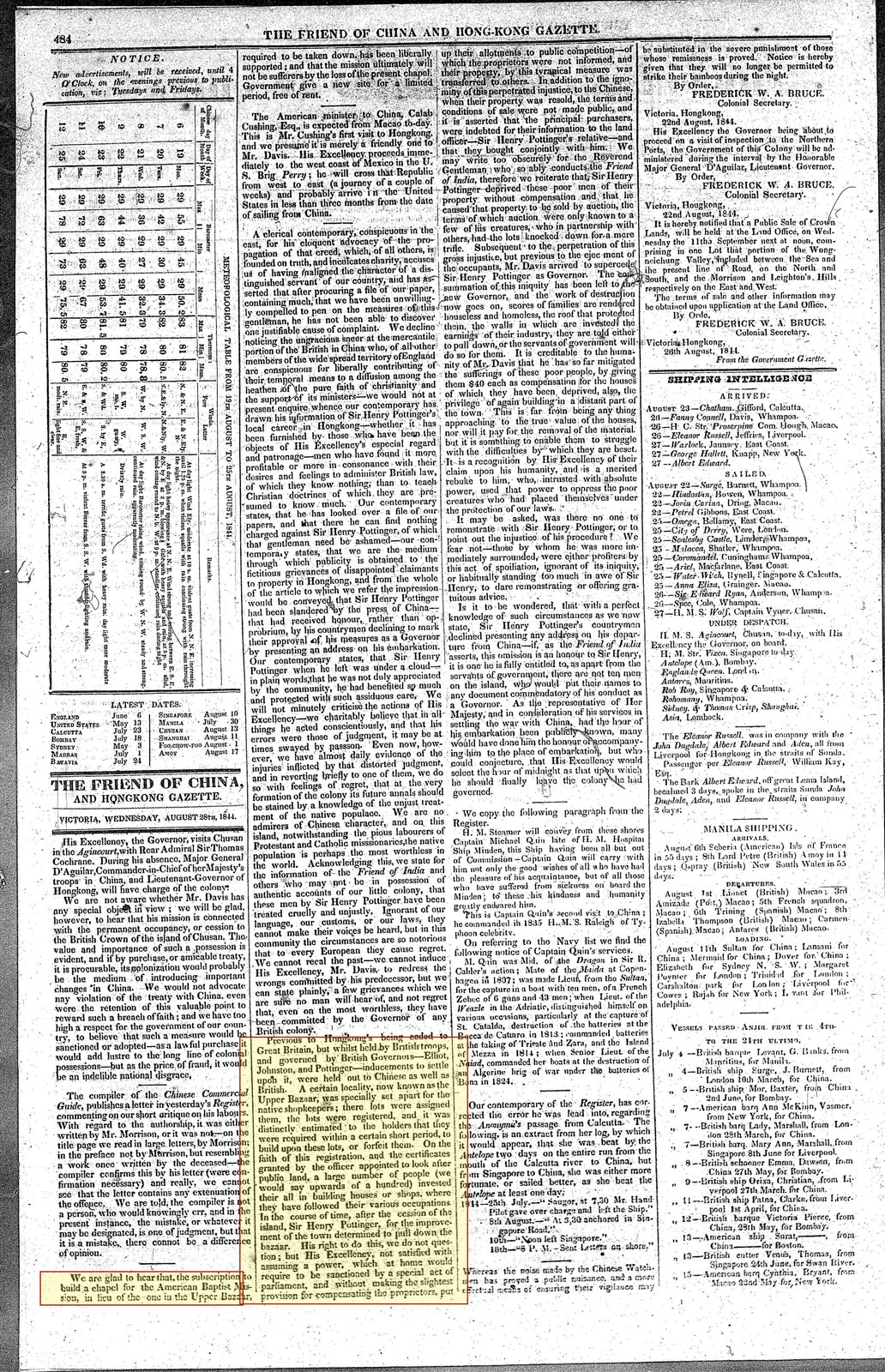
1844年8月28日,Friend of China回顧整個事件,語氣轉為批評:地段被「put up … to public competition — of which the proprietors were not informed」;拍賣是「a tyrannical measure」;「knocked down for a mere trifle」;「upwards of a hundred invested their all」。總督「distinctly intimated [原文印作 ‘entimated’] that the proceeds of the sale should be applied to the erection of a new Market」12。同一版第三欄,American Baptist 的教堂公告寫著:在「the Upper Bazar」的原址建堂,「in lieu of the one in the Upper Bazar」——同一張報紙、同一個版面,「Bazaar」與「Bazar」兩種拼法並存13。
清拆令本身則只以一行文字存在於殖民地部的登記冊。Register of Correspondence 第162條(1844年4月17日):「Hon’d Major Caine — Regarding the removal of the present occupants of the Upper Bazar, and conveying final Instructions on the subject.」14令文全文不在語料庫中(§3 G1)。
四、清拆之後:中市場的名字去了哪裡?
清拆之後,中市場這個名字並沒有立刻消失。1844年9月11日的憲報刊出American Baptist 教堂的建堂通告:「It is proposed that the Chapel should be erected in the Middle Bazaar, where an eligible site may be obtained, behind the office of the FRIEND OF CHINA… about $1,000。」15教堂建在中市場、且在Friend of China辦公室後面——這個位置說明中市場的地名在1844年下半年仍是可識別的地理座標。
1844年11月13日的憲報有一封關於道路與排水的來信:「In the ‘Center Bay,’ or middle Bazar the site of the old Chinese town — a good beginning has been made, both with the Roads and Drains。」16「Center Bay」是另一個對同一地區的稱呼,而信中明言這是「the site of the old Chinese town」——舊華人市鎮的所在地。
此後,這個名字從記錄中消失了十七年。下一次出現,是1861年教育局的視學報告:視學員視察了「boys’ schools in the middle and upper Bazaars」17。1862年3月8日的 Gazette No. 22 將三校(中市場、上市場、太平山)列入搬遷名單18;Blue Book 1861 第128頁印有同一句話19。這是中市場作為一個活躍地區名稱的最後一次出現在記錄中。
1844年之後,Loo Aqui 向政府申請市場專營權:建造成本$2,500的市場建築,月租$200,為期五年。Smith 寫道:「when the residents of the Middle Bazaar were removed to the Tai Ping Shan area in 1844, he petitioned the Government for the privilege of operating a market」20。這是單一的二手見證;語料庫中未找到對應的一手文件(§3 S4)。
五、結論
中市場(Middle Bazaar)在1844年的 census 中是一個有1,741人、三條街的獨立地區;它的住戶在1844年被清拆,遷往太平山;政府的最終公告以「Middle Bazaar」為正式名稱;而同期記錄自身卻在「Middle, or Upper Bazar」之間保持歧義。1970年代的史學將兩者合併,1971年的Smith 則保持區分——這個分歧的根源,在1844年的原始記錄中已經存在。
本文不解決「Middle 與 Upper 是否同一個地方」這個問題,因為現有文件不足以解決它。本文主張的是:在官方記錄中,這是兩個名稱;census 將它們分列;1862年的三校名單將它們並列;而1844年5月的通函標題自己寫著「Middle, or Upper」。歧義是記錄的一部分,不是後人閱讀的失誤。
至於中市場的實體命運:它的地皮在1844年1月22日被拍賣,住戶在六個月內被清拆,$40一戶;政府承諾「the proceeds of the sale should be applied to the erection of a new Market」,而這個新市場(Register 第183條,1844年5月27日)被指定在「the westward of the Lower Bazar」21。中市場的物理空間,就此被納入維多利亞城的新規劃;它的名字,則退入教育局的學校名單,最後消失在1862年的 Gazette 中。
The Middle Bazaar and Its Removal, Hong Kong, 1842–1862
A distinct district in the 1844 census, an ambiguous name in the colonial record, and the machinery of the first large-scale eviction of a Chinese community in Victoria City
Abstract
The colonial record names a district “Middle Bazaar” (also “Middle Bazar”; in one 1844 title, “Middle, or Upper Bazar”). The 1844 census counts it in three streets (Main, East, West) separately from the Upper Bazar. Its inhabitants were evicted in 1844 under Pottinger’s orders after the 22 January auction sold their ground “with the condition that the Purchasers should be put in possession within six months”; the Government’s own final instrument is titled “Final Regulations concerning the Middle Bazaar.” The name then disappears from the record for seventeen years, surviving only in the Board of Education’s 1861–62 three-schools list. Evans (1970) flattens Middle into Upper; Smith (1971) keeps them distinct. This paper does not resolve the ambiguity by assertion: the period’s own title — “Middle, or Upper Bazar” — is itself the finding.
1. Method
The full Elasticsearch battery was run on the hkintexts corpus (read-only), including phrase sweeps, the Middle/Upper conjunction family, period negative controls on Chinese terms with an 184 document-key prefix, and three whole-document dumpdoc pulls (the Friend of China 1844 series, 245 pages; the Blue Book 1844; Gazette No. 22 of 22 May 1844). Every load-bearing quotation was read back against the scan image by the research model’s own eyes before entering any deliverable.22 The commissioned name “中市場” is a modern topic label; the period record is entirely in English (Appendix A, proper-name battery).
2. The name: Middle, Upper, or both?
On 19 December 1843 A. J. Gordon, Land Officer, wrote to the Colonial Secretary proposing to “remove altogether” the Upper Bazar — “inhabited by Chinese of the lowest description, who are a nuisance” — and dividing its space into “twenty seven in number” of lots “for Europeans or respectable Chinese.”23 But the contemporaneous record is itself ambiguous. The Friend of China of 4 May 1844 published the Governor’s correspondence with the traders under the title “Middle, or Upper Bazar” — one document, one title, two names.24
The Government’s own final instrument, three weeks later, used only one: “Final Regulations concerning the Middle Bazaar,” signed by Caine, Gordon and Gutzlaff, remitting ground rent on the Middle Bazaar lots for “a space of five years, beginning 1st [January] 1845.”25 The census of the same year counts “Middle Bazar” in three streets — Main 529, East 590, West 622 — separately from “Upper Bazar Main St” (1,000).26 The 1862 Board of Education list names “the three schools of the Middle Bazaar, the Upper Bazaar, and the Tai-ping-shan” as distinct.27
Evans (1970) collapses the two (“sometimes referred to as the ‘Middle Bazaar’”);28 Smith (1971) keeps them distinct.29 The historiographic conflict is itself a finding: the period record’s own ambiguity is the root. This paper does not resolve it by assertion.
3. The auction and the eviction
Gordon’s plan had two steps. First: lots 89–158 to auction on 22 January 1844; “eighty-eight lots having been already disposed of.”30 Second: the auction’s condition became the legal basis of the eviction. The Governor’s decision: “the land on which they stand was sold on the 22nd January last with the condition, that the Purchasers should be put in possession within six months from the day of sale. The locality to which the Petitioners are to be removed is nearly opposite the Lower Bazaar, on the South-side of the Queen’s Road” — $40 compensation each.31
The traders’ petition and the Governor’s reply were published bilingually on 4 May 1844. The editorial the same day: “The right of Government to assure possession of that, or any other portion of the town, for improvement, or public purposes, is undeniable.”32 On 28 August the Friend of China looked back: the allotments were put up “to public competition — of which the proprietors were not informed”; the sale was “a tyrannical measure”; “knocked down for a mere trifle”; “upwards of a hundred invested their all.” The Governor “distinctly intimated [printed: ‘entimated’] that the proceeds of the sale should be applied to the erection of a new Market.”33
The removal order itself survives only as a one-line register entry: “Regarding the removal of the present occupants of the Upper Bazar, and conveying final Instructions on the subject” (17 April 1844).34 The despatch text is not in the corpus (Appendix A, gap G1).
4. After the removal: where the name went
The name survived the eviction. The Gazette of 11 September 1844 published the American Baptist chapel notice: “It is proposed that the Chapel should be erected in the Middle Bazaar, where an eligible site may be obtained, behind the office of the FRIEND OF CHINA.”35 The Gazette of 13 November carried a roads-and-drains letter: “In the ‘Center Bay,’ or middle Bazar the site of the old Chinese town — a good beginning has been made.”36
Then the name drops out for seventeen years. Next attestation: the 1861 Board of Education report, and the 1862 Gazette No. 22 three-schools list.37 After 1862, no continuous series was found (gap G4).
Loo Aqui’s market petition (Smith): a market house at $2,500, monthly rental $200 for five years.38 Single modern secondary witness; no corpus primary pulled (S4).
5. The historiographic conflict
Evans (1970): “the Upper Bazaar (sometimes referred to as the ‘Middle Bazaar’) which was built at the beginning of 1842 … two rows or streets of shops on lots about 36 feet by 14 feet … $4 per annum.”39 Smith (1971): “when the residents of the Middle Bazaar were removed to the Tai Ping Shan area in 1844, he [Loo Aqui] petitioned the Government … market house at a cost of $2,500 … $200 for a period of five years.”40 Smith’s book: “When the inhabitants of the Middle Bazaar had been relocated at Tai Ping Shan, the Government replotted the area”; index entry “Middle Bazaar, Hong Kong, 109, 122, 123.”41
The conflict is registered, not resolved by assertion (K1). The census and the 1862 list are the structural evidence: Middle and Upper are distinct as names in the official record.
6. Conclusion
The Middle Bazaar was a distinct named district in the 1844 census — not an alias of the Upper Bazaar, whatever the historiography says. Its inhabitants were evicted in 1844 under Pottinger’s orders after the 22 January auction sold their ground with a six-month possession condition; the Government’s own final notice is titled “concerning the Middle Bazaar”; and the district’s name then drops out of the record for seventeen years, surviving only in the Board of Education’s 1861–62 three-schools list. The period’s own ambiguity — “Middle, or Upper Bazar” — is preserved in the title of the correspondence itself, and this paper does not resolve it by assertion.
Appendix A: Evidence register
Confirmed (two or more witnesses): C1 Middle Bazaar as a distinct census district (three streets, 1,741 persons) + the 1862 three-schools list; C2 the Government’s “Final Regulations concerning the Middle Bazaar”; C3 the period’s own “Middle, or Upper Bazar”; C4 the removal order (register + correspondence + Governor’s decision); C5 the 22 Jan auction with the six-month condition; C6 $40 compensation; C7 Gordon’s “remove altogether” / “twenty seven lots”; C8 three schools 1861–62; C9 chapel in the Middle Bazaar.
Single-witness: S1 Gordon’s “lowest description … a nuisance”; S2 “eighty-nine Proprietors”; S3 “entimated” [printed]; S4 Loo Aqui’s $2,500/$200 petition (Smith only); S5 ground rent remission clause 2; S6 “upwards of a hundred invested their all”; S7 “Center Bay … old Chinese town.”
Conflicts: K1 Middle vs Upper identity (the ambiguity is the finding); K2 register year (volume “1843” vs entries 1844); K3 census image vs text OCR (image authoritative); K4 Bazaar1841’s “estimated” vs the scan’s “entimated” (scan wins).
Failed — do-not list: F1 the alleged 17 Apr despatch quotation (“fullest and most liberal manner” / “claim for compensation will be considered”) — 0 hits, dropped (rule 5); F2 Chinese period names 中市場/上市場/下市場/上下市場 with 184 prefix — 0 hits; F3 “fullest and most liberal manner” corpus-wide — 0; F4 an official renaming notice — 0 hits.
Gaps: G1 the 17 Apr despatch text itself; G2 the exact physical extent of Middle vs Upper; G3 the fate of the 27 lots’ new Chinese buyers; G4 the name’s persistence after 1844.
Adversarial pass (A1–A6): A1 phrase sweep 15 hits (the term IS period); A2 negative controls 0 hits (no Chinese period name); A3 “the sale of the lots” + 1844 = 0 (F1); A4 “Middle, or Upper” = 1 hit (load-bearing, single-witness); A5 Evans vs Smith conflict registered; A6 census “Middle Bazar” eye-verified.
Appendix B: Query log and plates
Full query log in the research notes (Appendix A): 15-hit “Middle Bazaar” sweep; “Middle, or Upper” = 1; four Chinese negative controls = 0; three dumpdoc pulls (FoC 1844 series 245 pp., Blue Book 1844, Gazette 22 May 1844); 25+ page pulls. Rule-9 proper-name battery in the notes’ Appendix A.
Plates: five document plates, all read back by the session model’s own eyes at their final crops (the §6B gate): Figures 1–5 above.
Notes
- ↑Census of 1844, “Middle Bazar” rows (Main Street 529 | 4 | 24 | … | 49 shops; East 590 | 44 | 26 | 75 | 73; West 622 | 38 | 35 | 201 | 71), printed p. [101], separately from “Upper Bazar Main St” (1000 | 28 | 38 | 117 | 110); colony total 4,786 | 253 | 205 | 539 | 581. Scan: https://hkintexts.histsyn.com/image-page/612227, accessed 15 October 2026.
- ↑A. J. Gordon (Land Officer), letter to the Colonial Secretary, 19 December 1843, in CO 129/2, p. 448: “That part of the town known as the Upper Bazar I propose to remove altogether; at present it is inhabited by Chinese of the lowest description, who are a nuisance to the neighbourhood. I have divided the space it occupies into lots (twenty seven in number) suitable for shops and dwellings for Europeans or respectable Chinese.” https://hkintexts.histsyn.com/page/217240, accessed 15 October 2026.
- ↑“Correspondence between Sir Henry Pottinger and the Chinese of the Middle, or Upper Bazar; Translated from the Chinese,” The Friend of China and Hong-Kong Gazette, 4 May 1844 (No. 129), with the traders’ letter signed “by eighty-nine Proprietors” and the Governor’s reply. Scan: https://hkintexts.histsyn.com/image-page/612169, accessed 15 October 2026.
- ↑“Final Regulations concerning the Middle Bazaar being a Translation of the Chinese Edict,” The Friend of China and Hong-Kong Gazette, 22 May 1844, issued under Caine (Magistrate), Gordon (Land Surveyor) and Gutzlaff (Mandarin of the Chinese Records); clause 2 remits ground rent on the Middle Bazaar lots for “a space of five years, beginning 1st [January] 1845.” Scan: https://hkintexts.histsyn.com/image-page/612146, accessed 15 October 2026.
- ↑Census of 1844, Blue Book, printed p. [101]; Board of Education Report, Blue Book 1861, p. 128.
- ↑Board of Education, Gazette No. 22, 8 March 1862: the three schools “of the Middle Bazaar, the Upper Bazaar, and the Tai-ping-shan” to be moved to Gough Street; the same three-schools sentence appears in Blue Book 1861, p. 128. Scans: https://hkintexts.histsyn.com/image-page/612839 and https://hkintexts.histsyn.com/page/655359, accessed 15 October 2026.
- ↑Dafydd Emrys Evans, “Chinatown in Hong Kong: The Beginnings of Taipingshan,” Journal of the Hong Kong Branch of the Royal Asiatic Society 10 (1970), p. 75: “the Upper Bazaar (sometimes referred to as the ‘Middle Bazaar’) which was built at the beginning of 1842… two rows or streets of shops on lots about 36 feet by 14 feet… $4 per annum.” https://hkintexts.histsyn.com/page/205995, accessed 15 October 2026.
- ↑Carl T. Smith, “The Emergence of a Chinese Elite in Hong Kong,” JHKBRAS 11 (1971), p. 87: “when the residents of the Middle Bazaar were removed to the Tai Ping Shan area in 1844, he [Loo Aqui] petitioned the Government for the privilege of operating a market… a market house at a cost of $2,500… monthly rental… $200 for a period of five years.” https://hkintexts.histsyn.com/page/206270, accessed 15 October 2026.
- ↑Gordon, same letter, CO 129/2, p. 447: lots 89–158 to be sold by auction on 22 January 1844; “eighty-eight lots having been already disposed of.” https://hkintexts.histsyn.com/page/217239, accessed 15 October 2026.
- ↑Governor’s decision on the Upper Bazar petition, CO 129/6, p. 446: “the land on which they stand was sold on the 22nd January last with the condition, that the Purchasers should be put in possession within six months from the day of sale. The locality to which the Petitioners are to be removed is nearly opposite the Lower Bazaar, on the South-side of the Queen’s Road”—compensation $40 each. https://hkintexts.histsyn.com/page/219120, accessed 15 October 2026.
- ↑Friend of China editorial on the correspondence, 4 May 1844: “The right of Government to assure possession of that, or any other portion of the town, for improvement, or public purposes, is undeniable. The question is what compensation will be allowed the parties who have built houses on the faith of promises from a government servant of obtaining a title to the same.” https://hkintexts.histsyn.com/image-page/612169, accessed 15 October 2026.
- ↑“A certain locality, now known as the Upper Bazaar…”, The Friend of China and Hong-Kong Gazette, 28 August 1844, folio 484: the allotments were put up “to public competition—of which the proprietors were not informed”; the sale was “a tyrannical measure”; “upwards of a hundred invested their all”; the Governor “distinctly intimated [printed: entimated]” that the proceeds should build a new Market. Scan: https://hkintexts.histsyn.com/image-page/612284, accessed 15 October 2026.
- ↑“A certain locality… Upper Bazaar,” Friend of China, 28 August 1844.
- ↑Register of Correspondence, entry 162, 17 April 1844, in CO 129/10, p. 663: “Hon’d Major Caine—Regarding the removal of the present occupants of the Upper Bazar, and conveying final Instructions on the subject.” The year is fixed by entry 89 of the same run, which forwards despatch No. 15 of 28 February 1844 (CO 129/10, p. 661). https://hkintexts.histsyn.com/page/221068 and /page/221066, accessed 15 October 2026.
- ↑“It is proposed that the Chapel should be erected in the Middle Bazaar, where an eligible site may be obtained, behind the office of the FRIEND OF CHINA… about $1,000,” Government Gazette, 11 September 1844 (728638-1844-11-Sep-1844), p. 3. https://hkintexts.histsyn.com/page/1687003, accessed 15 October 2026.
- ↑“In the ‘Center Bay,’ or middle Bazar the site of the old Chinese town—a good beginning has been made, both with the Roads and Drains,” Government Gazette, 13 November 1844 (728656-1844-13-Nov-1844), p. 2. https://hkintexts.histsyn.com/page/1687077, accessed 15 October 2026.
- ↑Board of Education, Gazette No. 22, 8 March 1862; Blue Book 1861, p. 128.
- ↑Board of Education, Gazette No. 22, 8 March 1862; Blue Book 1861, p. 128.
- ↑Census of 1844, Blue Book, printed p. [101]; Board of Education Report, Blue Book 1861, p. 128.
- ↑Smith, “The Emergence of a Chinese Elite,” p. 87.
- ↑Register of Correspondence, entry 183, 27 May 1844: Gordon directed “to select and mark off a site for a new Market Place, to the westward of the Lower Bazar.” CO 129/10, p. 663. https://hkintexts.histsyn.com/page/221068, accessed 15 October 2026.
- ↑Method note: the full Elasticsearch battery was run on the hkintexts cluster (read-only), including phrase sweeps, the Middle/Upper conjunction family, period negative controls on Chinese terms with an 184 document-key prefix, and three whole-document dumpdoc pulls (the Friend of China 1844 series, 245 pages; the Blue Book 1844; Gazette No. 22 of 22 May 1844). Every load-bearing quotation was read back against the scan image by the research model’s own eyes before entering any deliverable (the §6B plate gate).
- ↑Gordon, letter of 19 December 1843, CO 129/2, p. 448.
- ↑“Correspondence… Middle, or Upper Bazar,” Friend of China, 4 May 1844.
- ↑“Final Regulations concerning the Middle Bazaar,” Friend of China, 22 May 1844.
- ↑Census of 1844, Blue Book, printed p. [101]; Board of Education Report, Blue Book 1861, p. 128.
- ↑Board of Education, Gazette No. 22, 8 March 1862; Blue Book 1861, p. 128.
- ↑Evans, “Chinatown in Hong Kong,” p. 75.
- ↑Smith, “The Emergence of a Chinese Elite,” p. 87.
- ↑Gordon, letter of 19 December 1843, CO 129/2, p. 447.
- ↑Governor’s decision, CO 129/6, p. 446.
- ↑Friend of China editorial, 4 May 1844.
- ↑“A certain locality… Upper Bazaar,” Friend of China, 28 August 1844.
- ↑Register of Correspondence, entry 162, CO 129/10, p. 663.
- ↑Chapel notice, Government Gazette, 11 September 1844.
- ↑“Center Bay… middle Bazar,” Gazette, 13 November 1844.
- ↑Board of Education, Gazette No. 22, 8 March 1862; Blue Book 1861, p. 128.
- ↑Carl T. Smith, Chinese Christians and Elites: Prelude to the Occupation of Hong Kong (research-publications series): “When the inhabitants of the Middle Bazaar had been relocated at Tai Ping Shan, the Government replotted the area”; index entry “Middle Bazaar, Hong Kong, 109, 122, 123.” https://hkintexts.histsyn.com/page/3185995, accessed 15 October 2026.
- ↑Evans, “Chinatown in Hong Kong,” p. 75.
- ↑Smith, “The Emergence of a Chinese Elite,” p. 87.
- ↑Smith, Chinese Christians and Elites.