別人的燈——香港的燈塔與橫瀾島的15年之爭,1867–1901
摘要 本文考察香港殖民地燈塔體系的形成,重點不在於工程本身,而在於一個殖民地如何面對一項它既無力興建、又無權掌控的公共設施。語料庫顯示了一條容易被忽略的結構性事實:香港憲報自 1875 年起便持續刊登中國海關(Imperial Maritime Customs)的航海通告,包括為澎湖群島芬特島所立的燈塔,而此一慣例在 1870 年代出現 191 次、1880 年代 160 次、1890 年代 137 次。橫瀾燈塔的兩則通告正是此一慣例的延續——通告抬頭印著英文 Government of China(即「大清國」),由上海的海關海務巡工司署(Coast Inspector's Office)發出,署名 Coast Inspector A. M. Bisbee,再由香港殖民地秘書長以政府公告形式刊於憲報。港府自 1886 年起爭取在南面航道 Gap Rock 建燈,1888 年提出以補助換取中國海關代建橫瀾,1889 年督憲明言「鑑於我方已承擔 Gap Rock 燈塔工程,中國海關將承擔橫瀾燈塔」,1893 年卻答覆定例局「並無此項諒解或協議」。燈塔終由海關建成,於 1893 年 5 月 10 日亮燈。1898 年新界租借使海關退出,輔政司 Stuart Lockhart 在檔案中寫下「恐怕本政府必須接手」;1901 年 3 月 2 日,港府以 2,943.60 元購回該站傢具與設備。一個殖民地長年刊登他國政府的燈塔通告,最終買回自己的燈。
一、題旨與方法
本研究以 hkintexts 文獻庫(只讀)為主要材料,查詢族包括燈塔名稱本身(「lighthouse」25,852;「Gap Rock」16,530;「Waglan」6,138;鶴咀 3,346;「light dues」413)、中國海關的通告機制(憲報內「By Order of the Inspector General of Customs」於 1870 年代 191 次、1880 年代 160 次、1890 年代 137 次)、定例局會議紀錄 1886–1901(60 余次會議),以及中文專名核對(橫瀾島 576、鶴咀 370、青洲 5,002)。1
二、別人的燈:憲報長期刊登中國海關的航海通告
整條線索的關鍵,是 1875 年 5 月 15 日憲報第 213 頁上的一紙公告。政府公告第 93 號寫道:「The following Notice to Mariners is published for general information.」其後全文照錄中國海關第 43 號航海通告,為澎湖群島芬特島(Fisher Island, Pescadores)擬建的燈塔——「a lighthouse will shortly be erected close to the present native light-tower on Litsitah Point」——由上海海關總部工程總監 David M. Henderson 簽發。2
值得留意的是同一版面上方:那是以「APPROACHING THE PORT. COAST OF SIND. Indus Banks」為題的卡拉奇航道指南,由庫雷奇港務代理 George C. Parker 簽署。香港憲報刊登印度海岸的航行資料,本身就是常態。3
此一慣例貫穿整個時期。以「By Order of the Inspector General of Customs」計,憲報在 1870 年代刊登 191 次、1880 年代 160 次、1890 年代 137 次、1900 年代 84 次,合計 572 則中國海關發出的通告。4 橫瀾的兩則通告(第 262 號與第 269 號)因此並非特例;特例出現在 1901 年——慣例終止,一盞外國政府的燈成為香港的燈。
三、南面航道:由第一座燈塔到15年之爭
香港自身的最初三座燈塔建於 1875 至 1876 年:鶴咀(德己立角)於 1875 年 4 月 16 日啟用,為本港第一座燈塔,以時任陸軍司令德己立少將命名;5 其後為青洲與 Cape Collinson(赤柱角)。6 但南面航道——由新加坡而來的航路——仍然全無照明。7
商會與歷任督憲自 1886 年起力爭此燈。1886 年 9 月 17 日,殖民地秘書長向定例局提交《擬於 Gap Rock 或其附近設立燈塔之往來文件》,附註記載商會主席早在同年 7 月 8 日已建議趁海關總巡在港之機探詢意向——可見海關在此之前已有「former proposal」。8 同年 11 月 5 日開幕致辞確認:「The Gap Rock is, in the opinion of those qualified to judge, the best situation for this Lighthouse.」9
四、協議與否認
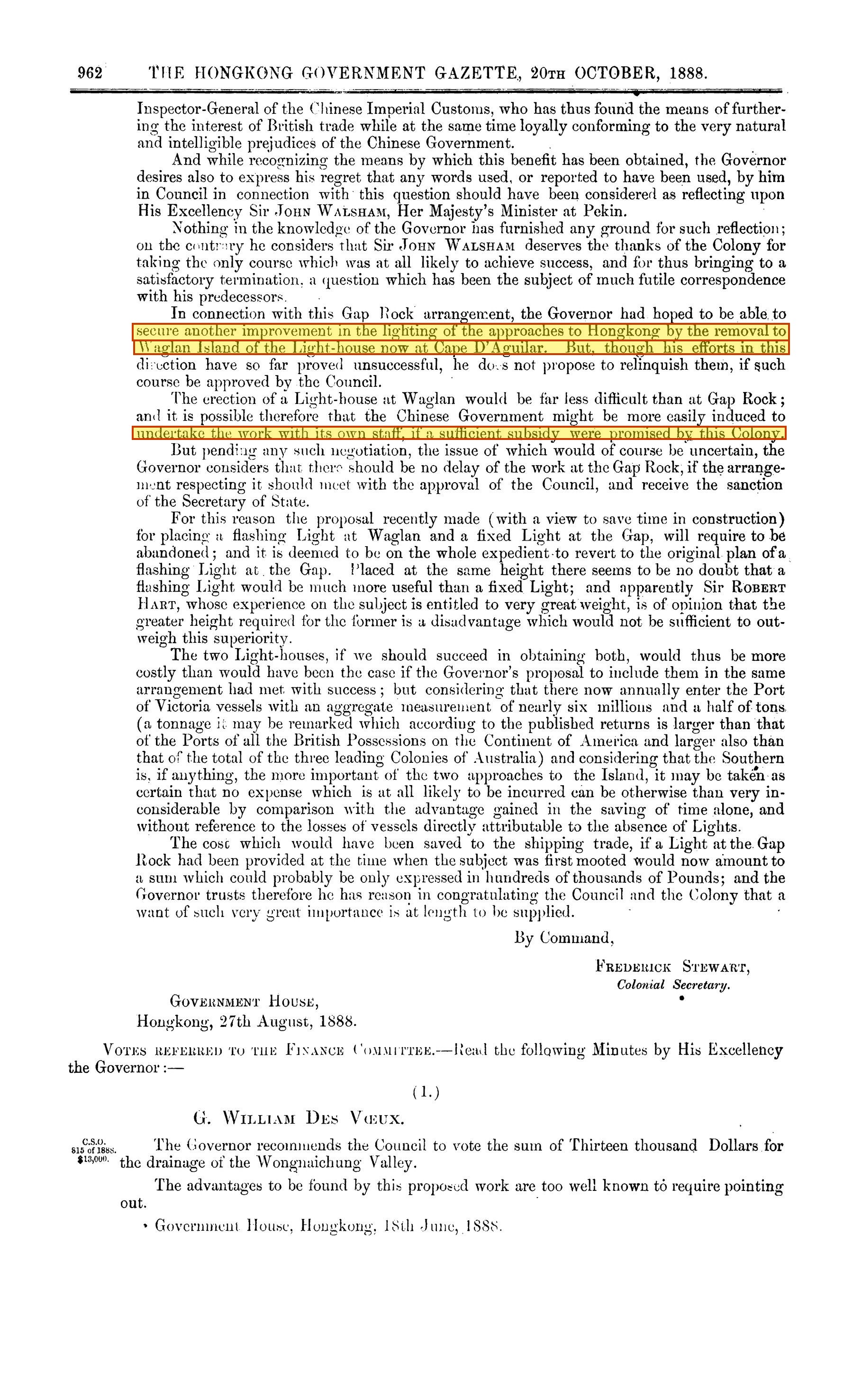
1888 年 8 月 27 日,督憲狄更斯(G. William des Voeux)向定例局提交關鍵信息,把整個策略講得最清楚:10
「總督原希望藉此安排,再進一步改善香港入口航道的照明——將現設於鶴咀的燈塔遷往橫瀾島。此事雖未成功,但只要議局同意,總督不擬放棄。於橫瀾建燈遠較 Gap Rock 容易,故中國政府或較易願意自行出資出人承辦,只要本殖民地承諾足夠補助。」10
同一篇信息亦交代了殖民地為何願意付錢:每年進出維多利亞港的船隻總噸位「接近六百五十萬噸」,比英國在美洲大陸全部屬港的總和還要多;而「南方入口較諸另一入口更為重要」;至於延誤的代價,則「恐怕只能以數十萬鎊計」。11
1889 年 12 月 18 日,督憲在議局明言:「我去年得悉,鑑於我方已承擔 Gap Rock 燈塔工程,中國海關將承擔橫瀾燈塔。」此語於 1891 年由議員 T. H. Whitehead 在提問中逐字引用,刊於憲報。12
然而 1893 年 2 月 26 日,面對議員 E. R. Belilios 追問是否存在「any understanding or agreement」,督憲的答覆只有一句:「The answer to that question is No.」13 本文不調和此一矛盾:1889 年是大臣本人所述的理解,1893 年則是否認正式協議的存在,兩者並列為檔案自身的矛盾。
五、橫瀾:由海關建成,至 1893 年亮燈
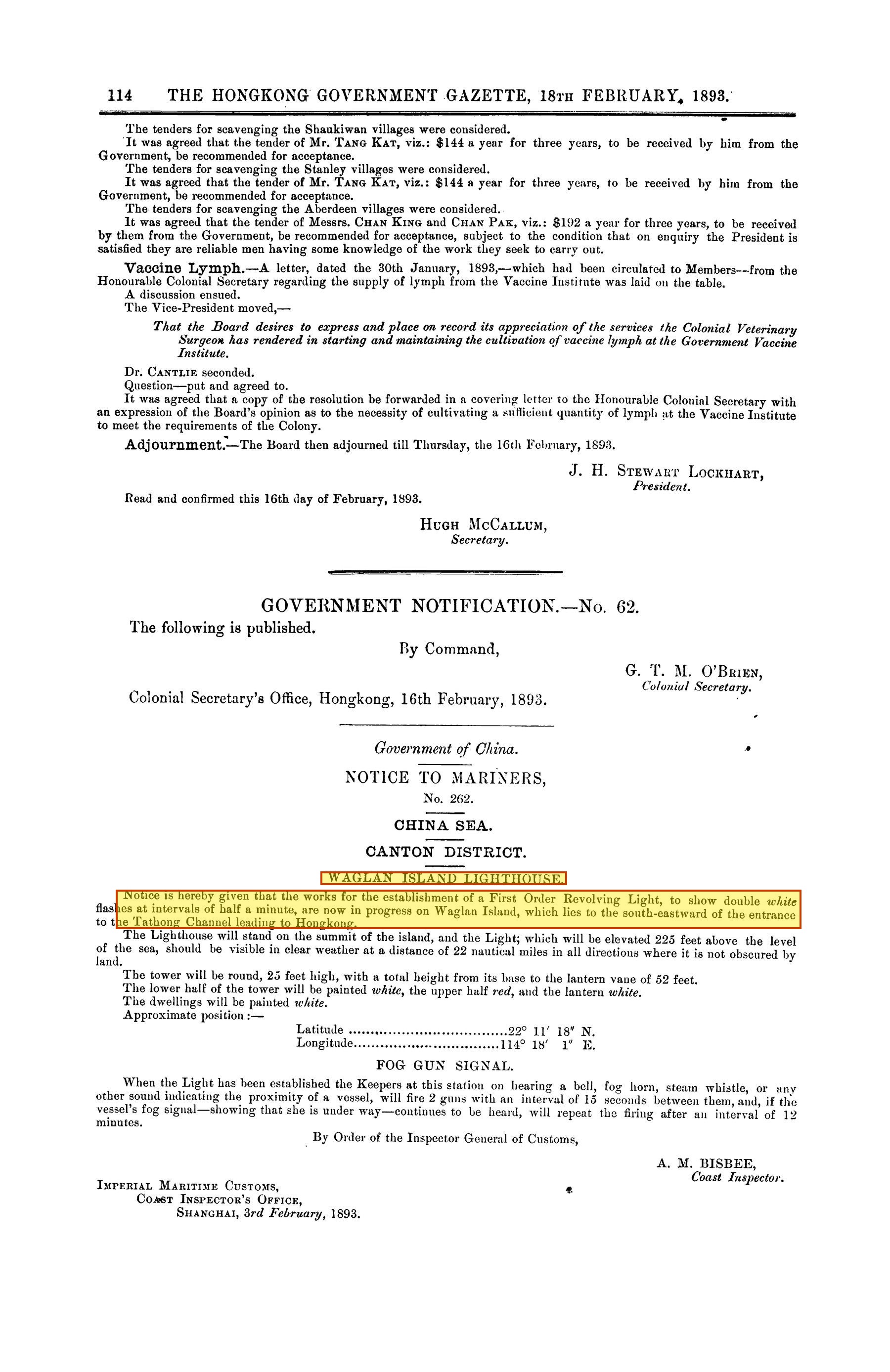
1893 年 2 月 18 日,憲報政府公告第 62 號刊出海關第 262 號航海通告,抬頭印著英文 Government of China(即「大清國」),通告正在橫瀾島興建「First Order Revolving Light」——一級旋轉燈,每半分鐘閃白光兩次,燈高海平面 225 呎,射程 22 海里,鐵塔高 25 呎,連燈塔頂共 52 呎,並載有霧炮信號:濃霧時聽聞任何船隻信號即鳴炮 2 響,間隔 15 秒,若信號持續,則每 12 分鐘重複。14
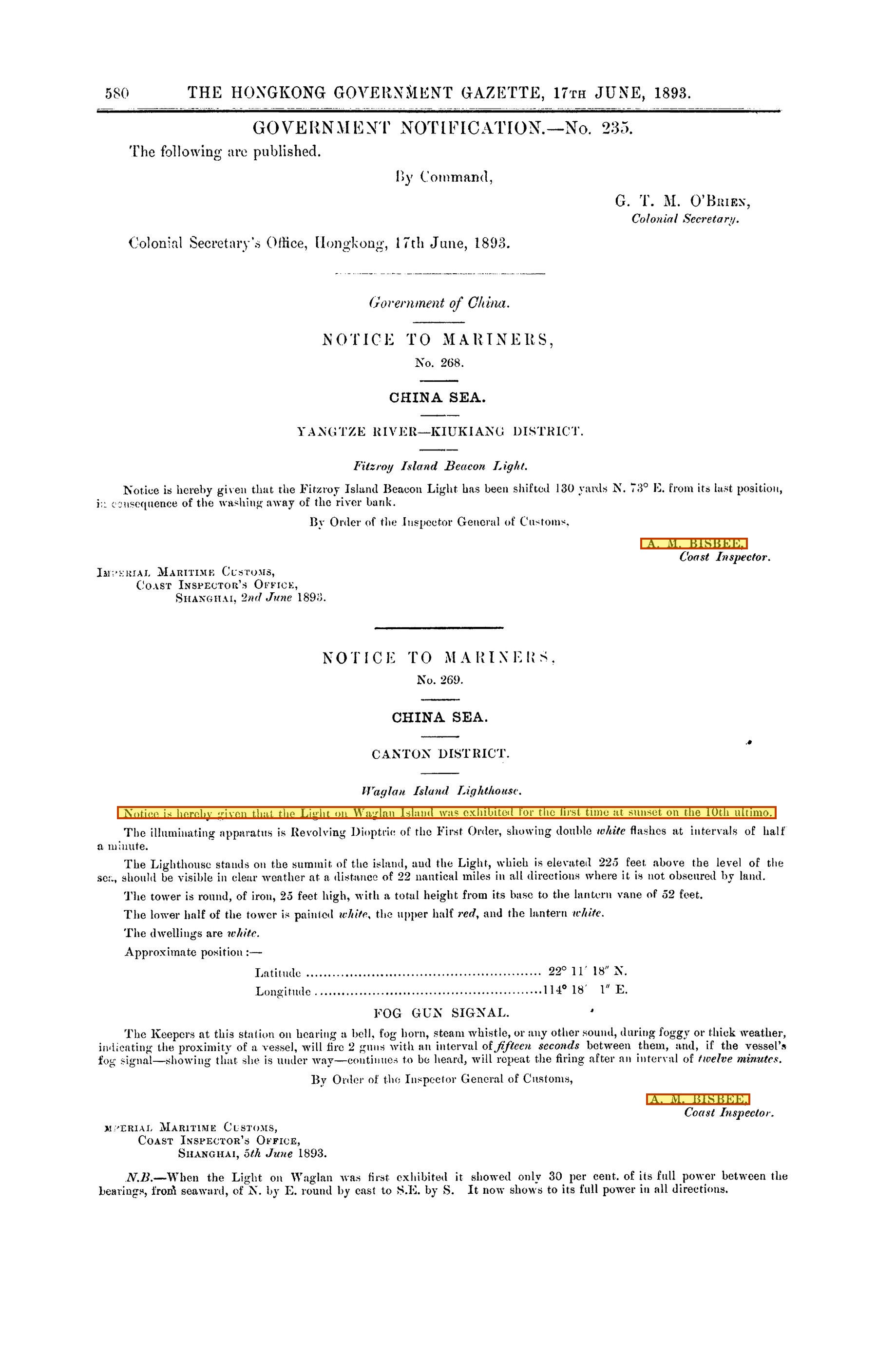
同年 6 月 17 日,憲報政府公告第 235 號刊出第 269 號,即落成通告:燈「於上月 10 日日落時首次燃點」(即 1893 年 5 月 10 日),照明儀器為「Revolving Dioptric of the First Order」;15 此頁同時刊有海關同日發出的九江 Fitzroy Island 燈樁通告,兩則均由海關海務巡工司(Coast Inspector)A. M. Bisbee 自上海簽署。15 官方記錄亦吻合:古物古蹟辦事處載明橫瀾燈塔「於一八九三年五月十日投入服務」。16
通告末尾另有一則附註,是只有原始檔案才會留下的細節:「本燈初次燃點時,在自北偏東經東至南偏東之方位扇面內,僅顯示其全功率的 30%;現已全面顯示。」15
5 月 10 日的啟用場合上,督憲致謝「McLeavy Brown 先生帶領各位到橫瀾,以及 Harding 先生向在場紳淑清晰解釋燈的運作」——即海關稅務司本人。17
六、經費與工程:燈課、Coode 報告與 1898 年的轉折
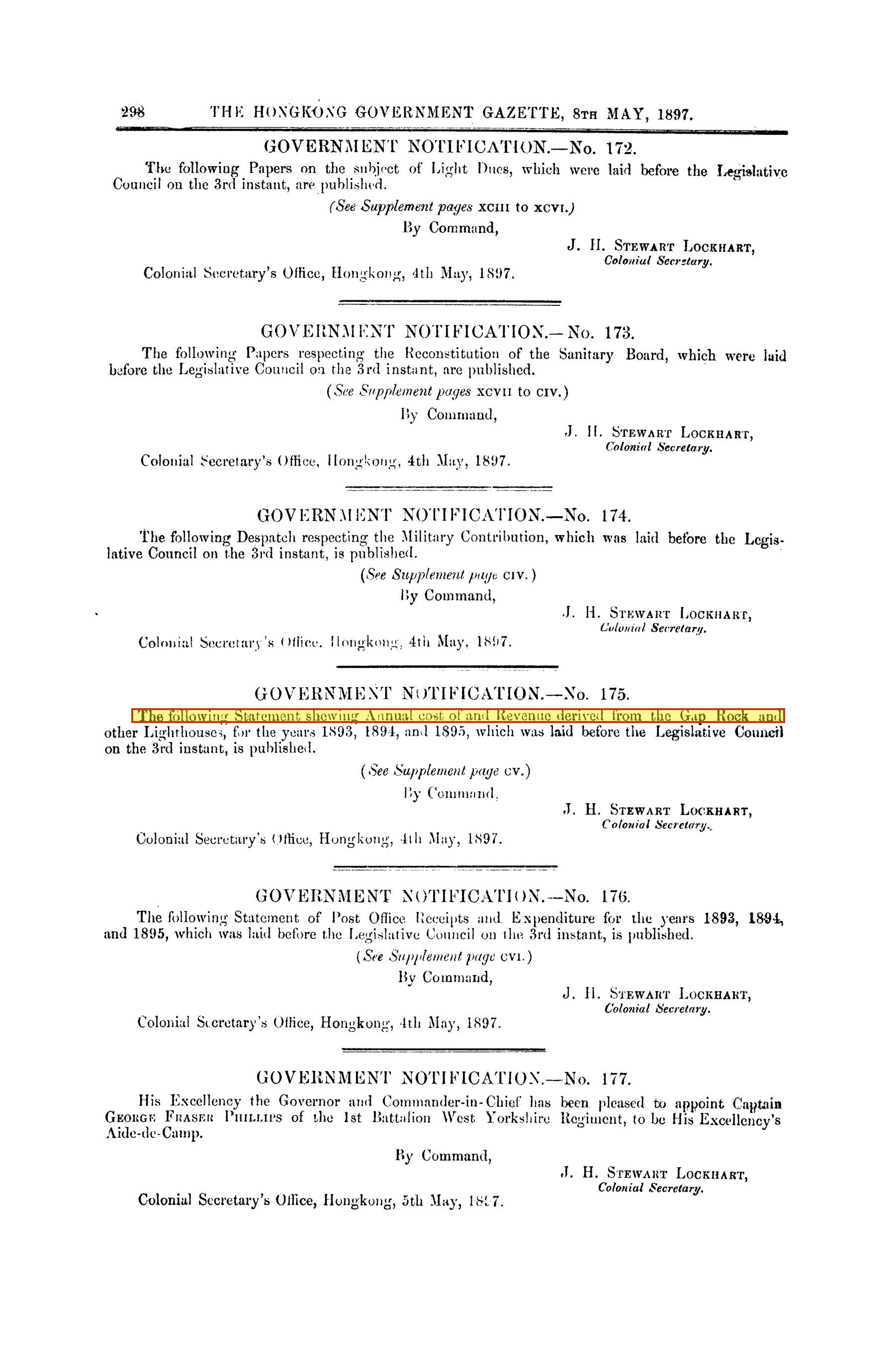
燈要錢,錢向船徵。1897 年 2 月 27 日,議員 T. H. Whitehead 提出動議,指「特別 Gap Rock 燈課」(Special Gap Rock Light Dues)當初為興建該燈而徵,如今燈已建成,課税理應檢討;18 同年 5 月 8 日憲報刊出「Gap Rock 及其他燈塔 1893 至 1895 年度經常費用與收入一覽表」。19 該表的附錄頁在語料庫中沒有獨立文字記錄,故本文不引用其中任何數字。
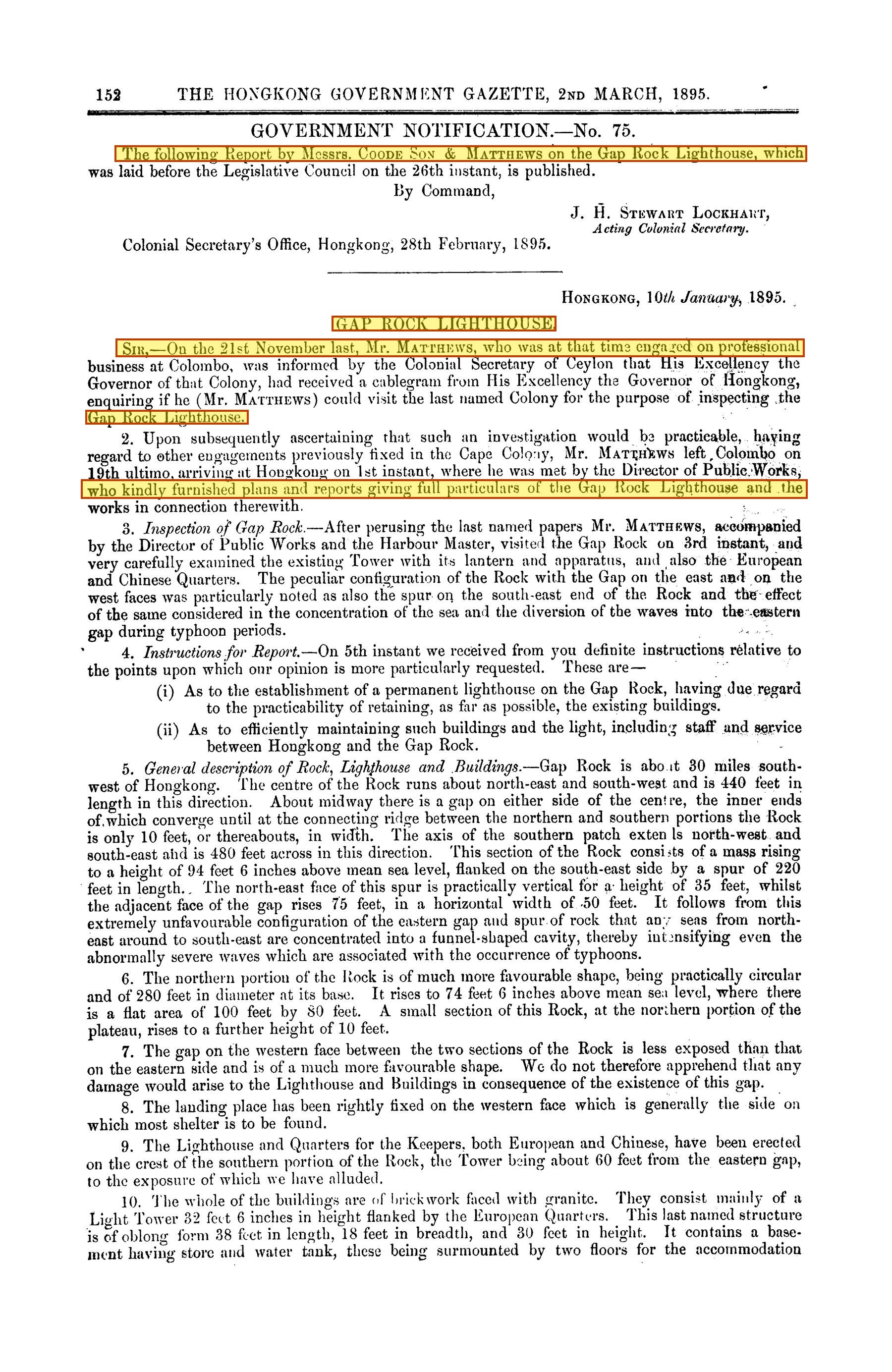
工程方面,Gap Rock 的條件極差。1895 年 1 月 10 日,Coode Son & Matthews 的報告受命勘察:總督為此自錫蘭電召工程師 Matthews,後者於 12 月 1 日抵港,3 日偕工務司(Director of Public Works)與船政司(Harbour Master)實地視察。20 報告描述該礁「在香港西南約 30 英里」——21 礁石中段兩側各有一裂口,南北兩段由一道連接脊相連,最窄處僅約 10 呎;而東面裂口把「自北偏東至南偏東的巨浪匯聚成漏斗狀,即使颱風所伴隨的異常狂浪亦為之加劇」。21 當局向工程師提出的兩個問題,其一即為「維持燈塔與燈,包括香港與 Gap Rock 之間的員工與交通」。22 航行工程如小型遠征:定例局質詢要追討工作船「Fame」的出海次數與每航次成本。23
1898 年新界租借徹底改變了局面。24 海關設於東面入口的站房隨租借而撤,輔政司 Stuart Lockhart 在殖民地部檔案上寫下:25
「曾有人向我提議接手;但該燈塔的勤務與海關設於 Fo-to-chow 的站房相連。該站一旦撤走,中國海關便無可用的躉船服務此燈,我恐怕本政府必須接手,並如 Gap Rock 燈塔般自行維持。屆時現徵燈課收入恐將不足。」25
殖民地部自己的批示更為直白:「我料中國政府未必會回敬這份好意」;「我們勢必保留橫瀾島站」。26
七、餘緒:1901 年的買回與其後
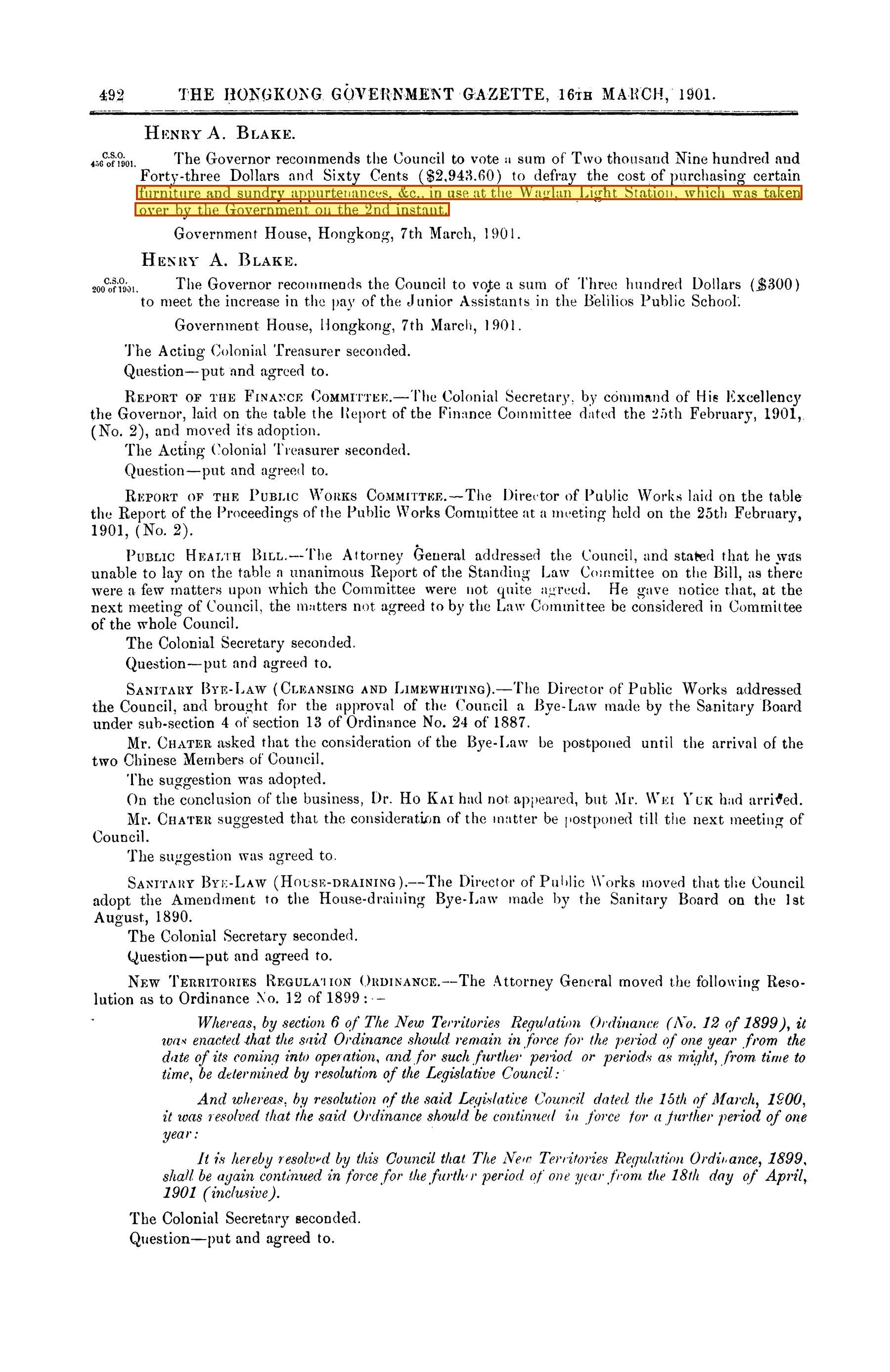
1901 年 3 月 7 日,督憲 Sir Henry Blake 以財務文件第 456 號建議議局通過 2,943.60 元,「支付購入現時使用中之橫瀾燈塔站傢具及各項附屬物品之費,該站已於本月 2 日由政府接手」。27 動議於 3 月 11 日在定例局通過,同日《士蔑新聞》、3 月 2 日《德臣西報》、3 月 5 日《孖剌西報》均有報道;15 日的議局索引亦列有「財務文件第 15 號……2,943.60」。28 三星期後,另有一份文件建議通過 288 元,「支付橫瀾燈塔站所需若干物品之費」。28
此處出現一項須並列而不可合併的日期差異:古物古蹟辦事處記為 1901 年 1 月 1 日接管;16 而定例局的投票所記為 3 月 2 日。兩者所指並非同一件事——前者是站房運作的移交,後者是站內傢具的購置——本文保留此一差異。
自此,橫瀾的看守員歸港府,燈塔亦成為氣象站,29 資料送往天文台分析。青洲則在 1905 年接收鶴咀停用的一級號燈;29 鶴咀本身於 1975 年重新自動化,橫瀾於 1989 年自動化,兩者先後列為法定古蹟。29
結論
這段歷史的核心並非工程,而是一條容易被忽略的制度慣例:香港憲報自 1875 年起便長期刊登中國海關的航海通告,為包括澎湖群島在內的各地燈塔發佈消息,慣例貫穿整個殖民時期。3 4 當港府終於需要一盞自己的燈時,它想到的正是加入這個慣例——出資,由海關代建代管。10 12
慣例無法解決主權的問題。1893 年的「No」把協議一筆勾銷;13 燈塔照樣由海關建成亮燈;15 直到 1898 年租借把站房連同燈塔一併交到港府手上,Lockhart 才寫下「我恐怕本政府必須接手」。25 1901 年 3 月,港府以 2,943.60 元購回站內傢具,28 正式成為自己的燈塔。一盞殖民地花了15年爭取的燈,最終不是談判談回來的,而是租界帶回來的。
The Light Another Government Built
Hong Kong’s lighthouses and the fifteen-year argument over Gap Rock and Waglan, 1867–1901
Abstract
This paper reconstructs how Hong Kong acquired a lighthouse system, and centres on the fifteen-year argument over the two lights the colony needed on its southern approach — Gap Rock and Waglan Island. The load-bearing finding is structural and easily missed: the colony’s own Gazette had been publishing the Imperial Chinese Maritime Customs’ notices to mariners, including lighthouse notices for lights the colony neither built nor owned, from 1875 onward — 191 such notices in the 1870s, 160 in the 1880s, 137 in 1890s. Waglan’s two notices are that same routine: headed “Government of China,” issued by the Customs’ Coast Inspector’s Office in Shanghai, signed by A. M. Bisbee, and published in the Hongkong Gazette by the Colonial Secretary. The colony’s own bargain — the Governor’s 1889 statement that the Customs would build Waglan in consideration of the colony building Gap Rock — was answered in Council in 1893 with “The answer to that question is No.” The light was built anyway, and first exhibited on 10 May 1893. The 1898 lease of the New Territories removed the Customs’ eastern station and with it the service that had kept Waglan running; the Colonial Secretary wrote that “it will be necessary for this Government to take it over”; and on 2 March 1901 the Legislative Council voted $2,943.60 to buy the station’s furniture back. A colony that had published another government’s lighthouse notices for a quarter of a century finally bought its own light.
1. Scope and method
The thread is built on the hkintexts corpus (read-only), searched in query families: the lights themselves, the Customs’s notice machinery, the Legislative Council Hansard series 1886–1901, and a Chinese-name battery. 1 One compulsory whole-document pull anchors the paper: the Coode, Son & Matthews report on the Gap Rock Lighthouse, published in the Gazette of 2 March 1895 (Appendix A).
The paper is deliberately not about the colony’s warning-shape history — that story belongs to the Observatory thread — nor about the 1883 telegraph cables, though the Gap Rock cable of 1892 shares the rock. What it is about is a jurisdictional problem dressed as an engineering one: the colony needed lights it could not build, on islands it did not yet control, and spent fifteen years negotiating with a foreign government whose own notices it printed every week.
2. Another government’s notices: the routine, 1875–1900s
The single most important structural fact of this story, and the one that reframes everything else, is visible on one page of the Hongkong Government Gazette of 15 May 1875, printed p. 213. Government Notification No. 93 reads: “The following Notice to Mariners is published for general information.” What follows is not a Hong Kong notice at all. It is Notice to Mariners No. 43, China Sea, Takow District, announcing that “a lighthouse will shortly be erected close to the present native light-tower on Litsitah Point at the S. W. extremity of Fisher Islands, Pescadores” — a light in the Pescadores, signed at the Custom House, Shanghai, by David M. Henderson, Engineer-in-Chief, by order of the Inspector General of Customs. 3
The same Gazette leaf carries sailing directions for the “COAST OF SIND. Indus Banks,” signed by the Acting Master Attendant at Kurrachee. Publishing navigational notices for Karachi was simply what the colony’s official organ did. 3
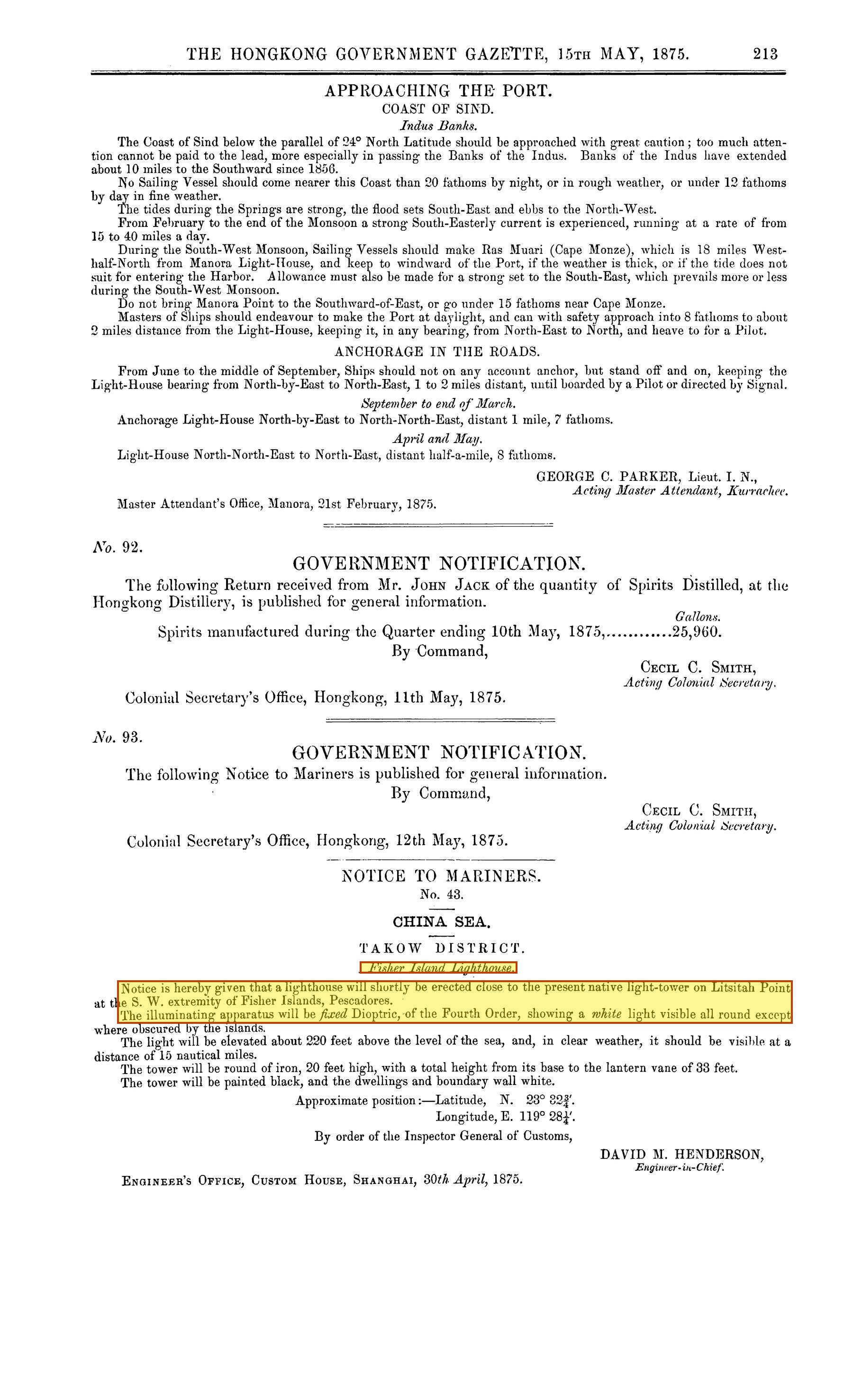
The scale of the routine is worth stating plainly. The formula “By Order of the Inspector General of Customs” appears in the Gazette 191 times in the 1870s, 160 times in the 1880s, 137 times in the 1890s and 84 times in the 1900s — 572 Customs-issued notices published in the colony’s own official organ across the period. 4 The Customs’s Coast Inspector’s Office in Shanghai ran a China-wide lighthouse and hydrographic service, and Hongkong published it.
This matters for everything that follows. When the Waglan notices arrive in the Gazette in 1893, they are not an anomaly. They are the same routine applied to an island the colony had wanted for itself since 1886. The anomaly is what happened in 1901, when the routine stopped and one of the published foreign lights became a Hong Kong light.
3. The southern approach: the demand and the first lights, 1867–1888
The colony’s own first three lights were built in 1875 and 1876: Cape d’Aguilar, lit on 16 April 1875, Hong Kong’s first lighthouse, named for Major-General Henry d’Aguilar, the colony’s Commanding Officer; 5 Green Island; and Cape Collinson. 6 None of them guarded the southern approach — the lane from Singapore — and the modern official account records that a British naval surveyor had recommended three sites, including Waglan and the island called Gap Rock, as early as 1867, but that nothing could be done because “當時這些地方不屬於香港水域”: those places were not yet Hong Kong waters. 16
The geography explains why two lights were needed rather than one. Gap Rock lies about thirty miles south-west of Hongkong; Waglan lies south-east of the entrance to the Tathong Channel. 7 The Chamber of Commerce’s “Southern approach” was the island’s entire southern flank, and the two lights the colony argued over for fifteen years stand on opposite sides of it.
The demand runs from 1886. On 17 September that year the Colonial Secretary laid before the Legislative Council the “Correspondence respecting a proposed Lighthouse on Gap Rock or its Vicinity,” whose enclosing minute records that the Chairman of the Chamber of Commerce had suggested taking advantage of the presence in the colony of the Inspector-General of the Imperial Chinese Maritime Customs to sound him out “on as good if not better basis than his former proposal” — the Customs, that is, had already made a proposal before July 1886. 8 The opening address of the session of 5 November confirms the site in the colony’s own words: “The Gap Rock is, in the opinion of those qualified to judge, the best situation for this Lighthouse, although it is more difficult of access than some of the other Islands in the immediate vicinity. This objection is, however, I believe, not insuperable.” 9
Two years later the plan was stated in full. The Governor’s message of 27 August 1888 sets out the strategy in one paragraph: 10
“In connection with this Gap Rock arrangement, the Governor had hoped to be able to secure another improvement in the lighting of the approaches to Hongkong by the removal to Waglan Island of the Light-house now at Cape D’Aguilar. But, though his efforts in this direction have so far proved unsuccessful, he does not propose to relinquish them, if such course be approved by the Council. The erection of a Light-house at Waglan would be far less difficult than at Gap Rock; and it is possible therefore that the Chinese Government might be more easily induced to undertake the work with its own staff, if a sufficient subsidy were promised by this Colony.”
The same message is worth reading for the arguments the colony used to justify paying. There entered the Port of Victoria annually vessels measuring “nearly six millions and a half of tons” — a tonnage, the message observes, larger than all the British Possessions on the Continent of America combined and larger than the three leading Colonies of Australia; the southern was “if anything, the more important of the two approaches to the Island”; and the cost already inflicted on shipping by the absence of the light “would now amount to a sum which could probably be only expressed in hundreds of thousands of Pounds.” 11 The message also regrets that words of the Governor’s had been taken as reflecting on Sir John Walsham, Her Majesty’s Minister at Pekin, thanks Walsham for “taking the only course which was at all likely to achieve success,” and invokes Sir Robert Hart’s weight of experience on the merits of flashing over fixed lights. 11
4. The bargain and its denial, 1888–1893
The bargain exists in the record only as the Governor’s own statement, and it is worth having verbatim. On 18 December 1889 the Governor told the Council: 12
“I was given to understand last year that in consideration of our having undertaken the work of the Gap Rock Light, the Imperial Chinese Maritime Customs would undertake the Lighthouse on Waglan.”
That sentence survives because Hon. T. H. Whitehead quoted it back, word for word, in his question paper of April 1891, published in the Gazette of 9 May 1891 and reprinted in the Sessional Papers. 12 There is no agreement, no memorandum and no correspondence recording the bargain as a transaction — only a Minister’s stated understanding, preserved by an unofficial member’s question. The register records this as a failed verification of the stronger claim: the bargain was never papered. 13
Four years later it was denied. On 26 February 1893, answering Hon. E. R. Belilios’s question about “any understanding or agreement” with the Chinese Government, the Governor said: “The answer to that question is No.” Belilios’s own speech in the same sitting called the arrangement “a unique fact in international relations.” 13
This paper does not reconcile the two. The 1889 statement is a Minister’s recollection of an understanding; the 1893 answer denies the existence of a formal agreement. Both are the Governors’ own words, three and four years apart, about the same arrangement. The contradiction is the record’s, and the register keeps it as K1.
5. Waglan: built by the Customs, lit 10 May 1893
Whatever was or was not agreed, the light was built — by the Chinese Customs, on its own account, through its own machinery. Notice to Mariners No. 262, issued at Shanghai on 3 February 1893 and published in the Hongkong Gazette under Government Notification No. 62 of 16 February, gives the works in progress: 14
“Government of China. NOTICE TO MARINERS, No. 262. CHINA SEA. CANTON DISTRICT. Waglan Island Lighthouse. Notice is hereby given that the works for the establishment of a First Order Revolving Light, to show double white flashes at intervals of half a minute, are now in progress on Waglan Island, which lies to the south-eastward of the entrance to the Tathong Channel leading to Hongkong…”
The notice gives the light’s elevation at 225 feet, its range at 22 nautical miles in all directions unobscured by land, the tower as round and 25 feet high with a total height to the lantern vane of 52 feet, and the fog gun signal: two guns at fifteen-second intervals, repeated every twelve minutes if the vessel’s own fog signal continued to be heard. It is signed, like every Customs notice, “By Order of the Inspector General of Customs, A. M. BISBEE, Coast Inspector,” from the Coast Inspector’s Office, Shanghai. 14
The completion notice is the more revealing document. Notice to Mariners No. 269, issued at Shanghai on 5 June 1893 and published under G.N. No. 235 of 17 June 1893, reports the light’s first burning and adds a technical postscript that only a primary source would preserve: 15
“Notice is hereby given that the Light on Waglan Island was exhibited for the first time at sunset on the 10th ultimo. The illuminating apparatus is Revolving Dioptric of the First Order, showing double white flashes at intervals of half a minute… The tower is round, of iron, 25 feet high…
N.B.—When the Light on Waglan was first exhibited it showed only 30 per cent. of its full power between the bearings, from seaward, of N. by E. round by east to S.E. by S. It now shows to its full power in all directions.”
The light was lit imperfectly and corrected inside a month. The modern official record agrees on the date to the day: the Antiquities and Monuments Office records the light as entering service on 10 May 1893, and adds that the apparatus burned oil and that its revolving optic floated on mercury — one of the two earliest such installations in Asia. 16 The commonly quoted 9 May has no verifiable witness in the corpus, and is not used.
The same Gazette leaf that publishes the Waglan notice publishes, above it, the Customs’ Fitzroy Island beacon notice for the Yangtze at Kiukiang — both signed by Bisbee from Shanghai, both under the heading “Government of China.” 15
The inauguration had its social side. The China Mail of 10 May 1893 records the Governor thanking “Mr McLeary Brown for having brought them to Waglan and Mr Harding for having so clearly explained the mechanism of the light to the ladies and gentlemen present” — the Commissioner of Customs himself having taken the press out to the island five days earlier. 17
6. The money, the engineering, and the New Territories
Lights had to be paid for, and the colony made shipping pay. On 27 February 1897 Hon. T. H. Whitehead gave notice of a resolution beginning “That, whereas the Special Gap Rock Light Dues…” — the levy imposed on vessels to fund the Gap Rock works, now that the works were done. 18 On 8 May 1897 the Gazette published the papers on light dues laid before the Council, and with them the “Statement shewing Annual cost of and Revenue derived from the Gap Rock and other Lighthouses, for the years 1893, 1894, and 1895.” 19 The Supplement leaf carrying the statement itself is not held as a separate text page in the corpus, and no figure from it is used here — a gap recorded rather than filled by estimate.
On the engineering, the record is unusually good. Gap Rock was a wretched site, and the colony went abroad for a second opinion. The report of Messrs. Coode Son & Matthews, dated Hongkong 10 January 1895 and published as G.N. No. 75 on 2 March 1895, records that Mr. Matthews was at Colombo on professional business when the Colonial Secretary of Ceylon passed him a cablegram from the Governor of Hongkong asking whether he could come out to inspect the Gap Rock Lighthouse — the Governor cabled Ceylon to borrow an engineer. 21 Matthews arrived on 1 December and inspected the rock on 3 December, with the Director of Public Works and the Harbour Master.
His description of the site is the best in the record: 21
“Gap Rock is about 30 miles south-west of Hongkong… About midway there is a gap on either side of the centre, the inner ends of which converge until at the connecting ridge between the northern and southern portions the Rock is only 10 feet, or thereabouts, in width… any seas from north-east around to south-east are concentrated into a funnel-shaped cavity, thereby intensifying even the abnormally severe waves which are associated with the occurrence of typhoons.”
The buildings were of brickwork faced with granite, with a light tower 32 feet 6 inches high flanked by European quarters, and quarters for Chinese keepers as well. 21 The two questions put to the engineers were whether a permanent lighthouse could be established keeping the existing buildings, and how to maintain it “including staff and service between Hongkong and the Gap Rock” 22 — a question that reveals how remote and how expensive the place was.
Then came 1898, and the ground moved. The lease of the New Territories put the eastern approaches — and the Customs station that serviced Waglan — inside British-leased territory. Blake’s despatch of 10 June 1899 states the consequence without adornment: “The removal of the Chinese Imperial Customs from the territory releases a number of buildings.” 24 The Colonial Secretary’s minute on the same file explains exactly why that mattered for a lighthouse: 25
“A proposal has been made to me to take it over; but the service of the lighthouse is connected with the Customs station at Fo-to-chow on the eastern entrance to the harbour. When that station is removed there will be no launch available for its service by the Chinese Customs, and I apprehend that it will be necessary for this Government to take it over and maintain it as the lighthouse at Gap Rock is maintained.”
The Colonial Office’s own minutes on the file are blunter still. One notes that “although the Japanese maintain a lighthouse on Gap Rock, which is, I believe, on the Chinese side, it is, I submit, highly improbable that the Chinese will reciprocate this little attention”; another contemplates removing the Cape d’Aguilar light to Waglan “if the Chinese Government would consent” and points out the “necessity for keeping up both Cape d’Aguilar and Waglan”; and a third settles the matter in four words: “We shall have to keep the Waglan Island Station.” 26
7. The takeover, 2 March 1901
The station came to the colony with the territory. What the colony still had to buy was its contents. On 7 March 1901 the Governor, Sir Henry Blake, moved Financial Minute No. 456: 28
“The Governor recommends the Council to vote a sum of Two thousand Nine hundred and Forty-three Dollars and Sixty Cents ($2,943.60) to defray the cost of purchasing certain furniture and sundry appurtenances, &c., in use at the Waglan Light Station, which was taken over by the Government on the 2nd instant.”
The motion was carried in the Legislative Council on 11 March 1901. The China Mail had reported it on 2 March under the heading “Taking over Waglan Light”; the Hong Kong Telegraph and the Daily Press covered the same vote; and the Council’s own index of 15 July 1901 lists “Financial Minute No. 15… 2,943.60.” 28 Three weeks later a further minute voted $288 “to cover the cost of certain articles required for the use of the Waglan Light Station.” 28
One date discrepancy must be kept rather than resolved. The Antiquities and Monuments Office records the takeover as 1 January 1901; 16 the Legislative Council’s vote records the station as taken over on 2 March 1901. These are not the same fact: the first is the transfer of the station’s operation, the second the payment for its furniture and appurtenances. The register keeps both (K2).
8. Epilogue
From 1901 the Waglan keepers were the colony’s own, and the station became a source of weather data for the Observatory as well as a light. 29 Cape d’Aguilar, whose purpose had gone when Waglan opened, ceased operating in 1896; its first-order lantern and apparatus were transferred to Green Island in 1905 to replace that light’s fourth-order lamp, and it was re-lit and automated in 1975, declared a monument in 2006. 29 Waglan was automated in 1989 and is a declared monument. 29
The line that runs from 1875 to 1901 is not, in the end, a line about engineering. It is a line about jurisdiction. For twenty-five years the colony printed another government’s lighthouse notices as a matter of routine — for the Pescadores, for the Yangtze, and then for an island on its own southern approach that it had wanted, asked for, offered to pay for, been told did not exist as an agreement, and watched someone else build. When the political facts changed in 1898, the light came with them, and in March 1901 the colony paid $2,943.60 for the furniture. The light it had spent fifteen years arguing about it acquired not by negotiation but by lease.
Notes
Notes
Research method. The thread is built on the hkintexts corpus (read-only), searched in query families: the lights themselves (“lighthouse” 25,852; “Gap Rock” 16,530; “Waglan” 6,138; Cape d’Aguilar 3,346; “light dues” 413; Cape Collinson 238), the Customs’s own notice machinery (“By Order of the Inspector General of Customs” in the Gazette: 191 in the 1870s, 160 in the 1880s, 137 in the 1890s, 84 in the 1900s), the LegCo Hansard series 1886–1901 (60+ sittings), and a Chinese-name battery (橫瀾島 576; 鶴咀 370; 青洲 5,002; 橫瀾 745; 蚊尾洲 1). One compulsory whole-document pull anchors the thread: the Coode, Son & Matthews report on the Gap Rock Lighthouse, Gazette 2 March 1895, document key
641350-1895-Report-Coode-Son---Matthews-on-Gap-Rock, 4 pages. Access 30 October 2026. ↩Hongkong Government Gazette, 15 May 1875, printed p. 213, G.N. No. 93 — the publication clause and the Customs notice together: “The following Notice to Mariners is published for general information. By Command, CECIL C. SMITH, Acting Colonial Secretary. Colonial Secretary’s Office, Hongkong, 12th May, 1875.” then “NOTICE TO MARINERS. No. 43. CHINA SEA. TAKOW DISTRICT. Fisher Island Lighthouse. Notice is hereby given that a lighthouse will shortly be erected close to the present native light-tower on Litsitah Point at the S. W. extremity of Fisher Islands, Pescadores… By order of the Inspector General of Customs, DAVID M. HENDERSON, Engineer-in-Chief. Engineer’s Office, Custom House, Shanghai, 30th April, 1875.” The same leaf carries sailing directions for the “COAST OF SIND. Indus Banks” signed “GEORGE C. PARKER, Lieut. I. N., Acting Master Attendant, Kurrachee.” Plate 1; scan https://hkintexts.histsyn.com/image-page/1455942; text https://hkintexts.histsyn.com/page/1671695 (accessed 30 October 2026). ↩
Gazette, 22 January 1876, G.N. No. 16 — the same Fisher Island light now complete: “Notice to Mariners, No. 53… the new Light on the S. W. extremity of Fisher Island near Litsitah Point was exhibited for the first time at sunset of the 20th December”; “The new Tower has been erected near the old stone one, which has since been removed.” https://hkintexts.histsyn.com/page/1671695 (accessed 30 October 2026). ↩
The routine, quantified: the formula “By Order of the Inspector General of Customs” appears in the Gazette 191 times in the 1870s, 160 in the 1880s, 137 in the 1890s and 84 in the 1900s — 572 Customs-issued notices in the colony’s own official organ across the period. “IMPERIAL MARITIME CUSTOMS” appears 665 times, “Inspector General of Customs” 864 times, “NOTICE TO MARINERS” 4,256 times. Counts are phrase queries over the gazette series, run 30 October 2026; they are stated as counts, not as an exhaustive census of the Customs’s output. ↩
The name: the AMO pamphlet records that Cape d’Aguilar Lighthouse “英文名稱為「德己立角燈塔」,以紀念香港的陸軍司令德己立少將” — named for the colony’s Commanding Officer, Major-General Henry d’Aguilar. https://www.amo.gov.hk/filemanager/amo/common/download-area/pamphlet/lighthouse_in_HK.pdf (accessed 30 October 2026). ↩
The colony’s own first three lights, 1875–76: Cape d’Aguilar (opened 16 April 1875, Hong Kong’s first lighthouse, named for Major-General Henry d’Aguilar, the colony’s Commanding Officer; a first-order fixed light, focal plane 200 ft, range 23 nautical miles; a 9.7-metre round granite tower), Green Island, and Cape Collinson. The modern official record is the Antiquities and Monuments Office pamphlet Lighthouses in Hong Kong, which gives Cape d’Aguilar’s opening as 1875年4月16日 and its Chinese name as 「德己立角燈塔」, “以紀念香港的陸軍司令德己立少將”. https://www.amo.gov.hk/filemanager/amo/common/download-area/pamphlet/lighthouse_in_HK.pdf (accessed 30 October 2026). The 1875 Gazette notices for the works are in the corpus (the Green Island lighting notice and the Harbour Department’s annual reports for 1874 and 1875). ↩
The two lights’ relative positions, from their own notices: Gap Rock lies “about 30 miles south-west of Hongkong” (the Coode report, paragraph 5), while Waglan “lies to the south-eastward of the entrance to the Tathong Channel leading to Hongkong” (Notice to Mariners No. 262). The Chamber of Commerce’s “Southern approach” is therefore the island’s whole southern flank, and the two lights stand on opposite sides of it. ↩
The Colonial Secretary to the Legislative Council, 17 September 1886 — the first official file, laid before the Council as “Correspondence respecting a proposed Lighthouse on Gap Rock or its Vicinity” (CO 129/229, printed p. 123): the enclosing minute records that “the Chairman of the Chamber of Commerce suggested, on 8th July last, that advantage should be taken of the presence in this Colony of the Inspector-General of the Imperial Chinese Maritime Customs to ascertain whether he was willing to enter into negotiations with this Government ‘on as good if not better basis than his former proposal’” — the Customs had already made a “former proposal” before July 1886. https://hkintexts.histsyn.com/page/332142 (accessed 30 October 2026). ↩
Legislative Council, 5 November 1886, the opening address of the session: “the representations of the Chamber of Commerce on the necessity of constructing a Lighthouse for the Southern approach to the Colony will be transmitted to the Secretary of State, as soon as I have received all the reports on the subject which have been called for. The Gap Rock is, in the opinion of those qualified to judge, the best situation for this Lighthouse, although it is more difficult of access than some of the other Islands in the immediate vicinity. This objection is, however, I believe, not insuperable.” The Address in reply answers: “We learn with satisfaction that the question of a Lighthouse for the Southern approach to the Colony is at last receiving serious attention… The want of such a light has been much felt for many years.” Mr. ALEXANDER PALMER MACEWEN, Mr. J. BELL-IRVING, the Surveyor General, the Acting Attorney General and the Treasurer all speak to the Address. https://hkintexts.histsyn.com/page/1881478 (accessed 30 October 2026). ↩
The Governor’s message to the Legislative Council, 27 August 1888 (LegCo No. 17), signed Frederick Stewart, Colonial Secretary, under G. William des Voeux: “In connection with this Gap Rock arrangement, the Governor had hoped to be able to secure another improvement in the lighting of the approaches to Hongkong by the removal to Waglan Island of the Light-house now at Cape D’Aguilar. But, though his efforts in this direction have so far proved unsuccessful, he does not propose to relinquish them, if such course be approved by the Council. The erection of a Light-house at Waglan would be far less difficult than at Gap Rock; and it is possible therefore that the Chinese Government might be more easily induced to undertake the work with its own staff, if a sufficient subsidy were promised by this Colony. But pending any such negotiation, the issue of which would of course be uncertain, the Governor considers that there should be no delay of the work at the Gap Rock.” Plate 2; scan https://hkintexts.histsyn.com/image-page/1536112 (printed p. 962); text https://hkintexts.histsyn.com/page/1881533 (accessed 30 October 2026). ↩
The same message, on what the colony could afford: “there now annually enter the Port of Victoria vessels with an aggregate measurement of nearly six millions and a half of tons (a tonnage it may be remarked which according to the published returns is larger than that of the Ports of all the British Possessions on the Continent of America and larger also than that of the total of the three leading Colonies of Australia) and considering that the Southern is, if anything, the more important of the two approaches to the Island, it may be taken as certain that no expense which is at all likely to be incurred can be otherwise than very inconsiderable by comparison with the advantage gained… The cost which would have been saved to the shipping trade, if a Light at the Gap Rock had been provided at the time when the subject was first mooted would now amount to a sum which could probably be only expressed in hundreds of thousands of Pounds.” The same message regrets that words of his “should have been considered as reflecting upon His Excellency Sir John Walsham, Her Majesty’s Minister at Pekin,” thanks Walsham “for taking the only course which was at all likely to achieve success,” and invokes “Sir Robert Hart, whose experience on the subject is entitled to very great weight.” Scan https://hkintexts.histsyn.com/image-page/1536112 (accessed 30 October 2026). ↩
The Governor’s statement in Council, 18 December 1889, quoted verbatim in the question paper of Hon. T. H. Whitehead: “With reference to His Excellency the Governor’s statement in Council on 18th December, 1889, viz.: ‘I was given to understand last year that in consideration of our having undertaken the work of the Gap Rock Light, the Imperial Chinese Maritime Customs would undertake the Lighthouse on Waglan,’ will the Government state whether the Chinese Government have commenced the erection of the very necessary Lighthouse on Waglan, and if not when operations are likely to be commenced?” Published in the Gazette of 9 May 1891 (LegCo No. 8, printed p. 398), reprinted in the Sessional Papers 1891 (printed p. 28) and reported in the China Mail of the same day. Plate 3; scan of the Gazette printing not located; text https://hkintexts.histsyn.com/page/1650373 (/1815198, /2830264) (accessed 30 October 2026). This is a Minister’s stated understanding, quoted by a questioner — no papered agreement exists in the corpus (see the register, F1). ↩
Legislative Council, 26 February 1893 — the Governor’s answer to Hon. E. R. Belilios’s question about “any understanding or agreement” with the Chinese Government: “The answer to that question is No.” Belilios’s own speech in the same sitting calls the arrangement “a unique fact in international relations.” https://hkintexts.histsyn.com/page/1881657 (accessed 30 October 2026). The register keeps this beside the 1889 bargain statement as the record’s own contradiction (K1); it does not reconcile them. ↩
Notice to Mariners No. 262, Imperial Maritime Customs, Coast Inspector’s Office, Shanghai, 3 February 1893, signed “By Order of the Inspector General of Customs, A. M. BISBEE, Coast Inspector”; published in the Gazette under G.N. No. 62 of 16 February 1893 (printed p. 114): “Government of China. NOTICE TO MARINERS, No. 262. CHINA SEA. CANTON DISTRICT. Waglan Island Lighthouse. Notice is hereby given that the works for the establishment of a First Order Revolving Light, to show double white flashes at intervals of half a minute, are now in progress on Waglan Island, which lies to the south-eastward of the entrance to the Tathong Channel leading to Hongkong… The tower will be round, 25 feet high, with a total height from its base to the lantern vane of 52 feet… FOG GUN SIGNAL. When the Light has been established the Keepers at this station… will fire 2 guns with an interval of 15 seconds between them, and, if the vessel’s fog signal—showing that she is under way—continues to be heard, will repeat the firing after an interval of 12 minutes.” Plate 4; scan https://hkintexts.histsyn.com/image-page/1540992; text https://hkintexts.histsyn.com/page/1646921 (accessed 30 October 2026). ↩
Notice to Mariners No. 269, Imperial Maritime Customs, Coast Inspector’s Office, Shanghai, 5 June 1893, signed “By Order of the Inspector General of Customs, A. M. BISBEE, Coast Inspector”; published in the Gazette under G.N. No. 235 of 17 June 1893 (printed p. 580), in the same publication as the Customs’s Fitzroy Island (Kiukiang) notice No. 268: “Government of China. NOTICE TO MARINERS, No. 269. CHINA SEA. CANTON DISTRICT. Waglan Island Lighthouse. Notice is hereby given that the Light on Waglan Island was exhibited for the first time at sunset on the 10th ultimo. The illuminating apparatus is Revolving Dioptric of the First Order, showing double white flashes at intervals of half a minute… The tower is round, of iron, 25 feet high… N.B.—When the Light on Waglan was first exhibited it showed only 30 per cent. of its full power between the bearings, from seaward, of N. by E. round by east to S.E. by S. It now shows to its full power in all directions.” Plate 5; scan https://hkintexts.histsyn.com/image-page/1541430; text https://hkintexts.histsyn.com/page/1647496 (accessed 30 October 2026). ↩
Antiquities and Monuments Office, HKSAR, the Waglan Island Lighthouse monument page 「橫瀾島橫瀾燈塔」: the works were entrusted to a French firm by the Chinese Customs — “橫瀾燈塔由中國海關委託法國公司興建,於一八九三年五月十日投入服務” — the apparatus “以石油為燃料,其旋轉的照明儀器則浮於水銀上。橫瀾燈塔是當時在亞洲其中兩座最先採用這種先進設備的燈塔之一”; the station “最初由中國海關管理”; and after the lease, “隨著新界於一八九八年租借予英國後,燈塔於一九〇一年一月一日交由香港政府接管及操作”. https://www.amo.gov.hk/tc/historic-buildings/monuments/outlying-islands/monuments_71/index.html (accessed 30 October 2026). Note the AMO’s takeover date (1 January 1901) against the Legislative Council’s own vote of 2 March 1901 — kept as two different facts (K2), never collapsed. ↩
China Mail, 10 May 1893 — the inauguration’s social column: “Mr McLeary Brown for having brought them to Waglan and Mr Harding for having so clearly explained the mechanism of the light to the ladies and gentlemen present. The Governor said that…” The same paper’s report of the 5 May press visit (6 May 1893, printed p. 3) describes the apparatus; the Telegraph of 6 May carries the visit as well. https://hkintexts.histsyn.com/page/1908119 (accessed 30 October 2026). The press columns of these days are column-interleaved in the OCR and cannot be quoted at length; the register keeps the specific figures they appear to carry out of the deliverables (K4). ↩
Gazette, 27 February 1897, printed p. 118, LegCo Minutes No. 9 of 1896 — Hon. T. H. Whitehead gives notice of the resolution: “That, whereas the Special Gap Rock Light Dues we[re imposed]…” The Special Gap Rock Light Dues were the levy imposed on shipping to fund the Gap Rock works. The Light Dues Ordinance No. 19 of 1899 consolidates the regime. https://hkintexts.histsyn.com/page/1639704 (accessed 30 October 2026). ↩
Gazette, 8 May 1897, printed p. 298 — G.N. No. 172: “The following Papers on the subject of Light Dues, which were laid before the Legislative Council on the 3rd instant, are published. (See Supplement pages xcIII to xcVI.)”; and G.N. No. 175: “The following Statement shewing Annual cost of and Revenue derived from the Gap Rock and other Lighthouses, for the years 1893, 1894, and 1895, which was laid before the Legislative Council on the 3rd instant, is published. (See Supplement page cv.)” The Supplement leaf itself is not held as a separate text page in the corpus, so no figure from the statement is used here. Plate 7; scan https://hkintexts.histsyn.com/image-page/1546433; text https://hkintexts.histsyn.com/page/1639968 (/1639971) (accessed 30 October 2026). ↩
Messrs. Coode Son & Matthews, “Gap Rock Lighthouse,” Hongkong, 10 January 1895, published as G.N. No. 75 in the Gazette of 2 March 1895 (printed p. 152), laid before the Legislative Council on 26 February: “On the 21st November last, Mr. MATTHEWS, who was at that time engaged on professional business at Colombo, was informed by the Colonial Secretary of Ceylon that His Excellency the Governor of that Colony, had received a cablegram from His Excellency the Governor of Hongkong, enquiring if he (Mr. MATTHEWS) could visit the last named Colony for the purpose of inspecting the Gap Rock Lighthouse.” Matthews left Colombo on 19 November, arrived 1 December, was met by the Director of Public Works, and on 3 December “accompanied by the Director of Public Works and the Harbour Master, visited the Gap Rock… and very carefully examined the existing Tower with its lantern and apparatus, and also the European and Chinese Quarters.” Plate 6; scan https://hkintexts.histsyn.com/image-page/1543307; text https://hkintexts.histsyn.com/page/1643657 (accessed 30 October 2026). The compulsory whole-document pull of this report is recorded in Appendix A. ↩
The same report’s description of the site: “Gap Rock is about 30 miles south-west of Hongkong. The centre of the Rock runs about north-east and south-west and is 440 feet in length in this direction. About midway there is a gap on either side of the centre, the inner ends of which converge until at the connecting ridge between the northern and southern portions the Rock is only 10 feet, or thereabouts, in width… This section of the Rock consists of a mass rising to a height of 94 feet 6 inches above mean sea level, flanked on the south-east side by a spur of 220 feet in length… any seas from north-east around to south-east are concentrated into a funnel-shaped cavity, thereby intensifying even the abnormally severe waves which are associated with the occurrence of typhoons.” The buildings are “of brickwork faced with granite… a Light Tower 32 feet 6 inches in height flanked by the European Quarters”; “The Lighthouse and Quarters for the Keepers, both European and Chinese” stand on the crest of the southern portion, the Tower “about 60 feet from the eastern gap.” Scan https://hkintexts.histsyn.com/image-page/1543307 (accessed 30 October 2026). ↩
The two questions put to the engineers: “(i) As to the establishment of a permanent lighthouse on the Gap Rock, having due regard to the practicability of retaining, as far as possible, the existing buildings. (ii) As to efficiently maintaining such buildings and the light, including staff and service between Hongkong and the Gap Rock.” Scan https://hkintexts.histsyn.com/image-page/1543307 (accessed 30 October 2026). ↩
Legislative Council, 1891, Hon. T. H. Whitehead’s questions: “Will the Government lay on the table a statement showing the actual cost to date of the steamer Fame; the monthly expenditure for wages and running expenses, interest, &c.; the number of trips she has made to the Gap Rock, and the cost per trip to and from the Gap Rock?” The works were run like a small expedition. https://hkintexts.histsyn.com/page/1881610 (accessed 30 October 2026). ↩
Sir Henry Blake to the Secretary of State, Government House, Hongkong, 10 June 1899 (CO 129/291, printed p. 729): “With reference to the taking over of the leased area of Kowloon Extension there are two matters on which I desire to receive your instructions. 2. The removal of the Chinese Imperial Customs from the territory releases a number of buildings, some of which have already been taken over as Police stations and some that are not at present required by the Government.” https://hkintexts.histsyn.com/page/371989 (accessed 30 October 2026). ↩
Stuart Lockhart, minute on the same file (CO 129/291, printed p. 731): “A proposal has been made to me to take it over; but the service of the lighthouse is connected with the Customs station at Fo-to-chow on the eastern entrance to the harbour. When that station is removed there will be no launch available for its service by the Chinese Customs, and I apprehend that it will be necessary for this Government to take it over and maintain it as the lighthouse at Gap Rock is maintained. In that event the amount of light dues at present collected will probably be insufficient.” “Fo-to-chow” has only two hits in the whole corpus, the other in CO 882. Plate 8; scan not located; text https://hkintexts.histsyn.com/page/371990 (accessed 30 October 2026). ↩
The Colonial Office’s own minutes on the same file. One (CO 129/291, printed p. 728): “Although the Japanese maintain a lighthouse on Gap Rock, which is, I believe, on the Chinese side, it is, I submit, highly improbable that the Chinese will reciprocate this little attention.” Another (printed p. 730): “As I was contemplating the removal of the Cape d’Aguilar light to Waglan Island, if the Chinese Government would consent… the late d’Aguilar light is still down in the [P.W.D.] list of Colonial buildings… it is a small island manned by a Signalman and Telegraph staff, with a clock, and it appears to absorb the energies of both.” And the instruction: “Refer to F.O. as a precedent for public surrenders… pointing out the necessity for keeping up both Cape d’Aguilar and Waglan.” A further minute on the same file answers the question in four words: “We shall have to keep the Waglan Island Station.” https://hkintexts.histsyn.com/page/371987 (/371988, /371991) (accessed 30 October 2026). ↩
Gazette, 16 March 1901, printed p. 492, Financial Minute C.S.O. 456 of 1901, dated Government House, 7 March 1901, signed Henry A. Blake: “The Governor recommends the Council to vote a sum of Two thousand Nine hundred and Forty-three Dollars and Sixty Cents ($2,943.60) to defray the cost of purchasing certain furniture and sundry appurtenances, &c., in use at the Waglan Light Station, which was taken over by the Government on the 2nd instant.” Voted in the Legislative Council on 11 March 1901; reported the same day in the Telegraph and on 2 and 5 March in the China Mail and the Daily Press. Plate 9; scan https://hkintexts.histsyn.com/image-page/1553931; text https://hkintexts.histsyn.com/page/1881794 (accessed 30 October 2026). A further minute of 4 April 1901 votes $288 “to cover the cost of certain articles required for the use of the Waglan Light Station” (https://hkintexts.histsyn.com/page/1881796). ↩
The same vote, independently reported: the China Mail of 2 March 1901 heads the item “Taking over Waglan Light”; the Hong Kong Telegraph of 11 March 1901 (printed p. 2) and the Daily Press of 5 March 1901 (printed p. 3) report the same $2,943.60 vote. The Legislative Council index of 15 July 1901 lists “Financial Minute No. 15… 2,943.60” among the year’s minutes. https://hkintexts.histsyn.com/page/1920340 (/2842473, /2237721, /1881797) (accessed 30 October 2026). ↩
The modern official record of the lights’ afterlife. Cape d’Aguilar ceased operating in 1896 — “一八九三年橫瀾燈塔落成啟用後,鶴咀燈塔失去原有作用,至一八九六年停止運作” — its first-order lantern and apparatus were moved to Green Island in 1905 to replace that light’s fourth-order lamp, and it was re-lit and automated in 1975 (monument 2006). Waglan was automated in 1989 (“該座燈塔自一九八九年年起,改為自動化,毋須人手操作,現由海事處管理”) and is declared a monument (“橫瀾燈塔於二〇〇〇年列為古蹟”); and its data “會送往香港天文台分析使用” — the lighthouse became a weather station as well as a light. Antiquities and Monuments Office, both pages cited at amo (accessed 30 October 2026). ↩
The lighthouse steamtender Stanley appears in the Council’s own finance votes: 31 January 1901 — “Lighthouse repairs, &c. … $1,500.00” and “$200… additional support to boats’ davits in the lighthouse steamtender Stanley”; 15 July 1901 again carries lighthouse works and the tender’s upkeep. https://hkintexts.histsyn.com/page/1881790 (/1881797) (accessed 30 October 2026). ↩
Appendix A — Query log
All queries were run on 30 October 2026 against the read-only corpus; the endpoint and index names are deliberately kept out of this paper (rule 6), and every citation carries the public viewer link instead (rule 8).
- A1–A6 — phrase counts: “lighthouse” 25,852; “Gap Rock” 16,530; “Waglan” 6,138; Cape d’Aguilar 3,346; “light dues” 413; Cape Collinson 238.
- A7–A9 — the 1901 takeover: “Waglan” filtered to 1900–1902 (32 hits); “taken over by the Government”; “2,943” (2 hits, both the LegCo minutes).
- A10–A13 — the bargain: “in consideration of our having undertaken” (0 hits — the phrase exists only as quoted inside the 1891 question paper); “the Imperial Chinese Maritime Customs would undertake” (3); “undertake the lighthouse on Waglan” (2); “Customs would undertake” (8).
- A14–A20 — the documents: Notices to Mariners in the gazette series; “Gap Rock Lighthouse” (1,350); “Coode, Son” / “Coode Son” / “Matthews”; “Fo-to-chow” (2 hits only); “Revenue derived from the Gap Rock” (7); “Light Dues” 1895–98.
- A21–A31 — the Chinese-name battery: 橫瀾島 576; 橫瀾 745; 蚊尾洲 1 (an unrelated 1950 page); 蚊尾洲 + “Gap Rock” together 0; 鶴咀 370; 青洲 5,002; 赤柱角 14; 香港燈塔 2; 燈塔 3,613; 航海通告 22; 橫欄洲 0 / 橫欄 157.
- A32 — the compulsory whole-document pull:
dumpdoc.pyon641350-1895-Report-Coode-Son---Matthews-on-Gap-Rock, 4 pages. - A33 — a page-range pull of CO 129/291, pp. 735–745, recovering Blake’s despatch of 10 June 1899 and the Colonial Office minutes on the Waglan and Cape d’Aguilar lights.
- A34–A36 — the notice machinery: “was exhibited for the first time at sunset” (180 hits — the standard formula); “Bisbee” (1,232, earliest 1864); “Coast Inspector” in the gazette (2,676).
- A37–A40 — the scale of the routine, counted in the gazette series by decade: “By Order of the Inspector General of Customs” 191 / 160 / 137 / 84 = 572; “IMPERIAL MARITIME CUSTOMS” 665; “Inspector General of Customs” 864; “NOTICE TO MARINERS” 4,256.
Appendix B — Evidence register: the conflicts and gaps
Confirmed by two or more independent witnesses: Cape d’Aguilar as the first lighthouse (16 April 1875); Gap Rock as the judged best site for the southern light; the colony’s plan to subsidise a Customs-built Waglan light and move Cape d’Aguilar there; Waglan’s construction and lighting by the Imperial Chinese Maritime Customs; the Gap Rock works and the 1895 engineering investigation; the causal chain from the 1898 lease to the 1901 takeover; the takeover vote of $2,943.60 on 2 March 1901 (four witnesses: the Council minutes and three papers); the light-dues regime; the routine of publishing the Customs’ notices.
Single-witness and labelled as such: the 1867 three-site recommendation (the modern official account only — the corpus holds no 1867 survey); the Governor’s thanks to McLeavy Brown and Mr Harding (China Mail, 10 May 1893); the Fame’s trips as framed by a questioner’s own words; the Foreign Office minute’s belief about a Japanese lighthouse on Gap Rock.
Conflicts, kept and not reconciled. K1, the bargain: the Governor’s 1889 statement that the Customs would build Waglan in consideration of the colony building Gap Rock, against his 1893 answer “The answer to that question is No.” Both are the Governors’ own words; the first is a stated understanding, the second denies a formal agreement; the corpus holds no papered agreement either way. K2, the takeover date: the official monument record gives 1 January 1901, the Council’s vote 2 March 1901 — two different facts (operation vs. furniture), never collapsed. K3: modern accounts sometimes credit the colony with building Waglan; four witnesses and the modern official record say the Customs. K4: the press columns of May 1893 appear to carry a cost comparison between the two lights, but the OCR interleaves the columns and the figures cannot be read cleanly — registered as unusable rather than cited. K5: the China Mail’s “first in the world” for the mercury-float apparatus against the official record’s careful Asia-first; the world-first claim is dropped.
Failed verification (do not use). No papered Customs–Hong Kong agreement on Waglan exists in the corpus (the bargain phrase returns 0 hits as an independent document). No period Chinese-language witness exists for either light — the corpus’s Chinese press begins in 1926/1947, and 燈塔’s 3,613 hits are all modern; this is registered as a stratum gap, not an argument from silence. 蚊尾洲 is not the corpus’s own Chinese name for Gap Rock: its single corpus hit is an unrelated 1950 newspaper page, and the identification is the HKSAR government’s own usage, presented as such. A commonly quoted 9 May 1893 first-lighting date has no verifiable corpus witness; the Customs’s own notice says the 10th, and the official record agrees.
Gaps. The 1867 surveyor’s report is not in the corpus. The 1897 cost-and-revenue statement is notified in the Gazette but its Supplement leaf is not held as a separate text page, so no figure from it is used. The Government’s response to the Coode report’s recommendations is not in the same document. The keepers’ names, wages and routine lie in archive series outside this corpus. The 1901 transfer’s legal instrument, if any existed, is not in the corpus — only the Council’s vote for the furniture.