租約先於割讓:九龍(1855–1861)的3紙文書,與1條留下了名字的界線
摘要
「九龍在1860年割讓」是一句正確而不完整的話。把檔案逐頁讀過去,九龍南部的得來是一場接力:1855至1859年間,海軍上校 W. K. Hall、陸軍中將 Van Straubenzee與港督寶靈(Bowring)先後向倫敦要求取得九龍,談判代表額羅金(Elgin)在1858年以「未奉訓令」為由拒絕;1860年3月20日,兩廣總督勞崇光與英國駐粵專員巴夏禮(Parkes)在廣州簽下一紙租約——年租500両白銀、範圍「自九龍砲臺南附近與洋船洲(今昂船洲)極北一線相平之地起」南至尖沙嘴——租約自稱「臨時之舉」(as a preliminary measure);同年10月24日,《北京條約》第六款把這片租約地割讓給英王,並註銷租約、設立中英混合委員會調查華人業權與補償。1861年1月至3月,額羅金在香港宣告接管(「畫定界址收管駐守」)、Charles May 出任九龍撫民官(Civil Commissioner)、2月4日樞密院令宣布該區「part and parcel」屬於本殖民地,3月28日羅便臣(Robinson)總督宣言使香港法律在九龍生效。1862年混合委員會交回報告與補償備忘;1864年7月九龍首次土地拍賣(26幅海旁地與39幅內陸地,溢價4,050元、年租18,793元)。那條1860年的界線,後來成了1927年《憲報》印出的界限街——當年中文作「地界街」,1929年定為「界限街」。本文的證據鏈全部出自語料庫本身:換言之,九龍是「先租後割」,而租約的語言、界線的位置、補償的名字,都留在文書裏。
一、問題與材料
本文問三個具體問題:1860年前後,九龍南部的治權是經由哪些文書移轉的?各文書自己的用語與邊界是什麼?這片土地和它上面的人,在其後幾年從記錄裏得到了什麼?語料庫的日報層不覆蓋1860–61年(《孖剌西報》由1864年1月4日開始,《德臣西報》1866年開始),當時的即時報刊只剩《遐邇貫珍》系列的《Friend of China》(1860–61年合訂本,1861年初在廣州出版)12。因此本文的骨架由四層文獻承擔:憲報(1860年3月24日的政府公告第41號起,至1861年3月30日公告第31號)、英國殖民地部CO 129檔案(1855–58年的外交、1860年的租約文書、1861–62年的行政與索償)、1964年《憲法文件選編》附錄四所收的《Alabaster法律彙編》重印本(租約、條約第六款、樞密院令),以及 Eitel《Europe in China》(1895)——語料庫所藏的一冊,保留了巴夏禮日記與格蘭特將軍(Hope Grant)的證言1。每段引文都對照掃描頁覆核(見圖版說明)。
二、租約之前(1855–1859)
對九龍的要求比租約早5年。1855年8月,香港輔政司署第490號文件把 Van Straubenzee 中將3月25日的信與3件附件轉呈倫敦,「關於九龍半島土地之割讓」;廣州方面的答覆(1856年8月10日)說:此事「此後未再有人處理……進一步的處理權在母國政府」3。1858年3月2日,皇家海軍「加爾各答號」的霍爾上校致函哈德威克伯爵,並把副本送到本港政府:取得「九龍角與洋船洲割讓」的機會「不應錯過,尤其因為另一個強國可能佔據這些要點」——他的理由包括商業海旁地段、兵營用地、以及尖沙嘴「無法無天的中國流民聚落」對颱風季泊船的威脅4。
倫敦隨即表態。1858年6月10日,外相 Malmesbury 訓令駐華公使,設法「以條約割讓方式為英國取得這些地方,至少是九龍這個香港對岸的地點」5。但《天津條約》(1858年6月28日)沒有拿到九龍;Eitel 的評語是額羅金「從不做任何他能不做的、有益香港的事」——他「說自己未奉訓令」,把建議擱下6。1859年3月29日,港督寶靈再次上書殖民地部:「這個香港對岸的小半島,其重要性與日俱增……除軍事與海防不論,其商業與衛生價值甚大……我希望採取措施取得這片土地的割讓」6。
1860年3月,事情在12天內定局。3月12日同日:陸軍大臣西德尼·赫伯特(Sidney Herbert)發出關於九龍軍事佔領的備忘;港督羅便臣在巴夏禮的力促下,把「民事佔領」備忘轉給駐華公使布魯斯(Bruce)——Eitel 記載羅便臣起初不願開口求租,因為「殖民地憲章沒有這種安排的餘地」,半島的一部分自1860年2月起已獲他默許「非正式地」用作軍隊營地78。3月13日,英軍司令格蘭特將軍抵港,日後自稱「取得九龍的念頭由軍方而起」;3月16日,巴夏禮日記:「聽完我的話後,羅便臣爵士與格蘭特爵士都轉到我的想法——弄到一張九龍的租約。羅便臣爵士急不可待,希望立刻辦妥。」87
三、1860年3月20日的租約
租約本身留在《Alabaster法律彙編》的重印本裏:「立租約契——1860年3月20日」,勞崇光(Laou,兩廣總督)與巴夏禮之間訂立。序言說尖沙嘴(Tseem-sha-tsuy,租約原文如此)「大部分是無法耕種的荒山,向來是盜賊亡命的淵藪,(匪徒)利用與域多利城鄰近之便,不時渡海到香港搶劫,英國臣民深受其害而無從追究」;因此雙方議定,「九龍半島南至九龍砲臺(Kowloon Fort)附近以南一線、北至洋船洲(Stone-cutters Island)極北點之全部,連同該島」,以「臨時之舉」(as a preliminary measure)的名義租給巴夏禮代表之英國政府;年租500両白銀,「只要英國政府按時交租,中國政府永不得要求收回此地」;協議有效至勞崇光向朝廷奏准「更永久之安排」為止9。勞崇光自己的咨文寫得更直白:「此事尚未奏明朝廷,總督不能擅自議割,現議先行租借,並派兵保護……年租定為白銀500両,交由地方官轉解」10。英國海軍部同年春天接到的通知是另一種語言:「九龍半島與洋船洲已經取得——由廣東總督以永久租約方式,年租160英鎊,由英國政府支付……此安排由駐粵專員巴夏禮先生促成。」11
租約與條約對同一件事的用語並不一致:租約說「臨時之舉」,條約第六款說「授予永久租約之地」(a lease was granted in perpetuity),海軍部說「永久租約」。3份文本、兩種說法,本文並列保存,不代它們調和12。租金的兩個數字(500両與160英鎊)同理:一筆租金,兩種貨幣,依原文分列119。
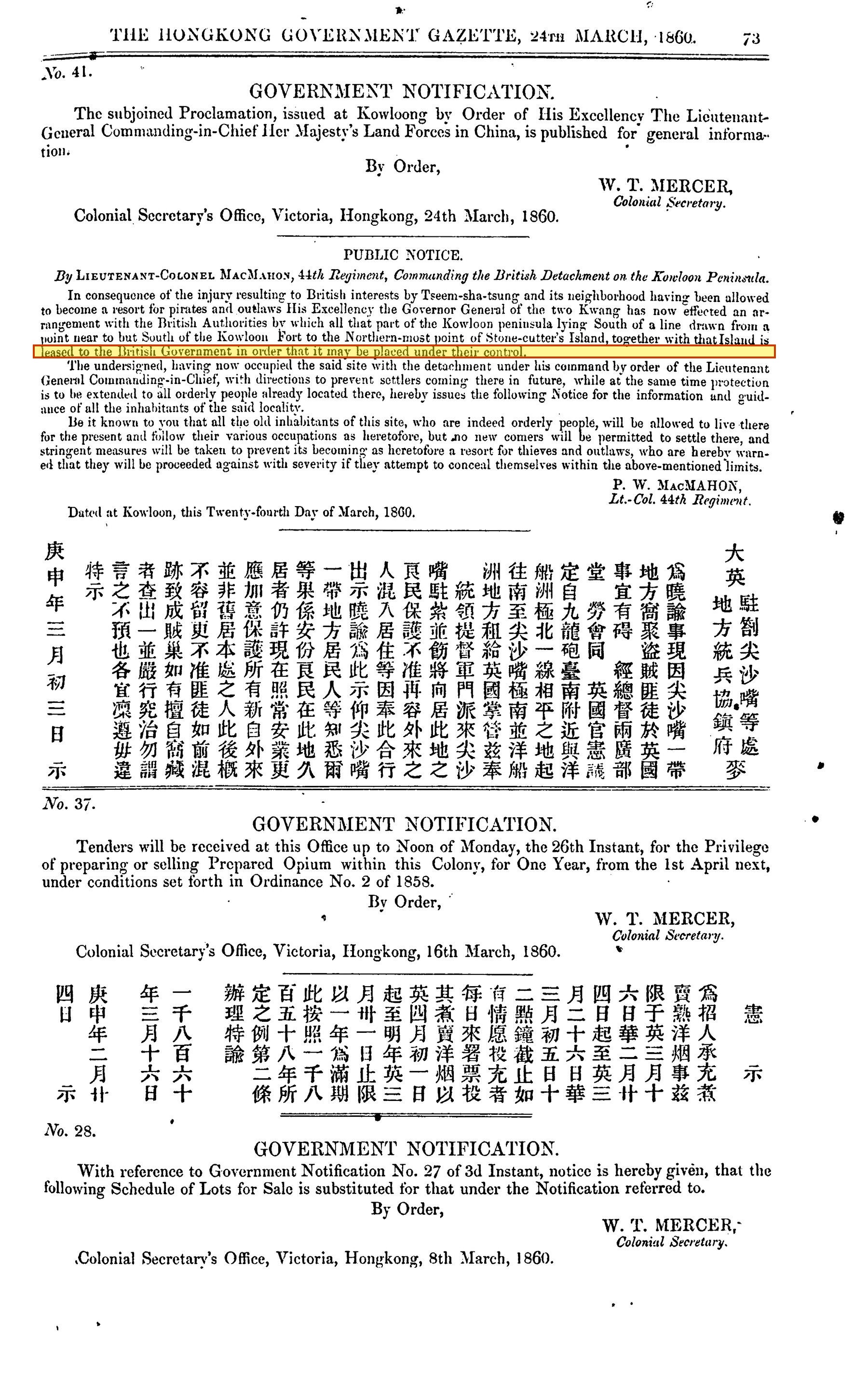
佔領幾乎與簽字同時。《憲報》1860年3月24日刊出陸軍中校 MacMahon(第44團,「駐九龍半島英軍統帶」)在九龍發出的中英雙語公告:兩廣總督「已與英國官憲議定」,把「九龍半島自九龍砲臺南附近與洋船洲極北一線相平之地起」租給英國政府;他已奉命率部進駐該地,「除保護原有良民外,不准新來之人遷入居住」,居民「仍許照常安業」,盜賊「嚴行究治」13。公告的中文欄用字,正是本節3個時代名詞:「九龍砲臺」「洋船洲」「尖沙嘴」14。
四、《北京條約》第六款(1860年10月24日)
1860年10月24日,額羅金與恭親王在北京禮部大堂簽署《北京條約》。第六款:「為維持香港港口及其附近之法律與治安起見,大清大皇帝同意將廣東省九龍司地方一區——即先前授予巴夏禮(Harry Smith Parkes)永久租約之地——割讓與大英大君主及其繼承人,作為英屬香港殖民地之附屬地」;並聲明「該租約即行註銷」;「該區內任何華人對物業之權利主張,應由中英官員組成之混合委員會秉公查核」,「如英國政府認為需要遷移,應給予補償」15。憲報所刊額羅金公告的中文版把日期寫作「九月十一日」——即西曆1860年10月24日16。
香港的即時反應留在《Friend of China》。1861年1月的社評說:「把我們在九龍岸上的持有由一張租約改成一張永久授予——我們確實做錯了。我們做錯了,因為我們開了先例,讓法國和其他西方列強今後只要喜歡就可以向中國索取領土。」17同一時期的報端還留有一則關於接管儀式的花邊:「額羅金伯爵對華南的英國臣民不滿……於是在每個場合都表現出明顯的冷淡——九龍儀式上那頂舊遮陽帽就是證據。」儀式本身沒有直接記載留下18。
五、接管與併入(1861年1月–3月)
1861年1月19日,額羅金在香港發出接管公告:「本大臣業已代表大英大君主接收並公開佔有上述割讓之領土,並將界址四至樹立標記」;在女王裁示之前,該地由政府交由香港總督羅便臣管理,「有全權委任官員」。公告當日刊於《憲報》第3號,並由羅便臣轉報倫敦,文件名目是「公告:宣布九龍政府移交香港殖民地」1920。1月24日,政府公告第10號任命 Charles May 為「九龍撫民官(Civil Commissioner at Kowloon),候女王政府訓令」,這是新區的第一個官職21。1月26日,中文版公告見報:「大清兩廣總督勞 將廣東九龍司地方一區交與 大英駐札粵省暫充英總局正使功賜三等寶星巴〔夏禮〕」;日期欄並列「大英一千八百六十一年正月十九日」與「庚申年十二月初九日」——中曆、西曆同一日16。
2月4日,樞密院令(Kowloon Order in Council)在白金漢宮通過:九龍區「宣布為本殖民地之組成部分(part and parcel),就一切意圖與目的而言,猶如自始即為該殖民地之一部分」,其法律「在香港總督以公告指定之日期起」生效22。兩個月後的3月28日,羅便臣的宣言兌現了那個「指定日期」:「自本公告之日起,九龍區組成並將組成香港殖民地之一部分;香港現行及此後制定之一切法律規例,均在該區生效」23。3月30日,政府公告第31號收尾:九龍既已宣布為本殖民地一部分,1月24日第10號公告(撫民官之設)註銷,但「該區原有之警察法庭與警署」續設,由 Charles May 以「助理裁判官(Assistant Magistrate)」名義管轄24。1861年《藍皮書》的雜項收入欄裡,還留著一行「九龍撫民官帳目結餘」——那是行政機器運轉過的憑據25。
六、索償與土地(1862–1864)
條約第六款的另一半是索償。1862年4月30日,羅便臣把混合委員會的報告轉呈倫敦(第82號):委員會由測量總監 St George Cleverly 與駐廣州領事 D. B. Robertson 組成,譯員梅耶斯(Mayers)襄助,任務是「依《北京條約》第六條調查九龍境內華人之權利主張」26。附呈的《九龍補償備忘》規定:業主的主張「或收購、或另行批給;若收購而有租戶居住,租戶於遷出時按估價補償其青苗與房屋(得扣除只能移走之材料價值)」;棚戶(squatters)另按通則處理27。政策的另一句話是同年的公文:「遭遷移的華人,凡在軍事與海軍所需範圍內者,由陸軍部與海軍部給予依法估定之補償」;而「半島後方只宜於華人村落與農業之地,則無意打擾現有業主與佔用人,並將發給英國地契」28。
土地開發接著開始。1864年6月18日政府公告第102號:「九龍土地公開拍賣,訂於7月25日星期一開始——就在拍賣地上舉行」;Eitel 記下結果:賣出「26幅海旁地與39幅內陸地,短期租契,溢價4,050元、年租18,793元(此數實際繳納不足四分之一);最有價值的一段為軍方保留」29。軍民爭地從1861年3月7日委員會「無法達成一致」開始,拖到1864年以軍方「分得最大一份」作結8。人口方面,1861年全港人口自94,917增至119,321(一年增加24,404,「九龍的割讓也有份推高」)6;1862年12月31日的普查表,第一次把九龍村落記入冊內:「居於村落者(含九龍)」30。報端對新區的期待與現實仍有距離:1861年的《Friend of China》一邊寫「九龍割讓的貿易前景將化為泡影」,一邊在月度記事裡登出「一幫九龍海盜襲擊天主教傳教會房屋,被擊退」——租約初衷要清除的那類人,在契約換軌的年份仍是新聞3132。割讓的內政餘波也在立法局留下記錄:有議員被指「受政府僱用,在九龍割讓一事上保護本殖民地利益」,更有人被指「把某種代表殖民地處理九龍割讓事宜的權力帶回本國」33。
七、留下名字的界線(1927–1929)
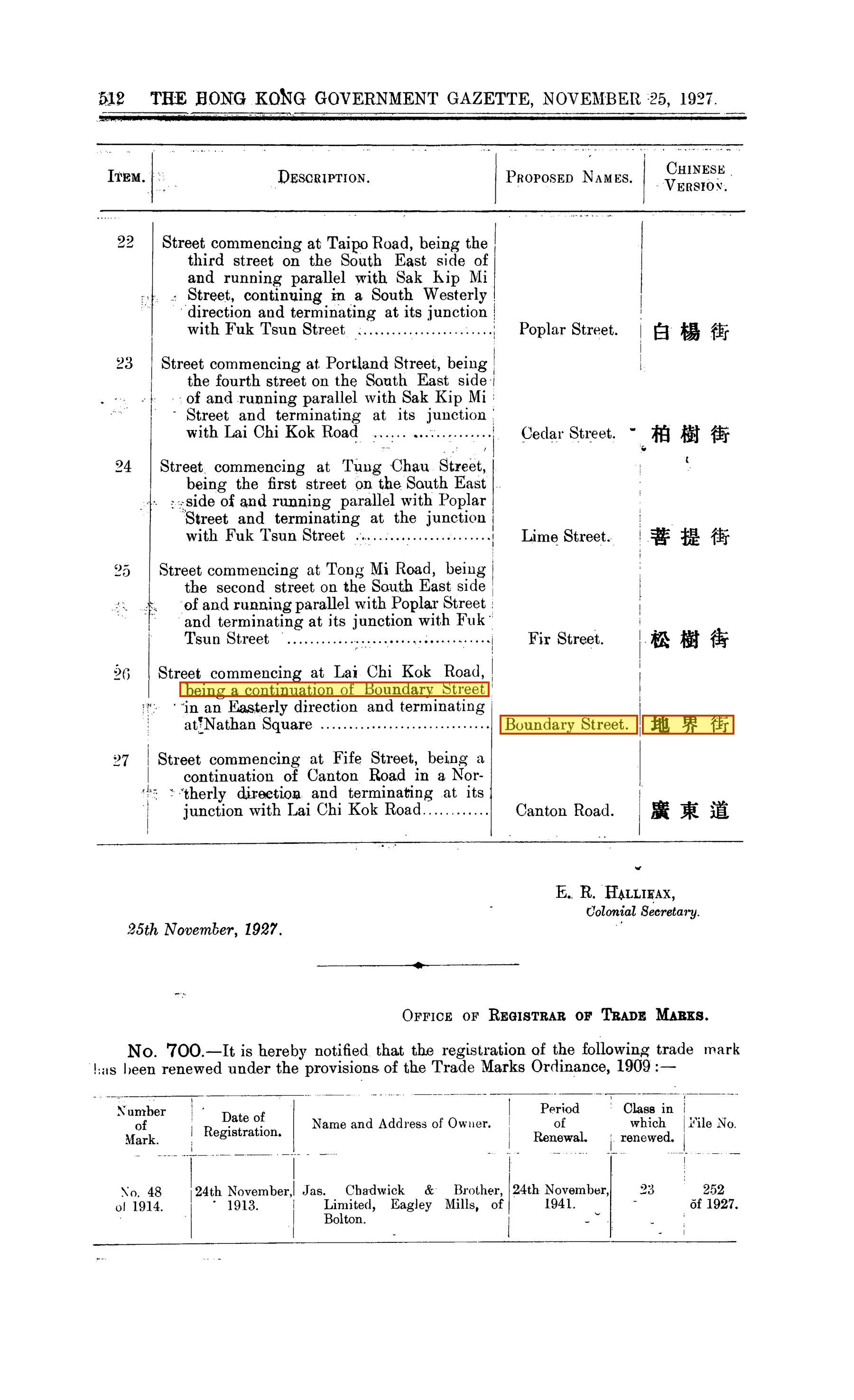
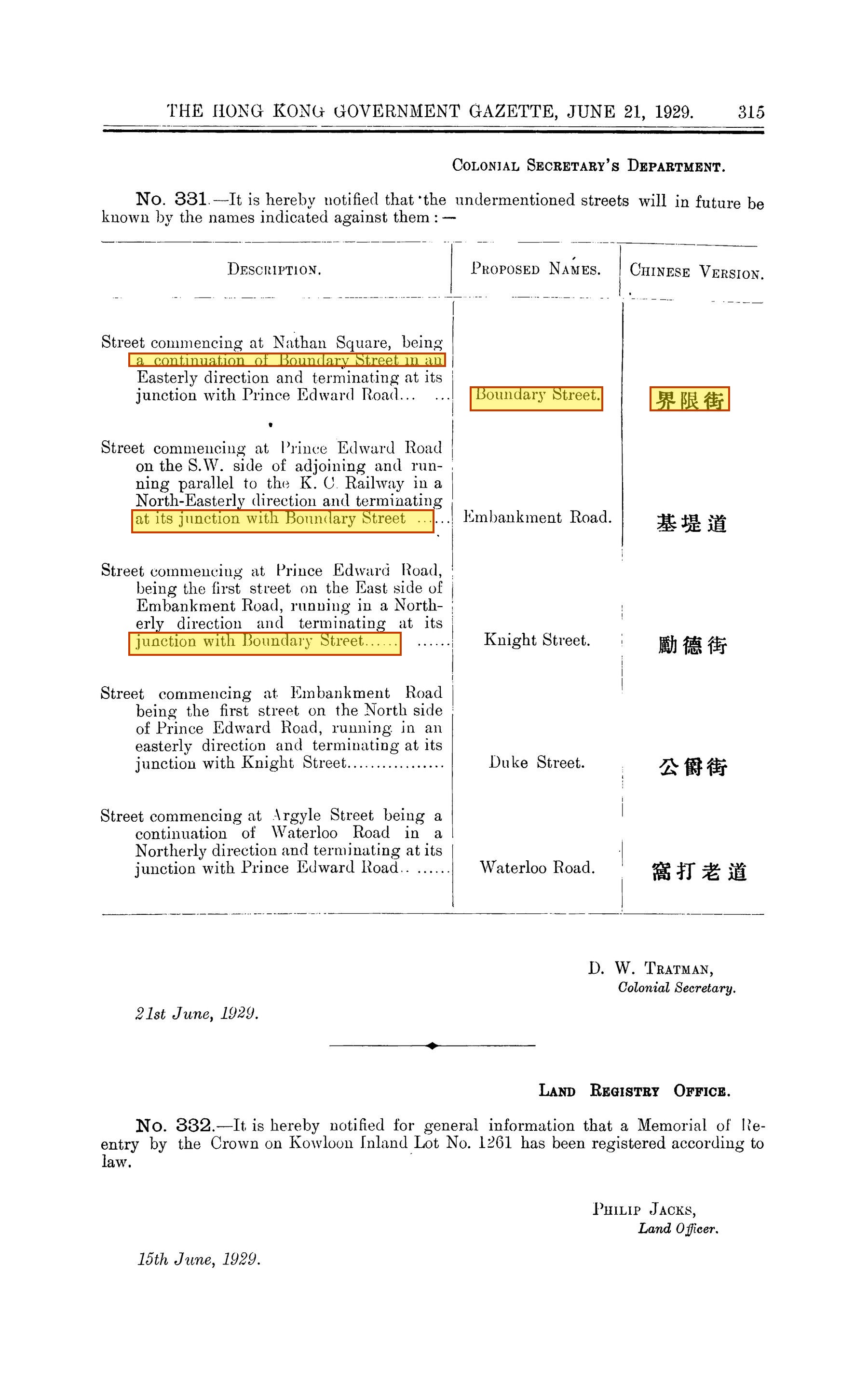
1860年那條線,從九龍砲臺附近畫向洋船洲北端;額羅金公告說界址「樹立標記」34。此後60餘年,這條線的英語路名「Boundary Street」在語料庫的1840–1900年代報刊與憲報中查無一處——1860–90年代的「Boundary Street」檢索結果全部是誤中(1882年一封英國街道地址、1891年上海法租界的界路等)34。它第一次以《憲報》表格現身,是1927年11月25日的街道命名公告第699號:新界街道「自荔枝角道起,為Boundary Street向東之延續……至Nathan Square止——Boundary Street. **地界街**」35。1929年6月21日公告第331號,同一條街的中文改印為**界限街**36。也就是說:這條以1860年界線得名的街道,其英語名字的檔案記錄從1927年才開始被找到,中文名則在1927年作「地界街」、1929年作「界限街」,此後以「界限街」通行至今14。
結論
九龍南部的故事不是一次割讓,而是一條鏈條:1855年起的外交要求、1858年《天津條約》的落空、1860年3月20日的500両租約、同年10月24日第六款的割讓與註銷租約、1861年1–3月的接管與併入。每一環都有自己的語言——「臨時之舉」對「永久租約」,「九龍司」對「township of Kowloon」,「畫定界址」對「set out and marked」——本文把這些語言原樣保存。鏈條的另一端是人:混合委員會為他們立案,補償備忘為青苗與房屋定價,一部分人拿到英國地契;1864年的拍賣在「拍賣地上」舉行,把這片剛取得不久的土地按殖民地的尺子重新丈量。而那條界線最終只剩一個地名學的尾巴:1927年的「地界街」、1929年的「界限街」。租約早已註銷,名字留了下來。
The Lease Before the Cession
Kowloon, 1855–1861:
three instruments, one boundary, and the street that kept its name
Abstract
Kowloon came to the Crown twice: first as a lease, then as a cession. On 20 March 1860 Laou Tsung-kwang, Governor-General of the Two Kwang, leased to Harry Smith Parkes — for the British Government — the peninsula “South of the Kowloon Fort to the Northern-most point of Stone-cutters Island, together with that island”, at five hundred taels a year, “as a preliminary measure”. On 24 October 1860 the Convention of Peking’s Article VI ceded that leased portion, cancelled the lease, and created a Mixed Commission to investigate Chinese claims with compensation. Between January and March 1861 the machinery completed: Elgin proclaimed possession at Hongkong (“the metes and bounds… set out and marked”), Charles May became Civil Commissioner at Kowloon, an Order in Council of 4 February declared the district part and parcel of the Colony, and Governor Robinson’s proclamation of 28 March brought the Colony’s laws into force there. The paper follows the instruments’ own words — including their unresolved disagreements (the deed’s “preliminary measure” against the Convention’s “in perpetuity”; five hundred taels against £160) — through the 1862 Mixed Commission’s report and compensation memorandum, the 1864 on-site land sale, and the boundary line’s afterlife: the street whose Chinese name the Gazette printed as 地界街 in 1927 and 界限街 in 1929.
Keywords: Kowloon cession; Convention of Peking; Parkes lease; Boundary Street; 界限街; 九龍司; Mixed Commission; Hong Kong 1860.
1. Scope, sources, and method
This is an instrument-history of the peninsula south of the 1860 line. The corpus’s daily press does not reach 1860–61 — the Daily Press begins 4 January 1864 and the China Mail in 1866 — so the record rests on the Government Gazette (1860–61, and 1927/1929 for the boundary’s afterlife), the CO 129 despatches (the 1855–58 diplomacy, the 1860 lease papers, the 1861–62 administration and claims), the Historical Laws appendix’s Alabaster reprints (the deed, the Convention article, the Order in Council), and Eitel’s Europe in China (1895), whose corpus copy preserves Parkes’ journal and Hope Grant’s testimony; the only immediate press witness is the Friend of China, publishing at Canton in January 1861 12. Every quotation was re-verified against the page scan; the six plates’ page numbers are the printed folios, with the image-index labels’ offsets recorded in the plate manifest. The query log and the full evidence register are deposited with the research notes; Appendix B summarises the register’s confirmed, conflicting, do-not and gap rows.
2. Before the lease: the demand, 1855–1859
The demand for Kowloon is five years older than the lease. In August 1855 the Colonial Secretary’s office forwarded to London Major-General Sir C. J. Van Straubenzee’s letter of 25 March with enclosures “in reference to the cession of land on the Kowloon Peninsula”; from Canton the file closed with a shrug on 10 August 1856 — the documents were all that had passed, “no further notice has since been taken in the Matter… the further conduct of this question rested with the Home Government” 3. On 2 March 1858 Captain W. K. Hall of H.M.S. Calcutta copied to the local Government his letter to the Earl of Hardwicke: the opportunity of obtaining “the cession of Kowloon Point and Stonecutters’ Island should not be lost, especially as another Power might occupy these vantage points” — sea-frontage for commercial building lots, barrack accommodation, the danger to shipping moored near “the settlement of lawless Chinese vagabonds at Tsimshatsui”, a naval yard, a quarantine station 4.
London instructed accordingly: on 10 June 1858 Malmesbury told the Minister at Peking to “endeavour to obtain from the Chinese Government by treaty cession of those places to the British Crown or at all events of the point called Kowloon opposite Hongkong” 5. The Treaty of Tientsin, three weeks later, left the Colony as it was. Eitel’s verdict on Elgin is its own kind of evidence — he “never did anything for Hongkong that he could help”, refused the suggestion, and “said he had no instructions on the subject” 6. On 29 March 1859 Governor Bowring tried again from Hongkong: “The possession of the small peninsula opposite the Island is become of more and more importance. To say nothing of questions of military and naval defence, it would be of great commercial and sanatory value… I hope therefore that measures will be taken for obtaining a cession of this tract of land.” 6
March 1860 settled it within twelve days. On the 12th two memoranda left Hongkong the same day — Sidney Herbert’s on the military occupation, and Robinson’s on the civil occupation, forwarded to Sir F. W. Bruce at Parkes’ urgent suggestion; Parkes believed that as chief of the Commission occupying Canton he could easily obtain a lease from Viceroy Lao Tsung-kwang, while Robinson shrank from begging as a favour ground the war itself needed. A part of the peninsula had already, with his sanction, been used informally as a camping ground since February 1860 7. On the 13th General Sir Hope Grant arrived — the man who “afterwards claimed to have originated the idea”; his own account: the promontory “within three-quarters of a mile” was “absolutely essential for the defence of Hongkong harbour”, an open healthy camping ground, a salubrious site 8. On the 16th, Parkes’ journal: “both Sir H. Robinson and Sir Hope Grant came round to my way of thinking as to the desirability of getting a lease of Kowloon… Sir H. Robinson is all eagerness that it should be settled forthwith.” 7
3. 20 March 1860: the lease
The deed survives in the Alabaster reprint. Its preamble, in the parties’ own voice: Tseem-sha-tsuy and its neighbourhood, “consisting for the most part of barren hills that cannot be cultivated, has hitherto formed a place of resort for thieves and outlaws, who, availing themselves of the immediate proximity of the City of Victoria, constantly cross to Hong Kong, and commit depredations…”. Therefore “all that part of the Kowloon peninsula lying South of the Kowloon Fort to the Northern-most point of Stone-cutters Island, together with that island… shall be leased, as a preliminary measure… in order that the latter may exercise complete control over the same”; the rent “Five Hundred Taels of Silver… annually” to the local authorities; the term open-ended, “until… other arrangements of a more permanent character” 9. Lao’s letter frames the same instrument from the Chinese side: “The subject not having as yet been laid before the Imperial Government, the Governor General cannot take upon himself to arrange the cession of this locality, but it has been determined to temporarily transfer it upon lease, and to station troops there for its protection… I fix the yearly rental at 500 Taels in Silver.” 10. The Admiralty was told it in sterling: “the Peninsula of Kowloon & Stone Cutters Island have been acquired by a perpetual lease from the Govr Genl of Canton at a rent of £160 per annum to be paid by the British Govt… effected through the instrumentality of Mr. Parkes” 11.
The instruments disagree about what the lease was. The deed says “as a preliminary measure”; the Convention’s Article VI, seven months later, recites a lease “granted in perpetuity”; the Admiralty’s letter splits the difference in its own words. Three prints, two positions: the paper keeps them side by side rather than harmonising them 12. The rent has the same shape — one obligation, two currencies (500 taels; £160) 119.
The occupation was gazetted within four days. Government Notification No. 41 of 24 March 1860 prints Lieut.-Colonel P. W. MacMahon’s bilingual proclamation, issued the same day at Kowloon: the Governor-General “has now effected an arrangement with the British Authorities by which all that part of the Kowloon peninsula… is leased to the British Government… The undersigned, having now occupied the said site with the detachment under his command… all the old inhabitants of this site, who are indeed orderly people, will be allowed to live there… but no new comers will be permitted to settle there”. The Chinese column carries the line’s own words — 「定自九龍砲臺南附近與洋船洲極北一線相平之地起」 — and the three period names this paper keeps: 九龍砲臺 for the fort, 洋船洲 for Stonecutters, 尖沙嘴 for Tsim Sha Tsui 1314.
4. 24 October 1860: Article VI
The Convention of Peking’s Article VI cedes “that portion of the township of Kowloon, in the Province of Kwang-tung, of which a lease was granted in perpetuity to Harry Smith Parkes… by Lan Tsung Kwang, Governor General of the Two Kwang” — to hold as a dependency of the Colony; declares “the lease in question is hereby cancelled”; provides that “the claims of any Chinese to any property on the said portion of Kowloon shall be duly investigated by a Mixed Commission of British and Chinese Officers”; and fixes compensation where removal “should… be deemed necessary” 15. The Gazette’s Chinese print of Elgin’s proclamation of the article dates the convention 九月十一日 — the eleventh day of the ninth moon, 24 October 1860 16.
Hongkong’s immediate press reaction is a dissent. In January 1861 the Friend of China editorialised: “we verily… have done wrong in changing our hold on the Kowloon shore from a lease to a grant for ever. We have done wrong, because we have set the example to France and other western powers of making demand for territory whenever it pleases them…” 17. And beside the instrument, a scrap of the ceremony: the Earl of Elgin “is annoyed with British subjects in the south… hence his marked disrespect on every prominent occasion; the old pith hat at the Kowloon ceremony to wit” 18. The ceremony itself left no direct report; the sentence is its only trace in the record pulled for this paper.
5. January–March 1861: possession, and incorporation
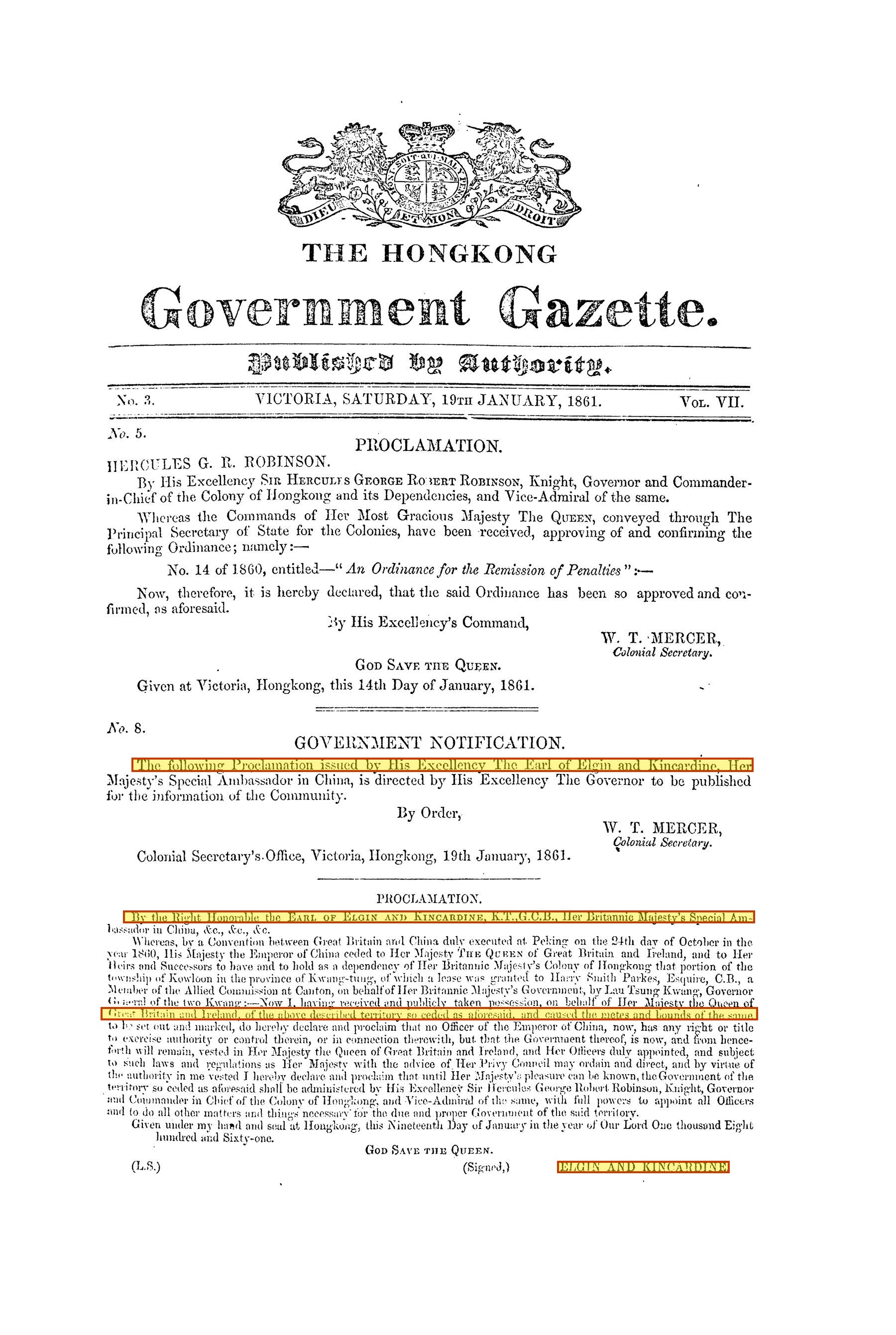
Elgin’s proclamation, “Given under my hand and seal at Hongkong, this Nineteenth Day of January… 1861”, records the possession and the marking: he had “received and publicly taken possession… of the above described territory so ceded… and caused the metes and bounds of the same to be set out and marked”, and the government was to be administered by Governor Robinson “with full powers to appoint all Officers”. Gazetted the same day as G.N. 8 19, it travelled home as “Proclamation, announcing transfer of Government of Kowloon to the Colony of Hongkong” 20.
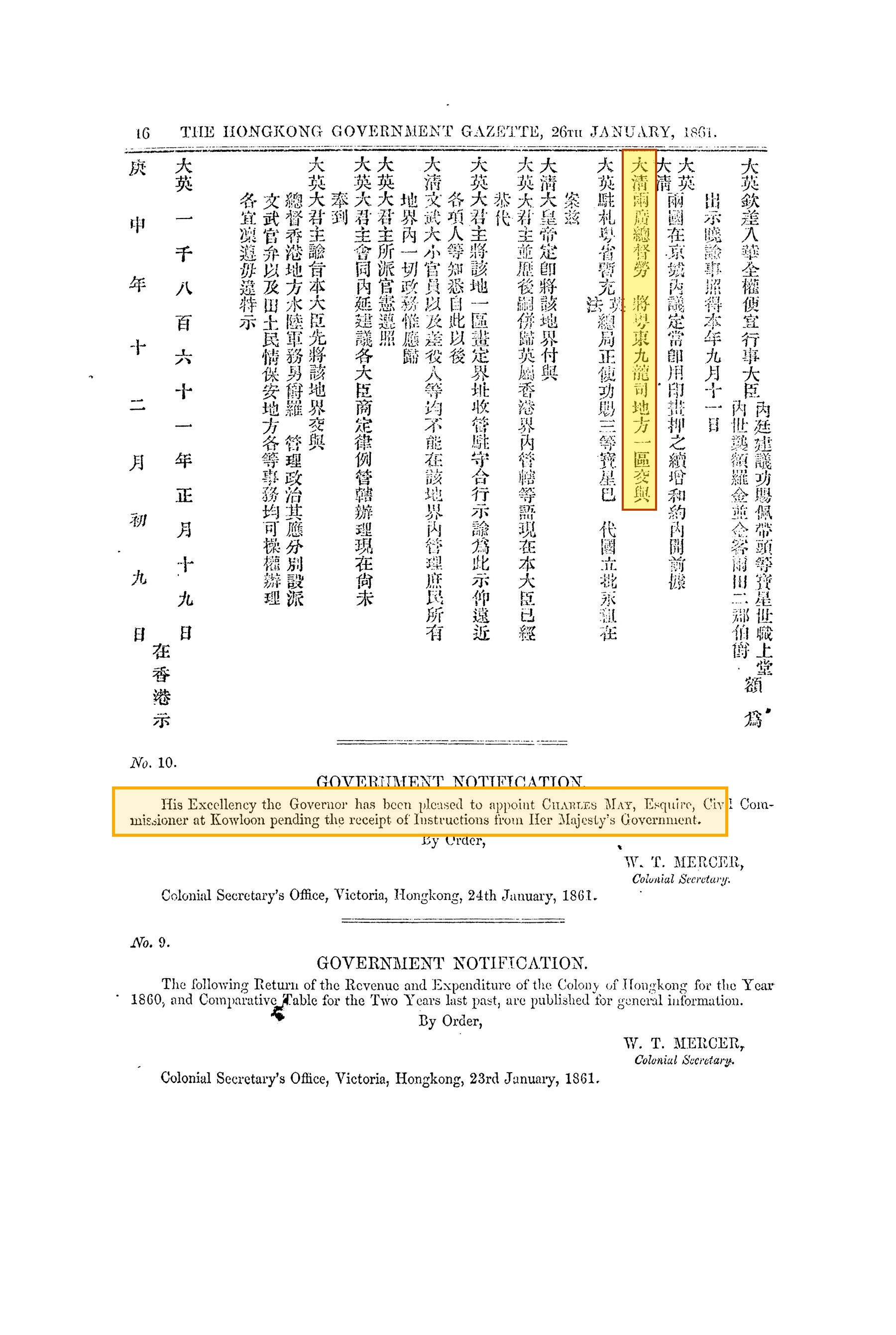
On 24 January Charles May — until then the Colony’s Superintendent of Police, “an ex-Inspector of Scotland Yard” in Eitel’s phrase — was appointed “Civil Commissioner at Kowloon pending the receipt of Instructions from Her Majesty’s Government” 218. On 26 January the Chinese version of the proclamation was gazetted: 「大清兩廣總督勞 將廣東九龍司地方一區交與大英駐札粵省暫充英總局正使功賜三等寶星巴〔夏禮〕」, dated both “大英一千八百六十一年正月十九日” and “庚申年十二月初九日” — the same day in two calendars 16. The Chinese print had already chosen its words: the ceded district is 九龍司 (the Qing administrative name for Kowloon), and the men are 勞 (Lao) and 巴夏禮 (Parkes) 14.
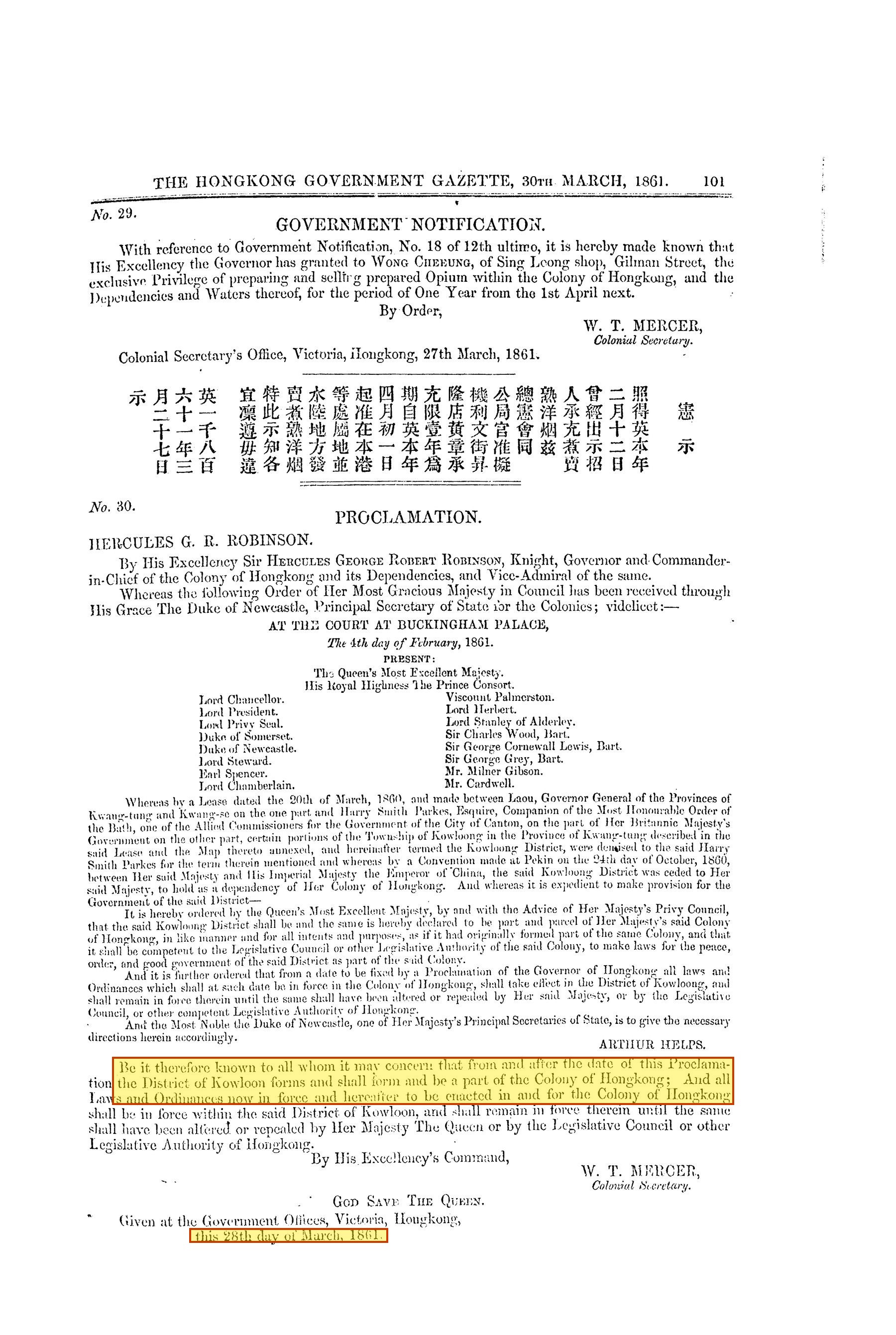
On 4 February the Order in Council at Buckingham Palace declared the Kowloong District “part and parcel of Her Majesty’s said Colony of Hong Kong, in like manner and for all intents and purposes as if it had originally formed part of the same Colony”, with the Colony’s laws to take effect “from a date to be fixed by a Proclamation of the Governor” 22. Robinson fixed it on 28 March: “from and after the date of this Proclamation the District of Kowloon forms and shall form and be a part of the Colony of Hongkong; And all Laws and Ordinances now in force… shall be in force within the said District” 23. Two days later G.N. 31 tidied the administration: G.N. 10 cancelled, but “the Police Court and Station hitherto existing in the said District are continued… under the charge of CHARLES MAY, Esq., Assistant Magistrate” 24. The 1861 Blue Book carries the paper trace of the office’s first year — a “Balance of the account of the Civil Commissioner at Kowloon” among the incidental receipts 25.
6. Claims and land, 1862–1864
Article VI’s second clause is the one about people. Robinson forwarded the commissioners’ report on 30 April 1862 (No. 82): the “Report of the Commissioners appointed under the VI. art. of the Convention of Pekin to investigate the claims of the Chinese on the Kowloon territory”, by the Honourable St George Cleverly (Surveyor General) and D. B. Robertson (H.M. Consul, Canton), assisted by M. S. F. Mayers 26. The appended “Memorandum as to Kowloon Compensations” prices the removals: proprietary claims “either to be purchased or regranted”; dispossessed tenants compensated for “the value of their growing crops” and buildings “less the value of materials which may in all cases only be removed”; squatters’ claims under a general rule 27. The policy is stated in the same file: the War Department and the Admiralty would “provide the compensations awarded to the Chinese dispossessed from the area actually required for military and naval purposes”; for “the remainder of the Peninsula at the back, which is fitted only for Chinese villages and agriculture… no intention to disturb the present proprietors and occupiers, who would be given British titles” 28.
The military–civil contest over the peninsula had opened on 7 March 1861 with the Board’s “inability to come to any agreement” and Hope Grant’s claim that the ceded territory should become “a purely military cantonment separate and apart from the Government of Hongkong”; it ran until 1864, when the military kept “the lion’s share” 8. The land sale followed the settlement. On 18 June 1864 G.N. 102 announced “a Sale of Land at Kowloon by Public Auction… on the ground to be sold commencing on Monday 25th July” 29 — and Eitel’s ledger of the result reads: “some 26 marine and 39 inland lots were sold, on short leases, at a premium of $4,050 and an annual rent of $18,793 (of which sum hardly one-fourth was ever paid). The one portion which was of essential value for the Colony was retained by the Military Authorities.” 6
The people are counted soon after. The census of 31 December 1862 carries the new row for the first time — Chinese “residing in Villages inclusive of Kowloon” 30 — and Eitel records the cession’s own demographic moment: population rose from 94,917 in 1860 to 119,321 in 1861, an increase of 24,404, “when the cession of Kowloon also contributed to swell the population” 6. The press, meanwhile, kept both faces of the new district: “the prospective tradal advantages of the Kowloon cession will have vanished into thin air”, one editorial reckoned 31; the monthly register for February 1861 noted that “a band of pirates from Kowloon attacked a house of the Catholic Missionaries but were repulsed” 32 — the very nuisance the lease had promised to expel, still news in the year the instruments changed. The cession’s political wake shows in the Legislative Council’s Bridges affair: a member defended as having been “employed by Government to protect the interest of the colony touching the Kowloon [cession]”, and accused of having “took home some kind of authority to act for the Colony in the matter of the Kowloon cession” 33.
7. The boundary’s afterlife: 地界街, then 界限街
The lease line ran “from a point near to but South of the Kowloon Fort to the Northern-most point of Stone-cutter’s Island” 34; Elgin’s proclamation says the metes and bounds were “set out and marked” 19. No corpus witness locates the markers, and — the negative finding this paper registers rather than papers over — the name “Boundary Street” appears nowhere in the corpus’s 1840s–1900s press or gazette strata: the pre-1927 hits are false positives (a British street address in an 1882 unclaimed-letters list; the French–English boundary street of Shanghai in the 1891 press) 34. The street enters the record in the Gazette’s own naming tables: on 25 November 1927, G.N. 699 names the street “commencing at Lai Chi Kok Road, being a continuation of Boundary Street in an Easterly direction and terminating at Nathan Square — Boundary Street. 地界街” 35; on 21 June 1929, G.N. 331 prints the same street’s Chinese version as “Boundary Street. 界限街” 36. Between the two prints the Gazette’s own Chinese for the street changes from 地界街 — a literal “boundary line street” — to the 界限街 that is its name today 14.
8. Conclusion
Kowloon came to the Crown as a chain, not a stroke: five years of requests (1855–59), a treaty that left the demand out (1858), a five-hundred-tael lease signed at Canton (20 March 1860), a cession that cancelled its own antecedent (24 October 1860), and a three-month incorporation (January–March 1861) that ran through a proclamation, an appointment, an Order in Council and a second proclamation. Each instrument judged the arrangement in its own words — “as a preliminary measure”, “in perpetuity”, “part and parcel” — and this paper keeps them as the documents wrote them. At the chain’s other end stand people and prices: a Mixed Commission for the Chinese claims, a compensation memorandum that valued crops and buildings, British titles for the villages, and an 1864 auction held, as the notice says, “on the ground to be sold”. The line itself outlived all of it as a street name — 地界街 in the Gazette’s 1927 table, 界限街 from 1929 to today.
Appendix A — Sources and query log
The battery and its counts (all read-only, 31 October 2026): “Convention of Peking” 523; “Boundary Street” 6,499 (all pre-1927 hits false positives, §7); “Kowloon peninsula” 5,325; “lease was granted to Harry Smith Parkes” 5; “Lau Tsung Kwang” 12; “Civil Commissioner at Kowloon” 2; “proclaimed part and parcel” 2; series aggregation over “Convention of Peking”: FCO 40 220 / yearbook 113 / CO 129 37 / TNA misc 39 / HKRS 38 / research-publications 24. Gazette sweeps for Kowloon: 1860 keys 13 documents, 1861 keys 25; press keys 1860–63: none (no press stratum); Friend of China 1860–61 with five spellings: Kowloon 8 / Kowloong 2 / Cowloon 2. Name counts: 洋船洲 2 / 昂船洲 1,821; 九龍砲臺 3 / 九龍寨城 199; 尖沙嘴 486 / 尖沙咀 10,000+; 額羅金 3 / 額爾金 14; 勞崇光 7; 九龍司 115; 地界街 18 / 界限街 10,000+. Land-lots index: Kowloon Inland Lots 830 entries (gazette years begin 1876 — an index limitation, not a prohibition: the 1864 sale rests on G.N. 102 and Eitel). The compulsory whole-document pull: the Historical Laws appendix’s 1964 selection of constitutional documents (43 pages, the Alabaster reprints). Six scans downloaded and read back at their final crops; the manifest is images/README.md.
Appendix B — Evidence register (summary)
Confirmed. The lease’s terms (deed; Lao’s letter; the Admiralty letter; G.N. 41’s recital; Eitel); the 24 March 1860 occupation, gazetted the same day; Article VI (Alabaster; the FoC reprint; the proclamation recital; the Chinese print’s 九月十一日); the Order in Council and both 1861 proclamations; Charles May’s two commissions (24 January, 30 March); the Mixed Commission’s report and the compensation memorandum; the 1864 sale announcement; the 1927/1929 street-name prints.
Conflicts kept. The lease’s date (20 vs 21 March, deed against Parkes’ journal); its character (“preliminary measure” against “in perpetuity”; cf. the Admiralty’s “perpetual lease”); the rent (“500 Taels” against £160); Elgin’s Chinese name (額羅金 in the 1861 print, 額爾金 in modern usage); Boundary Street’s Chinese (地界街 1927 vs 界限街 1929 — both Gazette prints); Eitel’s “October, 1850” line, withdrawn from use as anachronistic against the 1859 recommendation it follows.
Do not use. Any pre-1860 British occupation or title (F1); any claim that the lease/cession line included the Kowloon Fort (F2); 1860–61 news attribution to the Daily Press or China Mail (their corpus strata begin 1864/1866) (F3); any naming date for Boundary Street before 1927 (F4); any boundary-marker witness (F5); quoting one instrument’s lease-character words as if they were another’s (F6/K2).
Gaps. The lease’s annexed map; the boundary markers’ record; Boundary Street’s construction/naming record before 1927; a direct account of the possession ceremony; the Convention’s ratification exchange 37.
Notes
Scope and method. The corpus’s daily press does not reach 1860–61 (the Daily Press begins 4 January 1864; the China Mail, 1866), so the record of the cession’s machinery rests on the Government Gazette, the CO 129 despatches, the Historical Laws appendix’s Alabaster reprints and Eitel’s Europe in China; the only immediate press witness is the Friend of China (1860–61 year-volumes). Every quotation was re-verified against the page scan. Government Notification No. 41, Hongkong Government Gazette, 24 March 1860, 73, https://hkintexts.histsyn.com/image-page/1448467. ↩
On the stratum’s structure see the note above; on the same absence in a neighbouring thread’s founding decade, cf. the HongkongGas1862 notes (the Friend of China text series ends 1861). The 1861 volume was being printed at Canton: masthead, Friend of China, 25 January 1861, 19, https://hkintexts.histsyn.com/page/3032434. ↩
Colonial Secretary’s Office, Hong Kong, No. 490, 16 August 1855, forwarding Major-General Sir C. J. Van Straubenzee’s letter of 25 March 1855 with three enclosures “in reference to the cession of land on the Kowloon Peninsula”; the Canton answer of 10 August 1856 (“no further notice has since been taken in the Matter”), CO 129/69, 94–96, https://hkintexts.histsyn.com/page/245015 and https://hkintexts.histsyn.com/page/245017. ↩
Captain W. K. Hall, H.M.S. Calcutta, to the Earl of Hardwicke, 2 March 1858, copied to the local Government: the opportunity of obtaining “the cession of Kowloon Point and Stonecutters’ Island should not be lost”; E. J. Eitel, Europe in China (1895), ch. XVIII, https://hkintexts.histsyn.com/page/3185720. ↩
Malmesbury to Bonham, 10 June 1858: “to endeavour to obtain from the Chinese Government by treaty cession of those places to the British Crown or at all events of the point called Kowloon opposite Hongkong”, CO 129/70, 238–242, https://hkintexts.histsyn.com/page/245805; cf. https://hkintexts.histsyn.com/page/245801. ↩
Eitel’s verdict on the whole acquisition: “The principal benefit of a lasting character that Hongkong derived from this second war with China consists in the acquisition of the Kowloon Peninsula.” E. J. Eitel, Europe in China (1895), ch. XVIII, https://hkintexts.histsyn.com/page/3185720. ↩
The consultation of 16 March 1860, from Parkes’ journal: “both Sir H. Robinson and Sir Hope Grant came round to my way of thinking as to the desirability of getting a lease of Kowloon… Sir H. Robinson is all eagerness that it should be settled forthwith”; Eitel, Europe in China, ch. XVIII, https://hkintexts.histsyn.com/page/3185720. ↩
Sir Hope Grant’s own account (via Eitel): the promontory “within three-quarters of a mile” was “absolutely essential for the defence of Hongkong harbour and the town of Victoria”, “an open healthy spot, admirably suited for a camping ground”; and his later claim that “the idea of appropriating the peninsula had originated with the Military Authorities”, with the Board’s report of 7 March 1861 “their inability to come to any agreement”; Eitel, Europe in China, ch. XVIII, https://hkintexts.histsyn.com/page/3185720 and https://hkintexts.histsyn.com/page/3185721. ↩
“A Deed of Lease”, 20 March 1860, Laou, Governor-General of Kwang-tung and Kwang-se, to Harry Smith Parkes: Tseem-sha-tsuy (Tsim Sha Tsui) “a place of resort for thieves and outlaws”; the territory “all that part of the Kowloon peninsula lying South of the Kowloon Fort to the Northern-most point of Stone-cutters Island, together with that island”; “leased, as a preliminary measure”; “a Rental of Five Hundred Taels of Silver shall be annually paid”. “Lease of Kowloon” (Alabaster reprint), A Selection of Constitutional Documents, Conventions and Treaties (1964), Appendix IV, 20–21, https://hkintexts.histsyn.com/page/1853153. ↩
Lao Tsung-kwang’s letter fixing the terms: “it has been determined to temporarily transfer it upon lease, and to station troops there for its protection… I fix the yearly rental at 500 Taels in Silver, which can be paid to the local Authorities”; CO 129/77, 240, https://hkintexts.histsyn.com/page/249050. ↩
“The Peninsula of Kowloon & Stone Cutters Island have been acquired by a perpetual lease from the Govr Genl of Canton at a rent of £160 per annum to be paid by the British Govt… effected through the instrumentality of Mr. Parkes”, Hongkong, April 1860; CO 129/79, 114, https://hkintexts.histsyn.com/page/249964. ↩
The two instruments’ own words, kept side by side: the deed “as a preliminary measure” (https://hkintexts.histsyn.com/page/1853153); the Convention’s Article VI “a lease was granted in perpetuity” (https://hkintexts.histsyn.com/page/1853154); the Admiralty’s “perpetual lease” (https://hkintexts.histsyn.com/page/249964); the proclamation print without the phrase (https://hkintexts.histsyn.com/image-page/1448693). ↩
“Public Notice” by Lieut.-Colonel P. W. MacMahon, 44th Regiment, “Commanding the British Detachment on the Kowloon Peninsula”, at Kowloon, 24 March 1860 (bilingual; the Chinese column reads “定自九龍砲臺南附近與洋船洲極北一線相平之地起”): “all that part of the Kowloon peninsula… is leased to the British Government… no new comers will be permitted to settle there”; Government Notification No. 41, HKGG, 24 March 1860, 73, https://hkintexts.histsyn.com/image-page/1448467. ↩
Renders by period attestation (corpus, 2026-10-31): 九龍司 115; 九龍砲臺 3 (G.N. 41 and CO 129/77); 尖沙嘴 486 (period) against 尖沙咀 10,000+ (modern); 洋船洲 2 against 昂船洲 1,821 (modern); 額羅金 3 (the 1861 print) against 額爾金 14; 勞崇光 7; 地界街 18; 界限街 10,000+. Period contexts keep the printed form, narratives gloss the modern name once. See also the web leg recorded in the research notes (§1.4). ↩
Convention of Peking, 24 October 1860, Article VI: “His Imperial Majesty the Emperor of China agrees to cede… that portion of the township of Kowloon, in the Province of Kwang-tung, of which a lease was granted in perpetuity to Harry Smith Parkes…”; “the lease in question is hereby cancelled”; a Mixed Commission “to investigate the claims of any Chinese to any property on the said portion of Kowloon”, compensation where removal “deemed necessary”; Alabaster reprint, Appendix IV, 21, https://hkintexts.histsyn.com/page/1853154. ↩
The Chinese version of Elgin’s proclamation, HKGG, No. 4, 26 January 1861, 16: “大清兩廣總督勞 將廣東九龍司地方一區交與大英駐札粵省暫充英總局正使功賜三等寶星巴〔夏禮〕”; dated “大英一千八百六十一年正月十九日” and “庚申年十二月初九日”. https://hkintexts.histsyn.com/image-page/1448700. ↩
“We verily… have done wrong in changing our hold on the Kowloon shore from a lease to a grant for ever. We have done wrong, because we have set the example to France and other western powers of making demand for territory whenever it pleases them”; Friend of China, 25 January 1861, 19, https://hkintexts.histsyn.com/page/3032434. ↩
“The Earl of Elgin is annoyed with British subjects in the south… hence his marked disrespect on every prominent occasion; the old pith hat at the Kowloon ceremony to wit”; Friend of China, 2 February 1861, 34, https://hkintexts.histsyn.com/page/3032449. The ceremony itself is not directly reported in any pulled document. ↩
The Earl of Elgin’s proclamation, “Given under my hand and seal at Hongkong, this Nineteenth Day of January… 1861”: possession taken, “the metes and bounds of the same… set out and marked”, government vested in the Queen and to be administered by “His Excellency Sir Hercules George Robert Robinson”; HKGG, No. 3, 19 January 1861 (G.N. 8), https://hkintexts.histsyn.com/image-page/1448693. ↩
Robinson to the Duke of Newcastle, forwarding “Lord Elgin’s Proclamation, announcing transfer of Government of Kowloon to the Colony of Hongkong”; CO 129/80, 51, https://hkintexts.histsyn.com/page/250490. ↩
Government Notification No. 10, 24 January 1861: “His Excellency the Governor has been pleased to appoint CHARLES MAY, Esquire, Civil Commissioner at Kowloon pending the receipt of Instructions from Her Majesty’s Government”; HKGG, No. 4, 26 January 1861, 16, https://hkintexts.histsyn.com/image-page/1448700. ↩
“Kowloon Order in Council”, At the Court at Buckingham Palace, the 4th day of February 1861: the Kowloong District “declared to be part and parcel of Her Majesty’s said Colony of Hong Kong, in like manner and for all intents and purposes as if it had originally formed part of the same Colony”; the Colony’s laws to take effect there “from a date to be fixed by a Proclamation of the Governor of Hong Kong”; Alabaster reprint, Appendix IV, 22–23, https://hkintexts.histsyn.com/page/1853155. ↩
Governor Robinson’s proclamation of 28 March 1861: “from and after the date of this Proclamation the District of Kowloon forms and shall form and be a part of the Colony of Hongkong; And all Laws and Ordinances now in force… shall be in force within the said District”; HKGG, 30 March 1861, 101, https://hkintexts.histsyn.com/image-page/1448783. ↩
Government Notification No. 31: “The District of Kowloon having been proclaimed part and parcel of this Colony… the Police Court and Station hitherto existing in the said District are continued… under the charge of CHARLES MAY, Esq., Assistant Magistrate”; HKGG, 30 March 1861, 102, https://hkintexts.histsyn.com/page/1682895. ↩
“Balance of the account of the Civil Commissioner at Kowloon” among the year’s incidental receipts; Blue Book 1861, 19, https://hkintexts.histsyn.com/page/655250. ↩
“Report of the Commissioners appointed under the VI. art. of the Convention of Pekin to investigate the claims of the Chinese on the Kowloon territory” (Robinson’s despatch No. 82, 30 April 1862): the British Commissioners the Honourable St George Cleverly, H.M. Surveyor General, and D. B. Robertson, H.M. Consul at Canton, “assisted by M. S. F. Mayers, H.M. Interpreter”; CO 129/85, 435, https://hkintexts.histsyn.com/page/253352. ↩
“Memorandum as to Kowloon Compensations”: proprietary claims “either to be purchased or regranted”; dispossessed tenants compensated for “the value of their growing crops” and buildings “less the value of materials which may in all cases only be removed”; squatters’ claims “as a general rule” under a stated figure; CO 129/85, 445, https://hkintexts.histsyn.com/page/253362. ↩
Robinson to Newcastle: compensation “the War Department and the Admiralty would of course provide… for the Chinese dispossessed from the area actually required for military and naval purposes”; “as regards the remainder of the Peninsula at the back, which is fitted only for Chinese villages and agriculture… no intention to disturb the present proprietors and occupiers, who would be given British titles”; CO 129/86, 10, https://hkintexts.histsyn.com/page/253382. ↩
Government Notification No. 102, 18 June 1864: “Notice is hereby given that a Sale of Land at Kowloon by Public Auction will be held on the ground to be sold commencing on Monday 25th July”; HKGG, https://hkintexts.histsyn.com/page/1681033. Eitel’s ledger of the result: “some 26 marine and 39 inland lots were sold, on short leases, at a premium of $4,050 and an annual rent of $18,793 (of which sum hardly one-fourth was ever paid)”, https://hkintexts.histsyn.com/page/3185721. ↩
“Census of Hongkong, 31st December, 1862”, Registrar General’s returns, row “Do. do. in Villages inclusive of Kowloon”; HKGG, 7 February 1863, https://hkintexts.histsyn.com/page/1681516. ↩
On the cession’s commercial hopes: “the prospective tradal advantages of the Kowloon cession will have vanished into thin air”; Friend of China, 1861, 83, https://hkintexts.histsyn.com/page/3032498. ↩
“A band of pirates from Kowloon attacked a house of the Catholic Missionaries but were repulsed after a struggle”, the monthly register, February 1861; Friend of China, 1861, 307, https://hkintexts.histsyn.com/page/3032723. ↩
The Legislative Council scene over Dr Bridges and the cession: a member “was employed by Government to protect the interest of the colony touching the Kowloon [cession]”, and the leader’s charge that “he took home some kind of authority to act for the Colony in the matter of the Kowloon cession”; Friend of China, 1861, 164, 203, https://hkintexts.histsyn.com/page/3032579 and https://hkintexts.histsyn.com/page/3032618. ↩
The lease line runs “from a point near to but South of the Kowloon Fort” (i.e. 九龍砲臺 / the later walled city sits on the Chinese side) “to the Northern-most point of Stone-cutter’s Island”; the deed (https://hkintexts.histsyn.com/page/1853153) and G.N. 41 (https://hkintexts.histsyn.com/image-page/1448467). Elgin’s proclamation records that he “caused the metes and bounds of the same to be set out and marked”. No corpus witness records the markers or the road that later took the line’s name before 1927. ↩
Government Notification No. 699, 25 November 1927 (street names): “a continuation of Boundary Street in an Easterly direction and terminating at Nathan Square — Boundary Street. 地界街”; HKGG, 512, https://hkintexts.histsyn.com/image-page/1462798. ↩
Government Notification No. 331, 21 June 1929: “Street commencing at Nathan Square, being a continuation of Boundary Street… Boundary Street. 界限街”; HKGG, 315, https://hkintexts.histsyn.com/image-page/1468690. ↩
Registered gaps: the lease’s “accompanying map” and “Map thereto annexed” (https://hkintexts.histsyn.com/page/1853153 and https://hkintexts.histsyn.com/page/1853155) are not located; the boundary markers’ and Boundary Street’s own naming/construction record before 1927 is absent from the corpus; the possession ceremony is not directly reported; the Convention’s ratification exchange was not pulled. ↩