摘要
1882年,殖民地政府請來英國公共衛生工程師查德威(Osbert Chadwick)勘查香港,得到一份專業調查:全港死亡率的官方數字介乎每千26至30人,1881年維多利亞城死者的平均年齡只有18.33歲,而當時英國的平均是29歲;報告警告,城市的底土「正緩慢而確定地飽和着污物」。查德威沒有閉門造車——他印了接近200份問題紙,分發給東華醫院委員會、兩個華人醫學會、天主教會與客家及華人基督教會,並在東華醫院開會,由 Ng-Choi、Y. Ayuk 與何亞美傳譯。華人的主要憂慮是加稅與官府「勒榨」(squeeze);東華委員會反對把糞便專利批給承辦商,又指出體面人家的婦女不會用公廁,並要求設立公共浴場與洗衣房。1
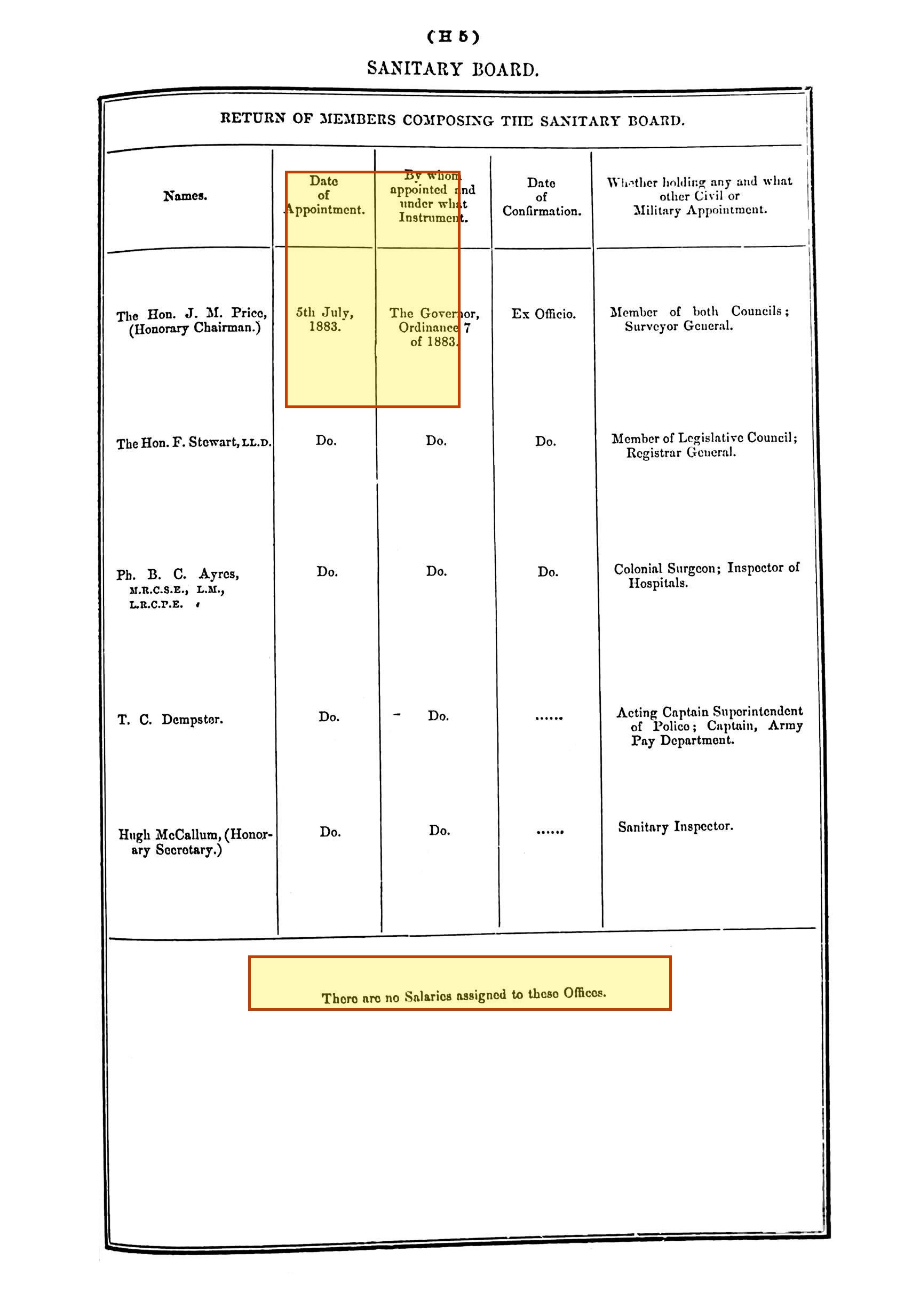
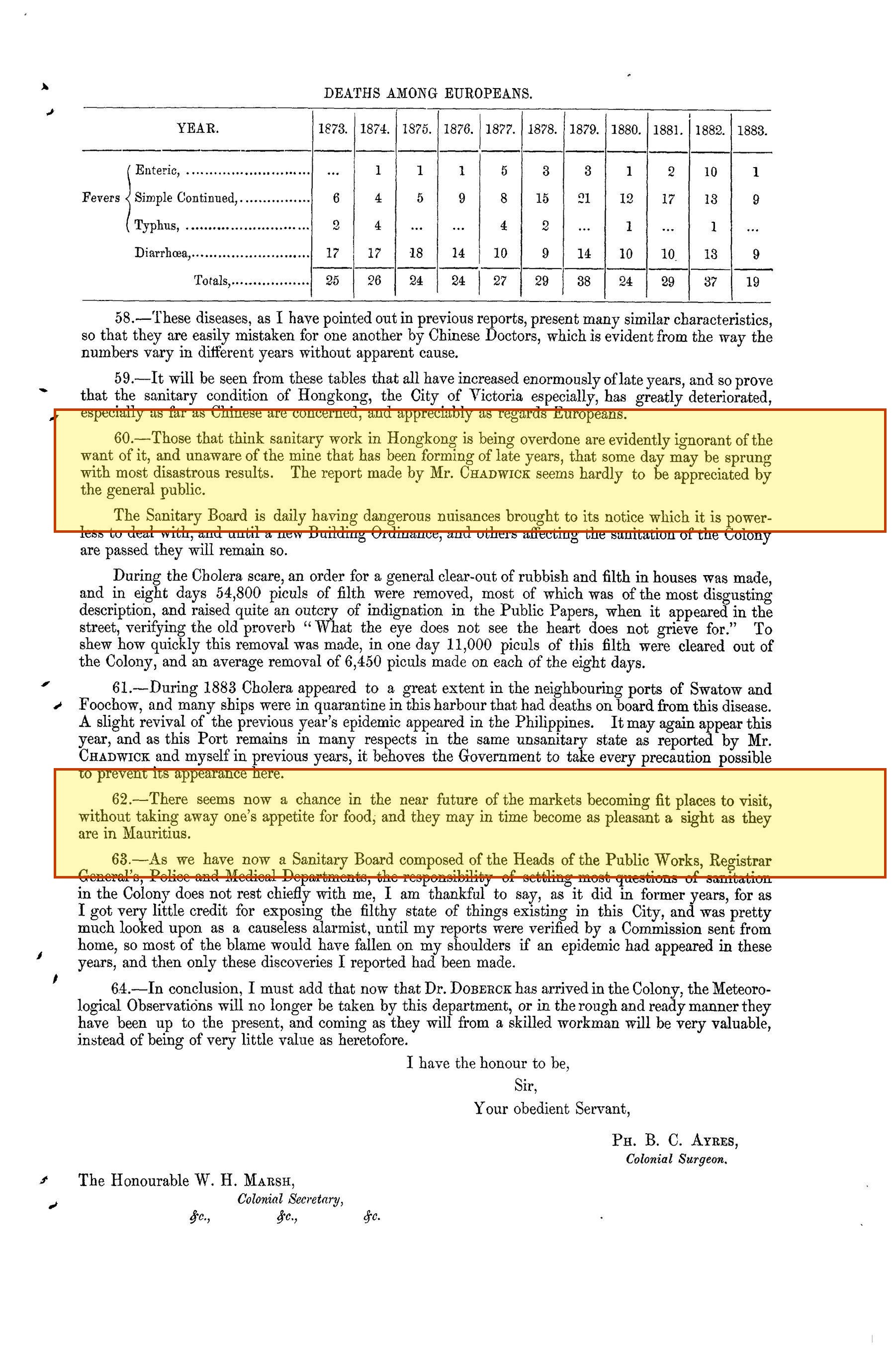
殖民地從這份知識建出了甚麼?1883年6月13日,《秩序與潔淨修訂條例》(第7號條例)設立常設潔淨局(潔淨局此一中文名,在語料庫中最早見於1887年條例的中文文本);7月5日委出五位成員——工務司、撫華道(Registrar General)、Colonial Surgeon(政府首席醫官)、警察總監及名譽秘書——而《藍皮書》自己寫明:「這些職位並無薪酬。」2 報紙說主席 Price 的「翅膀終於被剪」。殖民醫官在1883年年報直言:潔淨局「每日接獲危險的滋擾舉報,卻無力處理」,而查德威的報告「似乎不大受公眾欣賞」。3 1887年《公共衛生條例》(第24號)重組潔淨局,並首次給華人兩個席位;但到1895年,護督報告「前任華人成員辭職後,找不到任何華人紳商願意填補空缺」,他們「寧願衛生事務由官府直接管轄」。4 1896年,總督羅便臣兩次建議乾脆廢除潔淨局,經費支絀的折衷草案又引起英籍居民反對,於是舉行了331票對31票的「公民投票」——「投前者的華人只有三四名,投後者的一個也沒有」;殖民地部最終在1896年11月把整個問題擱置:「以公民投票尋求指引,與皇家殖民地政府體制不符。」56 1901年的《公共衛生條例》保留了1887年的架構,華人兩席仍在。7
一、問題與材料
本文的問題是:1881至1883年間,殖民地手上已經有一份完整的公共衛生調查,它據此建成了甚麼機器、由誰反對、而這一切在1894年鼠疫之前的十年裏又值多少?材料以 hkintexts 語料庫(只讀)為主:殖民地部的原始檔案(CO 129/204、205、207、269、272)、定例局(立法局)紀錄、憲報、藍皮書、年報、定例局文件(Sessional Papers)、以及1882至1884年的報刊(《孖剌西報》、《士蔑新聞》、《德臣西報》)。查德威報告本身在語料庫中有兩個印本:CO 882 東方38號(打字本)與《publications》系列的影像掃描本。89
二、報告:一份專業調查的全部
報告分三部分:第一部份描述現狀(城市、房屋構造與排水、街道、下水道、供水、清掃與糞便處理);第二部份指出缺陷,並先交代華人的健康狀況與死亡率;第三部份寫村落與九龍半島。另有三個附錄——房屋排水、公廁、潮流——與分區圖則;軍營衛生另有專報。10 報告的結論句後來被報紙引回殖民地自己身上:這些措施應「在必要被一場嚴重疫症以不可抗拒的邏輯證明之前」就實行。11
報告手上最有力的數字是死亡年齡:1881年維多利亞城全部死者的平均年齡為18.33歲(二十歲以上死者:男42.0、女46.0),而1840年全英格蘭是29.00歲,1878年克羅伊登是31.0歲。死亡率本身「最多只是不可靠的指引」,官方數字每千26至30,查德威認為高得「不能假定公共衛生狀況良好」。12 他的工程判斷同樣不留情:「全鎮的住宅都需要重新排水,不做這件事,健康改善不會有多少」;而費用應由公帑負擔——「強迫業主一次過付出巨款,去補救實際上得到官方認可的缺陷,是不公平的。」他又指出,要工務司或 Colonial Surgeon 親自監督衛生,「與他們的其他職務不能相容」,因此需要一名專責衛生官員。13
三、社群的答覆:200份問題紙
查德威記錄了他如何詢問華人:他把問題寫成具體題目,「以策劃的初步意念為基礎」,交給多個團體,「這些問題紙,為數接近200份,連同答覆交回我手上,有些附有相當詳盡的意見,顯示出深思與細心」。收件的團體是東華醫院委員會、兩個華人醫學會、天主教會、以及客家與華人基督教會;他解釋取樣的用意:東華委員會代表「有錢與置業的利益」,醫學會代表租客,教會則用以「更深入群眾」。14 隨後他在東華醫院開會,由 Ng-Choi、Y. Ayuk、何亞美傳譯;又與客家及華人基督教會另行開會。他總結華人的主要反對理由:「一是恐怕加稅,二是恐怕官府專橫干預,簡言之,怕『勒榨』(squeeze)。」1516
這些答覆確實改變了報告:東華委員會反對把糞便專利批給承辦商(運費會上升,挑糞工人失去肥料的價值);又「着重指出」體面人家的婦女不會使用公廁;公共浴場與洗衣房則是「由東華委員會向我指出」的。17 1882年12月13日,定例局議員 Johnson 已經就查德威的公共洗衣房建議詢問工務司——報告出爐只有數月,已在議事桌上使用。18
四、1883年:條例與無薪的潔淨局
1883年5月26日,憲報刊登《秩序與潔淨修訂條例》草案:第2條——「總督可設立常設潔淨局,監督與管制本殖民地一切與衛生有關的事務」,成員為工務司、撫華道、殖民醫官,另加總督委任的不少於兩名成員。19 6月13日憲報號外,條例正式制定(第7號條例),第3至6條帶出實際權力:處理過擠房屋、拒絕入屋者可罰、傳染病者的移送、以及消毒費用「撥歸潔淨局」。20 倫敦的回覆卻是延後:殖民地大臣「暫不就查德威的整套住宅與街道排水計劃發出詳細或確切的指示,直至聽到你建議如何進行」,以免過度壓迫工務司的人手或殖民地庫房。21
7月5日,潔淨局委出:工務司 Price(名譽主席)、撫華道 Stewart、Colonial Surgeon Ayres、警察總監 Dempster、名譽秘書兼衛生督察 McCallum——藍皮書的委任欄引「第7號條例」,並在欄末寫明「這些職位並無薪酬」。22 5月,定例局已先撥出人手:衛生督察月薪220元、華人書記及傳譯月薪40元。23 報紙對這份名單的看法帶着保留:主席 Price「終於剪了翅膀」,因為他的同僚「既不受嚇也不受哄」;Ayres 因多年前的報告而懂衛生,Stewart 則「常識、獨立與實幹」。24
五、潔淨局的機器、敵人與成績
潔淨局開工的第一批工程是公廁與村落:向財務委員會申請3,800元,在油麻地建三座、紅磡建兩座免費公廁;紅磡的狀況被形容為「對公眾健康構成嚴重危險,被公眾視為政府的恥辱」,需要5,000元去擴闊街道、廢除臭水井、填平泥灘及做基本排水;另有300元的示範糞船與各涌口的沉沙井,「全部符合查德威的建議」。25 但敵意同樣存在:1883年9月的報章專欄譏諷這是「名字嚴重改錯了的潔淨局」,又抱怨它「硬要干預挑糞工人的糞桶,毫無分寸」,並把查德威的警告引回殖民地身上。26
殖民醫官1883年年報是這一年最沉重的判詞:衛生狀況「大為惡化」;「近年形成的那個礦,總有一天會以最災難性的後果引爆」;潔淨局「每日接獲危險的滋擾舉報,卻無力處理」;霍亂恐慌期間八日清出54,800擔污物,而他自己當年被視為「無故驚慌的人,直到我的報告被倫敦派來的委員會證實」。27 1884年2月28日,總督寶雲在重開的定例局上說,第7號條例下的潔淨局「已經帶來本殖民地實際衛生上的顯著改善」,並提出一筆「適度的公共借款」去進行工程:油麻地與銅鑼灣的填海、下水道擴建、新中央街市、石鼓洲的永久檢疫所、海旁疏濬、村落衛生,以及黃泥涌馬場沼澤的排水與公園。28
六、1887年:重組,與華人的兩個席位
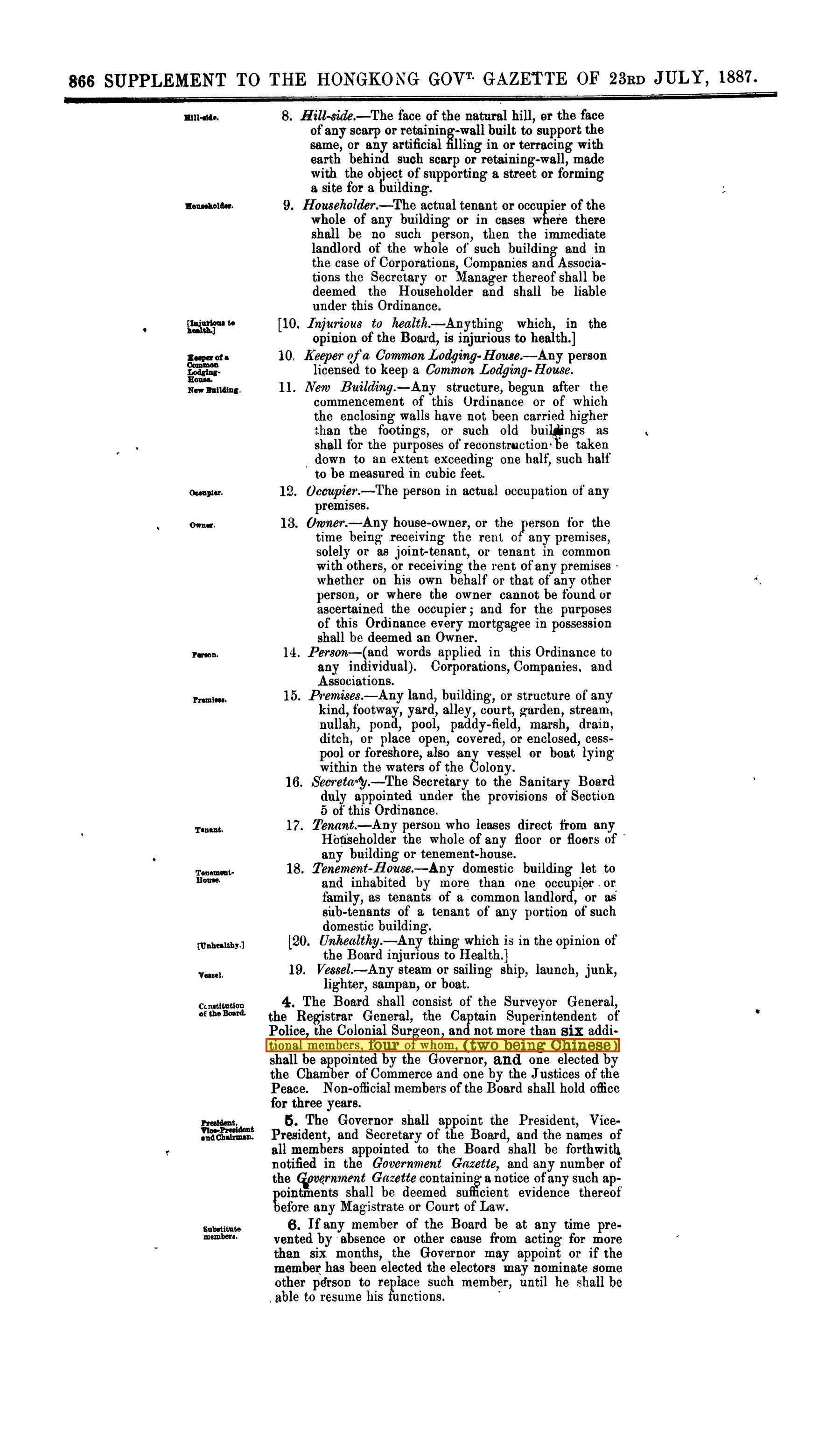
1887年7月23日憲報號外的《公共衛生條例》(第24號)重組潔淨局。第4條(首次刊印本):「潔淨局由工務司、撫華道、總緝捕官、Colonial Surgeon,以及不多於六名額外成員組成,其中四名(兩名須為華人)由總督委任,一名由商會選出,一名由太平紳士選出。」29 第67條把查德威的標準寫成法律:「任何住宅或其中部分,如居住密度超過每一成年人300立方呎的淨內部空間,即視為過擠,並屬滋擾。」附表A則廢除了1883年的第7號條例。30 1887年4月30日憲報刊出的潔淨局會議紀錄,出席者包括何啟(Dr. Ho Kai)——兩個華人席位確曾有人出任。31
七、1895至1896年:廢除潔淨局的嘗試,與被擱置的問題
1895年,總督羅便臣呈上廢除建議:潔淨局「應予廢除」,衛生事務交由醫療部門首長負責(工程性質者歸工務司);他在同一份文件報告:前任華人成員辭職後,找不到任何華人紳商願意填補空缺,他們「寧願衛生事務由官府直接管轄」。3233 羅便臣其後接受折衷草案——「三名官方成員加兩名由納稅人選出的非官方成員」。34 1896年3月10日,草案首讀時被 Whitehead 以「劇烈、徹底而倒退」為由動議押後一個月,何啟和議。35
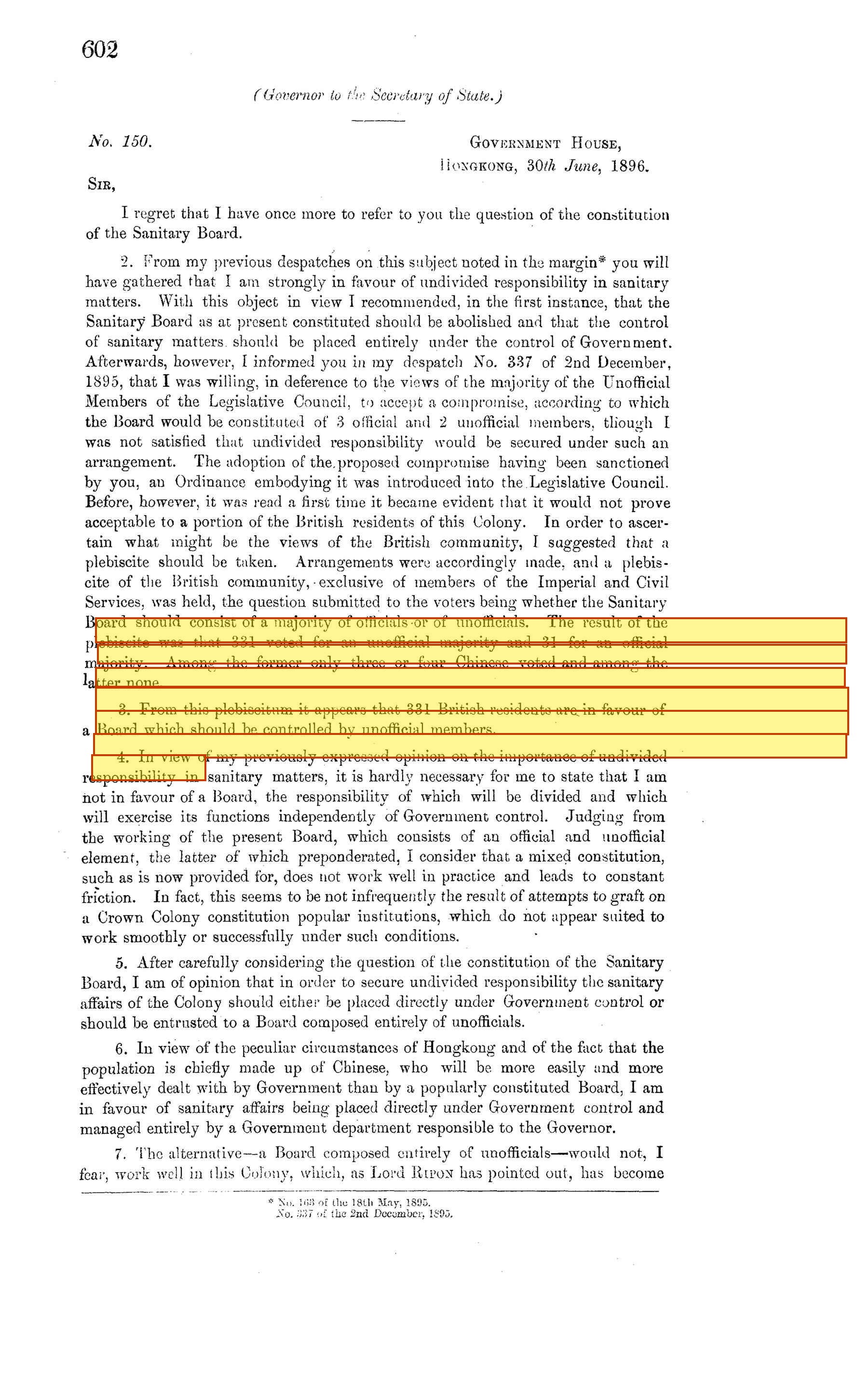
壓倒性的理由來自一次「公民投票」:英籍居民(不包括帝國及民政公務員)就「潔淨局應以官方抑或非官方佔多數」投票,結果331票對31票;「投前者(非官方多數)的華人只有三四名,投後者的一個也沒有」。羅便臣向倫敦寫道:香港人口25萬,華人約24.3萬,衛生事務「主要關係華人」。36 1896年11月6日,殖民地大臣張伯倫(Chamberlain)決定擱置:「以我看,潔淨局按現行架構運作良好……以公民投票尋求指引,與皇家殖民地政府體制不符。」問題留給下一任總督。37 1901年的《公共衛生條例》(第10號)重訂第4條,1887年的「兩名須為華人」仍然在內——被刪去的版本從未成為法律。38
結論
1882年的報告把殖民地自己的死亡率、死亡年齡與底土攤在紙上;查德威要求的是一名專責衛生官員,殖民地卻建了一個委員會,成員無薪,主席是報紙說要剪翅膀的工務司,而它在自己的年報裏被形容為「無力處理」。1887年的重組把標準寫成法律,也給了華人兩個席位——這兩個席位後來被辭去、無人接替,理由與1882年那200份問題紙的答案一樣:華人怕的是稅與「勒榨」,而寧取官府的直接管轄。1896年的擱置把整個問題留給時間:距離查德威警告「不可抗拒的邏輯」,還有不到十年。3940
The Knowledge and the Board
Chadwick’s report and Hong Kong’s first Sanitary Board, 1881–1896
Abstract
In 1882 the Hong Kong government had in its hands a complete professional survey of its own sanitary condition: Osbert Chadwick’s report, transmitted to London on 21 July 1882 with its appendix and plans following on 20 September, and printed for Parliament. It reported officially published death-rates of Chinese at 26 to 30 per 1,000 and a mean age at death in Victoria for 1881 of 18·33 years, against 29·00 for All England in 1840. This paper follows what the colony built out of that knowledge. Chadwick had consulted the Chinese community before he wrote — nearly two hundred question papers returned, a meeting at the Tung-Wa Hospital, with Ng-Choi, Y. Ayuk and Ho Amei 何亞美 interpreting, and the recorded objections of taxation and “squeeze”. The colony built a Board of five officials with no salaries, which its own Colonial Surgeon reported “powerless to deal with” the nuisances brought to it. The 1887 reconstitution wrote Chadwick’s overcrowding standard into law and gave the community two Chinese seats — seats that were then resigned and left empty. When the Governor moved to abolish the Board in 1895, the Colonial Secretary reported that no leading Chinese gentleman would take them, all preferring direct Government control. The compromise bill was met by a plebiscite of the British community — 331 for an unofficial majority, 31 for an official one, and only three or four Chinese among the former — and Whitehall closed the question in November 1896: inconsistent with Crown Colony government to seek the guidance of a plebiscite. The 1901 consolidation kept the 1887 form; the knowledge outlasted every instrument built on it. 41
1. The report and the man
The instrument was an outside engineer. Osbert Chadwick, an Associate Member of the Institution of Civil Engineers, was engaged through Downing Street — the despatch of 8 December 1881 sets the inquiry in motion — and worked in the colony during 1882, inspecting “the various quarters of the town, the waterworks” and the sewers, and forming his idea of “the average condition of the dwellings of the working classes”. The manuscript report went to the Crown Agents and reached the Colonial Office through Governor Marsh’s despatch; the appendix and plans followed on 20 September 1882, with a Colonial Office minute hoping “a dozen copies will do for Hong Kong, telling them to be careful of them”. The file records the fee — £669.3.9 — and the side-commissions Chadwick took on: a report on the water supply of Canton, “at the request of certain Chinese”, and tidal observations for the colony. 42 The report was printed as Eastern No. 38, “Mr. Chadwick’s Reports on the Sanitary Condition of Hong Kong; with Appendices and Plans”, Colonial Office, November 1882. 43
Its structure is the surveyor’s: Part I describes the existing state — the city’s site and formation, house construction and drainage, streets, sewers, water supply, scavenging; Part II states the defects, opening with the health condition of the Chinese; Part III takes the villages and the Kowloon peninsula. Three appendices (house drainage, public latrines, tidal currents) and the district plans follow, and the sanitary surroundings of the barracks are treated in a separate report. 44 The report ends on the sentence the decade would answer: the measures should be undertaken “without waiting for the necessity, to be demonstrated by the irresistible logic of a severe epidemic”. 45
2. What the report found
The report’s own numbers are its argument. The officially published death-rates of Chinese varied “from 26 to 30 per 1,000”, which Chadwick took as “far too high to permit the assumption of a good state of public health”; and because death-rates in a shifting population are “at best but uncertain guides”, he checked them against the mean age at death of every Chinese who died in 1881. The table he built gives Victoria, Hong Kong, in 1881 a mean age at death of 18·33 years, against All England, 1840, at 29·00 and Croydon, 1878, at 31·0. On the colony’s epidemic luck he was explicit: the settlement was but forty years old and the subsoil might not “yet be sufficiently saturated with filth to make it a hot-bed for disease… the process of saturation is slowly but surely going on”. 46
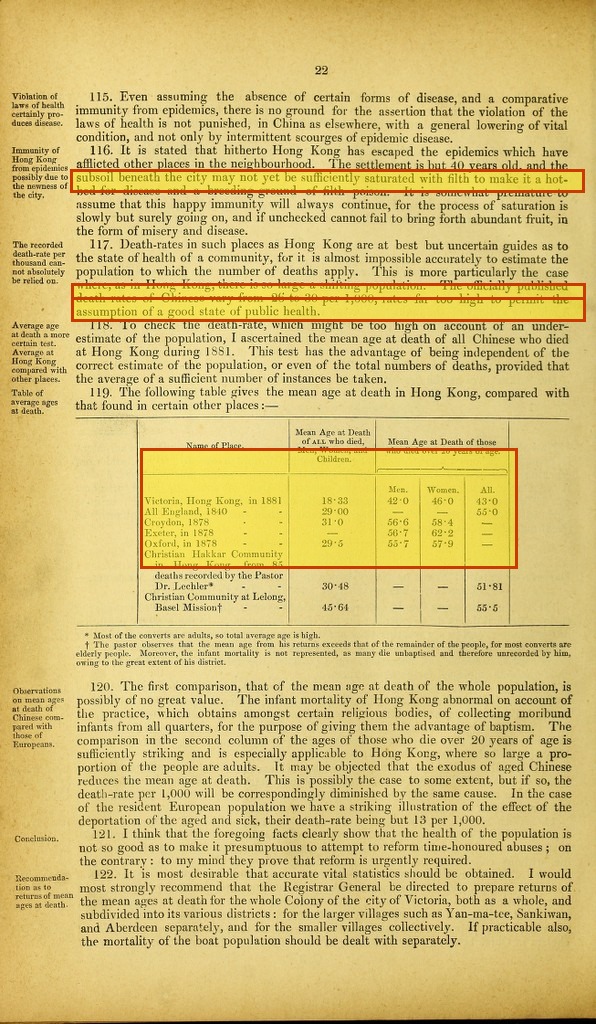
The engineering doctrine was as unsparing. “The system of house drainage is radically bad. The whole of the dwellings within the town require re-draining, and unless this is done but little health-improvement will be made.” The remedy was, deliberately, public expense: “It is unjust to compel a landlord to pay a lump sum for remedying defects which have virtually received official sanction… it will be just and expedient for the Government to pay for their execution out of general revenue.” The dry-earth system was “inapplicable to Hong Kong”; the improved bucket system had to continue; public latrines should be bought by Government, improved, multiplied and “thrown open to the public gratis”. And the institutional recommendation is the one the colony did not take: “an organised sanitary staff is required, operating under the personal direction of a responsible European officer… That either the Colonial Surgeon or the Surveyor General should be required to exercise the necessary personal supervision, is incompatible with their other duties.” 47
3. The community’s answer
Chadwick did not write from the outside. The subject being new to those he meant to consult, he put it in definite form: “I therefore drew up a series of questions which embodied the crude ideas which I had formed, and submitted them to certain bodies, both collectively and individually. These question papers, of which to the number of nearly two hundred, were returned to me with replies, in some cases with remarks of considerable length, showing much enlightened thought and care.” The bodies were the “Tung-Wa” Hospital Committee, the two Associations of Chinese Medical Practitioners, the Roman Catholics, and the Chinese and Hakka Christian Churches — chosen deliberately: the Tung-Wa Committee “obviously represents the moneyed and house-owning interests”, the medical associations the tenants, and the churches the deepest layer of the population. 48
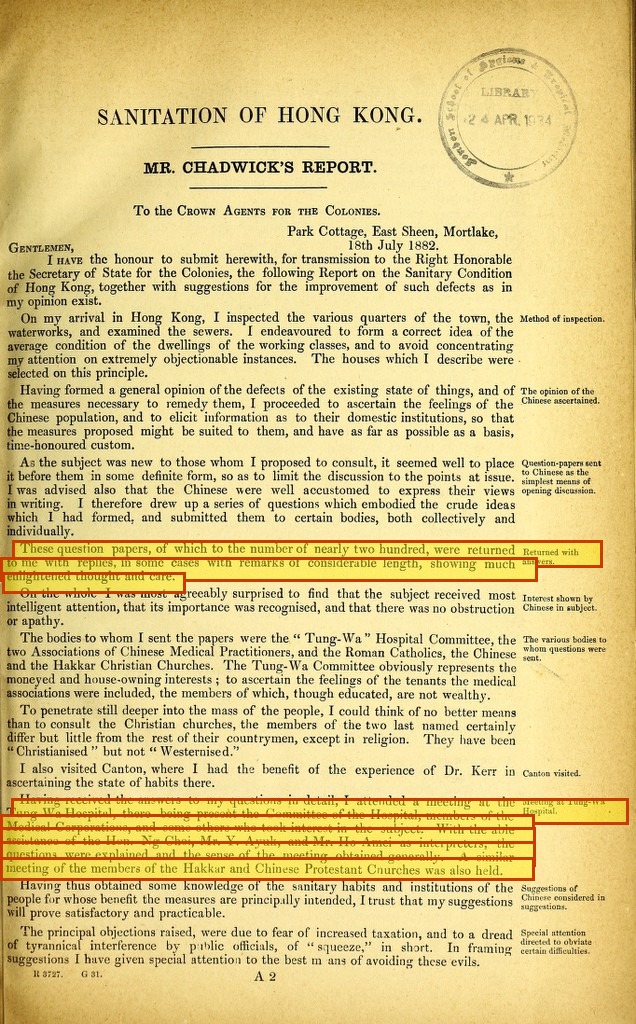
He then met them. “Having received the answers to my questions in detail, I attended a meeting at the Tung-Wa Hospital, there being present the Committee of the Hospital, members of the Medical Corporations, and some others who took interest in the subject. With the able assistance of the Hon. Ng-Choi, Mr. Y. Ayuk, and Mr. Ho Amei as interpreters, the questions were explained and the sense of the meeting obtained generally”; a similar meeting followed with the Hakka and Chinese Protestant churches. Ho Amei 何亞美 is the corpus’s own identification (Ho Hsien-chih 何獻鄰, named in the Royal Asiatic Society’s Journal for 1982); the other two interpreters are given in the report’s romanization, no Chinese form having been verified. 49 The objections he recorded are the answer to any reading of the report as a technical exercise: “The principal objections raised, were due to fear of increased taxation, and to a dread of tyrannical interference by public officials, of ‘squeeze’ in short. In framing my suggestions I have given special attention to the best means of avoiding these evils.” 50
Three of the community’s answers are visible in the report’s own text. The night-soil monopoly: the Tung-Wa Committee objected that giving the monopoly to a contractor would raise the cost of removal, since the coolie would no longer have the manure to sell. Public latrines and women: the Committee stated “emphatically” that women of the better classes would not use places “resorted to by others”. And baths and laundries: “the want of baths for the poor, also public laundries… The second want was pointed out to me by the Tung-Wa Committee.” That last recommendation reached the Legislative Council within months: on 13 December 1882 a member asked the Surveyor General whether, with the Tytam water works, he would give effect to “the suggestions of Mr. CHADWICK as to the establishments of public Laundries”. 51 52
4. The ordinance and the unpaid Board
The Bill was gazetted on 26 May 1883. It was an amendment to the Order and Cleanliness Ordinance of 1867, and its second clause is the whole institution: “The Governor may constitute a permanent Sanitary Board to exercise supervision and control over all matters connected with Sanitation in the Colony. The Board shall consist of the Surveyor General, the Registrar General and the Colonial Surgeon for the time being, and of such other members not less than two in number as the Governor may from time to time appoint.” 53
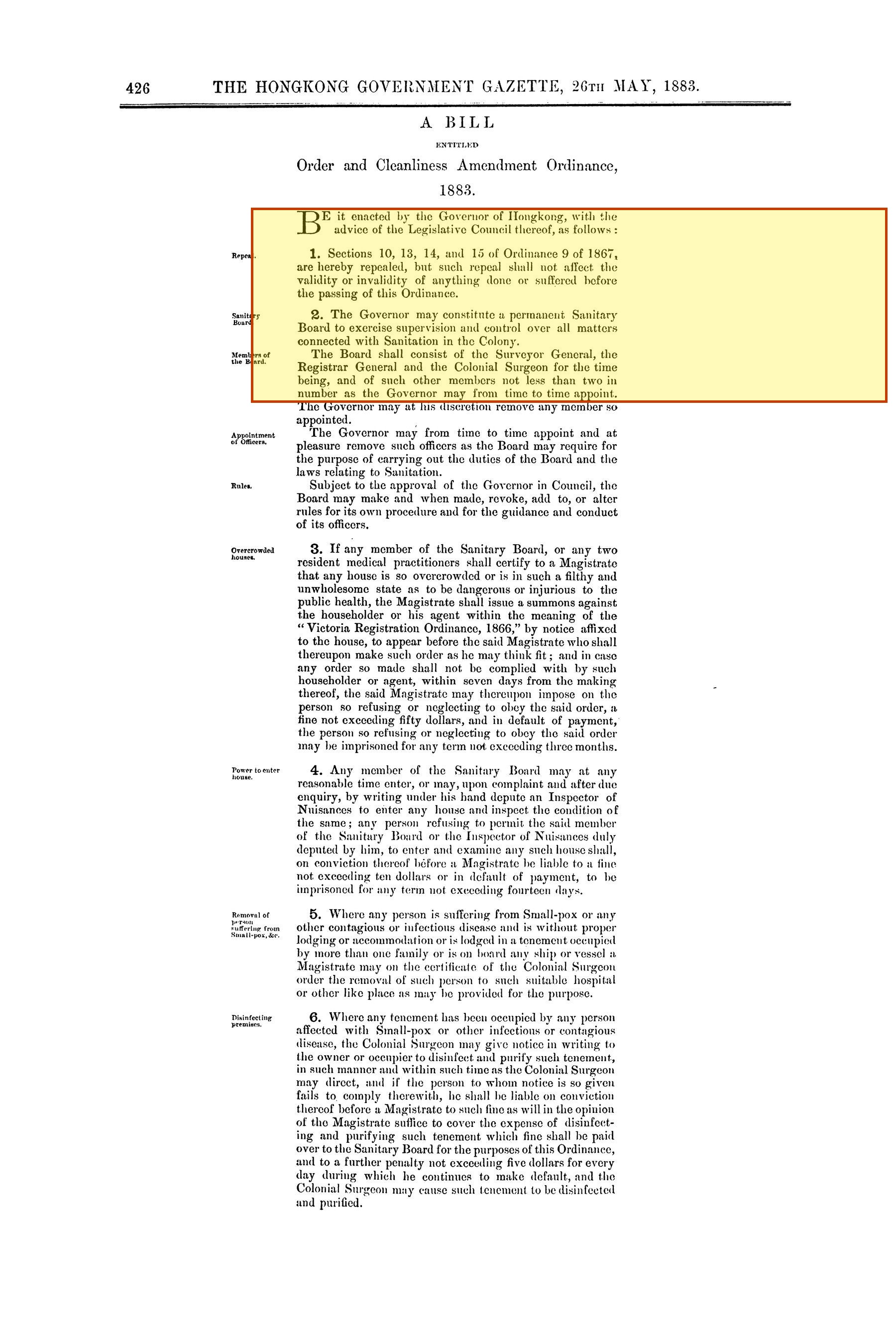
The Ordinance — No. 7 of 1883, the Order and Cleanliness Amendment Ordinance, gazetted in an Extraordinary on 13 June 1883 — carried working powers in its ss. 3–6: the handling of overcrowded houses on a magistrate’s order, entry by the Inspector of Nuisances, the removal of small-pox and contagious cases, and the disinfection of premises, the fine in that last case being “paid over to the Sanitary Board”. 54 The Secretary of State’s reply, laid before the Council in February 1883, deferred the substance: “I defer giving any detailed or precise instructions on Mr. Chadwick’s scheme for introducing a complete system of house and street drainage into the town, until I hear what course you would recommend in order that this great work may be so regulated as not to press unduly on the strength of the Surveyor General’s Staff or on the Colonial Revenue.” The same despatch asked for “the name of an officer fitted to undertake the duties” — the officer Chadwick had asked for, and the colony had not appointed. 55
The Board was appointed on 5 July 1883, and the Blue Book’s own return is the institution’s epitaph: Price (Surveyor General) as Honorary Chairman, Stewart (Registrar General), Ayres (Colonial Surgeon), Dempster (Acting Captain Superintendent of Police), and McCallum as Honorary Secretary and Sanitary Inspector — “By whom appointed… The Governor, Ordinance 7 of 1883” — and, at the foot of the return, “There are no Salaries assigned to these Offices.” 56 The working arm had been voted in May, on the estimates: one Sanitary Inspector at $220 a month, one Chinese clerk and interpreter at $40. 57
The press read the appointments as a leash. The Telegraph of 23 April 1883: “Mr. PRICE is no doubt entitled to the position of chairman, and with the exuberance of his vivid imagination held closely in check by his practical colleagues some of whom are neither to be bullied nor cajoled — he is likely to do far more good with his wings clipped than ever was possible when his arbitrary rule was supreme.” 58
5. The Board at work — and its enemies
Its first programme was village sanitation. The Board asked the Finance Committee for $3,800 to build “three free public latrines in the village of Yaumáti and two in the village of Hung Hom”, and $5,000 for Hung Hom, “a source of grave danger to the Public Health, and… considered by the Public a reproach to the Government”; a model night-soil boat at $300 and catch-pits at the nullah mouths completed the list, “all in accordance with the recommendations of Mr. Chadwick”. 59
The hostility was real. In September 1883 the Telegraph attacked “this attempt to establish what is very grossly misnamed a Sanitary Board”, complaining that it “must needs interfere with the buckets of the night soil coolies. No discretion was used…” — and, in the same column, turned Chadwick’s warning back on the colony: the “primary and urgent necessity” of acting before “the irresistible logic of a severe epidemic”. 60
The Colonial Surgeon’s report for 1883 is the year’s verdict, and it came from inside the Board: the sanitary condition had “greatly deteriorated”; “the mine that has been forming of late years, that some day may be sprung with most disastrous results. The report made by Mr. CHADWICK seems hardly to be appreciated by the general public”; and “The Sanitary Board is daily having dangerous nuisances brought to its notice which it is powerless to deal with, and until a new Building Ordinance, and others affecting the sanitation of the Colony are passed they will remain so.” The cholera scare had cleared 54,800 piculs of filth in eight days; and Ayres added his own record of the price of warning early — he had been “looked upon as a causeless alarmist, until my reports were verified by a Commission sent from home”. 61
In February 1884 the Governor put the official account to the reconstituted Council: the Board under Ordinance No. 7 of 1883 and its new rules had been followed by “a marked improvement in the practical sanitation of the Colony”; Chadwick’s “strong and complete measures” were “absolutely necessary ‘for the immediate benefit of the public health’”; and the works could be had for a “moderate public loan”, since “the present generation of Colonists ought not to be deprived”. The list is the report’s own programme, item by item: the reclamation of unhealthy tidal lands at Yau-ma-Ti and Causeway Bay, sewer extensions, a new Central Market, a permanent lazaretto on Stone Cutters’ Island, the dredging of the Praya foreshore, the sanitation of the villages, and the drainage of the Wong Nei Chung racecourse marsh into a public park. 62
6. 1887: reconstitution, and two Chinese seats
The Public Health Ordinance, No. 24 of 1887, replaced the 1883 act (repealing it by name in Schedule A) and rebuilt the Board. Section 4, as first printed in the Supplement to the Gazette of 23 July 1887: “The Board shall consist of the Surveyor General, the Registrar General, the Captain Superintendent of Police, the Colonial Surgeon, and not more than six additional members, four of whom (two being Chinese) shall be appointed by the Governor, and one elected by the Chamber of Commerce and one by the Justices of the Peace.” 63 The same supplement carries the ordinance’s Chinese text — the corpus’s first use of 潔淨局 (23 July 1887). One caveat belongs here: the 1890 Historical Laws print of the same section assigns the two elected places to “such rate-payers as are included in the special and common jury lists” rather than to the Chamber and the magistracy, so the franchise changed between the first printing and the consolidation; each print is cited for its own moment. 64
Section 67 made Chadwick’s standard enforceable: every dwelling inhabited “in excess of a proportion of one adult to every three hundred cubic feet of clear internal space” was “to be considered… overcrowded… and shall be deemed a nuisance”. 65 And the seats were taken. The Board’s gazetted minutes for 30 April 1887 list, besides the officials, “Dr. P. MANSON… N. J. EDE, Esquire… Dr. Ho KAI” — the Chinese side of the s.4 appointees, sitting on mortality returns, the convents inquiry, and the bye-laws for overcrowding and common lodging-houses. 66
7. 1895–1896: the abolition attempted, and the question deferred
Within a year of the 1894 plague the Governor proposed to end the experiment. Sir William Robinson, Despatch No. 163 of 18 May 1895: “I therefore submit for your Lordship’s approval that the Sanitary Board as at present constituted be abolished and that the Head of the Medical Department… be made responsible… for the sanitary work of the Colony other than that of an engineering nature.” 67 The same despatch carries the finding that closes the community’s half of the story: “The Colonial Secretary and Registrar General also reports that it is not possible to find any leading Chinese gentleman who is willing to fill the vacancy on the Board caused by the resignation of the Chinese Members who formerly belonged to it, and that all those Chinese gentlemen whom he has approached on the subject… informed him that they would prefer the sanitation of the Colony to be under the direct control of the Government.” 68
London would not abolish without the Legislature, and the Legislature would not agree; the compromise that emerged was Robinson’s reluctant one — “three officials, viz., the Colonial Surgeon, the Director of Public Works, and the Captain Superintendent of Police, and two unofficial members to be elected by the ratepayers”. 69 When the bill reached the Council on 10 March 1896, T. H. Whitehead moved its postponement in words the record kept: the changes were “so drastic… so radical, and… so retrograde” that the papers should be read first — and Ho Kai seconded him. The first reading was postponed a month. 70
What decided it was a poll. In order to test opinion the Governor had a plebiscite taken of the British community, excluding the Imperial and Civil Services, on whether the Board should have an official or an unofficial majority. The result, in his own despatch of 30 June 1896: “331 voted for an unofficial majority and 31 for an official majority. Among the former only three or four Chinese voted and among the latter none.” Robinson noted the arithmetic of the colony in the same despatch — “Out of a population of 250,000, the Chinese amount to about 243,000” — and held to his own preference for “sanitary affairs being placed directly under Government control”. 71
On 6 November 1896 the Secretary of State closed it: “I understand the Board, as at present constituted, to be working well, and I consider that the question of its future constitution may well stand over to be dealt with, if necessary, hereafter by your successor… it is impossible that Hongkong should be other than a Crown Colony; it is inconsistent with Crown Colony government to seek the guidance of a plebiscite; and in no community whatever… can a satisfactory solution of a question, in which the whole body of the ratepayers and many outside that body are interested, be induced from an expression of the opinions of one section alone.” 72 The consolidation of 1901 re-enacted the Board in its 1887 shape, the two Chinese places included; the version put to the Council in 1895 was never law. 73
8. Conclusion
Two documents frame the fourteen years this paper covers. The first is Chadwick’s: a professional survey that told the colony its death-rates, its mean age at death, and that the ground under its houses was filling up — and which asked, in plain institutional terms, for one responsible officer to hold the work together. The second is Chamberlain’s, closing the file: the Board was working well, and a plebiscite was the wrong instrument for a Crown Colony. Between them the colony built, amended, resigned from, polled over and finally shelved the same body; and the standard Chadwick had arrived at — the mean age at death, the cubic feet per adult, the house re-drained — outlasted every constitution the Board was given. 7475
Notes
Chadwick’s report, the account of how he consulted the Chinese community: “As the subject was new to those whom I proposed to consult, it seemed well to place it before them in some definite form… I therefore drew up a series of questions which embodied the crude ideas which I had formed, and submitted them to certain bodies, both collectively and individually. These question papers, of which to the number of nearly two hundred, were returned to me with replies, in some cases with remarks of considerable length, showing much enlightened thought and care… The bodies to whom I sent the papers were the ‘Tung-Wa’ Hospital Committee, the two Associations of Chinese Medical Practitioners, and the Roman Catholics, the Chinese and the Hakkar Christian Churches. The Tung-Wa Committee obviously represents the moneyed and house-owning interests; to ascertain the feelings of the tenants the medical associations were included…” Plate 4; scan https://hkintexts.histsyn.com/image-page/1702702; text https://hkintexts.histsyn.com/page/701652 (accessed 29 October 2026). ↩
Blue Book 1883 (H 5), the return of the members composing the Sanitary Board: Price (Surveyor General), Honorary Chairman; Stewart (Registrar General); Ayres (Colonial Surgeon); Dempster (Acting Captain Superintendent of Police); McCallum (Honorary Secretary; Sanitary Inspector) — “By whom appointed… The Governor, Ordinance 7 of 1883”, 5 July 1883 — and, at the foot, “There are no Salaries assigned to these Offices.” Plate 3; image https://hkintexts.histsyn.com/image-page/2186963; text https://hkintexts.histsyn.com/page/660108 (accessed 28 October 2026). ↩
Annual Report 1883, the Colonial Surgeon’s report (Ph. B. C. Ayres to Marsh), §§59–63: “the sanitary condition of Hongkong… has greatly deteriorated”; “the mine that has been forming of late years, that some day may be sprung with most disastrous results. The report made by Mr. CHADWICK seems hardly to be appreciated by the general public”; “The Sanitary Board is daily having dangerous nuisances brought to its notice which it is powerless to deal with, and until a new Building Ordinance, and others affecting the sanitation of the Colony are passed they will remain so”; the cholera scare’s clear-out of 54,800 piculs of filth in eight days (11,000 in one day); and Ayres’s own retrospection — “I got very little credit… and was pretty much looked upon as a causeless alarmist, until my reports were verified by a Commission sent from home.” Plate 5; image https://hkintexts.histsyn.com/image-page/417141; text https://hkintexts.histsyn.com/page/612674 (/612678) (accessed 28 October 2026). ↩
Governor Sir W. Robinson to the Secretary of State, Despatch No. 163, 18 May 1895: “The Colonial Secretary and Registrar General also reports that it is not possible to find any leading Chinese gentleman who is willing to fill the vacancy on the Board caused by the resignation of the Chinese Members who formerly belonged to it, and that all those Chinese gentlemen whom he has approached on the subject, while expressing their unwillingness or incapability to serve, informed him that they would prefer the sanitation of the Colony to be under the direct control of the Government.” Sessional Papers 1896, printed p. 598, https://hkintexts.histsyn.com/page/1818666 (accessed 29 October 2026). ↩
Robinson to Chamberlain, Despatch No. 150, 30 June 1896, printed p. 602: “a plebiscite of the British community, exclusive of members of the Imperial and Civil Services, was held, the question submitted to the voters being whether the Sanitary Board should consist of a majority of officials or of unofficials. The result of the plebiscite was that 331 voted for an unofficial majority and 31 for an official majority. Among the former only three or four Chinese voted and among the latter none.” And: “3. From this plebiscitum it appears that 331 British residents are in favour of a Board which should be controlled by unofficial members.” The despatch also fixes the population: “Out of a population of 250,000, the Chinese amount to about 243,000, and it is with sanitation among the Chinese that a Board… must be chiefly concerned.” Plate 7; https://hkintexts.histsyn.com/image-page/1610046; text /1818670 (/1818671) (accessed 29 October 2026). ↩
Chamberlain to Robinson, 6 November 1896: “I understand the Board, as at present constituted, to be working well, and I consider that the question of its future constitution may well stand over to be dealt with, if necessary, hereafter by your successor… I think that, on reflection, you must concur with me that in taking a plebiscite of the British community exclusive of the members of the Government services the situation has been much complicated… it is impossible that Hongkong should be other than a Crown Colony; it is inconsistent with Crown Colony government to seek the guidance of a plebiscite; and in no community whatever… can a satisfactory solution of a question, in which the whole body of the ratepayers and many outside that body are interested, be induced from an expression of the opinions of one section alone.” https://hkintexts.histsyn.com/page/1818672 (accessed 29 October 2026). ↩
Public Health Ordinance, No. 10 of 1901, s.4(1) — the consolidation retaining the 1887 constitution: “The Sanitary Board shall consist of the Director of Public Works, the Registrar General, the Captain Superintendent of Police, the Principal Civil Medical Officer, and (if appointed by the Governor) the Medical Officer of Health, and not more than six additional members, four of whom (two being Chinese) shall be appointed by the Governor, and two elected by such ratepayers as are included in the Special and Common Jury Lists…” https://hkintexts.histsyn.com/page/1840689 (accessed 29 October 2026). ↩
Research note. The battery ran on the hkintexts corpus (read-only Elasticsearch) in query families: the Board and the man (“Sanitary Board” 10,000+ capped; “Osbert Chadwick” 539; “sanitary condition of Hongkong” 179), the ordinance family (“Sanitary Board Ordinance” 16; the act’s own title “Order and Cleanliness Amendment” 21 in the image series), the Chinese-name sweep (潔淨局 336; 衛生局 3,424, all post-war), and the press window of 1882–84 (“Sanitary Board” 57; “Chadwick” 102; “nuisance” 325 pages). One whole-document pull anchors the thread: CO 129/204 [11–12], 449 pages — the report’s transmission file. Access 28–29 October 2026. ↩
“Mr. Chadwick’s Reports on the Sanitary Condition of Hong Kong; with Appendices and Plans. Colonial Office, November 1882” — Eastern No. 38; the corpus’s printed copy is CO 882, https://hkintexts.histsyn.com/page/701651 (title), /701652 (contents and the report’s own abstract). A second scan of the printed report, page-imaged, is in the publications series, https://hkintexts.histsyn.com/image-page/1702701 (contents) (accessed 29 October 2026). ↩
The report’s own arrangement, from its printed contents: Part I, description of existing state (the city, house construction and drainage, streets, sewers, water, scavenging); Part II, defects (the health condition of the Chinese — death-rate — then the dry-earth system, house drainage, streets, sewers, water, scavenging, and the sanitary staff); Part III, the villages and Kowloon; Appendix 1 (house drainage), Appendix 2 (public latrines), Appendix 3 (tidal currents); and the district plans. Separate: the report on the sanitary surroundings of the Barracks, with a ventilation appendix. https://hkintexts.histsyn.com/page/701658 (accessed 29 October 2026). ↩
Chadwick’s report, closing passage: “I trust that even should these suggestions be found undesirable or impracticable, my report will show the necessity for strong and complete measures of sanitation, and I trust that they will be undertaken for the immediate benefit of the public health, without waiting for the necessity, to be demonstrated by the irresistible logic of a severe epidemic.” https://hkintexts.histsyn.com/page/701653 (accessed 29 October 2026). Emphasis added. ↩
Chadwick’s report, Part II, §§115–119: “The settlement is but 40 years old, and the subsoil beneath the city may not yet be sufficiently saturated with filth to make it a hot-bed for disease and a breeding ground of filth poison… the process of saturation is slowly but surely going on”; “the officially published death-rates of Chinese vary from 26 to 30 per 1,000, rates far too high to permit the assumption of a good state of public health”; and the mean-age-at-death table: Victoria, Hong Kong, in 1881 — 18·33 years for all who died (men 42·0, women 46·0 over twenty), against All England, 1840 — 29·00, and Croydon, 1878 — 31·0. Plate 2; scan https://hkintexts.histsyn.com/image-page/1702747; text https://hkintexts.histsyn.com/page/701677 (accessed 29 October 2026). ↩
The report’s engineering doctrine: “The system of house drainage is radically bad. The whole of the dwellings within the town require re-draining, and unless this is done but little health-improvement will be made”; the remedy is public — “It is unjust to compel a landlord to pay a lump sum for remedying defects which have virtually received official sanction… it will be just and expedient for the Government to pay for their execution out of general revenue”; the dry-earth system “is inapplicable to Hong Kong” and the bucket system must continue improved; public latrines “should be acquired by Government, improved, their number increased, and they should be thrown open to the public gratis”; and the sanitary staff — “an organised sanitary staff is required, operating under the personal direction of a responsible European officer… That either the Colonial Surgeon or the Surveyor General should be required to exercise the necessary personal supervision, is incompatible with their other duties.” https://hkintexts.histsyn.com/page/701653 (accessed 29 October 2026). ↩
Chadwick’s report, the consultation passage. ↩
The meeting and the interpreters, in the same account: “Having received the answers to my questions in detail, I attended a meeting at the Tung-Wa Hospital, there being present the Committee of the Hospital, members of the Medical Corporations, and some others who took interest in the subject. With the able assistance of the Hon. Ng-Choi, Mr. Y. Ayuk, and Mr. Ho Amei as interpreters, the questions were explained and the sense of the meeting obtained generally. A similar meeting of the members of the Hakker and Chinese Protestant Churches was also held.” Plate 4; https://hkintexts.histsyn.com/image-page/1702702 (accessed 29 October 2026). Ho Amei 何亞美 (Ho Hsien-chih 何獻鄰) is the corpus’s own identification (Royal Asiatic Society Journal, 1982, p. 89, https://hkintexts.histsyn.com/page/209432); the other two names are given here in the report’s romanization, no Chinese form having been verified. ↩
Chadwick’s summary of what the community told him: “The principal objections raised, were due to fear of increased taxation, and to a dread of tyrannical interference by public officials, of ‘squeeze’ in short. In framing my suggestions I have given special attention to the best means of avoiding these evils.” https://hkintexts.histsyn.com/image-page/1702702 (accessed 29 October 2026). ↩
Three answers that shaped the report. (a) The night-soil monopoly — “In reference to a suggestion that the monopoly of night-soil should be given to a contractor, the Tung-Wa Hospital Committee objected that to do so would increase the cost of removal, the coolie who carried it away no longer being able to dispose of the manure, and that therefore he would charge more for his services” (the report answers the objection at length and keeps the recommendation). (b) Latrines and women — “A single latrine for the inhabitants of a house comprising several families would not be in accordance with Chinese custom. Women, of the better classes at least, would continue to use pots; they distinctly object to places resorted to by others; this was emphatically stated by the Tung-Wa Hospital Committee.” (c) Baths and laundries — “I would call attention to the indifferent condition of the markets, and the want of baths for the poor, also public laundries. The second want was pointed out to me by the Tung-Wa Committee.” https://hkintexts.histsyn.com/page/701675 (/701680, /701653) (accessed 29 October 2026). ↩
Legislative Council, 13 December 1882 (special session): Mr. Johnson asks the Surveyor General “whether in connection with the Tytam Water Works he has taken into consideration and will recommend the Government to give effect to the suggestions of Mr. CHADWICK as to the establishments of public Laundries” — the report in use at the Council table seven months before the ordinance, https://hkintexts.histsyn.com/page/1881380 (accessed 29 October 2026). ↩
Gazette, 26 May 1883, printed p. 426 — “A BILL entitled an Ordinance to amend the Order and Cleanliness Ordinance, 1867”: the enacting clause, s.1 (repealing ss. 10, 13, 14 and 15 of Ordinance No. 9 of 1867) and s.2: “The Governor may constitute a permanent Sanitary Board to exercise supervision and control over all matters connected with Sanitation in the Colony. The Board shall consist of the Surveyor General, the Registrar General and the Colonial Surgeon for the time being, and of such other members not less than two in number as the Governor may from time to time appoint.” Image, plate 1: https://hkintexts.histsyn.com/image-page/1519461 (accessed 28 October 2026). ↩
The enactment, Gazette Extraordinary, 13 June 1883, printed p. 480 — the Order and Cleanliness Amendment Ordinance, 1883, No. 7 of 1883; its home clause s.2 as in the Bill, with ss. 3–6 carrying the working powers (overcrowded houses: a magistrate’s order, fine not exceeding $50 or three months; entry by the Inspector of Nuisances on refusal, fine not exceeding $10; the removal of small-pox and contagious cases; the disinfecting of premises, the fine “paid over to the Sanitary Board”). Text https://hkintexts.histsyn.com/page/1664295; images, the same leaf run, https://hkintexts.histsyn.com/image-page/1519512 (accessed 28–29 October 2026). Do not cite “No. 3 of 1883” — that was the Companies Ordinance Amendment. ↩
The Secretary of State’s deferral, laid before the Council 27 February 1883 and printed in the Hongkong Telegraph of 28 February and 6 March 1883: “I defer giving any detailed or precise instructions on Mr. Chadwick’s scheme for introducing a complete system of house and street drainage into the town, until I hear what course you would recommend in order that this great work may be so regulated as not to press unduly on the strength of the Surveyor General’s Staff or on the Colonial Revenue”; and “it will be necessary, as pointed out by Mr. Chadwick, that the Government should carefully watch the proceedings of the Contractor… I request you to consider Mr. Chadwick’s recommendations on this head and report to me the name of an officer fitted to undertake the duties.” https://hkintexts.histsyn.com/page/2825425 (/2825433) (accessed 29 October 2026). The Administrator’s words to the Council — “the report… is in the possession of every member of the Council” — are on the same page. ↩
Blue Book 1883 (H 5), the Board return. ↩
Legislative Council, 26 May 1883, the Sanitary Staff votes: “Salaries from 1st April to 30th November, 1883 — 1 Sanitary Inspector, at $220 per month ($1,760.00); 1 Chinese Clerk and Interpreter, at $40 per month ($320.00); 1 Senior Inspector of Nuisances, additional salary at $15…” https://hkintexts.histsyn.com/page/1881387 (accessed 28 October 2026). The Blue Book’s own staff row names “No. 211 Pang Sau-chun, Clerk & Interpreter Sanitary Board”. ↩
Hongkong Telegraph, 23 April 1883, p. 2 — the appointment reported with the press’s verdict on the Board’s composition: “Mr. PRICE is no doubt entitled to the position of chairman, and with the exuberance of his vivid imagination held closely in check by his practical colleagues some of whom are neither to be bullied nor cajoled — he is likely to do far more good with his wings clipped than ever was possible when his arbitrary rule was supreme. Dr. AYRES has, judging by the famous report he wrote some years ago, made sanitation a special study, and ought therefore to render most valuable assistance, while Dr. STEWART’s sound common sense, sturdy independence and thoroughly practical acquaintance with the [subject]…” https://hkintexts.histsyn.com/page/2825601 (accessed 29 October 2026). ↩
Hongkong Telegraph, 20 July 1883, p. 4 — the Board’s programme as sent to the Finance Committee: “The Sanitary Board, however, would respectfully submit the necessity of building, with as little delay as possible, three free public latrines in the village of Yaumáti and two in the village of Hung Hom, and would request for this purpose a grant of $3,800”; on Hung Hom — “In its present condition Hung Hom is a source of grave danger to the Public Health, and it is considered by the Public a reproach to the Government. Money is needed to widen, straighten, and level the village street, and lanes, to abolish putrid cess-pools, to reclaim an offensive mud foreshore, and to carry out elementary drainage works. It is estimated that $5,000 will defray the cost of meeting the more urgent needs of this village”; also a model night-soil boat ($300), catch-pits at the nullah mouths, and works “all in accordance with the recommendations of Mr. Chadwick.” https://hkintexts.histsyn.com/page/2825887 (accessed 29 October 2026). ↩
Hongkong Telegraph, 1 September 1883, p. 3 — the anti-Board column, on the year’s sanitary act: the paper calls it “this attempt to establish what is very grossly misnamed a Sanitary Board”, and complains that the “energetic Sanitary Board must needs interfere with the buckets of the night soil coolies. No discretion was used…” The same column applies Chadwick’s own words back to the colony: “strong and complete measures of sanitation ‘for the immediate benefit of the public health,’ which Mr. Chadwick has declared in his report to be of primary and urgent necessity, if we would not wait for that necessity to be demonstrated by the irresistible logic of a severe epidemic.” https://hkintexts.histsyn.com/page/2825972 (accessed 29 October 2026). The press here names the act the “Order and Health” Amendment Ordinance; the gazetted title is “Order and Cleanliness” and the gazette governs. ↩
Annual Report 1883 (Colonial Surgeon), §§59–63. ↩
Legislative Council, 28 February 1884 — the Governor’s address, among the ordinances “already become law since I assumed this Government… To constitute a Sanitary Board”: “the recent organisation of a Government Sanitary Board under Ordinance No. 7 of 1883, and the promulgation of new Rules and Regulations under that Ordinance, together with the introduction of improved contracts for the removal and disposal of waste products, have been followed by a marked improvement in the practical sanitation of the Colony”; Chadwick’s “strong and complete measures of sanitation… absolutely necessary ‘for the immediate benefit of the public health’”; the proposal of “a moderate public loan” (“the present generation of Colonists ought not to be deprived”); and the works list — the reclamation of unhealthy tidal lands at Yau-ma-Ti and Causeway Bay, the extension of the sewers, a new Central Market, a permanent Lazaretto on Stone Cutters’ Island, the dredging of the Praya foreshore, the general sanitation of the villages, the Wong Nei Chung racecourse-marsh drainage into a Public Park, and “Overcrowding in its worst form has consequently been the result.” https://hkintexts.histsyn.com/page/1881396 (accessed 28 October 2026). ↩
Public Health Ordinance, No. 24 of 1887, s.4 as first printed (Gazette, Supplement to the Gazette of 23 July 1887, printed p. 866): “The Board shall consist of the Surveyor General, the Registrar General, the Captain Superintendent of Police, the Colonial Surgeon, and not more than six additional members, four of whom (two being Chinese) shall be appointed by the Governor, and one elected by the Chamber of Commerce and one by the Justices of the Peace. Non-official members of the Board shall hold office for three years.” Plate 6; image https://hkintexts.histsyn.com/image-page/1532600. The same supplement (printed pp. 877–888) prints the ordinance’s Chinese text — the corpus’s first 潔淨局 (23 July 1887). Conflict: the 1890 Historical Laws print of the same section reads “two elected by such rate-payers as are included in the special and common jury lists” — a different electoral body; the gazette is cited for 1887 and the later print for its own moment, https://hkintexts.histsyn.com/page/1839200 (accessed 29 October 2026). ↩
The same ordinance’s two other load-bearing clauses: s.67 — “Every domestic building or portion thereof found to be inhabited in excess of a proportion of one adult to every three hundred cubic feet of clear internal space, shall be considered to be in an overcrowded condition, and shall be deemed a nuisance” — the Chadwick standard with the force of law; and Schedule A, which repeals among others No. 7 of 1883. https://hkintexts.histsyn.com/page/1839215 (/1839218) (accessed 29 October 2026). ↩
The Board’s own gazetted minutes, Gazette, 30 April 1887 (printed pp. 431–432): the members in session — “The Honourable the Surveyor General (Chairman). The Acting Registrar General. The Colonial Surgeon. Major T. C. DEMPSTER. Dr. P. MANSON, LL.D. N. J. EDE, Esquire. Dr. Ho KAI. Hugh McCallum, Esquire, (Secretary)” — and the meeting’s business: the monthly mortality returns, the Maraamus/Trismus inquiry into the convents, the circulation of the weekly mortality statistics to every registered medical practitioner, and the bye-laws for overcrowding and common lodging-houses. https://hkintexts.histsyn.com/page/1657211 (/1657212) (accessed 29 October 2026). ↩
The same despatch, Despatch No. 163, printed p. 597–598: “I therefore submit for your Lordship’s approval that the Sanitary Board as at present constituted be abolished and that the Head of the Medical Department of this Colony, who should be styled Principal Civil Medical Officer, be made responsible not only for the work of that department but also for the sanitary work of the Colony other than that of an engineering nature which should be placed under the Director of Public Works.” https://hkintexts.histsyn.com/page/1818665 (/1818666) (accessed 29 October 2026). ↩
Despatch No. 163, 18 May 1895 (SP 1896, printed p. 598). ↩
Robinson to Chamberlain, Despatch No. 337, 2 December 1895: “I accordingly submit for your consideration the enclosed Draft Bill for the reconstitution of the Sanitary Board on the lines suggested by those gentlemen, from which you will observe that it is proposed that the new Board shall consist of three officials, viz., the Colonial Surgeon, the Director of Public Works, and the Captain Superintendent of Police, and two unofficial members to be elected by the ratepayers… In view of my previously expressed opinion on this subject I cannot pretend to regard the proposed new Board as entirely satisfactory… but on the other hand it must necessarily involve, even though it be only in a minor degree, division of responsibility.” The bill’s own text in the original file, C.O. 129/269 p. 28 (its citation clause: “The Sanitary Board Ordinance, 1895” — the only occurrence of that title in the corpus; it was never enacted): https://hkintexts.histsyn.com/page/358622; SP 1896, printed p. 601, https://hkintexts.histsyn.com/page/1818669 (accessed 29 October 2026). ↩
Legislative Council, 10 March 1896: the Acting Attorney General moves the first reading of the bill “to further amend the Public Health Ordinance, 1887, with regard to the constitution of the Sanitary Board”; Hon. T. H. Whitehead moves that the first reading be postponed for a month — “The changes which this Bill propose to enact are so drastic, are so radical, and are so retrograde that I think before acquiescing in the first reading of the Bill all the members of the Council should have an opportunity of perusing all the papers on the subject”; Hon. Ho Kai seconds the postponement; the Governor, “Personally I have no objection”, and the first reading is postponed a month. https://hkintexts.histsyn.com/page/1881701 (accessed 29 October 2026). ↩
Despatch No. 150, 30 June 1896 (SP 1896, printed p. 602). ↩
Chamberlain to Robinson, 6 November 1896. ↩
Public Health Ordinance, No. 10 of 1901, s.4. ↩
Research note (see the note on method). ↩
Chadwick’s report, §§115–119. ↩
Battery as in the note on method. ↩
Governor Marsh to the Secretary of State, CO 129/204 (1882), pp. 429–434: the manuscript report of the sanitary condition forwarded 21 July 1882, and the “Appendix and Plans” transmitted 20 September 1882 with the Colonial Office file note “a dozen copies will do for Hong Kong, telling them to be careful of them”; the same file records Chadwick’s fee of £669.3.9 and his side-undertakings (the Canton water-supply report and tidal observations for the colony). https://hkintexts.histsyn.com/page/319425 (accessed 28 October 2026). The compulsory whole-document pull (449 pages). ↩
“Mr. Chadwick’s Reports…” Eastern No. 38 (CO 882). ↩
The report’s printed contents (CO 882). ↩
Chadwick’s report, closing passage. ↩
Chadwick’s report, §§115–119 (the death-rates and the mean-age table). ↩
Chadwick’s report, the engineering recommendations. ↩
Chadwick’s report, the consultation (the question papers and the bodies consulted). ↩
Chadwick’s report, the Tung-Wa Hospital meeting. ↩
Chadwick’s report, the objections summarised. ↩
Chadwick’s report, §§102, 173, and the abstract. ↩
Legislative Council, 13 December 1882. ↩
Gazette, 26 May 1883, printed p. 426 (the Bill). ↩
Gazette Extraordinary, 13 June 1883, printed p. 480. ↩
The Secretary of State’s deferral, Telegraph, 28 February and 6 March 1883. ↩
Blue Book 1883 (H 5), the Board return (no salaries). ↩
Legislative Council, 26 May 1883. ↩
Hongkong Telegraph, 23 April 1883. ↩
Hongkong Telegraph, 20 July 1883. ↩
Hongkong Telegraph, 1 September 1883. ↩
Annual Report 1883, §§59–63 (the mine; powerless). ↩
Legislative Council, 28 February 1884. ↩
Public Health Ordinance, No. 24 of 1887, s.4 (gazette print). ↩
The 1887 ordinance, s.4. ↩
Public Health Ordinance, No. 24 of 1887, s.67 and Schedule A. ↩
The Board’s gazetted minutes, Gazette, 30 April 1887. ↩
Despatch No. 163, 18 May 1895. ↩
Despatch No. 163, 18 May 1895 (the resignations). ↩
Despatch No. 337, 2 December 1895 (SP 1896, printed p. 601). ↩
Legislative Council, 10 March 1896. ↩
Despatch No. 150, 30 June 1896 (the plebiscite). ↩
Chamberlain to Robinson, 6 November 1896 (the deferral). ↩
Public Health Ordinance, No. 10 of 1901, s.4 (the two Chinese places retained). ↩
Chadwick’s report, §§115–119. ↩
Battery and access as recorded in the note on method. ↩
Appendix A — Query log
The battery ran on the hkintexts corpus (read-only). Principal families, with hit counts (access 28–29 October 2026):
- “Sanitary Board” 10,000+ (capped); “Osbert Chadwick” 539; “Chadwick’s report” 337; “sanitary condition of Hongkong” 179; “Sanitary Board Ordinance” 16.
- Press window 1882–84: “Sanitary Board” 57; “Chadwick” 102; “nuisance” 325 pages; “overcrowd” 7; “night-soil” 10.
- Chinese-name sweep: 潔淨局 336 (first 23 July 1887, the Public Health Bill’s Chinese text; 11 hits in the 1880s, all 1887+); 衛生局 3,424 (earliest 1947, modern); 查德威 1 (1978, modern).
- The report itself: CO 882 text pages /701651–/701658 and /701675–/701680 read; the publications scan (127 leaves) searched by phrase for the load-bearing passages.
- Whole-document pull: CO 129/204 [11–12], 449 pages — the report’s transmission file.
- The endgame: Sessional Papers 1896 pp. 597–604; the Weekly Press of 26 March and 23 December 1896; CO 129/269 p. 28 (the draft bill); CO 129/272 p. 260; LegCo 10 March 1896.
- A filter error was caught in flight and is recorded: a press sweep patterned
.*-188[2-4]-.*returns zero for press keys (YYYY-MM-DDhas no leading dash); the working pattern is188[2-4]-.*. - Web leg: web search was unavailable (repeated cancellations) during the session. The rule-9 web half for the Chinese names used here was therefore not run; each name stands on its recorded corpus witness (見 Appendix B).
Appendix B — Evidence register
Confirmed (two or more independent witnesses, or a document speaking for itself). The report’s existence, transmission and print — CO 129/204 (21 July and 20 September 1882) plus the printed Eastern No. 38. The report’s own numbers — §§115–119, read off the print. The consultation and the Tung-Wa Hospital meeting — the report’s own account. The ordinance’s identity — Bill (26 May 1883, p. 426) and Extraordinary (13 June 1883, p. 480), and the repeal by the 1887 act’s Schedule A. The Board’s appointment, its no-salary status and its membership — the Blue Book return, 5 July 1883. The 1887 reconstitution, the two Chinese seats, s.67 — the gazette print and the Historical Laws print. The 1895–96 papers — the Sessional Paper print and the Weekly Press reprint.
Single-witness. The exact date of the Board’s first sitting (not established here). The 1883–86 Board minutes (the gazetted minutes read are 1887). The identity of the two Chinese members beyond Ho Kai (N. J. Ede’s status as a s.4 appointee counted “Chinese” is not stated in the papers read). The interpreters Ng-Choi and Y. Ayuk (report only; no Chinese form verified).
Conflicts, kept unreconciled. (K1) The 1887 s.4 electoral body: the gazette original gives the Chamber of Commerce and the Justices of the Peace; the 1890 Historical Laws print gives the special and common jury ratepayers. Each cited for its own moment. (K2) The act’s name in the press: “Order and Health Amendment Ordinance” (Telegraph, 1 September 1883) against the gazetted “Order and Cleanliness”. (K3) The 1895 draft’s title: “The Sanitary Board Ordinance, 1895” appears in the draft’s own citation clause (CO 129/269) and nowhere else; it was never enacted.
Failed verification / do not use. “Ordinance No. 3 of 1883” as the sanitary act — No. 3 was the Companies Ordinance Amendment. “The Sanitary Board Ordinance of 1895/1896” as law — the bill was deferred, not passed. A 1883–86 press reading of the Board as powerless as the 1883 annual report — not found; the 1887–88 minutes show routine business.
Gaps. The plebiscite’s own returns and roll (the despatch gives the result only). The Chinese members’ resignation letters (the fact is Robinson’s report of them). Chadwick’s engagement terms in the Colonial Office correspondence (the fee is recorded; the commission’s instructions are not pulled). The 1894 plague itself — owned by the Taipingshan thread, cited here only as the trigger the papers name.