山上的禁令:香港山頂保留制度(1888–1946)
摘要
本文以政府憲報、定例局會議紀錄、殖民地檔案(CO 129)及當時報章為據,重建香港山頂保留制度的全程:1888 年《歐人住宅區保留條例》確立的先例;1901 年樓盤廣告中「now European Residence」的市場語言;1904 年 2 月山頂業主的請願與輔政司召集的三輪華人磋商;1904 年 4 月何啟博士「階級立法」警告與「租予非華人居住」的條文改寫;以御准文本為準的《山腰區保留條例》(第 4 號條例,788 呎等高線);1917 年的起草漏洞、何東與 Lysholt 的公帑回購;1918 年種族中立的《山頂區(居住)條例》(第 8 號條例);以及 1930 年與 1946 年兩部法例先後死亡的經過。結論:山頂的種族居住限制並非一條法例守住四十二年,而是兩部法例接力——制度的日常,正在於它的平淡。
一、先例與市場:1888 年條例與 1901 年廣告
山頂條例並非起點。1888 年 3 月 27 日,港督在立法局的咨文中,以「歐人在熱帶的健康與舒適」為由,提出劃出歐人住宅區——殖民地在山頂條例之前十六年,已以條例規範種族居住。1 市場則走得更早:1901 年 4 月 10 日一則樓盤廣告,將 Seymour Road 的住宅標為「now European Residence」——隔離先被寫成賣點,三年之後才成為法律。2
二、請願與磋商:1904 年 2 月至 3 月
1904 年 2 月 22 日,山頂業主聯署上書港督,要求永久保留該區作「非華人居民 exclusive residence」;請願書已同時寫下日後條例的氣候辯護(「非自然環境」)與階級牙齒(僕傭以外的華人一概不准,租金「差不多是十年前的三倍」)。3 政府沒有照抄請願:輔政司派登記官 Brewin 召集三輪會面,五十餘名華人代表開會,最後決議表示條文措辭若能「少一些刺眼」,他們並不反對。4
三、1904 年立法:目的、改寫與通過
1904 年 3 月 28 日一讀,律政司陳明條例目的:將俗稱「山頂」的部分保留作「非華人居住的地方」,以便為那些習慣溫帶氣候、在熱帶生活屬於非自然環境的人,保留一個健康的居住地方——種族規則與氣候辯護,同出一手。5 4 月 19 日二讀,何啟博士直言條例「明顯帶有階級立法的味道,尤其針對華人」,在解釋之後與同僚「同意不作反對」;律政司承認原條文「有區別而無差異」,將赤裸的禁令改寫成「業主不得將土地租予非華人居住」。6 4 月 26 日三讀,會議紀錄只有「動議獲接納,條例草案通過,立法局隨即無定期休會」一句,沒有分票紀錄。7 4 月 29 日御准,憲報第 189 號刊登《山腰區保留條例》(Hill District Reservation Ordinance):高於 788 呎等高線、Middle or Cemetery Gap 以西,包括金馬倫山、歌賦山、奇力山與扯旗山(即太平山);7 月 15 日生效。8
四、1917 年的漏洞:何東與 Lysholt
改寫後的條文管不到華人業主自己居住自己的樓宇。1917 年 9 月 5 日,港督 May 在秘密公文中承認:「迄今沒有華人住過山頂,除了何東爵士。」9 同一檔案的另一頁記錄了政府的執行方式——回購:何東之弟何甘棠以二十三萬七千元在拍賣會購入山頂洋房 Lysholt,政府旋即以二十四萬元買回,三千元差額捐予慈善;山,是用帳本守住的。10
五、1918 年的更替與兩部法例之死
1918 年 5 月 31 日,種族中立的《山頂區(居住)條例》(第 8 號條例)御准:未經行政局同意不得在山頂居住,第 3 條以「no person whatsoever」取代「非華人」,同意書可於六個月書面通知後撤銷;788 呎邊界照舊。11 1930 年,1904 年條例被靜靜列入《法律修訂條例》草案的廢除清單;12 1946 年 7 月 26 日,第 10 號條例廢除 1918 年條例——由 1904 年第一條保留草案起算,山頂的種族居住限制維持四十二年,先後由兩部法例接力。13
結論
「四十二年」從來不是一條法例的壽命:1904 年條例二十六年便死於修訂清單,1918 年條例撐到二十八年——四十二年的是制度本身。14 保留結束,不是因為種族觀念被揚棄,而是因為條文的形式——先直白,再倒裝成租約的門檻,終至改寫為種族中立的居留許可——已經追不上寫下它的那支筆。制度性歧視最令人不寒而慄的,往往不是它有多苛刻,而是它有多尋常。
Research article
The Hill Reserved
The Peak Reservation regime, Hong Kong, 1888–1946
Abstract
The hill was reserved twice, in two statutes, and the record lets both speak for themselves. The first European District law came in 1888 (Ordinance No. 16 of 1888), for “the health and comfort of Europeans in a tropical climate”. In 1901 the market was already selling “now European Residence” as a property feature. On 22 February 1904 the Peak owners petitioned for “exclusive residence of non-Chinese inhabitants”, rents “nearly treble” of ten years before. The Bill of 28 March 1904 stated its object in the government’s own plain words — reserved “as a place of residence for persons other than Chinese” so that “a healthy place of residence may be preserved for all those who are accustomed to a temperate climate”. At the second reading Dr. Ho Kai (何啟) named the thing “class legislation”; the Attorney-General rewrote clause 3 into a letting form (“by any but non-Chinese”); the Governor “relied upon their sound practical common-sense”. The third reading was quiet: “the Bill passed. The Council adjourned sine die”. As enacted the law was the Hill District Reservation Ordinance (No. 4 of 1904) — the 788-feet contour and the four hills. The letting form left a drafting loophole: by 1917 “No Chinese has hitherto resided at the Peak excepting Sir Robert Ho Tung”, and the government bought Lysholt back at $240,000 to stop a Chinese owner moving in. The 1918 replacement (No. 8 of 1918) said “no person whatsoever” without the Governor’s consent — race-neutral in form, the same hill in fact. The 1904 law died in the Law Revision list of 1930 (“No explanation… is given”); the 1918 law died by No. 10 of 1946. The reservation regime lasted forty-two years, in two statutes.
Keywords: Hong Kong; the Peak; Peak Reservation; Hill District Reservation Ordinance; No. 4 of 1904; No. 8 of 1918; No. 10 of 1946; segregation; Ho Kai; Sir Robert Ho Tung; 788 feet contour; Law Revision Ordinance 1930
1. Introduction: two statutes, one hill
The Peak Reservation is usually told as one law — a racial line drawn in 1904 and erased in 1946. The corpus shows two statutes. The 1904 law (the Hill District Reservation Ordinance, No. 4 of 1904) died quietly in the Law Revision list of 1930. The 1918 replacement (No. 8 of 1918, the race-neutral Peak District (Residence) Ordinance) was repealed by No. 10 of 1946. The reservation regime — the practice of reserving the hill by statutory residence control — ran from the first reservation bill of 1904 to the 1946 repeal: forty-two years, two statutes, one contour. This paper reads the regime in its own drafting hand, with every step pulled and the four load-bearing pages scan-verified as document plates.15
2. Before the bill: the 1888 precedent and the 1901 market
Sixteen years before the Peak bill the colony had already legislated racial residence. The Governor’s message of 27 March 1888 opened the European District Reservation bill for “the health and comfort of Europeans in a tropical climate” against “the influx of Chinese” narrowing Victoria’s residential area. The 1904 petitioners cite Ordinances Nos. 16 and 26 of 1888 and complain they “have not prevented the practical absorption by Chinese” — a failure claim that is the petitioners’ single witness, attributed, never asserted.16
The market had already gone first. A real-estate advertisement of 10 April 1901 sells a house on Seymour Road as “now European Residence”: segregation as a property feature, three years before the law wrote it.17
3. The petition and the consultation
On 22 February 1904 the Peak owners petitioned the Governor: prompt steps to reserve the district for “exclusive residence of non-Chinese inhabitants”. The petition already carries the bill’s future climate alibi (“the disadvantage of an unnatural environment”) and its class teeth (“directly to prohibit Chinese, other than servants”; rents “on the average nearly treble that which was paid ten years ago”). The text survives twice — in the Weekly Press of 4 April 1904 and as the despatch’s enclosure in CO 129/322.18
The Government did not simply copy the petition. A. W. Brewin, Registrar-General, convened three meetings of “representative Chinese” (Tung Wah Hospital Committee, Po Leung Kuk, leading firms, guilds — fifty-seven in all). The resulting resolution asked for wording “less distasteful to Chinese sentiment”. The same file carries the Kowloon contrast: Chamberlain’s Despatch No. 289 of 1902 had laid down a race-neutral form for the Kowloon Reservation; May explains that form was impossible at the Peak, where the land was already in private (overwhelmingly European) hands. The Peak law’s blunt racial drafting is therefore a function of the land-tenure map, not of official candour alone.19
4. March–April 1904: the object, the amendment, the passage
The first reading, 28 March 1904, stated the object in plain words: the Peak reserved “as a place of residence for persons other than Chinese” so that “a healthy place of residence may be preserved for all those who are accustomed to a temperate climate” — the racial rule and the climate alibi, both in the drafting hand’s own words.20
At the second reading (19 April) Dr. Ho Kai (何啟), the senior Chinese member, opened that the Bill “has a decided savour of the nature of class legislation, and especially against the Chinese” — but after the reasons were explained he and his colleague offered no opposition, on the understanding that the Chinese community had been consulted. The Attorney-General conceded the point in form: the original clause 3’s ban was “a distinction without a difference” once the exceptions were written; he struck it and substituted a letting form — no owner, lessee, tenant or occupier to let or permit residence “by any but non-Chinese”. Governor May called it “a delicate subject” and said he had “relied upon their sound practical common-sense”.21
The third reading, 26 April, was quiet: the Council’s own report records no division and no speeches — “the Bill passed. The Council adjourned sine die”.22
5. The enacted law: Hill District, 788 feet
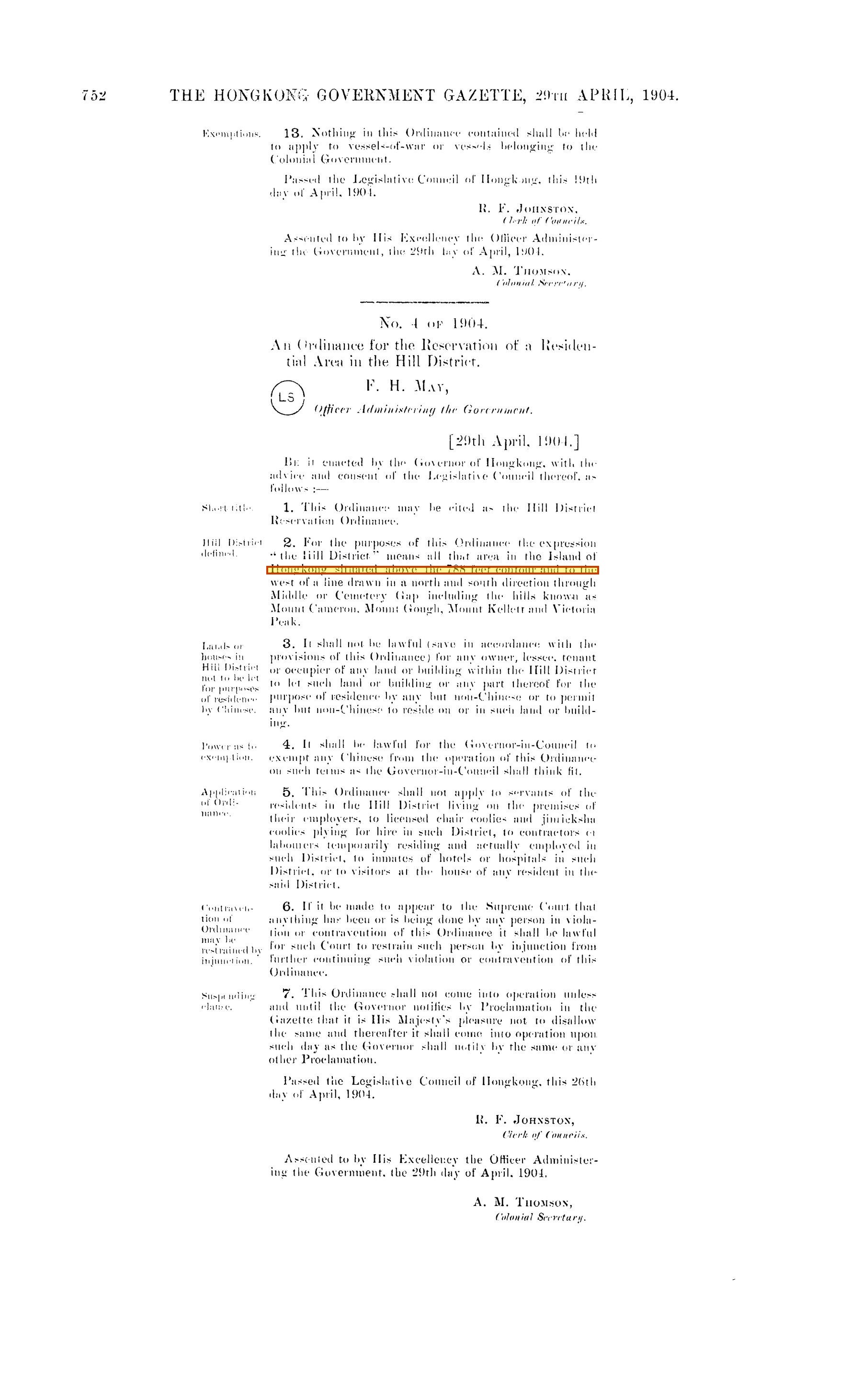
As assented on 29 April 1904 the short title was Hill District Reservation Ordinance (No. 4 of 1904, Gazette 189 of 1904, in force 15 July). Section 2 drew the line: all that area above the 788 feet contour and west of a north–south line through Middle or Cemetery Gap, “including the hills known as Mount Cameron, Mount Gough, Mount Kellett and Victoria Peak”. Section 3 was the letting rule; sections 4–7 carried the exemption power, the servants and hotel exceptions, the injunction remedy and the suspending clause. The later revision’s retitling “Peak District Reservation Ordinance, 1904” is a convenience name of the 1912 era; both titles are true of different moments of the statute’s life.2324
6. 1917: the drafting crisis
The letting form left a hole: a Chinese owner residing in his own house was not caught by “permitting”. May’s confidential despatch of 5 September 1917 (CO 129/443) admits the slip and names the only Chinese resident: “No Chinese has hitherto resided at the Peak excepting Sir Robert Ho Tung” — who had bought in about 1907.26 A companion page records the government’s own enforcement by purchase: Ho Kom-tong (何甘棠), Ho Tung’s brother, had bought “Lysholt” at auction for $237,000; the Government bought it back at $240,000, the $3,000 profit to charity — the hill kept white by balance-sheet.27 Public opposition followed in print: M. K. Lo’s letter of 22 November 1917 in the China Mail called the bill “unjust, unnecessary, and inopportune” and asked the Government to drop it.28
7. 1918–1919: the race-neutral replacement and its first dissent
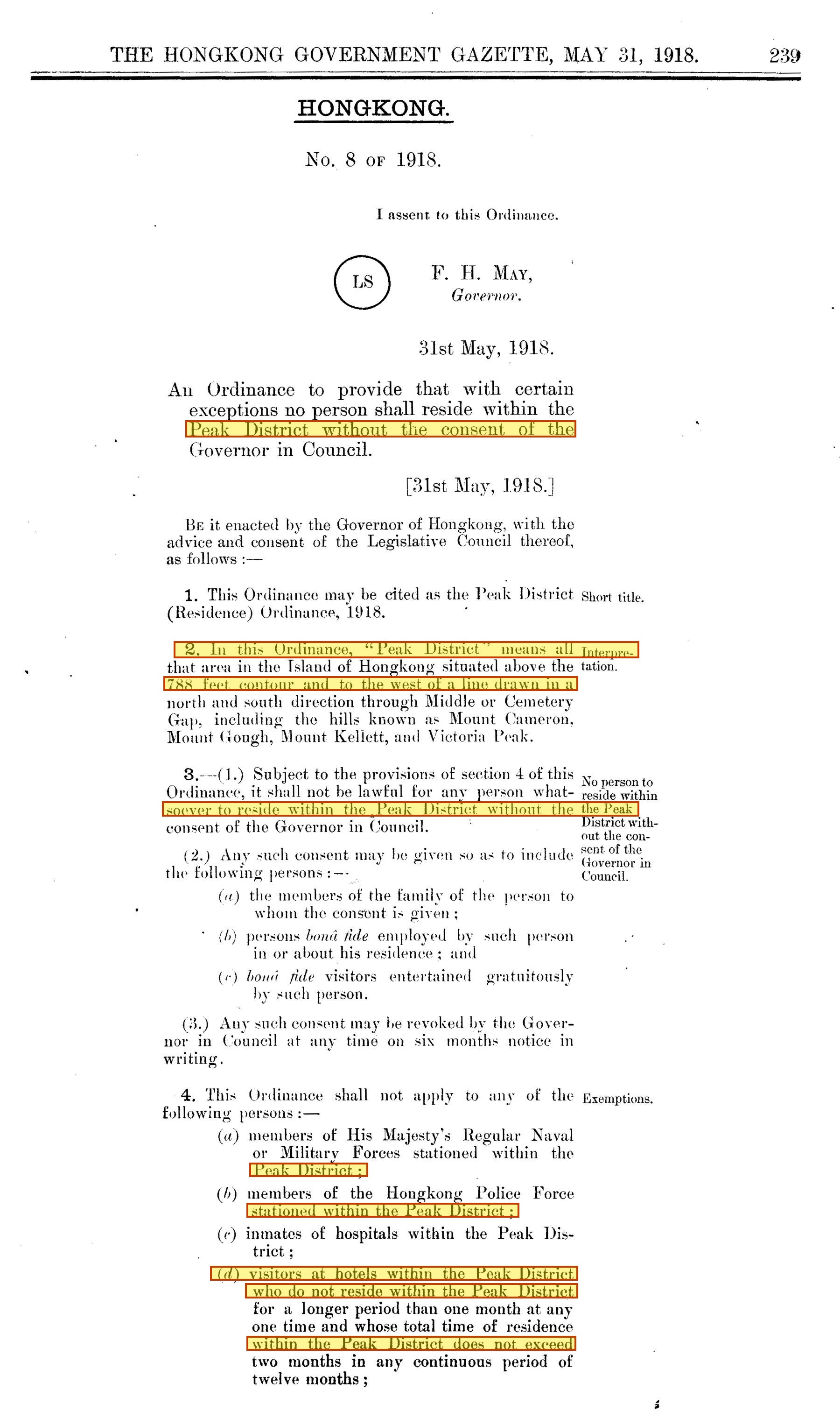
No. 8 of 1918 (assent F. H. May, Governor, 31 May) replaced the form, not the hill. The long title: with exceptions, “no person shall reside within the Peak District without the consent of the Governor in Council”. Section 3 said “no person whatsoever” — the race-neutral phrasing the Kowloon reservation had used in 1902; consent could be revoked on six months’ notice; section 4 kept the naval, police, hospital and hotel exemptions. The same 788-feet contour and the same four hills; no repeal of the 1904 law in the 1918 text — the two coexisted until 1930.29
all_text form
“No. 2 of 1918” (as the 1946 repeal’s margin target) is an OCR misread; the
scan prints No. 8 of 1918.
View scan
(accessed 14 Oct. 2026).The template then sailed, and met its first recorded dissent. The Cheung Chau “Dumb Bell Island” reservation bill of 28 August 1919 was, the Attorney-General told the Council, “modelled, roughly, on the Peak District Reservation Ordinance which passed through this Council last year without any opposition or comment”. Lau Chu Pak (劉鑄伯) and Ho Fook (何福) voted against. Ho Fook: the war had been won by all races in the Empire; he could not be party to a Bill that was “nothing more or less than racial legislation”. The Bill passed with those two against — the first recorded division on a Peak-model reservation.31 Between 1921 and 1927 the Executive Council granted residence permits under the 1918 law in the ordinary way; a 1925 telephone tariff already drifted the boundary to 700 feet.3233
8. 1930 and 1946: how the two laws died
The 1904 law died as a line in a revision list. The Law Revision Ordinance bill of 1930 repealed six spent ordinances; among them “The Peak District Reservation Ordinance, 1904” (the margin: No. 4 of 1904). The Daily Press leader of 3 November 1930 noticed: “Quite tucked away in the Supplement… No explanation of this proposal is given beyond the general one.”3435 The name still cut in 1941, when a Telegraph joke column could still invoke “the Peak Reservation Ordinance” as civic furniture.36
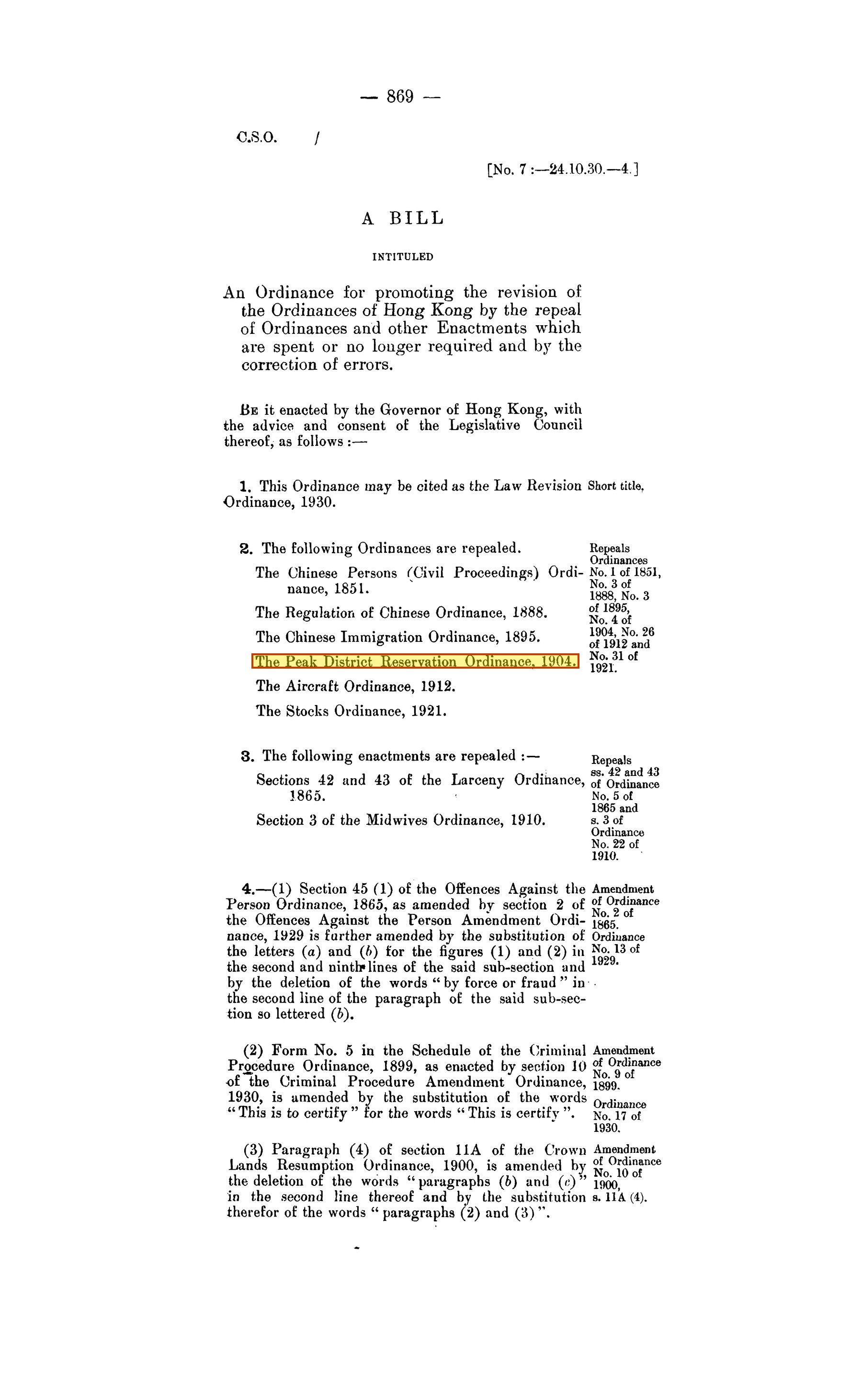
[No. 7:—24.10.30.—4.]) — s.2’s repeals list, with “The Peak
District Reservation Ordinance, 1904” (the margin: No. 4 of 1904) boxed.
The racial law’s death is a line in a revision list.
View scan
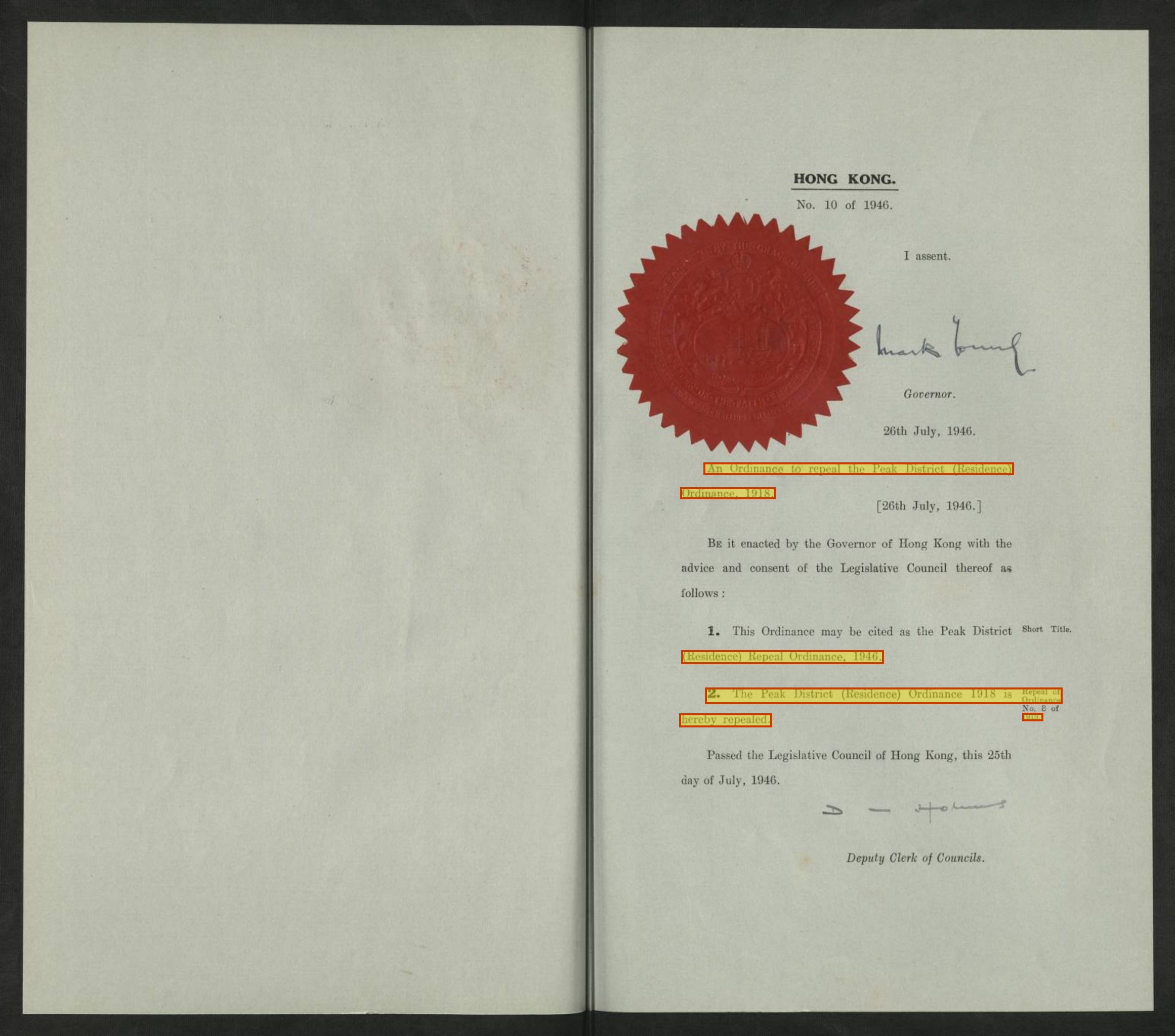
(accessed 14 Oct. 2026).The 1918 law died more cleanly. No. 10 of 1946 (passed 25 July, assent Mark Young, Governor, 26 July) repealed it in one clause: s.2 “The Peak District (Residence) Ordinance 1918 is hereby repealed” — the margin prints No. 8 of 1918 (the image index’s “No. 2 of 1918” is an OCR misread, killed by the scan). The race-neutral residence regime ended forty-two years after the first reservation bill; the 1904 law itself had already been off the book sixteen years.38
9. Conclusion: the regime, not one statute
The record keeps the law’s own honesty. The 1888 message for health; the 1901 ad for the market; the 1904 petition for the owners; the Bill for the object; Ho Kai for the name; the gazette for the contour; the 1917 despatch for the loophole; the 1918 scan for the replacement; the 1930 list for the first death; the 1946 repeal for the second. What the record does not carry — an enforcement case, a resident-count figure, a Chinese-language press witness for the 1904 bill — is bracketed as a gap, never asserted.40 The popular “forty-two years” is the regime, not one statute’s life; the paper uses that form throughout.41 The reservation ended not because the racial idea was renounced but because the form — first blunt, then inverted into a letting trick, then rewritten as race-neutral consent — had outrun the drafting hand that wrote it.4243
Appendix A: sources and method
The documentary corpus is the hkintexts research index (read-only), queried 7 and 13–14 October 2026. Every passage quoted was read in its whole document; the four plates were read back against their scans at their final crops on 14 October 2026. Where a text-series page has an image twin, the citation follows the image-first rule. No write was made to the index. The compulsory full-document pull is CO 129/322 (45,663 lines). Query families:
- “Peak Reservation” / “Residential Area in the Hill District” / “Hill District Reservation” / “European District Reservation” / “Peak District (Residence)” — the title families;
- “European residence” + 19xx — the market’s prior language; “Law Revision Ordinance” + Peak — the 1930 death;
- “Lysholt” / “Ho Kom-tong” / “M. K. Lo” / “Dumb Bell Island” / “no person whatsoever” / 788 feet — the rework arc;
- injunction + Peak District / “contravene” + Peak — the enforcement gap (only historical-laws reprints); Chinese controls (山頂 / 保留 / 條例) — no period Chinese bill witness in the corpus;
- the 1946 repeal (image
all_text+ HKRS series); the re-verify batch of 14 October (get.py on twelve page ids).
Appendix B: evidence register
| Claim | Witnesses |
|---|---|
| The Bill’s racial object and its climate alibi | the objects and reasons, 28 Mar 1904; the petition’s own climate sentence |
| The petition (22 Feb 1904; “exclusive residence of non-Chinese”; rents “nearly treble”) | the Weekly Press full text; the CO 129/322 enclosure |
| The Brewin consultation (three meetings, fifty-seven Chinese, “less distasteful”) | CO 129/322 (Brewin’s note + May’s despatch) |
| Ho Kai’s second-reading concession and the “any but non-Chinese” rewrite | the Council report of 19 Apr 1904; the enacted s.3 on the gazette scan |
| The 1904 short title as enacted = Hill District Reservation Ordinance | the gazette scan s.1; the 1912-era retitling as the variant |
| 788 feet contour + the four hills | gazette s.2 scan; 1918 s.2 scan; the 1930 press definition |
| No. 8 of 1918 (“no person whatsoever”; six months’ notice) | the 1918 gazette scan; the bill text |
| Ho Tung as the one Chinese resident (c. 1907); Lysholt $237,000 / $240,000 | May’s despatch pages |
| Cheung Chau modelled on the Peak ordinance; Ho Fook “racial legislation” | the 1919 Council report |
| The 1904 law’s repeal by the Law Revision Ordinance 1930 | the gazette bill scan; the Council first reading; the Daily Press leader |
| The 1918 law’s repeal by No. 10 of 1946 | the 1946 assented text scan |
| The 1888 precedent (No. 16 of 1888; the health message) | the 1888 message; the petition’s citation of it |
| Item | Note |
|---|---|
| Ho Tung’s purchase “about 1907” | May’s confidential despatch only |
| The “$3,000 profit to charity” on the Lysholt buy-back | May’s own arithmetic in the despatch |
| The 1925 tariff’s 700-feet substitute | the tariff instrument only; no second document repeats it |
| The 1941 Telegraph joke | a joke column |
| Item | Resolution |
|---|---|
| Short title | Enacted s.1 (scan): “Hill District Reservation Ordinance”; revision-era / press name: “Peak District Reservation Ordinance, 1904”. Both true of different moments; the paper uses the enacted title at first mention. |
| The 1946 repeal’s target number | The image
index’s all_text OCRs “No. 2 of 1918”;
the scan prints “No. 8 of 1918”. Scan wins. |
| “700 feet” in the 1904 Daily Press speech report | Press OCR of May’s second-reading speech; the enacted law says 788. Never quote the press OCR for the contour; the gazette scan is the authority. |
| “No opposition” (1904 / 1918) | True of the recorded 1904 division and of the AG’s 1919 recollection of 1918 — but Lo (1917) and the Cheung Chau pair (1919) show the opposition existed in public form; the blanket claim is falsified. |
| Item | Why |
|---|---|
| An injunction enforcement case under s.6 | only historical-laws reprints returned — do not assert enforcement either way |
| A colony-wide death toll / resident-count for the reserved area | none pulled; do not invent one |
| “The 1904 Ordinance lasted forty-two years” | the 1904 law dies 1930; the 1918 law dies 1946; the regime runs 1904–1946 — corrected in the deliverables |
| The Attorney-General’s name in 1904 as “Bakeler” | OCR unverified; do not print |
| Chinese period press for the 1904 bill | the ksyp / 華僑日報 strata do not reach 1904; no contemporaneous Chinese-language newspaper witness in the corpus |
| Item | Note |
|---|---|
| Enforcement | no case, no prosecution, no named contravener in the corpus |
| The reserved area’s occupancy numbers | not pulled; do not guess |
| Ho Tung’s actual purchase instrument | the despatch says “some ten years ago purchased”; the deed is not in the pulls |
| The Chinese-language press of 1904 on the bill | outside the corpus’s surviving strata |
| The rest of Gazette 189 of 1904 | the pull is the ordinance’s pages; the rest of the issue is unexamined |
Adversarial pass (Stage 7, seven attempts, all documented in the research notes §3): (1) racial frame vs health frame — both always co-occur; the “health-only” and “race-only” readings both fail; (2) Ho Kai’s amendment cosmetic or real? — the 1917 loophole is exactly what the rewrite left; (3) “the Peak bills passed without opposition” — falsified as a blanket claim by Ho Kai, Lo and the Cheung Chau division; (4) the 1888 “failure” claim — the petitioners’ single witness, attributed; (5) Ho Tung as the only Chinese Peak resident — survives as May’s single confidential witness with the Lysholt buy-back as circumstantial support; (6) enforcement — unproven either way, registered as a gap; (7) the “forty-two years” arithmetic — the regime, not one statute, corrected in the deliverables.
Notes
- ↑Governor’s message to the Legislative Council, 27 March 1888, opening the European District Reservation bill: the reservation of a residential area for Europeans for “the health and comfort of Europeans in a tropical climate” against “the influx of Chinese” narrowing Victoria’s residential area. https://hkintexts.histsyn.com/page/1881527 (accessed 14 Oct. 2026). Sixteen years before the Peak bill the colony had already legislated racial residence by ordinance; the 1904 petitioners cite Ordinances Nos. 16 and 26 of 1888 and complain they “have not prevented the practical absorption by Chinese” — the failure claim is the petitioners’ single witness, attributed never asserted (adversarial attempt 4).
- ↑The real-estate advertisement, the press, 10 April 1901, p. 4: “THE HOUSE, No. 3, SEYMOUR ROAD, now European Residence, containing 6 ROOMS and commanding a good View of the Harbour” — the market’s prior language: segregation sold as a property feature three years before the law wrote it. https://hkintexts.histsyn.com/page/2237962 (accessed 14 Oct. 2026).
- ↑The Peak owners’ petition to the Governor, 22 February 1904: “Your Petitioners are owners and occupiers of houses in the Hill District… beg to submit… that prompt steps should be taken permanently to reserve that particular part of this Colony for exclusive residence of non-Chinese inhabitants.” The petition’s own climate sentence already carries the bill’s future alibi (“the disadvantage of an unnatural environment… accustomed to a temperate climate”) and its class teeth (“directly to prohibit Chinese, other than servants”; rents “on the average nearly treble that which was paid ten years ago”). Printed in full beside its own leading article in the Weekly Press of 4 April 1904, p. 7 (https://hkintexts.histsyn.com/page/2164435), and filed as the despatch’s enclosure in CO 129/322, p. 641 (https://hkintexts.histsyn.com/page/392622) — two independent witnesses (accessed 14 Oct. 2026).
- ↑CO 129/322 — A. W. Brewin, Registrar-General, convened three meetings of “representative Chinese” (Tung Wah Hospital Committee, Po Leung Kuk, leading firms, guilds — fifty-seven in all). The resulting resolution asked for wording “less distasteful to Chinese sentiment”; the officials’ own note explains the “somewhat awkwardly inverted form” of clause 3 that followed. May’s covering despatch: the Bill passed “without a single vote being recorded against it.” Pages incl. https://hkintexts.histsyn.com/page/392617 (full-document pull; accessed 14 Oct. 2026). The same file carries the Kowloon contrast: Chamberlain’s Despatch No. 289 of 4 September 1902 had laid down a race-neutral form for the Kowloon Reservation; May explains that form was impossible at the Peak, where the land was already in private (overwhelmingly European) hands — the Peak law’s blunt racial drafting is therefore a function of the land-tenure map, not of official candour alone.
- ↑The Legislative Council report, 28 March 1904, p. 1 (the first reading, and the Bill’s objects and reasons): “This measure has as its object the reservation of that portion of the Island of Hongkong commonly known as ‘the Peak’ as a place of residence for persons other than Chinese. The reservation of this district is desirable in order that a healthy place of residence may be preserved for all those who are accustomed to a temperate climate and to whom life in the tropics presents the disadvantage of an unnatural environment.” https://hkintexts.histsyn.com/page/1881857 (accessed 14 Oct. 2026).
- ↑The Legislative Council report, 19 April 1904 — second reading. Dr. Ho Kai (何啟), the senior Chinese member, opened: the Bill “has a decided savour of the nature of class legislation, and especially against the Chinese” — but after the reasons were explained he and his colleague “agreed to offer no opposition”, on the understanding that the Chinese community had been consulted (the three Brewin meetings). Pollock (one of the petition’s movers) supported on public-health grounds. The Attorney-General conceded Ho Kai’s point in form — the original clause 3’s ban was “a distinction without a difference” once the exceptions were written — struck clause 3 and substituted the letting form: no owner, lessee, tenant or occupier to let or permit residence “for the purpose of residence by any but non-Chinese”. Governor May: “a delicate subject… might perhaps bear the appearance of what has been called class legislation”; he had “relied upon their sound practical common-sense” — the Chinese members’ support. https://hkintexts.histsyn.com/page/1881858 (accessed 14 Oct. 2026). Ho Kai is the period’s Chinese member of Council; the Chinese form 何啟 is corpus-attested (the later Council succession line).
- ↑The Legislative Council report, 26 April 1904, p. 1: “PEAK RESERVATION. The ATTORNEY-GENERAL moved the third reading of the Bill entitled an Ordinance for the Reservation of a Residential Area in the Hill District. The ACTING COLONIAL SECRETARY seconded, and the motion was agreed to and the Bill passed. The Council adjourned sine die.” https://hkintexts.histsyn.com/page/1881859 (accessed 14 Oct. 2026). No recorded division, no recorded speeches in the Council’s own report — the quiet passage. The “without opposition” frame survives only as “no vote against in 1904”; as a blanket claim it is falsified by Ho Kai’s warning, M. K. Lo’s 1917 letter and the Cheung Chau division of 1919 (adversarial attempt 3).
- ↑The gazette text of No. 4 of 1904, 29 April 1904, p. 752 (scan-verified plate 1): assented by F. H. May, Officer Administering the Government. s.1 short title as enacted — “Hill District Reservation Ordinance” (the later revision’s retitling “Peak District Reservation Ordinance, 1904” is a 1912-era convenience name; both are true of different moments of the statute’s life). s.2: the Hill District = all that area above the 788 feet contour and west of a north–south line through Middle or Cemetery Gap, “including the hills known as Mount Cameron, Mount Gough, Mount Kellett and Victoria Peak”. s.3 the “any but non-Chinese” letting rule; s.4 the Governor-in-Council exemption power; s.5 the servants / chair coolies / contractors / hotels / hospitals / visitors exceptions; s.6 the Supreme Court injunction; s.7 the suspending clause. https://hkintexts.histsyn.com/image-page/1560456 (accessed 14 Oct. 2026). Never quote the press OCR of May’s second-reading speech for the contour (the Daily Press OCR reads “700 feet”; the gazette scan is the authority; the 1925 tariff’s 700 is a separate later instrument).
- ↑May’s confidential despatch, CO 129/443, p. 395, 5 September 1917: a Chinese owner residing in his own house was not caught by “permitting”; “No Chinese has hitherto resided at the Peak excepting Sir Robert Ho Tung” — who had bought in “some ten years ago” (c. 1907). https://hkintexts.histsyn.com/page/468632 (accessed 14 Oct. 2026). Ho Tung’s purchase date is this despatch’s single witness; no second document fixes it. The Chinese form 何東 is corpus-attested.
- ↑The same file, p. 407: Ho Kom-tong (何東’s brother — the despatch’s own kinship note; the Chinese form 何甘棠 is corpus-attested) had bought “Lysholt” at auction for $237,000; the Government bought it back at $240,000, the $3,000 profit to charity. https://hkintexts.histsyn.com/page/468644 (accessed 14 Oct. 2026). The $3,000 arithmetic is May’s own in the despatch — single-witness.
- ↑The gazette text of No. 8 of 1918, 31 May 1918, p. 239 (scan-verified plate 2): Peak District (Residence) Ordinance; assent F. H. May, Governor. Long title: with certain exceptions “no person shall reside within the Peak District without the consent of the Governor in Council”. s.2 keeps the same 788-feet contour and the same four hills; s.3 — “no person whatsoever” — the form the Kowloon reservation had used in 1902; consent runs to family, bona fide employees and visitors and “may be revoked… on six months notice in writing”; s.4 exemptions (naval/military, police, hospitals, hotel visitors ≤ one month at a time / ≤ two months in twelve, etc.). No repeal of the 1904 law in the 1918 text — the two coexisted on the statute book until 1930. https://hkintexts.histsyn.com/image-page/1500244 (accessed 14 Oct. 2026); bill text: https://hkintexts.histsyn.com/page/1625246. The image index’s all_text “No. 2 of 1918” for the 1946 repeal’s margin is an OCR misread; the scan prints No. 8 of 1918.
- ↑The Law Revision Ordinance bill, 1930 (gazette supplement
[No. 7:—24.10.30.—4.], scan-verified plate 3): section 2 repeals six spent Ordinances, and among them “The Peak District Reservation Ordinance, 1904” (the margin note: No. 4 of 1904). https://hkintexts.histsyn.com/image-page/1469916 (accessed 14 Oct. 2026). The Legislative Council first reading of the Law Revision Bill, 6 November 1930: https://hkintexts.histsyn.com/page/1882340. The 1904 law dies twenty-six years after assent; the 1918 law is not touched. - ↑The Peak District (Residence) Repeal Ordinance, No. 10 of 1946 (assented text, scan-verified plate 4): passed Legislative Council 25 July 1946; assent Mark Young, Governor, 26 July 1946; s.2 “The Peak District (Residence) Ordinance 1918 is hereby repealed” (the margin: No. 8 of 1918 — the image index’s all_text “No. 2 of 1918” is an OCR misread, killed by the scan). https://hkintexts.histsyn.com/image-page/1792258 (accessed 14 Oct. 2026). The race-neutral residence regime ends forty-two years after the first reservation bill; the 1904 law itself had already been off the book sixteen years.
- ↑On the “forty-two years”: the 1904 law dies in the Law Revision list of 1930 (twenty-six years); the 1918 law dies by No. 10 of 1946 (twenty-eight years). The popular “forty-two years” is the regime (1904–1946), not one statute’s life. Never write “the 1904 Ordinance lasted forty-two years” — say “the reservation regime lasted forty-two years, in two statutes” (adversarial attempt 7).
- ↑Method note: the documentary corpus interrogated for this paper is the hkintexts research index (read-only), queried 7 and 13–14 October 2026; the logged queries are itemised in Appendix A. The compulsory full-document pull is CO 129/322 (45,663 lines — the 1904 consultation file). Every passage quoted was read in its whole document; the four document plates were read back against their scans at their final crops (14 October 2026). Where a text-series page has an image twin, the citation follows the image-first rule. No write was made to the index.
- ↑Governor’s message to the Legislative Council, 27 March 1888. https://hkintexts.histsyn.com/page/1881527 (accessed 14 Oct. 2026).
- ↑The real-estate advertisement, the press, 10 April 1901, p. 4. https://hkintexts.histsyn.com/page/2237962 (accessed 14 Oct. 2026).
- ↑The Peak owners’ petition, 22 February 1904; printed in the Weekly Press, 4 April 1904, p. 7; filed in CO 129/322, p. 641. https://hkintexts.histsyn.com/page/2164435 (accessed 14 Oct. 2026).
- ↑CO 129/322 — Brewin’s three meetings of representative Chinese, 1904 (full-document pull). https://hkintexts.histsyn.com/page/392617 (accessed 14 Oct. 2026).
- ↑The Legislative Council report, 28 March 1904, p. 1 (first reading, the Bill’s objects). https://hkintexts.histsyn.com/page/1881857 (accessed 14 Oct. 2026).
- ↑The Legislative Council report, 19 April 1904 (second reading: Ho Kai’s warning and the rewrite). https://hkintexts.histsyn.com/page/1881858 (accessed 14 Oct. 2026).
- ↑The Legislative Council report, 26 April 1904, p. 1 (third reading). https://hkintexts.histsyn.com/page/1881859 (accessed 14 Oct. 2026).
- ↑No. 4 of 1904, Government Gazette, 29 April 1904, p. 752 (scan). https://hkintexts.histsyn.com/image-page/1560456 (accessed 14 Oct. 2026).
- ↑The colonial ordinances table for 1904, p. 106: “29th April | 4 | An Ordinance for the Reservation of a Residential Area in the Hill District. | 189 of 1904” — No. 4 of 1904, gazetted 189 of 1904; passed 26 April; assent 29 April; in force 15 July 1904. https://hkintexts.histsyn.com/page/666276 (accessed 14 Oct. 2026).
- ↑Plate 1: Government Gazette, 29 April 1904, p. 752 — the assented text of No. 4 of 1904, with the s.2 788-feet contour definition boxed. The highlight box was seated on the ink band of the printed lines and read back at the final crop. https://hkintexts.histsyn.com/image-page/1560456 (accessed 14 Oct. 2026).
- ↑May’s confidential despatch, CO 129/443, p. 395, 5 September 1917. https://hkintexts.histsyn.com/page/468632 (accessed 14 Oct. 2026).
- ↑The same file, p. 407 (the Lysholt purchase and buy-back). https://hkintexts.histsyn.com/page/468644 (accessed 14 Oct. 2026).
- ↑M. K. Lo’s letter, China Mail, 22 November 1917: the drafting slip, the Bill “unjust, unnecessary, and inopportune”, drop it. https://hkintexts.histsyn.com/page/1954464 (accessed 14 Oct. 2026). Public opposition in printed form three years before the 1946 repeal of the replacement law — the “sailed through uncontested” frame does not survive as a blanket claim.
- ↑No. 8 of 1918, Government Gazette, 31 May 1918, p. 239 (scan). https://hkintexts.histsyn.com/image-page/1500244 (accessed 14 Oct. 2026).
- ↑Plate 2: Government Gazette, 31 May 1918, p. 239 — the assented text of No. 8 of 1918, with s.3’s “no person whatsoever” boxed. https://hkintexts.histsyn.com/image-page/1500244 (accessed 14 Oct. 2026).
- ↑The Legislative Council report, 28 August 1919 — the Cheung Chau “Dumb Bell Island” reservation bill. The Attorney-General told the Council the Bill “has been modelled, roughly, on the Peak District Reservation Ordinance which passed through this Council last year without any opposition or comment”; Lau Chu Pak (劉鑄伯 — corpus-attested) and Ho Fook (何福 — corpus-attested) opposed — Ho Fook: “the war has been won by all races in the Empire I cannot be a party to the passing of this Bill which, in my opinion, is nothing more or less than racial legislation.” The Bill passed with those two voting against — the first recorded division on a Peak-model reservation. https://hkintexts.histsyn.com/page/1882145 (accessed 14 Oct. 2026).
- ↑Executive Council records, 1921–27 — residence permits granted under the Peak District (Residence) Ordinance (e.g. Lieut. H. E. Power, 1st Battalion East Surrey Regiment): the consent machinery in quiet daily use. https://hkintexts.histsyn.com/page/5216600 (accessed 14 Oct. 2026).
- ↑The telephone tariff’s Peak District definition (1925) uses the 1904 boundary but substitutes 700 feet for the 788 feet contour — the contour already soft at the edges of the administration’s own instruments. https://hkintexts.histsyn.com/page/1882234 (accessed 14 Oct. 2026). Single-witness: no second document repeats the 700-feet substitute. A press restatement of the boundary (788 feet, the four hills) is the Telegraph retrospective of 1925: https://hkintexts.histsyn.com/page/2915832 (accessed 14 Oct. 2026).
- ↑The Law Revision Ordinance bill, 1930, s.2 repeals list (scan). https://hkintexts.histsyn.com/image-page/1469916 (accessed 14 Oct. 2026).
- ↑The Daily Press leader, 3 November 1930: “Quite tucked away in the Supplement… No explanation of this proposal is given beyond the general one.” https://hkintexts.histsyn.com/page/2327962 (accessed 14 Oct. 2026).
- ↑A Telegraph joke column, 1941 — still invokes “the Peak Reservation Ordinance” thirty-five years after the bill: the reservation as civic furniture. https://hkintexts.histsyn.com/page/3015771 (accessed 14 Oct. 2026). Single-witness (a joke column).
- ↑Plate 3: Law Revision Ordinance bill, 1930 — s.2’s repeals list, with “The Peak District Reservation Ordinance, 1904” boxed. https://hkintexts.histsyn.com/image-page/1469916 (accessed 14 Oct. 2026). The racial law’s death is a line in a revision list.
- ↑The Peak District (Residence) Repeal Ordinance, No. 10 of 1946, assented text (scan). https://hkintexts.histsyn.com/image-page/1792258 (accessed 14 Oct. 2026).
- ↑Plate 4: Peak District (Residence) Repeal Ordinance, No. 10 of 1946 — the assented text with the s.2 repealing clause boxed, and the Governor’s assent block. https://hkintexts.histsyn.com/image-page/1792258 (accessed 14 Oct. 2026).
- ↑Enforcement: the corpus’s injunction hits under s.6 of the 1904 law are the historical-laws reprints (1912/1923 revision text) only — no prosecution or Supreme Court injunction found. Do not assert enforcement either way (adversarial attempt 6).
- ↑On the “forty-two years”: the regime (1904–1946) spans two statutes — the 1904 law died in the Law Revision list of 1930, the 1918 law by No. 10 of 1946. Never write “the 1904 Ordinance lasted forty-two years.”
- ↑Method note, as above: the corpus, the query log (Appendix A), the full-document pull (CO 129/322) and the plate read-backs of 14 October 2026.
- ↑Name confirmations — every name ran the mandatory battery of AGENTS.md rule 9 (corpus phrase search AND exact-phrase web search, both 14 October 2026): Ho Kai = 何啟 (corpus 1,101 hits; Legislative Council database); Sir Robert Ho Tung = 何東; Ho Kom-tong = 何甘棠 (corpus 98 hits + the AMO 甘棠第 page); Lau Chu Pak = 劉鑄伯 (corpus 23 hits; Legislative Council database — an NTNU paper corroborates his 1919 Cheung Chau opposition); Ho Fook = 何福 (corpus 2,328 hits; Legislative Council database); Mount Cameron = 金馬倫山 (corpus 391; Wikipedia), Mount Gough = 歌賦山 (corpus 135), Mount Kellett = 奇力山 (corpus 15, variant 加列山 94; Wikipedia), Victoria Peak = 扯旗山 (corpus 522; the everyday district name 太平山, corpus 616); Cheung Chau = 長洲 (corpus 10,000+) with its island nickname 啞鈴島 (corpus 3 + Wikipedia’s 長洲 article). Press glosses per the name rule: China Mail = 德臣西報 (corpus 310), Hong Kong Daily Press = 孖喇西報 (pre-verified gloss in AGENTS.md). Lysholt, Middle Gap and Cemetery Gap stay English — no confirmed Chinese form.
Bibliography
Primary sources
- Governor’s message to the Legislative Council, 27 March 1888 (European District Reservation). https://hkintexts.histsyn.com/page/1881527 (accessed 14 Oct. 2026).
- The real-estate advertisement, the press, 10 April 1901, p. 4 (“now European Residence”). https://hkintexts.histsyn.com/page/2237962 (accessed 14 Oct. 2026).
- The Peak owners’ petition, 22 February 1904, printed in the Weekly Press, 4 April 1904, p. 7. https://hkintexts.histsyn.com/page/2164435; filed as CO 129/322, p. 641: https://hkintexts.histsyn.com/page/392622 (accessed 14 Oct. 2026).
- CO 129/322 — the consultation file (Brewin’s three meetings; the “less distasteful” resolution; May’s despatch; the Kowloon contrast). Full-document pull; pages incl. https://hkintexts.histsyn.com/page/392617 (accessed 14 Oct. 2026).
- The Legislative Council report, 28 March 1904, p. 1 (first reading; the objects). https://hkintexts.histsyn.com/page/1881857 (accessed 14 Oct. 2026).
- The Legislative Council report, 19 April 1904 (second reading; Ho Kai; the substituted clause 3). https://hkintexts.histsyn.com/page/1881858 (accessed 14 Oct. 2026).
- The Legislative Council report, 26 April 1904, p. 1 (third reading; the passage). https://hkintexts.histsyn.com/page/1881859 (accessed 14 Oct. 2026).
- Government Gazette, 29 April 1904, p. 752 — No. 4 of 1904 as assented (scan-verified plate 1). https://hkintexts.histsyn.com/image-page/1560456 (accessed 14 Oct. 2026).
- The colonial ordinances table for 1904, p. 106 (No. 4 of 1904; 189 of 1904). https://hkintexts.histsyn.com/page/666276 (accessed 14 Oct. 2026).
- May’s confidential despatch, CO 129/443, pp. 395, 407, 5 September 1917 (Ho Tung; Lysholt). https://hkintexts.histsyn.com/page/468632; https://hkintexts.histsyn.com/page/468644 (accessed 14 Oct. 2026).
- M. K. Lo’s letter, China Mail, 22 November 1917. https://hkintexts.histsyn.com/page/1954464 (accessed 14 Oct. 2026).
- Government Gazette, 31 May 1918, p. 239 — No. 8 of 1918 as assented (scan-verified plate 2); bill text: https://hkintexts.histsyn.com/page/1625246. https://hkintexts.histsyn.com/image-page/1500244 (accessed 14 Oct. 2026).
- The Legislative Council report, 28 August 1919 (the Cheung Chau bill; Ho Fook’s “racial legislation”). https://hkintexts.histsyn.com/page/1882145 (accessed 14 Oct. 2026).
- Executive Council records, 1921–27 (residence permits). https://hkintexts.histsyn.com/page/5216600 (accessed 14 Oct. 2026).
- The telephone tariff’s Peak District definition (1925). https://hkintexts.histsyn.com/page/1882234; the Telegraph retrospective of the same year: https://hkintexts.histsyn.com/page/2915832 (accessed 14 Oct. 2026).
- Law Revision Ordinance bill, 1930 (scan-verified plate 3); the Council first reading, 6 November 1930; the Daily Press leader, 3 November 1930. https://hkintexts.histsyn.com/image-page/1469916; https://hkintexts.histsyn.com/page/1882340; https://hkintexts.histsyn.com/page/2327962 (accessed 14 Oct. 2026).
- The Telegraph joke column, 1941. https://hkintexts.histsyn.com/page/3015771 (accessed 14 Oct. 2026).
- Peak District (Residence) Repeal Ordinance, No. 10 of 1946 (assented text; scan-verified plate 4). https://hkintexts.histsyn.com/image-page/1792258 (accessed 14 Oct. 2026).
Secondary sources
- The Historical Laws of Hong Kong online reprints of the 1912 and 1923 revision texts (used only to register the enforcement gap; never cited as a prosecution record).
The four document plates (the _hl files,
read back at their final crops on 14 October 2026) are hosted at
histsyn.github.io/plates/PeakReservation1904/images/
(md5-verified against the local copies before publishing). The cm1904_secondreading scan is kept raw and
unplated; the gaz1904_clause3 and
gaz1918_bill sets are supplementary and are not wired as
plates.