摘要
香港的電話時代並非始於商人,而是始於警察:一八七七年的殖民地年報已經 請求以「電話」取代「開支浩大而弊端百出」的電報機器。交換機的構想經上海與 日本於一八八〇年傳入中國海岸,而香港自己的記錄則以一場難堪開場——一八八一 年二月十八日《德臣西報》寫道:「新加坡人遠遠走在本殖民地的前面……難道沒有 一家有進取心的商號,願意為香港做成新加坡已經做成的事嗎?」回答以一場競逐的 形式到來:Oriental Telephone Company 於一八八一年四月招股東方,並委 Gibb, Livingstone & Co. 為香港代理;愛迪生本人的代理人向行政局請求「碳質電話」 的專利,遭東方公司的律師反對;一八八一年十月二十八日,大北電報公司的 A. Suenson 警告私人測量師 R. G. Alford 不得出售貝爾電話,由此掀開兩公司 之戰,並在一八八二年一月催生 Alford 自己的 Local Public Telephone Company。政府的裁決(一八八一年十一月)准許設立電話交換機,卻拒絕了上海 申請所要求的東西:「此項准許並不賦予貴公司任何專營權。」政府先為自己架線 ——總督府至政府辦公樓、中環警署至九龍警署——按每具年租二十五元向公司租用。 而公眾交換機本身一直等到一八八三年二月一日方才開通,報紙明言,延誤「由於 本地政府對於准許公司豎立所需電線杆一事,顯示了相當的遲疑」。本文的結論: 這場到來在每一步都是制度性的——專利先於電杆,拒絕專營先於可用的交換機,而 公眾在印刷品上讀到第一部電話說明書,比打出第一通電話早了十六個月。
一、緒論
技術經由制度進入城市,先於經由線路進入城市。香港的電話經過一份警察報告、 一篇羞辱性的社論、兩份倫敦招股書、一項專利請願、行政局的一紙附條件裁決、 一家對手的廣告——然後才經過中環的交換台。本文循殖民地自己的記錄追蹤這一 序列,從一八七七年警察的願望清單,到一八八九年交換機最早存留下來的用戶名單, 並在每一步修正關於這場到來的傳說所鼓勵的捷徑。1
二、早於交換機:警察與海岸,一八七七至一八八〇年
電話在香港的第一位倡議者穿着制服。一八七七年度殖民地報告中,署理警察司 (署理警務處長)權衡了本部門的電報儀器,請求予以替換:「本部門現用電報儀器 開支浩大而弊端百出,本官認為以電話取代當更為有利。」這一願望在檔案中塵封了 四年。其間,這種儀器已在中國海岸巡迴:一八八〇年三月,上海的電話交換機公司 已被報道為前景不妙;至一八八〇年四月,日本的電報部門已被請求將神戶、兵庫的 警察站與其中央站以電話相連。到一八八〇年十一月,殖民地的報紙已刊出交換機 如何運作的標準說明——按鈕、總局的鈴、丟下來話者姓名與線號的示號器、接線生 把兩線接通、全部操作「不超過半分鐘」——為 Anglo-Indian Telephone Company 的印度計劃而印,卻在殖民地自己有交換機可講之前十六個月,已在香港被讀到。 2
三、一八八一年:比較、招股與代理
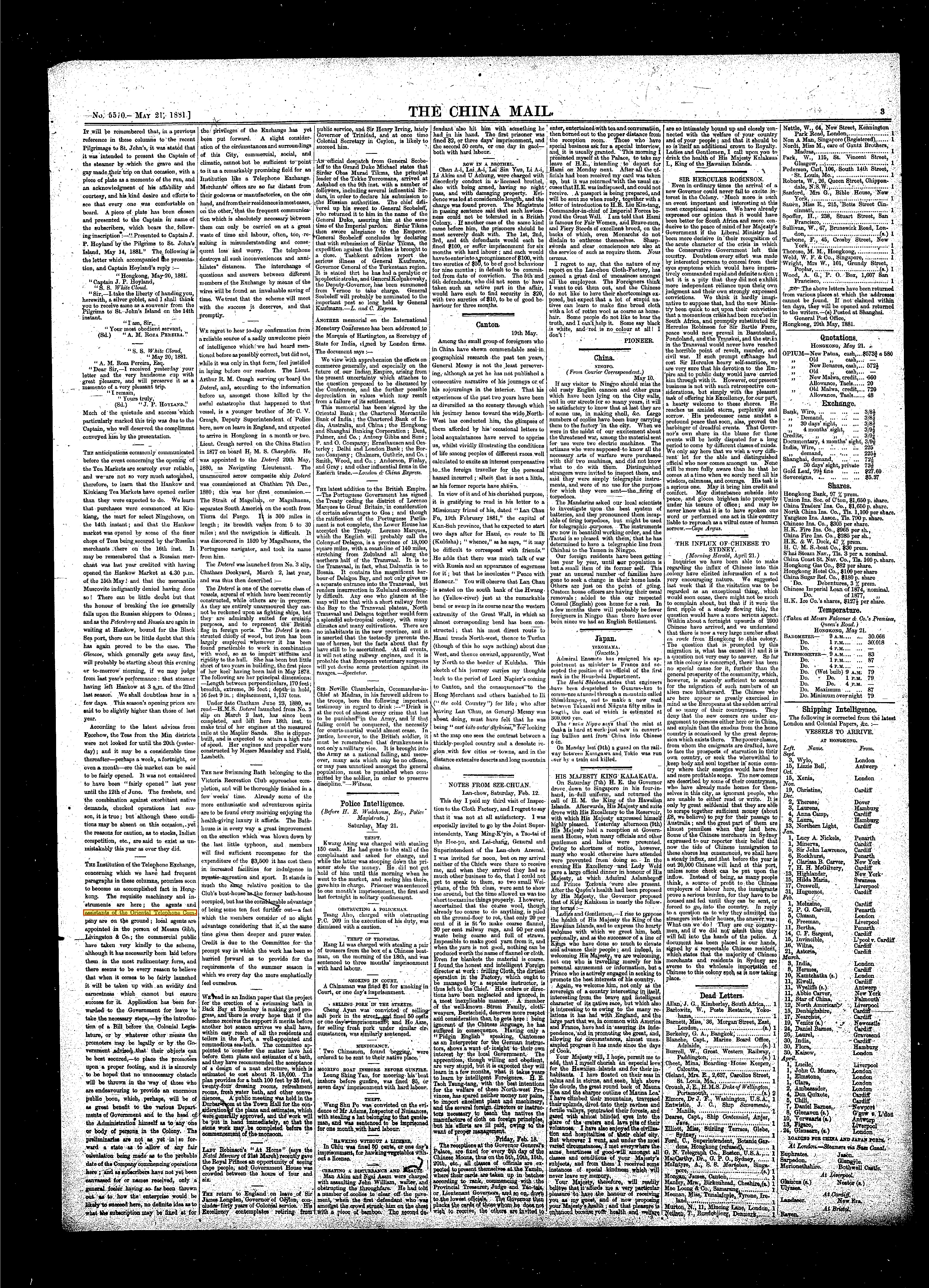
羞辱於一八八一年二月十八日到達:新加坡的三十名用戶、其「高爾—貝爾大聲 電話」、其每月十元的租費,以及把殖民地的落後寫進印刷品的質問——「難道沒有 一家有進取心的商號,願意為香港做成新加坡已經做成的事嗎?」3 答案在數週之內成形。Oriental Telephone Company (Limited) 於四月初為 「東方的主要國家,包括印度、中國、日本」招股(資本三十萬鎊,半數公開發售), 四月底的第二次印刷把數目提到八十萬鎊、範圍擴至印度、錫蘭、爪哇、澳洲、新 西蘭、埃及、土耳其與希臘——兩個資本額,如印照錄。四月中旬出現專利行號的 替代方案:倫敦 Austin Friars 十八號的 Crossley Telephone Company,為 經營「CROSSLEY 專利」而設,範圍同樣是「印度、澳洲、新西蘭及其他殖民地與 屬地」。至五月二十一日,本地的一端已經接上:交換機「預料不久即將成為香港 既成的事實」,東方公司的代理人「已在現場」,本地代理「由 Gibb, Livingstone and Co. 兩位先生出任」,豎杆的申請已遞交政府。4
四、行政局內的專利之戰
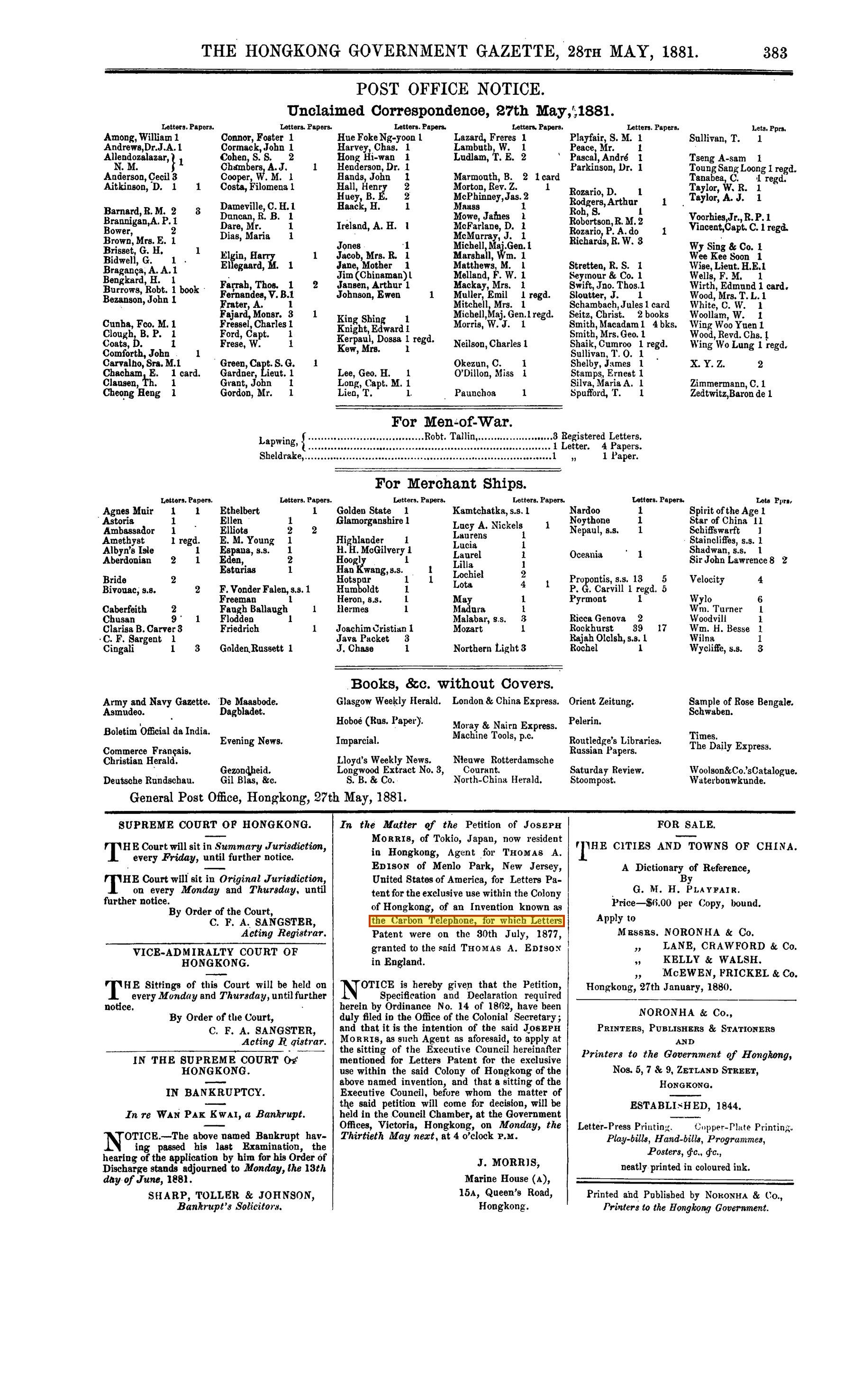
公司向公眾經營之際,專利問題送上了行政局。一八八一年五月二十八日,政府 憲報刊出正式公告:Joseph Morris——「日本東京人氏,現居香港,Thomas A. Edison (Menlo Park) 之代理人」——請求「在香港殖民地裏獨家使用一項稱為 碳質電話 (Carbon Telephone) 的發明」的專利,狀內追述一八七七年七月三十日 的英國授權,並定五月三十日星期一下午四時開局審議。5
五、准許而無專營:一八八一年十一月
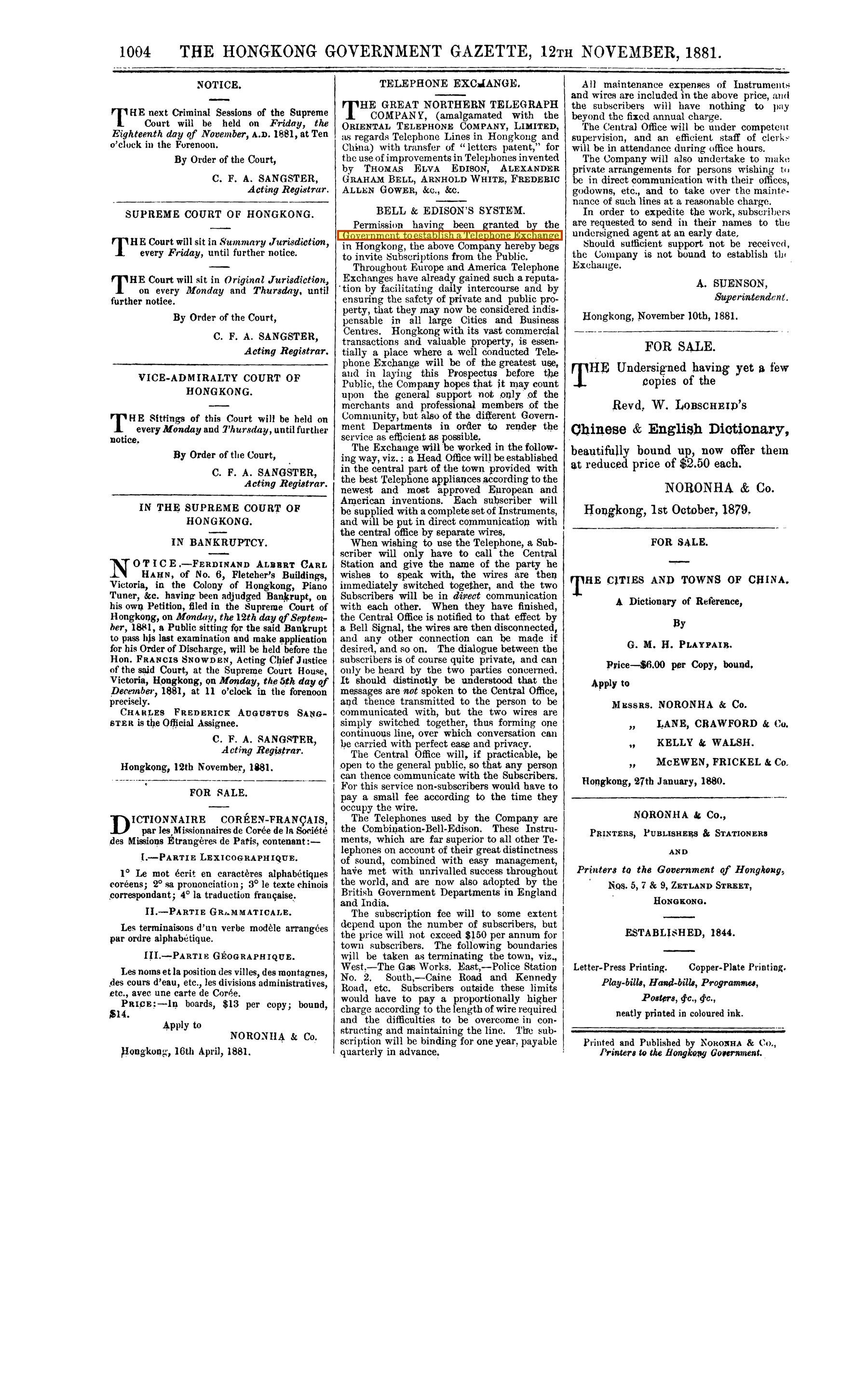
行政局的裁決於一八八一年十一月到達,兩份文件說了兩遍同樣的話。局錄: 政府「準備准許他(代表大北電報公司——其時已與 Oriental Telephone Company 就香港與中國的電話線路合併——提出申請的 Suenson)在香港殖民地設立電話 交換機,但王座保留隨時撤回此項准許之權」。輔政司十一月七日的信加上 定義整個事件的條件:「此項准許並不賦予貴公司任何專營權,而其他設立電話 交換機的申請,均將按其本身的優點予以考慮。」6 7 上海六月的平行申請要求的是「為期十年的獨家權利」; 香港的政府給的卻是一紙可撤回的准許,並由此發放了隨之而來的競爭本身。公司 自己的機器於十一月十二日的政府憲報上公開:「貝爾與愛迪生系統……政府已 准許在香港設立電話交換機」,器具為 Combination-Bell-Edison,市區用戶年租 「不超過一百五十元」,市界「西至煤氣廠,東至二號警署,南至堅道與堅尼地道 一帶」,並附使整件事帶有條件色彩的免責句:「如未獲足夠支持,公司沒有義務 設立該交換機。」8
六、兩公司之戰:一八八一年十月至一八八二年一月
戰事早於十月爆發。十月二十八日,Suenson 警告「R. G. Alford 先生」—— 一名私人測量師——出售「貝爾電話」將使其「面臨法律起訴」,狀內歷數東方 公司取得的特許;Alford 當日即把此信轉呈輔政司,追問該專利特許是否已 「在本殖民地發出,並依照一八六二年第十四號條例的規定……存檔註冊」; 而行政局檔案裏,對其十月二十五日詢問的答覆早已在卷:「並無此類專利特許 發出。」Suenson 十一月九日刊出的回信,一邊承認缺口一邊主張權利:合併之時 「若干『專利特許』已移交本人」,貝爾專利的註冊文件「已經……從本國訂購 在途」。到一八八二年一月,戰事已成市場事實:一月十一日的社論報道交換機的 支持者「深信數日之內即可全面運作」,但「兩家敵對公司之間現存的分歧」尚待 「行政局的一項裁決」;同一天的廣告欄裏載着對手的回答——擬議中的 Local Public Telephone Company,聲稱已獲政府「准許在殖民地裏所有地方的公共街道 及官地上架線」,其電杆與托架已經完工,「自市區中心至東角」,其利潤「在於 身為股東的用戶之手,而不會被攜出殖民地之外」,其代理人正是 R. G. Alford 本人。一月二十一日,第一家的回答:「確定性的步驟……正在完成於大北電報 公司辦事處開設 Hongkong Telephone Exchange 的安排。」9 1011
七、政府自己的線路,與等待的一年
兩公司相爭之際,政府為自己架線。署理輔政司一八八一年十一月十四日的 批示下令在「總督府與政府辦公樓之間」試線(他指出電報線「不適合電話」); 公司的線路數日之內豎起;中環警署被接到「與九龍警署通話」;警察部門的條款 定為「每具年租二十五元」,向公司租用,維修包括在內。軒尼詩總督一八八二年 二月二十七日的dispatch請求倫敦批准警察線路,並附上警察司的理由:這種器具 「不需要熟練的操作員,站裏任何一名警員都能隔着它說話」12。 相比之下,公眾交換機在等待。一八八二年三月七日的「如何使用」說明——叫 鈴、鍍鋅鐵線、中環站的「交換台」、丟下 A 君號碼的示號器、開口詢問的接線生 ——描述的是私線運作(《德臣西報》自己的辦公室已「以電話接通」),而非公眾 開幕。那一年的開幕公告始終沒有來;報紙自己的回顧道出緣由。13
八、一八八三年二月一日:電話終於開通
「我們欣然注意到,與 Oriental Telephone Company 相連、在大北電報公司 主持之下的電話交換機,終於在香港成為既成事實,並自本月一日起向公眾開放」 ——《士蔑報》一八八三年二月五日,把公眾開幕定在一八八三年二月一日,並道出 一年的等待:「展開實際工程的延誤,是由於本地政府對於准許公司豎立所需電線杆 一事,顯示了相當的遲疑。」此時的器具是「Blake 的送話器與貝爾的手持電話」; 社論的判語:「電話系統在香港的用處已經得到實際證明,它在所有商號中的普遍 採用,只是時間問題。」兩週之後,該報已在為消防局請線。專利機器繼續轉動 ——Consolidated Telephone Construction and Maintenance Company(John Henry Johnson 專利的受讓人)於一八八三年三月請求其專利權,其代理人正是 大北公司自己的總監;至一八八七年,財務委員會已在推薦商人接線的需求;一八 八九年四月,承繼的公司——China & Japan Telephone Company, Limited——印出 交換機最早存留下來的用戶名單:兩家報館、Cantlie、Manson、Hartigan、Jordan 諸醫生、銀行與大洋行、中環警署、煤氣公司、船塢、酒店的公共電話與雅麗氏 紀念醫院。1415 一八七七年警員的願望,已成 全城的家具。
結論
這場到來的每一步都是制度性的:一份等了四年的警察請求(一八七七);一篇 召來資本的報紙羞辱(一八八一年二月);兩份招股書與一個代理(一八八一年四至 五月);行政局內部的一場專利之戰(一八八一年五至十一月)——愛迪生本人的 代理人與貝爾專利的持有人對簿公堂;一項拒絕了上海所求專營權的准許(一八八一 年十一月);一場在廣告欄裏由一家用戶持股的本地公司進行的兩公司之戰(一八八 一年十月至一八八二年一月);一個先為自己的辦公樓與警察架線、按每具二十五元 租用的政府;以及一場等到電線杆准許、而非等到技術的一八八三年二月一日的公眾 開幕。記錄沒有承载的東西——行政局對兩公司之爭本身的裁決、本地公司的下場、 專利註冊的完成——在附錄乙裏加了括號,本文保持這份誠實。16
Research article
The Exchange at Last
The telephone comes to Hong Kong, 1877–89
Abstract
Hong Kong’s telephone era began with the police, not the merchants: the colony’s report for 1877 already asked for the “Telephone” to replace “the great expense and numerous defects” of its telegraph instruments. The exchange idea reached the China coast through Shanghai and Japan in 1880, and the colony’s own record opens with an embarrassment — “The Singapore people are far ahead… Will no enterprising firm undertake for Hongkong what has been done for Singapore?” (18 February 1881). The answer came as a contest. The Oriental Telephone Company of London prospectused the East in April 1881 and named Gibb, Livingstone & Co. its Hong Kong agents; Thomas Edison’s own agent petitioned the Executive Council for the Carbon Telephone’s patent (May 1881), opposed by the Oriental’s solicitor; and on 28 October 1881 the Great Northern’s A. Suenson warned a private surveyor, R. G. Alford, off Bell’s telephones — the opening shot of the rivals’ war that produced, in January 1882, Alford’s own Local Public Telephone Company. The Government’s decision (November 1881) granted the exchange permission but refused what Shanghai’s application had sought: “this permission does not confer on your company any monopoly.” The Government wired itself first — Government House to the offices, the Central Police Station to Police Station Kowloon — at $25 a set a year, rented from the company. And the public exchange itself waited until 1 February 1883, the delay, the press recorded, “caused by the local Government having shown considerable hesitation in granting the Company the permission to erect the necessary poles.” The paper’s finding: the arrival was institutional at every step — patents before poles, a refused monopoly before a working exchange, and a public that read its first telephone explanation in print sixteen months before it could make its first call.
Keywords: Hong Kong; telephone; telephone exchange; Great Northern Telegraph Company; Oriental Telephone Company; Bell and Edison; Edison Carbon Telephone; Executive Council; Local Public Telephone Company; R. G. Alford; A. Suenson; switch table; annunciator
1. Introduction: the institutional arrival
Technologies arrive in cities through institutions before they arrive through wires. Hong Kong’s telephone came through a police report, a shaming editorial, two London prospectuses, a patent petition, an Executive Council’s conditions, a rival’s advertisement — and only then a switch table.16 This paper follows that sequence in the colony’s own record, from the police’s 1877 wish-list to the exchange’s first surviving subscriber list of 1889, and corrects, at every step, the shortcuts the arrival’s legend has encouraged.
2. Before the exchange: the police and the coast, 1877–80
The telephone’s first Hong Kong advocate wore a uniform. The colony’s report for 1877, over the Acting Captain Superintendent of Police’s signature, weighed the department’s telegraph instruments and asked for their replacement: “I think the Telephone might be substituted with advantage.”17 The wish sat in the files for four years. Meanwhile the instrument itself toured the China coast: Shanghai’s exchange company was already wobbling in March 1880, 18 and by April 1880 the Japanese Telegraph Department was being asked to wire the police stations of Kobe and Hiogo to their central station.19 By November 1880 the colony’s papers carried the standard explanation of how an exchange worked — the button, the central-office bell, the annunciator dropping the caller’s name and wire number, the operator switching the lines together, the whole operation “does not exceed half a minute” — printed for the Anglo-Indian Telephone Company’s Indian schemes, and read in Hong Kong sixteen months before the colony had an exchange of its own to explain.20
3. 1881: the comparison, the prospectuses, the agency
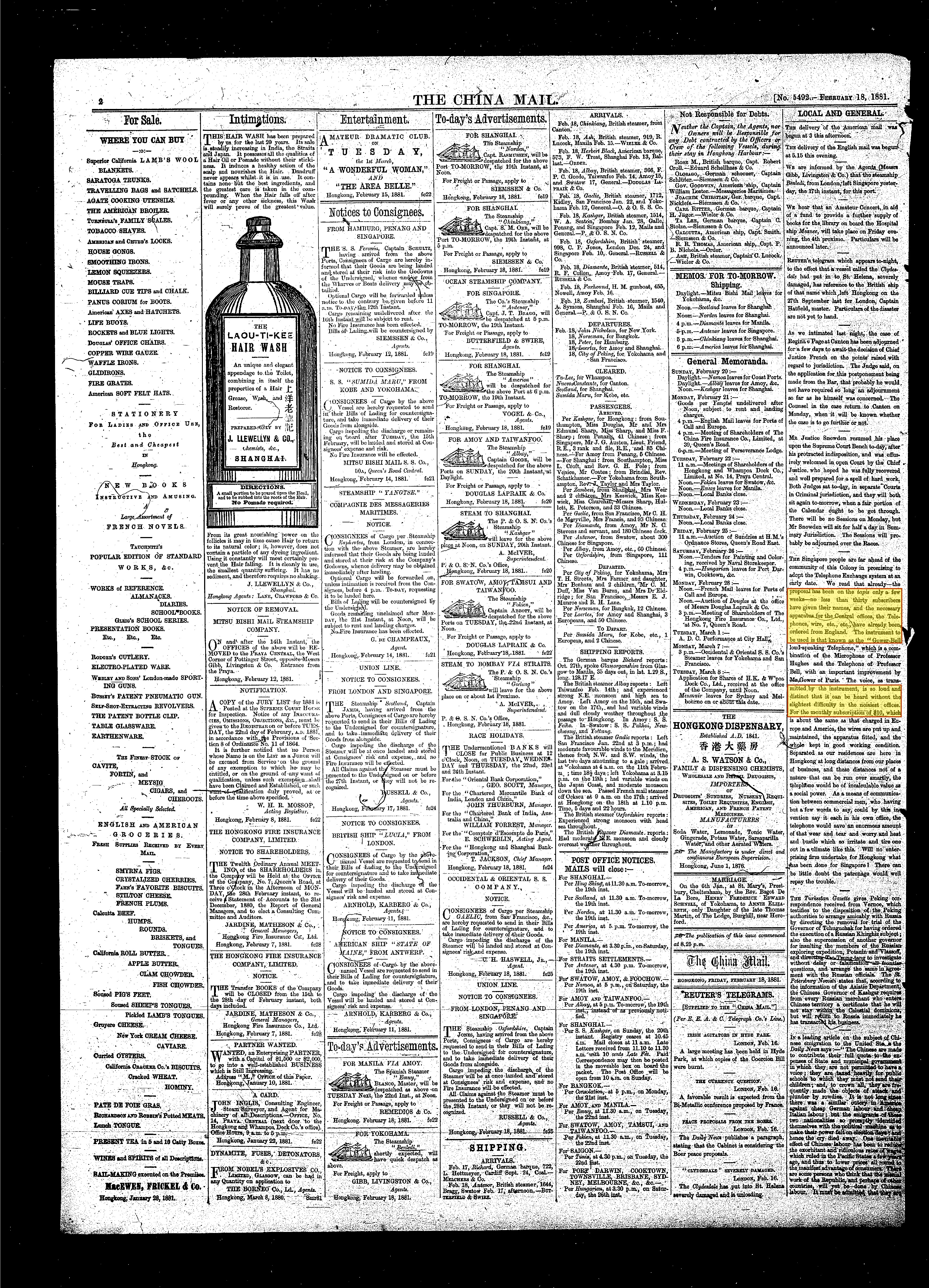
The shaming arrived on 18 February 1881: Singapore’s thirty subscribers, its Gower-Bell loud-speaking instrument, its $10 monthly subscription, and the challenge that wrote the colony’s lag into print — “Will no enterprising firm undertake for Hongkong what has been done for Singapore?”21 The answer formed within weeks. The Oriental Telephone Company (Limited) prospectused “the chief countries of the East, including India, China, Japan” in early April (capital £300,000, half offered), with a second April print raising the figure to £800,000 and the scope to India, Ceylon, Java, Australia, New Zealand, Egypt, Turkey and Greece — two capitals, kept as printed.22 A patent-house alternative followed mid-April: the Crossley Telephone Company of 18 Austin Friars, London, formed to work “the CROSSLEY PATENTS” across “India, Australia, New Zealand, and in other Colonies and Dependencies.”23 By 21 May the local tie was cut: the exchange “promises soon to become an accomplished fact in Hongkong,” the Oriental’s agents were “on the ground,” the local agency stood appointed “in the persons of Messrs Gibb, Livingstone and Co.,” and the poles application had gone in to the Government.24 The Oriental’s first ordinary general meeting (3 June, reported in July) confirmed the agency and put the Hong Kong application “before the Government.”25
4. The patent war in Executive Council
While the company cultivated the public, the patent question went to the Council. On 28 May 1881 the Gazette printed the formal notice: Joseph Morris, “of Tokio, Japan, now resident in Hongkong, Agent for THOMAS A. EDISON of Menlo Park,” petitioned for Letters Patent “for the exclusive use within the Colony of Hongkong, of an Invention known as the Carbon Telephone,” the English grant of 30 July 1877 recited, and a Council sitting fixed for Monday 30 May at 4 o’clock.26 The minutes record the collision: the petition “is opposed by certain gentlemen connected with the Oriental Telephone Company, who claim to have the exclusive right of the Patent”; Dr. A. B. Johnson, solicitor, addressed the Council “at length in opposition,” demanding a more detailed specification and “strict proof” that Edison had assigned his rights to Morris; Morris asked time; the Council’s later rulings — the specification would satisfy Ordinance No. 14 of 1862 but for “the technical error on the face of it,” and “two specifications, one declaration should be filed for each” — kept the petition grinding.27 The Exchange, in short, fought Edison’s own agent in the colony’s highest council before it sold a single instrument.
5. The permission and the machine, November 1881
The Council’s decision arrived in November 1881, in two documents that say the same thing twice. The minute: the Government “are prepared to grant him [Suenson, for the Great Northern Telegraph Company, since amalgamated with the Oriental] permission to establish a Telephone Exchange in the Colony, which permission the Crown reserves to itself the right of revoking at any time.” The Colonial Secretary’s letter of 7 November adds the condition that defines the whole episode: “this permission does not confer on your company any monopoly, but… all other applications to establish Telephone Exchanges will be considered on their own merits.”2829 Shanghai’s parallel application that June had asked for “exclusive right for a period of ten years”; Hong Kong’s Government gave a revocable permission instead, and in doing so licensed the very rivalry that followed. The Company’s own machine went on public view in the Gazette of 12 November: “BELL & EDISON’S SYSTEM… Permission having been granted,” the Combination-Bell-Edison instruments, the subscription “not [to] exceed $150 per annum for town subscribers,” the town bounded “West — The Gas Works. East — Police Station No. 2. South — Caine Road and Kennedy Road,” and the disclaimer that kept the whole thing conditional: “Should sufficient support not be received, the Company is not bound to establish the Exchange.”30
6. The rivals’ war, October 1881 – January 1882
The rivalry had opened in October. On 28 October 1881 Suenson warned “R. G. Alford, Esq.” — a private surveyor31 — that offering “Bell’s Telephones for sale” would make him “liable to legal prosecution,” the Oriental’s acquired privileges recited; Alford forwarded the letter to the Colonial Secretary the same day, asking whether the letters patent had been “issued in this Colony and filed and registered… according to the requirements of Ordinance No. 14 of 1862”32 — and the Council’s answer to his 25 October enquiry was already on file: “no such Letters Patent have been issued.”33 Suenson’s published reply (9 November) conceded the gap while claiming the rights: the Bell patents “were handed over to me” on the amalgamation, and the registration papers were “already… ordered out from home.”34 By January 1882 the war was a market fact. The editorial of 11 January reported the exchange’s supporters “confidently anticipate… in full working order in a few days,” but “the differences at present existing between the rival companies” awaited “a decision in Executive Council”; the same issue’s advertisements carried the rival’s answer — the proposed Local Public Telephone Company, “permission from Government to erect lines in the public streets and over Crown lands in all parts of the Colony,” its posts and brackets already finished “from the Centre of the Town to East Point,” its profits “in the hands of the Subscribers who are Shareholders, and not be taken out of the Colony,” its agent R. G. Alford himself.35 On 21 January the first company’s answer: “CONCLUSIVE steps… opening the Hongkong Telephone Exchange, at the offices of the Great Northern Telegraph.”36 The empire’s patent holders settled their own accounts that February — the six-party Bell–Edison agreement confirmed, “£10,000 in cash and 25,000 [£1] in shares”37 — but the colony’s Council minute of the rivalry’s own decision does not surface in the record, and the fate of Alford’s local company after 17 January is silence.
7. The Government’s own wires, and the waiting year
While the companies fought, the Government wired itself. The Acting Colonial Secretary’s minute of 14 November 1881 ordered a trial “between Government House and Government Offices” (telegraph wires, he noted, being “unsuitable for Telephones”); the Company’s line was up within days; the Central Police Station was put “in telephone communication with Police Station Kowloon”; and the Police Department’s terms settled at “Twenty Five [dollars] per set” a year, rented from the company, maintenance included. Hennessy’s despatch of 27 February 1882 asked the Secretary of State to approve the police circuit, with the Captain Superintendent’s reason: the instruments “do not require a skilled operator, any constable in the station being able to speak through them.”38 The constable’s instrument had come a long way since the 1877 report17 — and the constable, not the merchant, had been first in the field all along.
The public exchange, by contrast, waited. March 1882’s how-it-works description — the call bell, the galvanized wire, the “switch table” at Central station, the annunciator dropping A’s number, the operator asking what is wanted — describes private-line working (the China Mail’s own office was “connected by Telephone”), not a public opening.39 The opening notice never came that year; the press’s own retrospective explains why.
8. The exchange at last, 1 February 1883
“We are glad to observe that the Telephone Exchange… has at last become un fait accompli in Hongkong, having been opened to the public from the 1st instant” — the Telegraph, 5 February 1883, dating the public opening to 1 February 1883 and explaining the year’s wait: “the delay in commencing active operations was caused by the local Government having shown considerable hesitation in granting the Company the permission to erect the necessary poles.” The instruments were now “Blake’s transmitter and Bell’s hand-telephone”; the editorial’s verdict: “The usefulness of the system in Hongkong has already been practically demonstrated, so that its general adoption in all business houses can only be a question of time.”40 Two weeks later the paper was petitioning for the fire stations.41 The patent machinery kept moving — the Consolidated Telephone Construction and Maintenance Company (assignees of John Henry Johnson) petitioned for its patent rights in March 1883, its attorney the Great Northern’s own superintendent42 — and by 1887 the Finance Committee was recommending merchants’ requests to wire the Harbour Office and the Treasury to the exchange.43 In April 1889 the successor company, the China & Japan Telephone Company Limited, printed the exchange’s first surviving subscriber list: the two newspapers, the doctors Cantlie, Manson, Hartigan and Jordan, the bank and the great hongs, the Central Police Station, the Gas Company, the Dock, the hotels’ public telephones and the Alice Memorial Hospital.44 The constable’s wish of 1877 had become the town’s furniture.
9. Conclusion
The arrival’s story is institutional at every step: a police request (1877) that waited four years; a press shaming (February 1881) that summoned capital; two prospectuses and an agency (April–May 1881); a patent war inside Executive Council (May–November 1881) in which Edison’s own agent fought the Bell patents’ holders; a permission granted without the monopoly Shanghai sought (November 1881); a rivals’ war fought in the advertising columns by a subscriber-owned local company (October 1881 – January 1882); a government that wired its own offices and its own police first, at $25 a set; and a public opening (1 February 1883) that waited on the pole permission, not on the technology.2130 What the record does not carry — the Council’s ruling on the rivalry itself, the local company’s fate, the patent registration’s completion — is bracketed in Appendix B, and the paper keeps the honesty.16
Appendix A: sources and method
The documentary corpus is the hkintexts research index (Elasticsearch
cluster hkintexts, index hkintexts_pages, with the scan
series hkintexts_image_pages), queried read-only on 11 October
2026. Every passage quoted was read in its whole document; five newspaper
issues were additionally read whole (the compulsory pull and its companions:
11 and 14 January 1882, 9 February 1882, 7 March 1882, 5 February 1883, with
10 February and 16 March 1882 as controls). No write was made to the index.
Query families:
- “telephone” + 188[0–5], series-aggregated — 555 hits across nine series (press, gazette, CO 129, Executive Council, blue books, directories);
- “Telephone Exchange” + 1880–83 (67, earliest-first); “Bell and Edison” (49); “Oriental Telephone” (57); “telephonic” (85); “switch table” (1 — the 7 March 1882 page);
- “LOCAL PUBLIC TELEPHONE” (10 — the rival’s advertisements, 11–17 January 1882); “Alford” + “Telephone” conjunct (65); “Mutual Telephone” (417 — the 1881–82 Hong Kong-paper hits are Shanghai news, labelled as contrast);
- series-scoped sweeps: the gazette 1880–86 (12 — the Morris notices, the Bell & Edison runs, the 1883 Consolidated Telephone notices, one 1887 Postmaster-General report); ExCo (16); CO 129 (34); the directories (4,996 broad; the Alford lines of 1881/1882 and the company listings of 1884–89 pulled); “Hongkong Telephone Exchange” (912 — the 1889 subscriber list pulled);
- negative controls: “Telephone Ordinance” (897, all modern — the 1881–83 machinery ran on permissions, not ordinance); the gazette 1882–86 (3 hits, no ordinance); the 1882 February–December sweep (68 hits, no opening notice).
Image-series twins were hunted for every cited page; four were found and
plated (Figures 1–4). CO 129, CO 131 and the Telegraph have no image
twins (the pair table); their citations stay on /page/ links.
Appendix B: evidence register
| Claim | Witnesses |
|---|---|
| The police recommended telephones over telegraph, 1877 | the Blue Book 1877 police report; the Captain Superintendent’s 1882 concurrence in “the recommendation made by Creagh in his report for 1877” (CO 129/197) |
| The Singapore comparison (the Gower-Bell; $10/month; thirty subscribers) | the China Mail of 18 February 1881, scan-verified against the image twin |
| The Oriental Telephone Company’s prospectus and imperial scope | the prints of 2 April (£300,000) and 29 April 1881 (£800,000); the first AGM reported 29 July 1881 |
| Edison’s Carbon Telephone petition and the 30 May 1881 ExCo sitting | the Gazette notices of 21 and 28 May 1881; the ExCo minutes pp. 30–31, 39–40 |
| The Oriental’s Hong Kong agency = Gibb, Livingstone & Co. | the China Mail of 21 May 1881; the AGM report (“the agents here”); the firm in the 1889 subscriber list |
| The permission of November 1881: revocable, no monopoly | the ExCo minute (p. 107); the Colonial Secretary’s letter of 7 November 1881 (CO 129/197); the 12 November Gazette advertisement |
| The Suenson–Alford patent war, October–November 1881 | the correspondence in the China Mail (7, 8, 9 November) and Telegraph (8, 9 November); Alford’s 25 October enquiry minuted in ExCo |
| The rival = Alford’s Local Public Telephone Company | the advertisements of 11 and 14 January 1882; the Directories’ “Alford, R. G., surveyor” (1881, 1882); Alford’s own 25/28 October letters |
| The public exchange opened 1 February 1883 | the Telegraph’s retrospective of 5 February 1883 (“opened to the public from the 1st instant”); the Telegraph’s “recently opened Telephone Exchange” of 20 February 1883 |
| The Government’s trial lines, 1881–82 | the Acting Colonial Secretary’s minute (14 November 1881) and the Superintendent’s replies (Government House–Government Offices; Central Police–Police Station Kowloon); Hennessy’s despatch of 27 February 1882 |
| The exchange’s afterlife | the Sessional Paper 1887–88 (the Harbour Office/Treasury request); the 1889 subscriber list; the directories’ company listings 1884–89 |
| Item | Status |
|---|---|
| The £10,000-cash-and-25,000-shares settlement (the Oriental EGM, 4 February 1882) | one London report reprinted; labelled |
| The rival’s posts-and-brackets line “from the Centre of the Town to East Point” (four lines) | the rival’s own advertisement; labelled |
| The Crossley manager-in-Brisbane item (28 October 1881) | one line; the company’s wider activity; labelled |
| The Fire Brigade suggestion (20 February 1883) | an editorial proposal, not an adopted policy; labelled |
| Item | Handling |
|---|---|
| £300,000 (2 April) vs £800,000 (29 April 1881) for the Oriental’s capital | two prints of a growing prospectus; both cited, no average |
| The press advertisement’s date: the text index’s key says 1881-11-11; the scan’s masthead reads SATURDAY, NOVEMBER 12, 1881 | the printed masthead wins; the variance registered |
| The Acting Colonial Secretary’s name garbles in the CO 129/197 transcriptions | cited by OFFICE only; never reconstructed (hard rule 1) |
| “Gower-Bell” (February 1881) vs “Combination-Bell-Edison” (November 1881) | two instrument names, two documents, eleven months apart; each under its own citation |
| Claim | Why killed |
|---|---|
| “The exchange opened for regular business on 1 March 1882” (the first pass’s reading) | the phrase fragment “(1st)” sits in a two-column transcription interleave and cannot be pinned to Hong Kong; the Telegraph’s 5 February 1883 retrospective (“at last… opened to the public from the 1st instant”, the poles hesitation named as the delay) contradicts it. The March 1882 item is cited only for the private line and the switch-table description |
| “£420,000 capital” for the Crossley Telephone Company (the first pass) | the capital lines near the advertisement in the interleave belong to the Yang Tsze Insurance Association’s advertisement; dropped from every deliverable |
| “The how-it-works paragraph that taught the colony” (the first pass’s framing) | the standard explanation already ran on 27 November 1880 (the Anglo-Indian company); the 7 March 1882 paragraph is the local exchange’s explanation, not the colony’s first |
| “The Mutual Telephone Association” as a Hong Kong third company | the Telegraph says so explicitly (4 February 1882): “organised in Shanghai”; its exchange was to open at No. 2 Kiukiang Road. Used only as labelled contrast |
| “Telephone Ordinance” for the 1881–83 exchanges | negative control: 897 hits, all modern or other jurisdictions; the machinery ran on permissions under the Crown’s reservation |
| Item | Status |
|---|---|
| The subscriber list of 1881–83 | the names behind the first wires are not in the corpus; the earliest surviving list is the successor company’s of 26 April 1889 |
| The Executive Council’s ruling on the rivalry itself | the January 1882 editorial awaits “a decision in Executive Council”; the Council’s minute of that decision is not found in the pulled pages of CO 131/12 |
| The fate of Alford’s Local Public Telephone Company | after 17 January 1882 its advertisements stop; no winding-up, no opening notice; bracketed |
| The identity of “the Bill now before the Legislative Council” cited for the poles (21 May 1881) | not pinned to a named bill in the pulled strata; bracketed |
| Whether Bell’s English patents were ever registered in the Colony | Suenson’s papers were “ordered out from home” (9 November 1881); the later registration is not documented in the pulled record; bracketed |
Notes
Method note: the documentary corpus interrogated for this paper is the hkintexts research index (Elasticsearch cluster hkintexts, index
hkintexts_pages, with the scan serieshkintexts_image_pagesfor page images), queried read-only on 17 October 2026. The logged queries and pulls are itemised in Appendix A. This paper supersedes the thread’s first pass of 7 October 2026 on three points — the public opening belongs to 1883, not 1882; the Crossley prospectus’s capital is not verifiable; and the standard how-it-works paragraph antedates the local one by sixteen months — each documented in Appendix B. No write was made to the index. ↩Report of the Acting Captain Superintendent of Police, in the Blue Book for 1877, p. 262: “Having regard to the great expense and numerous defects of the telegraph instruments now supplied to this Department, I think the Telephone might be substituted with advantage. This instrument appears to be in many respects superior to the Telegraph for Police purposes.” The Captain Superintendent of Police concurred in “the recommendation made by Creagh in his report for 1877” in his 1882 report (CO 129/197, p. 518; see note 12). https://hkintexts.histsyn.com/page/658908 (accessed 17 October 2026). ↩
The China Mail, 18 February 1881, p. 2: “The Singapore people are far ahead of the community of this Colony in promising to adopt the Telephone Exchange system at an early date. We read that already the proposal has been on the tapis only a few weeks [and] no less than thirty subscribers have given their names… The instrument to be used is that known as the ‘Gower-Bell loud-speaking Telephone’, which is a combination of the Microphone of Professor Hughes and the Telephone of Professor Bell, with an important improvement by Mr. Gower of Paris… For the monthly subscription of $10, which is about the same as that charged in Europe and America, the wires are put up and maintained… Will no enterprising firm undertake for Hongkong what has been done for Singapore?” Scan: https://hkintexts.histsyn.com/image-page/1194586 (accessed 11 October 2026). ↩
The China Mail, 21 May 1881, p. 9: “The Institution of the Telephone Exchange, concerning which we had frequent paragraphs in these columns, promises soon to become an accomplished fact in Hongkong. The requisite machinery and instruments are here; the agents of the Oriental Telephone Company are on the ground; local agents are appointed in the persons of Messrs Gibb, Livingstone and Co.… Application has been forwarded to the Government for leave to erect the necessary poles.” Scan: https://hkintexts.histsyn.com/image-page/1194915 (accessed 17 October 2026). ↩
The Hongkong Government Gazette, 28 May 1881, p. 383: “In the Matter of the Petition of JOSEPH MORRIS, of Tokio, Japan, now resident in Hongkong, Agent for THOMAS A. EDISON of Menlo Park, New Jersey… for Letters Patent for the exclusive use within the Colony of Hongkong, of an Invention known as the Carbon Telephone, for which Letters Patent were on the 30th July, 1877, granted to the said THOMAS A. EDISON in England… a sitting of the Executive Council, before whom the matter of the said petition will come for decision, will be held in the Council Chamber, at the Government Offices, Victoria, Hongkong, on Monday, the Thirtieth May next, at 4 o’clock P.M.” The first notice had run on 21 May. Scans: https://hkintexts.histsyn.com/image-page/1505059 and https://hkintexts.histsyn.com/image-page/1505046 (accessed 11 October 2026). ↩
CO 131/12, page 107 (the same sitting that considered Mr Alford’s enquiry, note 33): “The Council proceeds to consider Mr Suenson’s application on behalf of the Great Northern Telegraph Company (since amalgamated with the Oriental Telephone Company) dated the 14th April 1881, for permission to establish a Telephone Exchange in the Colony. After deliberation it is agreed that Mr Suenson be informed that as far as the rights of the Crown are concerned, the Government are prepared to grant him permission to establish a Telephone Exchange in the Colony, which permission the Crown reserves to itself the right of revoking at any time.” https://hkintexts.histsyn.com/page/5222098 (accessed 17 October 2026). ↩
CO 129/197, Governor Hennessy, 1882 (C.O. 5883), p. 514 — the Acting Colonial Secretary to A. Suenson, Hong Kong, 7 November 1881: “…as far as the rights of the Crown are concerned, the Governor is prepared to grant you permission to establish a Telephone Exchange, but I am to add that His Excellency reserves the right of revoking the permission at any time. You will understand that this permission does not confer on your company any monopoly, but that all other applications to establish Telephone Exchanges will be considered on their own merits.” The Company’s reply begs in addition “the support of the Government by including all Police and Fire Stations into the system.” https://hkintexts.histsyn.com/page/311493 and https://hkintexts.histsyn.com/page/311494 (accessed 17 October 2026). ↩
The Hongkong Government Gazette, 12 November 1881, p. 1004: “THE GREAT NORTHERN TELEGRAPH COMPANY, (amalgamated with the ORIENTAL TELEPHONE COMPANY, LIMITED, as regards Telephone Lines in Hongkong and China) with transfer of ‘letters patent,’ for the use of improvements in Telephones invented by THOMAS ELVA EDISON, ALEXANDER GRAHAM BELL, ARNHOLD WHITE, FREDERIC ALLEN GOWER, &c., &c. — BELL & EDISON’S SYSTEM. Permission having been granted by the Government to establish a Telephone Exchange in Hongkong, the above Company hereby begs to invite Subscriptions from the Public… The Telephones used by the Company are the Combination-Bell-Edison… The subscription fee… will not exceed $150 per annum for town subscribers. The following boundaries will be taken as terminating the town, viz., West — The Gas Works. East — Police Station No. 2. South — Caine Road and Kennedy Road… Should sufficient support not be received, the Company is not bound to establish the Exchange. — A. SUENSON, Superintendent. Hongkong, November 10th, 1881.” Scan: https://hkintexts.histsyn.com/image-page/1505669 ; the press printing: the China Mail, 12 November 1881, p. 2 (scan masthead SATURDAY, NOVEMBER 12, 1881; the text index’s key reads 1881-11-11 — the variance is registered in Appendix B), https://hkintexts.histsyn.com/page/1895190 ; and the Telegraph, 11 November 1881, p. 2, https://hkintexts.histsyn.com/page/2823827 (accessed 17 October 2026). ↩
The China Mail, 7 November 1881, p. 3 (“INTRODUCTION OF THE TELEPHONE INTO HONGKONG”; the Hongkong Telegraph printed the same correspondence on 8 November, p. 2): A. Suenson, Superintendent, Great Northern Telegraph Co.’s Station, Hongkong, 28 October 1881, to “R. G. Alford, Esq.” — “Having been brought to my knowledge on good authority that you offer Bell’s Telephones for sale… all privileges in the nature of letters patent or concessions for the use of Telephones, that Mr Alexander Graham Bell has acquired, or is entitled to acquire, in Hongkong are transferred to the Oriental Telephone Company Limited, now amalgamated with the Great Northern Telegraph Company as far as Telephone lines in Hongkong and China are concerned, and that you will make yourself liable to legal prosecution by offering the instruments for sale.” Alford the same day, to the Colonial Secretary: “I… respectfully… enquire if the Letters Patent to which he refers have been issued in this Colony and filed and registered in your office according to the requirements of Ordinance No. 14 of 1862. — R. G. ALFORD, Surveyor, &c.” https://hkintexts.histsyn.com/page/1895175 and https://hkintexts.histsyn.com/page/2823815 (accessed 17 October 2026). ↩
The China Mail, 11 January 1882, p. 2: “the supporters of the Telephone Exchange confidently anticipate that the institution under that name will be in full working order in a few days… Until, however, the differences at present existing between the rival companies have been finally settled by a decision in Executive Council, it seems doubtful that this latest advance in the art of speedy communication will be generally adopted.” The same issue’s advertising column names the rival: “THE Undersigned, Acting as AGENT for the proposed LOCAL PUBLIC TELEPHONE COMPANY, the Promoters of which have received permission from Government to erect lines in the public streets and over Crown lands in all parts of the Colony… He has just finished a complete set of Posts and Brackets from the Centre of the Town to East Point… As the profits of the proposed local Company will be in the hands of the Subscribers who are Shareholders, and not be taken out of the Colony, the Promoters anticipate that their scheme will meet with large support. For Estimates and all information apply to R. G. ALFORD, Surveyor, &c., &c., 12, Queen’s Road, Central” (repeated 14 January 1882, p. 1; whole issues read). https://hkintexts.histsyn.com/page/1895404 (accessed 17 October 2026). ↩
The China Mail, 21 January 1882, p. 2: “CONCLUSIVE steps are now being taken to complete arrangements for opening the Hongkong Telephone Exchange, at the offices of the Great Northern Telegraph [Company]… and notice to the contrary be given before…” https://hkintexts.histsyn.com/page/1895442 (accessed 17 October 2026). ↩
CO 129/197 (C.O. 5883), pp. 520–532: the Acting Colonial Secretary’s minute of 14 November 1881 — “I understand that telegraph wires are unsuitable for Telephones… I think a trial should be made between Government House and Government Offices”; the Superintendent’s reply of 16 November — “a line for the trial of our telephone instruments will now be put up between Government House and Government Offices”; later in the file — “we have now put the Central Police station in telephone communication with Police Station Kowloon, and that, as far as we can ascertain, the line is ready for use”; and the terms for the Police Department — “annual rental of Twenty Five [dollars] per set… includ[ing] the maintenance.” Hennessy’s despatch of 27 February 1882 asks approval of the police circuit and reports the Captain Superintendent’s judgment: “the instruments of the Company are preferable to the telegraphic instruments now in use in his department, as they do not require a skilled operator, any constable in the station being able to speak through them.” https://hkintexts.histsyn.com/page/311499 , https://hkintexts.histsyn.com/page/311502 , https://hkintexts.histsyn.com/page/311503 , https://hkintexts.histsyn.com/page/311511 , https://hkintexts.histsyn.com/page/311487 (accessed 17 October 2026). ↩
The China Mail, 7 March 1882, p. 3: “each subscriber has in his office a call bell, receiving Telephone, and transmitter, or speaking Telephone, connected by a wall galvanized wire to the ‘switch table’ at Central station. Supposing A wishes to communicate with B: A rings his bell which drops an annunciator with A’s number on it at the Central station. The operator there immediately switches his telephone on to A’s… and asks what is wanted”; and, in the same item, “we are [n]ow connected by Telephone and can say that it is all that can [be] desired” (the paper’s own office) and “It is now only about three years since the first Telephonic Exchange was started in St. Louis.” The whole issue was read; the page’s two columns interleave in transcription, and the item is cited only for the passages here quoted (Appendix B). https://hkintexts.histsyn.com/page/1895596 (accessed 11 October 2026). ↩
The Hongkong Telegraph, 5 February 1883, p. 2: “We are glad to observe that the Telephone Exchange in connection with the Oriental Telephone Company, Limited, and under the auspices of the Great Northern Telegraph Company, has at last become un fait accompli in Hongkong, having been opened to the public from the 1st instant [1 February 1883]. It is now such a considerable time since subscribers to establish a Telephone Exchange in this Colony were solicited… that we were under the impression the movement had been abandoned, owing to lack of support. However, it appears that the delay in commencing active operations was caused by the local Government having shown considerable hesitation in granting the Company the permission to erect the necessary poles… The usefulness of the system in Hongkong has already been practically demonstrated, so that its general adoption in all business houses can only be a question of time.” The instruments: “Blake’s transmitter and Bell’s hand-telephone.” Whole issue read. https://hkintexts.histsyn.com/page/2825351 (accessed 11 October 2026). ↩
The China Mail, 26 April 1889, p. 1 (advertisement): “THE CHINA & JAPAN TELEPHONE COMPANY, LIMITED… LIST OF SUBSCRIBERS TO THE HONGKONG TELEPHONE EXCHANGE” — The Hongkong Telegraph first; Dr J. Cantlie, Dr P. Manson, Dr W. Hartigan, Dr G. P. Jordan; the Hongkong & Shanghai Banking Corporation; Russell & Co.; Butterfield & Swire; the P. & O. S. N. Co.; Gibb, Livingston & Co.; the Daily Press; the China Mail; the Central Police Station; the Hongkong & China Gas Co.; the Hongkong & Whampoa Dock; the Hongkong Hotel and the Peak Hotel (“Public Telephone”); the Alice Memorial Hospital; and other houses. The Directories of 1885–86 list the successor (Head Office, Austin Friars, London). https://hkintexts.histsyn.com/page/1903141 (accessed 11 October 2026). ↩
Method note (see note 1). ↩
Report of the Acting Captain Superintendent of Police, Blue Book 1877, p. 262 (see note 2). https://hkintexts.histsyn.com/page/658908. ↩
The China Mail, 8 March 1880, p. 2: “THE proposed Telephone Exchange Company at Shanghai does not promise to be a…” (printed among the Shanghai intelligence). https://hkintexts.histsyn.com/page/1892991 (accessed 17 October 2026). ↩
The China Mail, 13 April 1880, p. 3 (a Japan item): “the Telegraph Department here will be requested to arrange telephonic communication between the Kencho and the Central Police Station, between the gaol and the Hiogo and Kobe police stations.” https://hkintexts.histsyn.com/page/1893114 (accessed 17 October 2026). ↩
The China Mail, 27 November 1880, p. 2 (the Anglo-Indian Telephone Company, head office Edinburgh, “ready to commence operations”): “When a subscriber wishes to communicate… he presses his button, which rings a bell at the Central Office, and drops an annunciator showing his name and the number of his wire. The operator then signals back and asks him whom he wishes to be connected with… switches the two lines together… With well-trained operators the whole operation of putting two people in communication does not exceed half a minute.” https://hkintexts.histsyn.com/page/1893942 (accessed 17 October 2026). ↩
The China Mail, 18 February 1881, p. 2 (see note 6). https://hkintexts.histsyn.com/image-page/1194586. ↩
The China Mail, 2 April 1881, p. 3: “The prospectus has been issued of the Oriental Telephone Company (Limited)… telephonic communication in the chief countries of the East, including India, China, Japan… The capital is £300,000, in 300,000 shares, of which half are offered for subscription”; with the second print, the China Mail, 29 April 1881, p. 3: “It is called the ‘Oriental Telephone Company, Limited,’ and has a capital of £800,000 in £10 shares. Its object is to establish telephonic communication by exchanges, private lines, and otherwise in India, Ceylon, Java, [Australia,] New Zealand, Egypt, Turkey, and Greece… [and] absorb the business of the Anglo-Indian Telephone Company” — the two capital figures kept as printed (Appendix B). https://hkintexts.histsyn.com/page/1894386 and https://hkintexts.histsyn.com/page/1894482 (accessed 17 October 2026). ↩
The China Mail, 16 April 1881, p. 5 (advertisement): “CROSSLEY TELEPHONE COMPANY, Offices — 18, Austin Friars, London, E.C.… THIS Company has been formed for [working] the CROSSLEY PATENTS… for providing Telephonic communication by Private Lines, Telephone Exchanges, and otherwise, in India, Australia, New Zealand, and in other Colonies and Dependencies.” No capital figure is legible in the advertisement as printed (Appendix B). https://hkintexts.histsyn.com/page/1894438 (accessed 17 October 2026). ↩
The China Mail, 21 May 1881, p. 9 (see note 4). https://hkintexts.histsyn.com/image-page/1194915. ↩
The China Mail, 29 July 1881, p. 2 (the Oriental Telephone Company’s first ordinary general meeting, held 3 June at the City Terminus Hotel, Mr. Pender, M.P., presiding): “We have before referred to this Company as purposing to establish a system of telephone communication here. Their application is one of these now before the Government. Messrs Gibb, Livingstone & Co. are the agents here.” https://hkintexts.histsyn.com/page/1894799 (accessed 17 October 2026). ↩
The Hongkong Government Gazette, 28 May 1881, p. 383 (see note 5). https://hkintexts.histsyn.com/image-page/1505059. ↩
CO 131/12, Executive Council minutes and papers (the ExCo series, pages 30–31 and 39–40): the petition “is opposed by certain gentlemen connected with the Oriental Telephone Company, who claim to have the exclusive right of the Patent”; “Dr. A. B. Johnson, solicitor, on behalf of the Oriental Telephone Company addresses the Council at length in opposition to the Petition, alleging that the specification should be in more detail, and also alleging that Mr Morris should be required to satisfy the Governor by strict proof that he had had assigned to him Mr Edison’s Patent”; Morris asks time to reply; a later sitting — the specification “would meet… the requirements of Ordinance… 14 of 1862”, but “owing to the technical error on the face of it, it is necessary to get further evidence before admitting that Mr Edison has assigned his rights”; and a still later minute: “two specifications, one declaration should be filed for each.” The minutes are manuscript; the readings follow the series’ transcription. https://hkintexts.histsyn.com/page/5222021 , https://hkintexts.histsyn.com/page/5222030 , https://hkintexts.histsyn.com/page/5222123 (accessed 17 October 2026). ↩
CO 131/12, page 107 (see note 6). https://hkintexts.histsyn.com/page/5222098. ↩
CO 129/197 (C.O. 5883), p. 514, 7 November 1881 (see note 7). https://hkintexts.histsyn.com/page/311493. ↩
The Hongkong Government Gazette, 12 November 1881, p. 1004 (see note 8). https://hkintexts.histsyn.com/image-page/1505669. ↩
Directory and Chronicle 1881, p. 53: “Alford, R. G., surveyor, Arbuthnot Road”; Directory and Chronicle 1882, p. 58: “Alford, R. G., surveyor, Queen’s Road” — the rival promoter listed as a private resident surveyor in both years. https://hkintexts.histsyn.com/page/991823 and https://hkintexts.histsyn.com/page/992377 (accessed 17 October 2026). ↩
The China Mail, 7 November 1881, p. 3; the Hongkong Telegraph, 8 November 1881, p. 2 (see note 9). ↩
CO 131/12, page 107: “Consideration given to letter from Mr. R. G. Alford dated the 25th October 1881, enquiring whether Letters Patent have been issued in the Colony for Bell’s Telephones. To be informed that no such Letters Patent have been issued.” https://hkintexts.histsyn.com/page/5222098 (accessed 17 October 2026). ↩
The Hongkong Telegraph, 9 November 1881, p. 3 (also the China Mail, 8 November 1881, p. 3): “On the amalgamation of the Oriental Telephone Co. with the Great Northern Telegraph Co. certain ‘letters patent’ were handed over to me amongst others, also ‘letters patent’ for the exclusive use of Mr. Alexander Graham Bell’s Telephones in England, India, Australia, China, etc., etc… ‘letters patent’ granted in England should be extended to this Colony by having them filed and registered at the Colonial Secretary’s Office. The necessary papers for doing this have already been ordered out from home. — A. SUENSON… Nov. 9th, 1881.” https://hkintexts.histsyn.com/page/2823820 and https://hkintexts.histsyn.com/page/1895179 (accessed 17 October 2026). ↩
The China Mail, 11 and 14 January 1882 (see note 10). ↩
The China Mail, 21 January 1882, p. 2 (see note 11). https://hkintexts.histsyn.com/page/1895442. ↩
The Hongkong Telegraph, 4 February 1882: “An extraordinary general meeting of the Oriental Telephone Company (Limited) has been held at the City Terminus Hotel to consider a resolution approving and confirming a certain conditional agreement… between Mr. Bell of the first part, Mr. Edison of the second part, the Oriental Telephone Company of New York of the third part, the Anglo-Indian Telephone Company (Limited) of the fourth part, Messrs. Gouraud, Hubbard, Bigelow, Cargill, and Ormes of the fifth part, and this company of the sixth part… Mr. Pender, M.P., presided… the vendors had secured £10,000 in cash and 25,000 [£1] in shares.” The same day: “a Mutual Telephone Association has been organised in Shanghai” — the coast’s parallel contest, cited as contrast only. https://hkintexts.histsyn.com/page/2824108 and https://hkintexts.histsyn.com/page/2824107 (accessed 17 October 2026). ↩
CO 129/197 (C.O. 5883), pp. 520–532 (see note 12). ↩
The China Mail, 7 March 1882, p. 3 (see note 13). https://hkintexts.histsyn.com/page/1895596. ↩
The Hongkong Telegraph, 5 February 1883, p. 2 (see note 14). https://hkintexts.histsyn.com/page/2825351. ↩
The Hongkong Telegraph, 20 February 1883, p. 6: “MIGHT we be allowed to suggest to the authorities that the recently opened Telephone Exchange could with advantage be placed in communication with all the stations of the Fire Brigade in the colony!… As the expense of telephonic connection is not great, we think that our suggestion is at least worthy of a trial.” https://hkintexts.histsyn.com/page/2825405 (accessed 17 October 2026). ↩
The Hongkong Government Gazette, March 1883: “In the matter of the Petition of THE CONSOLIDATED TELEPHONE CONSTRUCTION AND MAINTENANCE COMPANY, LIMITED, of No. 6, Lombard Street, in the City of London, by their Attorney CHRISTIAN ADRIAN SCHULTZ… Superintendent of the GREAT NORTHERN TELEGRAPH COMPANY in Hongkong… the Petition, Specification and Declaration required herein by Ordinance No. 14 of 1862, were duly filed… on the 28th day of February, 1883… a sitting of the Executive Council… will be held… on Tuesday, the 27th day of March, 1883.” The Council’s minute of the same file names the petition as the assignees of John Henry Johnson’s telephone patent rights (Letters Patent, England, 26 June 1880). https://hkintexts.histsyn.com/page/1664016 and https://hkintexts.histsyn.com/page/1664043 ; CO 131/12, page 325, https://hkintexts.histsyn.com/page/5222278 (accessed 17 October 2026). ↩
Sessional Paper 1887–1888, p. 68 (the Finance Committee): Mr MacEwes “has been requested by several of the leading merchants to bring to the notice of the Government the desirability of connecting the Harbour Office and the Treasury with the Telephone Exchange… The Committee consider the request a reasonable one, and recommend it to the favourable consideration of the Government.” https://hkintexts.histsyn.com/page/1814009 (accessed 17 October 2026). ↩
The China Mail, 26 April 1889, p. 1 (see note 15). https://hkintexts.histsyn.com/page/1903141. ↩
Bibliography
Primary sources
- Blue Book for 1877 (the Acting Captain Superintendent of Police’s report).
- The China Mail, March 1880 – April 1889 (the coast items; the Singapore comparison; the Oriental and Crossley prospectuses; the agency item; the Suenson–Alford correspondence; the rival’s advertisements; the switch-table description; the 1889 subscriber list).
- The Hongkong Telegraph, November 1881 – February 1883 (the correspondence; the Oriental EGM; the opening retrospective; the Fire Brigade suggestion).
- The Hongkong Government Gazette, May 1881, November 1881, March 1883 (the Morris/Edison petition notices; the Bell & Edison’s System advertisement; the Consolidated Telephone petition notices).
- CO 131/12, Executive Council minutes and papers, 1881–1883 (the patent hearings; the Suenson permission; the Consolidated Telephone petition).
- CO 129/197, Governor Hennessy, 1882 (C.O. 5883) — the telephone file (the permission letter; the trial lines; the Kowloon line; the $25 terms; the 27 February 1882 despatch).
- Directory and Chronicle, 1881 and 1882 (the Alford listings); 1884–89 (the exchange’s company listings).
- Sessional Paper 1887–1888 (the Finance Committee’s telephone request).