The Councillor's Seat — the Chinese in Hong Kong's Councils, 1880–1926 / 定例局紳:香港議會裏的華人
定例局紳與議政局紳:香港議會裏的華人,1880–1926
摘要
1880年1月19日,港督軒尼詩(John Pope Hennessy)在《憲報》上公布,暫委律師伍廷芳(Ng Choy,伍君)為定例局(立法局)議員,填補離港議員郭氏(Gibb)之缺,以待英廷批准1。這不是一個常設席位,而是一次「暫委」:任期以3年為限、原議員若回港即告終止2。同年2月19日,全港華商代表團到督轅致謝,其稟詞寫道,議例局員「向未聞華人得預其列」,今「特立伍局員」為「開港以來未有之創舉」3。軒尼詩在答詞中說,此舉是「本港開埠以來首次委任華人入局」;但他自己又舉出更早的先例——星洲的胡亞基(Hoo Ah Kay,1869年入當地議會)與他在納閩任內所委的曹馬蘇(Choa Massoo;皇家亞洲學會1969年講稿寫作 Chou Massoo,兩者照錄不改)3。因此本硏究為「首次」一詞劃定範圍:是本港首次,不是帝國首次。
伍廷芳的3年,是一段被「可否常設」反覆拉扯的任期:1880年7月港督推薦他補實缺,9月英廷改派駱克(Lowcock),伍廷芳只獲准以「署理」身分續任,且任期不得超過3年2。1882年2月他在局內審議電車法案時投下反對票,與總督對立4;同年11月,天津傳來他將出任李鴻章與海關道的外務法律顧問的消息,報紙直言他應「依禮」辭去議席5。1883年,殖民部檔案以第7號函記錄「伍廷芳辭去定例局議員,及繼任人的委任」6。第二位華人議員是黃勝(Wong Shing)——他在1870年《東華醫院立案條例》的附表裏以「買辦 黃勝 Wong Shing」的雙語形式出現7,1883年獲《1883年第15號條例》歸化為英籍,1884年2月28日坐在改組後的新局內8。此後,1890年何啟(Ho Kai)補上黃勝6年期滿的席位9;1896年,港督羅便臣在局內宣布委任韋寶珊(Wei Yuk)為華人議員,理由是「華人社會咸以他為代表」10。1921年12月2日,周壽臣(Chow Shou-son)補何福(Ho Fook)退休之缺11;1926年7月9日,《憲報》公告英皇批准周壽臣為議政局(行政局)議員,任期5年——這是議政局首位華人成員12。
本硏究的主線因此不是「第一人的故事」,而是一個席位如何從「暫委」變成常設、再從定例局走到議政局:起點是填補缺位的權宜,終點是行政機關核心的常設委任;中間的46年,由憲報的委任通知、殖民部檔案、殖民部大臣與港督的往復函件,以及報紙的評論所記錄。凡語料庫不能證實者(如請願書裏「九成」一語的原文、辭職函的文本),本硏究均據實說明,不作推測。
一、1880年1月:一個「暫委」席位的誕生
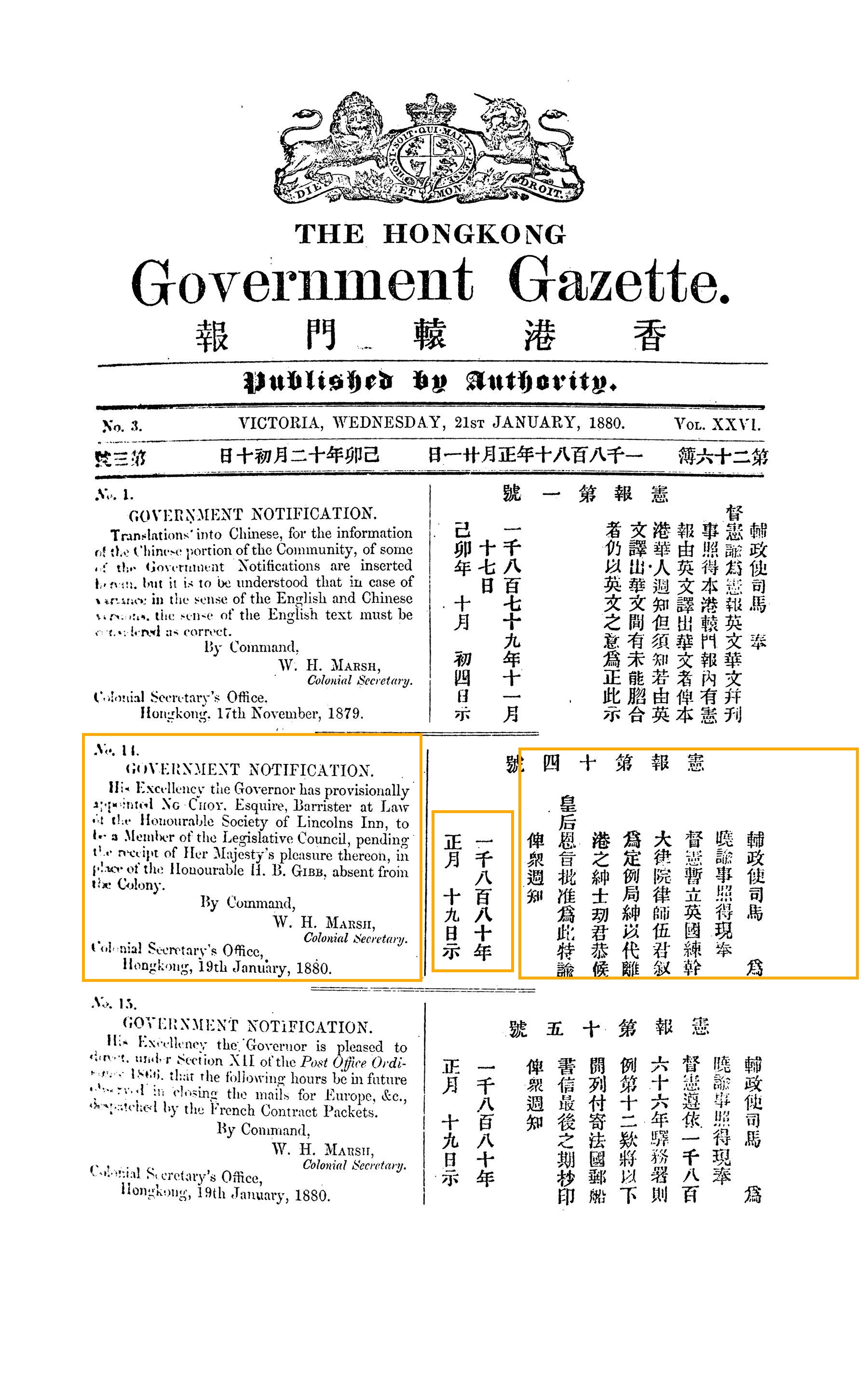
1880年1月21日出版的《憲報》第3號,刊出政府第14號公告:軒尼詩「暫委林肯法學院律師伍廷芳」為定例局議員,「以代離港之郭氏」,「恭候皇后恩旨批准」1。同一版面上,憲報以中文刊出同一公告的官譯:「輔政使司馬為曉諭事照得現奉督憲暫立英國練幹大律院律師伍君敘為定例局紳以代離港之紳士郭君恭候皇后恩旨批准為此特諭俾衆週知」,日期欄作「一千八百八十年正月十九日示」1。這是本港官方文書最早以「定例局紳」稱呼華人議員的記錄之一;「定例局」作為立法局的中文官名,此後沿用至20世紀13。公告發布於1月21日,文尾日期為19日;英、中兩欄都作19日,故本硏究以19日為委任日期,21日為公布日期1。
委任的背景是一份請願書。1879年12月17日(光緒5年11月初五),12名華人具稟港督,由歐德理(E. J. Eitel)於12月19日譯成英文;稟文以「香港九成人口為華人」為理據,要求華人得有代表,並提及1878年十月的一封舊稟14。軒尼詩於1880年1月19日將稟文封送殖民部(第2751號函)14。殖民部的官員在檔案上留下了一條眉批,措詞坦白:理論上華人理應有代表,但「若伍先生勝任,這項實驗不必再以委任華人的方式重複」、「一次的先例不等於要永遠為該民族保留一個席位」15——這條眉批,正是此後40餘年席位安排反覆的伏筆(見第三節)。
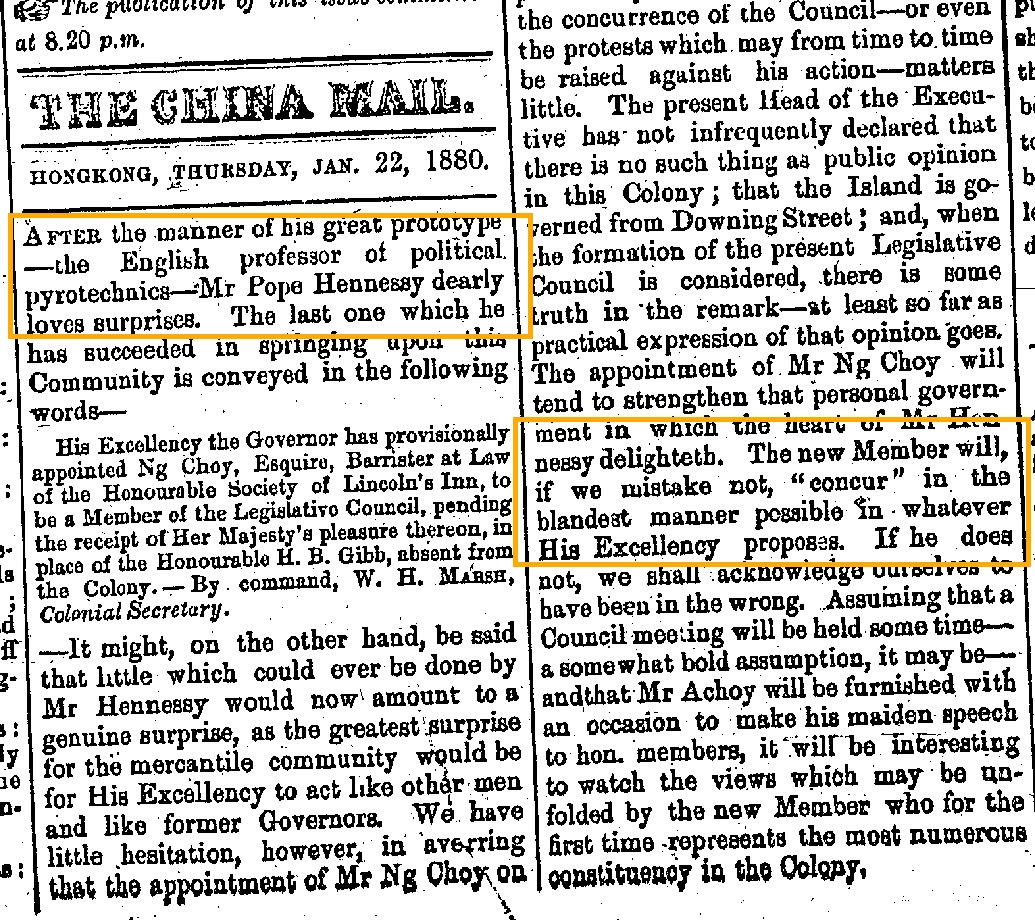
22日,《德臣西報》將公告連同社論一起刊出。社論開首寫道:「以其偉大原型——那位政治煙火的英國教授——的作風,軒尼詩先生酷愛驚喜」;又說:「新議員若不『同意』總督的每一項提案,我們就得承認自己錯了」16。
二、1880年2月19日:華商代表團與「開港以來未有之創舉」
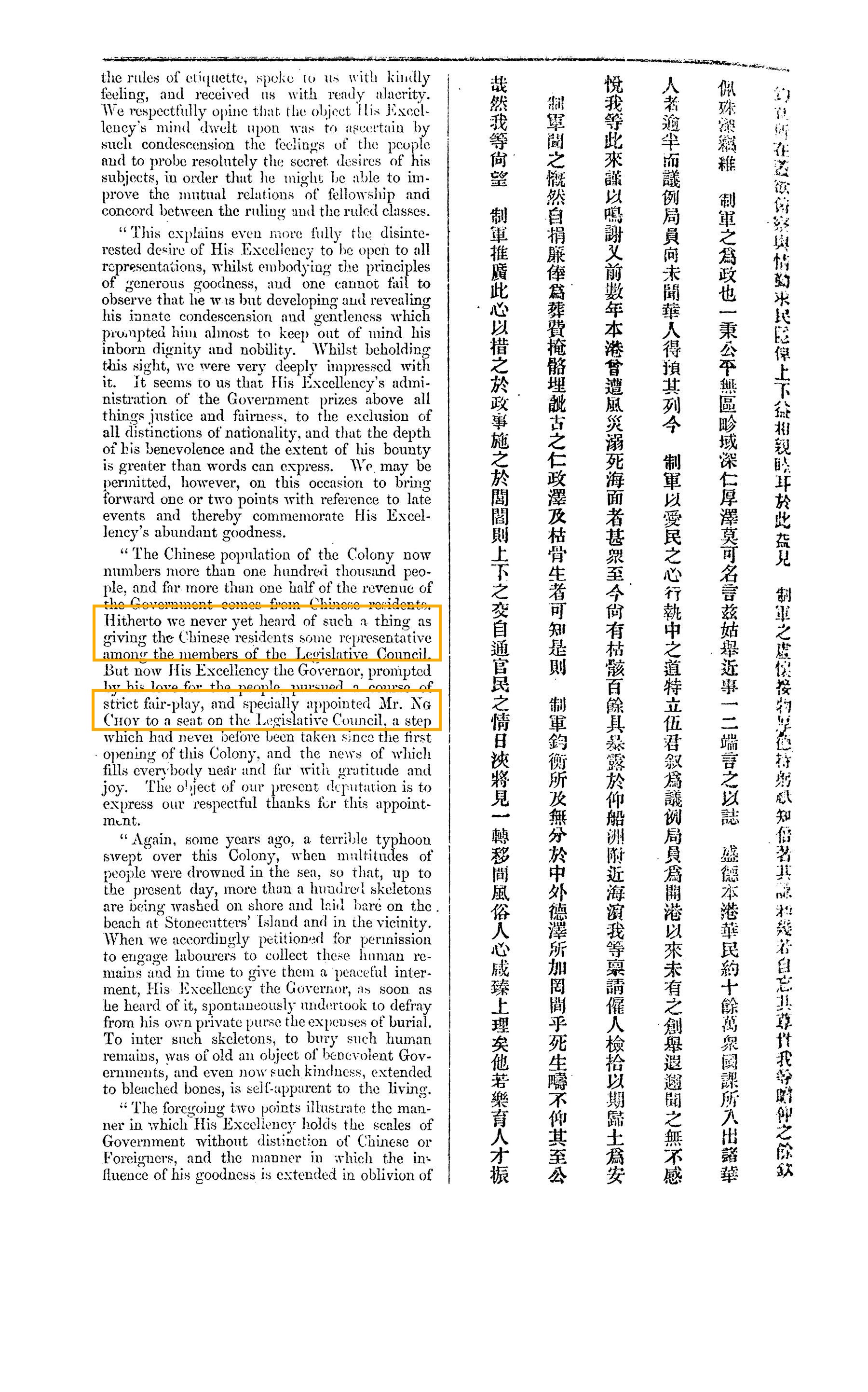
1880年2月19日,華商代表團到督轅致謝,憲報於2月25日以中英對照全文刊出(共8頁),構成本硏究的核心文件3。稟詞中文寫道:「本港華民約十餘萬衆,國課所入出諸華者逾半,而議例局員向未聞華人得預其列。今制軍以愛民之心行執中之道,特立伍局員,為開港以來未有之創舉,遐邇聞之,無不感悅。」英譯作「Hitherto we never yet heard of such a thing as giving the Chinese residents some representative among the members of the Legislative Council」3。注意此處的中文用字:代表團把立法局寫作「議例局」,而憲報的官譯用「定例局」——兩種同時代的寫法,本硏究一概照錄不改13。
軒尼詩的答詞是全文裏最可寶貴的一段:他說自己不願獨佔功勞,「因為這是本港開埠以來第一次委任一位華人入議會」;接着他自己又列出更早的先例:寶靈(Bowring)總督早在1855年便建議讓業主選舉非官守議員、讓華人如星洲般進入司法機關;羅便臣(Hercules Robinson)亦有同類建議;而他本人在納閩任內已「首次」委任華人曹馬蘇入議會3。最後他談及當年困擾本港的「買賣人口」問題,措詞強硬:英國法律所不容者,是把人當貨物買賣3。
代表團名單亦是史料:其中一人是《循環日報》主筆王韜(Wong To),其餘為各行商的東主或司事3。這是本港華人第一次以「全體華民代表」的姿態向總督遞詞——比伍廷芳的委任晚一個月,卻與它同屬一個政治時刻。
三、三年之限:常設化的失敗(1880–1883)
伍廷芳的席位自始帶着三重限制:其一「暫委」,其二「代郭氏之缺」,其三「任期3年」2。1880年4月20日,殖民部大臣第38號函確認委任為「署理」,任期不超過3年;5月28日輔政司史釗域(Frederick Stewart)致函伍廷芳,告知英廷已批准其「署理」身分,並註明「憲報第130號公告未有載明3年之限」——公告與檔案的分歧,本硏究並存照錄217。5月29日,憲報第130號公告刊出英廷的批准,中英對照,中文作「紳士伍恭奉叙爲定例局紳」17。
1880年7月9日,因郭氏退休,港督推薦伍廷芳補實缺——即把「暫委」變成「常設」。9月24日,英廷否決,改派駱克(Lowcock)補缺;伍廷芳只可在駱克未返港期間以「署理」身分再獲委任,「任期不得超過3年」2。連同1880年5月他暫署裁判司一事(華人首次出任政府高級職位),可見這一席位的常設化在英廷眼中仍未成熟——殖民部要的是「一位受過英國教育、有英國臣民身分的署理人」,而不是一位常任的華人議員218。
在任內,伍廷芳並非一位「聽話的議員」。1882年2月8日與9日,局內審議《電車條例草案》,在刪除第19條的動議上,他與貝理士(Belilios)、莊臣(Johnson)投反對票,與總督、輔政司、署理按察司、署理庫務司所投的贊成票相對;結果由總督的決定票通過4。這張反對票,是他3年任期裏最清晰的一次議會記錄。
1882年11月3日,《士蔑報》引上海《字林西報》(Shanghai Mercury)天津消息:伍廷芳將出任李鴻章與海關道的翻譯及外務法律顧問,月薪各250兩5。報紙隨即評論:若他確已受聘於中國政府,則「依禮」應辭去議席5。1883年5月,《士蔑報》在另一議員暫代同僚的報導中仍稱,華人議員之位「宜以伍廷芳的暫代爲先例」——可見當時席位已在事實上懸空6。1883年,殖民部檔案第208卷的目錄載有一條:「伍廷芳辭去定例局議員,及繼任人的委任」(第7號函)6。辭職函的原文本硏究未能找到(檔案只有目錄條目),故不引其文;但「辭職—繼任」這一組事實,已由檔案目錄與報紙社論互相印證。
四、第二位:黃勝與1884年的改組
1883年12月20日,《憲報》特刊公布改組方案:經港督建議、英廷批准,定例局增設非官守議員,其中一名「一般由太平紳士提名」;公告並附上太平紳士投票的細則(書面提名、一人一票、祕密投票、記錄投票人姓名)19。1884年2月28日,改組後的新局首次開會:6名官守議員(按察司、輔政司、律政司、工務司、庫務司、註冊總署)與5名非官守議員(渣甸洋行的莊臣、沙宣洋行的沙宣,及由總督委任的賴里、約翰遜與黃勝)8。黃勝就此成為第二位華人議員,較伍廷芳晚4年。
黃勝的任命有兩重程序:1883年《第15號條例》為他辦理歸化英籍,1884年4月19日的公告確認該條例已獲英廷批准7;1884年4月12日,憲報公告英廷批准新一屆非官守議員的委任20。歸化之必要,源於他的出身:他是香山縣人,少年時就讀澳門馬禮遜學堂,1847年隨校長布朗赴美,與容閎同窗18。他在1870年已以「買辦 黃勝」之名列於《東華醫院立案條例》附表——這條1870年的雙語記錄,正是本硏究為他選定中文名的依據7。
五、由何啟到周壽臣:1890–1921
1890年3月1日,憲報公告:賴里、祁士域與何啟獲委為非官守議員——其中何啟一席,明確寫着「以補黃勝6年期滿之缺」9。黃勝的6年,因此成了這一席位「正常化」的量度:從此華人議員不再以「暫委」出現,而是有任期、有更替的席位。何啟此後在局內近25年,至1914年去世(月份兩說並存,本硏究不作定論)18。
1896年是一個轉折年。這一年,港督羅便臣在局內宣布:貝爾利榮(Bell-Irving)與渣打(Chater)將入議政局;「我為定例局選定的華人是韋寶珊先生——一位為人熟識、且切實代表華人社會的人」10。同時,何啟的議席亦獲續任(公告寫明「於其前任任期屆滿時」)21。至此定例局有兩名華人議員並存,這一格局維持至1929年18。韋寶珊的中文名,以1887年與1888年憲報所載東華醫院董事名單為據——名單上他作「韋寶珊」1310。
1921年12月2日,憲報公告周壽臣暫委為定例局議員,以補何福退休之缺11。何福是周壽臣的前任(1917年補韋寶珊退休之缺),何福之前則是劉鑄伯(1914年補何啟缺)18。1925–26年的省港大罷工期間,周壽臣與羅旭龢等華人議員支持政府、並在港粵之間奔走;1926年,周壽臣獲封爵士18。
六、1926年7月9日:議政局的首位華人
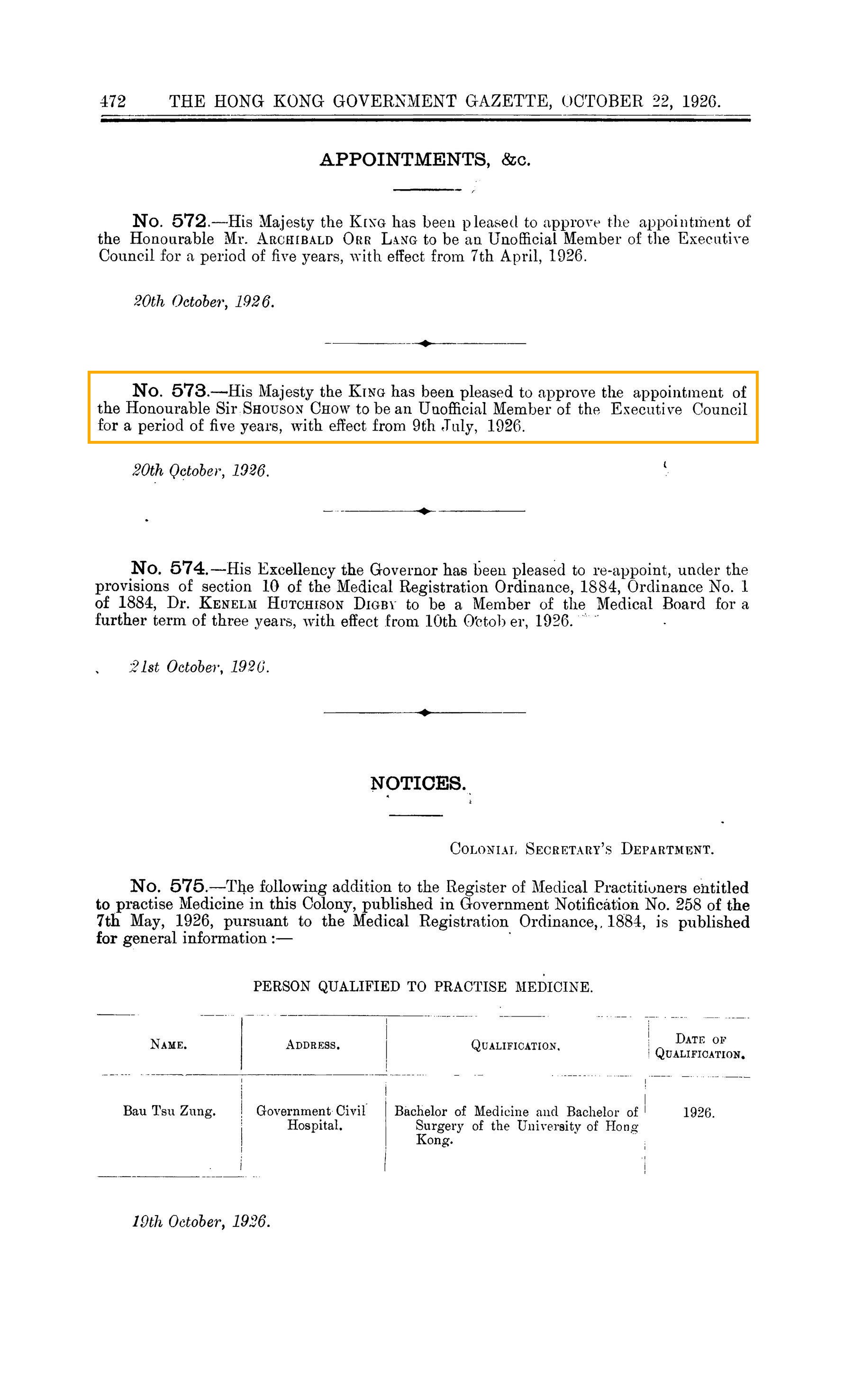
1926年10月22日出版的《憲報》第472頁,刊出第573號公告:「英皇陛下已批准委任周壽臣爵士為議政局非官守議員,任期5年,自1926年7月9日起生效。」公告日期為10月20日12。7月9日這個生效日期,緊接其時議政局非官守議員渣打(Chater)的逝世——渣打自1896年起任該局議員30年,是1896年體制的最後一位原任者1218。周壽臣因此成為議政局(行政局)歷史上第一位華人議員。
這一委任的性質,T. C. 鄭(T. C. Cheng)在1969年的講稿中有一段評語:委任「雖出於個人理由,但政治考慮亦在其中,即安撫中國的反英情緒,並鼓勵本地華人對香港的效忠」18。此說出於當事人的觀察,本硏究照錄,並與1926年的政局(罷工餘波、《中英關係》緊張)並置,讀者自可判斷18。
1929年,總督金文泰(Clementi)改組定例局:官守議員由8名增至10名,非官守議員由6名增至8名;新增的兩席,一席給華人(蔡昌)、一席給葡人(布力架,J. P. Braga)18。華人非官守議員自1929年起由2人增至3人;周壽臣任兩局議員至1930年(辭定例局)與1936年(退議政局)18。
結論
從1880年1月19日的「暫委伍君」,到1926年7月9日的「周壽臣爵士入議政局」,這46年的制度史可以概括為三句話:先是一個權宜的缺位替補,然後是一個常設的殖民地席位,最後是一個進入行政機關核心的委任。伍廷芳那一席,本質上是英廷的「實驗」——3年為限、可否常設由倫敦決定;黃勝與何啟的兩任,把這席位變成有任期、有更替的常規;1896年的體制確立了兩名華人議員並存的格局;1926年,周壽臣把華人代表從「表意」的議席,推進到「決策」的議席2912。
而這一切的開端,藏在兩份文件裏:一份是1879年12月17日的請願書——12名華人要求一個「得預其列」的席位14;一份是1880年1月21日的《憲報》——一句「定例局紳」的中文官譯,與一句英文的「pending the receipt of Her Majesty’s pleasure」1。前者是要求,後者是答覆;中間的那個人,叫做伍廷芳。
The Councillor’s Seat
The Chinese in Hong Kong’s Councils, 1880–1926:
from Ng Choy’s provisional appointment to the first Chinese member of the Executive Council
Abstract
On 19 January 1880 the Governor of Hong Kong, John Pope Hennessy, provisionally appointed the barrister Ng Choy (Wu Ting-fang 伍廷芳) to the Legislative Council, in the place of the absent H. B. Gibb, pending Her Majesty’s pleasure. The appointment was an experiment with a three-year limit; the Colonial Office minute on the file recorded that “the experiment need not be repeated… One thing is not a precedent for always keeping a vacancy for that nationality”. This paper follows the seat for the forty-six years that separate that minute from the appointment, on 9 July 1926, of Sir Shouson Chow 周壽臣 as the first Chinese member of the Executive Council — through the first administration of the colony’s Chinese-language apparatus (the Gazette’s own Chinese translation of the 1880 notice calls the seat 定例局紳), the merchants’ deputation of 19 February 1880 and Governor Hennessy’s reply (which itself cites the earlier Chinese members at Singapore and Labuan), the failed bid for a permanent seat in 1880, Ng Choy’s division vote in the Tramways Bill committee of February 1882, his departure for Li Hung-chang’s service and the resignation filed in 1883, the second member Wong Shing and the reconstituted Council of 1884, and the succession roll — Ho Kai (1890), Wei Yuk (1896), Lau Chu-pak (1914), Ho Fook (1917), Chow Shou-son (1921) — to the Executive Council in 1926. The argument is that the seat changed in kind three times: a provisional substitution, a normalised colonial seat, and finally a seat in the executive.
Keywords: Ng Choy; Wu Ting-fang; Shouson Chow; Legislative Council; Executive Council; Hong Kong; 定例局; 議政局; Wong Shing; Ho Kai.
1. Scope, sources, and method
This is a constitutional micro-history of one seat. Its documents are the colony’s own: the Government Gazette and its bilingual columns; the CO 129 despatches and minutes; the Blue Books’ council returns; the China Mail, Daily Press and Telegraph; and the 1969 retrospective roll compiled by T. C. Cheng for the Hong Kong Branch of the Royal Asiatic Society. The battery and query log are in Appendix A; the full evidence register, with its conflicts and do-nots, is in the research notes deposited with this paper. One whole-document pull anchors the narrative: the Gazette’s eight-page publication of the Chinese deputation and the Governor’s reply, 25 February 1880. All corpus links cite the public viewer; where a scan twin exists the image link is cited in preference. Accessed 30 October 2026.
Two method notes. First, the corpus’s Chinese-language press begins in 1947 (華僑日報); for the 1880–1926 stratum the only period Chinese is the official bilingual apparatus — the Gazette’s translated columns, the statutes’ schedules and the deputation’s own address. Every Chinese proper name in this paper is therefore either period-witnessed (黃勝 in the 1870 ordinance’s schedule; 韋寶珊 in the 1887/88 Gazette; 伍 as the 1880 Gazette’s own rendering) or modern-secondary, and the distinction is recorded. Second, Hennessy’s own reply refuses the word “first” for the Empire: it cites Sir John Bowring’s 1855 despatch, a Chinese member at Singapore in 1869 (Hoo Ah Kay) and Hennessy’s own appointment at Labuan (Choa Massoo). This paper accordingly scopes every “first”: first Chinese member of this colony’s council; first Chinese member of the Executive Council in 1926. Nothing in it is “first in the Empire”.
2. January 1880: the provisional appointment
The appointment is gazetted in Government Gazette No. 3 of 21 January 1880 as Government Notification No. 14: “His Excellency the Governor has provisionally appointed Ng Choy, Esquire, Barrister at Law of the Honourable Society of Lincoln’s Inn, to be a Member of the Legislative Council, pending the receipt of Her Majesty’s pleasure thereon, in place of the Honourable H. B. Gibb, absent from the Colony”, dated 19 January 1880. On the same leaf the Gazette prints its own Chinese translation — 「輔政使司馬為曉諭事照得現奉督憲暫立英國練幹大律院律師伍君敘為定例局紳以代離港之紳士郭君恭候皇后恩旨批准為此特諭俾衆週知」 — with the date column 「一千八百八十年正月十九日示」. The English and Chinese date lines agree on 19 January; the issue date is the 21st. The word the Gazette chose for the seat, 定例局紳 (Legislative Councillor), is the period’s official Chinese for membership of the Legislative Council 定例局, and it is used in the officially translated apparatus into the twentieth century 1 13.
The Chinese version matters beyond ornament. It is the earliest official Chinese sentence in this thread that names the seat, and it renders the appointee as 伍君 — the period’s own character for Ng Choy, decades before the modern full name 伍廷芳 entered print (the corpus’s Chinese press stratum begins only in 1947) 1 22.
The background was a petition. On 17 December 1879 (光緒5年11月初五) twelve named Chinese residents had petitioned the Governor, the translation being made by E. J. Eitel on 19 December; the petition argued from the community’s numbers (“whilst ninety per cent of Hong Kong are Chinese”) and its share of the revenue, and referred to an earlier petition of the tenth moon of 1878. Hennessy forwarded it to London with his despatch No. 2751 of 19 January 1880 14. The Colonial Office minute written on that file — signed “C-P.d 25-Feb” — is the policy’s own horizon statement: “In theory, it is certainly just that the Chinese should be represented on Council, and if Mr Ng Choy succeeds, the experiment need not be repeated by appointing a Chinese to be a member. One thing is not a precedent for always keeping a vacancy for that nationality” 15.
The press read the appointment as a characteristic Hennessy surprise. The China Mail of 22 January reprinted the Gazette notice inside its leader — “After the manner of his great prototype — the English professor of political pyrotechnics — Mr Pope Hennessy dearly loves surprises…” — and added the prophecy that the new member would “‘concur’ in the blandest manner possible in whatever His Excellency proposes”, with the audacious rider: “If he does not, we shall acknowledge ourselves to have been in the wrong” 16.
3. 19 February 1880: the deputation, and the Governor’s reply
On 19 February 1880 a deputation of Chinese merchants waited on the Governor at Government House to thank him. The Gazette printed the whole exchange on 25 February 1880 in parallel columns, Chinese and English, across eight pages — the document that anchors this paper 3. The address states the community’s case in its own words: 「本港華民約十餘萬衆,國課所入出諸華者逾半,而議例局員向未聞華人得預其列。今制軍以愛民之心行執中之道,特立伍局員,為開港以來未有之創舉」 — “Hitherto we never yet heard of such a thing as giving the Chinese residents some representative among the members of the Legislative Council.” The address writes the Council as 議例局; the Gazette’s own apparatus writes 定例局. Both period forms are quoted as printed 3 13.
Hennessy’s reply is the thread’s central text. He declines the whole credit — “I do not wish to take too much credit to myself for having for the first time in this Colony appointed a Chinese gentleman to a seat on the Council” — and then supplies the longer history himself: Sir John Bowring’s despatch of 1855 (a system by which every lot-holder of £10 rental or upwards would vote for five unofficial members; the Chinese, “as at Singapore, ought to be put into the Magistracy, made Justices of the Peace”), an equivalent proposal by Sir Hercules Robinson, and his own action as Governor of Labuan, where he had “for the first time” placed a Chinese on the Legislative Council, “my lamented friend Mr. Choa Massoo” 3. He then answers the deputation’s thanks with a passage on the buying and selling of human beings — British law, he says, objects to the sale of persons for any purpose — and on the colony’s own statistics of the trade: the recorded cases of buying children for adoption or domestic service, numbered from 1877 to 1879 3.
The deputation’s roll is itself an artefact: among the named representatives is Wong To, the editor of the Universal Circulating Herald 循環日報, alongside the heads and managers of the great hongs, trading and opium firms 3. The address is the community’s first appearance as a collective petitioner of the Governor — one month after the appointment it thanks him for.
4. The three-year limit and the failure of permanence (1880–1883)
The seat was provisional in three ways at once: it was an acting appointment, it was held in the absence of a named member, and its term was capped. The Secretary of State’s despatch No. 38 of 20 April 1880 confirmed the appointment “as an acting Member of Council… for a term not exceeding three years”; the Colonial Secretary’s letter to Ng Choy of 28 May 1880 communicated the Queen’s confirmation “during the absence, if it should not exceed three years, of the Honourable Hugh Bold Gibb”, and the same file notes, drily, that “the notification in the Gazette No. 130 omits all mention of the term of 3 years”. Gazette No. 130 of 29 May 1880 had indeed printed the confirmation without the cap, bilingual: 「紳士伍恭奉叙爲定例局紳」 2 17.
Then the bid for permanence. On 9 July 1880, with Gibb retired, the Governor recommended Ng Choy “for the permanent unofficial seat now vacant”. On 24 September 1880 the Secretary of State directed otherwise: Mr. Lowcock was to be provisionally appointed on his return; Ng Choy might be re-appointed only as acting member “for no longer period than three years”, and his acting appointment would expire if Lowcock resumed the seat 2. The permanent Chinese seat was refused at the first ask. (In May 1880 Ng Choy had also acted temporarily as a magistrate — the first Chinese to hold a senior post in the Government; a question was asked in the House of Commons about the combining of a paid office with an unofficial seat, by which time the original holder had returned 18.)
The Council’s own minutes show the member at work, and show him in opposition. On 8 and 9 February 1882, in the committee stage of the Tramways Bill, on the omission of clause 19 the Council divided: Ayes — the Acting Colonial Secretary, the Acting Colonial Treasurer, the Acting Chief Justice, the Governor; Noes — Mr. Belilios, Mr. Johnson, Mr. Ng Choy, the Attorney General; “His Excellency also gives his casting vote with the Ayes.” The clause fell — but the division records a Chinese member voting against the Governor’s side, and the editorials of the day may be read beside it 4 23.
5. The service and the resignation (1882–1883)
In November 1882 the Telegraph, quoting the Shanghai Mercury’s Tientsin despatch, reported that Ng Choy was “to be Interpreter, and legal adviser on foreign matters to Li Hung-chang and the Customs Taotai, at a salary of Tls. 250 per month from Li and Tls. 250 from the Customs Taotai”, and appended the courteous demand: if the report were true, he should, “as a matter of courtesy”, resign his seat in the Legislative Council 5. In May 1883 the same paper, commenting on the temporary substitution of a European member, observed that it was “equally as necessary to appoint a Chinese member of Council as locum tenens for Mr. Ng Choy” — the seat treated, in practice, as vacant 6.
The resignation itself survives as a file entry. The contents leaf of CO 129/208 (Governor Sir George Bowen, 1883) lists, among the year’s despatches, No. 7: “Resignation of Mr. Ng Choy, M.L.C. and appt. of successor.” The despatch text is not among the OCRed pages of the volume; the paper therefore dates the resignation to 1883, on the file’s own docket, and does not quote a resignation letter that cannot be produced 6. A press note is preserved from the earlier phase: in September 1880, when the Governor’s general policy was under attack in the colony, Ng Choy had written to the China Mail in its defence — the Administrator forwarded the letter to London with the remark that he could “only meet the charge by general denial” 24.
6. The second member: Wong Shing and the reconstitution of 1884
Four years separate Ng Choy’s resignation from the Council’s next Chinese member, and the interval produced a constitutional change. On 20 December 1883 a Gazette Extraordinary published Government Notification No. 415: henceforth one unofficial member would, “as a general rule”, be appointed on the nomination of the Justices of the Peace, with ballot rules for the Justices’ meeting. The reconstituted Council met on 28–29 February 1884: six officials and five unofficials, the latter being Thomas Jackson (elected by the Chamber of Commerce), F. D. Sassoon (elected by the Justices), and P. Ryrie, F. B. Johnson and Wong Shing, nominated by the Governor. The minutes print his name in the presence list 19 8.
Wong Shing 黃勝 — the second Chinese member, four years after the first — was, like Ng Choy, a product of the missionary school system. A native of Heungshan, he had entered the Morrison School at Macao, gone to the United States with the schoolmaster Samuel Robbins Brown in 1847 in the company of Yung Wing, and returned to make his career in the colony’s commerce and administration 18. Two period documents witness him. The Chinese Hospital Incorporation Ordinance, No. 3 of 1870, prints its schedule of incorporators bilingually, and in it “買辦 黃勝 Wong Shing, 英華書院” — the period’s own pairing of his two names 7. And the naturalisation ordinance: No. 15 of 1883, “An Ordinance for the naturalisation of Wong Shing”, allowed by the Secretary of State and proclaimed in the Gazette of 19 April 1884 7. On 12 April 1884 the Gazette carried the Queen’s approval of “the new Un-Official Members of the Legislative Council” 20.
7. From Ho Kai to Chow Shou-son (1890–1921)
The normalisation is legible in a single gazette sentence. On 1 March 1890, Government Notification No. 82 appointed Phineas Ryrie, James Johnston Keswick and “Dr. Ho Kai 何啟, Barrister-at-law, on expiration of the period of six years for which the Honourable Wong Shing held his seat, to be Un-official Members of the Legislative Council” 9. The seat had acquired a term, a clock and a succession: the “experiment” of the Colonial Office minute had become machinery. Ho Kai, the colony’s leading Chinese professional — physician, barrister, hospital founder — would hold the seat for a quarter-century, and was the community’s principal spokesman in the crisis years of plague and reform 18.
The next enlargement came in 1896, and the Governor’s own words record it. In Council, Sir William Robinson announced: “I have chosen the senior member of the unofficial body Mr. Chater, and Mr. Bell-Irving… will be added to the Executive Council. The Chinese gentleman I have chosen for the Legislative Council is Mr. Wei Yuk, a gentleman who is well known and thoroughly representative of the Chinese community and well suited for the appointment for which I have selected him” 10. The seat was thus doubled: from 1896 to 1929 there were two Chinese unofficial members of the Legislative Council, the new one being Wei Yuk 韋寶珊 — a form the Gazette’s own Tung Wah Hospital directors’ lists print in 1887 and 1888 13 10. Ho Kai’s own seat was renewed in the same season, the notification noting that the appointment ran “on the expiration of the period of his former appointment” 21. Wei Yuk’s re-appointments run to 1909 and 1914 in the Gazette’s records 25.
The roll thereafter follows the file: Lau Chu-pak succeeded Ho Kai; Ho Fook succeeded Wei Yuk on the latter’s retirement in 1917; and on 2 December 1921 the Gazette announced that “Mr. Chow Shou-son” was appointed “to be an Unofficial Member of the Legislative Council vice the Honourable Mr. Ho Fook, retired, with effect from this date”. The Blue Book’s return for 1921 spells the chain out in its remarks: Chau Siu-ki had acted during Ho Fook’s leave in April, and Ho Fook “retired and succeeded by Mr. Chow Shou-son on the 20th December, 1921” 11.
8. 9 July 1926: the Executive Council
The endpoint is a gazette notice of 1926. Government Notification No. 573, printed on page 472 of the issue of 22 October 1926, reads: “His Majesty the King has been pleased to approve the appointment of the Honourable Sir Shouson Chow to be an Unofficial Member of the Executive Council for a period of five years, with effect from 9th July, 1926”, dated 20 October 1926 12. The effective date is the hinge: Sir Paul Chater, an unofficial member of the Executive Council since 1896, had died, and with him the last survivor of the 1896 settlement; Chow Shou-son, then the colony’s senior Chinese unofficial, was appointed into the vacancy 12 26. The Blue Book for 1925, the last full return before the change, lists the Executive Council’s unofficials as Chater, Pollock and Holyoak — no Chinese member 26.
The appointment’s politics are described by T. C. Cheng’s lecture of 1968 with the caution of a contemporary: the choice was made “on personal grounds”, but “it was evident that political considerations also came in, viz., to pacify anti-British sentiment in China and to further encourage the loyalty of local Chinese towards Hong Kong” — a reading set beside the strike-and-boycott years of 1925–26, in which Chow and his colleague Robert Kotewall had stood by the Government and carried messages between Hong Kong and Canton 18. Chow served on both Councils until he resigned the Legislative Council in 1930, remaining in the Executive Council until 1936 18. In 1929, under Governor Clementi, the Legislative Council was enlarged from six to eight unofficials, one of the two new seats Chinese and one Portuguese (J. P. Braga); the Chinese unofficial membership rose from two to three, and the first of the new members was Dr. Tso Seen-wan 18.
9. Conclusion
The seat changed in kind three times in forty-six years. From 1880 to 1882 it was a provisional substitution — acting, capped, revocable on a named member’s return, its continuation a matter for London; the Colonial Office’s own minute said in writing that it need not become a precedent. From 1884, on the reconstituted Council, it became a normal colonial seat: nominated, fixed-term, succeeded — the Gazette of 1 March 1890 records the succession as arithmetic, Ho Kai entering “on expiration of the period of six years for which the Honourable Wong Shing held his seat”. And in 1926 it became executive: on 9 July Sir Shouson Chow entered the Executive Council, the first Chinese member of the body that advised the Governor, and the vacancy he filled was the oldest unofficial seat in that body. It is worth setting the beginning and the end side by side: the Chinese translation of January 1880 renders the appointment as the provisional standing of “伍君” as a 定例局紳 pending the Queen’s pleasure; the notice of October 1926 records the King’s approval of Sir Shouson Chow for five years in the 議政局. The vocabulary of the two documents — 暫立 and 批准, provisional and approved — is the whole distance the seat travelled.
Notes
Government Gazette 政府憲報, No. 3, 21 January 1880, Government Notification No. 14: “His Excellency the Governor has provisionally appointed Ng Choy, Esquire, Barrister at Law of the Honourable Society of Lincoln’s Inn, to be a Member of the Legislative Council, pending the receipt of Her Majesty’s pleasure thereon, in place of the Honourable H. B. Gibb, absent from the Colony”; dated “Hongkong, 19th January, 1880”. The same leaf carries the official Chinese version — 「輔政使司馬為曉諭事照得現奉督憲暫立英國練幹大律院律師伍君敘為定例局紳以代離港之紳士郭君恭候皇后恩旨批准為此特諭俾衆週知」 with the date column 「一千八百八十年正月十九日示」. Scan, plate 1: https://hkintexts.histsyn.com/image-page/1491113 (accessed 30 October 2026). The text-series twin (OCR) reads the date line ambiguously — the scan settles 19 January; the leaf’s own head reads “No. 3” and the issue date 21 January. ↩
CO 129/204 (Acting Governor Marsh, 1882), the appointment machinery as the Colonial Office and Government House recorded it: the Secretary of State’s despatch No. 38 of 20 April 1880 confirms the appointment “as an acting Member of Council… for a term not exceeding three years”; the Colonial Secretary’s letter of 28 May 1880 informs Ng Choy of the confirmation “during the absence, if it should not exceed three years, of the Honourable Hugh Bold Gibb” and notes “the notification in the Gazette No. 130 omits all mention of the term of 3 years”; on 9 July 1880 the Governor recommends Ng Choy “for the permanent unofficial seat now vacant by the retirement of Mr. Gibb”; the Secretary of State directs on 24 September 1880 that Mr. Lowcock be appointed instead, Ng Choy to be re-appointable only as acting member “for no longer period than three years”. https://hkintexts.histsyn.com/page/319022 (the minute quoting all four documents), /page/319019, /page/319021 (accessed 30 October 2026). ↩
Government Gazette, 25 February 1880 — “CHINESE DEPUTATION TO THE GOVERNOR”: the address of the Chinese merchants received by Hennessy at Government House on 19 February, published in Chinese and English (printed pp. 185–192). The address: 「國課所入出諸華者逾半而議例局員向未聞華人得預其列今制軍以愛民之心行執中之道特立伍局員爲開港以來未有之創舉」 / “Hitherto we never yet heard of such a thing as giving the Chinese residents some representative among the members of the Legislative Council”; Hennessy’s reply cites Sir John Bowring’s despatch of 1855 and Sir Hercules Robinson’s, and his own action in Labuan, where he had placed “for the first time on the Legislative Council a Chinese”, “my lamented friend Mr. Choa Massoo”. Whole-document pull (8 pp., the thread’s compulsory dumpdoc): https://hkintexts.histsyn.com/page/1667785 (and /1667786–1667792); scan, plate 2: https://hkintexts.histsyn.com/image-page/1491236 (accessed 30 October 2026). ↩
Legislative Council minutes, 8–9 February 1882 (the Tramways Bill in committee): Ng Choy present at both sittings; on the omission of clause 19 the Council divides — Ayes: the Acting Colonial Treasurer, the Acting Colonial Secretary, the Acting Chief Justice, the Governor; Noes: Mr. Belilios, Mr. Johnson, Mr. Ng Choy, the Attorney General — “His Excellency also gives his casting vote with the Ayes.” CO 129/198, pp. 25–29, https://hkintexts.histsyn.com/page/311589, /page/311591 (accessed 30 October 2026). ↩
Hongkong Telegraph 士蔑報, 3 November 1882, p. 3 — the Shanghai Mercury’s Tientsin despatch: “Mr. Ng Choy is to be Interpreter, and legal adviser on foreign matters to Li Hung-chang and the Customs Taotai, at a salary of Tls. 250 per month from Li and Tls. 250 from the Customs Taotai.” The Telegraph’s own comment: “If Mr. Ng Choy has arranged to accept, or is negotiating with the intention of accepting, an appointment under the Chinese Imperial Government, we shall be glad to learn, that, as a matter of courtesy, he has [resigned his seat in the] Legislative Council.” https://hkintexts.histsyn.com/page/2825043 (accessed 30 October 2026). The bracketed words are the editorial’s own clause run over the column break. ↩
CO 129/208 (Governor Sir George Bowen, 1883), the volume’s contents leaf: Despatch No. 7, of the 1883 series — “Resignation of Mr. Ng Choy, M.L.C. and appt. of successor.” The despatch text itself is not in the OCR (the volume is filed by dockets); the resignation is therefore dated to 1883 by the file and witnessed in the press: the Telegraph of 15 May 1883, on a European member’s temporary substitution, “we consider that if it were imperative to appoint Mr. Bulkeley Johnson to temporarily take the place of Mr. W. Keswick it was equally as necessary to appoint a Chinese member of Council as locum tenens for Mr. Ng Choy”. https://hkintexts.histsyn.com/page/321298; Telegraph: /page/2825685 (accessed 30 October 2026). ↩
Wong Shing 黃勝, second Chinese member. The period bilingual pairing: the Chinese Hospital Incorporation Ordinance, No. 3 of 1870, Schedule — 「買辦 黃勝 Wong Shing, 英華書院」 among the incorporators, https://hkintexts.histsyn.com/page/1869482. The naturalisation: Proclamation No. 7, Gazette, 19 April 1884, confirming among the ordinances allowed by the Secretary of State “No. 15 of 1883, entitled — An Ordinance for the naturalisation of Wong Shing”, https://hkintexts.histsyn.com/page/1662782 (accessed 30 October 2026). ↩
Legislative Council minutes, 28–29 February 1884, the first sittings of the reconstituted Council: present, the Governor (Sir George Ferguson Bowen), the Chief Justice, the Colonial Secretary, the Attorney General, the Surveyor General, the Colonial Treasurer, the Registrar General, and among the unofficials — Phineas Ryrie, Francis Bulkeley Johnson, Thomas Jackson, Frederick David Sassoon, and Wong Shing. Gazette, 1 March 1884, printed p. 100, https://hkintexts.histsyn.com/page/1662503; printed p. 130, /page/1662539 (accessed 30 October 2026). ↩
Government Gazette, No. 10, 1 March 1890, Government Notification No. 82: “His Excellency the Officer Administering the Government has been pleased to appoint provisionally and until Her Majesty’s pleasure may be signified: Phineas Ryrie, Esquire, on expiration of the period of six years for which his former seat was retained, James Johnston Keswick, Esquire, on expiration of the period of six years for which the Honourable William Keswick held his seat, Dr. Ho Kai 何啟, Barrister-at-law, on expiration of the period of six years for which the Honourable Wong Shing held his seat, to be Un-official Members of the Legislative Council of Hongkong.” https://hkintexts.histsyn.com/page/1651914 (accessed 30 October 2026). ↩
Hong Kong Weekly Press, 16 July 1896 — the Governor, Sir William Robinson, in Council: “I have chosen the senior member of the unofficial body Mr. Chater, and Mr. Bell-Irving. Hereafter, when the Royal Instruction comes out, Mr. Chater and Mr. Bell-Irving will be added to the Executive Council. The Chinese gentleman I have chosen for the Legislative Council is Mr. Wei Yuk 韋寶珊, a gentleman who is well known and thoroughly representative of the Chinese community and well suited for the appointment for which I have selected him.” https://hkintexts.histsyn.com/page/2156501 (accessed 30 October 2026). The period Chinese form 韋寶珊 is witnessed by the Gazette’s own Tung Wah directors’ lists, 1887 and 1888 (https://hkintexts.histsyn.com/page/1655892; /page/1657944). ↩
Government Gazette, 2 December 1921, Government Notification No. 505: “His Excellency the Governor has been pleased to appoint, provisionally and subject to His Majesty’s pleasure, Mr. Chow Shou-son to be an Unofficial Member of the Legislative Council vice the Honourable Mr. Ho Fook, retired, with effect from this date.” https://hkintexts.histsyn.com/page/1682887; the Blue Book 1921 return records the chain — “Mr. Chau Siu-ki appointed a member during the absence on leave of Hon. Mr. Ho Fook on the 28th April, 1921… Retired and succeeded by Mr. Chow Shou-son on the 20th December, 1921” (the appointment notification printed 2 December, the effective date 20 December): https://hkintexts.histsyn.com/page/674139 (accessed 30 October 2026). ↩
Government Gazette, 22 October 1926, printed p. 472, Government Notification No. 573: “His Majesty the King has been pleased to approve the appointment of the Honourable Sir Shouson Chow to be an Unofficial Member of the Executive Council for a period of five years, with effect from 9th July, 1926”; dated 20 October 1926. Scan, plate 4: https://hkintexts.histsyn.com/image-page/1457849; text twin: /page/1568888 (accessed 30 October 2026). The appointment followed the death of Sir Paul Chater, an Executive Council unofficial since 1896. ↩
The period official Chinese for the two Councils, from the primary documents: 定例局 (Legislative Council) — the 1880 Gazette’s own Chinese columns (image index: https://hkintexts.histsyn.com/image-page/1491238; the appointment’s Chinese version on plate 1) and the 1909 gazette apparatus (https://hkintexts.histsyn.com/page/1572648); 議政局 (Executive Council) — the 1926 and 1927 gazettes (https://hkintexts.histsyn.com/page/1570089; image https://hkintexts.histsyn.com/image-page/1457705). The deputation’s own address prints a third, private form 議例局 (plate 2) — both period forms are quoted as printed (accessed 30 October 2026). ↩
The Chinese petition to Governor Hennessy, dated 17 December 1879 (光緒5年11月5日), translated by E. J. Eitel 19 December 1879, with Hennessy’s despatch to the Secretary of State (19 January 1880) enclosing it: the twelve named petitioners argue that “whilst ninety per cent of Hong Kong are Chinese”, the community is unrepresented in the Council, and refer to an earlier petition of the tenth moon of 1878. CO 129/187, https://hkintexts.histsyn.com/page/305317 (petition), /page/305305 (despatch) (accessed 30 October 2026). The OCR of the file is heavy; the “ninety per cent” clause is quoted from the cleanly legible run. ↩
The Colonial Office minute on Hennessy’s Despatch No. 2751 of 19 January 1880 (the despatch which enclosed the Chinese petition), written on the file and signed “C-P.d 25-Feb”: “In theory, it is certainly just that the Chinese should be represented on Council, and if Mr Ng Choy succeeds, the experiment need not be repeated by appointing a Chinese to be a member. One thing is not a precedent for always keeping a vacancy for that nationality.” CO 129/187, https://hkintexts.histsyn.com/page/305305 (accessed 30 October 2026). The minute is the policy’s own horizon statement. ↩
China Mail 德臣西報, 22 January 1880, p. 2 — the Gazette notice reprinted inside the leader: “After the manner of his great prototype — the English professor of political pyrotechnics — Mr Pope Hennessy dearly loves surprises… The new Member will, if we mistake not, ‘concur’ in the blandest manner possible in whatever His Excellency proposes. If he does not, we shall acknowledge ourselves to have been in the wrong.” Scan (column crop, plate 3): https://hkintexts.histsyn.com/image-page/1192330; text: https://hkintexts.histsyn.com/page/1892829 (accessed 30 October 2026). ↩
Government Gazette, 29 May 1880, Government Notification No. 130 — the Queen’s confirmation, bilingual: “The Right Honourable Sir Michael Hicks-Beach… has conveyed to His Excellency the Governor the gracious confirmation by Her Majesty the Queen of the acting appointment of the Honourable Ng Choy to be a Member of the Legislative Council in the absence of the Honourable Hugh Bold Gibb”, with the Chinese column 「紳士伍恭奉叙爲定例局紳以代離港之曉諭事」. Reproduced as an enclosure in CO 129/204, https://hkintexts.histsyn.com/page/319020 (accessed 30 October 2026). ↩
T. C. Cheng, O.B.E., M.A. (Lond.), “Chinese Unofficial Members of the Legislative and Executive Councils in Hong Kong up to 1941” (a lecture delivered to the Hong Kong Branch of the Royal Asiatic Society on 29 April 1968), Journal of the Hong Kong Branch of the Royal Asiatic Society, vol. 9 (1969), pp. 13–36, with the appended roll of substantive appointments. https://hkintexts.histsyn.com/page/205697 (the article opens at p. 13); the ng-choy pages /page/205708 (accessed 30 October 2026). The article’s own note 13 prints 區德 for Au Tak, and note 17 韋寶珊 for Wei Yuk. ↩
Government Gazette Extraordinary, 20 December 1883, Government Notification No. 415 — the reconstitution of the Council: “upon the Governor’s recommendation, as approved by Her Majesty the Queen, certain changes will be made in the constitution of the Legislative Council; and… for the future one Un-official Member of that body will, as a general rule, be appointed on the nomination of the Justices of the Peace”, with the ballot rules for the Justices’ meeting (proposal in writing, one vote each, voting by ballot, names recorded). https://hkintexts.histsyn.com/page/1664932 (accessed 30 October 2026). ↩
Government Gazette, 12 April 1884, Government Notification No. 134: “It is hereby notified for general information, that Her Majesty the Queen has been graciously pleased to approve the appointment of the new Un-Official Members of the Legislative Council of Hongkong.” https://hkintexts.histsyn.com/page/1662765 (accessed 30 October 2026). ↩
Government Gazette, No. 10, 7 March 1896, Government Notification No. 78: “His Excellency the Governor has been pleased to appoint, provisionally and subject to Her Majesty’s pleasure, Ho Kai to be an Un-official Member of the Legislative Council on the expiration of the period of his former appointment.” (The 1890 seat renewed; the appointment announcement of the day is gazetted as a Government Notification with no number gap — a second notification of the same import follows at No. 78 of the “Ordinary” series.) https://hkintexts.histsyn.com/page/1641597 (accessed 30 October 2026). ↩
The proper-name battery (rule 9): 伍廷芳 102 corpus hits (華僑日報, 1950+; no pre-1947 Chinese-press stratum exists for the 1880s — the corpus’s Chinese press begins 1947); 周壽臣 346; 何啟 1,053; 何福 2,299; 羅旭龢 54; 周俊年 257; 羅文錦 1,567; 李樹芬 533 (a 1932 Medical Register witness); 黃勝 1,117 (the 1870 ordinance’s own bilingual schedule); 韋寶珊 8 (the 1887/1888 Gazette’s Tung Wah lists). Web leg: zh.wikipedia 伍廷芳 (1842–1922; first Chinese barrister; LegCo 1880–83) and 張秀蓉, 〈1893年香港〈保良局立案法團條例〉與何啟〉 (“從一八八○到一九一七年,僅四位華人非官守議員,分別是:伍廷芳、黃勝、何啟、與韋玉”). Samples: https://hkintexts.histsyn.com/page/2390044 (accessed 30 October 2026). ↩
Hongkong Telegraph, 9–10 February 1882 — the verbatim report of the Council’s sittings, printed beside the official minutes: “The proceedings at the meeting of the Legislative Council held yesterday afternoon were of such an important and interesting character that we consider it advisable to publish a verbatim report”, with the members present including “Hon. Ng Choy”. https://hkintexts.histsyn.com/page/316346; /page/316348 (accessed 30 October 2026). ↩
CO 129/202 (1882), the Administrator’s despatch enclosing Ng Choy’s letter to the *China Mail* of 6 September 1880, written when the Governor’s policy was under attack in the Colony — “the general policy which he had carried out was by me being reversed… I can only meet the charge by general denial” (the Administrator’s words; the enclosure is the councillor’s letter itself). https://hkintexts.histsyn.com/page/318334 (accessed 30 October 2026). ↩
Government Gazette, 1909 — “Approval of re-appointment of the Hon. Mr. Wei Yuk, C.M.G., to be an Un-official M.L.C.”, https://hkintexts.histsyn.com/page/1571966; the 1914 re-appointment, /page/1603983 (both accessed 30 October 2026). ↩
Blue Book 1925, the return of members composing the Executive Council — the unofficials before the change: Sir Catchick Paul Chater (21 July 1896), Sir Henry Edward Pollock (9 March 1921), P. H. Holyoak (29 August 1921). No Chinese member appears. https://hkintexts.histsyn.com/page/675665 (accessed 30 October 2026). ↩
Appendix A — Select bibliography
- T. C. Cheng, “Chinese Unofficial Members of the Legislative and Executive Councils in Hong Kong up to 1941,” Journal of the Hong Kong Branch of the Royal Asiatic Society 9 (1969): 13–36. https://hkintexts.histsyn.com/page/205697.
- G. B. Endacott, Government and People in Hong Kong 1841–1962: A Constitutional History (Hong Kong: Hong Kong University Press, 1964), ch. on the Legislative Council. https://hkintexts.histsyn.com/page/3185747.
- Government Gazette 政府憲報, No. 3, 21 January 1880 (G.N. 14). https://hkintexts.histsyn.com/image-page/1491113.
- Government Gazette, 25 February 1880, “Chinese Deputation to the Governor” (8 pp.). https://hkintexts.histsyn.com/page/1667785.
- CO 129/187, 204, 208 (Hennessy 1880; Marsh 1882; Bowen 1883). https://hkintexts.histsyn.com/page/305305; /page/319017; /page/321298.
- Government Gazette, 29 May 1880 (G.N. 130, bilingual). https://hkintexts.histsyn.com/page/319020.
- China Mail 德臣西報, 22 January 1880. https://hkintexts.histsyn.com/image-page/1192330.
- Daily Press 孖剌西報, 28 January 1880. https://hkintexts.histsyn.com/page/2194215.
- Hongkong Telegraph 士蔑報, 3 November 1882; 15 May 1883. https://hkintexts.histsyn.com/page/2825043; /page/2825685.
- Government Gazette Extraordinary, 20 December 1883 (G.N. 415); Government Gazette, 19 April 1884 (Proclamation No. 7, Ord. 15 of 1883); 12 April 1884 (G.N. 134). https://hkintexts.histsyn.com/page/1664932; /page/1662782; /page/1662765.
- Legislative Council minutes, 28–29 February 1884. https://hkintexts.histsyn.com/page/1662503.
- “An Ordinance to incorporate the Chinese Hospital” (No. 3 of 1870), schedule. https://hkintexts.histsyn.com/page/1869482.
- Government Gazette, No. 10, 1 March 1890 (G.N. 82). https://hkintexts.histsyn.com/page/1651914.
- Government Gazette, 7 March 1896 (G.N. 78). https://hkintexts.histsyn.com/page/1641597.
- Hong Kong Weekly Press, 16 July 1896. https://hkintexts.histsyn.com/page/2156501.
- Government Gazette, 2 December 1921 (G.N. 505). https://hkintexts.histsyn.com/page/1682887.
- Blue Book 1921 (Legislative Council return); Blue Book 1925 (Executive Council return). https://hkintexts.histsyn.com/page/674139; /page/675665.
- Government Gazette, 22 October 1926 (G.N. 573). https://hkintexts.histsyn.com/image-page/1457849.
Appendix B — Evidence register (summary)
Confirmed. The 19 January 1880 provisional appointment (gazette scan and text, and the China Mail reprint); the gazette’s own Chinese version with 伍君/定例局紳; the December 1879 petition (CO 129/187); the 19 February 1880 deputation and Hennessy’s reply (8 pp.); the three-year cap and the failed permanence bid (CO 129/204); Ng Choy’s Tramways division (CO 129/198; Telegraph); the Li Hung-chang report and the 1883 resignation docket (CO 129/208); Wong Shing’s naturalisation and the 1884 reconstitution (proclamation, G.N. 415, minutes, G.N. 134); Ho Kai’s succession on Wong Shing’s six-year expiry (G.N. 82, 1890); Wei Yuk’s selection in the Governor’s own words (1896); Chow Shou-son’s Legislative Council appointment (G.N. 505) and Executive Council appointment (G.N. 573).
Conflicts kept. The gazette’s date line (19 January) against the publication date (21 January) and against modern secondary dates (the wikipedia term row begins 26 February 1880); the gazette’s omission of the three-year cap against the CO file (both printed); the deputation’s 議例局 against the gazette’s 定例局 (both printed); Choa/Chou Massoo as each witness prints it; Ng Choy’s birthplace Singapore (Cheng) against Malacca (zh.wikipedia). None is averaged or silently merged.
Do not use. “First Chinese member of a colonial council anywhere” (the Governor’s own reply cites Bowring 1855, Singapore 1869 and Labuan); a verbatim quotation of the petition’s “ninety per cent” clause beyond its cleanly legible run; a quotation of the 1883 resignation letter (only the docket exists); a Wong Shing appointment notification of December 1883/January 1884 (not in the OCR; the minutes and G.N. 134 stand instead); and any claim that the 1926 Executive Council appointment was not preceded by European unofficials since 1896.
Gaps. The despatch texts of 19 January 1880 (No. 2751) and of 1883 (No. 7) survive only as dockets/contents lines; CO 129 has no scan twin (text series only); the 1896 Wei Yuk appointment notification is not among the OCRed gazette documents (the Weekly Press report and the 1909/1914 re-appointments stand); the exact date Ng Choy ceased sitting is bracketed by the February 1882 minutes and the May 1883 editorial.