The Buses' Free-for-All and the 1933 Settlement The motor bus era, the tram's hedge and the exclusive franchises, 1919–1933
Research article
The Buses’ Free-for-All
and the 1933 Settlement
The motor bus era, the tram’s hedge and the exclusive franchises, 1919–1933
Abstract
The motor bus arrived in Hong Kong as a hotel amenity and left the decade as a state-licensed monopoly. This paper reads the whole arc in the colony’s own record. The first bus went onto the streets on 30 December 1919 — “Something new for Hongkong started yesterday” — and the Dragon Motor Car Co.’s service from New Year’s Day 1920 ran “from the HONGKONG HOTEL to the REPULSE BAY HOTEL. RETURN FARE $2”; a 1930 retrospective credited the Hotels Company with “Hongkong’s first motor bus service” from the 1921 Race Meeting — two period claims, kept both. The Kowloon companies followed: the Kowloon Motor Bus Company, a Chinese syndicate under Louis S. Pang whose tender was accepted in 1921; the China Motor Bus Company, born in 1924 at Hung Hom — ordering its Thornycroft chassis through the Hongkong Hotel Motor Department — a Kowloon operator that would “move over to the Island” only for the 1933 franchise. The first Kai Tack Motor Bus Company failed (wound up voluntarily, resolution of 26 August 1926); a “(1926), Ltd.” successor carried the routes — and on 1 January 1929 the threatened tram bought it (“KAI TACK COMPANY CHANGES HANDS”; “No details of the purchase price… are at present available”). The Chairman’s war followed: B. D. F. Beith’s doctrine that substituting buses for trams was “a fallacy pregnant with alarming possibilities”, proven by the 27,000,000-passenger arithmetic — even as a shareholder urged the tram onward “both on the Island and in Kowloon”. The Government answered with the instruments: Gazette No. 401 (22 June 1932, the tender-ready exclusive-licence power, with the official NOTE on why) and Notification S. 319 (2 September 1932, the fifteen-year exclusive franchises from 11 June 1933, British-made vehicles, and the tramways plus the Hotel–Repulse Bay service carved out by name). The award of 13 January 1933 (Gazette No. S. 10) gave the Island to the China Motor Bus Company and Kowloon and the New Territories to the Kowloon Motor Bus Company; the loser’s own account survives (“the successful tenderer… offered Government an even greater royalty than we did”). The handover weekend of 8–11 June 1933 dissolved the free-for-all: Kai Tack’s fleet to KMB, the CMB’s Kowloon buses to KMB, and — in the early hours of Sunday 11 June — “the buses operated by the Hotel and Tramway Companies… handed over to the new Company”. The Kai Tack company was struck off the register on 3 November 1933; the Hotel Garage’s beach line survived “in spite of the franchise” — the first bus’s own route, written into the monopoly as its statutory exception; and KMB was fined before the year ended (“You accepted a franchise… You have to maintain the service”). The paper’s corrections: the Kai Tack company was “(1926), Ltd.”, not “(1928)”; the 1933 settlement is a corpus finding, not an “accepted frame”; and the island franchise’s winner was born in Kowloon.
Keywords: Hong Kong; motor bus; omnibus; tramways; Kai Tack; Kowloon Motor Bus; China Motor Bus; Dennis; Thornycroft; franchise; 1919; 1933
1. Introduction: the record corrected
Technologies rarely kill each other cleanly; the threatened one buys the threatener — and then the state buys them both. The motor bus era in Hong Kong ran its full course in fourteen years: from a hotel’s five-vehicle experiment to a fifteen-year state monopoly, through a free-for-all of three companies, one liquidation, one tramway hedge and one chairman’s doctrinaire war. This paper follows that arc through the colony’s own record — the press, the Government Gazette, the advertisements — and corrects three errors that an earlier pass carried: the taken-over company’s name (the gazette’s strike-off notices print The Kai Tack Motor Bus Company (1926), Limited twice; an earlier draft’s “(1928)” was an OCR artefact, and the year suffix exists because an earlier, unsuffixed Kai Tack company had already failed); the status of the 1933 settlement (its instruments — Gazette No. 401, Notification S. 319, the award No. S. 10 — are in the corpus, so the settlement is a finding, not an “accepted frame”); and the geography of the island franchise’s winner (the China Motor Bus Company was born at Hung Hom, in Kowloon, and “moved over to the Island” only in June 1933).1
2. The first bus and the hotel line, 1919–1921
Something new started on 30 December 1919. The China Mail’s year-end page recorded it in the past tense: “HONGKONG MOTOR BUSSES. A SUCCESSFUL TRIAL TRIP. Something new for Hongkong started yesterday.” The Dragon Motor Car Co., under the management of Mr. C. Lauritsen, “put on the streets the first motor bus”, with “a service of five of the vehicles” to follow.2 The service, advertised from the next day, was a hotel line: “Commencing on the 1st January, 1920, the DRAGON MOTOR CAR CO. will run a MOTOR BUS SERVICE from the HONGKONG HOTEL to the REPULSE BAY HOTEL. RETURN FARE $2” — seats bookable at Moutrie’s.3
A rival claim to the “first” belongs to the same organisation. The Telegraph’s motoring supplement of 1 March 1930, reporting the Hongkong Hotel Garage’s order of “4 twenty-passenger ‘Duke’ type Vulcan motor buses” for the University route — buses that would “replace the White vehicles” — looked back: “It was at the time of the annual Race Meeting in 1921, that the Hotels Company inaugurated Hongkong’s first motor bus service, from the City to the Race Course… the White buses were the first vehicles of their class put on the roads in the Colony”.4 Both claims are the period’s own: a bus on the streets in December 1919, a regular service by the retrospective’s measure from 1921 — and both belonged to the hotel world that would, in 1932, be written into the monopoly law itself (§7).
3. The Kowloon companies, 1921–1924
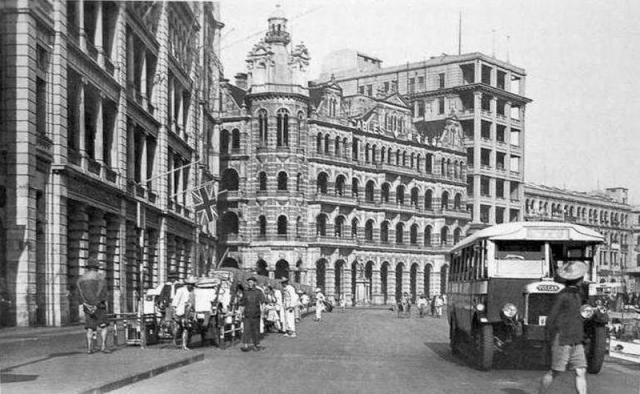
Kowloon’s buses began as a Chinese syndicate’s answer to a government’s reluctance. In July 1921 the China Mail tracked the venture down: “The company is known as ‘The Kowloon Motor Bus Company Ltd,’ and its promoter is Mr. Louis S. Pang.” The permission fight had run from early 1920 (“although a good deal of correspondence took place small progress was made”) until the Government called tenders — and the company’s tender was accepted. The plan: buses “running up Nathan Road, branching off to Shamshuipo by one route and to Hunghom by another”, 17 seats, ten cents first class and half that second, on nine one-ton Ford trucks.5 The formal inauguration followed on 26 November 1921, at the company’s own Nathan Road premises;6 by February 1923 the advertised service was a fifteen-minute run “direct from the Star Ferry Wharf to Kowloon City via Chatham Road, Gascoine Road, Hung Hom and the Kowloon City Road”.7
The China Motor Bus Company entered the record in March 1924 — as a Kowloon operator ordering through the Hotels’ own works: “The China Motor Bus Company& hellip; have placed an order with the Hongkong Hotel Motor Department for one of the ‘Thornycroft’ B. T. model extended passenger chassis… accommodating 10 first and 19 second class passengers. When ready, it will cater for Kowloon traffic.”8 By May its buses ran “to Shamshuipo from the Star Ferry”;9 its August notice was signed from “THE CHINA MOTOR BUS CO., HUNGHOM, KOWLOON”.10 The company that would take the island monopoly in 1933 was, for its first decade, a mainland firm — a correction this paper carries into its conclusion.
4. The failure and the successor, 1926–1928
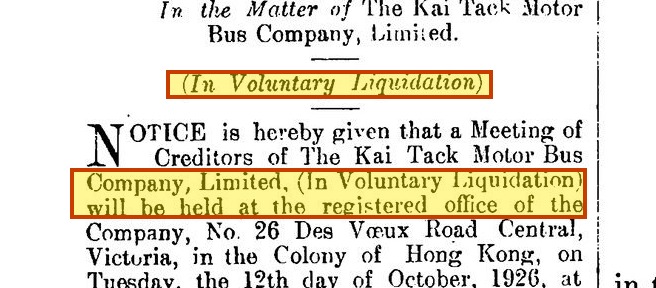
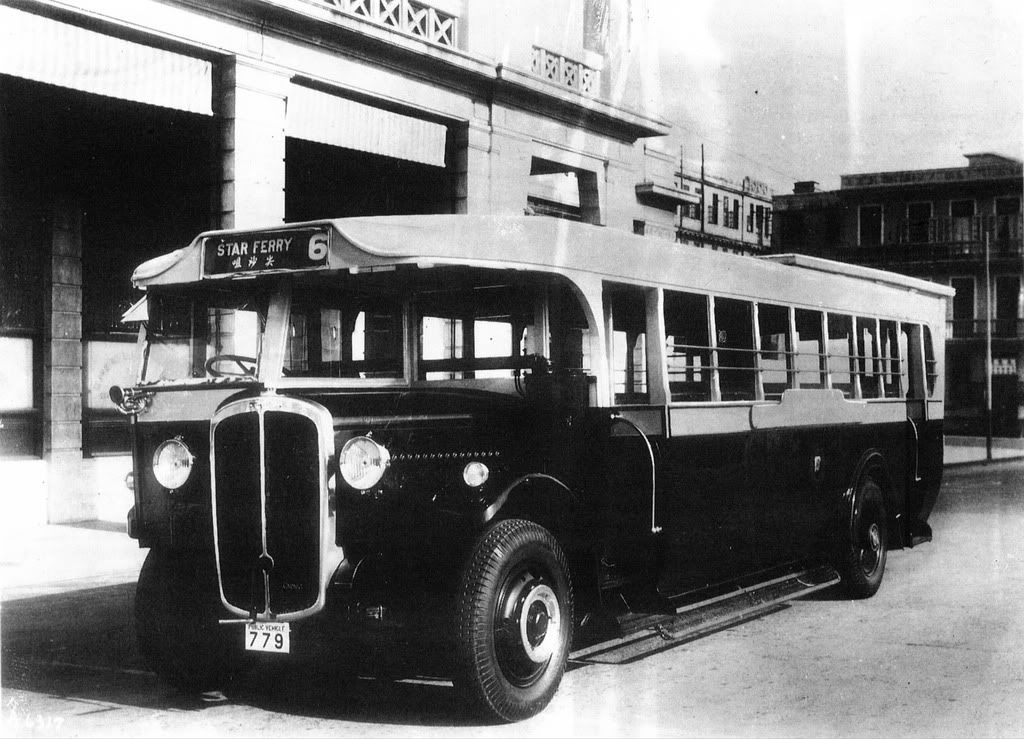
The free-for-all’s first casualty was the bus company whose name the era kept reusing. The Kai Tack Motor Bus Company, Limited went into voluntary liquidation in 1926: the special resolution was passed on 26 August and confirmed on 10 September; the creditors met on 12 October at the registered office, 26 Des Voeux Road Central (liquidators Un Pak Leung [阮伯良] and [李展南]); and the final general meeting — to lay the Liquidator’s account — was called for April 1927 at Haug Fa Lau, No. 325, Queen’s Road Central.1112 A successor, incorporated with the year in its name — The Kai Tack Motor Bus Co. (1926), Ltd. — carried the routes on: by January 1928 it was “supplementing [its] fleet of buses with six new Dennis buses built on the 30-cwt chassis… the low load line principle… only a single step is necessary from the road”;13 its advertised routes ran from 6.47 in the morning to nearly 1 a.m.;14 and the September motoring page printed the photograph of the new bodies — “of the low load line type… built on Dennis chassis” — by W. S. Bailey and Co., of Kowloon.15
The era’s texture survives in the record. In March 1926, in the strike’s tensest spring, a bomb thrown into the lunchtime crowd outside the Hung Hom Market damaged the two buses drawn up at the terminus — “a China Motor Bus Company’s vehicle (No. 1188) and… a Kai Tak Company’s bus (No. 789)”, the driver’s rolled-up overcoat struck through by the metal.16 And in March 1928 the two companies advertised in one block, two managers printed side by side — “NGAN SHING KWAN, Manager. China Bus Co.” over six routes, “HO SIU WOON, Manager, Kai Tack Motor Bus Co. (1926), Ltd.” over three — with the licensing regime’s sign-off beneath the tables: “Approved, E. D. C. WOLFE, Capt. Supt. of Police.”17 The state was already in the timetable.
5. The tram’s hedge, 1929
On New Year’s Day 1929 the threatened technology bought its threatener. The Telegraph of 2 January announced “a very interesting development in Kowloon transport… the entry into the field of competition of the Hongkong Tramways Limited” — a company “who have only recently started a bus service in Hongkong” — which would operate the Kai Tack buses “as from January 1st”. The report fixed the market: Kai Tack was “one of the three companies at present operating in Kowloon, the other two being the China Motor Bus Company and the Kowloon Motor Bus Company”; the fleet was sixteen buses on three routes — twelve modern low-loading twenty-seater Dennis and four twenty-eight-seater — to rise to twenty; and the price was not for the record: “No details of the purchase price paid by the Tramway Company are at present available.”18 The same day’s formal notice named the company correctly — “the Kai Tack Motor Bus Company (1926) Ltd.” — and took control “as from to-day”.19 The tram, already running its own island buses, had hedged itself into Kowloon.
6. The Chairman’s war, 1930
Fourteen months later the hedge’s first accounts met the chairman’s doctrine. At the Tramways’ annual general meeting of 18 March 1930, B. D. F. Beith reported receipts “DOWN BY $300,000 AND HEAVY EXPENSES” and delivered the war’s manifesto: “In some quarters the view has been expressed that a sure panacea for our present diminution of profits is gradually to substitute motor ‘buses for tram-cars. This, in your Board’s opinion, is a fallacy pregnant with alarming possibilities.” The arithmetic followed: “had the 27,000,000 passengers which our tram-cars carried last year been carried (at the same fares) by motor ‘buses instead of tram-cars not only should we not have had profit but we should not have made sufficient profit to pay any dividend” — proven, in the chairman’s reading, by Buenos Aires, Glasgow and New York, whose bus operations bled while their trams earned.20
The Kai Tack year itself was disappointment itemised: receipts “have not proved as satisfactory as expected”, mainly “due to the fares on our route No. 4 (Kowloon City–Yaumati Ferry) being too low”; a new Route 5 ran to the beach in the summer; the fleet was 24 Dennis buses; and the balance sheet grew a new head — “Motor Transport Investments… includes the investments in the Kai Tack Company”.21 Yet the same meeting carried the counter-argument. The chairman confirmed “current rumours as to the acquisition by this Company of the Hong Kong Hotel Motor Garage business” — negotiations “commenced a few days ago” — and described the tram’s own unremunerative island bus service between Blake Pier and Taikoo; and Mr. Frank Austin, in seconding, declared himself “a strong believer in the Company going forward on the policy of acquiring and running services of motor buses both on the Island and in Kowloon”, endorsing the negotiation “with the Hotel Company, for the purchase of its motor buses and franchise”.22 The company was at war with the bus in public and courting it in private.
Meanwhile the rival built its monument and the trade its temple: the KMB’s new premises at the end of Nathan Road — “a very imposing building of three storeys, with a central tower… accommodation for over 50 of the Company’s large buses… cost the Company $250,000”23 — and the Thornycroft advertisement in the same spring’s motoring pages: “SIX-CYLINDERED COACHES & OMNIBUSES… Pioneer Manufacturers… 20 to 70 Passengers.”24 The buses were already working the New Territories’ outer roads — one of them killing a sow “on the Saikung Road… at the junction of Kalyang Road”.25
7. The instruments, 1932
The Government’s answer to the free-for-all was drafted in the same legal stream that had licensed it. On 22 June 1932 the Governor in Council, under the Vehicles and Traffic Regulation Ordinance, 1912, rescinded the 1927 regulation (Government Notification No. 689) that had allowed licences to be granted “without calling for tenders” and substituted a new one: “the grant of rights and the issue of licences, exclusive or otherwise, to maintain public motor omnibus services may be made either with or without calling for tenders and such rights may be granted or licences issued for such periods, at such fees, royalties or other consideration, and upon such terms and conditions as the Governor in Council shall think fit.” The Gazette printed the reason in a NOTE: “the new regulation is made because it is desirable to call for tenders and to have full powers as to the prescribing of terms and conditions in the case of extensive services.”26
The tender came on 2 September 1932. Notification S. 319 (E. R. Hallifax, Colonial Secretary) called for “a licence or licences for the exclusive maintenance of a service or services for the mechanical transport of persons by road wherefor payment is made for the seat occupied” — for the whole Colony, or the Island, or “the whole of the Kowloon Peninsula, including the New Territories” — for “a period or term of Fifteen years commencing on the 11th day of June, 1933”, the service “conducted only by means of vehicles of British manufacture”, with scheduled routes (thirteen new ones for Kowloon and the New Territories, including Fanling–Tai Po at half-hourly intervals) and scheduled fares.27 And paragraph 3 carved out the old world by name: the tramways of the Hong Kong Tramway Company and the Peak Tramway Company would continue, and so would “the maintenance… of any service of motor buses for the transport of persons to, from and between the Hong Kong Hotel and the Repulse Bay Hotel (but not between any two intervening points on the route between them)” — the first bus’s own line, written into the monopoly law as its one statutory exception.28 The press read the terms plainly: “LICENCES TO BE OFFERED FOR THE NEXT FIFTEEN YEARS. NO COMPETING SERVICES TO BE ALLOWED… Buses must be of British make, and the person or persons obtaining the licence must be British subjects. No double deckers will be allowed on the Island.”29

8. The award and the loser’s account, 1933
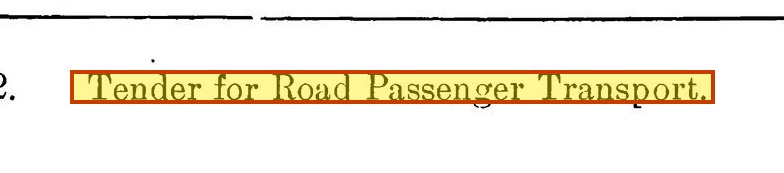
The award was gazetted on 13 January 1933 in the bureaucratic idiom of a tender board: “The following names of successful tenderers are notified for general information: — [Government Notification S. 319 of 2.9.32] Tender for Road Passenger Transport. Island of Hong Kong. The China Motor Bus Co. Kowloon and the New Territories. The Kowloon Motor Bus Co., Ltd.” — signed W. T. Southorn, Colonial Secretary.30 The press filled in the terms: fifteen years from 11 June, British vehicles, a majority of British subjects among the partners or directors, tenders offered “on the basis of a royalty by way of percentage on gross earnings”, maximum fares locked for three years, and no double-deckers on the Island.31 The winner’s manager, Mr. W. S. T. Louey, began at once — routes to be re-planned, “the assessment of the property of the other companies”, and “a new and larger garage… built outside the city limits”.32
The loser’s account survives, and it is the settlement’s economics in one page. At the Tramways’ meeting the following month the chairman, A. B. Stewart, explained why the company that owned a bus operation had not bid to keep it: the Mainland conditions were “of such drastic and onerous nature that… it was found impossible to accept them” — the tender had to be “a royalty by way of percentage on gross receipts” — while on the Island the company had offered “a tender (in my view a very high tender)… This was not accepted and it must be presumed that the successful tenderer—the China Motor Bus Company—offered Government an even greater royalty than we did”; as for Kowloon, “Neither scheme commended itself to Government who accepted the tender of the Kowloon Motor Bus Company”. The headline arithmetic was the tram’s epitaph for its bus era: “BIG PROFIT ON TRAMS: LOSSES ON ‘BUS SERVICES”.33
The monopoly company was incorporated for the purpose: the Kowloon Motor Bus Company (1933), Limited, with an authorised capital of $3,500,000 against the old company’s $250,000, eleven routes to be grown to eighteen “including greater facilities for New Territories travel”, sixty vehicles to be bought from the other operators at a tentative $100,000 on a sterling basis, and double-deckers — if sanctioned — “ordered from Messrs. Thornycroft’s or Messrs. Leyland”; the CMB’s parallel purchase of the island’s buses was “meeting with little success”, an appeal to Government as arbitrator “considered imminent”.34 The fares were promised unchanged, with the franchise’s own review clause after three years.35
9. The handover weekend, June 1933
The free-for-all died in one long weekend. Thursday 8 June: “the Kai Tack Bus Co., [ceased] to be, as their fleet of buses was taken over by the Kowloon Bus Co., and the operation of their three routes, Nos. 3, 4 and 5, continued by the new Company without any change that was apparent to passengers.” Friday the 9th: the China Motor Bus Company’s Kowloon buses — the company “which has moved over to the Island” — were “similarly taken over”. Saturday the 10th: unified control of all routes &ldash; the Kowloon Bus Co. in possession of 110 vehicles.36 And on the Island, the same weekend, the handover worked the other way: “it was not until the buses operated by the Hotel and Tramway Companies had completed their schedule early yesterday morning” — Sunday 11 June, the franchise’s first day — “that they were handed over to the new Company”, Mr. Ngan Shing Kwan, the China Motor Bus Company’s managing director, superintending at the Causeway Bay garage, “a hive of industry”.37 The tram’s bus operation ended the same weekend its Kai Tack routes passed to its rival’s franchise.
10. The corporate afterlife
The hedge’s corporate remains were cleared within months. On 28 July 1933 the Registrar of Companies noticed that at the expiration of three months “the name of The KAI TACK MOTOR BUS COMPANY (1926), LIMITED will, unless cause is shown to the contrary, be struck off the register and the company will be dissolved”;38 on 3 November 1933 the striking-off was gazetted as done.39 The first bus’s own line outlived the company that had franchised the world around it: “the service operated by the Hong Kong Hotel Garage… has been permitted to retain this omnibus service in spite of the franchise” — while the CMB started its own hourly Blake Pier–Repulse Bay service beside it.40 And the monopoly’s first lesson came before its first Christmas: the Kowloon Motor Bus Company was “AGAIN FINED” for failing to maintain its schedules, the manager’s plea that “there was no room in our garage the night before” cut short by the magistrate — “You accepted a franchise to run a bus service in Kowloon, and you have to see that the service is maintained… I am not concerned with whether you have room in your garage or not.”41

11. Conclusion
The record corrects the folk version at every joint. The first bus was a hotel’s amenity, not a commuter service; the Kowloon Motor Bus Company was a Chinese syndicate’s tender won against a slow government; the China Motor Bus Company was born at Hung Hom and only “moved over to the Island” when the franchise required it; the tram bought the second Kai Tack company — the first had already failed — and then argued in public, from Buenos Aires to New York, that the purchase was a mistake, while negotiating in private to buy the Hotels’ buses and franchise besides. The instruments that ended the free-for-all were printed in the Gazette with the state’s reasoning attached, and they preserved the era’s first line — the Hong Kong Hotel to Repulse Bay service — as the monopoly’s statutory exception. And the settlement’s first Christmas found the monopolist fined for the same offence the free-for-all had committed cheaply: not running enough buses. The hedge, the war, the capital, the roads — and the one-page tender notice that resolved them all.42
Appendix A: sources and method
The documentary corpus is the hkintexts research index (Elasticsearch
cluster hkintexts, indices hkintexts_pages and
hkintexts_image_pages), queried read-only on 10 October 2026.
The thread’s central document — the 19 March 1930 press record of
the Tramways AGM — was pulled and read in whole-issue context (the
44-page pull of that day’s China Mail, Daily Press and
Telegraph), and the S. 319 gazette supplementary was pulled in
full (17 pages, the tender notification and its schedules). Gazette
citations link to the image series (the scans); the press engines have no
image twins and link to the text series. Every quotation was read in its
whole page or document. No write was made to the index. Query families:
- “motor bus” + 191[0-9] — 50 (all foreign; the local record starts December 1919); “motor bus” + 192[0-3] — 456; “Kowloon Motor Bus” + 192[0-9] — 324; “China Motor Bus” + 192[0-9] — 162;
- “Kai Tack” — 1,257 (dominated by the Kai Tack Reclamation; the bus company queried as “Kai Tack Motor Bus”, 1926–33); “Motor Traffic Ordinance” — 4, all post-war (the 1933 franchise was not made under any such ordinance);
- the real chain: “motor omnibus” in the gazette; “Road Passenger Transport” — 4; “successful tenderers”; “motor bus” + 1933 — 342 (the franchise year’s press).
Appendix B: evidence register
| Claim | Witnesses |
|---|---|
| The first motor bus on the streets (30 December 1919) and the hotel–beach service from 1 January 1920 | the China Mail year-end page; the Daily Press/Telegraph/China Mail advertisements |
| The tram’s takeover of the Kai Tack Motor Bus Co. (1926), Ltd. (1 January 1929; the three companies; 16 buses, 3 routes) | the Telegraph report and formal notice of 2 January 1929; the 1930 AGM report |
| The Chairman’s war (the fallacy; the 27,000,000 arithmetic; the Hotel Garage negotiation; Austin’s counter-speech) | the AGM report, read in whole-issue context |
| The 1932 instruments and the 1933 award | Gazette No. 401; Notification S. 319 (with schedules); Gazette No. S. 10; the Telegraph/China Mail/Daily Press reports; the Tramways’ own AGM account |
| The handover (Kai Tack 8 June; the CMB’s Kowloon buses 9 June; unified by the 10th; 110 vehicles; the Hotel and Tramway Companies’ island buses to the CMB on the 11th) | the Telegraph of 8 June; the Daily Press of 12 June |
| The Kai Tack dissolution and the franchise’s first enforcement | Gazette No. 529; Gazette No. 720 and the year’s index; the Telegraph court report of 29 December 1933 |
| Item | The variance |
|---|---|
| The Kai Tack year suffix | the gazette prints “(1926)” twice and the 1929 notice and the 1928 advertisements agree; the AGM page’s OCR reads “(1998)” and one advertisement’s OCR “(1928)” — (1926) governs; the *Daily Press* has no scan to verify against |
| The “first” bus | 30 December 1919 (a bus on the streets) against the 1930 retrospective’s 1921 Race Meeting “first motor bus service” — both the period’s own claims, both kept |
| The takeover’s effective date | “as from January 1st” (the report; the AGM) against the formal notice’s “as from to-day” (published 2 January 1929) |
| The receipts decline | the printed headline “$300,000” (the chairman’s “nearly three lakhs”) against the accounts line’s garbled OCR — the headline is cited; the garbled digits are not |
| The June dates | permits terminated “from June 10 next” (the Tramways AGM) against the licence term commencing “the 11th day of June, 1933” (S. 319) |
| Item | Why |
|---|---|
| The (1926) successor’s registration date | not in the corpus; the suffix and the predecessor’s 1926 liquidation imply 1926 |
| The Kai Tack purchase price | “No details… are at present available” — the record’s own words |
| The winners’ royalty percentages | the award names the firms only; the tram’s own bid is “a very high tender”, unquantified |
| The CMB’s founding record | the corpus’s earliest CMB document is the March 1924 order; no founding notice found |
| The garbled 1930 accounts digits | the *Daily Press* has no image twin; the figures are not scan-verifiable; never cited |
Notes
- ↑Method note: the documentary corpus interrogated for this paper is the hkintexts research index (Elasticsearch cluster hkintexts, indices
hkintexts_pagesandhkintexts_image_pages), queried read-only on 10 October 2026. The logged query families are itemised in Appendix A; the thread’s central document (the 19 March 1930 press record of the Tramways AGM) was pulled and read in whole-issue context, together with the S. 319 gazette supplementary in full. Gazette citations link to the image series (the scans); the press engines have no image twins and link to the text series. The unresolved items are registered in Appendix B. No write was made to the index. - ↑China Mail, 31 December 1919, p. 12 (“HONGKONG MOTOR BUSSES. A SUCCESSFUL TRIAL TRIP. Something new for Hongkong started yesterday. The Dragon Motor [Car] Co., under the management of Mr. C. Lauritsen, put on the streets the first motor bus. A service of five of the vehicles is to be inaugur[ated]”). https://hkintexts.histsyn.com/page/1960332 (accessed 10 October 2026).
- ↑Daily Press, 1 January 1920, p. 3 (the Dragon Motor Car Co. advertisement: “Commencing on the 1st January, 1920, the DRAGON MOTOR CAR CO. will run a MOTOR BUS SERVICE from the HONGKONG HOTEL to the REPULSE BAY HOTEL. RETURN FARE $2”; the same advertisement in the Hongkong Telegraph of 2 January 1920, p. 8, adds “BOOK SEATS AT MOUTRIE’S”). https://hkintexts.histsyn.com/page/2287723 (accessed 10 October 2026).
- ↑Hongkong Telegraph, 1 March 1930, p. 33 (the motoring supplement, recording the Hongkong Hotel Garage’s order of “4 twenty-passenger ‘Duke’ type Vulcan motor buses… intended for the University route… which will replace the White vehicles”: “It was at the time of the annual Race Meeting in 1921, that the Hotels Company inaugurated Hongkong’s first motor bus service, from the City to the Race Course… the White buses were the first vehicles of their class put on the roads in the Colony”). https://hkintexts.histsyn.com/page/2937742 (accessed 10 October 2026).
- ↑China Mail, 27 July 1921, p. 4 (“BUSES FOR KOWLOON. READY IN OCTOBER. CHINESE ENTERPRISE”: “The company is known as ‘The Kowloon Motor Bus Company Ltd,’ and its promoter is Mr. Louis S. Pang. It appears that early in 1920 they tried to get the Government’s permission to run motor buses over at Kowloon but although a good deal of correspondence took place small progress was made. Then about twelve months after the company had made its original application, the Government announced that it proposed to call tenders for the job. The company put in a tender which was accepted”; the routes “running up Nathan Road, branching off to Shamshuipo by one route and to Hunghom by another”; “17 seats in each vehicle and… ten cents to ride first class and half that to go second”; “Nine one-ton Ford trucks pur[chased]”). https://hkintexts.histsyn.com/page/1965319 (accessed 10 October 2026).
- ↑Hongkong Telegraph, 26 November 1921, p. 4 (“The formal inauguration of the above company will take place to-morrow, November 26th., when a reception will be held at 3.30 p.m. on the company’s premises, Nathan Road, Kowloon”). https://hkintexts.histsyn.com/page/2902425 (accessed 10 October 2026).
- ↑China Mail, 15 February 1923, p. 3 (the KMB advertisement: “as from the 15th February fifteen minute service will be inaugurated running direct from the Star Ferry Wharf to Kowloon City via Chatham Road, Gascoine Road, Hung Hom and the Kowloon City Road”). https://hkintexts.histsyn.com/page/1970784 (accessed 10 October 2026).
- ↑Hongkong Telegraph, 22 March 1924, p. 7 (the motoring column: “The China Motor Bus Company… have placed an order with the Hongkong Hotel Motor Department for one of the ‘Thornycroft’ B. T. model extended passenger chassis… accommodating 10 first and 19 second class passengers. When ready, it will cater for Kowloon traffic”). https://hkintexts.histsyn.com/page/2911374 (accessed 10 October 2026).
- ↑China Mail, 12 May 1924, p. 9 (the accident report: a boy “ran into one of the China Motor Bus Co.’s buses going to Shamshuipo from the Star Ferry”; the bus overturned in swerving). https://hkintexts.histsyn.com/page/1975441 (accessed 10 October 2026).
- ↑Hongkong Telegraph, 30 August 1924, p. 17 (the notice signed “THE CHINA MOTOR BUS CO., HUNGHOM, KOWLOON” — student monthly tickets at $3.50 instead of $5.00, effective 1 September 1924). https://hkintexts.histsyn.com/page/2913260 (accessed 10 October 2026).
- ↑Government Gazette, 1926, supplementary advertisements, printed p. 577 (“In the Matter of the Companies Ordinance, No. 58 of 1911, and In the Matter of The Kai Tack Motor Bus Company, Limited. (In Voluntary Liquidation)” — the special resolution “PASSED the 26th August, 1926, CONFIRMED the 10th September, 1926”; the creditors’ meeting of 12 October 1926 at the registered office, “No. 26 Des Voeux Road Central, Victoria”; liquidators UN PAK LEUNG [Chinese characters in original: 阮伯良] and [李展南]). Scan: https://hkintexts.histsyn.com/image-page/1458491 (accessed 10 October 2026).
- ↑Government Gazette, 4 March 1927, supplementary advertisements, printed p. 128 (“THE KAI TACK MOTOR BUS COMPANY, LIMITED. (IN LIQUIDATION). NOTICE is hereby given that a General Meeting of the Company will be held… at Haug Fa Lau, No. 325, Queen’s Road Central, for the purpose of laying before it the Liquidator’s account of the winding up”). Scan: https://hkintexts.histsyn.com/image-page/1461042 (accessed 10 October 2026).
- ↑Daily Press, 18 January 1928, p. 8 (“The Kai Tack Motor Bus Co. are supplementing their fleet of buses with six new Dennis buses built on the 30-cwt chassis… the chassis is built on the low load line principle, and instead of the usual three, only a single step is necessary from the road to the [floor] of the bus”). https://hkintexts.histsyn.com/page/2315671 (accessed 10 October 2026).
- ↑China Mail, 30 March 1928, p. 3 (the Kai Tack route advertisement: Star Ferry to Kowloon City via Chatham and Gascoigne Roads; Yaumati to Kowloon City; Yaumati to Hung Hom; the running hours 6.47 a.m. to 12.50 a.m.). https://hkintexts.histsyn.com/page/1990359 (accessed 10 October 2026).
- ↑Hongkong Telegraph, 1 September 1928, p. 9 (“The above picture shows some of the new buses built for the Kai Tack Motor Bus Co., (1926) Ltd., by Messrs. W. S. Bailey and Co., Ltd., of Kowloon. The bodies, of the low load line type, have been built on Dennis chassis”). https://hkintexts.histsyn.com/page/2930604 (accessed 10 October 2026).
- ↑Daily Press, 11 March 1926, p. 5 (the strike-era bomb “just outside the Hunghom Market, near the corner of the Kowloon City Road about 1 p.m.”: “two motor-buses drawn up at the terminus near the market… were damaged by the force of the explosion. One was a China Motor Bus Company’s vehicle (No. 1188) and the other was a Kai Tak Company’s bus (No. 789)… The Kai Tak bus driver had a remarkable escape from death” — the metal struck his rolled-up overcoat). https://hkintexts.histsyn.com/page/2308527 (accessed 10 October 2026).
- ↑Daily Press, 30 March 1928, p. 8 (the joint advertisement block: “NGAN SHING KWAN, Manager. China Bus Co.” over routes 7, 8, D, 10, 11 and 12, and “HO SIU WOON, Manager, Kai Tack Motor Bus Co. (1926), Ltd.” over its routes, with the licensing regime’s sign-off printed beneath: “Approved, E. D. C. WOLFE, Capt. Supt. of Police.”). https://hkintexts.histsyn.com/page/2316463 (accessed 10 October 2026).
- ↑Hongkong Telegraph, 2 January 1929, p. 2 (“KOWLOON BUS. KAI TACK COMPANY CHANGES HANDS”: “the entry into the field of competition of the Hongkong Tramways Limited… this Company, who have only recently started a bus service in Hongkong, will be operating the buses of the Kai Tack Motor Bus Company as from January 1st. The Kai Tack Motor Bus Company is one of the three companies at present operating in Kowloon, the other two being the China Motor Bus Company and the Kowloon Motor Bus Company… a fleet of sixteen buses on three different routes… twelve of which are the modern low-loading twenty seater Dennis buses and [four] Dennis twenty-eight seaters… No details of the purchase price paid by the Tramway Company are at present available”). https://hkintexts.histsyn.com/page/2932147 (accessed 10 October 2026).
- ↑Hongkong Telegraph, 2 January 1929, p. 4 (the formal notice: “control of the business of the Kai Tack Motor Bus Company (1926) Ltd. of Kowloon and will operate that undertaking as from to-day”). https://hkintexts.histsyn.com/page/2932149 (accessed 10 October 2026).
- ↑Daily Press, 19 March 1930, p. 6 (the Hong Kong Tramways AGM report of 18 March 1930: the headline “CHAIRMAN’S UNABATED CONFIDENCE IN TRAMS AS AGAINST THE MOTOR ‘BUS. RECEIPTS DOWN BY $300,000 AND HEAVY EXPENSES”; “In some quarters the view has been expressed that a sure panacea for our present diminution of profits is gradually to substitute motor ‘buses for tram-cars. This, in your Board’s opinion, is a fallacy pregnant with alarming possibilities”; “had the 27,000,000 passengers which our tram-cars carried last year been carried (at the same fares) by motor ‘buses instead of tram-cars not only should we not have had profit but we should not have made sufficient profit to pay any dividend”; the comparative authorities — the Anglo-Argentine Tramways of Buenos Aires, the Glasgow General Omnibus and Motor Services, the Third Avenue Railway of New York, the Institute of Transport’s railless-trolley thresholds). Read in whole-issue context. https://hkintexts.histsyn.com/page/2324822 (accessed 10 October 2026).
- ↑Daily Press, 19 March 1930, p. 6 (the same AGM report, the Kai Tack year: “your Company [had] from January, 1929, assumed control of the Kai Tack Motor Bus Co. [(1926)], Ltd., operating in Kowloon. The capital of that Company has passed into the ownership of the Tramway Company and your Directors now constitute the Board of the Kai Tack Company… receipts have not proved as satisfactory as expected… mainly due to the fares on our route No. 4 (Kowloon City–Yaumati Ferry) being too low”; “A new route (No. 5) has been opened and in the summer months we are called upon to provide a service between Star Ferry and Tai Wan Beach”; “eight new buses were purchased… Including the former 10 passenger vehicles the Company now has a total of 24 (Dennis) motor ‘buses”; the new balance-sheet head “Motor Transport Investments… includes the investments in the Kai Tack Company”). https://hkintexts.histsyn.com/page/2324822 (accessed 10 October 2026).
- ↑Daily Press, 19 March 1930, p. 6 (the same AGM report: “I have been asked to make a statement concerning current rumours as to the acquisition by this Company of the Hong Kong Hotel Motor Garage business. Preliminary negotiations with such an acquisition in view commenced a few days ago”; the tram’s own island buses “between Blake Pier & Taikoo East Gate via Queen’s Road East and Leighton Hill Road… not remunerative [but] a much felt need”; and Mr. Frank Austin’s seconding speech: “I am a strong believer in the Company going forward on the policy of acquiring and running services of motor buses both on the Island and in Kowloon… the policy of the Board in negotiating with the Hotel Company, for the purchase of its motor buses and franchise should be endorsed by shareholders”). https://hkintexts.histsyn.com/page/2324822 (accessed 10 October 2026).
- ↑Daily Press, 15 January 1930, p. 2 (the KMB’s new premises: “at the end of Nathan Road, opposite the Ford Garage… a very imposing building of three storeys, with a central tower… accommodation for over 50 of the Company’s large buses, while living quarters for the employees are provided… The new premises have cost the Company $250,000”). https://hkintexts.histsyn.com/page/2323976 (accessed 10 October 2026).
- ↑Hongkong Telegraph, 1 March 1930, p. 14 (the Thornycroft advertisement: “SIX-CYLINDERED COACHES & OMNIBUSES… Pioneer Manufacturers of Commercial Motor Vehicles… 20 to 70 Passengers. JOHN I. THORNYCROFT & CO., LIMITED, UNION BUILDING, HONGKONG”). https://hkintexts.histsyn.com/page/2937723 (accessed 10 October 2026).
- ↑China Mail, 3 January 1930, p. 6 (“Liu Kwan, the driver of a motor bus owned by the Kowloon Motor Bus Co.… driving the bus on the Saikung Road… ran into and killed a sow at the junction of Kalyang Road”). https://hkintexts.histsyn.com/page/1997643 (accessed 10 October 2026).
- ↑Government Gazette, 24 June 1932, No. 401 (“ORDINANCE No. 40 of 1912 (VEHICLES AND TRAFFIC REGULATION)”: the Governor in Council “rescinds the regulation… published as Government Notification No. 689 in the Gazette of the 25th November, 1927, and makes the following regulation in substitution therefor… the grant of rights and the issue of licences, exclusive or otherwise, to maintain public motor omnibus services may be made either with or without calling for tenders and such rights may be granted or licences issued for such periods, at such fees, royalties or other consideration, and upon such terms and conditions as the Governor in Council shall think fit”; and the NOTE: “The new regulation is made because it is desirable to call for tenders and to have full powers as to the prescribing of terms and conditions in the case of extensive services”; D. W. Tratman, Clerk of Councils, 22 June 1932). Scan: https://hkintexts.histsyn.com/image-page/1479894 (accessed 10 October 2026).
- ↑Government Gazette, 2 September 1932, No. S. 319 (the “Tender for Road Passenger Transport” notification, E. R. Hallifax, Colonial Secretary: tenders “for a licence or licences for the exclusive maintenance of a service or services for the mechanical transport of persons by road wherefor payment is made for the seat occupied”; the whole-Colony / Island / “Kowloon Peninsula, including the New Territories” options; “The licence or licences will be for a period or term of Fifteen years commencing on the 11th day of June, 1933”; “conducted only by means of vehicles of British manufacture”; Schedules A–E, the new routes and fares). Scan: https://hkintexts.histsyn.com/image-page/1484336; the schedule page: https://hkintexts.histsyn.com/image-page/1484353 (both accessed 10 October 2026).
- ↑Government Gazette, 2 September 1932, No. S. 319, para. 3 (the statutory exceptions, by name: “The continued operation of the tramway services of the Hong Kong Tramway Company Limited and the Peak Tramway Company Limited and any lawful extensions thereof and the maintenance, under licence or otherwise, of any service of motor buses for the transport of persons to, from and between the Hong Kong Hotel and the Repulse Bay Hotel (but not between any two intervening points on the route between them) shall not be an infringement of the rights under any licence for exclusive maintenance”). Scan: https://hkintexts.histsyn.com/image-page/1484336 (accessed 10 October 2026).
- ↑Daily Press, 5 September 1932, p. 7 (“BUS SERVICE. LICENCES TO BE OFFERED FOR THE NEXT FIFTEEN YEARS. NO COMPETING SERVICES TO BE ALLOWED… Buses must be of British make, and the person or persons obtaining the licence must be British subjects. No double deckers will be allowed on the Island. The licence is to be granted from June 11, 1933. Fares as fixed will be for the next three years, when revision… will be made”). https://hkintexts.histsyn.com/page/2337091 (accessed 10 October 2026).
- ↑Government Gazette, 13 January 1933, No. S. 10 (W. T. Southorn, Colonial Secretary: “The following names of successful tenderers are notified for general information: — [Government Notification S. 319 of 2.9.32] Tender for Road Passenger Transport. Island of Hong Kong. The China Motor Bus Co. Kowloon and the New Territories. The Kowloon Motor Bus Co., Ltd.”). Scan: https://hkintexts.histsyn.com/image-page/1486572 (accessed 10 October 2026).
- ↑Hongkong Telegraph, 14 January 1933, p. 1 (“LOCAL OMNIBUS SERVICES. AWARD RUMOURS CONFIRMED. 15-YEAR PERIOD”: “the China Motor Bus Company had been awarded the franchise for the operation of motor buses on Hongkong Island, and the Kowloon Motor Bus Co. for Kowloon and the New Territories… officially confirmed, the Gazette intimating the acceptance of their tenders… British vehicles must be used and that the majority of the partners or directors of the successful tendering firms must be British subjects. Tenderers had to offer on the basis of a royalty by way of percentage on gross earnings… Those fares are to prevail for three years… Double-deck vehicles [are not] allowed on the Hongkong side”); the first report in the China Mail, 13 January 1933, p. 1. https://hkintexts.histsyn.com/page/2952979 (accessed 10 October 2026).
- ↑Daily Press, 17 January 1933, p. 7 (Mr. W. S. T. Louey, manager, on the KMB’s plans for “the Kowloon monopoly which has been granted to them by the Government”: “a considerable amount of change will take place as regards the present routes… A certain amount depends on the position of the Company and the number of vehicles which they will have in use, following the assessment of the property of the other companies… a new and larger garage would be necessary… built outside the city limits”). https://hkintexts.histsyn.com/page/2338923 (accessed 10 October 2026).
- ↑Daily Press, 17 February 1933, p. 9 (the Hong Kong Tramways AGM, Chairman A. B. Stewart: “On September 2 last Government announced the termination from June 10 next of all existing permits for motor bus operation within the Colony and invited tenders for the exclusive maintenance of motor bus services… no tender for the licence or licences should be other than a royalty by way of percentage on gross receipts… of such drastic and onerous nature that in the case of the Mainland—it was found impossible to accept them”; “a tender (in my view a very high tender)… was not accepted and it must be presumed that the successful tenderer—the China Motor Bus Company—offered Government an even greater royalty than we did”; “Neither scheme commended itself to Government who accepted the tender of the Kowloon Motor Bus Company”; the headline “BIG PROFIT ON TRAMS: LOSSES ON ‘BUS SERVICES”). https://hkintexts.histsyn.com/page/2339387 (accessed 10 October 2026).
- ↑China Mail, 3 May 1933, p. 1 (“$3,500,000 BUS COMPANY FOR KOWLOON. Expansion Plan. DOUBLE-DECKER BUSES MAY BE OPERATED”: “a new company has been formed with an authorised capital of $3,500,000… The capital of the old company was $250,000… Eleven routes are at present operated, and it is hoped to increase these to 18, including greater facilities for New Territories travel… the tentative price for 60 vehicles being $100,000, on a sterling basis… they will be ordered from Messrs. Thornycroft’s or Messrs. Leyland”; the CMB’s island negotiations “meeting with little success. An appeal to the Government to act as arbitrator… is considered imminent”). https://hkintexts.histsyn.com/page/2010608 (accessed 10 October 2026).
- ↑China Mail, 8 May 1933, p. 7 (“no increase in bus fares will occur when the Kowloon Motor Bus Company take over the monopoly of services on the mainland next month. Season tickets will cost $1 extra… The franchise permits the reviewing of fares after three years of operation”). https://hkintexts.histsyn.com/page/2010664 (accessed 10 October 2026).
- ↑Hongkong Telegraph, 8 June 1933, p. 19 (“the taking over by the Kowloon Motor Bus Co. (1933) Ltd., of the bus routes on the mainland by June 11, the ultimate date fixed in their franchise… yesterday the Kai Tack Bus Co., [ceased] to be, as their fleet of buses was taken over by the Kowloon Bus Co., and the operation of their three routes, Nos. 3, 4 and 5, continued by the new Company without any change that was apparent to passengers. To-morrow, the buses belonging to the China Motor Bus Company, which has moved over to the Island, will be similarly taken over… In all, the Kowloon Bus Co. will be in possession of a fleet of 110 vehicles”). https://hkintexts.histsyn.com/page/2955926 (accessed 10 October 2026).
- ↑Daily Press, 12 June 1933, p. 7 (“TAKING OVER THE BUS SERVICE. BUSY SCENES ON SATURDAY NIGHT”: “The China Motor Bus [Company] now controls the bus traffic on the Island… it was not until the buses operated by the Hotel and Tramway Companies had completed their schedule early yesterday morning that they were handed over to the new Company. Mr. Ngan Shing Kwan, managing director of the China Motor Bus Company personally superintended the operations… the garage at Causeway Bay was indeed a hive of industry”). https://hkintexts.histsyn.com/page/2341047 (accessed 10 October 2026).
- ↑Government Gazette, 4 August 1933, No. 529 (“at the expiration of three months from the date hereof the name of The KAI TACK MOTOR BUS COMPANY (1926), LIMITED will, unless cause is shown to the contrary, be struck off the register and the company will be dissolved. 28th July, 1933. T. M. HAZLERIGG, Registrar of Companies”). Scan: https://hkintexts.histsyn.com/image-page/1489491 (accessed 10 October 2026).
- ↑Government Gazette, 3 November 1933, No. 720 (“It is hereby notified that the name of The KAI TACK MOTOR BUS COMPANY (1926), LIMITED has been struck off the register. 3rd November, 1933. T. M. HAZLERIGG”; the same year’s gazette index lists the company “to be struck off the Register… 540” and “struck off the Register… 784”). Text series: https://hkintexts.histsyn.com/page/1581299; the year’s index (scan): https://hkintexts.histsyn.com/image-page/1488945 (both accessed 10 October 2026).
- ↑China Mail, 28 June 1933, p. 7 (“the service operated by the Hong Kong Hotel Garage, which has been permitted to retain this omnibus service in spite of the franchise, [and] the China Motor Bus Company… an hourly service from Blake Pier”). https://hkintexts.histsyn.com/page/2011210 (accessed 10 October 2026).
- ↑Hongkong Telegraph, 29 December 1933, p. 19 (“KOWLOON BUS COMPANY AGAIN FINED. FAILURE TO MAINTAIN BUS SCHEDULES”: “You accepted a franchise to run a bus service in Kowloon, and you have to see that the service is maintained,” said Mr. Wynne-Jones, at the Kowloon Magistracy this morning, when the manager of the Kowloon Motor Bus Company was summoned for failing to keep to schedule… ‘There was no room in our garage the night before…’ His Worship—You accepted a franchise… I am not concerned with whether you have room in your garage or not. You have to maintain the service.”). https://hkintexts.histsyn.com/page/2960150 (accessed 10 October 2026).
- ↑Method note: the documentary corpus interrogated for this paper is the hkintexts research index (Elasticsearch cluster hkintexts, indices
hkintexts_pagesandhkintexts_image_pages), queried read-only on 10 October 2026. The logged query families are itemised in Appendix A; the thread’s central document (the 19 March 1930 press record of the Tramways AGM) was pulled and read in whole-issue context, together with the S. 319 gazette supplementary in full. Gazette citations link to the image series (the scans); the press engines have no image twins and link to the text series. The unresolved items are registered in Appendix B. No write was made to the index.
Bibliography
Primary sources — the Government Gazette
- Government Gazette, supplementary advertisements, 1926 (the Kai Tack Motor Bus Company, Limited, in voluntary liquidation; printed p. 577). https://hkintexts.histsyn.com/image-page/1458491 (accessed 10 October 2026).
- Government Gazette, supplementary advertisements, 4 March 1927 (the Kai Tack final general meeting; printed p. 128). https://hkintexts.histsyn.com/image-page/1461042 (accessed 10 October 2026).
- Government Gazette, 24 June 1932, No. 401 (the tender-ready exclusive-licence regulation, with the NOTE). https://hkintexts.histsyn.com/image-page/1479894 (accessed 10 October 2026).
- Government Gazette, 2 September 1932, No. S. 319 (the Tender for Road Passenger Transport, with Schedules A–E). https://hkintexts.histsyn.com/image-page/1484336; https://hkintexts.histsyn.com/image-page/1484353 (accessed 10 October 2026).
- Government Gazette, 13 January 1933, No. S. 10 (the award). https://hkintexts.histsyn.com/image-page/1486572 (accessed 10 October 2026).
- Government Gazette, 4 August 1933, No. 529 (the strike-off warning). https://hkintexts.histsyn.com/image-page/1489491 (accessed 10 October 2026).
- Government Gazette, 3 November 1933, No. 720 (the strike-off), and the year’s gazette index. https://hkintexts.histsyn.com/page/1581299; https://hkintexts.histsyn.com/image-page/1488945 (accessed 10 October 2026).
Primary sources — the press
- China Mail, 31 December 1919, p. 12 (the first motor bus). https://hkintexts.histsyn.com/page/1960332 (accessed 10 October 2026).
- Daily Press, 1 January 1920, p. 3 (the Dragon Motor Car Co. advertisement); Hongkong Telegraph, 2 January 1920, p. 8. https://hkintexts.histsyn.com/page/2287723 (accessed 10 October 2026).
- China Mail, 27 July 1921, p. 4 (the KMB origin). https://hkintexts.histsyn.com/page/1965319 (accessed 10 October 2026).
- Hongkong Telegraph, 26 November 1921, p. 4 (the KMB inauguration). https://hkintexts.histsyn.com/page/2902425 (accessed 10 October 2026).
- China Mail, 15 February 1923, p. 3 (the KMB fifteen-minute service). https://hkintexts.histsyn.com/page/1970784 (accessed 10 October 2026).
- Hongkong Telegraph, 22 March 1924, p. 7 (the CMB’s Thornycroft order via the Hongkong Hotel Motor Department). https://hkintexts.histsyn.com/page/2911374 (accessed 10 October 2026).
- China Mail, 12 May 1924, p. 9 (the CMB bus to Shamshuipo); Hongkong Telegraph, 30 August 1924, p. 17 (the Hung Hom notice). https://hkintexts.histsyn.com/page/1975441; https://hkintexts.histsyn.com/page/2913260 (accessed 10 October 2026).
- Daily Press, 11 March 1926, p. 5 (the Hung Hom Market bomb). https://hkintexts.histsyn.com/page/2308527 (accessed 10 October 2026).
- Daily Press, 18 January 1928, p. 8 (the six new Dennis buses); China Mail, 30 March 1928, p. 3 (the Kai Tack routes); Daily Press, 30 March 1928, p. 8 (the joint advertisement); Hongkong Telegraph, 1 September 1928, p. 9 (the Bailey bodies). https://hkintexts.histsyn.com/page/2315671; https://hkintexts.histsyn.com/page/1990359; https://hkintexts.histsyn.com/page/2316463; https://hkintexts.histsyn.com/page/2930604 (accessed 10 October 2026).
- Hongkong Telegraph, 2 January 1929, pp. 2, 4 (the Kai Tack takeover report and formal notice). https://hkintexts.histsyn.com/page/2932147; https://hkintexts.histsyn.com/page/2932149 (accessed 10 October 2026).
- Daily Press, 15 January 1930, p. 2 (the KMB’s $250,000 headquarters); China Mail, 3 January 1930, p. 6 (the Saikung Road sow); Hongkong Telegraph, 1 March 1930, pp. 14, 33 (the Thornycroft advertisement; the motoring supplement). https://hkintexts.histsyn.com/page/2323976; https://hkintexts.histsyn.com/page/1997643; https://hkintexts.histsyn.com/page/2937723; https://hkintexts.histsyn.com/page/2937742 (accessed 10 October 2026).
- Daily Press, 19 March 1930, p. 6 (the Tramways AGM report, read in whole-issue context). https://hkintexts.histsyn.com/page/2324822 (accessed 10 October 2026).
- Daily Press, 5 September 1932, p. 7 (the fifteen-year licence terms). https://hkintexts.histsyn.com/page/2337091 (accessed 10 October 2026).
- China Mail, 13 January 1933, p. 1 (the award’s first report); Hongkong Telegraph, 14 January 1933, p. 1 (the confirmation and the terms); Daily Press, 17 January 1933, p. 7 (the Louey interview). https://hkintexts.histsyn.com/page/2009463; https://hkintexts.histsyn.com/page/2952979; https://hkintexts.histsyn.com/page/2338923 (accessed 10 October 2026).
- Daily Press, 17 February 1933, p. 9 (the Tramways’ 1933 AGM — the loser’s account). https://hkintexts.histsyn.com/page/2339387 (accessed 10 October 2026).
- China Mail, 3 May 1933, p. 1 (the KMB (1933) formation); Hongkong Telegraph, 3 May 1933, p. 1; China Mail, 8 May 1933, p. 7 (the fare assurance). https://hkintexts.histsyn.com/page/2010608; https://hkintexts.histsyn.com/page/2955149; https://hkintexts.histsyn.com/page/2010664 (accessed 10 October 2026).
- Hongkong Telegraph, 8 June 1933, p. 19 (the handover timetable); Daily Press, 12 June 1933, p. 7 (the busy scenes); China Mail, 28 June 1933, p. 7 (the Repulse Bay services). https://hkintexts.histsyn.com/page/2955926; https://hkintexts.histsyn.com/page/2341047; https://hkintexts.histsyn.com/page/2011210 (accessed 10 October 2026).
- Hongkong Telegraph, 29 December 1933, p. 19 (the franchise enforcement). https://hkintexts.histsyn.com/page/2960150 (accessed 10 October 2026).