在崩潰年誕生的銀行——香港上海滙豐銀行創立考,1864–66
摘要
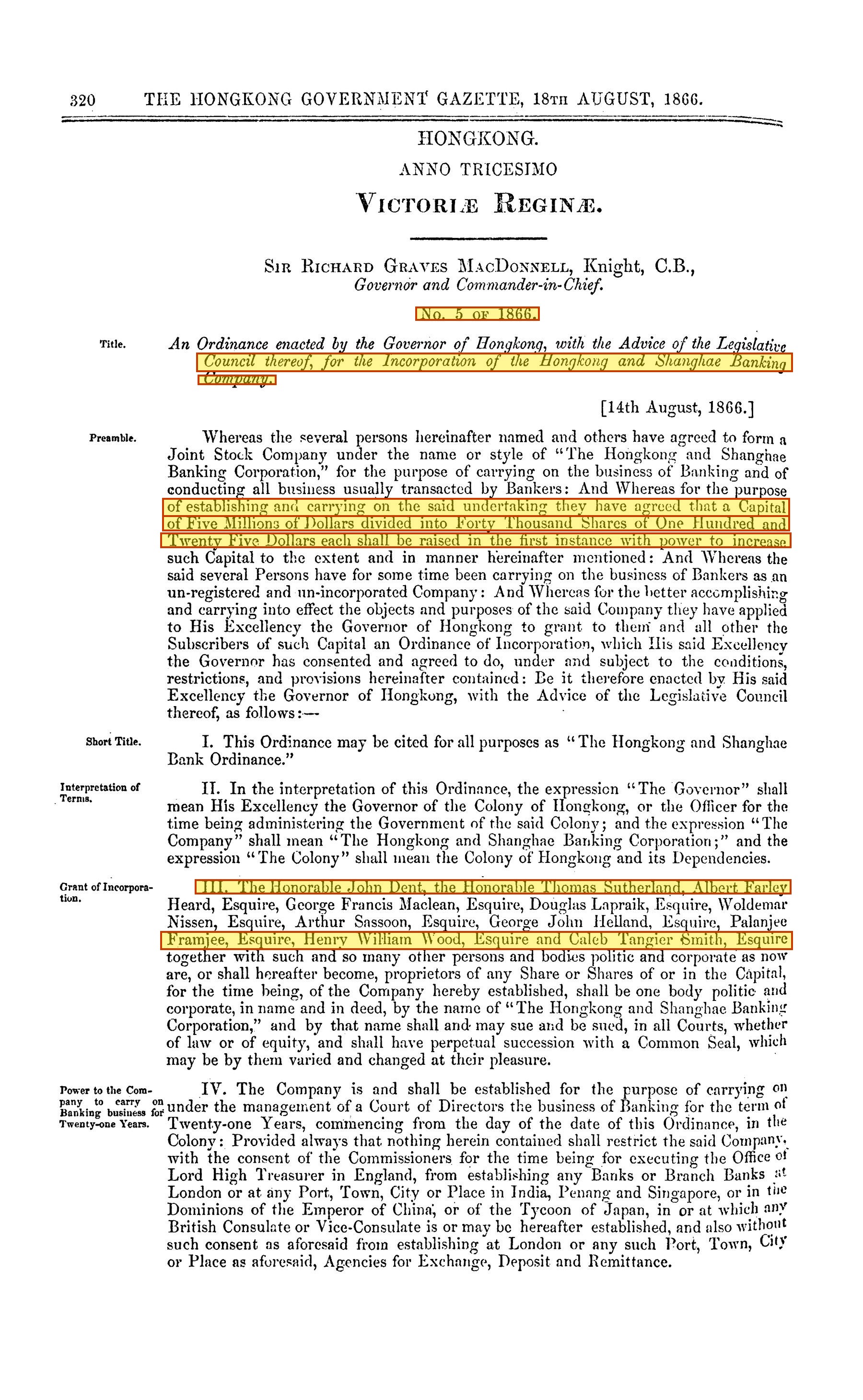
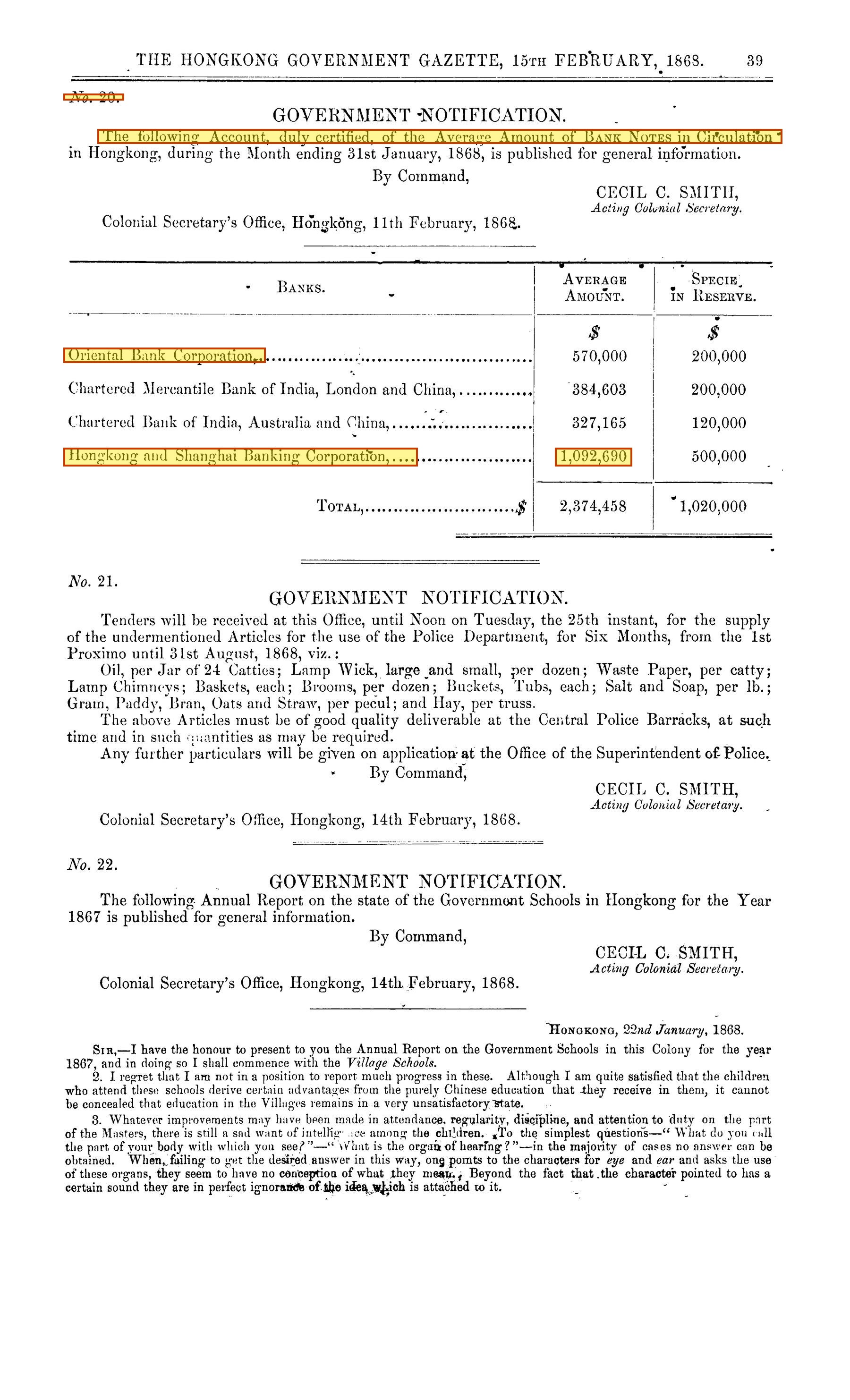
一八六六年,香港金融體系在數週之內崩潰:商業銀行宣告暫停支付,港元紙幣在匯兑市場按二七折(27 per cent discount)貼現,白銀大量外流。1 2 就在這一危機年的八月十四日,立法局通過了《Hongkong and Shanghae Banking Company Incorporation Ordinance》,即憲報第 5 號條例(Ordinance No. 5 of 1866),正式將一家已營業逾年、從未合法註冊的商業銀行納入法定架構。3 4 5 本研究重建了這家銀行從一八六四年東方匯兑銀行擠擁的市場中崛起,到一八六五年三月招股(Victor Kresser 出任經理),6 7 8 再到一八六六年五月總督 MacDonnell 以越權(ultra vires)為由拒絕首份條例草案,9 最終於一八六六年八月十四日獲得立法局通過、八月十八日刊憲的完整過程。10 條例規定資本五百萬元、四萬股、每股一百二十五元,十一名首任董事,並以 s.XII 規定股東對鈔票承擔無限責任(MacDonnell 在公文中說明此係董事會主動提出)。11 銀行於一八六六年十二月三十一日首次提交法定鈔票流通報告,12 一八六七年八月完成 s.X 所需的信託契約(Deed of Settlement)認證,13 至一八六八年一月,其鈔票流通額($1,092,690)已超越東方匯銀($570,000),躍居全港最大發鈔銀行。14 本研究以 CO 129/114 全卷、香港政府憲報影像庫、立法局會議紀錄及《中國郵報》(China Mail)為據,全面更正舊研究的條例編號錯誤,並提出「在崩潰年誕生」的分析框架。
關鍵詞:香港上海滙豐銀行、Ordinance No. 5 of 1866、一八六六年金融崩潰、MacDonnell、Victor Kresser、Deed of Settlement、鈔票流通
一、緒論
一八六〇年代的香港,東方匯兑銀行(exchange banks)主宰金融市場。一八六四年報章廣告可見 Asiatic Bank of India、Commercial Bank of India、Central Bank of Western India(「Capital, Two Million Sterling」)等印度匯兑銀行的身影。15 至一八六五年, Oriental Bank Corporation 以「Incorporated by Royal Charter. Paid-up Capital, £1,000,000」的規模佔據龍頭地位,16 本地商家的新銀行顯得年輕而規模有限。15 16 本研究的核心問題是:這家銀行為何遲至一八六六年八月才完成法定手續,其法定誕生與同年金融危機之間有何關聯?答案見於 CO 129/114 所藏 MacDonnell 總督的公文,以及一八六六年憲報條例原文本身。
二、一八六四至六五年:擁擠的東方匯兑世界
一八六四至六五年間,香港的銀行廣告版充斥着倫敦與加爾各答註冊的匯兑銀行。15 16 這些銀行以印度棉業匯兑為主業,資本動輒以百萬英鎊計。本地商家——John Dent、Thomas Sutherland 等人——決定成立一家服務於香港與上海之間貿易的銀行,資本定為五百萬元。一八六五年三月七日,《Daily Press》刊登招股章程:資本「Five Millions of Dollars divided into Forty Thousand Shares of One Hundred and Twenty Five Dollars each」,認購於同年三月三十日截止,Victor Kresser 出任經理。17 這是目前語料庫中最早可確認的該行文獻;一八六五年三月三日的正式成立報告因該時期 OCR 質量粗糙而未能確認,故註冊為缺口(gap),不作斷言。
三、一八六六年五月:總督拒絕首份條例草案
一八六六年五月,總督 Richard Graves MacDonnell 拒絕了首份條例草案。他在同年八月二十四日致殖民地大臣 Carnarvon 伯爵的第 100 號公文中寫道:「I declined to proceed with the Ordinance as I considered some of its provisions to be in excess of the powers of this Legislature, and an infringement of the Treasury Instructions.」18 即草案內容超出殖民地立法局的權限,並違反財政部(Treasury)的指示。公文同時記載:「The above Company has already been established more than a year, and has met with very great success this year, but till now it has never been legally Incorporated」——銀行已營業逾年,卻從未合法註冊。11 其後草案經修訂:新增 s.XXXVIII 清盤條款(MacDonnell 堅持加入),s.XII 則規定股東對鈔票承擔無限責任。MacDonnell 曾提議以銀行財產為鈔票持有人設定第一順位擔保(first charge),但「The Directors, however, on consultation preferred establishing unlimited liability of the Shareholders as to notes — a proposal which I at once accepted」。18 這一行政決定直接塑造了日後條例的文本。
四、一八六六年六月:金融崩潰
一八六六年六月,香港金融體系在數週內相繼倒下。《中國郵報》六月二十一日以「Commercial Bank has suspended payment」為題報導,另有「Bank Limited, has suspended payment. (The paid-up capital is £600,000.)」的通訊。19 同月二十八日的匯兑報告記錄:「On Hongkong, on demand, 27 per cent discount」——港元紙幣按七三折(即 27% 貼現)兌換,同時「Between two and three million taels have been sent to Hongkong and India in bullion」——白銀大量外流。20 在此背景下,一八六六年八月十四日通過的條例將一家新銀行合法化,其歷史意義正是「在崩潰年誕生」(born in the crash year):它不是危機的產物,而是與危機同步完成法定手續的機構。值得注意的是,本行從未出現在任何一份停業(suspended payment)清單中——語料庫中六月的停業報告僅點名商業銀行及資本六萬鎊的某行,本行不在其列(adversarial 試圖之一:「HSBC never appears in a suspension list」——語料庫重讀後確認)。
五、一八六六年八月十四日:法定誕生
立法局於一八六六年七月二十五日首讀該草案(Votes and Proceedings No. 8 of 1866),10 八月十四日「read a Second time, amended in Committee and passed,—being 'No. 5 of 1866'」(No. 9 of 1866)。10 八月十八日,《香港政府憲報》刊出條例全文:「An Ordinance enacted by the Governor of Hongkong, with the Advice of the Legislative Council thereof, for the Incorporation of the Hongkong and Shanghae Banking Company. [14th August, 1866.]」21 條例序言列明十一名首任董事:John Dent、Thomas Sutherland、Albert Farley Heard、George Francis Maclean、Douglas Lapraik、Woldemar Nissen、Arthur Sassoon、George John Helland、Palanjee Franjee、Henry William Wood、Caleb Tangier Smith。資本五百萬元分四萬股,每股一百二十五元;可增至一千萬元;鈔票面值不低於五元,須保留三分之一現金準備;s.XII 規定股東對鈔票負無限責任;s.XXVIII 為清盤條款。11 八月二十九日,律政司(Attorney General)Julian Pauncefote 出具意見書:原草案「nearly a transcript of the Asiatic Bank Corporation's Charter」,過度擴張,但經修訂後的版本「not open to the objection of being 'ultra vires'」,且「Banking Companies are excluded from the operation of the 'Companies Ordinance 1865'」。22 此意見書是該條例獲得殖民地部認可的關鍵文件。
六、一八六七年:法定鈔票報告與信託契約
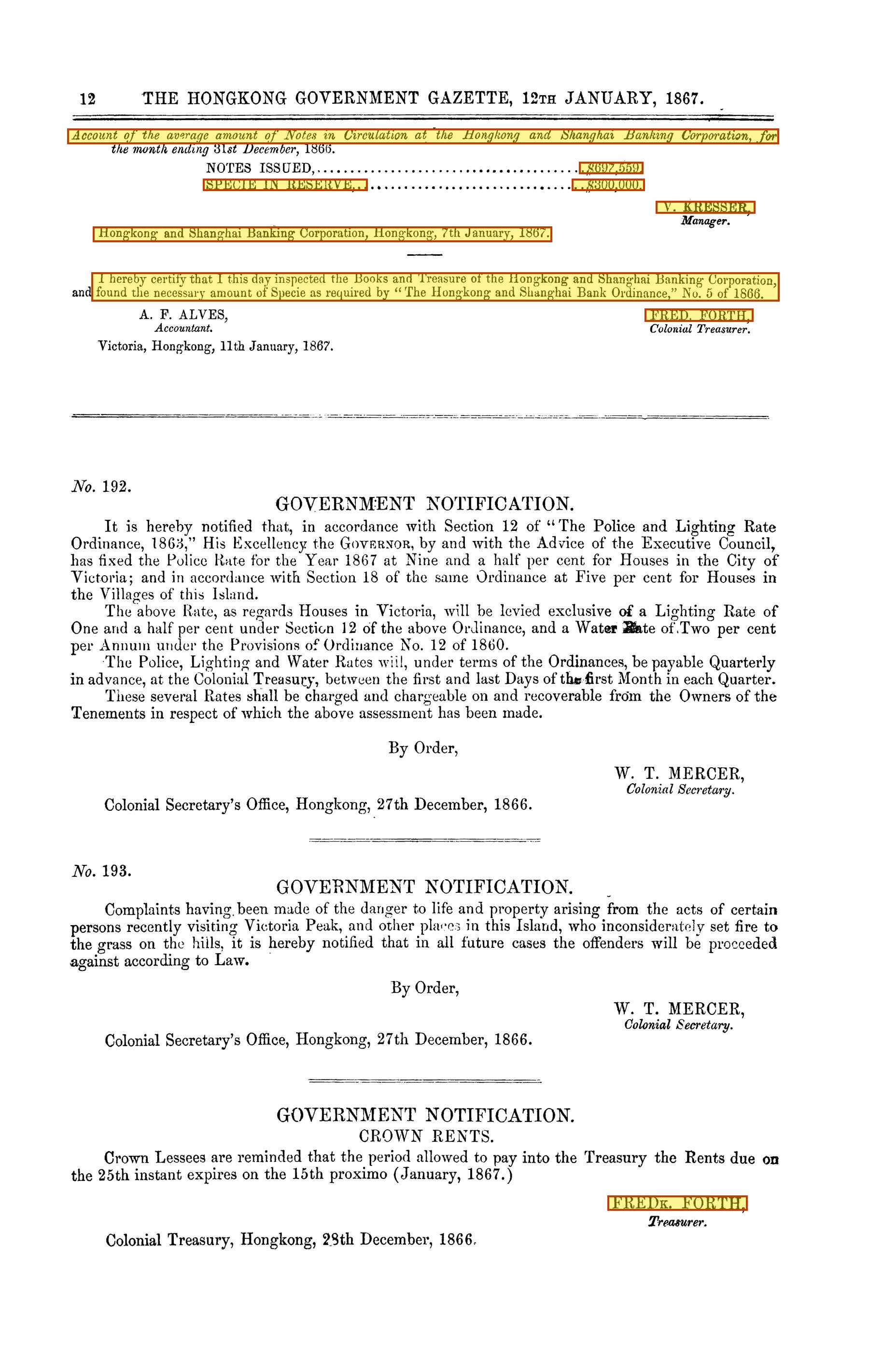
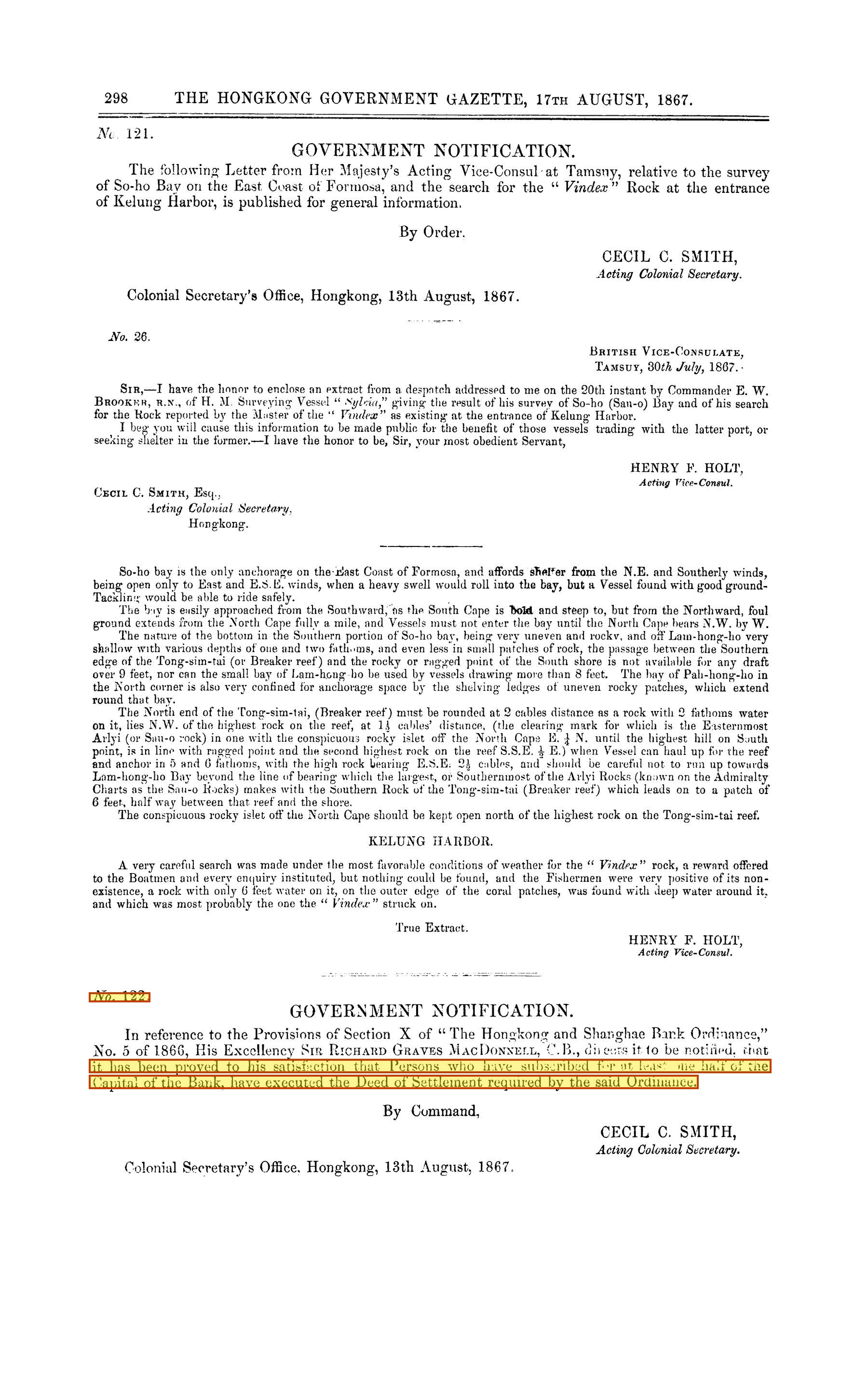
一八六六年十二月三十一日,銀行向政府提交首次法定鈔票流通報告。一八六七年一月十二日《憲報》刊出:「Account of the average amount of Notes in Circulation at the Hongkong and Shanghai Banking Corporation, for the month ending 31st December, 1866」——流通鈔票 $697,559,現金準備 $300,000;經理 V. Kresser 於一月七日簽署,會計 A. F. Alves 核查,財政司(Colonial Treasurer)Fred. Forth 於一月十一日副署,「as required by 'The Hongkong and Shanghai Bank Ordinance,' No. 5 of 1866」。23 這是該行作為法定銀行的第一份公開報告。一八六七年八月十二至十三日,s.X 所要求的信託契約(Deed of Settlement)完成認證。八月十七日《憲報》第 122 號政府公告(G.N. 122)宣佈:「Persons who have subscribed for at least one half of the Capital of the Bank, have executed the Deed of Settlement required by the said Ordinance.」24 藍皮書(Blue Book for 1867)將認證日期定為一八六七年八月十二日,憲報公告則由代理輔政司 Cecil C. Smith 於八月十三日簽署。25 自條例頒布(一八六六年八月十四日)至信託契約認證(一八六七年八月十二日),法定期限僅差兩日即屆滿——銀行在期限內完成法定程序。
七、結論
香港上海滙豐銀行的法定誕生並非發生在繁榮時期,而是與一八六六年香港金融崩潰同步。一八六四年至六五年,它在東方匯兑銀行的擠擁市場中脫穎而出;一八六五年三月招股成功,Victor Kresser 出任經理。17 一八六六年五月,總督以越權為由拒絕首份草案;18 六月,金融體系崩潰,港元按二七折貼現。19 20 八月十四日,立法局通過第 5 號條例,10 將一家已營業逾年的銀行正式合法化。11 一八六六年十二月三十一日的法定鈔票流通報告,23 一八六七年八月的信託契約認證,24 與一八六八年一月超越東方匯銀的發鈔紀錄($1,092,690 對 $570,000),26 共同見證了這家銀行從一家未註冊公司躍升為全港最大發鈔銀行的過程。舊研究將條例編號誤作「No. 1」或「No. 2 of 1866」,本研究以六份獨立文獻確認應為「No. 5 of 1866」,並全面更正。此一案例說明:在殖民地法律框架下,一家銀行的「誕生」日期,既取決於市場需求與商人網絡,也取決於殖民地大臣的越權審查與立法局的最後表決——而這一切,恰在一場將其前輩逐出市場的金融危機中發生。
Independent research · Dual-language paper
The Bank Born in the Crash Year
The Hongkong and Shanghai Banking Corporation, 1864–66: incorporation, crisis, and the first statutory returns
Abstract
In June 1866 Hong Kong’s financial system collapsed within weeks: the Commercial Bank suspended payment, Hong Kong notes traded at a 27 per cent discount, and bullion drained from the port. In the same crisis year, on 14 August 1866, the Legislative Council passed Ordinance No. 5 of 1866, incorporating the Hongkong and Shanghae Banking Company — a bank that had already traded for over a year as an unincorporated firm. This paper reconstructs the full arc from the crowded exchange-banking field of 1864–65, through the founding prospectus of 7 March 1865 (Victor Kresser, Manager), Governor MacDonnell’s ultra-vires refusal of the first bill in May 1866, the crash of June 1866, the statute of 14 August 1866, and the first statutory note return of 31 December 1866, to the Deed of Settlement certified 12–13 August 1867 and the January 1868 bank-note table in which the Corporation ($1,092,690) outissued the Oriental Bank Corporation ($570,000). The bank was born in the crash year: it was not a product of the crisis but a statute legalised in its midst. Based on the CO 129/114 despatch file, the Government Gazette image series, the Legislative Council’s Votes and Proceedings, and the China Mail, this paper corrects the earlier research’s ordinance number (No. 5, not No. 1 or No. 2) and presents the “born in the crash year” framework.
Keywords: Hongkong and Shanghai Banking Corporation; Ordinance No. 5 of 1866; Hong Kong crash 1866; MacDonnell; Victor Kresser; Deed of Settlement; bank-note circulation
1. Introduction
In the 1860s Hong Kong was dominated by the exchange banks — institutions registered in London or Calcutta and financed by the India cotton trade. 15 By 1865 the Oriental Bank Corporation stood at the summit with a Royal Charter and £1,000,000 paid-up capital. 16 Into this world a group of local merchants — John Dent, Thomas Sutherland, Albert Farley Heard, and others — proposed a new bank for the Hong Kong–Shanghai trade, with a capital of $5,000,000. 17 Its legal birth came only on 14 August 1866, in the very week the port’s paper currency collapsed. The story of how it came to that moment, and how it survived it, is the subject of this paper.
2. The crowded field (1864–65)
The press of 3–5 August 1864 carries the bank-ad blocks that mapped the port’s financial world: the Asiatic Bank of India, the Commercial Bank of India, the Central Bank of Western India (“Capital, Two Million Sterling”). 15 These were the Indian-exchange banks, backed by the cotton trade, with balances that dwarfed any local venture. 15 By November 1865 the Oriental Bank Corporation advertised itself as “Incorporated by Royal Charter. Paid-up Capital, £1,000,000,” and the Bank of India and the Trade Bank of Hindustan, China, and Japan competed for the same business. 16 The new local bank was smaller and younger than all of them.
3. The unincorporated company
The founding prospectus appeared in the Daily Press of 7 March 1865: capital “Five Millions of Dollars divided into Forty Thousand Shares of One Hundred and Twenty Five Dollars each”; subscription closed 30 March 1865; Victor Kresser, Manager. 17 This is the earliest confirmed corpus witness to the company; the exact founding-day report of 3 March 1865 is a registered gap (the OCR of the 1864–65 run is rough) and is never asserted. The bank then traded for over a year as an unincorporated firm. The ordinance’s own preamble states that the named persons “have for some time been carrying on the business of Bankers as an un-registered and un-incorporated Company”; MacDonnell’s despatch adds “The above Company has already been established more than a year, and has met with very great success this year, but till now it has never been legally Incorporated.” 11 The bank traded first, incorporated later — an unincorporated company that survived the crash of its seniors.
4. The Governor’s refusal (May 1866)
In May 1866 Governor Sir Richard Graves MacDonnell refused the first bill. In despatch No. 100 to the Earl of Carnarvon of 24 August 1866 (CO 129/114, pp. 333–339), he wrote: “I declined to proceed with the Ordinance as I considered some of its provisions to be in excess of the powers of this Legislature, and an infringement of the Treasury Instructions.” 18 The bill was remodeled. MacDonnell proposed a first charge on the bank’s property for noteholders, but “The Directors, however, on consultation preferred establishing unlimited liability of the Shareholders as to notes — a proposal which I at once accepted.” 18 The s.XXVIII winding-up clause was added at MacDonnell’s insistence; s.XII made shareholders jointly and severally liable for the bank’s notes. These terms, born of a governor’s ultra-vires concern and a directors’ commercial judgment, entered the ordinance as passed.
5. The crash (June 1866)
In June 1866 Hong Kong’s financial system collapsed. The China Mail of 21 June reported: “Commercial Bank has suspended payment”; and “Bank Limited, has suspended payment. (The paid-up capital is £600,000.)” 19 The exchange report of 28 June recorded: “On Hongkong, on demand, 27 per cent discount” — Hong Kong notes traded at 73 cents on the dollar — while “Between two and three million taels have been sent to Hongkong and India in bullion.” 20 The crash pages were re-read in full for the adversarial pass; the Hongkong and Shanghai Banking Corporation is absent from every suspension telegram. The bank was incorporated after the crash began, not before; the headline “born in the crash year” is the correct frame.
6. The statute (14 August 1866)
The Legislative Council read the bill a first time on 25 July 1866 (Votes and Proceedings No. 8 of 1866). 27 On 14 August it was “read a Second time, amended in Committee and passed,—being ‘No. 5 of 1866’” (No. 9 of 1866). 10 The Gazette of 18 August published the full text: “An Ordinance enacted by the Governor of Hongkong, with the Advice of the Legislative Council thereof, for the Incorporation of the Hongkong and Shanghae Banking Company. [14th August, 1866.]” 21 The preamble names the eleven first directors: John Dent, Thomas Sutherland, Albert Farley Heard, George Francis Maclean, Douglas Lapraik, Woldemar Nissen, Arthur Sassoon, George John Helland, Palanjee Franjee, Henry William Wood, and Caleb Tangier Smith. The capital was $5,000,000 in 40,000 shares of $125; the bank could increase it to $10,000,000; notes were not less than $5 bearer; one-third coin/bullion reserve; s.XII imposed double liability on notes; s.XXVIII provided for winding-up. 28 The ordinance number is unanimously No. 5 of 1866 across six independent witnesses (the Gazette text, the LegCo passage record, the despatch, the AG opinion, the first note return, and the Blue Book); the earlier research’s “No. 1” or “No. 2” is withdrawn. The “No. 2 of 1866” in the Historical Laws reprint (id 1844359) is a reprint-series renumbering artefact, recorded as a conflict.
7. The Attorney-General’s opinion
On 29 August 1866 Attorney General Julian Pauncefote advised that the original ordinance was “nearly a transcript of the Asiatic Bank Corporation’s Charter” — too extensive for a Colonial Legislature — but that the ordinance as passed was “not open to the objection of being ‘ultra vires’,” and that “Banking Companies are excluded from the operation of the ‘Companies Ordinance 1865’.” 29 This conditional approval was the linchpin of the statute’s survival: the Governor’s May refusal was answered, and the Colonial Office’s own law officer confirmed the remodeled bill’s validity.
8. The first statutory returns (1867–68)
For the month ending 31 December 1866 the bank filed its first statutory note return: NOTES ISSUED $697,559 / SPECIE IN RESERVE $300,000, certified by V. Kresser, Manager (7 January 1867), inspected by A. F. Alves, Accountant, and countersigned by Fred. Forth, Colonial Treasurer (11 January 1867), “as required by ‘The Hongkong and Shanghai Bank Ordinance,’ No. 5 of 1866.” 23 The Gazette published it on 12 January 1867. On 12–13 August 1867 the Deed of Settlement required by s.X was certified: Government Notification No. 122 (Gazette 17 August 1867) stated that “Persons who have subscribed for at least one half of the Capital of the Bank, have executed the Deed of Settlement required by the said Ordinance.” 24 The Blue Book for 1867 dates the certification 12 August 1867. 30 The statutory two-year subscription deadline (from 14 August 1866) was met with days to spare. By 31 January 1868 the Corporation’s note circulation stood at $1,092,690 against the Oriental Bank Corporation’s $570,000, the Chartered Mercantile Bank’s $384,603, and the Chartered Bank of India, Australia and China’s $327,165 (G.N. 20, Gazette 15 February 1868): less than two years after incorporation, the Corporation was already the port’s largest note issuer. 26
9. The bank in the port (1869)
By July 1869 the bank was holding annual meetings and paying dividends. The China Mail reported the ordinary yearly meeting notice — a meeting “for receiving a Statement of Accounts and Report of the Directors — and for declaring a Dividend” — with the Court of Directors listed as Chairman Geo. F. Heard, Deputy Julius Menke, Geo. J. Helland, Hon. J. B. Taylor; Chief Manager V. Kresser. 31 The dividend rate printed in that issue is subject to an OCR discrepancy (“13 % / $4.60” vs “12½% / $4.50” on the same page, possibly an interleaving with a Hongkong Fire Insurance dividend) and is never cited without an eye-read of the scan. The Court of Directors list itself, however, is clear: within three years of incorporation the bank was a dividend-paying, meeting-holding institution.
10. Conclusion
The Hongkong and Shanghai Banking Corporation was incorporated on 14 August 1866, in the same month the port’s paper currency collapsed. It was not a product of the crash; it was a statute legalised in its midst. The crowded exchange-banking field of 1864–65 15 16 gave way to a new local bank that traded unincorporated for over a year, 11 survived an ultra-vires refusal in May 1866, 18 and was incorporated by Ordinance No. 5 of 1866 after the crash of June. 19 The statute’s terms — the eleven named directors, the $5,000,000 capital, the s.XII double liability on notes, the s.XXVIII winding-up clause — were the product of a governor’s concern and a directors’ commercial judgment. 32 The first statutory note return ($697,559 notes / $300,000 specie), 23 the Deed of Settlement certified within the statutory deadline, 24 and the January 1868 table showing the Corporation outissuing every rival 26 together document the bank’s rise from an unregistered firm to the port’s largest note issuer. The “born in the crash year” framing is the paper’s contribution: the bank’s legal birth is inseparable from the crisis that engulfed its predecessors, and its survival is the record’s own evidence.
Appendix A — Method and corpus inventory
| Item | What | Where |
|---|---|---|
| Method | Direct execution per AGENTS.md §§1–2; the register (§3) written before the post. | research_hsbc_1864_66.md |
| Conjunct sweep | “Hongkong and Shanghai Bank” + date-key sweeps; “Hongkong and Shanghae Banking” (period spelling). | hkintexts_pages |
| Dumpdoc ×1 | CO 129/114 (31,644 lines) — the MacDonnell despatch file; ordinance at 6136–6258; despatch ~14060–14200; AG opinion 266448. | dumpdoc.py |
| Image-index sweep | match_phrase on all_text only (sort/filters 400) — img-1451065, img-1451255, img-1451528, img-1451709. | hkintexts_image_pages |
| Chinese battery | 匯豐/滙豐 earliest date-keyed 1947; 18xx = 0; period Chinese form unattested (rule-9, Appendix B of notes). | hkintexts_pages |
| Negative controls | HSBC absent from suspension lists; the founding-day report of 3 March 1865 unconfirmed; Telegraph series 0 hits. | hkintexts_pages |
| Eye-read | All four document plates read back at final crops (§6B gate, 19 October 2026). | images/ |
| Adversarial pass | 6 attempts documented in the notes §3 (ord number; incorporation before crash; Deed deadline; minor issuer; Pauncefote objection; HSBC in suspension list). | research_hsbc_1864_66.md §3 |
Single-page pulls: 1679448, 1881205, 1881204, 1678374, 1678778, 1677839, 266448, 656398, 2219096, 1884017, 1884025, 1887279. Citations carry the public viewer links only (hard rule 8).
Appendix B — Evidence register (condensed)
| Status | Claim | Handling |
|---|---|---|
| Confirmed | Incorporation by Ordinance No. 5 of 1866, passed 14 Aug, gazetted 18 Aug 1866. | 6 independent witnesses: Gazette text; LegCo passage; despatch; AG opinion; first note return; Blue Book. |
| Confirmed | The bank traded unincorporated for over a year before 14 Aug 1866. | Ordinance preamble; despatch (“established more than a year… never been legally Incorporated”). |
| Confirmed | MacDonnell refused the first bill (12 May 1866) as ultra vires / against Treasury Instructions; the bill was remodeled; s.XXVIII and s.XII added. | Despatch narrative; AG opinion. |
| Confirmed | First statutory note return: $697,559 notes / $300,000 specie, month ending 31 Dec 1866. | Gazette (image twin); Blue Book 1867. |
| Confirmed | Deed of Settlement certified 12–13 Aug 1867 (s.X requirement met). | G.N. 122 (image twin); Blue Book 1867. |
| Confirmed | By Jan 1868 the Corporation was the port’s largest note issuer ($1,092,690 / $500,000). | G.N. 20 (image twin). |
| Confirmed | June 1866 suspensions and the 27-per-cent discount. | China Mail crash page; exchange report. |
| Single-witness | 7 March 1865 prospectus and 30 March subscription close; July 1869 AGM notice; the £600,000 suspended bank. | S1–S3 — never presented as double-witness; the £600,000 bank never named. |
| Conflict (kept) | Ordinance number: “No. 2” in the Historical Laws reprint vs No. 5 in six witnesses; capital figures $5M vs “remaining $2,000,000 not yet paid up”; 1869 dividend rate OCR discrepancy. | K1–K3 — printed with both witnesses; never silently resolved; the dividend rate never cited without eye-read. |
| Do-not | No “No. 1” or “No. 2 of 1866”; no naming the £600,000 bank; no 1869 dividend rate without scan; no 3 March 1865 founding-day report; no period Chinese name; no “first bank in Hong Kong”; no HSBC in suspension list. | Failed-verification list — every item kept out of the body as fact. |
| Gap | Founding-day report of 3 March 1865; early ledgers/balance sheet; the establishment proclamation of 15 Dec 1866 (gazetted 1 Jan 1867); the full 1866 casualty list (Agra & Masterman etc.). | G1–G4 — registered as gaps, never filled by assertion. |
Stage-7 adversarial pass (19 October 2026), six attempts. (A1) “HSBC never appears in a suspension list” — the crash pages (ids 1884017, 1884025, 1884050) were re-read in full; the Corporation is absent from every suspension telegram; SURVIVES. (A2) “The ordinance number is No. 2” — the Historical Laws reprint (id 1844359) carries a “No. 2 of 1866” header (a renumbering artefact); six independent witnesses say No. 5; the scan wins; the renumbering is recorded as a conflict, not a finding. (A3) “The bank was incorporated before the crash” — FALSE (crash June; statute 14 Aug); the headline “born in the crash year” is correct. (A4) “The Deed deadline was missed” — FALSE (certified 12–13 Aug 1867; the ordinance is dated 14 Aug 1866); the deadline was met. (A5) “The Corporation was a minor issuer in 1868” — FALSE (G.N. 20: $1,092,690 vs the Oriental’s $570,000). (A6) “Pauncefote objected to the ordinance” — FALSE (conditional approval after remodelling).
Notes
- The China Mail, 21 June 1866, p. 2 (the crash: “Commercial Bank has suspended payment”; “Bank Limited, has suspended payment. (The paid-up capital is £600,000.)”). https://hkintexts.histsyn.com/page/1884017 (accessed 19 October 2026). ↩
- The exchange report, 28 June 1866, p. 4 (“On Hongkong, on demand, 27 per cent discount”; the bullion flight). https://hkintexts.histsyn.com/page/1884025 (accessed 19 October 2026). ↩
- Ordinance No. 5 of 1866, “An Ordinance enacted by the Governor of Hongkong, with the Advice of the Legislative Council thereof, for the Incorporation of the Hongkong and Shanghae Banking Company,” Gazette, 18 August 1866, printed p. 320. https://hkintexts.histsyn.com/image-page/1451065 (accessed 19 October 2026). ↩
- Votes and Proceedings of the Legislative Council of Hongkong, No. 9 of 1866, 14 August 1866 (“read a Second time, amended in Committee and passed,—being ‘No. 5 of 1866’”). https://hkintexts.histsyn.com/page/1881205 (accessed 19 October 2026). ↩
- Hongkong and Shanghai Banking Corporation, Ordinance No. 5 of 1866, Gazette, 18 August 1866, printed p. 320, preamble; MacDonnell despatch No. 100, 24 August 1866, CO 129/114, pp. 333–339. https://hkintexts.histsyn.com/image-page/1451065 (accessed 19 October 2026). ↩
- The Daily Press, 7 March 1865 (the founding prospectus: the capital “Five Millions of Dollars divided into Forty Thousand Shares of One Hundred and Twenty Five Dollars each”; subscription closed 30 March 1865; Victor Kresser Manager). https://hkintexts.histsyn.com/page/2219096 (accessed 19 October 2026). ↩
- The press, 3–5 August 1864, p. 1 (the bank-ad blocks: the Asiatic Bank of India; the Commercial Bank of India; the Central Bank of Western India, “Capital, Two Million Sterling”). https://hkintexts.histsyn.com/page/2218386 (accessed 19 October 2026). ↩
- The press, 18 November and 7 December 1865 (the Oriental Bank Corporation’s “Paid-up Capital, £1,000,000”; the Bank of India; the Trade Bank of Hindustan, China, and Japan). https://hkintexts.histsyn.com/page/2219958 (accessed 19 October 2026). ↩
- Sir Richard Graves MacDonnell, despatch No. 100 to the Earl of Carnarvon, 24 August 1866, CO 129/114, pp. 333–339 (the ultra-vires refusal of 12 May 1866; the remodelling; “established more than a year… never been legally Incorporated”; the s.XII unlimited-liability settlement). https://hkintexts.histsyn.com/page/266445 (accessed 19 October 2026). ↩
- Votes and Proceedings of the Legislative Council, No. 9 of 1866, 14 August 1866. https://hkintexts.histsyn.com/page/1881205 (accessed 19 October 2026). ↩
- Ordinance No. 5 of 1866, preamble; MacDonnell despatch No. 100, 24 August 1866. ↩
- Government Notification, “Account of the average amount of Notes in Circulation at the Hongkong and Shanghai Banking Corporation, for the month ending 31st December, 1866”—NOTES ISSUED $697,559 / SPECIE IN RESERVE $300,000; V. Kresser, Manager; A. F. Alves, Accountant; Fred. Forth, Colonial Treasurer—Gazette, 12 January 1867, printed p. 12. https://hkintexts.histsyn.com/image-page/1451255 (accessed 19 October 2026). ↩
- Government Notification No. 122 (Deed of Settlement certified under s.X of Ordinance No. 5 of 1866), Gazette, 17 August 1867, printed p. 298 (certified 12–13 August 1867). https://hkintexts.histsyn.com/image-page/1451528 (accessed 19 October 2026). ↩
- Government Notification No. 20, bank-note circulation table for the month ending 31 January 1868 (the Corporation $1,092,690 / $500,000—the port’s largest note issuer), Gazette, 15 February 1868, printed p. 39. https://hkintexts.histsyn.com/image-page/1451709 (accessed 19 October 2026). ↩
- The press, 3–5 August 1864, p. 1. ↩
- The press, 18 November and 7 December 1865. ↩
- The Daily Press, 7 March 1865, the founding prospectus. https://hkintexts.histsyn.com/page/2219096 (accessed 19 October 2026). ↩
- MacDonnell despatch No. 100, 24 August 1866, CO 129/114, pp. 333–339. ↩
- The China Mail, 21 June 1866, p. 2. ↩
- The exchange report, 28 June 1866, p. 4. https://hkintexts.histsyn.com/page/1884025 (accessed 19 October 2026). ↩
- Ordinance No. 5 of 1866, Gazette, 18 August 1866, printed p. 320. https://hkintexts.histsyn.com/image-page/1451065 (accessed 19 October 2026). ↩
- Julian Pauncefote, Attorney General, opinion on Ordinance No. 5 of 1866, 29 August 1866, CO 129/114, pp. 341–342 (“not open to the objection of being ‘ultra vires’”; “Banking Companies are excluded from the operation of the ‘Companies Ordinance 1865’”). https://hkintexts.histsyn.com/page/266448 (accessed 19 October 2026). ↩
- Government Notification, average Notes in Circulation, Hongkong and Shanghai Banking Corporation, month ending 31 December 1866, Gazette, 12 January 1867, printed p. 12. ↩
- Government Notification No. 122, Gazette, 17 August 1867, printed p. 298. ↩
- Blue Book for 1867, legislation table (Ordinance No. 5 of 1866; the Deed certified 12 August 1867). https://hkintexts.histsyn.com/page/656398 (accessed 19 October 2026). ↩
- Government Notification No. 20, Gazette, 15 February 1868, printed p. 39. ↩
- Votes and Proceedings of the Legislative Council of Hongkong, No. 8 of 1866, 25 July 1866 (first reading of the incorporation bill). https://hkintexts.histsyn.com/page/1881204 (accessed 19 October 2026). ↩
- Ordinance No. 5 of 1866, the Gazette text, preamble and ss.I–XIII (the eleven named first directors; the twenty-one-year term; the $5,000,000 capital in 40,000 shares of $125; the notes provisions; s.X Deed of Settlement; s.XII double liability on notes; s.XXVIII winding-up). https://hkintexts.histsyn.com/page/1679448 (accessed 19 October 2026). ↩
- Julian Pauncefote, Attorney General, opinion on Ordinance No. 5 of 1866, 29 August 1866, CO 129/114, pp. 341–342. https://hkintexts.histsyn.com/page/266448 (accessed 19 October 2026). ↩
- Blue Book for 1867, legislation table. https://hkintexts.histsyn.com/page/656398 (accessed 19 October 2026). ↩
- The China Mail, 24 July 1869 (the ordinary yearly meeting notice; Court of Directors: Chairman Geo. F. Heard, Deputy Julius Menke, Geo. J. Helland, Hon. J. B. Taylor; Chief Manager V. Kresser). https://hkintexts.histsyn.com/page/1887279 (accessed 19 October 2026). ↩
- Ordinance No. 5 of 1866, Gazette text, preamble and ss.I–XIII. https://hkintexts.histsyn.com/page/1679448 (accessed 19 October 2026). ↩
Bibliography
The notes above (CMOS 17th endnotes) carry full citations with public viewer links; they function as the paper’s notes-bibliography. The principal primary sources, in order of first appearance, are:
- Ordinance No. 5 of 1866, Gazette, 18 August 1866, printed p. 320 (image twin img-1451065). https://hkintexts.histsyn.com/image-page/1451065.
- Sir Richard Graves MacDonnell, despatch No. 100 to the Earl of Carnarvon, 24 August 1866, CO 129/114, pp. 333–339. https://hkintexts.histsyn.com/page/266445.
- The press, 3–5 August 1864, p. 1 (the bank-ad blocks). https://hkintexts.histsyn.com/page/2218386.
- The press, 18 November and 7 December 1865 (the Oriental Bank Corporation’s £1,000,000). https://hkintexts.histsyn.com/page/2219958.
- The Daily Press, 7 March 1865 (the founding prospectus). https://hkintexts.histsyn.com/page/2219096.
- The China Mail, 21 June 1866, p. 2 (the crash). https://hkintexts.histsyn.com/page/1884017.
- The exchange report, 28 June 1866, p. 4 (the 27-per-cent discount). https://hkintexts.histsyn.com/page/1884025.
- Votes and Proceedings of the Legislative Council of Hongkong, No. 8 of 1866, 25 July 1866 (first reading). https://hkintexts.histsyn.com/page/1881204.
- Votes and Proceedings of the Legislative Council of Hongkong, No. 9 of 1866, 14 August 1866 (passage, “No. 5 of 1866”). https://hkintexts.histsyn.com/page/1881205.
- Ordinance No. 5 of 1866, the Gazette text (preamble, ss.I–XIII). https://hkintexts.histsyn.com/page/1679448.
- Julian Pauncefote, Attorney General, opinion on Ordinance No. 5 of 1866, 29 August 1866, CO 129/114, pp. 341–342. https://hkintexts.histsyn.com/page/266448.
- Government Notification, average Notes in Circulation, Hongkong and Shanghai Banking Corporation, month ending 31 December 1866, Gazette, 12 January 1867, printed p. 12 (image twin img-1451255). https://hkintexts.histsyn.com/image-page/1451255.
- Government Notification No. 122 (Deed of Settlement certified under s.X of Ordinance No. 5 of 1866), Gazette, 17 August 1867, printed p. 298 (image twin img-1451528). https://hkintexts.histsyn.com/image-page/1451528.
- Blue Book for 1867, legislation table (Ordinance No. 5 of 1866; the Deed certified 12 August 1867). https://hkintexts.histsyn.com/page/656398.
- Government Notification No. 20, bank-note circulation table, Gazette, 15 February 1868, printed p. 39 (image twin img-1451709). https://hkintexts.histsyn.com/image-page/1451709.
- The China Mail, 24 July 1869 (the ordinary yearly meeting notice; Court of Directors). https://hkintexts.histsyn.com/page/1887279.
All links accessed 19 October 2026. The corpus is the hkintexts research index (read-only); every citation carries the public viewer link (rule 8). The dual-language structure (Chinese research section first, then the English paper) follows hard rule 7.