起一座天文台:由 Police Hulk 之炮,到紅桶紅球與 Ley 定律——香港天文台誕生史,1874–1897
起一座天文台:由黑桶到風球——香港天文台創立史,1874–1897
摘要
香港天文台之創立,並非始於1884年風球訊號,而是一條更長的鏈:1874年風災之死難、船政廳1878年黑色圓桶、殖民地部檔案中反覆擱置之提案、1882年 Astronomer Royal 對 Price 簡化方案之裁決,以及1884年8月11日四形四向之正式通告。本文運用殖民地部檔案(CO 129系列)、政府憲報、定例局文件與報紙,重建此鏈之每一環,並以對抗性檢索排除「1884年為最早風球」之常見誤解——1878年之黑桶通知早六年。1
一、問題與方法
香港風球之起源,通說置於1884年。然語料庫顯示,1878年5月30日船政廳已發出颱風通告,明文規定升起黑色圓桶、鳴炮示警——形狀與方向皆無,科學根據亦無。2 1884年之進步,在於四個形狀、四個方向、一套與觀測網連動之系統。
研究方法以檔案為先:殖民地部香港檔案(CO 129)之提案、批覆與人事記錄;政府憲報之通告與天氣報告;定例局文件之台長年報;以及《德臣西報》《士蔑新聞》之當日報導。每一引文均經文件編號重新驗證;中央文件——1885–86年定例局文件第17號——已全文拉取(249頁)。3
二、1874年之死與1878年之黑桶
1874年9月之颱風,為天文台之遠因。軒尼詩總督1880年於定例局答辯:「我到任時查明,1874年颱風有四五千華人在艇上溺斃;我又查閱文件,知道華人紳商曾經聯署要求政府有所作為。」4
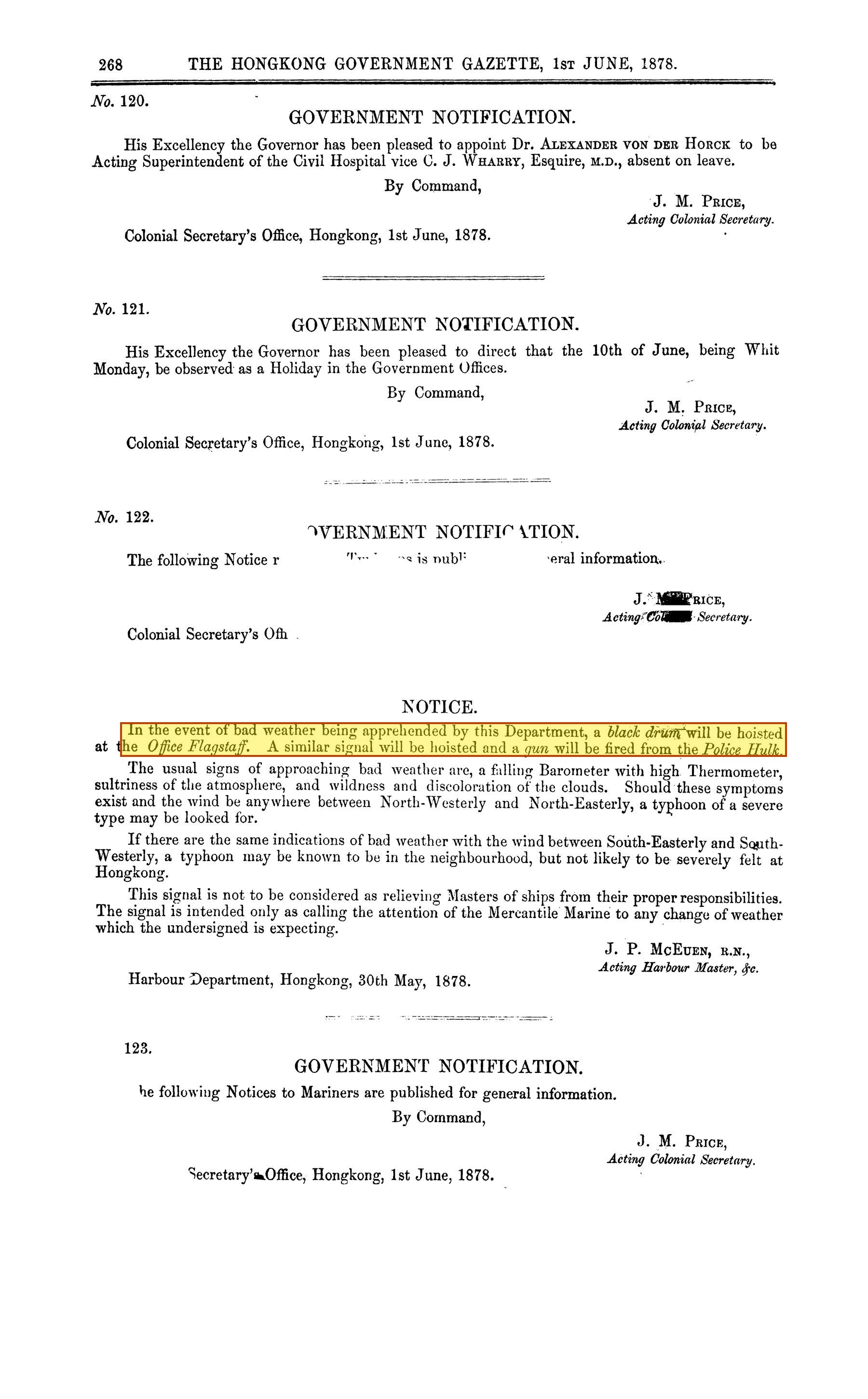
天文台之前身,並非科學建制,而是船政廳之黑桶。1878年5月30日憲報通告:「本廳預料天氣轉壞時,辦事處旗杆會升起一個黑色圓桶;Police Hulk 亦會升起同樣訊號,並鳴炮一響。」1879年9月,報紙已記錄此套系統運作:「颱風訊號在船政廳辦事處升起,Police Hulk 鳴炮警告,所有艇戶舢舨即刻移往安全地方。」5
三、提案、裁決與命名,1879–1883
1879年,殖民地部檔案已現「香港新天文台編制」提案,附有5,000元報時球撥款之批註:「我們要求彼等提交報告,終不可得。」6 1881年,軒尼詩開價:天文台、地磁台、儀器、報時球,估計30,000元。7
1882年,Astronomer Royal 親自裁決 Price 之簡化方案:「我認為 Price 先生提出的較小、較簡單方案已足夠應付目前需要——殖民地迫切需要的,看來是一個報時球與一個氣象服務。」8 同年,名稱定為「香港天文台」。9
1883年1月,財政委員會揭露:1882年表決之20,000元,只用了1,179元——「毫不猶豫」建議重撥18,680元。10
四、人事與基地,1883
台長任命為 William Doberck,副台長 Frederick George Figg;前者由1883年3月2日起,後者由6月6日起。11 人事之訓練,殖民地部安排 Doberck 先赴格林尼基與邱天文台見習,「然後再赴殖民地」。12
天文台被創立了兩次:一次在九龍 Elgin 山上用磚建造,一次在中國沿海以協議構築。1883年,殖民地部批准 Doberck「在天文台建成期間,走訪各個觀測站談判此一計劃」——「Doberck 博士此刻很可能已在執行此一任務的巡航途中」。13 選址為 Elgin 山。14
五、四形四向:1884年8月11日通告
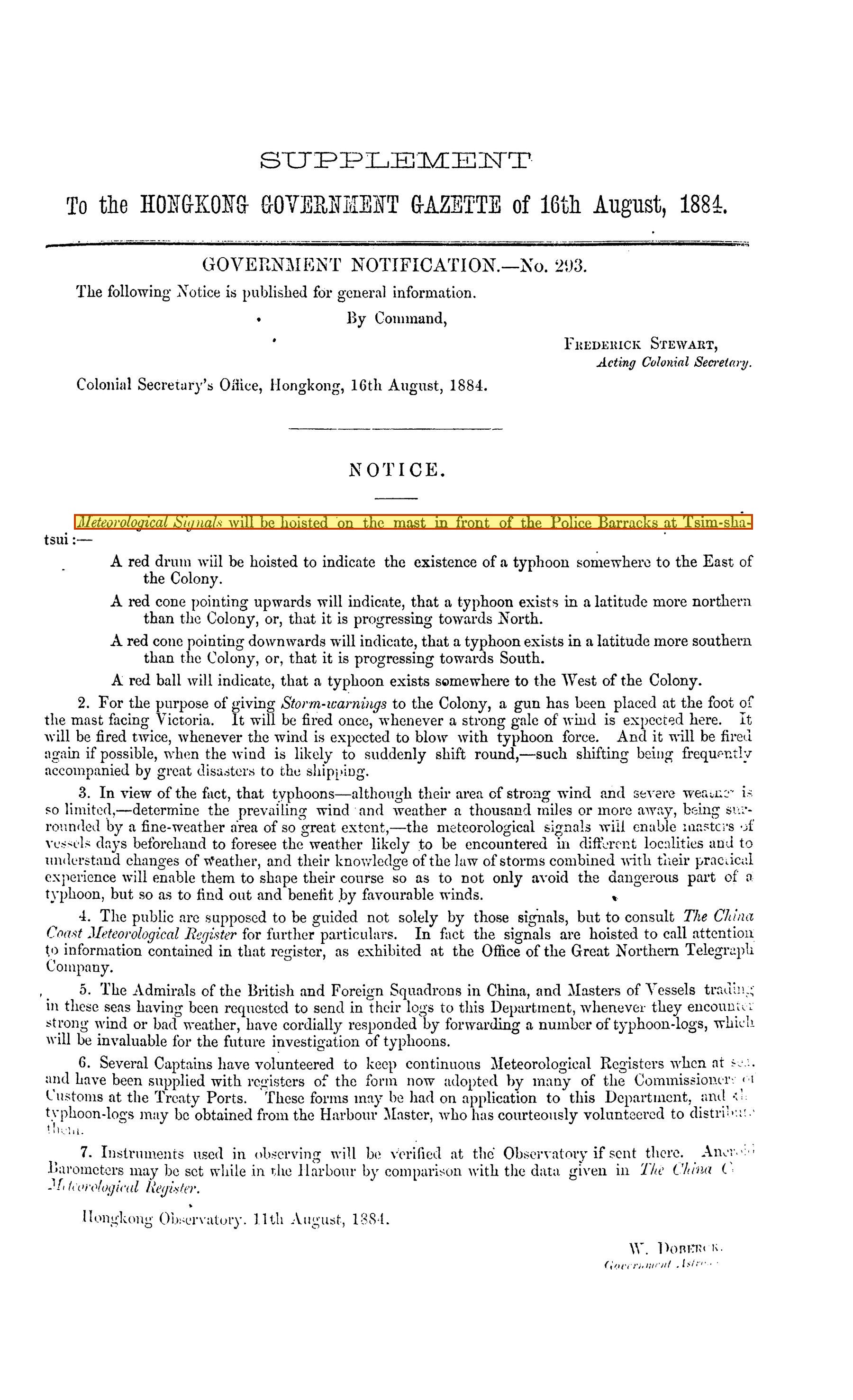
1884年8月11日,天文台發出屬於自己的訊號通告(8月16日刊憲,第293號政府通告):「天文台氣象訊號將於尖沙嘴差館對面的訊號杆懸掛:紅色圓桶——颱風在本殖民地以東某處;紅色尖錐向上——颱風在較北緯度,或正向北移動;紅色尖錐向下——颱風在較南緯度,或正向南移動;紅色圓球——颱風在本殖民地以西某處。」15 通告另有颱風炮與科學根據:「氣象訊號可令船長提前數日預見不同地方的天氣……他們對風暴定律的認識配合實際經驗,可令他們揀一條不僅避開颱風危險部分、更能獲得順風之利的航線。」16
六、第一季:紅桶、紅球與橫過
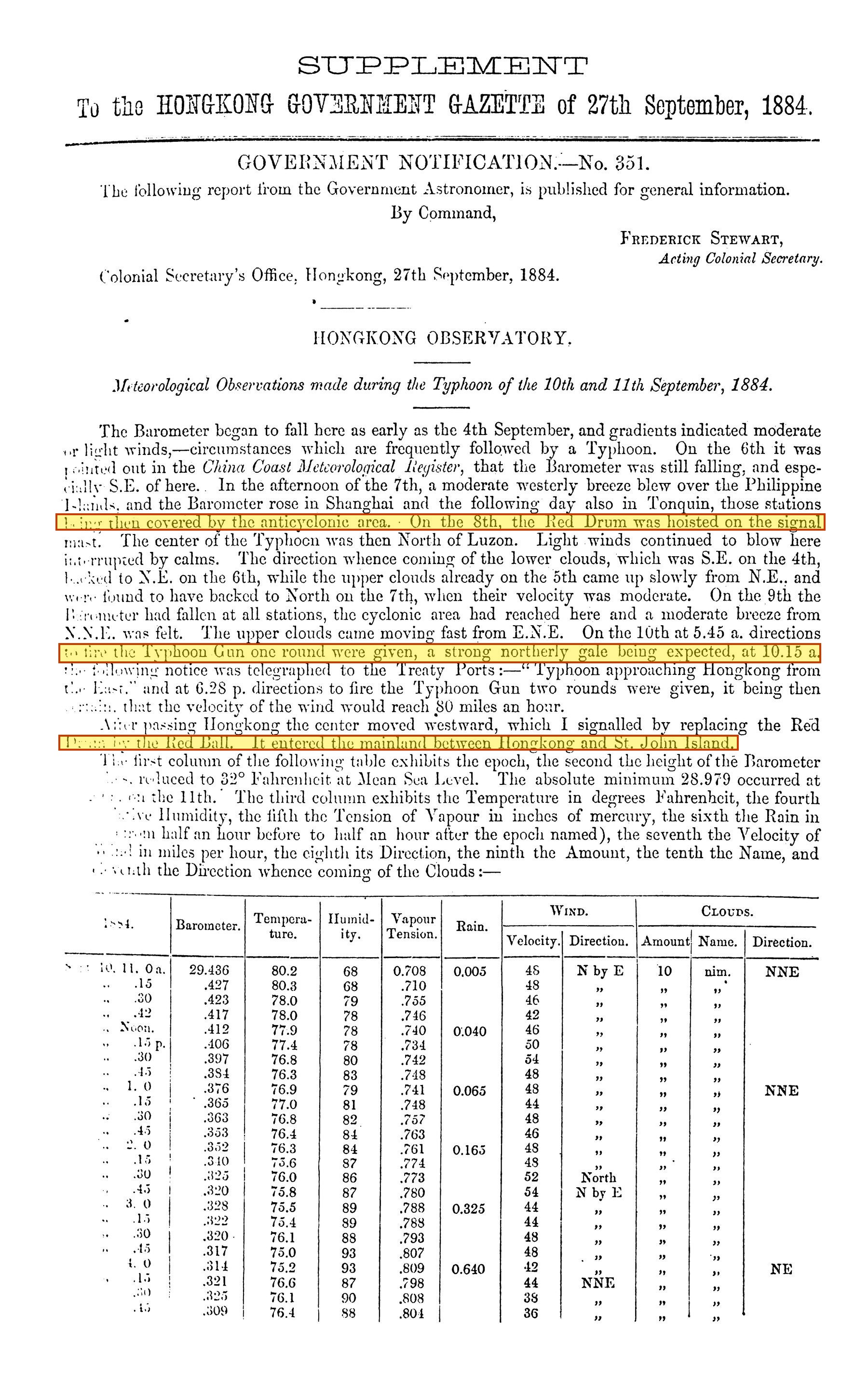
通告之後十日,炮已開了。1884年8月21–22日,颱風炮鳴炮一響。17 9月8日,訊號杆出現第一個有記錄的形狀:「8日,紅色圓桶在訊號杆升起。當時颱風中心在呂宋以北。」18
9月10日清晨5點45分,鳴炮一響;下午6點28分,鳴炮兩響——「風速將會達到每小時80英里」已可肯定。11日風暴橫過;中心過香港之後向西移動,「即刻用紅球換掉紅桶」標示西移。氣壓跌至28.979英寸。《德臣西報》當日報導與官方時間有半分鐘出入(報紙寫6點20分),但大事件一致:「強烈颱風今晨橫過香港。」19
七、報時、科學與人事之壓
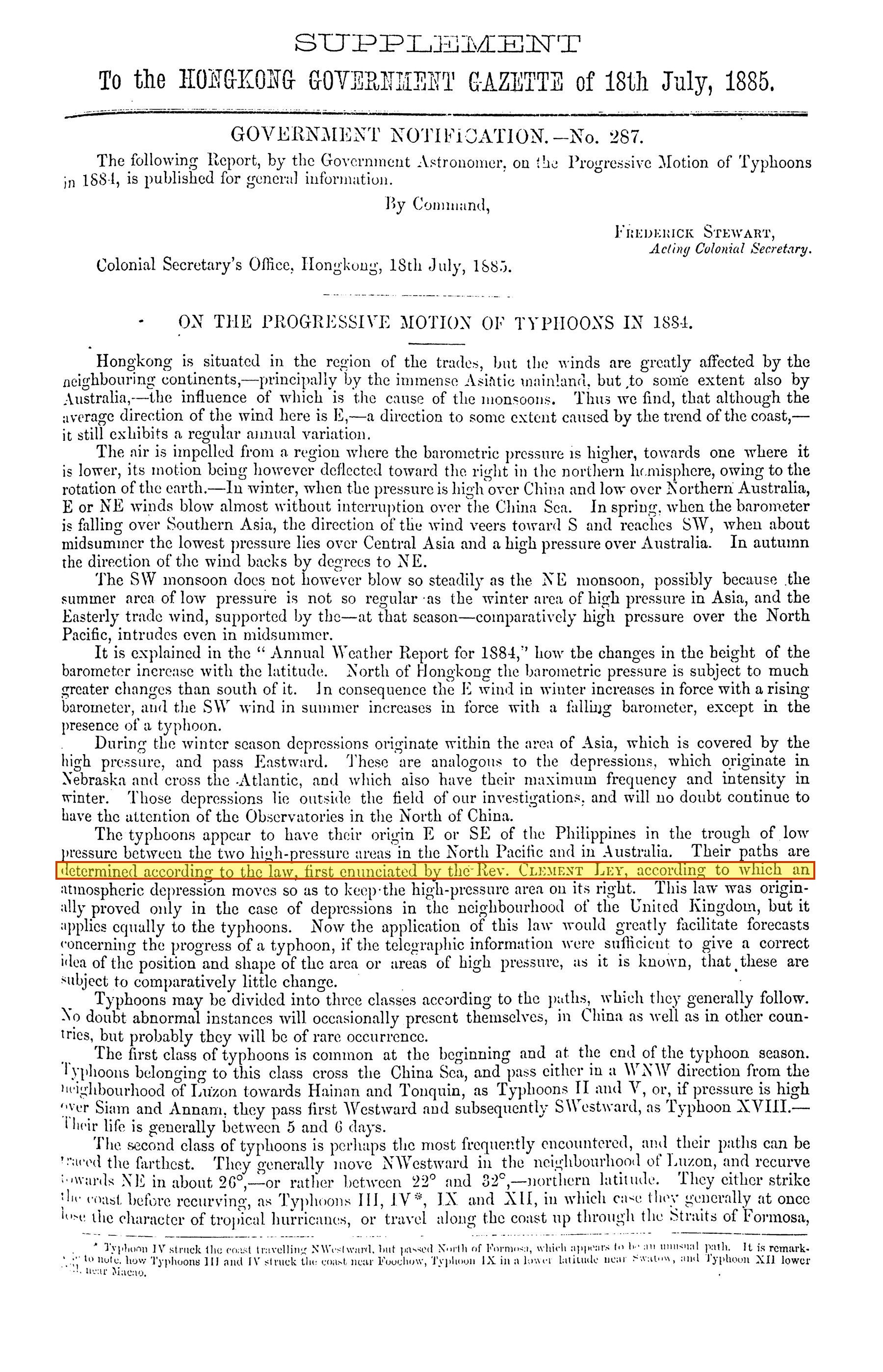
1885年1月1日,報時服務開始:「報時服務由1885年1月1日開始。」20 同年7月,Doberck 之颱風行進研究刊憲,將 Clement Ley 牧師首先提出之定律應用於颱風:「大氣低壓移動時,高壓區保持在其右方……此定律原本只在英格蘭附近的低壓得到證明,但同樣適用於颱風。」21
人事問題未解。1886年3月9日,Doberck 發出最後通牒:不加人,便停工——「如果尊貴的閣下不批准擴編,1883年下令擴展的工作——中國沿海氣象紀錄、氣象訊號等——應在本月底停止。」22
八、檢討、內訌與餘響
1893年,政府成立檢討委員會,Doberck 任主席;殖民地秘書明文限定範圍:「委員會的調查範圍嚴格限於氣象報告及天氣預報的發布系統——並不延伸到天文台獲取氣象結果的方法。」23 1897年,Doberck 與 Plummer 之間爆發內訌,殖民地部檔案記錄:Plummer「將颱風報告當作自己的成果呈交,而那些是 Figg 先生的勞動」。24
1932年,非本地風暴訊號密碼正式刊憲:十個符號,「在香港、上海與沿海港口展示」。25 黑桶之直系後裔,至此已成一套跨港共享之科學系統。
結論
天文台之創立,是一條由死難、黑桶、提案、裁決、人事與第一季風暴組成的鏈。1884年8月11日之通告,是鏈上最亮的一環,但並非起點——1878年船政廳之黑桶早六年。天文台被創立了兩次:一次在 Elgin 山上用磚建造,一次在中國沿海以協議構築,而後者早於前者完工。風球訊號之誕生史,因此不是一個日期,而是一場由災難驅動、經檔案反覆推遲、最終由一位天文學家在山頂與沿海之間建立的工程。3
Research article
The Observatory Built
The founding of the Hong Kong Observatory, 1874–1897: the drum before the signals
Abstract
The colony’s warning system was not born in 1884 — it was promoted in 1884. The Harbour Master had hoisted a black drum at the Office Flagstaff and fired a gun from the Police Hulk since 1878, one shape for all weather, on the Acting Harbour Master’s own reading of his barometer; the Observatory’s Notice of 11 August 1884 replaced it with four shapes for four directions — a red drum (East), a red cone point-up (North), a red cone point-down (South), a red ball (West) — at the mast before the Tsim-sha-tsui police barracks, with a gun code of its own (one round for a gale, two for typhoon force, again for a sudden shift). The paper follows the institution from the disaster that motivated it (the 1874 typhoon, “four or five thousand of the Chinese… drowned in their boats”) through the paperwork that delayed it (the 1879 proposal asked for a report “but asked in vain”; the $20,000 vote of 1882 of which $1,179 had been spent by January 1883), the imperial choice that defined it (the Astronomer Royal’s verdict for Mr. Price’s “smaller and simpler scheme”: the colony’s “pressing needs… a time ball and a Meteorological service”), and the first Director selected into the machine — Dr. William Doberck, attached to the Observatories at Greenwich & Kew before the Colony, then “probably… cruising around” the China coast “while the Observatory is being completed”, negotiating the network before the building stood. The first season is documented end to end: the gun’s first recorded firing (21–22 August 1884), the Red Drum hoisted on 8 September, the typhoon that crossed the colony on 10–11 September with the gun at two rounds and the Red Drum replaced by the Red Ball as the centre passed — and the press’s complaint that it had received “not a line… about the weather”. The science is read in the Director’s own words: the typhoon memoir of July 1885 applying Clement Ley’s law to typhoons, the 1884 storms numbered to XVIII, the drift velocities measured from Luzon to the Sea of Japan; the network that fed it — Imperial Maritime Customs stations with instruments verified in Hong Kong, the Jesuit Fathers’ telegrams from Manila, Bolinao by courtesy of the cable company. The time service “began on the 1st January 1885”; the institution was strained from inside (the salary row — “a Dane, formerly employed in a Private Observatory in Ireland”; the ultimatum that without a second Chinese clerk “the China Coast Register, Meteorological Signals, &c. should cease”), reviewed in 1893 by a committee its own Director chaired, and fought over in 1897 in a feud whose core charge was the theft of the first assistant’s labour — Figg, in the Observatory since 6 June 1883. The signals outlived everyone: the 1932 Non-Local Storm Signal Code, ten symbols strong, shared with Shanghai and the coast ports, was the 1884 drum-and-ball’s descendant.
Keywords: Hong Kong; Observatory; Dr. William Doberck; Figg; Greenwich; Kew; Mount Elgin; time ball; typhoon signals; typhoon gun; Red Drum; Clement Ley; China Coast Meteorological Register; 1874; 1878; 1884; 1897; 1932
1. Introduction: the drum before the signals
Science in a colony arrives as paperwork before it arrives as instruments — but its folklore arrives first of all. The Hong Kong Observatory’s founding record has long been told as a birth in 1883–84: a Director appointed, a building raised, and the typhoon signals invented. The documentary record tells a more layered story. The signals the Observatory gazetted in August 1884 were not the colony’s first warning shapes; they were its second system — the promotion of a cruder one the Harbour Master had run since 1878. What was new in 1884 was not the hoisting but the direction: four shapes pointing to where the typhoon stood relative to the colony, backed by a coast-wide network of observations, a telegraphed register, and a law of storms. That system — its pre-history, its slow construction, its first season in action, its science, and the small institution’s wars — is this paper’s subject.3
2. The pre-history: the dead of 1874 and the Harbour Master’s drum, 1878–79
The project’s motive is dated and counted by the Governor who campaigned for it. Hennessy, defending his public-works programme before the Legislative Council in 1880, reached back to his arrival: “I ascertained on my arrival that four or five thousand of the Chinese were drowned in their boats in the typhoon of 1874, and I also found, on calling for the papers, that the leading Chinese gentlemen had memorialised the government for something to be done in the way of a breakwater.”26 In the same speech he listed the works that money and the Praya had crowded out in 1879 — and the Observatory building stood among them.27
Before the Observatory there was, however, already a warning machinery — and this paper’s adversarial pass found it. Sweeping the pre-1884 strata for signal systems returned a notice the standard story forgets: the Harbour Department’s notice of 30 May 1878, gazetted 1 June — “In the event of bad weather being apprehended by this Department, a black drum will be hoisted at the Office Flagstaff. A similar signal will be hoisted and a gun will be fired from the Police Hulk.” Its meteorology was the Acting Harbour Master’s own: “a falling Barometer with high Thermometer, sultriness of the atmosphere, and wildness and discoloration of the clouds”; its disclaimer modest — the signal was “intended only as calling the attention of the Mercantile Marine to any change of weather which the undersigned is expecting.”28 The machinery worked: in September 1879 the China Mail recorded the drum hoisted at the Harbour Master’s office, the gun fired from the Police Hulk, and the harbour’s boats moving “in a body to places of comparative safety”.29 One shape, no direction, one officer’s judgment — but a warning system, six years before the Observatory’s Notice.
3. The project on paper, 1879–1883
The Observatory itself begins as an unanswered request. The 1879 docket records the despatch on the “New Observatory Establishment at Hong Kong” — a “Meteorological Observatory” whose advantages the Governor “points out” — alongside a $5,000 Time Ball vote in the Estimates; the Colonial Office’s minute on the time ball is bone-dry: “We have asked for a report on the subject but asked in vain.”30 In 1881 Hennessy put a number to the whole ambition — the astronomical and magnetic observatories, the instruments freighted from England, the Time Ball — “approximately at $30,000”.31
In 1882 the project met its defining choice. Two schemes were on the table, Major Palmer’s and the Surveyor General Mr. Price’s, and the Secretary of State asked for observations “on the respective proposals of Major Palmer & Mr. Price, now that they are both before you”.32 The answer came from Greenwich: the Astronomer Royal himself, writing in July 1882, chose the cheaper one — “the smaller and simpler scheme put forward by Mr. Price will suffice for present requirements, remarking that the pressing needs of the Colony appear to be a time ball and a Meteorological service.” The colony’s sky, in the imperial institution’s judgment, needed a service station, not a science palace.33 The name was fixed in the same volume of minutes: “it would be desirable to divert The new observatory ‘The Hong Kong Observatory’.”34
Then came the money, and the money’s slowness. The Finance Committee’s minute of 2 January 1883 survives in full: of the $20,000 voted for 1882, only $1,179 had been expended; no provision existed in the 1883 Estimates; the Committee recommended the re-vote of $18,680 “without hesitation”. A year of the building’s budget had gone into paper and the Praya.35
4. The Director and the mission, 1883
The staff was appointed before the building could receive it. The press carried the gazette: “THE appointments of Dr. William Doberck, director of the Hongkong Observatory, Mr. Frederick George Figg, assistant director of the Observatory… have been duly gazetted. Dr. Doberck’s appointment dates from March 2nd, and Mr. Figg’s from the 6th of June.”36 The Colonial Office’s minutes on the appointment record the imperial machine’s grip on its product: “It will be desirable for Dr. Doberck to be attached to the Observatories at Greenwich & Kew some little time before proceeding to the Colony.”37
And while the building rose, the Director was put to work on the Observatory’s other foundation. The minutes of 1883 record Mr. Price’s proposal “that Dr. Doberck should establish relation with other centres of observation along the coasts of China and the Philippine Islands… he should spend the time, while the Observatory is being completed, in visiting various stations to negotiate the scheme. Dr Doberck is probably by this time cruising around on this mission.” The Observatory was founded twice — once in brick on the Kowloon hill, once in agreements along the China coast; the second was finished first.38
5. The building and the arrival, 1883–84
The site had a name and a longitude problem: the CO minutes refer to “the latitude of Mount Elgin, the site of the new Observatory”, alongside the Surveyor General’s staff scheme already approved by the Secretary of State.39 The hill was Kowloon land with a swamp at its foot, and the colony’s sanitary machine had noticed: the 1883 afforestation report records that “until the occupation of the Observatory” the ground had been let for rice, and that “the Sanitary Department being of opinion that these paddy fields would be inimical to the health of the occupants of the Observatory the privilege of cultivating rice has been withdrawn”. The withdrawal dated the occupancy.40
The Director’s arrival is visible in the department’s own bookkeeping: the Observatory’s 1884 accounts carry “Rent of a bungalow… per month, from 18th March to 30th Nov 1884, at $30” — a March arrival, temporary quarters through November, and the fittings for the building and time ball at $947.41 The colony’s meteorology changed hands in the same season. The Colonial Surgeon’s report for 1883 surrenders the oldest instrument of all — the medical department’s amateur register: “now that Dr. DOBERCK has arrived in the Colony, the Meteorological Observations will no longer be taken by this department, or in the rough and ready manner they have been up to the present, and coming as they will from a skilled workman will be very valuable, instead of being of very little value as heretofore.”42
6. The machinery born: the Notice of 11 August 1884
On 11 August 1884 the Observatory issued the Notice that superseded the Harbour Master’s drum. Published as Government Notification No. 293 in the Gazette Supplement of 16 August, it fixed the shapes and their meanings:
“Meteorological Signals will be hoisted on the mast in front of the Police Barracks at Tsim-sha-tsui: A red drum will be hoisted to indicate the existence of a typhoon somewhere to the East of the Colony. A red cone pointing upwards will indicate, that a typhoon exists in a latitude more northern than the Colony, or, that it is progressing towards North. A red cone pointing downwards will indicate, that a typhoon exists in a latitude more southern than the Colony, or, that it is progressing towards South. A red ball will indicate, that a typhoon exists somewhere to the West of the Colony.”
The gun had its code as well, at the foot of the same mast: one round for a strong gale expected, two for typhoon force, and another “if possible, when the wind is likely to suddenly shift round—such shifting being frequently accompanied by great disasters to the shipping”.43 The Notice’s theory of its own use is worth quoting whole, because it is the founding text of the colony’s public weather: the signals would let masters “days beforehand foresee the weather likely to be encountered in different localities… and their knowledge of the law of storms combined with their practical experience will enable them to shape their course so as to not only avoid the dangerous part of a typhoon, but so as to find out and benefit by favourable winds” — and the shapes were only pointers to the real product, the daily China Coast Meteorological Register exhibited at the Great Northern Telegraph Company’s office.44
7. The first season: the gun, the drum, the crossing
The machinery was used the month it was born. The Observatory’s Weather Report for August 1884 records the gun fired one round between 9 and 10 in the evening of a day the Director judged it “risky to neglect to give warning to the Colony of the violent Typhoon, that would shortly [pass] within so short a distance” — the storm whose centre crossed Lamocks lighthouse outside Swatow at three the next morning. This is the earliest corpus-witnessed firing, ten days after the Notice.45
Then September brought the full test. The official report on the typhoon of the 10th and 11th — gazetted as Notification No. 351 on 27 September — reconstructs the sequence the Observatory had conceived in its Notice: on the 8th “the Red Drum was hoisted on the signal mast. The center of the Typhoon was then North of Luzon”. That hoisting is the earliest corpus-witnessed raising of the Observatory’s own shapes.46 On the 10th the warning escalated: one round ordered at 5.45 a.m.; the notice “Typhoon approaching Hongkong from the East” telegraphed to the Treaty Ports at 10.15; two rounds at 6.28 p.m., “it being then certain, that the velocity of the wind would reach 80 miles an hour”. The storm crossed the colony; the report’s table runs to the absolute barometric minimum, 28.979, on the 11th; and as the centre passed westward the Director signalled its turn the way the Notice had promised — “After passing Hongkong the center moved westward, which I signalled by replacing the Red Drum by the Red Ball. It entered the mainland between Hongkong and St. John Island.”47
The press witnessed the same hours — and quarrelled with the service. The China Mail of 11 September reported the two rounds (“given at 6h 20m p.m. yesterday” — its clock eight minutes behind the Observatory’s; both readings are kept in this paper’s register) and the telegraphed bulletin “Heavy typhoon crossed Hongkong early this morning”; and its editor closed with the complaint that has a modern ring: “Not a line was received yesterday either by ourselves or by our contemporary about the weather.”48 The daily register itself was already a public object: by 2 June 1884 the China Mail was printing the “METEOROLOGICAL REGISTER” over “W. DOBERCK, Government Astronomer. Hongkong Observatory”.49
8. The science and the network, 1884–85
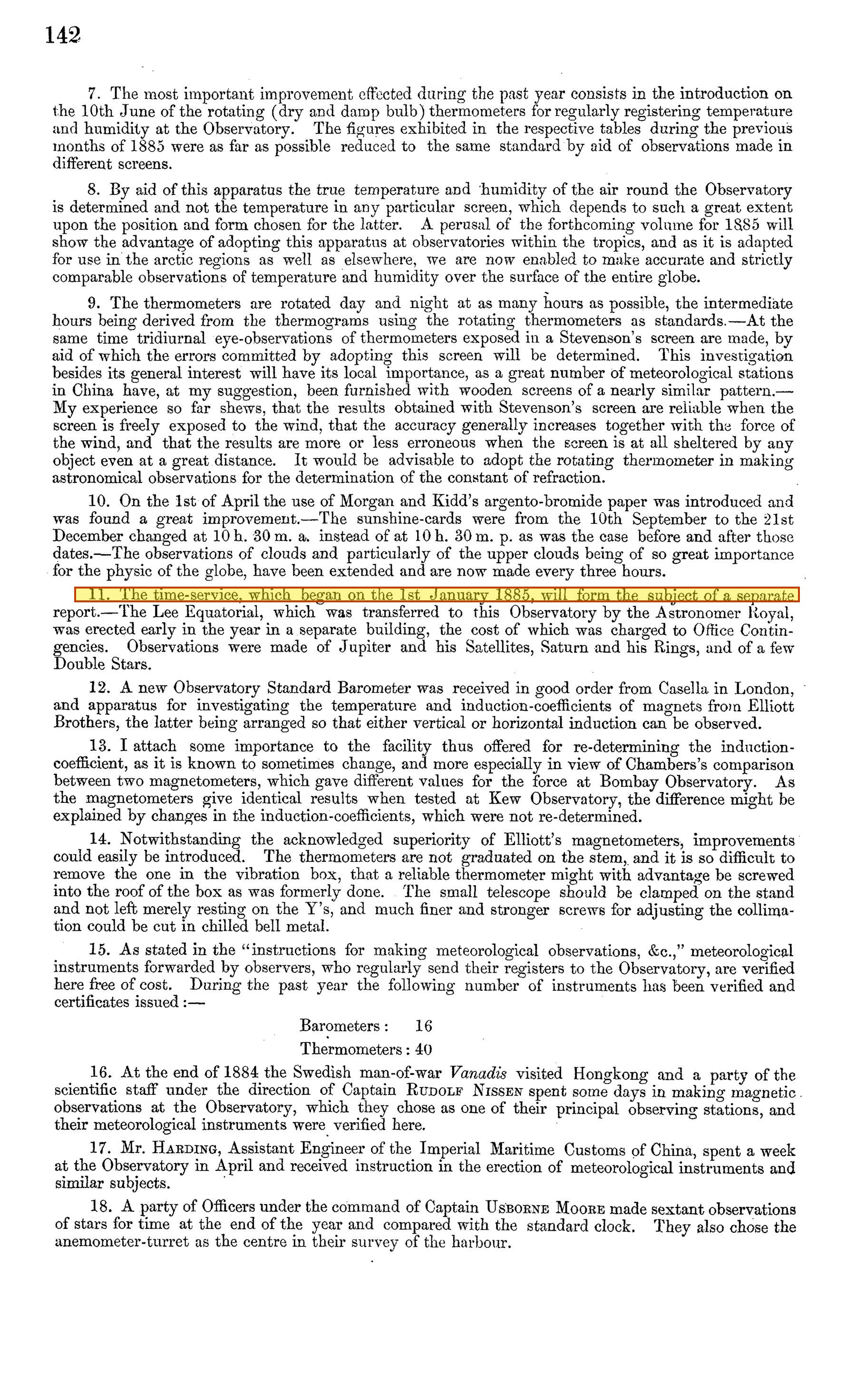
The storm-warnings had not even been the plan. The Director’s first annual report — for 1885, presented in February 1886 — confesses the institutional history: “It does not appear to have been originally intended to immediately start daily weather-reports and storm-warnings in connection with the Observatory, and no provision was made for such; but immediately on my arrival in the Colony I was instructed to take steps to organise the issue of daily weather-intelligence… The department was thus saddled with a great deal of extraneous work” — work he defended because it “ha[s] been of great advantage to the mercantile community”.50 The report also fixes the signals’ publication history — the Notice of 11 August 1884 “substantially the same as the two first paragraphs of my Notice of the 25th May, 1885”, ordered to appear weekly in the Gazette — and the gun’s double life, fired for typhoons and, in the same season, for the mails.51
The science that made the warnings more than the Harbour Master’s barometer was built on a network. The first annual report counts its stations: “observations with instruments verified here have been commenced at a greater part of the stations belonging to the Imperial Maritime Customs of China”; Bolinao’s observations arrived “through the courtesy of the Superintendent of the Eastern Extension, Australasia and China Telegraph Company”; and twice a day came “a telegram containing observations made at the Observatory of the Jesuit Fathers at Manila”.52 The network fed the memoir. In July 1885 the Gazette’s Supplement carried Doberck’s “On the Progressive Motion of Typhoons in 1884”: the typhoons “appear to have their origin E or SE of the Philippines in the trough of low pressure between the two high-pressure areas in the North Pacific and in Australia”; and their paths obey “the law, first enunciated by the Rev. CLEMENT LEY, according to which an atmospheric depression moves so as to keep the high-pressure area on its right. This law was originally proved only in the case of depressions in the neighbourhood of the United Kingdom, but it applies equally to the typhoons.” The claim is precise about the borrowing: Ley’s law was English; its application to typhoons was the Hong Kong Observatory’s.53
The memoir’s classification reads as printed: “Typhoons may be divided into three classes according to the paths, which they generally follow” — the typhoons of 1884 being numbered to at least XVIII — and the supplement’s second page proceeds to a fourth class “really situated outside the field of our investigations”; the count is kept as the source prints it.54 The memoir closes with measurement: the 1884 typhoons’ average drift, from 7 nautical miles an hour east of Luzon to 23 over Northern China and 30 in the Sea of Japan.55 The Observatory’s instrument-work kept pace: the “most important improvement” of 1885 was the rotating dry- and damp-bulb thermometer apparatus introduced on 10 June, with a claim as large as the globe — “accurate and strictly comparable observations of temperature and humidity over the surface of the entire globe”.56
The season of 1885 gave the shapes their press. The Weather Report for 1885 records “the small typhoon that passed northwards between Hongkong and Macao on the 17th of that month” — the storm that deflected the 24 August typhoon through the Formosa Channel; and the China Mail of 17 August saw the signal up: “hoisted at Tsim Sha T[s]ui, indicating that there’s a typhoon somewhere to the westward of the Colony” — the red ball at work.5758
9. The time service, 1885–86
The twin service began by the calendar: “The time-service, which began on the 1st January 1885, will form the subject of a separate report” — and the administrative report for 1885 corroborates the month: the time-ball’s electric-apparatus house “was ready for occupation in January, and the time ball was in working order from that month”. The same report notes the Lee Equatorial, “transferred to this Observatory by the Astronomer Royal” — the Greenwich connection arriving as glass and brass.59 The separate report came in 1886, and it is a small monument of practical electricity: the Dent mean-time clock (whose wooden cases “have shown themselves to be at any rate not less inconvenient [in] tropical climate, than they are known to be at home”), the reversing commutator, the Leclanché cells, the electric lock that held and dropped the ball; the typhoon gun “pointed towards the city opposite” from the police boat-basin; and, at the end, the ambition the cables of the day could not carry — “driving sympathetic clocks in buildings in Hong Kong similar to those worked from observatories in large towns in the United Kingdom”.60
10. The institution strained, 1885–86
The small institution’s budget was as leaky as its roof. In 1885 the Acting Governor refused the Director’s application for a higher salary, and his despatch is a set piece of colonial accounting: the Observatory “is situated on the summit of a hill commanding extensive and beautiful views, and is generally regarded as one of the most enviable residences in this Colony”; the applicant “is a Dane, formerly employed in a Private Observatory in Ireland”; in any country on the Continent “a Meteorological Observer would not (I am assured) receive one half of a salary of Six hundred pounds sterling. I cannot recommend the increase now applied for.” The despatch’s last argument is institutional: it was “not just to throw on the small revenue of Hongkong alone the entire cost of the Establishment of the Observatory”.61 The register of that year’s despatches carries the subject plainly: “Increase of Salary to Dr Doberck, Director of Observatory.”62
The building’s condition is the same report’s undertow: the “summer rains in 1884 shewed the building to be suffering from leakage”; the Director’s private quarters “very draughty in the winter during the height of the NE monsoon”; and the paddy ground, its rice prohibited but not drained, became after the summer rains “an extensive swamp, to the malaria emanating from which the intermittent and remittent fevers, from which we all suffered, may be ascribed”.63 The staff was four: Figg at the time-ball tower; Mahomet Alarakia on the thermograms and the batteries; Lau-Shau, the clerk who “writes out daily weather reports… and is responsible for the issue of information concerning typhoons and storm-warnings”; and the Director, who “make[s] [him]self all the astronomical observations and take[s] charge of the horological apparatus”.64 When the work outran the four, the Director issued his ultimatum (9 March 1886): without a second Chinese clerk, “the extension of the work ordered in 1883, the China Coast Register, Meteorological Signals, &c. should cease from the end of the present month” — adding the ledger of the cost: “A portion of the work was stopped in September, when our healths failed owing partly to overwork.”65
11. The review and the feud, 1893 and 1897
Ten years on, the government examined the reporting system — and put the reported in the chair. The committee on meteorological reports and weather forecasts of 1893 was presided over by Doberck himself, at the Governor’s direction; he asked for “five copies of the printed report of the Observatory Commission… and also… a copy of the Astronomer Royal’s letter, which was forwarded with the Secretary of State’s despatch of last autumn”. The Colonial Secretary then fenced the enquiry’s ground: “it is to be clearly understood that the scope of the enquiry by the Committee is strictly limited to a consideration of the system of issuing meteorological reports and weather forecasts… and that it does not extend to an investigation into the method adopted at the Observatory for obtaining meteorological results or observations.” The science was protected; the publication was audited — by its own author.66
Four years later the institution’s passions reached the imperial file. The 1897 committee minutes on the Doberck–Plummer feud record a locum tenens’s war against a Director and his sister: the correspondence books carried to England (“as the correspondence with other observatories… is bound together in books, it was impossible to take part and leave part”); “a report made by Mr. Plummer against Miss Doberck with reference to the temporary disappearance of a book”; and the charge that gives the feud its weight — that “Mr. Plummer presented typhoon reports as the result of his own instead of Mr. Figg’s labour”. Figg had been the first assistant director since 6 June 1883; the reports in question were the work of the Observatory’s other founder. The file closes on the letter the Director “considers insulting to Mr. Figg… and which we consider impertinent towards Dr. Doberck”.6736
12. The afterlife: the code of 1932
The shapes outlived their makers. By 1932 the Observatory (Royal by then) was publishing the Non-Local Storm Signal Code: ten symbols, hoisted “at the yard-arms and at the mast head of a Storm Signal Mast”, giving a typhoon’s position, direction of motion, accuracy, intensity and time — a code “exhibited in Hong Kong, Shanghai and Coast Ports”. The red drum and red ball of 1884 had become a coordinate system; the Harbour Master’s single black drum of 1878 had become, across two institutional lives, an international language.68
13. Conclusion
The founding record, read whole, corrects the folklore at its centre. The colony’s warning shapes were born in 1878, not 1884 — but the Observatory’s Notice of 11 August 1884 remains the founding text of Hong Kong’s public weather, because it replaced one officer’s expectation with a system: four directions on a mast, a gun with a code, a daily register on public exhibition, and a network reaching from the Customs stations of the China coast to the Jesuit Fathers’ observatory at Manila. The system’s first season is fully witnessed — the gun on 21 August, the Red Drum on 8 September, the crossing of 10–11 September with the Red Ball swapped in as the centre passed — and so are its costs: a year’s budget spent to $1,179; a building that leaked beside an undrained swamp; a salary refused on the grounds that a Dane from an Irish private observatory was already overpaid; a staff of four whose health “failed owing partly to overwork”; and a feud over the first assistant’s stolen labour. What survived was the layer the Harbour Master never had: the science — Ley’s law applied to typhoons, the typhoons of 1884 numbered and measured, the drift rates from Luzon to the Sea of Japan — and the shapes, still hoisted, in a code now three ports wide.2624353
Appendix A: sources and method
The documentary corpus is the hkintexts research index (Elasticsearch
cluster hkintexts, indices hkintexts_pages and
hkintexts_image_pages), queried read-only on 10 October 2026.
The thread’s central document — the Sessional Paper of
1885–86, carrying the Director’s first annual report (No. 17),
the Chinese-clerk ultimatum (No. 18), the Annual Weather Report (No. 25) and
the Five-Day Means (No. 26) — was pulled in full (249 pages); every
quotation was read in its fetched page, and the Sessional Paper quotations
within the whole-document pull. Citations print public viewer links: the
image-series link where a scan twin exists (the Government Gazette, the
Sessional Papers, the Administrative Reports), the text-series link where
the text series is the sole carrier (CO 129; the Telegraph; the
China Mail pages whose scans are absent from the image index). No
write was made to the index.
Query families (all logged in the research notes, Appendix A):
“new Observatory” (90); “Doberck” (4,141, with the
OCR variants Doberek/Toberek registered);
“Meteorological Signals” with an 1884–85 bound (26);
“time ball” (1,530); “erection of the Observatory”
(2); “Observatory Commission” (35); and the adversarial battery
— “storm signal”, “hoisted” + typhoon, gun +
warning, each with a pre-1884 document_key bound — the
battery that found the Harbour Master’s 1878 notice and its 1879 action
report, and falsified the naive “first signals 1884”
claim.3
Appendix B: evidence register
| Claim | Witnesses |
|---|---|
| The 1874 disaster as the project’s motive | Hennessy’s 1880 LegCo defence; the 1881 estimate’s Time Ball |
| The Observatory’s signals superseded the Harbour Master’s 1878 drum | the 1878 Gazette notice; the 1879 China Mail action report; Doberck’s 1885 report on “the work ordered in 1883” |
| The appointments (Doberck from 2 March; Figg from 6 June 1883) | the Telegraph appointments item; the CO 129/214 minutes; the 1897 feud minutes’ Figg record |
| The slow build ($20,000 voted 1882; $1,179 spent) | the Finance Committee minute; Hennessy’s catalogue of 1879’s undelivered works |
| The building occupied by early 1884 on a malarial site | the 1883 afforestation report; the Director’s 1885 report; the salary despatch’s “enviable residences” |
| The arrival (March 1884) | the bungalow rent from 18 March 1884; the Colonial Surgeon’s “has arrived” |
| The signals machinery born 11 August 1884 | the Gazette notice; the Director’s own reference to “my Notice of the 11th August, 1884” |
| The typhoon of 10–11 September 1884 and the machinery’s first full test | the official Observatory report; the China Mail of 11 September 1884 |
| The time service began 1 January 1885 | the Director’s first annual report; the 1885 administrative report |
| The gun fired 21–22 August 1884 (the earliest witnessed warning action) | the Weather Report for August 1884; the Notice’s gun clauses |
| Claim | Witness |
|---|---|
| The Red Drum hoisted 8 September 1884 (the earliest witnessed hoisting) | the official report on the storm of 10–11 September |
| The memoir’s classification and Ley’s law | the Gazette Supplement of 18 July 1885 |
| The 17 August 1885 red-ball hoisting | the China Mail fragment (with the Weather Report’s account of the same storm) |
| The naming; the Astronomer Royal’s scheme verdict | single CO minutes/letters, each the only pulled carrier |
| Item | The variance |
|---|---|
| The gun’s time, 10 September 1884 | official 6.28 p.m. vs press 6.20 p.m. |
| The memoir’s class count | “three classes” announced; four described (the fourth “outside the field of our investigations”) |
| The arrival’s wording | the 1883-report’s “has arrived” vs the bungalow’s 18 March 1884 start |
| The 1879 page’s OCR | the despatch and vote figures partly garbled — legible fragments only |
| The salary despatch’s cut-off | the establishment cost breaks at “Five thousand Eight hundred [£…]” — never completed |
| Item | Why |
|---|---|
| The building’s completion date and contractor | the budget, site, occupancy and condition are witnessed; the award and the completion day are not in the pulled pages |
| The first time-ball drop’s hour and ceremony | the day is witnessed twice; the drop itself is not described |
| Doberck’s cruise itinerary | the mission is witnessed; no page lists the ports |
| The feud’s outcome for the individuals | the charges are preserved; the final ruling is not in the pulled pages |
| The “Private Observatory in Ireland” | Cameron’s despatch is the only pulled witness; the institution is not named in these pages — the English is kept |
Notes
Method note: the documentary corpus interrogated for this paper is the hkintexts research index (Elasticsearch cluster hkintexts, indices
hkintexts_pagesandhkintexts_image_pages), queried read-only on 10 October 2026; the logged queries are itemised in Appendix A. The thread’s central document — the Sessional Paper of 1885–86 carrying the Director’s first annual report — was pulled in full (249 pages). Every passage quoted was read in its fetched page. Citations print the public viewer link; where the same page exists in both a text series and an image-series twin, the link is to the scan (/image-page/), and where the text series is the sole carrier (CO 129; the Telegraph; the China Mail pages without scans), the link is/page/. No write was made to the index. ↩Gazette, 1 June 1878, No. 122: “a black drum will be hoisted at the Office Flagstaff… a gun will be fired from the Police Hulk” (Harbour Master). https://hkintexts.histsyn.com/image-page/1461946 (accessed 18 October 2026). ↩
Method note: the hkintexts corpus (read-only), logged queries in Appendix A; the central Sessional Paper 1885–86 pulled in full (249 pp.); public viewer links throughout. Accessed 18 October 2026. ↩
CO 129/189, Governor Sir J. Pope Hennessy, 1880, p. 386: “I ascertained on my arrival that four or five thousand of the Chinese were drowned in their boats in the typhoon of 1874, and I also found, on calling for the papers, that the leading Chinese gentlemen had memorialised the government for something to be done in the way of a breakwater.” https://hkintexts.histsyn.com/page/306630 (accessed 10 October 2026). ↩
China Mail, 22 September 1879, p. 2: “A little later the typhoon signal was hoisted at the Harbour Master’s office and a warning gun fired from the Police Hulk. All the boats and sampans moved in a body to places of comparative safety”. https://hkintexts.histsyn.com/page/1892356 (accessed 10 October 2026). ↩
CO 129/186, Public Offices & Others, 1879, p. 271: the docket of the despatch “New Observatory Establishment at Hong Kong” (a “Meteorological Observatory… Points out advantages that would result”), with the Colonial Office minute on the time ball: “We have asked for a report on the subject but asked in vain” and the “$5,000” Time Ball vote of the June Estimates. The page is OCR-damaged; only legible fragments are quoted. https://hkintexts.histsyn.com/page/305014 (accessed 10 October 2026). ↩
CO 129/194, Governor Hennessy/Administrator Tonnochy, 1881, p. 459: the proposal “for constructing [an] astronomical observatory, magnetic observatory, purchase and freight from England of the necessary instruments, Time Ball… The cost of which I estimate approximately at $30,000”. https://hkintexts.histsyn.com/page/309798 (accessed 10 October 2026). ↩
CO 129/206, Public Offices & Others, 1882, p. 128: the Astronomer Royal’s letter (Royal Observatory, Greenwich, July 1882): “I am of opinion that the smaller and simpler scheme put forward by Mr. Price will suffice for present requirements, remarking that the pressing needs of the Colony appear to be a time ball and a Meteorological service. Mr. Price appears to me to have provided for these with due regard to economy and efficiency”. https://hkintexts.histsyn.com/page/320164 (accessed 10 October 2026). ↩
CO 129/206, Public Offices & Others, 1882, p. 160: “I am of opinion that it would be desirable to divert The new observatory ‘The Hong Kong Observatory’”. https://hkintexts.histsyn.com/page/320196 (accessed 10 October 2026). ↩
CO 129/207, Acting Governor W. H. Marsh, 1883, p. 65: the Finance Committee, 2 January 1883, on the re-vote of $18,680: “The Committee find that no provision has been made in the Estimates for 1883, and that out of the $20,000, voted for 1882, only $1,179 has been expended. Under the circumstances, the Committee do not hesitate in recommending the re-vote”. https://hkintexts.histsyn.com/page/320686 (accessed 10 October 2026). ↩
Hongkong Telegraph, 12 November 1883, p. 3: “THE appointments of Dr. William Doberck, director of the Hongkong Observatory, Mr. Frederick George Figg, assistant director of the Observatory… have been duly gazetted. Dr. Doberck’s appointment dates from March 2nd, and Mr. Figg’s from the 6th of June.” https://hkintexts.histsyn.com/page/2826200 (accessed 10 October 2026). ↩
CO 129/214, Public Offices & Others, 1883, p. 683 (the minutes on the first appointment): “It will be desirable for Dr. Doberck to be attached to the Observatories at Greenwich & Kew some little time before proceeding to the Colony”. https://hkintexts.histsyn.com/page/324650 (accessed 7 October 2026; re-verified 10 October 2026). ↩
CO 129/210, Governor Sir G. F. Bowen, 1883, p. 494 (the minutes on Mr. Price’s proposal): “establish relation with other centres of observation along the coasts of China and the Philippine Islands… he should spend the time, while the Observatory is being completed, in visiting various stations to negotiate the scheme. Dr Doberck is probably by this time cruising around on this mission”. https://hkintexts.histsyn.com/page/322622 (accessed 7 October 2026; re-verified 10 October 2026). ↩
CO 129/214, Public Offices & Others, 1883, p. 688: “on the latitude of Mount Elgin, the site of the new Observatory” — with the Surveyor General’s staff scheme “which scheme has received the approval of the Secretary of State”. https://hkintexts.histsyn.com/page/324655 (accessed 10 October 2026). ↩
“Notice” (Meteorological Signals), Hongkong Observatory, 11th August, 1884, W. Doberck, Government Astronomer; published as Government Notification No. 293, Supplement to the Hongkong Government Gazette, 16 August 1884: “Meteorological Signals will be hoisted on the mast in front of the Police Barracks at Tsim-sha-tsui: A red drum will be hoisted to indicate the existence of a typhoon somewhere to the East of the Colony. A red cone pointing upwards will indicate, that a typhoon exists in a latitude more northern than the Colony, or, that it is progressing towards North. A red cone pointing downwards will indicate, that a typhoon exists in a latitude more southern than the Colony, or, that it is progressing towards South. A red ball will indicate, that a typhoon exists somewhere to the West of the Colony” — and the gun: “a gun has been placed at the foot of the mast facing Victoria. It will be fired once, whenever a strong gale of wind is expected here. It will be fired twice, whenever the wind is expected to blow with typhoon force. And it will be fired again if possible, when the wind is likely to suddenly shift round—such shifting being frequently accompanied by great disasters to the shipping.” https://hkintexts.histsyn.com/image-page/1522178 (accessed 10 October 2026). ↩
The same Notice (11 August 1884), on what the signals were for: “the meteorological signals will enable masters of vessels days beforehand to foresee the weather likely to be encountered in different localities and to understand changes of weather, and their knowledge of the law of storms combined with their practical experience will enable them to shape their course so as to not only avoid the dangerous part of a typhoon, but so as to find out and benefit by favourable winds”; the signals “hoisted to call attention to information contained in The China Coast Meteorological Register, as exhibited at the Office of the Great Northern Telegraph Company”. https://hkintexts.histsyn.com/image-page/1522178 (accessed 10 October 2026). ↩
“Weather Report for August 1884” (published in the Supplement to the Hongkong Government Gazette, 23 May 1885): “Between 9 p. and 10 p. the Typhoon gun in Hongkong was fired one round, as I had been [informed] that it would be impossible to fire it after the latter hour, and on due consideration I con[sidered] it risky to neglect to give warning to the Colony of the violent Typhoon” — the storm whose “center of the Typhoon passed over Lamocks, the lighthouse outside Swatow, about 3 a.m. on [the] 22nd”. https://hkintexts.histsyn.com/image-page/1527020 (accessed 10 October 2026). ↩
“Meteorological Observations made during the Typhoon of the 10th and 11th September, 1884”, Government Notification No. 351, Supplement to the Hongkong Government Gazette, 27 September 1884: “On the 8th, the Red Drum was hoisted on the signal mast. The center of the Typhoon was then North of Luzon.” https://hkintexts.histsyn.com/image-page/1522287 (accessed 10 October 2026). ↩
Ibid. (the official report on the storm of 10–11 September 1884): “On the 10th at 5.45 a. directions to fire the Typhoon Gun one round were given, a strong northerly gale being expected, at 10.15 a. the following notice was telegraphed to the Treaty Ports: — ‘Typhoon approaching Hongkong from the East.’ and at 6.28 p. directions to fire the Typhoon Gun two rounds were given, it being then certain, that the velocity of the wind would reach 80 miles an hour… After passing Hongkong the center moved westward, which I signalled by replacing the Red Drum by the Red Ball. It entered the mainland between Hongkong and St. John Island” — the barometer at its absolute minimum, 28.979, on the 11th. https://hkintexts.histsyn.com/image-page/1522287 (accessed 10 October 2026). ↩
Ibid., p. 143: “The time-service, which began on the 1st January 1885, will form the subject of a separate report.” — with the Lee Equatorial, “which was transferred to this Observatory by the Astronomer Royal”; corroborated by the Hong Kong Annual Administrative Report for 1885, p. 709: “A house for keeping the electric apparatus for dropping the time ball was ready for occupation in January, and the time ball was in working order from that month.” https://hkintexts.histsyn.com/image-page/1604579 and https://hkintexts.histsyn.com/image-page/1133320 (accessed 10 October 2026). ↩
W. Doberck, “On the Progressive Motion of Typhoons in 1884”, Government Notification No. 287, Supplement to the Hongkong Government Gazette of 18th July, 1885 (Hongkong Observatory, 16th July, 1885): the typhoons “appear to have their origin E or SE of the Philippines in the trough of low pressure between the two high-pressure areas in the North Pacific and in Australia”; “their paths are determined according to the law, first enunciated by the Rev. CLEMENT LEY, according to which an atmospheric depression moves so as to keep the high-pressure area on its right. This law was originally proved only in the case of depressions in the neighbourhood of the United Kingdom, but it applies equally to the typhoons”. https://hkintexts.histsyn.com/image-page/1527162 (accessed 10 October 2026). ↩
“Application for an Additional Chinese Clerk for the Observatory”, Sessional Paper 1885–86, No. 18, p. 145 (Hongkong Observatory, 9th March, 1886): “if His Excellency is not inclined to approve of any extension of the staff, the extension of the work ordered in 1883, the China Coast Register, Meteorological Signals, &c. should cease from the end of the present month” — with the human record: “A portion of the work was stopped in September, when our healths failed owing partly to overwork.” https://hkintexts.histsyn.com/image-page/1604582 (accessed 10 October 2026). ↩
“Committee on Meteorological Reports and Weather Forecasts”, Hong Kong Government Gazette, 7th October, 1893, p. 1045: Doberck (Chairman, by the Governor’s direction) requesting “five copies of the printed report of the Observatory Commission… and also… a copy of the Astronomer Royal’s letter, which was forwarded with the Secretary of State’s despatch of last autumn”; the Colonial Secretary’s scope ruling: “it is to be clearly understood that the scope of the enquiry by the Committee is strictly limited to a consideration of the system of issuing meteorological reports and weather forecasts… it does not extend to an investigation into the method adopted at the Observatory for obtaining meteorological results or observations.” https://hkintexts.histsyn.com/image-page/1541878 (accessed 10 October 2026). ↩
CO 129/278, Governor Sir W. Robinson, 1897, p. 39 (the committee minutes on the Doberck–Plummer feud): the correspondence books taken to England (“as the correspondence with other observatories… is bound together in books, it was impossible to take part and leave part”); “a report made by Mr. Plummer against Miss Doberck with reference to the temporary disappearance of a book”; “Mr. Plummer presented typhoon reports as the result of his own instead of Mr. Figg’s labour”; and the letter “which Dr. Doberck considers insulting to Mr. Figg… and which we consider impertinent towards Dr. Doberck”. https://hkintexts.histsyn.com/page/364261 (accessed 7 October 2026; re-verified 10 October 2026). ↩
“Non-Local Storm Signal Code” (Royal Observatory, 31st May 1932), Hongkong Government Gazette, 2nd June, 1932: “The following ten symbols are used… The signals are hoisted at the yard-arms and at the mast head of a Storm Signal Mast” — figures giving the typhoon’s position, direction of motion, accuracy and intensity, and the time — the Code exhibited “in Hong Kong, Shanghai and Coast Ports” (C. W. JEFFRIES, Director, Royal Observatory). https://hkintexts.histsyn.com/image-page/1479814 (accessed 10 October 2026). ↩
CO 129/189 (1880), p. 386: “four or five thousand of the Chinese were drowned in their boats in the typhoon of 1874”; the Chinese gentlemen’s breakwater memorial. https://hkintexts.histsyn.com/page/306630 (accessed 18 October 2026). ↩
Ibid., the same LegCo defence naming the works the 1879 programme did not deliver: “why it is that we did not make the breakwater, the Observatory building, the Central School building, the separate system prison—why all these things were not done in 1879”. https://hkintexts.histsyn.com/page/306630 (accessed 10 October 2026). ↩
“Typhoon — Notice respecting” (Harbour Department notice, 30th May 1878), Hongkong Government Gazette, 1st June, 1878, No. 122: “In the event of bad weather being apprehended by this Department, a black drum will be hoisted at the Office Flagstaff. A similar signal will be hoisted and a gun will be fired from the Police Hulk” — with the meteorology of its author: “The usual signs of approaching bad weather are, a falling Barometer with high Thermometer, sultriness of the atmosphere, and wildness and discoloration of the clouds” — and his disclaimer: “The signal is intended only as calling the attention of the Mercantile Marine to any change of weather which the undersigned is expecting” (J. P. MCEUEN, R.N., Acting Harbour Master). https://hkintexts.histsyn.com/image-page/1461946 (accessed 10 October 2026). ↩
China Mail, 22 September 1879: “A typhoon signal was hoisted at the Harbour Office, and a gun fired from the Police Hulk”. https://hkintexts.histsyn.com/page/1186053 (accessed 18 October 2026). ↩
CO 129/186 (1879), p. 271: docket “New Observatory Establishment at Hong Kong”; Colonial Office minute: “We have asked for a report on the subject but asked in vain”. https://hkintexts.histsyn.com/page/305014 (accessed 18 October 2026). ↩
CO 129/194 (1881), p. 459: the $30,000 estimate for observatory, instruments and time ball. https://hkintexts.histsyn.com/page/309798 (accessed 18 October 2026). ↩
CO 129/206, Public Offices & Others, 1882, p. 522: the Secretary of State asking for “observations on the respective proposals of Major Palmer & Mr. Price, now that they are both before you”, in the context of a scheme “which would not entail heavy construction & maintenance costs originally contemplated by Major Palmer”. https://hkintexts.histsyn.com/page/320558 (accessed 10 October 2026). ↩
CO 129/206 (1882), p. 128: the Astronomer Royal’s verdict that the “smaller and simpler scheme put forward by Mr. Price will suffice” — a time ball and a meteorological service. https://hkintexts.histsyn.com/page/320164 (accessed 18 October 2026). ↩
CO 129/206 (1882), p. 160: “The Hong Kong Observatory” as the proposed name. https://hkintexts.histsyn.com/page/320196 (accessed 18 October 2026). ↩
CO 129/207 (1883), p. 65: the Finance Committee, 2 January 1883 — of the $20,000 voted for 1882, only $1,179 had been expended; the re-vote recommended. https://hkintexts.histsyn.com/page/320686 (accessed 18 October 2026). ↩
Hongkong Telegraph, 12 November 1883, p. 3: Doberck (from 2 March) and Figg (from 6 June) gazetted. https://hkintexts.histsyn.com/page/2826200 (accessed 18 October 2026). ↩
CO 129/214 (1883), p. 683: Doberck to be attached to Greenwich & Kew before proceeding. https://hkintexts.histsyn.com/page/324650 (accessed 18 October 2026). ↩
CO 129/210 (1883), p. 494: Doberck “cruising around” the China coast while the Observatory was being completed. https://hkintexts.histsyn.com/page/322622 (accessed 18 October 2026). ↩
CO 129/214 (1883), p. 688: Mount Elgin as the site of the new Observatory. https://hkintexts.histsyn.com/page/324655 (accessed 18 October 2026). ↩
Administrative Report 1883 (Botanical and Afforestation Department), p. 114: “Until the occupation of the Observatory these men were allowed to grow rice in the swampy ground, but the Sanitary Department being of opinion that these paddy fields would be inimical to the health of the occupants of the Observatory the privilege of cultivating rice has been withdrawn.” https://hkintexts.histsyn.com/image-page/417164 (accessed 10 October 2026). ↩
CO 129/220, Governor Sir G. F. Bowen, 1885, p. 102 (the Observatory’s 1884 accounts): “Fittings for the Observatory building and Time Ball | $947”; “Rent of a bungalow for the Obser[vator]y. per month, from 18th March to 30th Nov 1884, at $30 [per] month”; the instruments “received during the year”. https://hkintexts.histsyn.com/page/327724 (accessed 10 October 2026). ↩
Administrative Report 1883 (Colonial Surgeon), p. 91: “now that Dr. DOBERCK has arrived in the Colony, the Meteorological Observations will no longer be taken by this department, or in the rough and ready manner they have been up to the present, and coming as they will from a skilled workman will be very valuable, instead of being of very little value as heretofore”. https://hkintexts.histsyn.com/image-page/417141 (accessed 10 October 2026). ↩
Notice of 11 August 1884 (G.N. No. 293, 16 August 1884): the four shapes and the gun. https://hkintexts.histsyn.com/image-page/1522178 (accessed 18 October 2026). ↩
The same Notice, on the signals’ purpose: masters’ “knowledge of the law of storms”. https://hkintexts.histsyn.com/image-page/1522178 (accessed 18 October 2026). ↩
W. Doberck, “Meteorological Observations, August 1884”, https://hkintexts.histsyn.com/page/2940929 (accessed 18 October 2026): “the typhoon gun was fired once”, 21–22 August 1884. ↩
G.N. No. 351, 27 September 1884: “On the 8th, the Red Drum was hoisted on the signal mast.” https://hkintexts.histsyn.com/image-page/1522287 (accessed 18 October 2026). ↩
G.N. No. 351: the typhoon of 10–11 September 1884; the Red Drum replaced by the Red Ball. https://hkintexts.histsyn.com/image-page/1522287 (accessed 18 October 2026). ↩
China Mail, 11 September 1884, p. 3: “The Government Astronomer reports… that directions to fire the typhoon gun two rounds were given at 6h 20m p.m. yesterday. At 11 a.m., the following notice, was telegraphed through the Central Police Station from here: Heavy typhoon crossed Hongkong early this morning” and, on the earlier round, “At 5h 45m a.m. directions were given to fire the typhoon gun one round, a strong northerly gale being expected here” — with the editorial complaint: “Not a line was received yesterday either by ourselves or by our contemporary about the weather.” The press time (6.20 p.m.) differs from the official 6.28 p.m.; both are kept. https://hkintexts.histsyn.com/page/1897551 (accessed 10 October 2026). ↩
China Mail, 2 June 1884, p. 3: the daily “METEOROLOGICAL REGISTER” printed over “W. DOBERCK, Government Astronomer. Hongkong Observatory, June 2”. https://hkintexts.histsyn.com/page/1897217 (accessed 10 October 2026). ↩
“Report of the Director of the Observatory, for 1885”, Sessional Paper 1885–86, No. 17, pp. 141–42 (Hongkong Observatory, 4th February, 1886): “It does not appear to have been originally intended to immediately start daily weather-reports and storm-warnings in connection with the Observatory, and no provision was made for such; but immediately on my arrival in the Colony I was instructed to take steps to organise the issue of daily weather-intelligence… The department was thus saddled with a great deal of extraneous work… I understand, that the storm-warnings etc., have been of great advantage to the mercantile community”. https://hkintexts.histsyn.com/image-page/1604578 (accessed 10 October 2026). ↩
Ibid., p. 142, on the signals’ publication: “my Notice of the 25th May, 1885, (substantially the same as the two first paragraphs of my Notice of the 11th August, 1884. Compare Obs. and Res. 1884, App. F.) should be published daily in the local newspapers during the typhoon season… I was informed, that it would appear weekly in the Government Gazette, which has been carried out” — and on the gun’s double duty: “The gun placed at Tsim-shat-súi for announcing the approach of a typhoon, was, during the year, also fired for announcing the arrival of the mails.” https://hkintexts.histsyn.com/image-page/1604578 (accessed 10 October 2026). ↩
“Report of the Director of the Observatory, for 1885”, Sessional Paper 1885–86, No. 17, pp. 141–42: “In the course of the past year observations with instruments verified here have been commenced at a greater part of the stations belonging to the Imperial Maritime Customs of China… Through the courtesy of the Superintendent of the Eastern Extension, Australasia and China Telegraph Company I receive observations from Bolinao. At 10 a. and 4 p. daily, a telegram containing observations made at the Observatory of the Jesuit Fathers at Manila is also transmitted”. https://hkintexts.histsyn.com/image-page/1604578 (accessed 10 October 2026). ↩
Doberck, “On the Progressive Motion of Typhoons in 1884” (G.N. No. 287, 18 July 1885): Clement Ley’s law applied to typhoons. https://hkintexts.histsyn.com/image-page/1527162 (accessed 18 October 2026). ↩
Ibid.: “Typhoons may be divided into three classes according to the paths, which they generally follow” — the first class “common at the beginning and at the end of the typhoon season” (Typhoons II and V, XVIII); the second recursving “in about 26°… between 22° and 32° northern latitude” (III, IV, IX, XII); the third “pass E of Formosa moving Northward” (VI, X, XI, XIII) — while the supplement’s second page proceeds to “Typhoons of the fourth class… really situated outside the field of our investigations”, an internal count the paper keeps as printed. https://hkintexts.histsyn.com/image-page/1527162 and https://hkintexts.histsyn.com/image-page/1527163 (accessed 10 October 2026). ↩
Ibid., the closing table: “The average velocity of the typhoons of 1884 was as follows: — E of Luzon: 7 nautical miles an hour… About Hainan: 13 miles an hour… About Shanghai: 12 miles an hour. In Northern China: 23 miles an hour. About Japan: 19 miles an hour. In the Sea of Japan: 30 miles an hour.” https://hkintexts.histsyn.com/image-page/1527163 (accessed 10 October 2026). ↩
Ibid., p. 142: “The most important improvement effected during the past year consists in the introduction on the 10th June of the rotating (dry and damp bulb) thermometers for regularly registering temperature and humidity at the Observatory… we are now enabled to make accurate and strictly comparable observations of temperature and humidity over the surface of the entire globe.” https://hkintexts.histsyn.com/image-page/1604578 (accessed 10 October 2026). ↩
“Annual Weather Report of the Director of the Observatory, for 1885”, Sessional Paper 1885–86, No. 25, p. 181: “most of the typhoons passed east of Formosa, the most important exception being furnished by the typhoon that passed through the Formosa Channel on the 24th August, but this typhoon had apparently been deflected from the usual path and attracted by the small typhoon that passed northwards between Hongkong and Macao on the 17th of that month.” https://hkintexts.histsyn.com/image-page/1604618 (accessed 10 October 2026). ↩
China Mail, 17 August 1885, p. 3: “[the signal was] hoisted at Tsim Sha T[s]ui, indicating that there['s] a typhoon somewhere to the westward of the Colony” — the red ball (the West signal) in action; OCR-fragmentary, read with the Weather Report’s account of the same day. https://hkintexts.histsyn.com/page/1898650 (accessed 10 October 2026). ↩
Director’s Report for 1885, S.P. 1885–86 No. 17, p. 143: “The time-service, which began on the 1st January 1885”. https://hkintexts.histsyn.com/image-page/1604579 (accessed 18 October 2026). ↩
“Astronomical Instruments at Observatory and Time Service 1885” (Hongkong Government Gazette, 1886): the mean-time clock whose “wooden cases supplied by DENT & Co., although affording [a] good protection to the clockwork, have shown themselves to be at any rate not less inconvenient [in] tropical climate, than they are known to be at home”; the electric lock of the time-ball; and “the typhoon gun, pointed towards the city opposite, is placed… in the police boat-basin”; and the ambition: “it would be easy… driving sympathetic clocks in buildings in Hongkong similar to those worked from observatories in large towns in the United Kingdom.” https://hkintexts.histsyn.com/image-page/1530028 (accessed 10 October 2026). ↩
CO 129/222, Acting Governor G. W. Cameron (Governor Bowen on leave), 1885, p. 396: “The fact is that the new Observatory is situated on the summit of a hill commanding extensive and beautiful views, and is generally regarded as one of the most enviable residences in this Colony… he is a Dane, formerly employed in a Private Observatory in Ireland. In his own country, or in any other country on the Continent of Europe, a Meteorological Observer would not (I am assured) receive one half of a salary of Six hundred pounds sterling. I cannot recommend the increase now applied for… it is not just to throw on the small revenue of Hongkong alone the entire cost of the Establishment of the Observatory (amounting altogether to Five thousand Eight hundred [£…]” — the sentence breaks off mid-figure on the page; the OCR renders the name “Toberek”. https://hkintexts.histsyn.com/page/329136 (accessed 10 October 2026). ↩
CO 129/222, despatch register, 1885, p. 5: the entry “Increase of Salary to Dr Doberck, Director of Observatory”. https://hkintexts.histsyn.com/page/328746 (accessed 10 October 2026). ↩
Ibid., p. 143 (the Director on the building): “The summer rains in 1884 shewed the building to be suffering from leakage. Several attempts to repair this were unsuccessful… My private quarters are very draughty in the winter during the height of the NE monsoon… The growth of rice in the extensive paddy fields north of this was prohibited in 1884, but the ground has not been drained and was during the heavy rains last summer converted into an extensive swamp, to the malaria emanating from which the intermittent and remittent fevers, from which we all suffered, may be ascribed.” https://hkintexts.histsyn.com/image-page/1604579 (accessed 10 October 2026). ↩
Ibid., p. 143: “Mr. FIGG, First Assistant, took charge of the apparatus in the time-ball tower… Mr. MAHOMET ALARAKIA, who has also charge of the galvanic batteries… Mr. LAU-SHAU, Clerk, has charge of the correspondence, all business transactions and accounts, acts as telegraph clerk, writes out daily weather reports, collects meteorological observations and is responsible for the issue of information concerning typhoons and storm-warnings. I make myself all the astronomical observations and take charge of the horological apparatus.” https://hkintexts.histsyn.com/image-page/1604579 (accessed 10 October 2026). ↩
S.P. 1885–86 No. 18, p. 145: the 9 March 1886 clerk ultimatum — without an extension of staff, the coast register and signals “should cease”. https://hkintexts.histsyn.com/image-page/1604582 (accessed 18 October 2026). ↩
Gazette, 7 October 1893, p. 1045: the 1893 committee, Doberck chairing; the scope “strictly limited”. https://hkintexts.histsyn.com/image-page/1541878 (accessed 18 October 2026). ↩
CO 129/278 (1897), p. 39: the Doberck–Plummer feud committee minutes. https://hkintexts.histsyn.com/page/364261 (accessed 18 October 2026). ↩
Gazette, 2 June 1932: the ten-symbol Non-Local Storm Signal Code. https://hkintexts.histsyn.com/image-page/1479814 (accessed 18 October 2026). ↩
Bibliography
Primary sources (corpus)
- Colonial Office records: CO 129/186 (1879); CO 129/189 (1880); CO 129/194 (1881); CO 129/206 (1882); CO 129/207 (1883); CO 129/210 (1883); CO 129/214 (1883); CO 129/220 (1885); CO 129/222 (1885); CO 129/278 (1897).
- Government Gazette: the Harbour Master’s typhoon notice (1 June 1878); the Meteorological Signals notice (Supplement, 16 August 1884); the typhoon of 10–11 September 1884 report (Supplement, 27 September 1884); the Weather Report for August 1884 (Supplement, 23 May 1885); the revised Meteorological Signals notice (30 May 1885); the typhoon memoir (Supplement, 18 July 1885); the Time Service report (1886); the 1893 committee correspondence (7 October 1893); the Non-Local Storm Signal Code (2 June 1932).
- Sessional Papers 1885–86: the Director of the Observatory’s report for 1885 (No. 17); the application for an additional Chinese clerk (No. 18); the Annual Weather Report for 1885 (No. 25); the Five-Day Means (No. 26).
- Administrative Reports 1883 (Colonial Surgeon; Botanical and Afforestation Department) and 1885 (the time-ball house).
- Press: Hongkong Telegraph (12 November 1883); China Mail (22 September 1879; 2 June 1884; 11 September 1884; 17 August 1885).