Kai Tak — the land's four lives: the failed garden estate, the gaol that never was (1912–1941)
啟德:一塊土地的四個身分(1912–1941)
摘要
啟德機場的名字並非來自航空史,而來自一場失敗的房地產計劃。1910年代,伍廷芳首先構想、何啟推動、區德出任主席的「啟德營業有限公司」,在九龍灣灣頭填海二百三十英畝,計劃建成「專為華人」的花園郊區,名叫啟德濱。工程自1916年動工,其後資金斷裂;政府在1919至1920年間以「改組公司、修改股東權利」為條件討論援助,並先後買下十五英畝土地準備建新監獄。1923年,政府索性代公司完成填海,以未售土地作抵押;1920年動工的監獄在打下樁柱之後,於1926年宣布放棄。1927年,政府引用《收回官地條例》收回啟德填築地三十七幅地段,改作機場;公司最終獲賠一百零一萬二千五百元(申索二百萬元),並於1936年清盤。機場繼承了這塊土地,也繼承了它的名字:啟德。1
一、海灣與構想
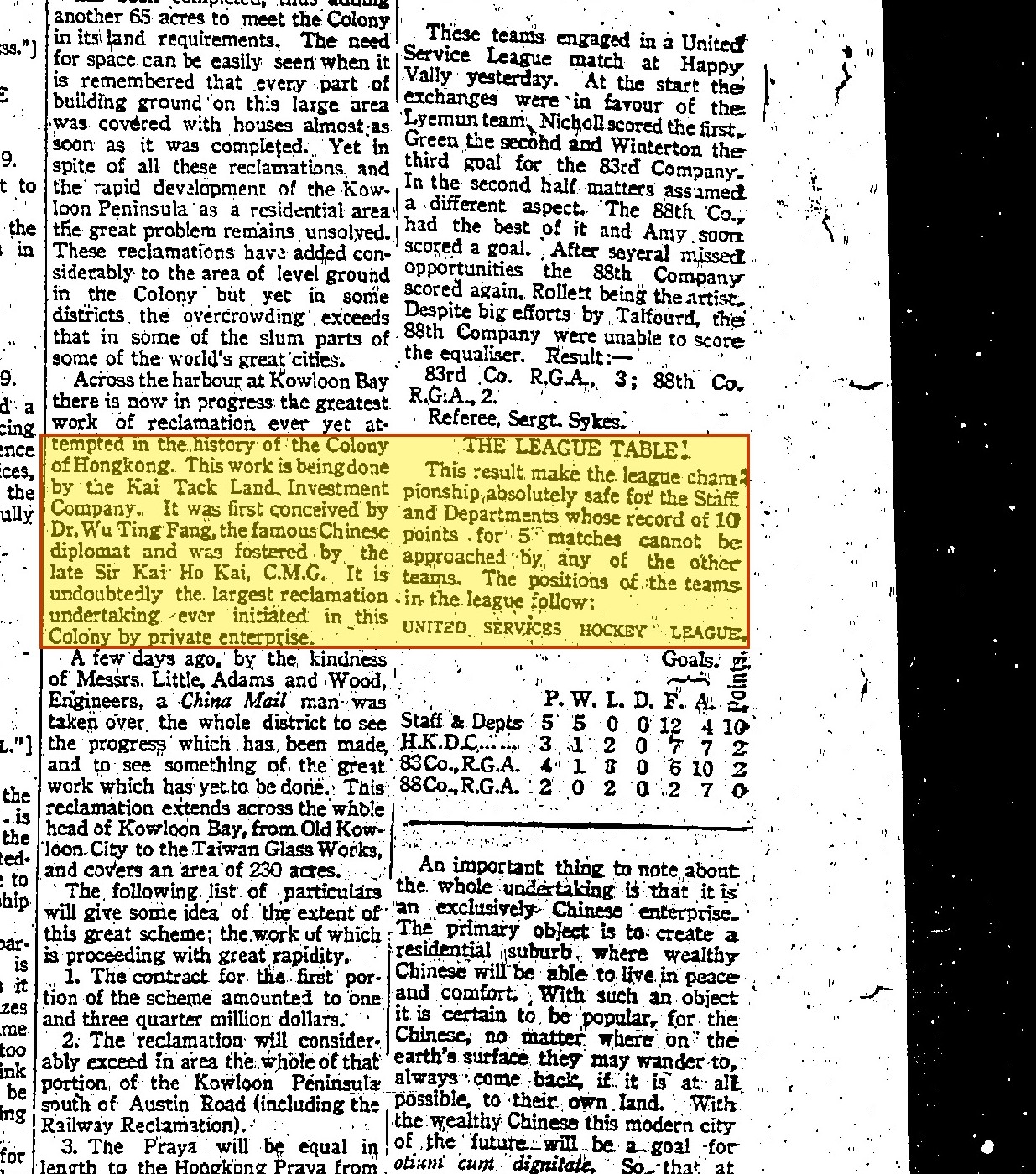
九龍灣灣頭原是海面。啟德計劃的構想,最早以文字記於公司自己的表述之中:《德臣西報》1919年4月11日的實地報道說,這是「本殖民地歷來所嘗試最大的填海工程」,由啟德營業有限公司進行,「最先由著名中國外交家伍廷芳博士構想,並由已故的何啟爵士(C.M.G.)扶植」,並且「無疑是本殖民地私人企業所發起最大的填海工程」。2 同一段話在1918年11月29日的《孖剌西報》上已由立法局議員Bowley提出;該報同時記錄了公司的改組方案:新股東以舊股換取新公司五元股份,並可優先認購新股。3
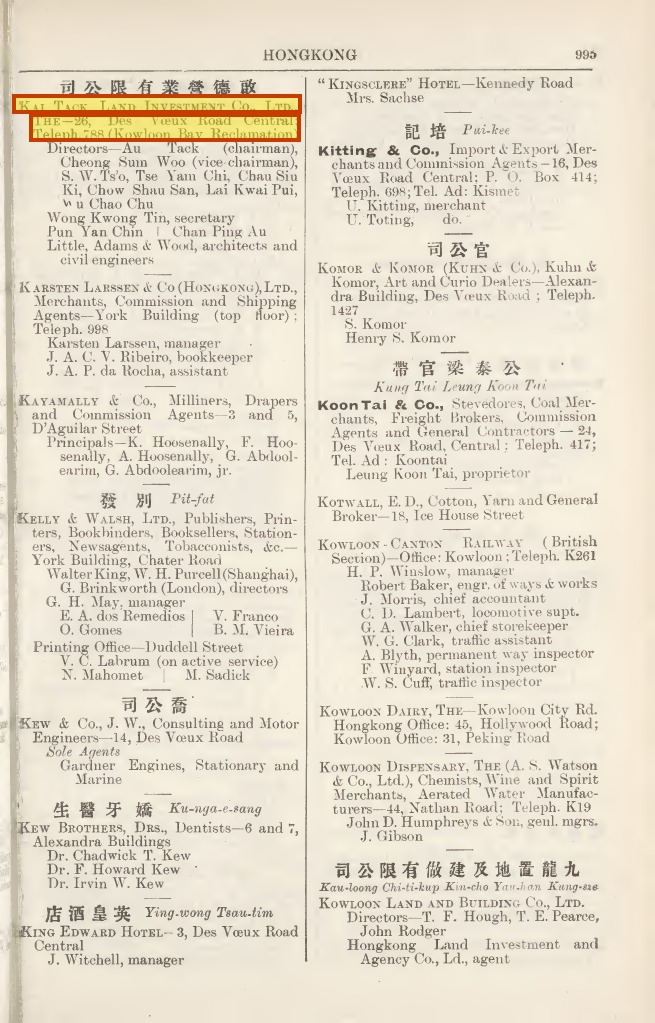
1916年11月16日,《孖剌西報》報道這項由啟德公司在九龍進行的填海工程「一星期內動工」。4 《香港指南》1919年首次載入公司;1920年的雙語條目印出它的中文名——「啟德營業有限公司」——地址為德輔道中26號,電話788,附註「Kowloon Bay Reclamation」;董事名單以區德(Au Tack)為主席,張心湖(Cheong Sum Woo)為副主席,建築師及土木工程師為Little, Adams & Wood。56
公司自述的規模:自舊九龍城至太古糖廠,佔地二百三十英畝;首期工程合約一百七十五萬元;海旁大道長度與由郵政總局至Whitty Street的港島海旁相等;可供遠洋輪船低潮泊岸的碼頭;四英畝遊樂場;海旁闊一百七十五呎,中央大道闊一百呎,其餘街道闊五十呎,均植樹。《德臣西報》記者由公司工程師帶同參觀全區後,寫下一句定義了整個計劃的話:「這是一項完全由華人經營的企業……首要目標是創造一個住宅郊區,讓富有的華人能夠安居」——「對富有的華人來說,這座未來之城將是他們的目標」。2
二、花園郊區與它的難關
1920年,行政局會議紀錄記載政府曾「討論九龍灣填海計劃,以及進一步援助是否適宜——條件是啟德公司改組內部安排、修改股東權利」,並先交由工務司報告工程進度、完成費用,以及「已完成部分若置之不顧,被海水摧毀的危險,與未完成部分變成不衛生沼澤的可能」。7 同年10月28日,立法局宣佈政府已從啟德填海公司購入九龍城填海區東端十五英畝土地,擬建新監獄與警察訓練學校;同一篇演辭說:「政府真誠希望啟德填海計劃成功……發起人因缺乏完成如此宏大計劃所需的資金而備受掣肘」,並期望「新的巴士與渡輪服務、通往九龍城的新道路」有所幫助。8 一星期後,議員促請政府「加緊開辦九龍東渡輪與九龍城巴士線」,政府答覆當週招標渡輪。9
公司自己解決交通問題:1923年,其附屬公司「啟德巴士有限公司」開辦尖沙咀至九龍城、油麻地至九龍城的新線。10 1922年2月,公司在灣頭一幅孤立地段上豎起一座「像小型德國碉堡」的方形水泥屋,作為建築新法「Simplex」的示範——花園郊區尚未建成,先成了新技術的展場。11 但資金問題無法以實驗解決:1923年10月4日,立法局宣佈「公司因種種原因未能迅速推進全部計劃,政府已承擔代公司完成填海,以全部未售土地作為墊支還款的抵押」。12
三、沒有建成的監獄
監獄本是這塊土地上第一座公共建築。1920年10月28日的演辭說,新監獄選址牛池灣(Ngau Shi Wan),購自啟德填海公司的十五英畝「位置對監獄與警校都極佳」,附近「有大量花崗岩,擬用囚犯開採」。8 1920年12月9日的會議紀錄批註:「此為從啟德填海公司購入監獄用地。批准。」9 1924年10月16日,工務委員會宣布「新監獄與警察訓練學校」的樁柱工程合約已批出,「警察訓練學校將佔用啟德填築地約十二英畝,位於監獄西面」。13 然後是1926年10月15日的一句話:「政府很遺憾,無法繼續進行啟德填築地上擬建的新監獄。」因為期待新監獄落成,域多利監獄的維修早已減至最低,政府要另外申請特別撥款。14
這座「沒有建成的監獄」留下了帳單:1928年,航空部派員視察啟德機場時,政府列出為此地支出的三十二萬五千餘元——1920年向啟德置業公司收回地段的十一萬五千四百七十元、1921年完成海堤的一萬五千零八元七五、監獄樁柱基礎的二十六萬五千五百元——並聲明這塊「Ngau Chi Wan監獄用地」必須與機場分開計算。15 十年後,監獄在赤柱建成。
四、機場接手
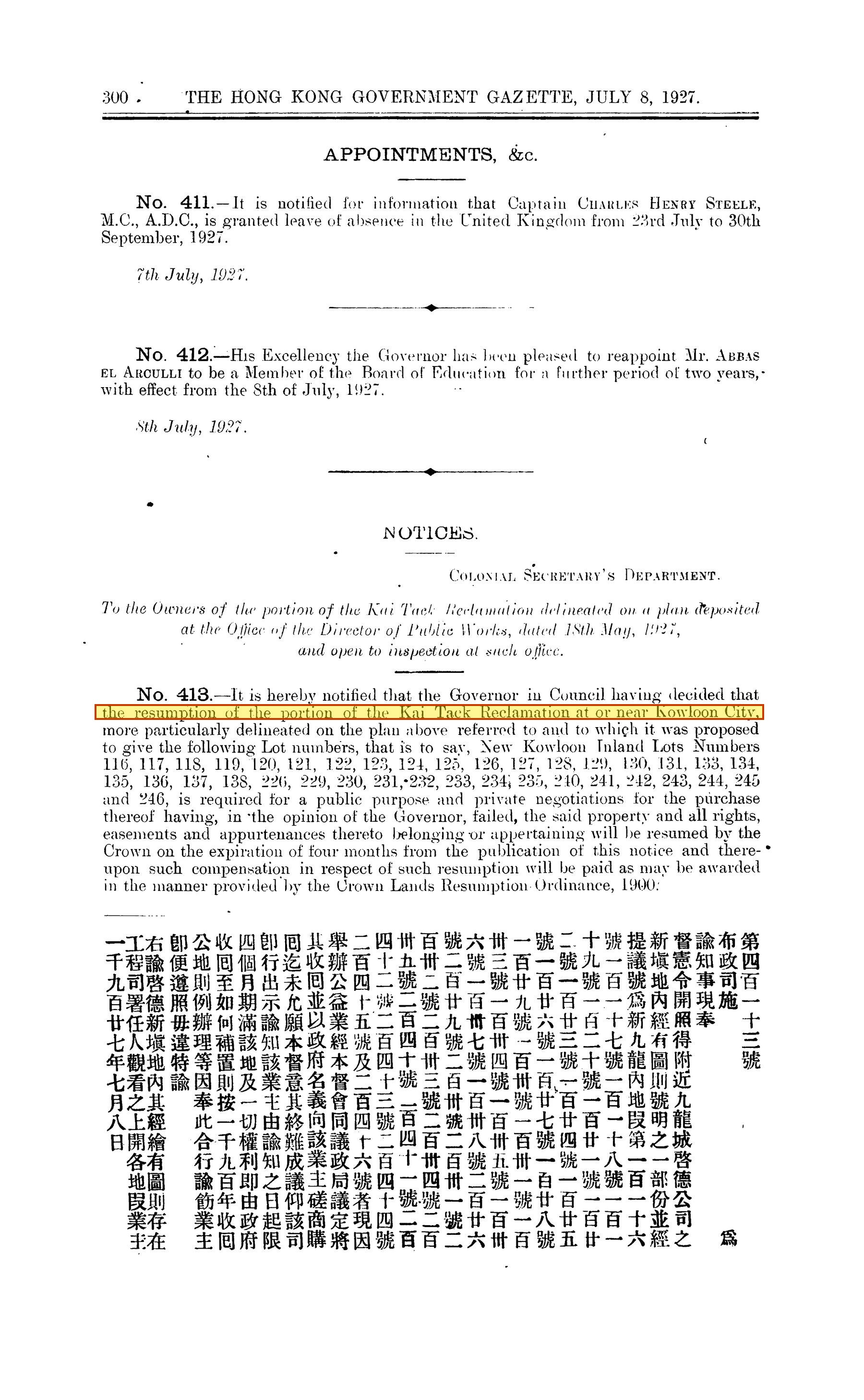
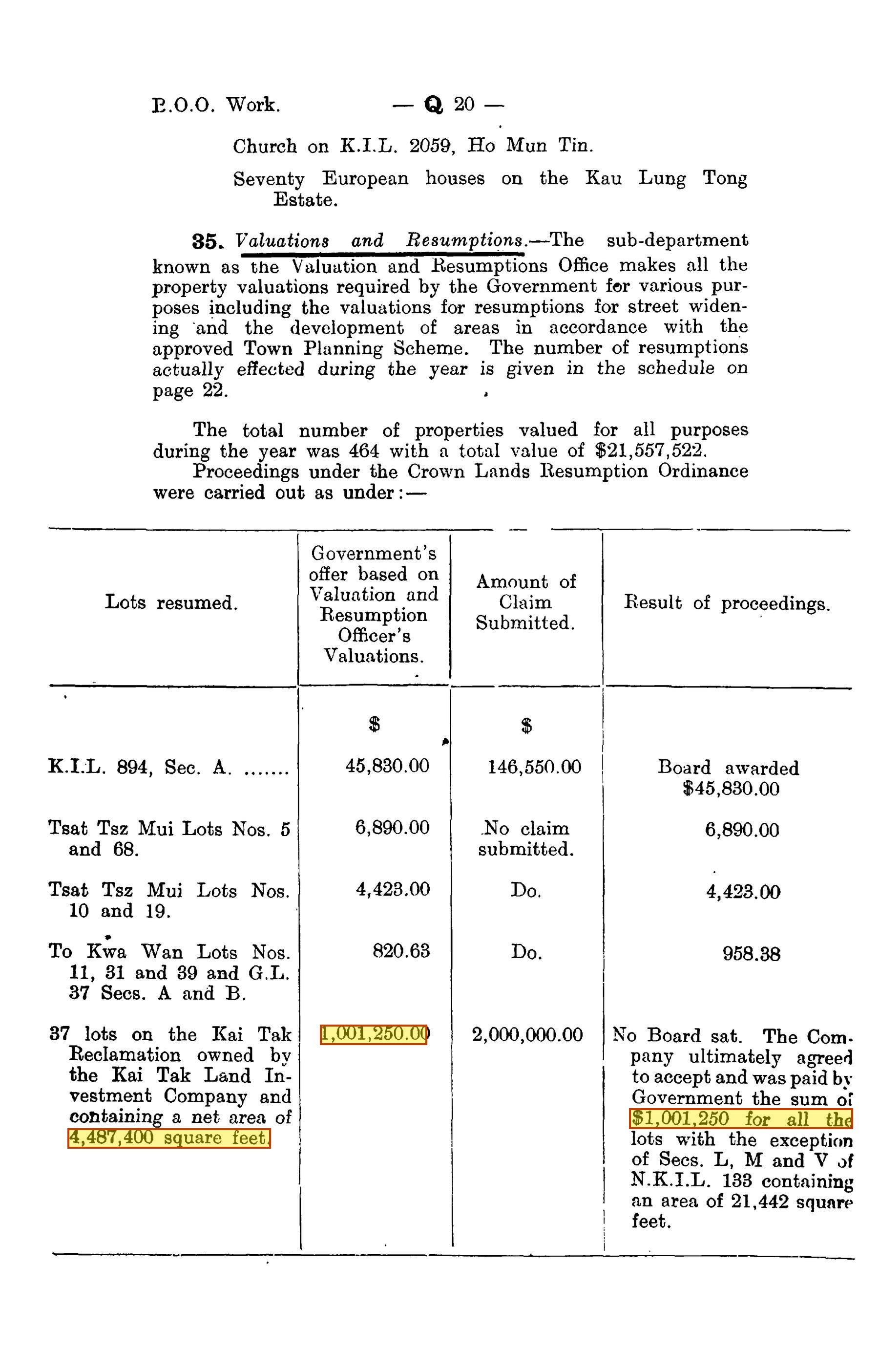
1927年6月,立法局在貸款議案中首次把「啟德機場的殖民地分擔費用」列入公共工程;16 7月8日,政府憲報刊登第418號公告:啟德填築地內三十七幅新九龍內地段(116至138、226至246號)「因公共用途所需,且私人洽購已失敗」,四個月後由政府收回;公告以中英雙文刊出,中文欄直書「啟德公司」之名。17 1927年9月的演辭披露帳目:一百萬元臨時撥作海港疏浚與機場的殖民地分擔,按「英政府承擔四分之三」的建議,殖民地需付五十九萬四千五百元;翌年定案為英方一筆十萬鎊。18 1927年9月9日,美國飛行員Brock與Schlee的「底特律之傲」號完成環球飛行的一站,「下午三時二十五分在啟德皇家空軍機場完美降落」,總督金文泰夫婦親臨機場。19 這是紀錄中最早的降落,而非記錄所稱的「第一架」。1927年的行政報告記下了補償的結局:三十七幅、淨面積四百四十八萬七千四百平方呎,政府出價一百零一萬二千五百元,公司索價二百萬元——「沒有仲裁委員會開庭。公司最終接納,政府以一百零一萬二千五百元購入全部地段(新九龍內地段133號L、M、V分段,面積二萬一千四百四十二平方呎除外)」。2021
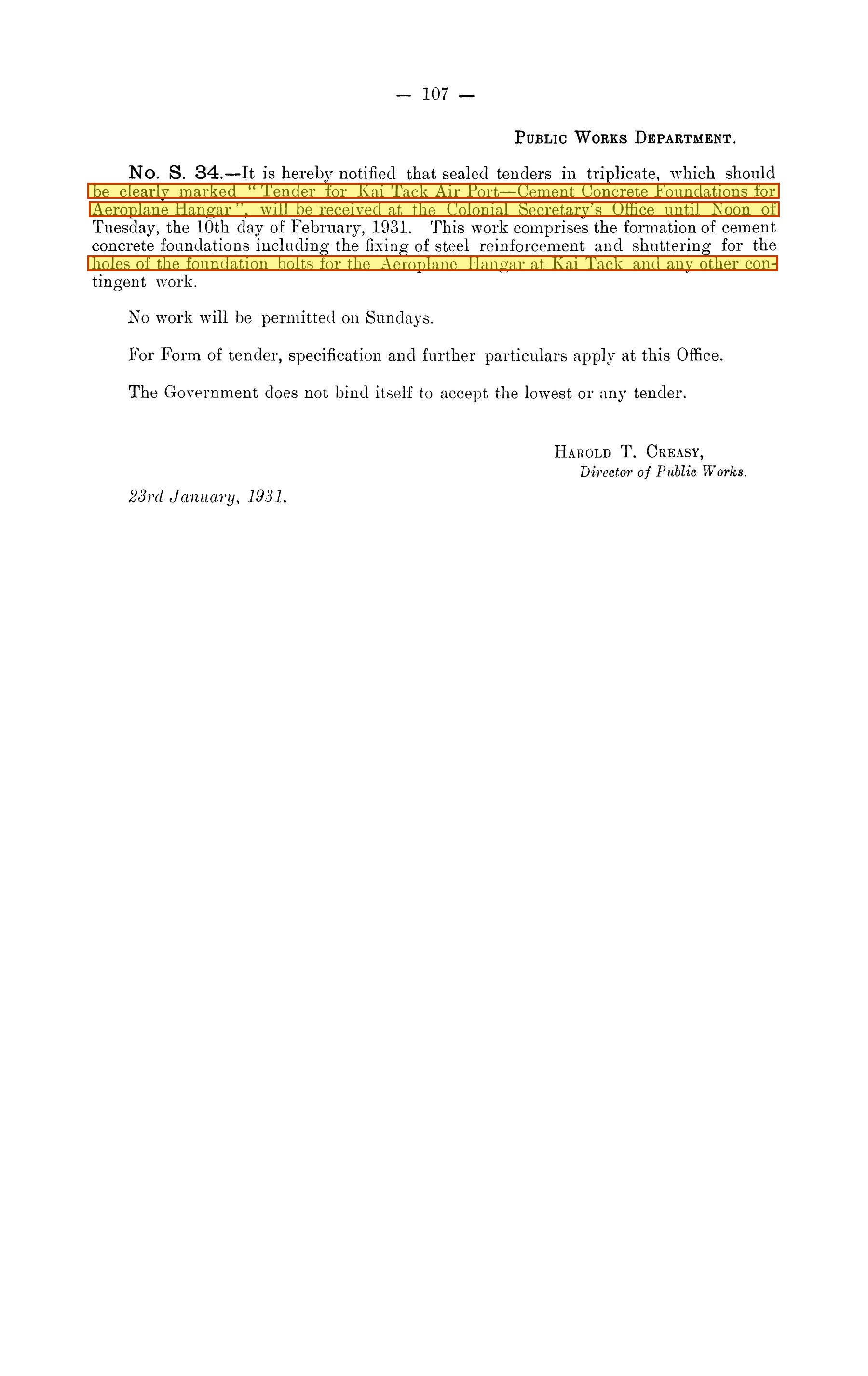
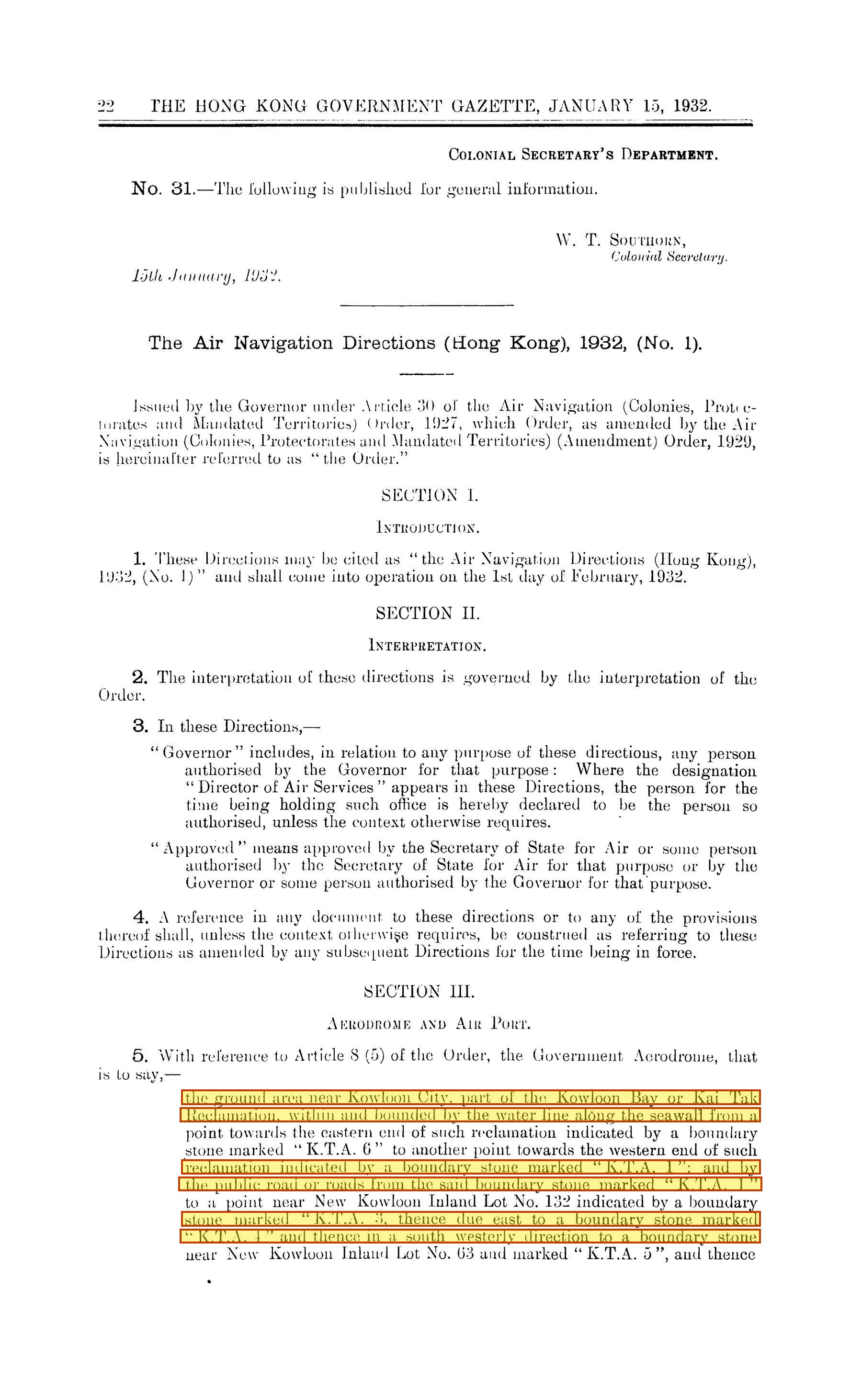
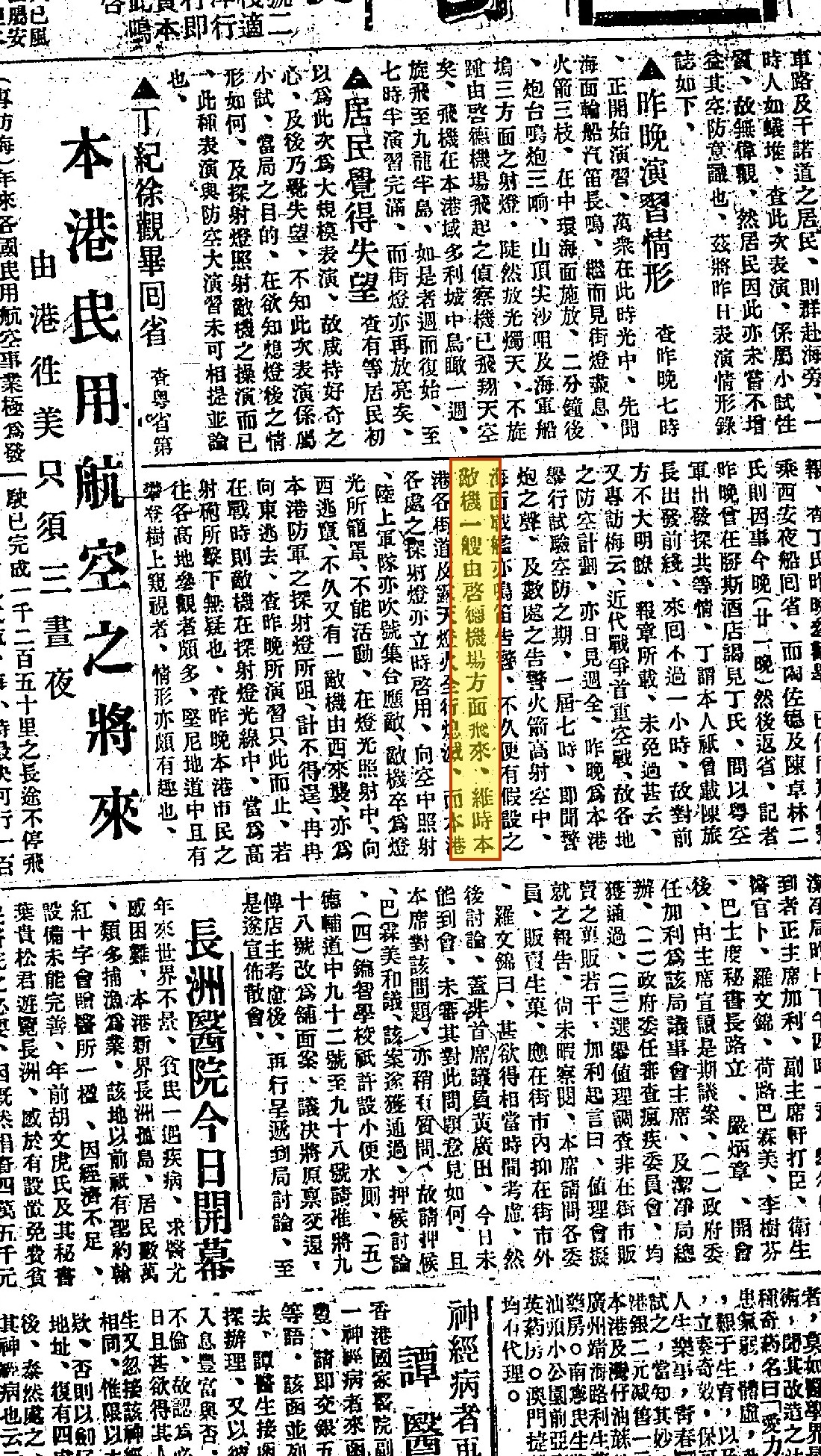
1928年,航空部派J. A. Dawson到港,確定機場布局:皇家空軍佔東面二十八英畝,民航佔十二英畝。15 1931年1月,工務局招標「啟德機場——飛機庫水泥混凝土基礎」,四月的開標紀錄見Vibro Piling與三利公司(Sang Lee & Co.)。22 1932年1月15日,《1932年航空導航指示(香港)第1號》第5條把機場界定為「九龍城附近、九龍灣或啟德填築地一部分的地面」,邊界界石以「K.T.A.1」至「K.T.A.6」標記——一條以界石畫出來的跑道地平。23 當年的夜航、1934年11月21日《工商日報》記載的防空演習(「假設之敵機一架由啟德機場方面飛來,維時本港各街道及露天燈火全行熄滅」),與1935至1937年間一連串「第一次」——帝國航空的Dorado號、泛美「菲律賓飛剪」號首次到訪(1936年10月23日,總裁Juan Trippe同機)、中國航空公司首班滬港航機與「本港首批中國航空郵件」(1936年11月5日)、1937年4月28日「香港飛剪」號的紐約周班郵航——把這塊從花園郊區搶救回來的地面,推進到遠東航空樞紐的位置。242526272829 1936年6月29日,啟德置業公司在律師樓舉行最後一次清盤會議——郊區的公司在機場成形的同一年走完自己的路。30
五、名字
「啟德」二字來自它的兩位華人:何啟之「啟」、區德之「德」。這個組合在1920年代已經是公司的正式中文名「啟德營業有限公司」;1930年代的《工商日報》用它作地址(「啟德濱」的學校廣告)、用「啟德機場」稱呼機場;1941年《百年商業》的條目說得最清楚:「有地啟德濱,原為海灘,再填闢之,是為今日之啟德機場。」3125 換句話說,機場從來沒有被「改名」:它接手了土地,也接手了土地的舊名——而這個名字的來處,是一場沒有完全成功的花園城市夢。
結論
啟德的故事不是「荒地變機場」,而是同一片填海地的接力:華商的自資郊區(1916–1923)、政府接手的公共工程(1923–1926)、被放棄的監獄(1920–1926)、被收回改作機場的三十七幅地(1927),最後是1930年代的航空時代(1931–1941)。殖民政府的檔案在此難得地誠實:它記載了「發起人缺乏資金」、記載了「遺憾無法繼續建監獄」,也記載了以一百零一萬二千五百元結清收回土地的價錢。而土地自己的記憶,存放在名字裡:啟德。
Kai Tak — the land's four lives
The failed garden estate, the gaol that never was, and the aerodrome that kept the name, 1912–1941
Abstract
Kai Tak's name does not come from aviation history but from a failed property scheme. In the 1910s the Kai Tack Land Investment Co., first conceived (the company's own wording) by Dr Wu Ting Fang, fostered by the late Sir Kai Ho Kai, and chaired by Au Tak, reclaimed 230 acres at the head of Kowloon Bay for a garden suburb called Kai Tak Bund — "an exclusively Chinese enterprise", in the China Mail's phrase of 1919, "a residential suburb where wealthy Chinese will be able to live in peace and comfort". The works began in November 1916 and stalled for want of funds; in 1919–20 the Government discussed assistance "conditional on a reconstruction of the internal arrangements of the Kai Tack Company and a modification of the rights of the shareholders"; in 1923 it undertook to finish the reclamation on the company's account, holding the unsold land as security. Meanwhile the Government had bought 15 acres from the company for a new prison (1920), let the piling contract (1924), and in 1926 announced that it was "unable to proceed". In 1927 the Crown resumed 37 lots under the Crown Lands Resumption Ordinance "for a public purpose", the aerodrome planning went to the Air Ministry, and the company was paid $1,001,250 against its $2,000,000 claim; it went into liquidation in 1936. The aerodrome inherited the ground and the name. This paper traces the whole chain from the corpus's own documents, with seven plates read against their scans.
1. The bay and the conception
The head of Kowloon Bay was water. The scheme's own account of its origin survives in two printings: the China Mail's site visit of 11 April 1919 — "the greatest work of reclamation ever yet attempted in the history of the Colony of Hongkong … This work is being done by the Kai Tack Land Investment Company. It was first conceived by Dr. Wu Ting Fang, the famous Chinese diplomat and was fostered by the late Sir Kai Ho Kai, C.M.G. It is undoubtedly the largest reclamation undertaking ever initiated in the Colony by private enterprise."2 — and, in the same words, the Daily Press of 29 November 1918, reporting Mr Bowley's remarks. The same report prints the company's 1918 reconstruction: "you will receive one $5 share in the new company for every share (whether $1 or $5) in the old … a further 100,000 share[s] at 8/6, giving present shareholders the first refusal of them".3
The Daily Press of 16 November 1916 dates the works: the reclamation "which is to be carried out by the Kai Tack Company at Kowloon … the work will be commenced in a week's time."4 The directories carry the company from 1919; the 1920 entry prints its Chinese name, 「啟德營業有限公司」 (right-to-left on the page), beside "KAI TACK LAND INVESTMENT Co., Ld., The—26, Des Vœux Road Central; Teleph. 788 (Kowloon Bay Reclamation)", with "Directors—Au Tack (chairman); Cheong Sum Woo (vice-chairman)…", and "Little, Adams & Wood, architects and civil engineers" — the same engineers who took the China Mail's reporter over the works.56 Their co-founder's presence in the Colony in 1920 is separately recorded — an interview granted "through the introduction of Mr. Wong Kwong-tin, the manager of the Kai Tack Land Investment Co."32
The scale, from the company's own statement: 230 acres from Old Kowloon City to the Taikoo works; "the contract for the first portion of the scheme amounted to one and three quarter million dollars"; a Praya "equal in length to the Hongkong Praya from the General Post Office to Whitty Street"; piers "at which ocean-going steamers can be berthed at low tide"; "an area of four acres … laid out as a Recreation Ground"; the Praya 175 feet wide, the main central thoroughfare 100 feet, all other roads 50 feet, "the Praya and the main central thoroughfare … lined with trees". The reporter's summary is the sentence the record kept: "**it is an exclusively Chinese enterprise. The primary object is to create a residential suburb where wealthy Chinese will be able to live in peace and comfort** … With the wealthy Chinese this modern city of the future will be a goal".2
2. The garden suburb and its remedies
By 1919 the Executive Council was already weighing the company's finances: the Council "discussed the Kowloon Bay Reclamation Scheme and the advisability of further Government assistance **conditional on a reconstruction of the internal arrangements of the Kai Tack Company and a modification of the rights of the shareholders**", and referred the matter to the Director of Public Works for a report on "the progress of the work, the probable cost of completion, **the danger of the work already done being destroyed by the sea if left incomplete, and the likelihood of the unfinished portion becoming an unhealthy swamp**".7 The Annual Reports mark the slide: 1920, "substantial progress"; 1921, "**but little progress** … The sea-wall of that portion of it acquired by the Government as the site for the new gaol was completed"; 1922–23, "some further progress".333435
The Government's goodwill is on the record: "It is the sincere hope of the Government that the **Kai Tack Reclamation Scheme at Kowloon City** will meet with the success which is anticipated by the promoters. **The promoters have been somewhat handicapped by lack of the funds necessary to complete so ambitious a project** … the new omnibus and ferry services and the new roads to Kowloon City will no doubt prove of considerable assistance."8 The estate's own remedy followed: its subsidiary, "the Kai Tack Motor Bus Co., Ltd.", opened the Tsimshatsui–Kowloon City and Yaumati–Kowloon City services in 1923.10 The estate also served as a laboratory: in February 1922 a square concrete building on an isolated section of the holding — "something like a miniature German 'pillbox'" — demonstrated the "Simplex" construction system.11 On 4 October 1923 the Government took over the work itself: "Item 100 provides a nominal sum in respect of the **Kai Tack Company's Reclamation at Kowloon City. The Company for various reasons has been unable to proceed with the full scheme with sufficient expedition, and the Government has undertaken to complete the reclamation on the Company's account, holding all the unsold land as security for full reimbursement of money expended.**"12
3. The prison that was piled
The first public building on the ground was to be a prison. LegCo, 28 October 1920: "$40,000 is provided for the commencement of the **new Gaol building at Ngau Shi Wan**. The Government has acquired from the Kai Tack Reclamation Company an area of **15 acres** of reclaimed ground at the eastern end of Kowloon City Reclamation, upon which it is proposed to erect the Gaol and the Police School. The site is admirably situated for both purposes and there is in the immediate neighbourhood a very large quantity of granite upon the working of which it is proposed to employ the prisoners."8 ExCo approved the purchase, minuted as "the purchase of the gaol site from the Kai Tack Reclamation Co. Approved".9 The Council's minute book also carries the standing item — "Arrangements with the Kai Tack Land Investment Co. with regard to the reclamation at Kowloon Bay" — and the earlier approval of "the proposed site for a new prison at the Eastern end of the new reclamation at Kowloon City".36 LegCo, 16 October 1924: "Item 97. **New Gaol and Police Training School**.— A contract has been let for the piling of the site and it may be possible to begin building before the end of next year … **The Police Training School will occupy about twelve acres of the Kai Tak Reclamation on the west side of the Gaol.**"13 And then, LegCo, 15 October 1926: "**The Government regrets that it is unable to proceed with the proposed new prison on the Kai Tak Reclamation.** In anticipation of the completion of the new prison repairs had been reduced to the minimum at Victoria Gaol and it has therefore become necessary to ask for a special vote this year."14
The piling was not wasted from the archive's point of view: the 1928 Air Ministry file accounts for "the Colony's expenditure in this connexion … **$395,978.75**" — "1. 1920 — **Resumption of Site from Kai Tak Land Investment Company $115,470.00**; 2. 1921. Completion of Sea Wall and Rubble pitching … $15,008.75; … [4.] **Gaol Foundations Piling etc $265,500.00**" — and notes the row the site caused: "Much discussion centred on the question of the **Ngau Chi Wan gaol site** … Dr. [J. A. Dawson] was surprised to hear that the area concerned was not definitely included in the ground available for Royal Air Force development without payment."15 The prison was finally built at Stanley (the 1931 "New Gaol at Wong Ma Kok" tenders).14
4. The aerodrome takes the ground
In June 1927 the loan that would build the waterworks carried, by the Government's own proposal, "the whole cost of the Shing Mun Water Scheme, the cost of purchasing the site of the old Diocesan Boys' School, the cost of the Harbour dredging and **the Colony's share of the cost of the Kai Tak Aerodrome**"; the China Mail's heading over the debate is simply "PROPOSED AERODROME".16 In July the resumption notice followed: Government Notification No. 418, gazetted 8 July 1927 — "the **Kai Tack Reclamation** … New Kowloon Inland Lots Numbers 116 … 246 [37 lots] … **is required for a public purpose and private negotiations for the purchase thereof having, in the opinion of the Governor, failed**" — a bilingual notice whose Chinese column heads the company's name 啟德公司.17 September's speech gives the sums: "$1,000,000 is provisionally allocated for the Harbour Dredging and the Colony's share of the Kai Tak Aerodrome … proposed that the **Imperial Government shall bear three quarters of the cost of the Aerodrome and the Colony one quarter** … the cost to the Colony … would be … **$594,500 for Kai Tak Aerodrome**"; the 1928 file records the final arithmetic — "the contribution from Imperial Funds being fixed at **£100,000**, thereby increasing the proportion of the total cost of the Kai Tak Scheme to be borne by this Colony".1815
On 9 September 1927 the field received its first arrival of record: the "**Pride of Detroit**", flown by William Brock and Edward Schlee around the world, "made a perfect landing at Kai Tak Royal Air Force Aerodrome at 3.25", met by "a large crowd of Royal Air Force officers", with the Governor, Sir Cecil Clementi, and Lady Clementi visiting that afternoon.19 The resumption's end is written in the 1927 Administrative Report: "**37 lots on the Kai Tak Reclamation owned by the Kai Tak Land Investment Company and containing a net area of 4,487,400 square feet … $1,001,250.00 … 2,000,000.00 … No Board sat. The Company ultimately agreed to accept and was paid by Government the sum of $1,001,250 for all the lots, with the exception of Secs. L, M and V of N.K.I.L. 133 containing an area of 21,442 square feet.**"20 (The excepted sections were served with their own notice in December 1927.21)
In 1928 the Air Ministry's own file states the aerodrome's authorship — "(1) **The original suggestion for the construction of an aerodrome came from the Air Ministry** (2) … the area reserved for the R.A.F. being 28 acres at the better end … the area reserved for commercial aviation is only 12 acres" — and Mr J. A. Dawson's visit produced layout plan HK1.15 The same season the press carried the colony's civil-aviation plans — a British company to be formed, "daily services to Canton and Macao, with a weekly return service to Shanghai", and Squadron-Leader Vaughan-Fowler's seaplane club — with the promise that the finished Kai Tak would be "one of the finest air ports of the world".37 Public Works tenders for "**Kai Tack Air Port**—Cement Concrete Foundations for Aeroplane Hangar" went out in January 1931; the successful tenderers were the Vibro Piling Co. and Messrs. Sang Lee & Co.22 The Air Navigation Directions (Hong Kong), 1932, (No. 1) then gave the field its legal body: "the **Government Aerodrome**, that is to say,— the ground area near Kowloon City, **part of the Kowloon Bay or Kai Tak Reclamation**, within and bounded by the water line along the seawall from a point towards the eastern end of such reclamation indicated by a boundary stone marked 'K.T.A. 6' …"— boundary stones numbered K.T.A. 1 to 6.23
5. The first services, and the rehearsal for war
The flying club was at Kai Tak by 1930 ("the Flying Club's Avro-Avian landplane"), and on the evening of 15 November 1932 "**flying history was made** at Kai Tak Aerodrome" — "**the first night flights ever to be accomplished in the Colony**", five flights in an Avro Cadet by Mr Vaughan-Fowler and Mr Bennett, with "**Mrs. A. D. Bennett first lady passenger**" and Mr Charles Lambert of the Kowloon-Canton Railway in the second seat.24 The Colony used the field that same decade to rehearse its defence: on 20 November 1934 (工商日報, next morning) the air-defence exercise put the streets in darkness — 「**不久便有假設之敵機一架由啟德機場方面飛來,維時本港各街道及露天燈火全行熄滅**」, the searchlights catching the raider, a second attack from the west also blocked; the paper's aside is the sentence the war would prove: 「若在戰時則敵機在探射燈光線中當為高射砲所聚下無疑也」 ("in war-time the raider in the beams would be [the] certain mark of the anti-aircraft guns").25
The scheduled services' firsts follow: Imperial Airways' liner Dorado working from Kai Tak (November 1935); Pan American's Philippine Clipper — Juan Trippe aboard — arriving "from Macao shortly before 4 p.m." on 23 October 1936, "making as graceful a landing as ever … to the delight of the huge crowd who had gathered at the aerodrome"; the China National Airways Corporation's Douglas Dolphin flying-boat bringing "the first Chinese airmail for the Colony" from Shanghai on 5 November 1936, received by the Governor, Sir Andrew Caldecott; and the "**Hong Kong Clipper**" inaugurating the weekly Hong Kong–New York service on 28 April 1937, its arrival ceremony broadcast by ZBW.26272829
The estate's own company did not live to see the trunk routes: "**Final [meeting] of Kai Tak Land Investment Co., Ltd. (In liquid.)**" stands in the Daily Press of 29 June 1936, at Messrs Ts'o and Hodgson's offices, Prince's Building, noon.30 The airport was in the official record by 1938 — the Blue Book's "Kai Tak Airport Aerodrome Schedule": "Aerodrome, Public Civil, shared by Royal Air Force. Open for use by civil visiting aircraft without prior permission" — while a 1938 gazette item appointed a "Committee to inquire into the adequacy of the aerodrome at Kai Tak"; the 1941 files already carry the war's touch (the RAF's Sergeants' Mess, a C.N.A.C. crash, and the retrospective that "an Imperial Airways air liner had arrived at Kai Tak aerodrome … with a **record load of mails totalling 1,652 lb**" in 1936).38
6. The name
啟 = 何啟 (Ho Kai); 德 = 區德 (Au Tak). The pairing was already the company's legal Chinese name in the 1920s — 「啟德營業有限公司」, printed in the directories beside "KAI TACK LAND INVESTMENT Co."6 — and the estate's own district name, 啟德濱 ("Kai Tak Bund"), survives in the Chinese record as a working address: the 民生書院 advertised its entrance examinations "在啟德濱本校" in the 工商日報 of January 1930; the 1948 street index lists "士他令道 — 九龍啟德濱對面"; and the 1941 almanac 百年商業 gives the plain formula: 「有地啟德濱,原為海灘,再填闢之,是為今日之啟德機場」 ("there was a place, Kai Tak Bund, originally foreshore; reclaimed, it became today's Kai Tak Airport").31 The modern literature states the naming directly — the airport "was named after Ho Kai and Au Tak"; the period record carries the fact only as this chain of name, men and land.31 Nothing was ever renamed: the aerodrome took the company's ground in 1927 and the company's name with it.
Conclusion
Kai Tak's story is not a wasteland becoming an airport; it is a relay race over one piece of reclaimed ground: the Chinese company's self-financed garden suburb (1916–23), the Government's takeover of the works (1923–26), the prison that was piled and abandoned (1920–26), the 37 lots resumed for a public purpose (1927), and the aviation decade (1931–41) built on all of them. The colonial archive is unusually candid at each handover — "the promoters have been somewhat handicapped by lack of the funds", "the Government regrets that it is unable to proceed", and the final receipt, $1,001,250 — and the land keeps its own memory in the name: 啟德, two Chinese founders of a suburb that failed, worn ever after by an airport that did not.
Appendix A — Evidence register (summary)
| Class | Items |
|---|---|
| Confirmed (2+ witnesses) | C1 company/works/name (press + directories); C2 conception formula (two printings) + name pairing; C3 gaol-site purchase (ExCo + LegCo + 1928 accounting); C4 prison piled then abandoned (LegCo ×2 + piling line); C5 1923 takeover; C6 G.N. 418 resumption, 37 lots; C7 $1,001,250 settlement (+ the N.K.I.L. 133 notice); C8 Air Ministry origin, £100,000; C9 Sept 1927 arrival; C10 1931 hangar + 1932 Directions; C11 the four "firsts" of 1935–37; C12 1936 liquidation. |
| Conflicts (kept as printed) | K1 Kai Tak/Kai Tack; K2 G.N. 418 vs the OCR's "413" (scan wins); K3 ¾ proposed vs £100,000 fixed; K5 230 vs 210 acres; K6 naming etymology (recorded inference); K7 1914 (modern) vs 1916 (first corpus works); K8 Ngau Shi Wan/Ngau Chi Wan. |
| Failed (do-not list) | personal-name "Kai Tak"s; the 1913 Corinthian Yacht Club cruise; the 19th-century "China clipper" ships; the 1961/72 name-reusing company; the interleaved 1941 war-page false hits. |
| Gaps | the incorporation record; Au Tak's exit; the full Chinese column of G.N. 418; whether the Pride of Detroit was the first aircraft ever (no "first" claim in the record — registered as the earliest arrival of record). |
Appendix B — Method and false-positive classes
Both period spellings were searched (Kai Tak / Kai Tack), in both the text and image indices; the Chinese record was searched as 啟德, 啟德濱, 啟德機場, 啟德營業, 啟德公司, 區德, 何啟, 伍廷芳. The compulsory whole-document pull is CO 129/508-8 (119 pp.); the plate pages were read back by eye against their scans (the 2026-10-30 §6B pass). Four classes of false positive were separated from the record: (1) personal names romanized "Kai Tak" (Wong Kai Tak of the Stamp Office, 1903–04 Blue Books); (2) garble ("Yuan Shih-kai tak[ing]"); (3) the same-named later company (post-war property ads) and the estate's bus subsidiary, whose operations belong to the motor-bus thread; (4) page-level interleaves (1941 war reports beside Kai Tak columns). The corpus's Chinese press begins in 1926, so the estate's Chinese record is thinner than its English one — and the company's own Chinese name in the 1920 directories is printed right-to-left on the page, a reading this paper states rather than corrects.
Notes
This paper works from the hkintexts corpus (read-only): the English press of the period (China Mail, Daily Press, Telegraph), the Executive Council minute book (CO 131), LegCo Hansard, the Administrative Reports, Blue Books, the Government Gazette, the CO 129 files, and — for the Chinese record — the directories, the 工商日報 scans (1926–) and the 1941 almanac 百年商業. Every citation carries the public viewer link; the plates were read back by eye against their scans.
↩"Kowloon Bay's modern suburb" (site visit), The China Mail, 11 April 1919, p. 4. hkintexts.histsyn.com/image-page/1731746 (scan read; plate).
↩The housing question (Mr. Bowley on the Kai Tack reclamation), The Hong Kong Daily Press, 29 November 1918, p. 3. hkintexts.histsyn.com/page/2284323.
↩"The reclamation scheme … work will be commenced", The Hong Kong Daily Press, 16 November 1916, p. 4. hkintexts.histsyn.com/page/2278328.
↩The Directory & Chronicle, 1919, p. 970 (the company entry; Au Tack chairman). hkintexts.histsyn.com/page/1082197.
↩The Directory & Chronicle, 1920, printed p. 995 — 「司公限有業營德啟」(啟德營業有限公司, printed right-to-left) / "KAI TACK LAND INVESTMENT Co., Ld." hkintexts.histsyn.com/image-page/932310 (scan read; plate).
↩Executive Council minutes (CO 131), p. 1509 — "Kowloon Bay Reclamation … reconstruction of the internal arrangements". hkintexts.histsyn.com/page/5229338.
↩LegCo Hansard, 28 October 1920 (the new Gaol at Ngau Shi Wan; the 15-acre purchase; "the sincere hope of the Government"). hkintexts.histsyn.com/page/1882159.
↩LegCo Hansard, 18 November 1920 (ferry and bus assistance for the scheme). hkintexts.histsyn.com/page/1882160; and 9 December 1920, "the purchase of the gaol site from the Kai Tack Reclamation Co. Approved": hkintexts.histsyn.com/page/1882161.
↩"The Kai Tack Motor Bus Co., Ltd., a subsidiary enterprise of the Kai Tack Land Investment Co., Ltd.", The China Mail, 1 May 1923, p. 5: hkintexts.histsyn.com/page/1971497; the new Tsimshatsui–Kowloon City service "under the auspices of the Kai Tak Company", The China Mail, 22 February 1923, p. 8: hkintexts.histsyn.com/page/1970837.
↩"The test building out at Kai Tak" (the "Simplex" demonstration), The China Mail, 9 February 1922, p. 8. hkintexts.histsyn.com/page/1967137.
↩LegCo Hansard, 4 October 1923 (the Government completes the reclamation on the Company's account). hkintexts.histsyn.com/page/1882211.
↩LegCo Hansard, 16 October 1924 (New Gaol and Police Training School; the piling contract; the cables to "the New Gaol on the Kai Tak Reclamation"). hkintexts.histsyn.com/page/1882226.
↩LegCo Hansard, 15 October 1926 ("The Government regrets that it is unable to proceed with the proposed new prison on the Kai Tak Reclamation"). hkintexts.histsyn.com/page/1882261. The prison went to Stanley instead — Government Gazette, 1931, "New Gaol at Wong Ma Kok": hkintexts.histsyn.com/page/1576249.
↩CO 129/508-8, "Plans and reports on proposed aerodrome at Kai Tak, 11-1-1928 – 21-12-1928" (the whole file, 119 pp., read for this paper). First page: hkintexts.histsyn.com/page/514054; the gaol-site accounting at hkintexts.histsyn.com/page/514082.
↩"Proposed aerodrome", The China Mail, 24 June 1927, p. 6: hkintexts.histsyn.com/page/1987254; the loan speech, LegCo, 23 June 1927: hkintexts.histsyn.com/page/1882273; Daily Press, 24 June 1927, p. 4: hkintexts.histsyn.com/page/2313367.
↩Government Gazette, 8 July 1927, G.N. 418 — the resumption of the Kai Tack Reclamation (bilingual; the Chinese column heads the company 啟德公司). hkintexts.histsyn.com/image-page/1462599 (scan read; plate). Text print: hkintexts.histsyn.com/page/1570430.
↩LegCo Hansard, 1 September 1927 (the $1,000,000 allocation; the proposed three-quarters Imperial share; the Colony's $594,500). hkintexts.histsyn.com/page/1882278.
↩"Pride of Detroit … perfect landing at Kai Tak Royal Air Force Aerodrome", The Hong Kong Daily Press, 10 September 1927, p. 10. hkintexts.histsyn.com/page/2314245.
↩Administrative Report 1927, "Valuations and Resumptions" (the 37 lots; $1,001,250 accepted). hkintexts.histsyn.com/image-page/429018 (scan read; plate).
↩Government Gazette, 23 December 1927, G.N. 754 (the owner of New Kowloon Inland Lot No. 133, Sections L, M and V). hkintexts.histsyn.com/page/1570888.
↩Government Gazette, 23 January 1931, G.N. S. 34 — "Tender for Kai Tack Air Port — Cement Concrete Foundations for Aeroplane Hangar": hkintexts.histsyn.com/image-page/1475272 (scan read; plate). Successful tenderers: hkintexts.histsyn.com/page/1575121 and hkintexts.histsyn.com/page/1575768.
↩Government Gazette, 15 January 1932, G.N. 31 — The Air Navigation Directions (Hong Kong), 1932, (No. 1), s. 5: hkintexts.histsyn.com/image-page/1479020 (scan read; plate). Housing Fees: hkintexts.histsyn.com/page/1576665; the $75,700 vote: hkintexts.histsyn.com/page/1577077.
↩"Flying history at Kai Tak — successful night flights", The Hong Kong Daily Press, 16 November 1932, p. 8: hkintexts.histsyn.com/page/2338076; the Flying Club's Avro-Avian, Telegraph, 5 August 1930: hkintexts.histsyn.com/page/2939615.
↩《工商日報》, 21 November 1934, p. 1 — the air-defence exercise; the 「敵機…由啟德機場方面飛來」 passage. hkintexts.histsyn.com/image-page/453607 (scan read; plate).
↩Imperial Airways' Dorado from Kai Tak, The Hong Kong Telegraph, 19 November 1935: hkintexts.histsyn.com/page/2973699.
↩The Philippine Clipper's first visit: The China Mail, 24 October 1936, p. 6 — hkintexts.histsyn.com/page/2024208; The Hong Kong Telegraph, 24 October 1936, p. 1 — hkintexts.histsyn.com/page/2980253.
↩"Shanghai-Hongkong air service — first plane arrives at Kai Tak", The China Mail, 6 November 1936, p. 6. hkintexts.histsyn.com/page/2024322.
↩The "Hong Kong Clipper" and the weekly New York service, The Hong Kong Daily Press, 23 April 1937, p. 1. hkintexts.histsyn.com/page/2361415.
↩"Final [meeting] of Kai Tak Land Investment Co., Ltd. (In liquid.)", The Hong Kong Daily Press, 29 June 1936, p. 1. hkintexts.histsyn.com/page/2357258.
↩The modern naming statement ("named after Ho Kai and Au Tak") and the modern account of the estate: 《香港極簡史》 and 《空白的一百年》 in the research-publications series — hkintexts.histsyn.com/page/3186262, hkintexts.histsyn.com/page/3186164 (modern secondary; labelled as such). The period Chinese record: 《百年商業》(1941), the 啟德機場 entry — hkintexts.histsyn.com/page/3186159; the 1948 street index "士他令道 九龍啟德濱對面" — hkintexts.histsyn.com/page/1757435.
↩Dr. Wu Ting-fang interview (through Mr. Wong Kwong-tin, manager of the company), The Hong Kong Telegraph, 5 April 1920, p. 6. hkintexts.histsyn.com/page/2896541.
↩Administrative Report 1920, "Reclamations". hkintexts.histsyn.com/page/618497.
↩Administrative Report 1921, "Reclamations". hkintexts.histsyn.com/page/619025.
↩Administrative Reports 1922 and 1923, "Reclamations". hkintexts.histsyn.com/page/619633 and hkintexts.histsyn.com/page/620325.
↩Executive Council minutes (CO 131): "Arrangements with the Kai Tack Land Investment Co. …" hkintexts.histsyn.com/page/5229254; "New prison at Kowloon City", p. 1462: hkintexts.histsyn.com/page/5229291.
↩"Civil aviation for Hong Kong", The Hong Kong Daily Press, 31 August 1928, p. 5: hkintexts.histsyn.com/page/2318138; the seaplane-club proposals, 27 July 1928, p. 6: hkintexts.histsyn.com/page/2317763.
↩Blue Book 1938, "Kai Tak Airport Aerodrome Schedule": hkintexts.histsyn.com/page/682082; the 1938 inquiry committee: hkintexts.histsyn.com/page/477255; the C.N.A.C. crash (September 1941): hkintexts.histsyn.com/page/2073946; the 1936 record mail load (1,652 lb): hkintexts.histsyn.com/page/2062668.
↩