香港經濟困局:蕭條、白銀危機與銀本位的終結(1930–1936)
摘要
本文探討香港在1930年代的經濟困難:大蕭條的貿易萎縮與失業(1930–1933)、 結束銀本位的白銀危機(1934–1935),以及殖民政府的回應機器。語料庫顯示, 這十年的中英語文獻並不對稱——華僑日報始於1947年,故同期中文報刊缺席, 負荷性論斷皆倚重英文原始檔案:憲報、立法局會議錄、行政報告書、香港計冊, 以及《德臣西報》《士蔑新聞》《孖剌西報》與殖民地部檔案 CO 129 L 123/549/14。 1 核心發現是:港府以一週完成脫離白銀——1935年11月4日法幣改革令 衝擊市場,2 9日禁止白銀出口並召開緊急立法局會議,3 12月5日三讀通過《貨幣條例》(1935年第54號),4 6日獲 總督批准,5 成立外匯基金、確定紙幣為法定貨幣、以每盎司純白銀128仙 強制兌售白銀,6 並設三千萬港元借款上限。7 而1930–34 年的調查機器(1930年貨幣委員會、8 1931年克萊格委員會、9 1934年經濟委員會 10)卻只產出被扣壓的報告——11 12 有診斷而無行動;13 直到危機才催生法例。 1936年的財政擠壓以《薪俸徵收條例》(1936年第17號)回應,14 向公務員自身徵收累進式臨時稅。15 16 土地收入枯竭 (G.N. 958:1935年首9個月售地僅190,247.26元,對上一年345,454.14元) 17 是財政結構性缺口的縮影,18 而廣東銀行1935年的停業 與1936年復業,19 20 21 則是白銀外流衝擊金融體系的 具體見證。本文主張:香港的脫銀並非十年漸變,而是在一週內以法例完成的 危機控制;此前的調查年代則是「有診斷、無行動」的機器。
關鍵詞:香港經濟史、白銀危機、貨幣條例、外匯基金、 薪俸徵收、大蕭條、法幣、銀本位
一、引言:三層機器
1930年代的香港經濟困難,在於其自身記錄所呈現的三層機器:診斷 (1930–34年的一連串委員會)、危機控制(1935年11–12月),以及財政擠壓 (1936年)。這三層並非同一速度運作:調查年代綿延四年,報告被扣壓、 被評為「束之高閣」,12 卻在危機一週之內化為法例。 5 本文的主張是:香港脫離銀本位,是一次以法例完成的危機控制, 而非十年的漸變;此前的機器只產出診斷,不產出行動。
負荷性論斷的來源結構本身即是第一個發現。1 語料庫的同期中文 報刊從1947年5月1日才開始,故白銀風潮、毫洋與法幣的邊境兌換、按揭與 銀號的世界,只能倚賴現代二手文獻的支持;22 本文凡涉及中文語彙之處, 皆明確標示其現代二手地位,不以語料庫發現論之。所有以英文為本的 論斷則以檔案為據,並附公共檢視連結(規則8)。
二、蕭條年代(1930–1933):有診斷,無行動
蕭條的社會面在殖民地自己的記錄中留下痕跡。23 聖文森 慈善會年報記錄了經濟蕭條的社會邊緣,24 而海峽殖民地以免費 船票將失業華人遣返中國,25 顯示這是區域性而非僅殖民地的 蕭條。貨幣層面,1930年4月總督署任命貨幣委員會,閉門進行,8 1931年在殖民地部邀請下重組,由克萊格率領,9 其報告卻在 1931年10月仍被記錄為未曾公布,11 至1934年8月被《士蔑新聞》 以「束之高閣?」為題質問——「克萊格委員會提交報告已三年」,12 其建議皆未實施。13 1934年成立的經濟委員會10 雖終於委託舒頓(Shenton)作出外部成因的診斷,其建議仍是「等待」。
三、白銀危機(1934–1935):外部壓力與市場崩解
美國1934年的購銀法案26 是壓力的外部來源;1934年11月 香港市場已見白銀外流(現貨23⅜、23-7/16,27 天津「青島丸」 輪查獲58,000元白銀 28)。29 1935年10月,殖民地 財政司在立法局直言匯率因素「是威脅」,30 引述《泰晤士報》8月 15日的警告。真正的崩解發生在1935年11月:中國3日於上海宣布法幣改革, 2 香港匯市「完全失去方寸」,2 匯豐銀行停止買賣;2 22 澳門7日亦禁止白銀出口,31 溢價達四至五成。31
四、一週脫銀(1935年11–12月):危機控制的機器
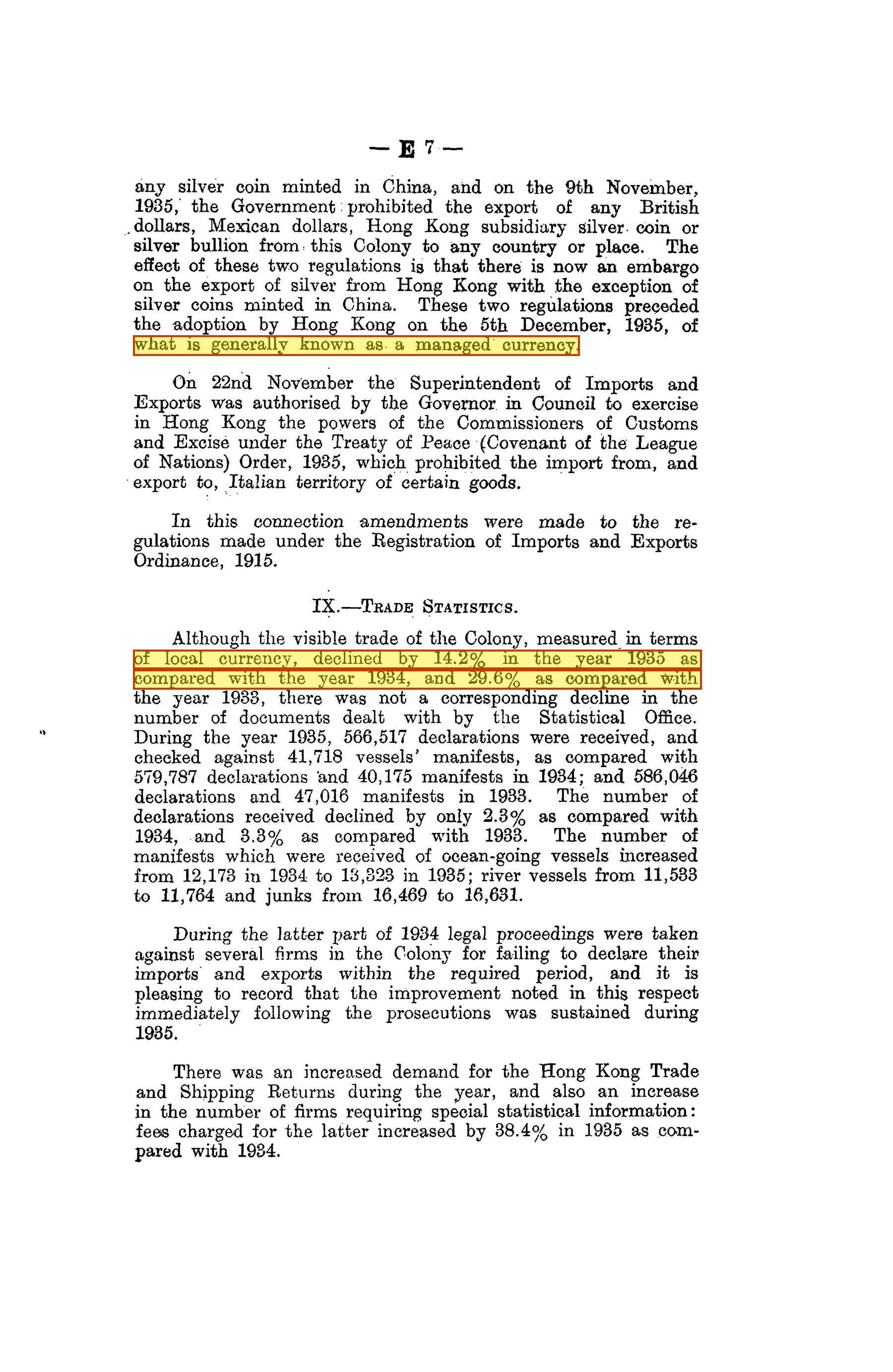
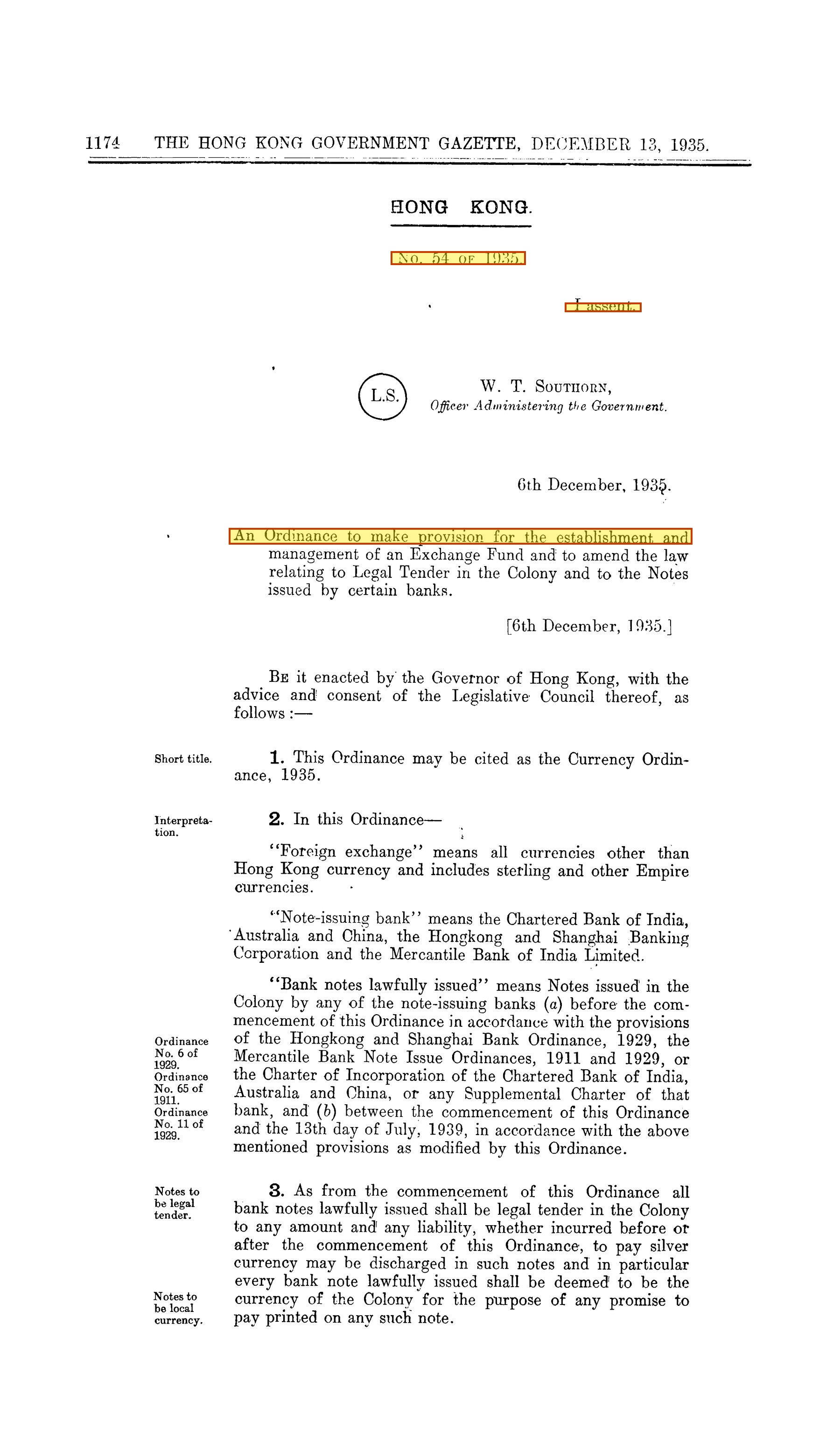
港府在一週內完成三步。第一步是11月6日的《公共收入保護條例》命令 (G.N. 864),32 對含酒精飲品及煙草實行配給,32 12月1日以G.N. 927解除。33 第二步是11月9日:政府禁止所有 白銀出口(英、墨銀元、香港輔幣白銀及生銀),3 同日召開 緊急立法局會議,發行一元法定紙幣並公告銅鎳十分、五分輔幣,「以紓 目前輔幣短缺」。3 行政報告書記載此二規例先於新貨幣政策 之採納。34 35 第三步是12月5日:立法局 一日三讀通過《貨幣條例》(1935年第54號),4 6日 獲批准。5 條例成立外匯基金,確定三家發鈔銀行為法定紙幣 (渣打、匯豐、有利),6 設三千萬港元借款上限,7 並以一個月期限、按銀元面值或生銀每盎司純白銀128仙強制兌售白銀, 6 違者最高一年監禁及兩倍罰款。6 《士蔑新聞》 於7日全文刊載。36 而G.N. 227記錄英廷未對該條例提 不同意見,37 完成帝國層面的批准程序。37
五、財政擠壓(1936):薪俸徵收與結構性缺口
匯率下跌使1936年赤字增加三百萬元(2,926,303元→5,926,303元), 15 政府的回應是《香港政府服務(薪俸徵收)條例》(1936年第 17號):向公務員自身徵收累進式、追溯性的臨時稅,14 星元薪俸 按1先令8便士計,16 1935年結餘僅138,913.27元。16 38 7月的《貨幣修訂條例》1936是該法例的首次修訂。39 而財政的結構性缺口在於土地與片稅收入枯竭:G.N. 958比較表顯示1935年 首9個月售地收入僅190,247.26元,對上一年345,454.14元,17 40 而香港計冊「貿易蕭條」各列(船艇牌照、魚類牌照、街市及 屠場費用、化驗費)則以數字記錄了蕭條。18 廣東銀行(廣東銀行) 1935年9月4日停業,19 41 1936年11月23日復業,20 21 42 是白銀外流衝擊金融體系的具體見證。
六、結論:法例在一周之內,而診斷在四年之後
1930年代的香港經濟困難,呈現一種鮮明的機器不對稱。1930至34年, 政府以委員會診斷蕭條——貨幣委員會、克萊格委員會、經濟委員會—— 其報告被扣壓、被評為「束之高閣」,11 12 13 有診斷而無行動。43 真正的行動則在 1935年11月中國法幣改革衝擊市場2 之後的一週內完成:配給命令 (G.N. 864)、32 白銀出口禁令、3 緊急發行法定紙幣 與輔幣,3 以及12月5日三讀、6日批准的《貨幣條例》 (1935年第54號),4 5 6 成立 外匯基金、終結銀本位。7 36 1936年的薪俸 徵收14 15 16 則顯示財政擠壓落在公務員自身, 而售地收入的枯竭17 18 與廣東銀行的停業19 20 21 則標示了蕭條的結構性深度。香港不是以十年漸變 告別白銀,而是以一週的法例、四年被扣壓的診斷,寫下這段困局的完整 機器。
Hong Kong's 1930s · Research paper
From Diagnosis to Statute: Hong Kong's 1930s Economic Difficulties and the End of the Silver Standard, 1930–1936
The depression's inquiry machinery, the November–December 1935 silver crisis, Currency Ordinance No. 54 of 1935, and the 1936 Levy on Salaries
Abstract
This paper examines Hong Kong's 1930s economic difficulties across three layers of governmental machinery: the depression's trade slump and unemployment (1930–33), the silver crisis that ended the silver standard (1934–35), and the fiscal squeeze that followed. Because the corpus's contemporaneous Chinese press begins only in 1947, the 1930s stratum is English-majority and the load-bearing claims rest on the English-primary record — the Government Gazette, the Legislative Council Hansard, the Administrative Reports, the Blue Books, the three English dailies, and Colonial Office file L 123/549/14. 1 The central finding is that Hong Kong left silver in a single week of November–December 1935: China's fapi decree of 3–4 November broke the market, 2 the government embargoed silver exports and convened an emergency Legislative Council meeting on the 9th, 3 and the Currency Ordinance No. 54 of 1935, passed 5 December and assented the 6th, established the Exchange Fund, made paper legal tender, demonetised silver with a one-month surrender at 128 cents per fine ounce, and capped borrowing at $30 million. 5 6 The inquiry years (1930–34) by contrast produced reports that were withheld and “pigeon-holed” — 11 12 diagnosis without action 13 until the crisis forced the statute. The 1936 Levy on Salaries Ordinance 14 15 16 shifted the fiscal squeeze onto the government's own servants, while the land-sales collapse 17 and the Bank of Canton's suspension 19 20 21 mark the depression's structural depth.
Keywords: Hong Kong economic history, silver crisis, Currency Ordinance, Exchange Fund, Levy on Salaries, Great Depression, fapi, silver standard
Contents
- Introduction: three layers of machinery
- The depression years, 1930–1933: diagnosis without action
- The silver crisis, 1934–1935: external pressure and market breakdown
- One week off silver, November–December 1935: the machinery of crisis control
- The fiscal squeeze, 1936: the Levy on Salaries and the structural gap
- Conclusion: the statute in a week, the diagnosis in four years
- Appendix A — Query log
- Appendix B — Corrections register
1. Introduction: three layers of machinery
The 1930s difficulties present themselves as three layers of governmental machinery running at different speeds: diagnosis (the commissions of 1930–34), crisis control (November–December 1935), and fiscal squeeze (1936). The inquiry years ran on for four years, their reports withheld and called “pigeon-holed,” 12 while the crisis forced statute in a single week. 5 This paper argues that Hong Kong left silver as a piece of crisis control executed in statute, not as a decade-long drift, and that the preceding machinery produced diagnosis without action.
The source structure is itself the first finding. 1 The corpus's contemporaneous Chinese press begins 11 May 1947, so the vocabulary of the silver crisis, of the border exchange between dollars and fapi, and of the money houses can only rest on modern-secondary frame work; 22 every claim involving Chinese terms is flagged as such, never offered as a corpus finding. The English-primary claims rest on the primary record with the public viewer links (rule 8), the image-series twin cited wherever a page exists in both indices.
2. The depression years, 1930–1933: diagnosis without action
The social edge of the depression registers in the colony's own record. The Society of St. Vincent de Paul's annual report carries the year's distress, 24 while the Federated Malay States repatriated unemployed Chinese on free tickets to China — 25 the slump as a regional, not merely colonial, condition. On the currency side the Acting Governor appointed a Currency Commission in camera in April 1930, 8 its membership joined by the Chinese members Li Tse-fong and Chau Yue-ting, reconstituted at the Colonial Office's invitation under W. H. Clegg in 1931. 9 The report was still recorded as unpublished when the Council sat on 22 October 1931, 11 and by August 1934 the Telegraph opened a column “Pigeon-holed?” with the flat sentence: “Three years have elapsed since the Clegg Commission submitted its Report, containing several important recommendations” — none of them carried into law. 12 The 1934 Economic Commission finally commissioned Shenton's external-causes diagnosis, whose recommendation was, in effect, to wait. 10 13
3. The silver crisis, 1934–1935: external pressure and market breakdown
The United States Silver Purchase Act of 1934 26 supplied the external pressure; by November 1934 the Hong Kong market was showing the outflow (spot 23⅜ and 23-7/16; a 58,000-dollar silver haul seized on the Tsingtao Maru at Tientsin). 27 28 29 In October 1935 the Colonial Treasurer told the Council that the exchange factor in the 1936 Estimates “is a menace,” quoting The Times of 15 August. 30 The breakdown itself came in early November: China announced the fapi reform at Shanghai on 3 November, and the Hong Kong exchange was “completely demoralised,” the Hongkong and Shanghai Bank neither buying nor selling. 2 Macao followed with its own silver-export prohibition on 7 November at a 40–45% premium. 31
4. One week off silver, November–December 1935: the machinery of crisis control
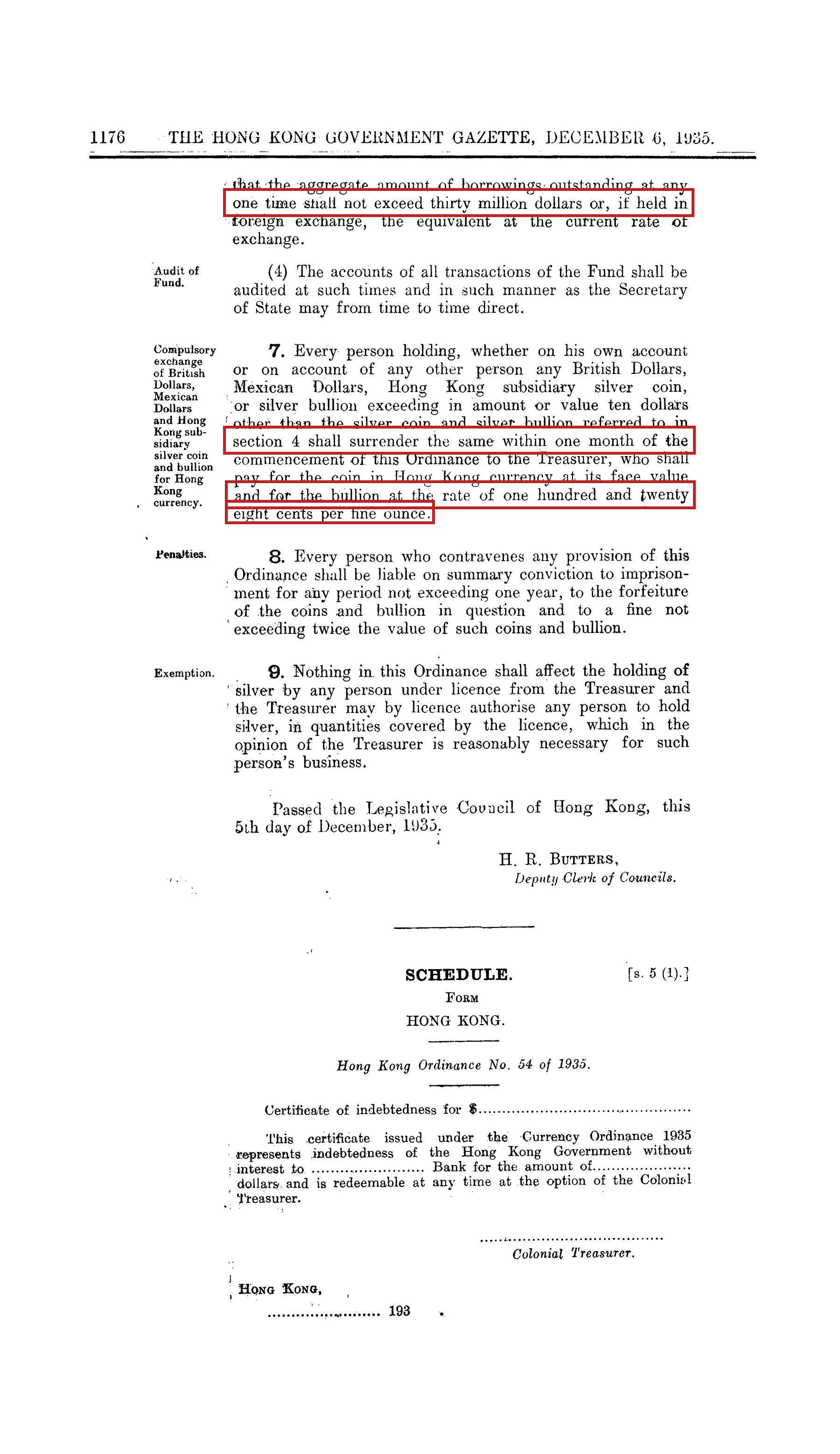
The government moved in three steps inside a single week. The first was the Order under the Public Revenue Protection Ordinance, 1927 (G.N. No. 864 of 6 November), 32 rationing dutiable liquors and tobacco — the crisis's first instrument, rescinded effective 1 December by G.N. 927. 33 The second was 9 November itself: the government prohibited the export of all silver — British and Mexican dollars, Hong Kong subsidiary silver, and bullion — and convened an emergency Legislative Council meeting that issued the Dollar Currency Notes Ordinance and proclaimed cupro-nickel ten- and five-cent pieces “to relieve the present shortage of subsidiary coins.” 3 The Administrative Reports record these two regulations as preceding the adoption of the new currency policy. 34 35 The third step was 5 December: the Currency Ordinance, 1935 (No. 54 of 1935), passed through all its stages in one sitting, 4 assented the 6th. 5 The statute established the Exchange Fund, made the three note-issuing banks' notes (Chartered, Hongkong and Shanghai, Mercantile) legal tender, capped borrowing at $30 million, 7 and set a one-month surrender of silver at coin face value or 128 cents per fine ounce for bullion, under penalty of a year's imprisonment, forfeiture, and a fine of twice the sum. 6 The Telegraph printed the full text the next morning. 36 The Imperial clearance is a separate entry: G.N. 227 of 6 March 1936 records that the Currency Ordinance was not disallowed — the same machinery as the Tung Wah and Telephone threads' assent chains. 37
5. The fiscal squeeze, 1936: the Levy on Salaries and the structural gap
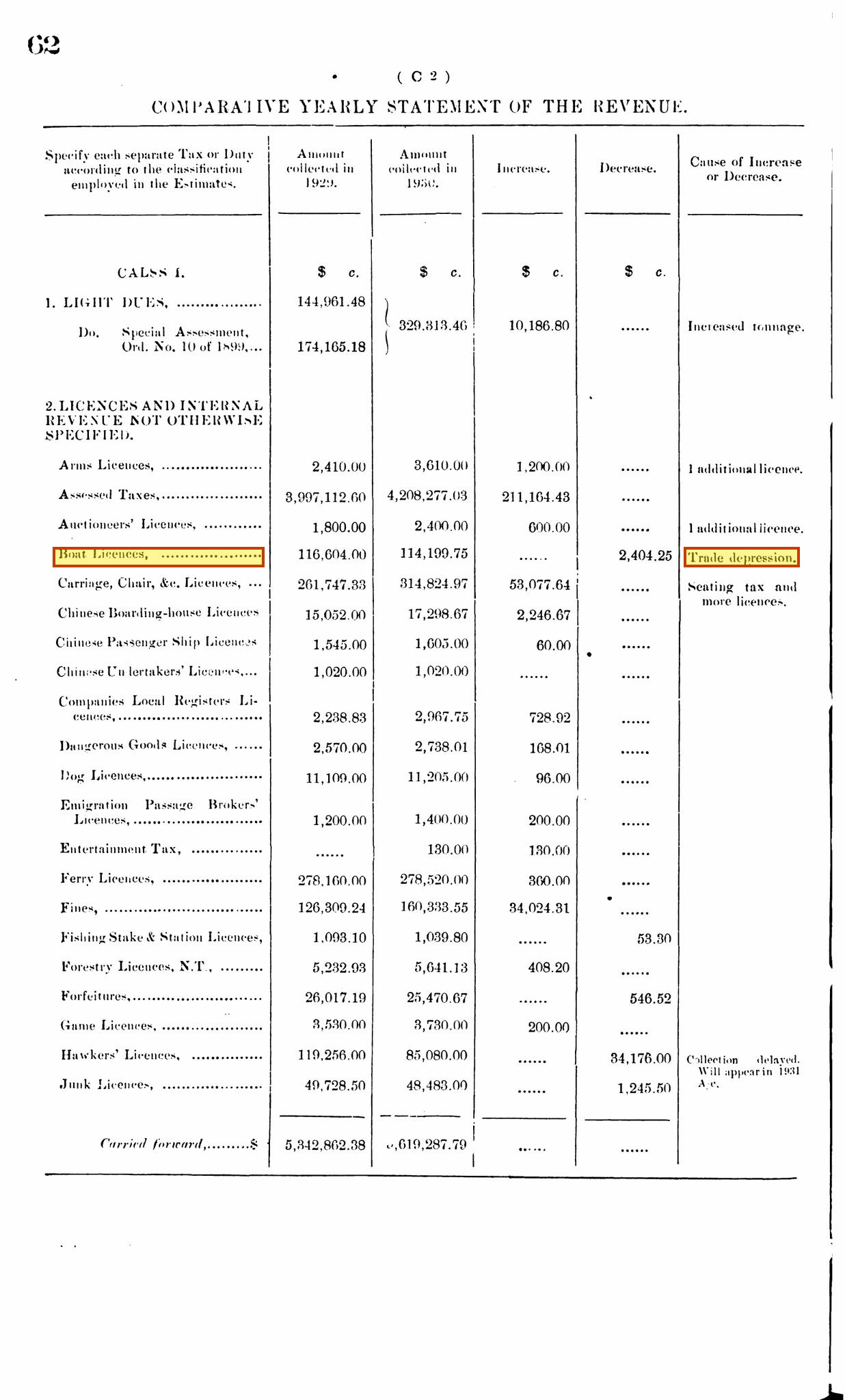
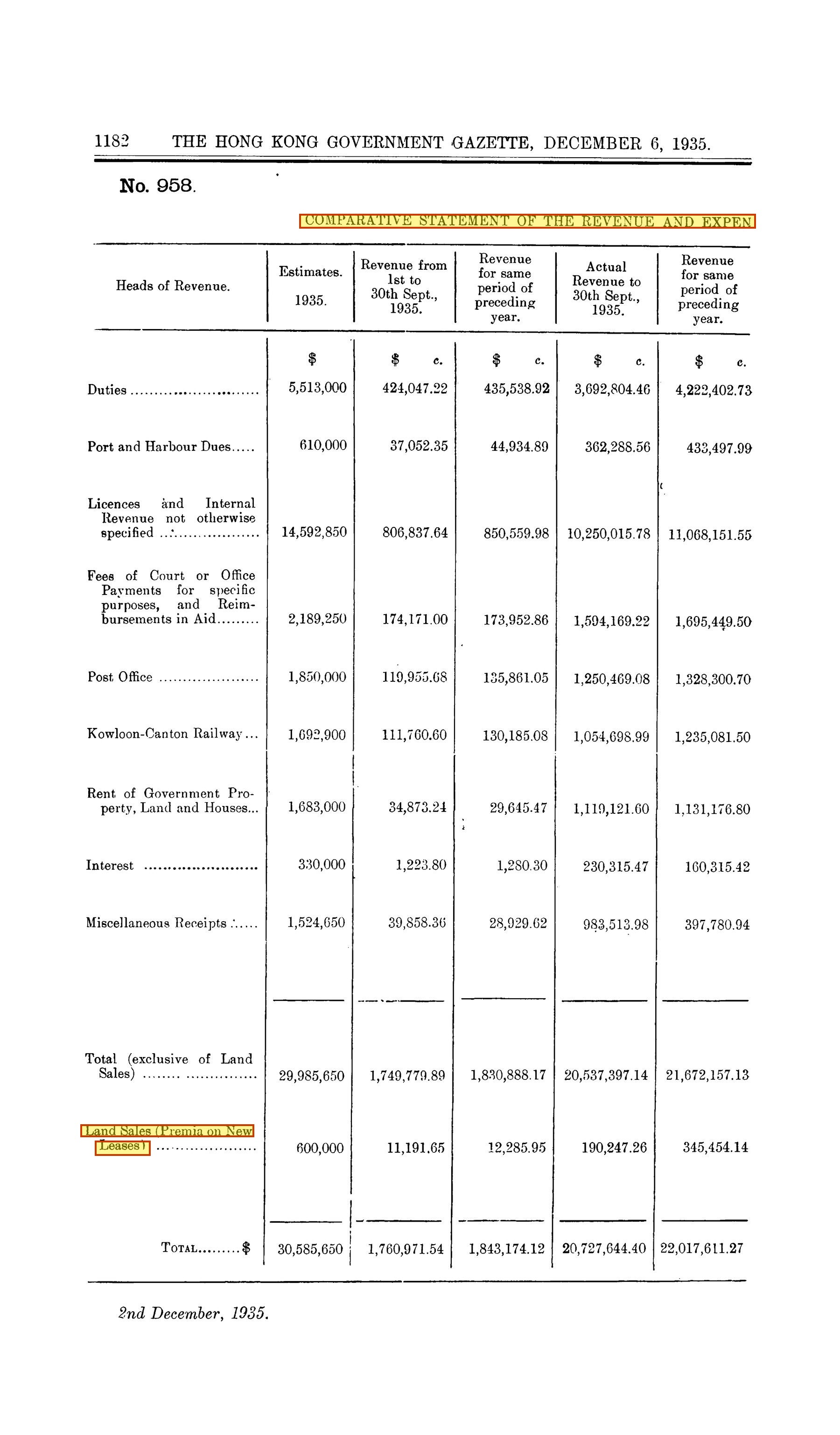
The exchange fall added $3,000,000 to the 1936 deficit — $2,926,303 to $5,926,303 — and the government's answer was the Hong Kong Government Service (Levy on Salaries) Ordinance, 1936 (No. 17 of 1936): a graduated, retrospective temporary levy on the government's own servants, with the 1931 levy on sterling-paid officers recalled as precedent at the first reading. 15 14 At the second reading the Colonial Treasurer put sterling-paid salaries at $11.5M at 1s. 8d., and named the structural problem — the 1935 year-end credit balance of $138,913.27, and the land and opium revenues drying up — without solving it. 16 38 The Currency Amendment Ordinance, 1936, was the statute's first revision. 39 The structural gap is a matter of record: the G.N. 958 comparative statement shows land-sale proceeds of $190,247.26 to 30 September 1935 against $345,454.14 the prior year, 17 40 and the Blue Book's “Trade depression” rows (Boat Licences −$2,404.25; Fish Licences −$1,768.76; Market and Slaughter-house Fees −$15,187.82; Analyses −$5,082.50) carry the slump in figures. 18 The Bank of Canton 廣東銀行 suspended on 4 September 1935 and was reorganised and reopened in November 1936 — the silver outflow's concrete casualty inside the financial system. 19 20 21 42
6. Conclusion: the statute in a week, the diagnosis in four years
The 1930s difficulties present a sharp asymmetry of machinery. From 1930 to 1934 the government diagnosed the depression through commissions — Currency, Clegg, Economic — whose reports were withheld and called pigeon-holed, 11 12 13 diagnosis without action. 43 The action came in the week after China's fapi reform broke the market 2: the rationing Order (G.N. 864), 32 the silver-export embargo, 3 the emergency issue of legal-tender notes and cupro-nickel coins, 3 and the Currency Ordinance No. 54 of 1935, passed 5 December and assented the 6th, 4 5 6 which established the Exchange Fund and ended the silver standard. 7 36 The Levy on Salaries of 1936 14 15 16 then placed the fiscal squeeze on the government's own servants, while the land-sales collapse 17 40 18 and the Bank of Canton's suspension 19 20 21 marked the depression's structural depth. Hong Kong did not drift out of silver over a decade; it left it in a week of statute, over four years of withheld diagnosis.
Appendix A — Query log
The corpus battery and the rework queries are recorded in the research
notes' Appendix A (research_hk_economy_1930s.md). The load-bearing
queries for this paper: phrase sweeps on the hkintexts read-only
cluster for “water famine,” “silver,” “currency,” “Levy on Salaries,”
“Exchange Fund,” the Chinese negative controls (華僑日報, 華僑年鑑, 白銀風潮,
法幣 — zero hits before 1947), and the G.N. / Ordinance number sweeps
(G.N. 864, G.N. 927, G.N. 958, Ordinance No. 54 of 1935, No. 17 of 1936).
Each claim's citation carries the public viewer link; where an image-series
twin exists it is cited (rule 8).
Appendix B — Corrections register
| # | Earlier pass | Corrected | Basis |
|---|---|---|---|
| 1 | Clegg report released May 1931 | Contradicted — still unpublished 22 Oct 1931; “pigeon-holed” by Aug 1934 | Hansard 22 Oct 1931; Telegraph 17 Aug 1934 |
| 2 | Carriage/Chair licences −$1,804.25 | Wrong — those rose $53,077.64; true negatives are Boat −$2,404.25, Fish −$1,768.76, Market/Slaughter-house −$15,187.82, Analyses −$5,082.50 | Blue Book 1935 pp. 62–63 (scan) |
| 3 | G.N. 958 id 1587825 (expenditure) | Correct id is 1587824 (revenue half, printed 1182) | image-page/1504630 |
| 4 | Ordinance “dated 5 Dec 1935” | Passed 5 Dec; assented/commenced 6 Dec — cite separately | G.N. 943, printed 1176 |
| 5 | p. 1174 head reads 13 Dec | Isolated running-head misprint; doc key 218847 is the 6 Dec issue | image-page/1504622 |
| 6 | AR-1935 “pp. 220–221” | Printed E6/E7 (text 629500/629501; image img-434728 = E7) | image-page/434728 |
| 7 | “British March 1935 assistance to China” | Dropped — 0 hits; lives only in failed-verification + bib 29 | China Mail 1935-11-14 p. 9 |
| 8 | Bank of Canton gap open | Closed — CO 129/557/9 despatch No. 430 + China Mail 1936-11-23 reopening | page/551384; page/2024469; [W3] |
Sources and method. The contemporaneous Chinese press does not reach the 1930s in this corpus: 華僑日報 begins 1 May 1947, 華僑香港年鑑 begins 1948, and the Hong Kong Year Books begin 1970 (a regexp sweep of 1930s document keys returns zero hits in any Chinese series). The 1930s stratum is therefore English-majority, and the load-bearing claims rest on the English-primary record — the Government Gazette, the Legislative Council Hansard, the Administrative Reports, the Blue Books, the China Mail / Telegraph / Daily Press, and the Colonial Office file CO 129 L 123/549/14. Every citation carries the public viewer link (rule 8); where a page exists in both a text and an image series the scan is cited (
/image-page/{id}), and where only the text series carries the leaf (the Telegraph, China Mail, Daily Press, Hansard, CO 129) the/page/{id}link is used. Query log: Appendix A. ↩Hong Kong Telegraph, 4 November 1935, p. 1 (the fapi decree; Shanghai, 3 November). https://hkintexts.histsyn.com/page/2973395 (accessed 18 October 2026). China's currency reform (法幣 / fapi) leaves the Hongkong exchange market “completely demoralised,” 1s. 8d. nominal, the Hongkong and Shanghai Bank neither buying nor selling. zh-wiki dates the promulgation 4 November 1935 — consistent (announced 3 Nov, decreed 4 Nov). ↩
Hong Kong Legislative Council, Hansard, 9 November 1935 (emergency meeting). https://hkintexts.histsyn.com/page/1882443 (accessed 18 October 2026). The government prohibits the export of all silver (British and Mexican dollars, Hong Kong subsidiary silver, and bullion); the emergency meeting issues the Dollar Currency Notes Ordinance and proclaims cupro-nickel ten- and five-cent pieces “to relieve the present shortage of subsidiary coins.” The AR records these two regulations as preceding the adoption of the new currency policy. ↩
Hong Kong Legislative Council, Hansard, 5 December 1935. https://hkintexts.histsyn.com/page/1882446 (accessed 18 October 2026). The Currency Ordinance, 1935, No. 54 of 1935, is passed through all its stages at one meeting, with the Attorney General's speech and the Objects and Reasons; the same sitting lays the dutiable-goods Order (G.N. 864) on the table. ↩
Hong Kong Government Gazette 政府憲報 轅門報, 6 December 1935, G.N. No. 943 (the assent list) with the full text of Ordinance No. 54 of 1935 (the Exchange Fund; legal tender; the surrender of silver at 128 cents per fine ounce; the $30 million borrowing cap), printed pp. 1174–1176. Image twins (authoritative): p. 1174 head https://hkintexts.histsyn.com/image-page/1504622 and p. 1176 clauses https://hkintexts.histsyn.com/image-page/1504624; text series https://hkintexts.histsyn.com/page/1587781 (doc
218847-1935-Ordinances-passed-and-assented-to--Vol, ids 1587781–1587809) (accessed 18 October 2026). “Passed the Legislative Council… this 5th day of December, 1935” (H. R. Butters, Deputy Clerk); “[6th December, 1935]” is the assent. The p. 1174 running head misprints “DECEMBER 13, 1935” — an isolated leaf misprint (§3 conflicts), not a second date. ↩Ordinance No. 54 of 1935, ss. 1–9 (the Exchange Fund; the note-issuing banks — Chartered, HSBC, Mercantile; legal tender; surrender on demand; Certificates of Indebtedness; the $30 million cap; the one-month surrender at coin face value / bullion 128 cents per fine ounce; the penalties; the silversmith exemption), Gazette, 6 December 1935, printed pp. 1174–1176, https://hkintexts.histsyn.com/image-page/1504624 (accessed 18 October 2026). Assented “[6th December, 1935]”; “I assent. W. T. SOUTHORN, Officer Administering the Government.” ↩
Ordinance No. 54 of 1935, Gazette, 6 December 1935, printed pp. 1174–1176, https://hkintexts.histsyn.com/image-page/1504624 (accessed 18 October 2026). ↩
“Currency Commission — Confirmed,” China Mail, 10 April 1930, p. 1, https://hkintexts.histsyn.com/page/1998731; and “The Currency Commission” (Reuter, from London; Lord Passfield), China Mail, 6 June 1930, p. 1, https://hkintexts.histsyn.com/page/1999339 (accessed 18 October 2026). The Acting Governor appoints a local Currency Commission, sitting in camera, with the Chinese members Li Tse-fong and Chau Yue-ting added; London's role confirmed via Passfield. ↩
“Clegg to head the Currency Commission” (official; from our own correspondent), Hong Kong Telegraph, 14 February 1931, p. 1, https://hkintexts.histsyn.com/page/2941912; and Hong Kong Telegraph, 1 April 1931, p. 1 (W. H. Clegg, with Ezechiel and Clauson, arrives on the Wakasa Maru), https://hkintexts.histsyn.com/page/2942530 (accessed 18 October 2026). ↩
“Decode of Telegram from H.M. Trade Commissioner, Hong Kong,” No. 72 of 5 July 1934 (the Trade Commissioner reports the proposed Economic Commission), in CO 129 file L 123/549/14, subject “Trade Depression — Commission of Enquiry,” scanned p. 61. https://hkintexts.histsyn.com/page/545580 (accessed 18 October 2026). The Commission of Enquiry into the trade depression is appointed 13 July 1934. ↩
Hong Kong Legislative Council, Hansard, 22 October 1931. https://hkintexts.histsyn.com/page/1882358 (accessed 18 October 2026). The Clegg Commission's report is recorded as still unpublished, with the Governor unable to say when it would appear; the Retrenchment Commission's 1932 draft Estimates are cut to $25,708,257. The Wikipedia claim of a May-1931 release is contradicted by this sitting (modern-secondary only). ↩
Hong Kong Telegraph, 17 August 1934, p. 6 (“Pigeon-holed?”). https://hkintexts.histsyn.com/page/2964740 (accessed 18 October 2026). “Three years have elapsed since the Clegg Commission submitted its Report, containing several important recommendations” — none implemented. ↩
W. E. L. Shenton, “General Memorandum” and “Supplemental Memoranda” submitted to the Economic Commission, 22 August 1934, printed by South China Morning Post, Limited (Confidential, 1934), in CO 129 file L 123/549/14, scanned pp. 18–22 and 26–31. https://hkintexts.histsyn.com/page/545537 (accessed 18 October 2026). Shenton diagnoses external causes and recommends waiting; the pre-1935 precedents (the Great War silver-export embargo, the 1925 Boycott's $25 currency-export limit) sit in the same file. ↩
Hong Kong Government Gazette 政府憲報 轅門報, 24 April 1936, the Hong Kong Government Service (Levy on Salaries) Ordinance, 1936, No. 17 of 1936, full text (doc
226366-1936-Ordinances-passed-and-assented-to--Sum, ids 1591021–1591022), https://hkintexts.histsyn.com/page/1591022 (accessed 18 October 2026). A graduated, retrospective temporary levy on the government's own servants; assented 24 April 1936; net $3,282,228; the arbitrary 1s. 6d. conversion for sterling salaries. ↩Hong Kong Legislative Council, Hansard, 19 March 1936 (first reading). https://hkintexts.histsyn.com/page/1882451 (accessed 18 October 2026). The exchange fall adds $3,000,000 to the 1936 deficit ($2,926,303 → $5,926,303); the 1931 levy on sterling-paid officers is recalled as precedent. ↩
Hong Kong Legislative Council, Hansard, 22 April 1936 (second reading). https://hkintexts.histsyn.com/page/1882452 (accessed 18 October 2026). Salaries $11.5M at 1s. 8d.; the 1935 year-end credit balance $138,913.27; land-sale proceeds and opium income drying up — the structural problem named but not solved. ↩
Hong Kong Government Gazette 政府憲報 轅門報, G.N. 958, the Comparative Statement of Revenue and Expenditure for the period ended 30th September 1935 — revenue half, printed p. 1182, with the Land Sales row ($600,000 estimate; $190,247.26 actual to 30 September against $345,454.14 the prior year). Image twin (authoritative): https://hkintexts.histsyn.com/image-page/1504630 (printed 1182); text series https://hkintexts.histsyn.com/page/1587824 (accessed 18 October 2026). The expenditure half is printed p. 1183, id 1587825 — the earlier pass cited that half by mistake (§3 conflicts). The printed head is truncated (“…REVENUE AND EXPEN”); a head-setting quirk, registered. ↩
Blue Books of Hong Kong 香港計冊, 1935, “Trade depression” rows, printed pp. 62–63. Image twins (authoritative): p. 62 https://hkintexts.histsyn.com/image-page/677766 and p. 63 https://hkintexts.histsyn.com/image-page/677767 (accessed 18 October 2026). The negative rows: Boat Licences −$2,404.25 (p. 62); Fish Licences −$1,768.76, Market and Slaughter-house Fees −$15,187.82, Analyses −$5,082.50 (p. 63). The Carriage/Chair licences rose $53,077.64 — the earlier pass's −$1,804.25 for those is wrong (§3 conflicts). ↩
Colonial Office, CO 129/557/9, despatch No. 430 of 30 October 1935 (the Bank of Canton 廣東銀行 and the National Commercial and Savings Bank suspended; liquidators appointed), printed pp. 121–122, https://hkintexts.histsyn.com/page/551384 (accessed 18 October 2026). The Bank of Canton had been suspended since 4 September 1935. ↩
“Bank of Canton Reopens,” China Mail, 23 November 1936, p. 1, https://hkintexts.histsyn.com/page/2024469 (accessed 18 October 2026). The bank (廣東銀行) reopens after the suspension recorded in CO 129/557/9; the en-wiki article “Bank of Canton” corroborates (modern-secondary, rule-9 web verification). ↩
Bank of Canton, Wikipedia (English), https://en.wikipedia.org/wiki/Bank_of_Canton (accessed 18 October 2026). “Bank of Canton (Chinese: 廣東銀行)… In 1935, China went off the silver standard; BoC was one of the banks that consequently failed… The next year T.V. Soong reorganized the BoC, and it reopened, but without the right to issue.” The rule-9 web verification for the 廣東銀行 name and the 1935 failure. ↩
法幣(法定貨幣)— Chinese National Currency, Wikipedia (Chinese), https://zh.wikipedia.org/wiki/法幣 (accessed 18 October 2026). The fapi promulgation 4 November 1935 (民國24年11月4日《財政部改革幣制令》); 白銀風潮 as the conventional term; the 1934 購銀法案 and the silver outflow — the modern-secondary frame for the Chinese-side vocabulary (no 1930s Chinese press in the corpus). ↩
Administrative Reports 行政報告書, Hong Kong, 1932, p. 96 (Labour), https://hkintexts.histsyn.com/page/626962; 1933, p. 93 (Labour), https://hkintexts.histsyn.com/page/627724; 1934, p. 25 (Commerce, Industry and Labour), https://hkintexts.histsyn.com/page/628478 (accessed 18 October 2026). The Labour sections carry the colony's jobless through the trough. ↩
“Society of St Vincent de Paul” (annual report), China Mail, 18 November 1931, p. 12. https://hkintexts.histsyn.com/page/2005006 (accessed 18 October 2026). The charitable order's annual report registers the depression's social edge in the colony. ↩
Daily Press, 14 June 1932, p. 11. https://hkintexts.histsyn.com/page/2336039 (accessed 18 October 2026). The Federated Malay States repatriate unemployed Chinese on free tickets to China — the regional, not merely colonial, face of the slump. ↩
“Silver Bill” (President Roosevelt signs the United States Silver Bill, 19 June 1934), China Mail, 20 June 1934, p. 1. https://hkintexts.histsyn.com/page/2014984 (accessed 18 October 2026). The American purchase policy that drains silver from China and, through her, from Hong Kong. ↩
“Silver Prices Decline” (spot 23⅜), China Mail, 1 November 1934, p. 6, https://hkintexts.histsyn.com/page/2016425; “Silver Prices Firm” (spot 23-7/16) and “Silver Report: Speculators bought. China sold.,” China Mail, 8 November 1934, p. 6, https://hkintexts.histsyn.com/page/2016499 (accessed 18 October 2026). The 1934 daily quotations on the eve of the crisis. ↩
“Haul of Silver Dollars” (Tientsin, Oct. 31; 58,000 dollars seized on the Tsingtao Maru), Daily Press, 1 November 1934, p. 8. https://hkintexts.histsyn.com/page/2348668 (accessed 18 October 2026). The physical outflow of silver from the China trade. ↩
“Silver a Handicap” (the Kemmerer Commission report on China's currency), Hong Kong Telegraph, 31 March 1930, p. 1. https://hkintexts.histsyn.com/page/2938094 (accessed 18 October 2026). A single-witness press summary; the report's recommended gold basis (a 40-US-cent coin, 1/7.72-in sterling, presented to T. V. Soong in November 1929) is noted but not generalised. ↩
Hong Kong Legislative Council, Hansard, 3 October 1935. https://hkintexts.histsyn.com/page/1882441 (accessed 18 October 2026). The Colonial Treasurer tells the Council that the exchange factor in the 1936 Estimates “is a menace,” quoting The Times of 15 August. ↩
Hong Kong Telegraph, 9 November 1935, p. 9 (Macao prohibits the export of silver in any form, 7 November; the 40–45% premium). https://hkintexts.histsyn.com/page/2973523 (accessed 18 October 2026). ↩
Hong Kong Government Gazette Extraordinary 政府憲報 轅門報, No. 53, 6 November 1935, G.N. No. 864 (Order under the Public Revenue Protection Ordinance, 1927 — dutiable liquors and tobacco rationed). No image twin exists; text series https://hkintexts.histsyn.com/page/1587667 (accessed 18 October 2026); sunzi PDF https://sunzi.lib.hku.hk/hkgro/view/g1935/218598.pdf. The crisis's first instrument, rescinded effective 1 December 1935. ↩
Hong Kong Government Gazette 政府憲報 轅門報, 29 November 1935, G.N. No. 927 (rescinding G.N. No. 864 with effect from 1 December 1935). Text series https://hkintexts.histsyn.com/page/1587754 (accessed 18 October 2026); sunzi PDF https://sunzi.lib.hku.hk/hkgro/view/g1935/218796.pdf. ↩
Administrative Reports 行政報告書, Hong Kong, 1935, printed pp. E6–E7 (Imports and Exports; Trade Statistics). Image twin (authoritative): https://hkintexts.histsyn.com/image-page/434728 (printed E7); text series https://hkintexts.histsyn.com/page/629501 (accessed 18 October 2026). The 9 November export prohibition is dated here; trade 14.2% down on 1934 (29.6% on 1933) — a single-witness statistic. ↩
Administrative Reports 行政報告書, Hong Kong, 1935, printed pp. E6–E7, https://hkintexts.histsyn.com/image-page/434728 (accessed 18 October 2026). ↩
“Full Text of Exchange Control Measure,” Hong Kong Telegraph, 7 December 1935, p. 6. https://hkintexts.histsyn.com/page/2974057 (accessed 18 October 2026). The Telegraph prints the full text of the Currency Ordinance the day after assent — the press record of the statute. ↩
Hong Kong Government Gazette 政府憲報 轅門報, 6 March 1936, G.N. No. 227 (Ordinances not disallowed, including Currency No. 54 of 1935). Text series https://hkintexts.histsyn.com/page/1590710 (accessed 18 October 2026); sunzi PDF https://sunzi.lib.hku.hk/hkgro/view/g1936/225934.pdf. ↩
Levy on Salaries Ordinance No. 17 of 1936, Gazette, 24 April 1936, https://hkintexts.histsyn.com/page/1591022 (accessed 18 October 2026). ↩
Hong Kong Legislative Council, Hansard, 7 October 1936 (the Currency Amendment Ordinance, 1936, first reading). https://hkintexts.histsyn.com/page/1882462 (accessed 18 October 2026). The statute's first revision. ↩
Gazette G.N. 958, Comparative Statement, revenue half, printed p. 1182, https://hkintexts.histsyn.com/image-page/1504630 (accessed 18 October 2026). ↩
CO 129/557/9 despatch No. 430, 30 October 1935, https://hkintexts.histsyn.com/page/551384 (accessed 18 October 2026). ↩
Bank of Canton, Wikipedia (English), https://en.wikipedia.org/wiki/Bank_of_Canton (accessed 18 October 2026). ↩
Hong Kong Telegraph, 24 July 1933, p. 6 (editorial). https://hkintexts.histsyn.com/page/2956865 (accessed 18 October 2026). The currency controversy is recorded as dormant since the Clegg Commission's report — three years of inaction before the 1934 Economic Commission. ↩