新公司與它的房子:香港會的檔案生命,1844–1899
摘要
本文以政府憲報、《華友西報》、《德臣西報》、《孖剌西報》、《士蔑新聞》、香港指南(Directory & Chronicle)及殖民地檔案 CO 129 為據,重建香港最老牌的歐人會所——香港會(The Hongkong Club;今名;華人舊稱「新公司」)——從籌建到遷離第一座會所的全程。考得:會所的圖則競賽於 1844 年 6 月 15 日見於憲報(冠軍圖則賞銀 200 元、亞軍 100 元,圖則「a ground floor (offices) and two stories, the lower with eight rooms, the upper with bed-rooms」,投圖致「Captain Edwards, Assistant Quarter-Master General」)——會所之組織早於坊間沿用的 1846 年「創立年」2 年;會所房子「erected some time in 1845」(1897 年《德臣西報》專欄語,恰與《德臣西報》創刊同年);1846 年 4 月 29 日憲報刊大會通告,秘書聲明會務「in that state of forwardness, which will admit of its being opened on the 17th of May」——開幕日只此一證,開幕之後的報道則一無所存;1849 年股東與已故商人 R. Edwards 的遺產執行人就會所土地興訟,總督麥當奴(MacDonnell)親函殖民部,稱股東俱為「all of the principal merchants, and… decidedly the most respectable and influential inhabitants of the Colony」;1868 年會所重組(1881 年秘書 Beart 的庭供:「I am and have been since 1868 the Secretary」;同年 6 月的會議紀錄記「新會所籌備委員會」與房子股東就「occupation of the Club house」議價);1883 年香港指南刊出會所的中文稱呼「新公司(Son-kung-sz)」;1896 年發行五厘債券 28,000 元以贖回海旁地段按揭(同一告示先書 Marine Lot No. 271、後書 No. 74,估值 $208,000);1897 年 7 月 26 日遷入海旁新廈,舊院(雲咸街口,即今 King’s Theatre 一帶)售予屈臣氏;而 1899 年 2 月 20 日《德臣西報》報道華人自己的會所(the Chinese Club;今考訂為華商會所)的規則「modelled on those of the Hongkong Club」——會員 147 人、入會費共 $1,070、委員會有何東、何福、謝纘泰。結論:檔案裡的香港會,不在「1846 年創立」的紀念辭裡,而在 1844 年 6 月的圖則競賽、1845 年的房子、1846 年 5 月 17 日的預告、1868 年的重組與 1897 年的搬遷之中;它留下的最有力的遺產,是被華商會所(今考訂)當作範本。
一、籌備:1844 年 6 月的圖則競賽
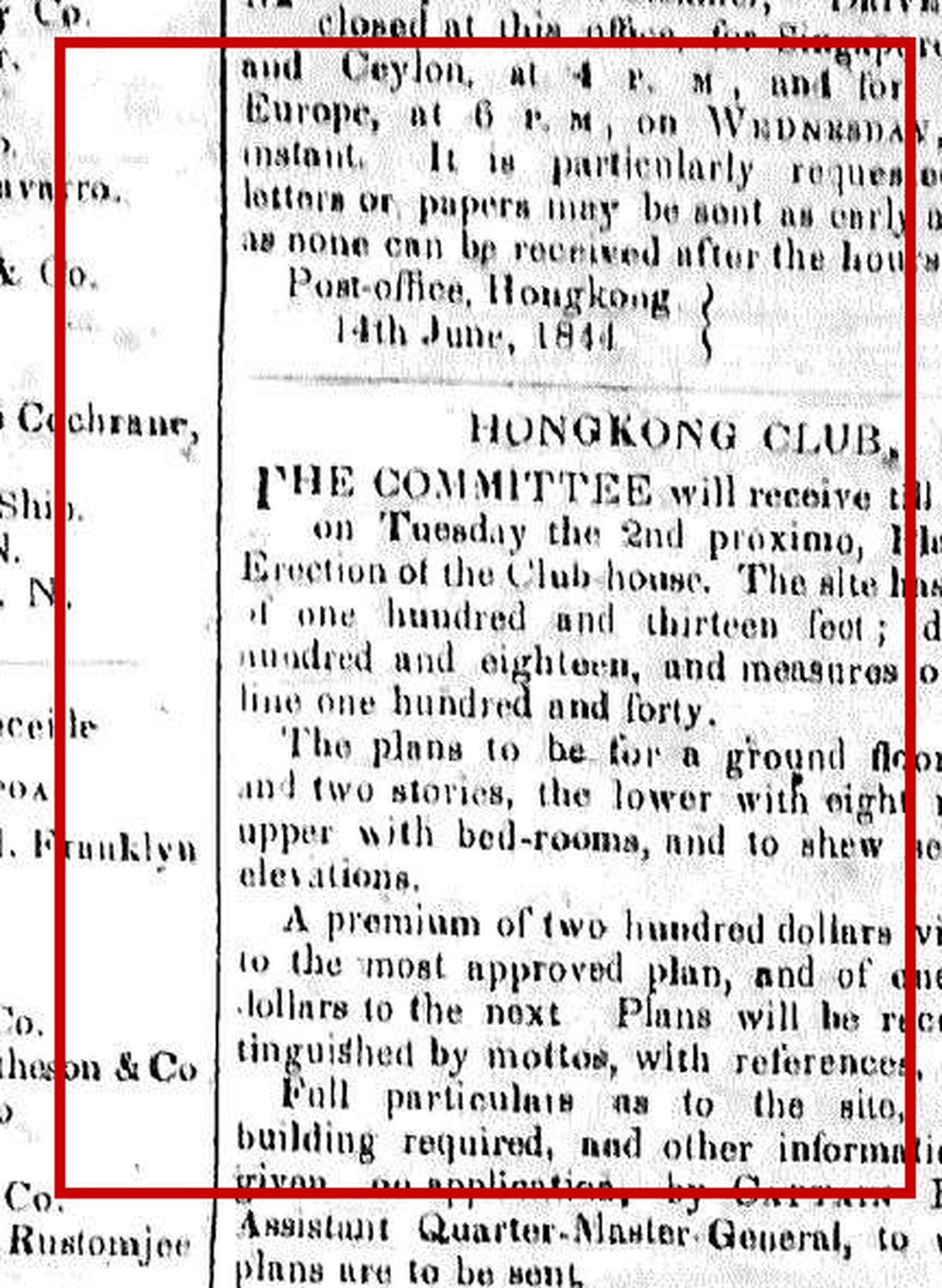
會所在檔案中的第一次露面,不是成立宣言,而是一張招圖告示。1844 年 6 月 15 日《香港政府憲報》刊出:「THE COMMITTEE will receive till 12 o’clock on Tuesday the 2nd proximo, Plans for the Erection of the Club house. The site has a frontage one hundred and thirteen feet; depth, one hundred and eighteen, and measures on the rear… one hundred and forty.」圖則須「for a ground floor (offices) and two stories, the lower with eight rooms, the upper with bed-rooms, and to shew sections and elevations」;賞格「A premium of two hundred dollars will be given to the most approved plan, and of one hundred dollars to the next」,計圖「distinguished by mottos」,投圖「by CAPTAIN EDWARDS, Assistant Quarter-Master General, to whom the plans are to be sent」。1
有委員會、有地段、有建築基金、有祕書處的會所,至此已在運轉——而記錄其「創立」的文件,一無所有(檔案空白 G1;見英文附錄甲)。同年 6 月 22 日憲報重刊此告示,規格如一,惟地界的一項數字不同:frontage 由「one hundred and thirteen feet」變成「one hundred and one feet」。2 個數字皆為逐字讀出的英文數詞,孰是孰非無從裁定,僅記為異文,不作調和(衝突 K5)。2《華友西報》同日亦有轉載,惟 OCR 章面殘損,僅作旁證。3
二、「1845 年建成」:房子自己的年份
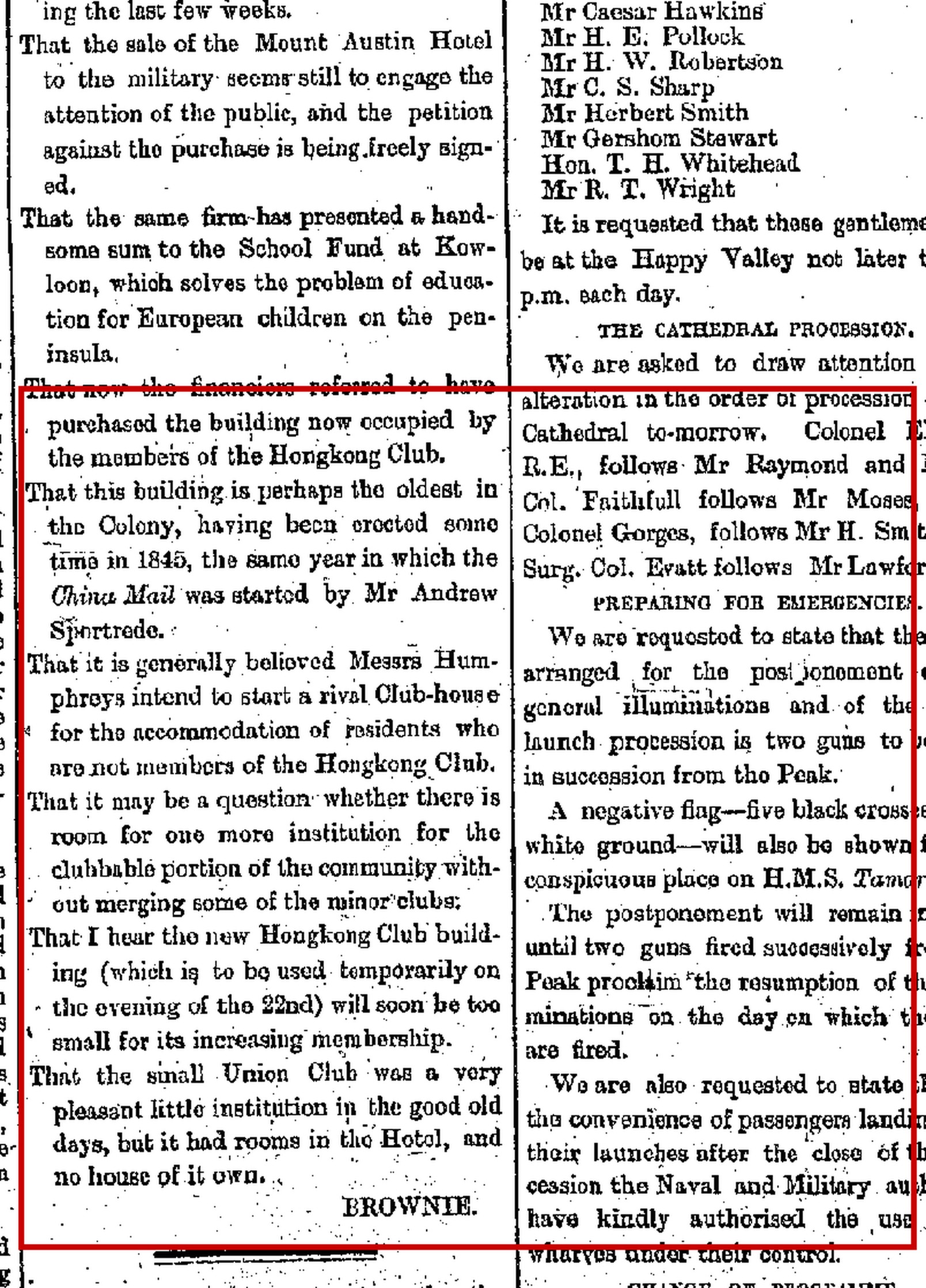
會所房子的年代,最好的見證是 53 年後《德臣西報》「BROWNIE」專欄的一句話:「the financiers referred to have purchased the building now occupied by the members of the Hongkong Club. That this building is perhaps the oldest in the Colony, having been erected some time in 1845, the same year in which the China Mail was started by Mr Andrew Shortrede.」——1897 年 6 月,籌建新廈的「financiers」買下了舊會所的房子;這座房子「大概是殖民地最老的建築」,建於 1845 年,與《德臣西報》創刊同年。專欄同段還記了 2 樁:「it is generally believed Messrs Humphreys intend to start a rival Club-house for the accommodation of residents who are not members of the Hongkong Club」——韓飛士(Humphreys)擬為非會員另起會所;而舊日的 Union Club「had rooms in the Hotel, and no house of its own」早已煙消。專欄又預告:「the new Hongkong Club building (which is to be used temporarily on the evening of the 22nd) will soon be too small for its increasing membership」——新廈未入伙,已嫌太小。4
三、開幕:1846 年 4 月 29 日的大會與「5 月 17 日」
1846 年 4 月 29 日憲報(欄間互錯、字跡交疊的一葉)同時載有 2 件事:其一,「General Meeting of the Members of the Hongkong Club will be held on Friday the 1st of May at 5 o’clock」;其二,秘書奉委員會之命宣告:「the Club is in that state of forwardness, which will admit of its being opened on the 17th of May」。5《華友西報》5 月 1 日「The New Club House」一文載有同一宣告,惟日期數字在 OCR 中殘缺(「opened on the 1–th of May」),無從據此頁斷言 15 日抑或 17 日——兩說並存,不強作調和(衝突 K2)。更要緊的是:開幕之後的報道,全庫為零。5 月 17 日(或 15 日)那一天,無報道、無憲報通告、無紀錄——所謂「1846 年開幕」,在檔案裡只是一個還未到來的日期(空白 G3)。6
四、1849 年的訴訟:股東、總督與殖民部
會所的第一場危機是產權。已故商人 R. Edwards 的遺產執行人以「the shareholders of the Hongkong Club」為被告,就會所土地提出衡平法訴訟。1849 年 9 月 5 日,股東常務委員會——Wal: Davidson, Pat: Dudgeon, Th: D. Neave, Peter Young, John Holliday, G. J. Braind, Edwrd Perceval, A. Campbell——上書總督,指殖民地竟無合格的大律師與律師可以接辦此案;附件追述會所地段的批給次序:Elliot→Zabell→Martin→Edwards→Braine,並引據「executed pursuant to Ordinance No. 3 of 1844」的租契。7
總督麥當奴(MacDonnell)於 11 月 13 日以第 93 號 Despatch 轉呈殖民部:信件「signed by all of the principal merchants, and by decidedly the most respectable and influential inhabitants of the Colony」;此案「ought to have been instituted against the local Government」。其附筆記下和解的價碼:原告律師提議被告「paying $1,000 and costs. These costs already amount to $1,126, besides the bill of the Plaintiff’s Attorney」。8輔政司 Sterling 的批示解釋何以要請英國的 2 人合議意見:如此被告方可避免「delay, and costs of suit」。9而那份英國合議意見書本身,檔案中只有 docket 一行——正文不在(空白 G4)。10
五、重組與會所生活:1868–1883
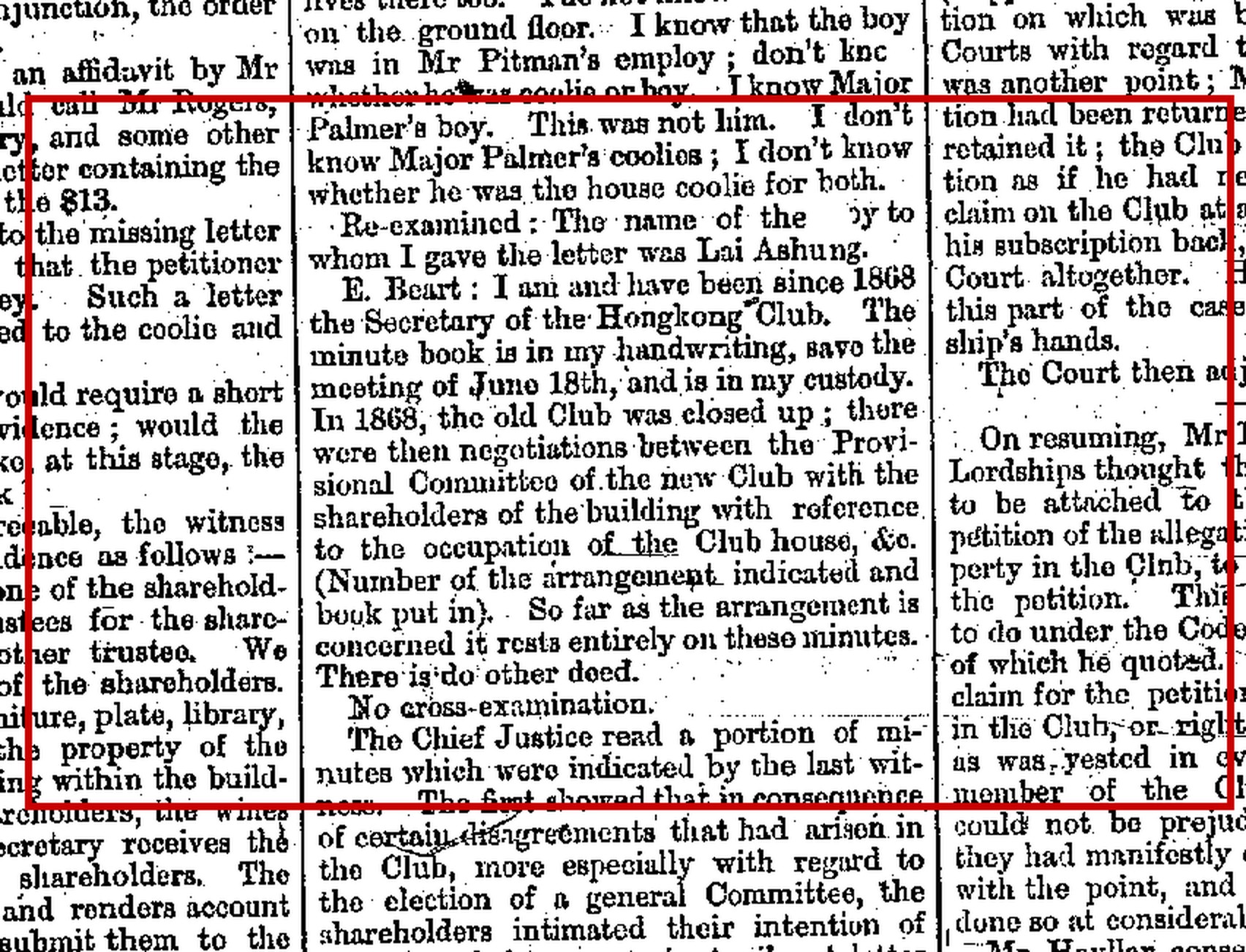
1868 年是會所的內部轉折,見證卻在 13 年後的法庭上。1881 年 3 月 28 日《德臣西報》報道 Pitman 訴香港會一案(會所內的口角、涉誹謗 H. B. Nelson、繼而「that Mr. Pitman be no longer a member」的除名決議),秘書出庭作證:「E. Beart: I am and have been since 1868 the Secretary of the Hongkong Club. The minute book is in my handwriting, save the meeting of June 18th… there were then negotiations between the Provisional Committee of the new Club with the shareholders of the building with reference to the occupation of the Club house… So far as the arrangement is concerned it rests entirely on these minutes. There is no other deed.」——1868 年 6 月,會議紀錄記下了「新會所籌備委員會」與房子股東之間就「occupation of the Club house」的議價;會所的整個產權安排,「rests entirely on these minutes. There is no other deed」。案件的判決不在此頁,亦在全期抽卷之餘,不著一字——判決不書(F4)。11
1869 年 11 月 13 日《德臣西報》又有一則:「…will be closed to the Public for fourteen days from the 2nd inst.」——會所房間封閉 14 日,原因未書(句子在互錯欄間被拆成碎片)。12此後 10 年,會所在指南與新聞裡照常生活:1872 年香港指南列「HONGKONG CLUB. Wyndham Street, behind the Club House」,祕書「Beart, E.」;131875 年 3 月《孖剌西報》的賽馬程序冊,開放對象包括「Members of the Hongkong Club and the Club Germania」;141880 年 6 月《德臣西報》的競賽獎品單裡,赫然有「1 four legged Chicken, by Hongkong Club」——會所送了一隻四腳雞做獎品;151881 年 11 月《士蔑新聞》刊板球賽「HONGKONG CLUB V. OFFICERS ARMY & NAVY」;161883 年香港指南的條目,在英文名之下印出會所的中文稱呼:「HONGKONG CLUB. 新公司 Son-kung-sz. Committee—Hon. F. B. Johnson, Hon. P. Ryrie, W. S. Young…」,祕書一欄仍舊是「Secretary—Edward Beart」。「新公司」一名,經當代粵語維基佐證(「舊時唐人叫佢新公司」),是本會所唯一經核證的中文寫法。171896 年 3 月《孖剌西報》「About Town」欄的會所房間描述(會員書櫃、「the stone tablet reserved for the names」、閱覽室、「the indispensable bar」)則因欄間互錯,僅作概述、不作引文;同欄的「116 members」一語無從歸屬,全文不用(F2)。18
六、1896 年的債券與 1897 年的搬遷
1896 年 9 月 1 日《孖剌西報》頭版刊出債券告示:「ISSUE OF $28,000 IN 5% DEBENTURES」——發債「to enable the said Club to pay off the Mortgage at present existing on Marine Lot No. 271, the property of the said Club, and on which the new Club premises are being built, and for other purposes」;債券以「the said Marine Lot No. 74 and the buildings thereon」作第一按揭,土地與房子「estimated by Mrs. Palmer and Turner to be of the value of $208,000」,署名「C. H. Grace」。同一告示,前書 271、後書 74——地段編號的異文照錄(衝突 K3);估價出自一紙,僅記為告示自己的數字(K4)。19
1897 年 7 月 26 日,《德臣西報》以「THE NEW HONGKONG CLUB」為題報道入伙:「The members of the Hongkong Club to-day went into occupation of their new and handsome premises on the Praya. The removal from the old premises on Queen’s Road was quickly effected.” 新廈為意大利文藝復興風格,佐以多力安與科林新式樣;入門左為 3 檯彈子房,石梯之後是 4 條保齡球道,再後是酒窖與冷藏室。20
七、舊樓的命運與華商會所的範本
舊房子的下落,見於《昔日香港》第 5 卷的回顧:「When the Hongkong Club left its old premises at the bottom of Wyndham Street (where the King’s Theatre is to-day) in 1897, those premises were bought by A. S. Watson & Co., and let for some time. The New Club, as it was named, which was a residential club, was formed in that year (1897) and took quarters in the former Hongkong Club building… the New Club was wound up as the premises were sold by Watson’s (in October 1898), and it was reorganised into a Bowling Club, which took over the Hongkong Club’s former bowling alley in Wyndham Street, at the back of the old premises (later the Coronet Theatre, and since pulled down and built over).」21第 4 卷的一則圖說補上此後的一章:「part of the old Hongkong Club building, later adapted by the Yee Sang Fat. Co. Theatre now stands on the site.」22
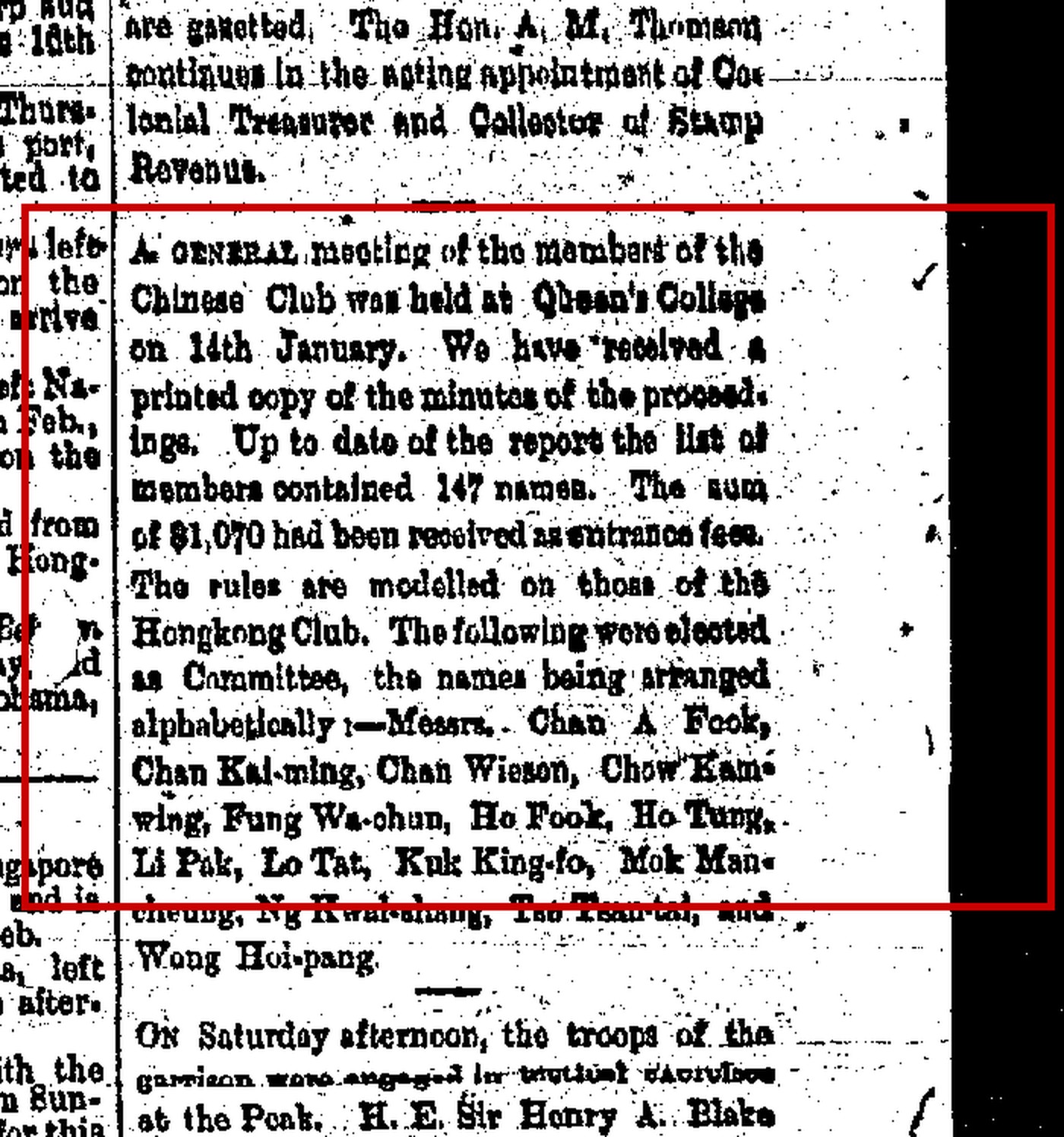
而這所房子留下的最耐人尋味的回聲,在 1899 年 2 月 20 日《德臣西報》(此段文字只存於掃描,文字庫 OCR 漏錄):「A general meeting of the members of the Chinese Club was held at Queen’s College on 14th January. We have received a printed copy of the minutes of the proceedings. Up to date of the report the list of members contained 147 names. The sum of $1,070 had been received as entrance fees. The rules are modelled on those of the Hongkong Club.」委員會 14 人:Chan A Fook、Chan Kai-ming、Chan Winson、Chow Kam-wing、Fung Wa-chun、何福(Ho Fook)、何東(Ho Tung)、Li Pak、Lo Tat、Kuk King-fo、Mok Man-cheung、Ng Kwai-chung、謝纘泰(Tso Tsan-tai)、Wong Hoi-pang——當代史志以「華商會所」考訂此會(1897 年謝纘泰等創立,何東任首任主席,與皇仁書院淵源極深),而檔案裡它自己的名字只有一個:the Chinese Club。23
結論
檔案裡的香港會,不在「1846 年創立」的紀念辭裡:成立文件一無所存(G1),最早的蹤跡是 1844 年 6 月的招圖告示;房子建於 1845 年;開幕日只有 1846 年 4 月 29 日憲報那一句預告,開幕本身則不見記載。會所的產權靠 1849 年那場訴訟與政府的介入站穩;1868 年的重組只存在於 1881 年的庭供;1896 年的債券贖回了按揭、蓋起了新廈;1897 年 7 月 26 日全體會員遷入海旁,舊院售予屈臣氏,此後輾轉成為戲院與商廈。而它最實在的遺產,是被華商會所拿來做範本——「The rules are modelled on those of the Hongkong Club」:一個殖民會所的制度形式,就這樣越過了它自己的會籍界線,成了城市的公共財。
The Hongkong Club: the Plans of 1844, the House of 1845, and the Two Afterlives
Abstract
The Hongkong Club’s own record begins not with a founding act but with a competition for plans: the Government Gazette of 15 June 1844 advertises premiums of $200 and $100 for the best design of a Club house on a site of 113 feet frontage, the plans to be sent to Captain Edwards, Assistant Quarter-Master General. No constitutive document survives, and the traditional founding year 1846 belongs instead to the opening: the Gazette of 29 April 1846 records a General Meeting for 1 May and the Secretary’s statement that the Club “is in that state of forwardness, which will admit of its being opened on the 17th of May” — prospective only, with no post-opening report anywhere in the corpus. The house itself “was erected some time in 1845, the same year in which the China Mail was started,” as the paper’s own columnist wrote when the “financiers” bought the building in 1897. The Club’s first crisis was proprietary: the Edwards estate’s suit of 1849, carried to the Colonial Office by Governor MacDonnell with the judgment that the shareholders were “decidedly the most respectable and influential inhabitants of the Colony.” The reconstitution of 1868 survives only in a secretary’s 1881 testimony; the institutional round of 1872–83 runs through the Directories — including the Chinese label 新公司 (Son-kung-sz) printed beside the Club’s name in 1883. In 1896 the Club raised $28,000 in debentures to pay the mortgage on its Marine Lot property “on which the new Club premises are being built”; on 26 July 1897 the members went into occupation of the new Praya building, the old Queen’s Road house passed to A. S. Watson & Co., and its afterlife ran through the “New Club,” the Bowling Club, and the theatre site. The epilogue measures what the original had become: in 1899 the Chinese Club — 147 members, $1,070 in entrance fees, its committee including Ho Tung, Ho Fook and Tso Tsan-tai — adopted rules “modelled on those of the Hongkong Club.”
Contents
1. The plans competition of June 1844
The Club enters the record as a building project. On 15 June 1844 the Government Gazette printed the Committee’s notice: “THE COMMITTEE will receive till 12 o’clock on Tuesday the 2nd proximo, Plans for the Erection of the Club house. The site has a frontage one hundred and thirteen feet; depth, one hundred and eighteen, and measures on the rear… one hundred and forty.” The plans were “to be for a ground floor (offices) and two stories, the lower with eight rooms, the upper with bed-rooms, and to shew sections and elevations”; the premiums — $200 for the most approved plan, $100 for the next — were to go to designs “distinguished by mottos”, and applications were directed “by CAPTAIN EDWARDS, Assistant Quarter-Master General, to whom the plans are to be sent.”24 A body with a committee, a site and a building fund was thus already at work in mid-1844; the founding act itself is nowhere in the corpus (gap G1). The notice ran again on 22 June — same programme, but the frontage now prints as “one hundred and one feet”: a variance kept, never averaged (K5).25 The Friend of China carried the notice the same month, its OCR too damaged for quotation and used as corroboration only.26
2. “Erected some time in 1845”
The building’s date is best witnessed at the moment of its disposal. The China Mail’s “BROWNIE” column of 19 June 1897 — printed as the “financiers” bought the old house — settles it: “That now the financiers referred to have purchased the building now occupied by the members of the Hongkong Club. That this building is perhaps the oldest in the Colony, having been erected some time in 1845, the same year in which the China Mail was started by Mr Andrew Shortrede.” The same column records the rivals — Messrs Humphreys’ intended club-house “for the accommodation of residents who are not members of the Hongkong Club,” and the defunct Union Club, which “had rooms in the Hotel, and no house of its own” — and the new building’s appetite: it “will soon be too small for its increasing membership.”27 The OCR layer of the text series garbles the key sentence (“eroated sno tima in 1845”); the quotation is from the eye-read of the scan.
3. The opening: April–May 1846
The opening survives as a forecast, not an event. The Gazette of 29 April 1846 — a leaf whose columns are interleaved in the OCR — carries both the summons (“General Meeting of the Members of the Hongkong Club will be held on Friday the 1st of May at 5 o’clock”) and the Secretary’s statement: “the Club is in that state of forwardness, which will admit of its being opened on the 17th of May.”28 The Friend of China of 1 May (“The New Club House”) prints the same statement with the day-digit garbled in the OCR; the day is not asserted from that leaf, and the two readings stand side by side (K2).29 What follows the date is silence: no opening-day report, no later notice, no retrospective in 1846. The corpus’s only witnesses to the opening are prospective (gap G3).
4. The Edwards lawsuit, 1849
The Club’s first crisis was proprietary. The administrator of the late R. Edwards’s estate sued “the shareholders of the Hongkong Club” over the Club’s land title, and the action ran to a Bill in Equity. On 5 September 1849 the Standing Committee of Shareholders — Davidson, Dudgeon, Neave, Young, Holliday, Braind, Perceval, Campbell — wrote to the Governor that the Colony had no qualified barristers or attorneys to carry the case on; the enclosure recites the prescribed chain of allotments — Elliot, Zabell, Martin, Edwards, Braine — and the lease “executed pursuant to Ordinance No. 3 of 1844.”30 Governor MacDonnell forwarded the letter on 13 November (Despatch No. 93): the signatories were “all of the principal merchants, and… decidedly the most respectable and influential inhabitants of the Colony,” and the action “ought to have been instituted against the local Government”; his postscript records the proposed compromise — “paying $1,000 and costs. These costs already amount to $1,126, besides the bill of the Plaintiff’s Attorney.”31 The Colonial Secretary’s office wanted a joint opinion of the Attorney and Solicitor General of England so that the defendants “might avoid… delay, and costs of suit.”32 The opinion itself is a docket line only — its text is not in the corpus (G4).33 The file’s later leaves acknowledge Despatch No. 153 of 16 November 1849, itself acknowledged in turn.34
5. The reconstitution of 1868 and the Club’s institutional life
The year 1868 is a pivot whose only witnesses are spoken thirteen years later, in court. The China Mail of 28 March 1881 reports the hearing of Pitman v. the Hongkong Club — a Club-room quarrel, an alleged libel on H. B. Nelson, and the resolution “that Mr. Pitman be no longer a member” — and the secretary’s evidence carries the institutional record: “I am and have been since 1868 the Secretary of the Hongkong Club. The minute book is in my handwriting, save the meeting of June 18th… there were then negotiations between the Provisional Committee of the new Club with the shareholders of the building with reference to the occupation of the Club house… So far as the arrangement is concerned it rests entirely on these minutes. There is no other deed.” The case’s disposition is not on the printed page (F4).35 A year earlier still, the paper had carried a temporary closure — the rooms “will be closed to the Public for fourteen days from the 2nd inst.” (13 November 1869), cause unstated, the sentence split across interleaved columns.12
The round of ordinary life runs through the serials. The Directory and Chronicle for 1872 lists the Club — “HONGKONG CLUB. Wyndham Street, behind the Club House” — with “Beart, E., secretary.”36 The Daily Press’s race programme of 27 and 29 March 1875 is open to “the officers of the Army, Navy, Royal Marines, and Members of the Hongkong Club and the Club Germania.”14 In June 1880 the China Mail’s competition prize list records, between books and a canary, “1 four legged Chicken, by Hongkong Club.”15 In November 1881 the Telegraph prints the cricket match “HONGKONG CLUB V. OFFICERS ARMY & NAVY.”16 And the 1883 Directory prints the Club’s Chinese label beside its English name: “HONGKONG CLUB. 新公司 Son-kung-sz. Committee—Hon. F. B. Johnson, Hon. P. Ryrie, W. S. Young…”, the secretary still “Edward Beart” — the one attested Chinese form of the Club’s name, confirmed by the modern Cantonese Wikipedia (“舊時唐人叫佢新公司”).37 The Daily Press’s club-rooms description of 5 March 1896 — the members’ bookcases, the stone tablet reserved for the members’ names, the reading room, the bar — is a column-interleaved fragment, used as paraphrase only; its “116 members” sentence is never used (F2).18 The FoC’s 1847 leaves add the secretary’s own voice from an earlier year — “Mr. Spring is secretary to the Hongkong Club” — testimony in the Corsair case about the Club’s mail arrangements.38 And the Club House appears as an address in the colony’s commercial life: Burgess’s sale of June 1846 directs its lots “TO THE HONGKONG CLUB HOUSE, TO MERCHANTS, TO NAVAL AND MILITARY MESSES.”39
6. The debentures of 1896 and the move of 1897
The end of the old house begins with a mortgage. The Daily Press of 1 September 1896 advertises the “ISSUE OF $28,000 IN 5% DEBENTURES”, issued “to enable the said Club to pay off the Mortgage at present existing on Marine Lot No. 271, the property of the said Club, and on which the new Club premises are being built, and for other purposes”; the debentures constitute “a first Mortgage charge on the said Marine Lot No. 74 and the buildings thereon, which land and buildings are estimated by Mrs. Palmer and Turner to be of the value of $208,000”; the notice is signed “C. H. Grace.” The lot prints as No. 271 in one clause and No. 74 in another (K3); the valuation is a single document’s figure, reported as such (K4).40
On 26 July 1897 the move happened: “The members of the Hongkong Club to-day went into occupation of their new and handsome premises on the Praya. The removal from the old premises on Queen’s Road was quickly effected.” The new building is Italian renaissance with Doric and Corinthian portions; a billiard room with three tables on entering, four bowling alleys behind the stone staircase, and behind these again the wine cellars and refrigerating room.41
7. The old building’s afterlife; the Chinese Club epilogue
The old house’s fate is recorded in the Old Hong Kong compilation’s retrospective: “When the Hongkong Club left its old premises at the bottom of Wyndham Street (where the King’s Theatre is to-day) in 1897, those premises were bought by A. S. Watson & Co., and let for some time. The New Club, as it was named, which was a residential club, was formed in that year (1897) and took quarters in the former Hongkong Club building… the New Club was wound up as the premises were sold by Watson’s (in October 1898), and it was reorganised into a Bowling Club, which took over the Hongkong Club’s former bowling alley in Wyndham Street, at the back of the old premises (later the Coronet Theatre, and since pulled down and built over).”42 A photograph caption in the same compilation adds the next chapter: “part of the old Hongkong Club building, later adapted by the Yee Sang Fat. Co. Theatre now stands on the site.”43
The house’s most pointed echo came the year after the move. The China Mail of 20 February 1899 — a passage that survives only in the scan, the text-series OCR having dropped the column — reports the Chinese Club: “A general meeting of the members of the Chinese Club was held at Queen’s College on 14th January. We have received a printed copy of the minutes of the proceedings. Up to date of the report the list of members contained 147 names. The sum of $1,070 had been received as entrance fees. The rules are modelled on those of the Hongkong Club.” The committee elected: Chan A Fook, Chan Kai-ming, Chan Winson, Chow Kam-wing, Fung Wa-chun, Ho Fook, Ho Tung, Li Pak, Lo Tat, Kuk King-fo, Mok Man-cheung, Ng Kwai-chung, Tso Tsan-tai, and Wong Hoi-pang.44 The modern histories identify this club as the 華商會所 (founded 1897 on Tso Tsan-tai’s initiative, with Ho Tung as first chairman, and close ties with Queen’s College); the corpus’s own column calls it only “the Chinese Club,” and the Daily Press’s text twin of the same day corroborates the story in interleave, printing “16th January” where the scan reads “14th” (K6).
8. Conclusion
The archive’s Hongkong Club is not the commemorated club of 1846. Its founding act does not survive (G1); its earliest trace is a competition for plans in June 1844; its house was built in 1845; its opening survives as a single prospective sentence of April 1846. Its title was secured through the Edwards lawsuit and the Governor’s intervention of 1849; its 1868 reconstitution exists only in a secretary’s testimony; its 1896 debentures paid the mortgage and raised the new house; on 26 July 1897 the membership walked out of the old Queen’s Road building into the Praya premises, and the old house passed to Watson’s, thence through the New Club and the Bowling Club to the theatre site. What the institution left that outlasted its own walls was a template: the Chinese Club drew up its rules “modelled on those of the Hongkong Club” — the institutional form crossing, in the record’s own words, the very membership line the original had drawn.2740
Appendix A — the record’s silences and the do-not list
Silences. (G1) No constitutive document, founding meeting notice or original subscriber list exists in the corpus; the earliest attestation is the plans notice of 15 June 1844. (G2) The Club’s own minute book is not in the corpus; its existence and the June 1868 meeting are known only through Beart’s 1881 testimony. (G3) No post-opening report of the 17 May 1846 event. (G4) The 1849 joint opinion of the Attorney and Solicitor General of England: docket only. (G5) The original lease document and its date: only the litigants’ description. (G6) The new premises’ architect and design record. (G7) A genuine 1904 “Hongkong Club” land notice was not located. (G8) The Chinese Club’s founding instruments: the corpus’s column summarises printed minutes that are themselves not in the corpus.
The do-not list (each item killed in the adversarial pass or withdrawn in the quote-verification battery): (F1) the 1904 “Murray Pier” notice belongs to the Victoria Recreation Club by column interleave — the 1844 notice never names a pier;45 (F2) no membership figure is used from 1896; (F3) Humphreys’ rival project and the defunct Union Club are never merged with the Club, and the earlier register’s syndicate-name list is withdrawn (unsourced); (F4) the Pitman case’s disposition is never stated; (F5) the election-rules quote “no person shall be admitted a member…” is withdrawn — the phrase resolves only to unrelated documents; (F6) the 1849 Attorney-General’s opinion is never quoted; (F7) the Club’s one attested Chinese name is 新公司 (Son-kung-sz); 香港會/香港會所 are modern and never used for the period; (F8) the sentence “In 1868 the old Club was closed up” is withdrawn — 0 hits; the 1868 witnesses are Beart’s testimony lines; (F9) the sentence “practically pulled down in 1903 and rebuilt” is withdrawn; (F10) the October 1846 race-meeting item was dropped — no corpus witness.
Conflicts kept, never averaged. (K1) 1846 as founding year (the Club’s own traditional date) vs the June 1844 notices — 1846 is the opening year. (K2) the 17 May statement vs the FoC’s garbled day-digit. (K3) Marine Lot No. 271 vs No. 74 (the land-lots index carries neither). (K4) the $208,000 valuation (single document; “Mrs. Palmer and Turner” kept verbatim). (K5) the frontage: 113 feet (15 June) vs 101 feet (22 June). (K6) the Chinese Club’s meeting date: 14 January (scan) vs 16 January (the Daily Press interleave). (K7) the 1844 addressee is “Captain Edwards, Assistant Quarter-Master General”; the earlier pass’s “Harbour Master” reading is withdrawn; the 1849 signature block is the shareholders’ standing committee, not a founding roll.
Appendix B — note on sources and method
The research battery ran in the hkintexts corpus (read-only): phrase
queries with date-prefix filters and ascending document_key
sorts; series aggregations; whole-issue and whole-document pulls (the China
Mail of 28 March 1881 pulled entire — four pages, docs 1894364–1894367;
the CO 129/30 correspondence pulled leaf by leaf); image twins located for
every load-bearing newspaper page and read at their final crops before any
publication step. The 1844–47 stratum (FoC, Gazette) is OCR-damaged and
column-interleaved: only cleanly-greppable strings are quoted, and the rest
is paraphrased with the defect registered. A second adversarial round —
the quote-verification battery of 25 October 2026 — grepped every
quoted string in the draft register against its pulled source; the strings
that failed were cut and replaced with the sources’ own words (the
kills are listed in Appendix A). Every corpus-derived citation carries the
public viewer link and an access date; Chinese proper names are printed only
where double-verified in the corpus and on the web (新公司,
華商會所, 何東, 何福, 謝纘泰, 雲咸街).
Notes
- “Hongkong Club,” notice of premiums for plans, The Hongkong Government Gazette, no. 24, 15 June 1844 (text OCR). https://hkintexts.histsyn.com/page/1686900, accessed October 25, 2026. The site prints here with “a frontage one hundred and thirteen feet; depth, one hundred and eighteen,” and the rear line “one hundred and forty”; the plans are “to be for a ground floor (offices) and two stories, the lower with eight rooms, the upper with bed-rooms, and to shew sections and elevations”; applications to “Captain Edwards, Assistant Quarter-Master General, to whom the plans are to be sent.” ↩
- “Hongkong Club,” reprint of the plans notice, The Hongkong Government Gazette, 22 June 1844. https://hkintexts.histsyn.com/page/1686908, accessed October 25, 2026. The reprint carries the same building programme but prints the frontage as “one hundred and one feet” — the variance is kept, never averaged (K5). ↩
- “Notice. Premiums for Plans,” The Friend of China and Hongkong Gazette, 15 June 1844, p. 122 (text OCR garbled; corroboration only). https://hkintexts.histsyn.com/page/3029065, accessed October 25, 2026. ↩
- “Brownie” [column], The China Mail, June 19, 1897, p. 3. https://hkintexts.histsyn.com/page/1913979, accessed October 25, 2026. The column’s sentences are quoted from the eye-read of the image-series scan (https://hkintexts.histsyn.com/image-page/1215216, accessed October 25, 2026); the OCR layer garbles the key passage (“eroated sno tima in 1845”). ↩
- The Hongkong Government Gazette, April 29, 1846. https://hkintexts.histsyn.com/page/1687728, accessed October 25, 2026. The interleaved columns carry the General Meeting notice (“General Meeting of the Members of the Hongkong Club will be held on Friday the 1st of May at 5 o’clock”) and the Secretary’s statement that the Club “is in that state of forwardness, which will admit of its being opened on the 17th of May.” ↩
- “The New Club House,” The Friend of China and Hongkong Gazette, May 1, 1846, p. 78. https://hkintexts.histsyn.com/page/3029512, accessed October 25, 2026. The same statement appears with the day-digit garbled in the OCR (“opened on the 1–th of May”); the day is not asserted from this leaf. ↩
- “The Hongkong Club” [shareholders’ letter to the Governor], September 5, 1849, Colonial Office Records, CO 129/30, Enclosure 3, docs 229256–229260 (signature block on doc 229260). https://hkintexts.histsyn.com/page/229256, accessed October 24, 2026. The enclosure recites the prescribed chain of allotments — Elliot, Zabell, Martin, Edwards, Braine — and the lease “executed pursuant to Ordinance No. 3 of 1844.” ↩
- O. MacDonnell, Despatch No. 93, November 13, 1849, CO 129/30, docs 229250–229251. https://hkintexts.histsyn.com/page/229250, accessed October 24, 2026. The letter is “signed by all of the principal merchants, and by decidedly the most respectable and influential inhabitants of the Colony”; the postscript (doc 229251) records the proposed compromise: “paying $1,000 and costs. These costs already amount to $1,126, besides the bill of the Plaintiff’s Attorney.” ↩
- A. R. Sterling, minutes on the despatch and note (Copy No. 288), CO 129/30, docs 229252 and 229265. https://hkintexts.histsyn.com/page/229265, accessed October 24, 2026. Sterling’s note explains the desire for a joint opinion of the Attorney and Solicitor General of England: thereby the defendants “might avoid… delay, and costs of suit.” ↩
- Colonial Office, “C.O. 422. 1849,” docket entry, CO 129/30, doc 229267. https://hkintexts.histsyn.com/page/229267, accessed October 24, 2026. The docket is the only witness of the enclosed opinion; its text is not in the corpus. ↩
- “Pitman v. the Hongkong Club” [hearing report], The China Mail, March 28, 1881, p. 3 (whole-issue pull, docs 1894364–1894367). https://hkintexts.histsyn.com/page/1894366, accessed October 25, 2026. Beart’s evidence: “I am and have been since 1868 the Secretary of the Hongkong Club. The minute book is in my handwriting, save the meeting of June 18th… there were then negotiations between the Provisional Committee of the new Club with the shareholders of the building with reference to the occupation of the Club house… So far as the arrangement is concerned it rests entirely on these minutes. There is no other deed.” The eye-read of the scan (https://hkintexts.histsyn.com/image-page/1194721, accessed October 25, 2026) supplies the case’s context: the Club-room quarrel, the alleged libel on H. B. Nelson, and the resolution “that Mr. Pitman be no longer a member.” The disposition is not on the printed page. ↩
- “Hongkong Club” [temporary closure notice], The China Mail, November 13, 1869, p. 5. https://hkintexts.histsyn.com/page/1887899, accessed October 25, 2026. The sentence is split across interleaved columns: “…will be closed to the Public for four– / teen days from the 2nd inst.” The cause is not stated. ↩
- Hongkong Directory and Chronicle for 1872, p. 10. https://hkintexts.histsyn.com/page/987262, accessed October 25, 2026. The entry reads “HONGKONG CLUB. Wyndham Street, behind the Club House,” with “Beart, E., secretary, Hongkong Club.” ↩
- Hong Kong Daily Press, March 27 and 29, 1875. https://hkintexts.histsyn.com/page/2230766, accessed October 25, 2026. The race programme is “Open to the officers of the Army, Navy, Royal Marines, and Members of the Hongkong Club and the Club Germania.” ↩
- “About Town” [prize list], The China Mail, June 7, 1880, p. 3. https://hkintexts.histsyn.com/page/1893310, accessed October 25, 2026. Among the prizes: “1 four legged Chicken, by Hongkong Club.” ↩
- The Hongkong Telegraph, November 3, 1881, p. 2. https://hkintexts.histsyn.com/page/2823799, accessed October 25, 2026. The match: “HONGKONG CLUB V. OFFICERS ARMY & NAVY.” ↩
- Hongkong Directory and Chronicle for 1883, pp. 61, 242. https://hkintexts.histsyn.com/page/993586, accessed October 25, 2026. The entry reads “HONGKONG CLUB. 新公司 Son-kung-sz. Committee—Hon. F. B. Johnson, Hon. P. Ryrie, W. S. Young…”; “Secretary—Edward Beart” (p. 61). ↩
- “About Town” [club-rooms fragment], Hong Kong Daily Press, March 5, 1896, p. 2 (column-interleaved fragment; paraphrase only). https://hkintexts.histsyn.com/page/2213095, accessed October 25, 2026. The description — the members’ bookcases, “the stone tablet reserved for the names,” a capital reading room, “the indispensable bar” — cannot be attributed to one club with certainty in the interleave; the “116 members” sentence is never used (F2). ↩
- “The Hongkong Club. Issue of $28,000 in 5% Debentures,” Hong Kong Daily Press, September 1, 1896, p. 1. https://hkintexts.histsyn.com/page/2213698, accessed October 25, 2026. The purpose clause reads: the debentures are issued “to enable the said Club to pay off the Mortgage at present existing on Marine Lot No. 271, the property of the said Club, and on which the new Club premises are being built, and for other purposes”; the charge is on “the said Marine Lot No. 74 and the buildings thereon, which land and buildings are estimated by Mrs. Palmer and Turner to be of the value of $208,000”; signed “C. H. Grace.” The lot prints as No. 271 in one clause and No. 74 in another (K3). ↩
- “The New Hongkong Club,” The China Mail, July 26, 1897, p. 3. https://hkintexts.histsyn.com/page/2837964, accessed October 25, 2026. “The members of the Hongkong Club to-day went into occupation of their new and handsome premises on the Praya. The removal from the old premises on Queen’s Road was quickly effected.” ↩
- “The Phoenix Club” [retrospective with the Hongkong Club’s departure], Old Hong Kong, vol. 5, p. 233. https://hkintexts.histsyn.com/page/1876364, accessed October 25, 2026. “When the Hongkong Club left its old premises at the bottom of Wyndham Street (where the King’s Theatre is to-day) in 1897, those premises were bought by A. S. Watson & Co.” The New Club (residential) took the building in 1897 and was wound up in October 1898 into a Bowling Club. ↩
- [Photograph caption] “part of the old Hongkong Club building, later adapted by the Yee Sang Fat. Co. Theatre now stands on the site,” Old Hong Kong, vol. 4, p. 202. https://hkintexts.histsyn.com/page/1876017, accessed October 25, 2026. ↩
- The China Mail, February 20, 1899, p. 2, image-series scan (the passage survives only in the scan; the text-series OCR dropped the column). https://hkintexts.histsyn.com/image-page/1218146, accessed October 24, 2026. “A general meeting of the members of the Chinese Club was held at Queen’s College on 14th January… the list of members contained 147 names. The sum of $1,070 had been received as entrance fees. The rules are modelled on those of the Hongkong Club.” The committee elected: Chan A Fook, Chan Kai-ming, Chan Winson, Chow Kam-wing, Fung Wa-chun, Ho Fook, Ho Tung, Li Pak, Lo Tat, Kuk King-fo, Mok Man-cheung, Ng Kwai-chung, Tso Tsan-tai, and Wong Hoi-pang. The Daily Press text twin of the same day corroborates in interleave (https://hkintexts.histsyn.com/page/2216595, accessed October 25, 2026), printing “16th January” where the scan reads “14th” (variance K6). ↩
- “Hongkong Club,” Gazette, June 15, 1844. https://hkintexts.histsyn.com/page/1686900. ↩
- Reprint of the plans notice, Gazette, June 22, 1844. https://hkintexts.histsyn.com/page/1686908. ↩
- Friend of China, June 15, 1844, p. 122. https://hkintexts.histsyn.com/page/3029065. ↩
- “Brownie,” China Mail, June 19, 1897, p. 3. https://hkintexts.histsyn.com/page/1913979. ↩
- Gazette, April 29, 1846. https://hkintexts.histsyn.com/page/1687728. ↩
- “The New Club House,” Friend of China, May 1, 1846, p. 78. https://hkintexts.histsyn.com/page/3029512. ↩
- Shareholders’ letter, September 5, 1849, CO 129/30, Enc. 3. https://hkintexts.histsyn.com/page/229256. ↩
- MacDonnell, Despatch No. 93, November 13, 1849, CO 129/30. https://hkintexts.histsyn.com/page/229250. ↩
- Sterling minutes and note, CO 129/30. https://hkintexts.histsyn.com/page/229265. ↩
- C.O. 422. 1849, docket, CO 129/30, doc 229267. https://hkintexts.histsyn.com/page/229267. ↩
- Copies of Colonial Correspondence, acknowledgment of “Your Lordship’s Despatch No. 153 of the 16th November, 1849,” CO 129 series, docs 229869 and 229871. https://hkintexts.histsyn.com/page/229869, accessed October 25, 2026. ↩
- “Pitman v. the Hongkong Club,” China Mail, March 28, 1881, p. 3. https://hkintexts.histsyn.com/page/1894366. ↩
- Directory and Chronicle for 1872, p. 10. https://hkintexts.histsyn.com/page/987262. ↩
- Directory and Chronicle for 1883, pp. 61, 242. https://hkintexts.histsyn.com/page/993586. ↩
- The Friend of China and Hongkong Gazette, 1847, p. 108 (Corsair-case testimony; leaf undated in the OCR pull). https://hkintexts.histsyn.com/page/3029780, accessed October 25, 2026. “Mr. Spring is secretary to the Hongkong Club” — the Club’s mail arrangements described from the witness box. ↩
- The Hongkong Government Gazette, June 27, 1846. https://hkintexts.histsyn.com/page/1687797, accessed October 25, 2026. E. N. Burgess’s sale: the lots are addressed “TO THE HONGKONG CLUB HOUSE, TO MERCHANTS,” “TO NAVAL AND MILITARY MESSES” — the address-string split across interleaved columns. ↩
- “Issue of $28,000 in 5% Debentures,” Daily Press, September 1, 1896, p. 1. https://hkintexts.histsyn.com/page/2213698. ↩
- “The New Hongkong Club,” China Mail, July 26, 1897, p. 3. https://hkintexts.histsyn.com/page/2837964. ↩
- Old Hong Kong, vol. 5, p. 233. https://hkintexts.histsyn.com/page/1876364. ↩
- Old Hong Kong, vol. 4, p. 202. https://hkintexts.histsyn.com/page/1876017. ↩
- China Mail, February 20, 1899, p. 2 (scan). https://hkintexts.histsyn.com/image-page/1218146. ↩
- “Pier Notices” [Victoria Recreation Club, Murray Pier], The Hongkong Government Gazette, 1904. https://hkintexts.histsyn.com/page/2021043, accessed October 24, 2026. Cited only as the kill record for the 1904 false positive (F1): the notice’s “Hongkong Club” belongs to the Victoria Recreation Club by column interleave. ↩
Bibliography
The numbered references key to the research notes
(research_hong_kong_club.md, §4, items 1–30). Every
corpus-derived citation carries the public viewer link
(/page/{id} or /image-page/{id}) and an access
date of 24–25 October 2026.