The Colony's Other Police — the District Watch Force: the force the Chinese community paid for, 1866–1969
摘要
1866年,香港的華人街坊向政府請願,自組一支協助警察的更練隊。它寫入同年第7號條例《維多利亞登記條例》第12至15條:由居民推薦人選、總登記官節制、擁有與警察同等的拘捕權力——而費用由坊眾逐戶收取,政府「起初完全沒有出錢」。這支「四環更練」此後存在102年:經手的案件印成「乙表」,1883年整隊被派去推行潔淨法例,1891年由12名華人組成的更練委員會接管基金,1937年送案達2,067宗,1949年新條例把它移入政府建制,1969年5月31日因市政區主任計劃而解散,隊員轉入「聯絡助理」職系。本文追踪三個線索:坊眾的錢、政府的法律、以及記錄在案的日常——並以政府自己在1969年寫下的那一頁結束。1
研究的重心是官方與機構檔案:憲報(條例、通告、基金帳目、更練任命、1911年以「四環更練館」定位的拍賣公告)、藍皮書(1867年的案件表、1883年的津貼與薪級)、定例局文件與會議紀錄、民政事務部門1913至1972年的年度報告,以及殖民地部檔案(CO 129)中1868、1872、1913與1922年的幾件函件。華人的聲音只能從這些官方印本的縫隙讀出:1883年《憲報》中文版把更練的職務寫成「練目及更練職守」;1911年的拍賣公告把更練館當作地標;1926年後的《工商日報》與1947年後的《華僑日報》才提供中文報刊的直接見證。2
一、問題與材料
本文的問題是:一支由被管治者自費供養的警察隊伍,如何在殖民地的法律與行政中生存一百年、又為何在1969年悄然結束?材料以 hkintexts 語料庫(只讀)為主,並以兩部在語料庫內的研究(Lethbridge 1971;Hamilton 1998)作為二級框架——兩者的細節均以一手印本覆核,其中兩個號碼與日期的出入已在文中更正。345
二、1866–1872:從請願到「有用的隊伍」
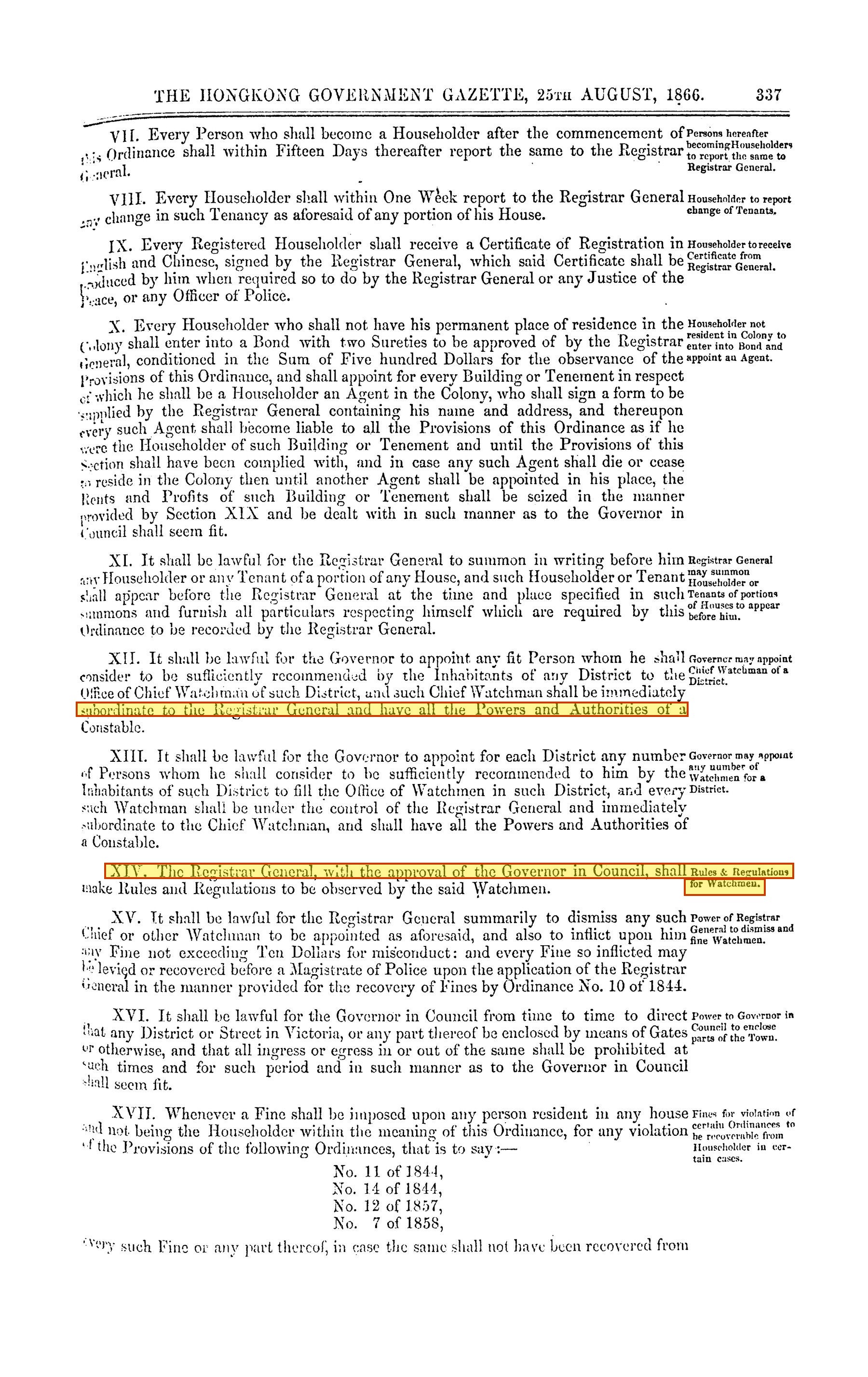
1866年初,英文報章報道廣州一帶局勢不穩;華人商賈與街坊領袖向政府請願,要求自組更練。港督麥當奴接納方案;1866年8月16日,立法局把《登記條例》修訂後三讀通過,成為第7號條例《維多利亞登記條例》;條例第12至15條定下更練的法律框架,並於1867年1月1日生效。6789
費用的安排是這支隊伍的性格所在:1867年的總登記官報告記載,操兵地以西若干街區的坊眾議決「自己支付更練的工錢,由專人逐戶收集」,5名更練頭目月薪20元、40名更練月薪8元,另租5間更練屋,制服由特別基金支出;帳目存放總登記官署,「隨時可供查閱」。報告又記錄了初期的角力——「起初對控制更練的權力頗有嫉妒」;並說明這支隊伍的功能設定:「付錢供養他們的人,期望他們按公認的華人習慣,使流氓與壞人不在自己區內聚集。」10
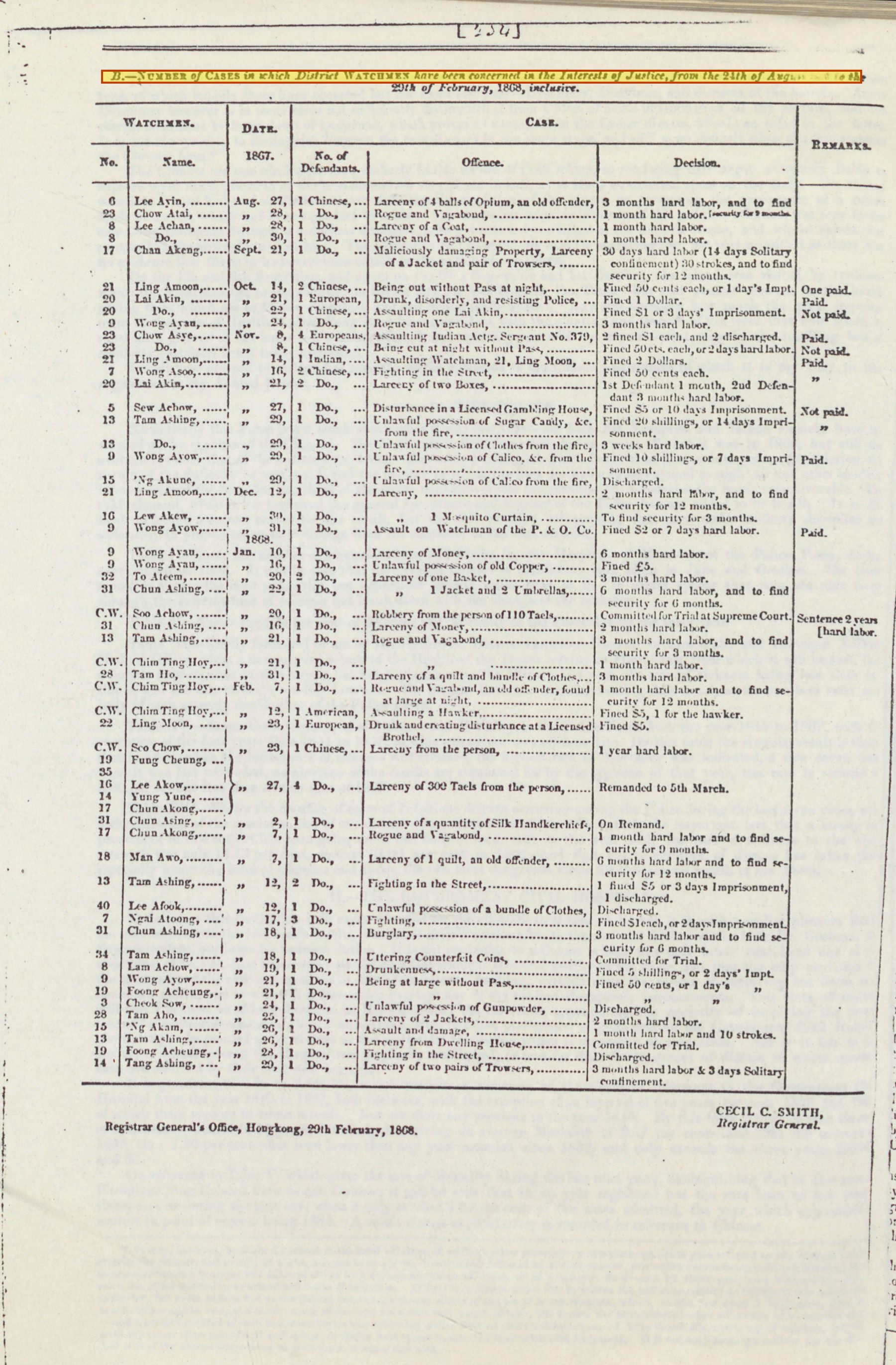
他們的日常工作第一次被系統記錄,始於1867年8月27日;截至1868年2月20日的「乙表」列明更練經手的案件:盜竊鴉片、毆打更練、行劫110兩等,旁載姓名與判決,由總登記官史密夫簽署。1868年的報告補充:更練「對新成立的消防隊大有幫助」,當年經手的68宗案件、126名被告中僅9人獲釋;相關記述又見於殖民地部1868至1869年間「在華人中間推行的警察制度……運作良好」的函件——該句常被歸於1866年,語料庫的抄本則屬1868至1869年。111213
1871年,因警隊醜聞而成立的警察調查委員會奉命同時檢視更練;1872年6月27日的報告認為更練「整體而言是有用的隊伍」,但建議「在警隊改組推行的同時,將他們逐步解散或併入警隊」。建議從未被執行:更練以獨立身分多存在了97年。14
三、1883:整支更練被「借」去潔淨
1883年是隊伍最奇特的一年。潔淨事務改革者查德威(Osbert Chadwick)在1882年的報告中把更練視為「推行潔淨法例的強力工具」,建議把他們納入衛生工作;當年的《憲報》通告把整支更練列為潔淨局的編制,藍皮書更在1883至1885年的「潔淨」項下記載6名更練頭目與37名更練,政府按年支付每人24元與12元,而坊眾繼續支付180元與72元。1516
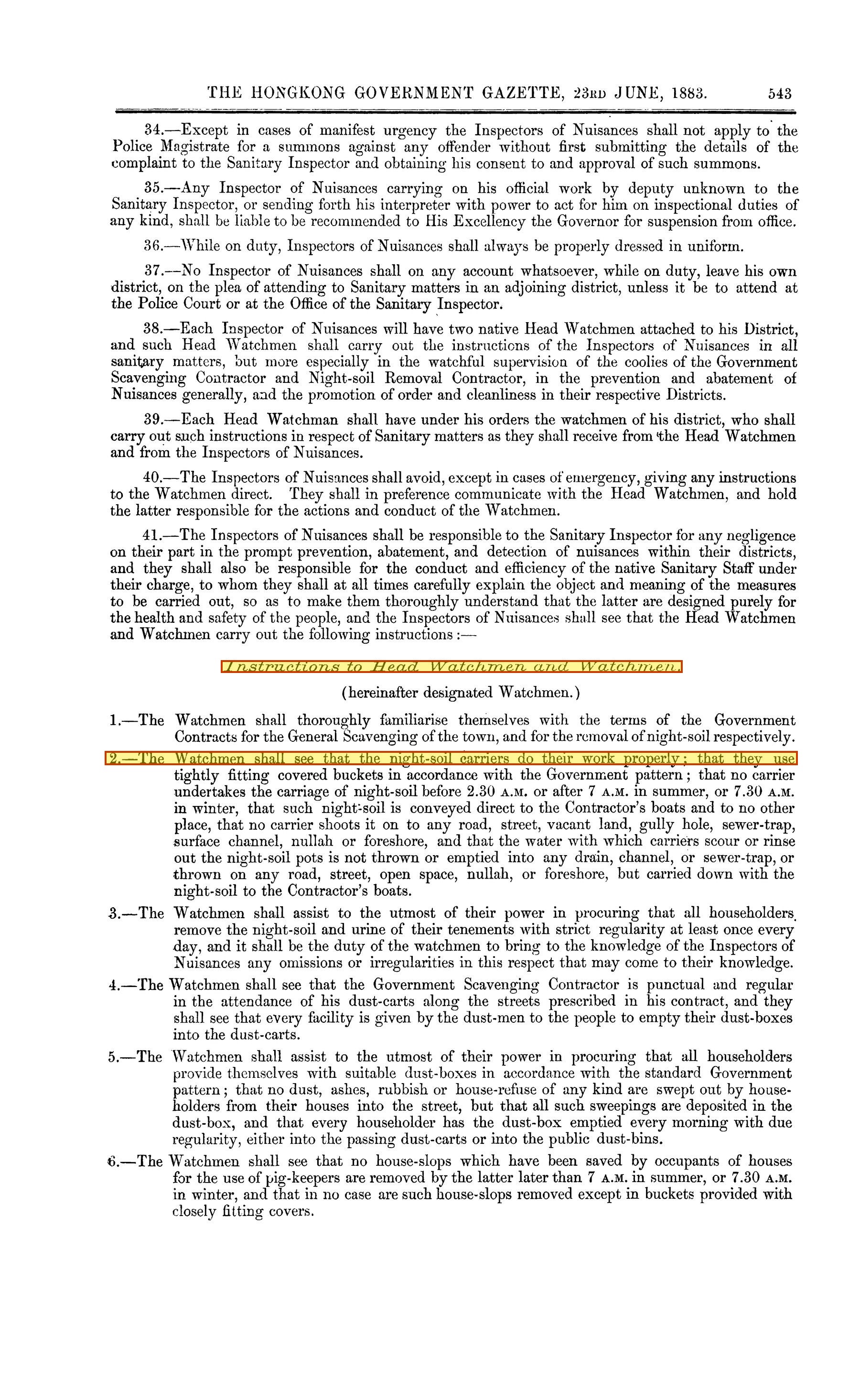
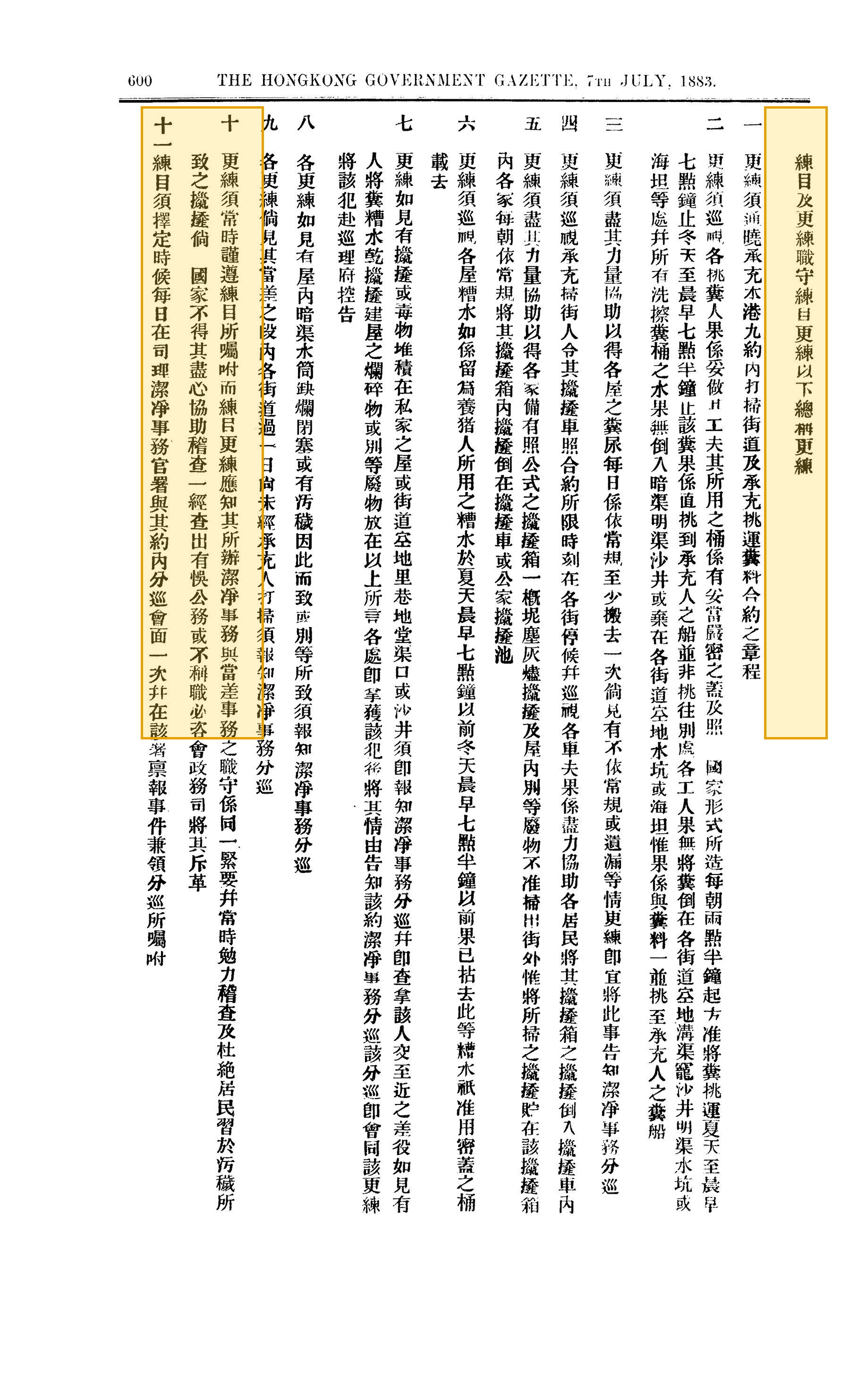
1883年6月23日的《憲報》刊登《更練職務守則》(中英雙語,中文版見7月7日《憲報》),開篇「練目及更練職守」,逐條規定挑糞時間、加蓋糞桶、掃街與垃圾箱的監督;並寫明「更練應知其所辦潔淨事務與當差事務之職守係同一緊要」——失職者「報知總登記官革除」。這三年,整支隊伍實際上被移作衛生之用;1886年的藍皮書已不再把他們列於潔淨項下,隊伍回到巡夜本業。1718
四、1888–1897:法律、委員會與巡更線
1888年3月,立法局把更練條文編入《管理華人條例》(第13號條例)第四部(第18至21條),內容大致沿用1866年的框架。1891年,總登記官駱克在何啟、韋玉等華人領袖推動下,委任12名華人組成更練委員會,管理由坊眾捐款組成的「更練基金」;基金的收支帳目自此定期在《憲報》刊登。當年的報告同時記錄業績:「年內更練送交裁判司的案件324宗,全部定罪。」192021
1897年6月7日起,維多利亞城內值夜的更練被納入警察巡邏線,受巡邏中的幫辦與警長監督;警察總監梅含理的報告說:「目的在提升這支極有用的輔助警察隊伍的效率,使他們與警察更緊密接觸。計劃至今運作良好。」任命與調動則持續以憲報通告刊行(如1889年余雲松、尹澤霖任更練頭目)。2223
五、1900年代–1930年代:更練館、九龍與2,067宗案件
20世紀初,更練在太平山、西環、灣仔與西營盤設有更練屋;1911年9月的一則官地拍賣公告,以「太平山四環更練館之南」為一幅內陸地段(Inland Lot 1892)定位——隊伍已寫入城市的坐標。1913年,政府把住戶登記的逐戶探訪交給更練,並在九龍設立分站;港督梅致殖民地部的函件記下九龍更練站的經費來源:「何甘棠先生慷慨捐出5,000元。」1914年的基金帳目顯示政府津貼2,000元,九龍新站的建築、則師與律師費用3,384元。24252627
1922年海員大罷工後,港督司徒拔批評華人領袖(包括更練委員會成員)「毫無用處」;輔政司施勳與華民政務司夏理德則以「隊伍幾乎全由坊眾自願捐款維持、行動須由委員會決定」為由,阻止改組——委員會不願深究,事情不了了之。此後數年,更練接受警察訓練、佩槍、更新制服;1930年12月5日,《更練條例》(第23號條例)制定:「華民政務司為委員會當然主席」、「委員會可委任任何數目的更練頭目與更練」,權力歸於委員會;律政司在立法局說,這是「一支極具價值的隊伍,應該有自己的條例」。1937年,更練送交法庭的案件達2,067宗(1936年1,567宗、1938年1,214宗),包括謀殺、搶劫、盜竊與拐帶;1938年他們協助天花疫苗接種與難民營警衛。2829303132
六、1941–1969:供養權的轉移與解散
日治前後,更練維持日常職務並協助護送米糧;戰後103人歸隊,委員會決定不再逐戶募捐,1947至1948年度起改由政府全費供養並逐步縮編;1949年4月29日,第15號條例(後為第230章)把隊伍改由華民政務司全權管理,保留警察權力,隊員不再穿制服出勤。其後20年,工作轉向民事調查與聯絡。3334
1968年市政區主任計劃推行,華民政務司改組為民政事務司;政府認為更練「再無合適角色」,1969年5月31日隊伍停止運作——政府自己的說法是「不少於102年」的公共服務,隊員多數轉入聯絡助理職系。1969至1972年間,九龍廣東道與灣仔石水渠街的更練宿舍先後撥作青年中心與志願團體用途;1971年,巴士條例仍把「更練隊」列在免費乘車的隊伍之一——名字在法律裏多留了兩年。35363738
結論
這支隊伍沒有成為「第二警隊」,也沒有等來完全自治:它是被出錢的人約束、被法律逐步收編、又被行政改組輕輕放下的一百年。三個母題互相拉扯——坊眾的錢(逐戶收取、帳目公開、1922年的「須由委員會決定」)、政府的法律(1866年的授權、1888年的重編、1930年與1949年的兩次改隸)、以及記錄在案的日常(乙表上的姓名、2,067宗的案件、最後41人的嘉許)。它最後的職務——調解、聯絡、了解民情——比任何制服都更接近它最初的樣子。394041
The Colony’s Other Police
The District Watch Force — the force the Chinese community paid for, 1866–1969
Abstract
In 1866 the Chinese householders of Victoria petitioned for permission to organise watchmen of their own; the result, written into the Victoria Registration Ordinance (No. 7 of 1866, ss. XII–XV), was a force appointed on the inhabitants’ recommendation, under the Registrar General, with the powers of constables — and paid by house-to-house subscription. It existed for 102 years. This paper follows the force through the records it generated: the Registrar General’s case return of 1867 (the watchmen’s own names, offences and sentences); the 1872 Police Commission’s recommendation, never carried out, that it should be “gradually disbanded or absorbed”; the 1883 sanitary transfer, when the whole force was put on night-soil and dust inspection under instructions printed in English and Chinese (練目及更練職守); the 1888 re-enactment (Part IV of No. 13 of 1888); the twelve-man Chinese committee of 1891 and the quarterly gazetting of its fund; the police beats of June 1897; the house-registration and Kowloon expansion of 1913, with Ho Kom-tong’s $5,000 for the station; the interwar modernisation and the 1930 ordinance (No. 23 of 1930); the caseload of 2,067 in 1937; the wartime and post-war run-down; the 1949 ordinance that made the force a government department; and the end — “The Force ceased to function on 31st May, 1969” — when the City District Officer scheme left it, in the Government’s own words, no longer a suitable role. Two findings carry the argument: the force was community-funded for eighty-three of its hundred and two years, and its end was administrative, not a consequence of scandal. Two of the scholarly literature’s details are corrected from the scans (the 1888 ordinance’s number; the force’s end date). 424344
1. Scope and method
This is a thread about an institution the literature has largely left to two articles: Lethbridge’s 1971 study of the force’s committee, and Hamilton’s 1998 study of the force, both in the Journal of the Hong Kong Branch of the Royal Asiatic Society, both in the corpus and both used here as secondary scaffolds, checked line by line against the primary prints. The question is the force’s own: how did a police body funded by the policed work, and why did it end? The sources are the ones the institution itself generated — the law (gazette and Historical Laws prints), the office reports (Registrar General 1867–68; the Sessional Papers; the Secretariat for Chinese Affairs / Home Affairs annual reports 1913–1972), the gazette’s notices and fund accounts, the despatches (CO 129), the Legislative Council records, and the press. The Chinese dimension is carried mainly by the Government’s own bilingual print (the 1883 instructions; the 1911 land notice) and from 1931 by the Chinese press in the image series; the community’s own records are lost (Lethbridge, note 23: “all the records in the Secretariat for Chinese Affairs were destroyed or lost during the Japanese occupation”). 454647
2. The founding, 1866–1872
The press of the 1866 New Year weeks carries the alarm — unrest rumoured in Canton — and the community’s response: a petition for permission to organise Chinese watchmen who would help the public police. The scheme was blessed by Governor MacDonnell and written into law on 16 August 1866, when the Registration Bill was recommitted, amended and passed as No. 7 of 1866. Its watchmen clauses are twelve to fifteen: chief watchmen and watchmen appointed on the recommendation of the district’s inhabitants, “immediately subordinate to the Registrar General”, “have all the Powers and Authorities of a Constable”; rules to be made by the Registrar General with the Governor in Council; dismissal and fines to $10 by the Registrar General. The ordinance came into force on 1 January 1867. 48495051
The money is the force’s signature. The Registrar General’s report for 1867 records the community of the Five Districts west of the Parade Ground deciding to elect watchmen “whose pay would be disbursed by themselves and be collected from house to house by men specially appointed for the purpose”: five chief watchmen (and one later for Wanchai) at $20 a month, forty watchmen at $8; five rented stations; “A uniform Coat provided from the special fund”; accounts kept at the Registrar General’s Office, “open at any time for inspection”. The same report records the founding frictions (“Much jealousy was at first displayed as to the powers which were to be exercised in controlling the Watchmen”) and the force’s theory of itself: “according to the recognized Chinese Custom, those who pay for their support expect them to keep the vagabonds and bad characters from congregating in their different Districts”. 52
The records of the men’s work begin on 27 August 1867 (a “mistake since remedied”), and the first return survives in full: Return B, signed by the Registrar General Cecil C. Smith on 20 February 1868, lists every case from 24 August 1867 to that date, with the watchmen’s names — Lee Ayin, Chow Atai, Lee Achan, Chan Akeng, Ling Amoon, Lai Akin, Wong Ayan, Chau Ayse, Sew Achow, Tam Ashing — the offences (from opium larceny to assaulting a watchman to “Robbery from the person of 110 Taels”) and the decisions. The 1868 report adds: “The District Watchmen have been found of great use in the work of the Brigade” (the new Fire Brigade), and of the year’s cases — “68 such cases, including 126 Defendants, of whom only Nine were discharged”. In the despatches of 1868–69 the scheme is “the Police system inaugurated… amongst the Chinese… working admirably” — and the same passage insists that no Chinese control of the gambling revenue could be dreamt of. 535455
Opposition to the force existed from the first. The Chief Justice, Sir John Smale, protested against its “inefficiency and corruption” and wanted it embodied in the police; the former Captain Superintendent Charles May was hostile to Chinese constables. The Police Commission of December 1871 — convened over police scandals — was asked both to review the police and to report on continuing “the auxiliary force of District Watchmen”. Its report of 27 June 1872 found them “on the whole… a useful body of men” and recommended that they “should be left alone for the present, but that, as the reorganisation of the Police proceeds, they should be gradually disbanded or absorbed into the latter force”. The recommendation was never carried out; the force would outlive it by ninety-seven years. 5657
3. The sanitary years, 1883–1886
In 1882 the sanitary reformer Osbert Chadwick, reporting on the colony’s condition, saw in the force “a powerful apparatus for enforcing sanitary law” and proposed that “their powers should be extended to include cleanliness as well as order”. The transfer followed: the gazette of April 1883 lists the Sanitary Board’s staff as the entire District Watch Force (a “Coloured Watchman” for the Peak; head watchmen and watchmen for Western, Central and Eastern), and the Blue Books of 1883–85 carry six Head District Watchmen and thirty-seven watchmen under “Sanitary”, the Government paying $24 and $12 a year against the community’s $180 and $72. Instruction No. 223 of 23 June 1883 set the duties: the night-soil carriers’ hours and covered buckets, the dust-carts, the house-slops, the drains — and, in the English and Chinese prints alike, the sentence that made the transfer plain: “The Watchmen must… understand that their sanitary duties are of equal importance with their police duties” (各更練應知其所辦潔淨事務與當差事務之職守係同一緊要), neglect being “reported to the Registrar General for dismissal”. By the 1886 Blue Book the watchmen had disappeared from the sanitary sub-department; the merchant subscribers had, in effect, got their force back. Hamilton reads the episode as the Government’s appropriation of a private security force for public sanitary duties; the record shows at least that the community continued to pay throughout. 58596061
4. Law and committee, 1888–1897
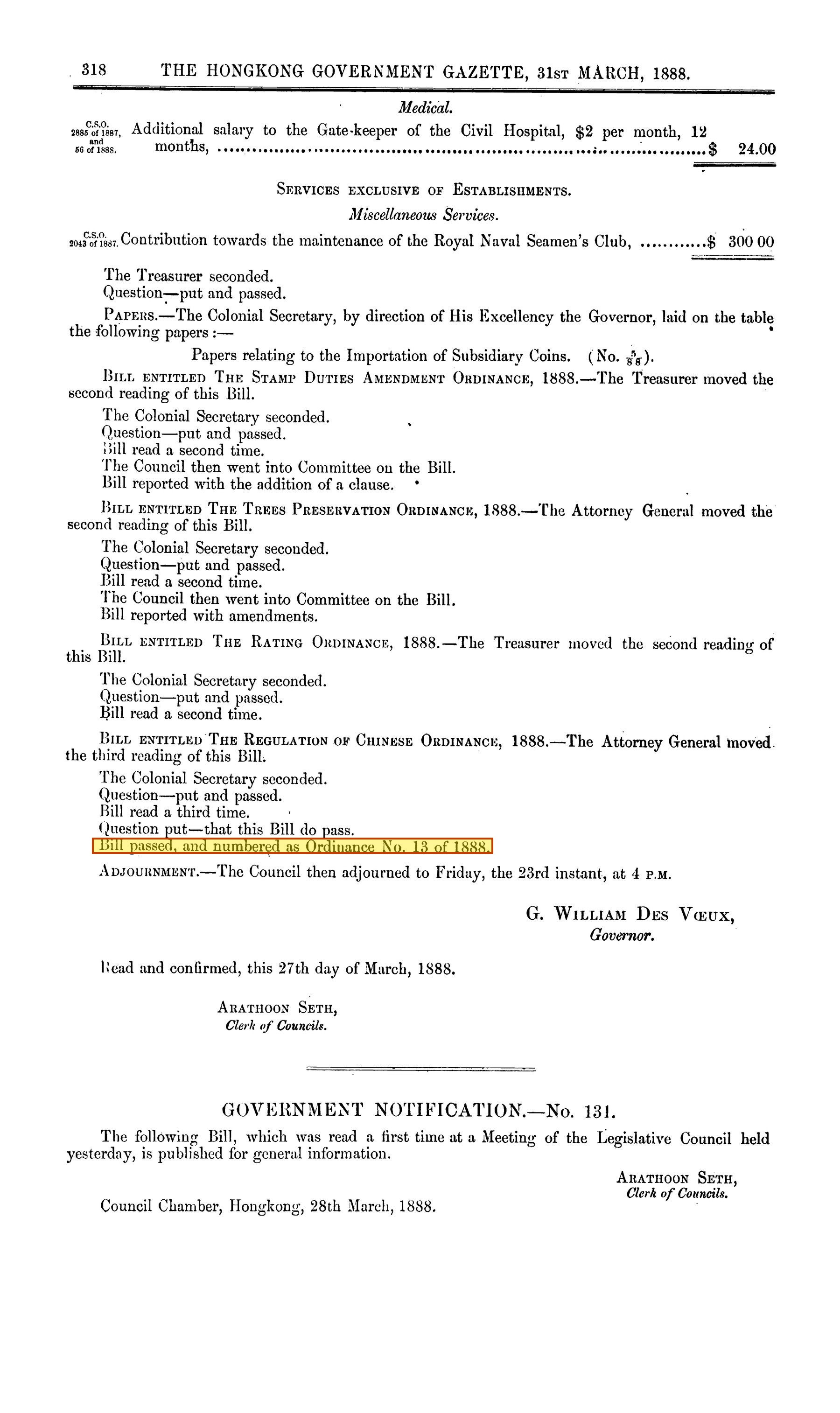
In March 1888 the Legislative Council re-enacted the watchmen’s law as Part IV of the Regulation of Chinese Ordinance, 1888. The gazette’s own line — “Bill passed, and numbered as Ordinance No. 13 of 1888” — settles the number against two text-series misreadings of “No. 3” (the scans win). The sections keep the 1866 shape: appointment on the inhabitants’ recommendation; “within his district, all the powers and authorities of a constable”; rules by the Registrar General with the Governor in Council; transfer, dismissal and fines by the Registrar General. Appointment notices under the new law run in the gazette from 1889 (“Ü Yun Chung and Wan Chak Lam to be Chief District Watchmen…”). 6263
The committee is the thread’s second engine. At the end of 1890, on the Registrar General Stewart Lockhart’s recommendation — encouraged by the compradore Wei Yuk — the Acting Governor appointed twelve Chinese gentlemen “to co-operate with this Department in the administration of the District Watchmen’s Fund”: Ho Kai, Ch’an Pan-pó, Choy Chee-bee, Ho Fook, Ip Chuk-k’ai, Lau Wai-ch’ün, Lau Yam-ts’ün, Li Shing, Poon Pong, Sham Ch’euk-tong, Tseung Sz-kái and Wai Yuk. The 1891 report records the year’s cases (324, all convicted) and hopes that “the advice of the gentlemen forming this Committee will be of great assistance to this office in dealing with the affairs of the Chinese community”. The fund’s accounts were gazetted quarter by quarter from 1888 — the subscribers’ money published where the subscribers could see it. Lethbridge reads the committee as the apex of a system of Chinese boards (Tung Wah, Po Leung Kuk, the Watch Committee) whose members became the colony’s Chinese advisers; the 1922 despatches bear him out (below). 646566
On 7 June 1897 the watchmen on night duty in Victoria (6 p.m. to 6 a.m.) were “placed on Police beats and subjected to the supervision of Police Inspectors and Sergeants on patrol duty” on Captain Superintendent F. H. May’s recommendation — “The object was to improve the efficiency of this very useful auxiliary Police Force… The scheme has so far worked well.” The men also served beyond the beats: the Po Leung Kuk Commission of 1892 found the Kuk’s principal detectives to be serving district watchmen. 6768
5. The twentieth-century force, 1900–1939
The early twentieth century brought houses, duties and prestige. Watch-houses stood at Taipingshan, West Point, Wanchai and Sai Ying Pun; by 1911 the Taipingshan hall had become a surveying landmark — an auction notice that year locates Inland Lot 1892 “south of the Taipingshan Sz-wan (四環) watchmen’s hall (更練館)”. In 1913 the force absorbed the household-registration visits (the Financial Secretary promised the Council that the work “should be of great value in checking serious crime”) and crossed to Kowloon: Governor May’s despatch of 12 May 1913 records “Mr. Ho Kom-tong has generously made a donation of $5,000” towards the Kowloon station. The 1914 fund statement shows the Government’s grant at $2,000 for the year and the station’s build, architect and solicitor at $3,384. 69707172
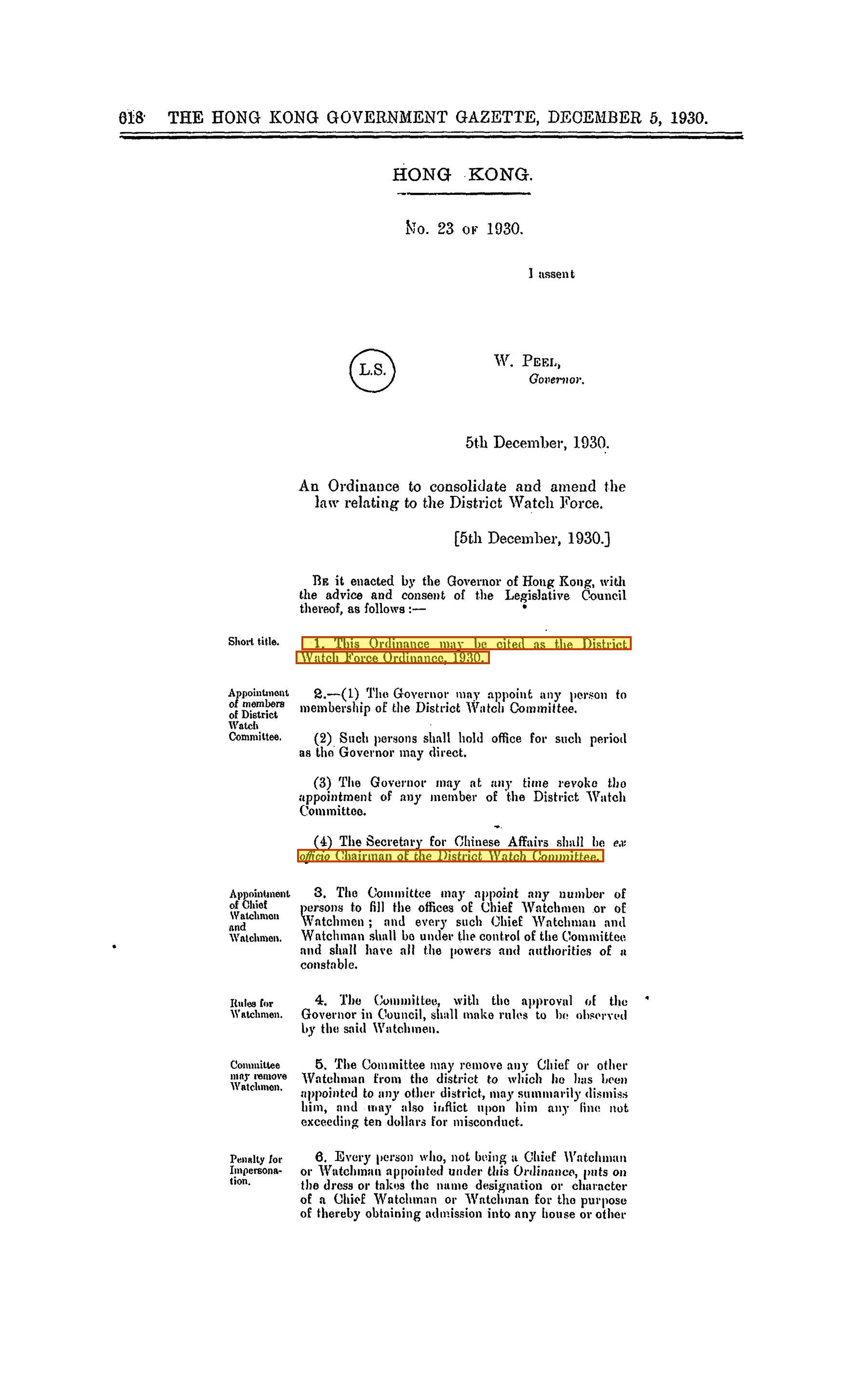
The interwar force professionalised under police guidance — detectives under a seconded police sergeant from 1919, training at the Police Training School, side-arms, a new uniform — and in 1930 received an ordinance of its own: No. 23 of 1930, whose s.2 makes the Secretary for Chinese Affairs the Committee’s ex officio chairman and whose s.3 gives the Committee the appointment of watchmen with constable powers. The Attorney General called it “this very valuable Force”. The caseload peaked in 1937: 2,067 cases obtained by the force (1,567 in 1936; 1,214 in 1938), from murder and robbery to larceny and the trafficking of children; in 1938 the men accompanied the smallpox vaccinators and guarded the refugee camps. Its war-crisis test came earlier, in 1922. 73747576
The 1922 seamen’s strike is the force’s great crisis. Governor Stubbs, reporting to Churchill, condemned the Chinese leadership — “the Members of the District Watchmen’s Committee, &c.” — as having been “of the slightest use” against intimidation, “sheer cowardice” the only explanation. The acting Governor Severn and the Secretary for Chinese Affairs Hallifax refused the implication: the force’s situation was “somewhat delicate”; it was “paid almost entirely by voluntary subscriptions, and is managed by the District Watchmen Committee composed of prominent local Chinese, who represent the subscribers”; any “Enquiry and action would necessarily be a matter for the Committee, which shows the greatest reluctance to carry the subject any further”. No reorganisation followed. The episode is the clearest evidence of the committee’s standing: a governor’s condemnation died on the committee’s reluctance. 777879
6. Government service and the end, 1941–1969
In December 1941 the watchmen kept to their posts and escorted rice and firewood from the North Point depot; in 1945, 103 men reported back. The Committee — the Secretary for Chinese Affairs still in the chair — decided against reviving the subscriptions; from 1947–48 the force was financed entirely by Government, and recruitment stopped. The ordinance of 29 April 1949 (No. 15 of 1949, later Cap. 230) transferred the force to the Secretary for Chinese Affairs’ “supreme direction and administration”, kept the constable powers, and ended the uniform: “District Watchmen now ceased to appear in uniform on the streets.” Through the 1950s the work shifted to civil enquiries and liaison; by 1961 the personnel were divided among the department’s sections, and in 1967, during the disturbances, the force did special guard duty and opinion surveys. 8081
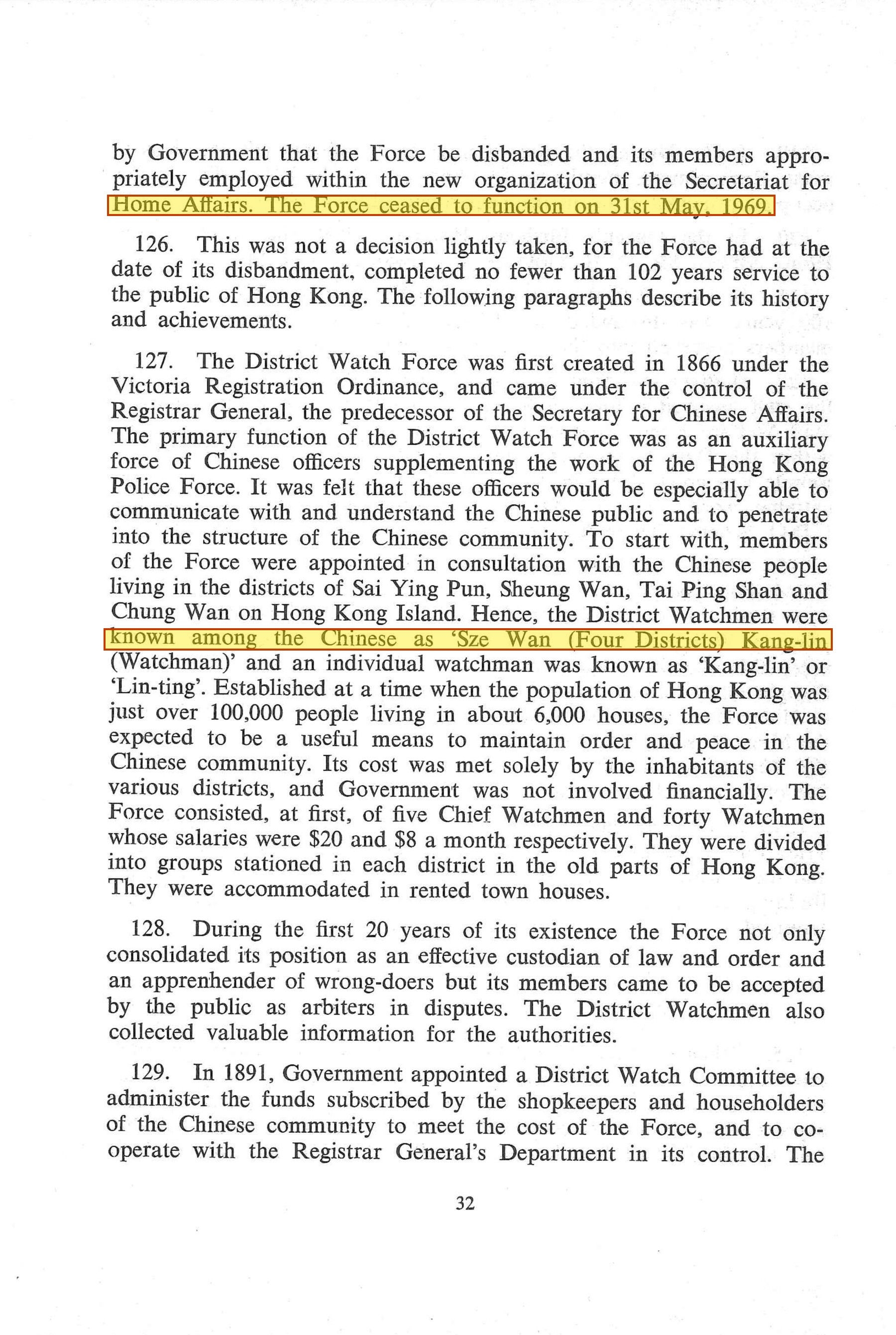
The end came with the City District Officer scheme of 1968. The Secretariat for Chinese Affairs became the Secretariat for Home Affairs “with an entirely new outlook”; “It was recognized that there was no longer a suitable role for the District Watch Force to fill”. The last commendation of 41 members was in February 1969; the force “ceased to function on 31st May, 1969”, after “no fewer than 102 years service”; most members moved into the Liaison Assistant Grade. No scandal, no prosecution, no debate marks the end in the record: the Government’s own chapter, headed “District Watch Force: 1866–1969”, is the obituary. The quarters followed: the Kowloon building in Canton Road became a Rotary-sponsored youth centre run by the Hong Kong Federation of Youth Groups; the Stone Nullah Lane building passed to five voluntary agencies. In 1971 the bus-fare schedules still named the force; in 1972 a Legislative Councillor urging neighbourhood watch called it “the traditional Chinese ‘po kak’ — a district watch force. It is not a private army.” 8283848586
7. What the record settles — and what it will not
Three findings, each against its adversarial test. First, the force was community-funded: the grants ($1,600 from 1870, $2,000 from 1874, withdrawn 1894, resumed 1903, cut to $100 by 1936) never displaced the subscriptions, and the 1922 despatch and the 1969 chapter both say the force was paid by the community until 1947–48. Second, it was never absorbed: the 1872 recommendation lapsed; the 1930 and 1949 ordinances describe a separate force; the 1969 absorption went to a civil grade, not the police. Third, the end was administrative: no scandal-driven abolition exists in the record, and the force’s own last crisis year (1922) is the counter-example — its committee protected it. Against the thread: the community’s own records are gone (Lethbridge note 23), the 1866 petition is not in the corpus, and no photograph of the force itself was located in the image series searched; the plates are the record’s documents. The scholarly literature’s four points of friction are kept as registered (the 1969/1970 end date; the No. 13/No. 3 number — settled by the scan; the 1893/1894 committee membership; the 1930s strength figures), never averaged. 87888990919293
Notes
Research note. The battery ran on the hkintexts corpus (read-only) in five families: the force’s names (“District Watch” 2,690; “District Watchmen” 2,603; “District Watch Force” 1,597; “District Watch Committee” 464); the law (“Ordinance No. 7 of 1866” 87; “Victoria Registration Ordinance” 159; “Ordinance 13 of 1888” 145; “District Watch Force Ordinance” in the gazette image series 5); the official record (the Registrar General’s reports for 1867–68; the quarterly District Watchmen’s Fund accounts from 1888; the Sessional Papers; the Chinese Affairs / Home Affairs annual reports, a 1913–1972 series of ~1,400 pages, whose 1969–70 volume carries the force’s obituary chapter); the Chinese terms (更練 419; 四環更練 116; 練目 169; the Chinese press in the 工商日報 image series from 1931, 更練 828); and the despatches (CO 129: MacDonnell 1866–69; Kennedy 1872–73; May 1913; Stubbs and Severn 1922). Two whole-document pulls anchor the thread: the 1969–70 Home Affairs report (Chapter XI) and the ordinances as printed. Access 30 October 2026. ↩
Proper-name battery (rule 9): 更練 — 419 text hits, decisive witness the Gazette’s own bilingual instructions (1883, p. 600) and the 1969–70 chapter’s “Sze Wan (Four Districts) Kang-lin”; 四環更練/更練館 — 116/13 hits, witness the 1911 gazette notice; 練目 — 169 hits (1883 Chinese instructions; Blue Book 1878 p. 215); 何啟/何福/何甘棠/韋玉 — both-leg checks (thread glossary and this pass). The 1891 committee’s other eight names are printed exactly as the record gives them; the epithet “Lin-ting” is kept romanized. Web verification: zh.wiktionary 更練; zh.wikipedia 打更/何福 (香港)/何甘棠/周壽臣/羅旭龢 — the search tool was intermittently unavailable; the recorded state is in the notes’ Appendix and register. ↩
Battery as in the note on method; access 30 October 2026. ↩
Sheilah Hamilton, “The District Watch Force”, Journal of the Hong Kong Branch of the Royal Asiatic Society 38 (1998), pp. 233–261: the force “existed, in fact if not in name, for more than a century between 1866 and 1970”; the sanitary transfer of 1883–85; the Wilson—the 1891 committee; the grant history; the 1920s reorganisation; the case table 1925–39; the McDouall description of the force as “an imperfectly comprehended mystery”. https://hkintexts.histsyn.com/page/214375 (accessed 30 October 2026). ↩
H. J. Lethbridge, “The District Watch Committee: ‘the Chinese Executive Council of Hong Kong’?”, JHKBRAS 11 (1971), pp. 122–147: the committee as the apex of the Chinese boards system (Tung Wah, Po Leung Kuk, the Watch Committee); the 1 February 1866 community meeting; the fifty-two committeemen 1891–1941; “all the records in the Secretariat for Chinese Affairs were destroyed or lost during the Japanese occupation” (note 23). https://hkintexts.histsyn.com/page/206305 (accessed 30 October 2026). ↩
The founding season in the press: The China Mail, 8 February 1866, p. 3 (the Canton-alarm weeks; the columns carry the garrison and court matter beside the unrest reports), https://hkintexts.histsyn.com/image-page/1182975; 22 February 1866, p. 2, /image-page/1182982; and the Registration Bill/Ordinance text as circulated, China Mail, 2 August 1866, https://hkintexts.histsyn.com/page/1884055 (accessed 30 October 2026). The petition itself is not in the corpus; its content is known through the Registrar General’s report (see the 1867 note) and the 1969–70 chapter. ↩
Votes and Proceedings of the Legislative Council, No. 11 of 1866 (16 August 1866): “The ‘Registration’ Bill is recommitted, amended and passed, bearing the Title of… dividing the City of Victoria into Districts and for the better Registration of Householders and Chinese Servants… being ‘No. 7 of 1866’”; the same sitting passed the Order and Cleanliness Bill (No. 8 of 1866) and the Piracy Court Bill (No. 9 of 1866). https://hkintexts.histsyn.com/page/1881207 (accessed 30 October 2026). ↩
The commencement proclamation, Gazette, 15 December 1866: “the said Ordinance shall commence and take effect on the First Day of January, 1867”; the same issue cites s.38 of Ordinance No. 7 of 1866 and s.35 on registration certificates. https://hkintexts.histsyn.com/page/1679690 (accessed 30 October 2026). ↩
The Victoria Registration Ordinance, 1866 (No. 7 of 1866), Hong Kong Government Gazette, 25 August 1866, pp. 336–340 — clauses XII–XV: the Governor may appoint a Chief Watchman “sufficiently recommended by the Inhabitants of any District… immediately subordinate to the Registrar General” and having “all the Powers and Authorities of a Constable”; watchmen likewise; the Registrar General with the Governor in Council “shall make Rules and Regulations to be observed by the said Watchmen”. Scans: the clauses page, https://hkintexts.histsyn.com/image-page/1451081; the ordinance’s first page, /image-page/1451097; text, https://hkintexts.histsyn.com/page/1679471 (accessed 30 October 2026). ↩
Registrar General’s report for 1867 (Blue Book 1867), §§20–28: the auxiliary force “created” by the Registration Ordinance; “Much jealousy was at first displayed as to the powers which were to be exercised in controlling the Watchmen”; the Community of the Five Districts to the west of the Parade Ground electing watchmen “whose pay should be disbursed by themselves and be collected from house to house by men especially appointed for the purpose”; five Chief Watchmen (and one later for Wanchai) and 40 watchmen; five rented stations; “A uniform Coat provided from the special fund”; accounts kept at the Registrar General’s Office and “open at any time for inspection”; “the month of August arrived ere I was enabled to state that the special Watchmen could be recognized by the Executive”; and “according to the recognized Chinese Custom, those who pay for their support expect them to keep the vagabonds and bad characters from congregating in their different Districts”. Text, https://hkintexts.histsyn.com/page/656484 (accessed 30 October 2026). ↩
Return B, signed by Cecil C. Smith, Registrar General, 20 February 1868: “Number of cases in which District Watchmen have been concerned in the Interests of Justice, from the 24th of August 1867 to the 20th of February 1868, inclusive” — the watchmen’s names (Lee Ayin, Chow Atai, Lee Achan, Chan Akeng, Ling Amoon, Lai Akin, Wong Ayan, Chau Ayse, Sew Achow, Tam Ashing…), offences (opium larceny; “Assaulting Watchman”; “Robbery from the person of 110 Taels”) and decisions. Scan, https://hkintexts.histsyn.com/image-page/2183092 (image label “1867 p150”); text, https://hkintexts.histsyn.com/page/656487 (accessed 30 October 2026). ↩
Registrar General’s report for 1868 (Blue Book 1868), §22: “The District Watchmen have been found of great use in the work of the Brigade” (the new Fire Brigade); §23: “they have been concerned in 68 such cases, including 126 Defendants, of whom only Nine were discharged… The class of Persons punished through their endeavours may be broadly described as ‘Thieves’”. https://hkintexts.histsyn.com/page/656692 (accessed 30 October 2026). Hamilton counts “ninety-eight cases… conviction of 117 defendants” from the same report family; the report’s own figures are given here and the variance is registered. ↩
“At this moment the Police system inaugurated… amongst the Chinese — an institution quite apart from that of the Colony — is working admirably, but the last thing which a resident here could dream of would be the handing over to any Chinese… the slightest control” — the gambling-correspondence stratum, CO 129/133, p. 149, https://hkintexts.histsyn.com/page/275577; duplicated in CO 129/137, p. 300, https://hkintexts.histsyn.com/page/278287. Lethbridge’s footnote trail dates the phrase 1866; the corpus’s copies sit in the 1868–69 despatches, and are dated so here (accessed 30 October 2026). ↩
Report of the Police Commission, 27 June 1872, ¶60: “The force of District Watchmen seems on the whole to have been a useful body of men, and the Commission, therefore, recommend that they should be left alone for the present, but that, as the reorganisation of the Police proceeds, they should be gradually disbanded or absorbed into the latter force. Should the advice of the majority of the Commission be accepted… the raison d’être of the District Watchmen will cease.” CO 129/158, p. 312, https://hkintexts.histsyn.com/page/288367; duplicate CO 129/164, p. 260, https://hkintexts.histsyn.com/page/291581 (accessed 30 October 2026). ↩
Blue Book 1883: Local Revenues — “The Chinese inhabitants contribute, by a voluntary assessment among themselves, to the pay of District Watchmen… received from the Government a Grant-in-Aid of $2,775.57 and $2,000.00 respectively”, https://hkintexts.histsyn.com/page/660079; the staff table carrying “Head District Watchmen ($180 per annum each); District Watchmen ($72 per annum each)”, https://hkintexts.histsyn.com/page/660130; and the sanitary sub-department rows ($24 per Head, $12 per watchman from Government) at https://hkintexts.histsyn.com/page/660108 (accessed 30 October 2026). ↩
Hamilton, “The District Watch Force” (1998). ↩
Government Notification No. 223, Gazette, 23 June 1883, pp. 538–544: “Instructions to Head Watchmen and Watchmen” — night-soil carriage only 2.30 a.m.–7 a.m. (7.30 winter), covered buckets, dust-carts and dust-boxes, house-slops before 7 a.m., nuisances reported and offenders charged; “The Watchmen must… understand that their sanitary duties are of equal importance with their police duties”, and neglect is “reported to the Registrar General for dismissal”. Scan, https://hkintexts.histsyn.com/image-page/1519576; text, https://hkintexts.histsyn.com/page/1664359 (accessed 30 October 2026). ↩
The Chinese print of the same instructions, 練目及更練職守 (“Duties of Head Watchmen and Watchmen”), Gazette, 7 July 1883, p. 600 — the force’s own working vocabulary: 練目 (head watchmen), 更練 (watchmen), 潔淨事務分巡 (the Inspectors of Nuisances), and the clause “各更練應知其所辦潔淨事務與當差事務之職守係同一緊要”. Scan, https://hkintexts.histsyn.com/image-page/1519630; text, https://hkintexts.histsyn.com/page/1664434 (accessed 30 October 2026). ↩
The Regulation of Chinese Ordinance, 1888 (No. 13 of 1888), Part IV “Watchmen” (ss. 18–21): chief watchmen and watchmen appointed on the inhabitants’ recommendation, “within his district, all the powers and authorities of a constable”, rules by the Registrar General with the Governor in Council, transfer/dismissal/fines not exceeding $10. The numbering line — “Bill passed, and numbered as Ordinance No. 13 of 1888” — is on the gazette scan, https://hkintexts.histsyn.com/image-page/1535497 (printed p. 318); the consolidated text in the Historical Laws print, https://hkintexts.histsyn.com/page/1842978 (accessed 30 October 2026). Two text-series OCR reads rendered the number “No. 3”; the scan wins (registered). ↩
Registrar General’s report for 1891 (printed in the Sessional Papers 1892, p. 241): “DISTRICT WATCHMEN. (ORDINANCE 13 OF 1888, CHAP. IV.)… The number of cases brought before the Magistrate by District Watchmen during the year amounted to 324, in all of which convictions were obtained. On my recommendation, General BARKER, when administering the Government, appointed the following gentlemen, at the end of last year, as a Committee to co-operate with this Department in the administration of the District Watchmen’s Fund” — the twelve names, beginning “Honourable Ho KAI… Ho Fook… WAI YUK”. Text, https://hkintexts.histsyn.com/page/1815844; image twin, https://hkintexts.histsyn.com/image-page/1607215 (accessed 30 October 2026). ↩
The District Watchmen’s Fund accounts, gazetted quarterly: e.g. 4th quarter 1887, https://hkintexts.histsyn.com/page/660658; the 1888 quarterlies, /page/657892, /page/658696, /page/659455, /page/660169; 1891, https://hkintexts.histsyn.com/page/1650560; 1892, /page/1648581; 1893, /page/1647019 (accessed 30 October 2026). The 1891 report notes “The accounts of the Watchmen’s Fund have already been published. (See Government Gazette, Notification No. 123.)” ↩
Report of the Captain Superintendent of Police for 1897 (Sessional Papers 1898, printed p. 154): “DISTRICT WATCHMEN. In accordance with my recommendation the District Watchmen (numbering on the average 40) on duty in Victoria from 6 p.m. to 6 a.m. were on the 7th of June placed on Police beats and subjected to the supervision of Police Inspectors and Sergeants on patrol duty. The object was to improve the efficiency of this very useful auxiliary Police Force, and to bring them into closer touch with the Police. The scheme has so far worked well.” — F. H. May. Text, https://hkintexts.histsyn.com/page/1819724; gazette print, https://hkintexts.histsyn.com/page/1638104 (accessed 30 October 2026). ↩
Watchmen’s appointment notices in the Gazette (sample): “Ü YUN CHUNG (余雲松) and WAN CHAK LAM (尹澤霖) to be Chief District Watchmen…”, 16 November 1889, https://hkintexts.histsyn.com/page/1654653; Ch’an Shing-ts’an to be a Chief District Watchman, 1886, https://hkintexts.histsyn.com/page/1660313; Lo Heung to be Chief Watchman, No. 5 District, 1885, https://hkintexts.histsyn.com/page/1661610; “Mok-un appointed Chief Watchman of No. 5 District”, 1881, https://hkintexts.histsyn.com/page/1667334; “LI-A-SHAM to be Head District Watchman”, 1878, https://hkintexts.histsyn.com/page/1670096 (accessed 30 October 2026). The 1889 notice cites “Sections 17 and 18 of Ordinance 13 of 1888” — the appointment machinery in operation. ↩
The 1911 auction notice locating Inland Lot 1892 “situated south of the Taipingshan Sz-wan (四環) watchmen’s hall (更練館)” (“坐落太平山四環更練館之南…”), with boundaries and an upset price of $14,315, Gazette, 8 September 1911, printed p. 559, https://hkintexts.histsyn.com/page/1592535 (accessed 30 October 2026). The notice is filed inside a gazette bundle labelled for the month’s bank-note return; it is cited by its content (registered). ↩
LegCo Hansard, 9 October 1913 (the Estimates speech): “it is proposed further to add to the duties of the Force the work connected with the registration of householders under the Regulation of Chinese Ordinance. This work alone will entail much responsible labour, but if efficiently carried out should be of great value in checking serious crime in the Colony. The matter is important enough for the District Watchmen Committee to have authorised the extension of their system of watchmen by opening a new station in Kowloon.” https://hkintexts.histsyn.com/page/1882039 (accessed 30 October 2026). ↩
Governor May to the Colonial Office, 12–13 May 1913 (CO 129/401, p. 215): “steps are now being taken to extend to the Kowloon Peninsula the system of the District Watchmen’s Organisation and to establish a District Watchmen’s Station there. To assist in defraying the necessary expenditure which will fall on the District Watchmen’s Fund, Mr. Ho Kom-tong has generously made a donation of $5,000.” The same despatch requests the reorganisation of householder registration under “Ordinance No. 3 of 1888” (the period’s shorthand for the 1888 ordinance scheme). https://hkintexts.histsyn.com/page/443177 (accessed 30 October 2026). ↩
Annual Report 1914, Table VI, “Statement of the Receipts and Expenditure relative to the Hongkong District Watchmen’s Fund for the year 1914”: the Government grant of $2,000; wages lines for chief watchmen, detectives and the three classes; and “Cost of Kowloon District Watchmen Station and fees for Architect and Solicitors, $3,384”. https://hkintexts.histsyn.com/page/615468 (accessed 30 October 2026). ↩
Governor Stubbs to Churchill, 18 March 1922 (CO 129/474, p. 230): “I had confidently expected that the leading members of the community, the Members of Council, the Justices of the Peace, the Members of the District Watchmen’s Committee, &c. would have done good service by calming the fears of the ignorant populace and obtaining for the Government information which would enable it to deal with intimidation. In neither respect were they of the slightest use. The only possible explanation is sheer cowardice.” https://hkintexts.histsyn.com/page/491689 (accessed 30 October 2026). ↩
Severn to Churchill, 22 August 1922 (CO 129/476, p. 98): “The information department of the Secretary for Chinese Affairs consists of a body of men known as the District Watchmen Force, and the situation as regards this body of men is somewhat delicate… The Force is paid almost entirely by voluntary subscriptions, and is managed by the District Watchmen Committee composed of prominent local Chinese, who represent the subscribers. Enquiry and action would necessarily be a matter for the Committee, which shows the greatest reluctance to carry the subject any further.” https://hkintexts.histsyn.com/page/492745 (accessed 30 October 2026). ↩
The District Watch Force Ordinance, 1930 (No. 23 of 1930), Gazette, 5 December 1930, printed p. 618: “An Ordinance to consolidate and amend the law relating to the District Watch Force” — s.2 (the Governor appoints the Committee; “The Secretary for Chinese Affairs shall be ex officio Chairman”), s.3 (“The Committee may appoint any number of persons to fill the offices of Chief Watchmen or of Watchmen; and every such Chief Watchman and Watchman shall be under the control of the Committee and shall have all the powers and authorities of a constable”), s.4–6 (rules; removal and fines; impersonation penalty). Scan, https://hkintexts.histsyn.com/image-page/1472244; text, https://hkintexts.histsyn.com/page/1871727 (accessed 30 October 2026). ↩
LegCo Hansard, 6 November 1930 — the Attorney General moving the Bill’s first reading: “The provisions of this Bill are practically the same as those contained in the Regulation of Chinese Ordinance, 1888. It has been decided that this very valuable Force should have an Ordinance of its own and the name of the Committee has been changed from The District Watchmen’s Committee to District Watch Committee as more suitable and as preferred by the Committee themselves.” https://hkintexts.histsyn.com/page/1882340 (accessed 30 October 2026). ↩
Annual Report 1938, Table VIII, “Comparative Statement of the Number of Cases obtained by the District Watch Force for the last three years”: totals 1,567 (1936), 2,067 (1937), 1,214 (1938), with offence lines (murder 1/1/3; robbery 3/4/5; larceny 769/1,123/543; “Trafficking in children (or kidnapping)” 21/—/17). https://hkintexts.histsyn.com/page/632082 (accessed 30 October 2026). ↩
Report of the Secretary for Home Affairs 1969–1970, Chapter XI, “DISTRICT WATCH FORCE: 1866–1969”: §121 — “In June 1969, the District Watch Force, with a history of over 100 years, was disbanded… and the majority of its members absorbed into the Liaison Assistant Grade”; §125 — “It was recognized that there was no longer a suitable role for the District Watch Force to fill… The Force ceased to function on 31st May, 1969.”; §126 — “no fewer than 102 years service”; §127 — “known among the Chinese as ‘Sze Wan (Four Districts) Kang-lin (Watchman)’ and an individual watchman was known as ‘Kang-lin’ or ‘Lin-ting’”; §§131, 137–143 — the Ho Kom-tong-funded Kowloon house; the 1941–45–1949–1969 arc; the 1967 disturbances. Text, https://hkintexts.histsyn.com/page/684304 (pp. 39 ff.); the chapter’s opening page scan, https://hkintexts.histsyn.com/image-page/2754443 (accessed 30 October 2026). ↩
The District Watch Force Ordinance (No. 15 of 1949; amended by No. 9 of 1950; Cap. 230 in the consolidations): “The Secretary for Chinese Affairs, subject to the orders and control of the Governor, shall be charged with the supreme direction and administration of the District Watch Force”; “A district watchman shall, in relation to such duties as he may be required to perform, have all the powers and privileges of a constable of the police force”; functions to assist the Secretary and to preserve the peace and prevent and detect offences; finance by annual vote of the Legislative Council. Assent date 29 April 1949. https://hkintexts.histsyn.com/page/1849059 (accessed 30 October 2026). ↩
HAD report 1969–70, Chapter XI, §§121–143. ↩
Report of the Secretary for Home Affairs 1970–1971, p. 31: “In view of the abolition of the District Watch Force in 1969, arrangements were made to lease the Kowloon District Watch Force Quarters in Canton Road, Kowloon as a youth centre sponsored by Rotary and to be operated by the Hong Kong Federation of Youth Groups. Similar arrangements for leasing the Hong Kong District Watch Force Quarters at Stone Nullah Lane in Hong Kong to voluntary and charitable bodies were under negotiation.” https://hkintexts.histsyn.com/page/684367 (accessed 30 October 2026). ↩
Report of the Secretary for Home Affairs 1971–1972, p. 41: “Following the disbandment of the District Watch Force in 1969, the District Watch Force Building at Stone Nullah Lane in Hong Kong was handed over to the Director of Public Works who, in turn, leased it to five voluntary agencies for community purposes.” https://hkintexts.histsyn.com/page/684470 (accessed 30 October 2026). ↩
The name in later life: LegCo Hansard, 1 September 1971 — the KMB bill removing the free travel “at present” enjoyed by “members of the Police Force, the Royal Hong Kong Auxiliary Police Force, the Preventive Service, the District Watch Force and postmen”, https://hkintexts.histsyn.com/page/1883165; and 1 November 1972 — the neighbourhood-watch speech: “This is the traditional Chinese ‘po kak’—a district watch force. It is not a private army.” https://hkintexts.histsyn.com/page/1883192; Daily Information Bulletin, 1 November 1972, p. 9, https://hkintexts.histsyn.com/page/852184 (accessed 30 October 2026). ↩
Return B (Blue Book 1867), signed C. C. Smith, 20 February 1868. ↩
Annual Report 1938, Table VIII. ↩
Report of the Secretary for Chinese Affairs 1968–1969, p. 25: Head Watchman Cheung Fu’s retirement (27 December 1968); “41 members of the District Watch Force were commended by the Secretary for Home Affairs in February 1969 for good work during the year. It is noteworthy that this was the last of such commendations as the District Watch Force is shortly to be disbanded.” https://hkintexts.histsyn.com/page/684231 (accessed 30 October 2026). ↩
Battery as in the note on method. ↩
Ordinance No. 7 of 1866, clause XII (the gazette scan). ↩
The 1969–70 chapter. ↩
Corpus battery as recorded. ↩
Hamilton (1998). ↩
Lethbridge, “The District Watch Committee” (1971). ↩
China Mail, 8 and 22 February 1866. ↩
Votes and Proceedings No. 11 of 1866. ↩
No. 7 of 1866, clauses XII–XV. ↩
Commencement proclamation, 15 December 1866. ↩
Registrar General’s report for 1867, §§20–28. ↩
Return B (1868), the case table. ↩
Registrar General’s report for 1868, §§22–23. ↩
CO 129/133, p. 149. ↩
Police Commission report, 27 June 1872, ¶60. ↩
Lethbridge (1971). ↩
Hamilton (1998), the sanitary years. ↩
Blue Book 1883 (Local Revenues; the staff rows). ↩
Government Notification No. 223, Gazette, 23 June 1883, pp. 538–544. ↩
Gazette, 7 July 1883, p. 600 (練目及更練職守). ↩
Regulation of Chinese Ordinance, 1888 (No. 13 of 1888), Part IV. ↩
The gazette appointment notices. ↩
Registrar General’s report for 1891 (SP 1892, p. 241). ↩
The gazetted District Watchmen’s Fund accounts. ↩
Lethbridge (1971), note 23 (the lost records). ↩
Captain Superintendent’s report for 1897 (SP 1898, p. 154). ↩
Report of the Commission on the Po Leung Kuk (Sessional Papers 1893, printed [LXIV]): the commission’s evidence that district watchmen “had been charged with the duty of making arrests” were detached to the Kuk’s service, and that its principal detectives were serving watchmen. https://hkintexts.histsyn.com/page/1816972 (accessed 30 October 2026). ↩
Gazette, 8 September 1911, p. 559 (IL 1892, 四環更練館). ↩
LegCo Hansard, 9 October 1913. ↩
CO 129/401, p. 215 (12–13 May 1913). ↩
Annual Report 1914, Table VI (the fund). ↩
District Watch Force Ordinance, 1930, No. 23 of 1930. ↩
LegCo Hansard, 6 November 1930. ↩
Annual Report 1938, Table VIII (the caseload). ↩
Hamilton (1998), the interwar force. ↩
CO 129/474, p. 230 (18 March 1922). ↩
CO 129/476, p. 98 (22 August 1922). ↩
Hamilton (1998), the 1922 episode. ↩
The 1969–70 chapter, §§131, 137–143. ↩
District Watch Force Ordinance, No. 15 of 1949 (Cap. 230). ↩
HAD report 1969–70, Chapter XI. ↩
SCA report 1968–69, p. 25. ↩
HAD report 1970–71, p. 31. ↩
HAD report 1971–72, p. 41. ↩
LegCo Hansard, 1 November 1972. ↩
The 1867 report, §§20–28. ↩
The 1897 beats report (SP 1898). ↩
Stubbs to Churchill (1922). ↩
Severn to Churchill (1922). ↩
The 1969–70 chapter, §125. ↩
Hamilton (1998), points of friction. ↩
Lethbridge (1971), the committee system. ↩
Appendix A — Query log
The battery ran on the hkintexts corpus (read-only; access 30 October 2026). Principal queries, with hit counts: “District Watch” 2,690; “District Watchmen” 2,603; “District Watch Force” 1,597; “District Watch Committee” 464; “Ordinance No. 7 of 1866” 87; “Victoria Registration Ordinance” 159; “dividing the City of Victoria” 19; watchmen+1866 (press) 5/20; Return B image hunt 1; “absorbed into the latter force” 3; “working admirably” 58; “Instructions to Head Watchmen” 7 (text) and 1 (image); 更練 419 (text) and 828 (工商日報 image); 練目 169; 四環更練 116; “District Watchmen’s Fund” (gazette) 63 image hits + the 1888–93 accounts; “Ordinance 13 of 1888” 145; “supervision of Police” 24; Hansard “watchmen” 1910–14 7; “District Watchmen’s Station” 2; “slightest use” 2; “somewhat delicate” 1; Hansard “District Watch Force” 40; “abolition of the District Watch” 1; “ceased to function” 9. Two OCR traps were settled by scans (the Return B date “31st”/“24th”; the 1888 number “13”/“3”). The web leg of the name battery is recorded in Appendix B. Whole-document pulls: the 1969–70 Home Affairs report (~70 pp.) and the ordinances as printed.
Appendix B — Evidence register
Confirmed. The founding law and its passage (gazette, Hansard/VP, the 1969–70 chapter); the community funding (RG 1867; Blue Book 1883; the 1891 report; the 1922 despatch; the 1969–70 chapter); the 1867 return and 1868 figures; the 1872 recommendation (two copies in CO 129); the 1883 sanitary transfer (gazette, Chinese print, Blue Books); the 1888 re-enactment and number (scan); the 1891 committee and 324 cases; the 1897 beats; 1913’s registration duties and Kowloon station with the $5,000 donation; the 1914 fund table; the 1922 despatches; the 1930 ordinance; the 1937–38 caseload table; the 1949 ordinance; the 1969 end and the quarters’ disposal.
Single-witness (used with caveat). The April 1883 staff list (Hamilton’s quotation); the October 1885 transfer rule (Historical Laws footnote + Hamilton); the 1892 weekly case lists in the two Chinese papers (Lethbridge quoting the 1892 report); the grant’s bookkeeping detail ($1,600→$2,000→withdrawn→resumed→$100; Hamilton, cross-checked at the $2,000 points by the Blue Book and the 1914 fund); the 1904 +13 men and Stone Nullah Lane works (Hamilton); the 1925 Yaumati quarters and subscriptions (Hamilton); the training/arms/uniform changes (Hamilton); the Nam Pak Hong blueprint claim (Hamilton on Lethbridge; not pressed).
Conflicts (kept, never averaged). K1: the end — 31 May 1969 (the record) vs Hamilton’s “1866 and 1970”. K2: the 1888 number — 13 (scan, reports, both scholars) vs two text-series “No. 3” OCRs; scan wins. K3: “working admirably” — 1868–69 despatches, not 1866. K4: the police chief’s committee membership — 1893 (chapter) vs 1894 (Hamilton). K5: grant bookkeeping dates (chapter’s summary vs Hamilton’s annual detail). K6: 1930s strength — 130→160 (chapter) vs 133/140 (Hamilton). K7: 1945 return — 103 (chapter) vs 101 (Lethbridge). K8: 1868 cases — 68/126 (the report) vs 98/117 (Hamilton). K9: Return B date — 24 August (scan) vs 31 August (text OCR).
Failed verification / do not use. “Amalgamated force” (the record says absorbed, and only in 1969, into a civil grade); any portrait or photograph of the force (none found); “Lin-ting” rendered into characters (no witness); a legislative debate on the disbandment (absent from the Hansard series searched); the 1866 petition text itself (not in the corpus; the “conflagration” wording is Lethbridge’s and cannot be checked).
Gaps. The community’s own records (destroyed in the occupation); the pre-1891 committee names; the 1969 dissolution instrument; the 1922 committee correspondence; pre-1926 Chinese-press attestation (the 工商日報 series begins 1926; the official Chinese of 1883 and 1911 carries the terms).